Cambridge A Level Physics 9702 — 2010 May/June Paper 5 · Variant 1
9702/51/M/J/10 · 2 questions · 30 marks · ≈34 min
The question paper and its mark scheme, free to read here and free to download. This is Cambridge’s own paper, exactly as it was sat.
Question paper8 pages

Mark scheme4 pages
Answers below. Sit the paper first if you are practising.
Questions as text
Q1 · A hammer is often used to force a nail into wood
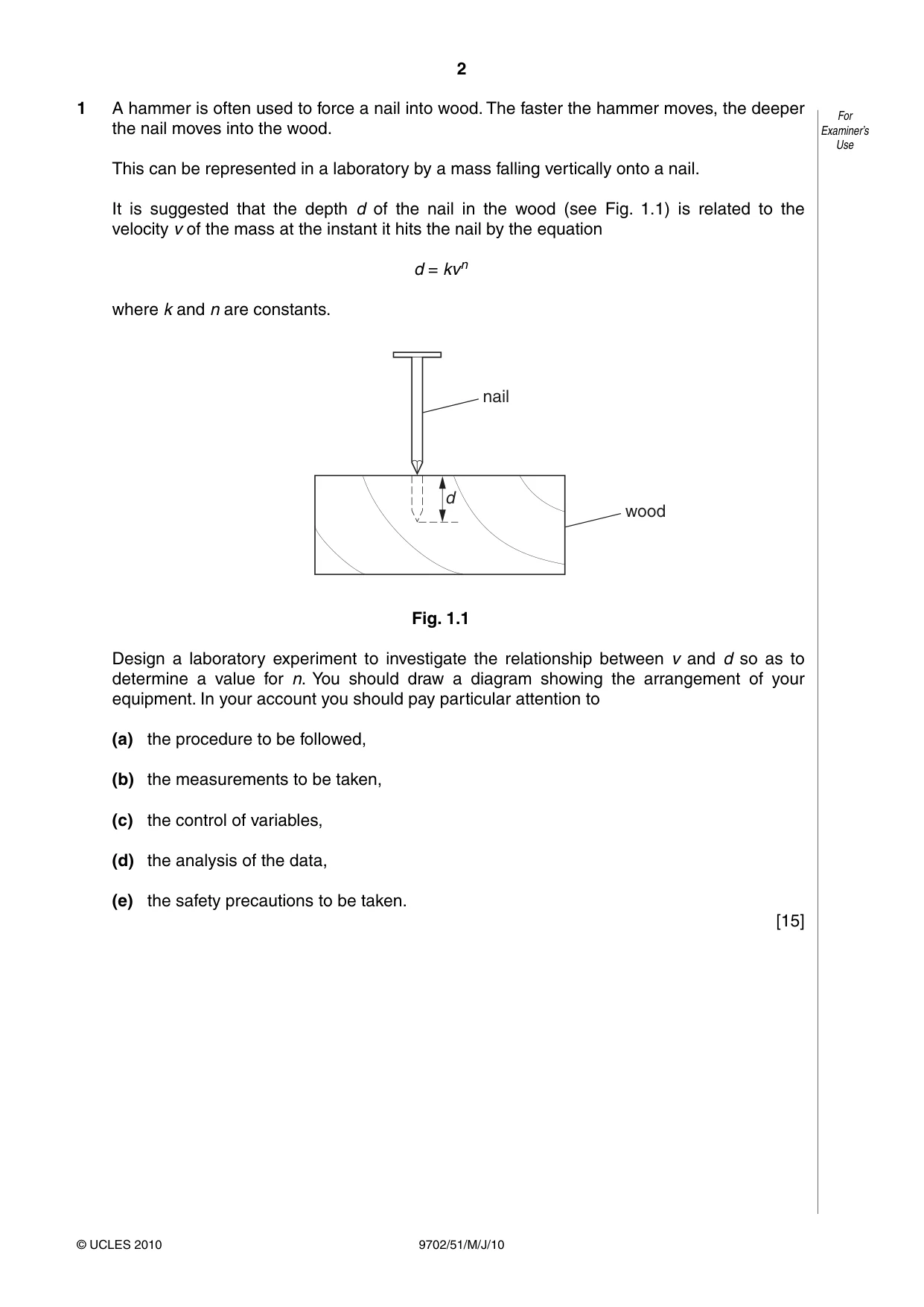
1 A hammer is often used to force a nail into wood. The faster the hammer moves, the deeper For the nail moves into the wood. Examiner’s Use This can be represented in a laboratory by a mass falling vertically onto a nail. It is suggested that the depth d of the nail in the wood (see Fig. 1.1) is related to the velocity v of the mass at the instant it hits the nail by the equation d = kv n where k and n are constants. nail d wood Fig. 1.1 Design a laboratory experiment to investigate the relationship between v and d so as to determine a value for n. You should draw a diagram showing the arrangement of your equipment. In your account you should pay particular attention to (a) the procedure to be followed, (b) the measurements to be taken, (c) the control of variables, (d) the analysis of the data, (e) the safety precautions to be taken. [15] Diagram For Examiner’s Use ......................................................................................................................................................... ......................................................................................................................................................... ......................................................................................................................................................... ......................................................................................................................................................... ......................................................................................................................................................... ......................................................................................................................................................... ......................................................................................................................................................... ......................................................................................................................................................... ......................................................................................................................................................... ......................................................................................................................................................... ......................................................................................................................................................... ......................................................................................................................................................... ......................................................................................................................................................... ......................................................................................................................................................... For ......................................................................................................................................................... Examiner’s Use ......................................................................................................................................................... ......................................................................................................................................................... ......................................................................................................................................................... ......................................................................................................................................................... ......................................................................................................................................................... ......................................................................................................................................................... ......................................................................................................................................................... ......................................................................................................................................................... ......................................................................................................................................................... ......................................................................................................................................................... ......................................................................................................................................................... ......................................................................................................................................................... ......................................................................................................................................................... ......................................................................................................................................................... ......................................................................................................................................................... ......................................................................................................................................................... ......................................................................................................................................................... ......................................................................................................................................................... ......................................................................................................................................................... ......................................................................................................................................................... ......................................................................................................................................................... ......................................................................................................................................................... ......................................................................................................................................................... Defining the Methods of Method of Safety Additional For problem data collection analysis considerations detail Examiner’s Use
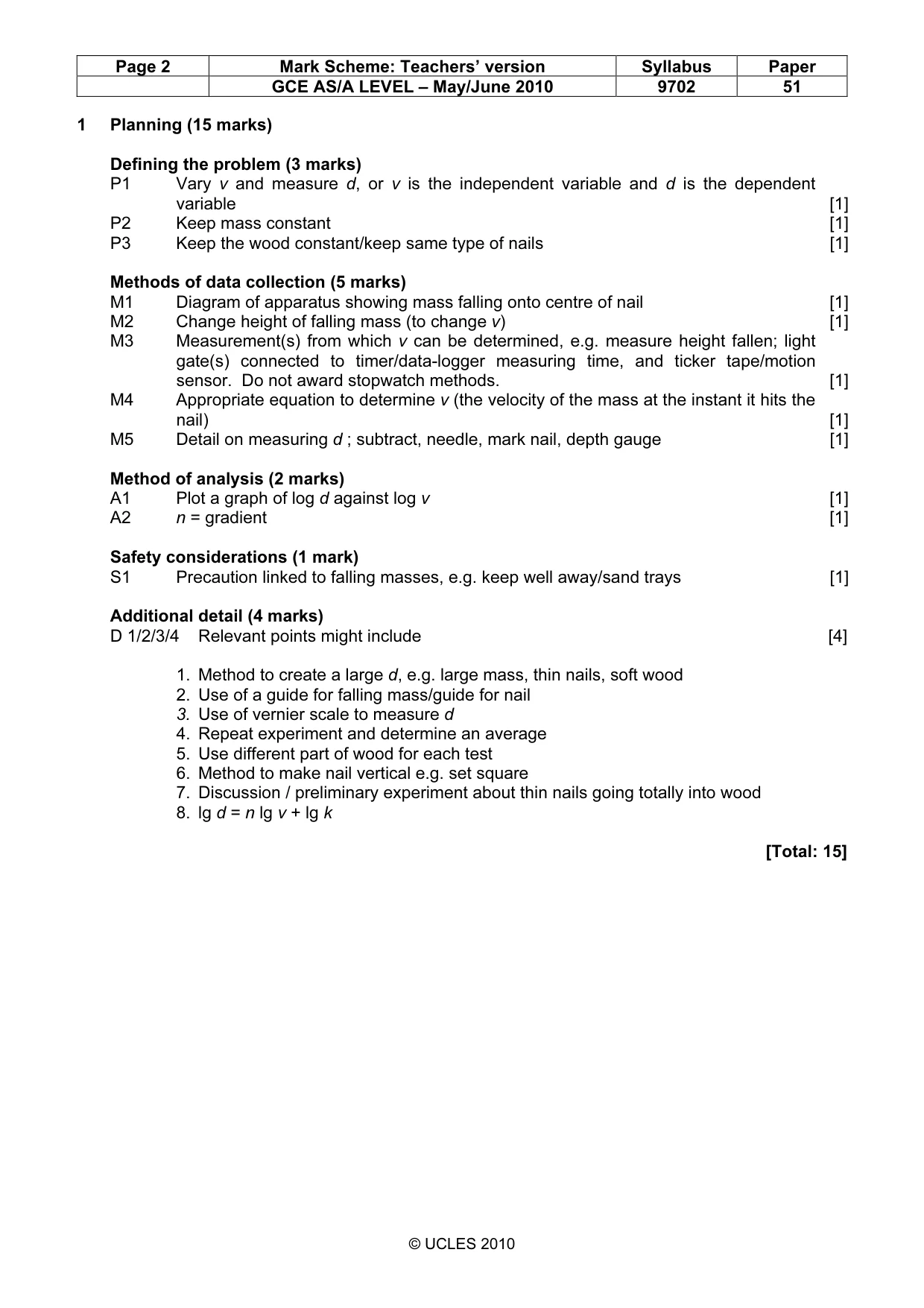
Mark scheme: 1 Planning (15 marks) Defining the problem (3 marks) P1 Vary v and measure d, or v is the independent variable and d is the dependent variable [1] P2 Keep mass constant [1] P3 Keep the wood constant/keep same type of nails [1] Methods of data collection (5 marks) M1 Diagram of apparatus showing mass falling onto centre of nail [1] M2 Change height of falling mass (to change v) [1] M3 Measurement(s) from which v can be determined, e.g. measure height fallen; light gate(s) connected to timer/data-logger measuring time, and ticker tape/motion sensor. Do not award stopwatch methods. [1] M4 Appropriate equation to determine v (the velocity of the mass at the instant it hits the nail) [1] M5 Detail on measuring d ; subtract, needle, mark nail, depth gauge [1] Method of analysis (2 marks) A1 Plot a graph of log d against log v [1] A2 n = gradient [1] Safety considerations (1 mark) S1 Precaution linked to falling masses, e.g. keep well away/sand trays [1] Additional detail (4 marks) D 1/2/3/4 Relevant points might include [4] 1. Method to create a large d, e.g. large mass, thin nails, soft wood 2. Use of a guide for falling mass/guide for nail 3. Use of vernier scale to measure d 4. Repeat experiment and determine an average 5. Use different part of wood for each test 6. Method to make nail vertical e.g. set square 7. Discussion / preliminary experiment about thin nails going totally into wood 8. lg d = n lg v + lg k [Total: 15] GCE AS/A LEVEL – May/June 2010 9702 51
Q2 · The reactance Xc of a capacitor is defined as For Examiner’s = V0 Xc Use I0 where V0 is…
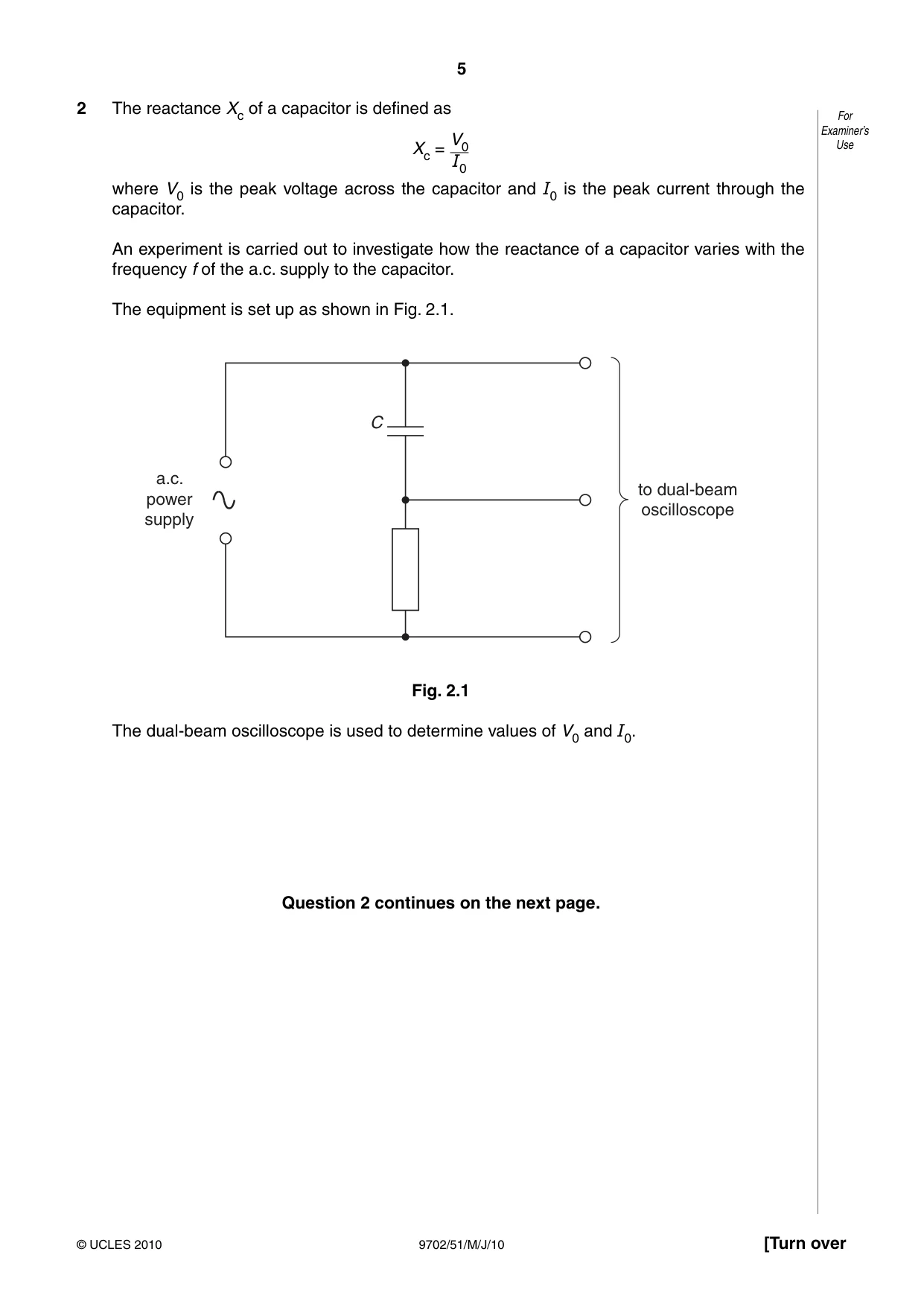
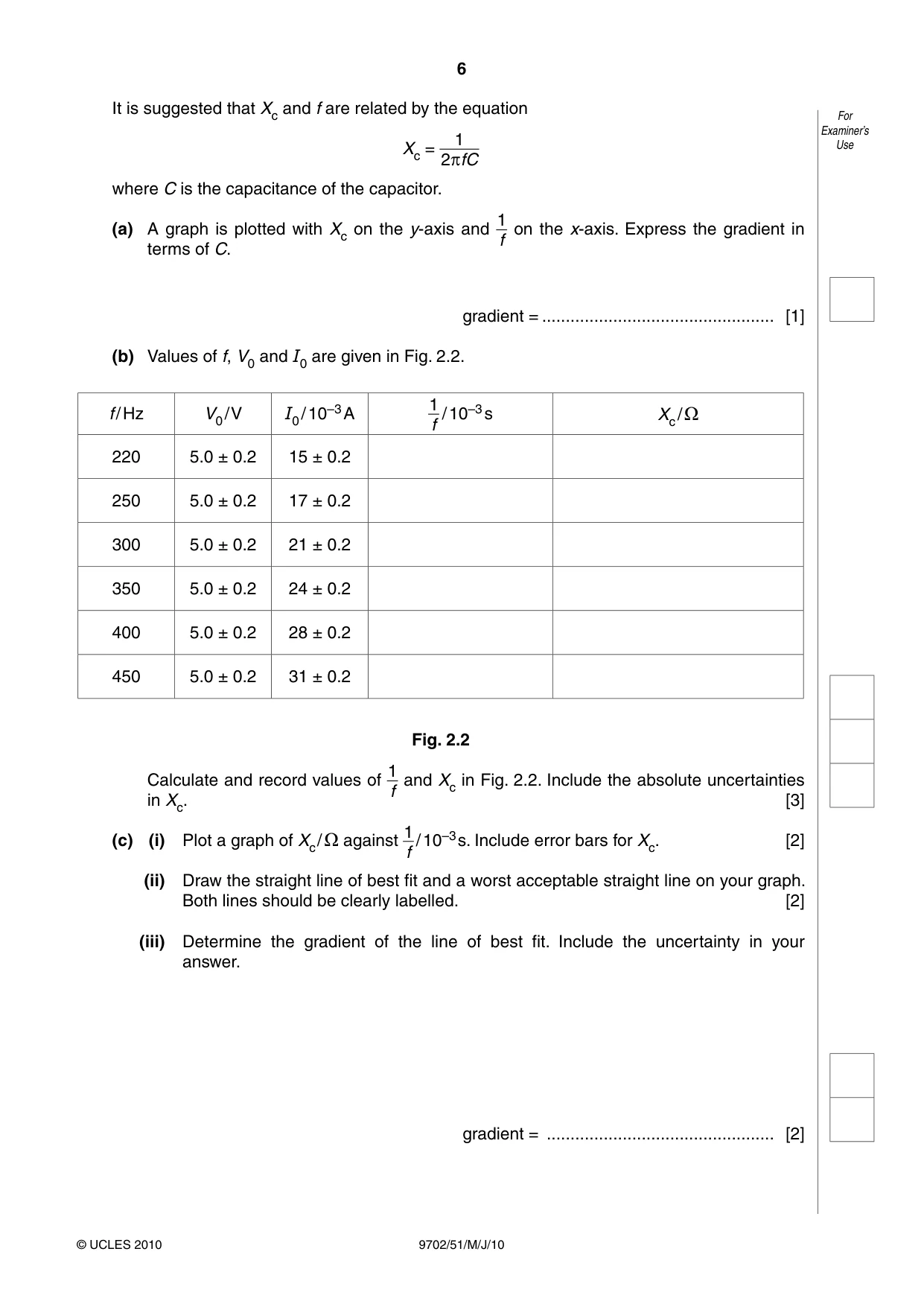
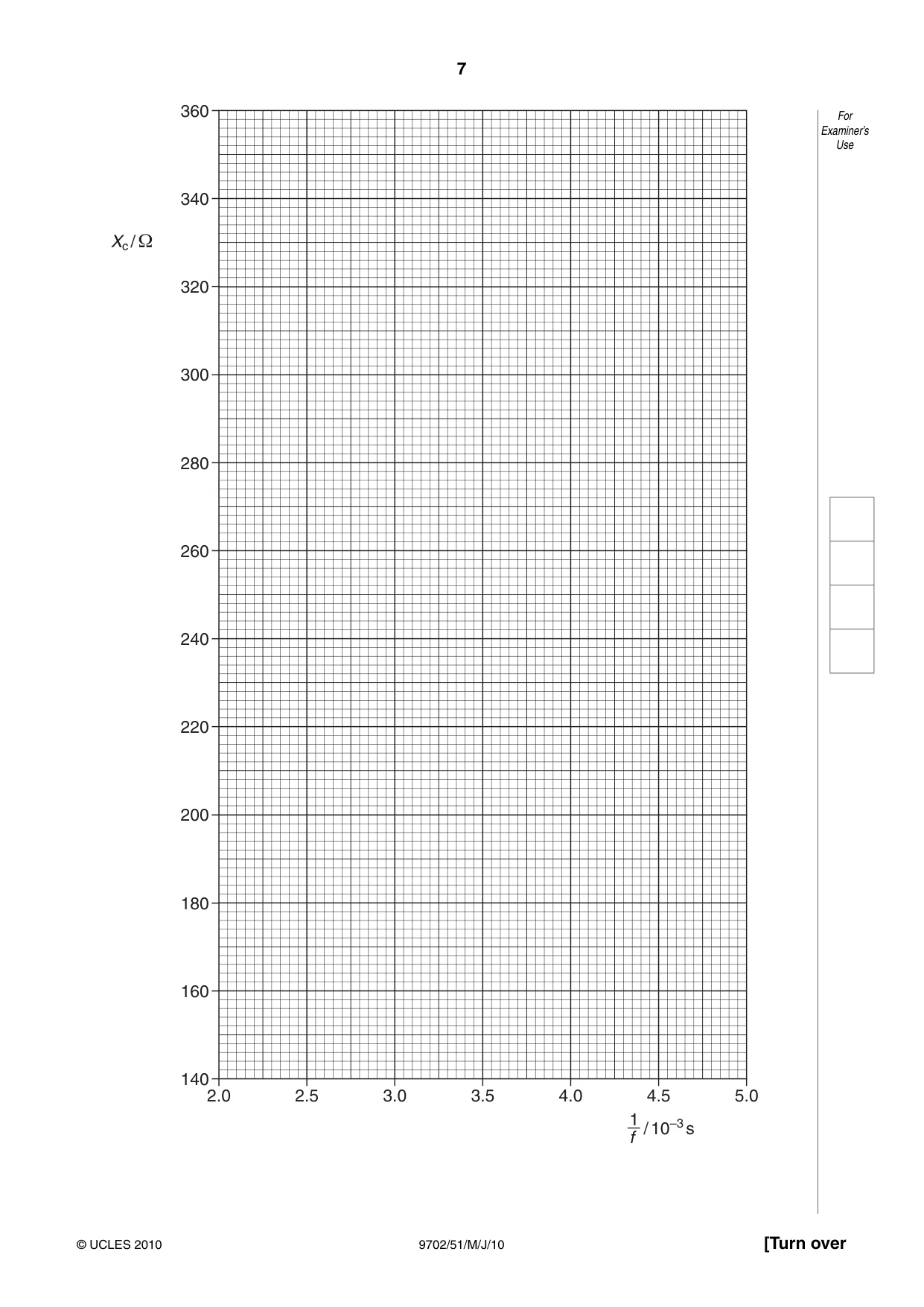
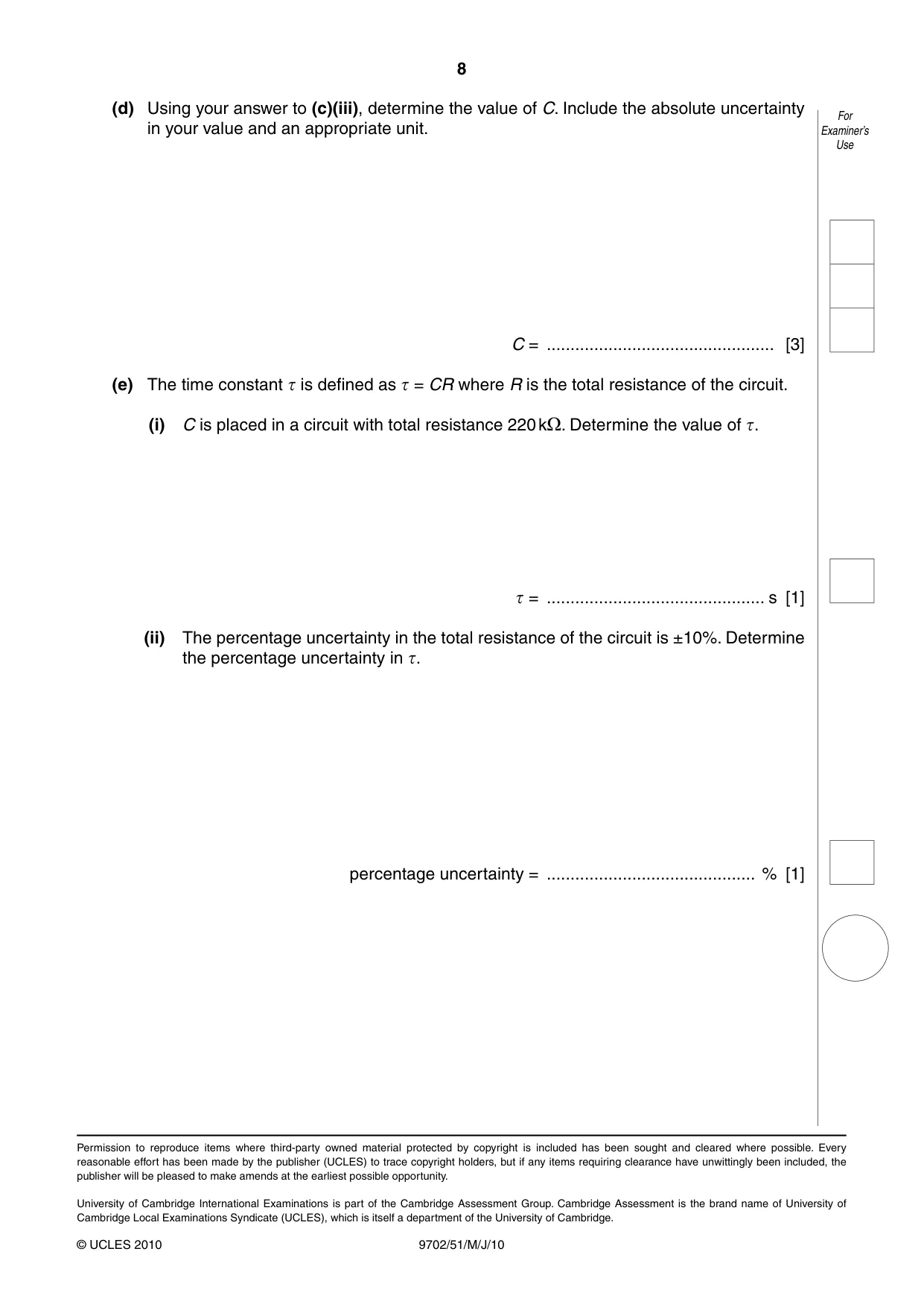
2 The reactance Xc of a capacitor is defined as For Examiner’s = V0 Xc Use I0 where V0 is the peak voltage across the capacitor and I0 is the peak current through the capacitor. An experiment is carried out to investigate how the reactance of a capacitor varies with the frequency f of the a.c. supply to the capacitor. The equipment is set up as shown in Fig. 2.1. C a.c. to dual-beam power oscilloscope supply Fig. 2.1 The dual-beam oscilloscope is used to determine values of V0 and I0. Question 2 continues on the next page. It is suggested that Xc and f are related by the equation For Examiner’s 1 Use Xc = 2 fC where C is the capacitance of the capacitor. 1 (a) A graph is plotted with Xc on the y-axis and on the x-axis. Express the gradient in f terms of C. gradient = ................................................. [1] (b) Values of f, V0 and I0 are given in Fig. 2.2. 1 f / Hz V0 / V I0 / 10–3 A / 10–3 s Xc / f 220 5.0 ± 0.2 15 ± 0.2 250 5.0 ± 0.2 17 ± 0.2 300 5.0 ± 0.2 21 ± 0.2 350 5.0 ± 0.2 24 ± 0.2 400 5.0 ± 0.2 28 ± 0.2 450 5.0 ± 0.2 31 ± 0.2 Fig. 2.2 1 Calculate and record values of and Xc in Fig. 2.2. Include the absolute uncertainties f in Xc. [3] 1 (c) (i) Plot a graph of Xc / against / 10–3 s. Include error bars for Xc. [2] f (ii) Draw the straight line of best fit and a worst acceptable straight line on your graph. Both lines should be clearly labelled. [2] (iii) Determine the gradient of the line of best fit. Include the uncertainty in your answer. gradient = ................................................ [2] 360 For Examiner’s Use 340 Xc / Ω 320 300 280 260 240 220 200 180 160 140 2.0 2.5 3.0 3.5 4.0 4.5 5.0 1 / 10–3 s f
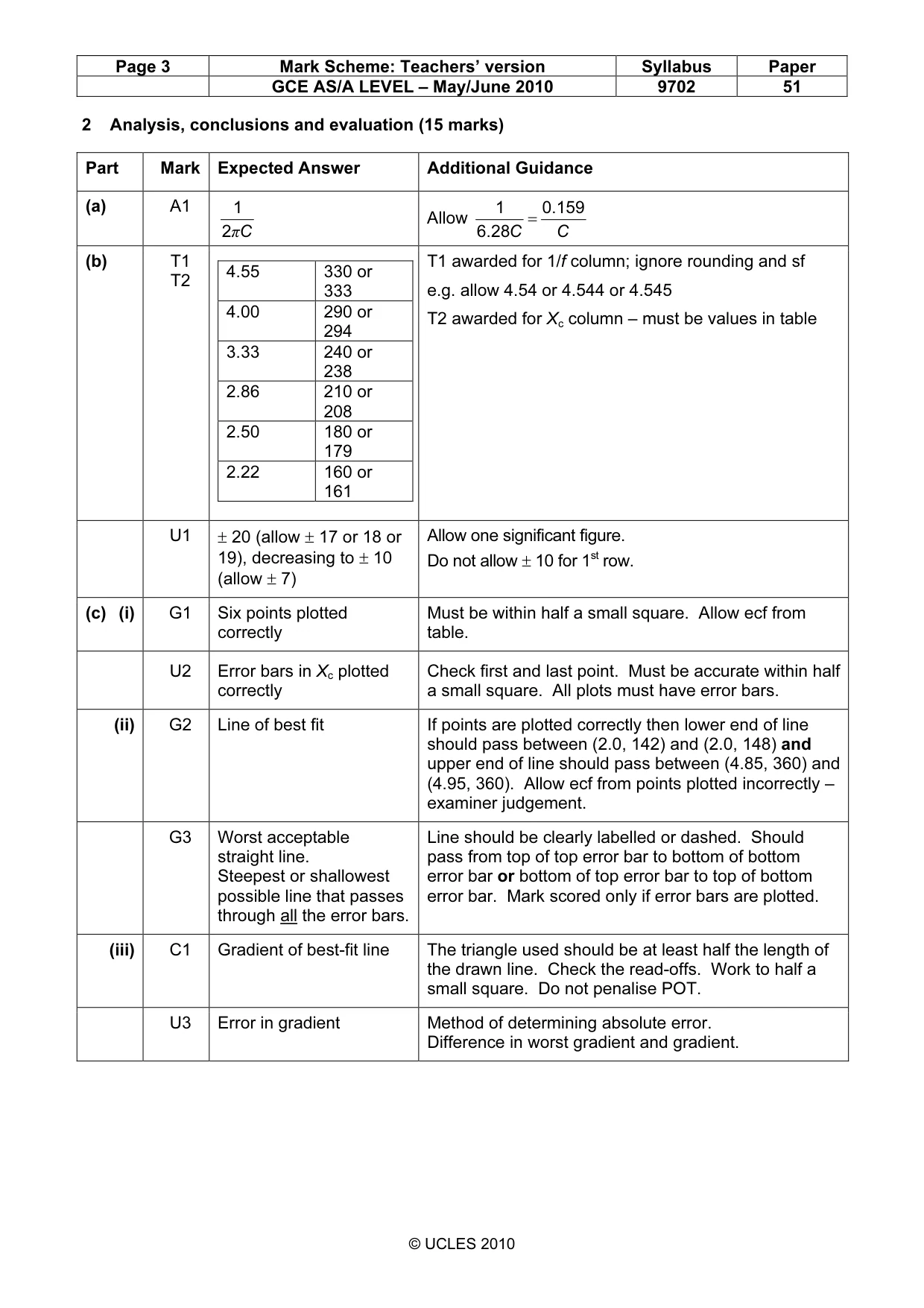
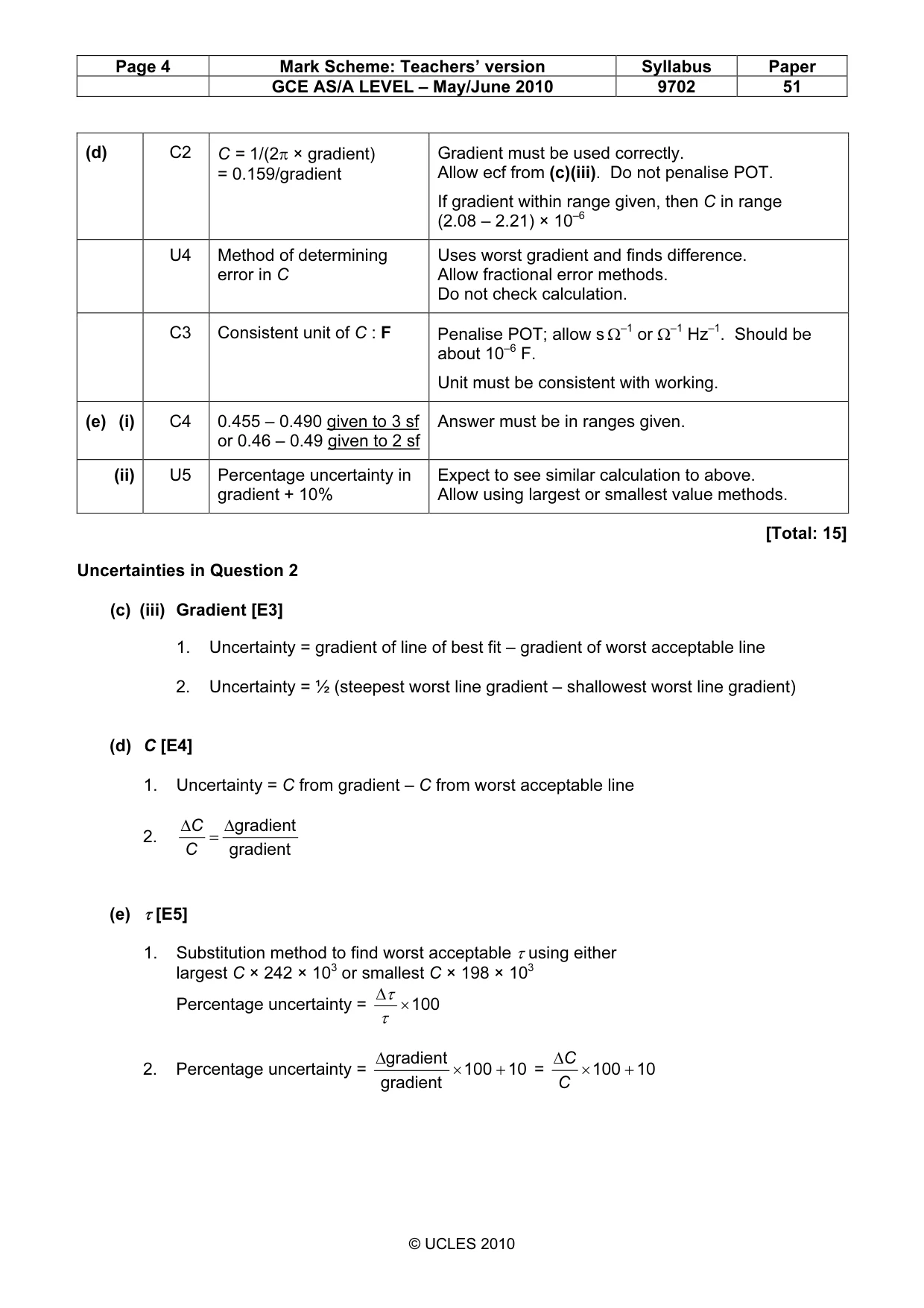
Mark scheme: 2 Analysis, conclusions and evaluation (15 marks) Part Mark Expected Answer Additional Guidance (a) A1 1 1 0.159 Allow = 2πC 6.28C C (b) T1 T1 awarded for 1/f column; ignore rounding and sf 4.55 330 or T2 333 e.g. allow 4.54 or 4.544 or 4.545 4.00 290 or T2 awarded for Xc column – must be values in table 294 3.33 240 or 238 2.86 210 or 208 2.50 180 or 179 2.22 160 or 161 U1 ± 20 (allow ± 17 or 18 or Allow one significant figure. 19), decreasing to ± 10 Do not allow ± 10 for 1st row. (allow ± 7) (c) (i) G1 Six points plotted Must be within half a small square. Allow ecf from correctly table. U2 Error bars in Xc plotted Check first and last point. Must be accurate within half correctly a small square. All plots must have error bars. (ii) G2 Line of best fit If points are plotted correctly then lower end of line should pass between (2.0, 142) and (2.0, 148) and upper end of line should pass between (4.85, 360) and (4.95, 360). Allow ecf from points plotted incorrectly – examiner judgement. G3 Worst acceptable Line should be clearly labelled or dashed. Should straight line. pass from top of top error bar to bottom of bottom Steepest or shallowest error bar or bottom of top error bar to top of bottom possible line that passes error bar. Mark scored only if error bars are plotted. through all the error bars. (iii) C1 Gradient of best-fit line The triangle used should be at least half the length of the drawn line. Check the read-offs. Work to half a small square. Do not penalise POT. U3 Error in gradient Method of determining absolute error. Difference in worst gradient and gradient. GCE AS/A LEVEL – May/June 2010 9702 51 (d) C2 C = 1/(2π × gradient) Gradient must be used correctly. = 0.159/gradient Allow ecf from (c)(iii). Do not penalise POT. If gradient within range given, then C in range (2.08 – 2.21) × 10–6 U4 Method of determining Uses worst gradient and finds difference. error in C Allow fractional error methods. Do not check calculation. C3 Consistent unit of C : F Penalise POT; allow s Ω–1 or Ω–1 Hz–1. Should be about 10–6 F. Unit must be consistent with working. (e) (i) C4 0.455 – 0.490 given to 3 sf Answer must be in ranges given. or 0.46 – 0.49 given to 2 sf (ii) U5 Percentage uncertainty in Expect to see similar calculation to above. gradient + 10% Allow using largest or smallest value methods. [Total: 15] Uncertainties in Question 2 (c) (iii) Gradient [E3] 1. Uncertainty = gradient of line of best fit – gradient of worst acceptable line 2. Uncertainty = ½ (steepest worst line gradient – shallowest worst line gradient) (d) C [E4] 1. Uncertainty = C from gradient – C from worst acceptable line ∆C ∆gradient 2. = C gradient (e) τ [E5] 1. Substitution method to find worst acceptable τ using either largest C × 242 × 103 or smallest C × 198 × 103 ∆τ Percentage uncertainty = × 100 τ ∆gradient ∆C 2. Percentage uncertainty = × 100 + 10 = × 100 + 10 gradient C
What was in this paper
The subtopics covered by these 2 questions, and how many questions each got. Open one in a new tab to see every Cambridge question on it.
What you needed in this session
Cambridge’s own grade thresholds for 2010 May/June, Paper 5 · Variant 1. A higher threshold means an easier paper — the bar moves with how the cohort did.