Cambridge A Level Physics 9702 — 2008 May/June Paper 5 · Variant 1
9702/51/M/J/08 · 2 questions · 30 marks · ≈34 min
The question paper and its mark scheme, free to read here and free to download. This is Cambridge’s own paper, exactly as it was sat.
Question paper8 pages

Mark scheme3 pages
Answers below. Sit the paper first if you are practising.
Questions as text
Q1 · A student wishes to measure the resistivity of glass
1 A student wishes to measure the resistivity of glass. A teacher suggests that its resistivity is For of the order of 106 Ω m which is very large. Examiner’s Use Resistivity ρ is defined by the equation RA ρ = l where R is resistance, A is cross-sectional area and l is the length of the material. The student is given a number of sheets of glass of the same thickness and of different areas. Design a laboratory experiment to determine the resistivity of glass. You should draw a diagram showing the arrangement of your equipment. In your account you should pay particular attention to (a) the procedure to be followed, (b) how the glass would be connected to the circuit, (c) the measurements that would be taken, (d) the control of variables, (e) how the data would be analysed, (f) any safety precautions that you would take. [15] Diagram For Examiner’s Use ......................................................................................................................................................... ......................................................................................................................................................... ......................................................................................................................................................... ......................................................................................................................................................... ......................................................................................................................................................... ......................................................................................................................................................... ......................................................................................................................................................... ......................................................................................................................................................... ......................................................................................................................................................... ......................................................................................................................................................... ......................................................................................................................................................... ......................................................................................................................................................... ......................................................................................................................................................... ......................................................................................................................................................... ......................................................................................................................................................... For ......................................................................................................................................................... Examiner’s Use ......................................................................................................................................................... ......................................................................................................................................................... ......................................................................................................................................................... ......................................................................................................................................................... ......................................................................................................................................................... ......................................................................................................................................................... ......................................................................................................................................................... ......................................................................................................................................................... ......................................................................................................................................................... ......................................................................................................................................................... ......................................................................................................................................................... ......................................................................................................................................................... ......................................................................................................................................................... ......................................................................................................................................................... ......................................................................................................................................................... ......................................................................................................................................................... ......................................................................................................................................................... ......................................................................................................................................................... ......................................................................................................................................................... ......................................................................................................................................................... ......................................................................................................................................................... ......................................................................................................................................................... ......................................................................................................................................................... ......................................................................................................................................................... ......................................................................................................................................................... ......................................................................................................................................................... .........................................................................................................................................................
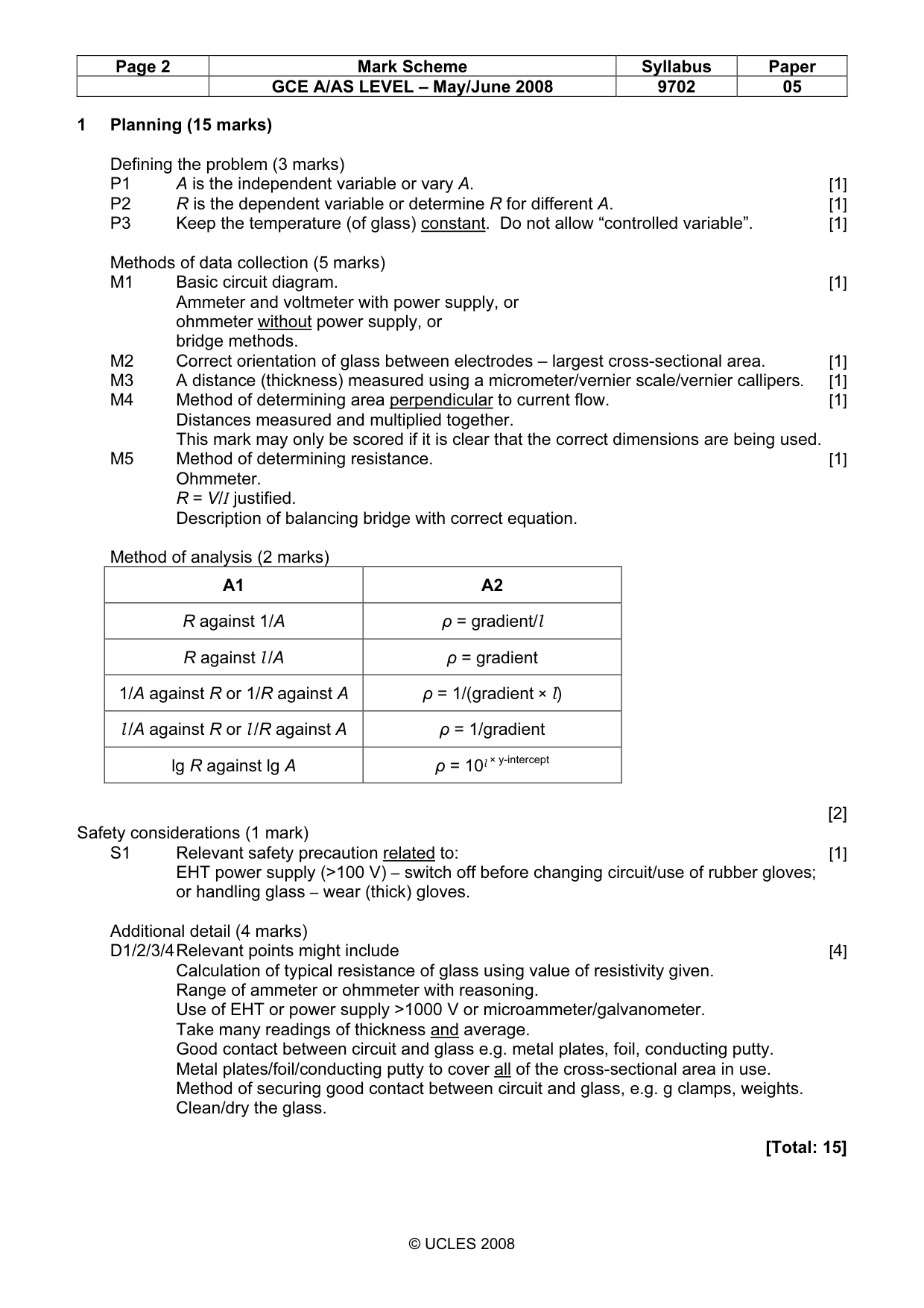
Mark scheme: 1 Planning (15 marks) Defining the problem (3 marks) P1 A is the independent variable or vary A. [1] P2 R is the dependent variable or determine R for different A. [1] P3 Keep the temperature (of glass) constant. Do not allow “controlled variable”. [1] Methods of data collection (5 marks) M1 Basic circuit diagram. [1] Ammeter and voltmeter with power supply, or ohmmeter without power supply, or bridge methods. M2 Correct orientation of glass between electrodes – largest cross-sectional area. [1] M3 A distance (thickness) measured using a micrometer/vernier scale/vernier callipers. [1] M4 Method of determining area perpendicular to current flow. [1] Distances measured and multiplied together. This mark may only be scored if it is clear that the correct dimensions are being used. M5 Method of determining resistance. [1] Ohmmeter. R = V/I justified. Description of balancing bridge with correct equation. Method of analysis (2 marks) A1 A2 R against 1/A ρ = gradient/l R against l /A ρ = gradient 1/A against R or 1/R against A ρ = 1/(gradient × l) l /A against R or l /R against A ρ = 1/gradient lg R against lg A ρ = 10l × y-intercept [2] Safety considerations (1 mark) S1 Relevant safety precaution related to: [1] EHT power supply (>100 V) – switch off before changing circuit/use of rubber gloves; or handling glass – wear (thick) gloves. Additional detail (4 marks) D1/2/3/4 Relevant points might include [4] Calculation of typical resistance of glass using value of resistivity given. Range of ammeter or ohmmeter with reasoning. Use of EHT or power supply >1000 V or microammeter/galvanometer. Take many readings of thickness and average. Good contact between circuit and glass e.g. metal plates, foil, conducting putty. Metal plates/foil/conducting putty to cover all of the cross-sectional area in use. Method of securing good contact between circuit and glass, e.g. g clamps, weights. Clean/dry the glass. [Total: 15] GCE A/AS LEVEL – May/June 2008 9702 05
Q2 · A radioactive source was placed facing a Geiger-Müller tube
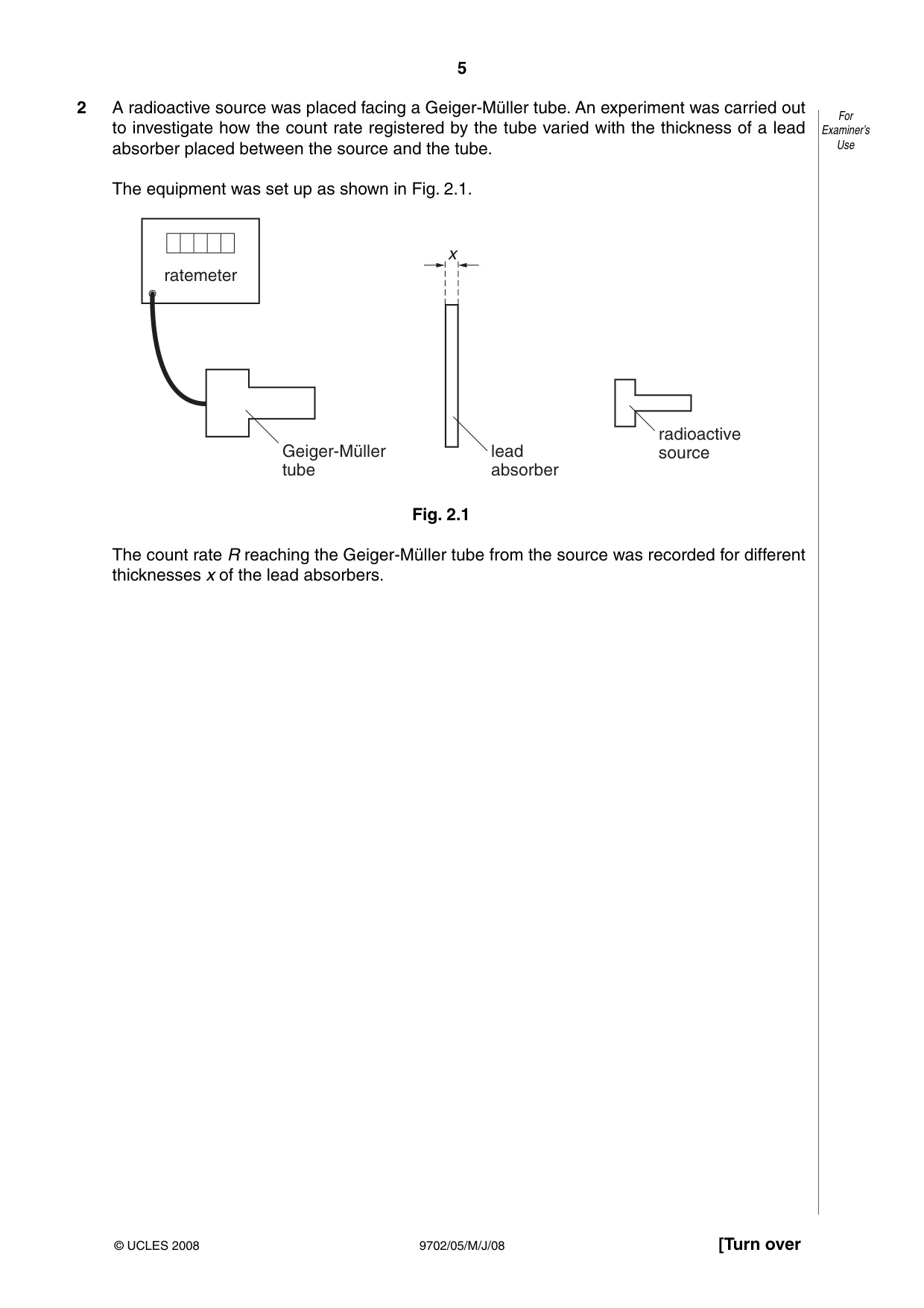
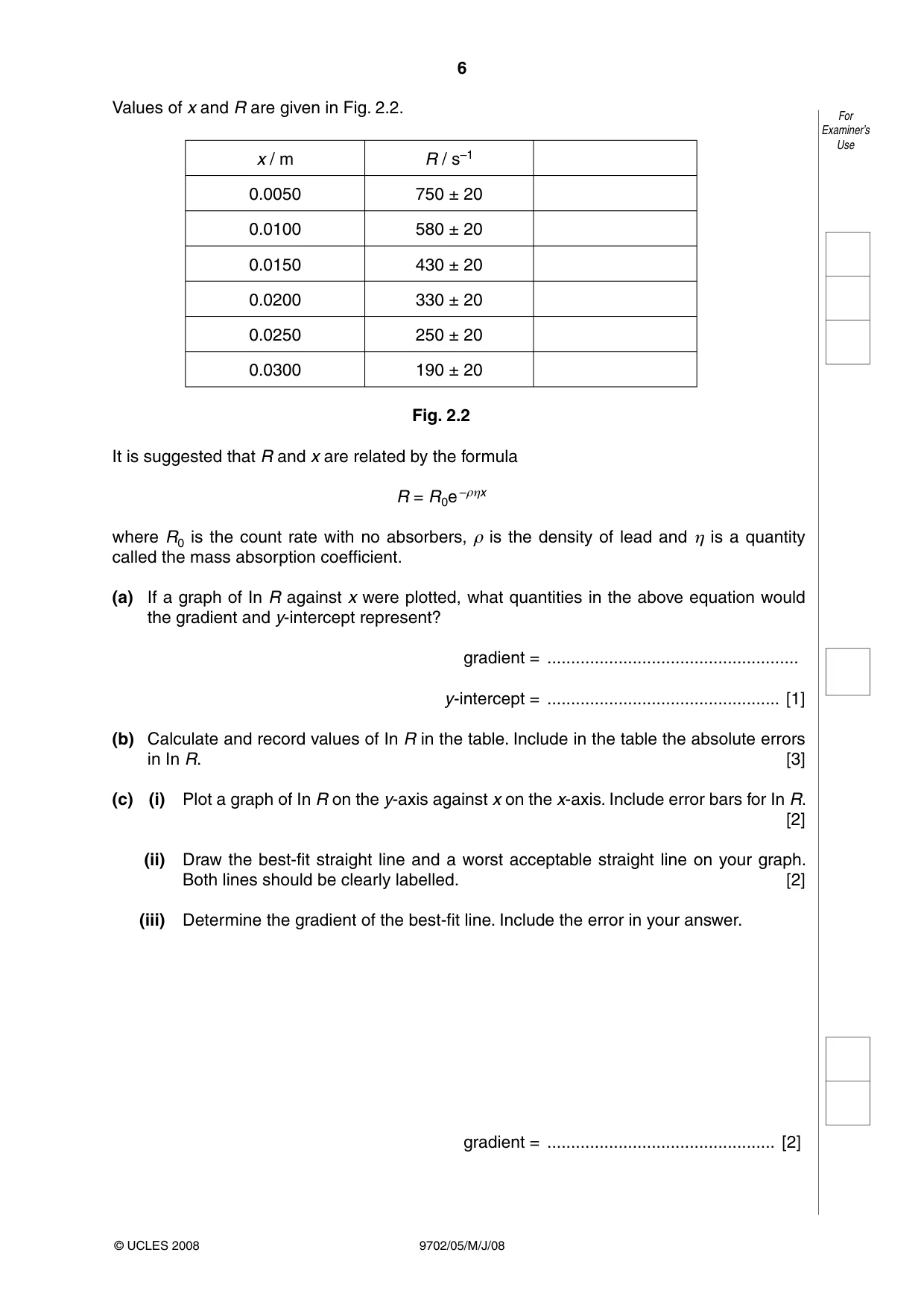
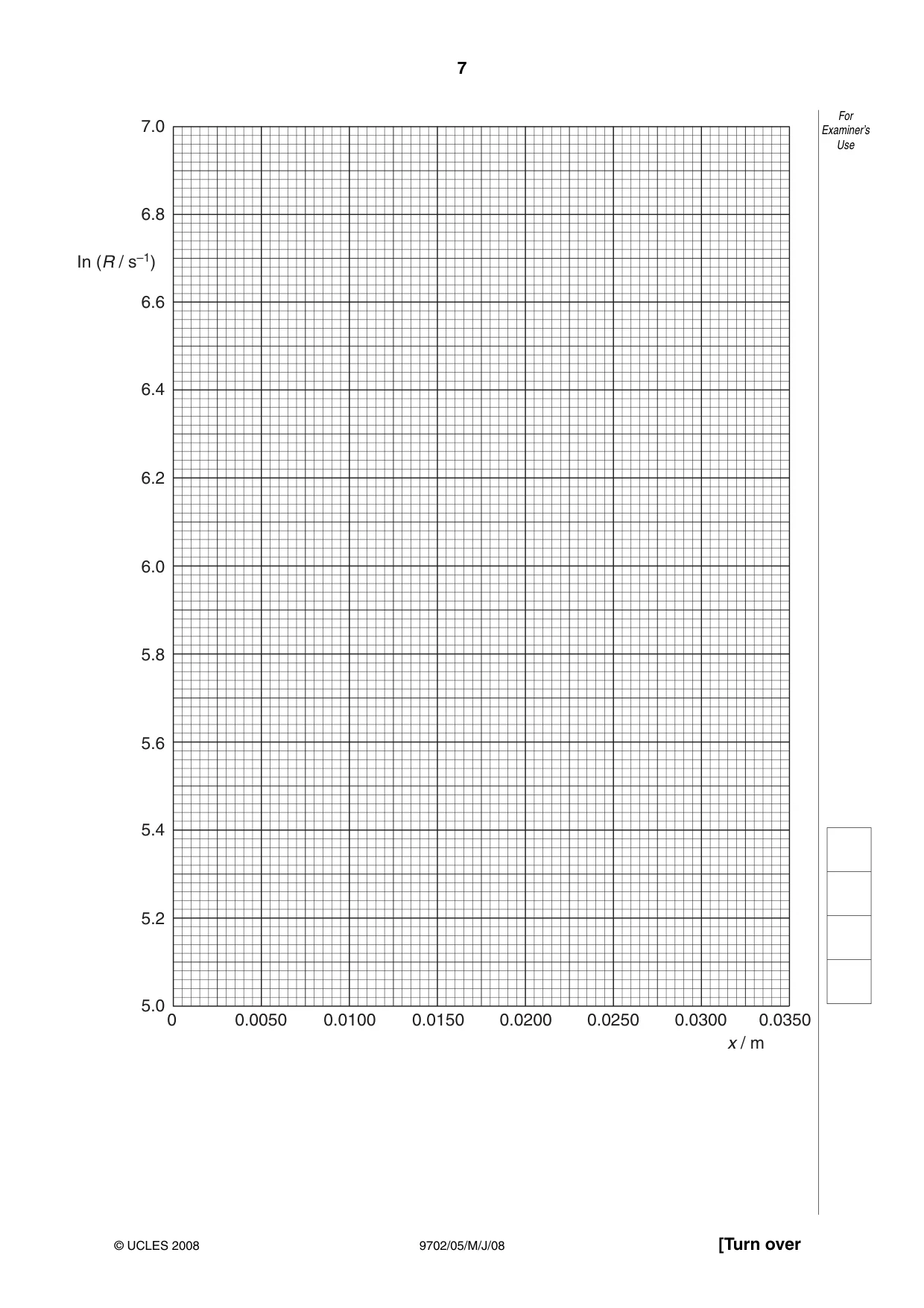
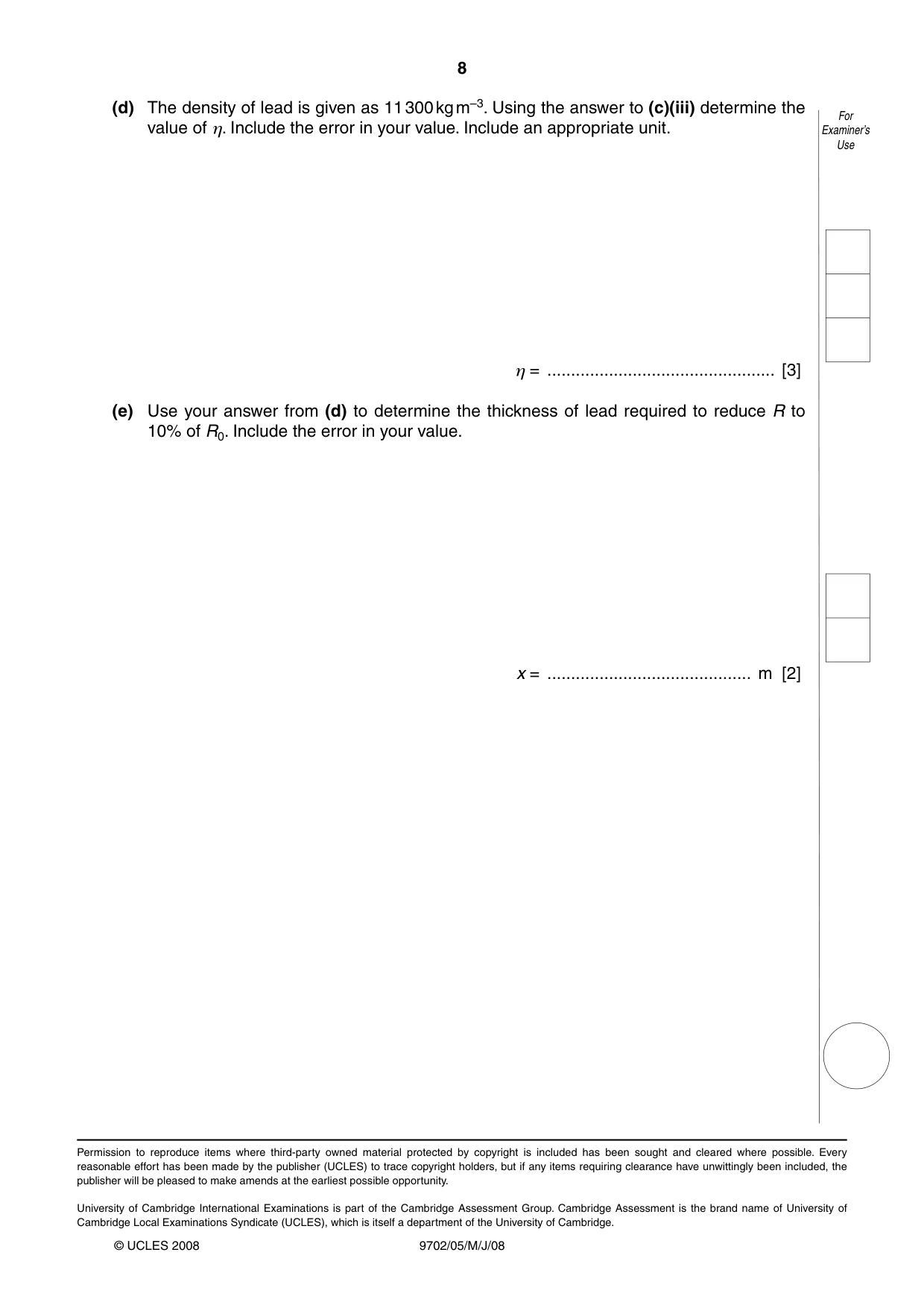
2 A radioactive source was placed facing a Geiger-Müller tube. An experiment was carried out For to investigate how the count rate registered by the tube varied with the thickness of a lead Examiner’s absorber placed between the source and the tube. Use The equipment was set up as shown in Fig. 2.1. x ratemeter radioactive Geiger-Müller lead source tube absorber Fig. 2.1 The count rate R reaching the Geiger-Müller tube from the source was recorded for different thicknesses x of the lead absorbers. Values of x and R are given in Fig. 2.2. For Examiner’s Use x / m R / s–1 0.0050 750 ± 20 0.0100 580 ± 20 0.0150 430 ± 20 0.0200 330 ± 20 0.0250 250 ± 20 0.0300 190 ± 20 Fig. 2.2 It is suggested that R and x are related by the formula R = R 0e –ρηx where R0 is the count rate with no absorbers, ρ is the density of lead and η is a quantity called the mass absorption coefficient. (a) If a graph of In R against x were plotted, what quantities in the above equation would the gradient and y-intercept represent? gradient = ..................................................... y -intercept = ................................................. [1] (b) Calculate and record values of In R in the table. Include in the table the absolute errors in In R. [3] (c) (i) Plot a graph of In R on the y-axis against x on the x-axis. Include error bars for In R. [2] (ii) Draw the best-fit straight line and a worst acceptable straight line on your graph. Both lines should be clearly labelled. [2] (iii) Determine the gradient of the best-fit line. Include the error in your answer. gradient = ................................................ [2] For 7.0 Examiner’s Use 6.8 In (R / s–1) 6.6 6.4 6.2 6.0 5.8 5.6 5.4 5.2 5.0 0 0.0050 0.0100 0.0150 0.0200 0.0250 0.0300 0.0350 x / m
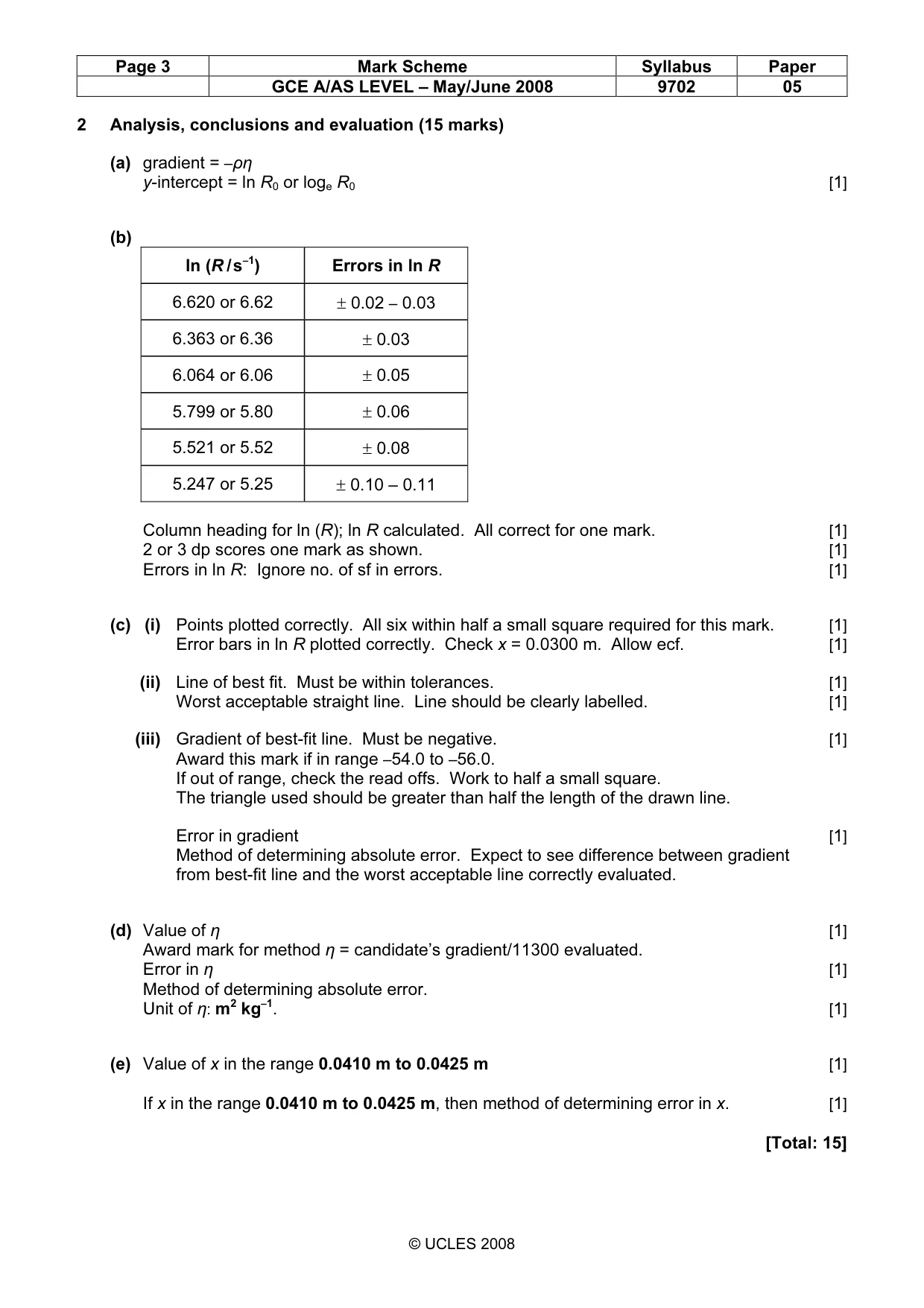
Mark scheme: 2 Analysis, conclusions and evaluation (15 marks) (a) gradient = –ρη y-intercept = ln R0 or loge R0 [1] (b) ln (R / s–1) Errors in ln R 6.620 or 6.62 ± 0.02 – 0.03 6.363 or 6.36 ± 0.03 6.064 or 6.06 ± 0.05 5.799 or 5.80 ± 0.06 5.521 or 5.52 ± 0.08 5.247 or 5.25 ± 0.10 – 0.11 Column heading for ln (R); ln R calculated. All correct for one mark. [1] 2 or 3 dp scores one mark as shown. [1] Errors in ln R: Ignore no. of sf in errors. [1] (c) (i) Points plotted correctly. All six within half a small square required for this mark. [1] Error bars in ln R plotted correctly. Check x = 0.0300 m. Allow ecf. [1] (ii) Line of best fit. Must be within tolerances. [1] Worst acceptable straight line. Line should be clearly labelled. [1] (iii) Gradient of best-fit line. Must be negative. [1] Award this mark if in range –54.0 to –56.0. If out of range, check the read offs. Work to half a small square. The triangle used should be greater than half the length of the drawn line. Error in gradient [1] Method of determining absolute error. Expect to see difference between gradient from best-fit line and the worst acceptable line correctly evaluated. (d) Value of η [1] Award mark for method η = candidate’s gradient/11300 evaluated. Error in η [1] Method of determining absolute error. Unit of η: m2 kg–1. [1] (e) Value of x in the range 0.0410 m to 0.0425 m [1] If x in the range 0.0410 m to 0.0425 m, then method of determining error in x. [1] [Total: 15]
What was in this paper
The subtopics covered by these 2 questions, and how many questions each got. Open one in a new tab to see every Cambridge question on it.
What you needed in this session
Cambridge’s own grade thresholds for 2008 May/June, Paper 5 · Variant 1. A higher threshold means an easier paper — the bar moves with how the cohort did.