Cambridge A Level Physics 9702 — 2004 Oct/Nov Paper 5 · Variant 1
9702/51/O/N/04
The question paper and its mark scheme, free to read here and free to download. This is Cambridge’s own paper, exactly as it was sat.
Question paper12 pages
Mark scheme8 pages
Answers below. Sit the paper first if you are practising.
Paper as text
Question paper, page 1
This document consists of 10 printed pages and 2 blank pages. SP (NF/GR) S60644/2 © UCLES 2004 [Turn over UNIVERSITY OF CAMBRIDGE INTERNATIONAL EXAMINATIONS General Certificate of Education Advanced Level PHYSICS 9702/05 Paper 5 Practical Test October/November 2004 1 hour 30 minutes Candidates answer on the Question Paper. Additional Materials: As specified in the Confidential Instructions. READ THESE INSTRUCTIONS FIRST Write your Centre number, candidate number and name on all the work you hand in. Write in dark blue or black pen in the spaces provided on the Question Paper. You may use a soft pencil for any diagrams, graphs or rough working. Do not use staples, paper clips, highlighters, glue or correction fluid. Answer both questions. You are expected to record all your observations as soon as they are made, and to plan the presentation of the records so that it is not necessary to make a fair copy of them. The working of the answers is to be handed in. Marks are mainly given for a clear record of the observations actually made, for their suitability and accuracy, and for the use made of them. Additional answer paper and graph paper should be submitted only if it becomes necessary to do so. You are reminded of the need for good English and clear presentation in your answers. At the end of the examination, fasten all your work securely together. Centre Number Candidate Number Name For Examiner’s Use If you have been given a label, look at the details. If any details are incorrect or missing, please fill in your correct details in the space given at the top of this page. Stick your personal label here, if provided. 1 2 Total
Question paper, page 2
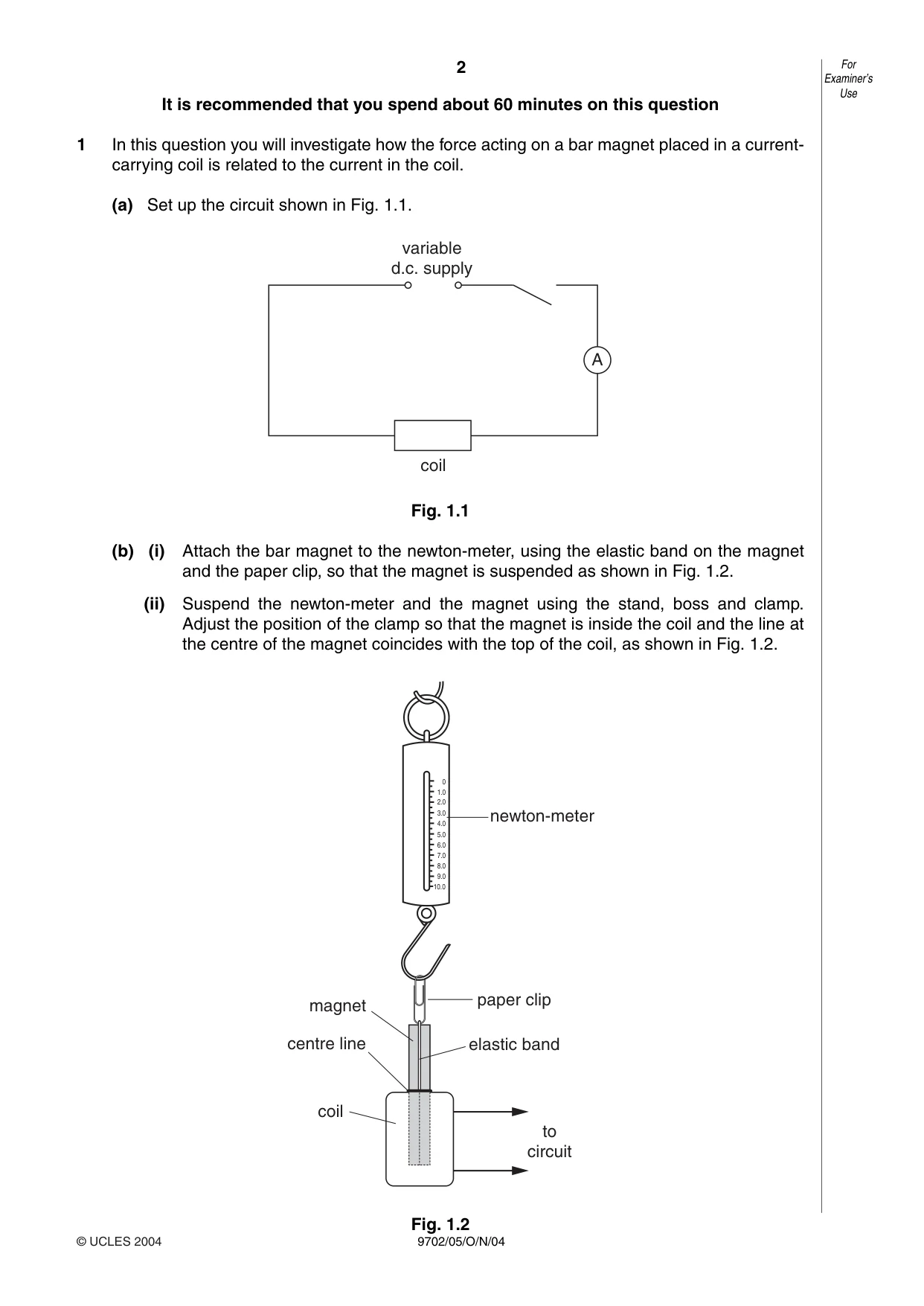
© UCLES 2004 2 9702/05/O/N/04 For Examiner’s Use It is recommended that you spend about 60 minutes on this question 1 In this question you will investigate how the force acting on a bar magnet placed in a current- carrying coil is related to the current in the coil. (a) Set up the circuit shown in Fig. 1.1. Fig. 1.1 (b) (i) Attach the bar magnet to the newton-meter, using the elastic band on the magnet and the paper clip, so that the magnet is suspended as shown in Fig. 1.2. (ii) Suspend the newton-meter and the magnet using the stand, boss and clamp. Adjust the position of the clamp so that the magnet is inside the coil and the line at the centre of the magnet coincides with the top of the coil, as shown in Fig. 1.2. Fig. 1.2 0 1.0 2.0 3.0 4.0 5.0 6.0 7.0 8.0 9.0 10.0 newton-meter paper clip elastic band magnet centre line coil to circuit variable d.c. supply coil A
Question paper, page 3
3 9702/05/O/N/04 [Turn over (iii) Explain how you ensured that the centre of the magnet is located at the top of the coil. … … … (iv) Record the reading F from the newton-meter. F = … (c) (i) Close the switch and adjust the output of the power supply to give a value of current in the range 0 to 5 A. Ensure that the reading on the newton-meter increases. If it does not, then the connections to the coil will need to be reversed. (ii) Adjust the position of the newton-meter so that the centre line on the magnet coincides with the top of the coil. Measure and record the new reading F from the newton-meter and the current I in the coil. F = … I = … (iii) Open the switch. For Examiner’s Use © UCLES 2004
Question paper, page 4
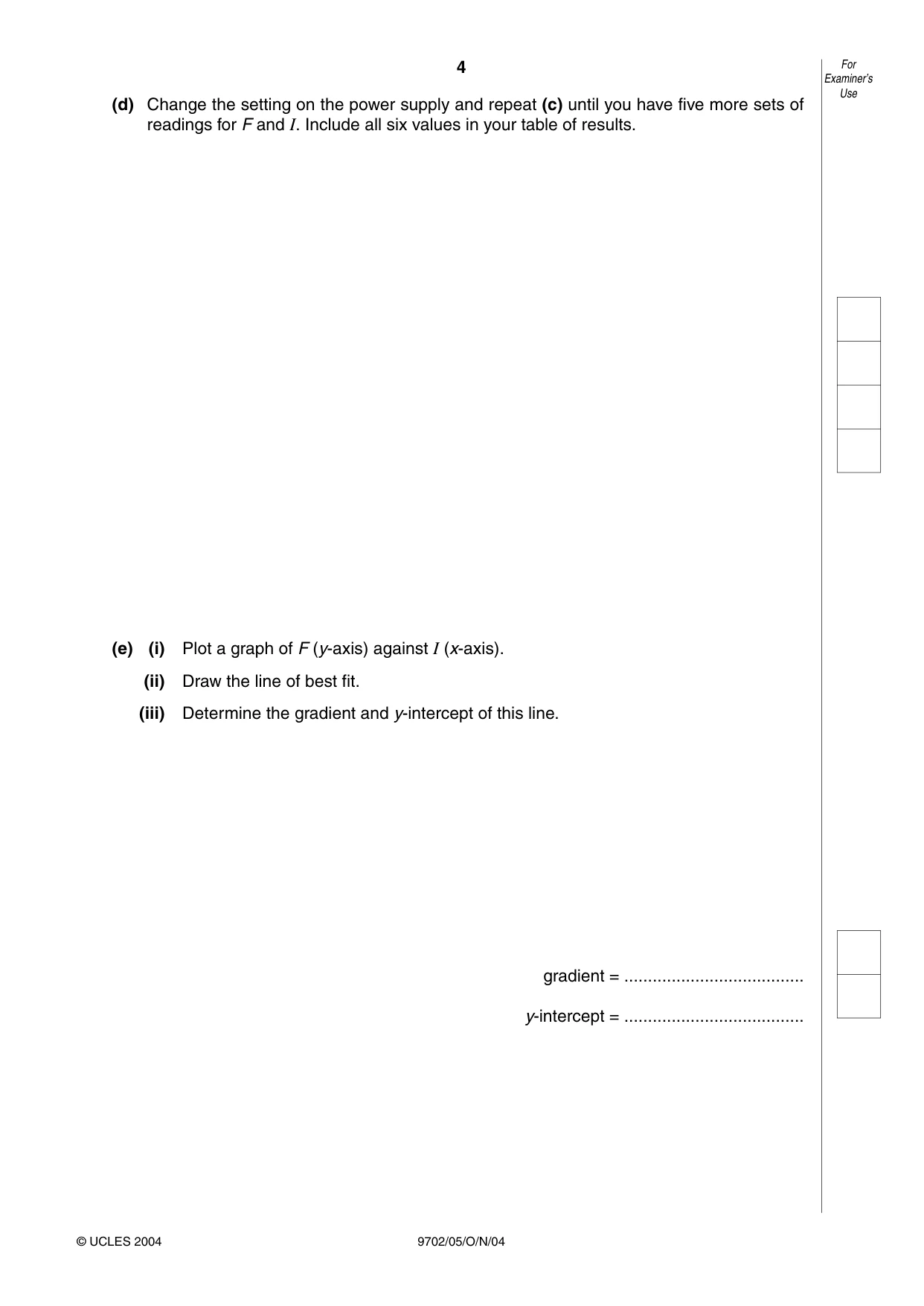
4 9702/05/O/N/04 (d) Change the setting on the power supply and repeat (c) until you have five more sets of readings for F and I. Include all six values in your table of results. (e) (i) Plot a graph of F (y-axis) against I (x-axis). (ii) Draw the line of best fit. (iii) Determine the gradient and y-intercept of this line. gradient = … y-intercept = … For Examiner’s Use © UCLES 2004
Question paper, page 5
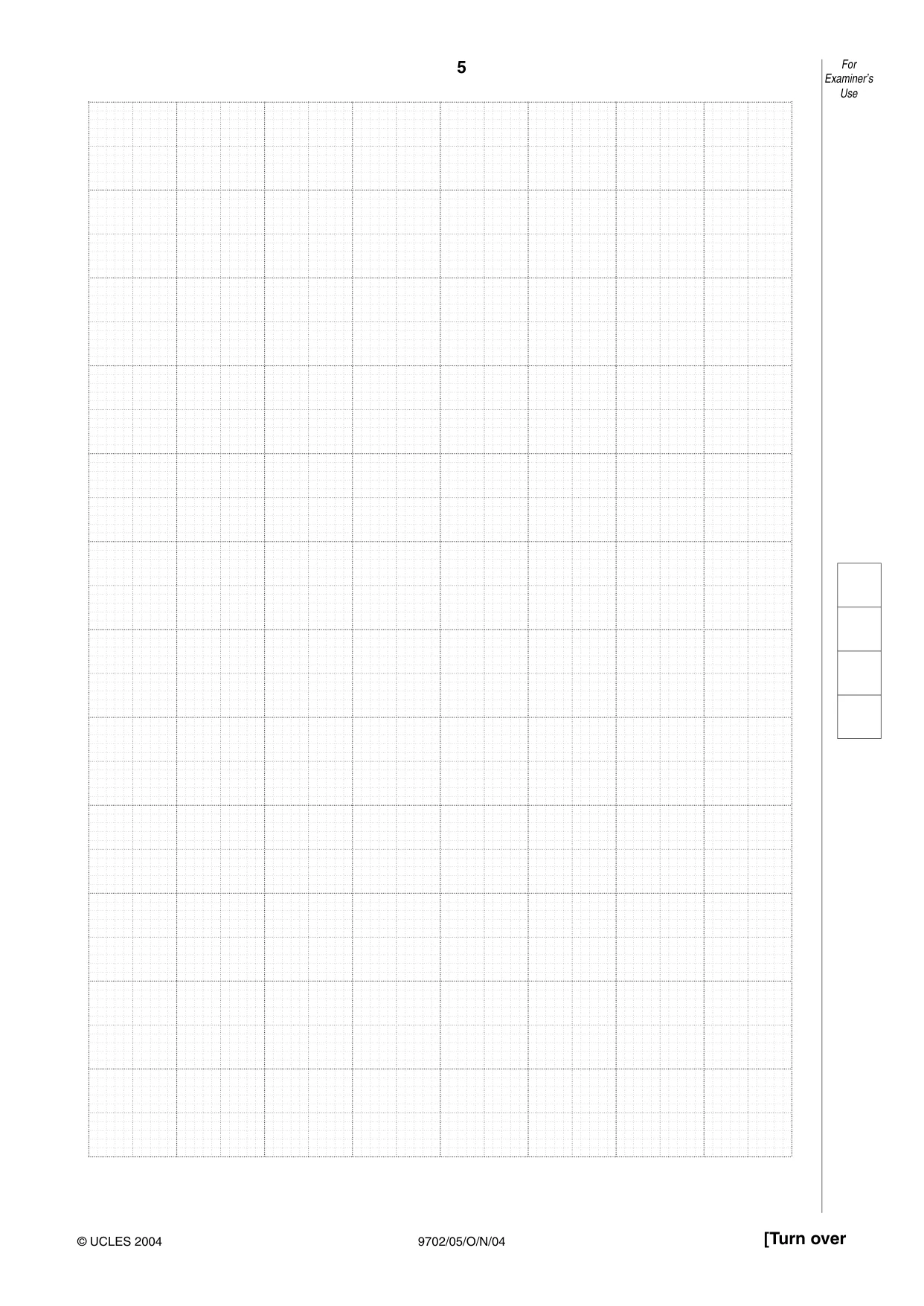
5 9702/05/O/N/04 [Turn over For Examiner’s Use © UCLES 2004
Question paper, page 6
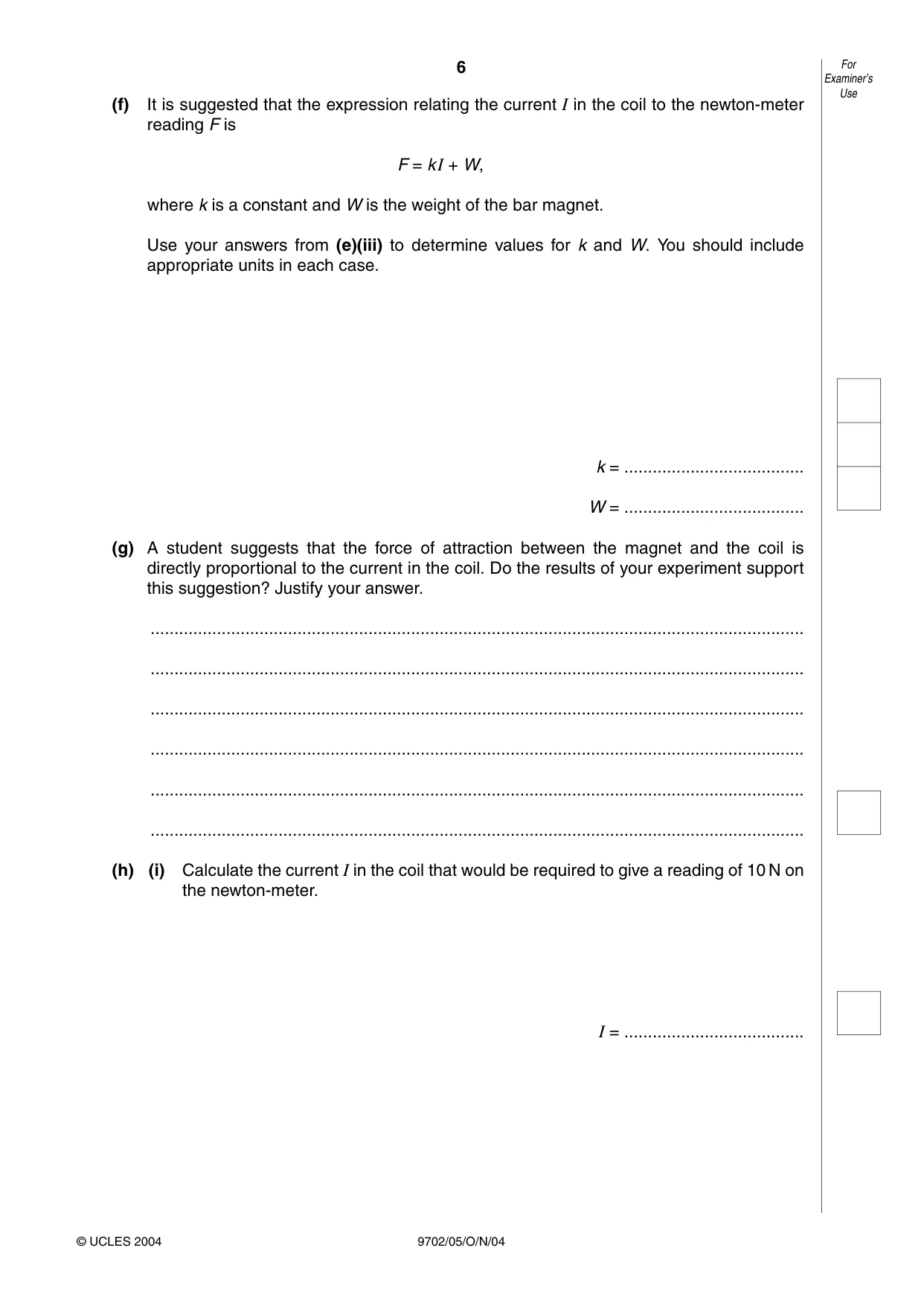
6 9702/05/O/N/04 (f) It is suggested that the expression relating the current I in the coil to the newton-meter reading F is F = kI + W, where k is a constant and W is the weight of the bar magnet. Use your answers from (e)(iii) to determine values for k and W. You should include appropriate units in each case. k = … W = … (g) A student suggests that the force of attraction between the magnet and the coil is directly proportional to the current in the coil. Do the results of your experiment support this suggestion? Justify your answer. … … … … … … (h) (i) Calculate the current I in the coil that would be required to give a reading of 10 N on the newton-meter. I = … For Examiner’s Use © UCLES 2004
Question paper, page 7
7 9702/05/O/N/04 [Turn over (ii) Explain why it would be difficult to verify this value of current experimentally. … … … … For Examiner’s Use © UCLES 2004
Question paper, page 8
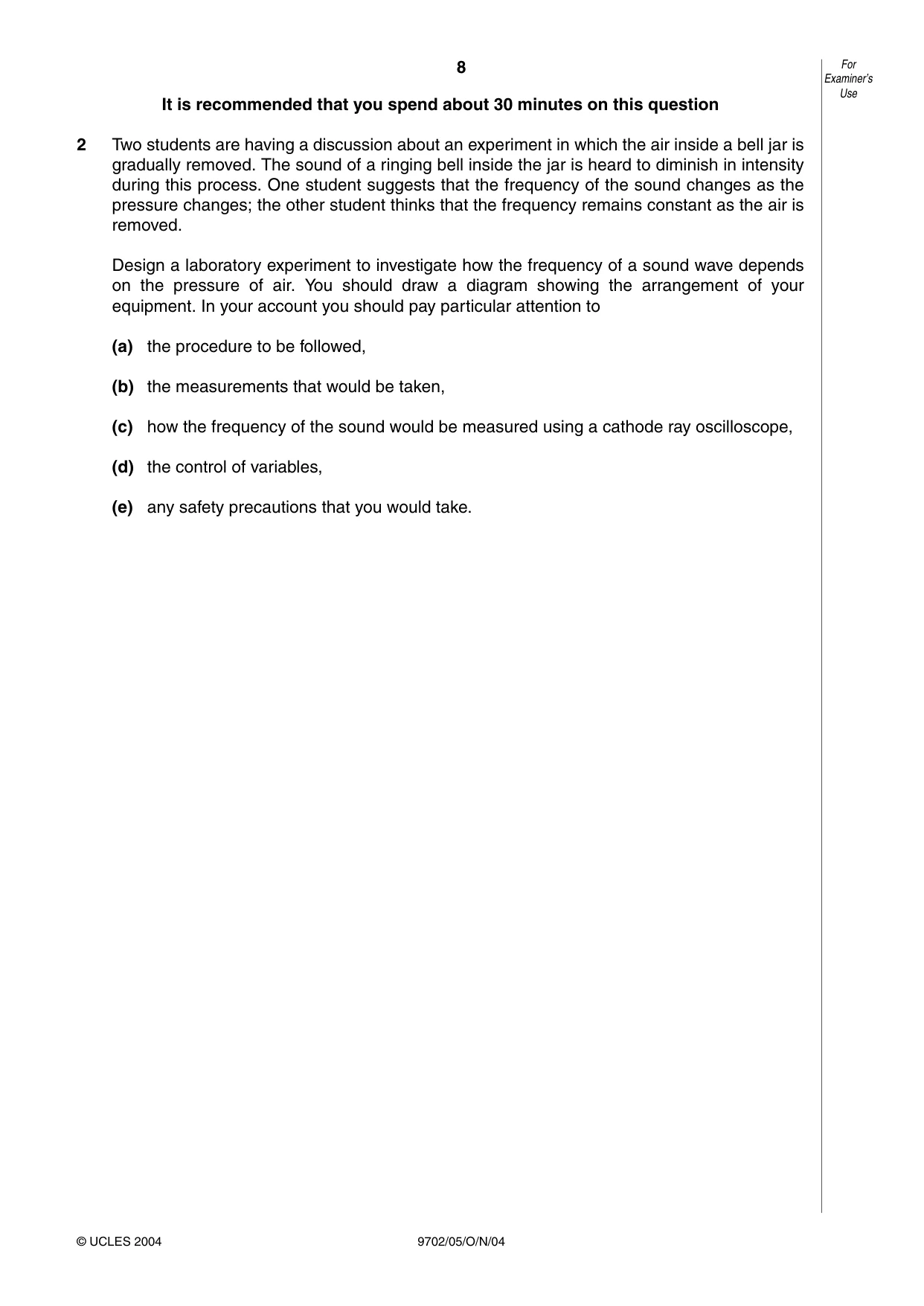
8 9702/05/O/N/04 It is recommended that you spend about 30 minutes on this question 2 Two students are having a discussion about an experiment in which the air inside a bell jar is gradually removed. The sound of a ringing bell inside the jar is heard to diminish in intensity during this process. One student suggests that the frequency of the sound changes as the pressure changes; the other student thinks that the frequency remains constant as the air is removed. Design a laboratory experiment to investigate how the frequency of a sound wave depends on the pressure of air. You should draw a diagram showing the arrangement of your equipment. In your account you should pay particular attention to (a) the procedure to be followed, (b) the measurements that would be taken, (c) how the frequency of the sound would be measured using a cathode ray oscilloscope, (d) the control of variables, (e) any safety precautions that you would take. For Examiner’s Use © UCLES 2004
Question paper, page 9
9 9702/05/O/N/04 [Turn over Diagram … … … … … … … … … … … … … … … For Examiner’s Use © UCLES 2004
Question paper, page 10
10 9702/05/O/N/04 … … … … … … … … … … … … … … … … … … … … … … … … … … … … For Examiner’s Use © UCLES 2004
Question paper, page 12
12 9702/05/O/N/04 BLANK PAGE Every reasonable effort has been made to trace all copyright holders. The publishers would be pleased to hear from anyone whose rights we have unwittingly infringed. University of Cambridge International Examinations is part of the University of Cambridge Local Examinations Syndicate (UCLES), which is itself a department of the University of Cambridge.
Mark scheme, page 1
UNIVERSITY OF CAMBRIDGE INTERNATIONAL EXAMINATIONS GCE Advanced Level MARK SCHEME for the November 2004 question paper 9702 PHYSICS 9702/05 Paper 5 (Practical Test), maximum raw mark 30 This mark scheme is published as an aid to teachers and students, to indicate the requirements of the examination. This shows the basis on which Examiners were initially instructed to award marks. It does not indicate the details of the discussions that took place at an Examiners’ meeting before marking began. Any substantial changes to the mark scheme that arose from these discussions will be recorded in the published Report on the Examination. All Examiners are instructed that alternative correct answers and unexpected approaches in candidates’ scripts must be given marks that fairly reflect the relevant knowledge and skills demonstrated. Mark schemes must be read in conjunction with the question papers and the Report on the Examination. • CIE will not enter into discussion or correspondence in connection with these mark schemes. CIE is publishing the mark schemes for the November 2004 question papers for most IGCSE and GCE Advanced Level syllabuses.
Mark scheme, page 2
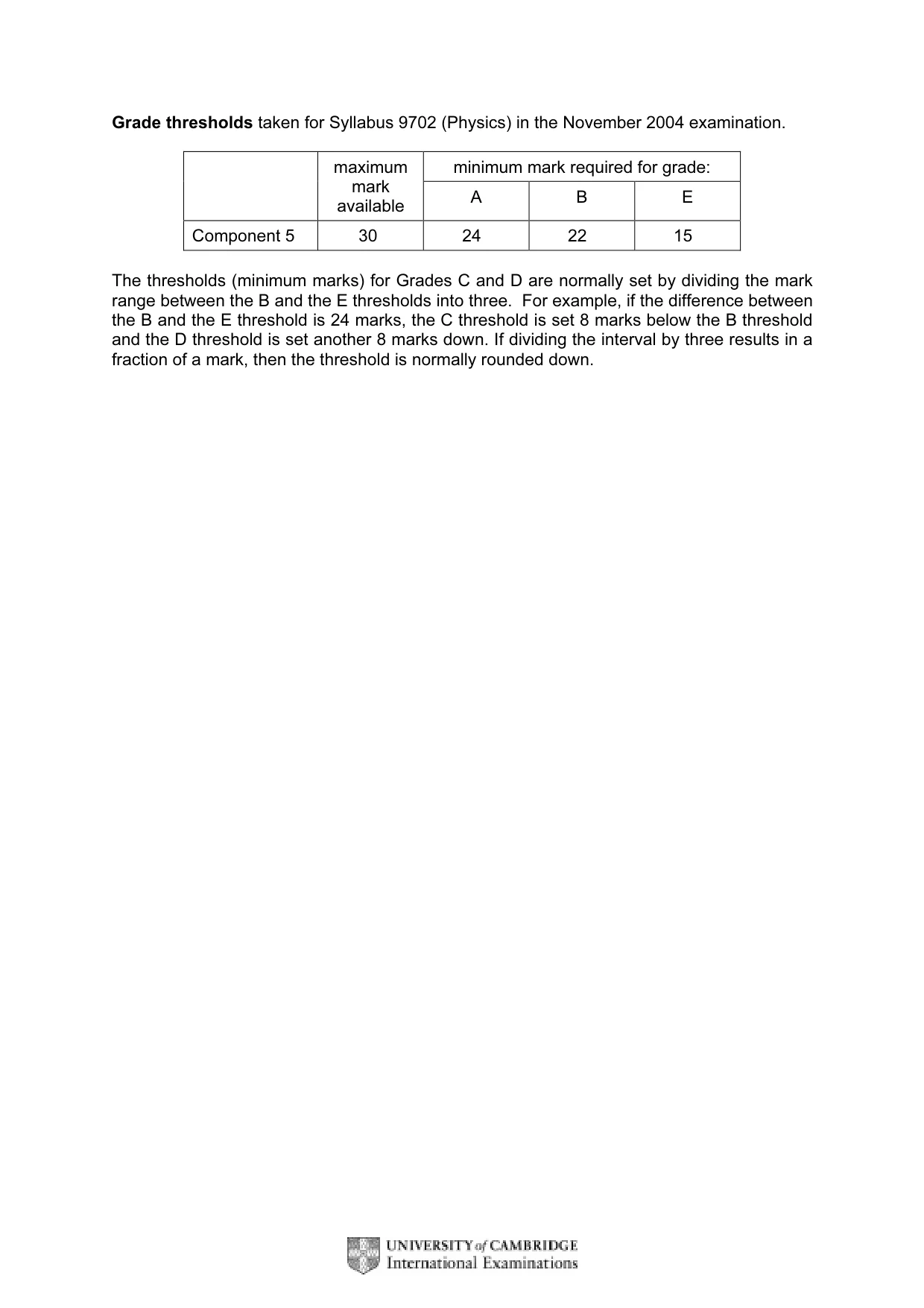
Grade thresholds taken for Syllabus 9702 (Physics) in the November 2004 examination. minimum mark required for grade: maximum mark available A B E Component 5 30 24 22 15 The thresholds (minimum marks) for Grades C and D are normally set by dividing the mark range between the B and the E thresholds into three. For example, if the difference between the B and the E threshold is 24 marks, the C threshold is set 8 marks below the B threshold and the D threshold is set another 8 marks down. If dividing the interval by three results in a fraction of a mark, then the threshold is normally rounded down.
Mark scheme, page 3
November 2004 GCE A LEVEL MARK SCHEME MAXIMUM MARK: 30 SYLLABUS/COMPONENT: 9702/05 PHYSICS Paper 5 (Practical Test)
Mark scheme, page 4
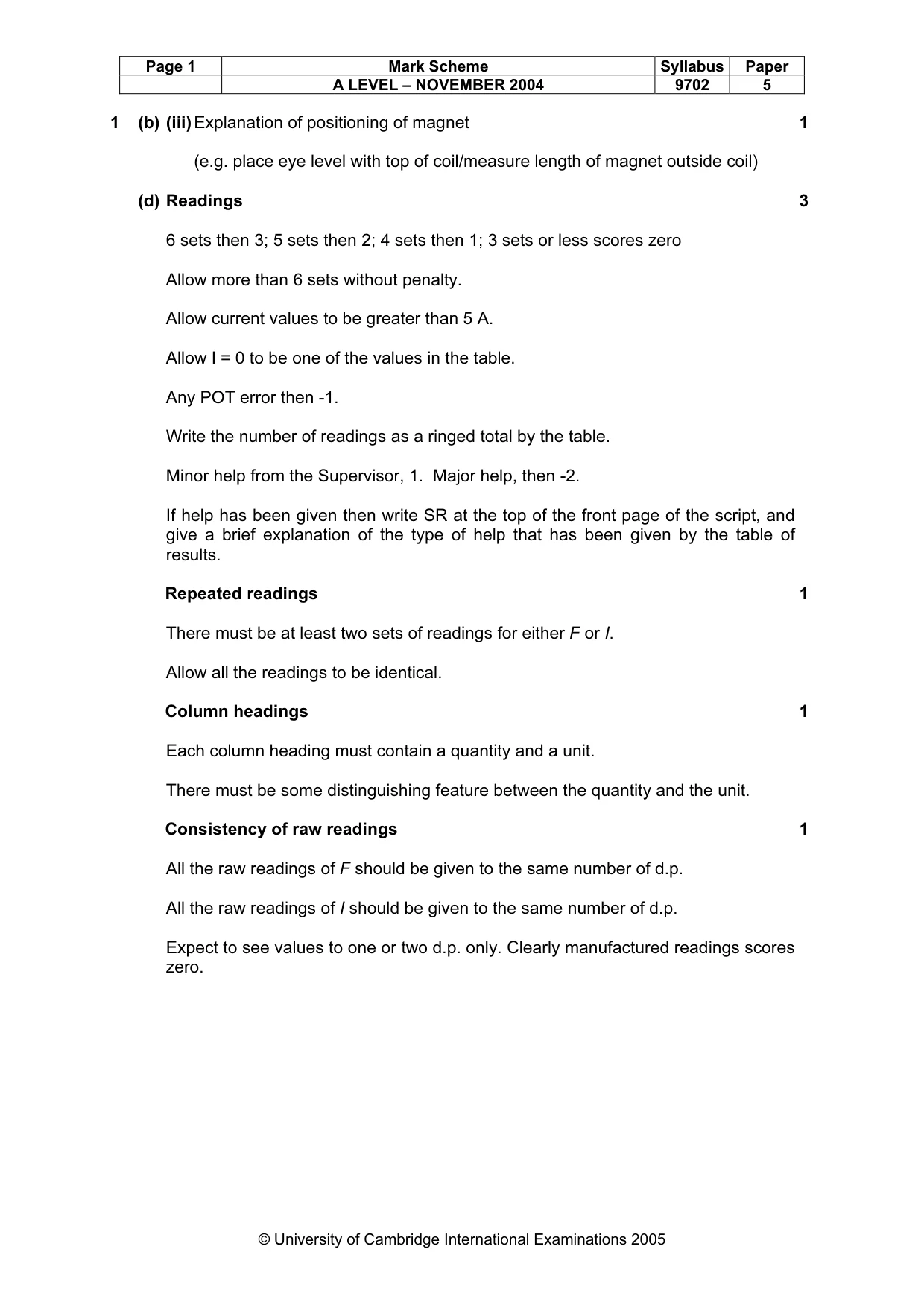
Page 1 Mark Scheme Syllabus Paper A LEVEL – NOVEMBER 2004 9702 5 © University of Cambridge International Examinations 2005 1 (b) (iii) Explanation of positioning of magnet 1 (e.g. place eye level with top of coil/measure length of magnet outside coil) (d) Readings 3 6 sets then 3; 5 sets then 2; 4 sets then 1; 3 sets or less scores zero Allow more than 6 sets without penalty. Allow current values to be greater than 5 A. Allow I = 0 to be one of the values in the table. Any POT error then -1. Write the number of readings as a ringed total by the table. Minor help from the Supervisor, 1. Major help, then -2. If help has been given then write SR at the top of the front page of the script, and give a brief explanation of the type of help that has been given by the table of results. Repeated readings 1 There must be at least two sets of readings for either F or I. Allow all the readings to be identical. Column headings 1 Each column heading must contain a quantity and a unit. There must be some distinguishing feature between the quantity and the unit. Consistency of raw readings 1 All the raw readings of F should be given to the same number of d.p. All the raw readings of I should be given to the same number of d.p. Expect to see values to one or two d.p. only. Clearly manufactured readings scores zero.
Mark scheme, page 5
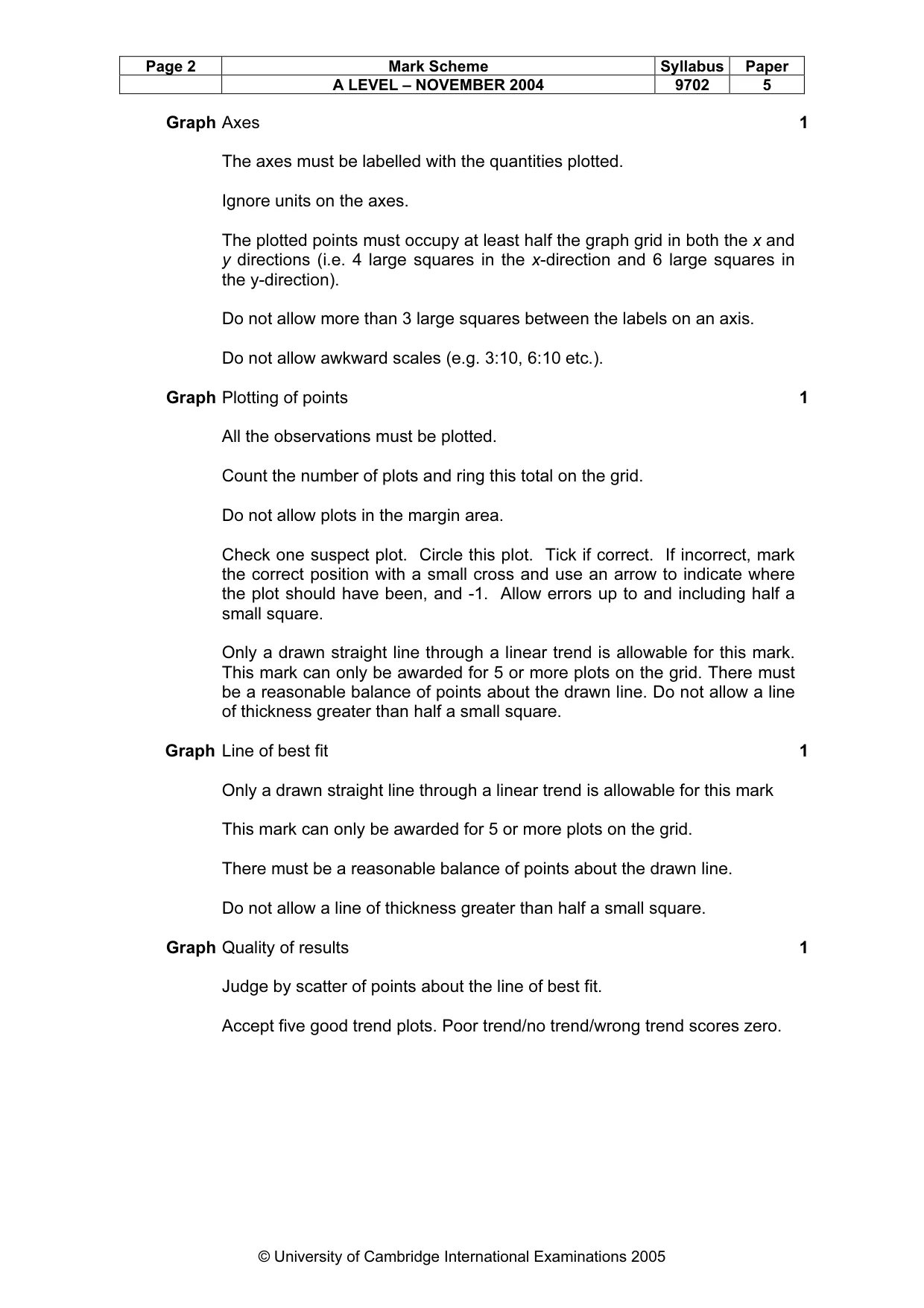
Page 2 Mark Scheme Syllabus Paper A LEVEL – NOVEMBER 2004 9702 5 © University of Cambridge International Examinations 2005 Graph Axes 1 The axes must be labelled with the quantities plotted. Ignore units on the axes. The plotted points must occupy at least half the graph grid in both the x and y directions (i.e. 4 large squares in the x-direction and 6 large squares in the y-direction). Do not allow more than 3 large squares between the labels on an axis. Do not allow awkward scales (e.g. 3:10, 6:10 etc.). Graph Plotting of points 1 All the observations must be plotted. Count the number of plots and ring this total on the grid. Do not allow plots in the margin area. Check one suspect plot. Circle this plot. Tick if correct. If incorrect, mark the correct position with a small cross and use an arrow to indicate where the plot should have been, and -1. Allow errors up to and including half a small square. Only a drawn straight line through a linear trend is allowable for this mark. This mark can only be awarded for 5 or more plots on the grid. There must be a reasonable balance of points about the drawn line. Do not allow a line of thickness greater than half a small square. Graph Line of best fit 1 Only a drawn straight line through a linear trend is allowable for this mark This mark can only be awarded for 5 or more plots on the grid. There must be a reasonable balance of points about the drawn line. Do not allow a line of thickness greater than half a small square. Graph Quality of results 1 Judge by scatter of points about the line of best fit. Accept five good trend plots. Poor trend/no trend/wrong trend scores zero.
Mark scheme, page 6
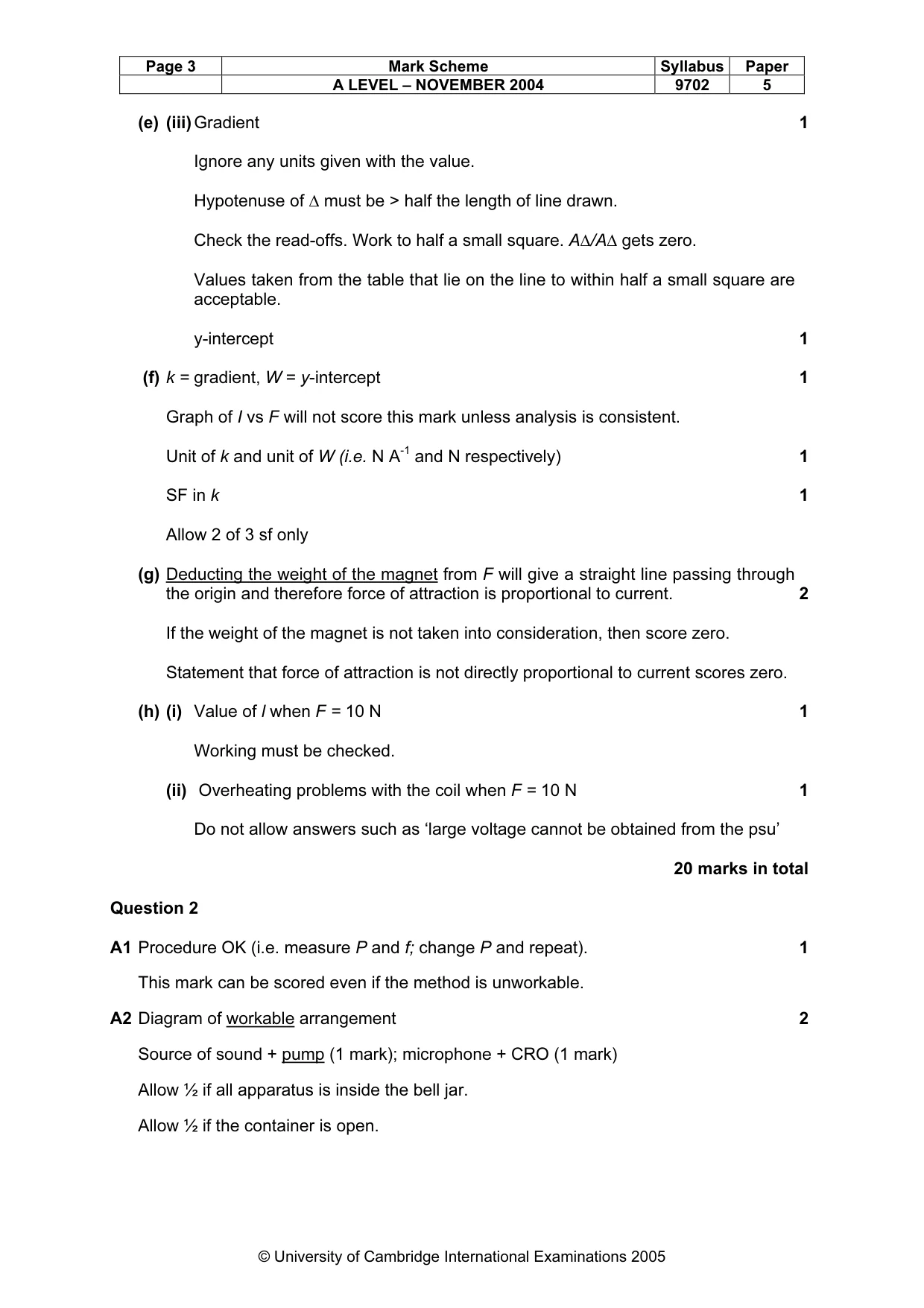
Page 3 Mark Scheme Syllabus Paper A LEVEL – NOVEMBER 2004 9702 5 © University of Cambridge International Examinations 2005 (e) (iii) Gradient 1 Ignore any units given with the value. Hypotenuse of ∆ must be > half the length of line drawn. Check the read-offs. Work to half a small square. A∆/A∆ gets zero. Values taken from the table that lie on the line to within half a small square are acceptable. y-intercept 1 (f) k = gradient, W = y-intercept 1 Graph of I vs F will not score this mark unless analysis is consistent. Unit of k and unit of W (i.e. N A-1 and N respectively) 1 SF in k 1 Allow 2 of 3 sf only (g) Deducting the weight of the magnet from F will give a straight line passing through the origin and therefore force of attraction is proportional to current. 2 If the weight of the magnet is not taken into consideration, then score zero. Statement that force of attraction is not directly proportional to current scores zero. (h) (i) Value of l when F = 10 N 1 Working must be checked. (ii) Overheating problems with the coil when F = 10 N 1 Do not allow answers such as ‘large voltage cannot be obtained from the psu’ 20 marks in total Question 2 A1 Procedure OK (i.e. measure P and f; change P and repeat). 1 This mark can be scored even if the method is unworkable. A2 Diagram of workable arrangement 2 Source of sound + pump (1 mark); microphone + CRO (1 mark) Allow ½ if all apparatus is inside the bell jar. Allow ½ if the container is open.
Mark scheme, page 7
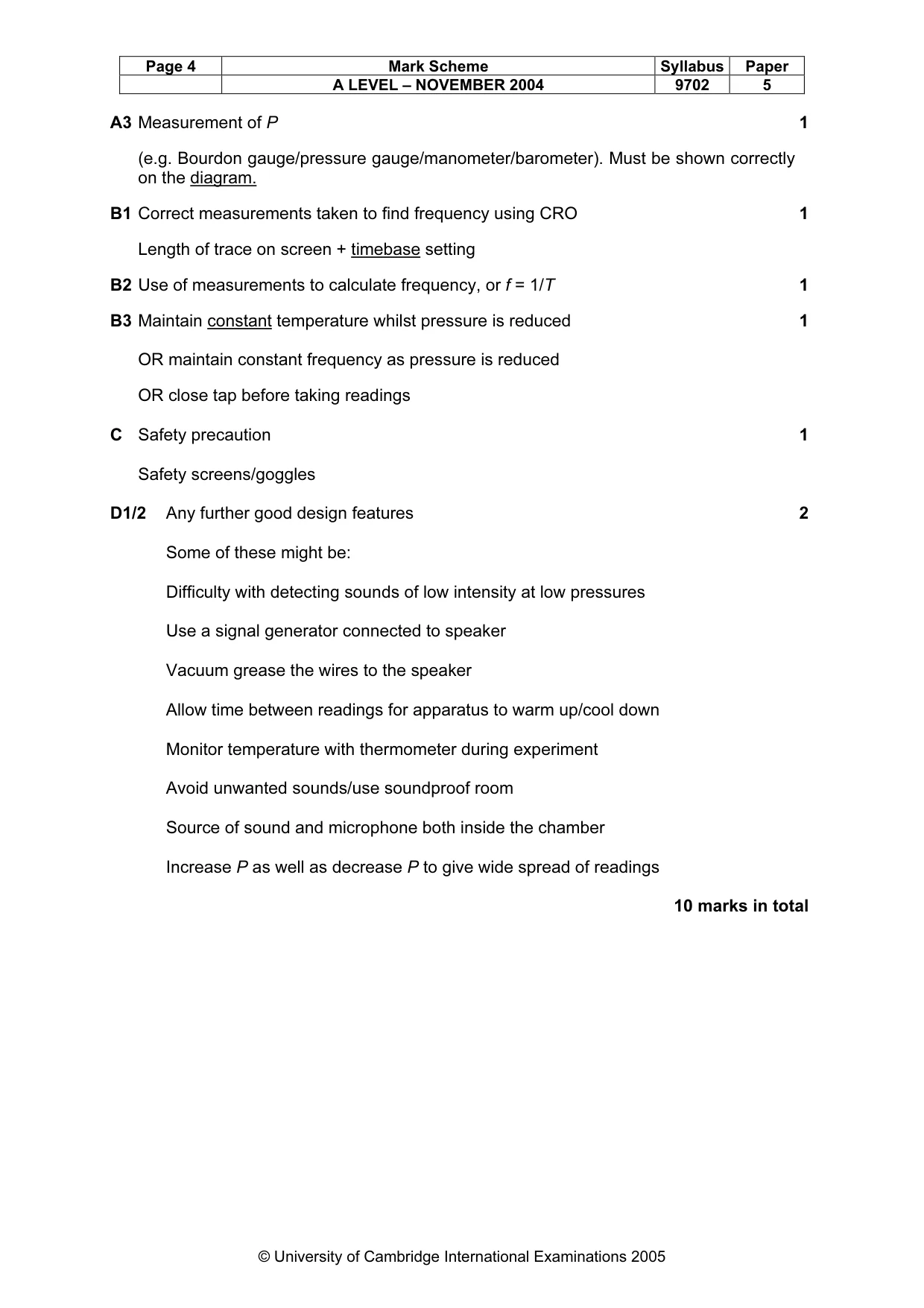
Page 4 Mark Scheme Syllabus Paper A LEVEL – NOVEMBER 2004 9702 5 © University of Cambridge International Examinations 2005 A3 Measurement of P 1 (e.g. Bourdon gauge/pressure gauge/manometer/barometer). Must be shown correctly on the diagram. B1 Correct measurements taken to find frequency using CRO 1 Length of trace on screen + timebase setting B2 Use of measurements to calculate frequency, or f = 1/T 1 B3 Maintain constant temperature whilst pressure is reduced 1 OR maintain constant frequency as pressure is reduced OR close tap before taking readings C Safety precaution 1 Safety screens/goggles D1/2 Any further good design features 2 Some of these might be: Difficulty with detecting sounds of low intensity at low pressures Use a signal generator connected to speaker Vacuum grease the wires to the speaker Allow time between readings for apparatus to warm up/cool down Monitor temperature with thermometer during experiment Avoid unwanted sounds/use soundproof room Source of sound and microphone both inside the chamber Increase P as well as decrease P to give wide spread of readings 10 marks in total
Mark scheme, page 8
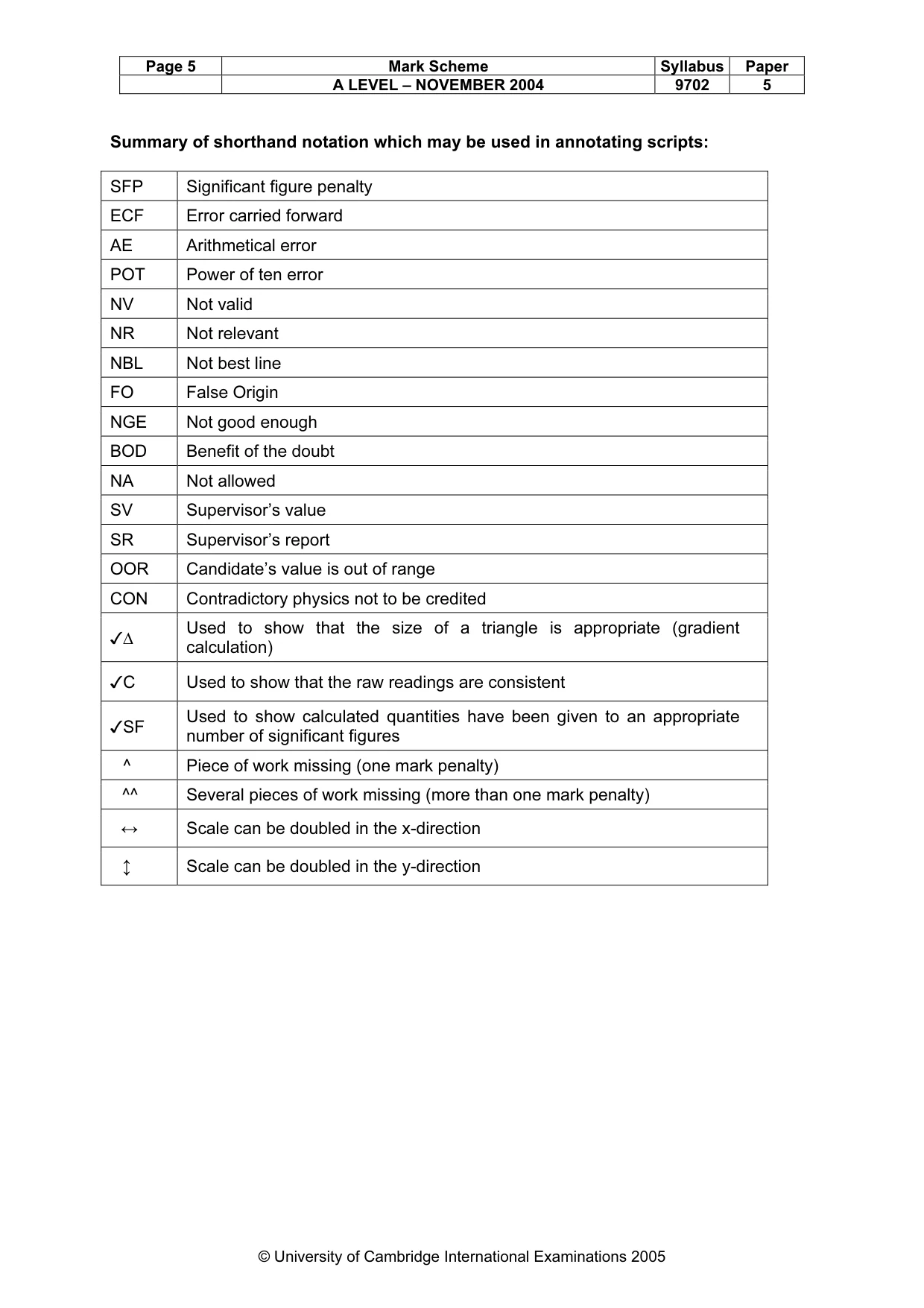
Page 5 Mark Scheme Syllabus Paper A LEVEL – NOVEMBER 2004 9702 5 © University of Cambridge International Examinations 2005 Summary of shorthand notation which may be used in annotating scripts: SFP Significant figure penalty ECF Error carried forward AE Arithmetical error POT Power of ten error NV Not valid NR Not relevant NBL Not best line FO False Origin NGE Not good enough BOD Benefit of the doubt NA Not allowed SV Supervisor’s value SR Supervisor’s report OOR Candidate’s value is out of range CON Contradictory physics not to be credited ✓∆ Used to show that the size of a triangle is appropriate (gradient calculation) ✓C Used to show that the raw readings are consistent ✓SF Used to show calculated quantities have been given to an appropriate number of significant figures ^ Piece of work missing (one mark penalty) ^^ Several pieces of work missing (more than one mark penalty) ↔ Scale can be doubled in the x-direction ↕ Scale can be doubled in the y-direction