Cambridge A Level Nepal Studies (AS Level only) 8024 — 2019 May/June Paper 2 · Variant 1
8024/21/M/J/19 · 75 marks · ≈84 min
The question paper and its mark scheme, free to read here and free to download. This is Cambridge’s own paper, exactly as it was sat.
Question paper8 pages



Mark scheme19 pages
Answers below. Sit the paper first if you are practising.

Paper as text
Question paper, page 1
This document consists of 7 printed pages, 1 blank page and 1 Insert. DC (ST/CT) 162401/4 © UCLES 2019 [Turn over Cambridge Assessment International Education Cambridge International Advanced Subsidiary Level * 5 9 3 6 8 0 0 6 7 6 * NEPAL STUDIES 8024/02 Paper 2 Written Paper May/June 2019 1 hour 45 minutes No Additional Materials are required. READ THESE INSTRUCTIONS FIRST An answer booklet is provided inside this question paper. You should follow the instructions on the front cover of the answer booklet. If you need additional answer paper ask the invigilator for a continuation booklet. Section A Answer any two questions. You must answer parts (a), (b) and (c) of the questions that you choose. Section B Answer any one question. You must answer parts (a) and (b) of the question that you choose. The number of marks is given in brackets [ ] at the end of each question or part question.
Question paper, page 2
2 8024/02/M/J/19 © UCLES 2019 BLANK PAGE
Question paper, page 3
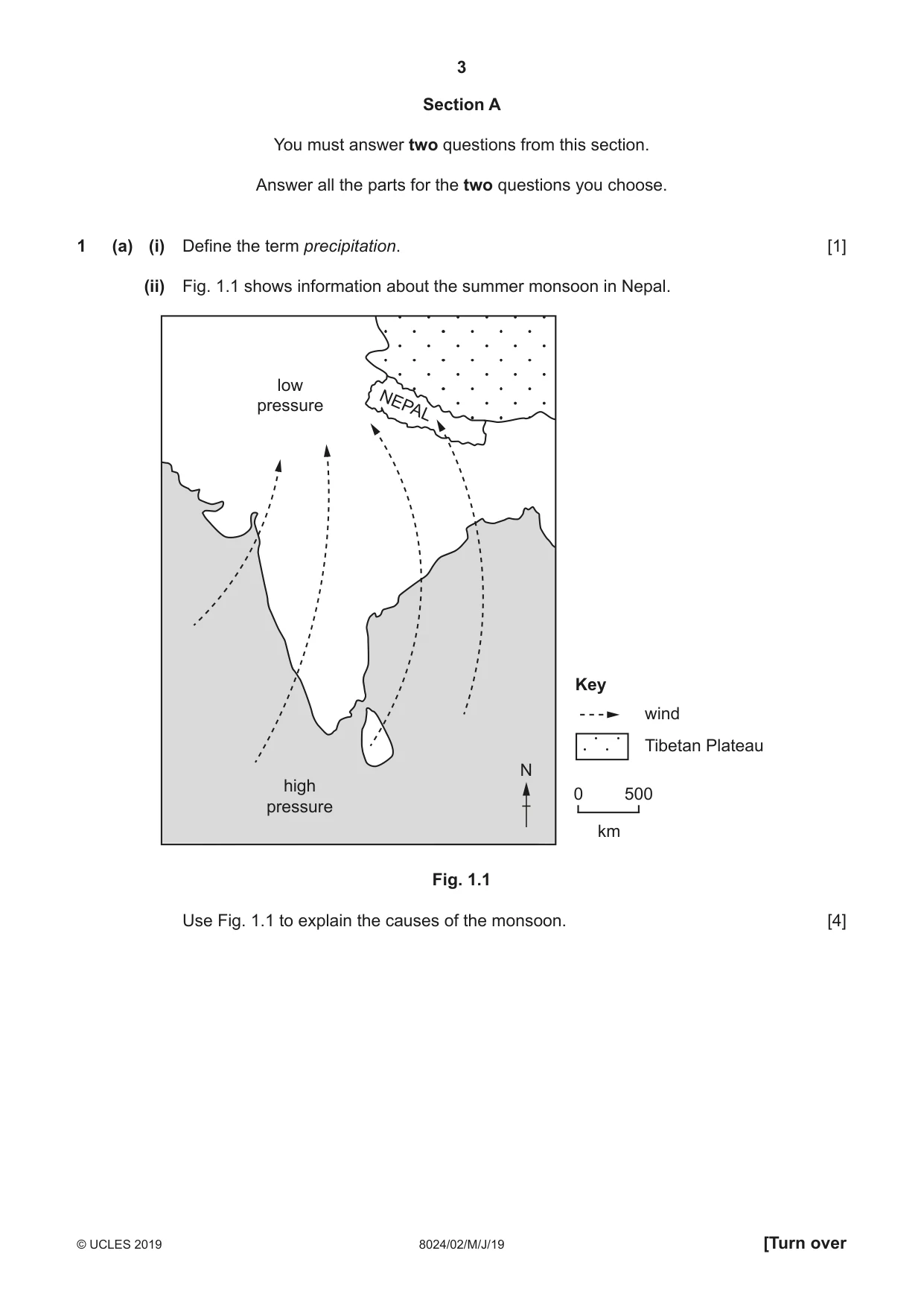
3 8024/02/M/J/19 © UCLES 2019 [Turn over Section A You must answer two questions from this section. Answer all the parts for the two questions you choose. 1 (a) (i) Define the term precipitation. [1] (ii) Fig. 1.1 shows information about the summer monsoon in Nepal. low pressure high pressure km 0 500 NEPAL Key wind Tibetan Plateau N Fig. 1.1 Use Fig. 1.1 to explain the causes of the monsoon. [4]
Question paper, page 4
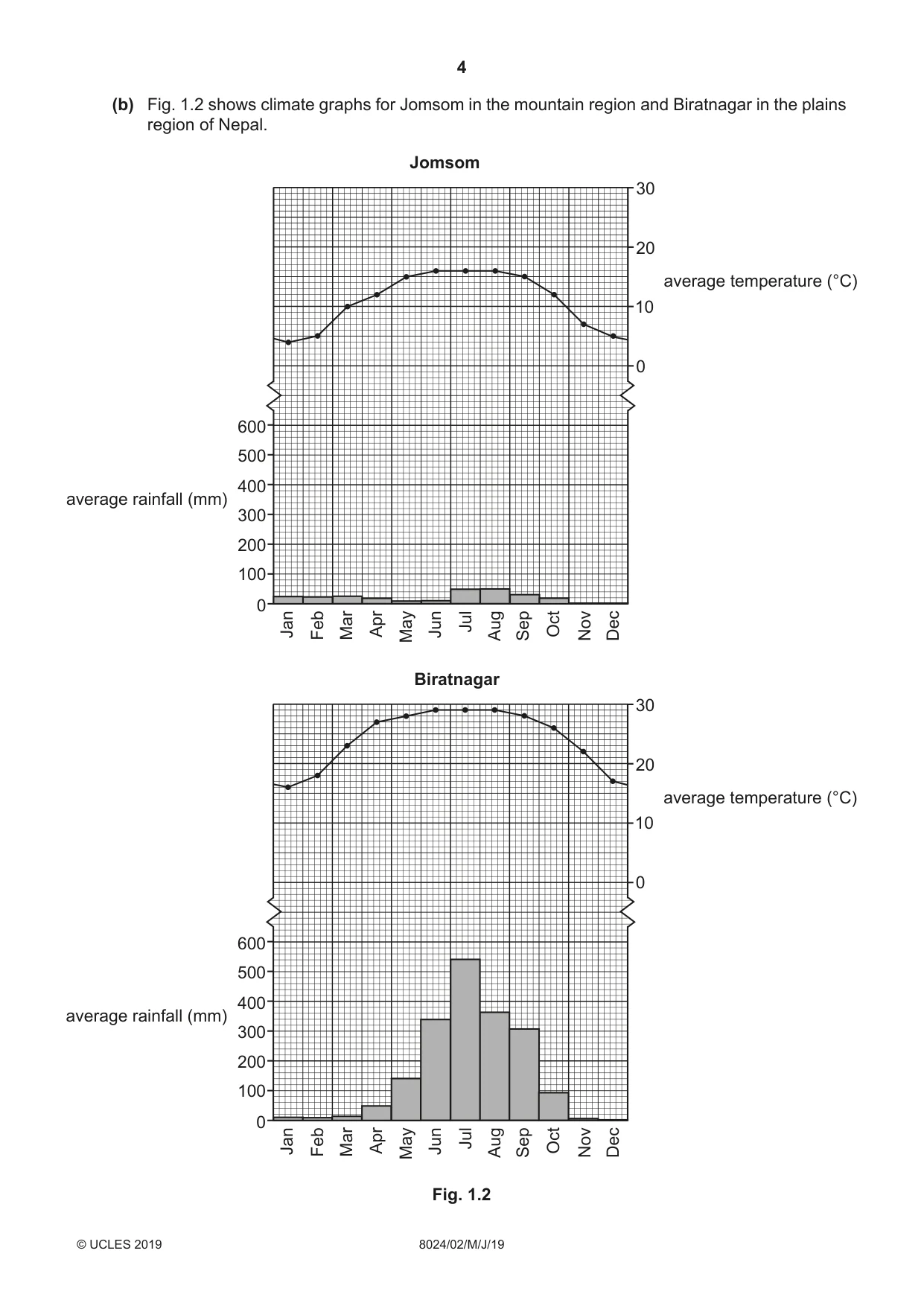
4 8024/02/M/J/19 © UCLES 2019 (b) Fig. 1.2 shows climate graphs for Jomsom in the mountain region and Biratnagar in the plains region of Nepal. 0 100 200 300 400 500 600 0 10 20 30 average rainfall (mm) average temperature (°C) Jan Feb Mar Apr May Jun Jul Aug Sep Oct Nov Dec 0 100 200 300 400 500 600 0 10 20 30 average rainfall (mm) average temperature (°C) Jan Feb Mar Apr May Jun Jul Aug Sep Oct Nov Dec Jomsom Biratnagar Fig. 1.2
Question paper, page 5
5 8024/02/M/J/19 © UCLES 2019 [Turn over (i) Using Fig. 1.2, identify and describe differences between the climate of the mountain (Jomsom) and the plains (Biratnagar) regions. [4] (ii) Explain two ways that the climate of the hill region differs from both the mountain and plains regions. [4] (c) Landslides are a common occurrence in Nepal. Explain the impacts of landslides on people and environments and suggest why they are a difficult hazard to manage. Support your answer with examples. [12]
Question paper, page 6
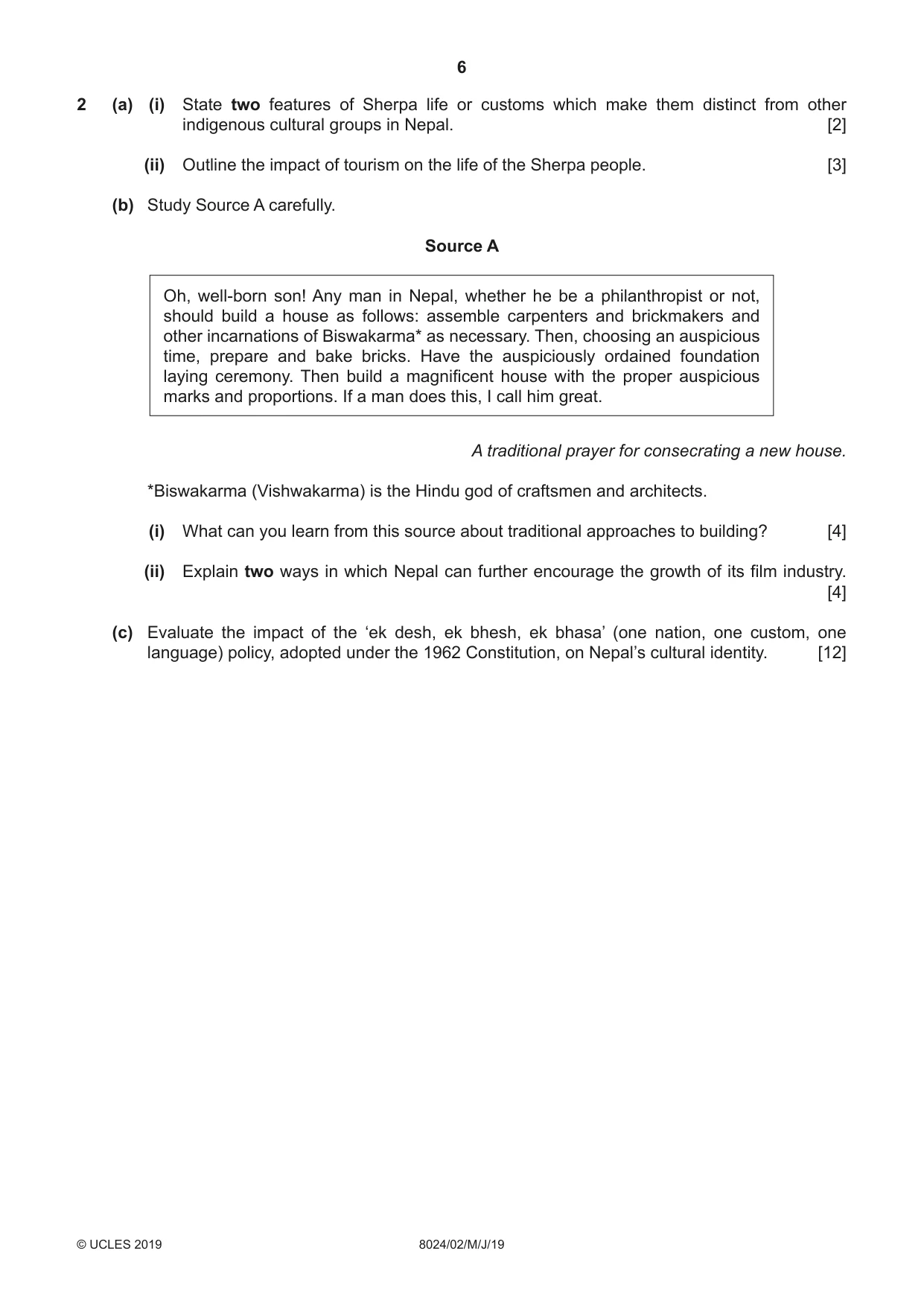
6 8024/02/M/J/19 © UCLES 2019 2 (a) (i) State two features of Sherpa life or customs which make them distinct from other indigenous cultural groups in Nepal. [2] (ii) Outline the impact of tourism on the life of the Sherpa people. [3] (b) Study Source A carefully. Source A Oh, well-born son! Any man in Nepal, whether he be a philanthropist or not, should build a house as follows: assemble carpenters and brickmakers and other incarnations of Biswakarma* as necessary. Then, choosing an auspicious time, prepare and bake bricks. Have the auspiciously ordained foundation laying ceremony. Then build a magnificent house with the proper auspicious marks and proportions. If a man does this, I call him great. A traditional prayer for consecrating a new house. *Biswakarma (Vishwakarma) is the Hindu god of craftsmen and architects. (i) What can you learn from this source about traditional approaches to building? [4] (ii) Explain two ways in which Nepal can further encourage the growth of its film industry. [4] (c) Evaluate the impact of the ‘ek desh, ek bhesh, ek bhasa’ (one nation, one custom, one language) policy, adopted under the 1962 Constitution, on Nepal’s cultural identity. [12]
Question paper, page 7
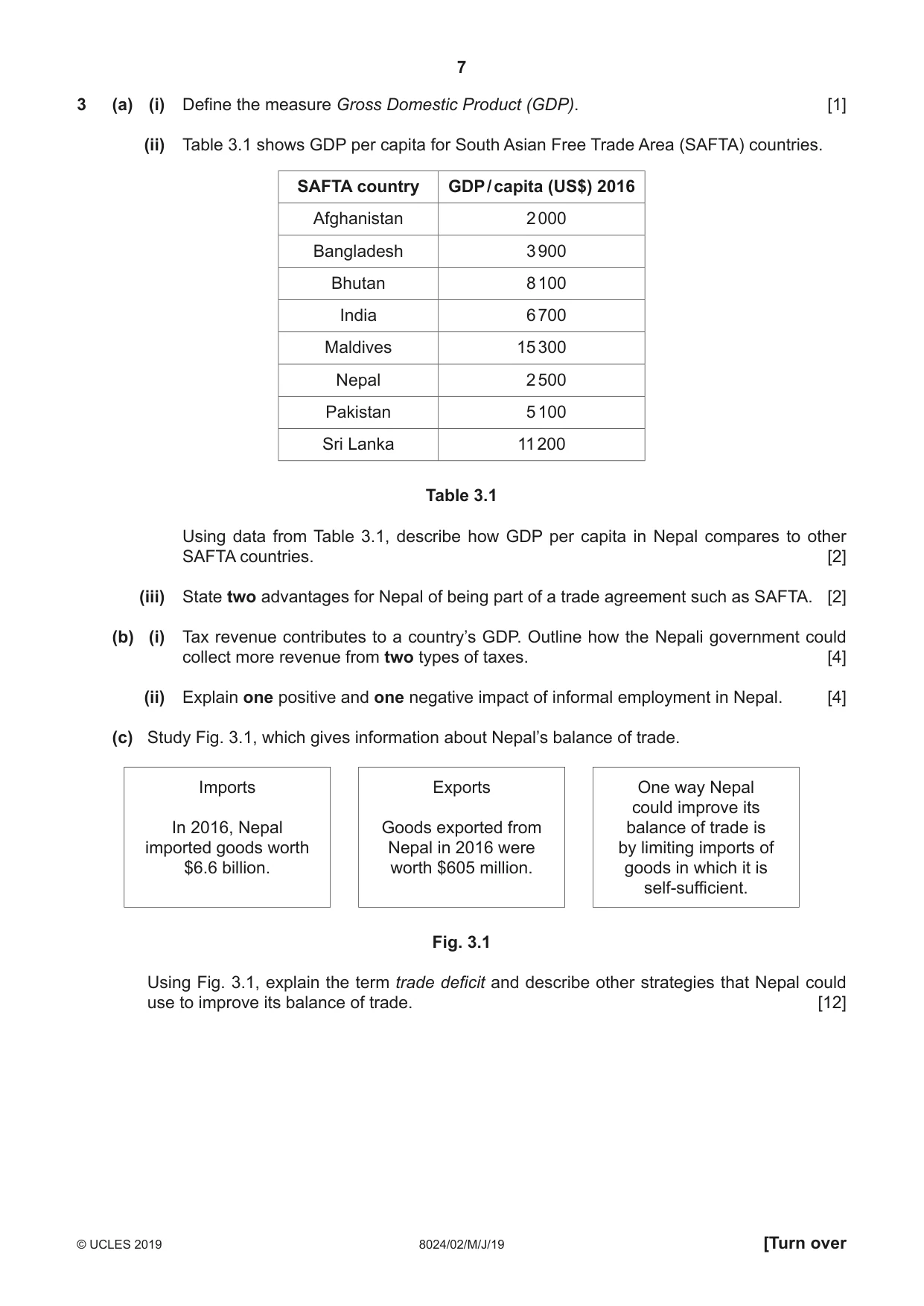
7 8024/02/M/J/19 © UCLES 2019 [Turn over 3 (a) (i) Define the measure Gross Domestic Product (GDP). [1] (ii) Table 3.1 shows GDP per capita for South Asian Free Trade Area (SAFTA) countries. SAFTA country GDP / capita (US$) 2016 Afghanistan 2 000 Bangladesh 3 900 Bhutan 8 100 India 6 700 Maldives 15 300 Nepal 2 500 Pakistan 5 100 Sri Lanka 11 200 Table 3.1 Using data from Table 3.1, describe how GDP per capita in Nepal compares to other SAFTA countries. [2] (iii) State two advantages for Nepal of being part of a trade agreement such as SAFTA. [2] (b) (i) Tax revenue contributes to a country’s GDP. Outline how the Nepali government could collect more revenue from two types of taxes. [4] (ii) Explain one positive and one negative impact of informal employment in Nepal. [4] (c) Study Fig. 3.1, which gives information about Nepal’s balance of trade. Imports In 2016, Nepal imported goods worth $6.6 billion. Exports Goods exported from Nepal in 2016 were worth $605 million. One way Nepal could improve its balance of trade is by limiting imports of goods in which it is self-sufficient. Fig. 3.1 Using Fig. 3.1, explain the term trade deficit and describe other strategies that Nepal could use to improve its balance of trade. [12]
Question paper, page 8
8 8024/02/M/J/19 © UCLES 2019 Permission to reproduce items where third-party owned material protected by copyright is included has been sought and cleared where possible. Every reasonable effort has been made by the publisher (UCLES) to trace copyright holders, but if any items requiring clearance have unwittingly been included, the publisher will be pleased to make amends at the earliest possible opportunity. To avoid the issue of disclosure of answer-related information to candidates, all copyright acknowledgements are reproduced online in the Cambridge Assessment International Education Copyright Acknowledgements Booklet. This is produced for each series of examinations and is freely available to download at www.cambridgeinternational.org after the live examination series. Cambridge Assessment International Education is part of the Cambridge Assessment Group. Cambridge Assessment is the brand name of the University of Cambridge Local Examinations Syndicate (UCLES), which itself is a department of the University of Cambridge. Section B You must answer one question from this section. Answer both parts for the question you choose. 4 (a) Habitat loss is a major threat to wildlife conservation. Describe how endangered species are threatened by human activity in Nepal. [10] (b) ‘Nepal cannot escape the increasing influence of global climate change.’ How far do you agree? Answer with reference to examples. [15] 5 (a) The average life expectancy of the Nepali people has risen from around 40 years in 1970 to 69 years in 2014. Outline the reasons for this change. [10] (b) ‘Changing household structure means that Nepal is facing a crisis in caring for the elderly.’ How far do you agree? Explain your answer. [15] 6 (a) Outline ways in which information communications technology (ICT) can be used to encourage sustainable development in Nepal. [10] (b) ‘Until Nepal achieves energy security, sustainable urban development cannot be achieved.’ How far do you agree? Explain your answer. [15]
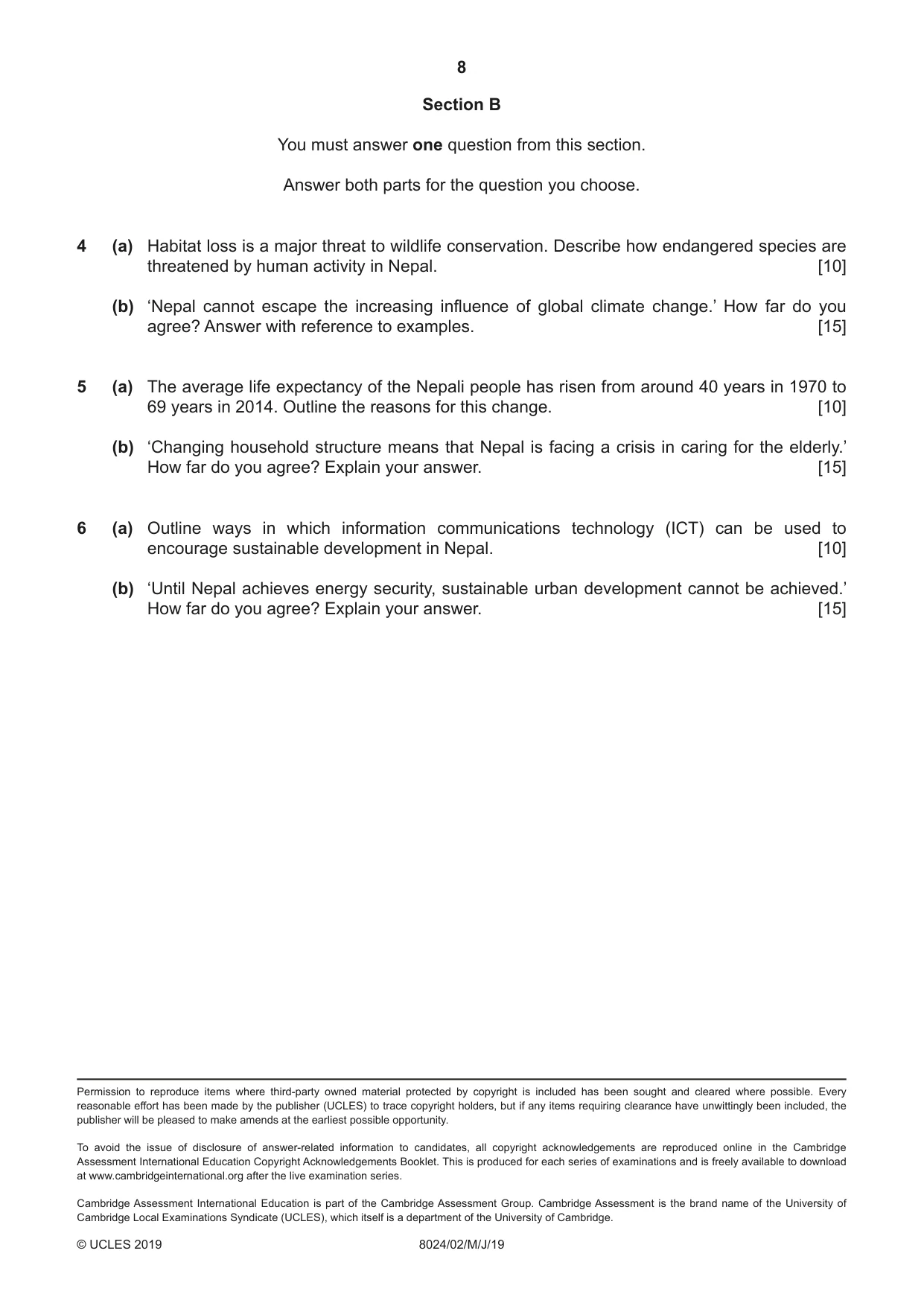
Mark scheme, page 1
This document consists of 19 printed pages. © UCLES 2019 [Turn over Cambridge Assessment International Education Cambridge International Advanced Subsidiary Level NEPAL STUDIES 8024/02 Paper 2 Written Paper May/June 2019 MARK SCHEME Maximum Mark: 75 Published This mark scheme is published as an aid to teachers and candidates, to indicate the requirements of the examination. It shows the basis on which Examiners were instructed to award marks. It does not indicate the details of the discussions that took place at an Examiners’ meeting before marking began, which would have considered the acceptability of alternative answers. Mark schemes should be read in conjunction with the question paper and the Principal Examiner Report for Teachers. Cambridge International will not enter into discussions about these mark schemes. Cambridge International is publishing the mark schemes for the May/June 2019 series for most Cambridge IGCSE™, Cambridge International A and AS Level and Cambridge Pre-U components, and some Cambridge O Level components.
Mark scheme, page 2
8024/02 Cambridge International AS Level – Mark Scheme PUBLISHED May/June 2019 © UCLES 2019 Page 2 of 19 Generic Marking Principles These general marking principles must be applied by all examiners when marking candidate answers. They should be applied alongside the specific content of the mark scheme or generic level descriptors for a question. Each question paper and mark scheme will also comply with these marking principles. GENERIC MARKING PRINCIPLE 1: Marks must be awarded in line with: • the specific content of the mark scheme or the generic level descriptors for the question • the specific skills defined in the mark scheme or in the generic level descriptors for the question • the standard of response required by a candidate as exemplified by the standardisation scripts. GENERIC MARKING PRINCIPLE 2: Marks awarded are always whole marks (not half marks, or other fractions). GENERIC MARKING PRINCIPLE 3: Marks must be awarded positively: • marks are awarded for correct/valid answers, as defined in the mark scheme. However, credit is given for valid answers which go beyond the scope of the syllabus and mark scheme, referring to your Team Leader as appropriate • marks are awarded when candidates clearly demonstrate what they know and can do • marks are not deducted for errors • marks are not deducted for omissions • answers should only be judged on the quality of spelling, punctuation and grammar when these features are specifically assessed by the question as indicated by the mark scheme. The meaning, however, should be unambiguous. GENERIC MARKING PRINCIPLE 4: Rules must be applied consistently e.g. in situations where candidates have not followed instructions or in the application of generic level descriptors. GENERIC MARKING PRINCIPLE 5: Marks should be awarded using the full range of marks defined in the mark scheme for the question (however; the use of the full mark range may be limited according to the quality of the candidate responses seen). GENERIC MARKING PRINCIPLE 6: Marks awarded are based solely on the requirements as defined in the mark scheme. Marks should not be awarded with grade thresholds or grade descriptors in mind.
Mark scheme, page 3
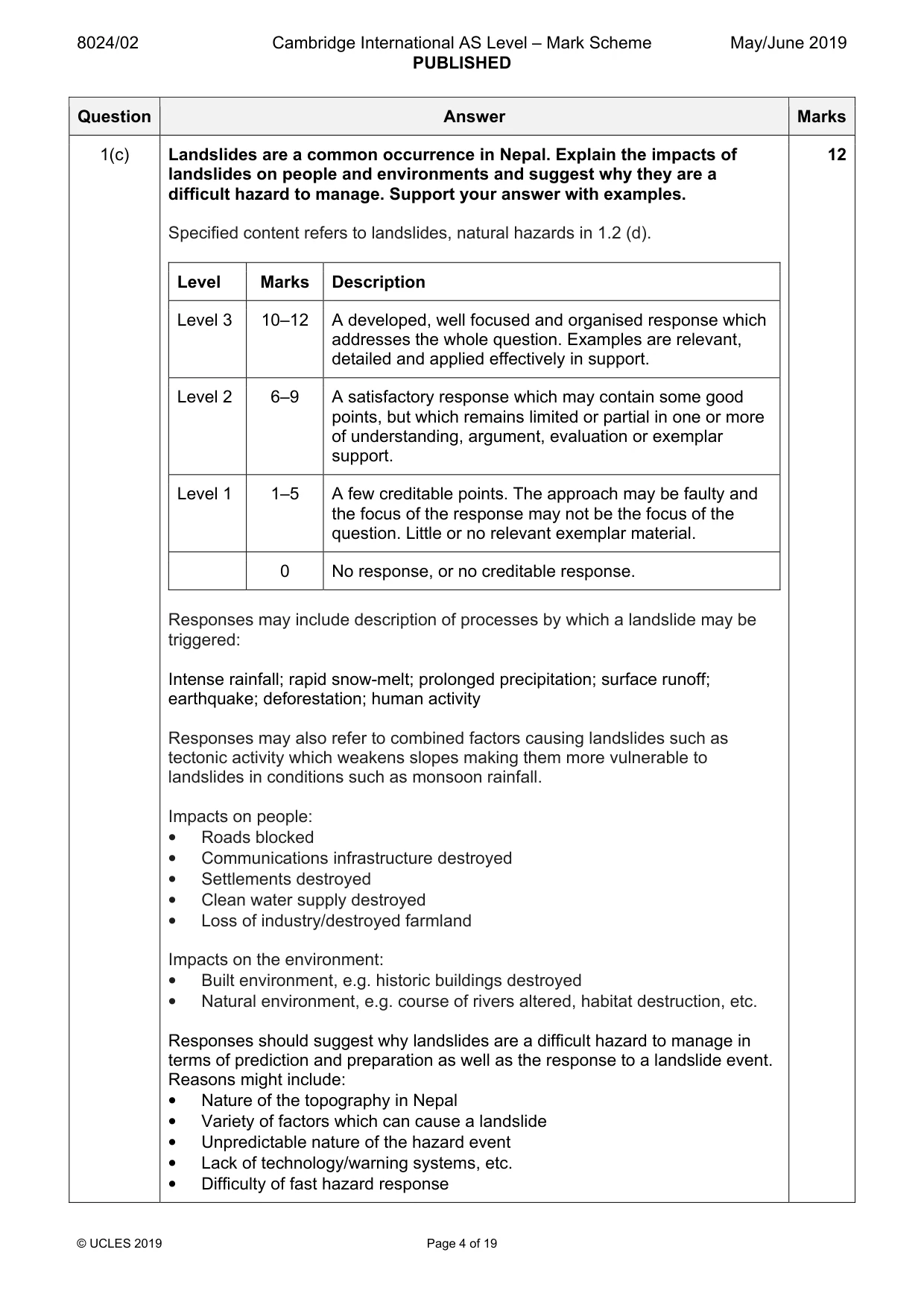
8024/02 Cambridge International AS Level – Mark Scheme PUBLISHED May/June 2019 © UCLES 2019 Page 3 of 19 Question Answer Marks 1(a)(i) Define the term precipitation. The definition of precipitation is any form of water – liquid or solid – falling from the sky. It includes rain, sleet, snow, hail and drizzle. 1 1(a)(ii) Use Fig. 1.1 to explain the causes of the monsoon. Indicative content: • Cool ocean/hot land in summer • High pressure over ocean • Low pressure over land • Wind blowing onshore low pressure over land draws in cooler air from over the Bay of Bengal • Heat released and cloud forming over higher land = intense rainfall • Monsoon travels northwestward over Nepal 4 1(b)(i) Using Fig. 1.2, identify and describe differences between the climate of the mountain (Jomsom) and the plains (Biratnagar) regions. Colder winters in mountains/warmer winters in plains Wetter summers in plains/drier summers in mountains Seasonal patterns in either rainfall or temperature Highest/lowest months compared 4 1(b)(ii) Explain two ways that the climate of the hill region differs from both the mountain and plains regions. Comparative responses should be credited. Cooler than plains/warmer than mountains in summer Warmer than mountains and cooler than plains in winter Average temperature is higher than mountains and lower than plains Much higher annual average rainfall overall than in the mountains Bigger variation in rainfall between seasons than in the plains Each difference should be supported by explanation. 4
Mark scheme, page 4
8024/02 Cambridge International AS Level – Mark Scheme PUBLISHED May/June 2019 © UCLES 2019 Page 4 of 19 Question Answer Marks 1(c) Landslides are a common occurrence in Nepal. Explain the impacts of landslides on people and environments and suggest why they are a difficult hazard to manage. Support your answer with examples. Specified content refers to landslides, natural hazards in 1.2 (d). Level Marks Description Level 3 10–12 A developed, well focused and organised response which addresses the whole question. Examples are relevant, detailed and applied effectively in support. Level 2 6–9 A satisfactory response which may contain some good points, but which remains limited or partial in one or more of understanding, argument, evaluation or exemplar support. Level 1 1–5 A few creditable points. The approach may be faulty and the focus of the response may not be the focus of the question. Little or no relevant exemplar material. 0 No response, or no creditable response. Responses may include description of processes by which a landslide may be triggered: Intense rainfall; rapid snow-melt; prolonged precipitation; surface runoff; earthquake; deforestation; human activity Responses may also refer to combined factors causing landslides such as tectonic activity which weakens slopes making them more vulnerable to landslides in conditions such as monsoon rainfall. Impacts on people: • Roads blocked • Communications infrastructure destroyed • Settlements destroyed • Clean water supply destroyed • Loss of industry/destroyed farmland Impacts on the environment: • Built environment, e.g. historic buildings destroyed • Natural environment, e.g. course of rivers altered, habitat destruction, etc. Responses should suggest why landslides are a difficult hazard to manage in terms of prediction and preparation as well as the response to a landslide event. Reasons might include: • Nature of the topography in Nepal • Variety of factors which can cause a landslide • Unpredictable nature of the hazard event • Lack of technology/warning systems, etc. • Difficulty of fast hazard response 12
Mark scheme, page 5
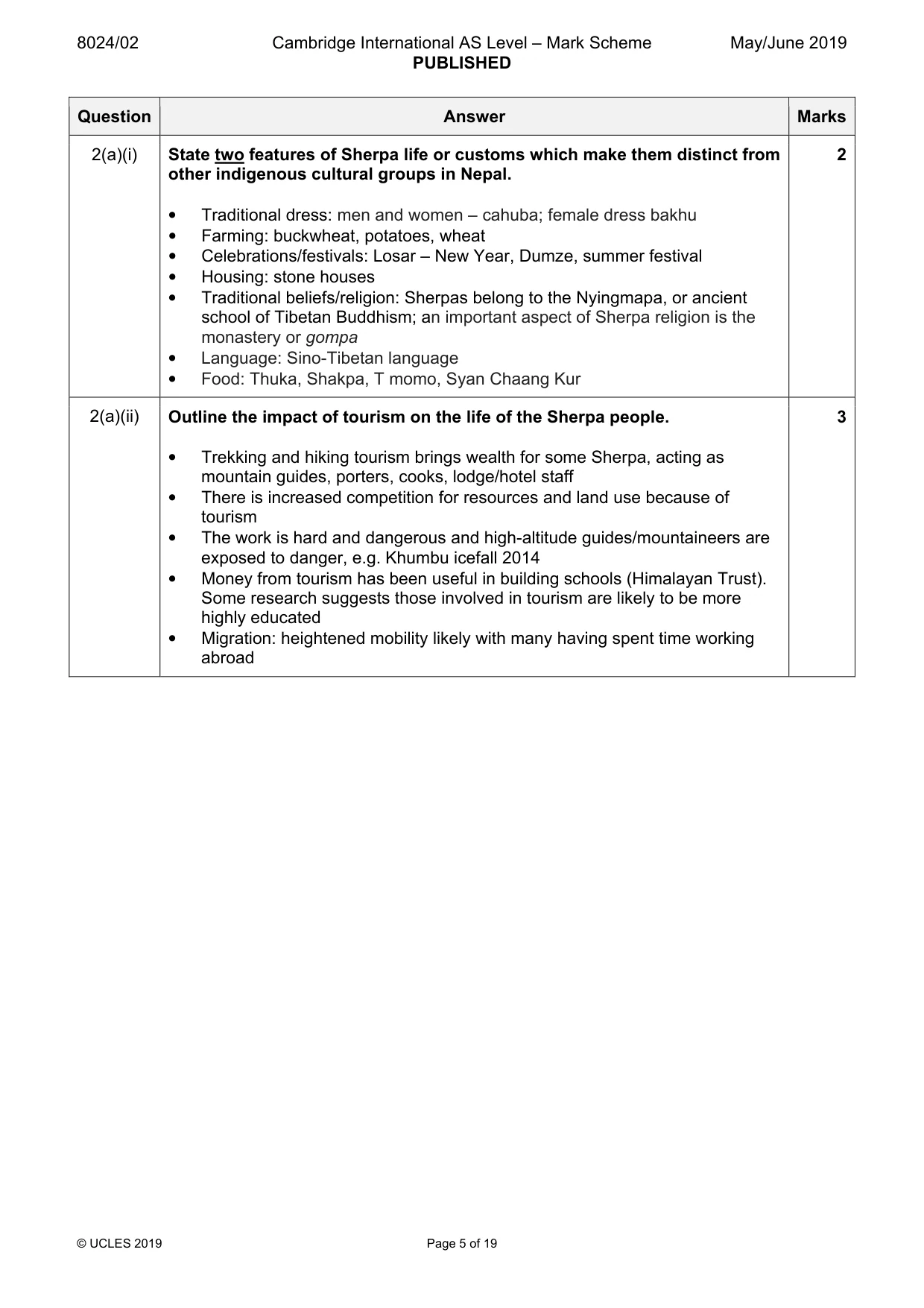
8024/02 Cambridge International AS Level – Mark Scheme PUBLISHED May/June 2019 © UCLES 2019 Page 5 of 19 Question Answer Marks 2(a)(i) State two features of Sherpa life or customs which make them distinct from other indigenous cultural groups in Nepal. • Traditional dress: men and women – cahuba; female dress bakhu • Farming: buckwheat, potatoes, wheat • Celebrations/festivals: Losar – New Year, Dumze, summer festival • Housing: stone houses • Traditional beliefs/religion: Sherpas belong to the Nyingmapa, or ancient school of Tibetan Buddhism; an important aspect of Sherpa religion is the monastery or gompa • Language: Sino-Tibetan language • Food: Thuka, Shakpa, T momo, Syan Chaang Kur 2 2(a)(ii) Outline the impact of tourism on the life of the Sherpa people. • Trekking and hiking tourism brings wealth for some Sherpa, acting as mountain guides, porters, cooks, lodge/hotel staff • There is increased competition for resources and land use because of tourism • The work is hard and dangerous and high-altitude guides/mountaineers are exposed to danger, e.g. Khumbu icefall 2014 • Money from tourism has been useful in building schools (Himalayan Trust). Some research suggests those involved in tourism are likely to be more highly educated • Migration: heightened mobility likely with many having spent time working abroad 3
Mark scheme, page 6
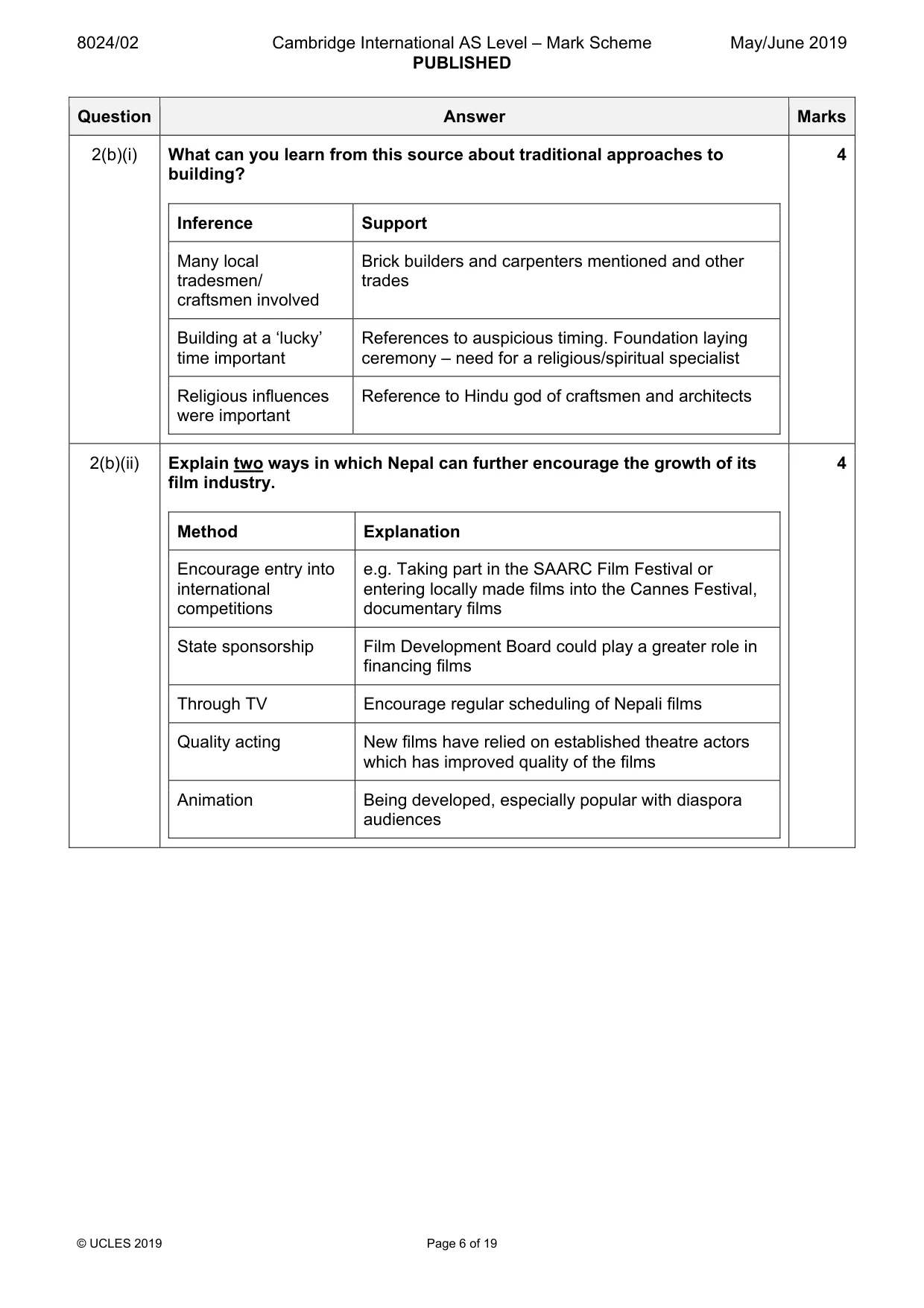
8024/02 Cambridge International AS Level – Mark Scheme PUBLISHED May/June 2019 © UCLES 2019 Page 6 of 19 Question Answer Marks 2(b)(i) What can you learn from this source about traditional approaches to building? Inference Support Many local tradesmen/ craftsmen involved Brick builders and carpenters mentioned and other trades Building at a ‘lucky’ time important References to auspicious timing. Foundation laying ceremony – need for a religious/spiritual specialist Religious influences were important Reference to Hindu god of craftsmen and architects 4 2(b)(ii) Explain two ways in which Nepal can further encourage the growth of its film industry. Method Explanation Encourage entry into international competitions e.g. Taking part in the SAARC Film Festival or entering locally made films into the Cannes Festival, documentary films State sponsorship Film Development Board could play a greater role in financing films Through TV Encourage regular scheduling of Nepali films Quality acting New films have relied on established theatre actors which has improved quality of the films Animation Being developed, especially popular with diaspora audiences 4
Mark scheme, page 7
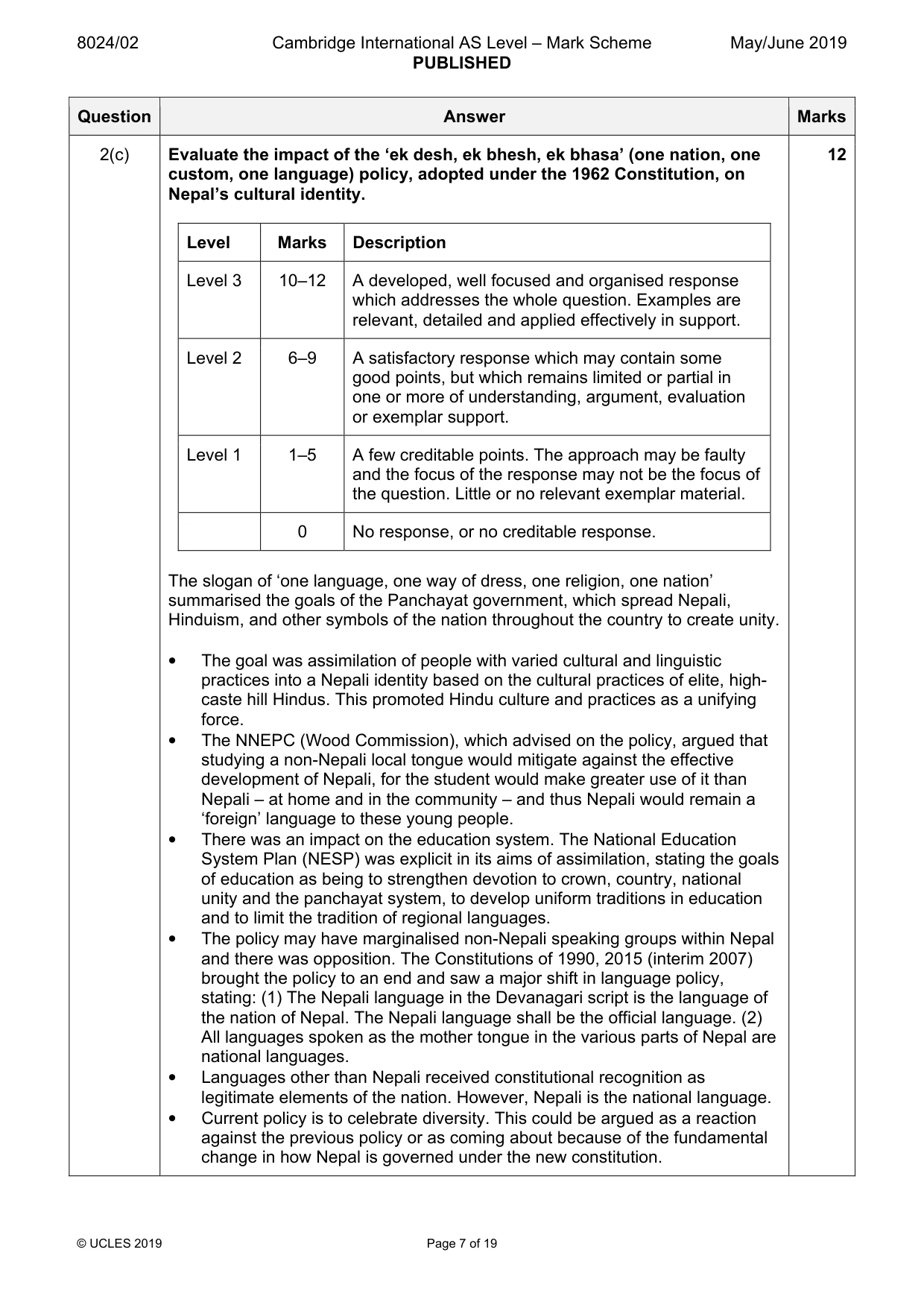
8024/02 Cambridge International AS Level – Mark Scheme PUBLISHED May/June 2019 © UCLES 2019 Page 7 of 19 Question Answer Marks 2(c) Evaluate the impact of the ‘ek desh, ek bhesh, ek bhasa’ (one nation, one custom, one language) policy, adopted under the 1962 Constitution, on Nepal’s cultural identity. Level Marks Description Level 3 10–12 A developed, well focused and organised response which addresses the whole question. Examples are relevant, detailed and applied effectively in support. Level 2 6–9 A satisfactory response which may contain some good points, but which remains limited or partial in one or more of understanding, argument, evaluation or exemplar support. Level 1 1–5 A few creditable points. The approach may be faulty and the focus of the response may not be the focus of the question. Little or no relevant exemplar material. 0 No response, or no creditable response. The slogan of ‘one language, one way of dress, one religion, one nation’ summarised the goals of the Panchayat government, which spread Nepali, Hinduism, and other symbols of the nation throughout the country to create unity. • The goal was assimilation of people with varied cultural and linguistic practices into a Nepali identity based on the cultural practices of elite, high- caste hill Hindus. This promoted Hindu culture and practices as a unifying force. • The NNEPC (Wood Commission), which advised on the policy, argued that studying a non-Nepali local tongue would mitigate against the effective development of Nepali, for the student would make greater use of it than Nepali – at home and in the community – and thus Nepali would remain a ‘foreign’ language to these young people. • There was an impact on the education system. The National Education System Plan (NESP) was explicit in its aims of assimilation, stating the goals of education as being to strengthen devotion to crown, country, national unity and the panchayat system, to develop uniform traditions in education and to limit the tradition of regional languages. • The policy may have marginalised non-Nepali speaking groups within Nepal and there was opposition. The Constitutions of 1990, 2015 (interim 2007) brought the policy to an end and saw a major shift in language policy, stating: (1) The Nepali language in the Devanagari script is the language of the nation of Nepal. The Nepali language shall be the official language. (2) All languages spoken as the mother tongue in the various parts of Nepal are national languages. • Languages other than Nepali received constitutional recognition as legitimate elements of the nation. However, Nepali is the national language. • Current policy is to celebrate diversity. This could be argued as a reaction against the previous policy or as coming about because of the fundamental change in how Nepal is governed under the new constitution. 12
Mark scheme, page 8
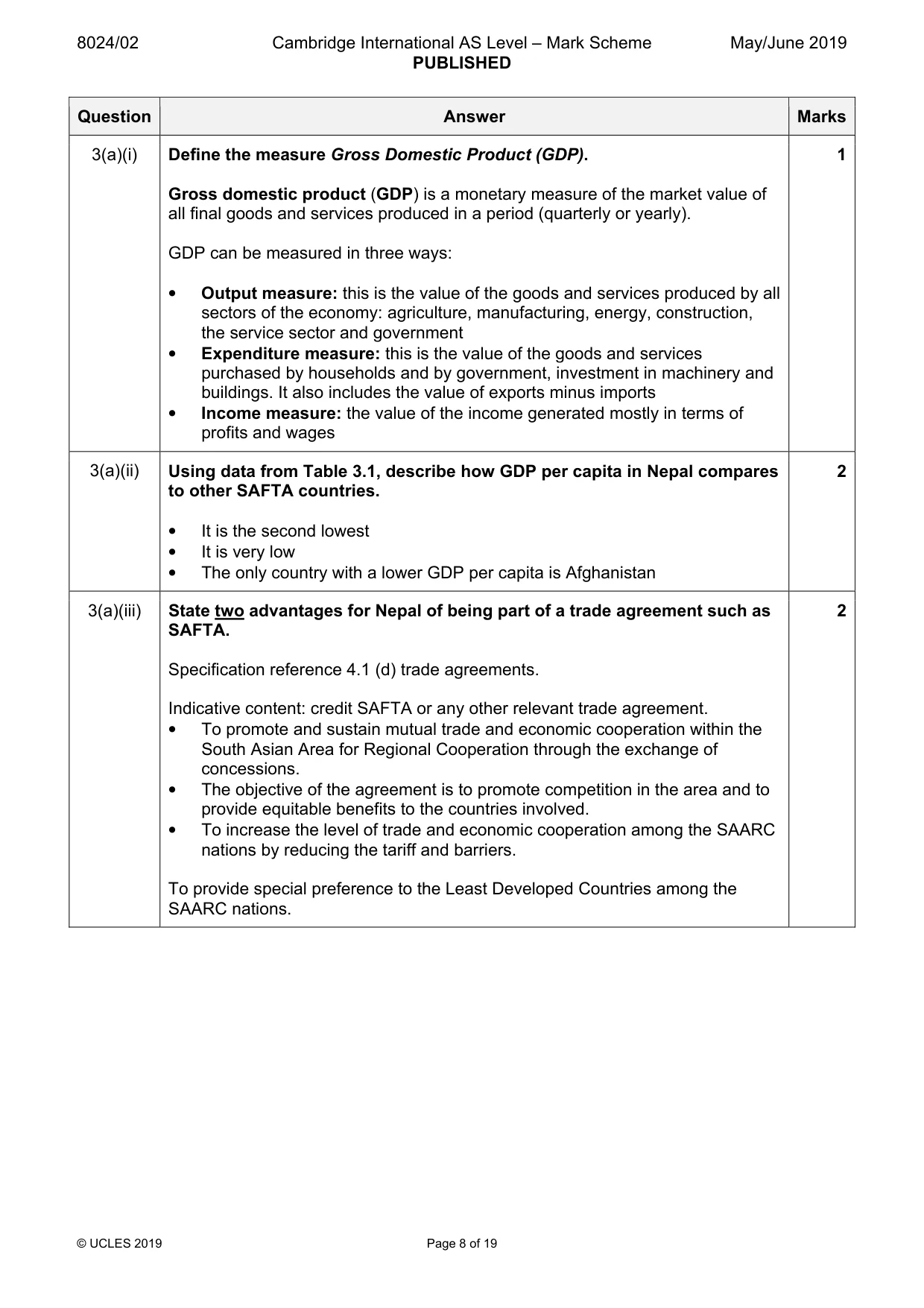
8024/02 Cambridge International AS Level – Mark Scheme PUBLISHED May/June 2019 © UCLES 2019 Page 8 of 19 Question Answer Marks 3(a)(i) Define the measure Gross Domestic Product (GDP). Gross domestic product (GDP) is a monetary measure of the market value of all final goods and services produced in a period (quarterly or yearly). GDP can be measured in three ways: • Output measure: this is the value of the goods and services produced by all sectors of the economy: agriculture, manufacturing, energy, construction, the service sector and government • Expenditure measure: this is the value of the goods and services purchased by households and by government, investment in machinery and buildings. It also includes the value of exports minus imports • Income measure: the value of the income generated mostly in terms of profits and wages 1 3(a)(ii) Using data from Table 3.1, describe how GDP per capita in Nepal compares to other SAFTA countries. • It is the second lowest • It is very low • The only country with a lower GDP per capita is Afghanistan 2 3(a)(iii) State two advantages for Nepal of being part of a trade agreement such as SAFTA. Specification reference 4.1 (d) trade agreements. Indicative content: credit SAFTA or any other relevant trade agreement. • To promote and sustain mutual trade and economic cooperation within the South Asian Area for Regional Cooperation through the exchange of concessions. • The objective of the agreement is to promote competition in the area and to provide equitable benefits to the countries involved. • To increase the level of trade and economic cooperation among the SAARC nations by reducing the tariff and barriers. To provide special preference to the Least Developed Countries among the SAARC nations. 2
Mark scheme, page 9
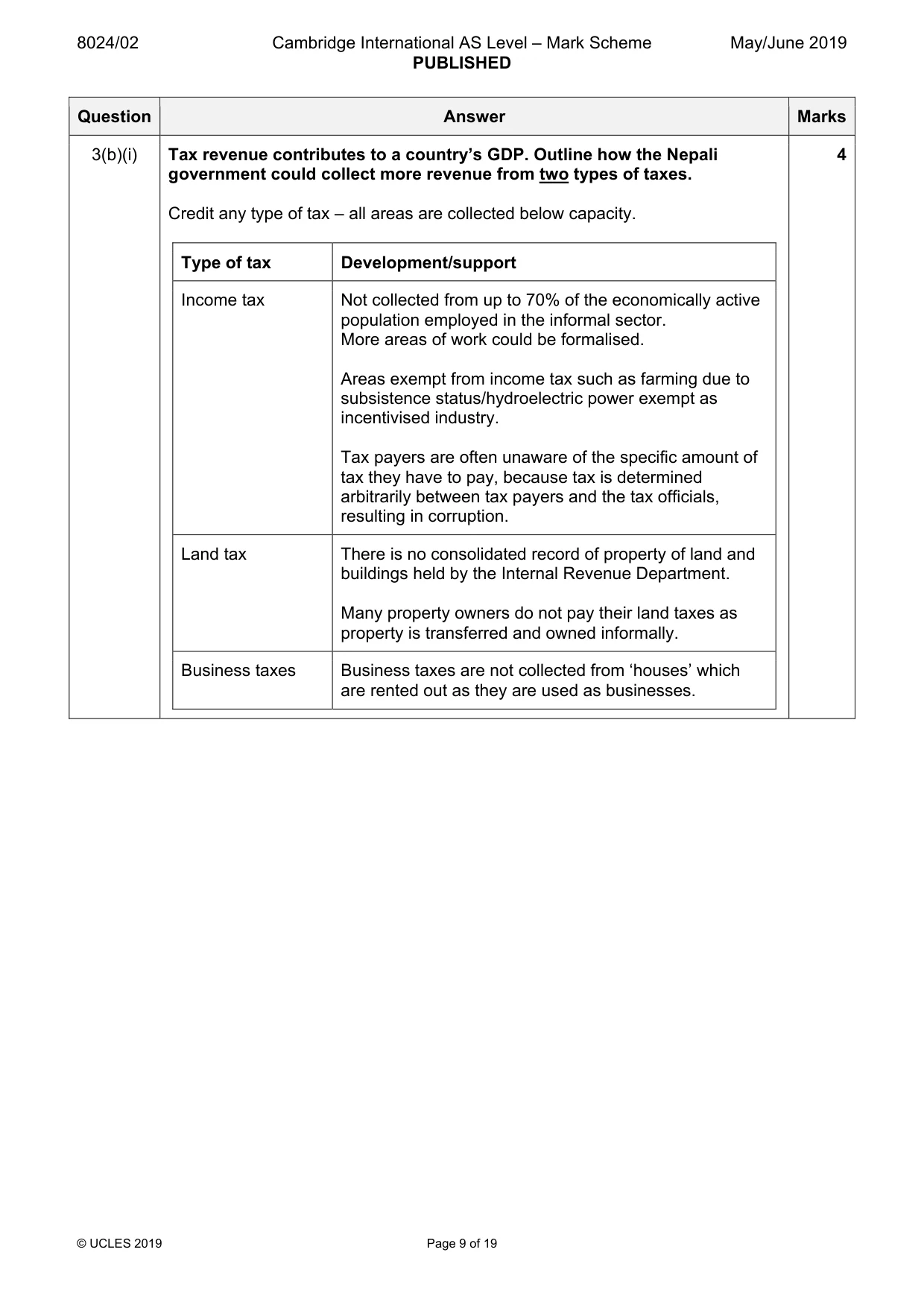
8024/02 Cambridge International AS Level – Mark Scheme PUBLISHED May/June 2019 © UCLES 2019 Page 9 of 19 Question Answer Marks 3(b)(i) Tax revenue contributes to a country’s GDP. Outline how the Nepali government could collect more revenue from two types of taxes. Credit any type of tax – all areas are collected below capacity. Type of tax Development/support Income tax Not collected from up to 70% of the economically active population employed in the informal sector. More areas of work could be formalised. Areas exempt from income tax such as farming due to subsistence status/hydroelectric power exempt as incentivised industry. Tax payers are often unaware of the specific amount of tax they have to pay, because tax is determined arbitrarily between tax payers and the tax officials, resulting in corruption. Land tax There is no consolidated record of property of land and buildings held by the Internal Revenue Department. Many property owners do not pay their land taxes as property is transferred and owned informally. Business taxes Business taxes are not collected from ‘houses’ which are rented out as they are used as businesses. 4
Mark scheme, page 10
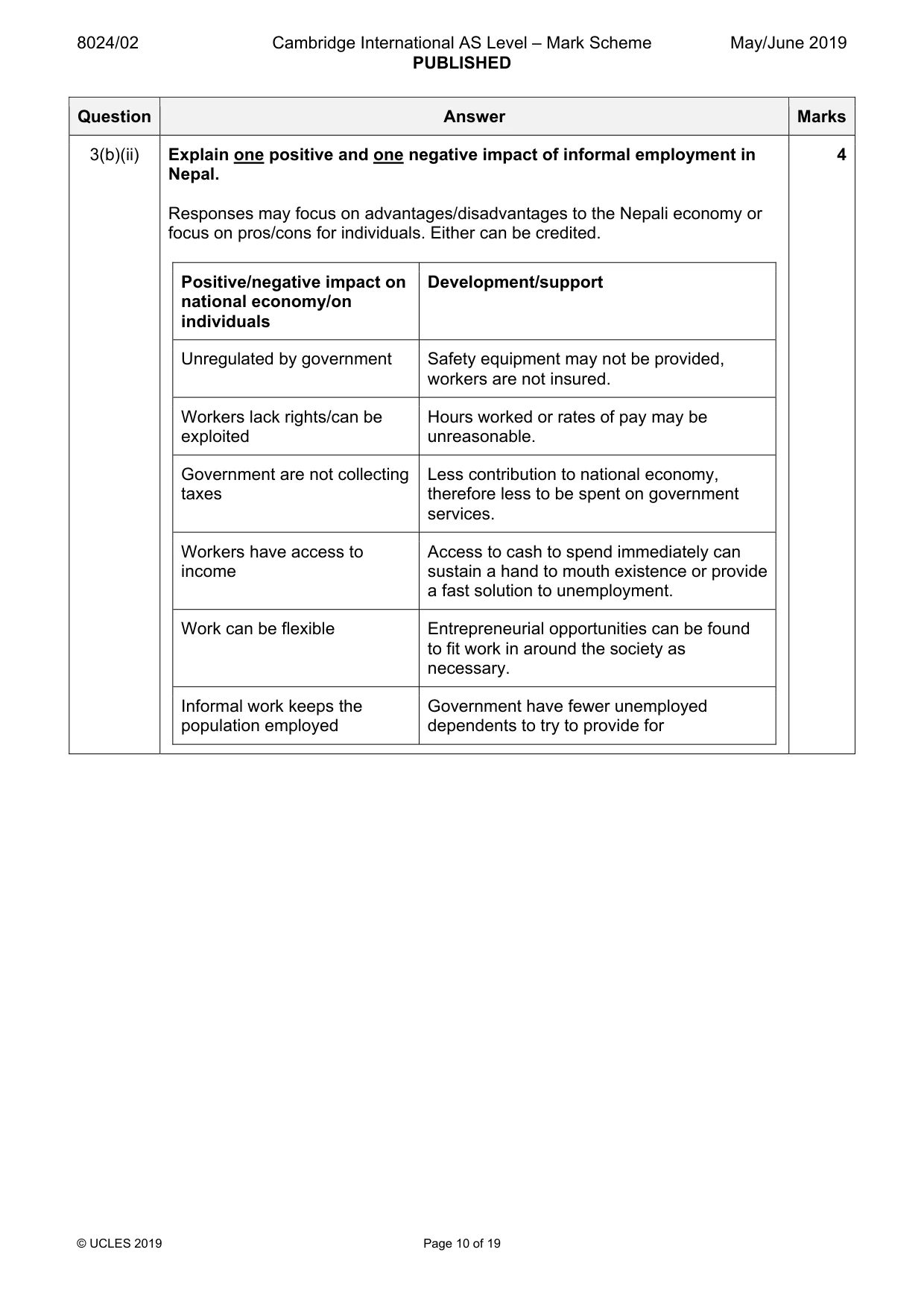
8024/02 Cambridge International AS Level – Mark Scheme PUBLISHED May/June 2019 © UCLES 2019 Page 10 of 19 Question Answer Marks 3(b)(ii) Explain one positive and one negative impact of informal employment in Nepal. Responses may focus on advantages/disadvantages to the Nepali economy or focus on pros/cons for individuals. Either can be credited. Positive/negative impact on national economy/on individuals Development/support Unregulated by government Safety equipment may not be provided, workers are not insured. Workers lack rights/can be exploited Hours worked or rates of pay may be unreasonable. Government are not collecting taxes Less contribution to national economy, therefore less to be spent on government services. Workers have access to income Access to cash to spend immediately can sustain a hand to mouth existence or provide a fast solution to unemployment. Work can be flexible Entrepreneurial opportunities can be found to fit work in around the society as necessary. Informal work keeps the population employed Government have fewer unemployed dependents to try to provide for 4
Mark scheme, page 11
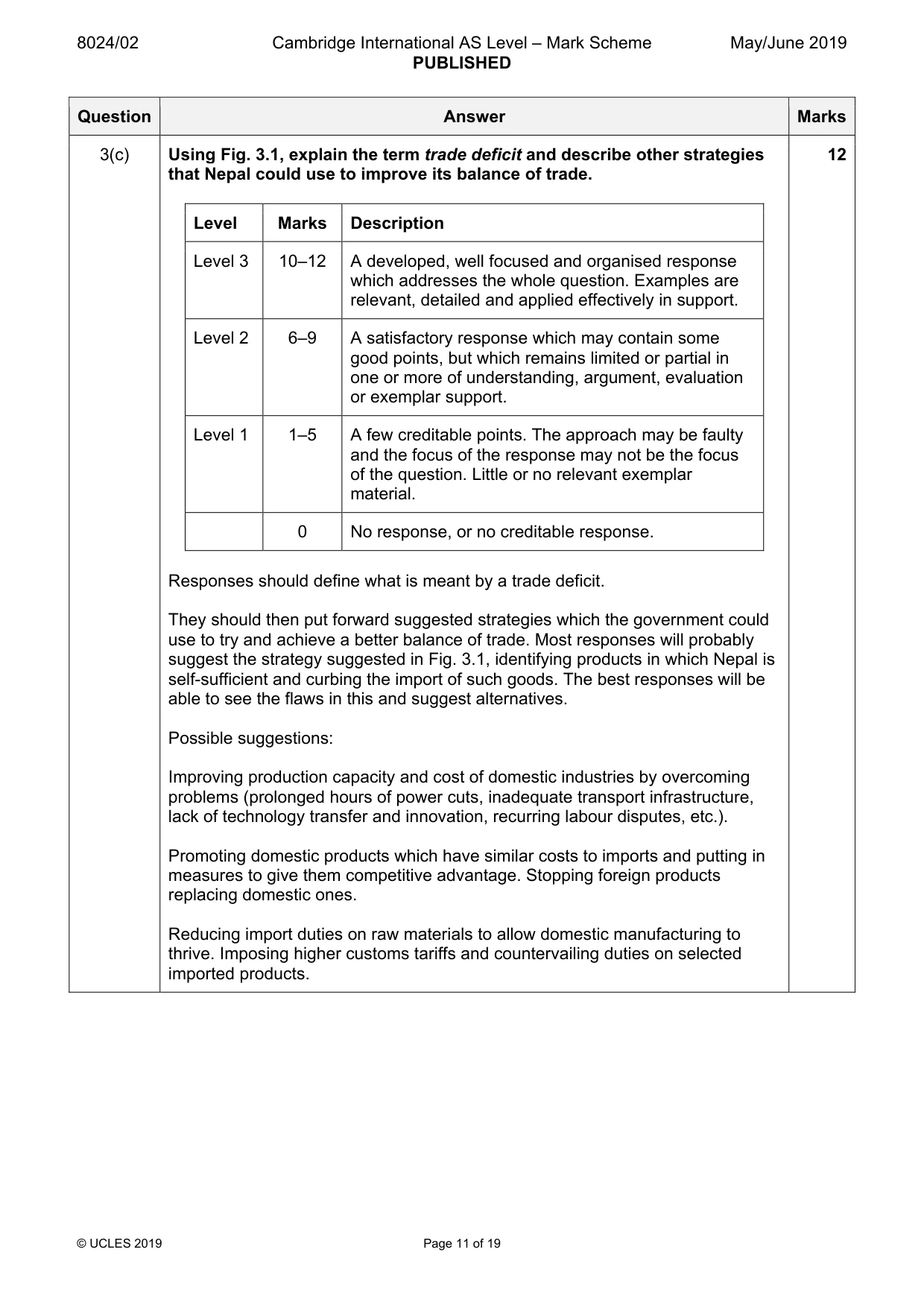
8024/02 Cambridge International AS Level – Mark Scheme PUBLISHED May/June 2019 © UCLES 2019 Page 11 of 19 Question Answer Marks 3(c) Using Fig. 3.1, explain the term trade deficit and describe other strategies that Nepal could use to improve its balance of trade. Level Marks Description Level 3 10–12 A developed, well focused and organised response which addresses the whole question. Examples are relevant, detailed and applied effectively in support. Level 2 6–9 A satisfactory response which may contain some good points, but which remains limited or partial in one or more of understanding, argument, evaluation or exemplar support. Level 1 1–5 A few creditable points. The approach may be faulty and the focus of the response may not be the focus of the question. Little or no relevant exemplar material. 0 No response, or no creditable response. Responses should define what is meant by a trade deficit. They should then put forward suggested strategies which the government could use to try and achieve a better balance of trade. Most responses will probably suggest the strategy suggested in Fig. 3.1, identifying products in which Nepal is self-sufficient and curbing the import of such goods. The best responses will be able to see the flaws in this and suggest alternatives. Possible suggestions: Improving production capacity and cost of domestic industries by overcoming problems (prolonged hours of power cuts, inadequate transport infrastructure, lack of technology transfer and innovation, recurring labour disputes, etc.). Promoting domestic products which have similar costs to imports and putting in measures to give them competitive advantage. Stopping foreign products replacing domestic ones. Reducing import duties on raw materials to allow domestic manufacturing to thrive. Imposing higher customs tariffs and countervailing duties on selected imported products. 12
Mark scheme, page 12
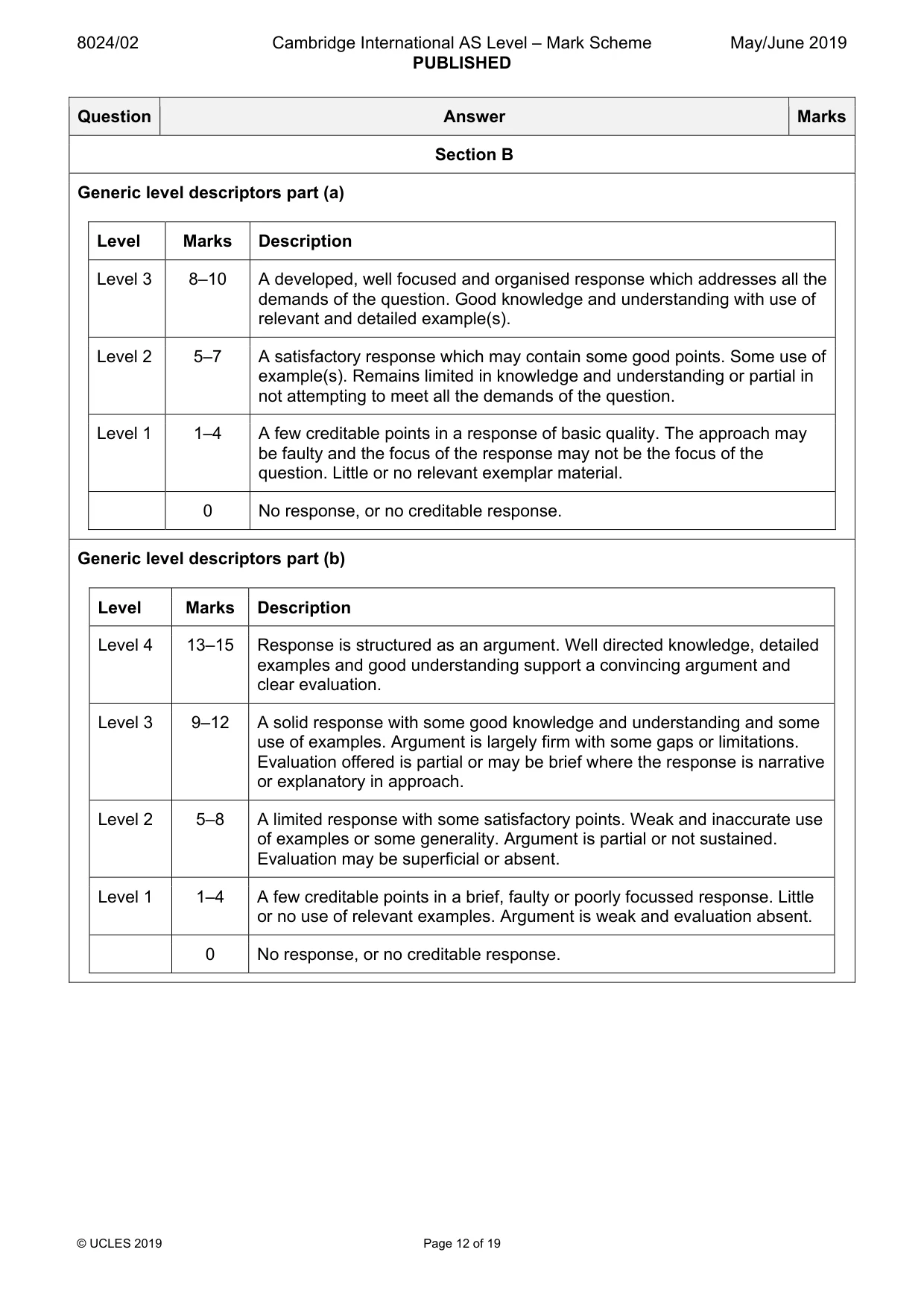
8024/02 Cambridge International AS Level – Mark Scheme PUBLISHED May/June 2019 © UCLES 2019 Page 12 of 19 Question Answer Marks Section B Generic level descriptors part (a) Level Marks Description Level 3 8–10 A developed, well focused and organised response which addresses all the demands of the question. Good knowledge and understanding with use of relevant and detailed example(s). Level 2 5–7 A satisfactory response which may contain some good points. Some use of example(s). Remains limited in knowledge and understanding or partial in not attempting to meet all the demands of the question. Level 1 1–4 A few creditable points in a response of basic quality. The approach may be faulty and the focus of the response may not be the focus of the question. Little or no relevant exemplar material. 0 No response, or no creditable response. Generic level descriptors part (b) Level Marks Description Level 4 13–15 Response is structured as an argument. Well directed knowledge, detailed examples and good understanding support a convincing argument and clear evaluation. Level 3 9–12 A solid response with some good knowledge and understanding and some use of examples. Argument is largely firm with some gaps or limitations. Evaluation offered is partial or may be brief where the response is narrative or explanatory in approach. Level 2 5–8 A limited response with some satisfactory points. Weak and inaccurate use of examples or some generality. Argument is partial or not sustained. Evaluation may be superficial or absent. Level 1 1–4 A few creditable points in a brief, faulty or poorly focussed response. Little or no use of relevant examples. Argument is weak and evaluation absent. 0 No response, or no creditable response.
Mark scheme, page 13
8024/02 Cambridge International AS Level – Mark Scheme PUBLISHED May/June 2019 © UCLES 2019 Page 13 of 19 Question Answer Marks 4(a) Habitat loss is a major threat to wildlife conservation. Describe how endangered species are threatened by human activity in Nepal. Responses should focus on examples of endangered species which have been studied, e.g. snow leopard, rhinoceros, red panda, etc., and the habitats in which they live. Responses should describe a variety of human activities which are the cause of habitat loss and the ways in which the species are impacted such as: • Urbanisation • Road building • Poaching • Primary industry • Tourism • Illegal trade in endangered species • Use of animals in Chinese medicine The best responses will show contrasting impacts and discuss the difficulties of managing human activity in order that wildlife conservation can be achieved alongside population growth and economic development. 10
Mark scheme, page 14
8024/02 Cambridge International AS Level – Mark Scheme PUBLISHED May/June 2019 © UCLES 2019 Page 14 of 19 Question Answer Marks 4(b) ‘Nepal cannot escape the increasing influence of global climate change.’ How far do you agree? Answer with reference to examples. Responses should describe some of the impacts of climate change seen in Nepal. Responses may refer to the causes of climate change, referring to the growth of industry, settlement and economic development in Nepal and/or in other countries such as those which contribute more greenhouse gases such as China, India or USA. Responses may agree that to an extent Nepal is powerless to escape the impacts of climate change but should offer possible approaches for adaptation to climate change, which Nepal could adopt. Indicative content – impacts • Rapid rise in temperature (>0.06 °C) – link to agriculture/changed crop production e.g. orange farming or reduced wheat production/link to increase in water borne infectious diseases, e.g. diarrhoea or cholera • Retreating glaciers (average retreat of more than 30 m/year) – link to flooding/link to river levels for water supply/link to hydroelectric power • Erratic rainfall/delayed monsoon – link to agriculture/reduced productivity/crop failure/food security • Increase in frequency of natural hazards such as avalanches, floods or drought – link to food security/emergency management/health/tourism, etc. • Water scarcity – link to health/wells, water spouts or ponds drying up • Reduced snow on mountains – link to loss of tourism in future Indicative content – other, larger contributors to greenhouse gases • China and India are the world’s most populous countries and have fast growing economies • China is the highest consumer of coal in the world and the highest emitter of greenhouse gases. India is the fourth largest contributor of greenhouse gases after China, USA and the EU • Per capita emissions are still low for both China and India compared to all developed countries, e.g. USA • Some governments have been slow to adopt greener technology, e.g. to reduce sulphur dioxide emissions, e.g. USA 15
Mark scheme, page 15
8024/02 Cambridge International AS Level – Mark Scheme PUBLISHED May/June 2019 © UCLES 2019 Page 15 of 19 Question Answer Marks 4(b) Indicative content – climate change adaptation approaches • Climate changes not only make Nepal’s major sectors of economy such as agriculture, tourism and energy more vulnerable but also endanger the health, safety and wellbeing of Nepali people • Nepal is largely a mountainous country and current indications are that the mountain regions are more vulnerable due to increased warming trends • Nepal published a National Action Plan on Adaptation (NAPA) in 2010. Projects have been identified as urgent and immediate national adaptation priorities • Promoting community-based adaptation through integrated management of agriculture, water, forest and biodiversity • Building and enhancing adaptive capacity of vulnerable communities through agriculture development • Community-based disaster management such as GLOF Monitoring. Empowering vulnerable communities through sustainable management of water resources and green energy support Positive impacts of climate change may be suggested in some responses, such as increased yields in some cash crops, e.g. oranges.
Mark scheme, page 16
8024/02 Cambridge International AS Level – Mark Scheme PUBLISHED May/June 2019 © UCLES 2019 Page 16 of 19 Question Answer Marks 5(a) The average life expectancy of the Nepali people has risen from around 40 years in 1970 to 69 years in 2014. Outline the reasons for this change. Nepal has made dramatic progress in increasing the average life expectancy of its citizens. Nepal has now overtaken other South Asian countries and has the second highest life expectancy in the region after Sri Lanka. In a recent study, Nepal is among the top ten countries to have dramatically improved life expectancy. Indicative content: • Life expectancy goes up if the mortality rate decreases in proportion with the birth rate. Nepal has significantly lowered maternal and under-five mortality rates (achieving two of their MDGs ahead of schedule in the process). • Maternal mortality rates have dropped to 170 in every 100 000 from 880 per 100 000 compared to 20 years ago. Improved literacy and access to healthcare has contributed to this trend. • Infant mortality has declined. In the 1990s, 150 out of 1000 children died before they reached the age of five. That figure has dropped to 54 out of 1000 today. Better maternal health is one reason for this. Health programmes such as NIP have also been significant. • The growth in life expectancy is also a result of Nepal’s dramatically decreasing fertility rate, which is now at just 2.5 – down from nearly 6 in 1990. Changing work and marriage patterns may also have contributed to this trend. • Preventing deaths from curable disease is also a factor. Nepal has doubled its healthcare spending since 1990 and this has led to a decrease in deaths from diseases such as TB, pneumonia and diarrhoea. • An increase in per capita income means Nepalis can buy healthier food and afford medical care. This means they are likely to become ill less frequently, have better chances of survival if they do become ill and therefore live longer. 10
Mark scheme, page 17
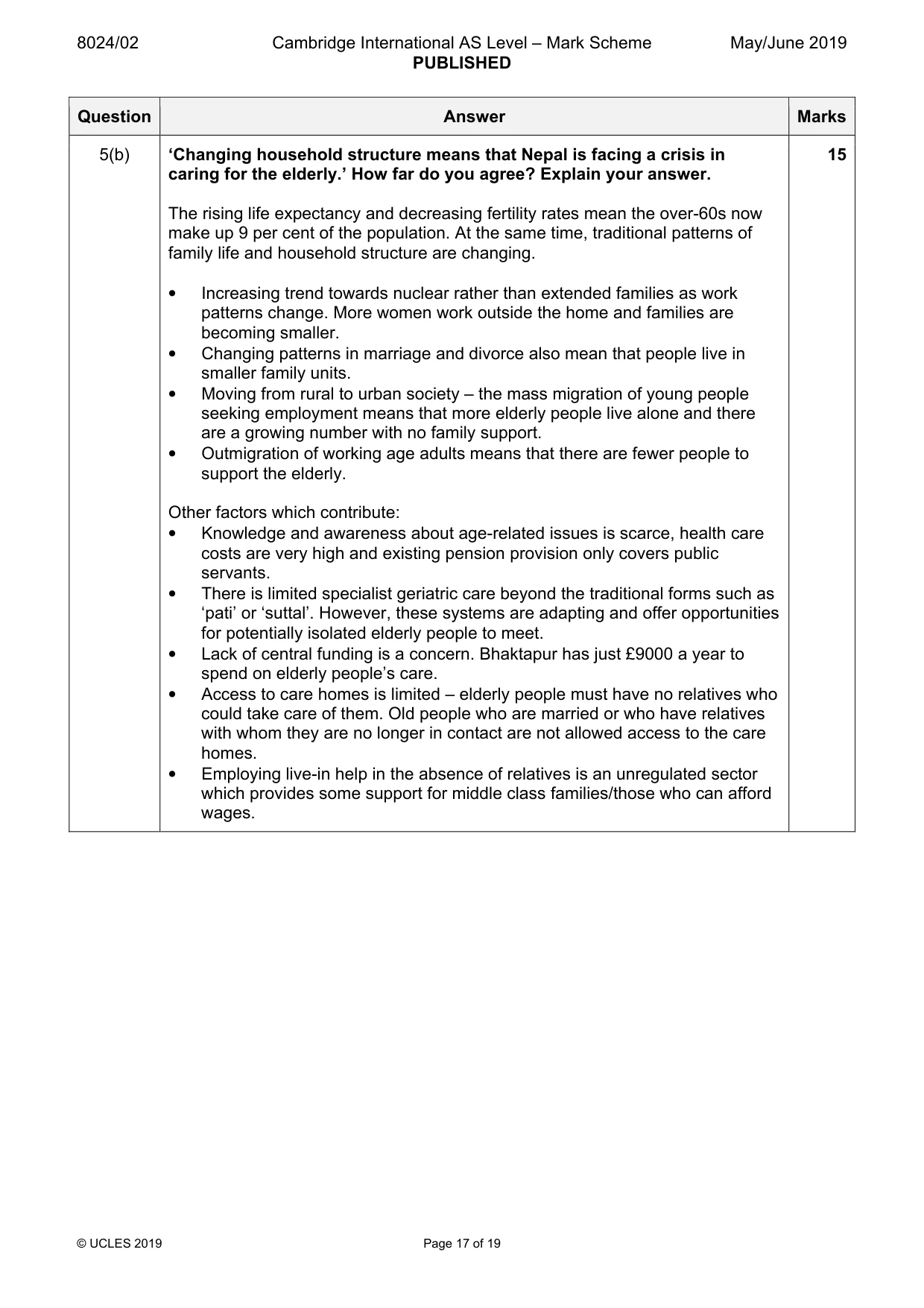
8024/02 Cambridge International AS Level – Mark Scheme PUBLISHED May/June 2019 © UCLES 2019 Page 17 of 19 Question Answer Marks 5(b) ‘Changing household structure means that Nepal is facing a crisis in caring for the elderly.’ How far do you agree? Explain your answer. The rising life expectancy and decreasing fertility rates mean the over-60s now make up 9 per cent of the population. At the same time, traditional patterns of family life and household structure are changing. • Increasing trend towards nuclear rather than extended families as work patterns change. More women work outside the home and families are becoming smaller. • Changing patterns in marriage and divorce also mean that people live in smaller family units. • Moving from rural to urban society – the mass migration of young people seeking employment means that more elderly people live alone and there are a growing number with no family support. • Outmigration of working age adults means that there are fewer people to support the elderly. Other factors which contribute: • Knowledge and awareness about age-related issues is scarce, health care costs are very high and existing pension provision only covers public servants. • There is limited specialist geriatric care beyond the traditional forms such as ‘pati’ or ‘suttal’. However, these systems are adapting and offer opportunities for potentially isolated elderly people to meet. • Lack of central funding is a concern. Bhaktapur has just £9000 a year to spend on elderly people’s care. • Access to care homes is limited – elderly people must have no relatives who could take care of them. Old people who are married or who have relatives with whom they are no longer in contact are not allowed access to the care homes. • Employing live-in help in the absence of relatives is an unregulated sector which provides some support for middle class families/those who can afford wages. 15
Mark scheme, page 18
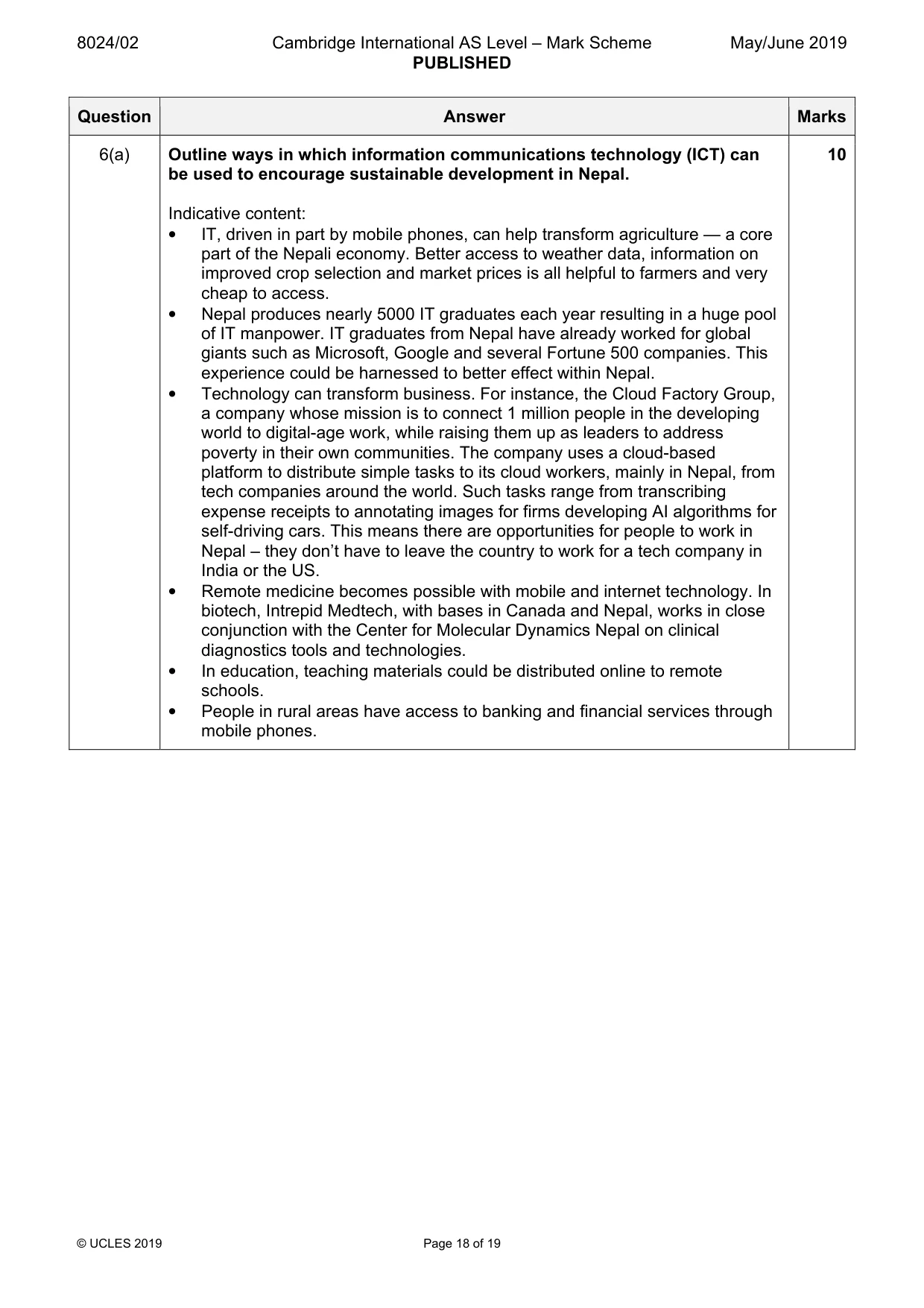
8024/02 Cambridge International AS Level – Mark Scheme PUBLISHED May/June 2019 © UCLES 2019 Page 18 of 19 Question Answer Marks 6(a) Outline ways in which information communications technology (ICT) can be used to encourage sustainable development in Nepal. Indicative content: • IT, driven in part by mobile phones, can help transform agriculture — a core part of the Nepali economy. Better access to weather data, information on improved crop selection and market prices is all helpful to farmers and very cheap to access. • Nepal produces nearly 5000 IT graduates each year resulting in a huge pool of IT manpower. IT graduates from Nepal have already worked for global giants such as Microsoft, Google and several Fortune 500 companies. This experience could be harnessed to better effect within Nepal. • Technology can transform business. For instance, the Cloud Factory Group, a company whose mission is to connect 1 million people in the developing world to digital-age work, while raising them up as leaders to address poverty in their own communities. The company uses a cloud-based platform to distribute simple tasks to its cloud workers, mainly in Nepal, from tech companies around the world. Such tasks range from transcribing expense receipts to annotating images for firms developing AI algorithms for self-driving cars. This means there are opportunities for people to work in Nepal – they don’t have to leave the country to work for a tech company in India or the US. • Remote medicine becomes possible with mobile and internet technology. In biotech, Intrepid Medtech, with bases in Canada and Nepal, works in close conjunction with the Center for Molecular Dynamics Nepal on clinical diagnostics tools and technologies. • In education, teaching materials could be distributed online to remote schools. • People in rural areas have access to banking and financial services through mobile phones. 10
Mark scheme, page 19
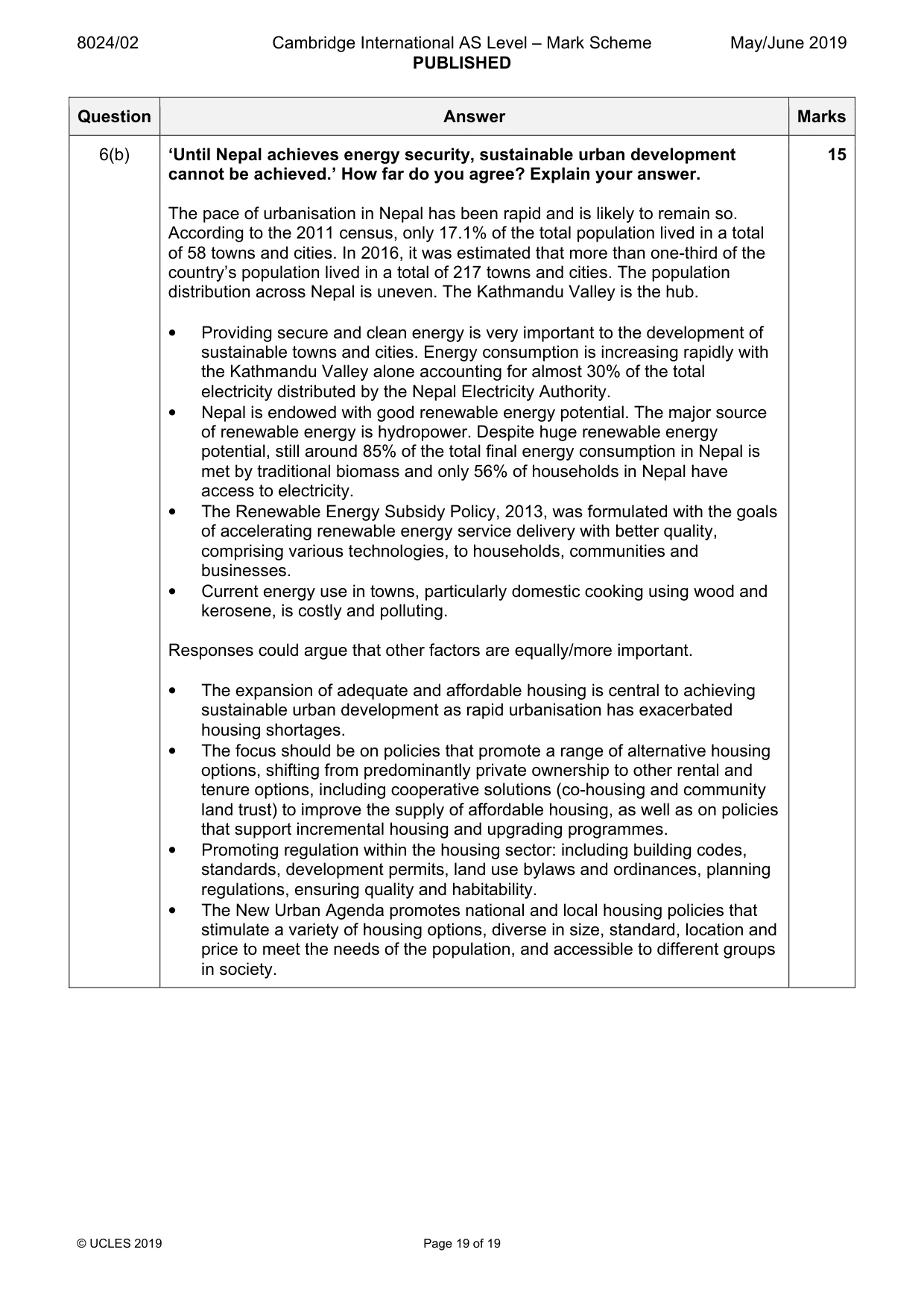
8024/02 Cambridge International AS Level – Mark Scheme PUBLISHED May/June 2019 © UCLES 2019 Page 19 of 19 Question Answer Marks 6(b) ‘Until Nepal achieves energy security, sustainable urban development cannot be achieved.’ How far do you agree? Explain your answer. The pace of urbanisation in Nepal has been rapid and is likely to remain so. According to the 2011 census, only 17.1% of the total population lived in a total of 58 towns and cities. In 2016, it was estimated that more than one-third of the country’s population lived in a total of 217 towns and cities. The population distribution across Nepal is uneven. The Kathmandu Valley is the hub. • Providing secure and clean energy is very important to the development of sustainable towns and cities. Energy consumption is increasing rapidly with the Kathmandu Valley alone accounting for almost 30% of the total electricity distributed by the Nepal Electricity Authority. • Nepal is endowed with good renewable energy potential. The major source of renewable energy is hydropower. Despite huge renewable energy potential, still around 85% of the total final energy consumption in Nepal is met by traditional biomass and only 56% of households in Nepal have access to electricity. • The Renewable Energy Subsidy Policy, 2013, was formulated with the goals of accelerating renewable energy service delivery with better quality, comprising various technologies, to households, communities and businesses. • Current energy use in towns, particularly domestic cooking using wood and kerosene, is costly and polluting. Responses could argue that other factors are equally/more important. • The expansion of adequate and affordable housing is central to achieving sustainable urban development as rapid urbanisation has exacerbated housing shortages. • The focus should be on policies that promote a range of alternative housing options, shifting from predominantly private ownership to other rental and tenure options, including cooperative solutions (co-housing and community land trust) to improve the supply of affordable housing, as well as on policies that support incremental housing and upgrading programmes. • Promoting regulation within the housing sector: including building codes, standards, development permits, land use bylaws and ordinances, planning regulations, ensuring quality and habitability. • The New Urban Agenda promotes national and local housing policies that stimulate a variety of housing options, diverse in size, standard, location and price to meet the needs of the population, and accessible to different groups in society. 15
What you needed in this session
Cambridge’s own grade thresholds for 2019 May/June, Paper 2 · Variant 1. A higher threshold means an easier paper — the bar moves with how the cohort did.