Cambridge A Level Nepal Studies (AS Level only) 8024 — 2017 May/June Paper 2 · Variant 1
8024/21/M/J/17 · 75 marks · ≈84 min
The question paper and its mark scheme, free to read here and free to download. This is Cambridge’s own paper, exactly as it was sat.
Question paper8 pages



Mark scheme19 pages
Answers below. Sit the paper first if you are practising.
Paper as text
Question paper, page 1
* 4 3 6 0 8 6 2 7 2 1 * This document consists of 5 printed pages and 3 blank pages. DC (LK/SG) 138231/4 © UCLES 2017 [Turn over Cambridge International Examinations Cambridge International Advanced Subsidiary Level NEPAL STUDIES 8024/02 Paper 2 Written Paper May/June 2017 1 hour 45 minutes No Additional Materials are required. READ THESE INSTRUCTIONS FIRST An answer booklet is provided inside this question paper. You should follow the instructions on the front cover of the answer booklet. If you need additional answer paper ask the invigilator for a continuation booklet. Section A Answer any two questions. You must answer parts (a), (b) and (c) of the questions that you choose. Section B Answer any one question. You must answer parts (a) and (b) of the question that you choose. The number of marks is given in brackets [ ] at the end of each question or part question.
Question paper, page 2
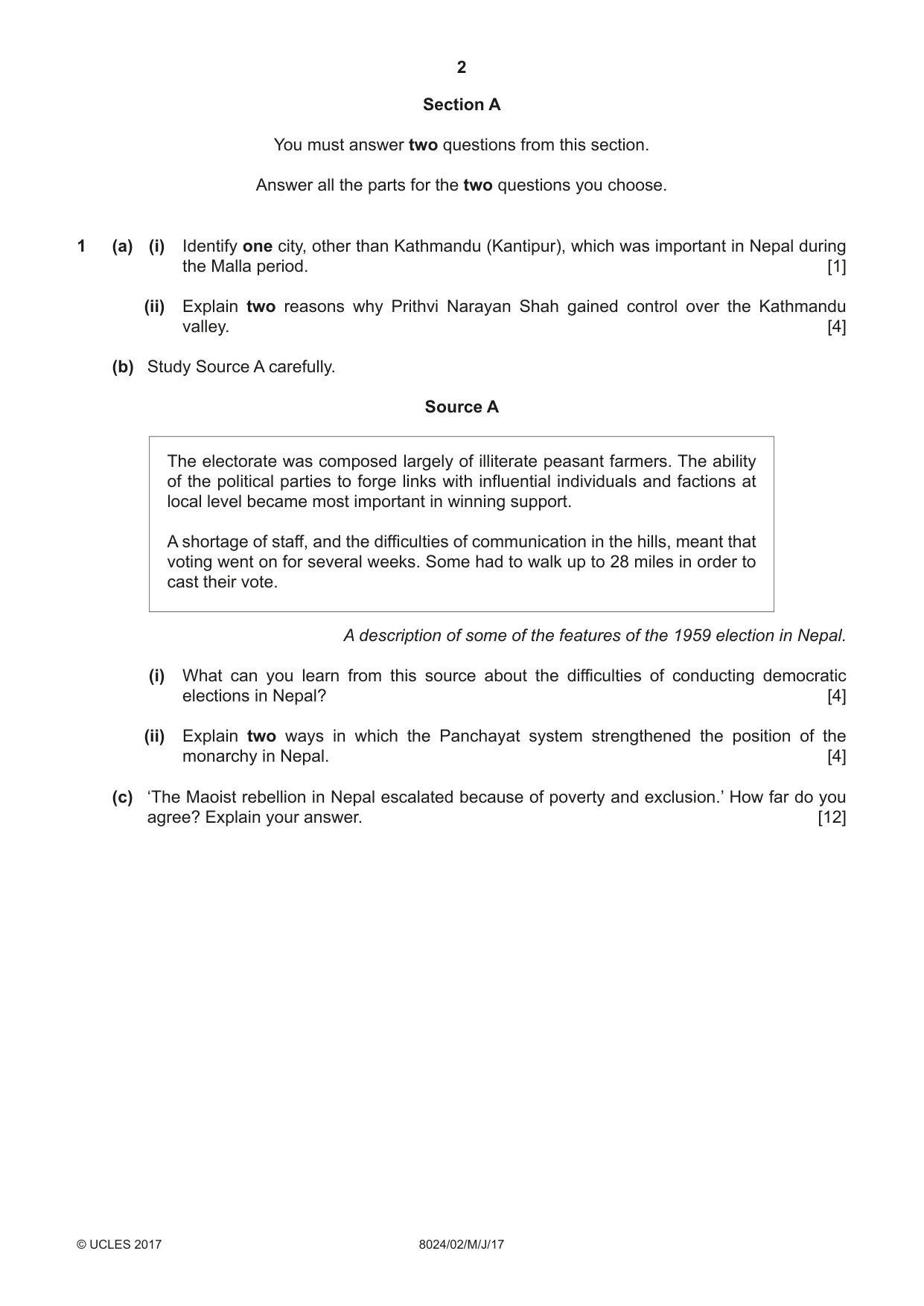
2 8024/02/M/J/17 © UCLES 2017 Section A You must answer two questions from this section. Answer all the parts for the two questions you choose. 1 (a) (i) Identify one city, other than Kathmandu (Kantipur), which was important in Nepal during the Malla period. [1] (ii) Explain two reasons why Prithvi Narayan Shah gained control over the Kathmandu valley. [4] (b) Study Source A carefully. Source A The electorate was composed largely of illiterate peasant farmers. The ability of the political parties to forge links with influential individuals and factions at local level became most important in winning support. A shortage of staff, and the difficulties of communication in the hills, meant that voting went on for several weeks. Some had to walk up to 28 miles in order to cast their vote. A description of some of the features of the 1959 election in Nepal. (i) What can you learn from this source about the difficulties of conducting democratic elections in Nepal? [4] (ii) Explain two ways in which the Panchayat system strengthened the position of the monarchy in Nepal. [4] (c) ‘The Maoist rebellion in Nepal escalated because of poverty and exclusion.’ How far do you agree? Explain your answer. [12]
Question paper, page 3
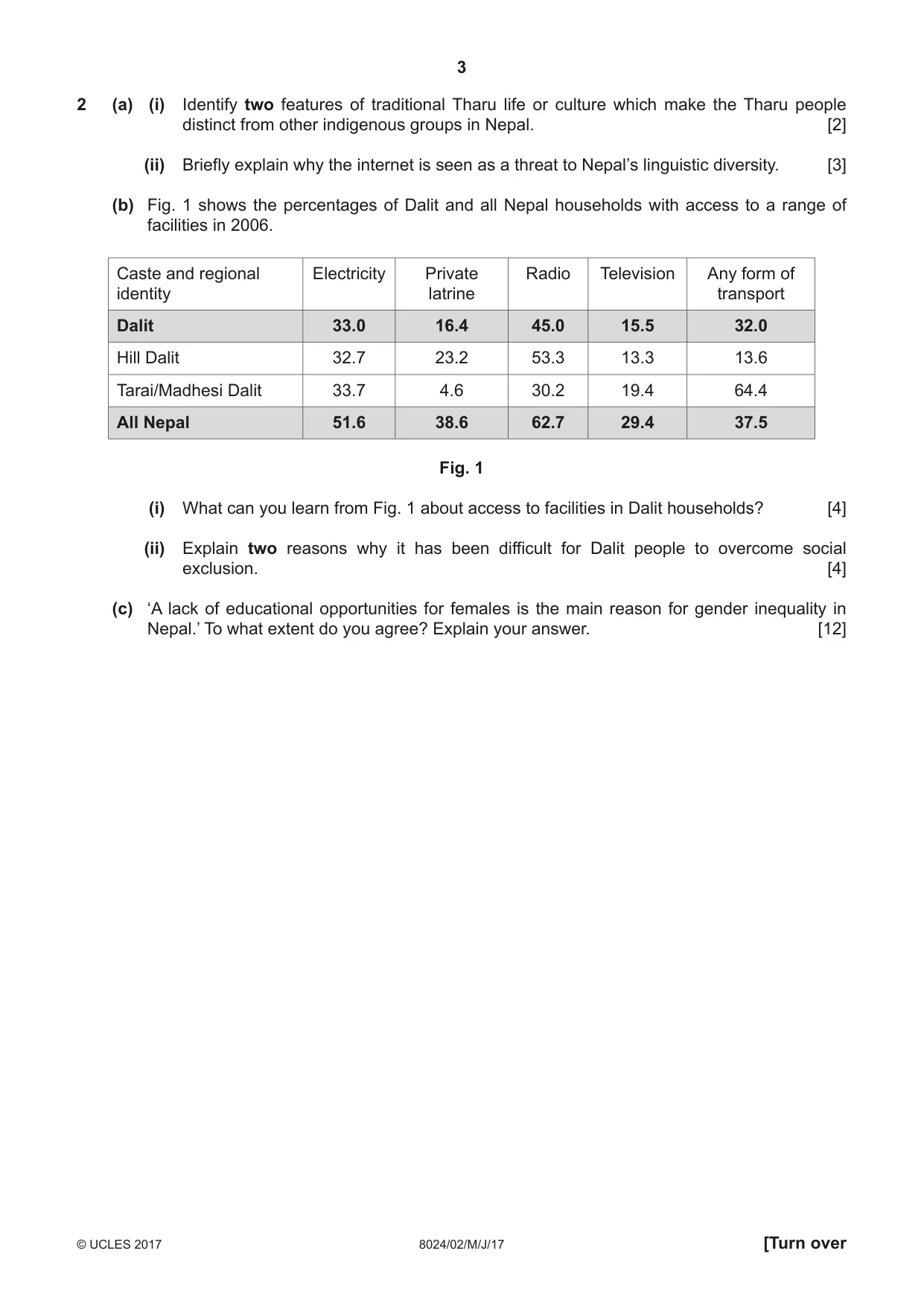
3 8024/02/M/J/17 © UCLES 2017 [Turn over 2 (a) (i) Identify two features of traditional Tharu life or culture which make the Tharu people distinct from other indigenous groups in Nepal. [2] (ii) Briefly explain why the internet is seen as a threat to Nepal’s linguistic diversity. [3] (b) Fig. 1 shows the percentages of Dalit and all Nepal households with access to a range of facilities in 2006. Caste and regional identity Electricity Private latrine Radio Television Any form of transport Dalit 33.0 16.4 45.0 15.5 32.0 Hill Dalit 32.7 23.2 53.3 13.3 13.6 Tarai/Madhesi Dalit 33.7 4.6 30.2 19.4 64.4 All Nepal 51.6 38.6 62.7 29.4 37.5 Fig. 1 (i) What can you learn from Fig. 1 about access to facilities in Dalit households? [4] (ii) Explain two reasons why it has been difficult for Dalit people to overcome social exclusion. [4] (c) ‘A lack of educational opportunities for females is the main reason for gender inequality in Nepal.’ To what extent do you agree? Explain your answer. [12]
Question paper, page 4
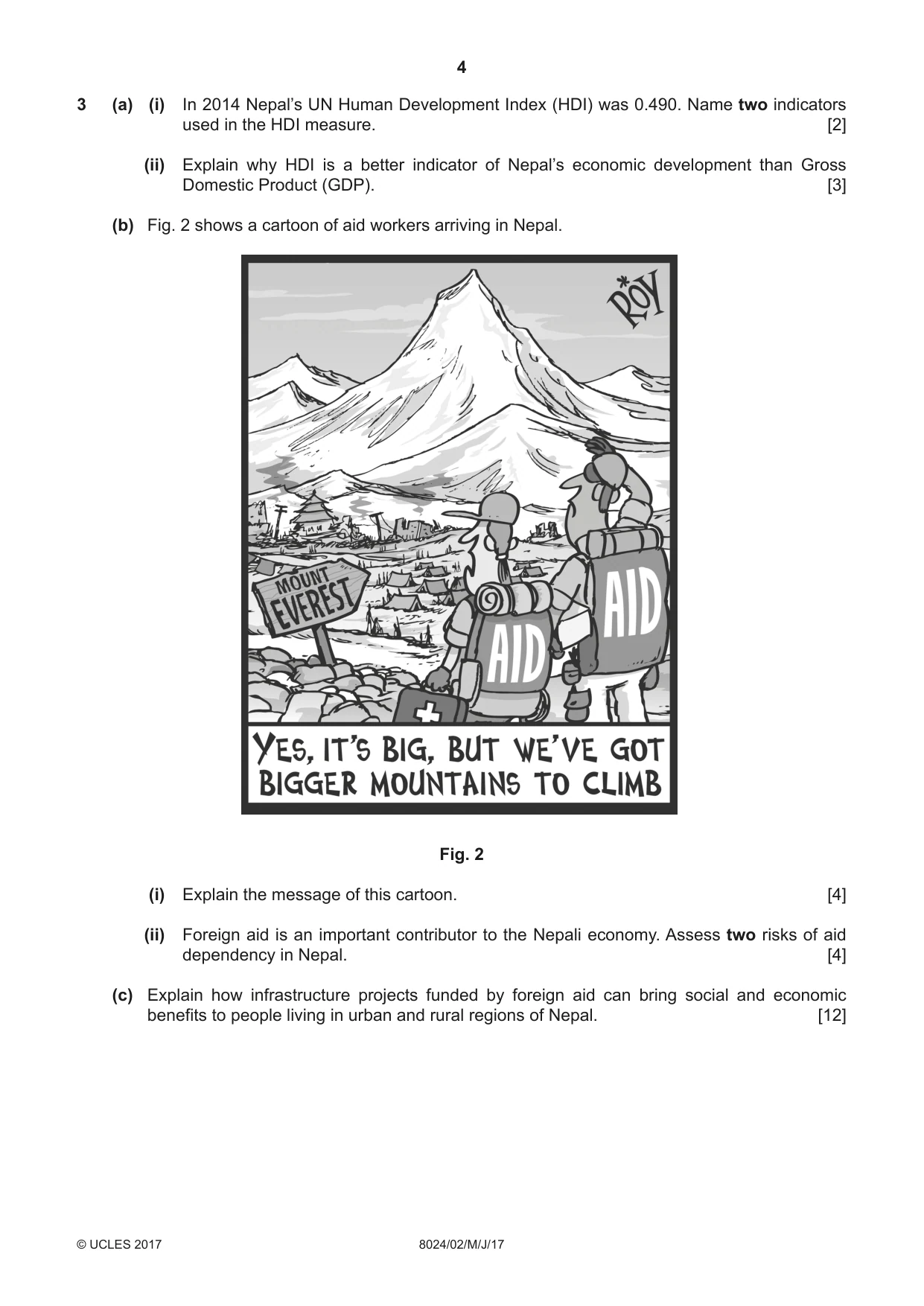
4 8024/02/M/J/17 © UCLES 2017 3 (a) (i) In 2014 Nepal’s UN Human Development Index (HDI) was 0.490. Name two indicators used in the HDI measure. [2] (ii) Explain why HDI is a better indicator of Nepal’s economic development than Gross Domestic Product (GDP). [3] (b) Fig. 2 shows a cartoon of aid workers arriving in Nepal. Fig. 2 (i) Explain the message of this cartoon. [4] (ii) Foreign aid is an important contributor to the Nepali economy. Assess two risks of aid dependency in Nepal. [4] (c) Explain how infrastructure projects funded by foreign aid can bring social and economic benefits to people living in urban and rural regions of Nepal. [12]
Question paper, page 5
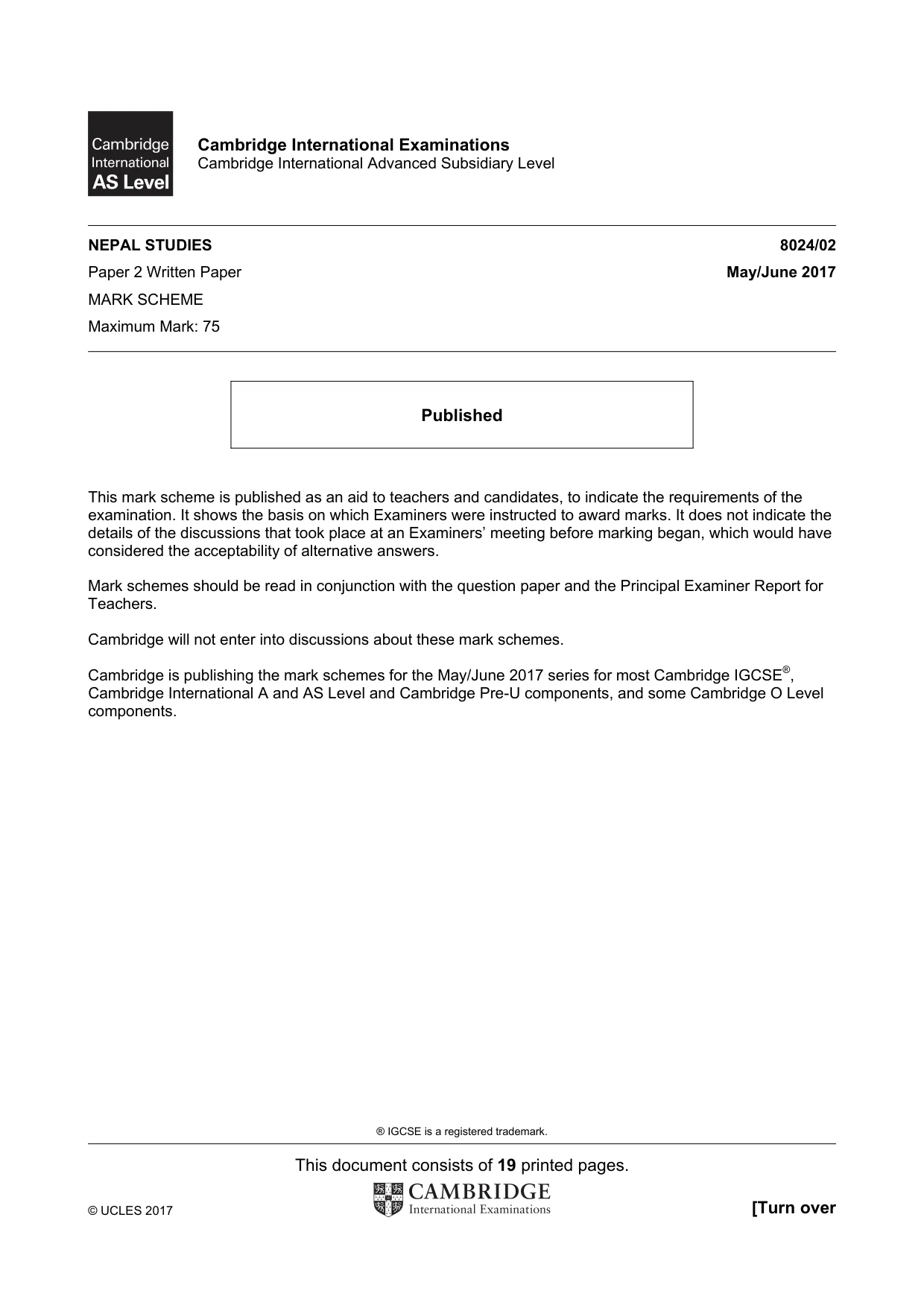
5 8024/02/M/J/17 © UCLES 2017 Section B You must answer one question from this section. Answer both parts for the question you choose. 4 (a) Describe the pressures on forest resources in Nepal and explain how forests can be managed sustainably. [10] (b) To what extent does the establishment of national parks cause conflicts of interest over the environment in Nepal? [15] 5 (a) Define cultural tourism and explain how it has been developed in Nepal. Answer with reference to examples. [10] (b) With the help of examples, assess ways in which intangible heritage can be preserved in Nepal. [15] 6 (a) Outline the reasons why agreeing a constitution for Nepal took from 2008 to 2015. [10] (b) ‘Improving relations with China is the main aim of Nepal’s foreign policy.’ How far do you agree? Explain your answer. [15]
Question paper, page 6
6 8024/02/M/J/17 © UCLES 2017 BLANK PAGE
Question paper, page 7
7 8024/02/M/J/17 © UCLES 2017 BLANK PAGE
Question paper, page 8
8 8024/02/M/J/17 © UCLES 2017 Permission to reproduce items where third-party owned material protected by copyright is included has been sought and cleared where possible. Every reasonable effort has been made by the publisher (UCLES) to trace copyright holders, but if any items requiring clearance have unwittingly been included, the publisher will be pleased to make amends at the earliest possible opportunity. To avoid the issue of disclosure of answer-related information to candidates, all copyright acknowledgements are reproduced online in the Cambridge International Examinations Copyright Acknowledgements Booklet. This is produced for each series of examinations and is freely available to download at www.cie.org.uk after the live examination series. Cambridge International Examinations is part of the Cambridge Assessment Group. Cambridge Assessment is the brand name of University of Cambridge Local Examinations Syndicate (UCLES), which is itself a department of the University of Cambridge. BLANK PAGE
Mark scheme, page 1
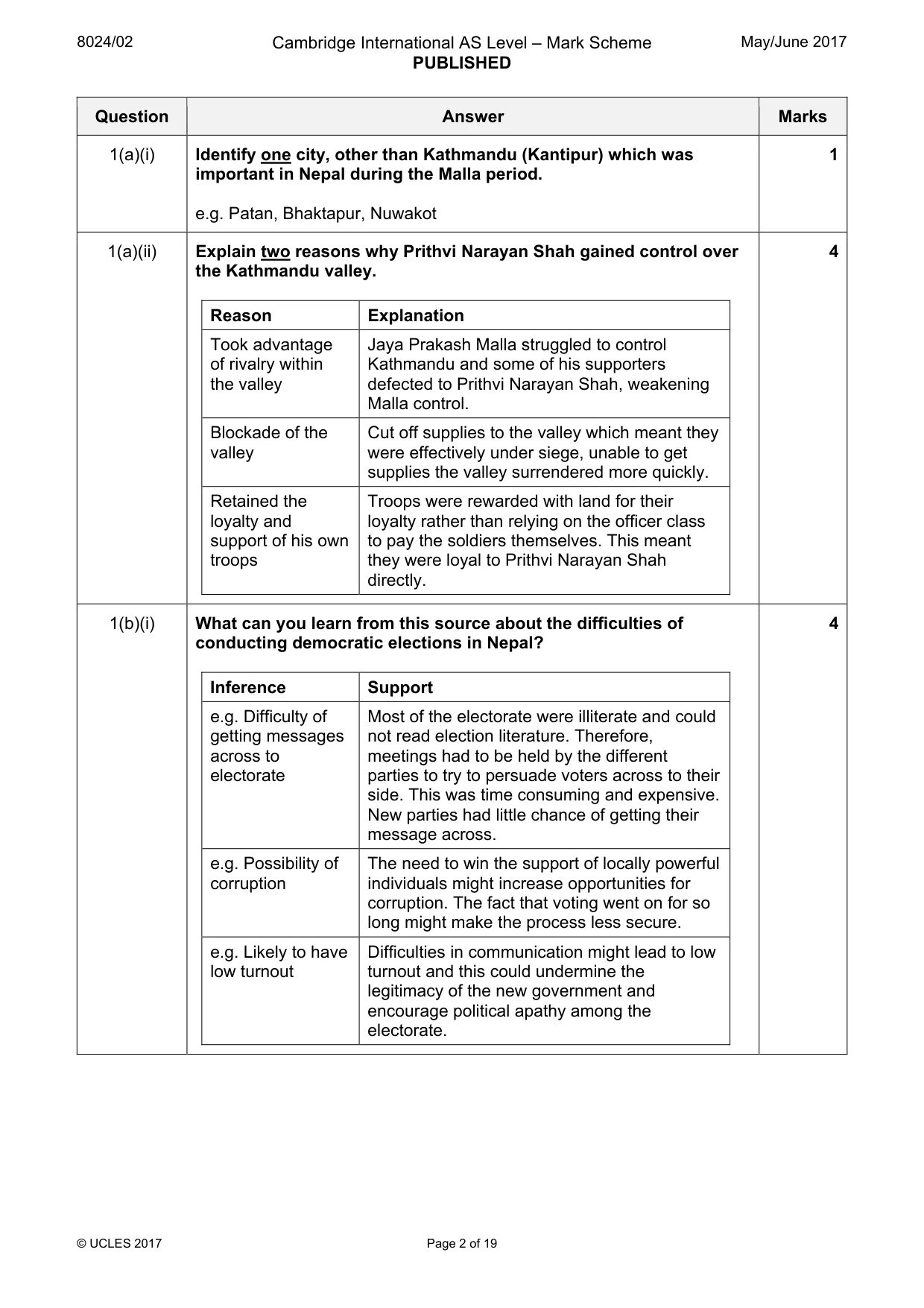
® IGCSE is a registered trademark. This document consists of 19 printed pages. © UCLES 2017 [Turn over Cambridge International Examinations Cambridge International Advanced Subsidiary Level NEPAL STUDIES 8024/02 Paper 2 Written Paper May/June 2017 MARK SCHEME Maximum Mark: 75 Published This mark scheme is published as an aid to teachers and candidates, to indicate the requirements of the examination. It shows the basis on which Examiners were instructed to award marks. It does not indicate the details of the discussions that took place at an Examiners’ meeting before marking began, which would have considered the acceptability of alternative answers. Mark schemes should be read in conjunction with the question paper and the Principal Examiner Report for Teachers. Cambridge will not enter into discussions about these mark schemes. Cambridge is publishing the mark schemes for the May/June 2017 series for most Cambridge IGCSE®, Cambridge International A and AS Level and Cambridge Pre-U components, and some Cambridge O Level components.
Mark scheme, page 2
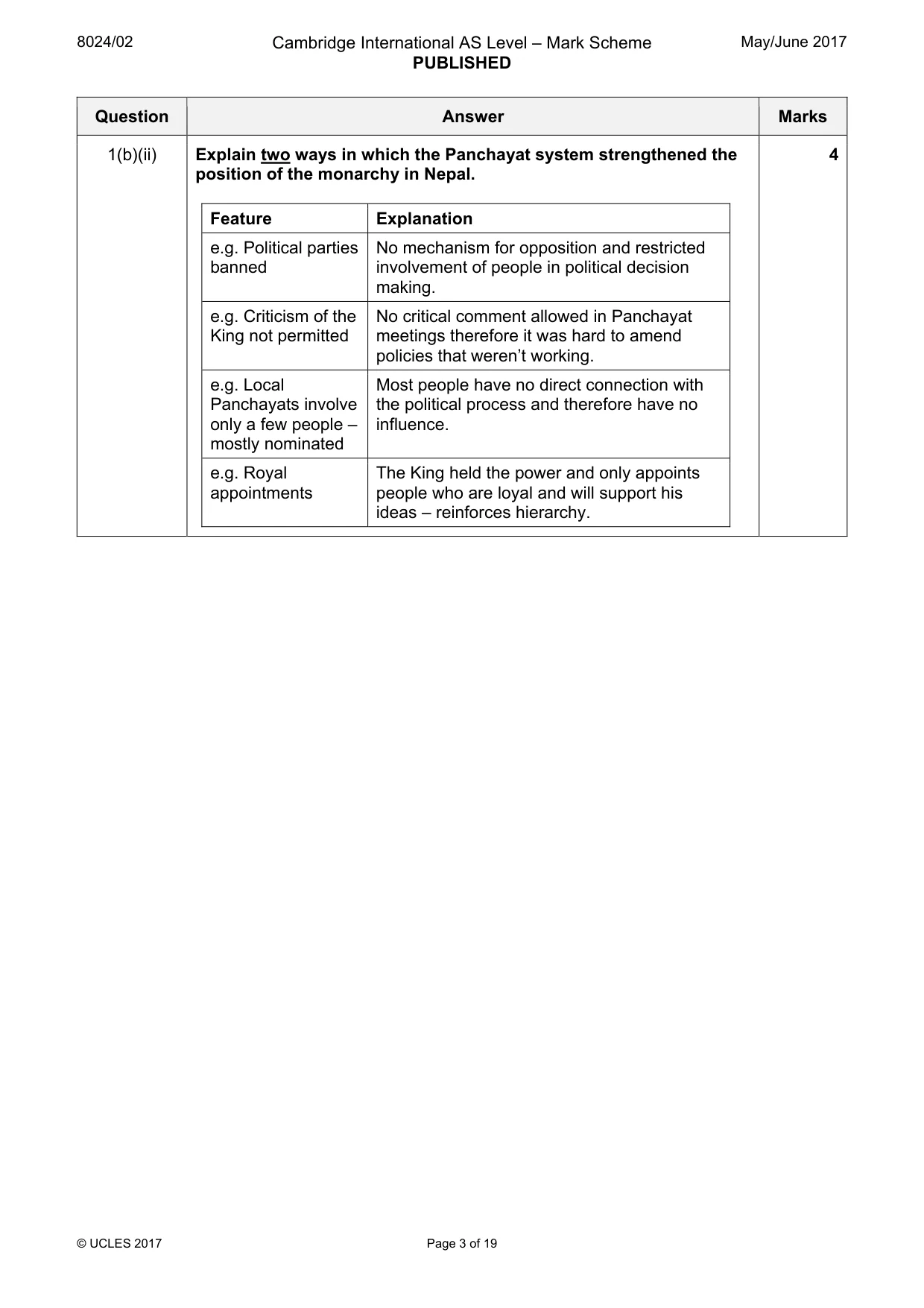
8024/02 Cambridge International AS Level – Mark Scheme PUBLISHED May/June 2017 © UCLES 2017 Page 2 of 19 Question Answer Marks 1(a)(i) Identify one city, other than Kathmandu (Kantipur) which was important in Nepal during the Malla period. e.g. Patan, Bhaktapur, Nuwakot 1 1(a)(ii) Explain two reasons why Prithvi Narayan Shah gained control over the Kathmandu valley. Reason Explanation Took advantage of rivalry within the valley Jaya Prakash Malla struggled to control Kathmandu and some of his supporters defected to Prithvi Narayan Shah, weakening Malla control. Blockade of the valley Cut off supplies to the valley which meant they were effectively under siege, unable to get supplies the valley surrendered more quickly. Retained the loyalty and support of his own troops Troops were rewarded with land for their loyalty rather than relying on the officer class to pay the soldiers themselves. This meant they were loyal to Prithvi Narayan Shah directly. 4 1(b)(i) What can you learn from this source about the difficulties of conducting democratic elections in Nepal? Inference Support e.g. Difficulty of getting messages across to electorate Most of the electorate were illiterate and could not read election literature. Therefore, meetings had to be held by the different parties to try to persuade voters across to their side. This was time consuming and expensive. New parties had little chance of getting their message across. e.g. Possibility of corruption The need to win the support of locally powerful individuals might increase opportunities for corruption. The fact that voting went on for so long might make the process less secure. e.g. Likely to have low turnout Difficulties in communication might lead to low turnout and this could undermine the legitimacy of the new government and encourage political apathy among the electorate. 4
Mark scheme, page 3
8024/02 Cambridge International AS Level – Mark Scheme PUBLISHED May/June 2017 © UCLES 2017 Page 3 of 19 Question Answer Marks 1(b)(ii) Explain two ways in which the Panchayat system strengthened the position of the monarchy in Nepal. Feature Explanation e.g. Political parties banned No mechanism for opposition and restricted involvement of people in political decision making. e.g. Criticism of the King not permitted No critical comment allowed in Panchayat meetings therefore it was hard to amend policies that weren’t working. e.g. Local Panchayats involve only a few people – mostly nominated Most people have no direct connection with the political process and therefore have no influence. e.g. Royal appointments The King held the power and only appoints people who are loyal and will support his ideas – reinforces hierarchy. 4
Mark scheme, page 4
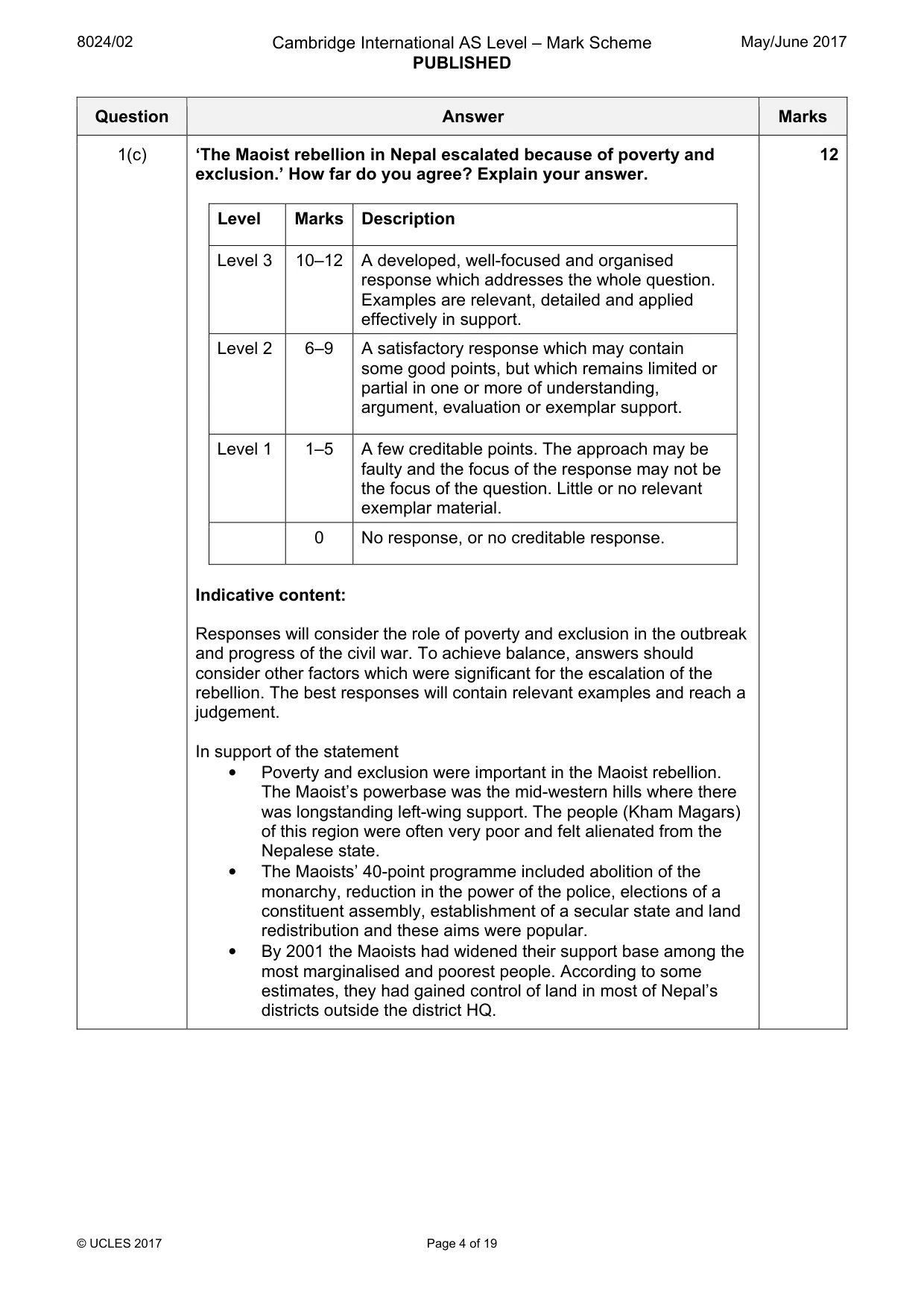
8024/02 Cambridge International AS Level – Mark Scheme PUBLISHED May/June 2017 © UCLES 2017 Page 4 of 19 Question Answer Marks 1(c) ‘The Maoist rebellion in Nepal escalated because of poverty and exclusion.’ How far do you agree? Explain your answer. Level Marks Description Level 3 10–12 A developed, well-focused and organised response which addresses the whole question. Examples are relevant, detailed and applied effectively in support. Level 2 6–9 A satisfactory response which may contain some good points, but which remains limited or partial in one or more of understanding, argument, evaluation or exemplar support. Level 1 1–5 A few creditable points. The approach may be faulty and the focus of the response may not be the focus of the question. Little or no relevant exemplar material. 0 No response, or no creditable response. Indicative content: Responses will consider the role of poverty and exclusion in the outbreak and progress of the civil war. To achieve balance, answers should consider other factors which were significant for the escalation of the rebellion. The best responses will contain relevant examples and reach a judgement. In support of the statement • Poverty and exclusion were important in the Maoist rebellion. The Maoist’s powerbase was the mid-western hills where there was longstanding left-wing support. The people (Kham Magars) of this region were often very poor and felt alienated from the Nepalese state. • The Maoists’ 40-point programme included abolition of the monarchy, reduction in the power of the police, elections of a constituent assembly, establishment of a secular state and land redistribution and these aims were popular. • By 2001 the Maoists had widened their support base among the most marginalised and poorest people. According to some estimates, they had gained control of land in most of Nepal’s districts outside the district HQ. 12
Mark scheme, page 5
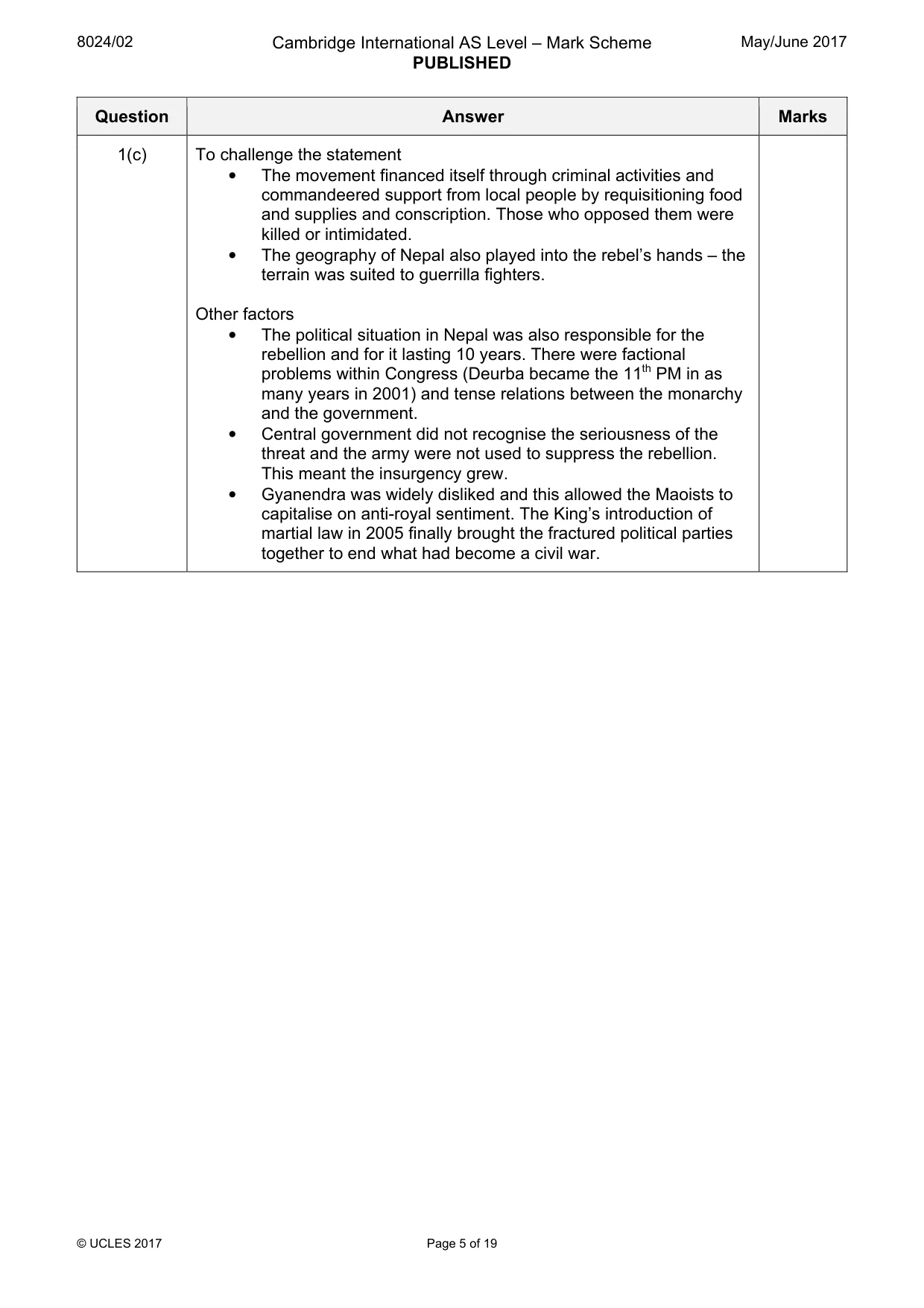
8024/02 Cambridge International AS Level – Mark Scheme PUBLISHED May/June 2017 © UCLES 2017 Page 5 of 19 Question Answer Marks 1(c) To challenge the statement • The movement financed itself through criminal activities and commandeered support from local people by requisitioning food and supplies and conscription. Those who opposed them were killed or intimidated. • The geography of Nepal also played into the rebel’s hands – the terrain was suited to guerrilla fighters. Other factors • The political situation in Nepal was also responsible for the rebellion and for it lasting 10 years. There were factional problems within Congress (Deurba became the 11th PM in as many years in 2001) and tense relations between the monarchy and the government. • Central government did not recognise the seriousness of the threat and the army were not used to suppress the rebellion. This meant the insurgency grew. • Gyanendra was widely disliked and this allowed the Maoists to capitalise on anti-royal sentiment. The King’s introduction of martial law in 2005 finally brought the fractured political parties together to end what had become a civil war.
Mark scheme, page 6
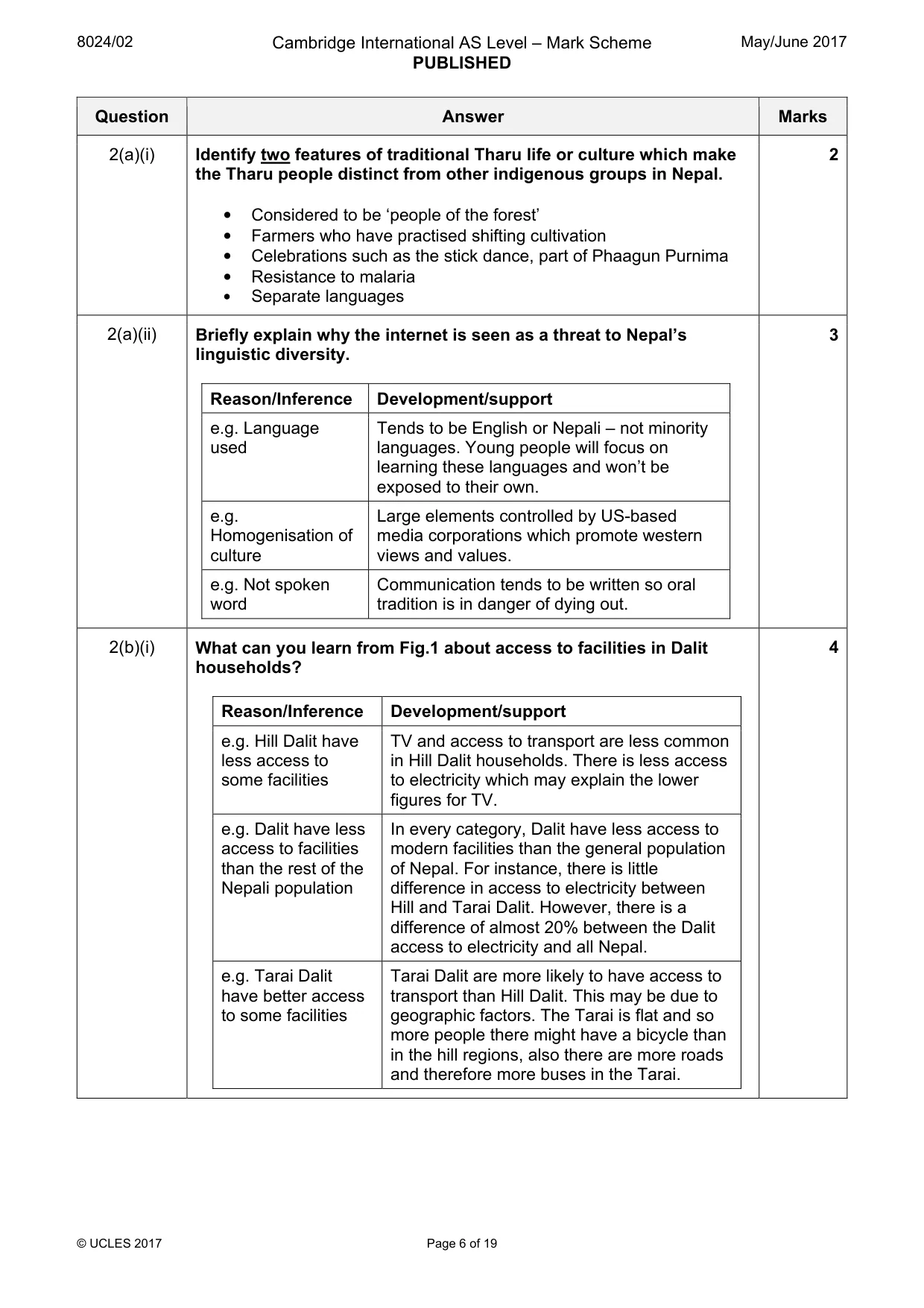
8024/02 Cambridge International AS Level – Mark Scheme PUBLISHED May/June 2017 © UCLES 2017 Page 6 of 19 Question Answer Marks 2(a)(i) Identify two features of traditional Tharu life or culture which make the Tharu people distinct from other indigenous groups in Nepal. • Considered to be ‘people of the forest’ • Farmers who have practised shifting cultivation • Celebrations such as the stick dance, part of Phaagun Purnima • Resistance to malaria • Separate languages 2 2(a)(ii) Briefly explain why the internet is seen as a threat to Nepal’s linguistic diversity. Reason/Inference Development/support e.g. Language used Tends to be English or Nepali – not minority languages. Young people will focus on learning these languages and won’t be exposed to their own. e.g. Homogenisation of culture Large elements controlled by US-based media corporations which promote western views and values. e.g. Not spoken word Communication tends to be written so oral tradition is in danger of dying out. 3 2(b)(i) What can you learn from Fig.1 about access to facilities in Dalit households? Reason/Inference Development/support e.g. Hill Dalit have less access to some facilities TV and access to transport are less common in Hill Dalit households. There is less access to electricity which may explain the lower figures for TV. e.g. Dalit have less access to facilities than the rest of the Nepali population In every category, Dalit have less access to modern facilities than the general population of Nepal. For instance, there is little difference in access to electricity between Hill and Tarai Dalit. However, there is a difference of almost 20% between the Dalit access to electricity and all Nepal. e.g. Tarai Dalit have better access to some facilities Tarai Dalit are more likely to have access to transport than Hill Dalit. This may be due to geographic factors. The Tarai is flat and so more people there might have a bicycle than in the hill regions, also there are more roads and therefore more buses in the Tarai. 4
Mark scheme, page 7
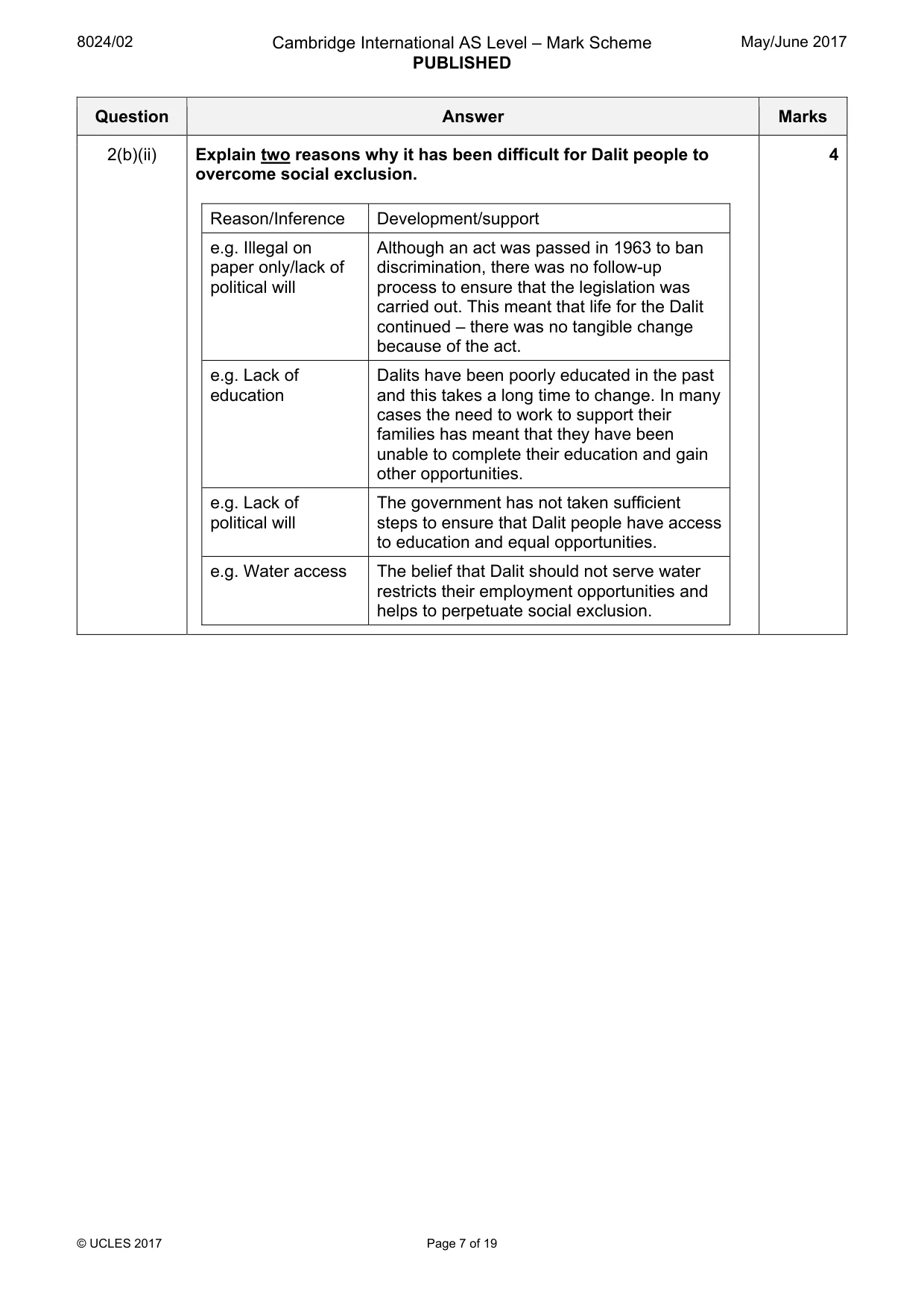
8024/02 Cambridge International AS Level – Mark Scheme PUBLISHED May/June 2017 © UCLES 2017 Page 7 of 19 Question Answer Marks 2(b)(ii) Explain two reasons why it has been difficult for Dalit people to overcome social exclusion. Reason/Inference Development/support e.g. Illegal on paper only/lack of political will Although an act was passed in 1963 to ban discrimination, there was no follow-up process to ensure that the legislation was carried out. This meant that life for the Dalit continued – there was no tangible change because of the act. e.g. Lack of education Dalits have been poorly educated in the past and this takes a long time to change. In many cases the need to work to support their families has meant that they have been unable to complete their education and gain other opportunities. e.g. Lack of political will The government has not taken sufficient steps to ensure that Dalit people have access to education and equal opportunities. e.g. Water access The belief that Dalit should not serve water restricts their employment opportunities and helps to perpetuate social exclusion. 4
Mark scheme, page 8
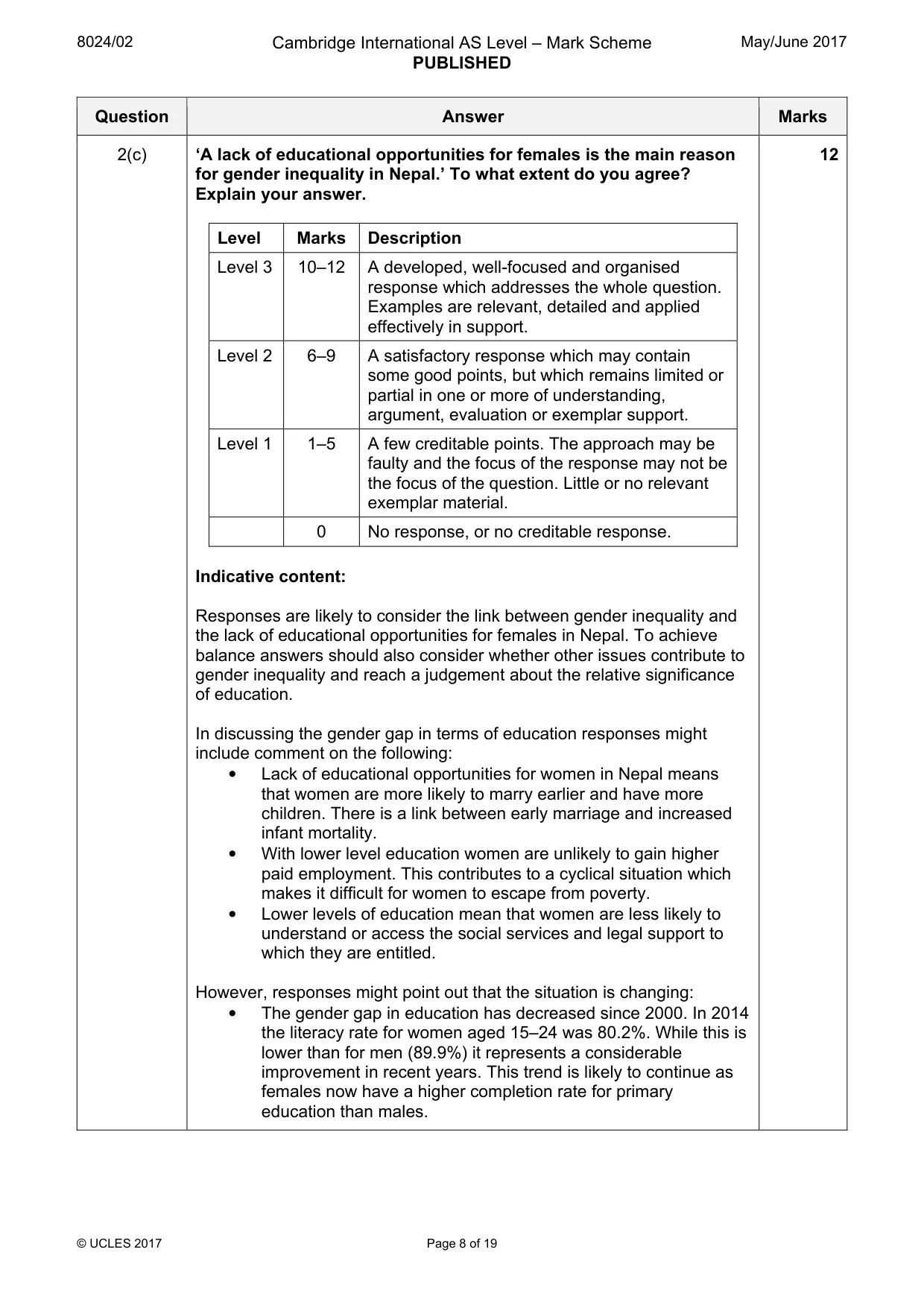
8024/02 Cambridge International AS Level – Mark Scheme PUBLISHED May/June 2017 © UCLES 2017 Page 8 of 19 Question Answer Marks 2(c) ‘A lack of educational opportunities for females is the main reason for gender inequality in Nepal.’ To what extent do you agree? Explain your answer. Level Marks Description Level 3 10–12 A developed, well-focused and organised response which addresses the whole question. Examples are relevant, detailed and applied effectively in support. Level 2 6–9 A satisfactory response which may contain some good points, but which remains limited or partial in one or more of understanding, argument, evaluation or exemplar support. Level 1 1–5 A few creditable points. The approach may be faulty and the focus of the response may not be the focus of the question. Little or no relevant exemplar material. 0 No response, or no creditable response. Indicative content: Responses are likely to consider the link between gender inequality and the lack of educational opportunities for females in Nepal. To achieve balance answers should also consider whether other issues contribute to gender inequality and reach a judgement about the relative significance of education. In discussing the gender gap in terms of education responses might include comment on the following: • Lack of educational opportunities for women in Nepal means that women are more likely to marry earlier and have more children. There is a link between early marriage and increased infant mortality. • With lower level education women are unlikely to gain higher paid employment. This contributes to a cyclical situation which makes it difficult for women to escape from poverty. • Lower levels of education mean that women are less likely to understand or access the social services and legal support to which they are entitled. However, responses might point out that the situation is changing: • The gender gap in education has decreased since 2000. In 2014 the literacy rate for women aged 15–24 was 80.2%. While this is lower than for men (89.9%) it represents a considerable improvement in recent years. This trend is likely to continue as females now have a higher completion rate for primary education than males. 12
Mark scheme, page 9
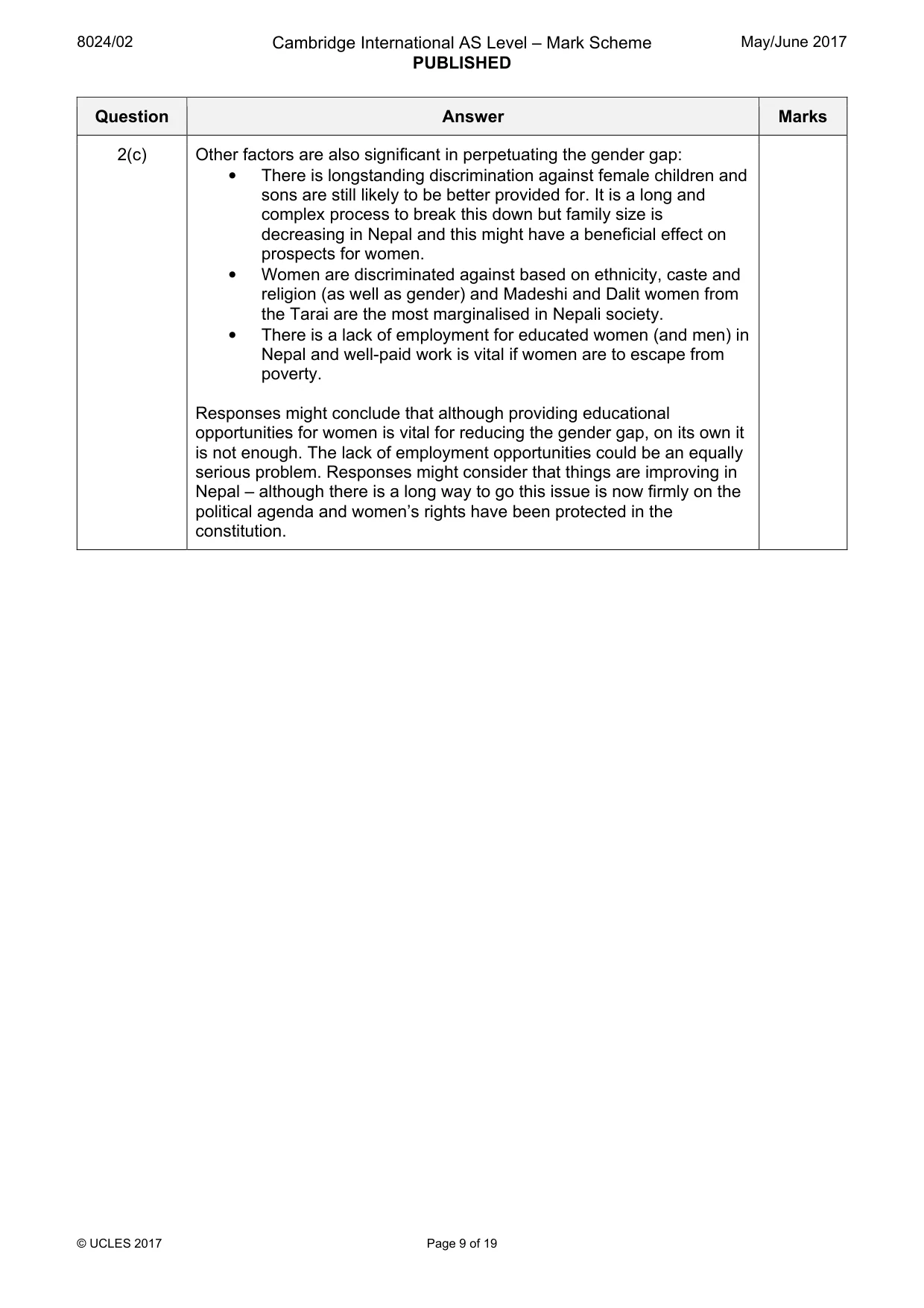
8024/02 Cambridge International AS Level – Mark Scheme PUBLISHED May/June 2017 © UCLES 2017 Page 9 of 19 Question Answer Marks 2(c) Other factors are also significant in perpetuating the gender gap: • There is longstanding discrimination against female children and sons are still likely to be better provided for. It is a long and complex process to break this down but family size is decreasing in Nepal and this might have a beneficial effect on prospects for women. • Women are discriminated against based on ethnicity, caste and religion (as well as gender) and Madeshi and Dalit women from the Tarai are the most marginalised in Nepali society. • There is a lack of employment for educated women (and men) in Nepal and well-paid work is vital if women are to escape from poverty. Responses might conclude that although providing educational opportunities for women is vital for reducing the gender gap, on its own it is not enough. The lack of employment opportunities could be an equally serious problem. Responses might consider that things are improving in Nepal – although there is a long way to go this issue is now firmly on the political agenda and women’s rights have been protected in the constitution.
Mark scheme, page 10
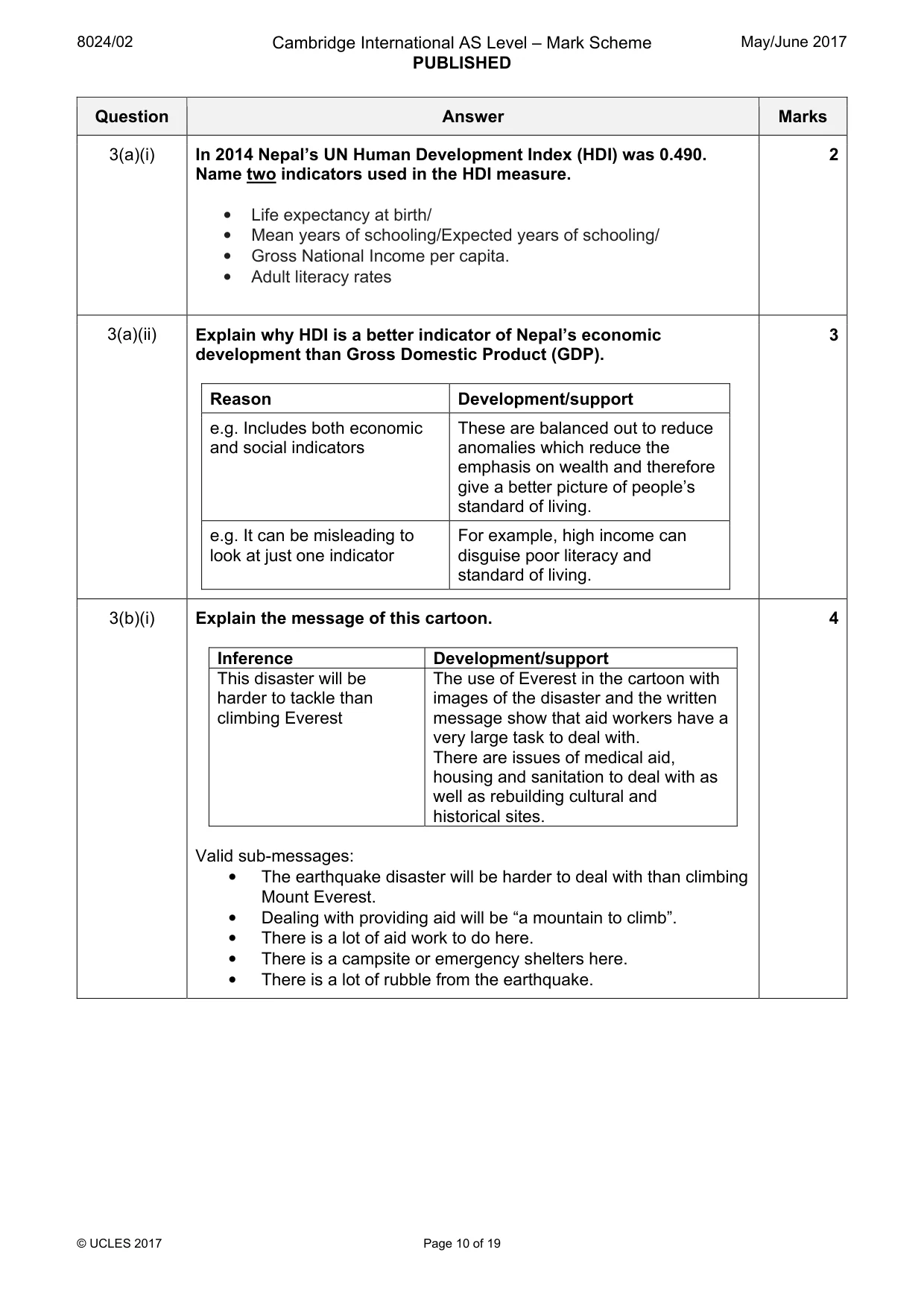
8024/02 Cambridge International AS Level – Mark Scheme PUBLISHED May/June 2017 © UCLES 2017 Page 10 of 19 Question Answer Marks 3(a)(i) In 2014 Nepal’s UN Human Development Index (HDI) was 0.490. Name two indicators used in the HDI measure. • Life expectancy at birth/ • Mean years of schooling/Expected years of schooling/ • Gross National Income per capita. • Adult literacy rates 2 3(a)(ii) Explain why HDI is a better indicator of Nepal’s economic development than Gross Domestic Product (GDP). Reason Development/support e.g. Includes both economic and social indicators These are balanced out to reduce anomalies which reduce the emphasis on wealth and therefore give a better picture of people’s standard of living. e.g. It can be misleading to look at just one indicator For example, high income can disguise poor literacy and standard of living. 3 3(b)(i) Explain the message of this cartoon. Inference Development/support This disaster will be harder to tackle than climbing Everest The use of Everest in the cartoon with images of the disaster and the written message show that aid workers have a very large task to deal with. There are issues of medical aid, housing and sanitation to deal with as well as rebuilding cultural and historical sites. Valid sub-messages: • The earthquake disaster will be harder to deal with than climbing Mount Everest. • Dealing with providing aid will be “a mountain to climb”. • There is a lot of aid work to do here. • There is a campsite or emergency shelters here. • There is a lot of rubble from the earthquake. 4
Mark scheme, page 11
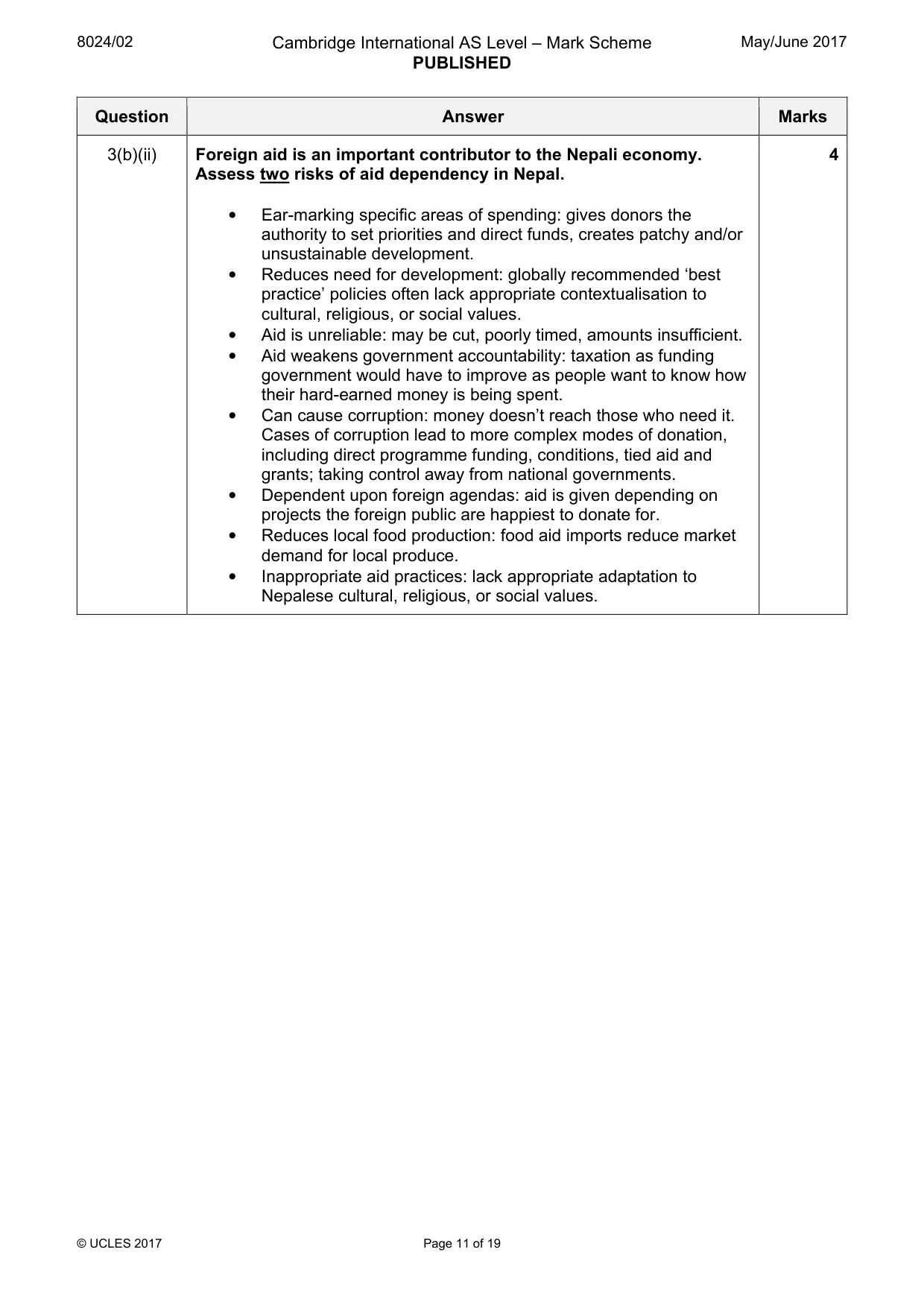
8024/02 Cambridge International AS Level – Mark Scheme PUBLISHED May/June 2017 © UCLES 2017 Page 11 of 19 Question Answer Marks 3(b)(ii) Foreign aid is an important contributor to the Nepali economy. Assess two risks of aid dependency in Nepal. • Ear-marking specific areas of spending: gives donors the authority to set priorities and direct funds, creates patchy and/or unsustainable development. • Reduces need for development: globally recommended ‘best practice’ policies often lack appropriate contextualisation to cultural, religious, or social values. • Aid is unreliable: may be cut, poorly timed, amounts insufficient. • Aid weakens government accountability: taxation as funding government would have to improve as people want to know how their hard-earned money is being spent. • Can cause corruption: money doesn’t reach those who need it. Cases of corruption lead to more complex modes of donation, including direct programme funding, conditions, tied aid and grants; taking control away from national governments. • Dependent upon foreign agendas: aid is given depending on projects the foreign public are happiest to donate for. • Reduces local food production: food aid imports reduce market demand for local produce. • Inappropriate aid practices: lack appropriate adaptation to Nepalese cultural, religious, or social values. 4
Mark scheme, page 12
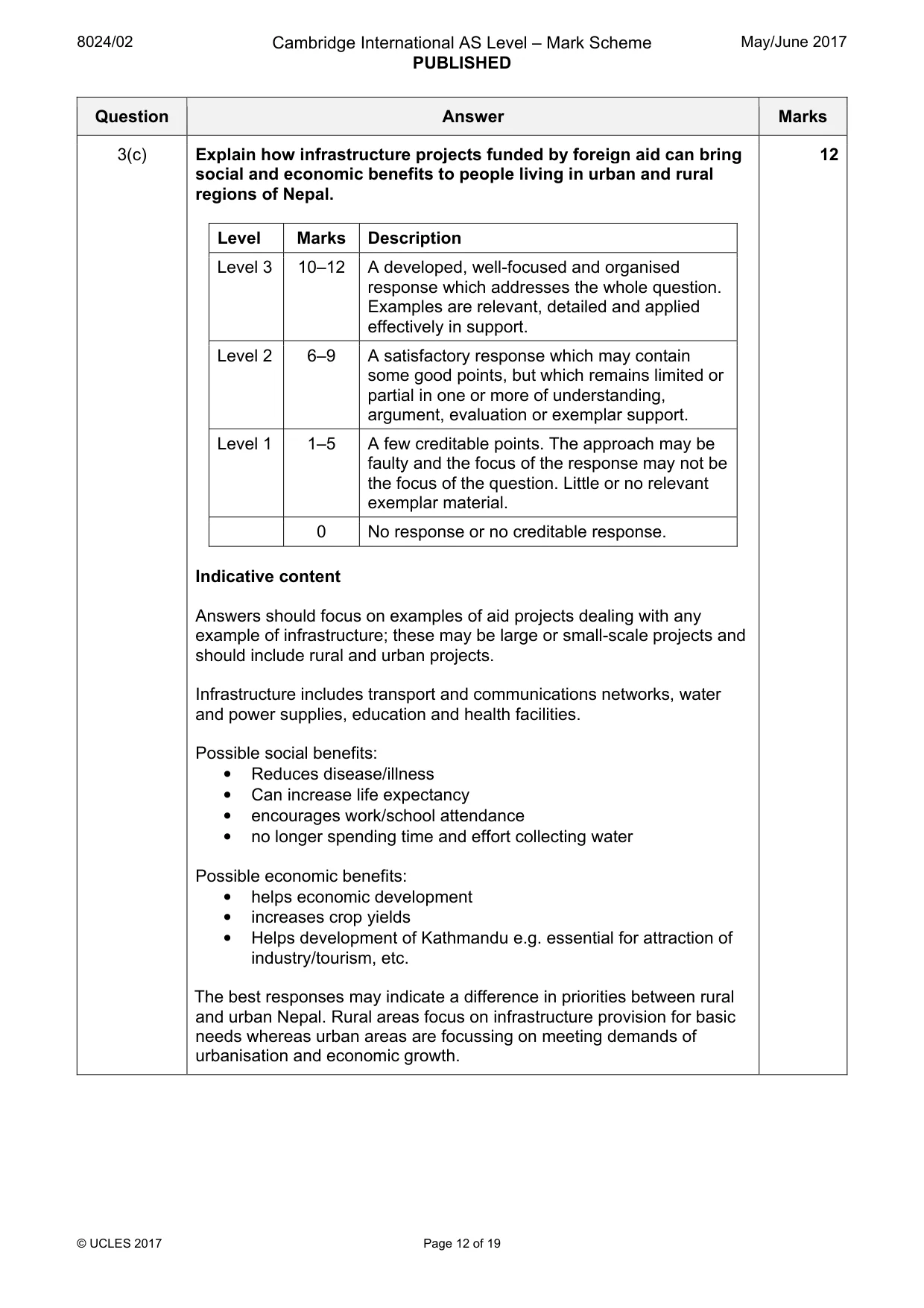
8024/02 Cambridge International AS Level – Mark Scheme PUBLISHED May/June 2017 © UCLES 2017 Page 12 of 19 Question Answer Marks 3(c) Explain how infrastructure projects funded by foreign aid can bring social and economic benefits to people living in urban and rural regions of Nepal. Level Marks Description Level 3 10–12 A developed, well-focused and organised response which addresses the whole question. Examples are relevant, detailed and applied effectively in support. Level 2 6–9 A satisfactory response which may contain some good points, but which remains limited or partial in one or more of understanding, argument, evaluation or exemplar support. Level 1 1–5 A few creditable points. The approach may be faulty and the focus of the response may not be the focus of the question. Little or no relevant exemplar material. 0 No response or no creditable response. Indicative content Answers should focus on examples of aid projects dealing with any example of infrastructure; these may be large or small-scale projects and should include rural and urban projects. Infrastructure includes transport and communications networks, water and power supplies, education and health facilities. Possible social benefits: • Reduces disease/illness • Can increase life expectancy • encourages work/school attendance • no longer spending time and effort collecting water Possible economic benefits: • helps economic development • increases crop yields • Helps development of Kathmandu e.g. essential for attraction of industry/tourism, etc. The best responses may indicate a difference in priorities between rural and urban Nepal. Rural areas focus on infrastructure provision for basic needs whereas urban areas are focussing on meeting demands of urbanisation and economic growth. 12
Mark scheme, page 13
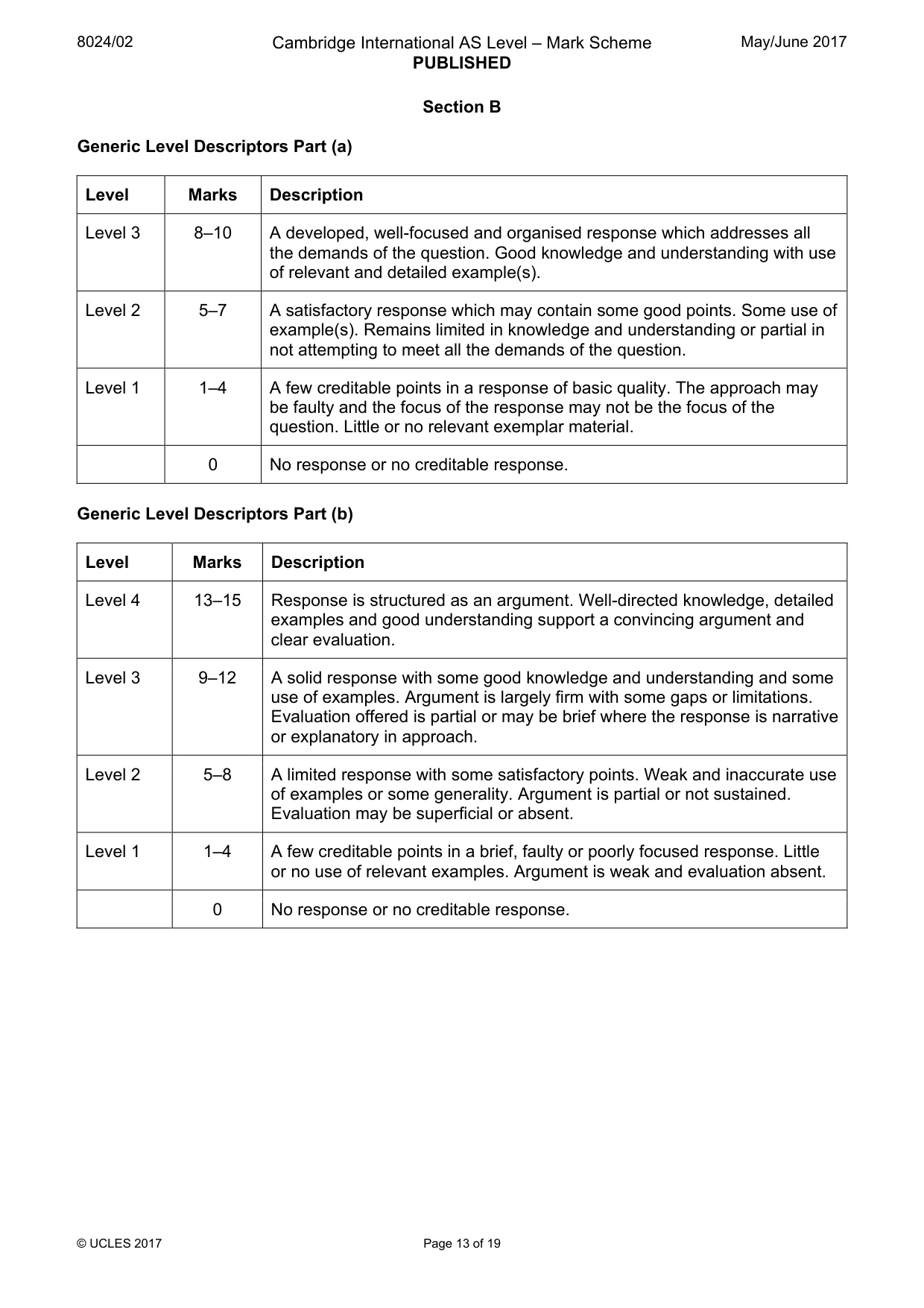
8024/02 Cambridge International AS Level – Mark Scheme PUBLISHED May/June 2017 © UCLES 2017 Page 13 of 19 Section B Generic Level Descriptors Part (a) Level Marks Description Level 3 8–10 A developed, well-focused and organised response which addresses all the demands of the question. Good knowledge and understanding with use of relevant and detailed example(s). Level 2 5–7 A satisfactory response which may contain some good points. Some use of example(s). Remains limited in knowledge and understanding or partial in not attempting to meet all the demands of the question. Level 1 1–4 A few creditable points in a response of basic quality. The approach may be faulty and the focus of the response may not be the focus of the question. Little or no relevant exemplar material. 0 No response or no creditable response. Generic Level Descriptors Part (b) Level Marks Description Level 4 13–15 Response is structured as an argument. Well-directed knowledge, detailed examples and good understanding support a convincing argument and clear evaluation. Level 3 9–12 A solid response with some good knowledge and understanding and some use of examples. Argument is largely firm with some gaps or limitations. Evaluation offered is partial or may be brief where the response is narrative or explanatory in approach. Level 2 5–8 A limited response with some satisfactory points. Weak and inaccurate use of examples or some generality. Argument is partial or not sustained. Evaluation may be superficial or absent. Level 1 1–4 A few creditable points in a brief, faulty or poorly focused response. Little or no use of relevant examples. Argument is weak and evaluation absent. 0 No response or no creditable response.
Mark scheme, page 14
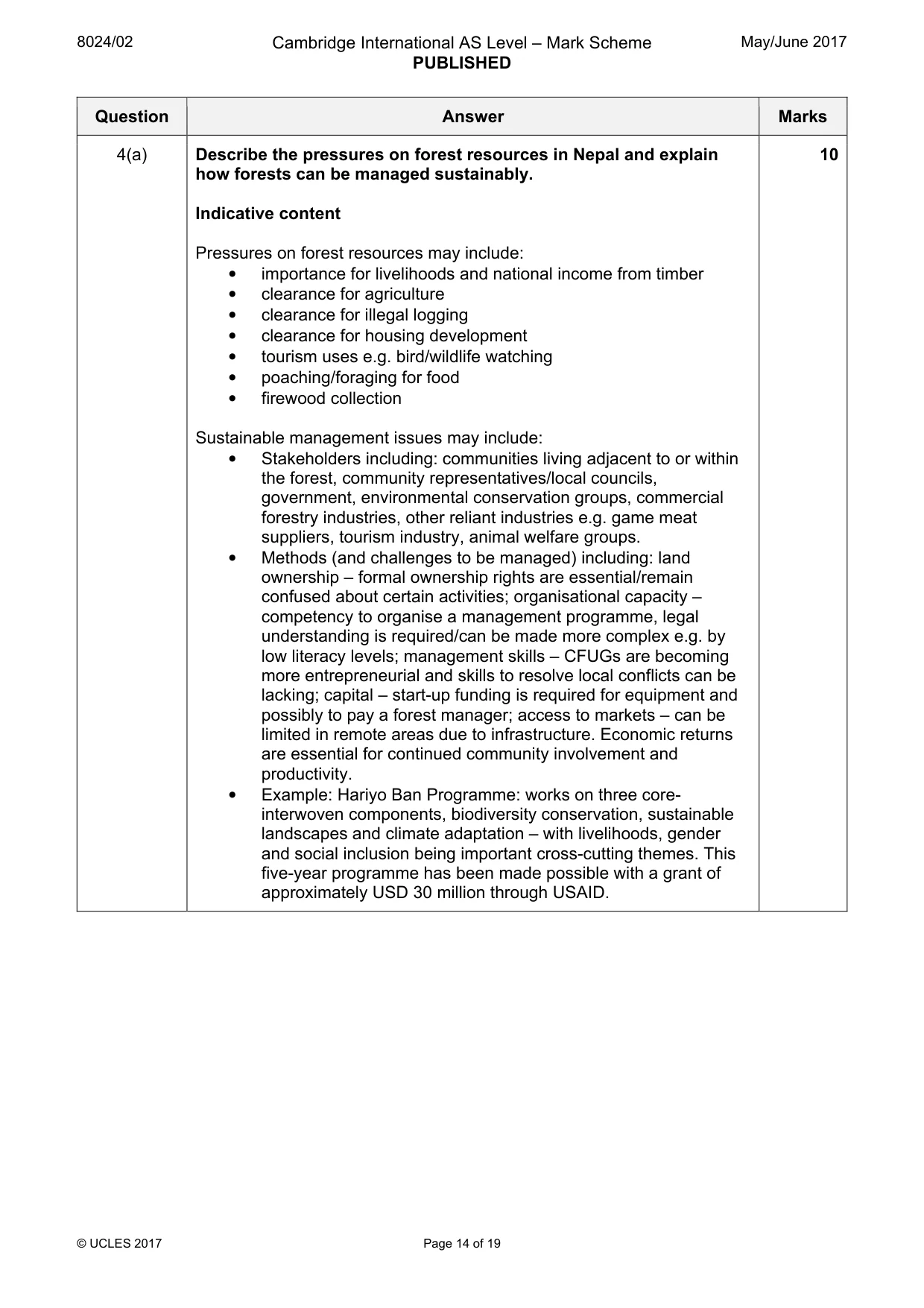
8024/02 Cambridge International AS Level – Mark Scheme PUBLISHED May/June 2017 © UCLES 2017 Page 14 of 19 Question Answer Marks 4(a) Describe the pressures on forest resources in Nepal and explain how forests can be managed sustainably. Indicative content Pressures on forest resources may include: • importance for livelihoods and national income from timber • clearance for agriculture • clearance for illegal logging • clearance for housing development • tourism uses e.g. bird/wildlife watching • poaching/foraging for food • firewood collection Sustainable management issues may include: • Stakeholders including: communities living adjacent to or within the forest, community representatives/local councils, government, environmental conservation groups, commercial forestry industries, other reliant industries e.g. game meat suppliers, tourism industry, animal welfare groups. • Methods (and challenges to be managed) including: land ownership – formal ownership rights are essential/remain confused about certain activities; organisational capacity – competency to organise a management programme, legal understanding is required/can be made more complex e.g. by low literacy levels; management skills – CFUGs are becoming more entrepreneurial and skills to resolve local conflicts can be lacking; capital – start-up funding is required for equipment and possibly to pay a forest manager; access to markets – can be limited in remote areas due to infrastructure. Economic returns are essential for continued community involvement and productivity. • Example: Hariyo Ban Programme: works on three core- interwoven components, biodiversity conservation, sustainable landscapes and climate adaptation – with livelihoods, gender and social inclusion being important cross-cutting themes. This five-year programme has been made possible with a grant of approximately USD 30 million through USAID. 10
Mark scheme, page 15
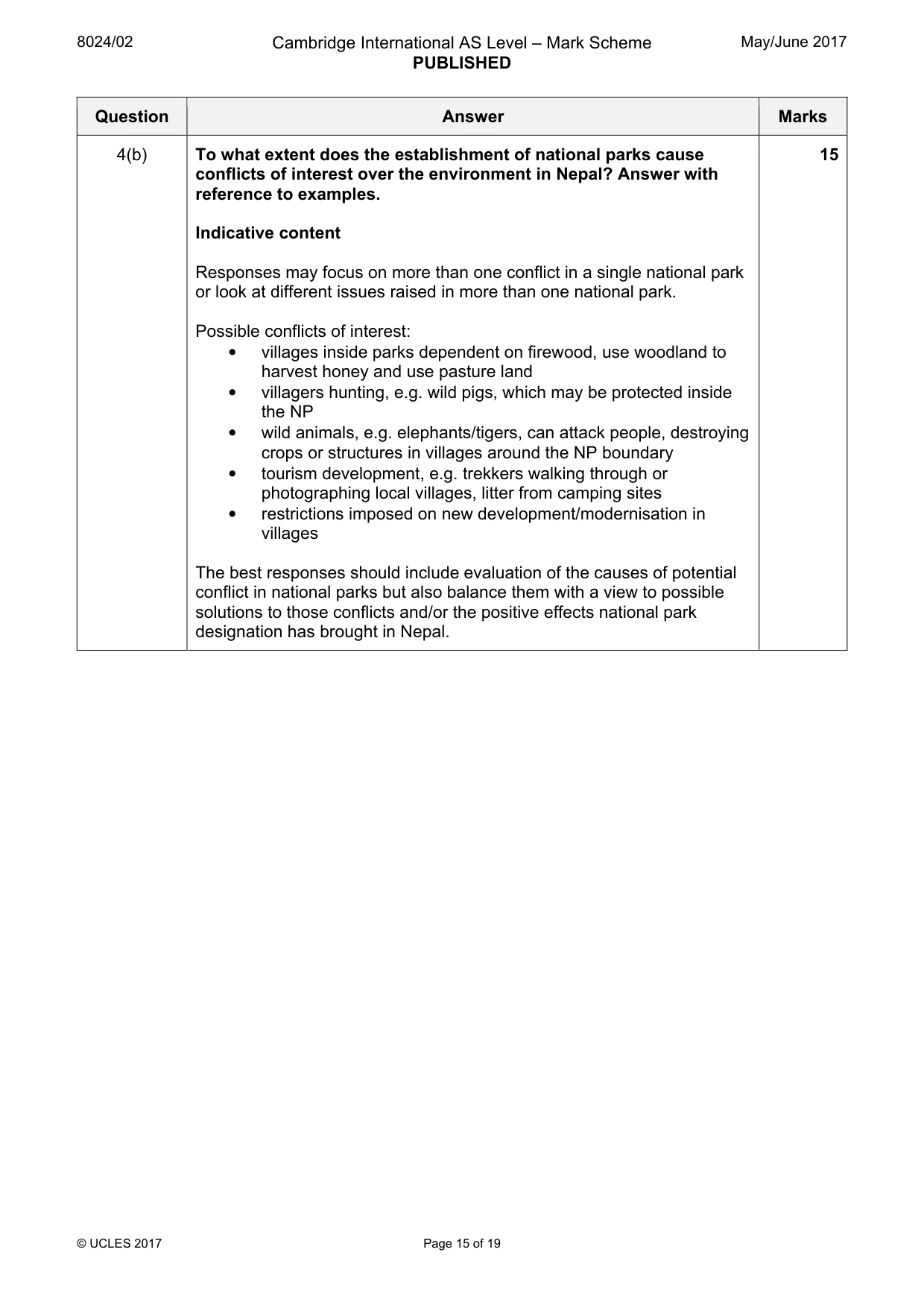
8024/02 Cambridge International AS Level – Mark Scheme PUBLISHED May/June 2017 © UCLES 2017 Page 15 of 19 Question Answer Marks 4(b) To what extent does the establishment of national parks cause conflicts of interest over the environment in Nepal? Answer with reference to examples. Indicative content Responses may focus on more than one conflict in a single national park or look at different issues raised in more than one national park. Possible conflicts of interest: • villages inside parks dependent on firewood, use woodland to harvest honey and use pasture land • villagers hunting, e.g. wild pigs, which may be protected inside the NP • wild animals, e.g. elephants/tigers, can attack people, destroying crops or structures in villages around the NP boundary • tourism development, e.g. trekkers walking through or photographing local villages, litter from camping sites • restrictions imposed on new development/modernisation in villages The best responses should include evaluation of the causes of potential conflict in national parks but also balance them with a view to possible solutions to those conflicts and/or the positive effects national park designation has brought in Nepal. 15
Mark scheme, page 16
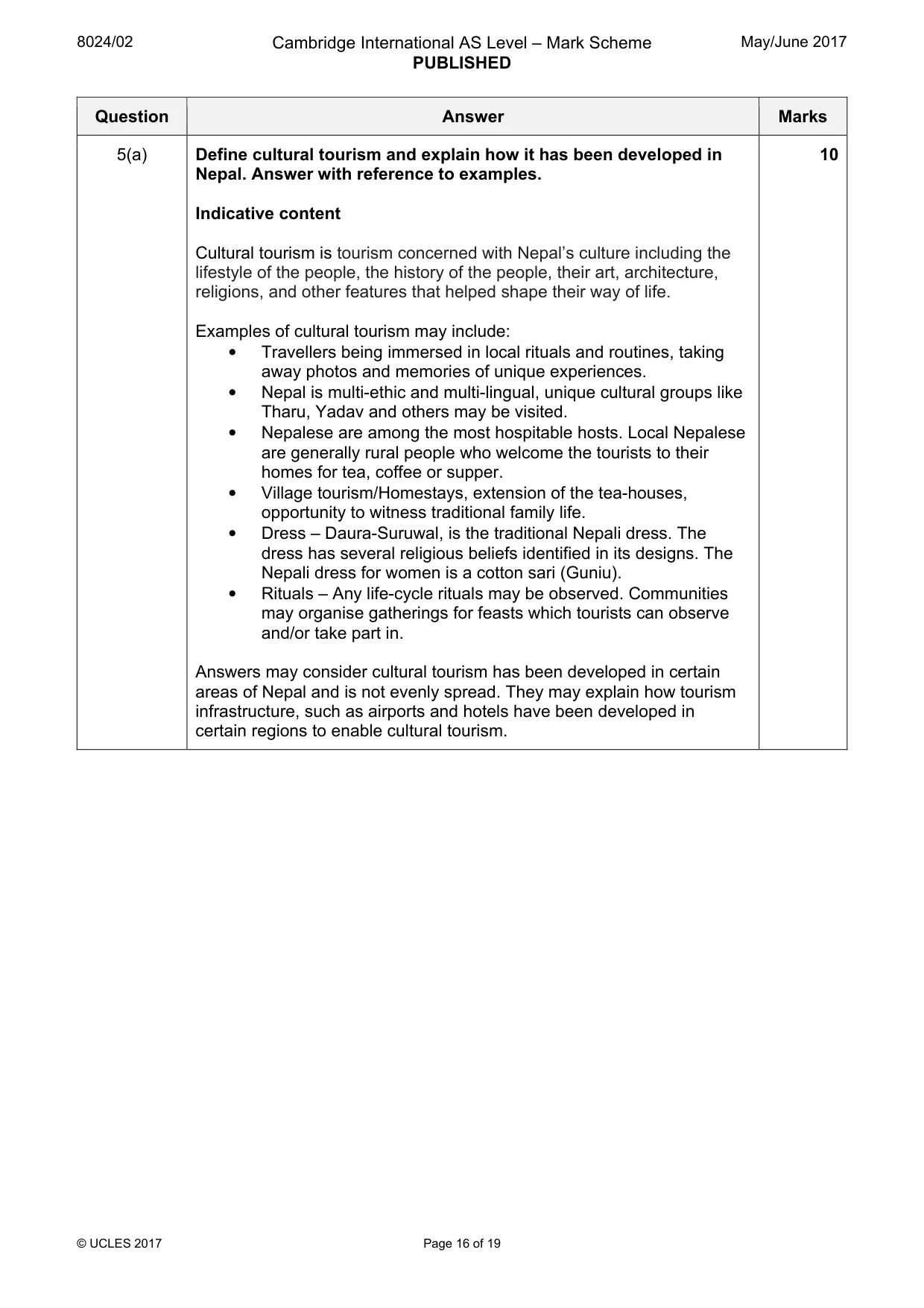
8024/02 Cambridge International AS Level – Mark Scheme PUBLISHED May/June 2017 © UCLES 2017 Page 16 of 19 Question Answer Marks 5(a) Define cultural tourism and explain how it has been developed in Nepal. Answer with reference to examples. Indicative content Cultural tourism is tourism concerned with Nepal’s culture including the lifestyle of the people, the history of the people, their art, architecture, religions, and other features that helped shape their way of life. Examples of cultural tourism may include: • Travellers being immersed in local rituals and routines, taking away photos and memories of unique experiences. • Nepal is multi-ethic and multi-lingual, unique cultural groups like Tharu, Yadav and others may be visited. • Nepalese are among the most hospitable hosts. Local Nepalese are generally rural people who welcome the tourists to their homes for tea, coffee or supper. • Village tourism/Homestays, extension of the tea-houses, opportunity to witness traditional family life. • Dress – Daura-Suruwal, is the traditional Nepali dress. The dress has several religious beliefs identified in its designs. The Nepali dress for women is a cotton sari (Guniu). • Rituals – Any life-cycle rituals may be observed. Communities may organise gatherings for feasts which tourists can observe and/or take part in. Answers may consider cultural tourism has been developed in certain areas of Nepal and is not evenly spread. They may explain how tourism infrastructure, such as airports and hotels have been developed in certain regions to enable cultural tourism. 10
Mark scheme, page 17
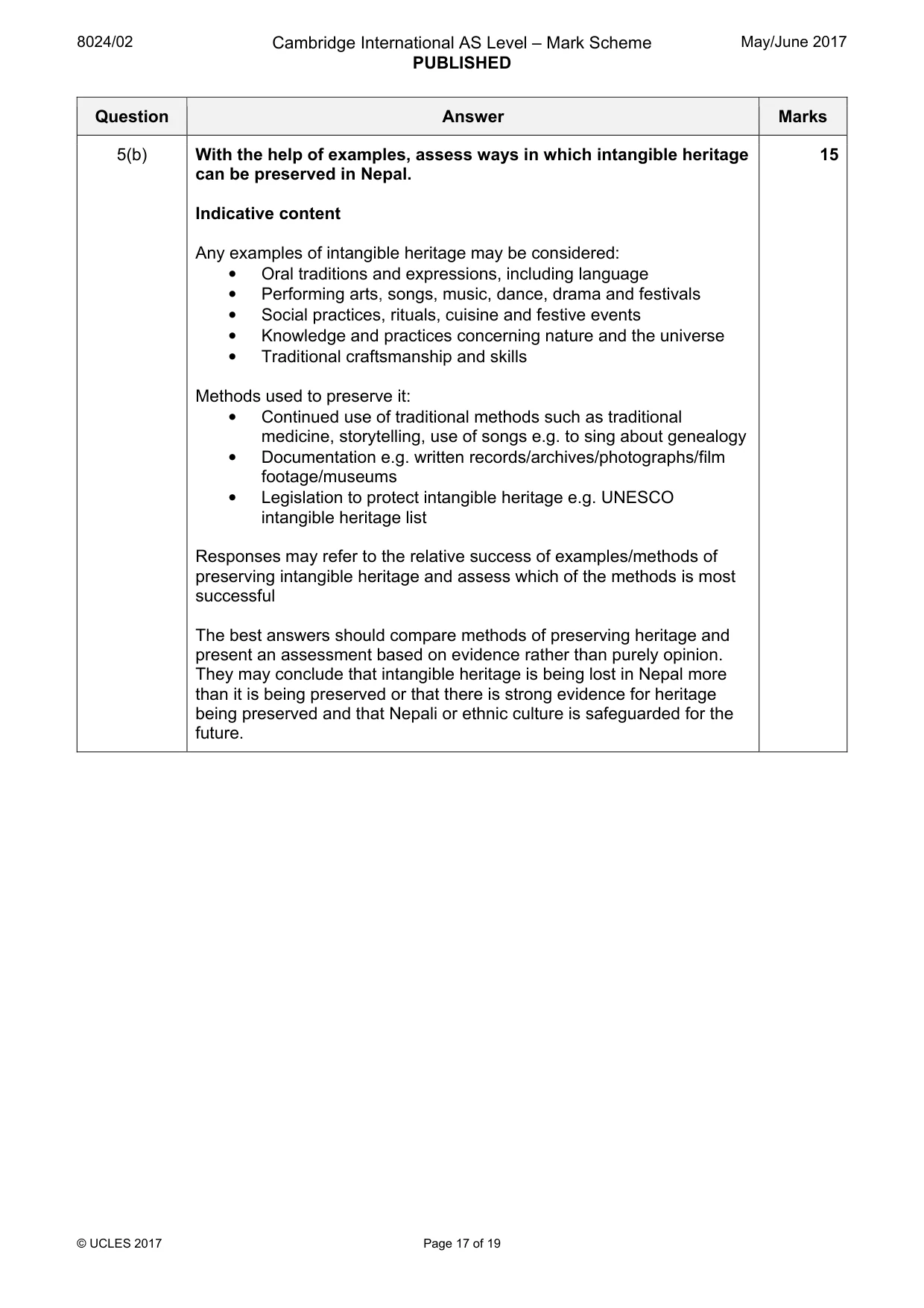
8024/02 Cambridge International AS Level – Mark Scheme PUBLISHED May/June 2017 © UCLES 2017 Page 17 of 19 Question Answer Marks 5(b) With the help of examples, assess ways in which intangible heritage can be preserved in Nepal. Indicative content Any examples of intangible heritage may be considered: • Oral traditions and expressions, including language • Performing arts, songs, music, dance, drama and festivals • Social practices, rituals, cuisine and festive events • Knowledge and practices concerning nature and the universe • Traditional craftsmanship and skills Methods used to preserve it: • Continued use of traditional methods such as traditional medicine, storytelling, use of songs e.g. to sing about genealogy • Documentation e.g. written records/archives/photographs/film footage/museums • Legislation to protect intangible heritage e.g. UNESCO intangible heritage list Responses may refer to the relative success of examples/methods of preserving intangible heritage and assess which of the methods is most successful The best answers should compare methods of preserving heritage and present an assessment based on evidence rather than purely opinion. They may conclude that intangible heritage is being lost in Nepal more than it is being preserved or that there is strong evidence for heritage being preserved and that Nepali or ethnic culture is safeguarded for the future. 15
Mark scheme, page 18
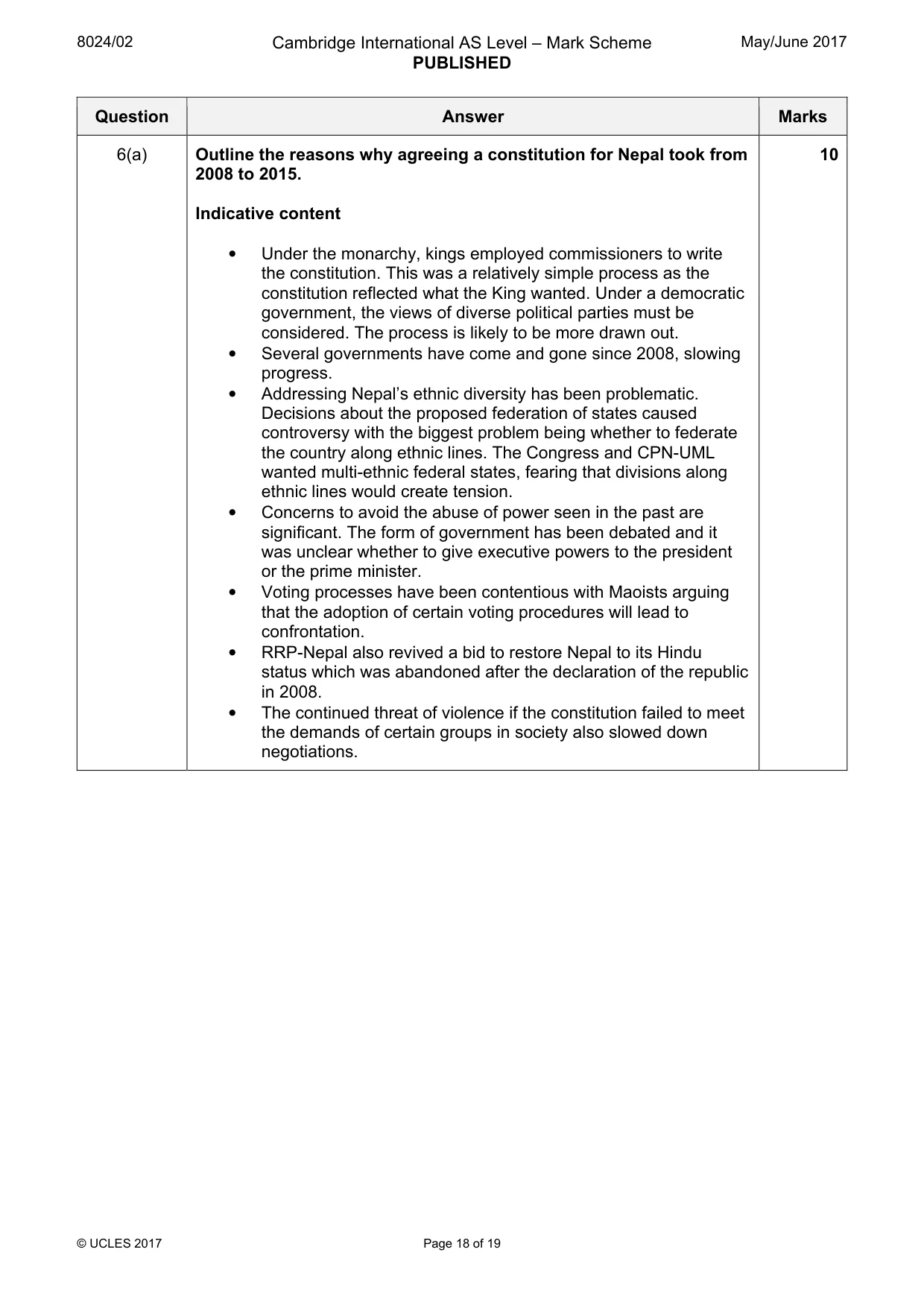
8024/02 Cambridge International AS Level – Mark Scheme PUBLISHED May/June 2017 © UCLES 2017 Page 18 of 19 Question Answer Marks 6(a) Outline the reasons why agreeing a constitution for Nepal took from 2008 to 2015. Indicative content • Under the monarchy, kings employed commissioners to write the constitution. This was a relatively simple process as the constitution reflected what the King wanted. Under a democratic government, the views of diverse political parties must be considered. The process is likely to be more drawn out. • Several governments have come and gone since 2008, slowing progress. • Addressing Nepal’s ethnic diversity has been problematic. Decisions about the proposed federation of states caused controversy with the biggest problem being whether to federate the country along ethnic lines. The Congress and CPN-UML wanted multi-ethnic federal states, fearing that divisions along ethnic lines would create tension. • Concerns to avoid the abuse of power seen in the past are significant. The form of government has been debated and it was unclear whether to give executive powers to the president or the prime minister. • Voting processes have been contentious with Maoists arguing that the adoption of certain voting procedures will lead to confrontation. • RRP-Nepal also revived a bid to restore Nepal to its Hindu status which was abandoned after the declaration of the republic in 2008. • The continued threat of violence if the constitution failed to meet the demands of certain groups in society also slowed down negotiations. 10
Mark scheme, page 19
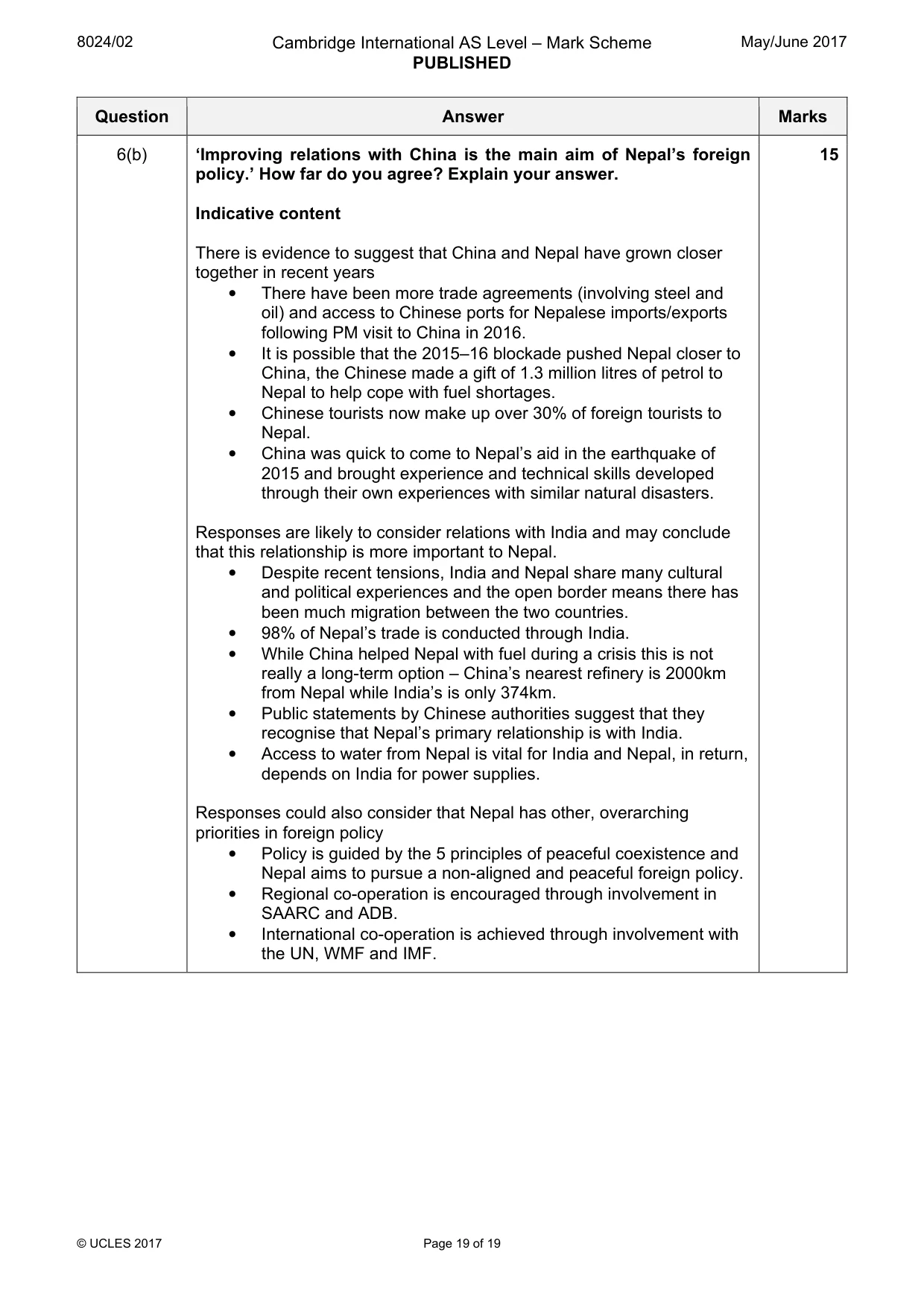
8024/02 Cambridge International AS Level – Mark Scheme PUBLISHED May/June 2017 © UCLES 2017 Page 19 of 19 Question Answer Marks 6(b) ‘Improving relations with China is the main aim of Nepal’s foreign policy.’ How far do you agree? Explain your answer. Indicative content There is evidence to suggest that China and Nepal have grown closer together in recent years • There have been more trade agreements (involving steel and oil) and access to Chinese ports for Nepalese imports/exports following PM visit to China in 2016. • It is possible that the 2015–16 blockade pushed Nepal closer to China, the Chinese made a gift of 1.3 million litres of petrol to Nepal to help cope with fuel shortages. • Chinese tourists now make up over 30% of foreign tourists to Nepal. • China was quick to come to Nepal’s aid in the earthquake of 2015 and brought experience and technical skills developed through their own experiences with similar natural disasters. Responses are likely to consider relations with India and may conclude that this relationship is more important to Nepal. • Despite recent tensions, India and Nepal share many cultural and political experiences and the open border means there has been much migration between the two countries. • 98% of Nepal’s trade is conducted through India. • While China helped Nepal with fuel during a crisis this is not really a long-term option – China’s nearest refinery is 2000km from Nepal while India’s is only 374km. • Public statements by Chinese authorities suggest that they recognise that Nepal’s primary relationship is with India. • Access to water from Nepal is vital for India and Nepal, in return, depends on India for power supplies. Responses could also consider that Nepal has other, overarching priorities in foreign policy • Policy is guided by the 5 principles of peaceful coexistence and Nepal aims to pursue a non-aligned and peaceful foreign policy. • Regional co-operation is encouraged through involvement in SAARC and ADB. • International co-operation is achieved through involvement with the UN, WMF and IMF. 15
What you needed in this session
Cambridge’s own grade thresholds for 2017 May/June, Paper 2 · Variant 1. A higher threshold means an easier paper — the bar moves with how the cohort did.