Cambridge A Level Nepal Studies (AS Level only) 8024 — 2019 May/June Paper 1 · Variant 1
8024/11/M/J/19 · 30 marks · ≈34 min
The question paper and its mark scheme, free to read here and free to download. This is Cambridge’s own paper, exactly as it was sat.
Question paper16 pages

Mark scheme3 pages
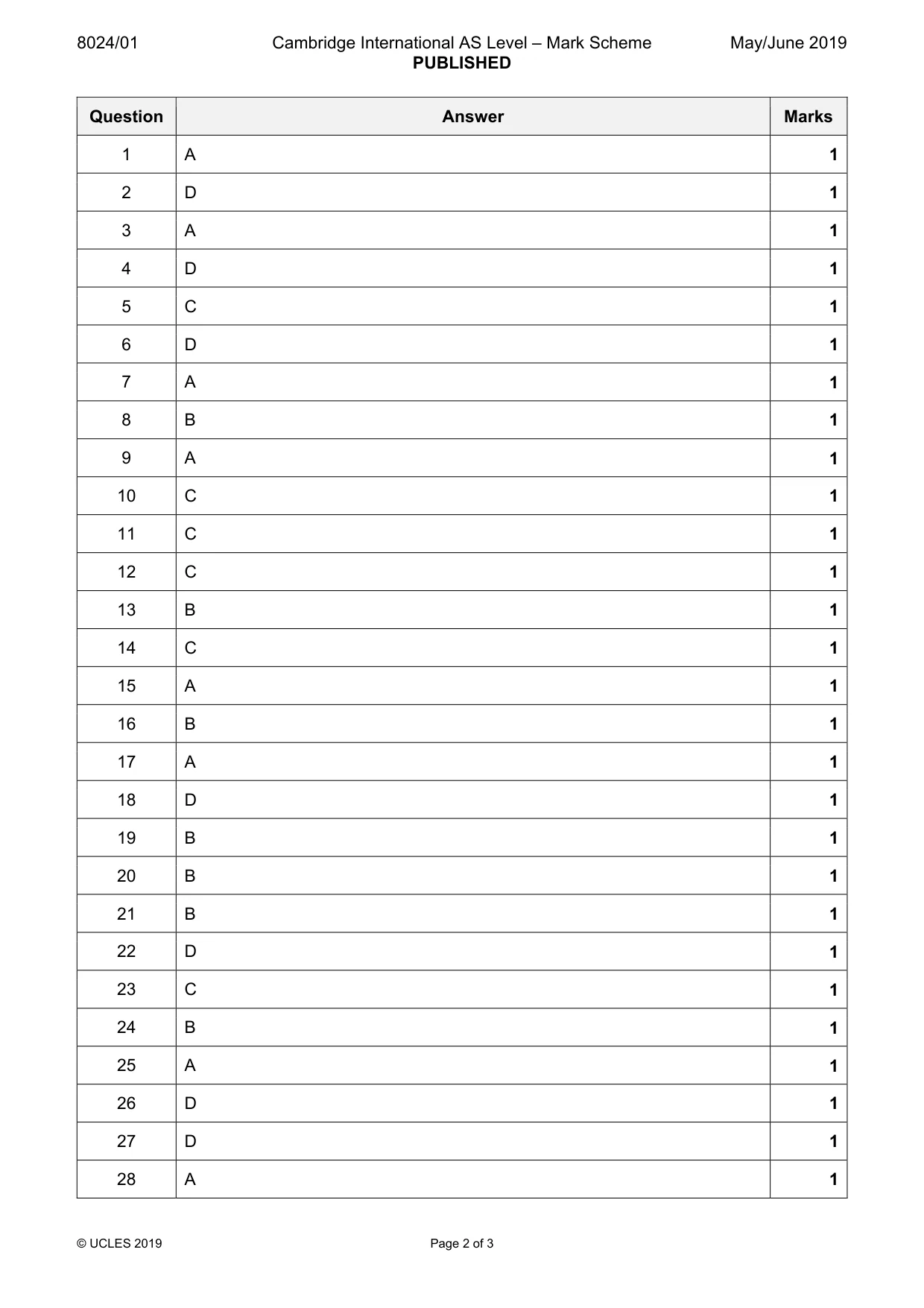
Answers below. Sit the paper first if you are practising.

Paper as text
Question paper, page 1
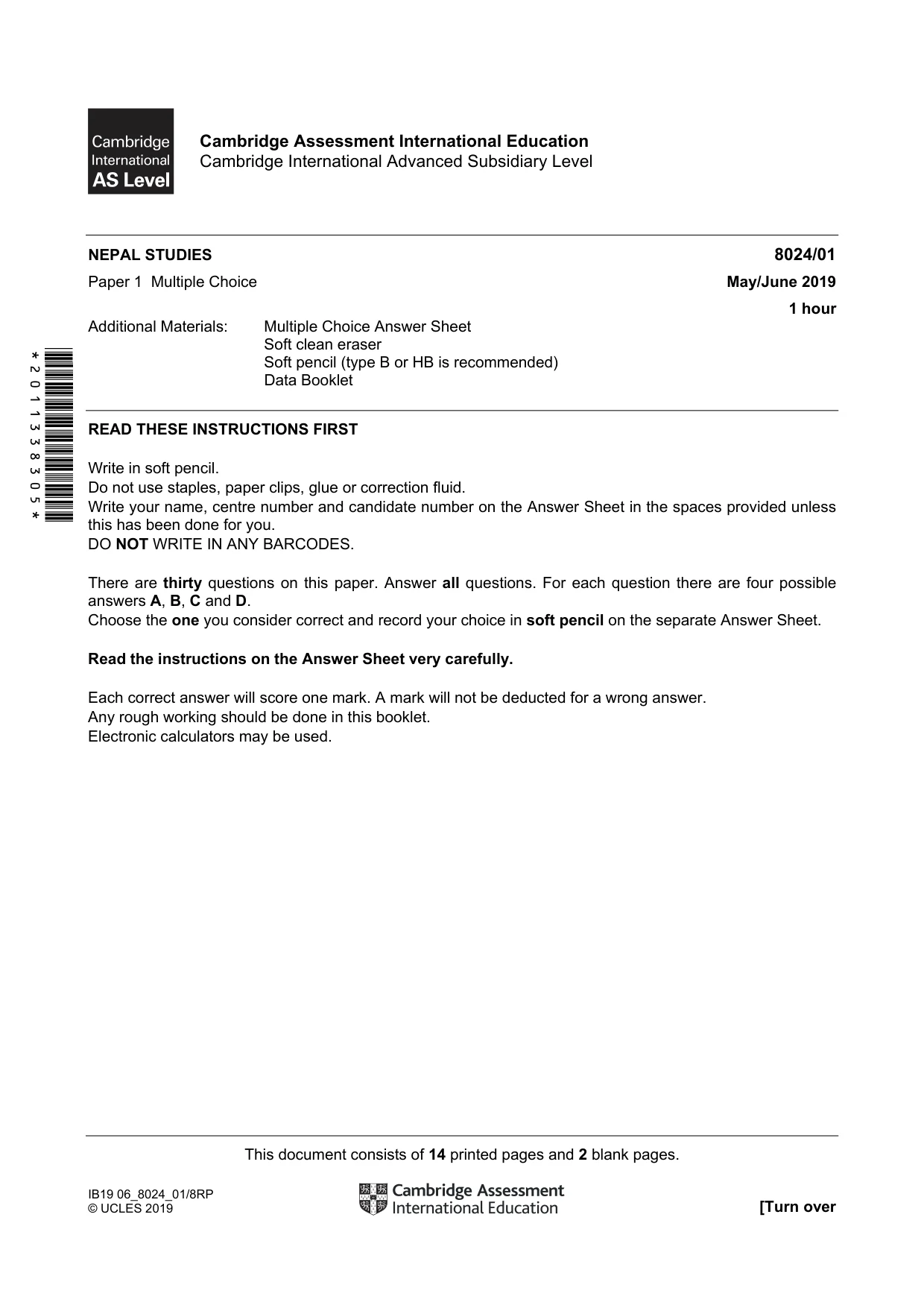
This document consists of 14 printed pages and 2 blank pages. IB19 06_8024_01/8RP © UCLES 2019 [Turn over *2011338305* Cambridge Assessment International Education Cambridge International Advanced Subsidiary Level NEPAL STUDIES 8024/01 Paper 1 Multiple Choice May/June 2019 1 hour Additional Materials: Multiple Choice Answer Sheet Soft clean eraser Soft pencil (type B or HB is recommended) Data Booklet READ THESE INSTRUCTIONS FIRST Write in soft pencil. Do not use staples, paper clips, glue or correction fluid. Write your name, centre number and candidate number on the Answer Sheet in the spaces provided unless this has been done for you. DO NOT WRITE IN ANY BARCODES. There are thirty questions on this paper. Answer all questions. For each question there are four possible answers A, B, C and D. Choose the one you consider correct and record your choice in soft pencil on the separate Answer Sheet. Read the instructions on the Answer Sheet very carefully. Each correct answer will score one mark. A mark will not be deducted for a wrong answer. Any rough working should be done in this booklet. Electronic calculators may be used.
Question paper, page 2
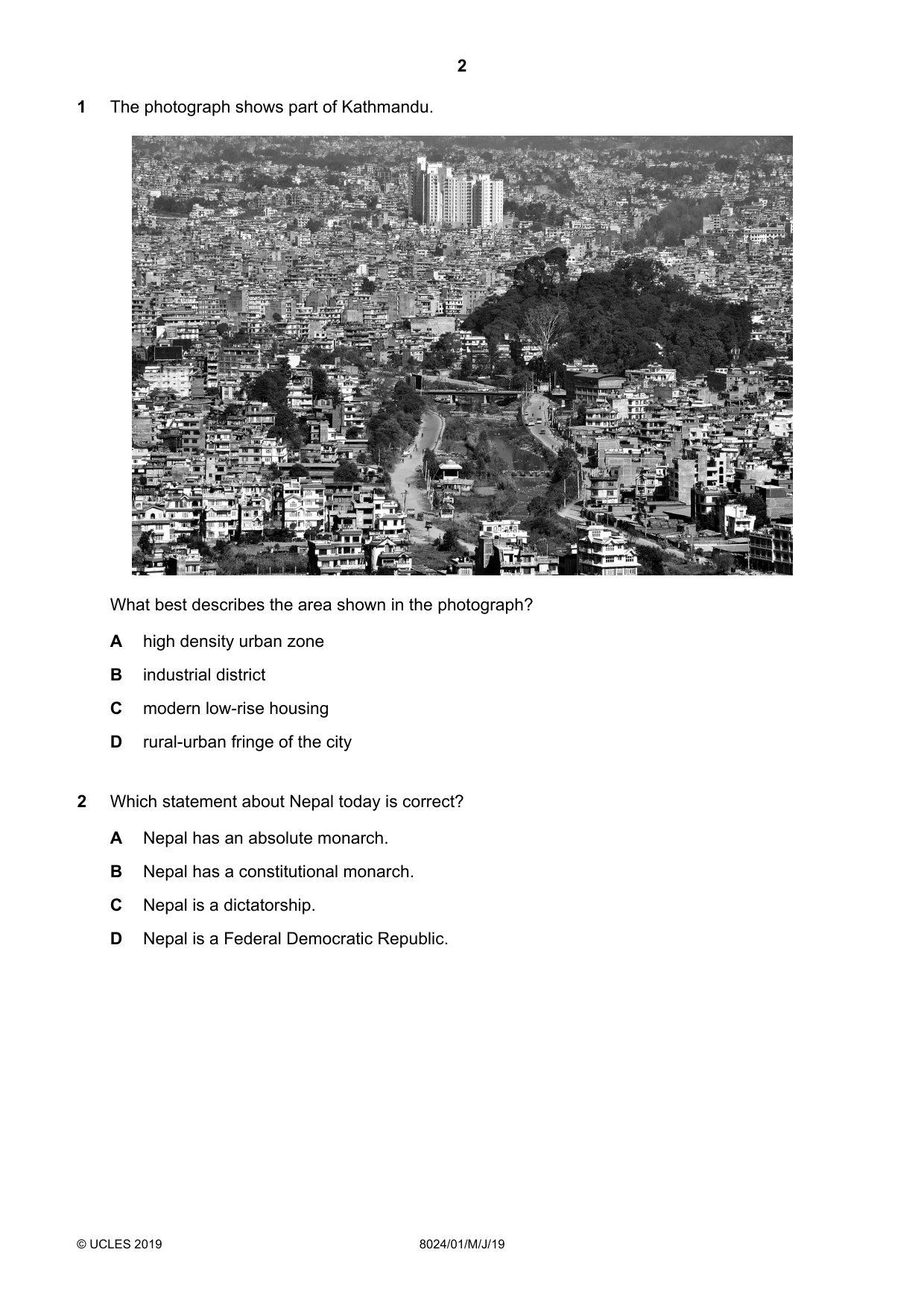
2 © UCLES 2019 8024/01/M/J/19 1 The photograph shows part of Kathmandu. What best describes the area shown in the photograph? A high density urban zone B industrial district C modern low-rise housing D rural-urban fringe of the city 2 Which statement about Nepal today is correct? A Nepal has an absolute monarch. B Nepal has a constitutional monarch. C Nepal is a dictatorship. D Nepal is a Federal Democratic Republic.
Question paper, page 3
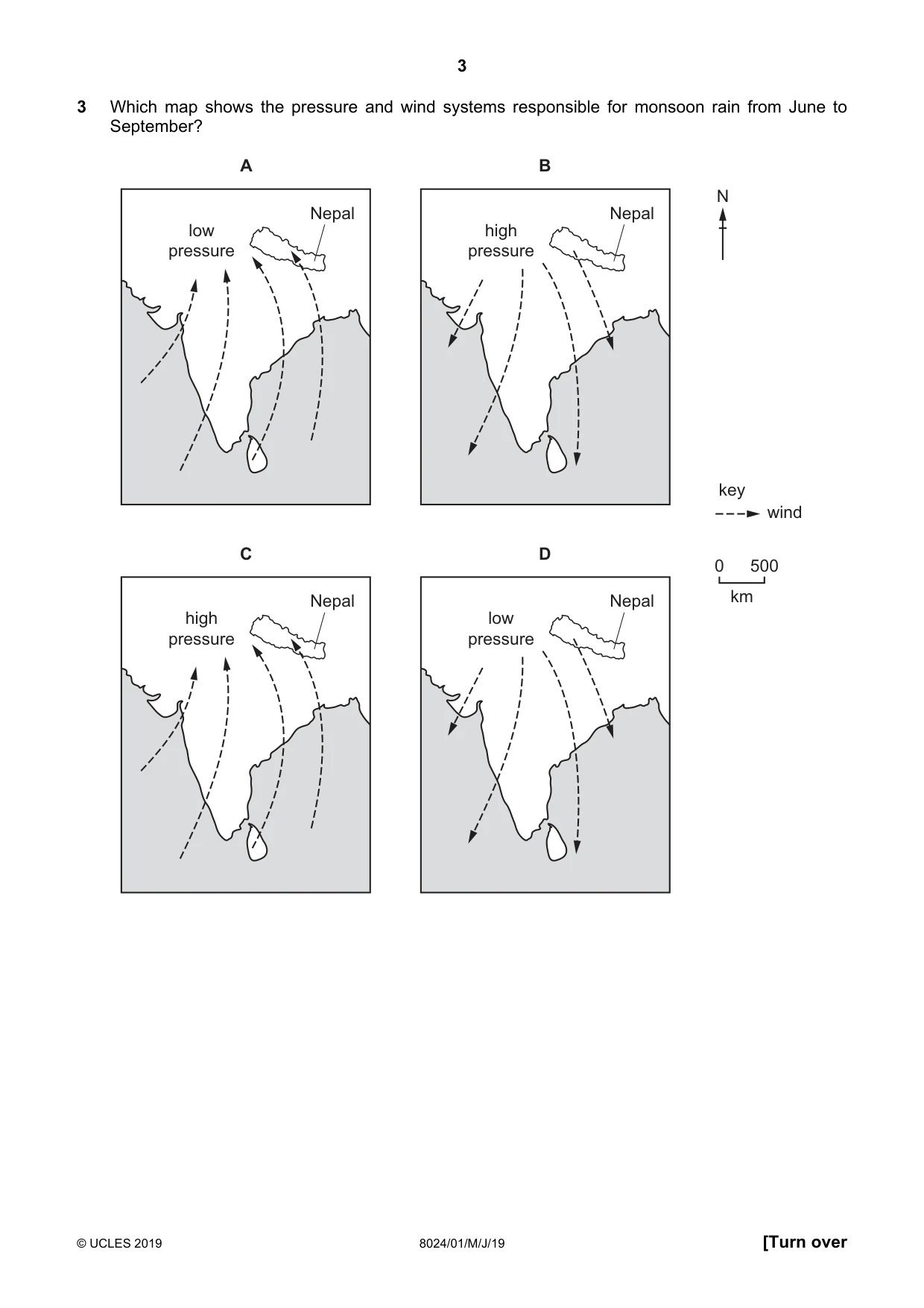
3 © UCLES 2019 8024/01/M/J/19 [Turn over 3 Which map shows the pressure and wind systems responsible for monsoon rain from June to September? Nepal high pressure Nepal high pressure A B Nepal low pressure Nepal low pressure C D N key 0 500 km wind
Question paper, page 4
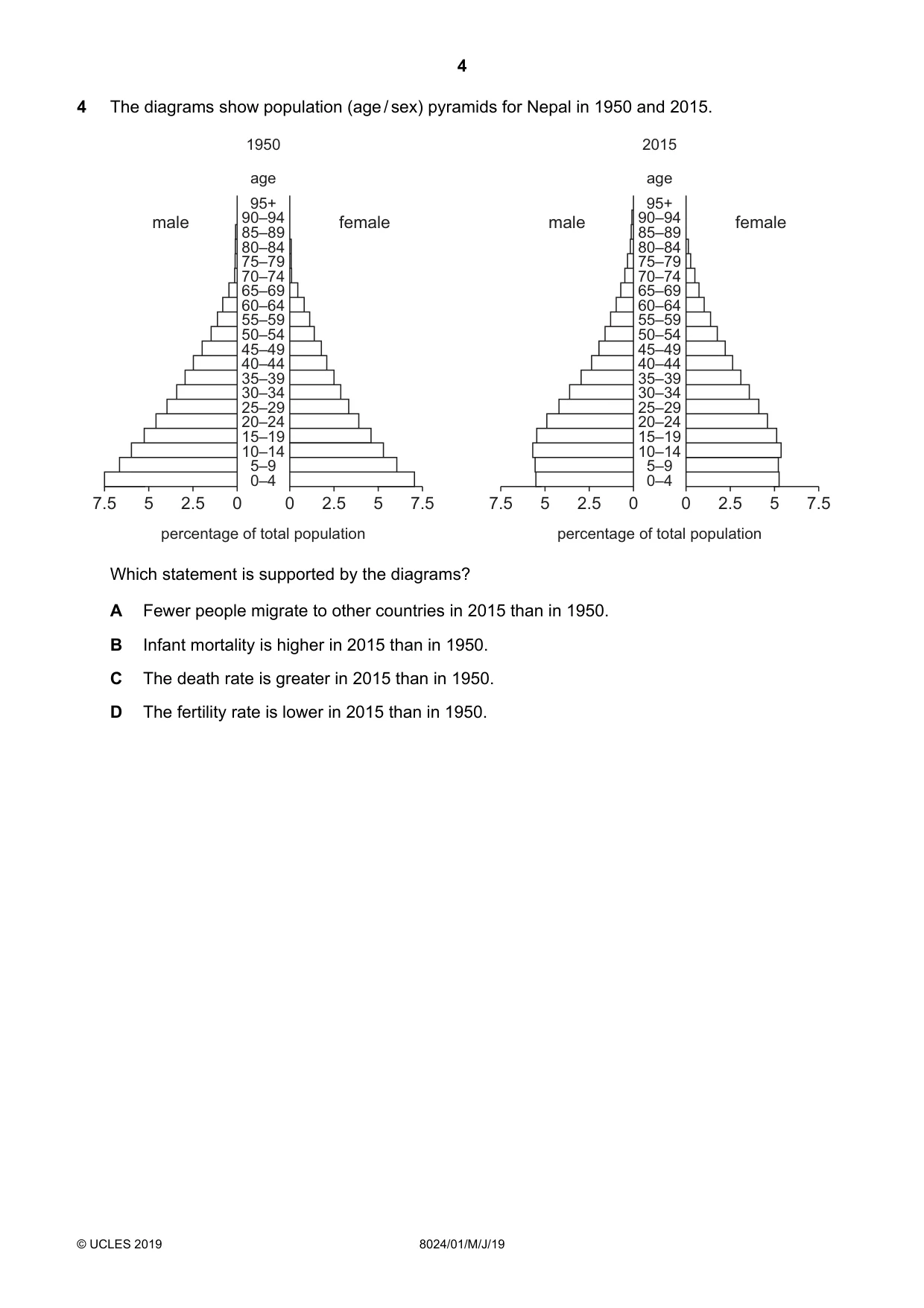
4 © UCLES 2019 8024/01/M/J/19 4 The diagrams show population (age / sex) pyramids for Nepal in 1950 and 2015. 95+ 90–94 85–89 80–84 75–79 70–74 65–69 60–64 55–59 50–54 45–49 40–44 35–39 30–34 25–29 20–24 15–19 10–14 5–9 0–4 age percentage of total population 0 2.5 5 7.5 0 2.5 5 7.5 male female 95+ 90–94 85–89 80–84 75–79 70–74 65–69 60–64 55–59 50–54 45–49 40–44 35–39 30–34 25–29 20–24 15–19 10–14 5–9 0–4 age 1950 2015 percentage of total population 0 2.5 5 7.5 0 2.5 5 7.5 male female Which statement is supported by the diagrams? A Fewer people migrate to other countries in 2015 than in 1950. B Infant mortality is higher in 2015 than in 1950. C The death rate is greater in 2015 than in 1950. D The fertility rate is lower in 2015 than in 1950.
Question paper, page 5
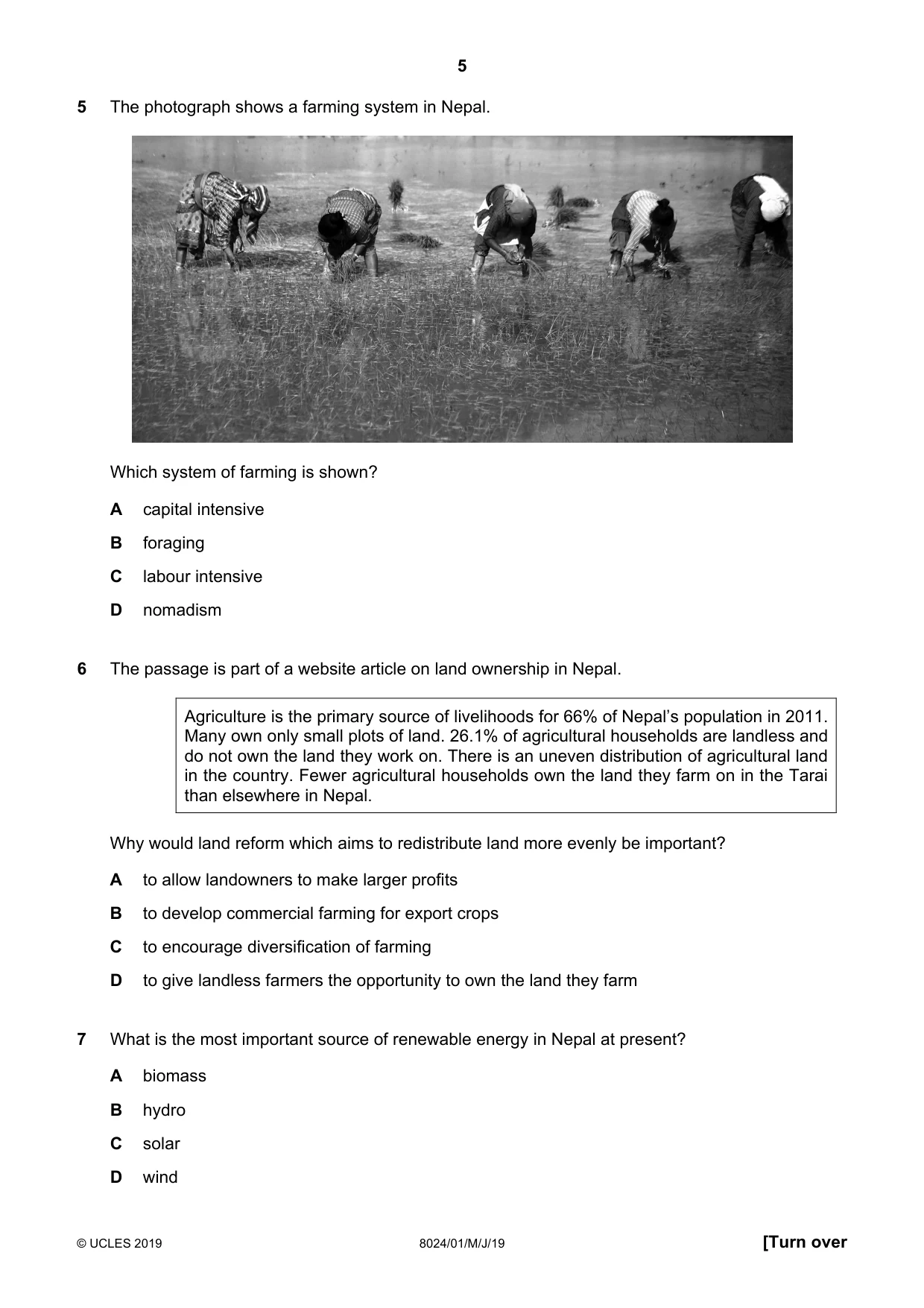
5 © UCLES 2019 8024/01/M/J/19 [Turn over 5 The photograph shows a farming system in Nepal. Which system of farming is shown? A capital intensive B foraging C labour intensive D nomadism 6 The passage is part of a website article on land ownership in Nepal. Agriculture is the primary source of livelihoods for 66% of Nepal’s population in 2011. Many own only small plots of land. 26.1% of agricultural households are landless and do not own the land they work on. There is an uneven distribution of agricultural land in the country. Fewer agricultural households own the land they farm on in the Tarai than elsewhere in Nepal. Why would land reform which aims to redistribute land more evenly be important? A to allow landowners to make larger profits B to develop commercial farming for export crops C to encourage diversification of farming D to give landless farmers the opportunity to own the land they farm 7 What is the most important source of renewable energy in Nepal at present? A biomass B hydro C solar D wind
Question paper, page 6
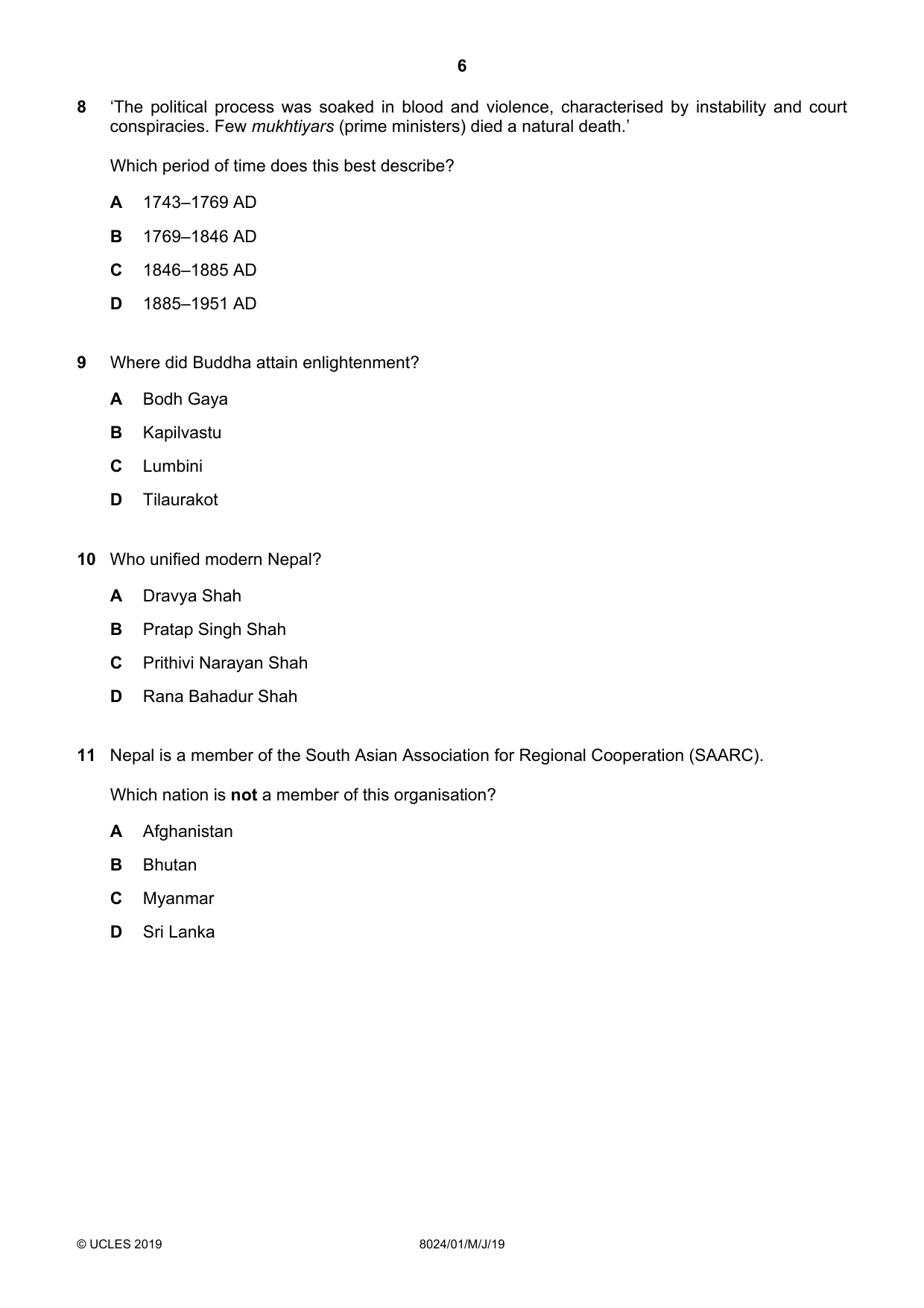
6 © UCLES 2019 8024/01/M/J/19 8 ‘The political process was soaked in blood and violence, characterised by instability and court conspiracies. Few mukhtiyars (prime ministers) died a natural death.’ Which period of time does this best describe? A 1743–1769 AD B 1769–1846 AD C 1846–1885 AD D 1885–1951 AD 9 Where did Buddha attain enlightenment? A Bodh Gaya B Kapilvastu C Lumbini D Tilaurakot 10 Who unified modern Nepal? A Dravya Shah B Pratap Singh Shah C Prithivi Narayan Shah D Rana Bahadur Shah 11 Nepal is a member of the South Asian Association for Regional Cooperation (SAARC). Which nation is not a member of this organisation? A Afghanistan B Bhutan C Myanmar D Sri Lanka
Question paper, page 7
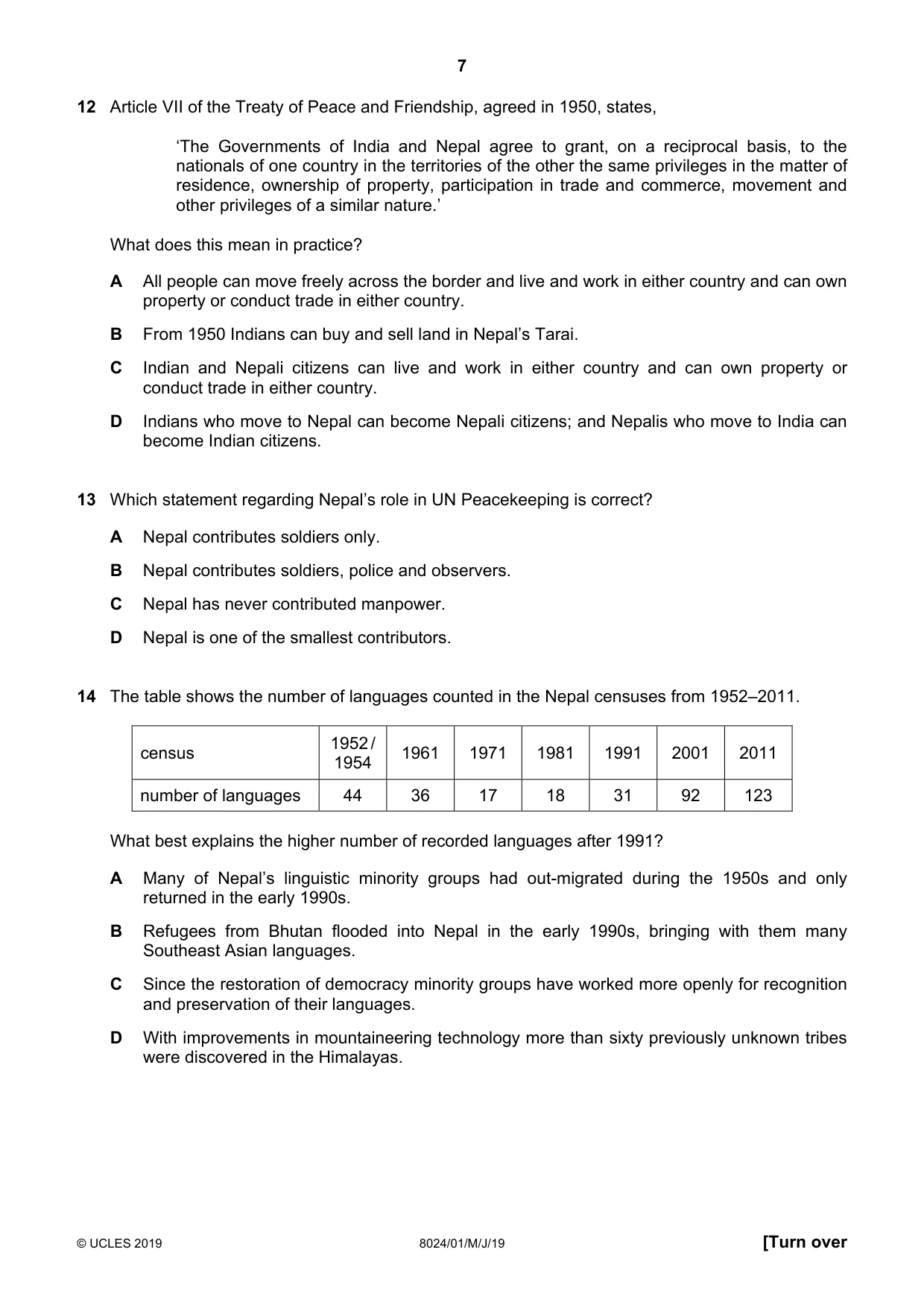
7 © UCLES 2019 8024/01/M/J/19 [Turn over 12 Article VII of the Treaty of Peace and Friendship, agreed in 1950, states, ‘The Governments of India and Nepal agree to grant, on a reciprocal basis, to the nationals of one country in the territories of the other the same privileges in the matter of residence, ownership of property, participation in trade and commerce, movement and other privileges of a similar nature.’ What does this mean in practice? A All people can move freely across the border and live and work in either country and can own property or conduct trade in either country. B From 1950 Indians can buy and sell land in Nepal’s Tarai. C Indian and Nepali citizens can live and work in either country and can own property or conduct trade in either country. D Indians who move to Nepal can become Nepali citizens; and Nepalis who move to India can become Indian citizens. 13 Which statement regarding Nepal’s role in UN Peacekeeping is correct? A Nepal contributes soldiers only. B Nepal contributes soldiers, police and observers. C Nepal has never contributed manpower. D Nepal is one of the smallest contributors. 14 The table shows the number of languages counted in the Nepal censuses from 1952–2011. census 1952 / 1954 1961 1971 1981 1991 2001 2011 number of languages 44 36 17 18 31 92 123 What best explains the higher number of recorded languages after 1991? A Many of Nepal’s linguistic minority groups had out-migrated during the 1950s and only returned in the early 1990s. B Refugees from Bhutan flooded into Nepal in the early 1990s, bringing with them many Southeast Asian languages. C Since the restoration of democracy minority groups have worked more openly for recognition and preservation of their languages. D With improvements in mountaineering technology more than sixty previously unknown tribes were discovered in the Himalayas.
Question paper, page 8
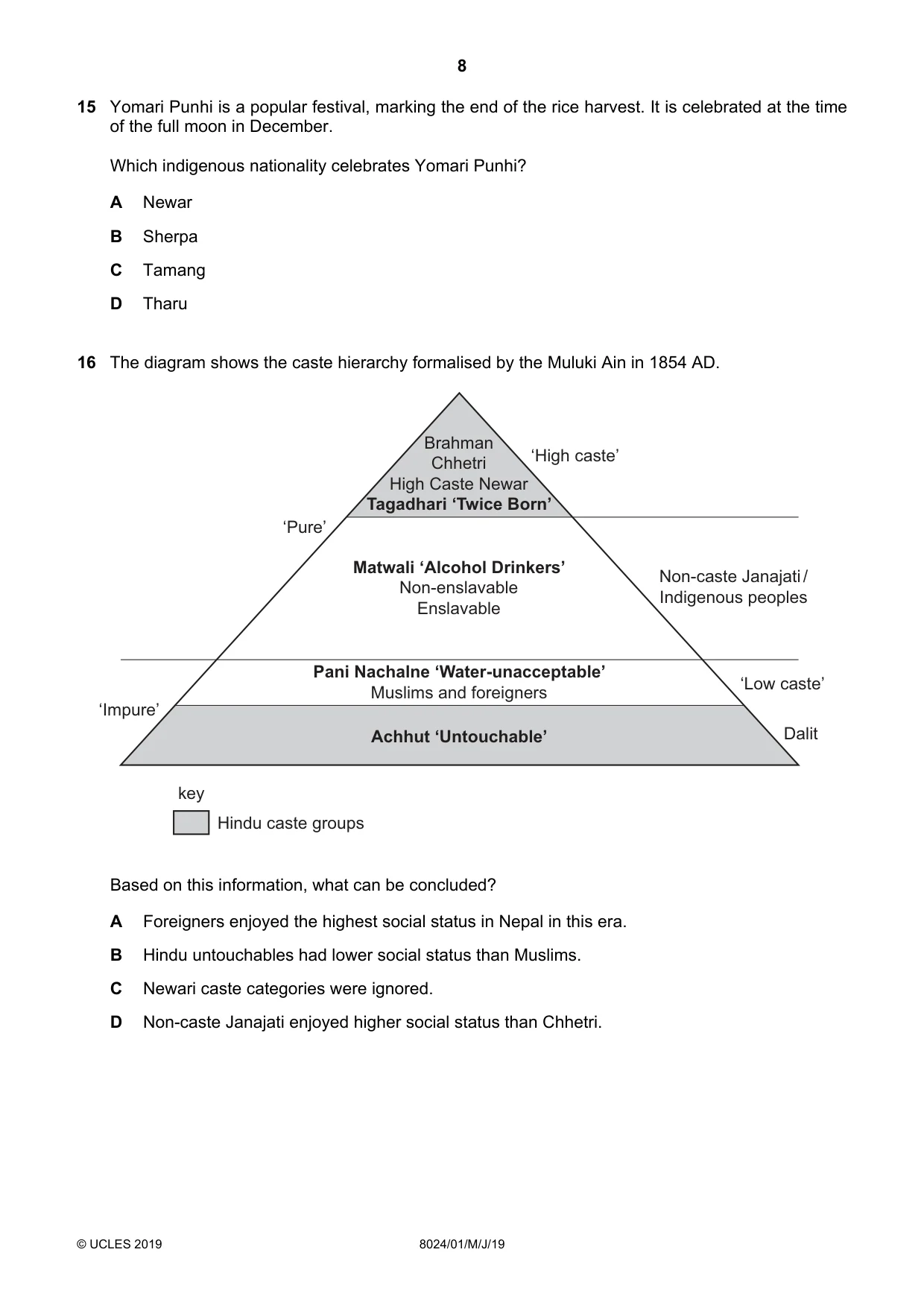
8 © UCLES 2019 8024/01/M/J/19 15 Yomari Punhi is a popular festival, marking the end of the rice harvest. It is celebrated at the time of the full moon in December. Which indigenous nationality celebrates Yomari Punhi? A Newar B Sherpa C Tamang D Tharu 16 The diagram shows the caste hierarchy formalised by the Muluki Ain in 1854 AD. Brahman Chhetri High Caste Newar Tagadhari ‘Twice Born’ Matwali ‘Alcohol Drinkers’ Non-enslavable Enslavable Pani Nachalne ‘Water-unacceptable’ Muslims and foreigners Achhut ‘Untouchable’ ‘High caste’ Non-caste Janajati / Indigenous peoples ‘Low caste’ Dalit ‘Impure’ ‘Pure’ key Hindu caste groups Based on this information, what can be concluded? A Foreigners enjoyed the highest social status in Nepal in this era. B Hindu untouchables had lower social status than Muslims. C Newari caste categories were ignored. D Non-caste Janajati enjoyed higher social status than Chhetri.
Question paper, page 9
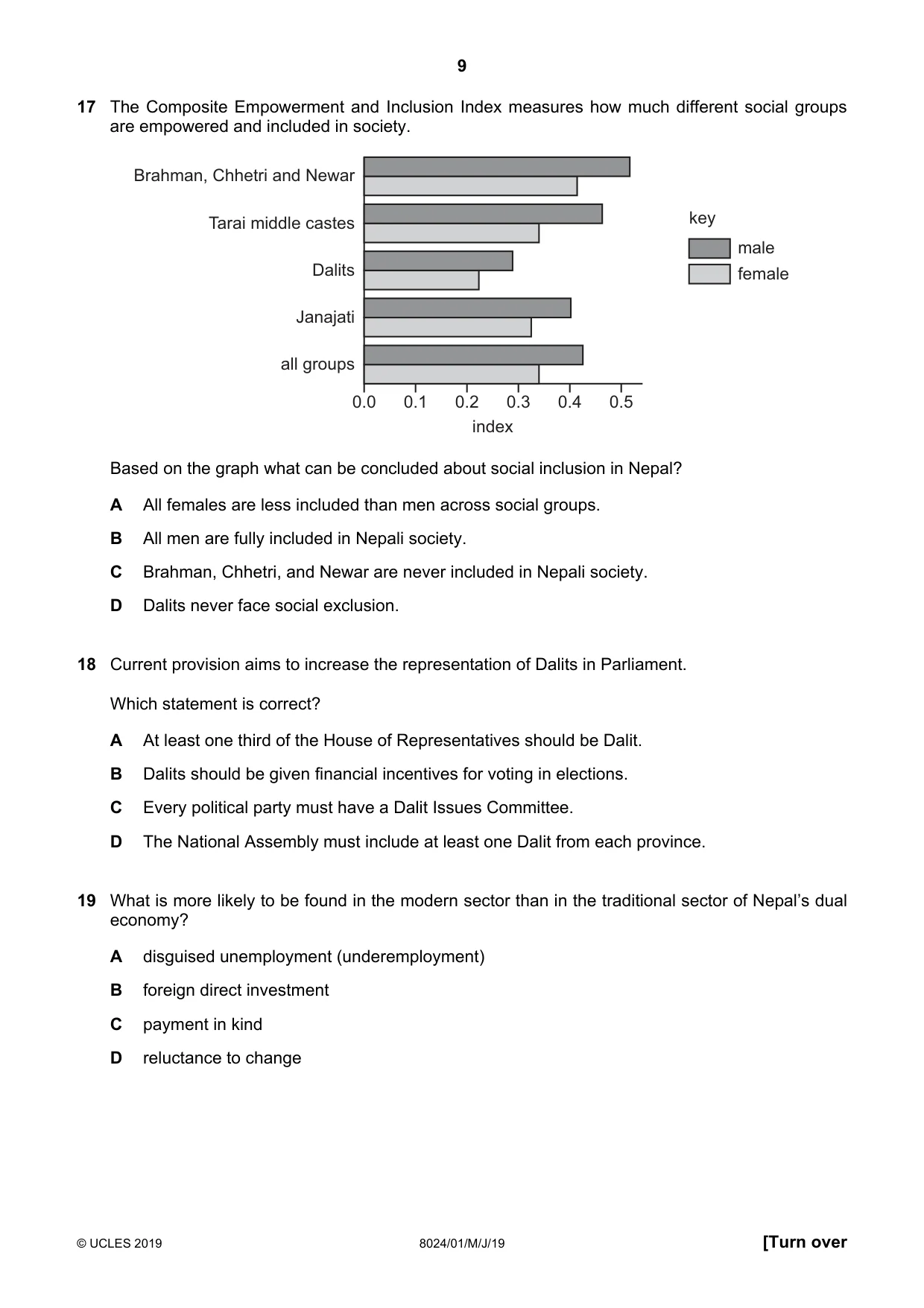
9 © UCLES 2019 8024/01/M/J/19 [Turn over 17 The Composite Empowerment and Inclusion Index measures how much different social groups are empowered and included in society. 0.0 0.1 0.2 0.3 index 0.4 0.5 all groups Janajati Dalits Tarai middle castes Brahman, Chhetri and Newar key female male Based on the graph what can be concluded about social inclusion in Nepal? A All females are less included than men across social groups. B All men are fully included in Nepali society. C Brahman, Chhetri, and Newar are never included in Nepali society. D Dalits never face social exclusion. 18 Current provision aims to increase the representation of Dalits in Parliament. Which statement is correct? A At least one third of the House of Representatives should be Dalit. B Dalits should be given financial incentives for voting in elections. C Every political party must have a Dalit Issues Committee. D The National Assembly must include at least one Dalit from each province. 19 What is more likely to be found in the modern sector than in the traditional sector of Nepal’s dual economy? A disguised unemployment (underemployment) B foreign direct investment C payment in kind D reluctance to change
Question paper, page 10
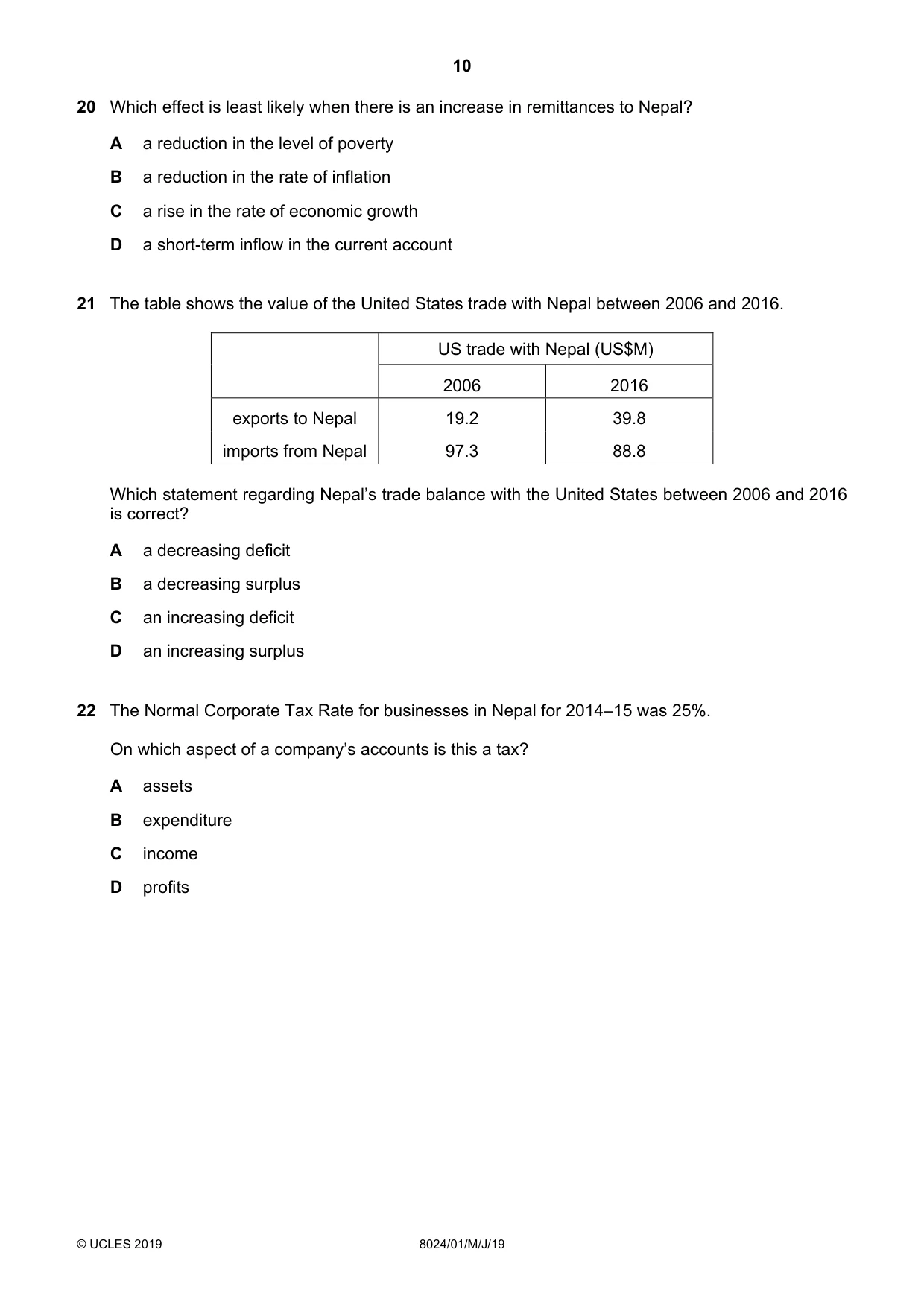
10 © UCLES 2019 8024/01/M/J/19 20 Which effect is least likely when there is an increase in remittances to Nepal? A a reduction in the level of poverty B a reduction in the rate of inflation C a rise in the rate of economic growth D a short-term inflow in the current account 21 The table shows the value of the United States trade with Nepal between 2006 and 2016. US trade with Nepal (US$M) 2006 2016 exports to Nepal 19.2 39.8 imports from Nepal 97.3 88.8 Which statement regarding Nepal’s trade balance with the United States between 2006 and 2016 is correct? A a decreasing deficit B a decreasing surplus C an increasing deficit D an increasing surplus 22 The Normal Corporate Tax Rate for businesses in Nepal for 2014–15 was 25%. On which aspect of a company’s accounts is this a tax? A assets B expenditure C income D profits
Question paper, page 11
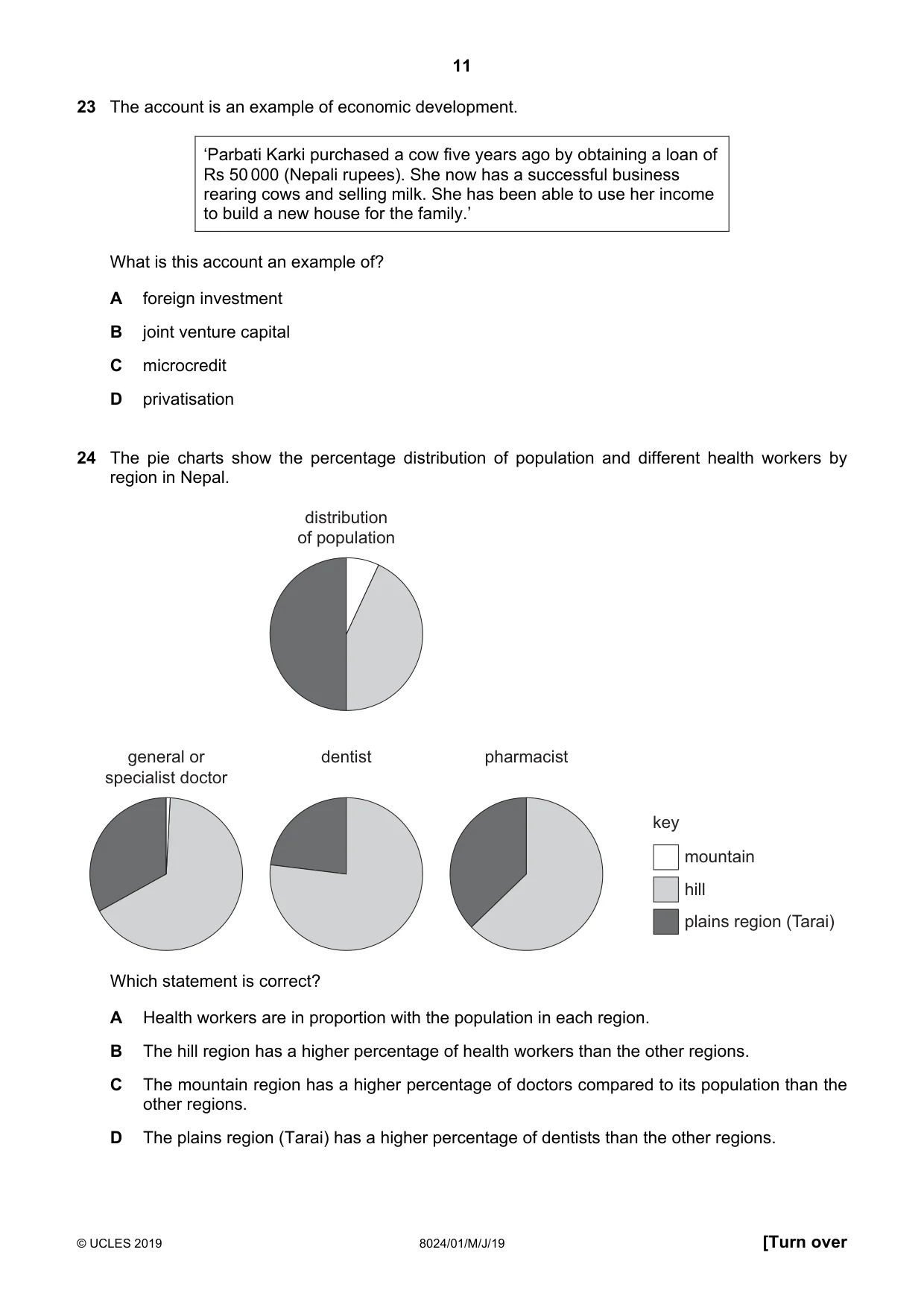
11 © UCLES 2019 8024/01/M/J/19 [Turn over 23 The account is an example of economic development. ‘Parbati Karki purchased a cow five years ago by obtaining a loan of Rs 50 000 (Nepali rupees). She now has a successful business rearing cows and selling milk. She has been able to use her income to build a new house for the family.’ What is this account an example of? A foreign investment B joint venture capital C microcredit D privatisation 24 The pie charts show the percentage distribution of population and different health workers by region in Nepal. distribution of population pharmacist dentist general or specialist doctor mountain hill plains region (Tarai) key Which statement is correct? A Health workers are in proportion with the population in each region. B The hill region has a higher percentage of health workers than the other regions. C The mountain region has a higher percentage of doctors compared to its population than the other regions. D The plains region (Tarai) has a higher percentage of dentists than the other regions.
Question paper, page 12
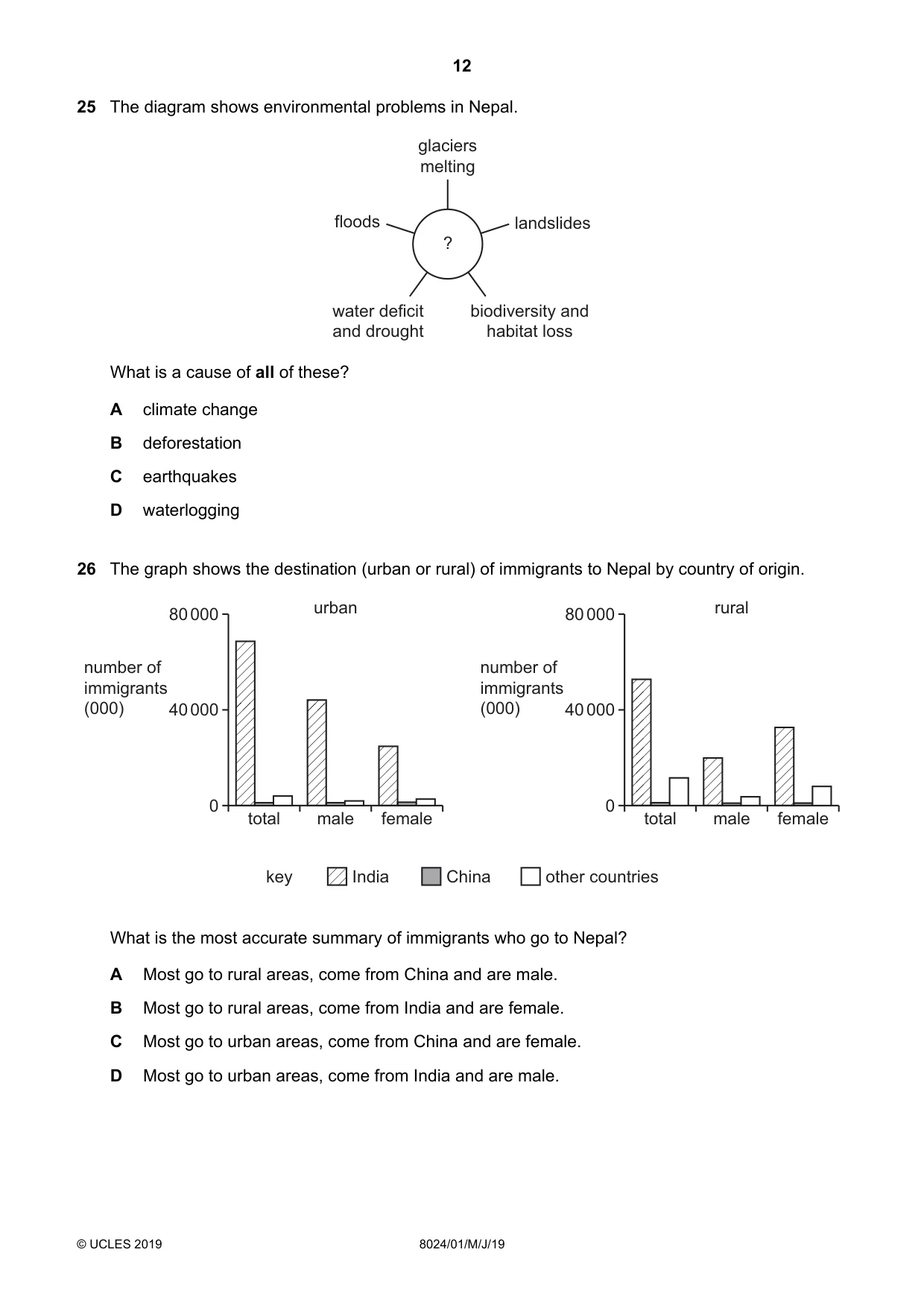
12 © UCLES 2019 8024/01/M/J/19 25 The diagram shows environmental problems in Nepal. ? glaciers melting landslides biodiversity and habitat loss water deficit and drought floods What is a cause of all of these? A climate change B deforestation C earthquakes D waterlogging 26 The graph shows the destination (urban or rural) of immigrants to Nepal by country of origin. total male urban female 80 000 40 000 0 number of immigrants (000) total male rural female 80 000 40 000 0 number of immigrants (000) key India China other countries What is the most accurate summary of immigrants who go to Nepal? A Most go to rural areas, come from China and are male. B Most go to rural areas, come from India and are female. C Most go to urban areas, come from China and are female. D Most go to urban areas, come from India and are male.
Question paper, page 13
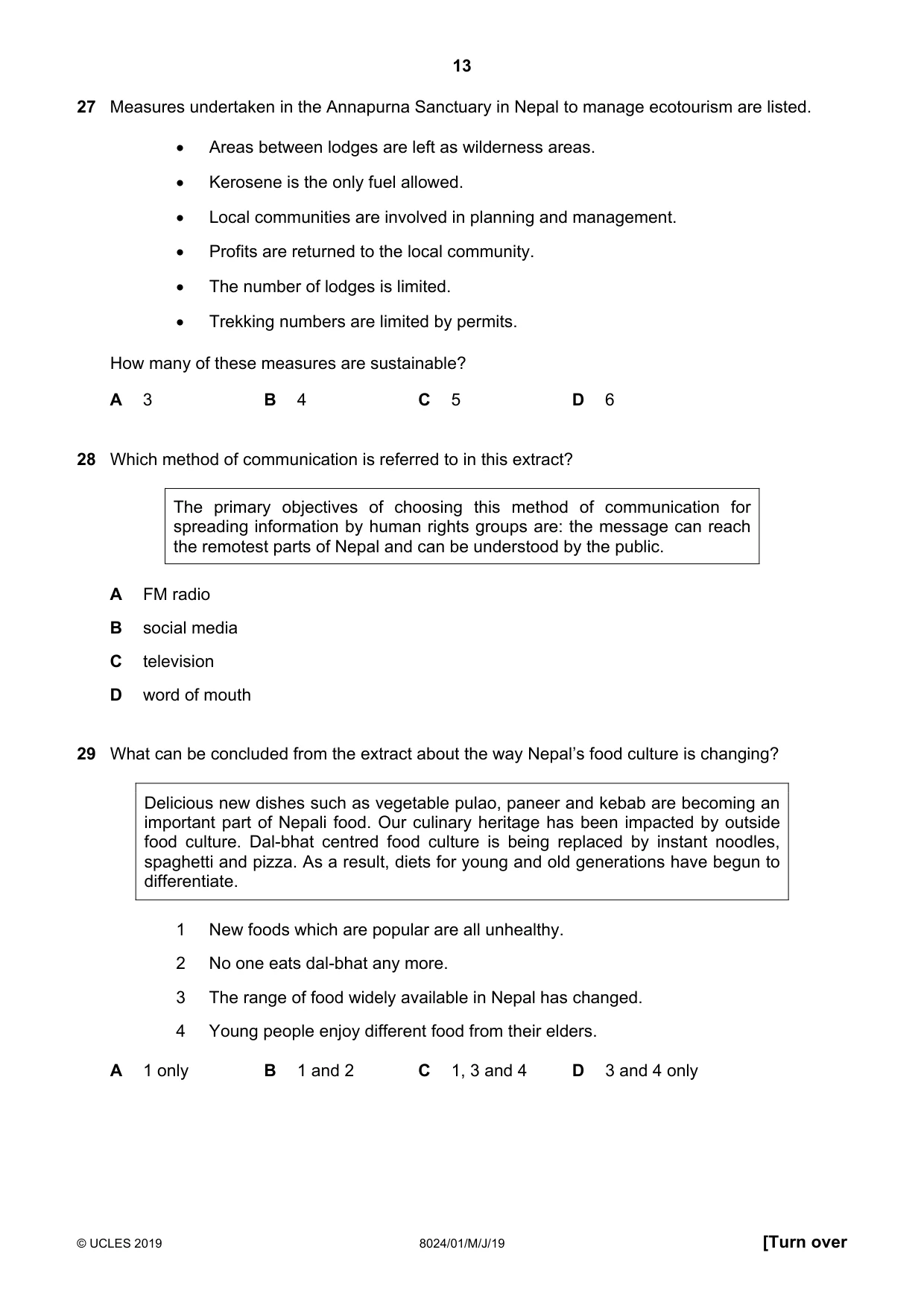
13 © UCLES 2019 8024/01/M/J/19 [Turn over 27 Measures undertaken in the Annapurna Sanctuary in Nepal to manage ecotourism are listed. • Areas between lodges are left as wilderness areas. • Kerosene is the only fuel allowed. • Local communities are involved in planning and management. • Profits are returned to the local community. • The number of lodges is limited. • Trekking numbers are limited by permits. How many of these measures are sustainable? A 3 B 4 C 5 D 6 28 Which method of communication is referred to in this extract? The primary objectives of choosing this method of communication for spreading information by human rights groups are: the message can reach the remotest parts of Nepal and can be understood by the public. A FM radio B social media C television D word of mouth 29 What can be concluded from the extract about the way Nepal’s food culture is changing? Delicious new dishes such as vegetable pulao, paneer and kebab are becoming an important part of Nepali food. Our culinary heritage has been impacted by outside food culture. Dal-bhat centred food culture is being replaced by instant noodles, spaghetti and pizza. As a result, diets for young and old generations have begun to differentiate. 1 New foods which are popular are all unhealthy. 2 No one eats dal-bhat any more. 3 The range of food widely available in Nepal has changed. 4 Young people enjoy different food from their elders. A 1 only B 1 and 2 C 1, 3 and 4 D 3 and 4 only
Question paper, page 14
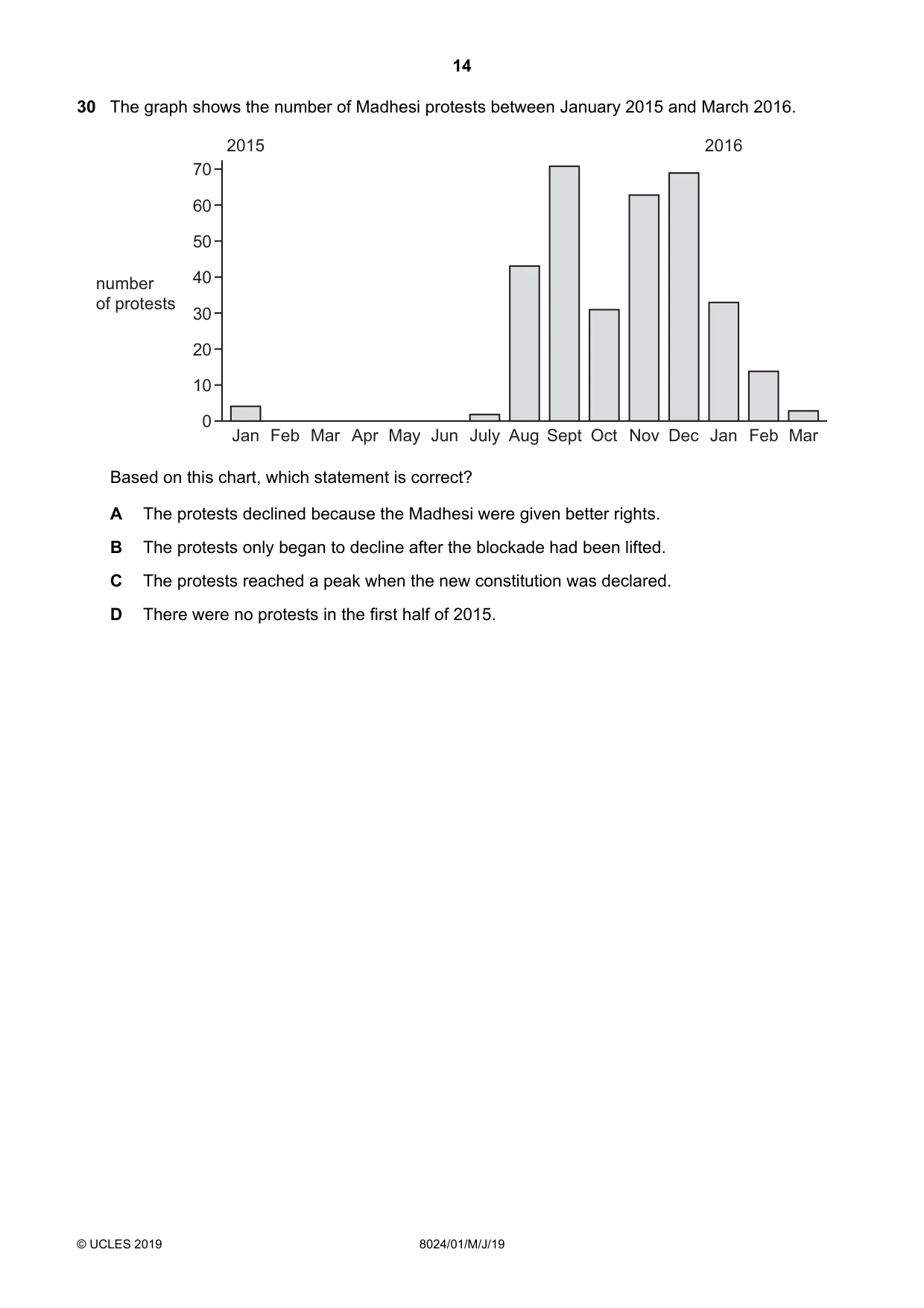
14 © UCLES 2019 8024/01/M/J/19 30 The graph shows the number of Madhesi protests between January 2015 and March 2016. Jan Feb Mar Apr May Jun 70 60 50 40 30 20 10 0 July Aug Sept Oct Nov Dec Jan Feb Mar 2015 2016 number of protests Based on this chart, which statement is correct? A The protests declined because the Madhesi were given better rights. B The protests only began to decline after the blockade had been lifted. C The protests reached a peak when the new constitution was declared. D There were no protests in the first half of 2015.
Question paper, page 15
15 © UCLES 2019 8024/01/M/J/19 BLANK PAGE
Question paper, page 16
16 Permission to reproduce items where third-party owned material protected by copyright is included has been sought and cleared where possible. Every reasonable effort has been made by the publisher (UCLES) to trace copyright holders, but if any items requiring clearance have unwittingly been included, the publisher will be pleased to make amends at the earliest possible opportunity. To avoid the issue of disclosure of answer-related information to candidates, all copyright acknowledgements are reproduced online in the Cambridge Assessment International Education Copyright Acknowledgements Booklet. This is produced for each series of examinations and is freely available to download at www.cambridgeinternational.org after the live examination series. Cambridge Assessment International Education is part of the Cambridge Assessment Group. Cambridge Assessment is the brand name of the University of Cambridge Local Examinations Syndicate (UCLES), which itself is a department of the University of Cambridge. © UCLES 2019 8024/01/M/J/19 BLANK PAGE
Mark scheme, page 1
This document consists of 3 printed pages. © UCLES 2019 [Turn over Cambridge Assessment International Education Cambridge International Advanced Subsidiary Level NEPAL STUDIES 8024/01 Paper 1 Multiple Choice May/June 2019 MARK SCHEME Maximum Mark: 30 Published This mark scheme is published as an aid to teachers and candidates, to indicate the requirements of the examination. Mark schemes should be read in conjunction with the question paper and the Principal Examiner Report for Teachers. Cambridge International will not enter into discussions about these mark schemes. Cambridge International is publishing the mark schemes for the May/June 2019 series for most Cambridge IGCSE™, Cambridge International A and AS Level and Cambridge Pre-U components, and some Cambridge O Level components.
Mark scheme, page 2
8024/01 Cambridge International AS Level – Mark Scheme PUBLISHED May/June 2019 © UCLES 2019 Page 2 of 3 Question Answer Marks 1 A 1 2 D 1 3 A 1 4 D 1 5 C 1 6 D 1 7 A 1 8 B 1 9 A 1 10 C 1 11 C 1 12 C 1 13 B 1 14 C 1 15 A 1 16 B 1 17 A 1 18 D 1 19 B 1 20 B 1 21 B 1 22 D 1 23 C 1 24 B 1 25 A 1 26 D 1 27 D 1 28 A 1
Mark scheme, page 3
8024/01 Cambridge International AS Level – Mark Scheme PUBLISHED May/June 2019 © UCLES 2019 Page 3 of 3 Question Answer Marks 29 D 1 30 C 1
What you needed in this session
Cambridge’s own grade thresholds for 2019 May/June, Paper 1 · Variant 1. A higher threshold means an easier paper — the bar moves with how the cohort did.