Cambridge A Level Nepal Studies (AS Level only) 8024 — 2017 May/June Paper 1 · Variant 1
8024/11/M/J/17 · 30 marks · ≈34 min
The question paper and its mark scheme, free to read here and free to download. This is Cambridge’s own paper, exactly as it was sat.
Question paper12 pages

Mark scheme3 pages
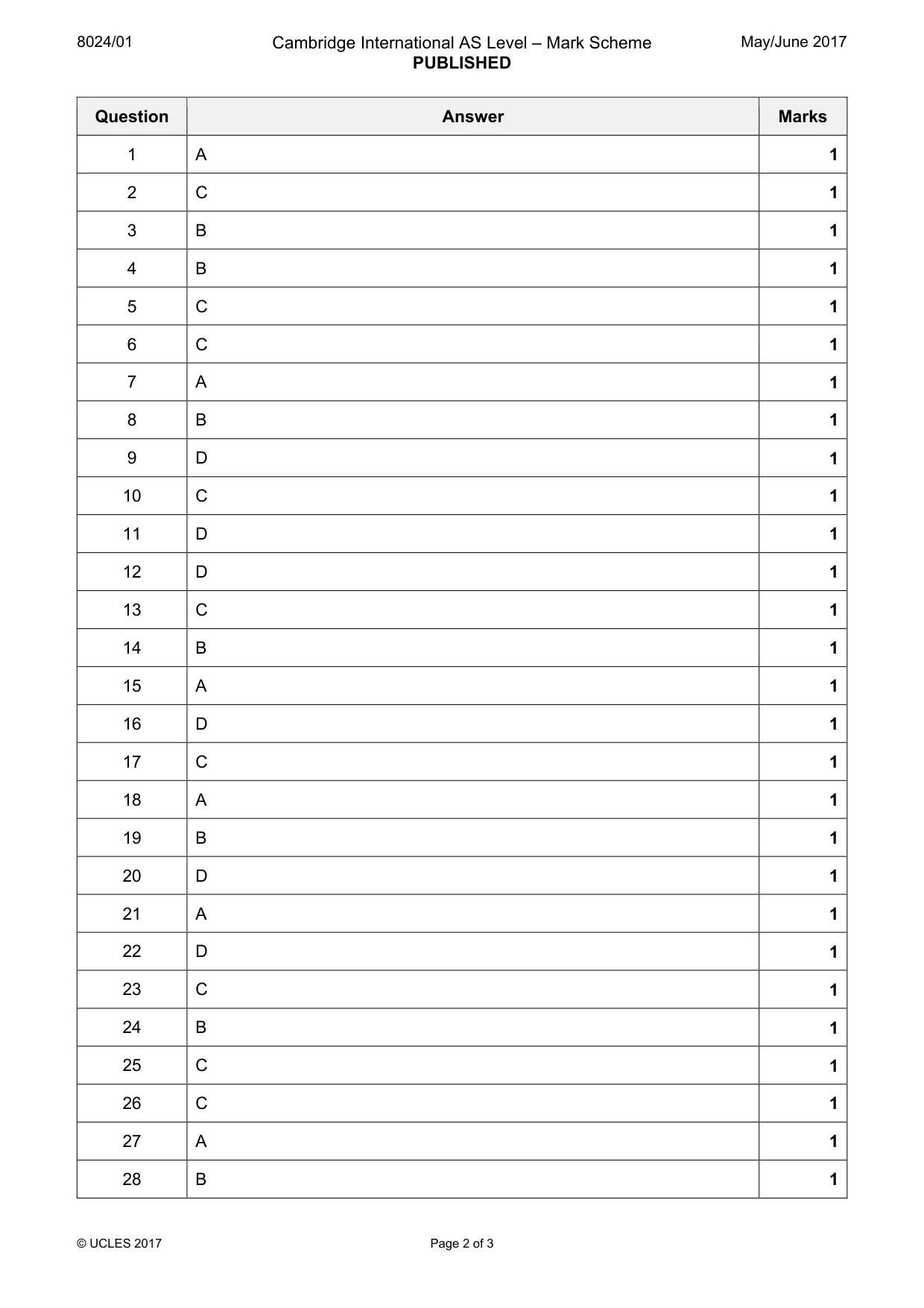
Answers below. Sit the paper first if you are practising.

Paper as text
Question paper, page 1
This document consists of 12 printed pages. IB17 06_8024_01/2RP © UCLES 2017 [Turn over *8434470939* Cambridge International Examinations Cambridge International Advanced Subsidiary Level NEPAL STUDIES 8024/01 Paper 1 Multiple Choice May/June 2017 1 hour Additional Materials: Multiple Choice Answer Sheet Soft clean eraser Soft pencil (type B or HB is recommended) Data Booklet READ THESE INSTRUCTIONS FIRST Write in soft pencil. Do not use staples, paper clips, glue or correction fluid. Write your name, Centre number and candidate number on the Answer Sheet in the spaces provided unless this has been done for you. DO NOT WRITE IN ANY BARCODES. There are thirty questions on this paper. Answer all questions. For each question there are four possible answers A, B, C and D. Choose the one you consider correct and record your choice in soft pencil on the separate Answer Sheet. Read the instructions on the Answer Sheet very carefully. Each correct answer will score one mark. A mark will not be deducted for a wrong answer. Any rough working should be done in this booklet. Electronic calculators may be used.
Question paper, page 2
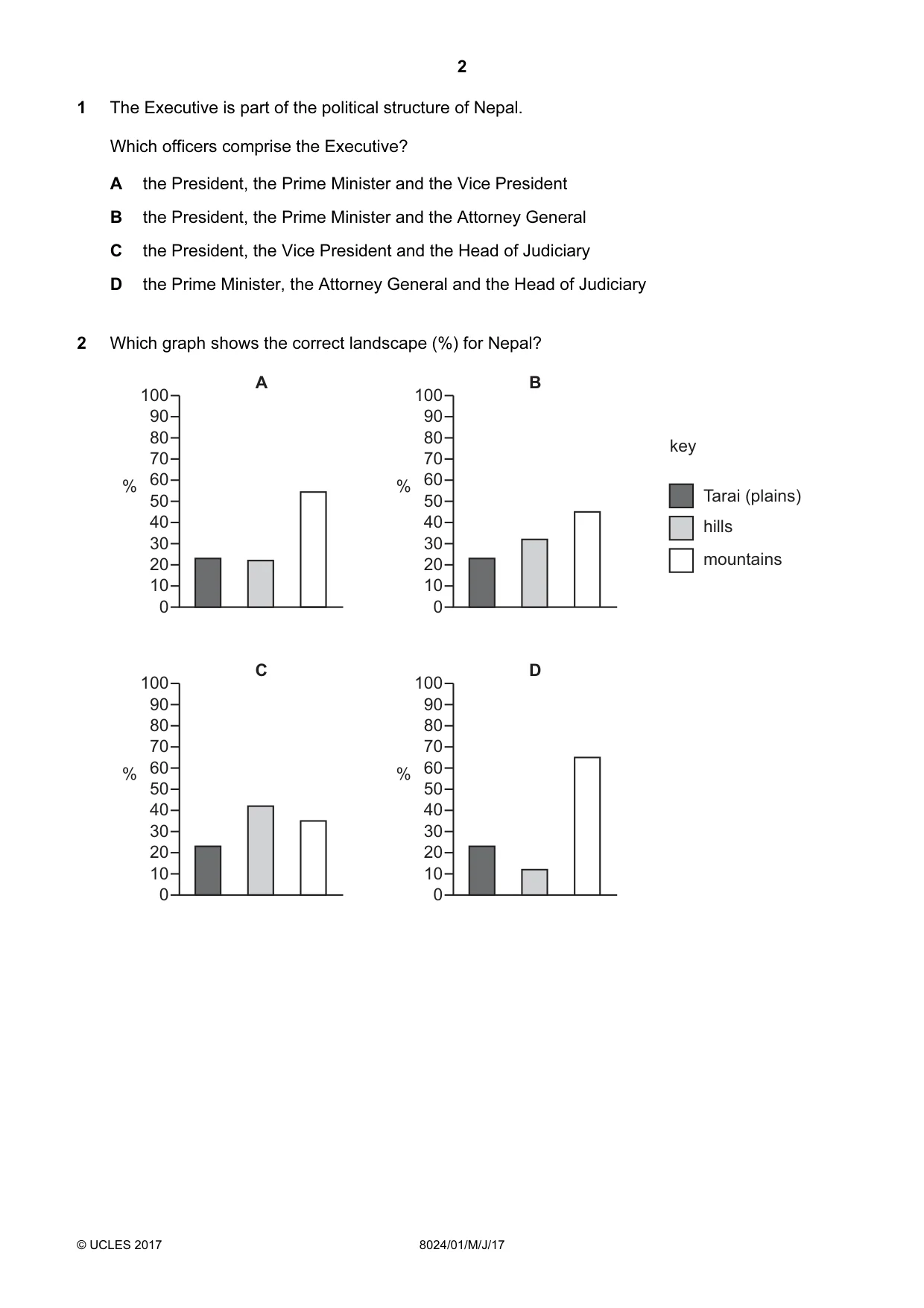
2 © UCLES 2017 8024/01/M/J/17 1 The Executive is part of the political structure of Nepal. Which officers comprise the Executive? A the President, the Prime Minister and the Vice President B the President, the Prime Minister and the Attorney General C the President, the Vice President and the Head of Judiciary D the Prime Minister, the Attorney General and the Head of Judiciary 2 Which graph shows the correct landscape (%) for Nepal? A 100 90 80 70 60 50 40 30 20 10 0 % B 100 90 80 70 60 50 40 30 20 10 0 % C 100 90 80 70 60 50 40 30 20 10 0 % D 100 90 80 70 60 50 40 30 20 10 0 % key mountains hills Tarai (plains)
Question paper, page 3
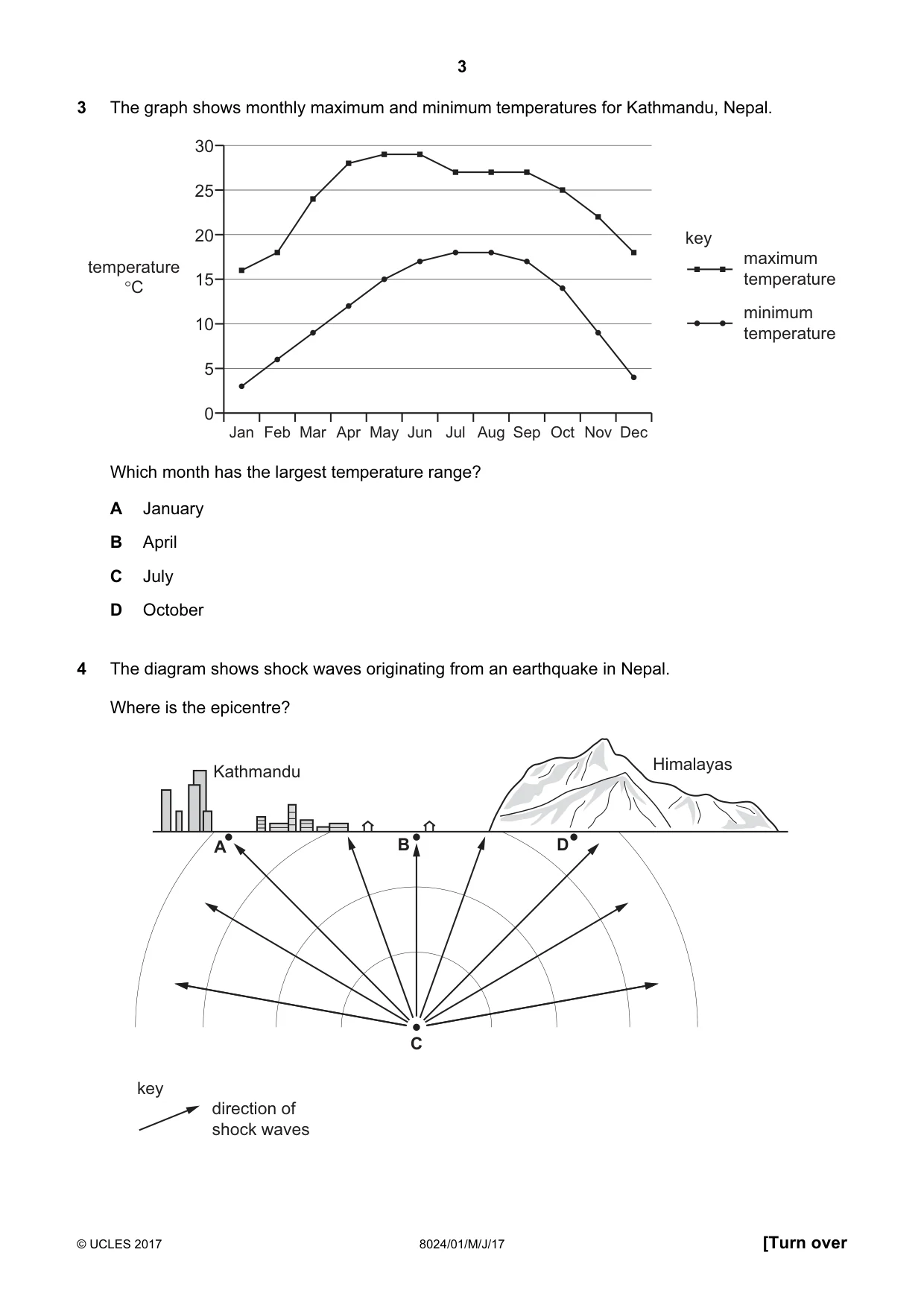
3 © UCLES 2017 8024/01/M/J/17 [Turn over 3 The graph shows monthly maximum and minimum temperatures for Kathmandu, Nepal. 30 25 20 15 10 5 0 temperature °C Jan Feb Mar Apr May Jun Jul Aug Sep Oct Nov Dec key maximum temperature minimum temperature Which month has the largest temperature range? A January B April C July D October 4 The diagram shows shock waves originating from an earthquake in Nepal. Where is the epicentre? A B C D Kathmandu Himalayas key direction of shock waves
Question paper, page 4
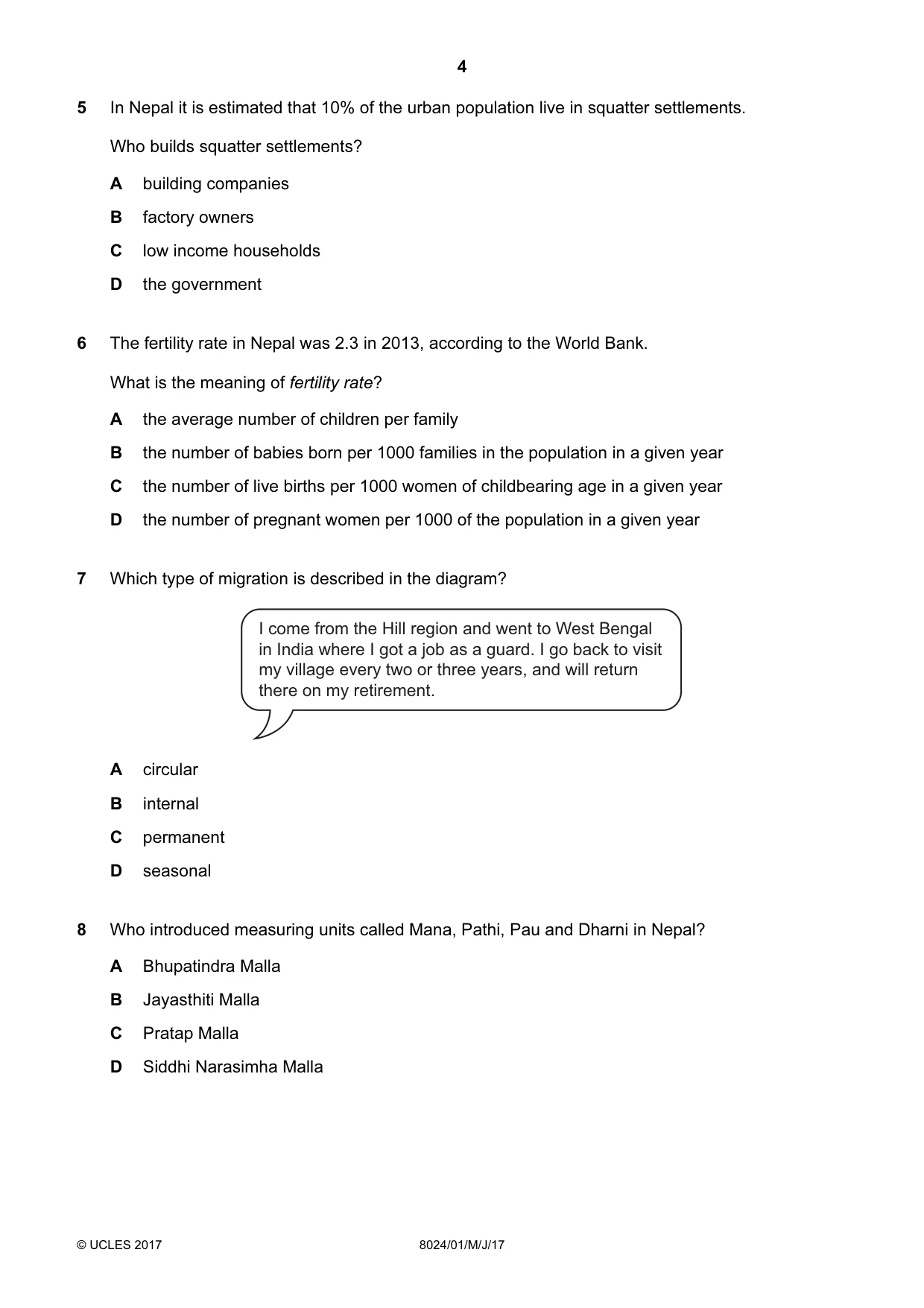
4 © UCLES 2017 8024/01/M/J/17 5 In Nepal it is estimated that 10% of the urban population live in squatter settlements. Who builds squatter settlements? A building companies B factory owners C low income households D the government 6 The fertility rate in Nepal was 2.3 in 2013, according to the World Bank. What is the meaning of fertility rate? A the average number of children per family B the number of babies born per 1000 families in the population in a given year C the number of live births per 1000 women of childbearing age in a given year D the number of pregnant women per 1000 of the population in a given year 7 Which type of migration is described in the diagram? I come from the Hill region and went to West Bengal in India where I got a job as a guard. I go back to visit my village every two or three years, and will return there on my retirement. A circular B internal C permanent D seasonal 8 Who introduced measuring units called Mana, Pathi, Pau and Dharni in Nepal? A Bhupatindra Malla B Jayasthiti Malla C Pratap Malla D Siddhi Narasimha Malla
Question paper, page 5
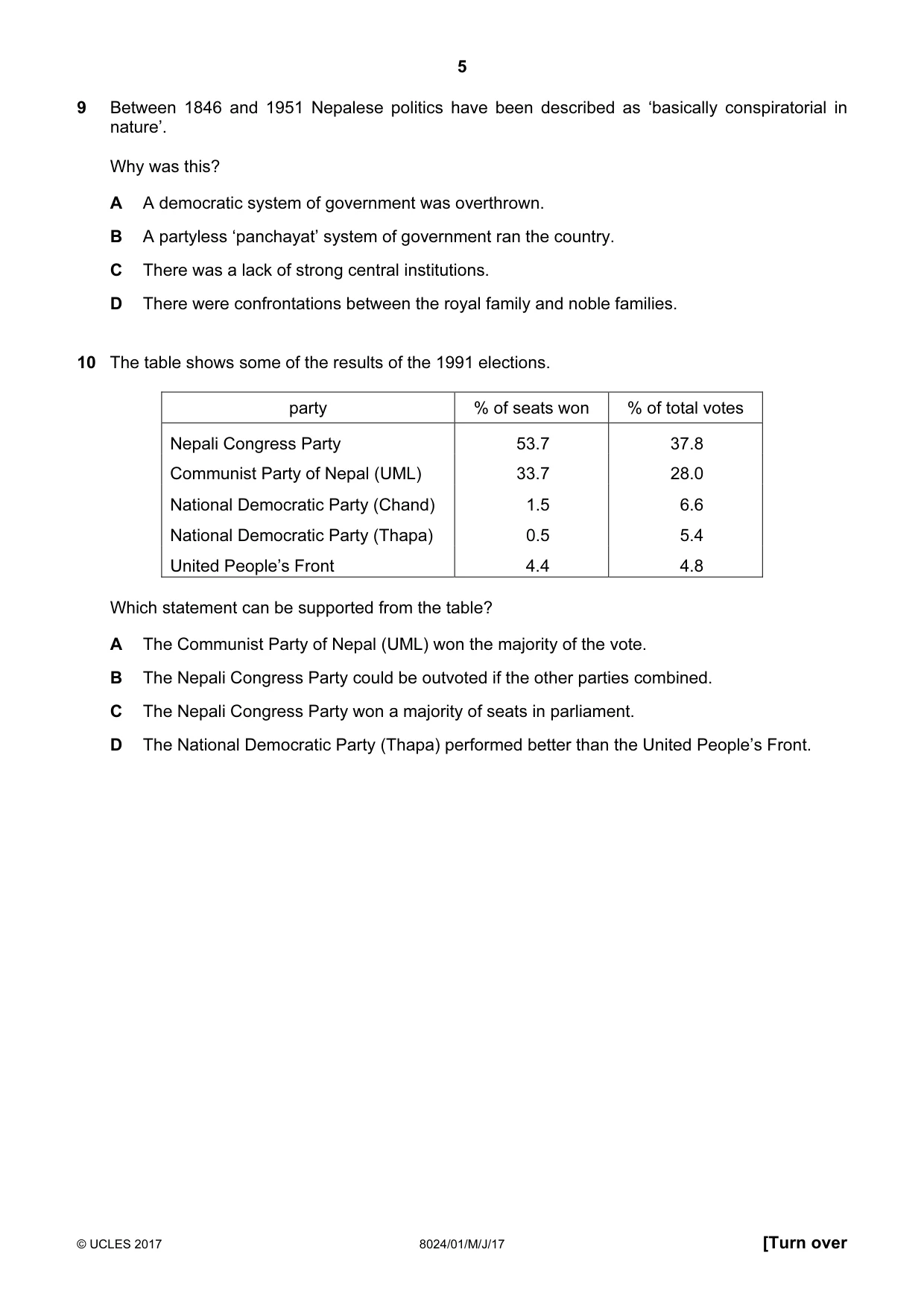
5 © UCLES 2017 8024/01/M/J/17 [Turn over 9 Between 1846 and 1951 Nepalese politics have been described as ‘basically conspiratorial in nature’. Why was this? A A democratic system of government was overthrown. B A partyless ‘panchayat’ system of government ran the country. C There was a lack of strong central institutions. D There were confrontations between the royal family and noble families. 10 The table shows some of the results of the 1991 elections. party % of seats won % of total votes Nepali Congress Party 53.7 37.8 Communist Party of Nepal (UML) 33.7 28.0 National Democratic Party (Chand) 1.5 6.6 National Democratic Party (Thapa) 0.5 5.4 United People’s Front 4.4 4.8 Which statement can be supported from the table? A The Communist Party of Nepal (UML) won the majority of the vote. B The Nepali Congress Party could be outvoted if the other parties combined. C The Nepali Congress Party won a majority of seats in parliament. D The National Democratic Party (Thapa) performed better than the United People’s Front.
Question paper, page 6
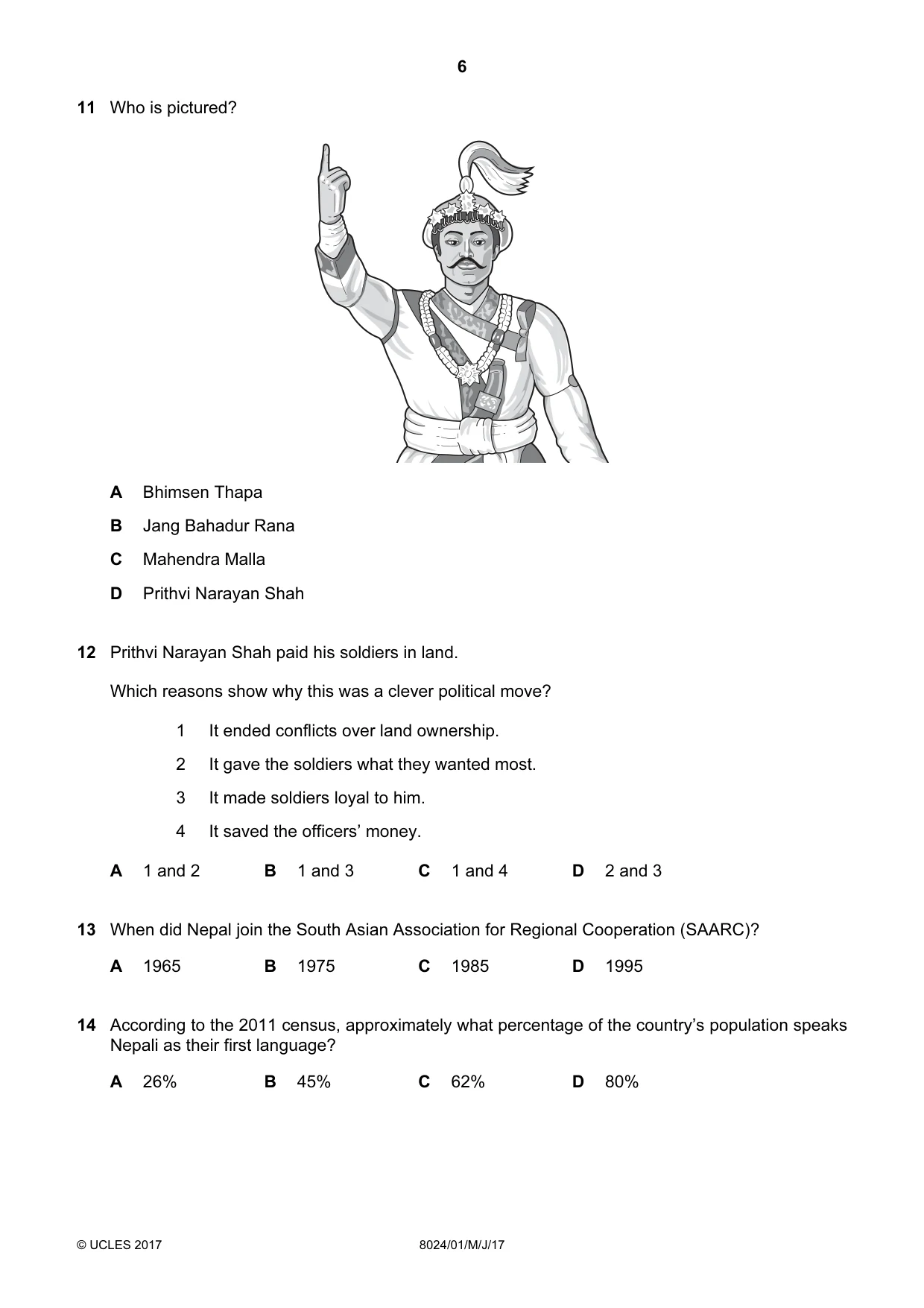
6 © UCLES 2017 8024/01/M/J/17 11 Who is pictured? A Bhimsen Thapa B Jang Bahadur Rana C Mahendra Malla D Prithvi Narayan Shah 12 Prithvi Narayan Shah paid his soldiers in land. Which reasons show why this was a clever political move? 1 It ended conflicts over land ownership. 2 It gave the soldiers what they wanted most. 3 It made soldiers loyal to him. 4 It saved the officers’ money. A 1 and 2 B 1 and 3 C 1 and 4 D 2 and 3 13 When did Nepal join the South Asian Association for Regional Cooperation (SAARC)? A 1965 B 1975 C 1985 D 1995 14 According to the 2011 census, approximately what percentage of the country’s population speaks Nepali as their first language? A 26% B 45% C 62% D 80%
Question paper, page 7
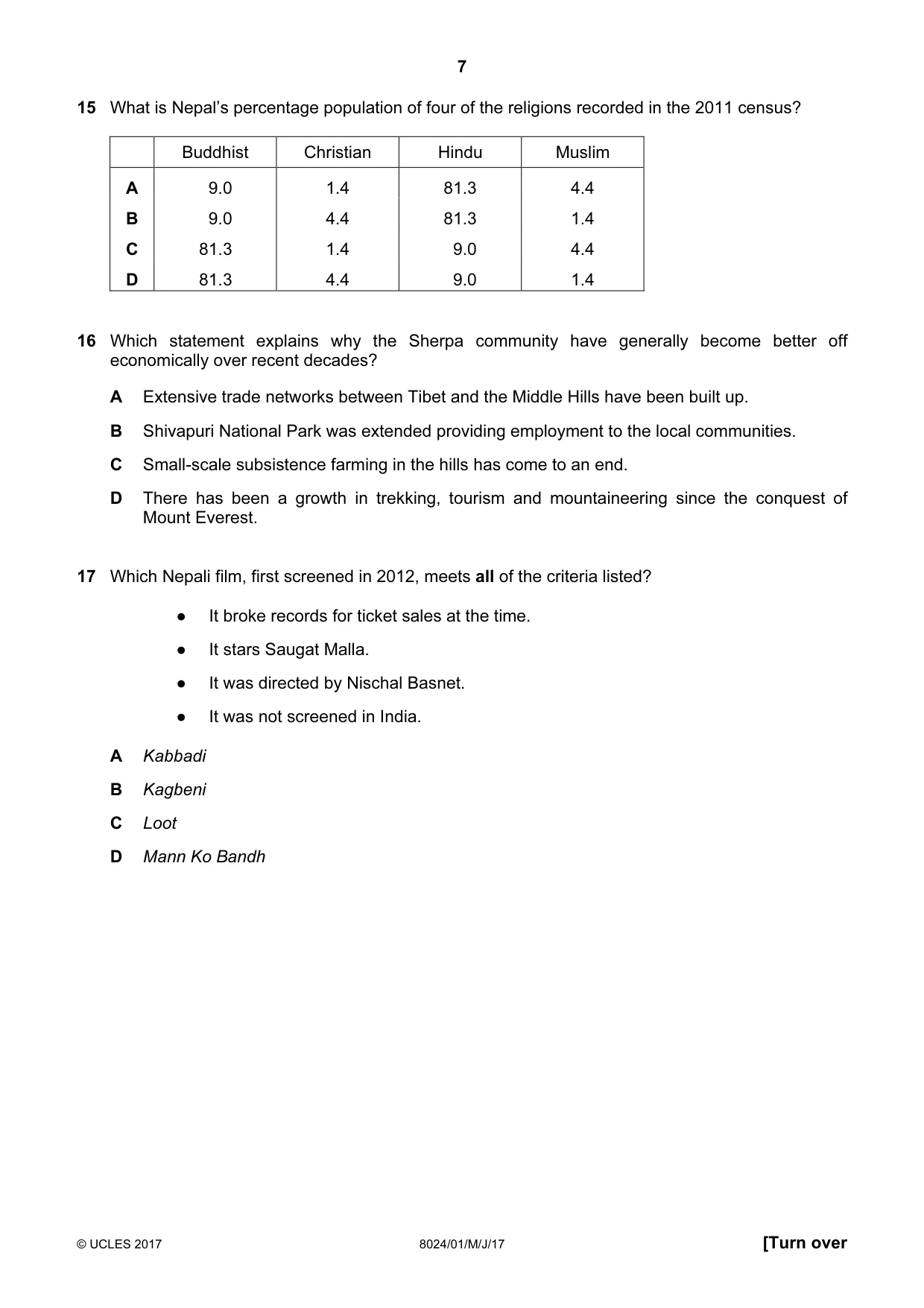
7 © UCLES 2017 8024/01/M/J/17 [Turn over 15 What is Nepal’s percentage population of four of the religions recorded in the 2011 census? Buddhist Christian Hindu Muslim A 9.0 1.4 81.3 4.4 B 9.0 4.4 81.3 1.4 C 81.3 1.4 9.0 4.4 D 81.3 4.4 9.0 1.4 16 Which statement explains why the Sherpa community have generally become better off economically over recent decades? A Extensive trade networks between Tibet and the Middle Hills have been built up. B Shivapuri National Park was extended providing employment to the local communities. C Small-scale subsistence farming in the hills has come to an end. D There has been a growth in trekking, tourism and mountaineering since the conquest of Mount Everest. 17 Which Nepali film, first screened in 2012, meets all of the criteria listed? ● It broke records for ticket sales at the time. ● It stars Saugat Malla. ● It was directed by Nischal Basnet. ● It was not screened in India. A Kabbadi B Kagbeni C Loot D Mann Ko Bandh
Question paper, page 8
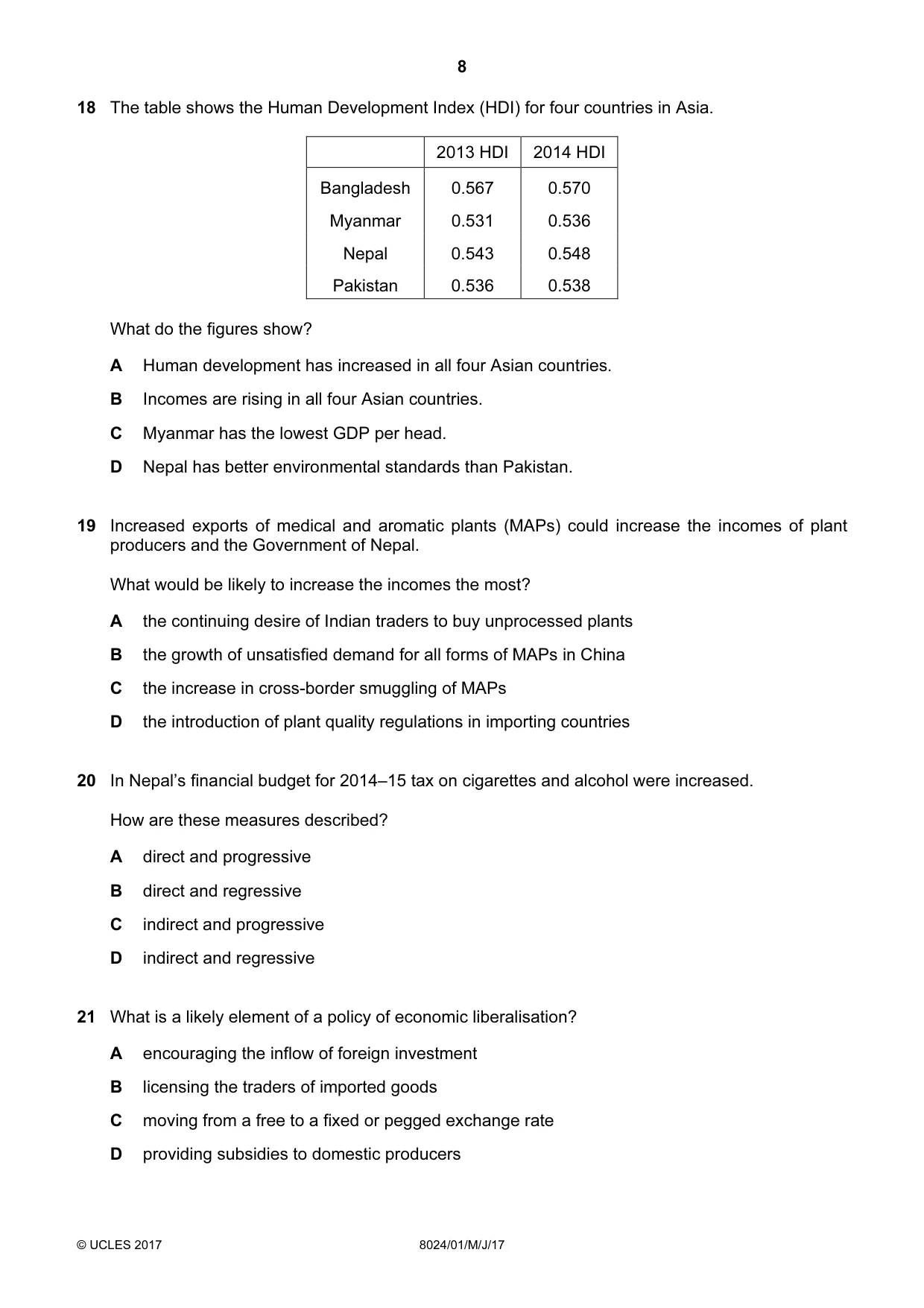
8 © UCLES 2017 8024/01/M/J/17 18 The table shows the Human Development Index (HDI) for four countries in Asia. 2013 HDI 2014 HDI Bangladesh 0.567 0.570 Myanmar 0.531 0.536 Nepal 0.543 0.548 Pakistan 0.536 0.538 What do the figures show? A Human development has increased in all four Asian countries. B Incomes are rising in all four Asian countries. C Myanmar has the lowest GDP per head. D Nepal has better environmental standards than Pakistan. 19 Increased exports of medical and aromatic plants (MAPs) could increase the incomes of plant producers and the Government of Nepal. What would be likely to increase the incomes the most? A the continuing desire of Indian traders to buy unprocessed plants B the growth of unsatisfied demand for all forms of MAPs in China C the increase in cross-border smuggling of MAPs D the introduction of plant quality regulations in importing countries 20 In Nepal’s financial budget for 2014–15 tax on cigarettes and alcohol were increased. How are these measures described? A direct and progressive B direct and regressive C indirect and progressive D indirect and regressive 21 What is a likely element of a policy of economic liberalisation? A encouraging the inflow of foreign investment B licensing the traders of imported goods C moving from a free to a fixed or pegged exchange rate D providing subsidies to domestic producers
Question paper, page 9
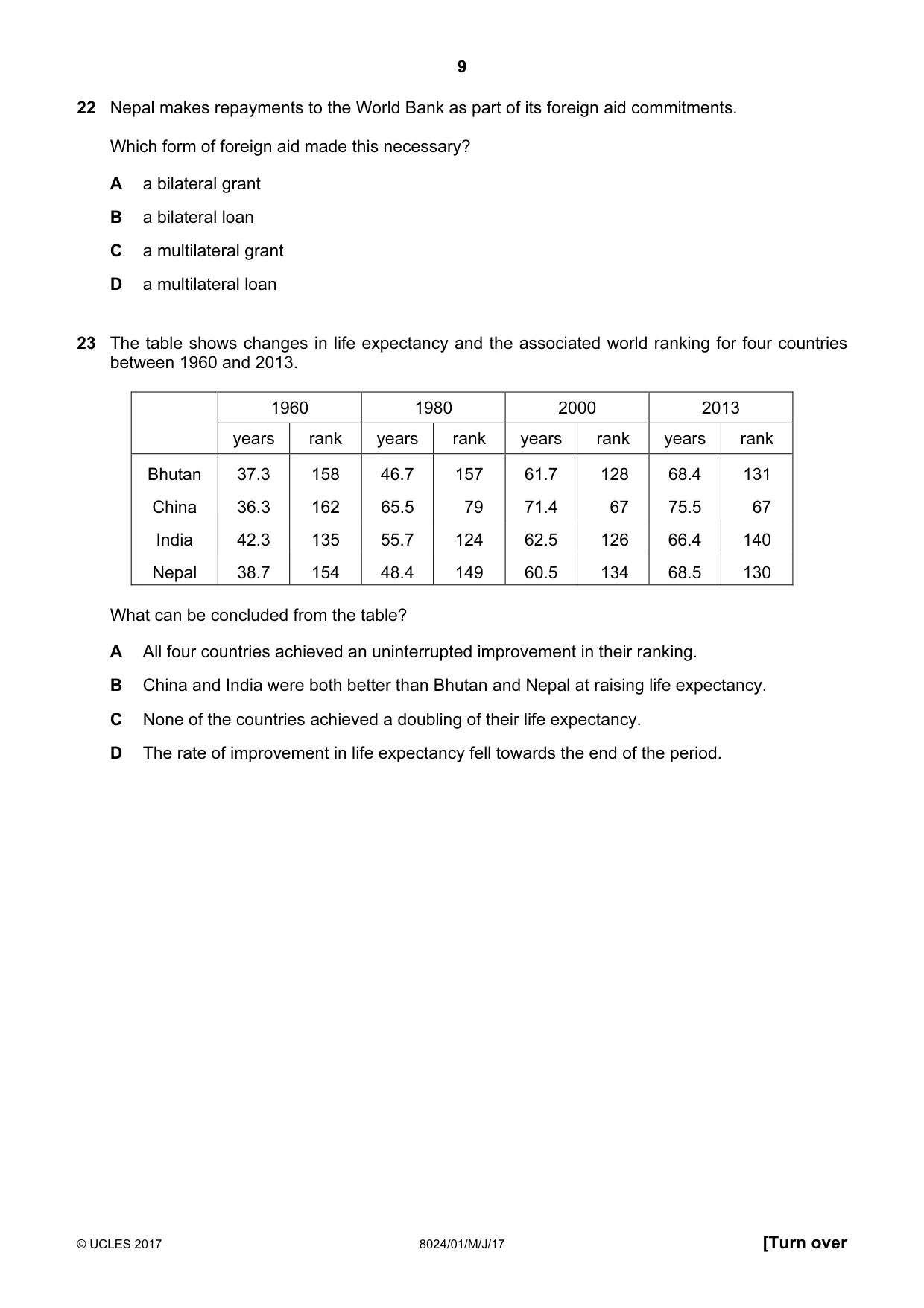
9 © UCLES 2017 8024/01/M/J/17 [Turn over 22 Nepal makes repayments to the World Bank as part of its foreign aid commitments. Which form of foreign aid made this necessary? A a bilateral grant B a bilateral loan C a multilateral grant D a multilateral loan 23 The table shows changes in life expectancy and the associated world ranking for four countries between 1960 and 2013. 1960 1980 2000 2013 years rank years rank years rank years rank Bhutan 37.3 158 46.7 157 61.7 128 68.4 131 China 36.3 162 65.5 79 71.4 67 75.5 67 India 42.3 135 55.7 124 62.5 126 66.4 140 Nepal 38.7 154 48.4 149 60.5 134 68.5 130 What can be concluded from the table? A All four countries achieved an uninterrupted improvement in their ranking. B China and India were both better than Bhutan and Nepal at raising life expectancy. C None of the countries achieved a doubling of their life expectancy. D The rate of improvement in life expectancy fell towards the end of the period.
Question paper, page 10
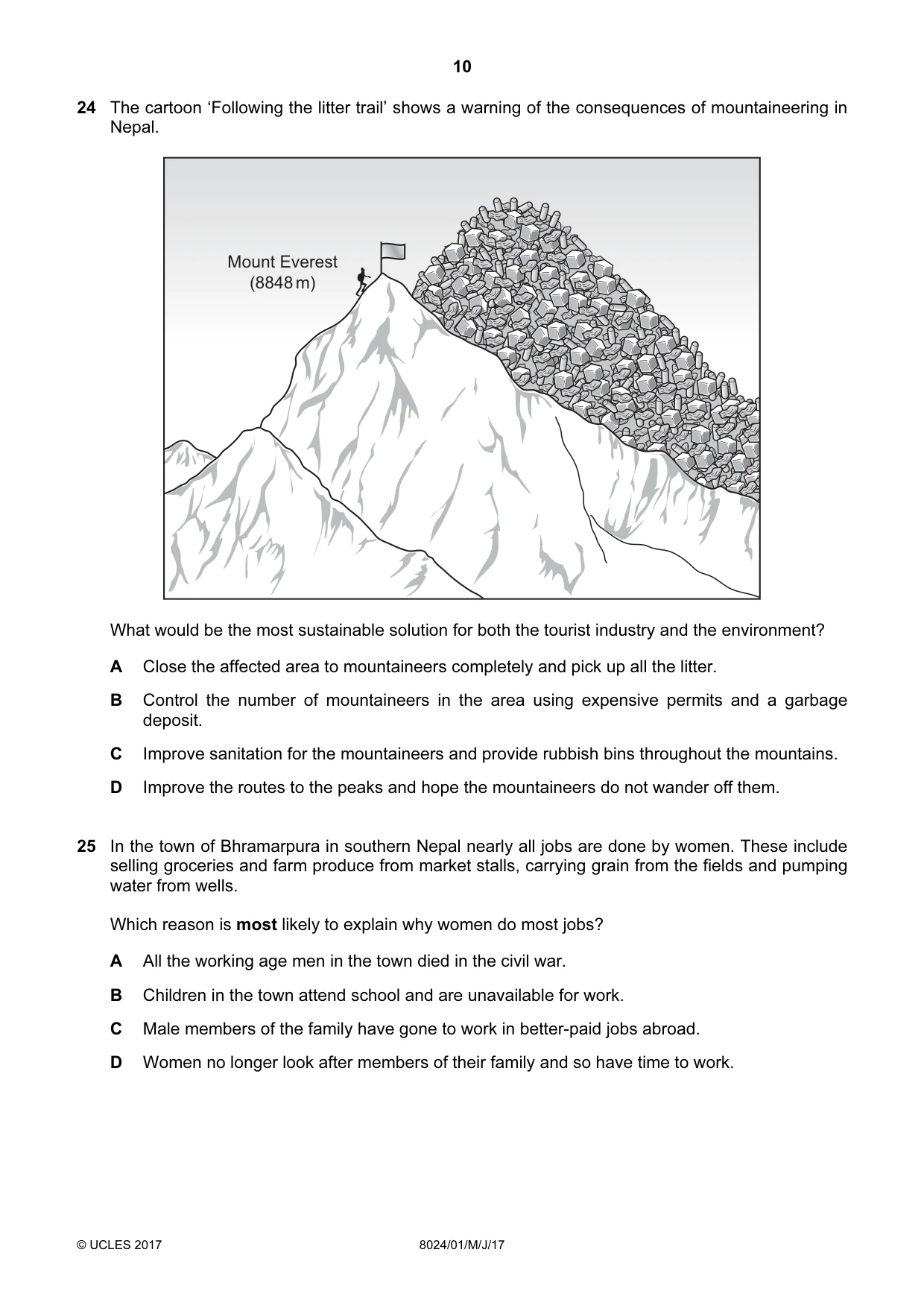
10 © UCLES 2017 8024/01/M/J/17 24 The cartoon ‘Following the litter trail’ shows a warning of the consequences of mountaineering in Nepal. Mount Everest (8848 m) What would be the most sustainable solution for both the tourist industry and the environment? A Close the affected area to mountaineers completely and pick up all the litter. B Control the number of mountaineers in the area using expensive permits and a garbage deposit. C Improve sanitation for the mountaineers and provide rubbish bins throughout the mountains. D Improve the routes to the peaks and hope the mountaineers do not wander off them. 25 In the town of Bhramarpura in southern Nepal nearly all jobs are done by women. These include selling groceries and farm produce from market stalls, carrying grain from the fields and pumping water from wells. Which reason is most likely to explain why women do most jobs? A All the working age men in the town died in the civil war. B Children in the town attend school and are unavailable for work. C Male members of the family have gone to work in better-paid jobs abroad. D Women no longer look after members of their family and so have time to work.
Question paper, page 11
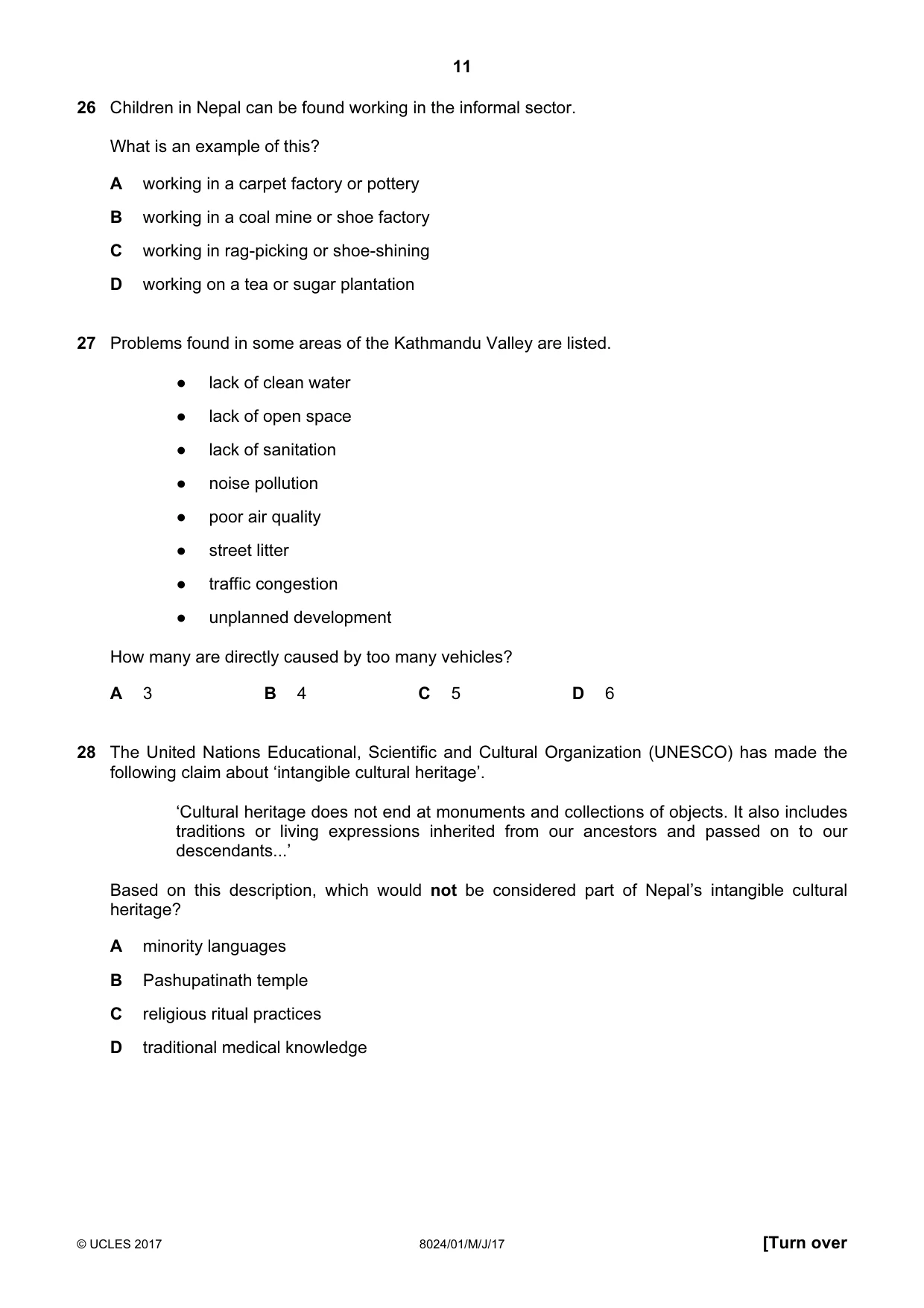
11 © UCLES 2017 8024/01/M/J/17 [Turn over 26 Children in Nepal can be found working in the informal sector. What is an example of this? A working in a carpet factory or pottery B working in a coal mine or shoe factory C working in rag-picking or shoe-shining D working on a tea or sugar plantation 27 Problems found in some areas of the Kathmandu Valley are listed. ● lack of clean water ● lack of open space ● lack of sanitation ● noise pollution ● poor air quality ● street litter ● traffic congestion ● unplanned development How many are directly caused by too many vehicles? A 3 B 4 C 5 D 6 28 The United Nations Educational, Scientific and Cultural Organization (UNESCO) has made the following claim about ‘intangible cultural heritage’. ‘Cultural heritage does not end at monuments and collections of objects. It also includes traditions or living expressions inherited from our ancestors and passed on to our descendants...’ Based on this description, which would not be considered part of Nepal’s intangible cultural heritage? A minority languages B Pashupatinath temple C religious ritual practices D traditional medical knowledge
Question paper, page 12
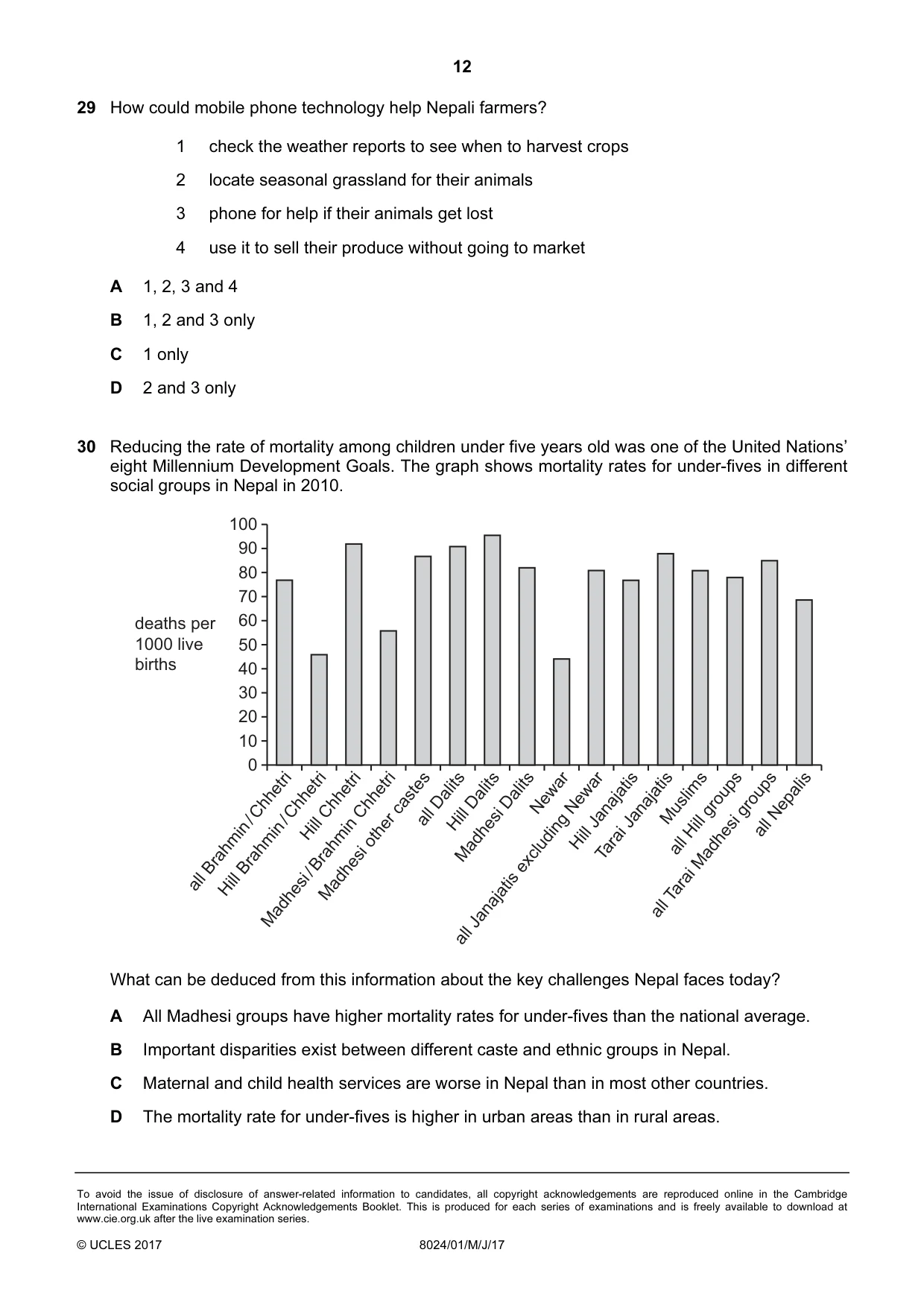
12 To avoid the issue of disclosure of answer-related information to candidates, all copyright acknowledgements are reproduced online in the Cambridge International Examinations Copyright Acknowledgements Booklet. This is produced for each series of examinations and is freely available to download at www.cie.org.uk after the live examination series. © UCLES 2017 8024/01/M/J/17 29 How could mobile phone technology help Nepali farmers? 1 check the weather reports to see when to harvest crops 2 locate seasonal grassland for their animals 3 phone for help if their animals get lost 4 use it to sell their produce without going to market A 1, 2, 3 and 4 B 1, 2 and 3 only C 1 only D 2 and 3 only 30 Reducing the rate of mortality among children under five years old was one of the United Nations’ eight Millennium Development Goals. The graph shows mortality rates for under-fives in different social groups in Nepal in 2010. deaths per 1000 live births 100 90 80 70 60 50 40 30 20 10 0 all Brahmin / Chhetri Hill Brahmin / Chhetri Hill Chhetri Madhesi / Brahmin Chhetri Madhesi other castes all Dalits Hill Dalits Madhesi Dalits Newar all Janajatis excluding Newar Hill Janajatis Tarai Janajatis Muslims all Hill groups all Tarai Madhesi groups all Nepalis What can be deduced from this information about the key challenges Nepal faces today? A All Madhesi groups have higher mortality rates for under-fives than the national average. B Important disparities exist between different caste and ethnic groups in Nepal. C Maternal and child health services are worse in Nepal than in most other countries. D The mortality rate for under-fives is higher in urban areas than in rural areas.
Mark scheme, page 1
® IGCSE is a registered trademark. This document consists of 3 printed pages. © UCLES 2017 [Turn over Cambridge International Examinations Cambridge International Advanced Subsidiary Level NEPAL STUDIES 8024/01 Paper 1 Multiple Choice May/June 2017 MARK SCHEME Maximum Mark: 30 Published This mark scheme is published as an aid to teachers and candidates, to indicate the requirements of the examination. Mark schemes should be read in conjunction with the question paper and the Principal Examiner Report for Teachers. Cambridge will not enter into discussions about these mark schemes. Cambridge is publishing the mark schemes for the May/June 2017 series for most Cambridge IGCSE®, Cambridge International A and AS Level and Cambridge Pre-U components, and some Cambridge O Level components.
Mark scheme, page 2
8024/01 Cambridge International AS Level – Mark Scheme PUBLISHED May/June 2017 © UCLES 2017 Page 2 of 3 Question Answer Marks 1 A 1 2 C 1 3 B 1 4 B 1 5 C 1 6 C 1 7 A 1 8 B 1 9 D 1 10 C 1 11 D 1 12 D 1 13 C 1 14 B 1 15 A 1 16 D 1 17 C 1 18 A 1 19 B 1 20 D 1 21 A 1 22 D 1 23 C 1 24 B 1 25 C 1 26 C 1 27 A 1 28 B 1
Mark scheme, page 3
8024/01 Cambridge International AS Level – Mark Scheme PUBLISHED May/June 2017 © UCLES 2017 Page 3 of 3 Question Answer Marks 29 A 1 30 B 1
What you needed in this session
Cambridge’s own grade thresholds for 2017 May/June, Paper 1 · Variant 1. A higher threshold means an easier paper — the bar moves with how the cohort did.