Cambridge A Level Nepal Studies (AS Level only) 8024 — 2018 May/June Paper 2 · Variant 0
8024/20/M/J/18
The question paper and its mark scheme, free to read here and free to download. This is Cambridge’s own paper, exactly as it was sat.
Question paper8 pages

Mark scheme
No mark scheme is in the library for this paper.
Paper as text
Question paper, page 1
* 6 7 0 1 3 0 5 4 7 4 * This document consists of 6 printed pages, 2 blank pages and 1 Insert. DC (SC/CGW) 151120/5 © UCLES 2018 [Turn over Cambridge International Examinations Cambridge International Advanced Subsidiary Level NEPAL STUDIES 8024/02 Paper 2 Written Paper May/June 2018 1 hour 45 minutes No Additional Materials are required. READ THESE INSTRUCTIONS FIRST An answer booklet is provided inside this question paper. You should follow the instructions on the front cover of the answer booklet. If you need additional answer paper ask the invigilator for a continuation booklet. Section A Answer any two questions. You must answer parts (a), (b) and (c) of the questions that you choose. Section B Answer any one question. You must answer parts (a) and (b) of the question that you choose. The number of marks is given in brackets [ ] at the end of each question or part question.
Question paper, page 2
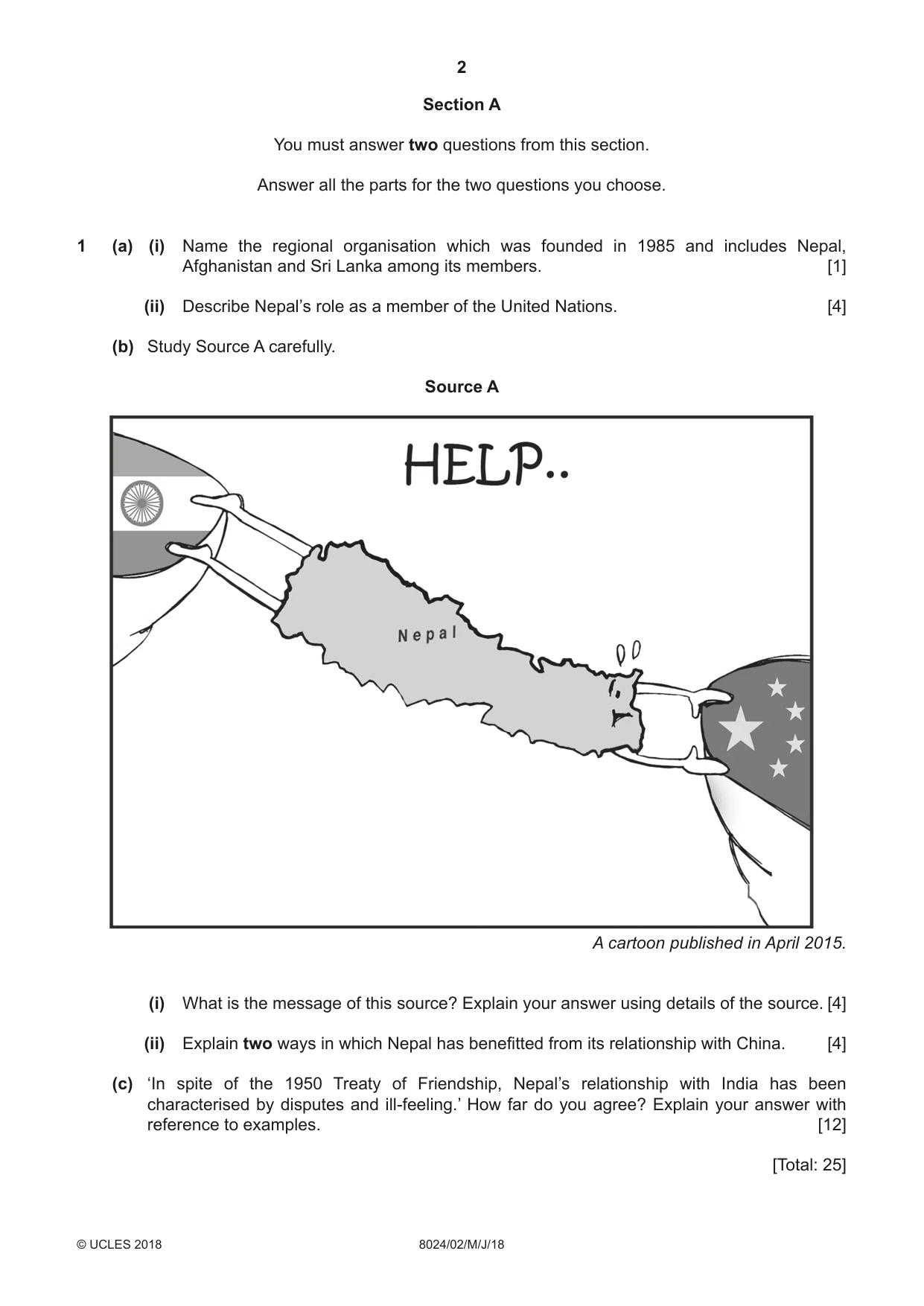
2 8024/02/M/J/18 © UCLES 2018 Section A You must answer two questions from this section. Answer all the parts for the two questions you choose. 1 (a) (i) Name the regional organisation which was founded in 1985 and includes Nepal, Afghanistan and Sri Lanka among its members. [1] (ii) Describe Nepal’s role as a member of the United Nations. [4] (b) Study Source A carefully. Source A A cartoon published in April 2015. (i) What is the message of this source? Explain your answer using details of the source. [4] (ii) Explain two ways in which Nepal has benefitted from its relationship with China. [4] (c) ‘In spite of the 1950 Treaty of Friendship, Nepal’s relationship with India has been characterised by disputes and ill-feeling.’ How far do you agree? Explain your answer with reference to examples. [12] [Total: 25]
Question paper, page 3
3 8024/02/M/J/18 © UCLES 2018 [Turn over BLANK PAGE
Question paper, page 4
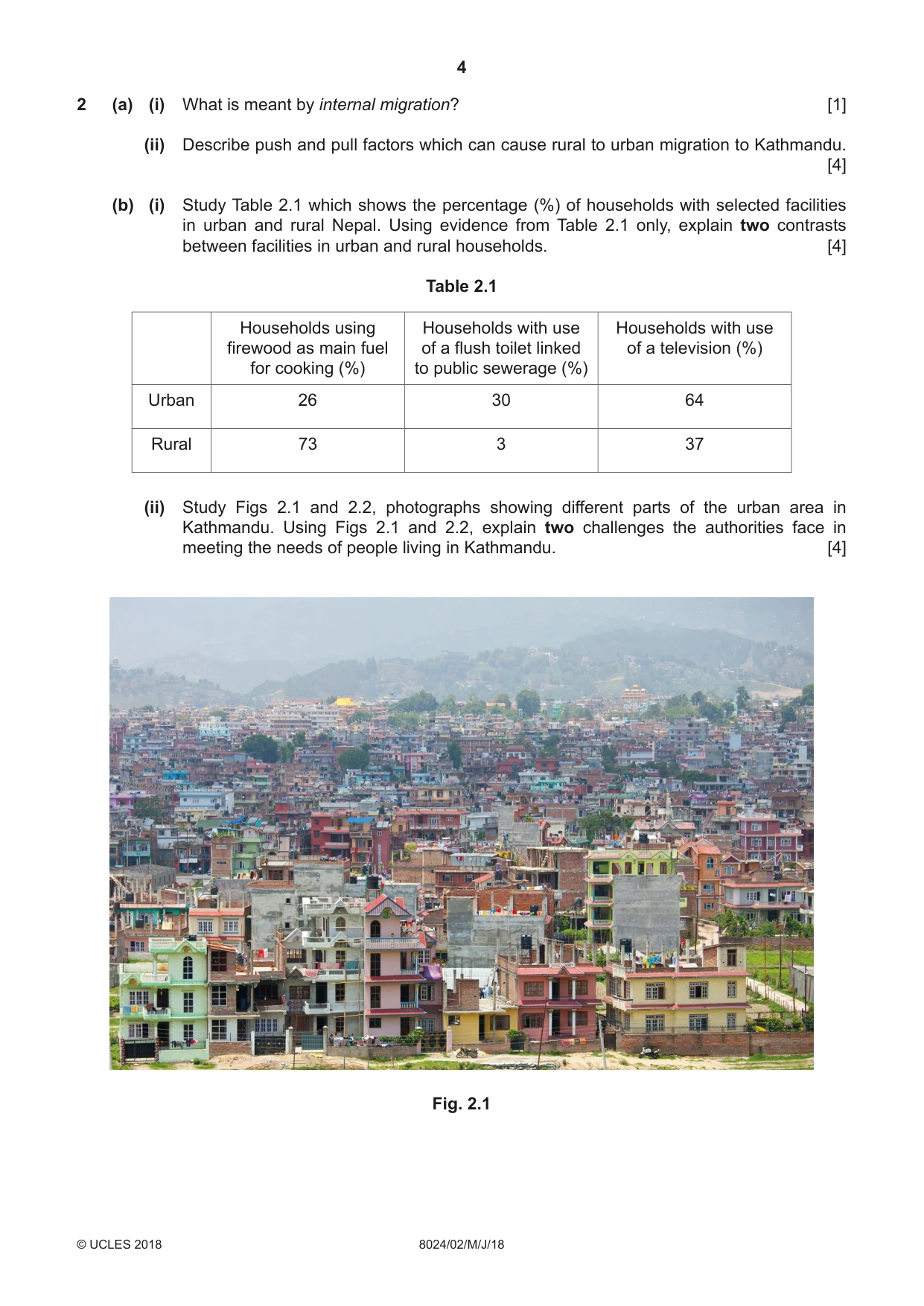
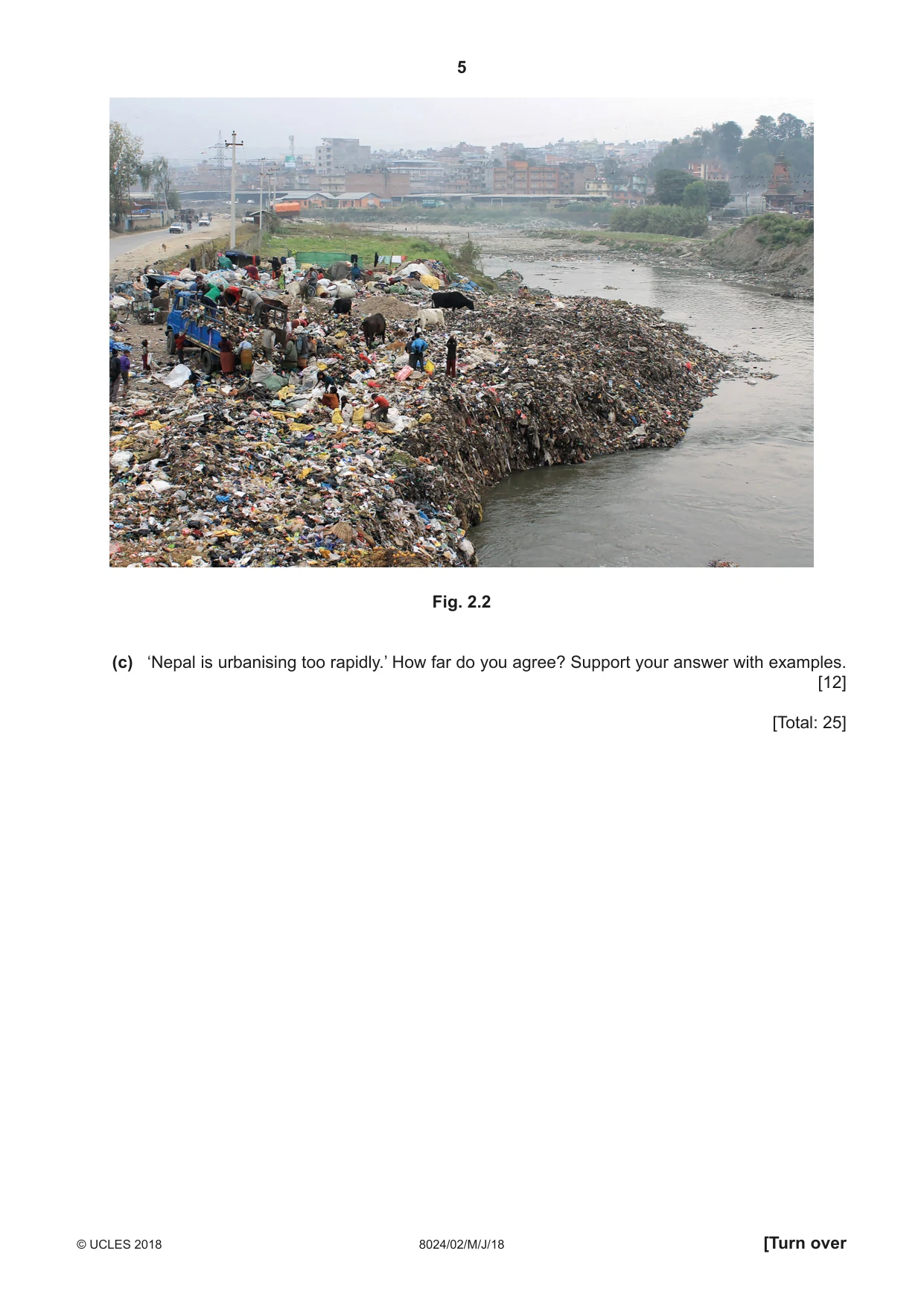
4 8024/02/M/J/18 © UCLES 2018 2 (a) (i) What is meant by internal migration? [1] (ii) Describe push and pull factors which can cause rural to urban migration to Kathmandu. [4] (b) (i) Study Table 2.1 which shows the percentage (%) of households with selected facilities in urban and rural Nepal. Using evidence from Table 2.1 only, explain two contrasts between facilities in urban and rural households. [4] Table 2.1 Households using firewood as main fuel for cooking (%) Households with use of a flush toilet linked to public sewerage (%) Households with use of a television (%) Urban 26 30 64 Rural 73 3 37 (ii) Study Figs 2.1 and 2.2, photographs showing different parts of the urban area in Kathmandu. Using Figs 2.1 and 2.2, explain two challenges the authorities face in meeting the needs of people living in Kathmandu. [4] Fig. 2.1
Question paper, page 5
5 8024/02/M/J/18 © UCLES 2018 [Turn over Fig. 2.2 (c) ‘Nepal is urbanising too rapidly.’ How far do you agree? Support your answer with examples. [12] [Total: 25]
Question paper, page 6
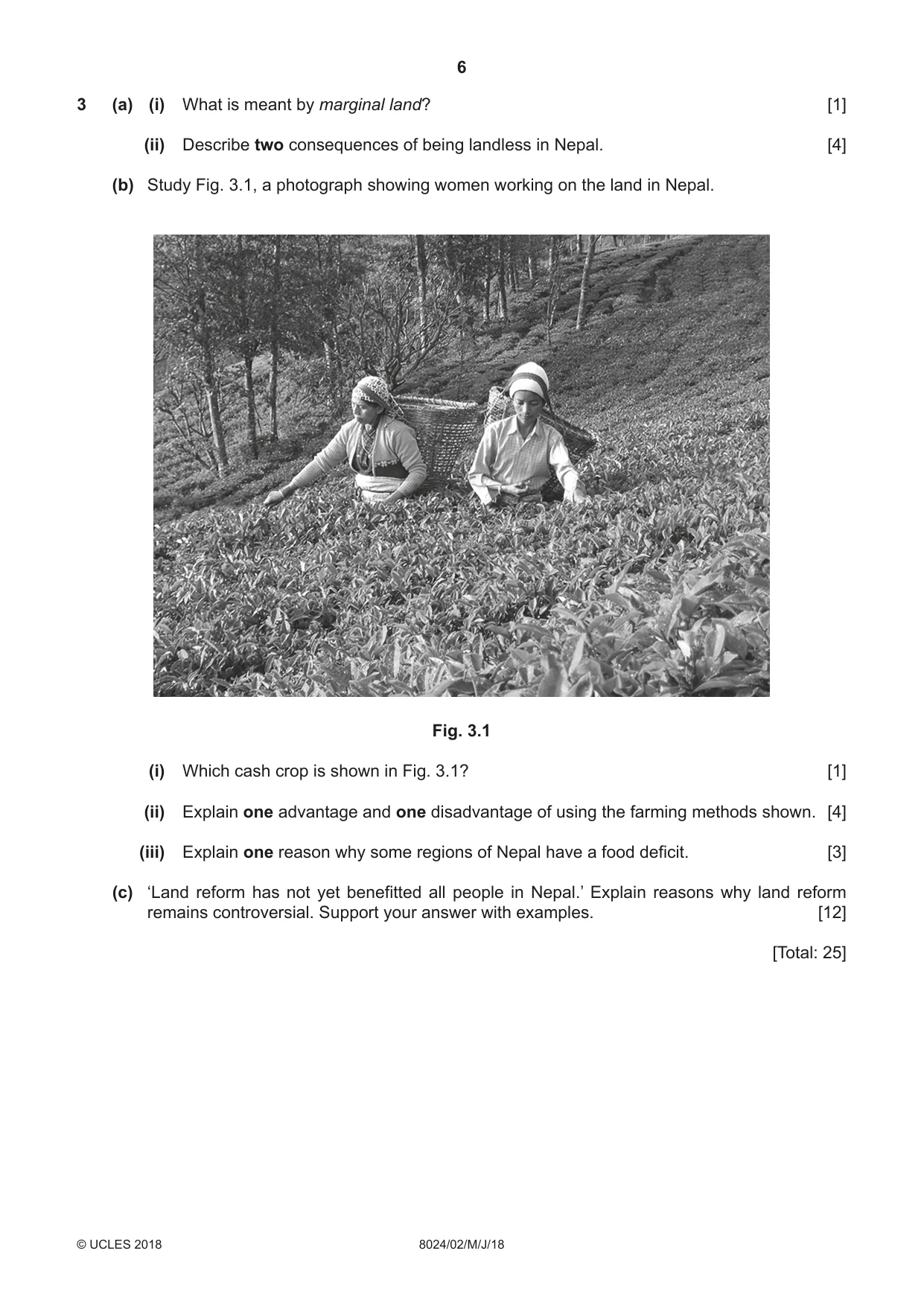
6 8024/02/M/J/18 © UCLES 2018 3 (a) (i) What is meant by marginal land? [1] (ii) Describe two consequences of being landless in Nepal. [4] (b) Study Fig. 3.1, a photograph showing women working on the land in Nepal. Fig. 3.1 (i) Which cash crop is shown in Fig. 3.1? [1] (ii) Explain one advantage and one disadvantage of using the farming methods shown. [4] (iii) Explain one reason why some regions of Nepal have a food deficit. [3] (c) ‘Land reform has not yet benefitted all people in Nepal.’ Explain reasons why land reform remains controversial. Support your answer with examples. [12] [Total: 25]
Question paper, page 7
7 8024/02/M/J/18 © UCLES 2018 Section B You must answer one question from this section. Answer both parts for the question you choose. 4 (a) Describe ways in which changing patterns of work are affecting women’s lives in Nepal. [10] (b) ‘The abolition of child labour means ensuring that every girl and boy has the opportunity to develop to their potential. The aim is to stop all work by children that threatens their education and development’. International Labour Organisation. To what extent is this realistic for all families in Nepal? Explain your answer. [15] [Total: 25] 5 (a) Outline the ways in which modern communications technology can be used to help protect Nepal’s diverse cultural and linguistic traditions. [10] (b) ‘The most serious threat to Nepal’s tangible heritage is unchecked urban development.’ How far do you agree? Explain your answer with reference to examples. [15] [Total: 25] 6 (a) Outline the reasons why many Nepali people work abroad. [10] (b) ‘Nepal’s political class are upper caste, male, Hindu and from the hill regions. Until this changes Nepal will not be a truly democratic society.’ How far do you agree? Explain your answer. [15] [Total: 25]
Question paper, page 8
8 8024/02/M/J/18 © UCLES 2018 BLANK PAGE Permission to reproduce items where third-party owned material protected by copyright is included has been sought and cleared where possible. Every reasonable effort has been made by the publisher (UCLES) to trace copyright holders, but if any items requiring clearance have unwittingly been included, the publisher will be pleased to make amends at the earliest possible opportunity. To avoid the issue of disclosure of answer-related information to candidates, all copyright acknowledgements are reproduced online in the Cambridge International Examinations Copyright Acknowledgements Booklet. This is produced for each series of examinations and is freely available to download at www.cie.org.uk after the live examination series. Cambridge International Examinations is part of the Cambridge Assessment Group. Cambridge Assessment is the brand name of University of Cambridge Local Examinations Syndicate (UCLES), which is itself a department of the University of Cambridge.