Cambridge A Level Nepal Studies (AS Level only) 8024 — 2016 May/June Paper 2 · Variant 0
8024/20/M/J/16
The question paper and its mark scheme, free to read here and free to download. This is Cambridge’s own paper, exactly as it was sat.
Question paper8 pages


Mark scheme
No mark scheme is in the library for this paper.
Paper as text
Question paper, page 1
This document consists of 5 printed pages, 3 blank pages and 1 insert. DC (ST/SG) 123570/3 © UCLES 2016 [Turn over Cambridge International Examinations Cambridge International Advanced Subsidiary Level * 2 4 6 5 7 5 0 0 8 5 * NEPAL STUDIES 8024/02 Paper 2 Written Paper May/June 2016 1 hour 45 minutes No Additional Materials are required. READ THESE INSTRUCTIONS FIRST An answer booklet is provided inside this question paper. You should follow the instructions on the front cover of the answer booklet. If you need additional answer paper ask the invigilator for a continuation booklet. Section A Answer any two questions. You must answer parts (a), (b) and (c) of the questions that you choose. Section B Answer any one question. You must answer parts (a) and (b) of the question that you choose. The number of marks is given in brackets [ ] at the end of each question or part question.
Question paper, page 2
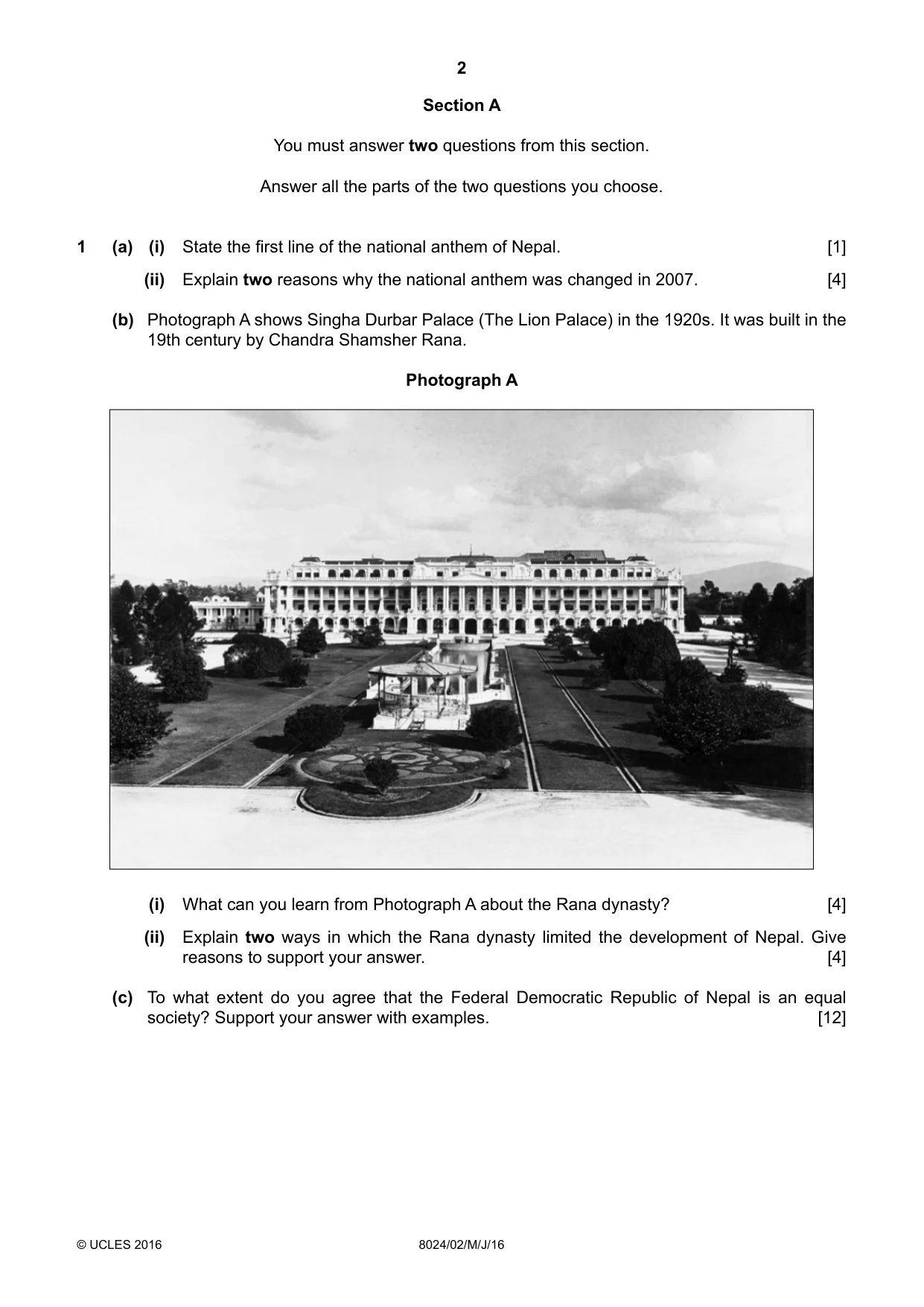
2 8024/02/M/J/16 © UCLES 2016 Section A You must answer two questions from this section. Answer all the parts of the two questions you choose. 1 (a) (i) State the first line of the national anthem of Nepal. [1] (ii) Explain two reasons why the national anthem was changed in 2007. [4] (b) Photograph A shows Singha Durbar Palace (The Lion Palace) in the 1920s. It was built in the 19th century by Chandra Shamsher Rana. Photograph A (i) What can you learn from Photograph A about the Rana dynasty? [4] (ii) Explain two ways in which the Rana dynasty limited the development of Nepal. Give reasons to support your answer. [4] (c) To what extent do you agree that the Federal Democratic Republic of Nepal is an equal society? Support your answer with examples. [12]
Question paper, page 3
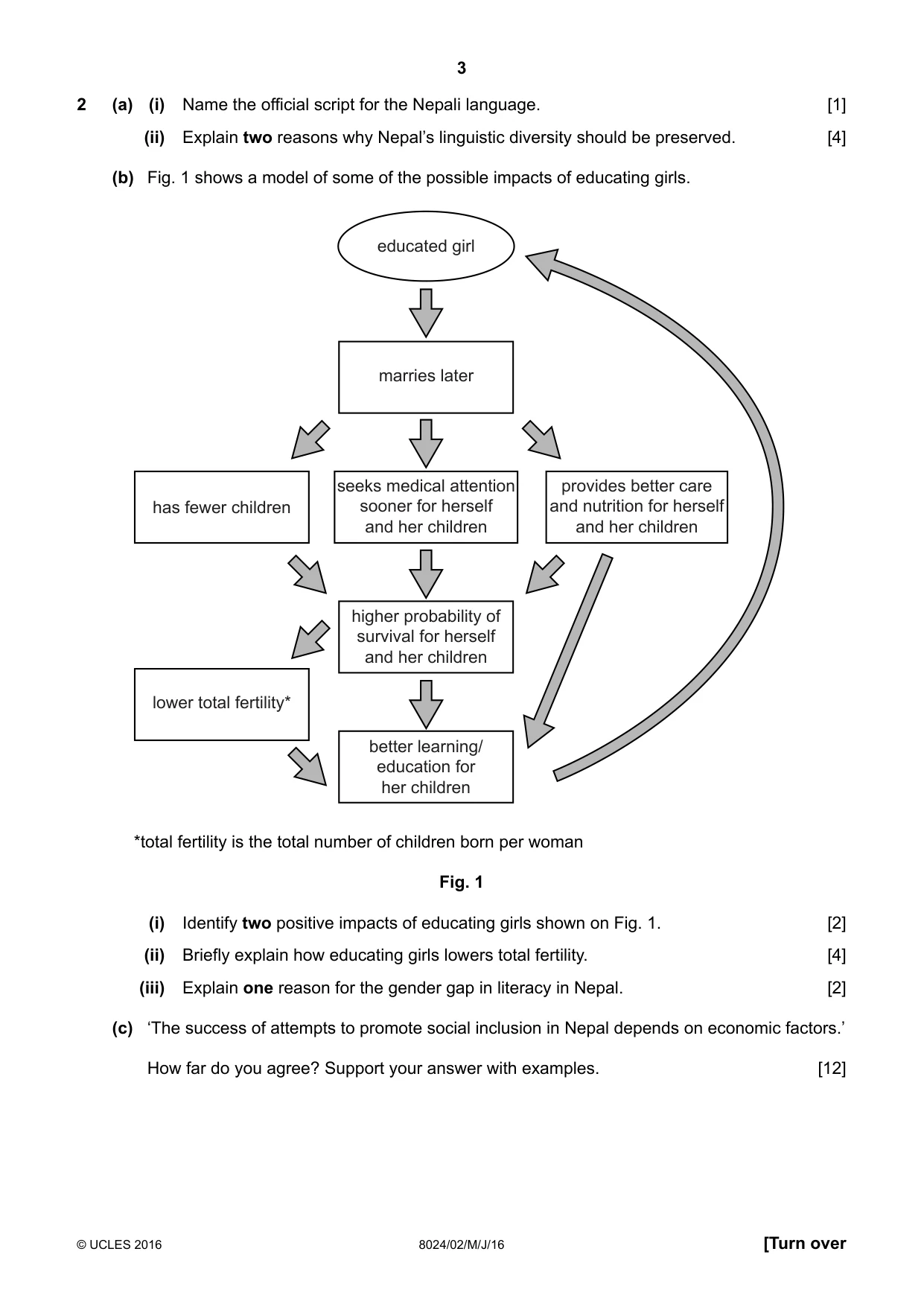
3 8024/02/M/J/16 © UCLES 2016 [Turn over 2 (a) (i) Name the official script for the Nepali language. [1] (ii) Explain two reasons why Nepal’s linguistic diversity should be preserved. [4] (b) Fig. 1 shows a model of some of the possible impacts of educating girls. educated girl marries later has fewer children seeks medical attention sooner for herself and her children provides better care and nutrition for herself and her children higher probability of survival for herself and her children better learning/ education for her children lower total fertility* *total fertility is the total number of children born per woman Fig. 1 (i) Identify two positive impacts of educating girls shown on Fig. 1. [2] (ii) Briefly explain how educating girls lowers total fertility. [4] (iii) Explain one reason for the gender gap in literacy in Nepal. [2] (c) ‘The success of attempts to promote social inclusion in Nepal depends on economic factors.’ How far do you agree? Support your answer with examples. [12]
Question paper, page 4
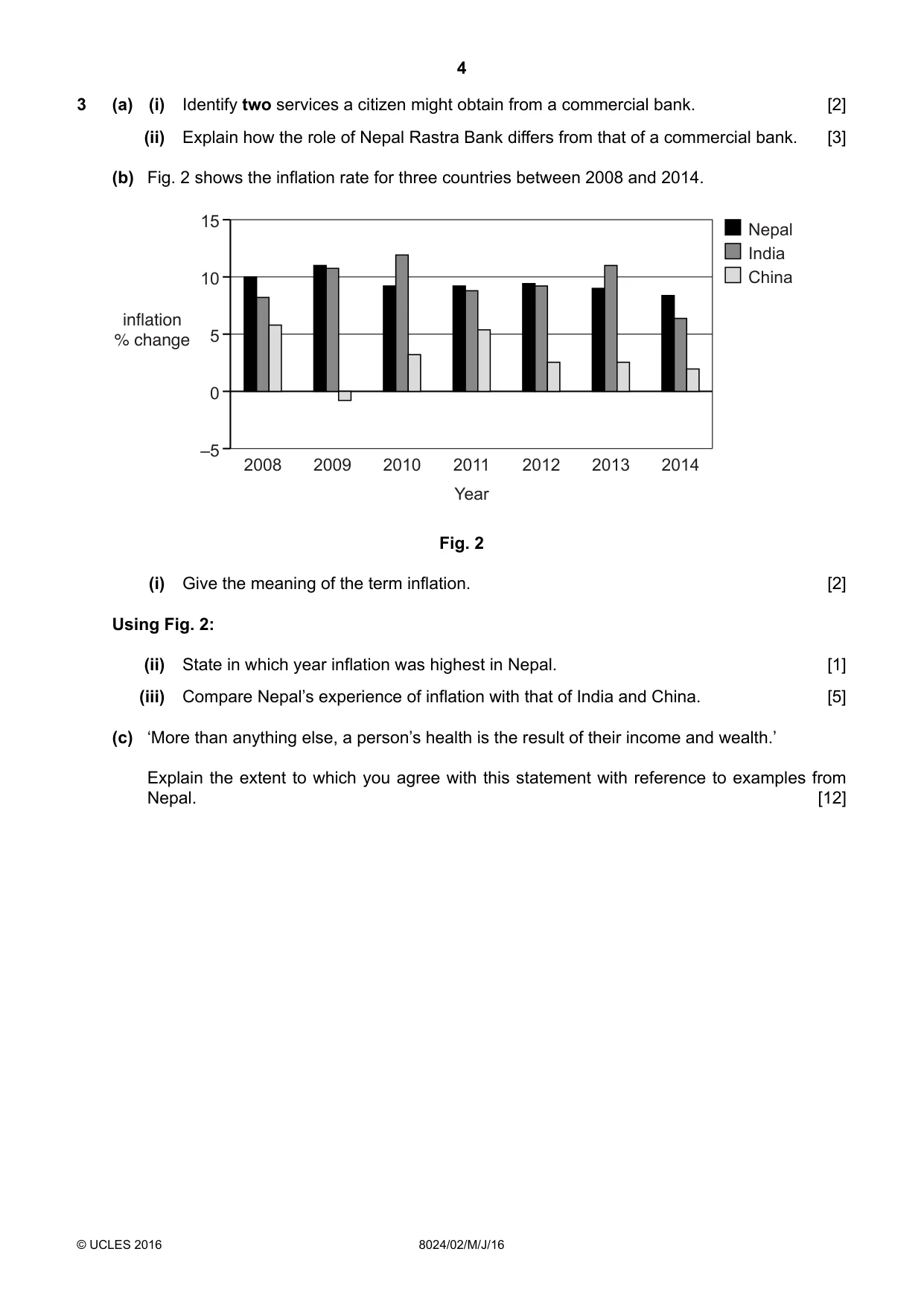
4 8024/02/M/J/16 © UCLES 2016 3 (a) (i) Identify two services a citizen might obtain from a commercial bank. [2] (ii) Explain how the role of Nepal Rastra Bank differs from that of a commercial bank. [3] (b) Fig. 2 shows the inflation rate for three countries between 2008 and 2014. 15 10 5 0 –5 2008 2009 2010 2011 Year 2012 2013 2014 Nepal India China inflation % change Fig. 2 (i) Give the meaning of the term inflation. [2] Using Fig. 2: (ii) State in which year inflation was highest in Nepal. [1] (iii) Compare Nepal’s experience of inflation with that of India and China. [5] (c) ‘More than anything else, a person’s health is the result of their income and wealth.’ Explain the extent to which you agree with this statement with reference to examples from Nepal. [12]
Question paper, page 5
5 8024/02/M/J/16 © UCLES 2016 Section B You must answer one question from this section. Answer both parts of the question you choose. 4 (a) Describe how push factors and pull factors combine to promote international migration from Nepal. [10] (b) Assess the impacts of international migration on the regions in Nepal from which people have migrated. Support your answer with examples. [15] 5 (a) Outline the role of multinationals in Nepal’s economic development. [10] (b) With the help of one or more examples, assess the extent to which economic liberalisation is sustainable in Nepal. [15] 6 (a) Outline why rapid urbanisation creates problems for the government of Nepal. [10] (b) Assess the extent to which constitutional reform is a challenge to governance in Nepal. Support your answer with examples. [15]
Question paper, page 6
6 8024/02/M/J/16 © UCLES 2016 BLANK PAGE
Question paper, page 7
7 8024/02/M/J/16 © UCLES 2016 BLANK PAGE
Question paper, page 8
8 8024/02/M/J/16 © UCLES 2016 BLANK PAGE Permission to reproduce items where third-party owned material protected by copyright is included has been sought and cleared where possible. Every reasonable effort has been made by the publisher (UCLES) to trace copyright holders, but if any items requiring clearance have unwittingly been included, the publisher will be pleased to make amends at the earliest possible opportunity. To avoid the issue of disclosure of answer-related information to candidates, all copyright acknowledgements are reproduced online in the Cambridge International Examinations Copyright Acknowledgements Booklet. This is produced for each series of examinations and is freely available to download at www.cie.org.uk after the live examination series. Cambridge International Examinations is part of the Cambridge Assessment Group. Cambridge Assessment is the brand name of University of Cambridge Local Examinations Syndicate (UCLES), which is itself a department of the University of Cambridge.