Cambridge A Level Music 9483 — 2021 May/June Paper 1 · Variant 1
9483/11/M/J/21 · 100 marks · ≈113 min
The question paper and its mark scheme, free to read here and free to download. This is Cambridge’s own paper, exactly as it was sat.
Question paper12 pages






Mark scheme11 pages
Answers below. Sit the paper first if you are practising.
Paper as text
Question paper, page 1
This document has 12 pages. Cambridge International AS & A Level * 4 4 2 7 4 7 1 0 1 7 * DC (KS) 199783/2 © UCLES 2021 [Turn over MUSIC 9483/11 Paper 1 Listening May/June 2021 2 hours You must answer on the question paper. You will need: Insert (enclosed) Section B audio recordings Manuscript paper (optional) Section A audio recordings (enclosed) Candidates may use their own unedited recording of the Set Works in Section B only. INSTRUCTIONS ● Answer five questions in total: Section A: answer all three questions. Section B: answer one question. Section C: answer one question. ● Use a black or dark blue pen. ● Write your name, centre number and candidate number in the boxes at the top of the page. ● Write your answer to each question in the space provided. ● Do not use an erasable pen or correction fluid. ● Do not write on any bar codes. ● Recordings: you must listen to recordings on individual listening equipment with headphones. Individual recordings for Section A are provided. You may use your own unedited recordings of the Set Works in Section B and may listen to extracts from any of them. No recordings are to be used for Section C. ● You may find it useful to make notes as you listen to the extracts. ● Scores: the insert contains the score referred to in Section A. No additional scores may be used. INFORMATION ● The total mark for this paper is 100. ● The number of marks for each question or part question is shown in brackets [ ].
Question paper, page 2
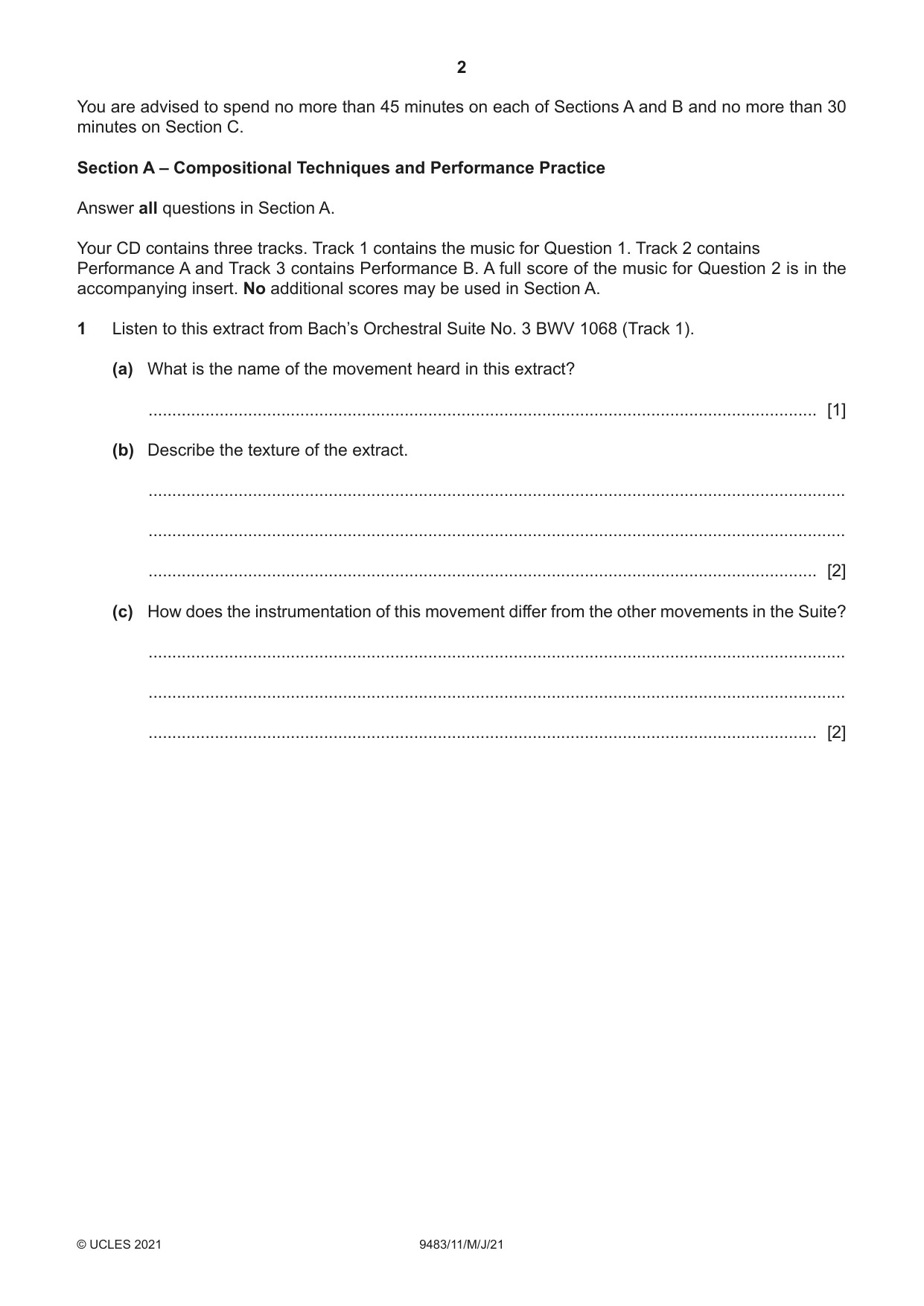
2 9483/11/M/J/21 © UCLES 2021 You are advised to spend no more than 45 minutes on each of Sections A and B and no more than 30 minutes on Section C. Section A – Compositional Techniques and Performance Practice Answer all questions in Section A. Your CD contains three tracks. Track 1 contains the music for Question 1. Track 2 contains Performance A and Track 3 contains Performance B. A full score of the music for Question 2 is in the accompanying insert. No additional scores may be used in Section A. 1 Listen to this extract from Bach’s Orchestral Suite No. 3 BWV 1068 (Track 1). (a) What is the name of the movement heard in this extract? … [1] (b) Describe the texture of the extract. … … … [2] (c) How does the instrumentation of this movement differ from the other movements in the Suite? … … … [2]
Question paper, page 3
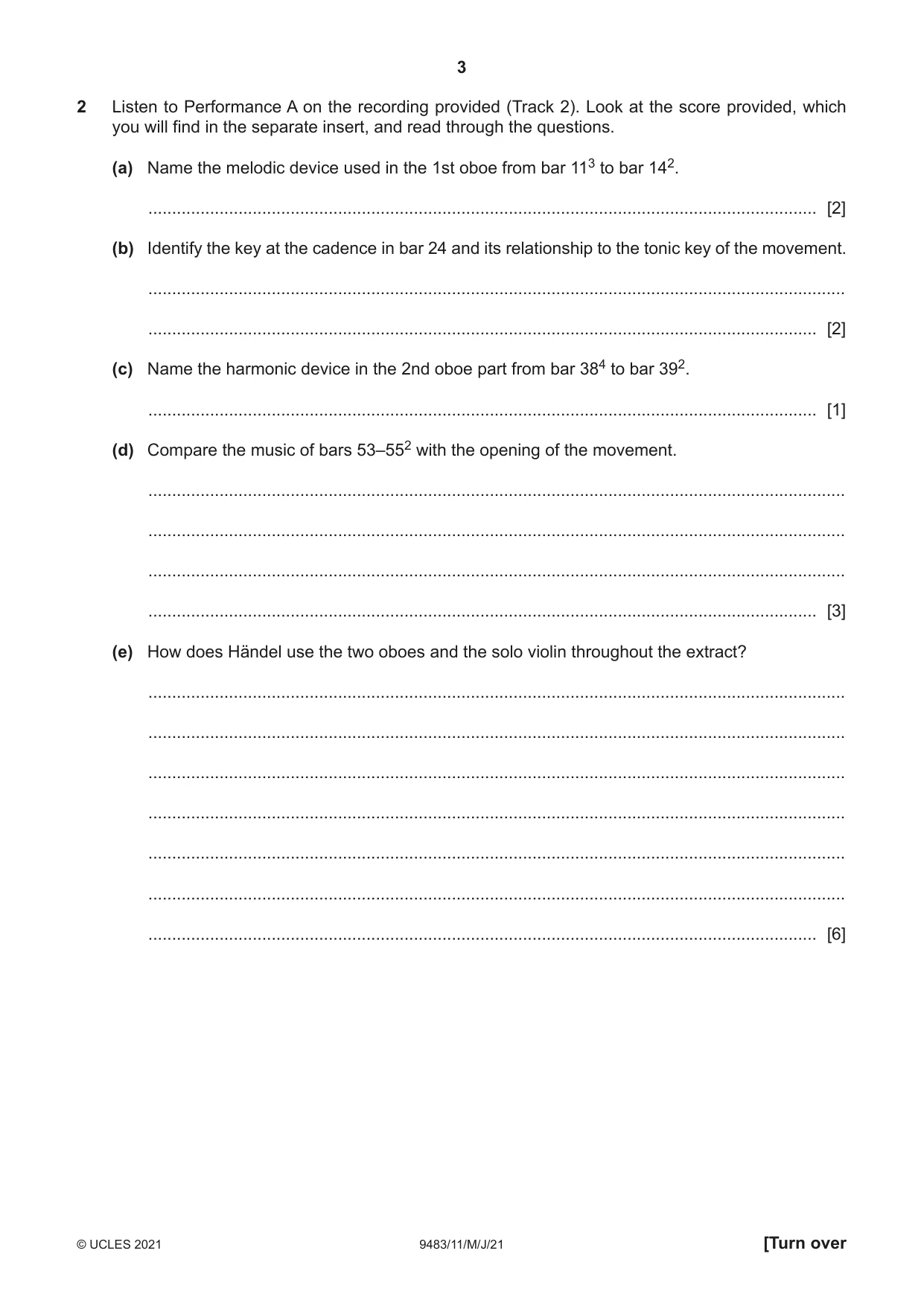
3 9483/11/M/J/21 © UCLES 2021 [Turn over 2 Listen to Performance A on the recording provided (Track 2). Look at the score provided, which you will find in the separate insert, and read through the questions. (a) Name the melodic device used in the 1st oboe from bar 113 to bar 142. … [2] (b) Identify the key at the cadence in bar 24 and its relationship to the tonic key of the movement. … … [2] (c) Name the harmonic device in the 2nd oboe part from bar 384 to bar 392. … [1] (d) Compare the music of bars 53–552 with the opening of the movement. … … … … [3] (e) How does Händel use the two oboes and the solo violin throughout the extract? … … … … … … … [6]
Question paper, page 4
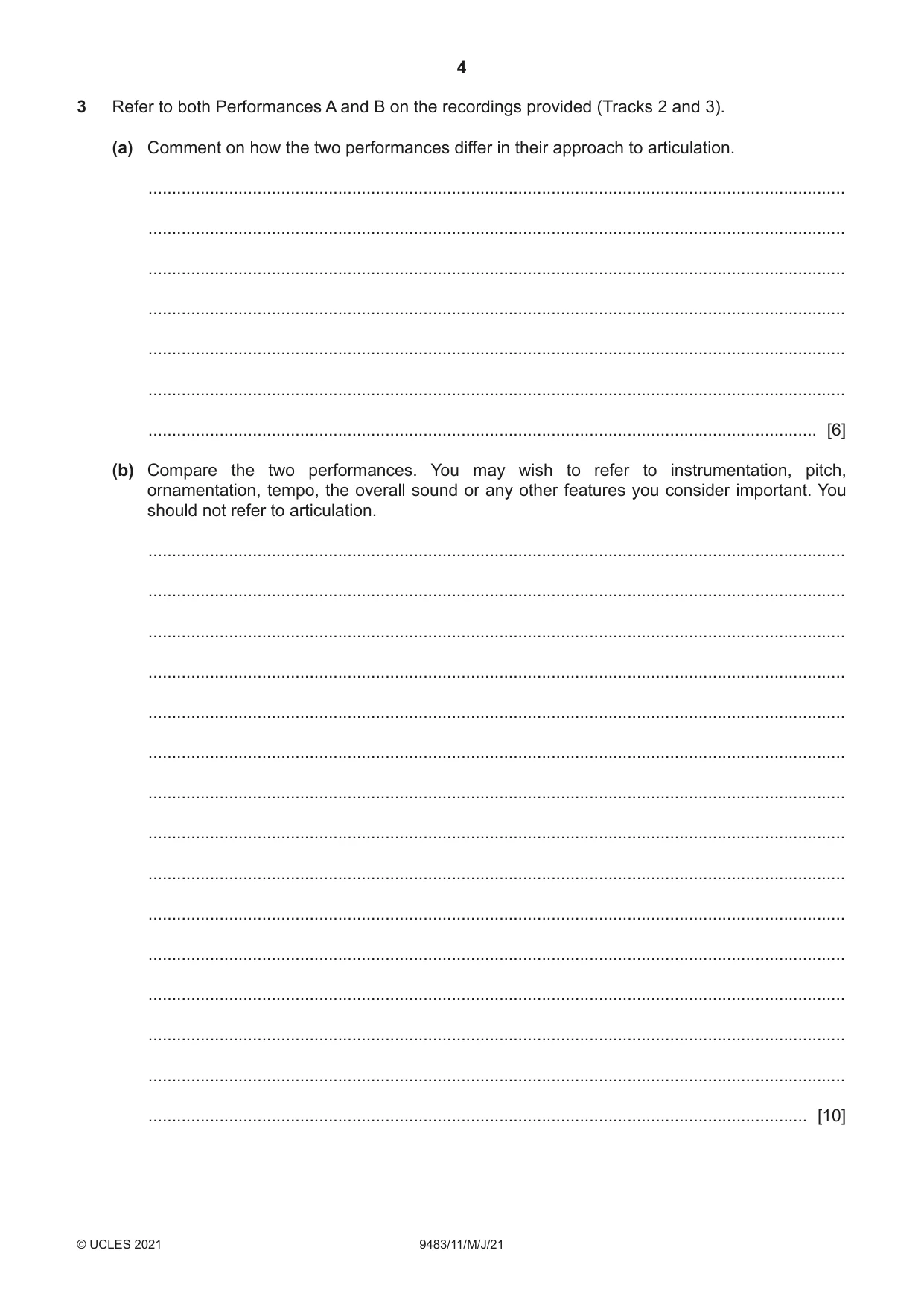
4 9483/11/M/J/21 © UCLES 2021 3 Refer to both Performances A and B on the recordings provided (Tracks 2 and 3). (a) Comment on how the two performances differ in their approach to articulation. … … … … … … … [6] (b) Compare the two performances. You may wish to refer to instrumentation, pitch, ornamentation, tempo, the overall sound or any other features you consider important. You should not refer to articulation. … … … … … … … … … … … … … … … [10]
Question paper, page 5
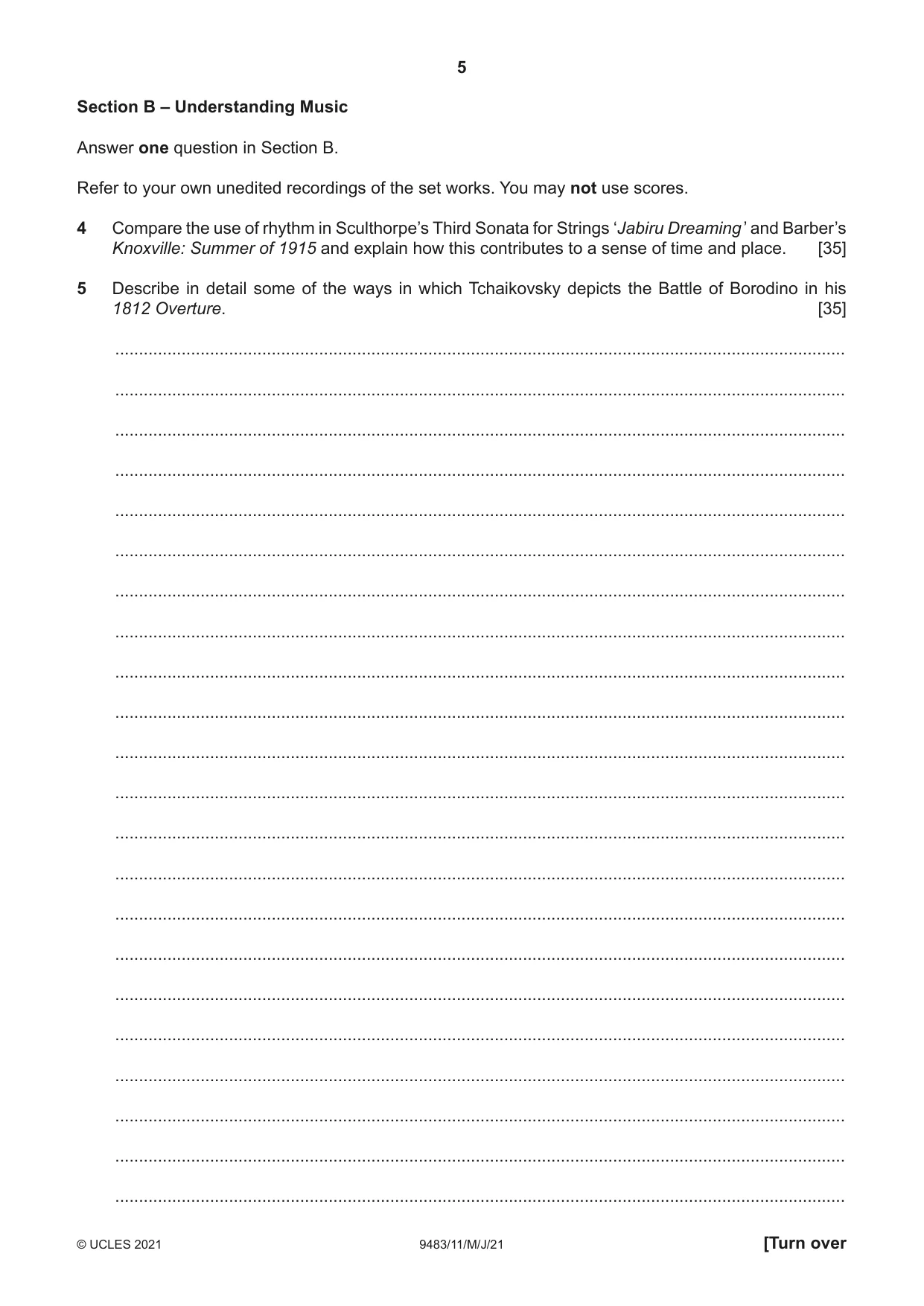
5 9483/11/M/J/21 © UCLES 2021 [Turn over Section B – Understanding Music Answer one question in Section B. Refer to your own unedited recordings of the set works. You may not use scores. 4 Compare the use of rhythm in Sculthorpe’s Third Sonata for Strings ‘Jabiru Dreaming ’ and Barber’s Knoxville: Summer of 1915 and explain how this contributes to a sense of time and place. [35] 5 Describe in detail some of the ways in which Tchaikovsky depicts the Battle of Borodino in his 1812 Overture. [35] … … … … … … … … … … … … … … … … … … … … … …
Question paper, page 6
6 9483/11/M/J/21 © UCLES 2021 … … … … … … … … … … … … … … … … … … … … … … … … … … … …
Question paper, page 7
7 9483/11/M/J/21 © UCLES 2021 [Turn over … … … … … … … … … … … … … … … … … … … … … … … … … … … …
Question paper, page 8
8 9483/11/M/J/21 © UCLES 2021 … … … … … … … … … … … … … … … … … … … … … … … … … … … …
Question paper, page 9
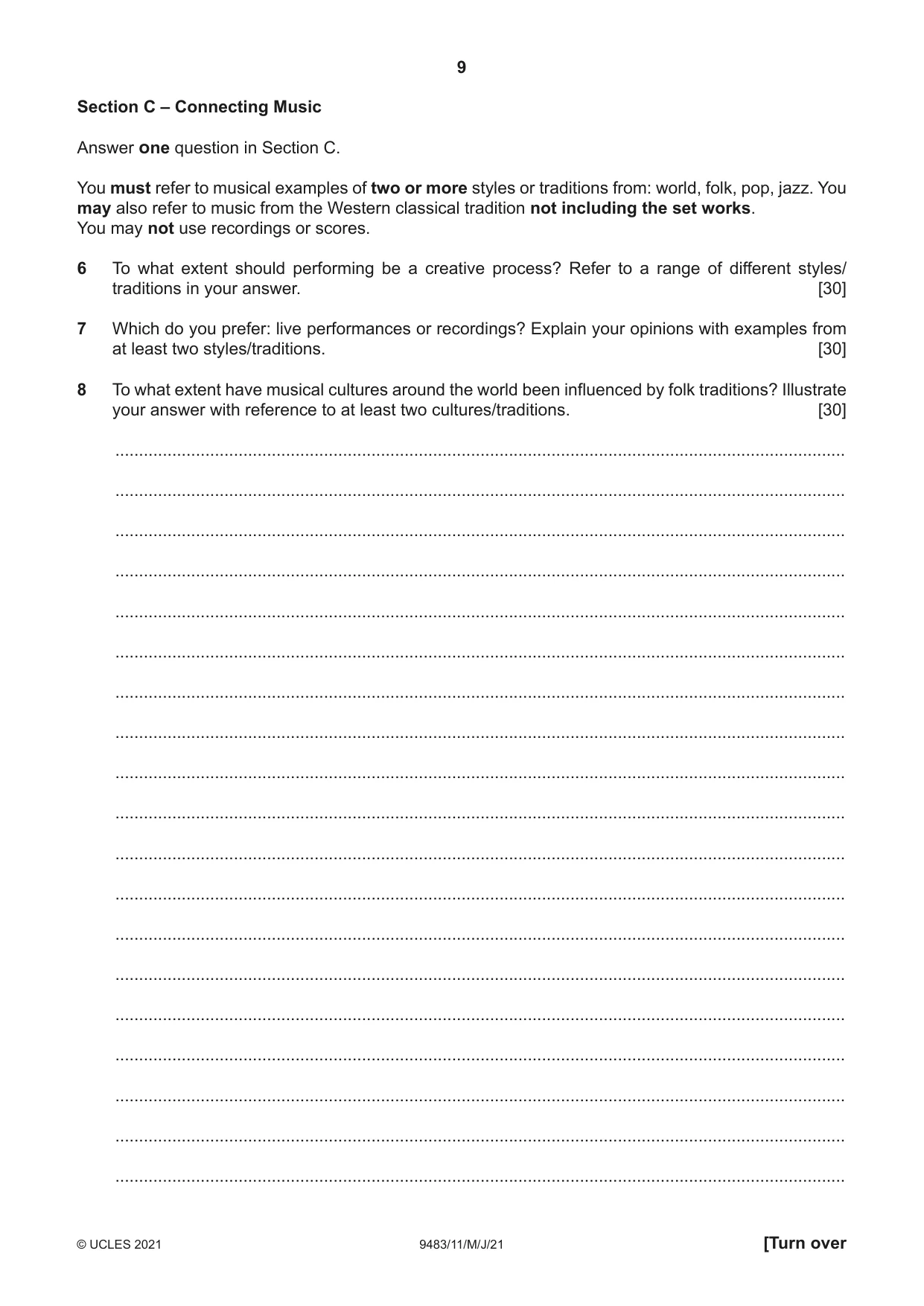
9 9483/11/M/J/21 © UCLES 2021 [Turn over Section C – Connecting Music Answer one question in Section C. You must refer to musical examples of two or more styles or traditions from: world, folk, pop, jazz. You may also refer to music from the Western classical tradition not including the set works. You may not use recordings or scores. 6 To what extent should performing be a creative process? Refer to a range of different styles/ traditions in your answer. [30] 7 Which do you prefer: live performances or recordings? Explain your opinions with examples from at least two styles/traditions. [30] 8 To what extent have musical cultures around the world been influenced by folk traditions? Illustrate your answer with reference to at least two cultures/traditions. [30] … … … … … … … … … … … … … … … … … … …
Question paper, page 10
10 9483/11/M/J/21 © UCLES 2021 … … … … … … … … … … … … … … … … … … … … … … … … … … … …
Question paper, page 11
11 9483/11/M/J/21 © UCLES 2021 [Turn over … … … … … … … … … … … … … … … … … … … … … … … … … … … …
Question paper, page 12
12 9483/11/M/J/21 © UCLES 2021 Permission to reproduce items where third-party owned material protected by copyright is included has been sought and cleared where possible. Every reasonable effort has been made by the publisher (UCLES) to trace copyright holders, but if any items requiring clearance have unwittingly been included, the publisher will be pleased to make amends at the earliest possible opportunity. To avoid the issue of disclosure of answer-related information to candidates, all copyright acknowledgements are reproduced online in the Cambridge Assessment International Education Copyright Acknowledgements Booklet. This is produced for each series of examinations and is freely available to download at www.cambridgeinternational.org after the live examination series. Cambridge Assessment International Education is part of the Cambridge Assessment Group. Cambridge Assessment is the brand name of the University of Cambridge Local Examinations Syndicate (UCLES), which itself is a department of the University of Cambridge. … … … … … … … … … … … … … … … … … … … … … … … …
Mark scheme, page 1
This document consists of 11 printed pages. © UCLES 2021 [Turn over Cambridge International AS & A Level MUSIC 9483/11 Paper 1 Listening May/June 2021 MARK SCHEME Maximum Mark:100 Published This mark scheme is published as an aid to teachers and candidates, to indicate the requirements of the examination. It shows the basis on which Examiners were instructed to award marks. It does not indicate the details of the discussions that took place at an Examiners’ meeting before marking began, which would have considered the acceptability of alternative answers. Mark schemes should be read in conjunction with the question paper and the Principal Examiner Report for Teachers. Cambridge International will not enter into discussions about these mark schemes. Cambridge International is publishing the mark schemes for the May/June 2021 series for most Cambridge IGCSE™, Cambridge International A and AS Level components and some Cambridge O Level components.
Mark scheme, page 2
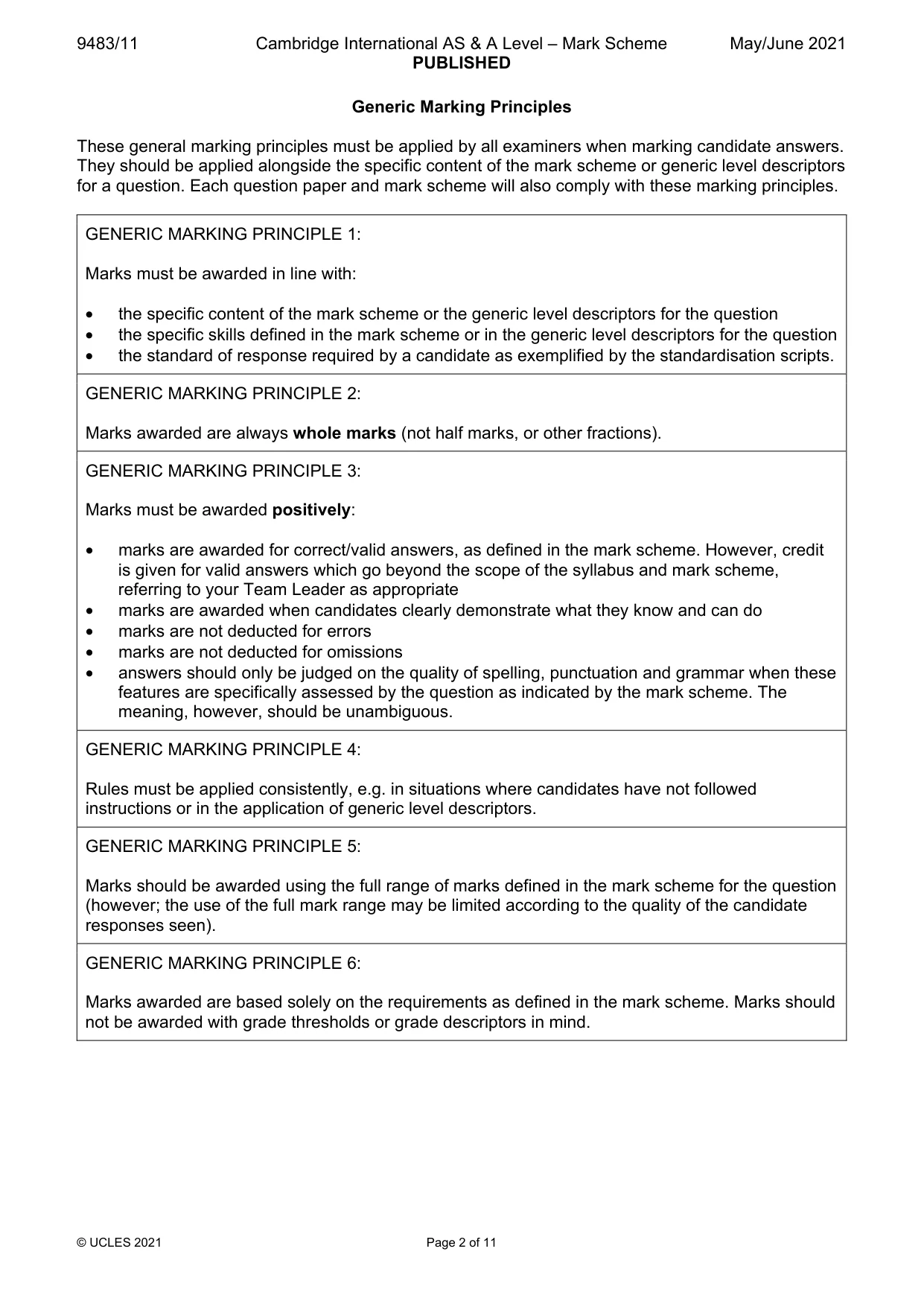
9483/11 Cambridge International AS & A Level – Mark Scheme PUBLISHED May/June 2021 © UCLES 2021 Page 2 of 11 Generic Marking Principles These general marking principles must be applied by all examiners when marking candidate answers. They should be applied alongside the specific content of the mark scheme or generic level descriptors for a question. Each question paper and mark scheme will also comply with these marking principles. GENERIC MARKING PRINCIPLE 1: Marks must be awarded in line with: • the specific content of the mark scheme or the generic level descriptors for the question • the specific skills defined in the mark scheme or in the generic level descriptors for the question • the standard of response required by a candidate as exemplified by the standardisation scripts. GENERIC MARKING PRINCIPLE 2: Marks awarded are always whole marks (not half marks, or other fractions). GENERIC MARKING PRINCIPLE 3: Marks must be awarded positively: • marks are awarded for correct/valid answers, as defined in the mark scheme. However, credit is given for valid answers which go beyond the scope of the syllabus and mark scheme, referring to your Team Leader as appropriate • marks are awarded when candidates clearly demonstrate what they know and can do • marks are not deducted for errors • marks are not deducted for omissions • answers should only be judged on the quality of spelling, punctuation and grammar when these features are specifically assessed by the question as indicated by the mark scheme. The meaning, however, should be unambiguous. GENERIC MARKING PRINCIPLE 4: Rules must be applied consistently, e.g. in situations where candidates have not followed instructions or in the application of generic level descriptors. GENERIC MARKING PRINCIPLE 5: Marks should be awarded using the full range of marks defined in the mark scheme for the question (however; the use of the full mark range may be limited according to the quality of the candidate responses seen). GENERIC MARKING PRINCIPLE 6: Marks awarded are based solely on the requirements as defined in the mark scheme. Marks should not be awarded with grade thresholds or grade descriptors in mind.
Mark scheme, page 3
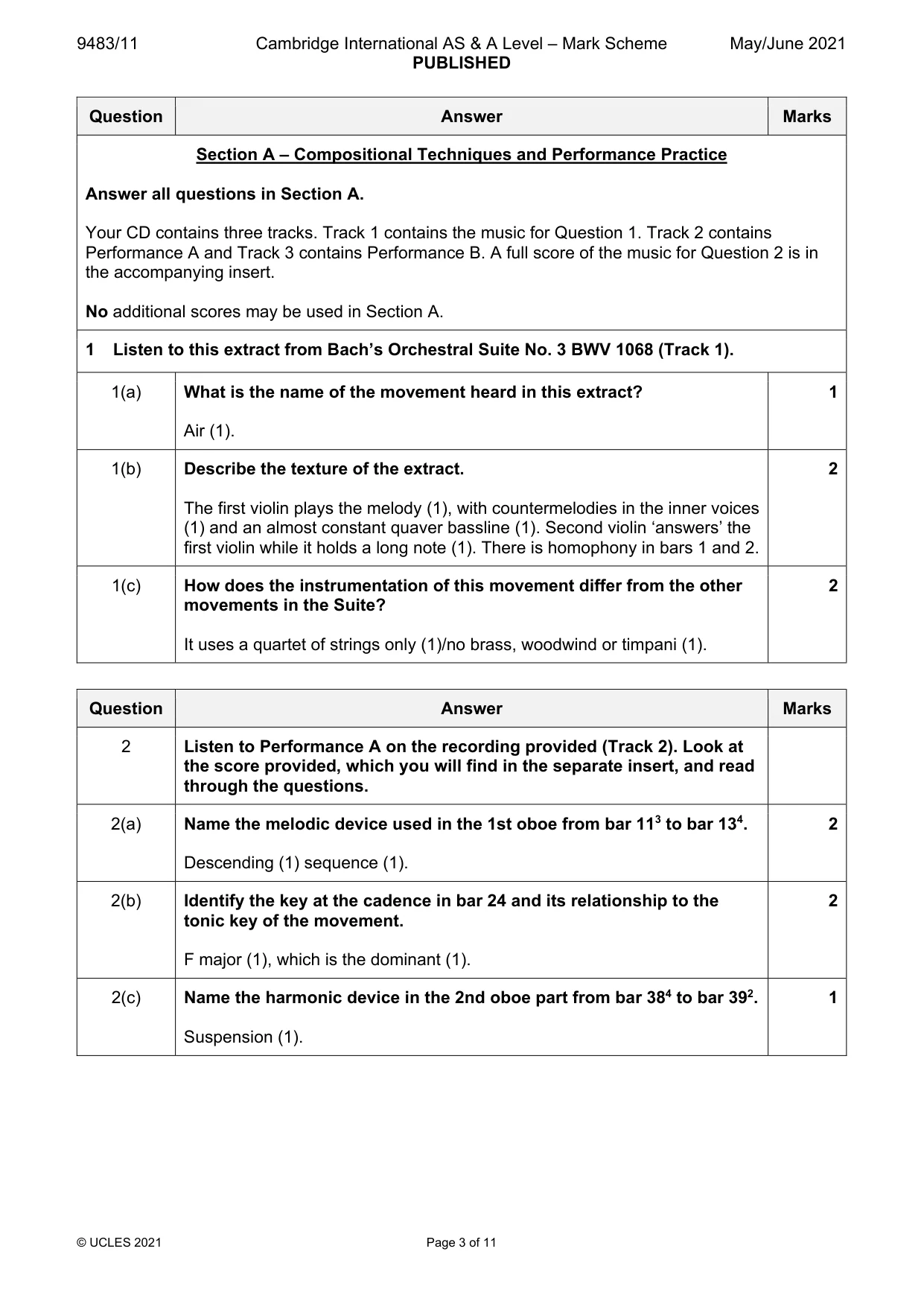
9483/11 Cambridge International AS & A Level – Mark Scheme PUBLISHED May/June 2021 © UCLES 2021 Page 3 of 11 Question Answer Marks Section A – Compositional Techniques and Performance Practice Answer all questions in Section A. Your CD contains three tracks. Track 1 contains the music for Question 1. Track 2 contains Performance A and Track 3 contains Performance B. A full score of the music for Question 2 is in the accompanying insert. No additional scores may be used in Section A. 1 Listen to this extract from Bach’s Orchestral Suite No. 3 BWV 1068 (Track 1). 1(a) What is the name of the movement heard in this extract? Air (1). 1 1(b) Describe the texture of the extract. The first violin plays the melody (1), with countermelodies in the inner voices (1) and an almost constant quaver bassline (1). Second violin ‘answers’ the first violin while it holds a long note (1). There is homophony in bars 1 and 2. 2 1(c) How does the instrumentation of this movement differ from the other movements in the Suite? It uses a quartet of strings only (1)/no brass, woodwind or timpani (1). 2 Question Answer Marks 2 Listen to Performance A on the recording provided (Track 2). Look at the score provided, which you will find in the separate insert, and read through the questions. 2(a) Name the melodic device used in the 1st oboe from bar 113 to bar 134. Descending (1) sequence (1). 2 2(b) Identify the key at the cadence in bar 24 and its relationship to the tonic key of the movement. F major (1), which is the dominant (1). 2 2(c) Name the harmonic device in the 2nd oboe part from bar 384 to bar 392. Suspension (1). 1
Mark scheme, page 4
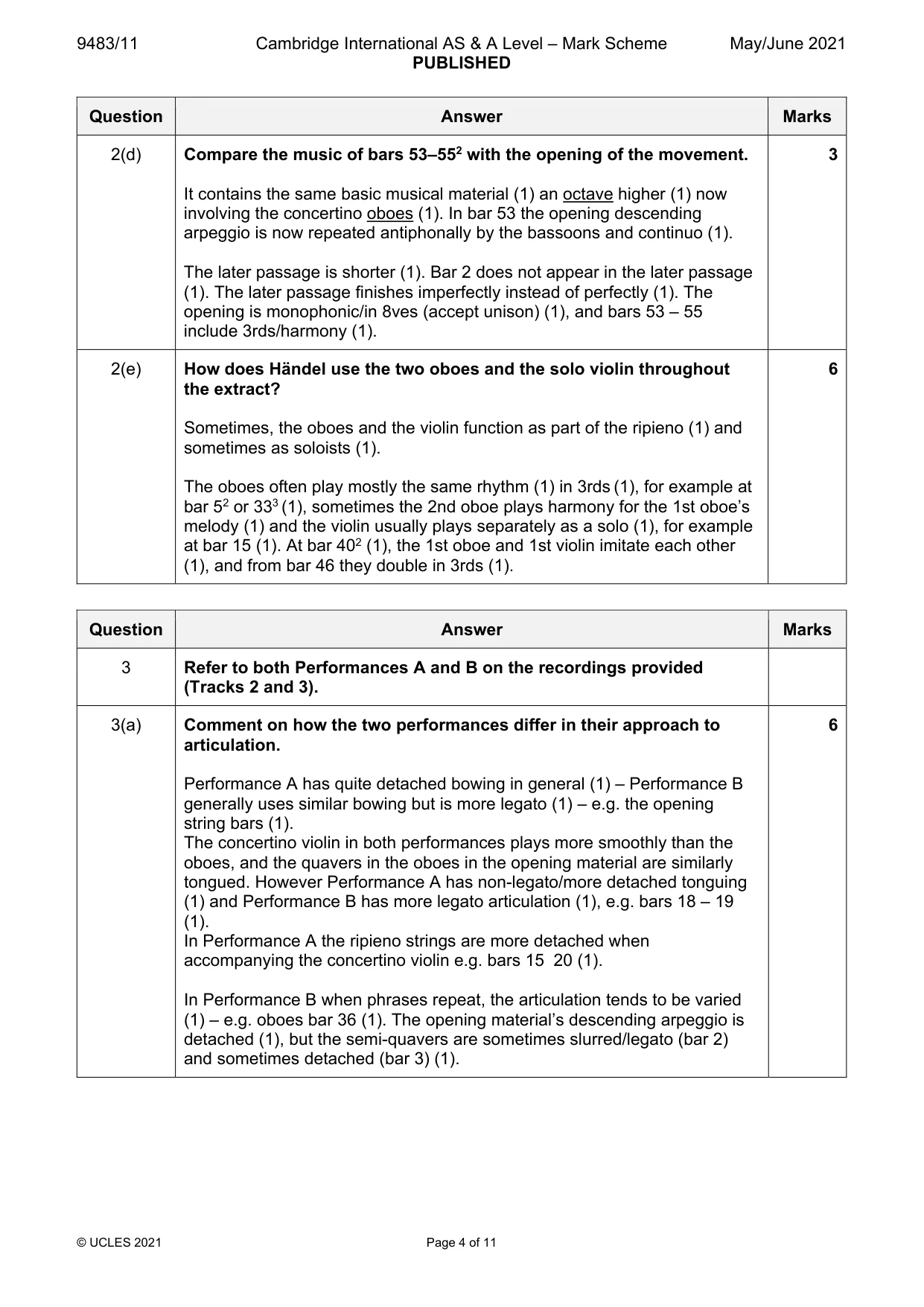
9483/11 Cambridge International AS & A Level – Mark Scheme PUBLISHED May/June 2021 © UCLES 2021 Page 4 of 11 Question Answer Marks 2(d) Compare the music of bars 53–552 with the opening of the movement. It contains the same basic musical material (1) an octave higher (1) now involving the concertino oboes (1). In bar 53 the opening descending arpeggio is now repeated antiphonally by the bassoons and continuo (1). The later passage is shorter (1). Bar 2 does not appear in the later passage (1). The later passage finishes imperfectly instead of perfectly (1). The opening is monophonic/in 8ves (accept unison) (1), and bars 53 – 55 include 3rds/harmony (1). 3 2(e) How does Händel use the two oboes and the solo violin throughout the extract? Sometimes, the oboes and the violin function as part of the ripieno (1) and sometimes as soloists (1). The oboes often play mostly the same rhythm (1) in 3rds (1), for example at bar 52 or 333 (1), sometimes the 2nd oboe plays harmony for the 1st oboe’s melody (1) and the violin usually plays separately as a solo (1), for example at bar 15 (1). At bar 402 (1), the 1st oboe and 1st violin imitate each other (1), and from bar 46 they double in 3rds (1). 6 Question Answer Marks 3 Refer to both Performances A and B on the recordings provided (Tracks 2 and 3). 3(a) Comment on how the two performances differ in their approach to articulation. Performance A has quite detached bowing in general (1) – Performance B generally uses similar bowing but is more legato (1) – e.g. the opening string bars (1). The concertino violin in both performances plays more smoothly than the oboes, and the quavers in the oboes in the opening material are similarly tongued. However Performance A has non-legato/more detached tonguing (1) and Performance B has more legato articulation (1), e.g. bars 18 – 19 (1). In Performance A the ripieno strings are more detached when accompanying the concertino violin e.g. bars 15 20 (1). In Performance B when phrases repeat, the articulation tends to be varied (1) – e.g. oboes bar 36 (1). The opening material’s descending arpeggio is detached (1), but the semi-quavers are sometimes slurred/legato (bar 2) and sometimes detached (bar 3) (1). 6
Mark scheme, page 5
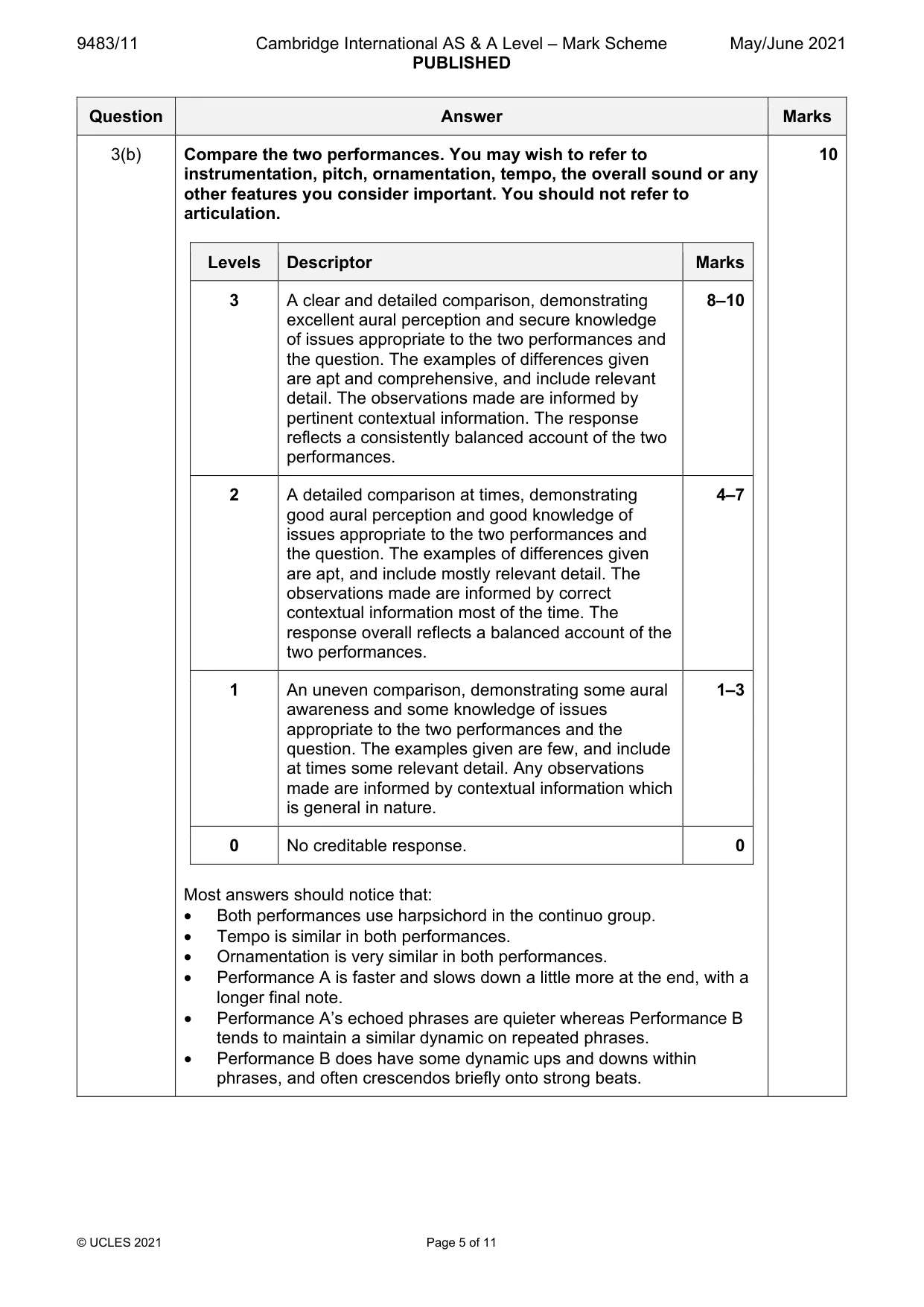
9483/11 Cambridge International AS & A Level – Mark Scheme PUBLISHED May/June 2021 © UCLES 2021 Page 5 of 11 Question Answer Marks 3(b) Compare the two performances. You may wish to refer to instrumentation, pitch, ornamentation, tempo, the overall sound or any other features you consider important. You should not refer to articulation. Levels Descriptor Marks 3 A clear and detailed comparison, demonstrating excellent aural perception and secure knowledge of issues appropriate to the two performances and the question. The examples of differences given are apt and comprehensive, and include relevant detail. The observations made are informed by pertinent contextual information. The response reflects a consistently balanced account of the two performances. 8–10 2 A detailed comparison at times, demonstrating good aural perception and good knowledge of issues appropriate to the two performances and the question. The examples of differences given are apt, and include mostly relevant detail. The observations made are informed by correct contextual information most of the time. The response overall reflects a balanced account of the two performances. 4–7 1 An uneven comparison, demonstrating some aural awareness and some knowledge of issues appropriate to the two performances and the question. The examples given are few, and include at times some relevant detail. Any observations made are informed by contextual information which is general in nature. 1–3 0 No creditable response. 0 Most answers should notice that: • Both performances use harpsichord in the continuo group. • Tempo is similar in both performances. • Ornamentation is very similar in both performances. • Performance A is faster and slows down a little more at the end, with a longer final note. • Performance A’s echoed phrases are quieter whereas Performance B tends to maintain a similar dynamic on repeated phrases. • Performance B does have some dynamic ups and downs within phrases, and often crescendos briefly onto strong beats. 10
Mark scheme, page 6
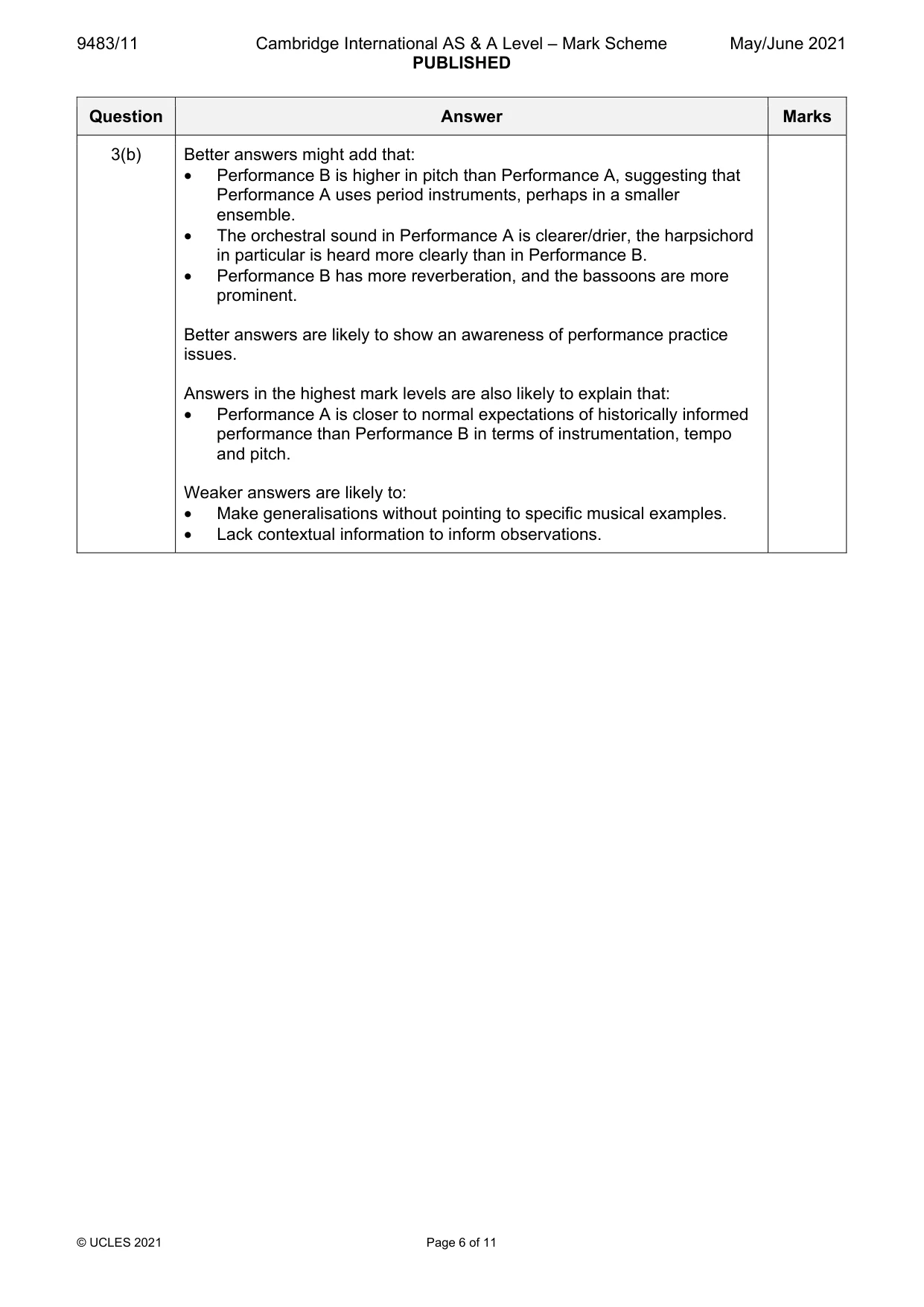
9483/11 Cambridge International AS & A Level – Mark Scheme PUBLISHED May/June 2021 © UCLES 2021 Page 6 of 11 Question Answer Marks 3(b) Better answers might add that: • Performance B is higher in pitch than Performance A, suggesting that Performance A uses period instruments, perhaps in a smaller ensemble. • The orchestral sound in Performance A is clearer/drier, the harpsichord in particular is heard more clearly than in Performance B. • Performance B has more reverberation, and the bassoons are more prominent. Better answers are likely to show an awareness of performance practice issues. Answers in the highest mark levels are also likely to explain that: • Performance A is closer to normal expectations of historically informed performance than Performance B in terms of instrumentation, tempo and pitch. Weaker answers are likely to: • Make generalisations without pointing to specific musical examples. • Lack contextual information to inform observations.
Mark scheme, page 7
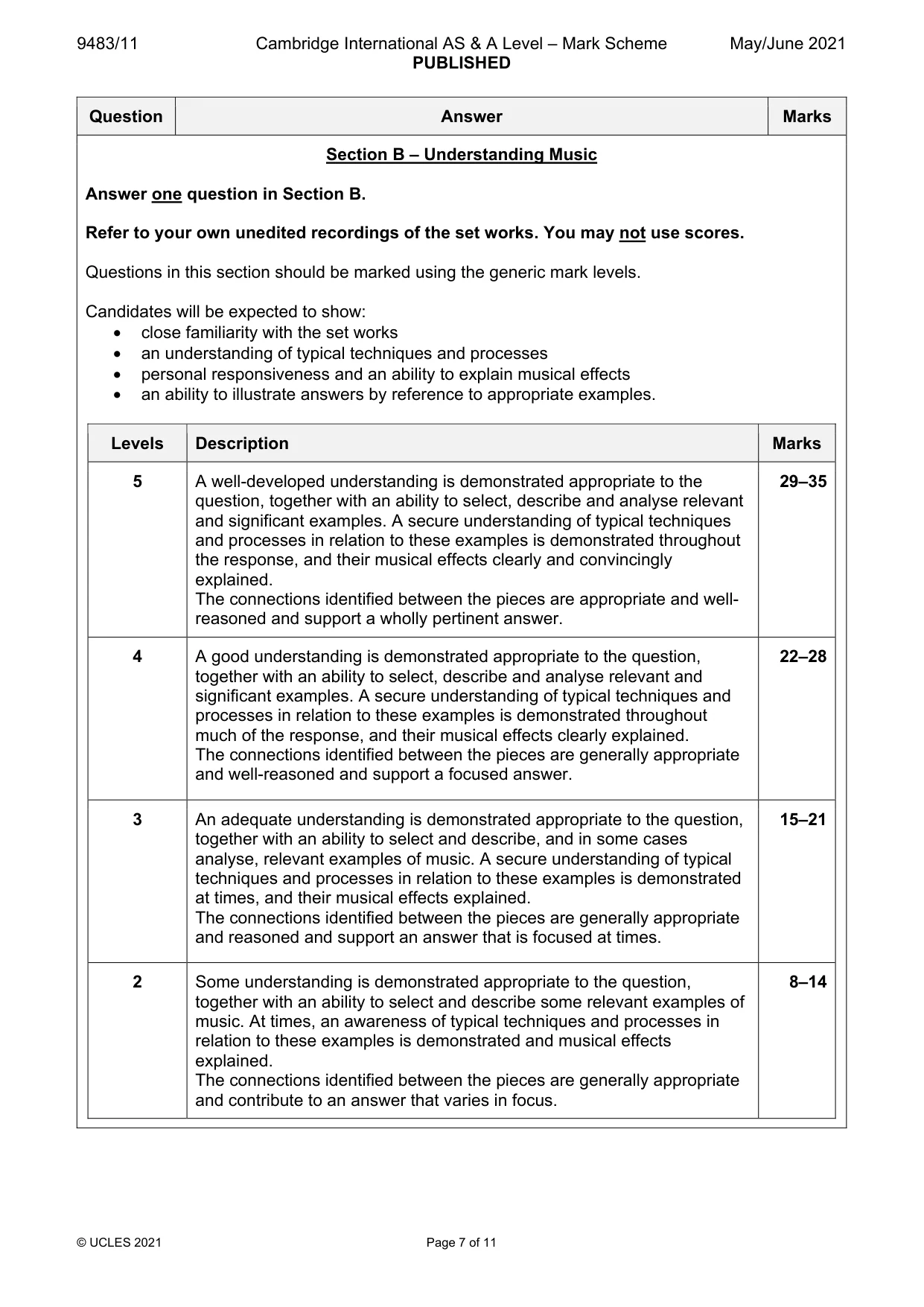
9483/11 Cambridge International AS & A Level – Mark Scheme PUBLISHED May/June 2021 © UCLES 2021 Page 7 of 11 Question Answer Marks Section B – Understanding Music Answer one question in Section B. Refer to your own unedited recordings of the set works. You may not use scores. Questions in this section should be marked using the generic mark levels. Candidates will be expected to show: • close familiarity with the set works • an understanding of typical techniques and processes • personal responsiveness and an ability to explain musical effects • an ability to illustrate answers by reference to appropriate examples. Levels Description Marks 5 A well-developed understanding is demonstrated appropriate to the question, together with an ability to select, describe and analyse relevant and significant examples. A secure understanding of typical techniques and processes in relation to these examples is demonstrated throughout the response, and their musical effects clearly and convincingly explained. The connections identified between the pieces are appropriate and well- reasoned and support a wholly pertinent answer. 29–35 4 A good understanding is demonstrated appropriate to the question, together with an ability to select, describe and analyse relevant and significant examples. A secure understanding of typical techniques and processes in relation to these examples is demonstrated throughout much of the response, and their musical effects clearly explained. The connections identified between the pieces are generally appropriate and well-reasoned and support a focused answer. 22–28 3 An adequate understanding is demonstrated appropriate to the question, together with an ability to select and describe, and in some cases analyse, relevant examples of music. A secure understanding of typical techniques and processes in relation to these examples is demonstrated at times, and their musical effects explained. The connections identified between the pieces are generally appropriate and reasoned and support an answer that is focused at times. 15–21 2 Some understanding is demonstrated appropriate to the question, together with an ability to select and describe some relevant examples of music. At times, an awareness of typical techniques and processes in relation to these examples is demonstrated and musical effects explained. The connections identified between the pieces are generally appropriate and contribute to an answer that varies in focus. 8–14
Mark scheme, page 8
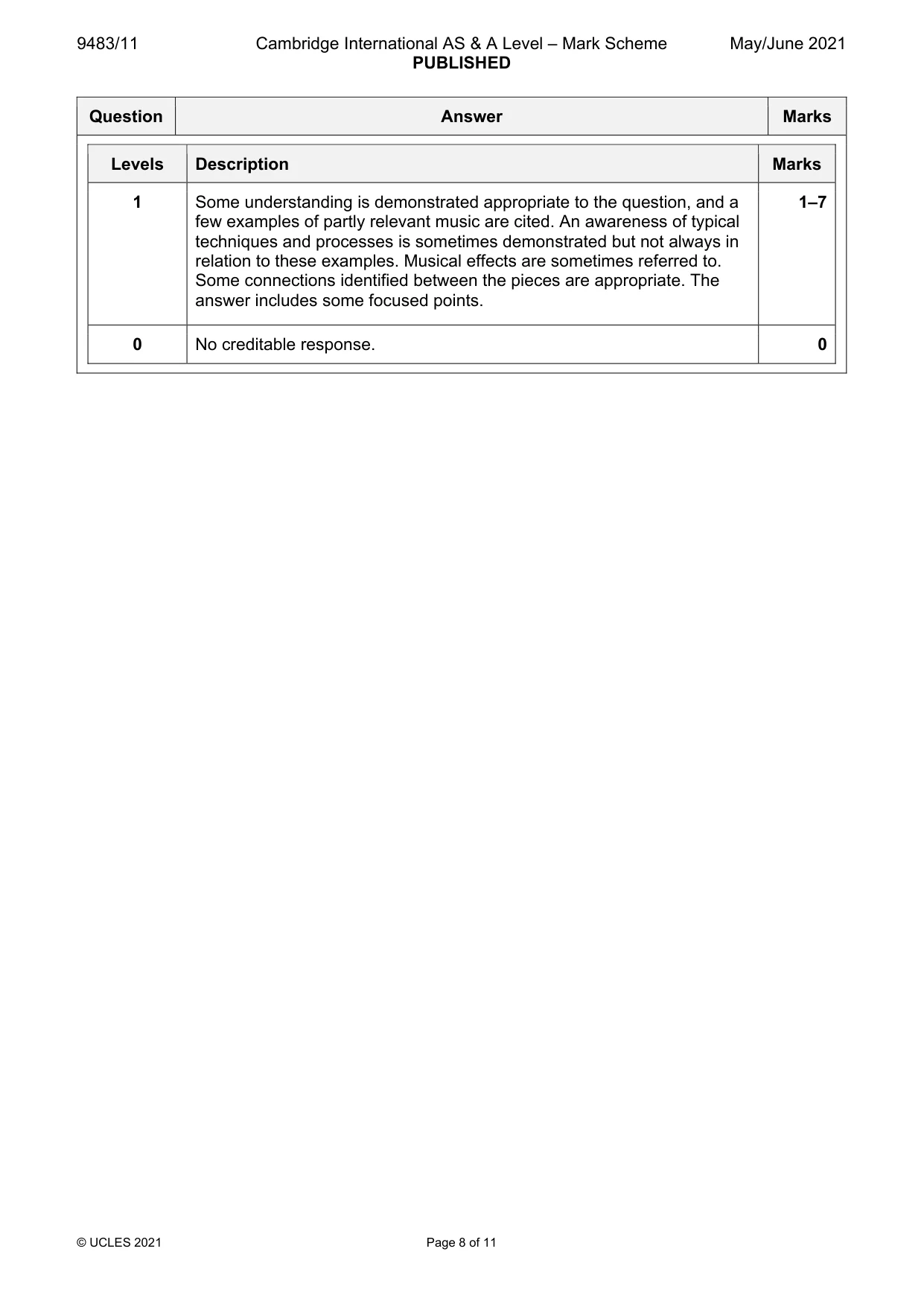
9483/11 Cambridge International AS & A Level – Mark Scheme PUBLISHED May/June 2021 © UCLES 2021 Page 8 of 11 Question Answer Marks Levels Description Marks 1 Some understanding is demonstrated appropriate to the question, and a few examples of partly relevant music are cited. An awareness of typical techniques and processes is sometimes demonstrated but not always in relation to these examples. Musical effects are sometimes referred to. Some connections identified between the pieces are appropriate. The answer includes some focused points. 1–7 0 No creditable response. 0
Mark scheme, page 9
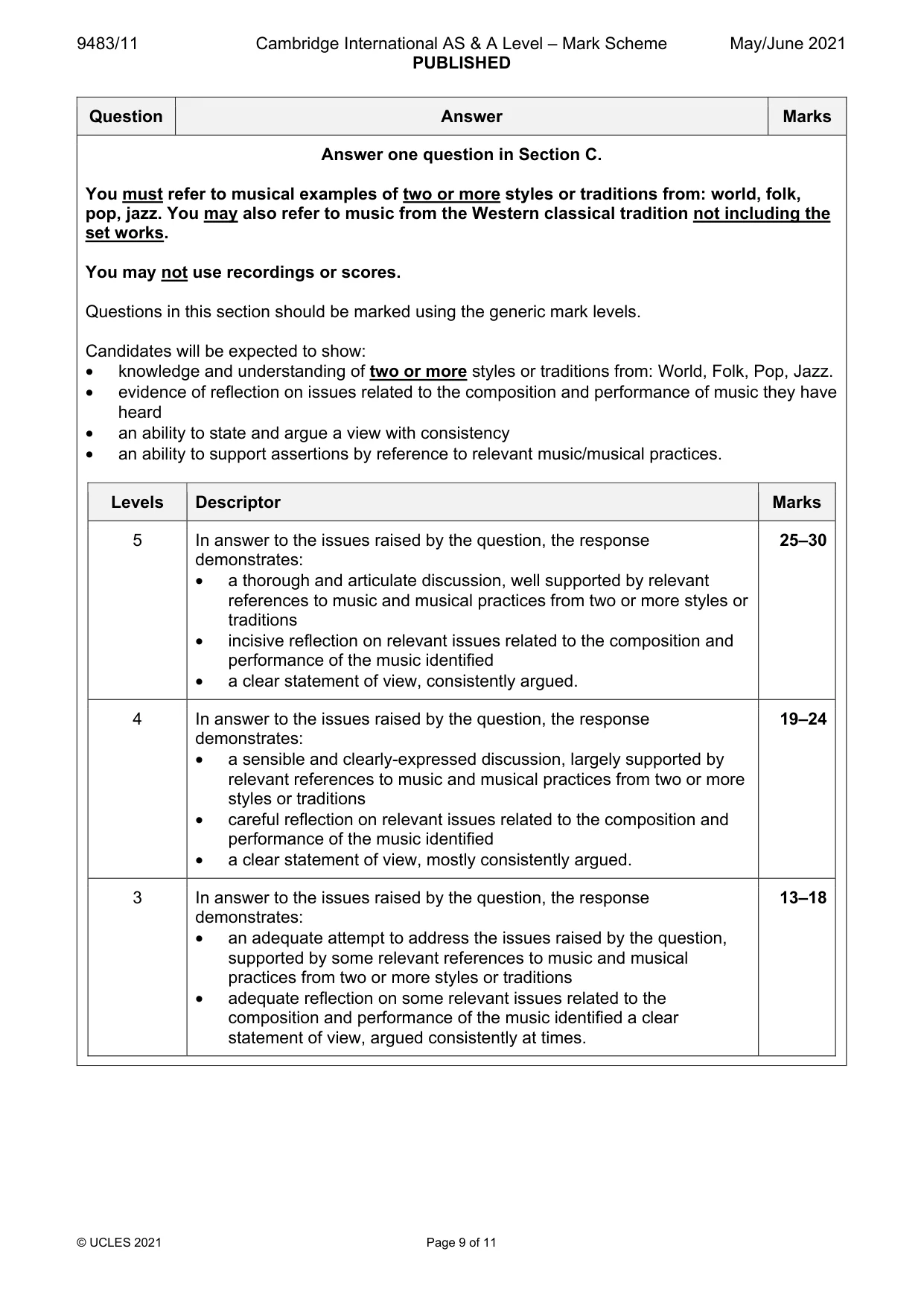
9483/11 Cambridge International AS & A Level – Mark Scheme PUBLISHED May/June 2021 © UCLES 2021 Page 9 of 11 Question Answer Marks Answer one question in Section C. You must refer to musical examples of two or more styles or traditions from: world, folk, pop, jazz. You may also refer to music from the Western classical tradition not including the set works. You may not use recordings or scores. Questions in this section should be marked using the generic mark levels. Candidates will be expected to show: • knowledge and understanding of two or more styles or traditions from: World, Folk, Pop, Jazz. • evidence of reflection on issues related to the composition and performance of music they have heard • an ability to state and argue a view with consistency • an ability to support assertions by reference to relevant music/musical practices. Levels Descriptor Marks 5 In answer to the issues raised by the question, the response demonstrates: • a thorough and articulate discussion, well supported by relevant references to music and musical practices from two or more styles or traditions • incisive reflection on relevant issues related to the composition and performance of the music identified • a clear statement of view, consistently argued. 25–30 4 In answer to the issues raised by the question, the response demonstrates: • a sensible and clearly-expressed discussion, largely supported by relevant references to music and musical practices from two or more styles or traditions • careful reflection on relevant issues related to the composition and performance of the music identified • a clear statement of view, mostly consistently argued. 19–24 3 In answer to the issues raised by the question, the response demonstrates: • an adequate attempt to address the issues raised by the question, supported by some relevant references to music and musical practices from two or more styles or traditions • adequate reflection on some relevant issues related to the composition and performance of the music identified a clear statement of view, argued consistently at times. 13–18
Mark scheme, page 10
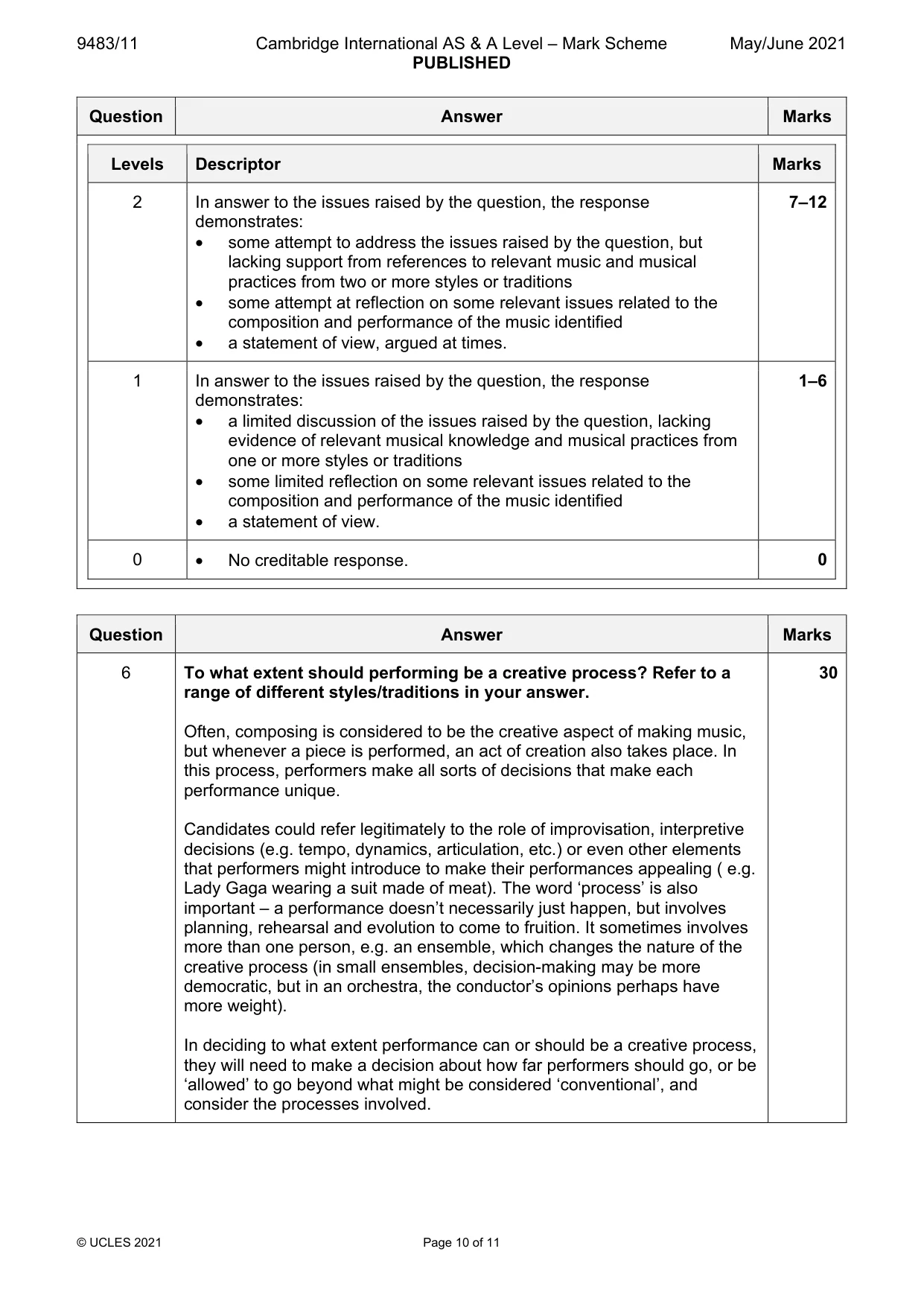
9483/11 Cambridge International AS & A Level – Mark Scheme PUBLISHED May/June 2021 © UCLES 2021 Page 10 of 11 Question Answer Marks Levels Descriptor Marks 2 In answer to the issues raised by the question, the response demonstrates: • some attempt to address the issues raised by the question, but lacking support from references to relevant music and musical practices from two or more styles or traditions • some attempt at reflection on some relevant issues related to the composition and performance of the music identified • a statement of view, argued at times. 7–12 1 In answer to the issues raised by the question, the response demonstrates: • a limited discussion of the issues raised by the question, lacking evidence of relevant musical knowledge and musical practices from one or more styles or traditions • some limited reflection on some relevant issues related to the composition and performance of the music identified • a statement of view. 1–6 0 • No creditable response. 0 Question Answer Marks 6 To what extent should performing be a creative process? Refer to a range of different styles/traditions in your answer. Often, composing is considered to be the creative aspect of making music, but whenever a piece is performed, an act of creation also takes place. In this process, performers make all sorts of decisions that make each performance unique. Candidates could refer legitimately to the role of improvisation, interpretive decisions (e.g. tempo, dynamics, articulation, etc.) or even other elements that performers might introduce to make their performances appealing ( e.g. Lady Gaga wearing a suit made of meat). The word ‘process’ is also important – a performance doesn’t necessarily just happen, but involves planning, rehearsal and evolution to come to fruition. It sometimes involves more than one person, e.g. an ensemble, which changes the nature of the creative process (in small ensembles, decision-making may be more democratic, but in an orchestra, the conductor’s opinions perhaps have more weight). In deciding to what extent performance can or should be a creative process, they will need to make a decision about how far performers should go, or be ‘allowed’ to go beyond what might be considered ‘conventional’, and consider the processes involved. 30
Mark scheme, page 11
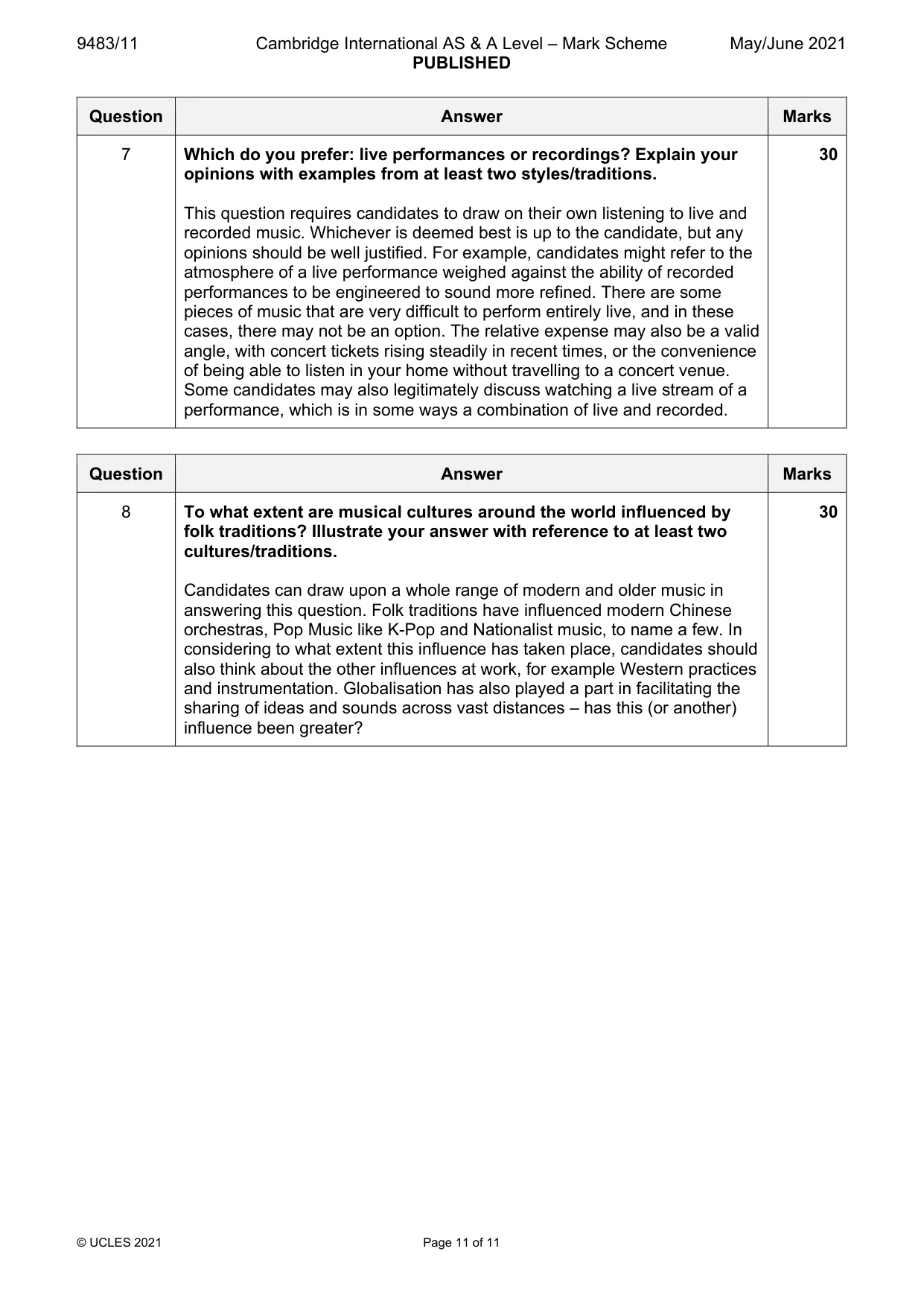
9483/11 Cambridge International AS & A Level – Mark Scheme PUBLISHED May/June 2021 © UCLES 2021 Page 11 of 11 Question Answer Marks 7 Which do you prefer: live performances or recordings? Explain your opinions with examples from at least two styles/traditions. This question requires candidates to draw on their own listening to live and recorded music. Whichever is deemed best is up to the candidate, but any opinions should be well justified. For example, candidates might refer to the atmosphere of a live performance weighed against the ability of recorded performances to be engineered to sound more refined. There are some pieces of music that are very difficult to perform entirely live, and in these cases, there may not be an option. The relative expense may also be a valid angle, with concert tickets rising steadily in recent times, or the convenience of being able to listen in your home without travelling to a concert venue. Some candidates may also legitimately discuss watching a live stream of a performance, which is in some ways a combination of live and recorded. 30 Question Answer Marks 8 To what extent are musical cultures around the world influenced by folk traditions? Illustrate your answer with reference to at least two cultures/traditions. Candidates can draw upon a whole range of modern and older music in answering this question. Folk traditions have influenced modern Chinese orchestras, Pop Music like K-Pop and Nationalist music, to name a few. In considering to what extent this influence has taken place, candidates should also think about the other influences at work, for example Western practices and instrumentation. Globalisation has also played a part in facilitating the sharing of ideas and sounds across vast distances – has this (or another) influence been greater? 30
What you needed in this session
Cambridge’s own grade thresholds for 2021 May/June, Paper 1 · Variant 1. A higher threshold means an easier paper — the bar moves with how the cohort did.