Cambridge A Level Music 9483 — 2019 May/June Paper 1 · Variant 1
9483/11/M/J/19 · 100 marks · ≈113 min
The question paper and its mark scheme, free to read here and free to download. This is Cambridge’s own paper, exactly as it was sat.
Question paper4 pages

Mark scheme15 pages
Answers below. Sit the paper first if you are practising.
Paper as text
Question paper, page 1
Cambridge International AS & A Level * 3 3 3 4 3 1 6 0 3 2 * DC (KN) 176499/3 © UCLES 2019 [Turn over This document has 4 pages. Blank pages are indicated. MUSIC 9483/11 Paper 1 Listening May/June 2019 2 hours You must answer on the enclosed answer booklet. You will need: Answer booklet (enclosed) Section A audio recordings (enclosed) Insert (enclosed) Section B audio recordings Manuscript paper (optional) Candidates may use their own unedited recordings of the Set Works in Section B only. INSTRUCTIONS ● Answer five questions in total: Section A: answer all three questions. Section B: answer one question. Section C: answer one question. ● Follow the instructions on the front cover of the answer booklet. If you need additional answer paper, ask the invigilator for a continuation booklet. ● Recordings: you must listen to recordings on individual listening equipment with headphones. Individual recordings for Section A are provided. You may use your own unedited recordings of the Set Works in Section B and may listen to extracts from any of them. No recordings are to be used for Section C. ● You may find it useful to make notes as you listen to the extracts. ● Scores: the insert contains the score referred to in Section A. No additional scores may be used. ● At the end of the examination, fasten all your work together. Do not use staples, paper clips or glue. INFORMATION ● The total mark for this paper is 100. ● The number of marks for each question or part question is shown in brackets [ ].
Question paper, page 2
2 9483/11/M/J/19 © UCLES 2019 Section A – Compositional Techniques and Performance Practice Answer all questions in Section A. Your CD contains three tracks. Track 1 contains the music for Question 1. Track 2 contains Performance A and Track 3 contains Performance B. A full score of the music for Question 2 is in the accompanying insert. No additional scores may be used in Section A. 1 Listen to the extract from Bach’s Brandenburg Concerto no. 5 (Track 1). (a) Which movement is this extract taken from? [1] (b) Which section of the movement starts at the end of the extract? [1] (c) Name the instrument heard in this recording. [1] (d) How is this instrument’s role different from what you might expect in a concerto grosso? [2] 2 Listen to Performance A on the recording provided (Track 2). Look at the score provided, which you will find in the separate insert, and read through the questions. (a) Outline the composer’s use of concertino and ripieno in the opening section (bars 1–58). [2] (b) What is the relationship of the chord in bar 20 to the chord in bar 21? [1] (c) Identify the cadence in bars 57 to 58. [1] (d) Name the texture from bars 59 to 69. [1] (e) Identify the harmonic device used in the first violin part in bars 72–73. [1] (f) Name the melodic device in bars 784 to 803 in the second violins. [2] (g) Describe in detail the structure of the extract from bar 59 to 88 (the end of the extract). [6] 3 Refer to both Performances A (Track 2) and B (Track 3) on the recordings provided. (a) Comment on how the two performances interpret tempo. [6] (b) Compare the two performances. You may wish to refer to instrumentation, pitch, articulation, ornamentation, the overall sound or any other features you consider important. You should not refer to tempo. [10]
Question paper, page 3
3 9483/11/M/J/19 © UCLES 2019 Section B – Understanding Music Answer one question in Section B. Refer to your own unedited recordings of set works. You may not use a copy of the scores. 4 Compare how contrast is created in Boulanger’s Les Sirènes and any one of Britten’s Four Sea Interludes. [35] 5 In what ways is calmness suggested in Moonlight (movement III of Britten’s Four Sea Interludes) and in Wagner’s Overture from Der fliegende Holländer ? [35] Section C – Connecting Music Answer one question in Section C. You must refer to musical examples of two or more styles or traditions from: world, folk, pop, jazz. You may also refer to music from the Western classical tradition not including the set works. You may not use recordings or scores. 6 Compare the notation practices of a range of styles/traditions. How necessary and helpful do you think they are? [30] 7 How do musical styles evolve? Illustrate your answer with reference to any two different styles of music. [30] 8 Explain how groups of singers are used in music of at least two different styles/traditions. [30]
Question paper, page 4
4 9483/11/M/J/19 © UCLES 2019 Permission to reproduce items where third-party owned material protected by copyright is included has been sought and cleared where possible. Every reasonable effort has been made by the publisher (UCLES) to trace copyright holders, but if any items requiring clearance have unwittingly been included, the publisher will be pleased to make amends at the earliest possible opportunity. To avoid the issue of disclosure of answer-related information to candidates, all copyright acknowledgements are reproduced online in the Cambridge Assessment International Education Copyright Acknowledgements Booklet. This is produced for each series of examinations and is freely available to download at www.cambridgeinternational.org after the live examination series. Cambridge Assessment International Education is part of the Cambridge Assessment Group. Cambridge Assessment is the brand name of the University of Cambridge Local Examinations Syndicate (UCLES), which itself is a department of the University of Cambridge. BLANK PAGE
Mark scheme, page 1
This document consists of 15 printed pages. © UCLES 2019 [Turn over Cambridge International AS & A Level MUSIC 9483/11 Paper 1 Listening May/June 2019 MARK SCHEME Maximum Mark: 100 Published This mark scheme is published as an aid to teachers and candidates, to indicate the requirements of the examination. It shows the basis on which Examiners were instructed to award marks. It does not indicate the details of the discussions that took place at an Examiners’ meeting before marking began, which would have considered the acceptability of alternative answers. Mark schemes should be read in conjunction with the question paper and the Principal Examiner Report for Teachers. Cambridge International will not enter into discussions about these mark schemes. Cambridge International is publishing the mark schemes for the May/June 2019 series for most Cambridge IGCSE™, Cambridge International A and AS Level and Cambridge Pre-U components, and some Cambridge O Level components.
Mark scheme, page 2
9483/11 Cambridge International AS & A Level – Mark Scheme PUBLISHED May/June 2019 © UCLES 2019 Page 2 of 15 Generic Marking Principles These general marking principles must be applied by all examiners when marking candidate answers. They should be applied alongside the specific content of the mark scheme or generic level descriptors for a question. Each question paper and mark scheme will also comply with these marking principles. GENERIC MARKING PRINCIPLE 1: Marks must be awarded in line with: • the specific content of the mark scheme or the generic level descriptors for the question • the specific skills defined in the mark scheme or in the generic level descriptors for the question • the standard of response required by a candidate as exemplified by the standardisation scripts. GENERIC MARKING PRINCIPLE 2: Marks awarded are always whole marks (not half marks, or other fractions). GENERIC MARKING PRINCIPLE 3: Marks must be awarded positively: • marks are awarded for correct/valid answers, as defined in the mark scheme. However, credit is given for valid answers which go beyond the scope of the syllabus and mark scheme, referring to your Team Leader as appropriate • marks are awarded when candidates clearly demonstrate what they know and can do • marks are not deducted for errors • marks are not deducted for omissions • answers should only be judged on the quality of spelling, punctuation and grammar when these features are specifically assessed by the question as indicated by the mark scheme. The meaning, however, should be unambiguous. GENERIC MARKING PRINCIPLE 4: Rules must be applied consistently e.g. in situations where candidates have not followed instructions or in the application of generic level descriptors.
Mark scheme, page 3
9483/11 Cambridge International AS & A Level – Mark Scheme PUBLISHED May/June 2019 © UCLES 2019 Page 3 of 15 GENERIC MARKING PRINCIPLE 5: Marks should be awarded using the full range of marks defined in the mark scheme for the question (however; the use of the full mark range may be limited according to the quality of the candidate responses seen). GENERIC MARKING PRINCIPLE 6: Marks awarded are based solely on the requirements as defined in the mark scheme. Marks should not be awarded with grade thresholds or grade descriptors in mind.
Mark scheme, page 4
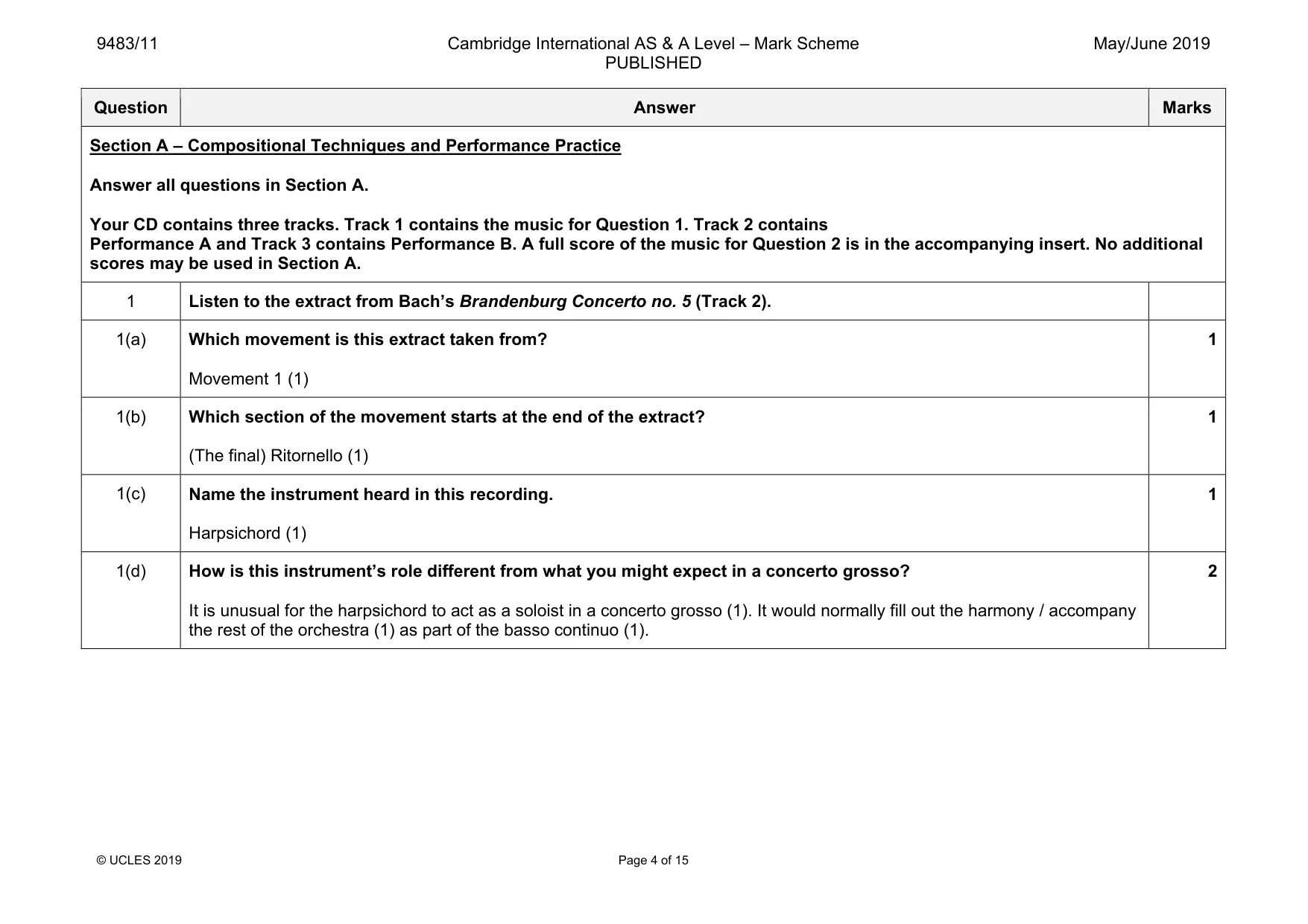
9483/11 Cambridge International AS & A Level – Mark Scheme PUBLISHED May/June 2019 © UCLES 2019 Page 4 of 15 Question Answer Marks Section A – Compositional Techniques and Performance Practice Answer all questions in Section A. Your CD contains three tracks. Track 1 contains the music for Question 1. Track 2 contains Performance A and Track 3 contains Performance B. A full score of the music for Question 2 is in the accompanying insert. No additional scores may be used in Section A. 1 Listen to the extract from Bach’s Brandenburg Concerto no. 5 (Track 2). 1(a) Which movement is this extract taken from? Movement 1 (1) 1 1(b) Which section of the movement starts at the end of the extract? (The final) Ritornello (1) 1 1(c) Name the instrument heard in this recording. Harpsichord (1) 1 1(d) How is this instrument’s role different from what you might expect in a concerto grosso? It is unusual for the harpsichord to act as a soloist in a concerto grosso (1). It would normally fill out the harmony / accompany the rest of the orchestra (1) as part of the basso continuo (1). 2
Mark scheme, page 5
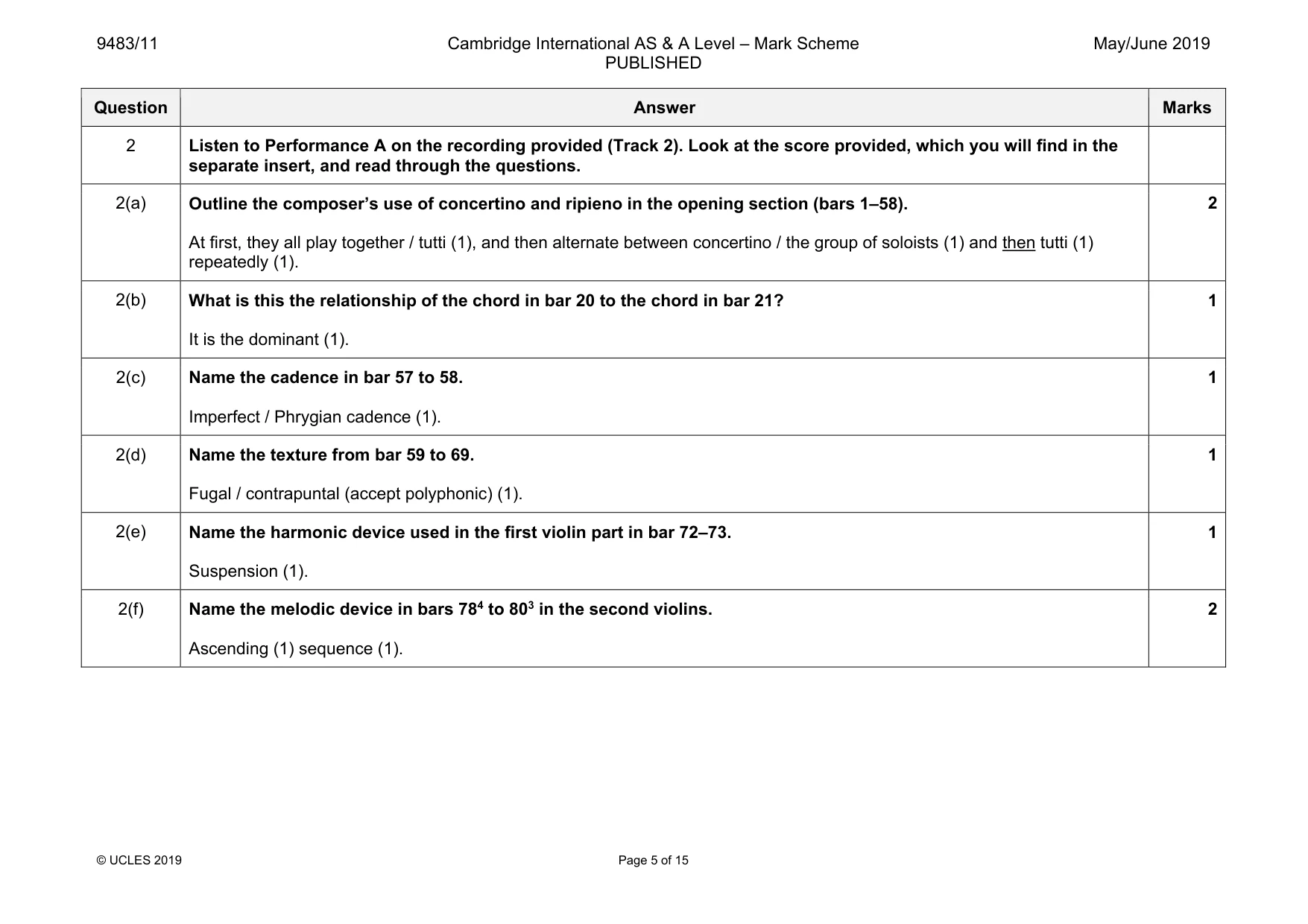
9483/11 Cambridge International AS & A Level – Mark Scheme PUBLISHED May/June 2019 © UCLES 2019 Page 5 of 15 Question Answer Marks 2 Listen to Performance A on the recording provided (Track 2). Look at the score provided, which you will find in the separate insert, and read through the questions. 2(a) Outline the composer’s use of concertino and ripieno in the opening section (bars 1–58). At first, they all play together / tutti (1), and then alternate between concertino / the group of soloists (1) and then tutti (1) repeatedly (1). 2 2(b) What is this the relationship of the chord in bar 20 to the chord in bar 21? It is the dominant (1). 1 2(c) Name the cadence in bar 57 to 58. Imperfect / Phrygian cadence (1). 1 2(d) Name the texture from bar 59 to 69. Fugal / contrapuntal (accept polyphonic) (1). 1 2(e) Name the harmonic device used in the first violin part in bar 72–73. Suspension (1). 1 2(f) Name the melodic device in bars 784 to 803 in the second violins. Ascending (1) sequence (1). 2
Mark scheme, page 6
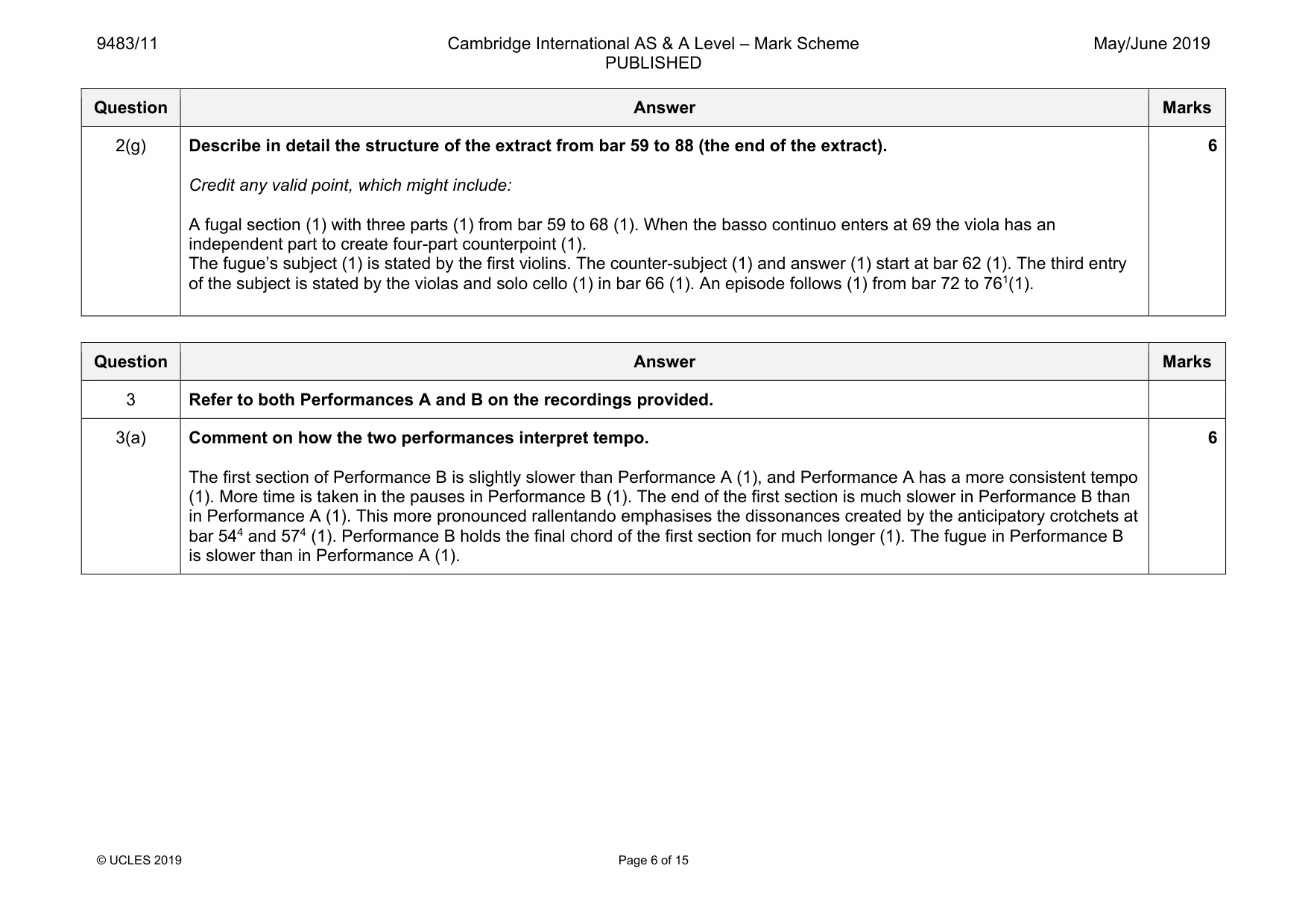
9483/11 Cambridge International AS & A Level – Mark Scheme PUBLISHED May/June 2019 © UCLES 2019 Page 6 of 15 Question Answer Marks 2(g) Describe in detail the structure of the extract from bar 59 to 88 (the end of the extract). Credit any valid point, which might include: A fugal section (1) with three parts (1) from bar 59 to 68 (1). When the basso continuo enters at 69 the viola has an independent part to create four-part counterpoint (1). The fugue’s subject (1) is stated by the first violins. The counter-subject (1) and answer (1) start at bar 62 (1). The third entry of the subject is stated by the violas and solo cello (1) in bar 66 (1). An episode follows (1) from bar 72 to 761(1). 6 Question Answer Marks 3 Refer to both Performances A and B on the recordings provided. 3(a) Comment on how the two performances interpret tempo. The first section of Performance B is slightly slower than Performance A (1), and Performance A has a more consistent tempo (1). More time is taken in the pauses in Performance B (1). The end of the first section is much slower in Performance B than in Performance A (1). This more pronounced rallentando emphasises the dissonances created by the anticipatory crotchets at bar 544 and 574 (1). Performance B holds the final chord of the first section for much longer (1). The fugue in Performance B is slower than in Performance A (1). 6
Mark scheme, page 7
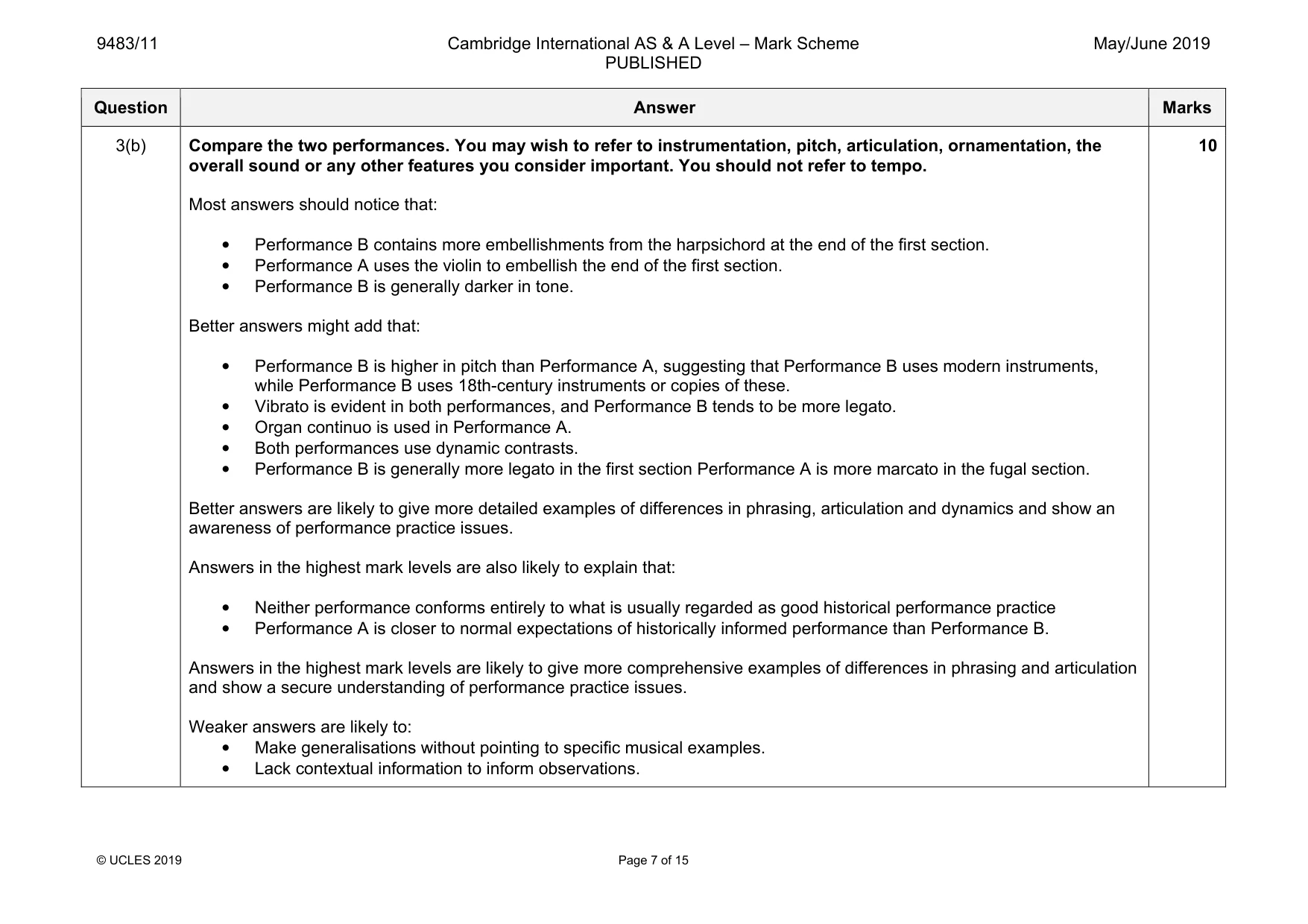
9483/11 Cambridge International AS & A Level – Mark Scheme PUBLISHED May/June 2019 © UCLES 2019 Page 7 of 15 Question Answer Marks 3(b) Compare the two performances. You may wish to refer to instrumentation, pitch, articulation, ornamentation, the overall sound or any other features you consider important. You should not refer to tempo. Most answers should notice that: • Performance B contains more embellishments from the harpsichord at the end of the first section. • Performance A uses the violin to embellish the end of the first section. • Performance B is generally darker in tone. Better answers might add that: • Performance B is higher in pitch than Performance A, suggesting that Performance B uses modern instruments, while Performance B uses 18th-century instruments or copies of these. • Vibrato is evident in both performances, and Performance B tends to be more legato. • Organ continuo is used in Performance A. • Both performances use dynamic contrasts. • Performance B is generally more legato in the first section Performance A is more marcato in the fugal section. Better answers are likely to give more detailed examples of differences in phrasing, articulation and dynamics and show an awareness of performance practice issues. Answers in the highest mark levels are also likely to explain that: • Neither performance conforms entirely to what is usually regarded as good historical performance practice • Performance A is closer to normal expectations of historically informed performance than Performance B. Answers in the highest mark levels are likely to give more comprehensive examples of differences in phrasing and articulation and show a secure understanding of performance practice issues. Weaker answers are likely to: • Make generalisations without pointing to specific musical examples. • Lack contextual information to inform observations. 10
Mark scheme, page 8
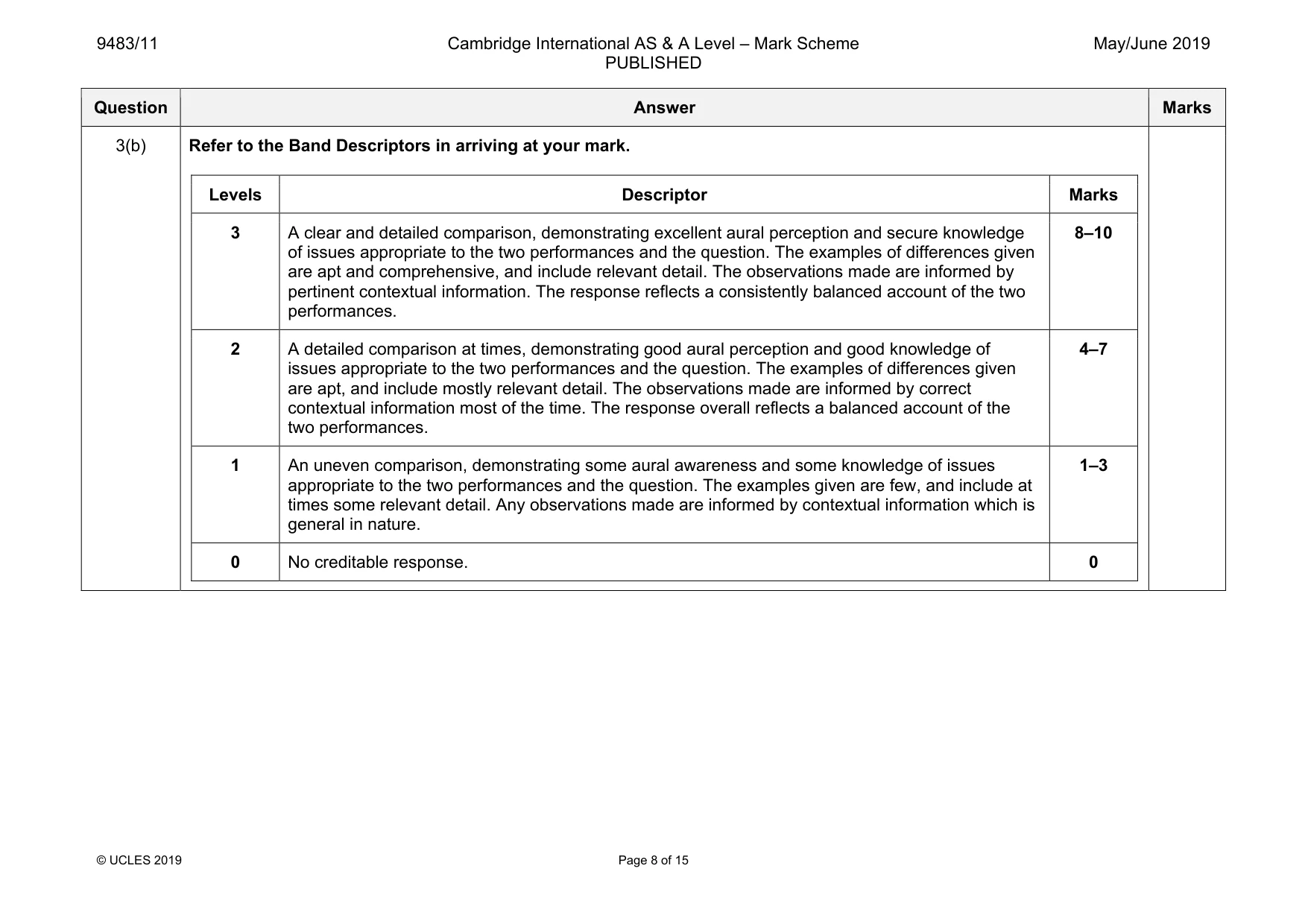
9483/11 Cambridge International AS & A Level – Mark Scheme PUBLISHED May/June 2019 © UCLES 2019 Page 8 of 15 Question Answer Marks 3(b) Refer to the Band Descriptors in arriving at your mark. Levels Descriptor Marks 3 A clear and detailed comparison, demonstrating excellent aural perception and secure knowledge of issues appropriate to the two performances and the question. The examples of differences given are apt and comprehensive, and include relevant detail. The observations made are informed by pertinent contextual information. The response reflects a consistently balanced account of the two performances. 8–10 2 A detailed comparison at times, demonstrating good aural perception and good knowledge of issues appropriate to the two performances and the question. The examples of differences given are apt, and include mostly relevant detail. The observations made are informed by correct contextual information most of the time. The response overall reflects a balanced account of the two performances. 4–7 1 An uneven comparison, demonstrating some aural awareness and some knowledge of issues appropriate to the two performances and the question. The examples given are few, and include at times some relevant detail. Any observations made are informed by contextual information which is general in nature. 1–3 0 No creditable response. 0
Mark scheme, page 9
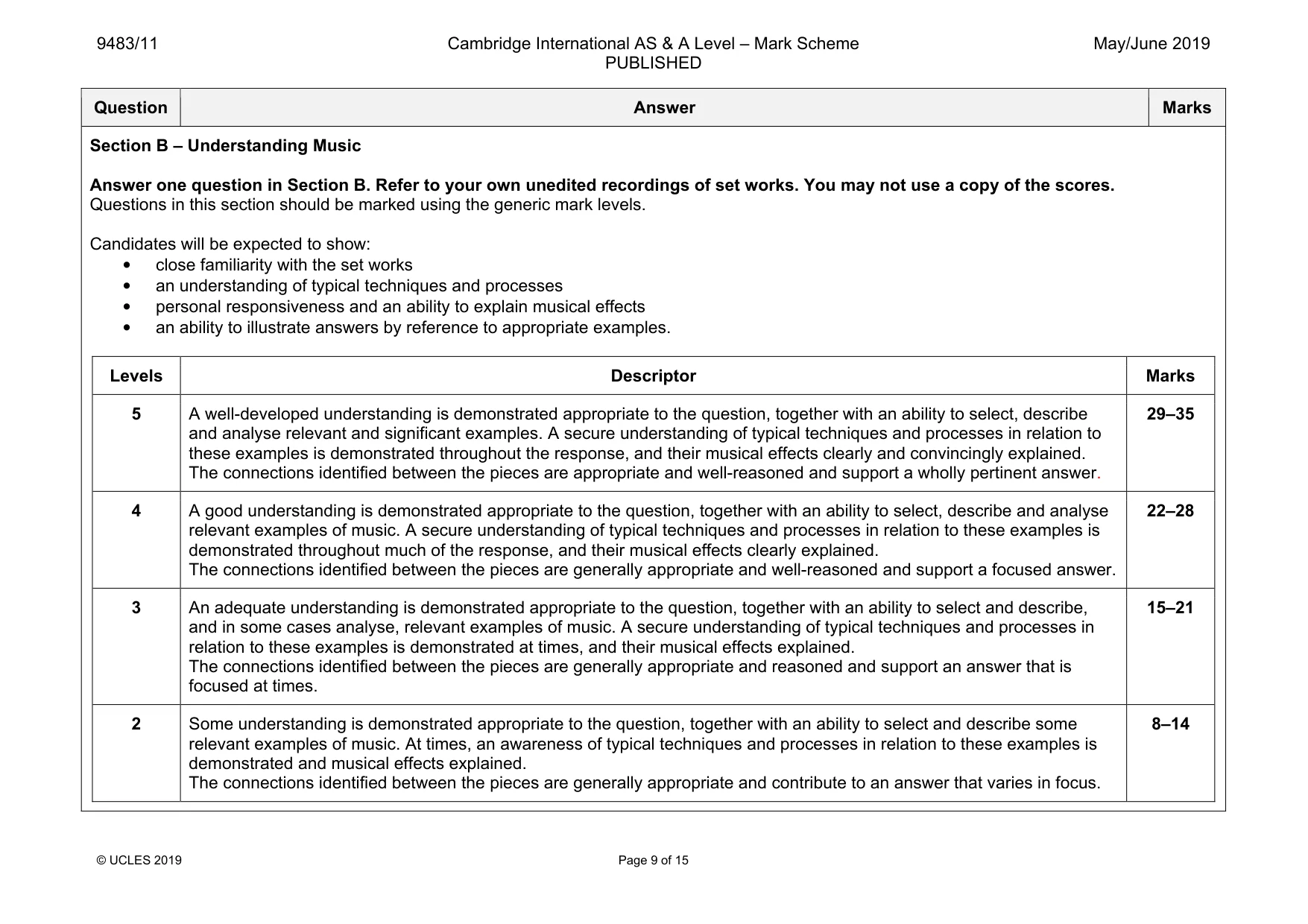
9483/11 Cambridge International AS & A Level – Mark Scheme PUBLISHED May/June 2019 © UCLES 2019 Page 9 of 15 Question Answer Marks Section B – Understanding Music Answer one question in Section B. Refer to your own unedited recordings of set works. You may not use a copy of the scores. Questions in this section should be marked using the generic mark levels. Candidates will be expected to show: • close familiarity with the set works • an understanding of typical techniques and processes • personal responsiveness and an ability to explain musical effects • an ability to illustrate answers by reference to appropriate examples. Levels Descriptor Marks 5 A well-developed understanding is demonstrated appropriate to the question, together with an ability to select, describe and analyse relevant and significant examples. A secure understanding of typical techniques and processes in relation to these examples is demonstrated throughout the response, and their musical effects clearly and convincingly explained. The connections identified between the pieces are appropriate and well-reasoned and support a wholly pertinent answer. 29–35 4 A good understanding is demonstrated appropriate to the question, together with an ability to select, describe and analyse relevant examples of music. A secure understanding of typical techniques and processes in relation to these examples is demonstrated throughout much of the response, and their musical effects clearly explained. The connections identified between the pieces are generally appropriate and well-reasoned and support a focused answer. 22–28 3 An adequate understanding is demonstrated appropriate to the question, together with an ability to select and describe, and in some cases analyse, relevant examples of music. A secure understanding of typical techniques and processes in relation to these examples is demonstrated at times, and their musical effects explained. The connections identified between the pieces are generally appropriate and reasoned and support an answer that is focused at times. 15–21 2 Some understanding is demonstrated appropriate to the question, together with an ability to select and describe some relevant examples of music. At times, an awareness of typical techniques and processes in relation to these examples is demonstrated and musical effects explained. The connections identified between the pieces are generally appropriate and contribute to an answer that varies in focus. 8–14
Mark scheme, page 10
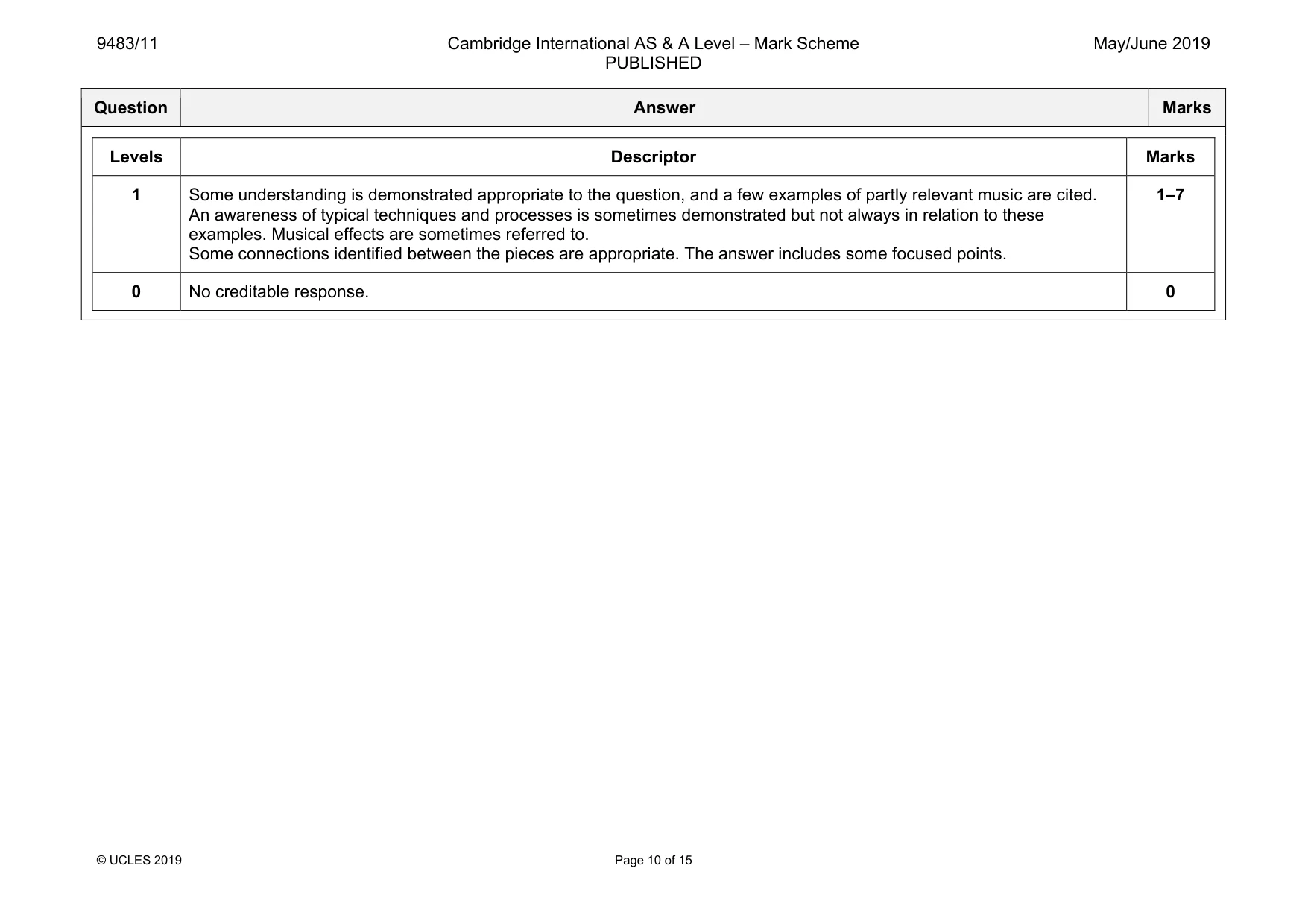
9483/11 Cambridge International AS & A Level – Mark Scheme PUBLISHED May/June 2019 © UCLES 2019 Page 10 of 15 Question Answer Marks Levels Descriptor Marks 1 Some understanding is demonstrated appropriate to the question, and a few examples of partly relevant music are cited. An awareness of typical techniques and processes is sometimes demonstrated but not always in relation to these examples. Musical effects are sometimes referred to. Some connections identified between the pieces are appropriate. The answer includes some focused points. 1–7 0 No creditable response. 0
Mark scheme, page 11
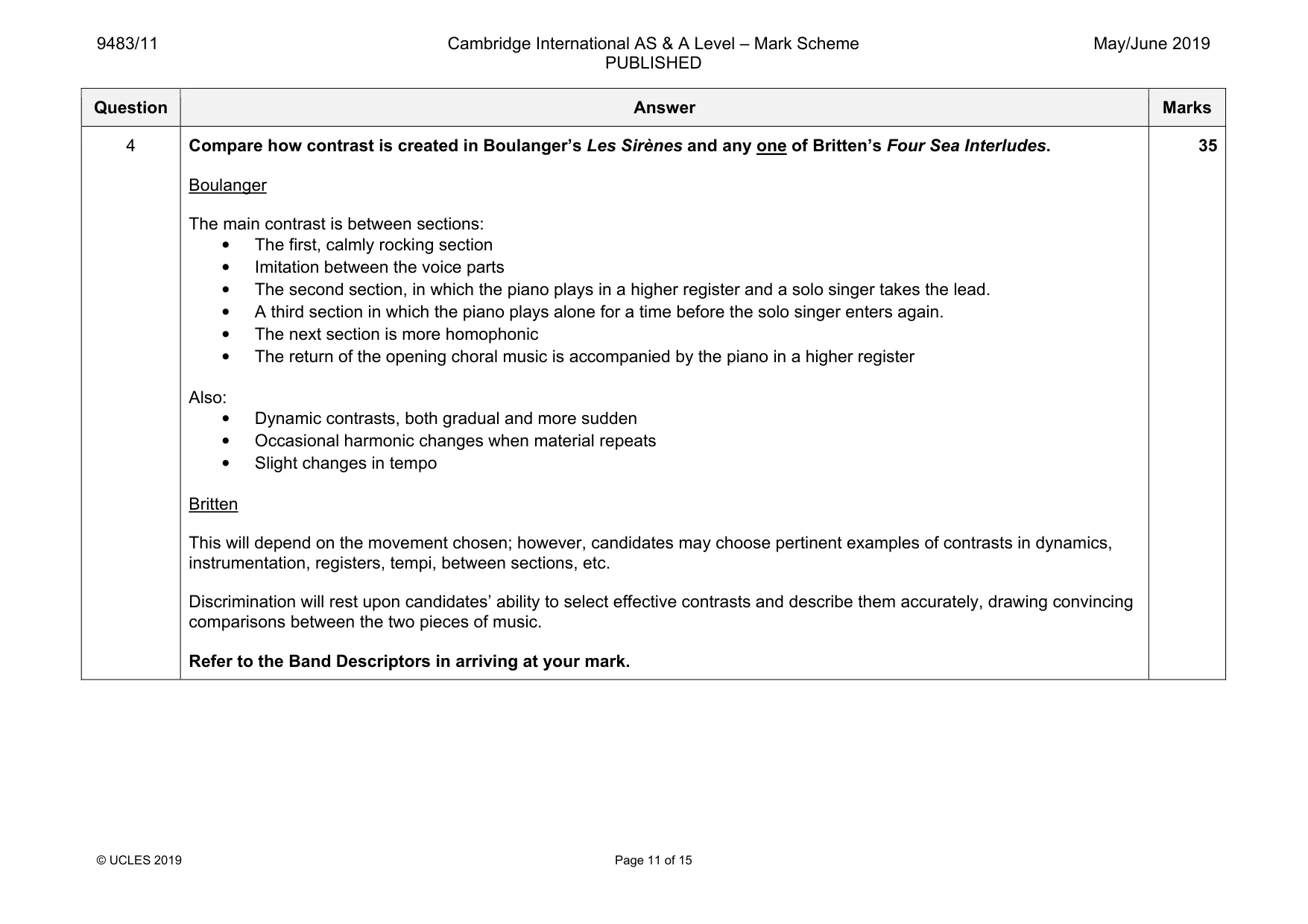
9483/11 Cambridge International AS & A Level – Mark Scheme PUBLISHED May/June 2019 © UCLES 2019 Page 11 of 15 Question Answer Marks 4 Compare how contrast is created in Boulanger’s Les Sirènes and any one of Britten’s Four Sea Interludes. Boulanger The main contrast is between sections: • The first, calmly rocking section • Imitation between the voice parts • The second section, in which the piano plays in a higher register and a solo singer takes the lead. • A third section in which the piano plays alone for a time before the solo singer enters again. • The next section is more homophonic • The return of the opening choral music is accompanied by the piano in a higher register Also: • Dynamic contrasts, both gradual and more sudden • Occasional harmonic changes when material repeats • Slight changes in tempo Britten This will depend on the movement chosen; however, candidates may choose pertinent examples of contrasts in dynamics, instrumentation, registers, tempi, between sections, etc. Discrimination will rest upon candidates’ ability to select effective contrasts and describe them accurately, drawing convincing comparisons between the two pieces of music. Refer to the Band Descriptors in arriving at your mark. 35
Mark scheme, page 12
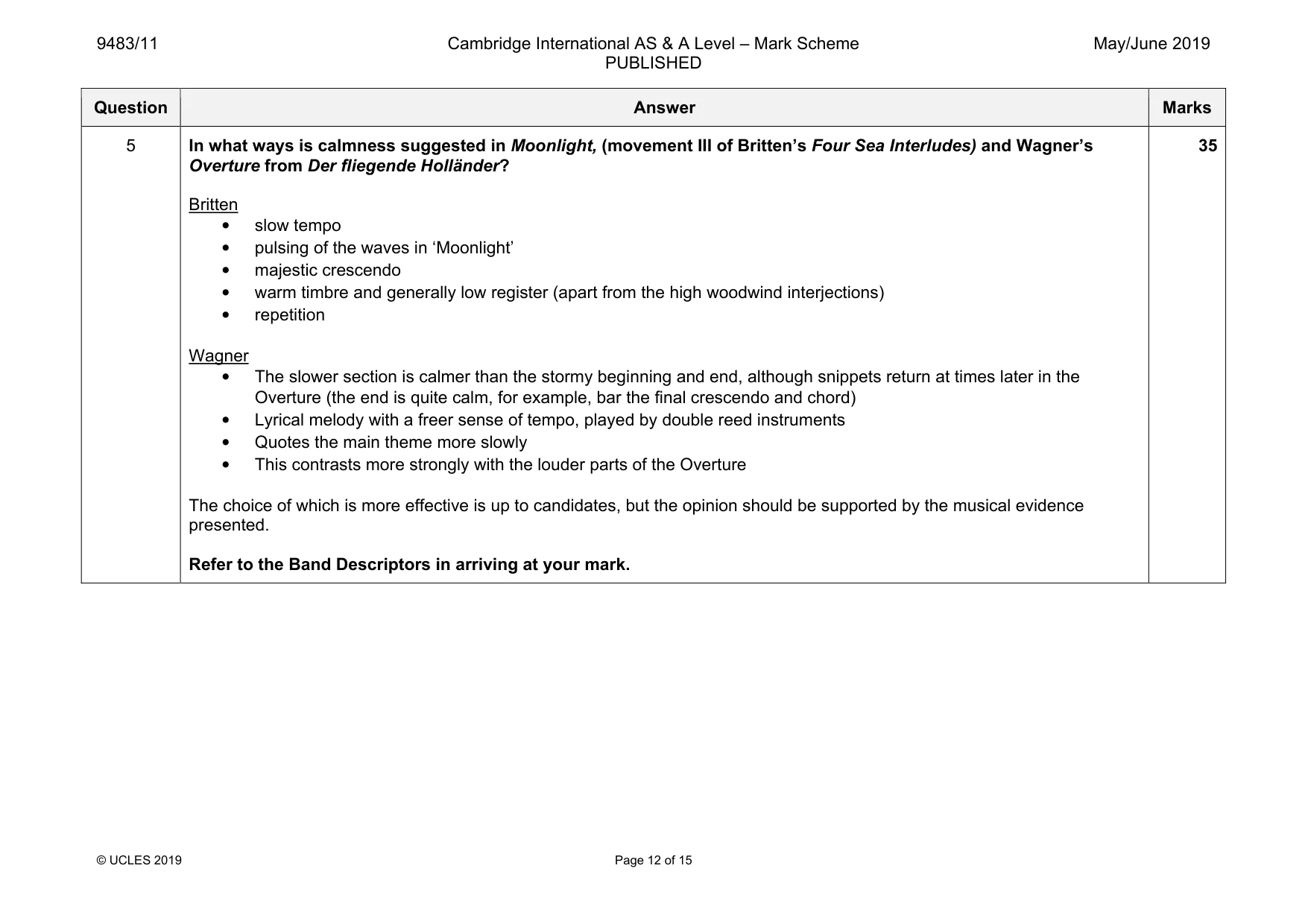
9483/11 Cambridge International AS & A Level – Mark Scheme PUBLISHED May/June 2019 © UCLES 2019 Page 12 of 15 Question Answer Marks 5 In what ways is calmness suggested in Moonlight, (movement III of Britten’s Four Sea Interludes) and Wagner’s Overture from Der fliegende Holländer? Britten • slow tempo • pulsing of the waves in ‘Moonlight’ • majestic crescendo • warm timbre and generally low register (apart from the high woodwind interjections) • repetition Wagner • The slower section is calmer than the stormy beginning and end, although snippets return at times later in the Overture (the end is quite calm, for example, bar the final crescendo and chord) • Lyrical melody with a freer sense of tempo, played by double reed instruments • Quotes the main theme more slowly • This contrasts more strongly with the louder parts of the Overture The choice of which is more effective is up to candidates, but the opinion should be supported by the musical evidence presented. Refer to the Band Descriptors in arriving at your mark. 35
Mark scheme, page 13
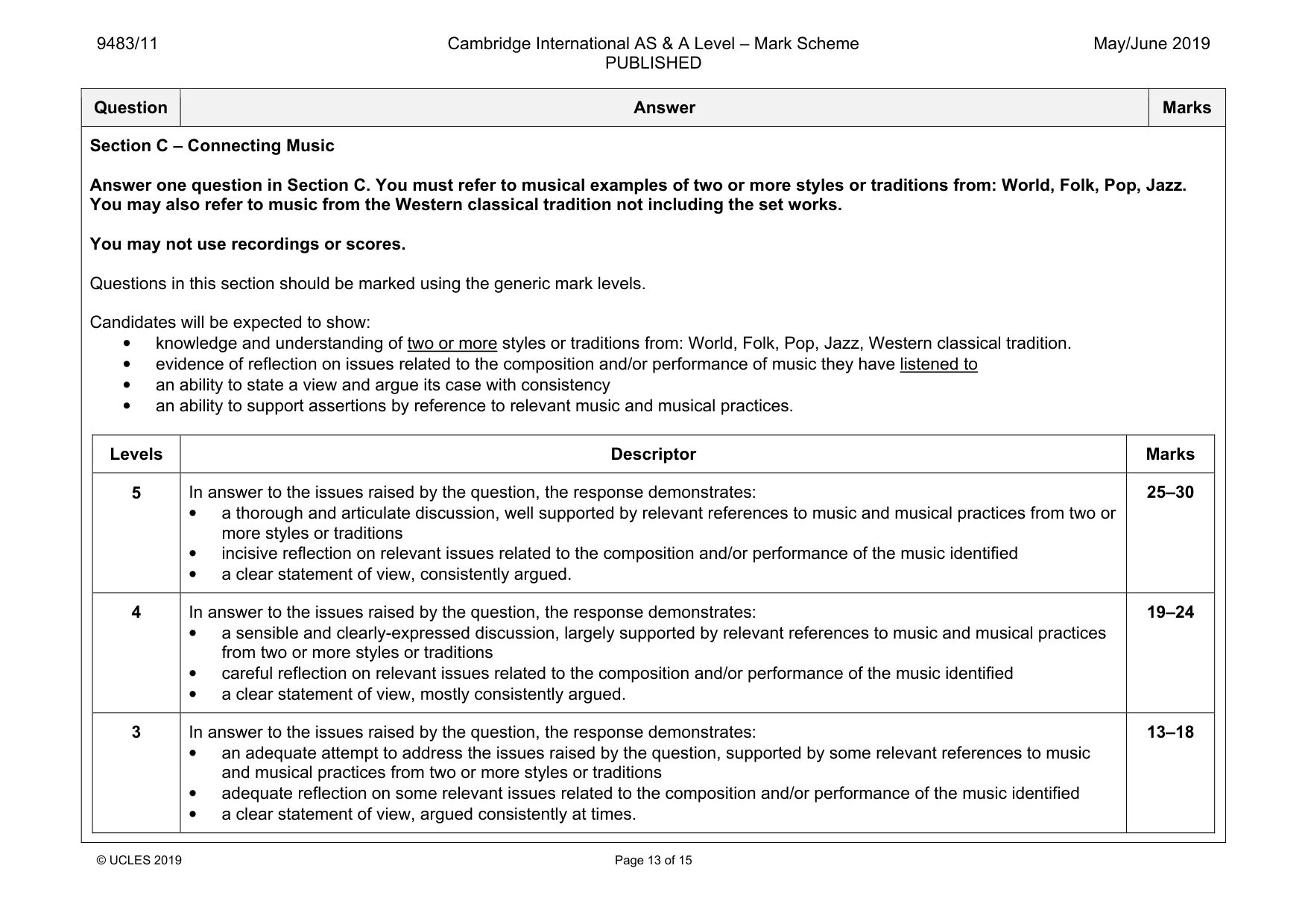
9483/11 Cambridge International AS & A Level – Mark Scheme PUBLISHED May/June 2019 © UCLES 2019 Page 13 of 15 Question Answer Marks Section C – Connecting Music Answer one question in Section C. You must refer to musical examples of two or more styles or traditions from: World, Folk, Pop, Jazz. You may also refer to music from the Western classical tradition not including the set works. You may not use recordings or scores. Questions in this section should be marked using the generic mark levels. Candidates will be expected to show: • knowledge and understanding of two or more styles or traditions from: World, Folk, Pop, Jazz, Western classical tradition. • evidence of reflection on issues related to the composition and/or performance of music they have listened to • an ability to state a view and argue its case with consistency • an ability to support assertions by reference to relevant music and musical practices. Levels Descriptor Marks 5 In answer to the issues raised by the question, the response demonstrates: • a thorough and articulate discussion, well supported by relevant references to music and musical practices from two or more styles or traditions • incisive reflection on relevant issues related to the composition and/or performance of the music identified • a clear statement of view, consistently argued. 25–30 4 In answer to the issues raised by the question, the response demonstrates: • a sensible and clearly-expressed discussion, largely supported by relevant references to music and musical practices from two or more styles or traditions • careful reflection on relevant issues related to the composition and/or performance of the music identified • a clear statement of view, mostly consistently argued. 19–24 3 In answer to the issues raised by the question, the response demonstrates: • an adequate attempt to address the issues raised by the question, supported by some relevant references to music and musical practices from two or more styles or traditions • adequate reflection on some relevant issues related to the composition and/or performance of the music identified • a clear statement of view, argued consistently at times. 13–18
Mark scheme, page 14
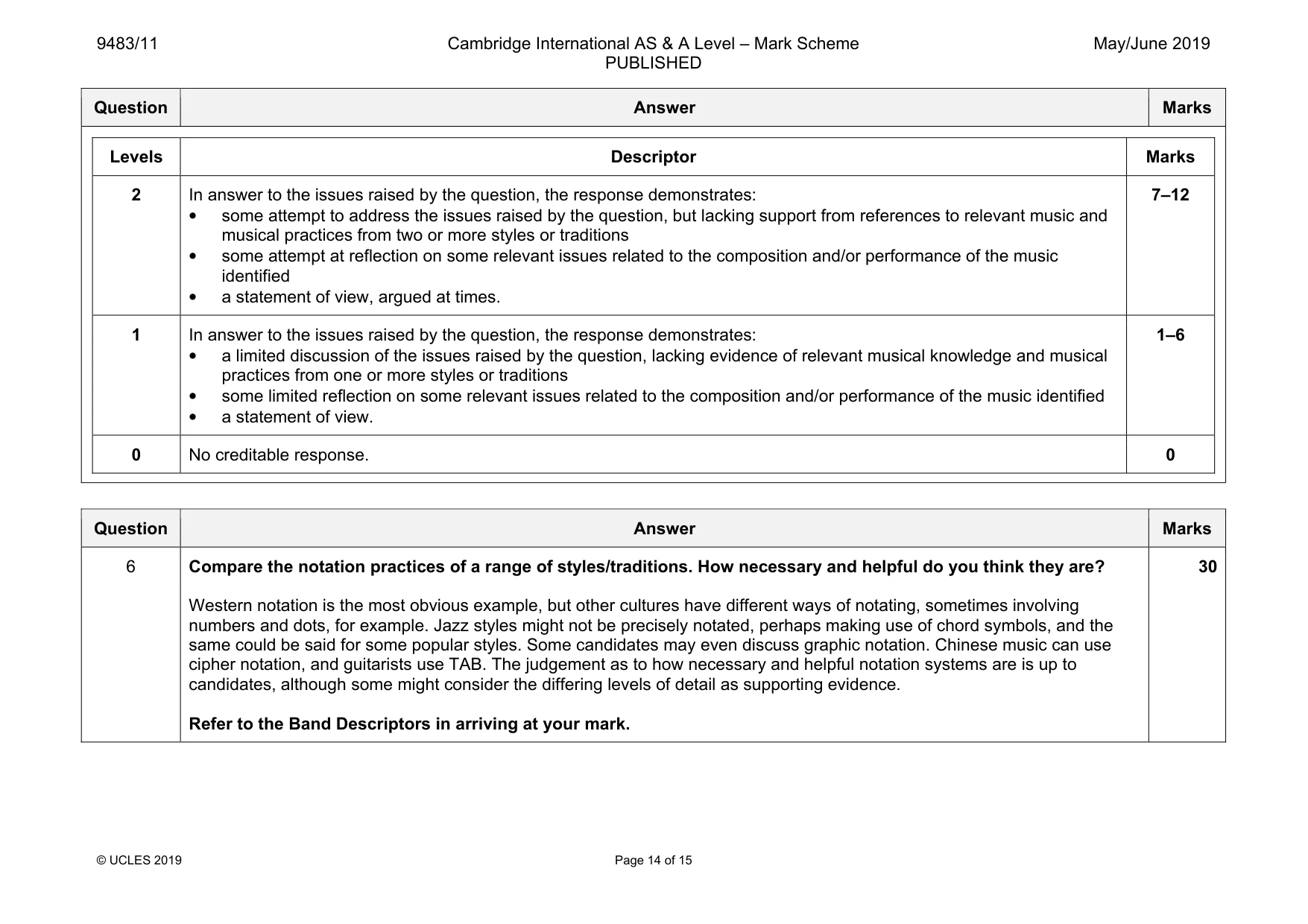
9483/11 Cambridge International AS & A Level – Mark Scheme PUBLISHED May/June 2019 © UCLES 2019 Page 14 of 15 Question Answer Marks Levels Descriptor Marks 2 In answer to the issues raised by the question, the response demonstrates: • some attempt to address the issues raised by the question, but lacking support from references to relevant music and musical practices from two or more styles or traditions • some attempt at reflection on some relevant issues related to the composition and/or performance of the music identified • a statement of view, argued at times. 7–12 1 In answer to the issues raised by the question, the response demonstrates: • a limited discussion of the issues raised by the question, lacking evidence of relevant musical knowledge and musical practices from one or more styles or traditions • some limited reflection on some relevant issues related to the composition and/or performance of the music identified • a statement of view. 1–6 0 No creditable response. 0 Question Answer Marks 6 Compare the notation practices of a range of styles/traditions. How necessary and helpful do you think they are? Western notation is the most obvious example, but other cultures have different ways of notating, sometimes involving numbers and dots, for example. Jazz styles might not be precisely notated, perhaps making use of chord symbols, and the same could be said for some popular styles. Some candidates may even discuss graphic notation. Chinese music can use cipher notation, and guitarists use TAB. The judgement as to how necessary and helpful notation systems are is up to candidates, although some might consider the differing levels of detail as supporting evidence. Refer to the Band Descriptors in arriving at your mark. 30
Mark scheme, page 15
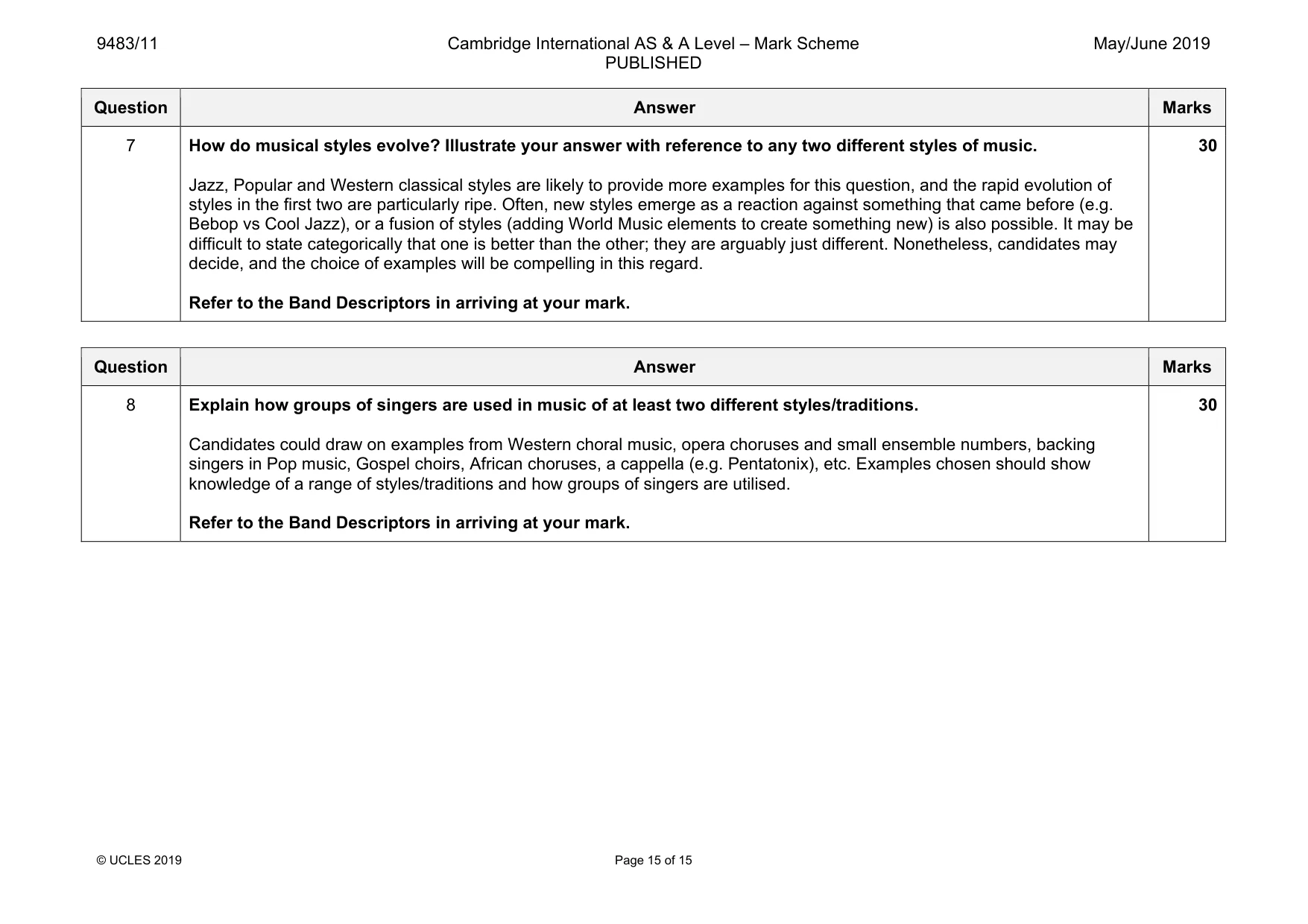
9483/11 Cambridge International AS & A Level – Mark Scheme PUBLISHED May/June 2019 © UCLES 2019 Page 15 of 15 Question Answer Marks 7 How do musical styles evolve? Illustrate your answer with reference to any two different styles of music. Jazz, Popular and Western classical styles are likely to provide more examples for this question, and the rapid evolution of styles in the first two are particularly ripe. Often, new styles emerge as a reaction against something that came before (e.g. Bebop vs Cool Jazz), or a fusion of styles (adding World Music elements to create something new) is also possible. It may be difficult to state categorically that one is better than the other; they are arguably just different. Nonetheless, candidates may decide, and the choice of examples will be compelling in this regard. Refer to the Band Descriptors in arriving at your mark. 30 Question Answer Marks 8 Explain how groups of singers are used in music of at least two different styles/traditions. Candidates could draw on examples from Western choral music, opera choruses and small ensemble numbers, backing singers in Pop music, Gospel choirs, African choruses, a cappella (e.g. Pentatonix), etc. Examples chosen should show knowledge of a range of styles/traditions and how groups of singers are utilised. Refer to the Band Descriptors in arriving at your mark. 30
What you needed in this session
Cambridge’s own grade thresholds for 2019 May/June, Paper 1 · Variant 1. A higher threshold means an easier paper — the bar moves with how the cohort did.