Cambridge A Level Media Studies 9607 — 2025 May/June Paper 4 · Variant 3
9607/43/M/J/25 · 4 questions · 60 marks · 120 min
The question paper and its mark scheme, free to read here and free to download. This is Cambridge’s own paper, exactly as it was sat.
Question paper4 pages
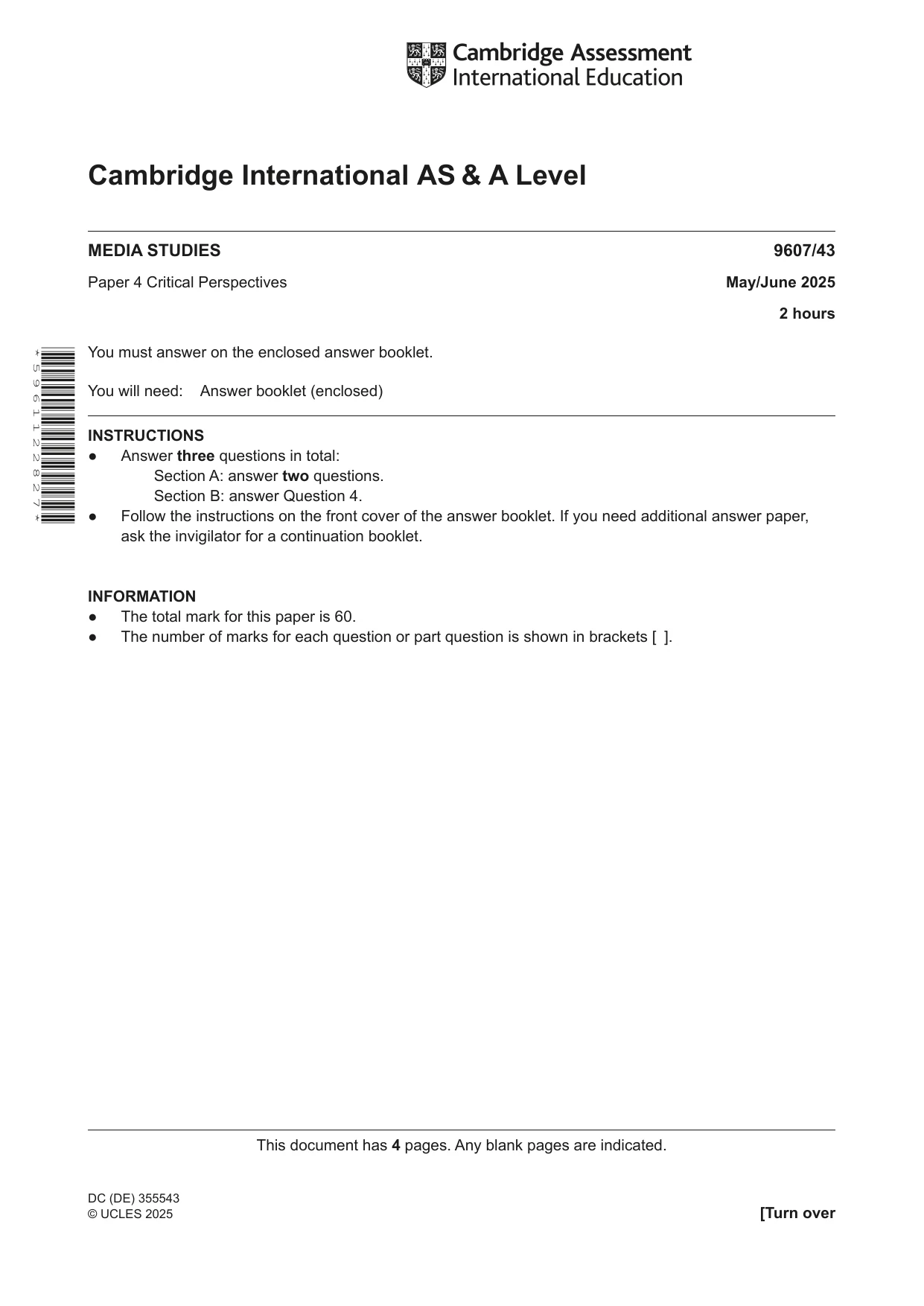
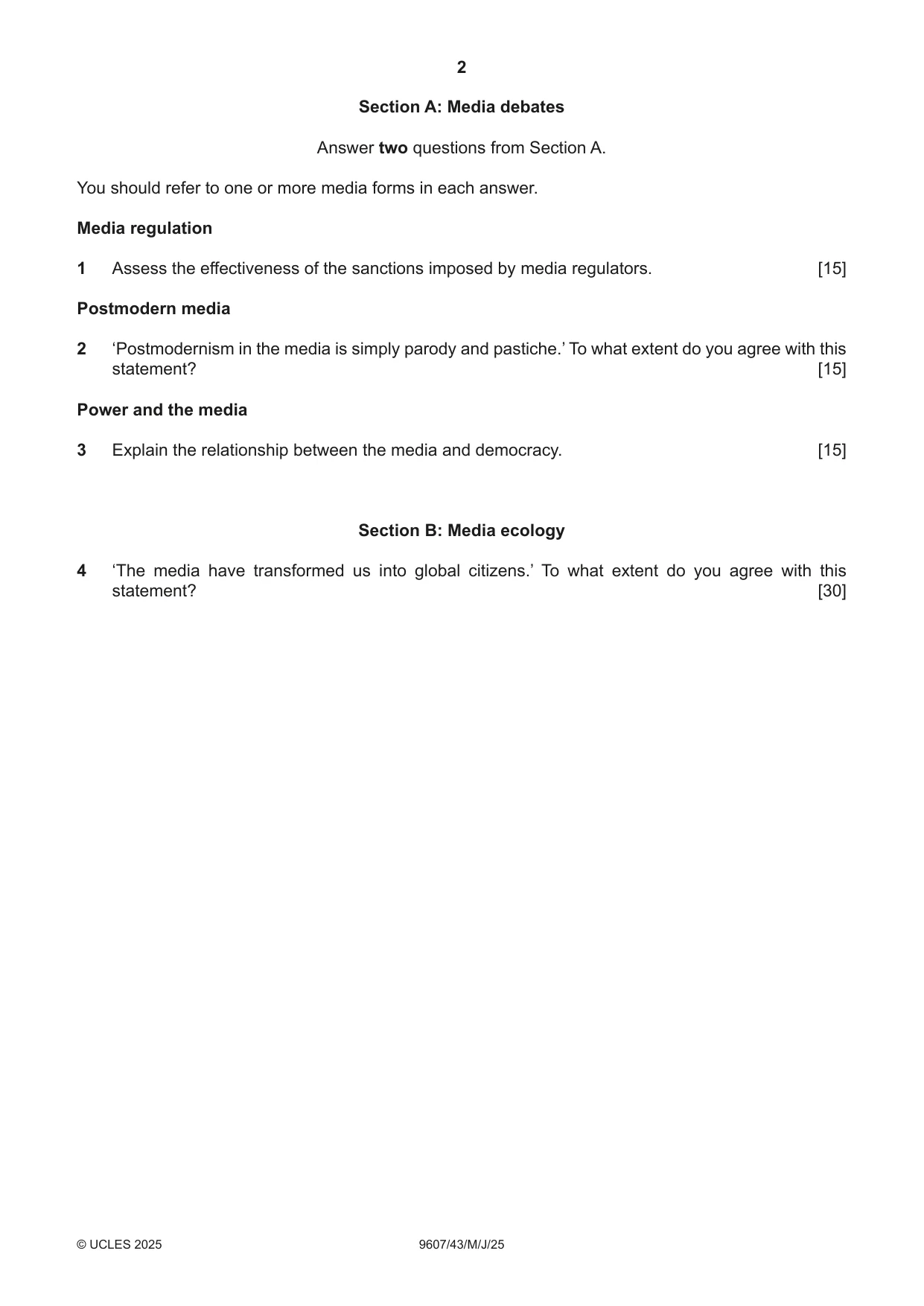

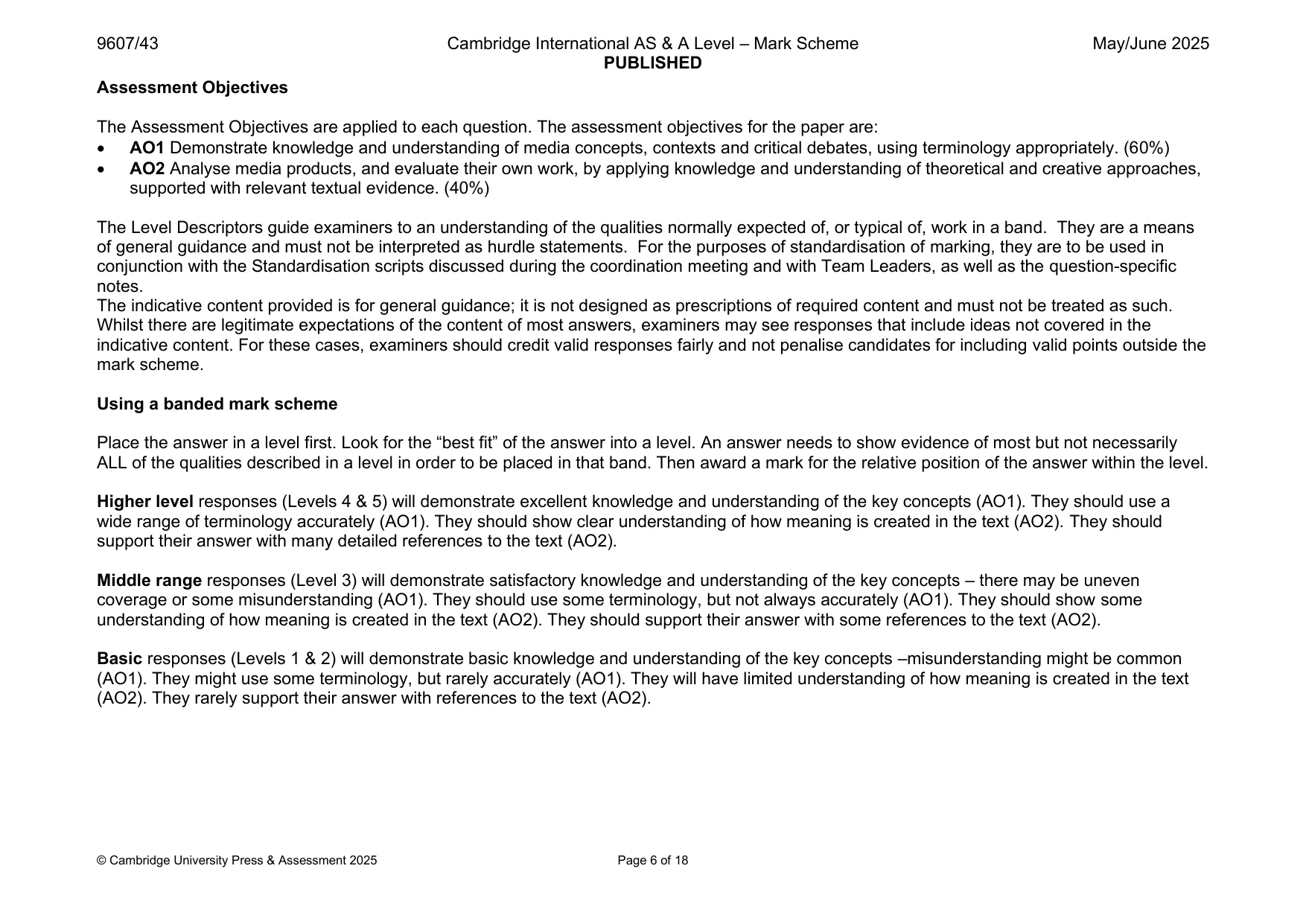
Mark scheme18 pages
Answers below. Sit the paper first if you are practising.
Questions as text
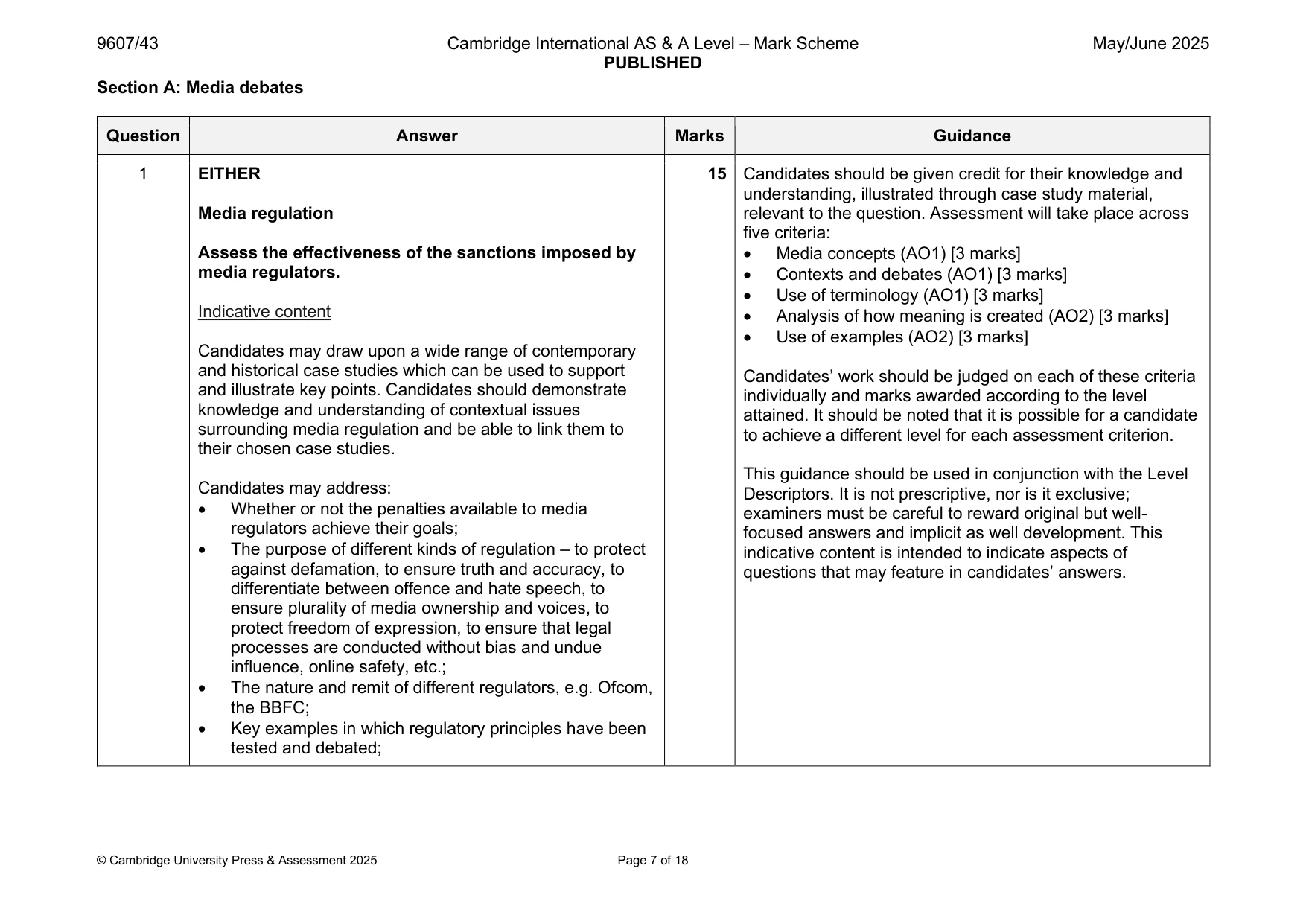
Q1 · Assess the effectiveness of the sanctions imposed by media regulators
1 Assess the effectiveness of the sanctions imposed by media regulators. [15] Postmodern media
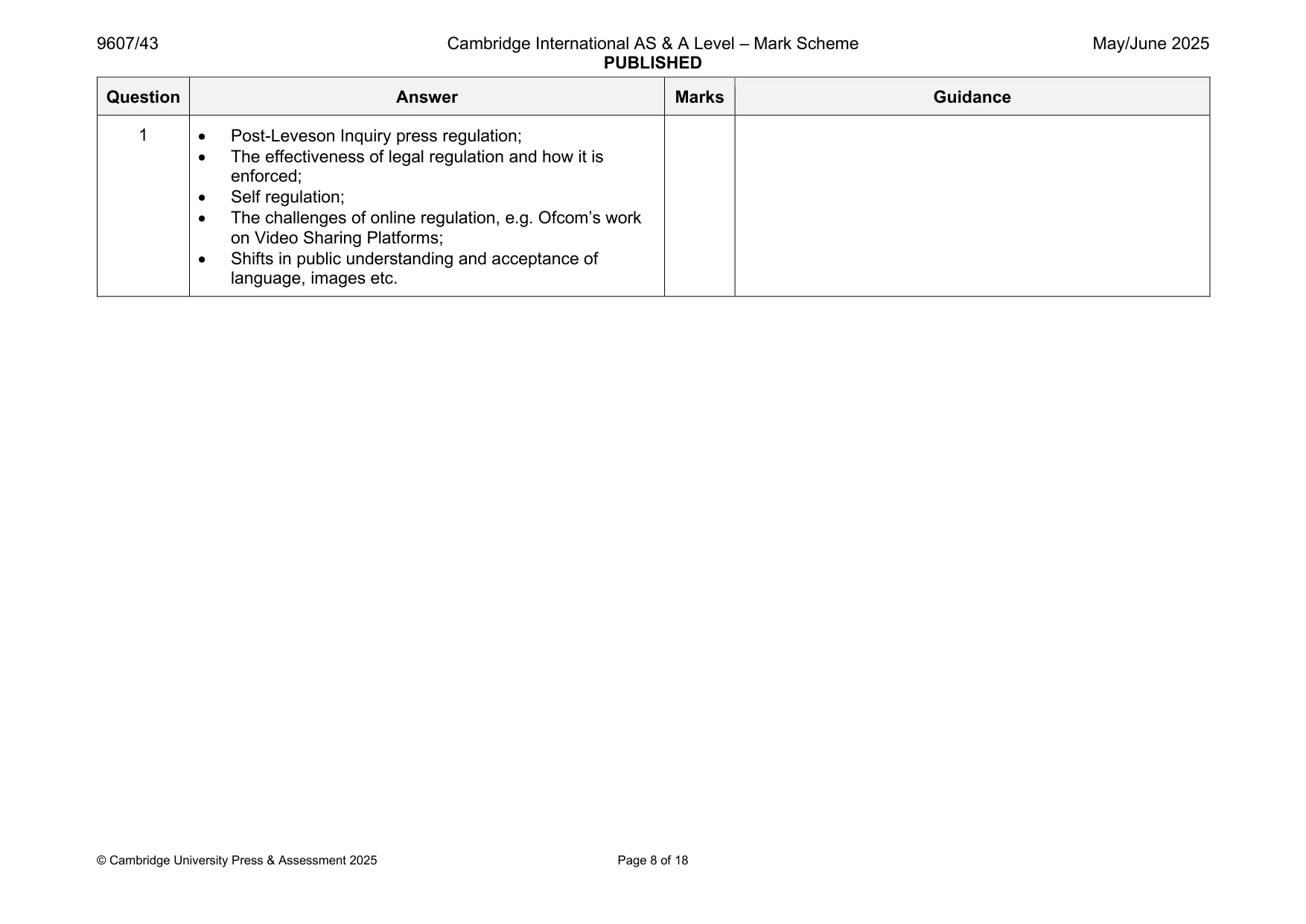
Mark scheme: Question Answer Marks Guidance 1 EITHER 15 Candidates should be given credit for their knowledge and understanding, illustrated through case study material, Media regulation relevant to the question. Assessment will take place across five criteria: Assess the effectiveness of the sanctions imposed by • Media concepts (AO1) [3 marks] media regulators. • Contexts and debates (AO1) [3 marks] • Use of terminology (AO1) [3 marks] Indicative content • Analysis of how meaning is created (AO2) [3 marks] • Use of examples (AO2) [3 marks] Candidates may draw upon a wide range of contemporary and historical case studies which can be used to support Candidates’ work should be judged on each of these criteria and illustrate key points. Candidates should demonstrate individually and marks awarded according to the level knowledge and understanding of contextual issues attained. It should be noted that it is possible for a candidate surrounding media regulation and be able to link them to to achieve a different level for each assessment criterion. their chosen case studies. This guidance should be used in conjunction with the Level Candidates may address: Descriptors. It is not prescriptive, nor is it exclusive; • Whether or not the penalties available to media examiners must be careful to reward original but well- regulators achieve their goals; focused answers and implicit as well development. This • The purpose of different kinds of regulation – to protect indicative content is intended to indicate aspects of against defamation, to ensure truth and accuracy, to questions that may feature in candidates’ answers. differentiate between offence and hate speech, to ensure plurality of media ownership and voices, to protect freedom of expression, to ensure that legal processes are conducted without bias and undue influence, online safety, etc.; • The nature and remit of different regulators, e.g. Ofcom, the BBFC; • Key examples in which regulatory principles have been tested and debated; 1 • Post-Leveson Inquiry press regulation; • The effectiveness of legal regulation and how it is enforced; • Self regulation; • The challenges of online regulation, e.g. Ofcom’s work on Video Sharing Platforms; • Shifts in public understanding and acceptance of language, images etc.
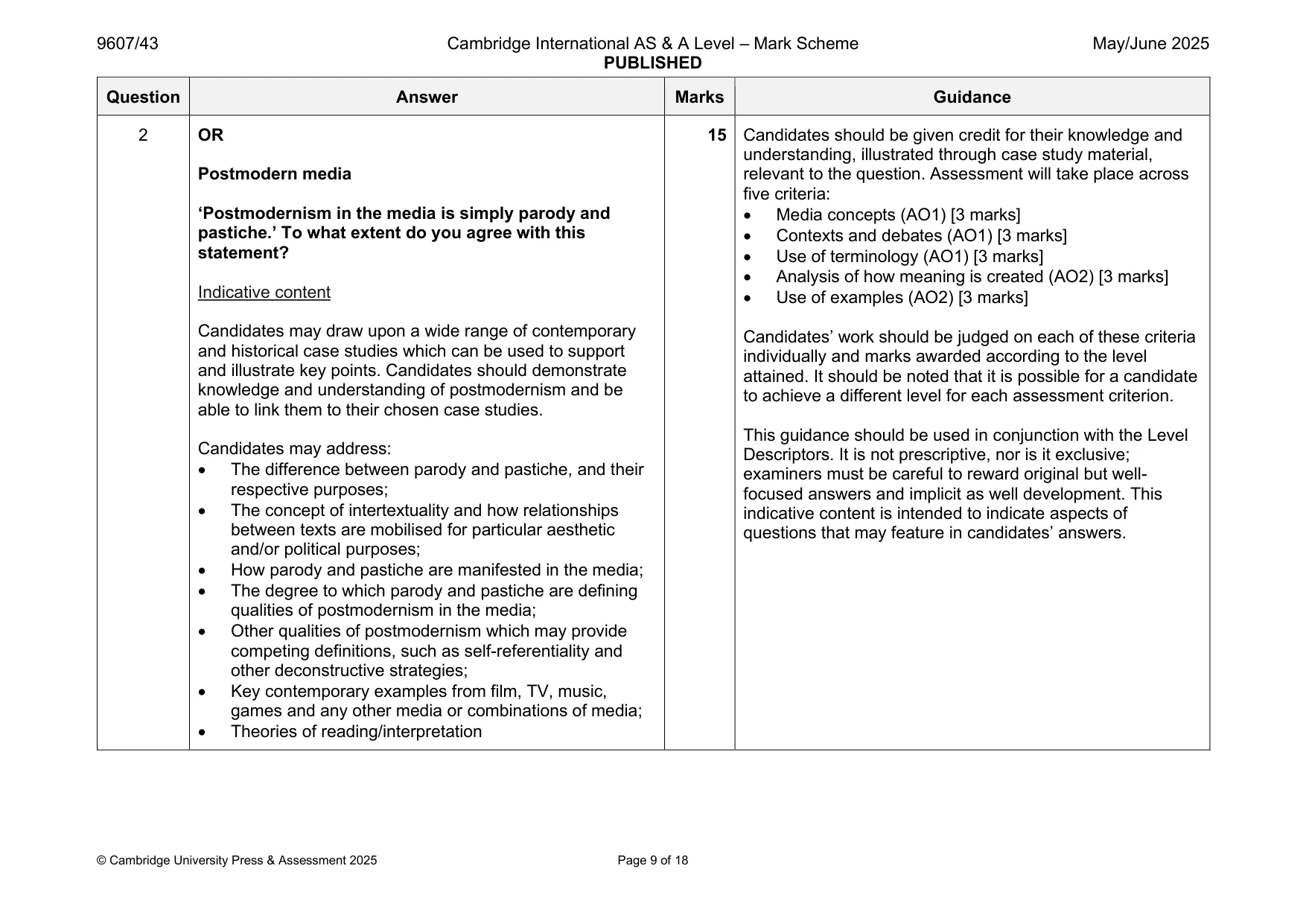
Q2 · ‘Postmodernism in the media is simply parody and pastiche.’ To what extent do you agree…
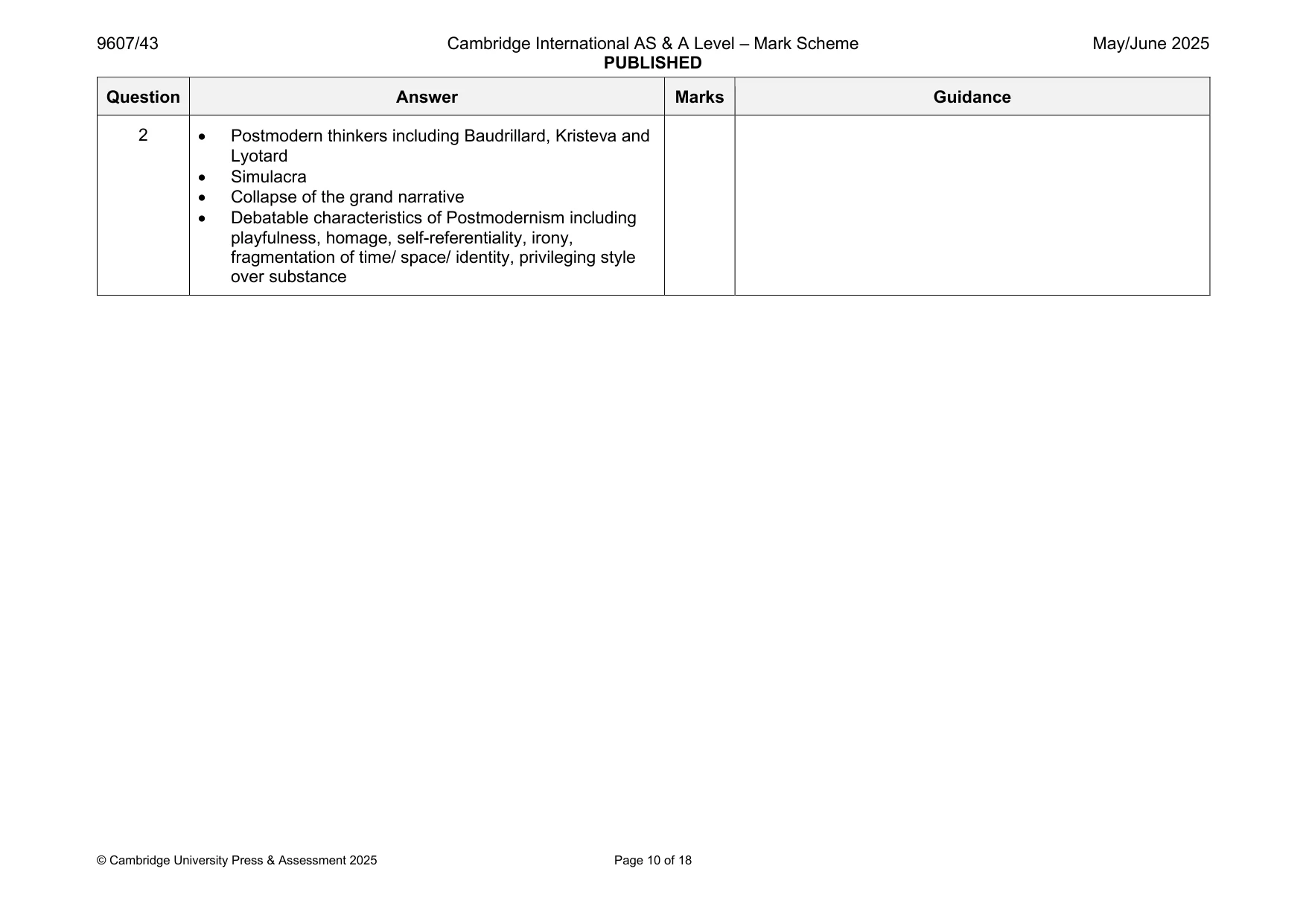
2 ‘Postmodernism in the media is simply parody and pastiche.’ To what extent do you agree with this statement? [15] Power and the media
Mark scheme: 2 OR 15 Candidates should be given credit for their knowledge and understanding, illustrated through case study material, Postmodern media relevant to the question. Assessment will take place across five criteria: ‘Postmodernism in the media is simply parody and • Media concepts (AO1) [3 marks] pastiche.’ To what extent do you agree with this • Contexts and debates (AO1) [3 marks] statement? • Use of terminology (AO1) [3 marks] • Analysis of how meaning is created (AO2) [3 marks] Indicative content • Use of examples (AO2) [3 marks] Candidates may draw upon a wide range of contemporary Candidates’ work should be judged on each of these criteria and historical case studies which can be used to support individually and marks awarded according to the level and illustrate key points. Candidates should demonstrate attained. It should be noted that it is possible for a candidate knowledge and understanding of postmodernism and be to achieve a different level for each assessment criterion. able to link them to their chosen case studies. This guidance should be used in conjunction with the Level Candidates may address: Descriptors. It is not prescriptive, nor is it exclusive; • The difference between parody and pastiche, and their examiners must be careful to reward original but well- respective purposes; focused answers and implicit as well development. This • The concept of intertextuality and how relationships indicative content is intended to indicate aspects of between texts are mobilised for particular aesthetic questions that may feature in candidates’ answers. and/or political purposes; • How parody and pastiche are manifested in the media; • The degree to which parody and pastiche are defining qualities of postmodernism in the media; • Other qualities of postmodernism which may provide competing definitions, such as self-referentiality and other deconstructive strategies; • Key contemporary examples from film, TV, music, games and any other media or combinations of media; • Theories of reading/interpretation 2 • Postmodern thinkers including Baudrillard, Kristeva and Lyotard • Simulacra • Collapse of the grand narrative • Debatable characteristics of Postmodernism including playfulness, homage, self-referentiality, irony, fragmentation of time/ space/ identity, privileging style over substance
Q3 · Explain the relationship between the media and democracy
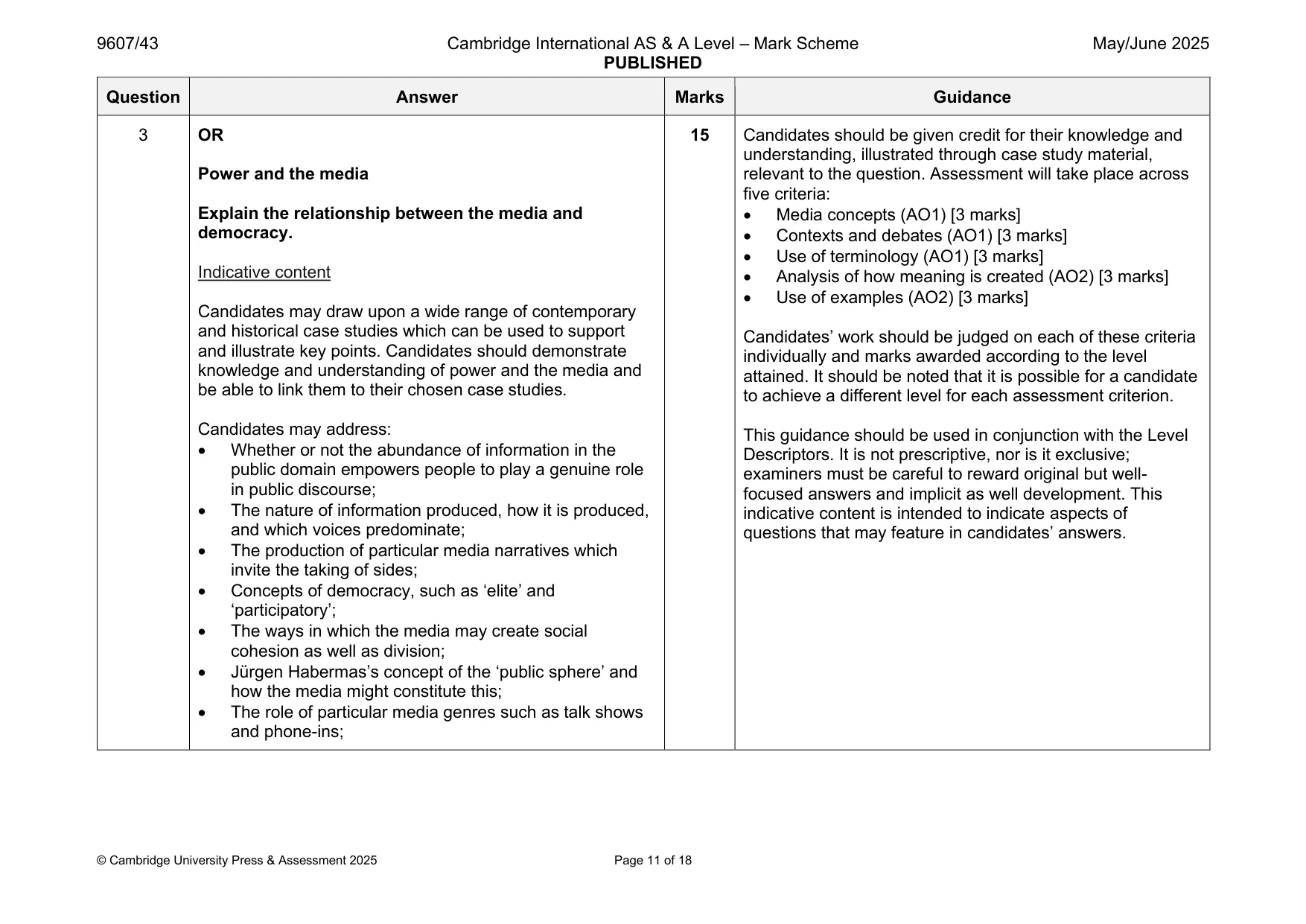
3 Explain the relationship between the media and democracy. [15]
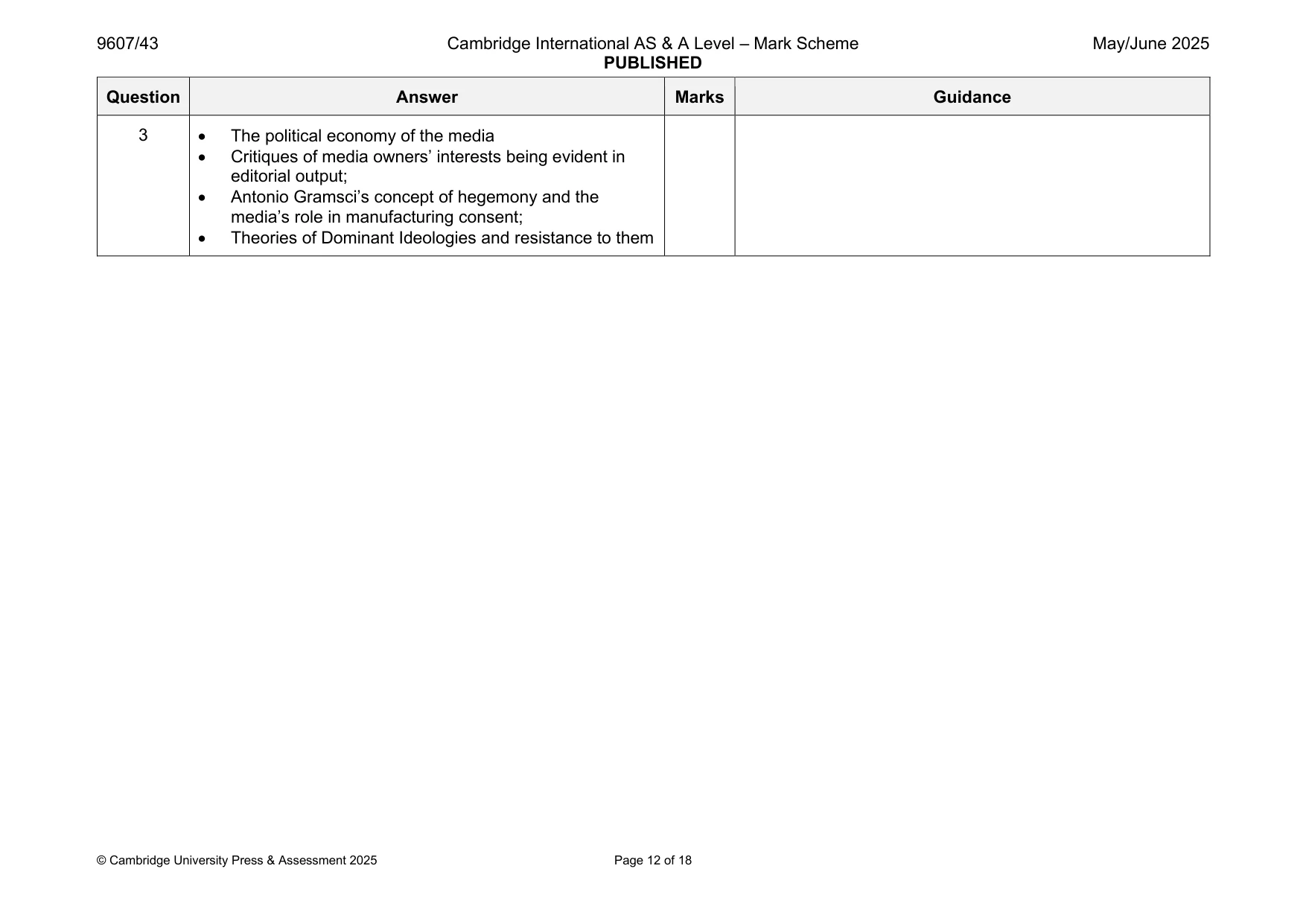
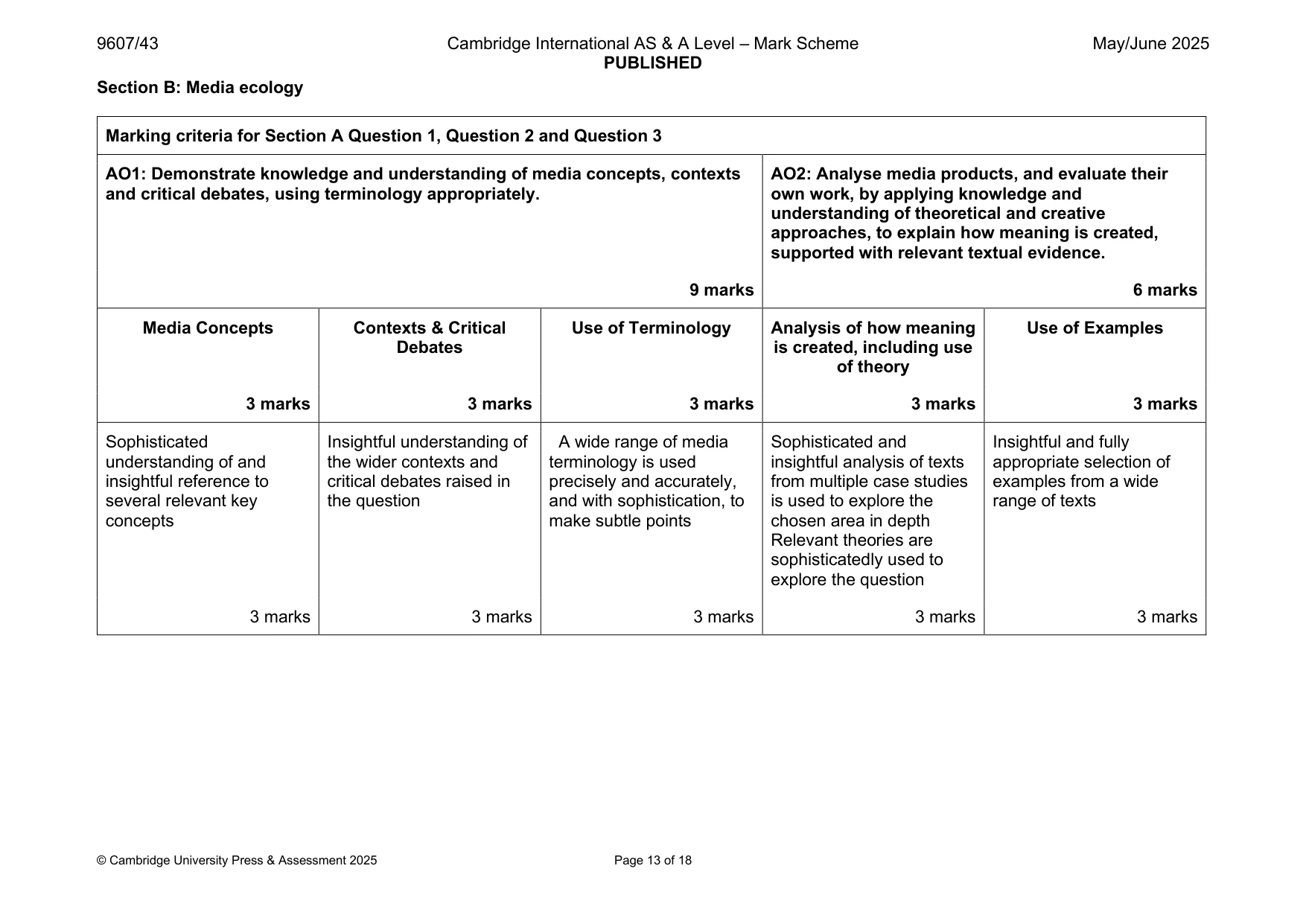
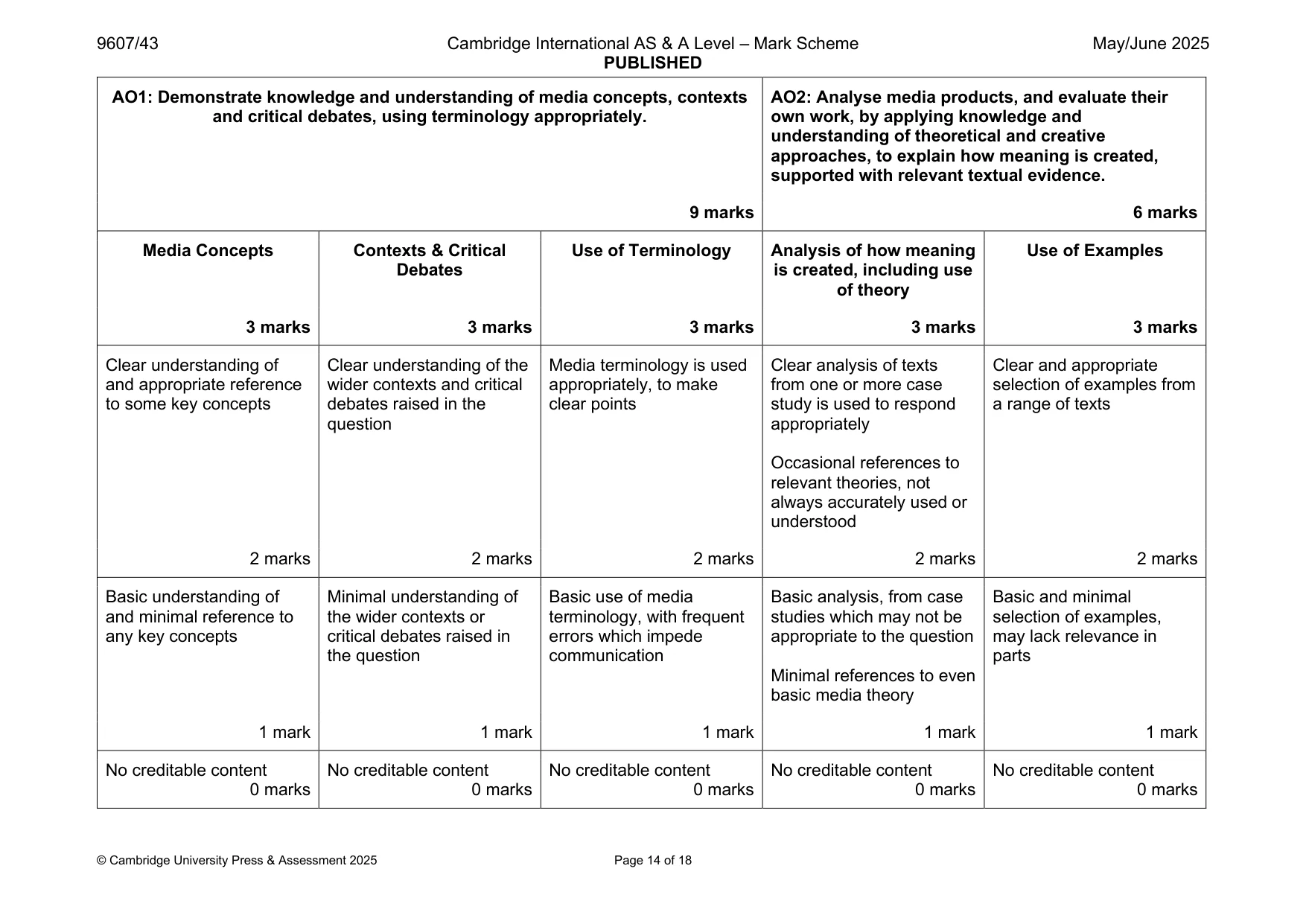
Mark scheme: 3 OR 15 Candidates should be given credit for their knowledge and understanding, illustrated through case study material, Power and the media relevant to the question. Assessment will take place across five criteria: Explain the relationship between the media and • Media concepts (AO1) [3 marks] democracy. • Contexts and debates (AO1) [3 marks] • Use of terminology (AO1) [3 marks] Indicative content • Analysis of how meaning is created (AO2) [3 marks] • Use of examples (AO2) [3 marks] Candidates may draw upon a wide range of contemporary and historical case studies which can be used to support Candidates’ work should be judged on each of these criteria and illustrate key points. Candidates should demonstrate individually and marks awarded according to the level knowledge and understanding of power and the media and attained. It should be noted that it is possible for a candidate be able to link them to their chosen case studies. to achieve a different level for each assessment criterion. Candidates may address: This guidance should be used in conjunction with the Level • Whether or not the abundance of information in the Descriptors. It is not prescriptive, nor is it exclusive; public domain empowers people to play a genuine role examiners must be careful to reward original but well- in public discourse; focused answers and implicit as well development. This • The nature of information produced, how it is produced, indicative content is intended to indicate aspects of and which voices predominate; questions that may feature in candidates’ answers. • The production of particular media narratives which invite the taking of sides; • Concepts of democracy, such as ‘elite’ and ‘participatory’; • The ways in which the media may create social cohesion as well as division; • Jürgen Habermas’s concept of the ‘public sphere’ and how the media might constitute this; • The role of particular media genres such as talk shows and phone-ins; 3 • The political economy of the media • Critiques of media owners’ interests being evident in editorial output; • Antonio Gramsci’s concept of hegemony and the media’s role in manufacturing consent; • Theories of Dominant Ideologies and resistance to them Section B: Media ecology Marking criteria for Section A Question 1, Question 2 and Question 3 AO1: Demonstrate knowledge and understanding of media concepts, contexts AO2: Analyse media products, and evaluate their and critical debates, using terminology appropriately. own work, by applying knowledge and understanding of theoretical and creative approaches, to explain how meaning is created, supported with relevant textual evidence. 9 marks 6 marks Media Concepts Contexts & Critical Use of Terminology Analysis of how meaning Use of Examples Debates is created, including use of theory 3 marks 3 marks 3 marks 3 marks 3 marks Sophisticated Insightful understanding of A wide range of media Sophisticated and Insightful and fully understanding of and the wider contexts and terminology is used insightful analysis of texts appropriate selection of insightful reference to critical debates raised in precisely and accurately, from multiple case studies examples from a wide several relevant key the question and with sophistication, to is used to explore the range of texts concepts make subtle points chosen area in depth Relevant theories are sophisticatedly used to explore the question 3 marks 3 marks 3 marks 3 marks 3 marks AO1: Demonstrate knowledge and understanding of media concepts, contexts AO2: Analyse media products, and evaluate their and critical debates, using terminology appropriately. own work, by applying knowledge and understanding of theoretical and creative approaches, to explain how meaning is created, supported with relevant textual evidence. 9 marks 6 marks Media Concepts Contexts & Critical Use of Terminology Analysis of how meaning Use of Examples Debates is created, including use of theory 3 marks 3 marks 3 marks 3 marks 3 marks Clear understanding of Clear understanding of the Media terminology is used Clear analysis of texts Clear and appropriate and appropriate reference wider contexts and critical appropriately, to make from one or more case selection of examples from to some key concepts debates raised in the clear points study is used to respond a range of texts question appropriately Occasional references to relevant theories, not always accurately used or understood 2 marks 2 marks 2 marks 2 marks 2 marks Basic understanding of Minimal understanding of Basic use of media Basic analysis, from case Basic and minimal and minimal reference to the wider contexts or terminology, with frequent studies which may not be selection of examples, any key concepts critical debates raised in errors which impede appropriate to the question may lack relevance in the question communication parts Minimal references to even basic media theory 1 mark 1 mark 1 mark 1 mark 1 mark No creditable content No creditable content No creditable content No creditable content No creditable content 0 marks 0 marks 0 marks 0 marks 0 marks
Q4 · ‘The media have transformed us into global citizens.’ To what extent do you agree with…
4 ‘The media have transformed us into global citizens.’ To what extent do you agree with this statement? [30]
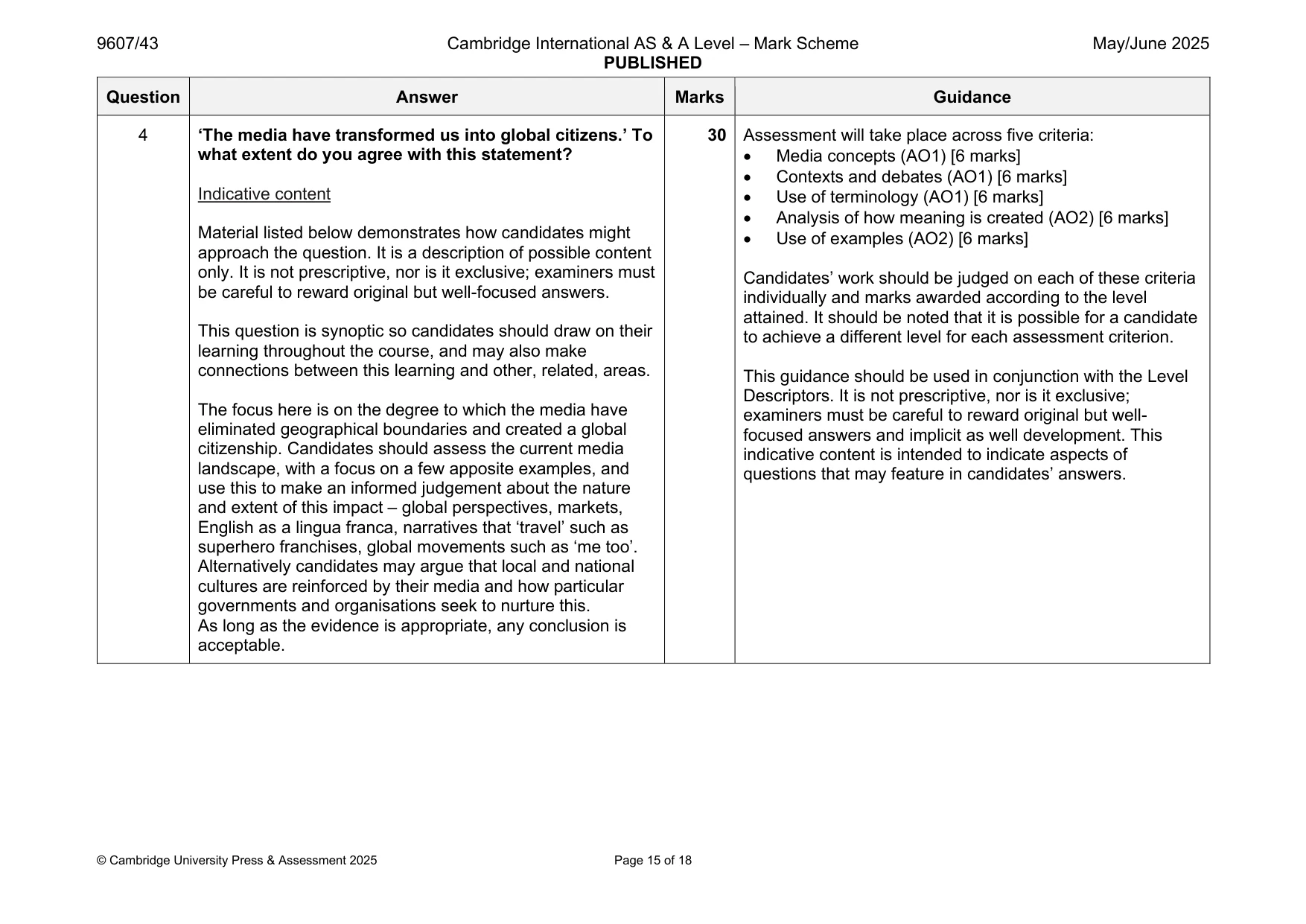
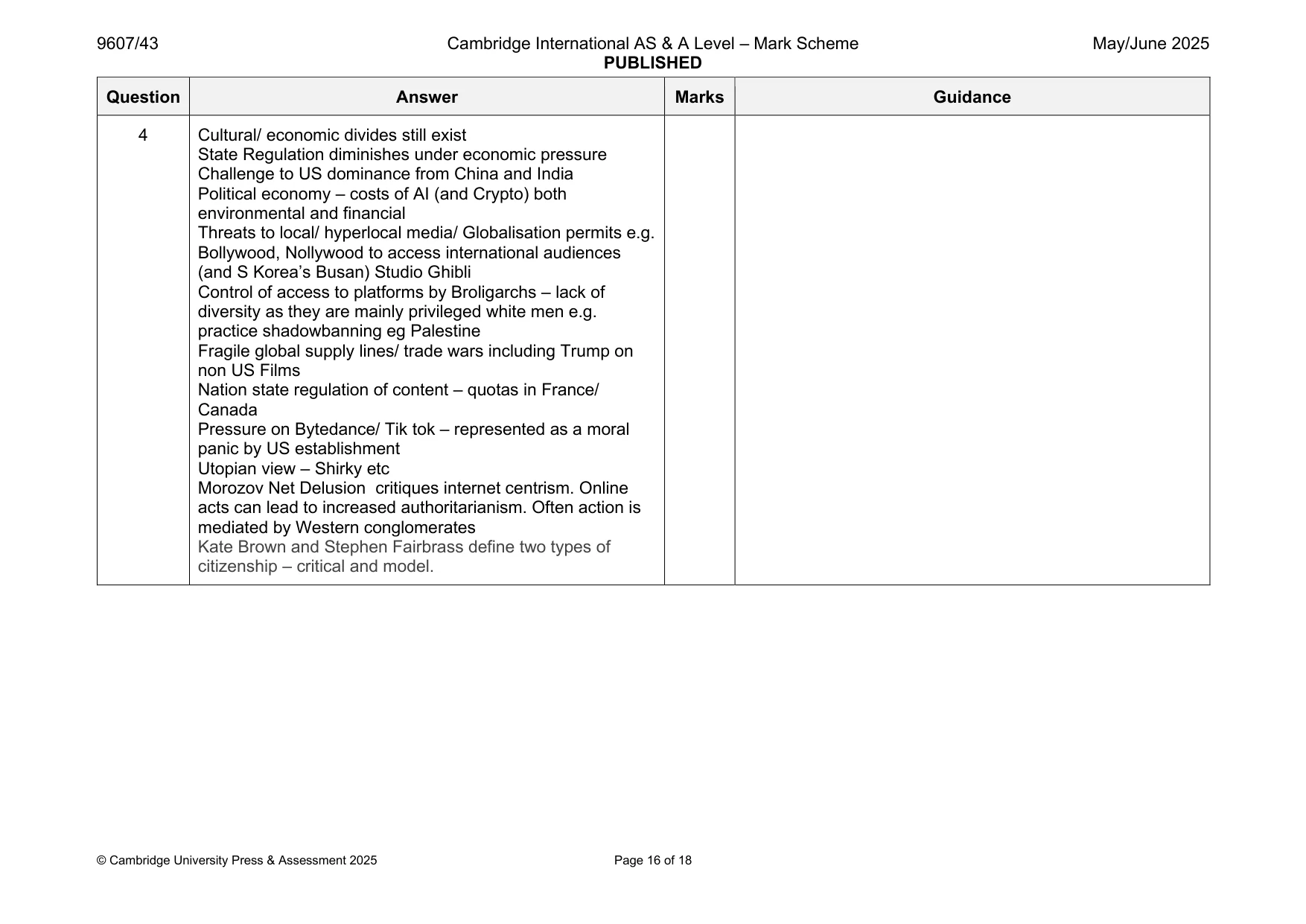
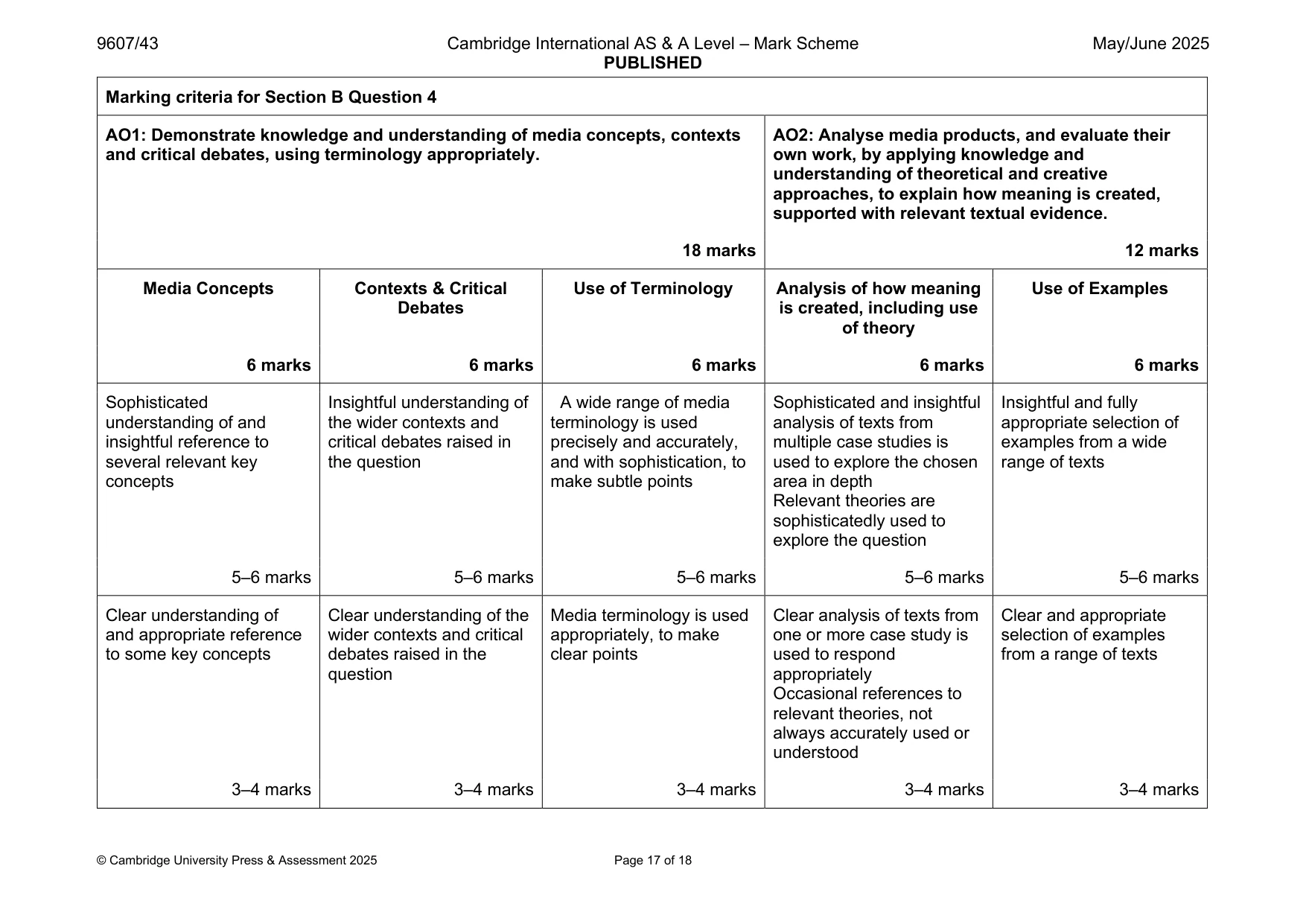
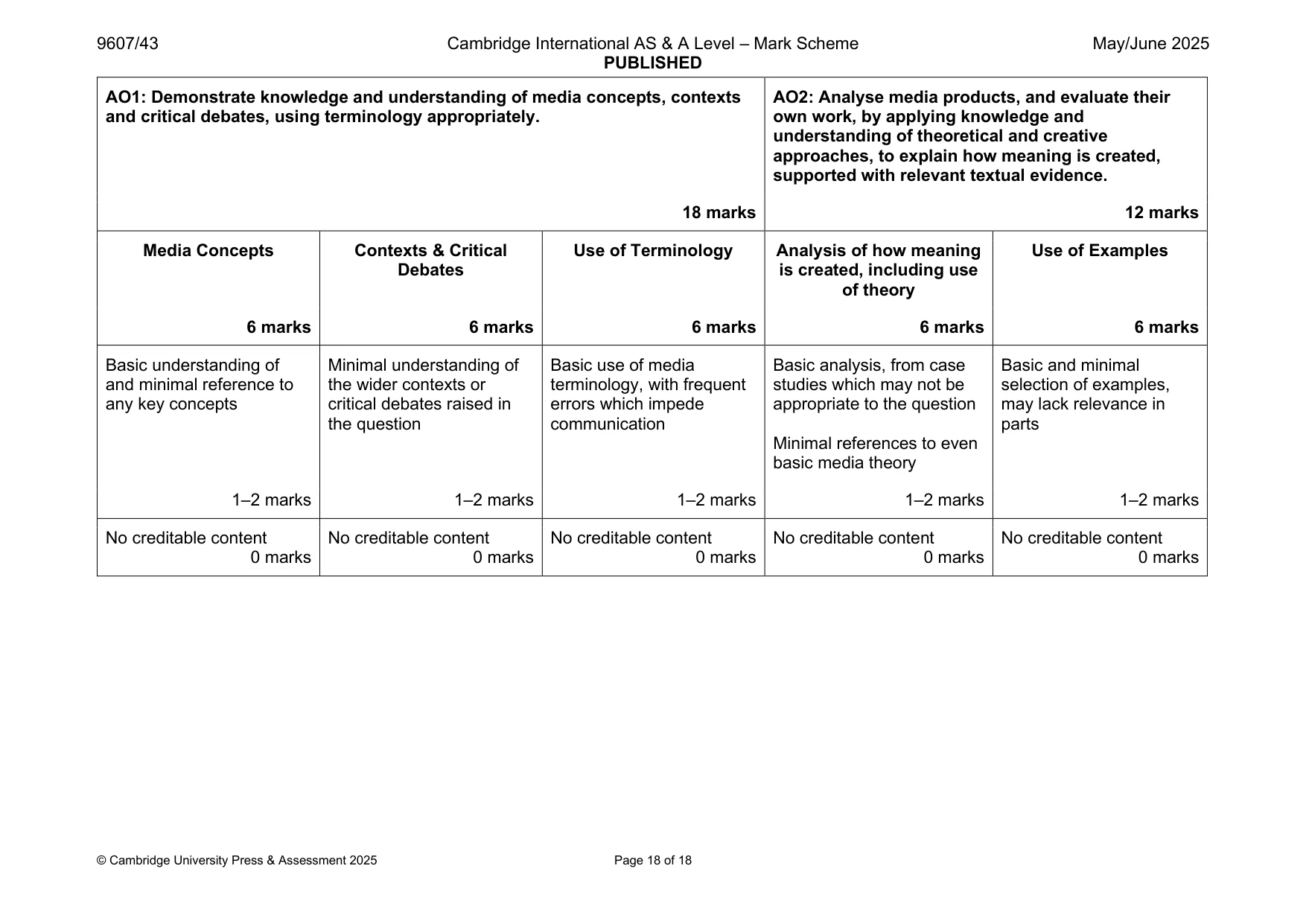
Mark scheme: 4 ‘The media have transformed us into global citizens.’ To 30 Assessment will take place across five criteria: what extent do you agree with this statement? • Media concepts (AO1) [6 marks] • Contexts and debates (AO1) [6 marks] Indicative content • Use of terminology (AO1) [6 marks] • Analysis of how meaning is created (AO2) [6 marks] Material listed below demonstrates how candidates might • Use of examples (AO2) [6 marks] approach the question. It is a description of possible content only. It is not prescriptive, nor is it exclusive; examiners must Candidates’ work should be judged on each of these criteria be careful to reward original but well-focused answers. individually and marks awarded according to the level attained. It should be noted that it is possible for a candidate This question is synoptic so candidates should draw on their to achieve a different level for each assessment criterion. learning throughout the course, and may also make connections between this learning and other, related, areas. This guidance should be used in conjunction with the Level Descriptors. It is not prescriptive, nor is it exclusive; The focus here is on the degree to which the media have examiners must be careful to reward original but well- eliminated geographical boundaries and created a global focused answers and implicit as well development. This citizenship. Candidates should assess the current media indicative content is intended to indicate aspects of landscape, with a focus on a few apposite examples, and questions that may feature in candidates’ answers. use this to make an informed judgement about the nature and extent of this impact – global perspectives, markets, English as a lingua franca, narratives that ‘travel’ such as superhero franchises, global movements such as ‘me too’. Alternatively candidates may argue that local and national cultures are reinforced by their media and how particular governments and organisations seek to nurture this. As long as the evidence is appropriate, any conclusion is acceptable. 4 Cultural/ economic divides still exist State Regulation diminishes under economic pressure Challenge to US dominance from China and India Political economy – costs of AI (and Crypto) both environmental and financial Threats to local/ hyperlocal media/ Globalisation permits e.g. Bollywood, Nollywood to access international audiences (and S Korea’s Busan) Studio Ghibli Control of access to platforms by Broligarchs – lack of diversity as they are mainly privileged white men e.g. practice shadowbanning eg Palestine Fragile global supply lines/ trade wars including Trump on non US Films Nation state regulation of content – quotas in France/ Canada Pressure on Bytedance/ Tik tok – represented as a moral panic by US establishment Utopian view – Shirky etc Morozov Net Delusion critiques internet centrism. Online acts can lead to increased authoritarianism. Often action is mediated by Western conglomerates Kate Brown and Stephen Fairbrass define two types of citizenship – critical and model. Marking criteria for Section B Question 4 AO1: Demonstrate knowledge and understanding of media concepts, contexts AO2: Analyse media products, and evaluate their and critical debates, using terminology appropriately. own work, by applying knowledge and understanding of theoretical and creative approaches, to explain how meaning is created, supported with relevant textual evidence. 18 marks 12 marks Media Concepts Contexts & Critical Use of Terminology Analysis of how meaning Use of Examples Debates is created, including use of theory 6 marks 6 marks 6 marks 6 marks 6 marks Sophisticated Insightful understanding of A wide range of media Sophisticated and insightful Insightful and fully understanding of and the wider contexts and terminology is used analysis of texts from appropriate selection of insightful reference to critical debates raised in precisely and accurately, multiple case studies is examples from a wide several relevant key the question and with sophistication, to used to explore the chosen range of texts concepts make subtle points area in depth Relevant theories are sophisticatedly used to explore the question 5–6 marks 5–6 marks 5–6 marks 5–6 marks 5–6 marks Clear understanding of Clear understanding of the Media terminology is used Clear analysis of texts from Clear and appropriate and appropriate reference wider contexts and critical appropriately, to make one or more case study is selection of examples to some key concepts debates raised in the clear points used to respond from a range of texts question appropriately Occasional references to relevant theories, not always accurately used or understood 3–4 marks 3–4 marks 3–4 marks 3–4 marks 3–4 marks AO1: Demonstrate knowledge and understanding of media concepts, contexts AO2: Analyse media products, and evaluate their and critical debates, using terminology appropriately. own work, by applying knowledge and understanding of theoretical and creative approaches, to explain how meaning is created, supported with relevant textual evidence. 18 marks 12 marks Media Concepts Contexts & Critical Use of Terminology Analysis of how meaning Use of Examples Debates is created, including use of theory 6 marks 6 marks 6 marks 6 marks 6 marks Basic understanding of Minimal understanding of Basic use of media Basic analysis, from case Basic and minimal and minimal reference to the wider contexts or terminology, with frequent studies which may not be selection of examples, any key concepts critical debates raised in errors which impede appropriate to the question may lack relevance in the question communication parts Minimal references to even basic media theory 1–2 marks 1–2 marks 1–2 marks 1–2 marks 1–2 marks No creditable content No creditable content No creditable content No creditable content No creditable content 0 marks 0 marks 0 marks 0 marks 0 marks
What was in this paper
The subtopics covered by these 4 questions, and how many questions each got. Open one in a new tab to see every Cambridge question on it.
What you needed in this session
Cambridge’s own grade thresholds for 2025 May/June, Paper 4 · Variant 3. A higher threshold means an easier paper — the bar moves with how the cohort did.