Cambridge A Level Media Studies 9607 — 2021 May/June Paper 2 · Variant 3
9607/23/M/J/21 · 50 marks · ≈56 min
The question paper and its mark scheme, free to read here and free to download. This is Cambridge’s own paper, exactly as it was sat.
Question paper4 pages

Mark scheme15 pages
Answers below. Sit the paper first if you are practising.
Paper as text
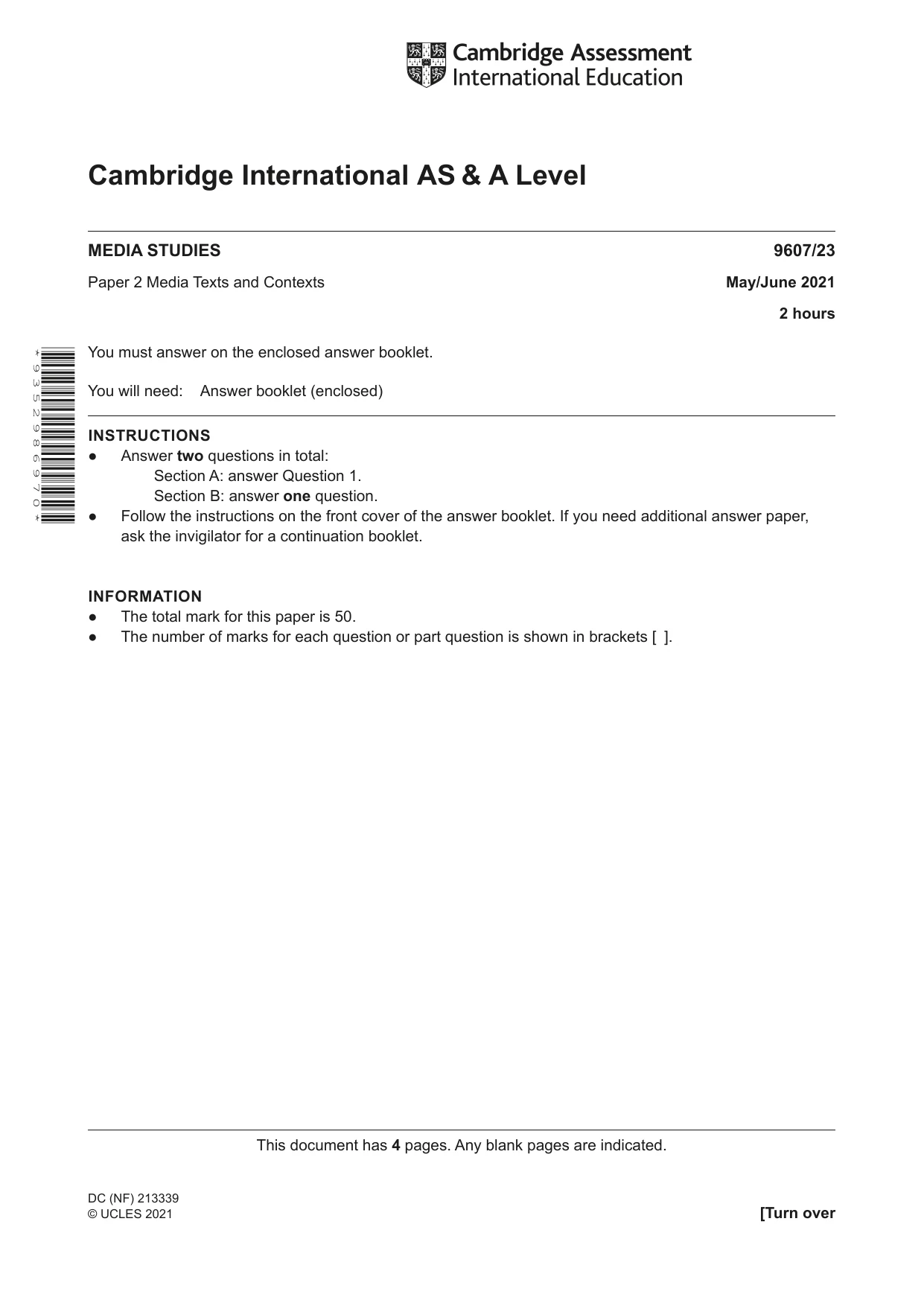
Question paper, page 1
Cambridge International AS & A Level DC (NF) 213339 © UCLES 2021 [Turn over This document has 4 pages. Any blank pages are indicated. * 9 3 5 2 9 8 6 9 7 0 * MEDIA STUDIES 9607/23 Paper 2 Media Texts and Contexts May/June 2021 2 hours You must answer on the enclosed answer booklet. You will need: Answer booklet (enclosed) INSTRUCTIONS ● Answer two questions in total: Section A: answer Question 1. Section B: answer one question. ● Follow the instructions on the front cover of the answer booklet. If you need additional answer paper, ask the invigilator for a continuation booklet. INFORMATION ● The total mark for this paper is 50. ● The number of marks for each question or part question is shown in brackets [ ].
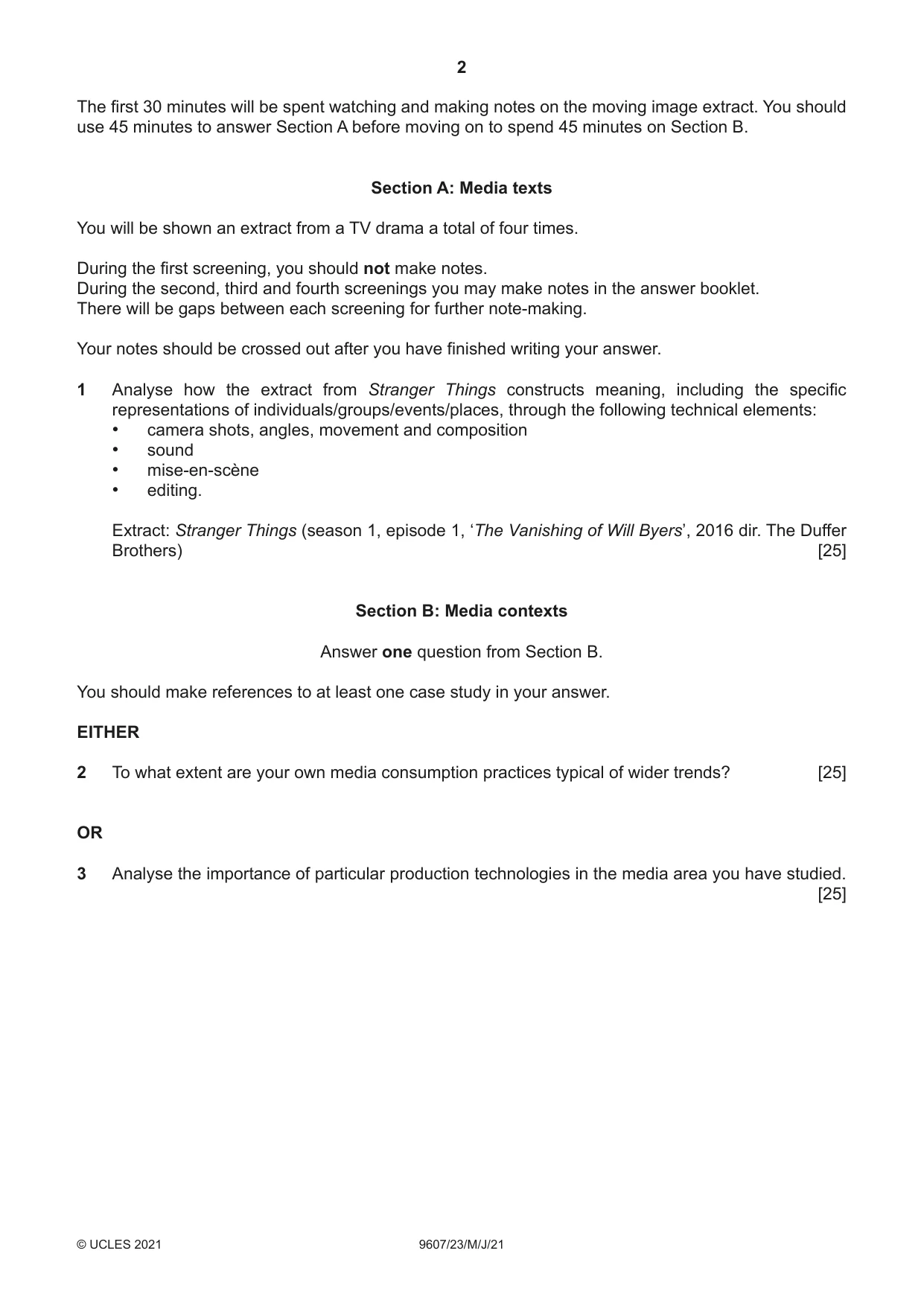
Question paper, page 2
2 9607/23/M/J/21 © UCLES 2021 The first 30 minutes will be spent watching and making notes on the moving image extract. You should use 45 minutes to answer Section A before moving on to spend 45 minutes on Section B. Section A: Media texts You will be shown an extract from a TV drama a total of four times. During the first screening, you should not make notes. During the second, third and fourth screenings you may make notes in the answer booklet. There will be gaps between each screening for further note-making. Your notes should be crossed out after you have finished writing your answer. 1 Analyse how the extract from Stranger Things constructs meaning, including the specific representations of individuals/groups/events/places, through the following technical elements: • camera shots, angles, movement and composition • sound • mise-en-scène • editing. Extract: Stranger Things (season 1, episode 1, ‘The Vanishing of Will Byers’, 2016 dir. The Duffer Brothers) [25] Section B: Media contexts Answer one question from Section B. You should make references to at least one case study in your answer. EITHER 2 To what extent are your own media consumption practices typical of wider trends? [25] OR 3 Analyse the importance of particular production technologies in the media area you have studied. [25]
Question paper, page 3
3 9607/23/M/J/21 © UCLES 2021 BLANK PAGE
Question paper, page 4
4 9607/23/M/J/21 © UCLES 2021 Permission to reproduce items where third-party owned material protected by copyright is included has been sought and cleared where possible. Every reasonable effort has been made by the publisher (UCLES) to trace copyright holders, but if any items requiring clearance have unwittingly been included, the publisher will be pleased to make amends at the earliest possible opportunity. To avoid the issue of disclosure of answer-related information to candidates, all copyright acknowledgements are reproduced online in the Cambridge Assessment International Education Copyright Acknowledgements Booklet. This is produced for each series of examinations and is freely available to download at www.cambridgeinternational.org after the live examination series. Cambridge Assessment International Education is part of the Cambridge Assessment Group. Cambridge Assessment is the brand name of the University of Cambridge Local Examinations Syndicate (UCLES), which itself is a department of the University of Cambridge. BLANK PAGE
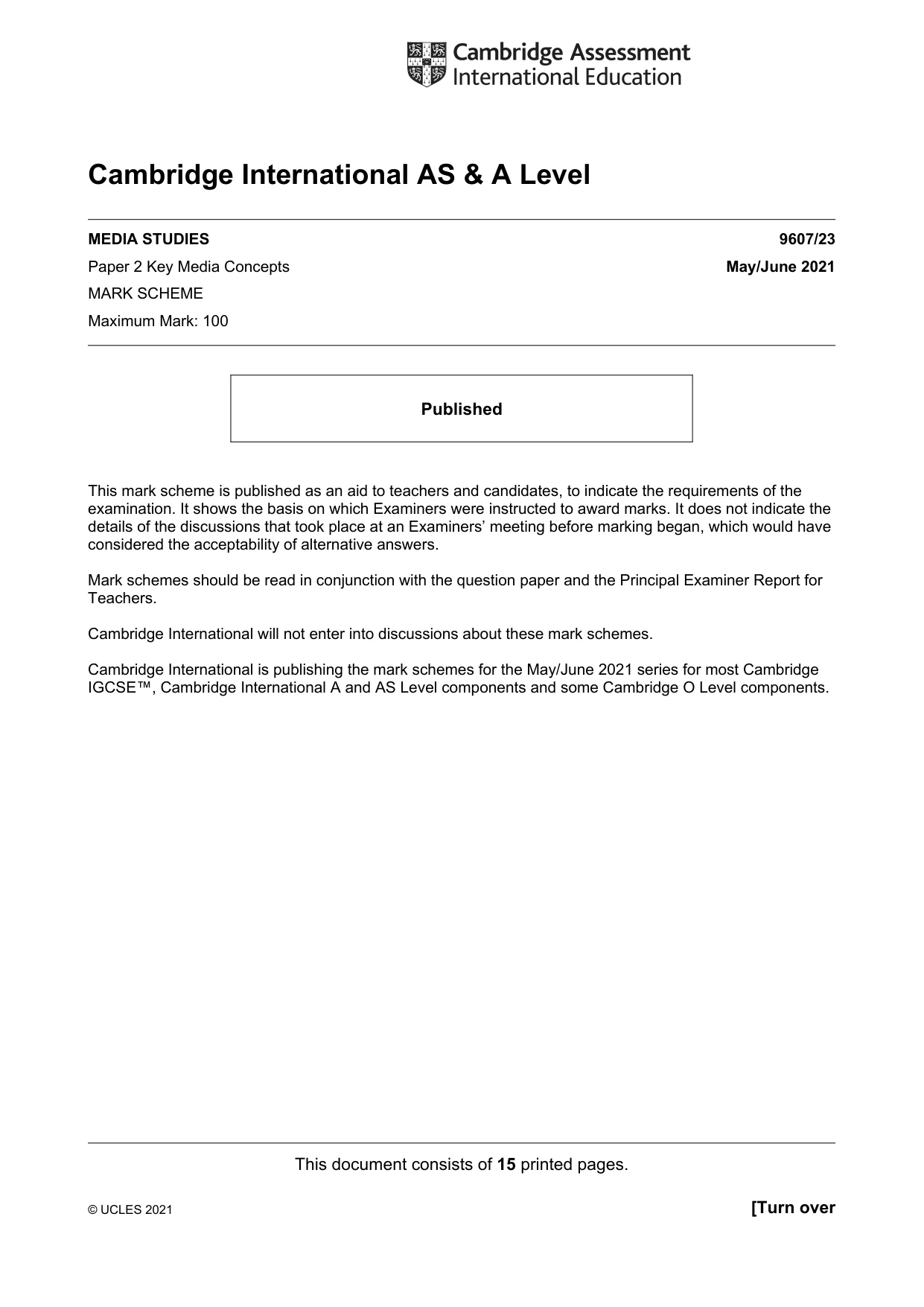
Mark scheme, page 1
This document consists of 15 printed pages. © UCLES 2021 [Turn over Cambridge International AS & A Level MEDIA STUDIES 9607/23 Paper 2 Key Media Concepts May/June 2021 MARK SCHEME Maximum Mark: 100 Published This mark scheme is published as an aid to teachers and candidates, to indicate the requirements of the examination. It shows the basis on which Examiners were instructed to award marks. It does not indicate the details of the discussions that took place at an Examiners’ meeting before marking began, which would have considered the acceptability of alternative answers. Mark schemes should be read in conjunction with the question paper and the Principal Examiner Report for Teachers. Cambridge International will not enter into discussions about these mark schemes. Cambridge International is publishing the mark schemes for the May/June 2021 series for most Cambridge IGCSE™, Cambridge International A and AS Level components and some Cambridge O Level components.
Mark scheme, page 2
9607/23 Cambridge International AS & A Level – Mark Scheme PUBLISHED May/June 2021 © UCLES 2021 Page 2 of 15 Generic Marking Principles These general marking principles must be applied by all examiners when marking candidate answers. They should be applied alongside the specific content of the mark scheme or generic level descriptors for a question. Each question paper and mark scheme will also comply with these marking principles. GENERIC MARKING PRINCIPLE 1: Marks must be awarded in line with: • the specific content of the mark scheme or the generic level descriptors for the question • the specific skills defined in the mark scheme or in the generic level descriptors for the question • the standard of response required by a candidate as exemplified by the standardisation scripts. GENERIC MARKING PRINCIPLE 2: Marks awarded are always whole marks (not half marks, or other fractions). GENERIC MARKING PRINCIPLE 3: Marks must be awarded positively: • marks are awarded for correct/valid answers, as defined in the mark scheme. However, credit is given for valid answers which go beyond the scope of the syllabus and mark scheme, referring to your Team Leader as appropriate • marks are awarded when candidates clearly demonstrate what they know and can do • marks are not deducted for errors • marks are not deducted for omissions • answers should only be judged on the quality of spelling, punctuation, and grammar when these features are specifically assessed by the question as indicated by the mark scheme. The meaning, however, should be unambiguous. GENERIC MARKING PRINCIPLE 4: Rules must be applied consistently, e.g. in situations where candidates have not followed instructions or in the application of generic level descriptors.
Mark scheme, page 3
9607/23 Cambridge International AS & A Level – Mark Scheme PUBLISHED May/June 2021 © UCLES 2021 Page 3 of 15 GENERIC MARKING PRINCIPLE 5: Marks should be awarded using the full range of marks defined in the mark scheme for the question (however; the use of the full mark range may be limited according to the quality of the candidate responses seen). GENERIC MARKING PRINCIPLE 6: Marks awarded are based solely on the requirements as defined in the mark scheme. Marks should not be awarded with grade thresholds or grade descriptors in mind. English & Media subject specific general marking principles (To be read in conjunction with the Generic Marking Principles (and requiring further guidance on how to place marks within levels)) Components using level descriptors: • We use level descriptors as a guide to broad understanding of the qualities normally expected of, or typical of, work in a level. • Level descriptors are a means of general guidance and should not be interpreted as hurdle statements. • Where indicative content notes are supplied for a question, these are not a prescription of required content, and must not be treated as such. Alternative correct points and unexpected answers in candidates’ scripts must be given marks that fairly reflect the knowledge and skills demonstrated. • While we may have legitimate expectations as to the ground most answers may occupy, we must at all times be prepared to meet candidates on their chosen ground, provided it is relevant ground (e.g. clearly related to and derived from a relevant passage/text and meeting the mark scheme requirements for the question).
Mark scheme, page 4
9607/23 Cambridge International AS & A Level – Mark Scheme PUBLISHED May/June 2021 © UCLES 2021 Page 4 of 15 Components using point-based marking: Point marking is often used to reward knowledge, understanding and application of skills. We give credit where the candidate’s answer shows relevant knowledge, understanding and application of skills in answering the question. We do not give credit where the answer shows confusion. From this it follows that we: a DO credit answers which are worded differently from the mark scheme if they clearly convey the same meaning (unless the mark scheme requires a specific term). b DO credit alternative answers/examples which are not written in the mark scheme if they are correct. c DO credit answers where candidates give more than one correct answer in one prompt/numbered/scaffolded space where extended writing is required rather than list-type answers. For example, questions that require n reasons (e.g. State two reasons…). d DO NOT credit answers simply for using a ‘key term’ unless that is all that is required. (Check for evidence it is understood and not used wrongly.). e DO NOT credit answers which are obviously self-contradicting or trying to cover all possibilities. f DO NOT give further credit for what is effectively repetition of a correct point already credited unless the language itself is being tested. This applies equally to ‘mirror statements’ (i.e. polluted/not polluted). g DO NOT require spellings to be correct unless this is part of the test. However, spellings of syllabus terms must allow for clear and unambiguous separation from other syllabus terms with which they may be confused (e.g. Corrasion/Corrosion). Assessment Objectives The Assessment Objectives are applied to each question. The assessment objectives for the paper are: • AO1 Demonstrate knowledge and understanding of media concepts, contexts, and critical debates, using terminology appropriately. (60%) • AO2 Analyse media products, and evaluate their own work, by applying knowledge and understanding of theoretical and creative approaches, supported with relevant textual evidence. (40%) The Level Descriptors guide examiners to an understanding of the qualities normally expected of, or typical of, work in a band. They are a means of general guidance and must not be interpreted as hurdle statements. For the purposes of standardisation of marking, they are to be used in conjunction with the Standardisation scripts discussed during the coordination meeting and with Team Leaders, as well as the question-specific notes. The indicative content provided is for general guidance; it is not designed as prescriptions of required content and must not be treated as such. Whilst there are legitimate expectations of the content of most answers, examiners may see responses that include ideas not covered in the indicative content. For these cases, examiners should credit valid responses fairly and not penalise candidates for including valid points outside the mark scheme.
Mark scheme, page 5
9607/23 Cambridge International AS & A Level – Mark Scheme PUBLISHED May/June 2021 © UCLES 2021 Page 5 of 15 Using a banded mark scheme Place the answer in a level first. Look for the “best fit” of the answer into a level. An answer needs to show evidence of most but not necessarily ALL the qualities described in a level in order to be placed in that band. Then award a mark for the relative position of the answer within the level. Higher level responses (Levels 4 & 5) will demonstrate excellent knowledge and understanding of the key concepts (AO1). They should use a wide range of terminology accurately (AO1). They should show clear understanding of how meaning is created in the text (AO2). They should support their answer with many detailed references to the text (AO2). Middle range responses (Level 3) will demonstrate satisfactory knowledge and understanding of the key concepts – there may be uneven coverage or some misunderstanding (AO1). They should use some terminology, but not always accurately (AO1). They should show some understanding of how meaning is created in the text (AO2). They should support their answer with some references to the text (AO2). Basic responses (Levels 1 & 2) will demonstrate basic knowledge and understanding of the key concepts –misunderstanding might be common (AO1). They might use some terminology, but rarely accurately (AO1). They will have limited understanding of how meaning is created in the text (AO2). They rarely support their answer with references to the text (AO2).
Mark scheme, page 6
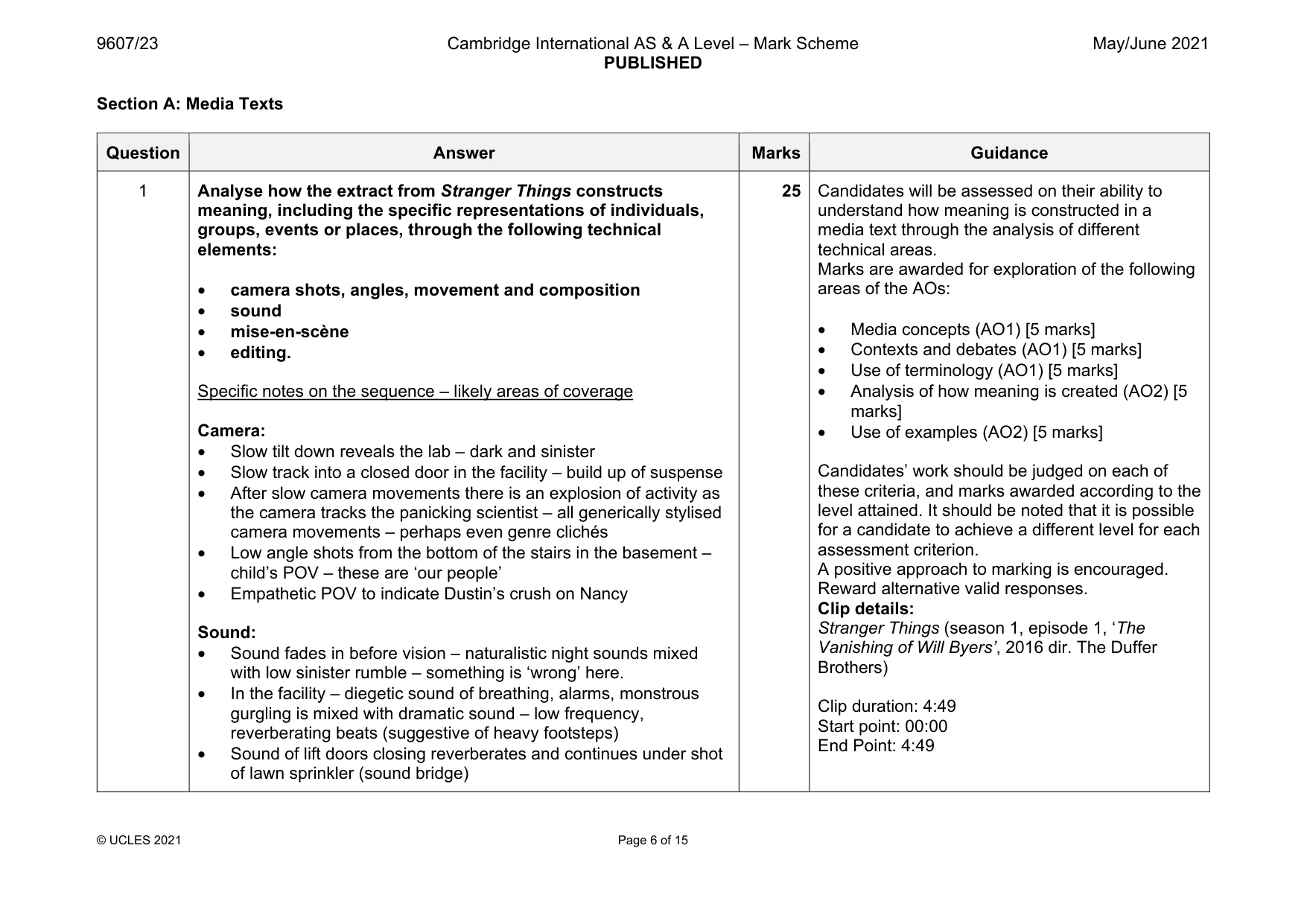
9607/23 Cambridge International AS & A Level – Mark Scheme PUBLISHED May/June 2021 © UCLES 2021 Page 6 of 15 Section A: Media Texts Question Answer Marks Guidance 1 Analyse how the extract from Stranger Things constructs meaning, including the specific representations of individuals, groups, events or places, through the following technical elements: • camera shots, angles, movement and composition • sound • mise-en-scène • editing. Specific notes on the sequence – likely areas of coverage Camera: • Slow tilt down reveals the lab – dark and sinister • Slow track into a closed door in the facility – build up of suspense • After slow camera movements there is an explosion of activity as the camera tracks the panicking scientist – all generically stylised camera movements – perhaps even genre clichés • Low angle shots from the bottom of the stairs in the basement – child’s POV – these are ‘our people’ • Empathetic POV to indicate Dustin’s crush on Nancy Sound: • Sound fades in before vision – naturalistic night sounds mixed with low sinister rumble – something is ‘wrong’ here. • In the facility – diegetic sound of breathing, alarms, monstrous gurgling is mixed with dramatic sound – low frequency, reverberating beats (suggestive of heavy footsteps) • Sound of lift doors closing reverberates and continues under shot of lawn sprinkler (sound bridge) 25 Candidates will be assessed on their ability to understand how meaning is constructed in a media text through the analysis of different technical areas. Marks are awarded for exploration of the following areas of the AOs: • Media concepts (AO1) [5 marks] • Contexts and debates (AO1) [5 marks] • Use of terminology (AO1) [5 marks] • Analysis of how meaning is created (AO2) [5 marks] • Use of examples (AO2) [5 marks] Candidates’ work should be judged on each of these criteria, and marks awarded according to the level attained. It should be noted that it is possible for a candidate to achieve a different level for each assessment criterion. A positive approach to marking is encouraged. Reward alternative valid responses. Clip details: Stranger Things (season 1, episode 1, ‘The Vanishing of Will Byers’, 2016 dir. The Duffer Brothers) Clip duration: 4:49 Start point: 00:00 End Point: 4:49
Mark scheme, page 7
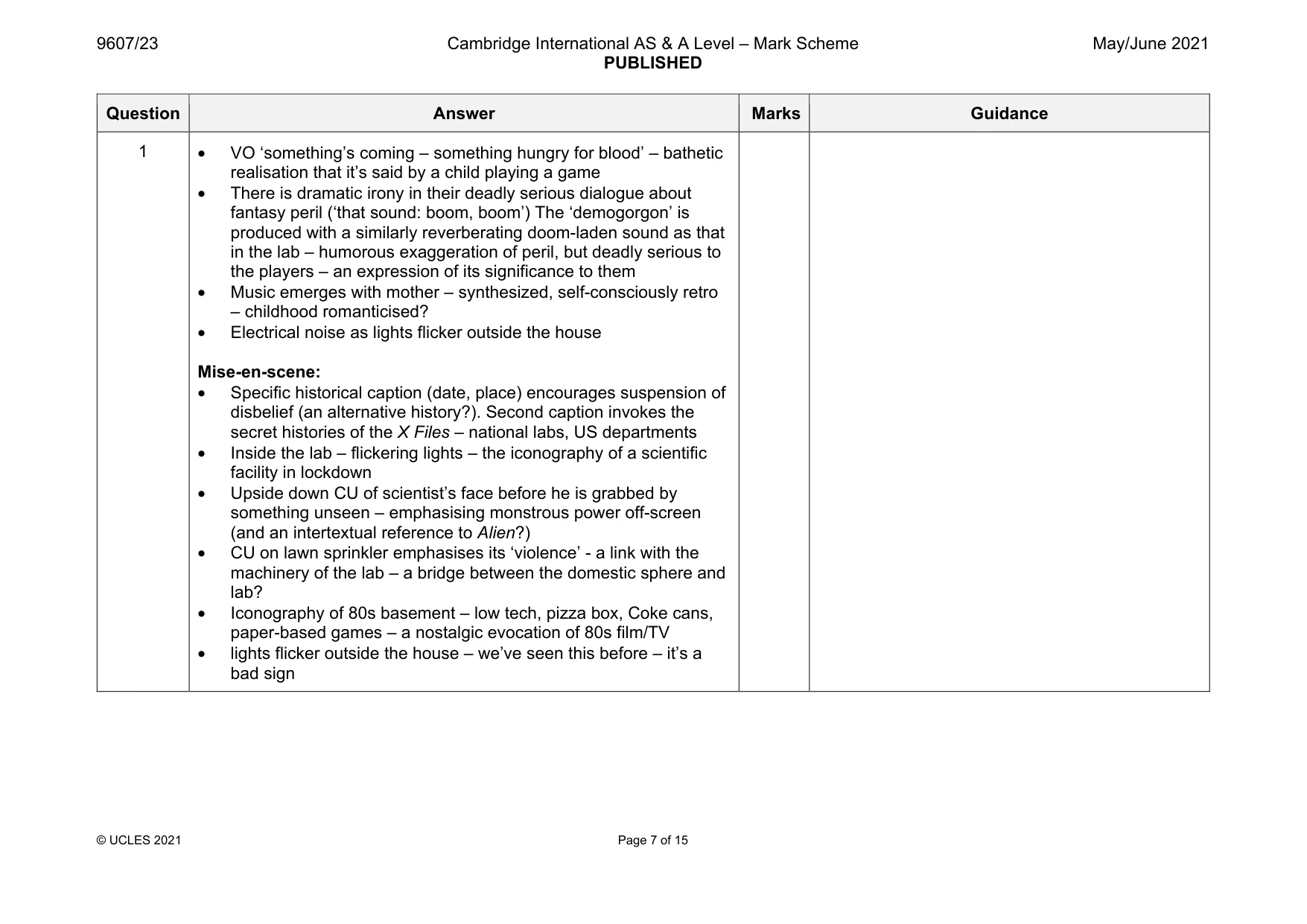
9607/23 Cambridge International AS & A Level – Mark Scheme PUBLISHED May/June 2021 © UCLES 2021 Page 7 of 15 Question Answer Marks Guidance 1 • VO ‘something’s coming – something hungry for blood’ – bathetic realisation that it’s said by a child playing a game • There is dramatic irony in their deadly serious dialogue about fantasy peril (‘that sound: boom, boom’) The ‘demogorgon’ is produced with a similarly reverberating doom-laden sound as that in the lab – humorous exaggeration of peril, but deadly serious to the players – an expression of its significance to them • Music emerges with mother – synthesized, self-consciously retro – childhood romanticised? • Electrical noise as lights flicker outside the house Mise-en-scene: • Specific historical caption (date, place) encourages suspension of disbelief (an alternative history?). Second caption invokes the secret histories of the X Files – national labs, US departments • Inside the lab – flickering lights – the iconography of a scientific facility in lockdown • Upside down CU of scientist’s face before he is grabbed by something unseen – emphasising monstrous power off-screen (and an intertextual reference to Alien?) • CU on lawn sprinkler emphasises its ‘violence’ - a link with the machinery of the lab – a bridge between the domestic sphere and lab? • Iconography of 80s basement – low tech, pizza box, Coke cans, paper-based games – a nostalgic evocation of 80s film/TV • lights flicker outside the house – we’ve seen this before – it’s a bad sign
Mark scheme, page 8
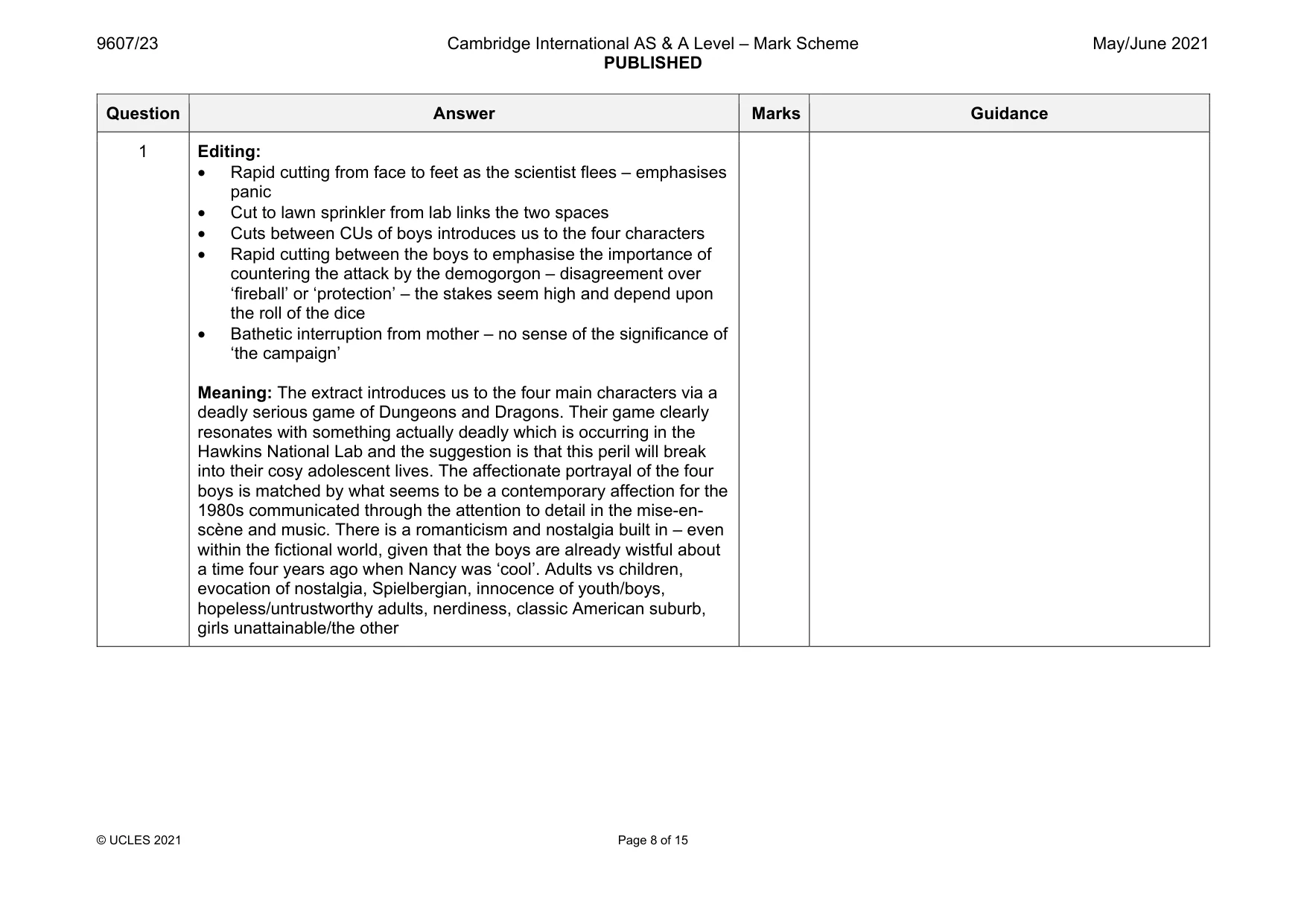
9607/23 Cambridge International AS & A Level – Mark Scheme PUBLISHED May/June 2021 © UCLES 2021 Page 8 of 15 Question Answer Marks Guidance 1 Editing: • Rapid cutting from face to feet as the scientist flees – emphasises panic • Cut to lawn sprinkler from lab links the two spaces • Cuts between CUs of boys introduces us to the four characters • Rapid cutting between the boys to emphasise the importance of countering the attack by the demogorgon – disagreement over ‘fireball’ or ‘protection’ – the stakes seem high and depend upon the roll of the dice • Bathetic interruption from mother – no sense of the significance of ‘the campaign’ Meaning: The extract introduces us to the four main characters via a deadly serious game of Dungeons and Dragons. Their game clearly resonates with something actually deadly which is occurring in the Hawkins National Lab and the suggestion is that this peril will break into their cosy adolescent lives. The affectionate portrayal of the four boys is matched by what seems to be a contemporary affection for the 1980s communicated through the attention to detail in the mise-en- scène and music. There is a romanticism and nostalgia built in – even within the fictional world, given that the boys are already wistful about a time four years ago when Nancy was ‘cool’. Adults vs children, evocation of nostalgia, Spielbergian, innocence of youth/boys, hopeless/untrustworthy adults, nerdiness, classic American suburb, girls unattainable/the other
Mark scheme, page 9
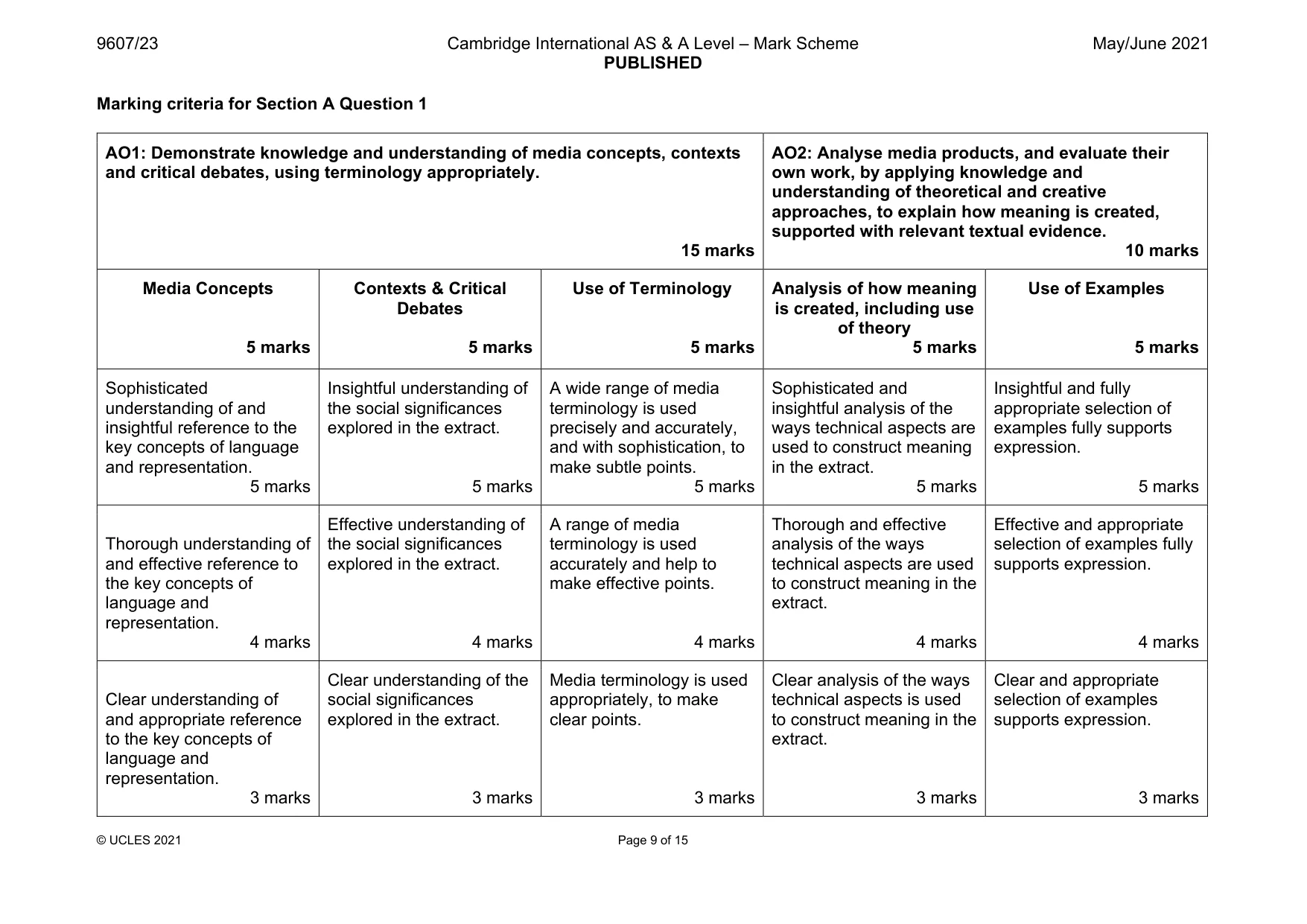
9607/23 Cambridge International AS & A Level – Mark Scheme PUBLISHED May/June 2021 © UCLES 2021 Page 9 of 15 Marking criteria for Section A Question 1 AO1: Demonstrate knowledge and understanding of media concepts, contexts and critical debates, using terminology appropriately. 15 marks AO2: Analyse media products, and evaluate their own work, by applying knowledge and understanding of theoretical and creative approaches, to explain how meaning is created, supported with relevant textual evidence. 10 marks Media Concepts 5 marks Contexts & Critical Debates 5 marks Use of Terminology 5 marks Analysis of how meaning is created, including use of theory 5 marks Use of Examples 5 marks Sophisticated understanding of and insightful reference to the key concepts of language and representation. 5 marks Insightful understanding of the social significances explored in the extract. 5 marks A wide range of media terminology is used precisely and accurately, and with sophistication, to make subtle points. 5 marks Sophisticated and insightful analysis of the ways technical aspects are used to construct meaning in the extract. 5 marks Insightful and fully appropriate selection of examples fully supports expression. 5 marks Thorough understanding of and effective reference to the key concepts of language and representation. 4 marks Effective understanding of the social significances explored in the extract. 4 marks A range of media terminology is used accurately and help to make effective points. 4 marks Thorough and effective analysis of the ways technical aspects are used to construct meaning in the extract. 4 marks Effective and appropriate selection of examples fully supports expression. 4 marks Clear understanding of and appropriate reference to the key concepts of language and representation. 3 marks Clear understanding of the social significances explored in the extract. 3 marks Media terminology is used appropriately, to make clear points. 3 marks Clear analysis of the ways technical aspects is used to construct meaning in the extract. 3 marks Clear and appropriate selection of examples supports expression. 3 marks
Mark scheme, page 10
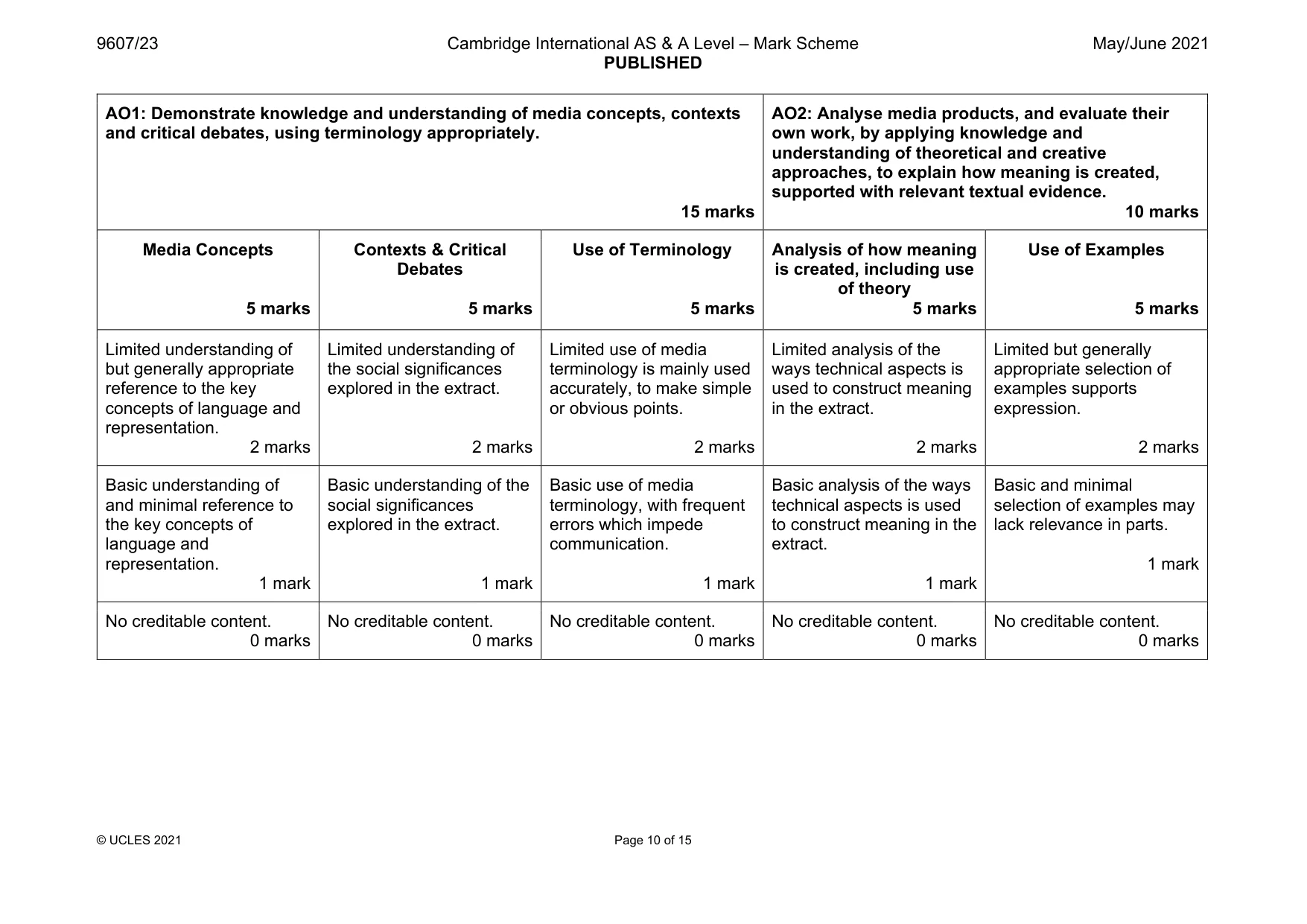
9607/23 Cambridge International AS & A Level – Mark Scheme PUBLISHED May/June 2021 © UCLES 2021 Page 10 of 15 AO1: Demonstrate knowledge and understanding of media concepts, contexts and critical debates, using terminology appropriately. 15 marks AO2: Analyse media products, and evaluate their own work, by applying knowledge and understanding of theoretical and creative approaches, to explain how meaning is created, supported with relevant textual evidence. 10 marks Media Concepts 5 marks Contexts & Critical Debates 5 marks Use of Terminology 5 marks Analysis of how meaning is created, including use of theory 5 marks Use of Examples 5 marks Limited understanding of but generally appropriate reference to the key concepts of language and representation. 2 marks Limited understanding of the social significances explored in the extract. 2 marks Limited use of media terminology is mainly used accurately, to make simple or obvious points. 2 marks Limited analysis of the ways technical aspects is used to construct meaning in the extract. 2 marks Limited but generally appropriate selection of examples supports expression. 2 marks Basic understanding of and minimal reference to the key concepts of language and representation. 1 mark Basic understanding of the social significances explored in the extract. 1 mark Basic use of media terminology, with frequent errors which impede communication. 1 mark Basic analysis of the ways technical aspects is used to construct meaning in the extract. 1 mark Basic and minimal selection of examples may lack relevance in parts. 1 mark No creditable content. 0 marks No creditable content. 0 marks No creditable content. 0 marks No creditable content. 0 marks No creditable content. 0 marks
Mark scheme, page 11
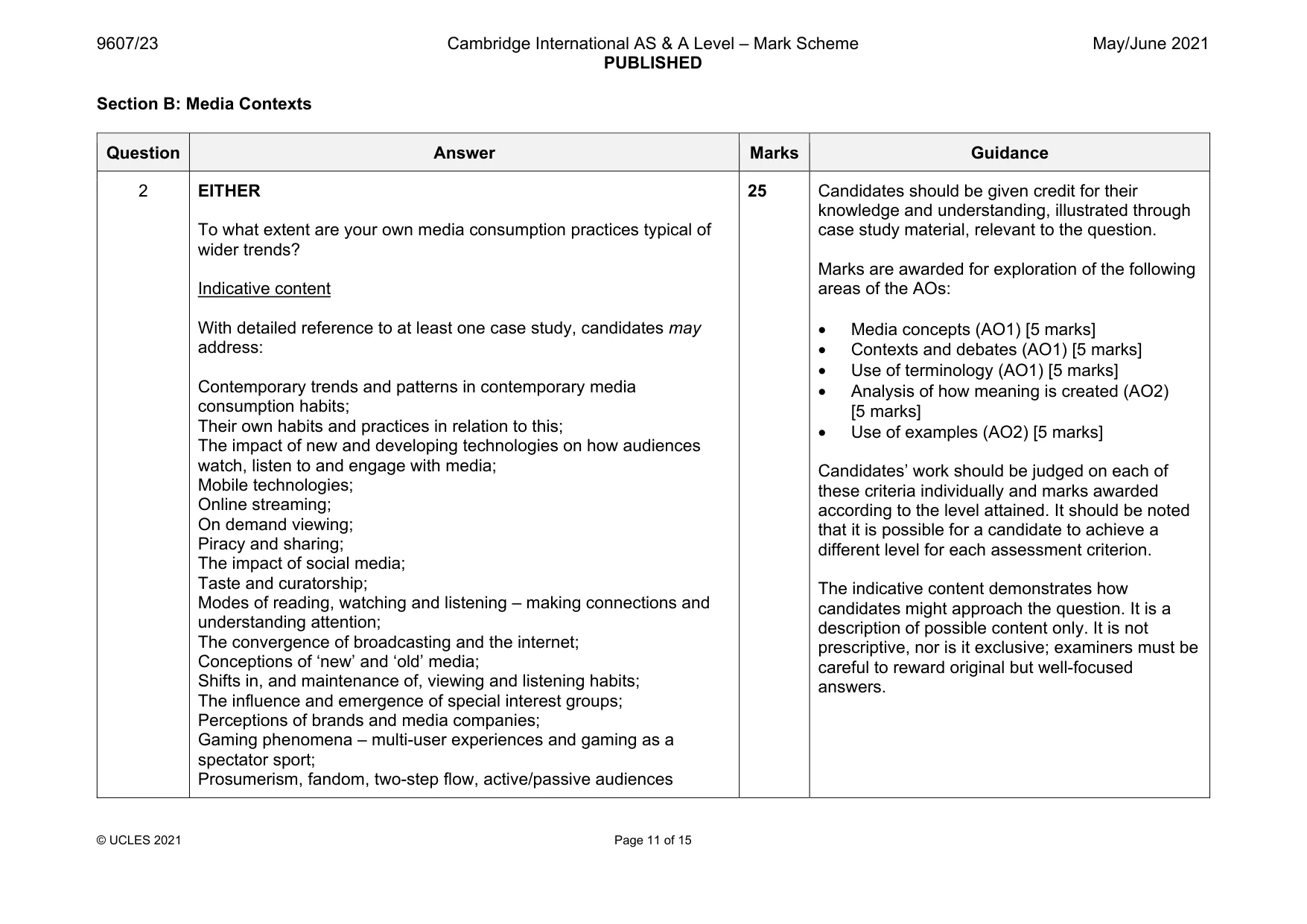
9607/23 Cambridge International AS & A Level – Mark Scheme PUBLISHED May/June 2021 © UCLES 2021 Page 11 of 15 Section B: Media Contexts Question Answer Marks Guidance 2 EITHER To what extent are your own media consumption practices typical of wider trends? Indicative content With detailed reference to at least one case study, candidates may address: Contemporary trends and patterns in contemporary media consumption habits; Their own habits and practices in relation to this; The impact of new and developing technologies on how audiences watch, listen to and engage with media; Mobile technologies; Online streaming; On demand viewing; Piracy and sharing; The impact of social media; Taste and curatorship; Modes of reading, watching and listening – making connections and understanding attention; The convergence of broadcasting and the internet; Conceptions of ‘new’ and ‘old’ media; Shifts in, and maintenance of, viewing and listening habits; The influence and emergence of special interest groups; Perceptions of brands and media companies; Gaming phenomena – multi-user experiences and gaming as a spectator sport; Prosumerism, fandom, two-step flow, active/passive audiences 25 Candidates should be given credit for their knowledge and understanding, illustrated through case study material, relevant to the question. Marks are awarded for exploration of the following areas of the AOs: • Media concepts (AO1) [5 marks] • Contexts and debates (AO1) [5 marks] • Use of terminology (AO1) [5 marks] • Analysis of how meaning is created (AO2) [5 marks] • Use of examples (AO2) [5 marks] Candidates’ work should be judged on each of these criteria individually and marks awarded according to the level attained. It should be noted that it is possible for a candidate to achieve a different level for each assessment criterion. The indicative content demonstrates how candidates might approach the question. It is a description of possible content only. It is not prescriptive, nor is it exclusive; examiners must be careful to reward original but well-focused answers.
Mark scheme, page 12
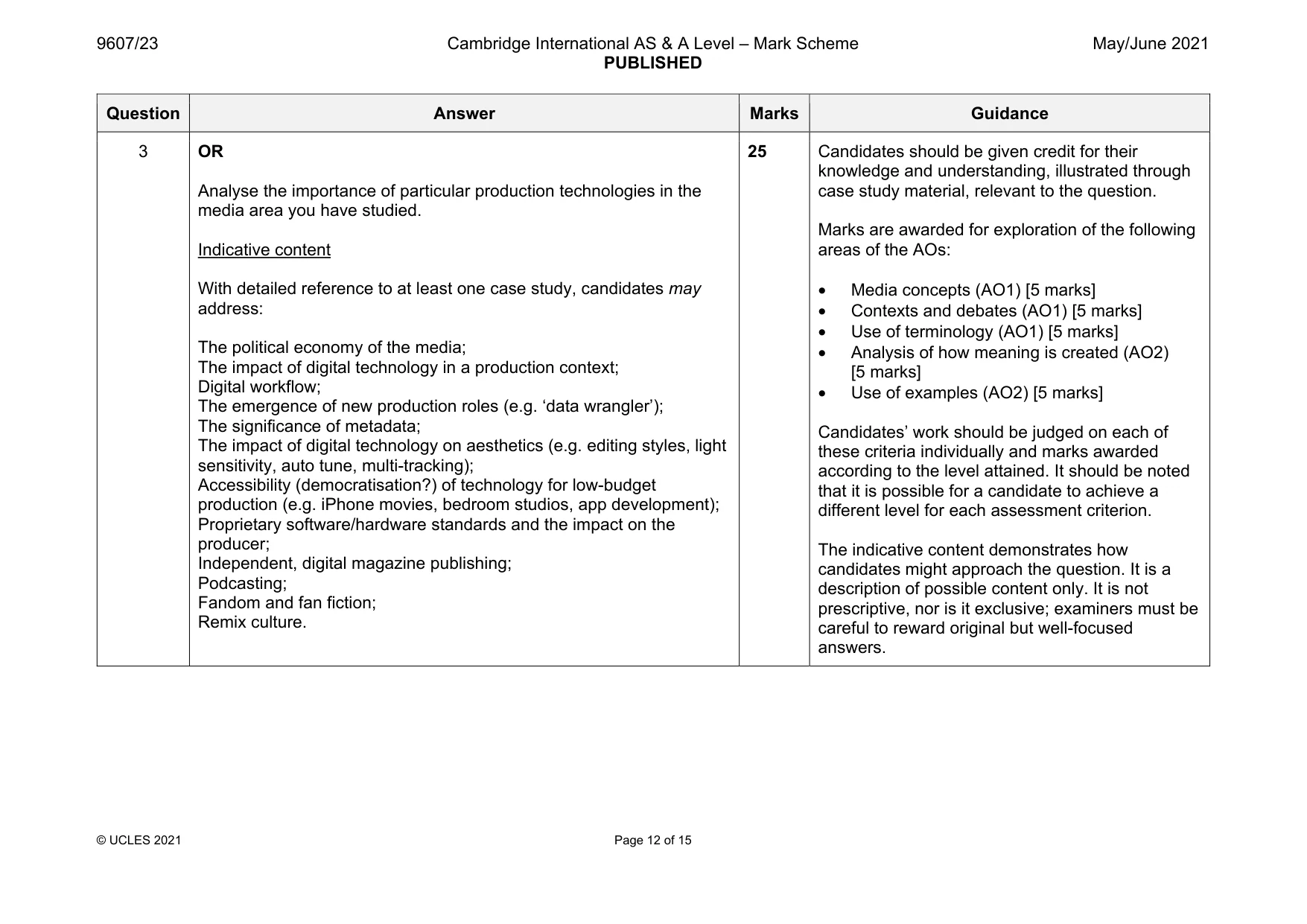
9607/23 Cambridge International AS & A Level – Mark Scheme PUBLISHED May/June 2021 © UCLES 2021 Page 12 of 15 Question Answer Marks Guidance 3 OR Analyse the importance of particular production technologies in the media area you have studied. Indicative content With detailed reference to at least one case study, candidates may address: The political economy of the media; The impact of digital technology in a production context; Digital workflow; The emergence of new production roles (e.g. ‘data wrangler’); The significance of metadata; The impact of digital technology on aesthetics (e.g. editing styles, light sensitivity, auto tune, multi-tracking); Accessibility (democratisation?) of technology for low-budget production (e.g. iPhone movies, bedroom studios, app development); Proprietary software/hardware standards and the impact on the producer; Independent, digital magazine publishing; Podcasting; Fandom and fan fiction; Remix culture. 25 Candidates should be given credit for their knowledge and understanding, illustrated through case study material, relevant to the question. Marks are awarded for exploration of the following areas of the AOs: • Media concepts (AO1) [5 marks] • Contexts and debates (AO1) [5 marks] • Use of terminology (AO1) [5 marks] • Analysis of how meaning is created (AO2) [5 marks] • Use of examples (AO2) [5 marks] Candidates’ work should be judged on each of these criteria individually and marks awarded according to the level attained. It should be noted that it is possible for a candidate to achieve a different level for each assessment criterion. The indicative content demonstrates how candidates might approach the question. It is a description of possible content only. It is not prescriptive, nor is it exclusive; examiners must be careful to reward original but well-focused answers.
Mark scheme, page 13
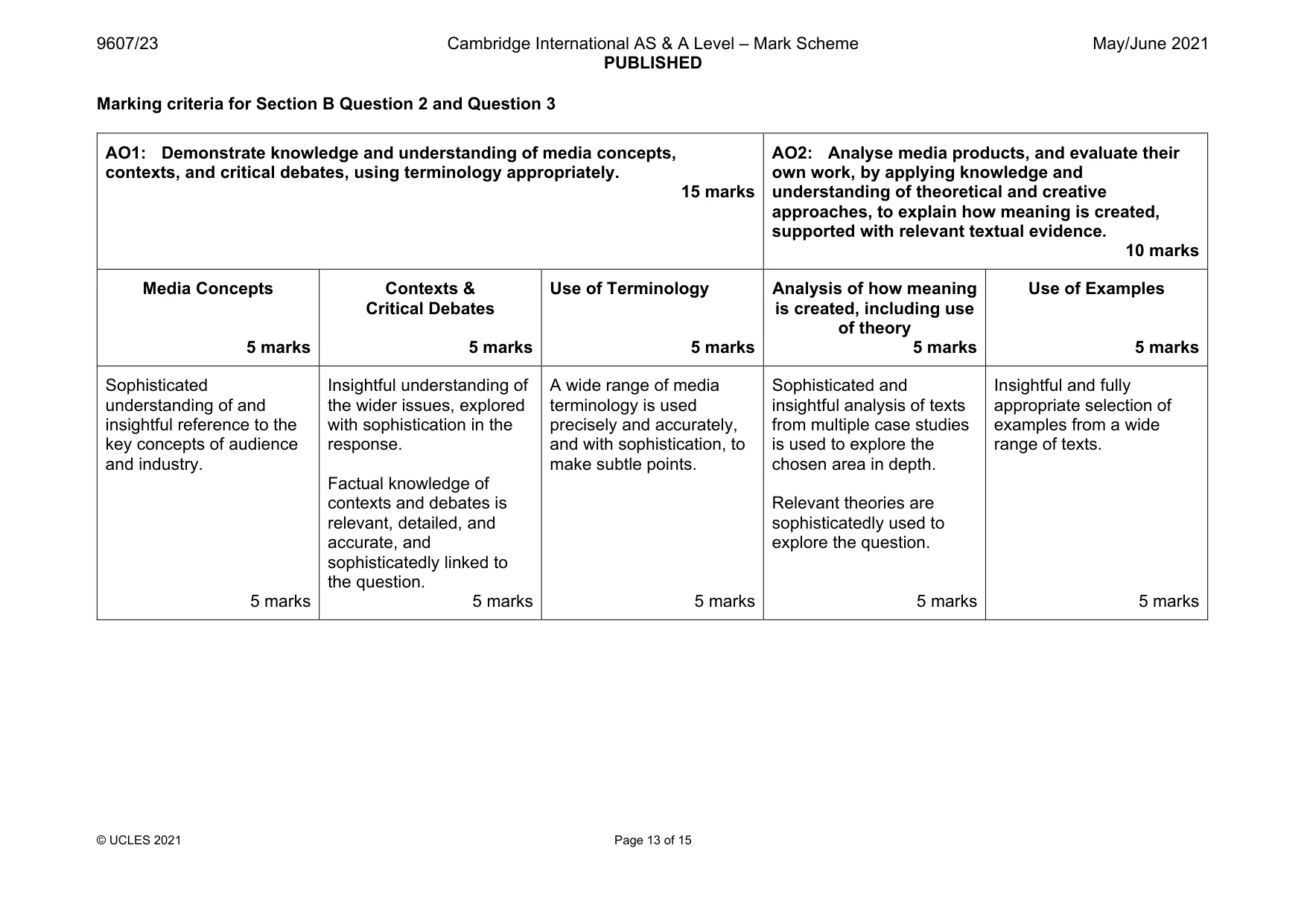
9607/23 Cambridge International AS & A Level – Mark Scheme PUBLISHED May/June 2021 © UCLES 2021 Page 13 of 15 Marking criteria for Section B Question 2 and Question 3 AO1: Demonstrate knowledge and understanding of media concepts, contexts, and critical debates, using terminology appropriately. 15 marks AO2: Analyse media products, and evaluate their own work, by applying knowledge and understanding of theoretical and creative approaches, to explain how meaning is created, supported with relevant textual evidence. 10 marks Media Concepts 5 marks Contexts & Critical Debates 5 marks Use of Terminology 5 marks Analysis of how meaning is created, including use of theory 5 marks Use of Examples 5 marks Sophisticated understanding of and insightful reference to the key concepts of audience and industry. 5 marks Insightful understanding of the wider issues, explored with sophistication in the response. Factual knowledge of contexts and debates is relevant, detailed, and accurate, and sophisticatedly linked to the question. 5 marks A wide range of media terminology is used precisely and accurately, and with sophistication, to make subtle points. 5 marks Sophisticated and insightful analysis of texts from multiple case studies is used to explore the chosen area in depth. Relevant theories are sophisticatedly used to explore the question. 5 marks Insightful and fully appropriate selection of examples from a wide range of texts. 5 marks
Mark scheme, page 14
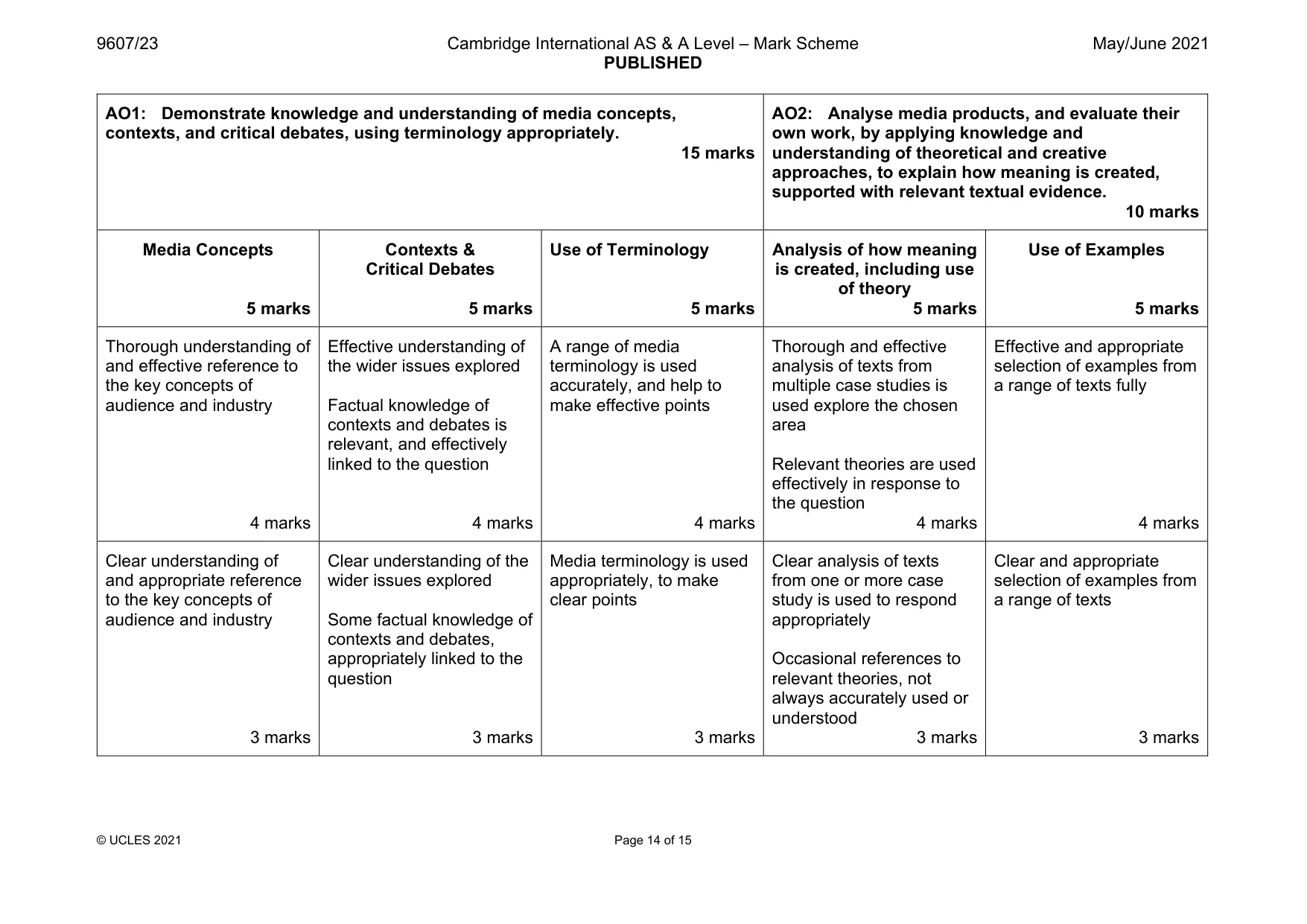
9607/23 Cambridge International AS & A Level – Mark Scheme PUBLISHED May/June 2021 © UCLES 2021 Page 14 of 15 AO1: Demonstrate knowledge and understanding of media concepts, contexts, and critical debates, using terminology appropriately. 15 marks AO2: Analyse media products, and evaluate their own work, by applying knowledge and understanding of theoretical and creative approaches, to explain how meaning is created, supported with relevant textual evidence. 10 marks Media Concepts 5 marks Contexts & Critical Debates 5 marks Use of Terminology 5 marks Analysis of how meaning is created, including use of theory 5 marks Use of Examples 5 marks Thorough understanding of and effective reference to the key concepts of audience and industry 4 marks Effective understanding of the wider issues explored Factual knowledge of contexts and debates is relevant, and effectively linked to the question 4 marks A range of media terminology is used accurately, and help to make effective points 4 marks Thorough and effective analysis of texts from multiple case studies is used explore the chosen area Relevant theories are used effectively in response to the question 4 marks Effective and appropriate selection of examples from a range of texts fully 4 marks Clear understanding of and appropriate reference to the key concepts of audience and industry 3 marks Clear understanding of the wider issues explored Some factual knowledge of contexts and debates, appropriately linked to the question 3 marks Media terminology is used appropriately, to make clear points 3 marks Clear analysis of texts from one or more case study is used to respond appropriately Occasional references to relevant theories, not always accurately used or understood 3 marks Clear and appropriate selection of examples from a range of texts 3 marks
Mark scheme, page 15
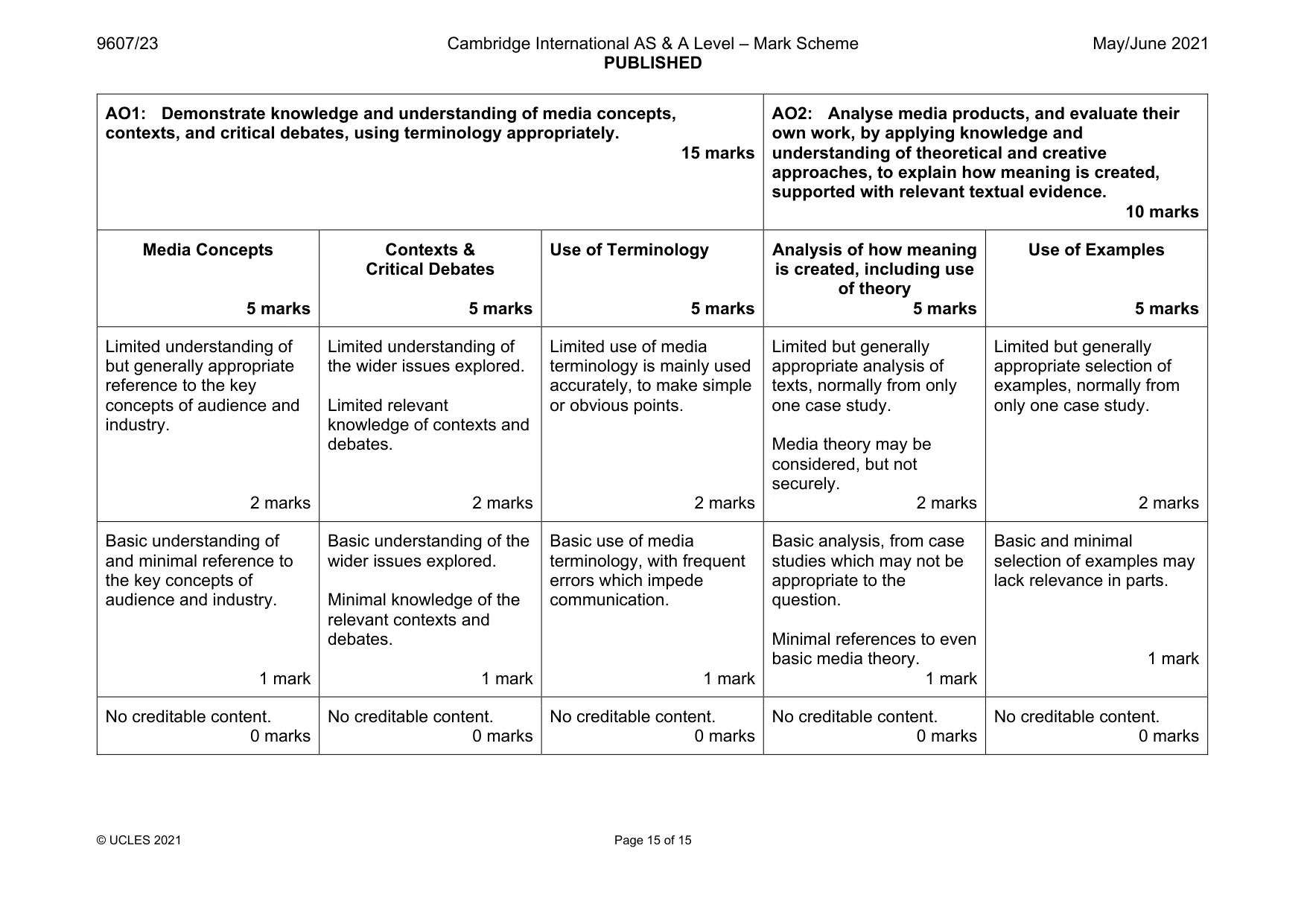
9607/23 Cambridge International AS & A Level – Mark Scheme PUBLISHED May/June 2021 © UCLES 2021 Page 15 of 15 AO1: Demonstrate knowledge and understanding of media concepts, contexts, and critical debates, using terminology appropriately. 15 marks AO2: Analyse media products, and evaluate their own work, by applying knowledge and understanding of theoretical and creative approaches, to explain how meaning is created, supported with relevant textual evidence. 10 marks Media Concepts 5 marks Contexts & Critical Debates 5 marks Use of Terminology 5 marks Analysis of how meaning is created, including use of theory 5 marks Use of Examples 5 marks Limited understanding of but generally appropriate reference to the key concepts of audience and industry. 2 marks Limited understanding of the wider issues explored. Limited relevant knowledge of contexts and debates. 2 marks Limited use of media terminology is mainly used accurately, to make simple or obvious points. 2 marks Limited but generally appropriate analysis of texts, normally from only one case study. Media theory may be considered, but not securely. 2 marks Limited but generally appropriate selection of examples, normally from only one case study. 2 marks Basic understanding of and minimal reference to the key concepts of audience and industry. 1 mark Basic understanding of the wider issues explored. Minimal knowledge of the relevant contexts and debates. 1 mark Basic use of media terminology, with frequent errors which impede communication. 1 mark Basic analysis, from case studies which may not be appropriate to the question. Minimal references to even basic media theory. 1 mark Basic and minimal selection of examples may lack relevance in parts. 1 mark No creditable content. 0 marks No creditable content. 0 marks No creditable content. 0 marks No creditable content. 0 marks No creditable content. 0 marks
What you needed in this session
Cambridge’s own grade thresholds for 2021 May/June, Paper 2 · Variant 3. A higher threshold means an easier paper — the bar moves with how the cohort did.