Cambridge A Level Media Studies 9607 — 2021 May/June Paper 2 · Variant 1
9607/21/M/J/21 · 50 marks · ≈56 min
The question paper and its mark scheme, free to read here and free to download. This is Cambridge’s own paper, exactly as it was sat.
Question paper4 pages


Mark scheme15 pages
Answers below. Sit the paper first if you are practising.
Paper as text
Question paper, page 1
This document has 4 pages. Any blank pages are indicated. Cambridge International AS & A Level MEDIA STUDIES 9607/21 Paper 2 Media Texts and Contexts May/June 2021 2 hours You must answer on the enclosed answer booklet. You will need: Answer booklet (enclosed) INSTRUCTIONS ● Answer two questions in total: Section A: answer Question 1. Section B: answer one question. ● Follow the instructions on the front cover of the answer booklet. If you need additional answer paper, ask the invigilator for a continuation booklet. INFORMATION ● The total mark for this paper is 50. ● The number of marks for each question or part question is shown in brackets [ ]. DC (KS) 201925/2 © UCLES 2021 [Turn over * 1 3 2 5 5 7 1 6 5 2 *
Question paper, page 2
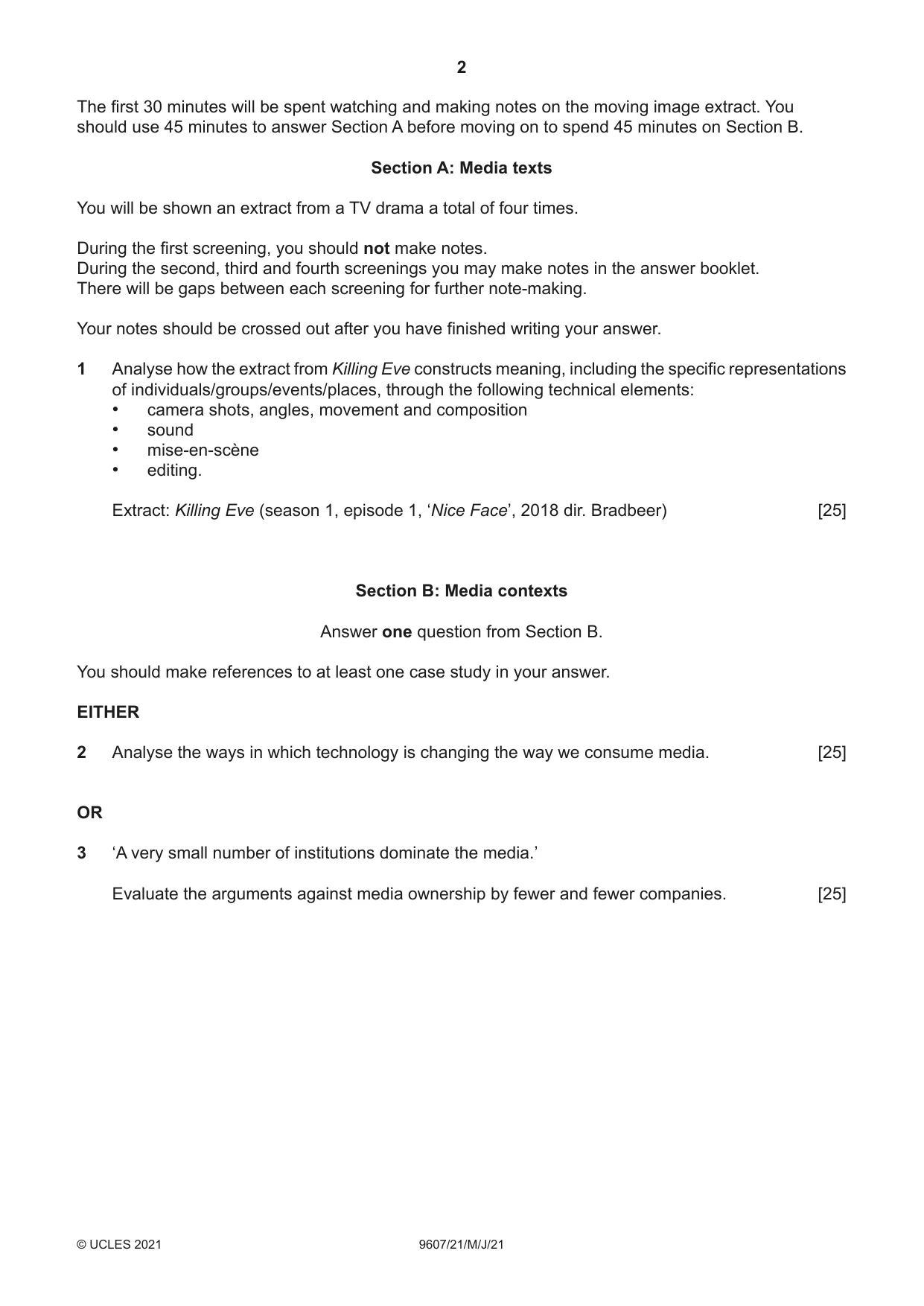
2 9607/21/M/J/21 © UCLES 2021 The first 30 minutes will be spent watching and making notes on the moving image extract. You should use 45 minutes to answer Section A before moving on to spend 45 minutes on Section B. Section A: Media texts You will be shown an extract from a TV drama a total of four times. During the first screening, you should not make notes. During the second, third and fourth screenings you may make notes in the answer booklet. There will be gaps between each screening for further note-making. Your notes should be crossed out after you have finished writing your answer. 1 Analyse how the extract from Killing Eve constructs meaning, including the specific representations of individuals/groups/events/places, through the following technical elements: • camera shots, angles, movement and composition • sound • mise-en-scène • editing. Extract: Killing Eve (season 1, episode 1, ‘Nice Face’, 2018 dir. Bradbeer) [25] Section B: Media contexts Answer one question from Section B. You should make references to at least one case study in your answer. EITHER 2 Analyse the ways in which technology is changing the way we consume media. [25] OR 3 ‘A very small number of institutions dominate the media.’ Evaluate the arguments against media ownership by fewer and fewer companies. [25]
Question paper, page 3
3 9607/21/M/J/21 © UCLES 2021 BLANK PAGE
Question paper, page 4
4 9607/21/M/J/21 © UCLES 2021 Permission to reproduce items where third-party owned material protected by copyright is included has been sought and cleared where possible. Every reasonable effort has been made by the publisher (UCLES) to trace copyright holders, but if any items requiring clearance have unwittingly been included, the publisher will be pleased to make amends at the earliest possible opportunity. To avoid the issue of disclosure of answer-related information to candidates, all copyright acknowledgements are reproduced online in the Cambridge Assessment International Education Copyright Acknowledgements Booklet. This is produced for each series of examinations and is freely available to download at www.cambridgeinternational.org after the live examination series. Cambridge Assessment International Education is part of the Cambridge Assessment Group. Cambridge Assessment is the brand name of the University of Cambridge Local Examinations Syndicate (UCLES), which itself is a department of the University of Cambridge. BLANK PAGE
Mark scheme, page 1
This document consists of 15 printed pages. © UCLES 2021 [Turn over Cambridge International AS & A Level MEDIA STUDIES 9607/21 Paper 2 Key Media Concepts May/June 2021 MARK SCHEME Maximum Mark: 100 Published This mark scheme is published as an aid to teachers and candidates, to indicate the requirements of the examination. It shows the basis on which Examiners were instructed to award marks. It does not indicate the details of the discussions that took place at an Examiners’ meeting before marking began, which would have considered the acceptability of alternative answers. Mark schemes should be read in conjunction with the question paper and the Principal Examiner Report for Teachers. Cambridge International will not enter into discussions about these mark schemes. Cambridge International is publishing the mark schemes for the May/June 2021 series for most Cambridge IGCSE™, Cambridge International A and AS Level components and some Cambridge O Level components.
Mark scheme, page 2
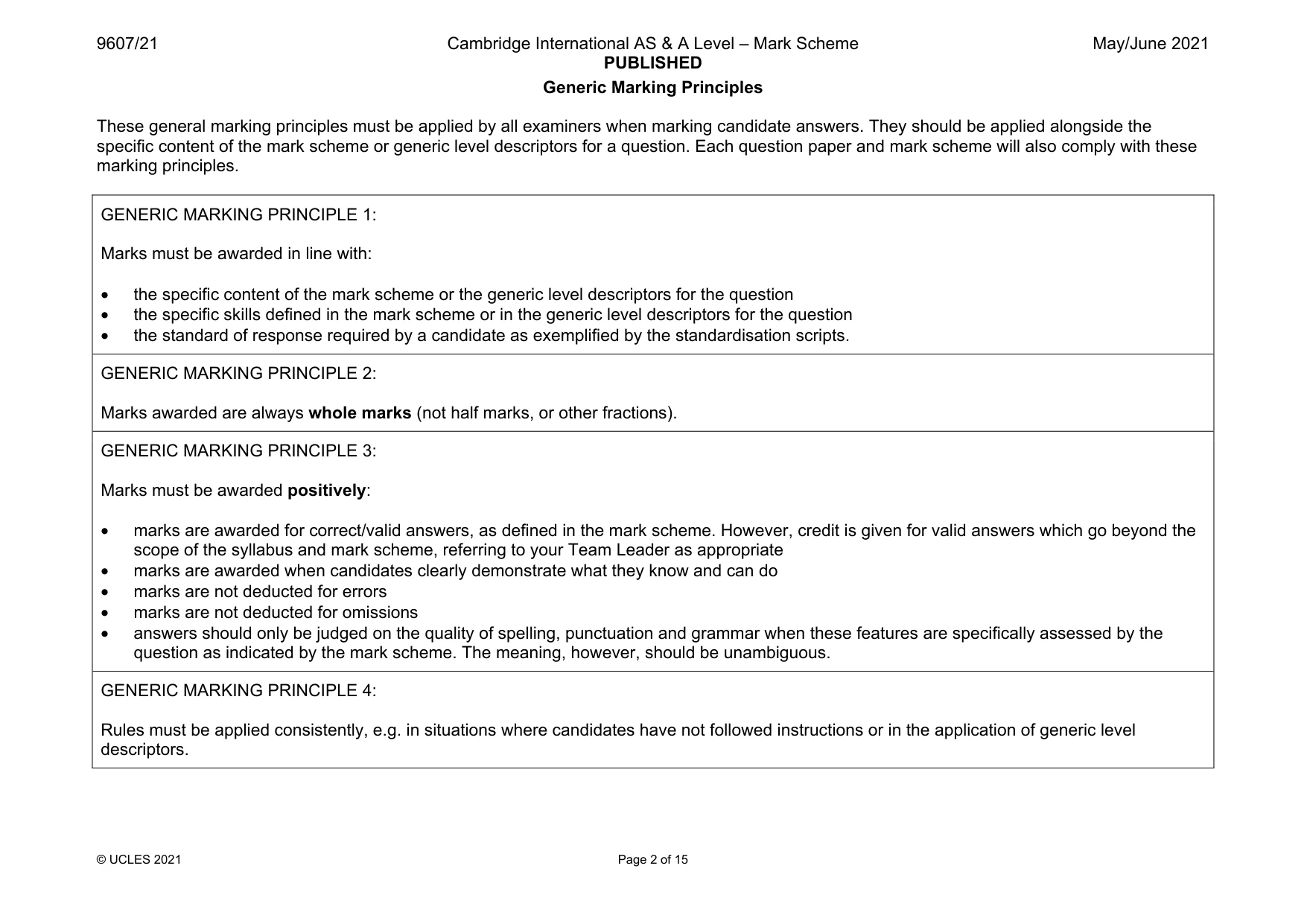
9607/21 Cambridge International AS & A Level – Mark Scheme PUBLISHED May/June 2021 © UCLES 2021 Page 2 of 15 Generic Marking Principles These general marking principles must be applied by all examiners when marking candidate answers. They should be applied alongside the specific content of the mark scheme or generic level descriptors for a question. Each question paper and mark scheme will also comply with these marking principles. GENERIC MARKING PRINCIPLE 1: Marks must be awarded in line with: • the specific content of the mark scheme or the generic level descriptors for the question • the specific skills defined in the mark scheme or in the generic level descriptors for the question • the standard of response required by a candidate as exemplified by the standardisation scripts. GENERIC MARKING PRINCIPLE 2: Marks awarded are always whole marks (not half marks, or other fractions). GENERIC MARKING PRINCIPLE 3: Marks must be awarded positively: • marks are awarded for correct/valid answers, as defined in the mark scheme. However, credit is given for valid answers which go beyond the scope of the syllabus and mark scheme, referring to your Team Leader as appropriate • marks are awarded when candidates clearly demonstrate what they know and can do • marks are not deducted for errors • marks are not deducted for omissions • answers should only be judged on the quality of spelling, punctuation and grammar when these features are specifically assessed by the question as indicated by the mark scheme. The meaning, however, should be unambiguous. GENERIC MARKING PRINCIPLE 4: Rules must be applied consistently, e.g. in situations where candidates have not followed instructions or in the application of generic level descriptors.
Mark scheme, page 3
9607/21 Cambridge International AS & A Level – Mark Scheme PUBLISHED May/June 2021 © UCLES 2021 Page 3 of 15 GENERIC MARKING PRINCIPLE 5: Marks should be awarded using the full range of marks defined in the mark scheme for the question (however; the use of the full mark range may be limited according to the quality of the candidate responses seen). GENERIC MARKING PRINCIPLE 6: Marks awarded are based solely on the requirements as defined in the mark scheme. Marks should not be awarded with grade thresholds or grade descriptors in mind.
Mark scheme, page 4
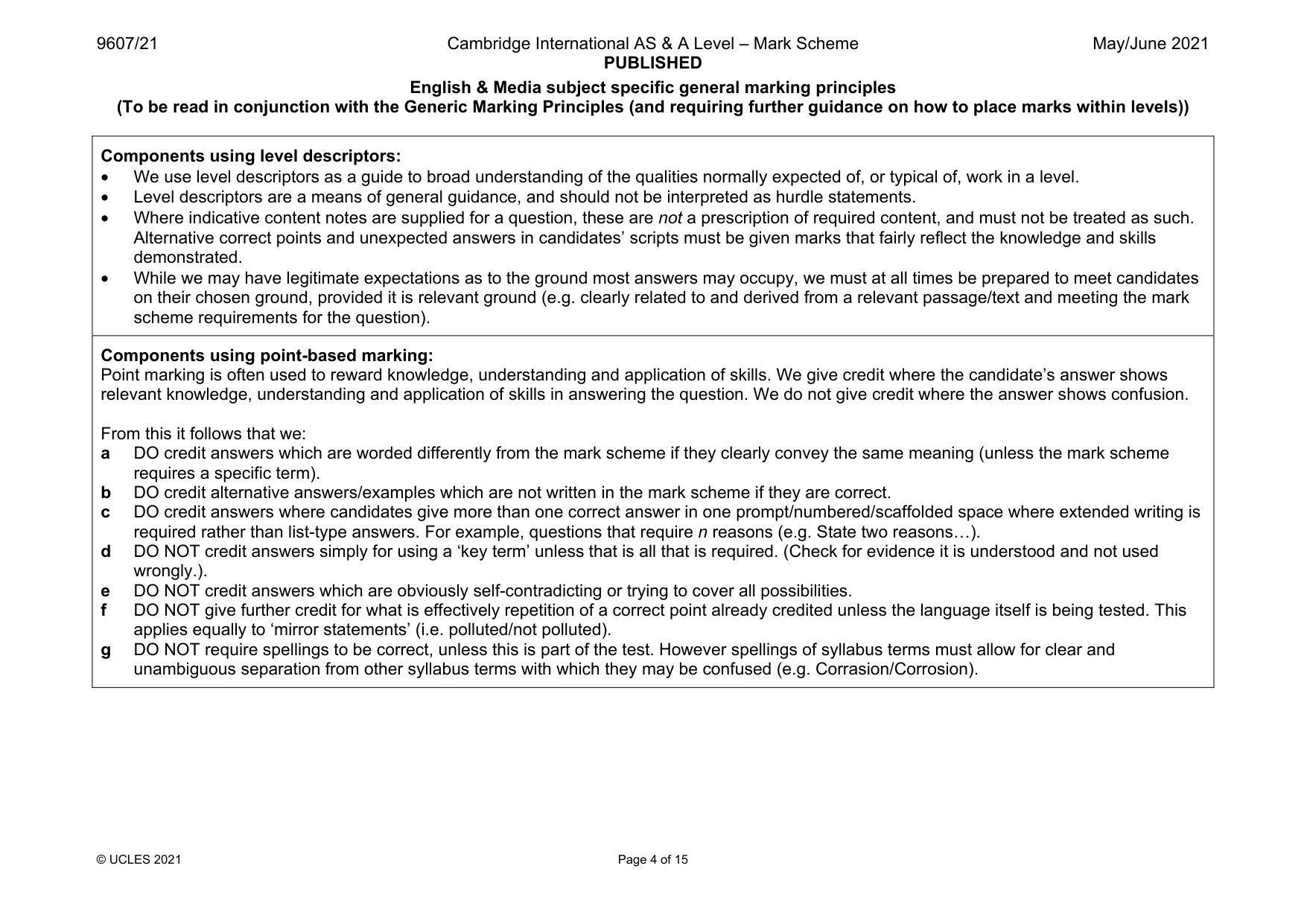
9607/21 Cambridge International AS & A Level – Mark Scheme PUBLISHED May/June 2021 © UCLES 2021 Page 4 of 15 English & Media subject specific general marking principles (To be read in conjunction with the Generic Marking Principles (and requiring further guidance on how to place marks within levels)) Components using level descriptors: • We use level descriptors as a guide to broad understanding of the qualities normally expected of, or typical of, work in a level. • Level descriptors are a means of general guidance, and should not be interpreted as hurdle statements. • Where indicative content notes are supplied for a question, these are not a prescription of required content, and must not be treated as such. Alternative correct points and unexpected answers in candidates’ scripts must be given marks that fairly reflect the knowledge and skills demonstrated. • While we may have legitimate expectations as to the ground most answers may occupy, we must at all times be prepared to meet candidates on their chosen ground, provided it is relevant ground (e.g. clearly related to and derived from a relevant passage/text and meeting the mark scheme requirements for the question). Components using point-based marking: Point marking is often used to reward knowledge, understanding and application of skills. We give credit where the candidate’s answer shows relevant knowledge, understanding and application of skills in answering the question. We do not give credit where the answer shows confusion. From this it follows that we: a DO credit answers which are worded differently from the mark scheme if they clearly convey the same meaning (unless the mark scheme requires a specific term). b DO credit alternative answers/examples which are not written in the mark scheme if they are correct. c DO credit answers where candidates give more than one correct answer in one prompt/numbered/scaffolded space where extended writing is required rather than list-type answers. For example, questions that require n reasons (e.g. State two reasons…). d DO NOT credit answers simply for using a ‘key term’ unless that is all that is required. (Check for evidence it is understood and not used wrongly.). e DO NOT credit answers which are obviously self-contradicting or trying to cover all possibilities. f DO NOT give further credit for what is effectively repetition of a correct point already credited unless the language itself is being tested. This applies equally to ‘mirror statements’ (i.e. polluted/not polluted). g DO NOT require spellings to be correct, unless this is part of the test. However spellings of syllabus terms must allow for clear and unambiguous separation from other syllabus terms with which they may be confused (e.g. Corrasion/Corrosion).
Mark scheme, page 5
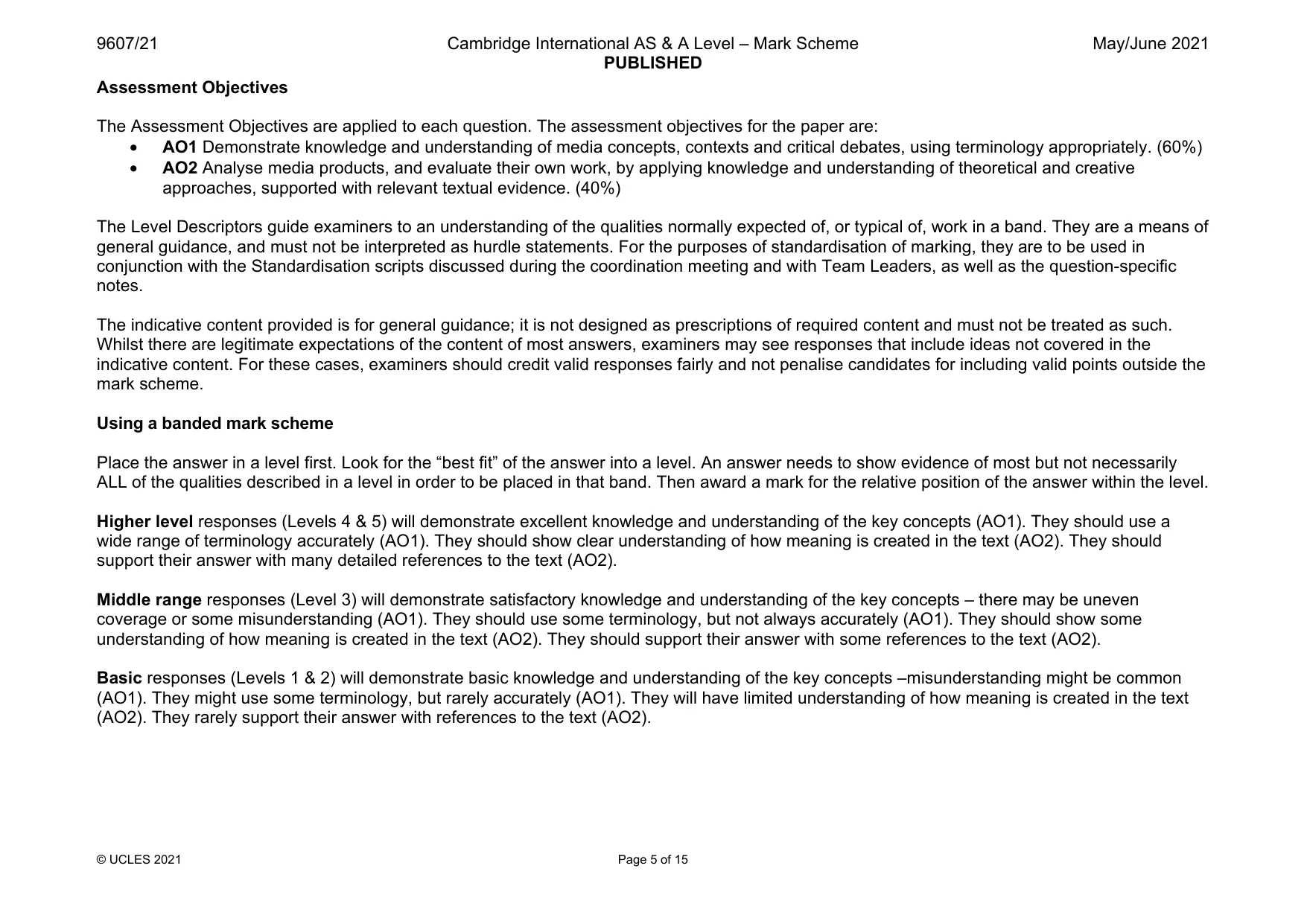
9607/21 Cambridge International AS & A Level – Mark Scheme PUBLISHED May/June 2021 © UCLES 2021 Page 5 of 15 Assessment Objectives The Assessment Objectives are applied to each question. The assessment objectives for the paper are: • AO1 Demonstrate knowledge and understanding of media concepts, contexts and critical debates, using terminology appropriately. (60%) • AO2 Analyse media products, and evaluate their own work, by applying knowledge and understanding of theoretical and creative approaches, supported with relevant textual evidence. (40%) The Level Descriptors guide examiners to an understanding of the qualities normally expected of, or typical of, work in a band. They are a means of general guidance, and must not be interpreted as hurdle statements. For the purposes of standardisation of marking, they are to be used in conjunction with the Standardisation scripts discussed during the coordination meeting and with Team Leaders, as well as the question-specific notes. The indicative content provided is for general guidance; it is not designed as prescriptions of required content and must not be treated as such. Whilst there are legitimate expectations of the content of most answers, examiners may see responses that include ideas not covered in the indicative content. For these cases, examiners should credit valid responses fairly and not penalise candidates for including valid points outside the mark scheme. Using a banded mark scheme Place the answer in a level first. Look for the “best fit” of the answer into a level. An answer needs to show evidence of most but not necessarily ALL of the qualities described in a level in order to be placed in that band. Then award a mark for the relative position of the answer within the level. Higher level responses (Levels 4 & 5) will demonstrate excellent knowledge and understanding of the key concepts (AO1). They should use a wide range of terminology accurately (AO1). They should show clear understanding of how meaning is created in the text (AO2). They should support their answer with many detailed references to the text (AO2). Middle range responses (Level 3) will demonstrate satisfactory knowledge and understanding of the key concepts – there may be uneven coverage or some misunderstanding (AO1). They should use some terminology, but not always accurately (AO1). They should show some understanding of how meaning is created in the text (AO2). They should support their answer with some references to the text (AO2). Basic responses (Levels 1 & 2) will demonstrate basic knowledge and understanding of the key concepts –misunderstanding might be common (AO1). They might use some terminology, but rarely accurately (AO1). They will have limited understanding of how meaning is created in the text (AO2). They rarely support their answer with references to the text (AO2).
Mark scheme, page 6
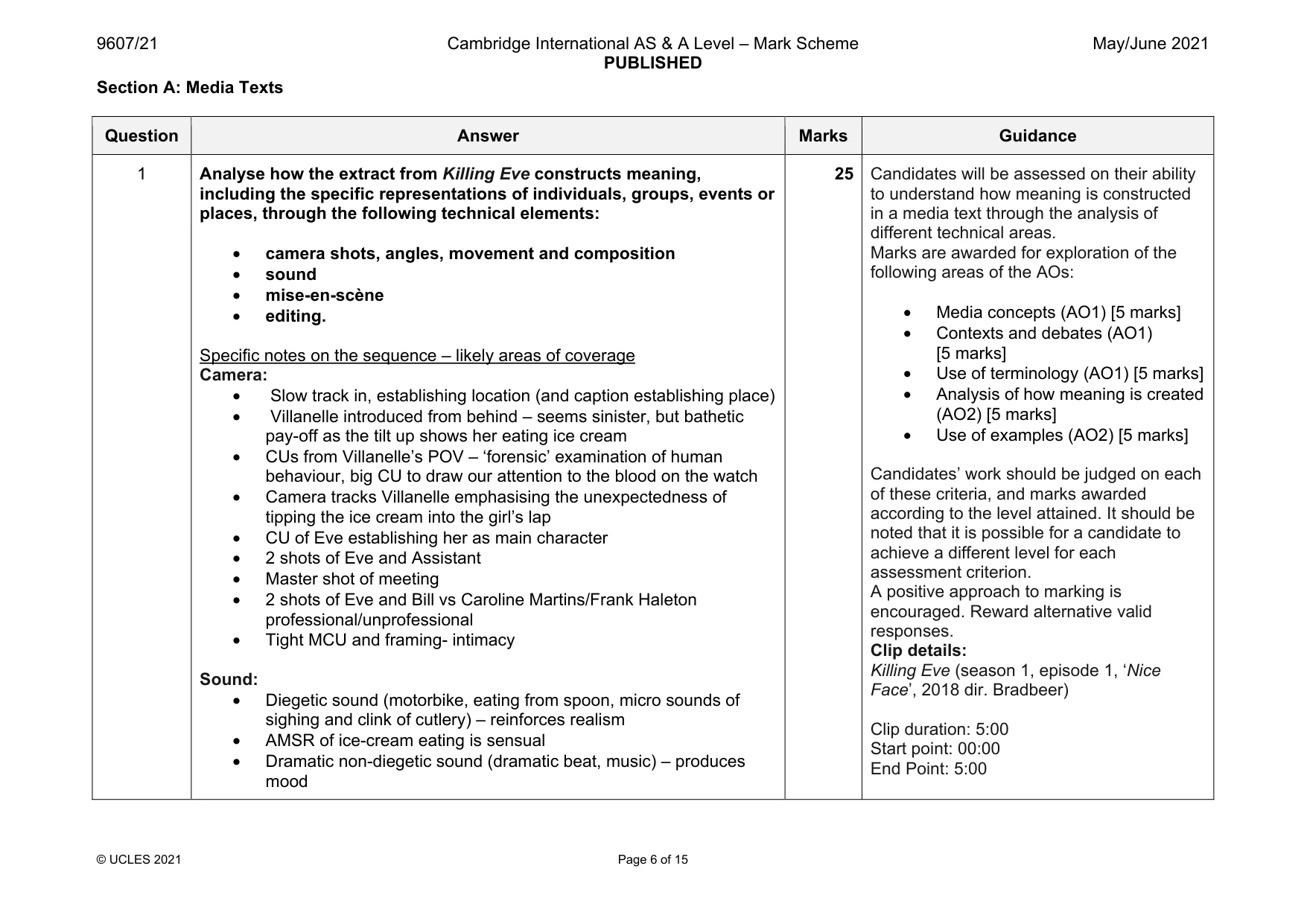
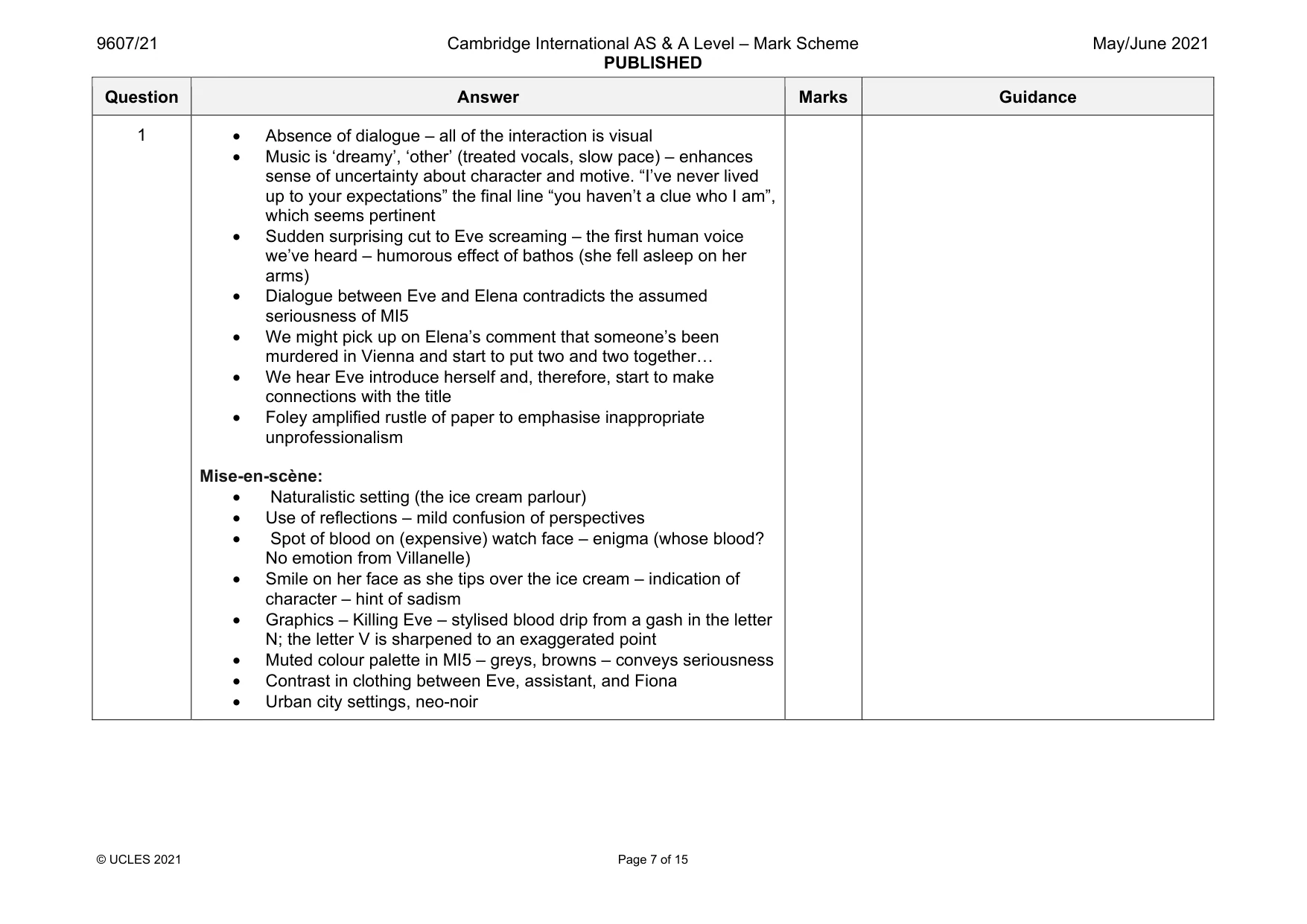
9607/21 Cambridge International AS & A Level – Mark Scheme PUBLISHED May/June 2021 © UCLES 2021 Page 6 of 15 Section A: Media Texts Question Answer Marks Guidance 1 Analyse how the extract from Killing Eve constructs meaning, including the specific representations of individuals, groups, events or places, through the following technical elements: • camera shots, angles, movement and composition • sound • mise-en-scène • editing. Specific notes on the sequence – likely areas of coverage Camera: • Slow track in, establishing location (and caption establishing place) • Villanelle introduced from behind – seems sinister, but bathetic pay-off as the tilt up shows her eating ice cream • CUs from Villanelle’s POV – ‘forensic’ examination of human behaviour, big CU to draw our attention to the blood on the watch • Camera tracks Villanelle emphasising the unexpectedness of tipping the ice cream into the girl’s lap • CU of Eve establishing her as main character • 2 shots of Eve and Assistant • Master shot of meeting • 2 shots of Eve and Bill vs Caroline Martins/Frank Haleton professional/unprofessional • Tight MCU and framing- intimacy Sound: • Diegetic sound (motorbike, eating from spoon, micro sounds of sighing and clink of cutlery) – reinforces realism • AMSR of ice-cream eating is sensual • Dramatic non-diegetic sound (dramatic beat, music) – produces mood 25 Candidates will be assessed on their ability to understand how meaning is constructed in a media text through the analysis of different technical areas. Marks are awarded for exploration of the following areas of the AOs: • Media concepts (AO1) [5 marks] • Contexts and debates (AO1) [5 marks] • Use of terminology (AO1) [5 marks] • Analysis of how meaning is created (AO2) [5 marks] • Use of examples (AO2) [5 marks] Candidates’ work should be judged on each of these criteria, and marks awarded according to the level attained. It should be noted that it is possible for a candidate to achieve a different level for each assessment criterion. A positive approach to marking is encouraged. Reward alternative valid responses. Clip details: Killing Eve (season 1, episode 1, ‘Nice Face’, 2018 dir. Bradbeer) Clip duration: 5:00 Start point: 00:00 End Point: 5:00
Mark scheme, page 7
9607/21 Cambridge International AS & A Level – Mark Scheme PUBLISHED May/June 2021 © UCLES 2021 Page 7 of 15 Question Answer Marks Guidance 1 • Absence of dialogue – all of the interaction is visual • Music is ‘dreamy’, ‘other’ (treated vocals, slow pace) – enhances sense of uncertainty about character and motive. “I’ve never lived up to your expectations” the final line “you haven’t a clue who I am”, which seems pertinent • Sudden surprising cut to Eve screaming – the first human voice we’ve heard – humorous effect of bathos (she fell asleep on her arms) • Dialogue between Eve and Elena contradicts the assumed seriousness of MI5 • We might pick up on Elena’s comment that someone’s been murdered in Vienna and start to put two and two together… • We hear Eve introduce herself and, therefore, start to make connections with the title • Foley amplified rustle of paper to emphasise inappropriate unprofessionalism Mise-en-scène: • Naturalistic setting (the ice cream parlour) • Use of reflections – mild confusion of perspectives • Spot of blood on (expensive) watch face – enigma (whose blood? No emotion from Villanelle) • Smile on her face as she tips over the ice cream – indication of character – hint of sadism • Graphics – Killing Eve – stylised blood drip from a gash in the letter N; the letter V is sharpened to an exaggerated point • Muted colour palette in MI5 – greys, browns – conveys seriousness • Contrast in clothing between Eve, assistant, and Fiona • Urban city settings, neo-noir
Mark scheme, page 8
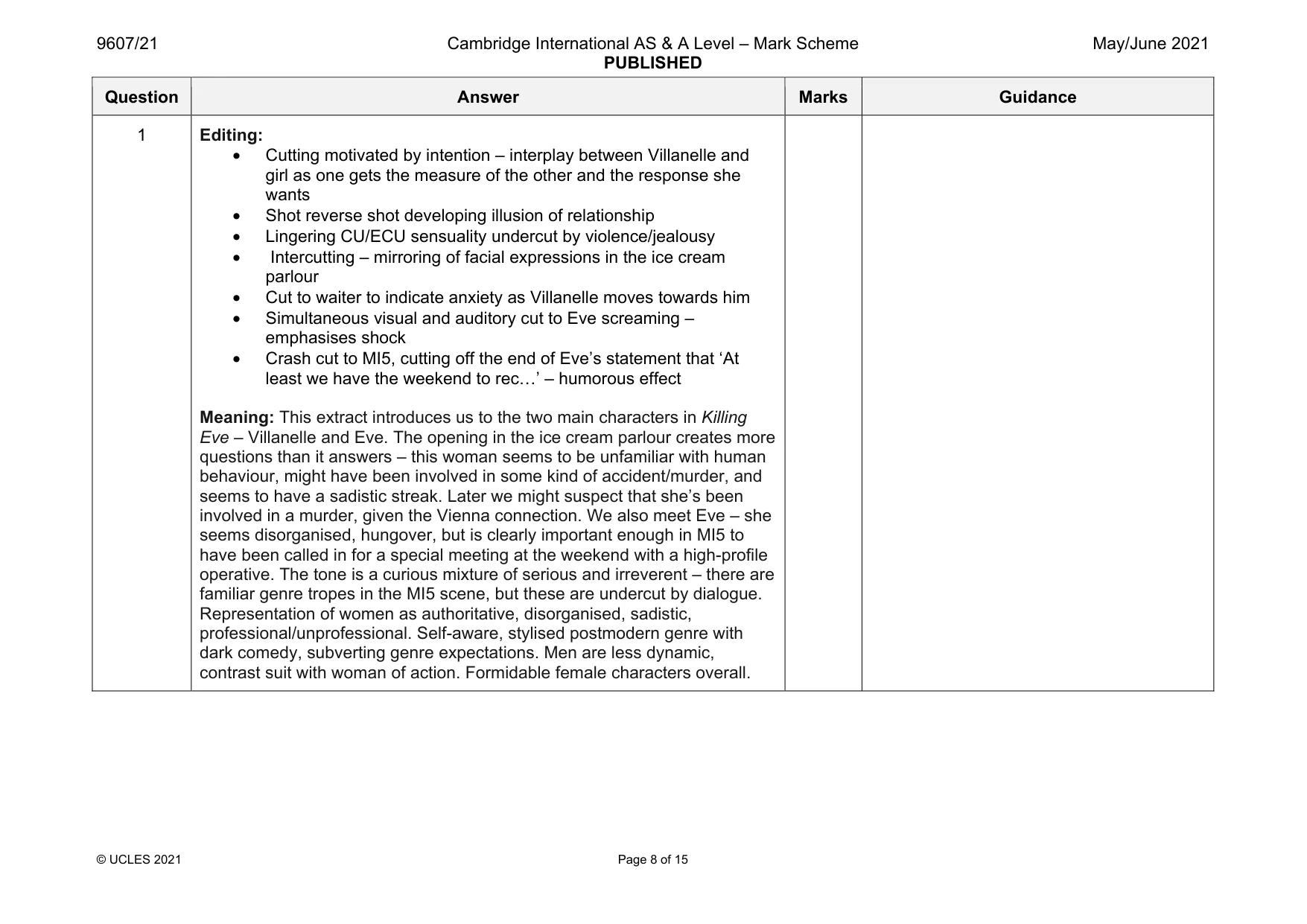
9607/21 Cambridge International AS & A Level – Mark Scheme PUBLISHED May/June 2021 © UCLES 2021 Page 8 of 15 Question Answer Marks Guidance 1 Editing: • Cutting motivated by intention – interplay between Villanelle and girl as one gets the measure of the other and the response she wants • Shot reverse shot developing illusion of relationship • Lingering CU/ECU sensuality undercut by violence/jealousy • Intercutting – mirroring of facial expressions in the ice cream parlour • Cut to waiter to indicate anxiety as Villanelle moves towards him • Simultaneous visual and auditory cut to Eve screaming – emphasises shock • Crash cut to MI5, cutting off the end of Eve’s statement that ‘At least we have the weekend to rec…’ – humorous effect Meaning: This extract introduces us to the two main characters in Killing Eve – Villanelle and Eve. The opening in the ice cream parlour creates more questions than it answers – this woman seems to be unfamiliar with human behaviour, might have been involved in some kind of accident/murder, and seems to have a sadistic streak. Later we might suspect that she’s been involved in a murder, given the Vienna connection. We also meet Eve – she seems disorganised, hungover, but is clearly important enough in MI5 to have been called in for a special meeting at the weekend with a high-profile operative. The tone is a curious mixture of serious and irreverent – there are familiar genre tropes in the MI5 scene, but these are undercut by dialogue. Representation of women as authoritative, disorganised, sadistic, professional/unprofessional. Self-aware, stylised postmodern genre with dark comedy, subverting genre expectations. Men are less dynamic, contrast suit with woman of action. Formidable female characters overall.
Mark scheme, page 9
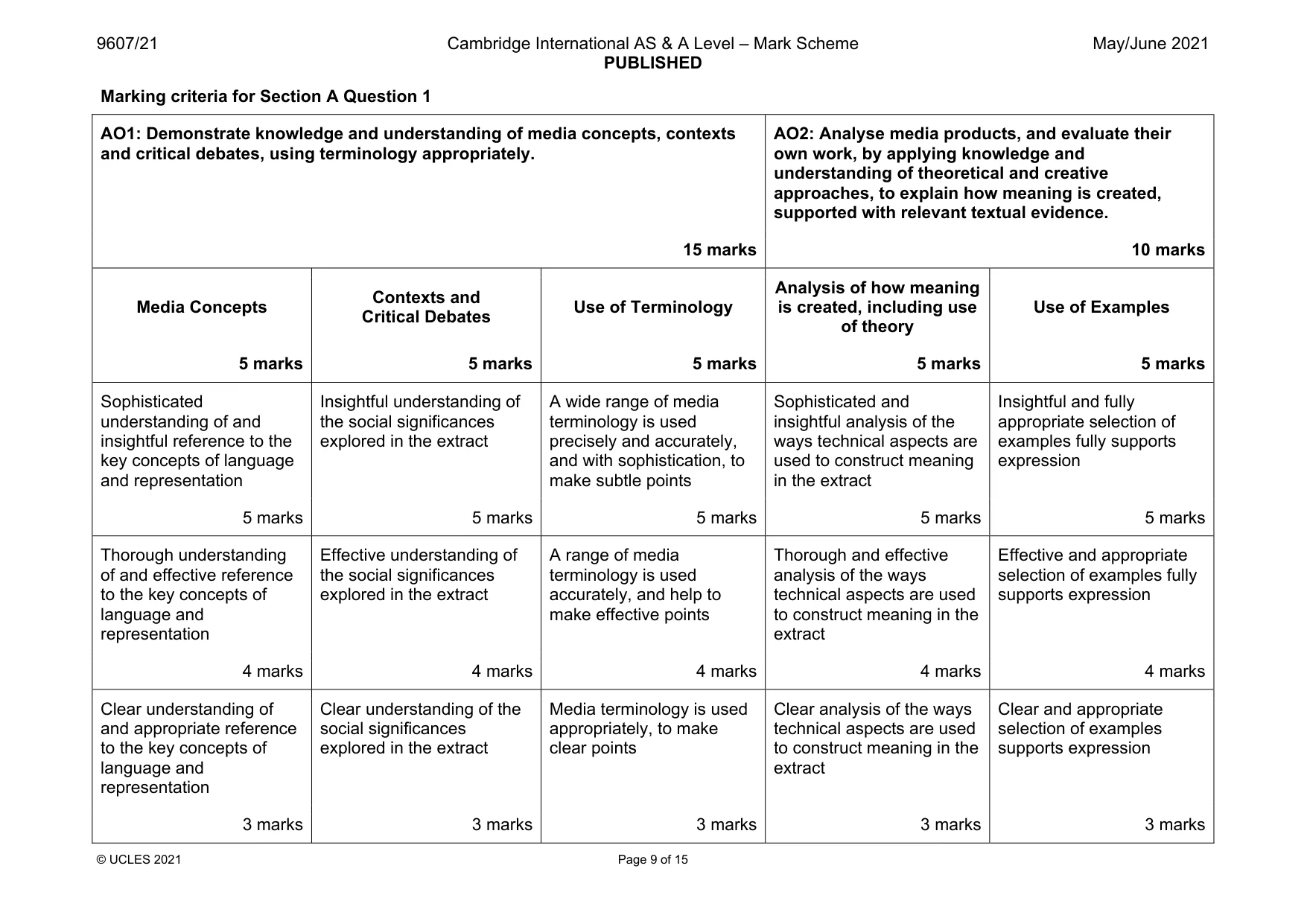
9607/21 Cambridge International AS & A Level – Mark Scheme PUBLISHED May/June 2021 © UCLES 2021 Page 9 of 15 Marking criteria for Section A Question 1 AO1: Demonstrate knowledge and understanding of media concepts, contexts and critical debates, using terminology appropriately. AO2: Analyse media products, and evaluate their own work, by applying knowledge and understanding of theoretical and creative approaches, to explain how meaning is created, supported with relevant textual evidence. 15 marks 10 marks Media Concepts Contexts and Critical Debates Use of Terminology Analysis of how meaning is created, including use of theory Use of Examples 5 marks 5 marks 5 marks 5 marks 5 marks Sophisticated understanding of and insightful reference to the key concepts of language and representation Insightful understanding of the social significances explored in the extract A wide range of media terminology is used precisely and accurately, and with sophistication, to make subtle points Sophisticated and insightful analysis of the ways technical aspects are used to construct meaning in the extract Insightful and fully appropriate selection of examples fully supports expression 5 marks 5 marks 5 marks 5 marks 5 marks Thorough understanding of and effective reference to the key concepts of language and representation Effective understanding of the social significances explored in the extract A range of media terminology is used accurately, and help to make effective points Thorough and effective analysis of the ways technical aspects are used to construct meaning in the extract Effective and appropriate selection of examples fully supports expression 4 marks 4 marks 4 marks 4 marks 4 marks Clear understanding of and appropriate reference to the key concepts of language and representation Clear understanding of the social significances explored in the extract Media terminology is used appropriately, to make clear points Clear analysis of the ways technical aspects are used to construct meaning in the extract Clear and appropriate selection of examples supports expression 3 marks 3 marks 3 marks 3 marks 3 marks
Mark scheme, page 10
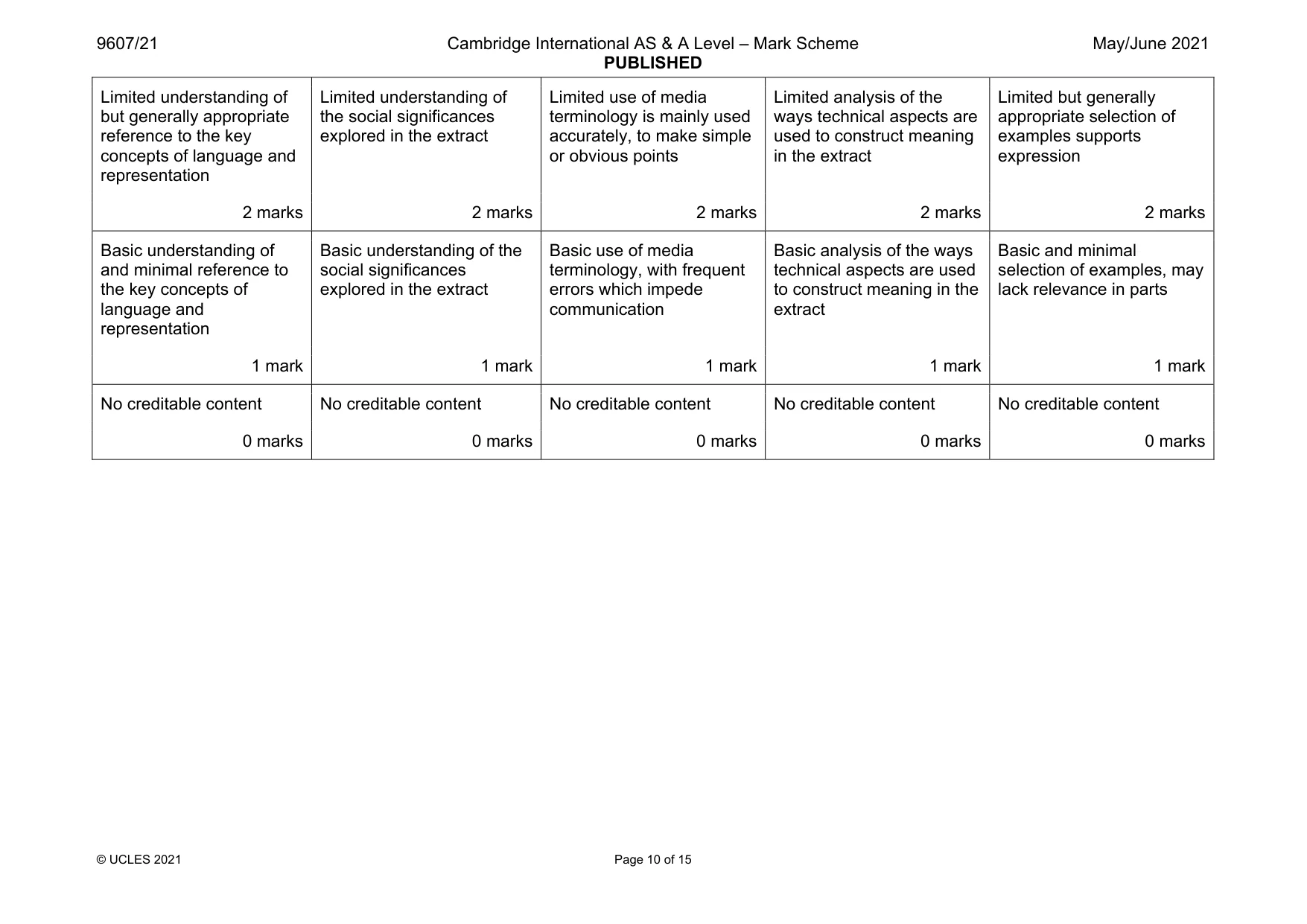
9607/21 Cambridge International AS & A Level – Mark Scheme PUBLISHED May/June 2021 © UCLES 2021 Page 10 of 15 Limited understanding of but generally appropriate reference to the key concepts of language and representation Limited understanding of the social significances explored in the extract Limited use of media terminology is mainly used accurately, to make simple or obvious points Limited analysis of the ways technical aspects are used to construct meaning in the extract Limited but generally appropriate selection of examples supports expression 2 marks 2 marks 2 marks 2 marks 2 marks Basic understanding of and minimal reference to the key concepts of language and representation Basic understanding of the social significances explored in the extract Basic use of media terminology, with frequent errors which impede communication Basic analysis of the ways technical aspects are used to construct meaning in the extract Basic and minimal selection of examples, may lack relevance in parts 1 mark 1 mark 1 mark 1 mark 1 mark No creditable content No creditable content No creditable content No creditable content No creditable content 0 marks 0 marks 0 marks 0 marks 0 marks
Mark scheme, page 11
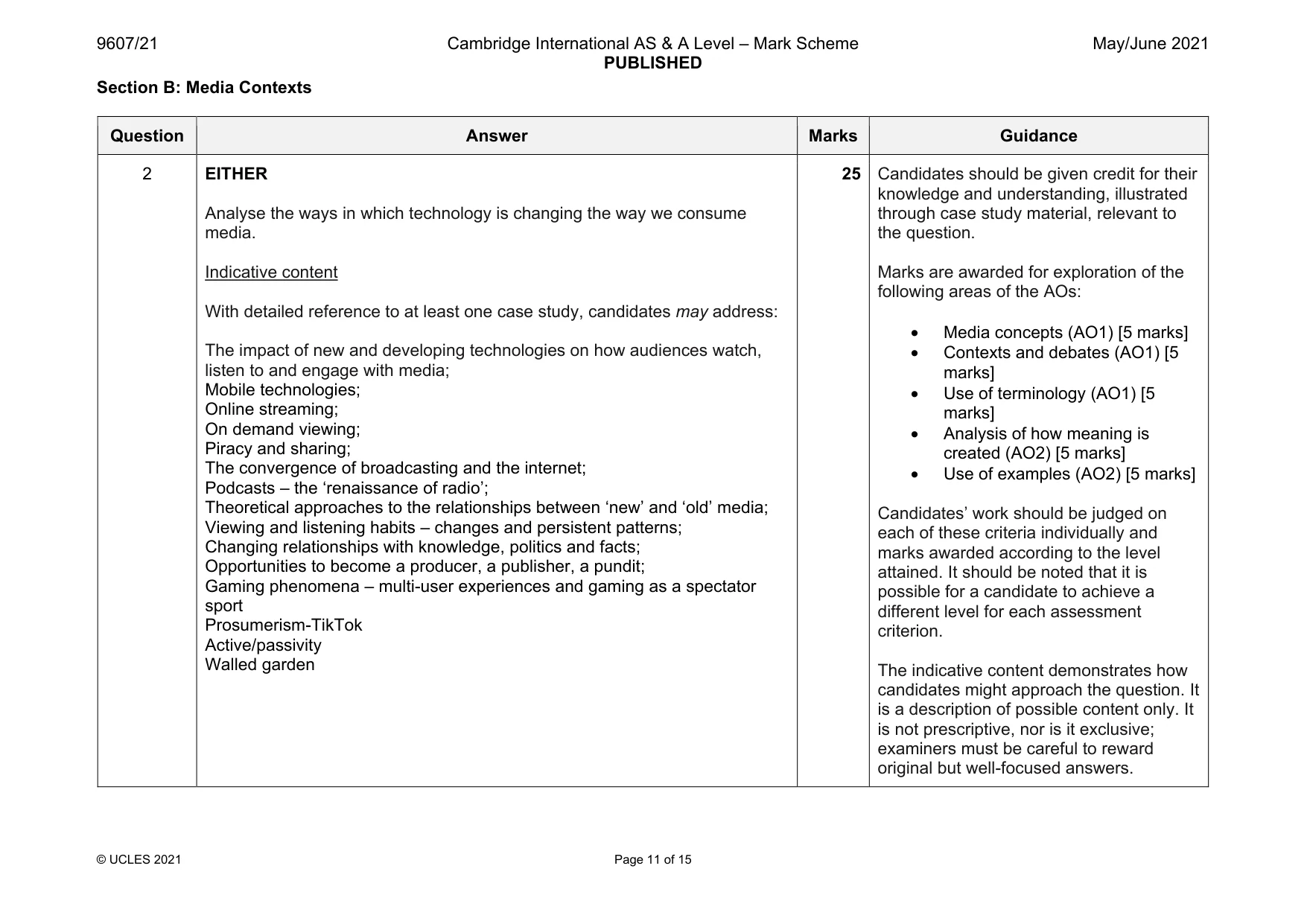
9607/21 Cambridge International AS & A Level – Mark Scheme PUBLISHED May/June 2021 © UCLES 2021 Page 11 of 15 Section B: Media Contexts Question Answer Marks Guidance 2 EITHER Analyse the ways in which technology is changing the way we consume media. Indicative content With detailed reference to at least one case study, candidates may address: The impact of new and developing technologies on how audiences watch, listen to and engage with media; Mobile technologies; Online streaming; On demand viewing; Piracy and sharing; The convergence of broadcasting and the internet; Podcasts – the ‘renaissance of radio’; Theoretical approaches to the relationships between ‘new’ and ‘old’ media; Viewing and listening habits – changes and persistent patterns; Changing relationships with knowledge, politics and facts; Opportunities to become a producer, a publisher, a pundit; Gaming phenomena – multi-user experiences and gaming as a spectator sport Prosumerism-TikTok Active/passivity Walled garden 25 Candidates should be given credit for their knowledge and understanding, illustrated through case study material, relevant to the question. Marks are awarded for exploration of the following areas of the AOs: • Media concepts (AO1) [5 marks] • Contexts and debates (AO1) [5 marks] • Use of terminology (AO1) [5 marks] • Analysis of how meaning is created (AO2) [5 marks] • Use of examples (AO2) [5 marks] Candidates’ work should be judged on each of these criteria individually and marks awarded according to the level attained. It should be noted that it is possible for a candidate to achieve a different level for each assessment criterion. The indicative content demonstrates how candidates might approach the question. It is a description of possible content only. It is not prescriptive, nor is it exclusive; examiners must be careful to reward original but well-focused answers.
Mark scheme, page 12
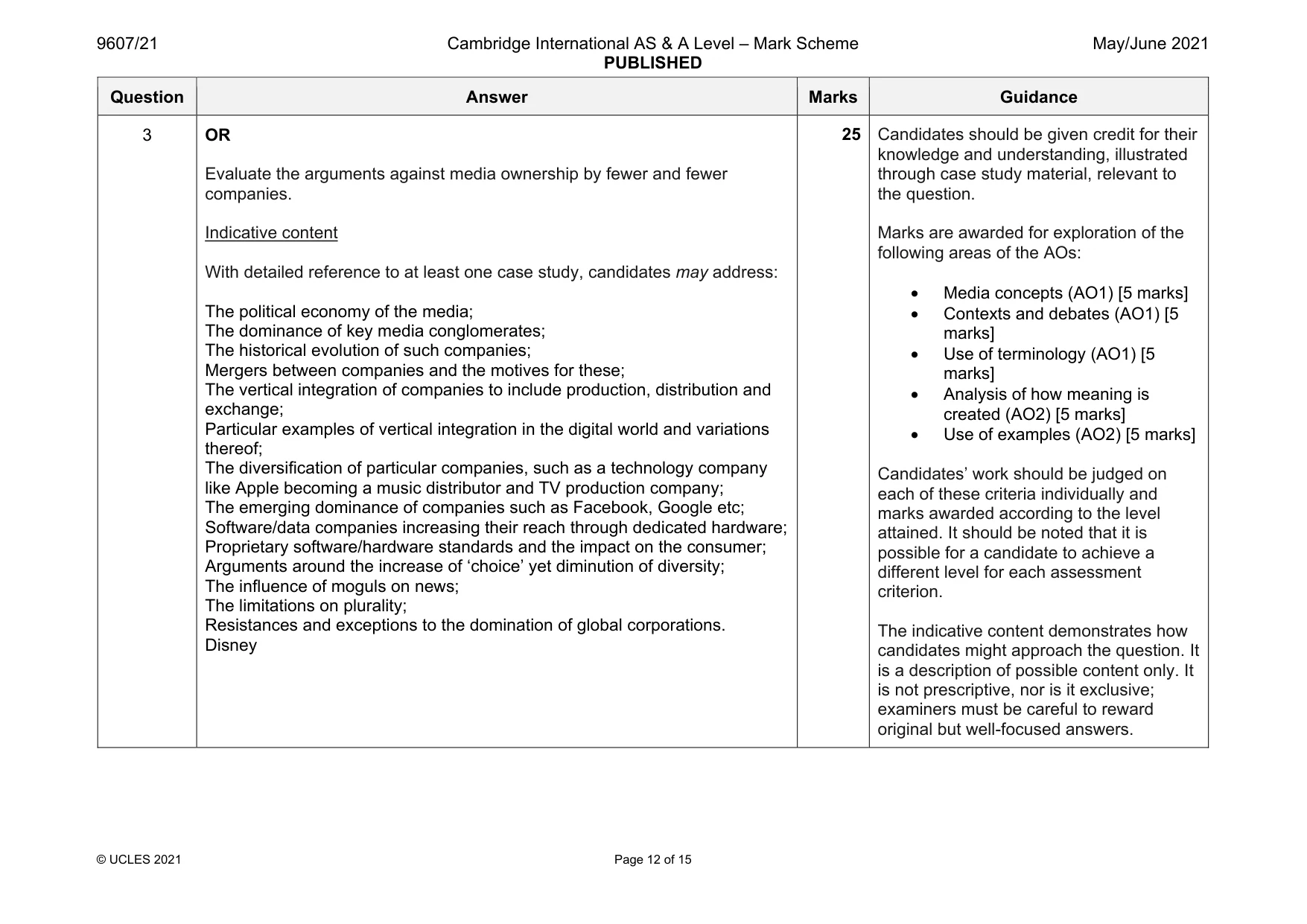
9607/21 Cambridge International AS & A Level – Mark Scheme PUBLISHED May/June 2021 © UCLES 2021 Page 12 of 15 Question Answer Marks Guidance 3 OR Evaluate the arguments against media ownership by fewer and fewer companies. Indicative content With detailed reference to at least one case study, candidates may address: The political economy of the media; The dominance of key media conglomerates; The historical evolution of such companies; Mergers between companies and the motives for these; The vertical integration of companies to include production, distribution and exchange; Particular examples of vertical integration in the digital world and variations thereof; The diversification of particular companies, such as a technology company like Apple becoming a music distributor and TV production company; The emerging dominance of companies such as Facebook, Google etc; Software/data companies increasing their reach through dedicated hardware; Proprietary software/hardware standards and the impact on the consumer; Arguments around the increase of ‘choice’ yet diminution of diversity; The influence of moguls on news; The limitations on plurality; Resistances and exceptions to the domination of global corporations. Disney 25 Candidates should be given credit for their knowledge and understanding, illustrated through case study material, relevant to the question. Marks are awarded for exploration of the following areas of the AOs: • Media concepts (AO1) [5 marks] • Contexts and debates (AO1) [5 marks] • Use of terminology (AO1) [5 marks] • Analysis of how meaning is created (AO2) [5 marks] • Use of examples (AO2) [5 marks] Candidates’ work should be judged on each of these criteria individually and marks awarded according to the level attained. It should be noted that it is possible for a candidate to achieve a different level for each assessment criterion. The indicative content demonstrates how candidates might approach the question. It is a description of possible content only. It is not prescriptive, nor is it exclusive; examiners must be careful to reward original but well-focused answers.
Mark scheme, page 13
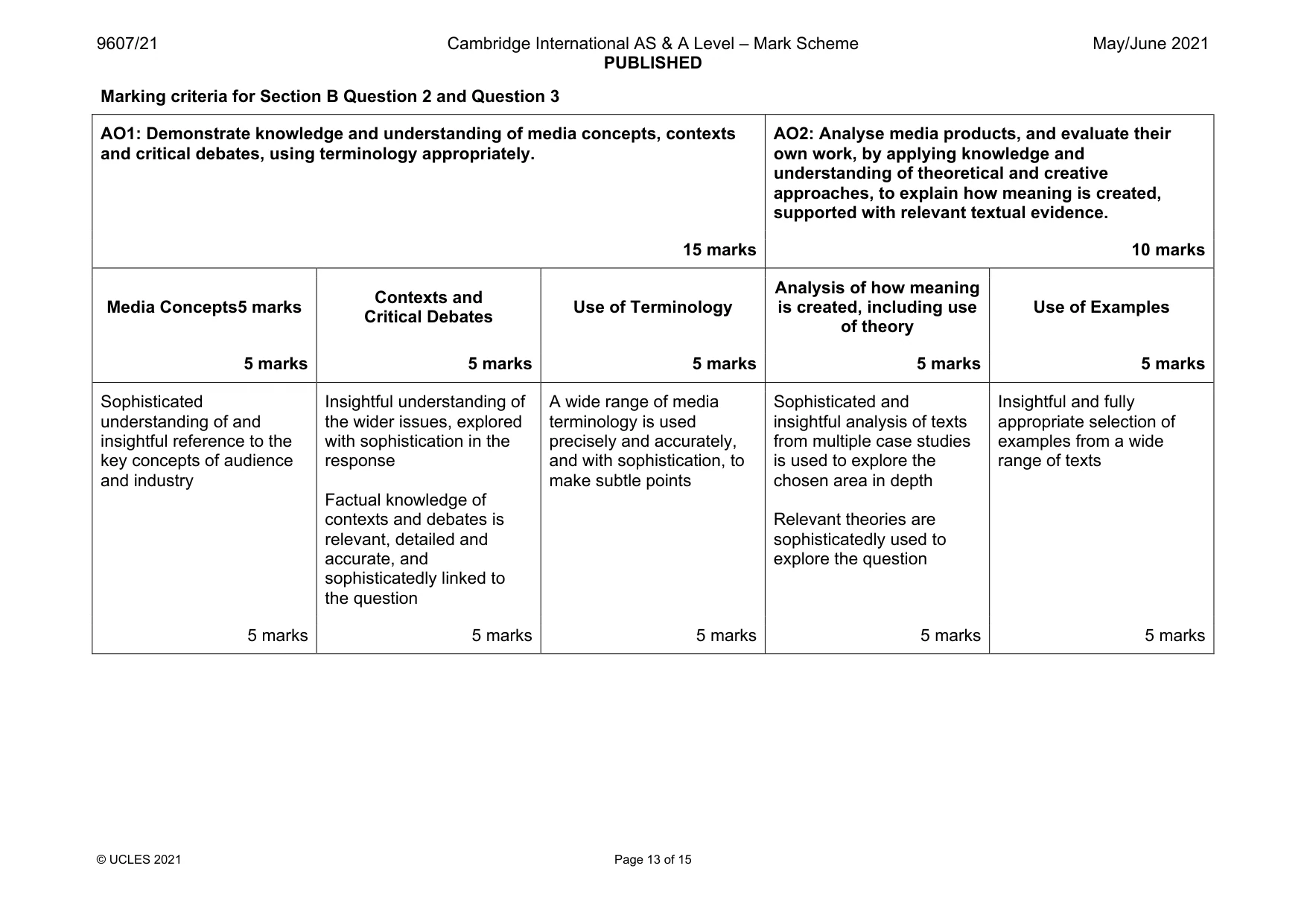
9607/21 Cambridge International AS & A Level – Mark Scheme PUBLISHED May/June 2021 © UCLES 2021 Page 13 of 15 Marking criteria for Section B Question 2 and Question 3 AO1: Demonstrate knowledge and understanding of media concepts, contexts and critical debates, using terminology appropriately. AO2: Analyse media products, and evaluate their own work, by applying knowledge and understanding of theoretical and creative approaches, to explain how meaning is created, supported with relevant textual evidence. 15 marks 10 marks Media Concepts5 marks Contexts and Critical Debates Use of Terminology Analysis of how meaning is created, including use of theory Use of Examples 5 marks 5 marks 5 marks 5 marks 5 marks Sophisticated understanding of and insightful reference to the key concepts of audience and industry Insightful understanding of the wider issues, explored with sophistication in the response Factual knowledge of contexts and debates is relevant, detailed and accurate, and sophisticatedly linked to the question A wide range of media terminology is used precisely and accurately, and with sophistication, to make subtle points Sophisticated and insightful analysis of texts from multiple case studies is used to explore the chosen area in depth Relevant theories are sophisticatedly used to explore the question Insightful and fully appropriate selection of examples from a wide range of texts 5 marks 5 marks 5 marks 5 marks 5 marks
Mark scheme, page 14
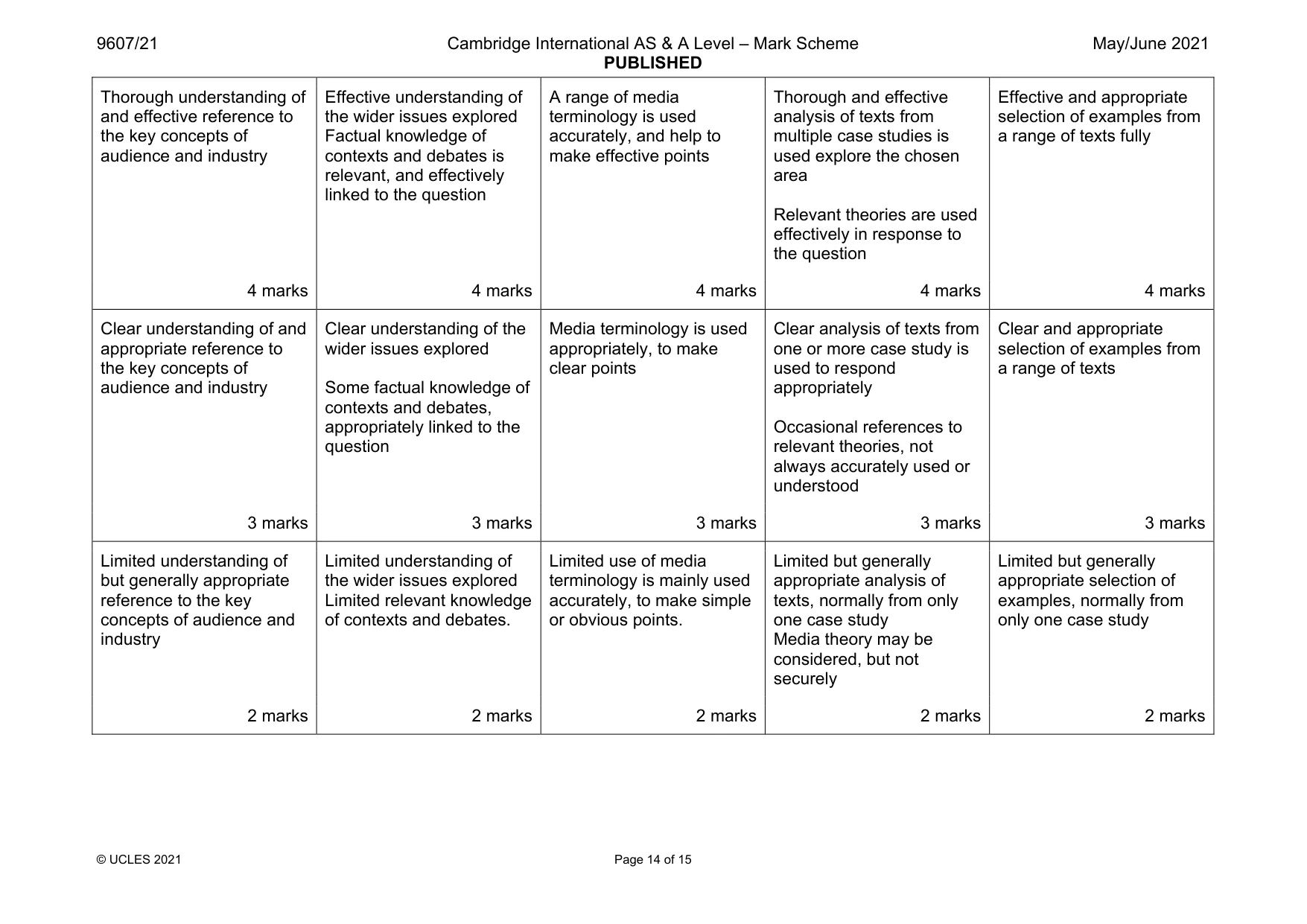
9607/21 Cambridge International AS & A Level – Mark Scheme PUBLISHED May/June 2021 © UCLES 2021 Page 14 of 15 Thorough understanding of and effective reference to the key concepts of audience and industry Effective understanding of the wider issues explored Factual knowledge of contexts and debates is relevant, and effectively linked to the question A range of media terminology is used accurately, and help to make effective points Thorough and effective analysis of texts from multiple case studies is used explore the chosen area Relevant theories are used effectively in response to the question Effective and appropriate selection of examples from a range of texts fully 4 marks 4 marks 4 marks 4 marks 4 marks Clear understanding of and appropriate reference to the key concepts of audience and industry Clear understanding of the wider issues explored Some factual knowledge of contexts and debates, appropriately linked to the question Media terminology is used appropriately, to make clear points Clear analysis of texts from one or more case study is used to respond appropriately Occasional references to relevant theories, not always accurately used or understood Clear and appropriate selection of examples from a range of texts 3 marks 3 marks 3 marks 3 marks 3 marks Limited understanding of but generally appropriate reference to the key concepts of audience and industry Limited understanding of the wider issues explored Limited relevant knowledge of contexts and debates. Limited use of media terminology is mainly used accurately, to make simple or obvious points. Limited but generally appropriate analysis of texts, normally from only one case study Media theory may be considered, but not securely Limited but generally appropriate selection of examples, normally from only one case study 2 marks 2 marks 2 marks 2 marks 2 marks
Mark scheme, page 15
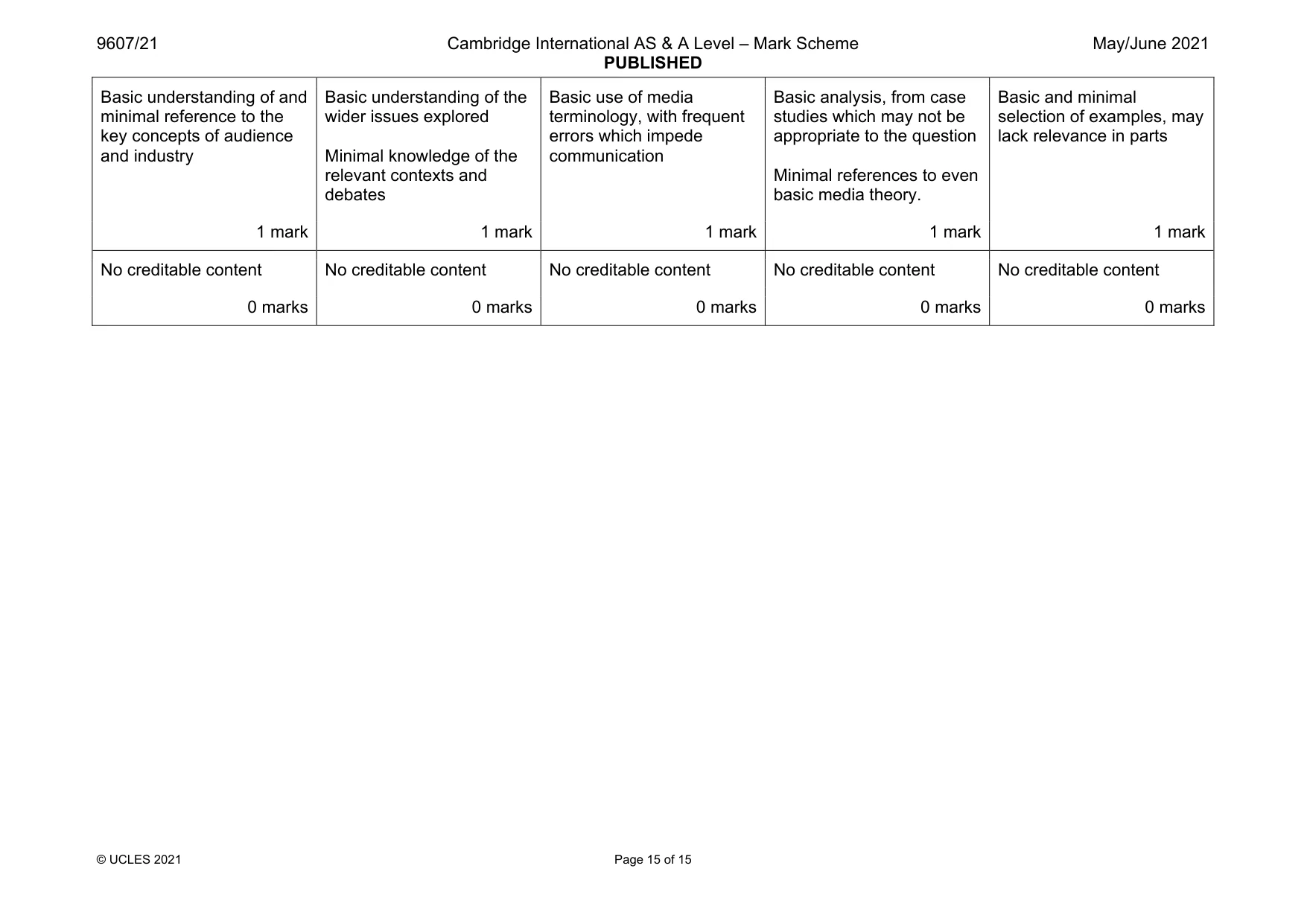
9607/21 Cambridge International AS & A Level – Mark Scheme PUBLISHED May/June 2021 © UCLES 2021 Page 15 of 15 Basic understanding of and minimal reference to the key concepts of audience and industry Basic understanding of the wider issues explored Minimal knowledge of the relevant contexts and debates Basic use of media terminology, with frequent errors which impede communication Basic analysis, from case studies which may not be appropriate to the question Minimal references to even basic media theory. Basic and minimal selection of examples, may lack relevance in parts 1 mark 1 mark 1 mark 1 mark 1 mark No creditable content No creditable content No creditable content No creditable content No creditable content 0 marks 0 marks 0 marks 0 marks 0 marks
What you needed in this session
Cambridge’s own grade thresholds for 2021 May/June, Paper 2 · Variant 1. A higher threshold means an easier paper — the bar moves with how the cohort did.