Questions as text
Q1 · A bag contains 4 red balls and 6 blue balls 9231/41 May/June 2020
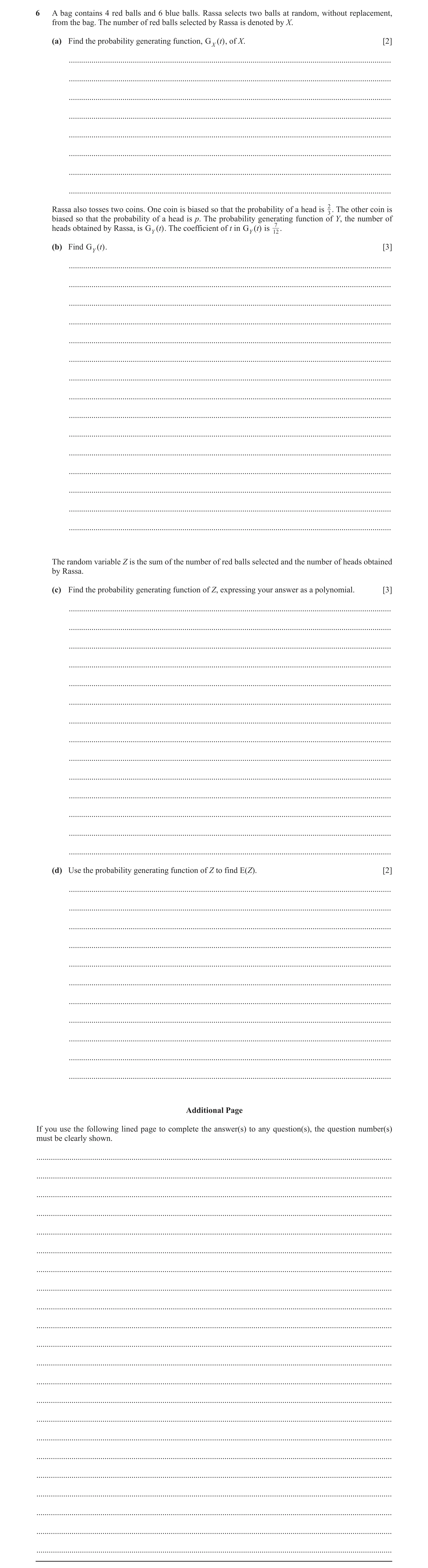
6 A bag contains 4 red balls and 6 blue balls. Rassa selects two balls at random, without replacement, from the bag. The number of red balls selected by Rassa is denoted by X. (a) Find the probability generating function, G X ( t) , of X. [2] … … … … … … … … Rassa also tosses two coins. One coin is biased so that the probability of a head is 2.3 The other coin is biased so that the probability of a head is p. The probability generating function of Y, the number of heads obtained by Rassa, is G Y ( t) . The coefficient of t in G Y ( t) is 127 . (b) Find G Y ( t) . [3] … … … … … … … … … … … … … … … The random variable Z is the sum of the number of red balls selected and the number of heads obtained by Rassa. (c) Find the probability generating function of Z, expressing your answer as a polynomial. [3] … … … … … … … … … … … … … … (d) Use the probability generating function of Z to find E(Z). [2] … … … … … … … … … … … Additional Page If you use the following lined page to complete the answer(s) to any question(s), the question number(s) must be clearly shown. … … … … … … … … … … … … … … … … … … … … … …
10 marks
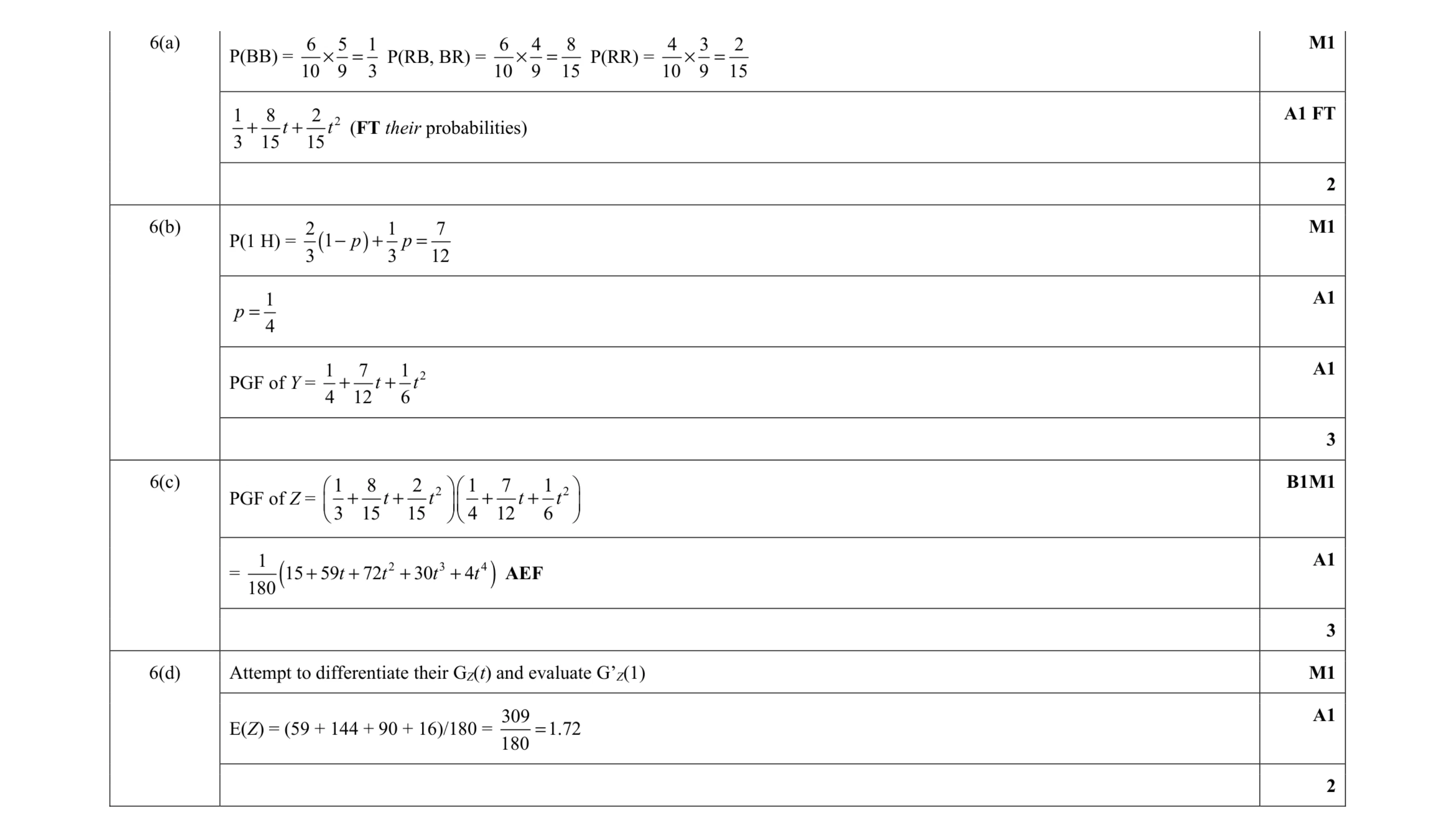
Mark scheme: 6(a) P(BB) = 6 5 1 10 9 3 × = P(RB, BR) = 6 4 8 10 9 15 × = P(RR) = 4 3 2 10 9 15 × = M1 2 1 8 2 3 15 15 + + t t (FT their probabilities) A1 FT 2 6(b) P(1 H) = ( ) 2 1 7 1 3 3 12 − + = p p M1 1 4 = p A1 PGF of Y = 2 1 7 1 4 12 6 + + t t A1 3 6(c) PGF of Z = 2 2 1 8 2 1 7 1 3 15 15 4 12 6 + + + + t t t t B1M1 = ( ) 2 3 4 1 15 59 72 30 4 180 + + + + t t t t AEF A1 3 6(d) Attempt to differentiate their GZ(t) and evaluate G’Z(1) M1 E(Z) = (59 + 144 + 90 + 16)/180 = 309 1.72 180 = A1 2
This question in 9231/41 May/June 2020
Q2 · A bag contains 4 red balls and 6 blue balls 9231/42 May/June 2020
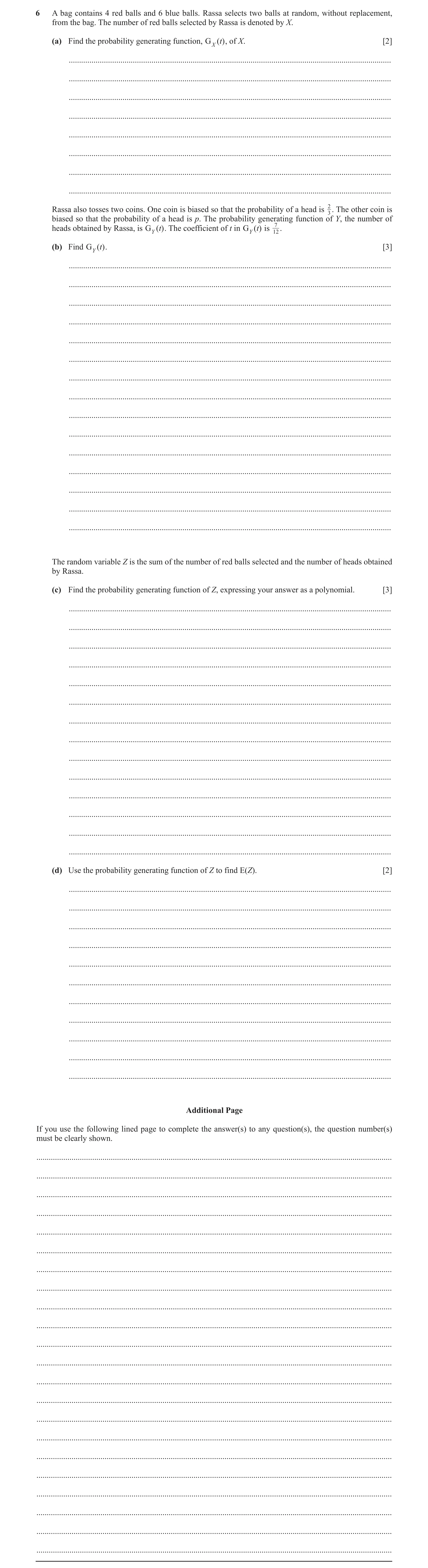
6 A bag contains 4 red balls and 6 blue balls. Rassa selects two balls at random, without replacement, from the bag. The number of red balls selected by Rassa is denoted by X. (a) Find the probability generating function, G X ( t) , of X. [2] … … … … … … … … Rassa also tosses two coins. One coin is biased so that the probability of a head is 2.3 The other coin is biased so that the probability of a head is p. The probability generating function of Y, the number of heads obtained by Rassa, is G Y ( t) . The coefficient of t in G Y ( t) is 127 . (b) Find G Y ( t) . [3] … … … … … … … … … … … … … … … The random variable Z is the sum of the number of red balls selected and the number of heads obtained by Rassa. (c) Find the probability generating function of Z, expressing your answer as a polynomial. [3] … … … … … … … … … … … … … … (d) Use the probability generating function of Z to find E(Z). [2] … … … … … … … … … … … Additional Page If you use the following lined page to complete the answer(s) to any question(s), the question number(s) must be clearly shown. … … … … … … … … … … … … … … … … … … … … … …
10 marks
Mark scheme: 6(a) P(BB) = 6 5 1 10 9 3 × = P(RB, BR) = 6 4 8 10 9 15 × = P(RR) = 4 3 2 10 9 15 × = M1 2 1 8 2 3 15 15 + + t t (FT their probabilities) A1 FT 2 6(b) P(1 H) = ( ) 2 1 7 1 3 3 12 − + = p p M1 1 4 = p A1 PGF of Y = 2 1 7 1 4 12 6 + + t t A1 3 6(c) PGF of Z = 2 2 1 8 2 1 7 1 3 15 15 4 12 6 + + + + t t t t B1M1 = ( ) 2 3 4 1 15 59 72 30 4 180 + + + + t t t t AEF A1 3 6(d) Attempt to differentiate their GZ(t) and evaluate G’Z(1) M1 E(Z) = (59 + 144 + 90 + 16)/180 = 309 1.72 180 = A1 2
This question in 9231/42 May/June 2020
Q3 · The discrete random variable X has probability generating function G X ( t) given by =… 9231/43 May/June 2020
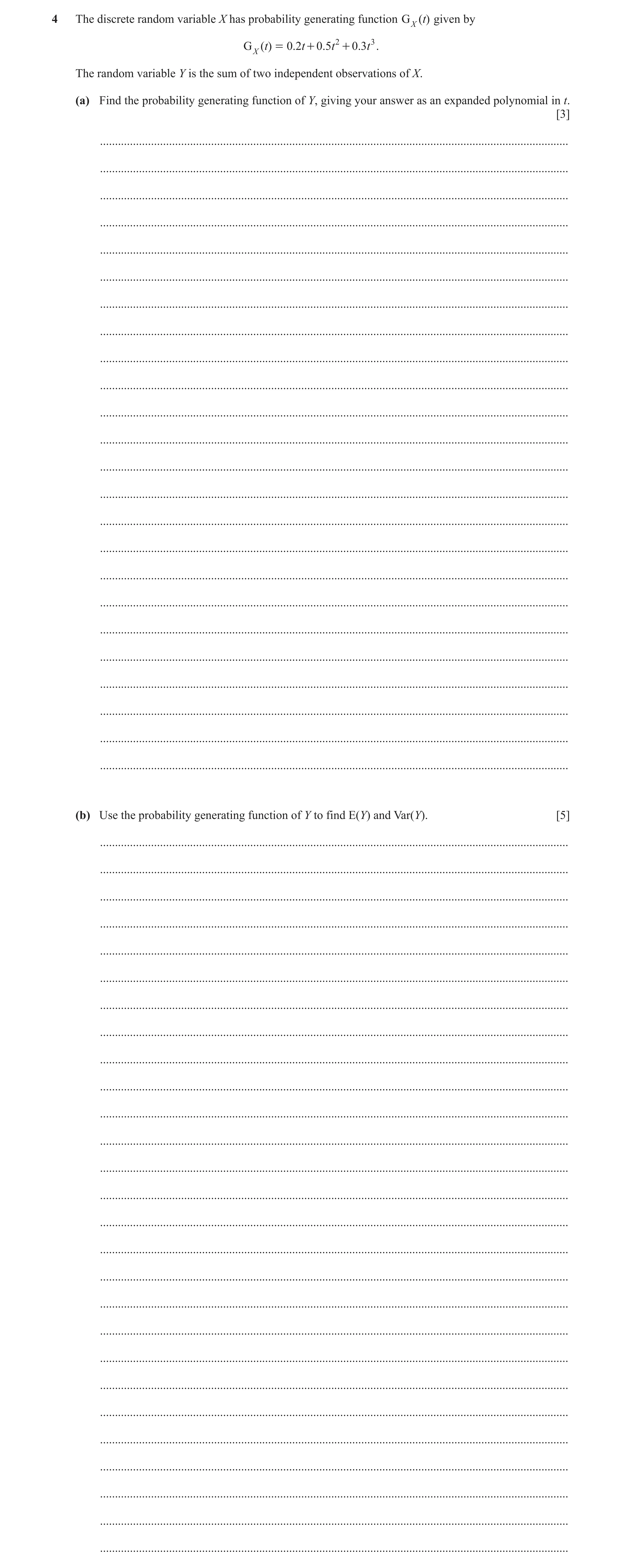
4 The discrete random variable X has probability generating function G X ( t) given by = 0.2t + 0 .5t + 0 .3t . G X ( t) 2 3 The random variable Y is the sum of two independent observations of X. (a) Find the probability generating function of Y, giving your answer as an expanded polynomial in t. [3] … … … … … … … … … … … … … … … … … … … … … … … … (b) Use the probability generating function of Y to find E(Y) and Var(Y). [5] … … … … … … … … … … … … … … … … … … … … … … … … … … …
8 marks
Mark scheme: 4(a) GX (t) = 2 3 0.2 0.5 0.3 + + t t t B1 GY (t) = ( ) 2 3 0.2 0.5 0.3 + + t t t 2 M1 = 2 3 4 5 6 0.04 0.2 0.37 0.3 0.09 + + + + t t t t t A1 3 4(b) G’Y(t) = 2 3 4 5 0.08 0.6 1.48 1.5 0.54 + + + + t t t t t M1 E(Y) = 4.2 A1 G’’Y(t) = 2 3 4 0.08 1.2 4.44 6 2.7 + + + + t t t t M1 Use G’’Y (1) + G’Y(1) – (G’Y(1))2 M1 Var(Y) = 14.42 + 4.2 – 4.22 = 0.98 A1 5
This question in 9231/43 May/June 2020
Q4 · Keira has two unbiased coins 9231/41 Oct/Nov 2020
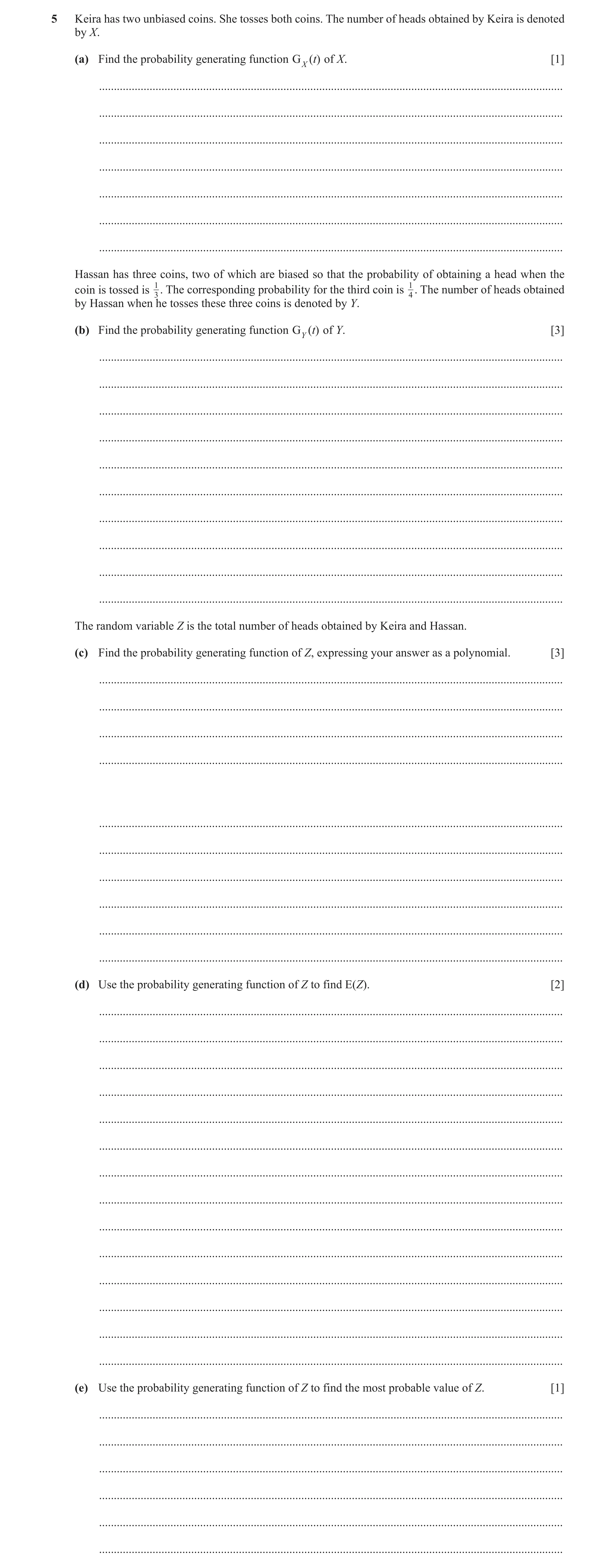
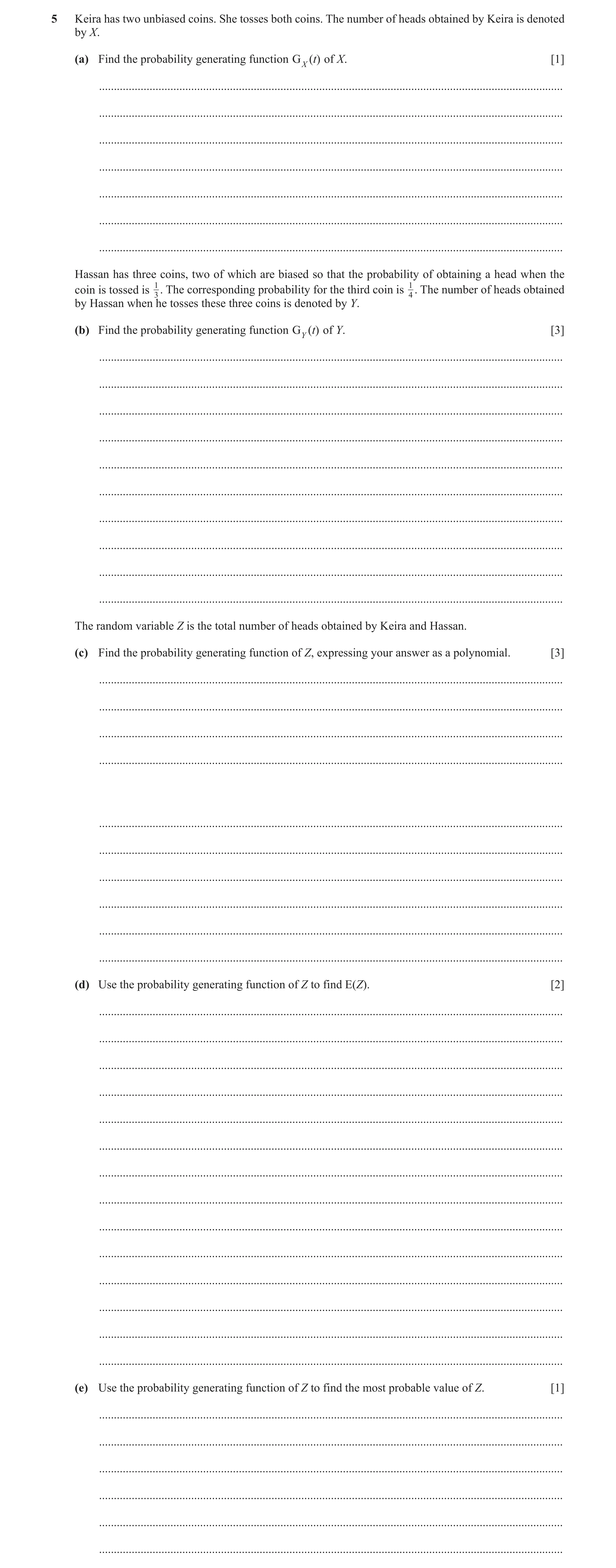
5 Keira has two unbiased coins. She tosses both coins. The number of heads obtained by Keira is denoted by X. (a) Find the probability generating function GX ( )t of X. [1] … … … … … … … Hassan has three coins, two of which are biased so that the probability of obtaining a head when the coin is tossed is 1.3 The corresponding probability for the third coin is 1.4 The number of heads obtained by Hassan when he tosses these three coins is denoted by Y. (b) Find the probability generating function GY ( )t of Y. [3] … … … … … … … … … … The random variable Z is the total number of heads obtained by Keira and Hassan. (c) Find the probability generating function of Z, expressing your answer as a polynomial. [3] … … … … … … … … … … (d) Use the probability generating function of Z to find E(Z). [2] … … … … … … … … … … … … … … (e) Use the probability generating function of Z to find the most probable value of Z. [1] … … … … … …
10 marks
Mark scheme: 5(a) GX (t) = 2 1 1 1 4 2 4 t t + + 1 5(b) P(0H)= 12 36 P(1H) = 16 36 P(2H) = 7 36 P(3H) = 1 36 M1 A1 Attempt at probs, at least 2 correct All correct GY (t) = 2 3 12 16 7 1 36 36 36 36 t t t + + + B1 FT FT their probabilities, must be cubic with 4 non-zero terms 3 5(c) GZ (t) = ( 2 2 3 1 1 1 12 16 7 1 ) 4 2 4 36 36 36 36 t t t t t + + + + + M1 Attempt to multiply their two PGF = ( ) 2 3 4 5 1 12 40 51 31 9 144 t t t t t + + + + + M1 A1 Obtain quintic expression and collect terms 3 5(d) G’Z ( ) t = ( ) 2 3 4 1 40 102 93 36 5 144 t t t t + + + + M1 Differentiate E(Z) = G’Z (1) = 23 12 = (= 1.92) A1 2 5(e) 2 B1 FT FT power of term with largest coefficient in their GZ (t) 1
This question in 9231/41 Oct/Nov 2020
Q5 · The random variable X has the binomial distribution B(n, p) 9231/42 Oct/Nov 2020
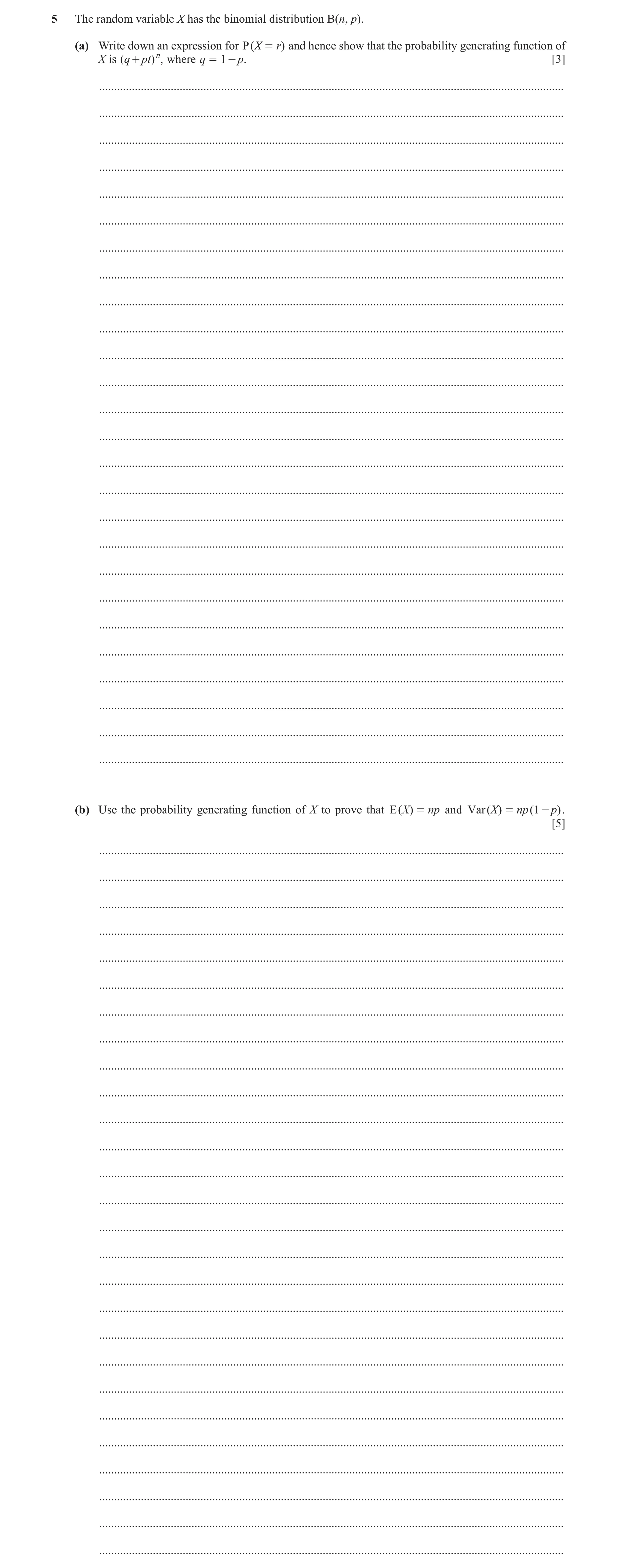
5 The random variable X has the binomial distribution B(n, p). (a) Write down an expression for P ( X = r) and hence show that the probability generating function of X is ( q + pt) n , where q = 1 - p. [3] … … … … … … … … … … … … … … … … … … … … … … … … … … (b) Use the probability generating function of X to prove that E ( X ) = np and Var ( X ) = np ( 1 - p). [5] … … … … … … … … … … … … … … … … … … … … … … … … … … …
8 marks
Mark scheme: 5(a) B1 GX(t) = ( ) 0 nCr 1 n n r r r p p t − − M1 Accept minimum of 4 terms including the last. Shown with specific value of n is M0 ( ) 0 nCr ( ) 1 n n r r pt p − − = ( ) n q pt + A1 At least one intermediate step to be shown, with p and t grouped AG 3 5(b) G’X(t) = ( ) 1 n n q pt p − + × M1 So E(X) = G’X(1) = ( ) 1 n np q p − + and 1 q p + = so E(X) = np A1 G’’X(t) = ( )( ) 2 1 n n n q pt p p − − + × × M1 Var(X) = ( ) ( ) 2 2 1 n n p np np − + − M1 ( ) 1 np p − A1 5
This question in 9231/42 Oct/Nov 2020
Q6 · Keira has two unbiased coins 9231/43 Oct/Nov 2020
5 Keira has two unbiased coins. She tosses both coins. The number of heads obtained by Keira is denoted by X. (a) Find the probability generating function GX ( )t of X. [1] … … … … … … … Hassan has three coins, two of which are biased so that the probability of obtaining a head when the coin is tossed is 1.3 The corresponding probability for the third coin is 1.4 The number of heads obtained by Hassan when he tosses these three coins is denoted by Y. (b) Find the probability generating function GY ( )t of Y. [3] … … … … … … … … … … The random variable Z is the total number of heads obtained by Keira and Hassan. (c) Find the probability generating function of Z, expressing your answer as a polynomial. [3] … … … … … … … … … … (d) Use the probability generating function of Z to find E(Z). [2] … … … … … … … … … … … … … … (e) Use the probability generating function of Z to find the most probable value of Z. [1] … … … … … …
10 marks
Mark scheme: 5(a) GX (t) = 2 1 1 1 4 2 4 t t + + 1 5(b) P(0H)= 12 36 P(1H) = 16 36 P(2H) = 7 36 P(3H) = 1 36 M1 A1 Attempt at probs, at least 2 correct All correct GY (t) = 2 3 12 16 7 1 36 36 36 36 t t t + + + B1 FT FT their probabilities, must be cubic with 4 non-zero terms 3 5(c) GZ (t) = ( 2 2 3 1 1 1 12 16 7 1 ) 4 2 4 36 36 36 36 t t t t t + + + + + M1 Attempt to multiply their two PGF = ( ) 2 3 4 5 1 12 40 51 31 9 144 t t t t t + + + + + M1 A1 Obtain quintic expression and collect terms 3 5(d) G’Z ( ) t = ( ) 2 3 4 1 40 102 93 36 5 144 t t t t + + + + M1 Differentiate E(Z) = G’Z (1) = 23 12 = (= 1.92) A1 2 5(e) 2 B1 FT FT power of term with largest coefficient in their GZ (t) 1
This question in 9231/43 Oct/Nov 2020
Q7 · Tanji has a bag containing 4 red balls and 2 blue balls 9231/41 May/June 2021
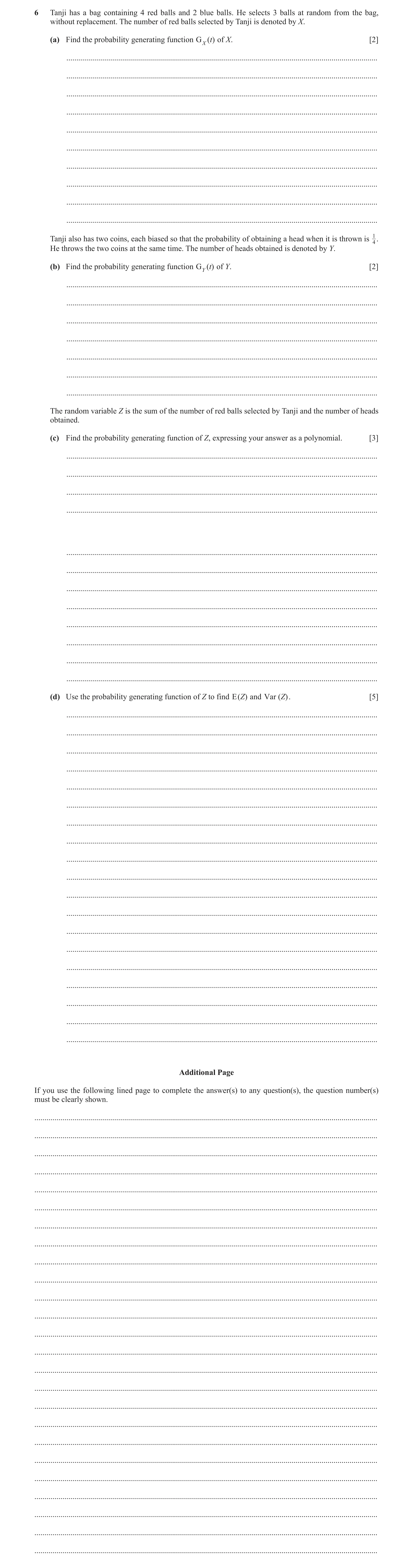
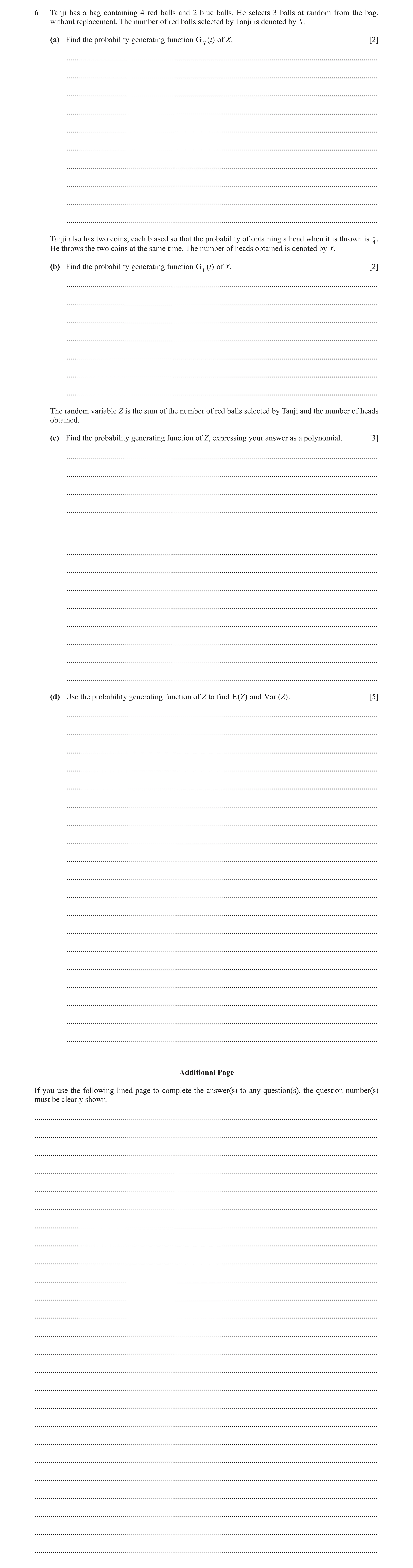
6 Tanji has a bag containing 4 red balls and 2 blue balls. He selects 3 balls at random from the bag, without replacement. The number of red balls selected by Tanji is denoted by X. (a) Find the probability generating function GX ( )t of X. [2] … … … … … … … … … … Tanji also has two coins, each biased so that the probability of obtaining a head when it is thrown is 1.4 He throws the two coins at the same time. The number of heads obtained is denoted by Y. (b) Find the probability generating function GY ( )t of Y. [2] … … … … … … … The random variable Z is the sum of the number of red balls selected by Tanji and the number of heads obtained. (c) Find the probability generating function of Z, expressing your answer as a polynomial. [3] … … … … … … … … … … … … (d) Use the probability generating function of Z to find E ( Z ) and Var ( Z ). [5] … … … … … … … … … … … … … … … … … … … Additional Page If you use the following lined page to complete the answer(s) to any question(s), the question number(s) must be clearly shown. … … … … … … … … … … … … … … … … … … … … … … … … …
12 marks
Mark scheme: 6(a) P(3R, 2R, 1R, 0R) = 1 3 1 , , , 0 5 5 5 M1 At least 2 correct probabilities used in a polynomial. ( ) 2 3 1 3 1 G 5 5 5 X t t t t = + + A1 2 6(b) P(2H, 1H, 0H) = 1 6 9 , , 16 16 16 M1 One correct probability and all three adding to 1 used in a polynomial. ( ) 2 9 6 1 G 16 16 16 Y t t t = + + A1 2 6(c) Attempt to multiply results from part (a) and part (b) M1 Obtain polynomial M1 2 3 4 5 9 33 28 9 1 80 80 80 80 80 t t t t t + + + + A1 Accept exact equivalent decimals. 3 6(d) E(Z) = ( ) ( ) ' 1 1 9 66 84 36 5 80 Z G = + + + + M1 Differentiate and put t = 1. = 200 2.5 80 = A1 ( ) ( ) ' ' 1 362 1 66 168 108 20 4.525 80 80 Z G = + + + = = M1 Question Answer Marks Guidance 6(d) Var (Z) = ( ) ( ) ( ) ( ) 2 1 1 ' 1 G G G ′ + − ′′ M1 Use result. 2 362 200 200 80 80 80 + − = 31 0.775 40 = A1 5
This question in 9231/41 May/June 2021
Q8 · Tanji has a bag containing 4 red balls and 2 blue balls 9231/42 May/June 2021
6 Tanji has a bag containing 4 red balls and 2 blue balls. He selects 3 balls at random from the bag, without replacement. The number of red balls selected by Tanji is denoted by X. (a) Find the probability generating function GX ( )t of X. [2] … … … … … … … … … … Tanji also has two coins, each biased so that the probability of obtaining a head when it is thrown is 1.4 He throws the two coins at the same time. The number of heads obtained is denoted by Y. (b) Find the probability generating function GY ( )t of Y. [2] … … … … … … … The random variable Z is the sum of the number of red balls selected by Tanji and the number of heads obtained. (c) Find the probability generating function of Z, expressing your answer as a polynomial. [3] … … … … … … … … … … … … (d) Use the probability generating function of Z to find E ( Z ) and Var ( Z ). [5] … … … … … … … … … … … … … … … … … … … Additional Page If you use the following lined page to complete the answer(s) to any question(s), the question number(s) must be clearly shown. … … … … … … … … … … … … … … … … … … … … … … … … …
12 marks
Mark scheme: 6(a) P(3R, 2R, 1R, 0R) = 1 3 1 , , , 0 5 5 5 M1 At least 2 correct probabilities used in a polynomial. ( ) 2 3 1 3 1 G 5 5 5 X t t t t = + + A1 2 6(b) P(2H, 1H, 0H) = 1 6 9 , , 16 16 16 M1 One correct probability and all three adding to 1 used in a polynomial. ( ) 2 9 6 1 G 16 16 16 Y t t t = + + A1 2 6(c) Attempt to multiply results from part (a) and part (b) M1 Obtain polynomial M1 2 3 4 5 9 33 28 9 1 80 80 80 80 80 t t t t t + + + + A1 Accept exact equivalent decimals. 3 6(d) E(Z) = ( ) ( ) ' 1 1 9 66 84 36 5 80 Z G = + + + + M1 Differentiate and put t = 1. = 200 2.5 80 = A1 ( ) ( ) ' ' 1 362 1 66 168 108 20 4.525 80 80 Z G = + + + = = M1 Question Answer Marks Guidance 6(d) Var (Z) = ( ) ( ) ( ) ( ) 2 1 1 ' 1 G G G ′ + − ′′ M1 Use result. 2 362 200 200 80 80 80 + − = 31 0.775 40 = A1 5
This question in 9231/42 May/June 2021
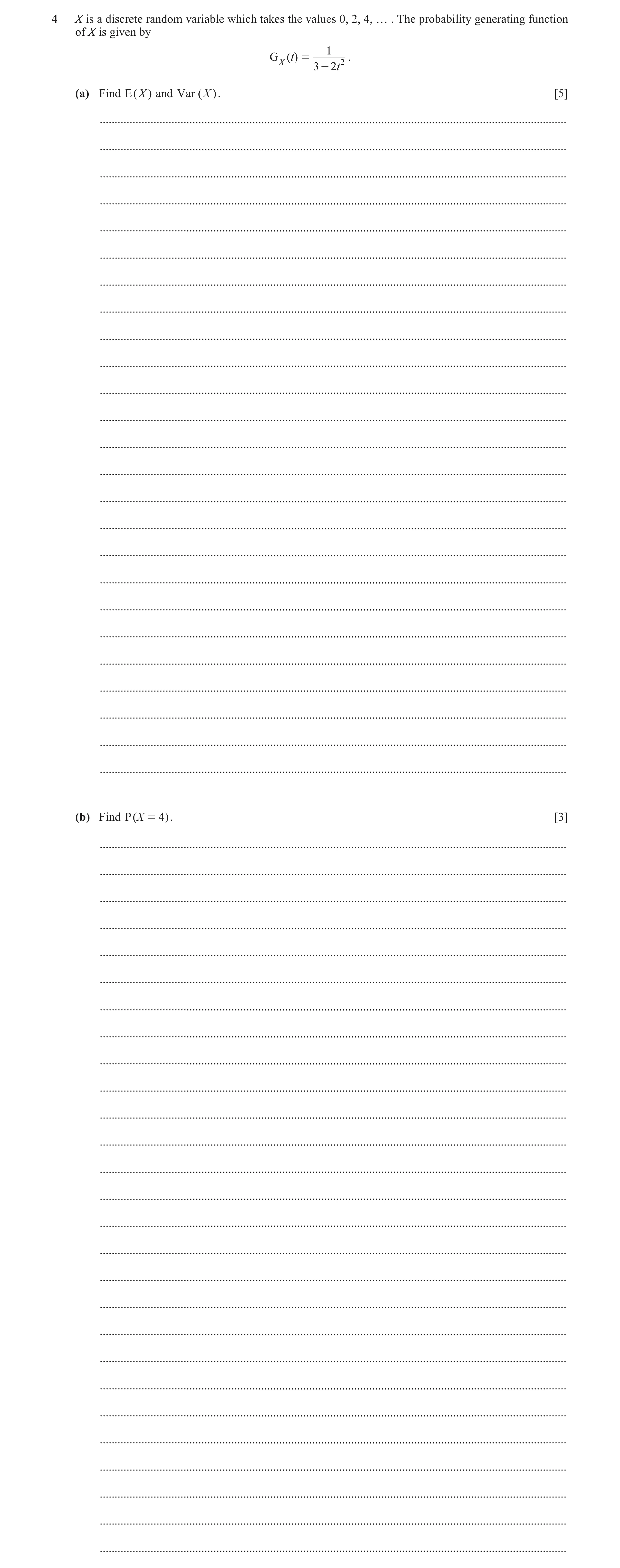
Q9 · X is a discrete random variable which takes the values 0, 2, 4, … 9231/43 May/June 2021
4 X is a discrete random variable which takes the values 0, 2, 4, … . The probability generating function of X is given by 1 GX ( )t = 2 . 3 - 2t (a) Find E ( X ) and Var ( X ). [5] … … … … … … … … … … … … … … … … … … … … … … … … … (b) Find P ( X = 4). [3] … … … … … … … … … … … … … … … … … … … … … … … … … … …
8 marks
Mark scheme: 4(a) G’(t) = ( ) 2 2 4 3 2 t t − M1 Differentiate to obtain ( ) 2 2 3 2 kt t − OE. so E(X) = G’(1) = 4 A1 CAO WWW G’’(t) = ( ) 2 3 2 12 24 3 2 t t + − or ( ) ( ) 2 3 2 2 2 4 3 2 32 3 2 t t t − − − + − M1 OE. Differentiate, allow only numerical or sign slips. Var(X) = G ' '(1) + G '(1) – ( ) ( ) 2 G' 1 = 36 + 4 – 16 M1 Substitute their values into correct formula, dependent on attempt at G ' '(t). [Var(X)] = 24 A1 CAO WWW 5 4(b) ( ) ( ) 1 2 2 1 3 2 3 2 X G t t t − = = − − = 2 4 1 2 4 1 . 3 3 9 t t + + +… M1 Expand given expression or give expression for the term in t4 . P(X = 4) = their coefficient of t4 M1 Found from legitimate method. [P(X = 4) =] 4 27 A1 WWW 3
This question in 9231/43 May/June 2021
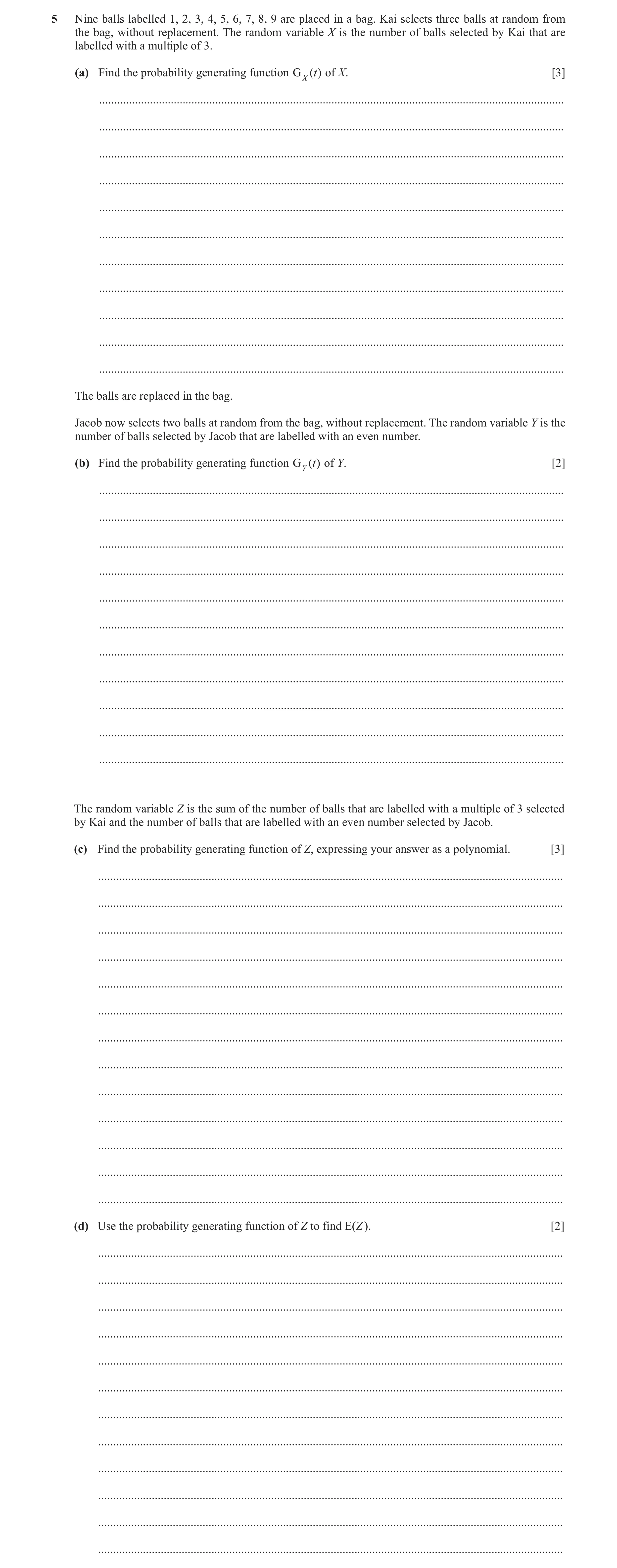
Q10 · Nine balls labelled 1, 2, 3, 4, 5, 6, 7, 8, 9 are placed in a bag 9231/41 Oct/Nov 2021
5 Nine balls labelled 1, 2, 3, 4, 5, 6, 7, 8, 9 are placed in a bag. Kai selects three balls at random from the bag, without replacement. The random variable X is the number of balls selected by Kai that are labelled with a multiple of 3. (a) Find the probability generating function G X (t ) of X. [3] … … … … … … … … … … … The balls are replaced in the bag. Jacob now selects two balls at random from the bag, without replacement. The random variable Y is the number of balls selected by Jacob that are labelled with an even number. (b) Find the probability generating function G Y (t ) of Y. [2] … … … … … … … … … … … The random variable Z is the sum of the number of balls that are labelled with a multiple of 3 selected by Kai and the number of balls that are labelled with an even number selected by Jacob. (c) Find the probability generating function of Z, expressing your answer as a polynomial. [3] … … … … … … … … … … … … … (d) Use the probability generating function of Z to find E(Z ). [2] … … … … … … … … … … … …
10 marks
Mark scheme: 5(a) P(3, 6, 9) = 3 2 1 6 9 8 7 504 × × = P(Two of 3, 6, 9) = 3 2 6 108 3 9 8 7 504 × × × = P(one of 3, 6, 9) = 3 6 5 270 3 9 8 7 504 × × × = P(none of 3, 6, 9) = 6 5 4 120 9 8 7 504 × × = B1 At least 2 probabilities correct. ( ) 2 3 20 45 18 1 G 84 84 84 84 X t t t t = + + + M1 A1 Attempt with at least 3 probabilities in a polynomial, CAO. 3 5(b) P(both even ) = 12 72 P(one even) = 40 72 P(no even) = 20 72 M1 ( ) 2 5 10 3 G 18 18 18 Y t t t = + + A1 CAO 2 Question Answer Marks Guidance 5(c) 2 3 1 20 45 18 1 1512 84 84 84 84 t t t + + + 2 5 10 3 18 18 18 t t + + M1 Method and attempt to multiply. M1 Multiplication to obtain single quintic polynomial. 2 3 4 5 1 (100 425 600 320 64 3 1512 t t t t t + + + + + ) A1 CAO 3 5(d) G'(1) = ( ) 1 425 1200 960 256 15 1512 + + + + M1 17 9 A1 CWO 2
This question in 9231/41 Oct/Nov 2021
Q11 · The random variable X is such that P ( X = r) = kr 2 for r = 1, 2, 3, 4, where k is a… 9231/42 Oct/Nov 2021
5 The random variable X is such that P ( X = r) = kr 2 for r = 1, 2, 3, 4, where k is a constant. (a) Find the value of k. [1] … … … … … … (b) Find the probability generating function G X ( t ) of X. [2] … … … … … … … … … = + 4 2 t + 4 t . The random variable Y has probability generating function GY ( t ) 1 1 1 2 The random variable Z is the sum of X and Y. (c) Assuming that X and Y are independent, find the probability generating function GZ ( t ) of Z as a polynomial in t. [3] … … … … … … … … … … … … … … … … (d) Given that E ( Z ) = 133 , use GZ ( t ) to find Var (Z). [3] … … … … … … … … … … … … … … … … … …
9 marks
Mark scheme: 5(a) ( ) 1 1 4 9 16 1 so 30 k k + + + = = 1 5(b) ( ) 2 3 4 1 4 9 16 G 30 30 30 30 = + + + X t t t t t M1A1 Using their k in a polynomial, at least two terms correct for their k. 2 5(c) 2 3 4 2 1 4 9 16 1 1 1 30 30 30 30 4 2 4 + + + + + t t t t t t M1 Method and attempt to multiply. ( ) 2 3 4 5 6 1 6 18 38 41 16 120 + + + + + t t t t t t M1A1 Multiplication to obtain single polynomial of order 6. 3 5(d) Given: G'(1) = 13/3 G''(t) = 2 3 4 1 (12 108 456 820 480 120 + + + + t t t t ) M1 Differentiate twice. Var(X) = G''(1) + 2 13 13 3 3 − M1 Use correct formula. 1876 13 169 107 120 3 9 90 + − = or 1.19 A1 CAO 3
This question in 9231/42 Oct/Nov 2021
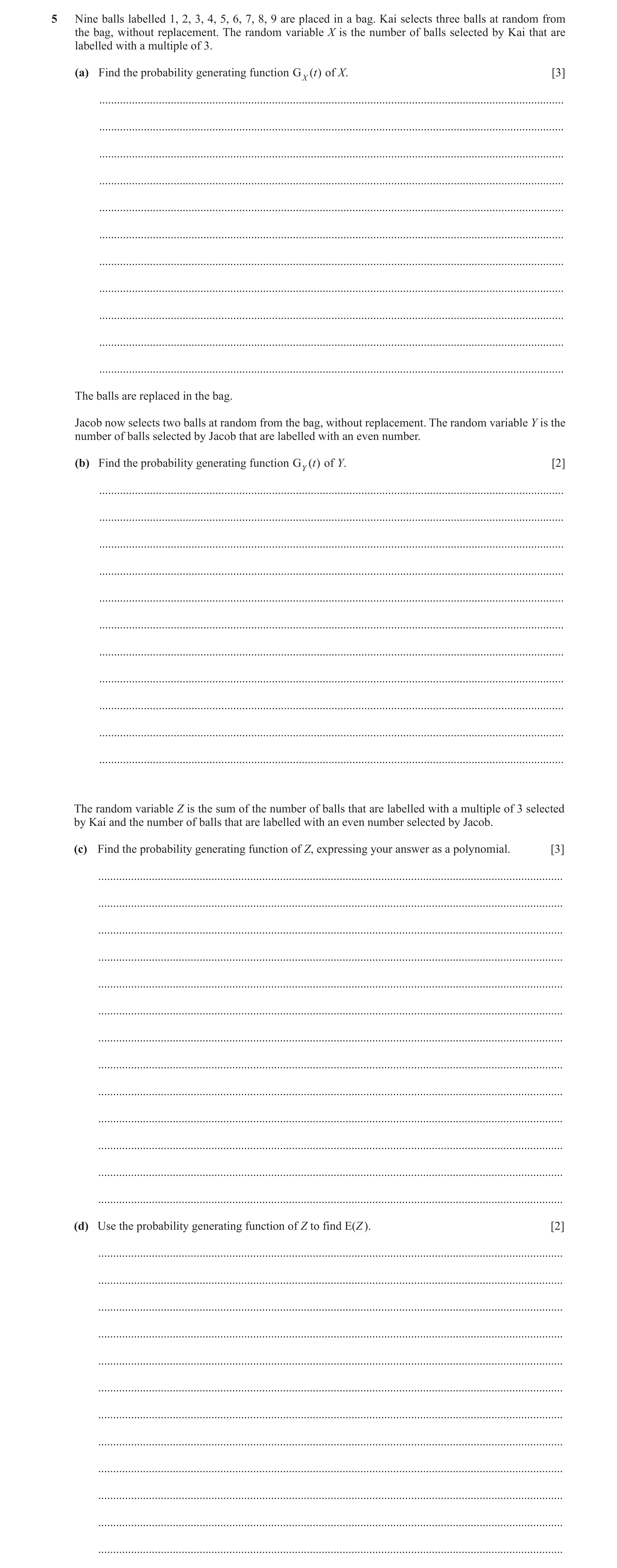
Q12 · Nine balls labelled 1, 2, 3, 4, 5, 6, 7, 8, 9 are placed in a bag 9231/43 Oct/Nov 2021
5 Nine balls labelled 1, 2, 3, 4, 5, 6, 7, 8, 9 are placed in a bag. Kai selects three balls at random from the bag, without replacement. The random variable X is the number of balls selected by Kai that are labelled with a multiple of 3. (a) Find the probability generating function G X (t ) of X. [3] … … … … … … … … … … … The balls are replaced in the bag. Jacob now selects two balls at random from the bag, without replacement. The random variable Y is the number of balls selected by Jacob that are labelled with an even number. (b) Find the probability generating function G Y (t ) of Y. [2] … … … … … … … … … … … The random variable Z is the sum of the number of balls that are labelled with a multiple of 3 selected by Kai and the number of balls that are labelled with an even number selected by Jacob. (c) Find the probability generating function of Z, expressing your answer as a polynomial. [3] … … … … … … … … … … … … … (d) Use the probability generating function of Z to find E(Z ). [2] … … … … … … … … … … … …
10 marks
Mark scheme: 5(a) P(3, 6, 9) = 3 2 1 6 9 8 7 504 × × = P(Two of 3, 6, 9) = 3 2 6 108 3 9 8 7 504 × × × = P(one of 3, 6, 9) = 3 6 5 270 3 9 8 7 504 × × × = P(none of 3, 6, 9) = 6 5 4 120 9 8 7 504 × × = B1 At least 2 probabilities correct. ( ) 2 3 20 45 18 1 G 84 84 84 84 X t t t t = + + + M1 A1 Attempt with at least 3 probabilities in a polynomial, CAO. 3 5(b) P(both even ) = 12 72 P(one even) = 40 72 P(no even) = 20 72 M1 ( ) 2 5 10 3 G 18 18 18 Y t t t = + + A1 CAO 2 Question Answer Marks Guidance 5(c) 2 3 1 20 45 18 1 1512 84 84 84 84 t t t + + + 2 5 10 3 18 18 18 t t + + M1 Method and attempt to multiply. M1 Multiplication to obtain single quintic polynomial. 2 3 4 5 1 (100 425 600 320 64 3 1512 t t t t t + + + + + ) A1 CAO 3 5(d) G'(1) = ( ) 1 425 1200 960 256 15 1512 + + + + M1 17 9 A1 CWO 2
This question in 9231/43 Oct/Nov 2021
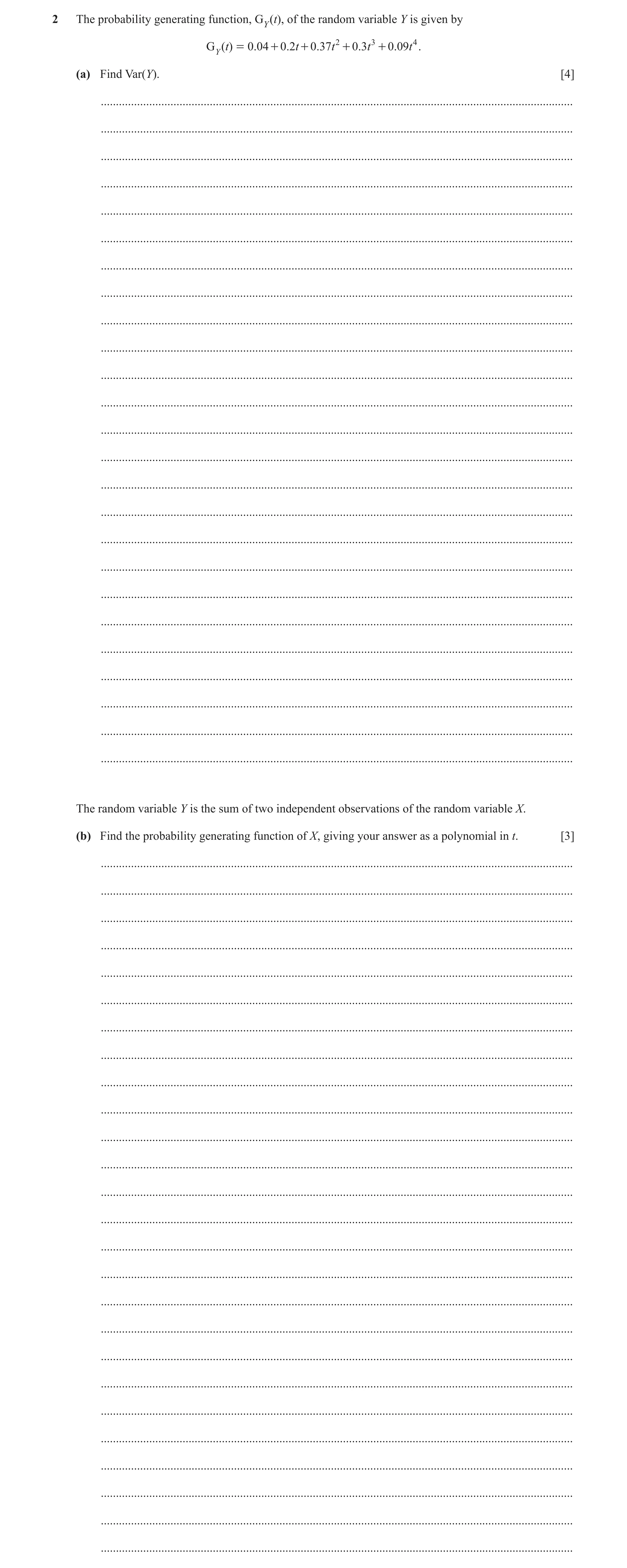
Q13 · The probability generating function, GY (t), of the random variable Y is given by = 0.04… 9231/41 May/June 2022
2 The probability generating function, GY (t), of the random variable Y is given by = 0.04 + 0.2t + 0.37t + 0.3t + 0 .09 t . GY ( t) 2 3 4 (a) Find Var(Y). [4] … … … … … … … … … … … … … … … … … … … … … … … … … The random variable Y is the sum of two independent observations of the random variable X. (b) Find the probability generating function of X, giving your answer as a polynomial in t. [3] … … … … … … … … … … … … … … … … … … … … … … … … … …
7 marks
Mark scheme: 2(a) GY ' (t) = 2 3 0.2 0.74 0.9 0.36 t t t GY "(t) = 2 0.74 1.8 1.08 t t M1 PGF differentiated twice. GY '(1) = 2.2 GY "(1) = 3.62 A1 Var(Y) = GY "(1) + GY '(1) – (GY '(1))2 3.62 + 2.2 – 2.22 M1 Correct formula used and attempt at Var(Y). 0.98 A1 4 2(b) GY (t) = 2 2 a bt ct M1* Correct method. So 2 0.04, 0.2 a a 2 0.09, 0.3 c c 0.1 2 0.2, 0.5 0.2 ab b depM1 Attempt to find all coefficients. GX (t) = 2 0.2 0.5 0.3 t t A1 Note: GY = 2 2 1 1 2 3 100 t t M1, accept without 1 100 . So GX = 1 1 2 3 10 t t dep M1, must have 1 10 . Final answer A1. 3
This question in 9231/41 May/June 2022
Q14 · The probability generating function, GY (t), of the random variable Y is given by = 0.04… 9231/42 May/June 2022
2 The probability generating function, GY (t), of the random variable Y is given by = 0.04 + 0.2t + 0.37t + 0.3t + 0 .09 t . GY ( t) 2 3 4 (a) Find Var(Y). [4] … … … … … … … … … … … … … … … … … … … … … … … … … The random variable Y is the sum of two independent observations of the random variable X. (b) Find the probability generating function of X, giving your answer as a polynomial in t. [3] … … … … … … … … … … … … … … … … … … … … … … … … … …
7 marks
Mark scheme: 2(a) GY ' (t) = 2 3 0.2 0.74 0.9 0.36 t t t GY "(t) = 2 0.74 1.8 1.08 t t M1 PGF differentiated twice. GY '(1) = 2.2 GY "(1) = 3.62 A1 Var(Y) = GY "(1) + GY '(1) – (GY '(1))2 3.62 + 2.2 – 2.22 M1 Correct formula used and attempt at Var(Y). 0.98 A1 4 2(b) GY (t) = 2 2 a bt ct M1* Correct method. So 2 0.04, 0.2 a a 2 0.09, 0.3 c c 0.1 2 0.2, 0.5 0.2 ab b depM1 Attempt to find all coefficients. GX (t) = 2 0.2 0.5 0.3 t t A1 Note: GY = 2 2 1 1 2 3 100 t t M1, accept without 1 100 . So GX = 1 1 2 3 10 t t dep M1, must have 1 10 . Final answer A1. 3
This question in 9231/42 May/June 2022
Q15 · George throws two coins, A and B, at the same time 9231/43 May/June 2022
3 George throws two coins, A and B, at the same time. Coin A is biased so that the probability of obtaining a head is a. Coin B is biased so that the probability of obtaining a head is b, where b 1 a . The probability generating function of X, the number of heads obtained by George, is G X ( t) . The coefficients of t and t2 in G X ( t) are 125 and 121 respectively. (a) Find the value of a. [2] … … … … … … … … … … … … … … … The random variable Y is the sum of two independent observations of X. (b) Find the probability generating function of Y, giving your answer as a polynomial in t. [3] … … … … … … … … … … … … … … … … (c) Find Var(Y ). [3] … … … … … … … … … … … … … … … … … … …
8 marks
Mark scheme: 3(a) GX(t) = 2 6 5 1 12 12 12 t t P(0 heads) = 6 1 1 12 a b P(1 head) = 5 1 1 12 a b a b P(2 heads) = 1 12 ab 7 1 , 12 12 a b ab Solve to give 1 1 3 4 a b A1 Correct value for a . 2 3(b) GY (t) = 2 2 6 5 1 12 12 12 t t M1 Square their GX (t). 2 3 4 1 36 60 37 10 144 t t t t M1 Obtain quartic polynomial from 3-term GX (t). A1 3 Question Answer Marks Guidance 3(c) GY '(t) = 2 3 1 60 74 30 4 144 t t t GY "(t) = 2 1 74 60 12 144 t t M1 Differentiate their GY (t) twice. Var(Y) = GY " (1) + GY ' (1) – (GY ' (1))2 1 7 49 59 146 0.819 144 6 36 72 M1 Use correct formula and attempt at Var(Y). 0.819 A1 3
This question in 9231/43 May/June 2022
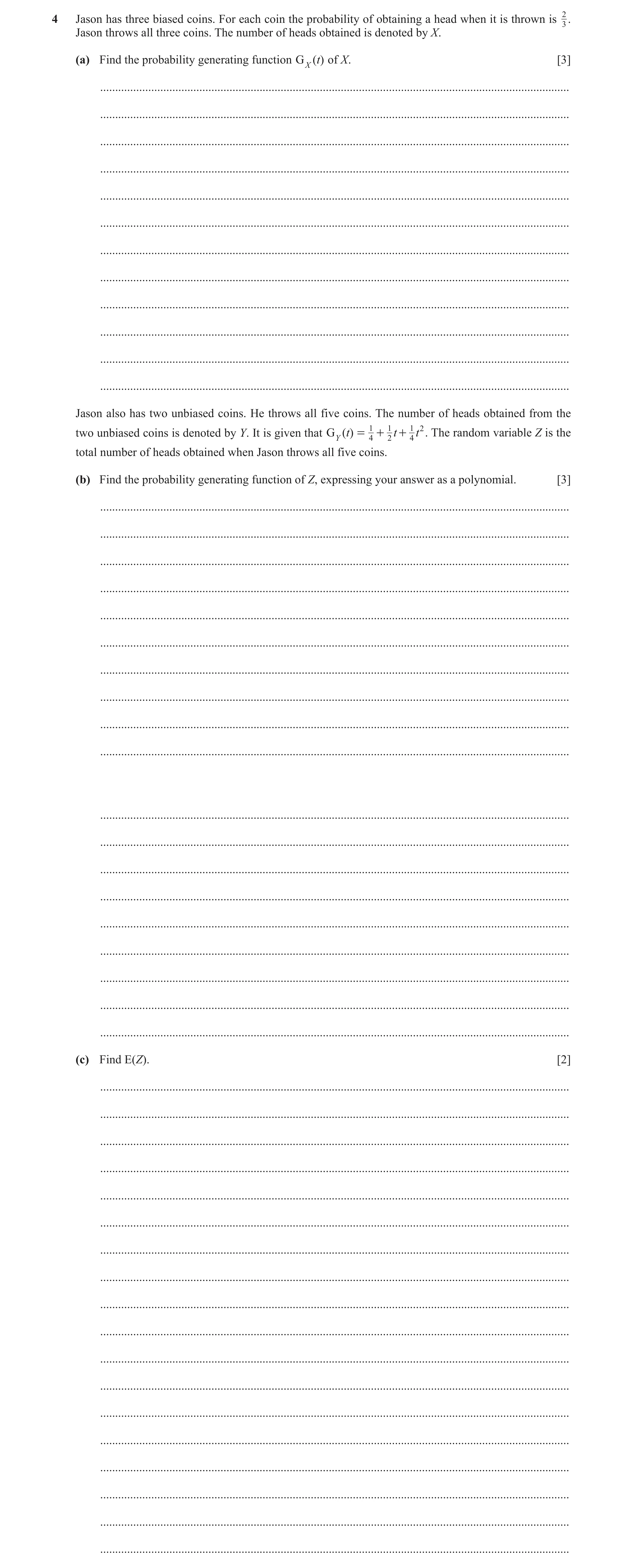
Q16 · Jason has three biased coins 9231/41 Oct/Nov 2022
4 Jason has three biased coins. For each coin the probability of obtaining a head when it is thrown is 2.3 Jason throws all three coins. The number of heads obtained is denoted by X. (a) Find the probability generating function G X ( t) of X. [3] … … … … … … … … … … … … Jason also has two unbiased coins. He throws all five coins. The number of heads obtained from the = + 4 2 t + 4 t . The random variable Z is the two unbiased coins is denoted by Y. It is given that G Y ( t) 1 1 1 2 total number of heads obtained when Jason throws all five coins. (b) Find the probability generating function of Z, expressing your answer as a polynomial. [3] … … … … … … … … … … … … … … … … … … … (c) Find E(Z). [2] … … … … … … … … … … … … … … … … … …
8 marks
Mark scheme: 4(a) 1 1 1 1 2 1 1 6 M1 P(0 H) = = P(1 H) = =3 At least 2 probabilities correct. 3 3 3 27 3 3 3 27 1 2 2 12 2 2 2 8 P(2 H) = =3 P(3 H) = = 3 3 3 27 3 3 3 27 1 6 12 2 8 3 M1A1 Correct form, ft their probabilities. GX (t) = + t + t + t 27 27 27 27 1 2 M1 OR: PGF for one coin is + t 3 3 3 M1A1 1 2 For 3 coins, PGF is + t 3 3 3 4(b) 1 2 2 3 M1 Correct method. GZ (t) = 1 + 2t + t 1 + 6t + 12t + 8t ( )( ) 108 1 2 3 4 5 M1 Obtain quintic polynomial. 1 + 8t + 25t + 38t + 28t + 8t ( ) 108 1 2 25 2 19 3 7 4 2 5 A1 + t + t + t + t + t 108 27 108 54 27 27 3 4(c) 1 2 3 4 M1 GZ’ (t) = 8 + 50t + 114t + 112t + 40t ( ) Differentiate and evaluate at t = 1 108 1 E(Z) = ( 8 + 50 + 114 + 112 + 40 ) 108 324 A1 = 3 108 Alternative method for questions 4(c) 2 2 2 1 1 M1 Summing expected values for each coin + + + + 3 3 3 2 2 3 A1 2
This question in 9231/41 Oct/Nov 2022
Q17 · A 6‑sided dice, A, with faces numbered 1, 2, 3, 4, 5, 6 is biased so that the probability… 9231/42 Oct/Nov 2022
5 A 6‑sided dice, A, with faces numbered 1, 2, 3, 4, 5, 6 is biased so that the probability of throwing a 6 is 1.4 The random variable X is the number of 6s obtained when dice A is thrown twice. (a) Find the probability generating function of X. [2] … … … … … … … … … A second dice, B, with faces numbered 1, 2, 3, 4, 5, 6 is unbiased. The random variable Y is the number of 6s obtained when dice B is thrown twice. The random variable Z is the total number of 6s obtained when both dice are thrown twice. (b) Find the probability generating function of Z, expressing your answer as a polynomial. [3] … … … … … … … … … … … … … (c) Find Var ( Z ) . [3] … … … … … … … … … … … … … … … … … … (d) Use the probability generating function of Z to find the most probable value of Z. [1] … … … … … … … …
9 marks
Mark scheme: 5(a) 9 6 1 2 M1 A1 2 probabilities correct, in a polynomial GX (t) = + t + t 16 16 16 2 5(b) 9 6 1 2 25 10 1 2 M1 Second PGF correct and multiplied by part (a). GZ (t) = + t + t + t + t 16 16 16 36 36 36 1 2 3 4 M1 Obtains a quartic polynomial. 225 + 240t + 94t + 16t + t ( ) 576 A1 1 2 2 25 5 47 2 1 3 1 4 Note: ( t + 3 ) ( t + 5 ) scores M1M1A0. Or + t + t + t + t 576 64 12 288 36 576 3 5(c) 1 2 3 M1 Differentiate twice. GZ’ (t) = 240 + 188t + 48t + 4t ( ) 576 1 3 GZ’’ (t) = 188 + 96t + 12t ( ) 576 1 5 25 M1 Use correct formula. Var (Z) = (188 + 96 + 12 ) + − 576 6 36 47 A1 72 1 3 1 5 M1 One term correct. OR: Var(Z) = 2 + 2 M1 Two terms present and added. 4 4 6 6 47 A1 72 3 5(d) 1 B1 FT FT their power with greatest coefficient in part (b). 1
This question in 9231/42 Oct/Nov 2022
Q18 · Jason has three biased coins 9231/43 Oct/Nov 2022
4 Jason has three biased coins. For each coin the probability of obtaining a head when it is thrown is 2.3 Jason throws all three coins. The number of heads obtained is denoted by X. (a) Find the probability generating function G X ( t) of X. [3] … … … … … … … … … … … … Jason also has two unbiased coins. He throws all five coins. The number of heads obtained from the = + 4 2 t + 4 t . The random variable Z is the two unbiased coins is denoted by Y. It is given that G Y ( t) 1 1 1 2 total number of heads obtained when Jason throws all five coins. (b) Find the probability generating function of Z, expressing your answer as a polynomial. [3] … … … … … … … … … … … … … … … … … … … (c) Find E(Z). [2] … … … … … … … … … … … … … … … … … …
8 marks
Mark scheme: 4(a) 1 1 1 1 2 1 1 6 M1 P(0 H) = = P(1 H) = =3 At least 2 probabilities correct. 3 3 3 27 3 3 3 27 1 2 2 12 2 2 2 8 P(2 H) = =3 P(3 H) = = 3 3 3 27 3 3 3 27 1 6 12 2 8 3 M1A1 Correct form, ft their probabilities. GX (t) = + t + t + t 27 27 27 27 1 2 M1 OR: PGF for one coin is + t 3 3 3 M1A1 1 2 For 3 coins, PGF is + t 3 3 3 4(b) 1 2 2 3 M1 Correct method. GZ (t) = 1 + 2t + t 1 + 6t + 12t + 8t ( )( ) 108 1 2 3 4 5 M1 Obtain quintic polynomial. 1 + 8t + 25t + 38t + 28t + 8t ( ) 108 1 2 25 2 19 3 7 4 2 5 A1 + t + t + t + t + t 108 27 108 54 27 27 3 4(c) 1 2 3 4 M1 GZ’ (t) = 8 + 50t + 114t + 112t + 40t ( ) Differentiate and evaluate at t = 1 108 1 E(Z) = ( 8 + 50 + 114 + 112 + 40 ) 108 324 A1 = 3 108 Alternative method for questions 4(c) 2 2 2 1 1 M1 Summing expected values for each coin + + + + 3 3 3 2 2 3 A1 2
This question in 9231/43 Oct/Nov 2022
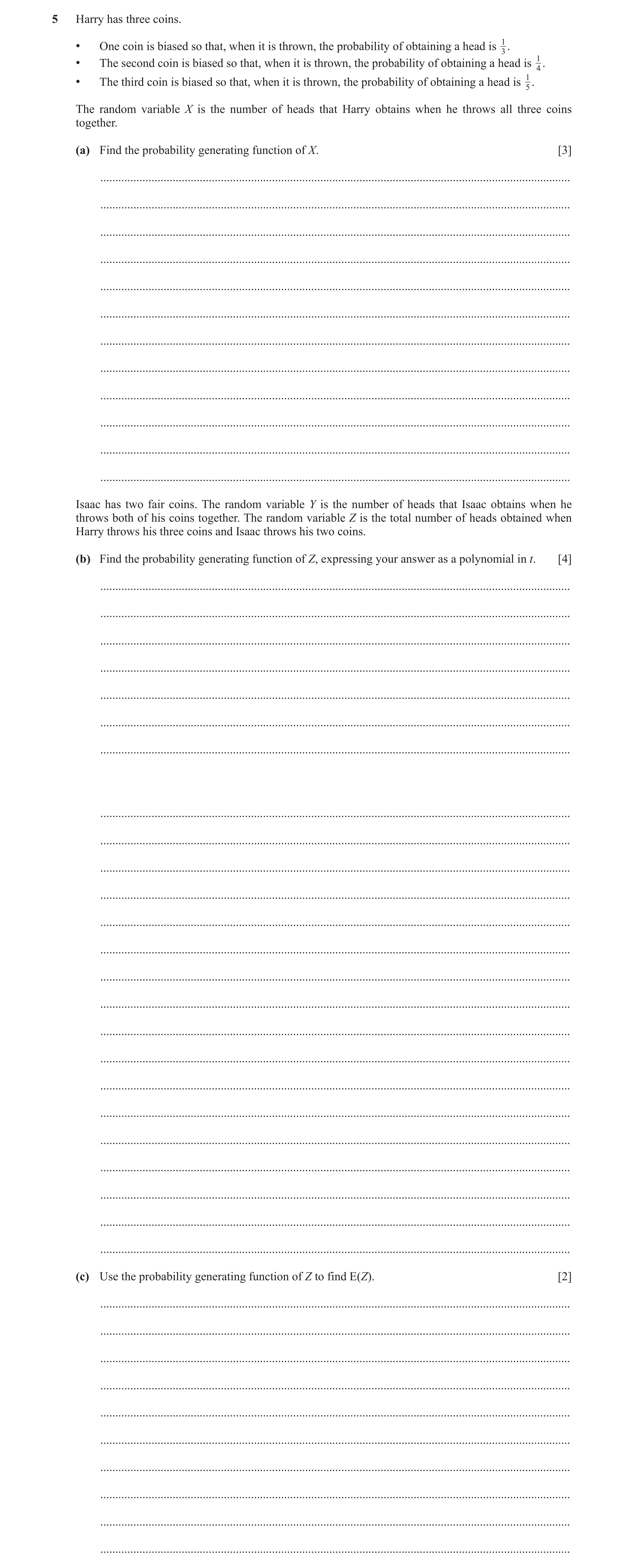
Q19 · Harry has three coins 9231/41 May/June 2023
5 Harry has three coins. • One coin is biased so that, when it is thrown, the probability of obtaining a head is 1.3 • The second coin is biased so that, when it is thrown, the probability of obtaining a head is 1.4 • The third coin is biased so that, when it is thrown, the probability of obtaining a head is 1.5 The random variable X is the number of heads that Harry obtains when he throws all three coins together. (a) Find the probability generating function of X. [3] … … … … … … … … … … … … Isaac has two fair coins. The random variable Y is the number of heads that Isaac obtains when he throws both of his coins together. The random variable Z is the total number of heads obtained when Harry throws his three coins and Isaac throws his two coins. (b) Find the probability generating function of Z, expressing your answer as a polynomial in t. [4] … … … … … … … … … … … … … … … … … … … … … … … … (c) Use the probability generating function of Z to find E(Z). [2] … … … … … … … … … …
9 marks
Mark scheme: 5(a) P(3H) = 1 60 P(2H) = 9 60 P(1H) = 26 60 P(0H) = 24 60 B1 Two probabilities correct, seen anywhere. GX (t) = 2 3 24 26 9 1 60 60 60 60 t t t M1 Cubic polynomial with 4 probabilities as coefficients with the correct powers of t from their working. Equivalent forms are acceptable. A1 Correct, AEF. 3 5(b) GY (t) = 2 1 1 1 4 2 4 t t B1 GZ(t) = 2 3 2 24 26 9 1 1 1 1 60 60 60 60 4 2 4 t t t t t M1 Attempt to multiply their two PGFs. 2 3 4 5 1 24 74 85 45 11 240 t t t t t M1 Obtain quintic expression and collect terms A1 Correct, AEF. 4 5(c) Differentiate: G'Z (t) = 2 3 4 1 74 170 135 44 5 240 t t t t M1 Differentiate their G. G'Z (1) = 428 107 1.78 240 60 A1 Any correct form. 2
This question in 9231/41 May/June 2023
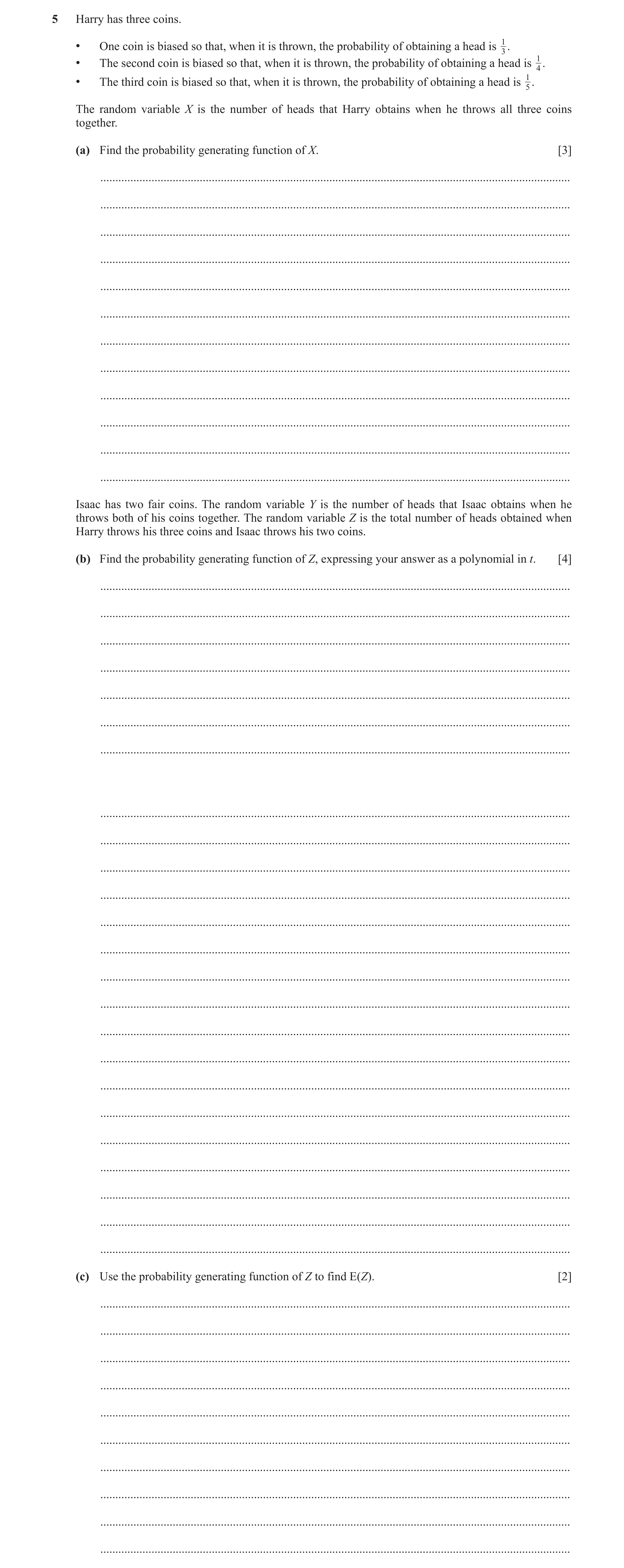
Q20 · Harry has three coins 9231/42 May/June 2023
5 Harry has three coins. • One coin is biased so that, when it is thrown, the probability of obtaining a head is 1.3 • The second coin is biased so that, when it is thrown, the probability of obtaining a head is 1.4 • The third coin is biased so that, when it is thrown, the probability of obtaining a head is 1.5 The random variable X is the number of heads that Harry obtains when he throws all three coins together. (a) Find the probability generating function of X. [3] … … … … … … … … … … … … Isaac has two fair coins. The random variable Y is the number of heads that Isaac obtains when he throws both of his coins together. The random variable Z is the total number of heads obtained when Harry throws his three coins and Isaac throws his two coins. (b) Find the probability generating function of Z, expressing your answer as a polynomial in t. [4] … … … … … … … … … … … … … … … … … … … … … … … … (c) Use the probability generating function of Z to find E(Z). [2] … … … … … … … … … …
9 marks
Mark scheme: 5(a) P(3H) = 1 60 P(2H) = 9 60 P(1H) = 26 60 P(0H) = 24 60 B1 Two probabilities correct, seen anywhere. GX (t) = 2 3 24 26 9 1 60 60 60 60 t t t M1 Cubic polynomial with 4 probabilities as coefficients with the correct powers of t from their working. Equivalent forms are acceptable. A1 Correct, AEF. 3 5(b) GY (t) = 2 1 1 1 4 2 4 t t B1 GZ(t) = 2 3 2 24 26 9 1 1 1 1 60 60 60 60 4 2 4 t t t t t M1 Attempt to multiply their two PGFs. 2 3 4 5 1 24 74 85 45 11 240 t t t t t M1 Obtain quintic expression and collect terms A1 Correct, AEF. 4 5(c) Differentiate: G'Z (t) = 2 3 4 1 74 170 135 44 5 240 t t t t M1 Differentiate their G. G'Z (1) = 428 107 1.78 240 60 A1 Any correct form. 2
This question in 9231/42 May/June 2023
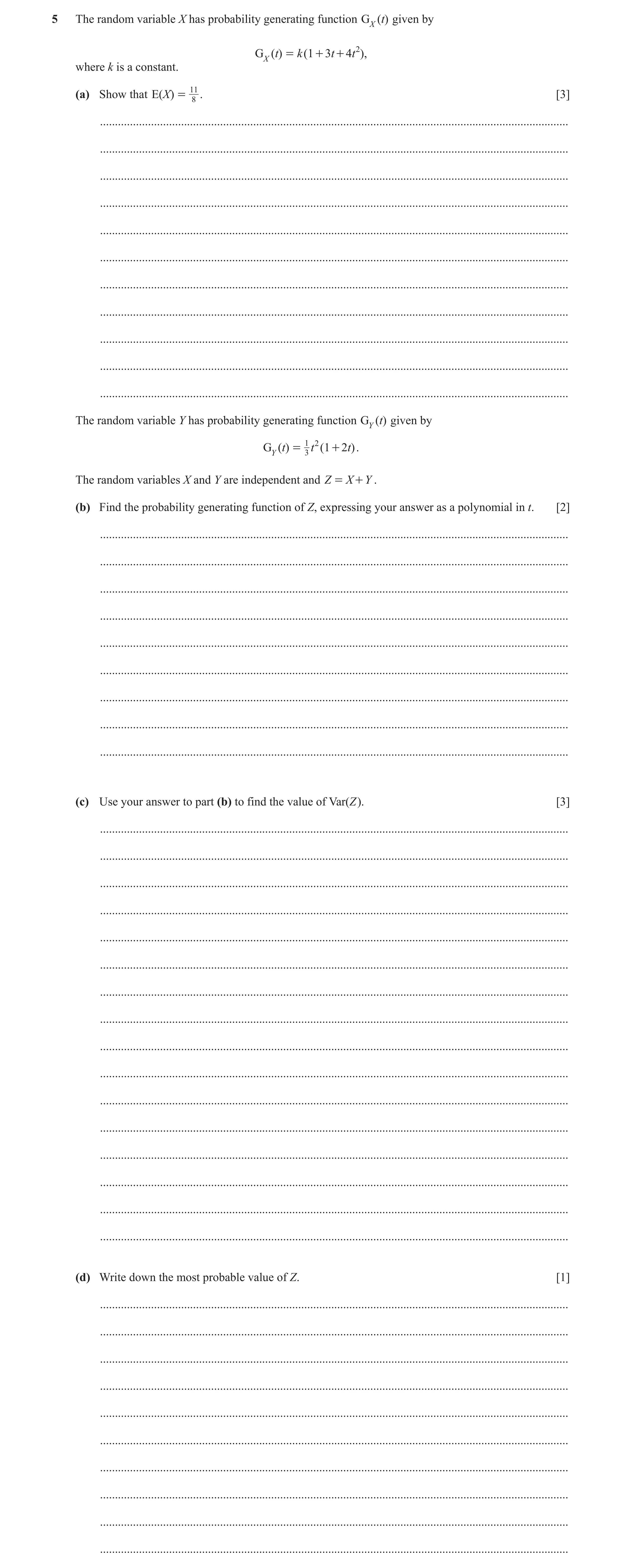
Q21 · The random variable X has probability generating function GX ( t) given by = k ( 1 + 3t +… 9231/43 May/June 2023
5 The random variable X has probability generating function GX ( t) given by = k ( 1 + 3t + 4t ), GX ( t) 2 where k is a constant. (a) Show that E ( X ) = 118 . [3] … … … … … … … … … … … The random variable Y has probability generating function GY ( t) given by = 3 t ( 1 + 2 t). GY ( t) 1 2 The random variables X and Y are independent and Z = X + Y . (b) Find the probability generating function of Z, expressing your answer as a polynomial in t. [2] … … … … … … … … … (c) Use your answer to part (b) to find the value of Var(Z ). [3] … … … … … … … … … … … … … … … … (d) Write down the most probable value of Z. [1] … … … … … … … … … …
9 marks
Mark scheme: 5(a) 2 G ( ) 1 3 4 X t k t t 1 1 3 4 1, 8 k k G'X (t) = 3 8 k t , M1 Or 1 3 4 11 0 1 2 8 8 8 8 px E(X) = G'X (1) = 11 8 A1 AG Evidence of using 1 t or px required. CWO 3 5(b) GZ(t) = 2 2 1 1 1 3 4 1 2 8 3 t t t t M1 Multiply the two PGFs to obtain a single polynomial of degree 5. 2 3 4 5 1 5 10 8 24 t t t t A1 May have 2t as a factor. 2 Question Answer Marks Guidance 5(c) G'Z(t) = 2 3 4 1 2 15 40 40 24 t t t t G''Z(t) = 2 3 1 2 30 120 160 24 t t t M1 Differentiate twice, allow one slip. Var(X) = G''Z(1) + G'Z(1) – (G'Z(1))2 = 2 1 97 97 312 24 24 24 M1 Use correct formula. 0.707 A1 407 576 3 5(d) 4 Z B1 FT FT their final polynomial in part (b) 1
This question in 9231/43 May/June 2023
Q22 · The random variable X has the geometric distribution Geo(p) 9231/41 Oct/Nov 2023
5 The random variable X has the geometric distribution Geo(p). pt (a) Show that the probability generating function of X is , where q = 1 - p . [3] 1- qt … … … … … … … … … … q (b) Use the probability generating function of X to show that Var ( X ) = 2 . [5] p … … … … … … … … … … … … … … … … … … … … … … … … … Kenny throws an ordinary fair 6-sided dice repeatedly. The random variable X is the number of throws that Kenny takes in order to obtain a 6. The random variable Z denotes the sum of two independent values of X. (c) Find the probability generating function of Z. [2] … … … … … … … … … … … … … … …
10 marks
Mark scheme: 5(a) r −1 B1 Implied by G(t) = pq r −1 t r . P(X = r) = p (1 − p ) r −1 = pq r −1 M1 (Infinite summation) with common ratio (qt) and first G(t) = pt ( qt ) term or common factor pt indicated or GP identified. 1 pt A1 AG G(t) = pt = Convincingly obtained. 1 − qt 1 − qt 3 5(b) −2 −1 −2 M1 Attempt to differentiate as a product/quotient. G'(t) = pqt (1 − qt ) + p (1 − qt ) [= p (1 − qt ) ] 2 −3 −2 −3 M1 Attempt to differentiate their G'(t). G''(t) = 2 pq t (1 − qt ) + 2 pq (1 − qt ) [= 2qp (1 − qt ) ] −2 1 2𝑞 M1 Substitute t = 1 into their G'(t) and G''(t) and use formula G'(1) = p (1 − q ) = , G''(1) = 𝑃2 for Var(X) (at some point). p 2 2𝑞 1 1 M1 (1−q ) replaced by p in denominator throughout, and Var(X) = + 𝑃2 𝑝−(𝑝) some cancellation seen (at some point). q A1 AG 2 Convincingly obtained. p 5 5(c) 1 B1 Implied by correct final answer. t t 6 GX(t) = = 5 1 − t 6 − 5t 6 2 B1 1 2 t t GZ(t) = (GX(t))2 = Allow 6 . 6 − 5t 1 − 5 t 6 2
This question in 9231/41 Oct/Nov 2023
Q23 · Toby has a bag which contains 6 red marbles and 3 green marbles 9231/42 Oct/Nov 2023
3 Toby has a bag which contains 6 red marbles and 3 green marbles. He randomly chooses 3 marbles from the bag, without replacement. The random variable X is the number of red marbles that Toby obtains. (a) Find the probability generating function of X. [3] … … … … … … … … … … … Ling also has a bag which contains 6 red marbles and 3 green marbles. He randomly chooses 2 marbles from his bag, without replacement. The random variable Y is the number of red marbles that Ling + 6 t + 5 t ) . obtains. It is given that the probability generating function of Y is 121 ( 1 2 The random variable Z is the total number of red marbles that Toby and Ling obtain. (b) Find the probability generating function of Z, expressing your answer as a polynomial in t. [3] … … … … … … … … … … … … … … … … … … … … … (c) Use the probability generating function of Z to find Var(Z ). [4] … … … … … … … … … … … … … … … …
10 marks
Mark scheme: 3(a) 120 270 108 6 B1 2 correct probabilities. P(3R) = P(2R) = P(1R) = P(0R) = 504 504 504 504 1 2 3 1 2 3 M1 Cubic polynomial with their probabilities. GX(t) = 6 + 108t + 270t + 120t = 1 + 18t + 45t + 20t ( ) ( ) 504 84 1 3 15 2 5 3 A1 Correct. + t + t + t 84 14 28 21 3 3(b) 1 2 3 1 2 M1 Attempt to multiply out the brackets. GZ(t) = 1 + 18t + 45t + 20t 1 + 6t + 5t ( ) ( ) 84 12 1 2 3 4 5 M1 Obtain quintic polynomial (may not be 1 + 24t + 158t + 380t + 345t + 100t ( ) simplified). 1008 1 1 79 2 95 3 115 4 25 5 A1 Correct. + t + t + t + t + t 1008 42 504 252 336 252 3 3(c) 1 2 3 4 M1 Differentiate twice. May not see derivatives in G' = 24 + 316t + 1140t + 1380t + 500t ( ) terms of t. 1008 1 2 3 G'' = 316 + 2280t + 4140t + 2000t ( ) 1008 3360 10 B1 Seen or implied, NFWW (e.g. sampling with E( Z ) = replacement). 1008 3 1) and G' (1) . 8736 10 10 2 26 10 100 M1 Use formula with their G ( Var(Z) = + − = − − 1008 3 3 3 3 9 8 A1 Or 0.889 9 4
This question in 9231/42 Oct/Nov 2023
Q24 · The random variable X has the geometric distribution Geo(p) 9231/43 Oct/Nov 2023
5 The random variable X has the geometric distribution Geo(p). pt (a) Show that the probability generating function of X is , where q = 1 - p . [3] 1- qt … … … … … … … … … … q (b) Use the probability generating function of X to show that Var ( X ) = 2 . [5] p … … … … … … … … … … … … … … … … … … … … … … … … … Kenny throws an ordinary fair 6-sided dice repeatedly. The random variable X is the number of throws that Kenny takes in order to obtain a 6. The random variable Z denotes the sum of two independent values of X. (c) Find the probability generating function of Z. [2] … … … … … … … … … … … … … … …
10 marks
Mark scheme: 5(a) r −1 B1 Implied by G(t) = pq r −1 t r . P(X = r) = p (1 − p ) r −1 = pq r −1 M1 (Infinite summation) with common ratio (qt) and first G(t) = pt ( qt ) term or common factor pt indicated or GP identified. 1 pt A1 AG G(t) = pt = Convincingly obtained. 1 − qt 1 − qt 3 5(b) −2 −1 −2 M1 Attempt to differentiate as a product/quotient. G'(t) = pqt (1 − qt ) + p (1 − qt ) [= p (1 − qt ) ] 2 −3 −2 −3 M1 Attempt to differentiate their G'(t). G''(t) = 2 pq t (1 − qt ) + 2 pq (1 − qt ) [= 2qp (1 − qt ) ] −2 1 2𝑞 M1 Substitute t = 1 into their G'(t) and G''(t) and use formula G'(1) = p (1 − q ) = , G''(1) = 𝑃2 for Var(X) (at some point). p 2 2𝑞 1 1 M1 (1−q ) replaced by p in denominator throughout, and Var(X) = + 𝑃2 𝑝−(𝑝) some cancellation seen (at some point). q A1 AG 2 Convincingly obtained. p 5 5(c) 1 B1 Implied by correct final answer. t t 6 GX(t) = = 5 1 − t 6 − 5t 6 2 B1 1 2 t t GZ(t) = (GX(t))2 = Allow 6 . 6 − 5t 1 − 5 t 6 2
This question in 9231/43 Oct/Nov 2023
Q25 · The random variable Y is the sum of two independent observations of the random variable X 9231/41 May/June 2024
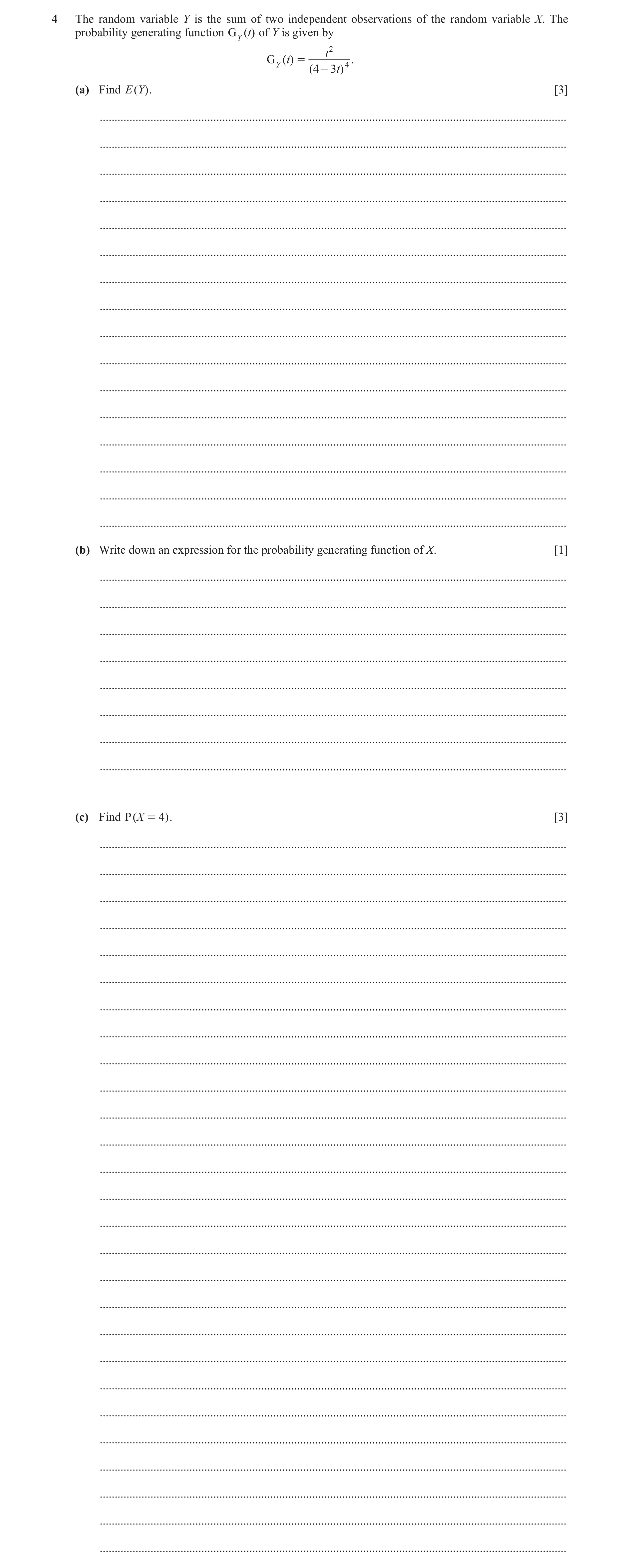
4 The random variable Y is the sum of two independent observations of the random variable X. The probability generating function G Y ( t) of Y is given by t 2 G Y ( t) = 4 . ( 4 - 3t) (a) Find E ( Y ) . [3] … … … … … … … … … … … … … … … … (b) Write down an expression for the probability generating function of X. [1] … … … … … … … … (c) Find P ( X = 4) . [3] … … … … … … … … … … … … … … … … … … … … … … … … … … …
7 marks
Mark scheme: 4(a) GY (t) = 2 4 , 4 3 t t 4 3 2 8 4 3 2 12 4 3 4 3 t t t t t or 2 4 5 2 12 4 3 4 3 t t t t M1 ‘Two’ terms obtained, correct denominator(s). E(Y) = G’Y (1) = 14 M1 A1 t = 1 in their expression. CWO 3 4(b) GX (t) = 2 4 3 t t B1 1 Question Answer Marks Guidance 4(c) GX (t) = 2 2 2 3 3 3 9 27 4 3 1 1 3 4 16 4 16 2 16 64 t t t t t t t t M1 Expansion as far as 3t OR term in 4t calculated. Use P(X = 4) = their coefficient of 4t M1 Find the numerical value of their coefficient of 4t . 27 256 A1 Accept 0.105. 3
This question in 9231/41 May/June 2024
Q26 · The random variable Y is the sum of two independent observations of the random variable X 9231/42 May/June 2024
4 The random variable Y is the sum of two independent observations of the random variable X. The probability generating function G Y ( t) of Y is given by t 2 G Y ( t) = 4 . ( 4 - 3t) (a) Find E ( Y ) . [3] … … … … … … … … … … … … … … … … (b) Write down an expression for the probability generating function of X. [1] … … … … … … … … (c) Find P ( X = 4) . [3] … … … … … … … … … … … … … … … … … … … … … … … … … … …
7 marks
Mark scheme: 4(a) GY (t) = 2 4 , 4 3 t t 4 3 2 8 4 3 2 12 4 3 4 3 t t t t t or 2 4 5 2 12 4 3 4 3 t t t t M1 ‘Two’ terms obtained, correct denominator(s). E(Y) = G’Y (1) = 14 M1 A1 t = 1 in their expression. CWO 3 4(b) GX (t) = 2 4 3 t t B1 1 Question Answer Marks Guidance 4(c) GX (t) = 2 2 2 3 3 3 9 27 4 3 1 1 3 4 16 4 16 2 16 64 t t t t t t t t M1 Expansion as far as 3t OR term in 4t calculated. Use P(X = 4) = their coefficient of 4t M1 Find the numerical value of their coefficient of 4t . 27 256 A1 Accept 0.105. 3
This question in 9231/42 May/June 2024
Q27 · Nikita has three coins 9231/41 Oct/Nov 2024
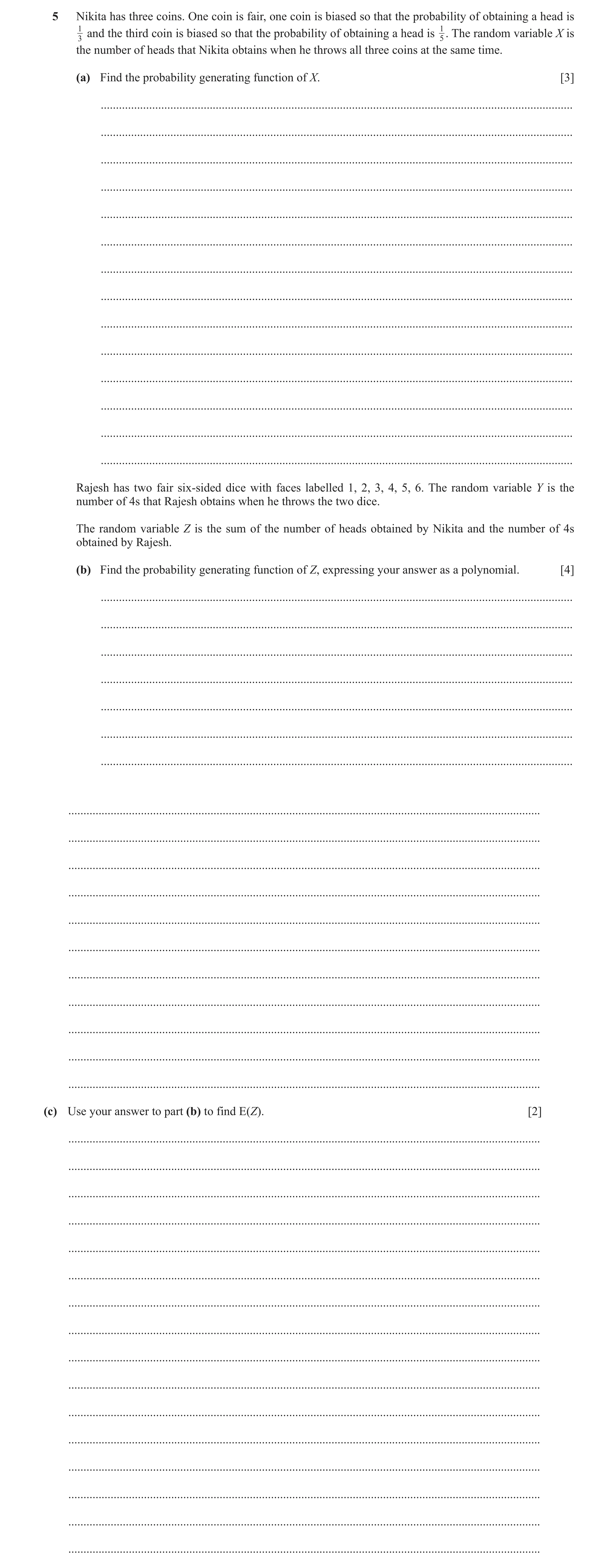
5 Nikita has three coins. One coin is fair, one coin is biased so that the probability of obtaining a head is 1 and the third coin is biased so that the probability of obtaining a head is 15. The random variable X is 3 the number of heads that Nikita obtains when he throws all three coins at the same time. (a) Find the probability generating function of X. [3] … … … … … … … … … … … … … … Rajesh has two fair six-sided dice with faces labelled 1, 2, 3, 4, 5, 6. The random variable Y is the number of 4s that Rajesh obtains when he throws the two dice. The random variable Z is the sum of the number of heads obtained by Nikita and the number of 4s obtained by Rajesh. (b) Find the probability generating function of Z, expressing your answer as a polynomial. [4] … … … … … … … … … … … … … … … … … … (c) Use your answer to part (b) to find E(Z). [2] … … … … … … … … … … … … … … … …
9 marks
Mark scheme: 5(a) 8 14 7 1 B1 All correct. P(0 heads) = , P(1 head) = , P(2 heads) = , P(3 heads) = 30 30 30 30 8 14 7 2 1 3 M1 Cubic polynomial. GX (t) = + t + t + t 30 30 30 30 A1 FT FT their probabilities that sum to one. 3 5(b) 25 10 1 2 B1 GY (t) = + t + t 36 36 36 1 8 14 7 2 1 3 2 M1 With attempt to multiply. 25 + 10t + t GZ (t) = + t + t + t ( ) 30 36 30 30 30 30 1 2 3 4 5 M1 A1 Obtain quintic polynomial. 200 + 430t + 323t + 109t + 17t + t ( ) 1080 4 5(c) 1 M1 Differentiate and substitute t = 1. GZ’ (1) = ( 430 + 646 + 327 + 68 + 5 ) 1080 1476 41 A1 = = 1.37 1080 30 2
This question in 9231/41 Oct/Nov 2024
Q28 · Nikita has three coins 9231/43 Oct/Nov 2024
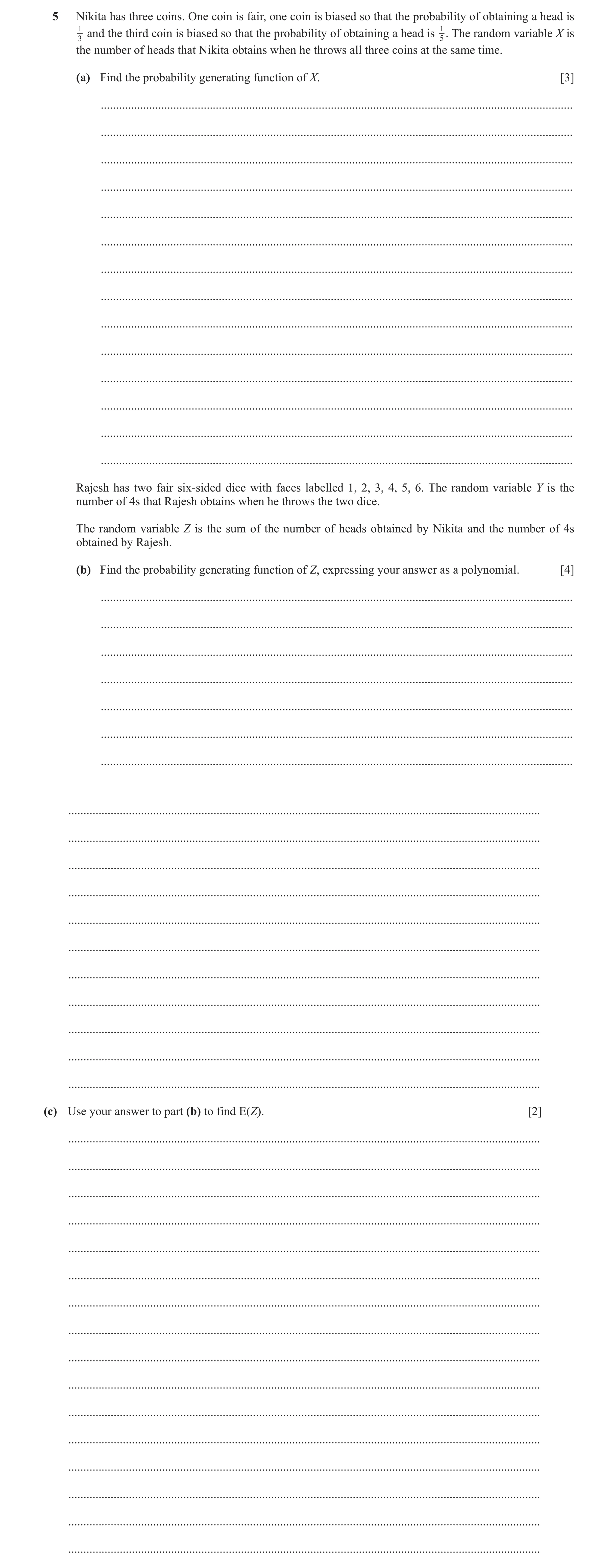
5 Nikita has three coins. One coin is fair, one coin is biased so that the probability of obtaining a head is 1 and the third coin is biased so that the probability of obtaining a head is 15. The random variable X is 3 the number of heads that Nikita obtains when he throws all three coins at the same time. (a) Find the probability generating function of X. [3] … … … … … … … … … … … … … … Rajesh has two fair six-sided dice with faces labelled 1, 2, 3, 4, 5, 6. The random variable Y is the number of 4s that Rajesh obtains when he throws the two dice. The random variable Z is the sum of the number of heads obtained by Nikita and the number of 4s obtained by Rajesh. (b) Find the probability generating function of Z, expressing your answer as a polynomial. [4] … … … … … … … … … … … … … … … … … … (c) Use your answer to part (b) to find E(Z). [2] … … … … … … … … … … … … … … … …
9 marks
Mark scheme: 5(a) 8 14 7 1 B1 All correct. P(0 heads) = , P(1 head) = , P(2 heads) = , P(3 heads) = 30 30 30 30 8 14 7 2 1 3 M1 Cubic polynomial. GX (t) = + t + t + t 30 30 30 30 A1 FT FT their probabilities that sum to one. 3 5(b) 25 10 1 2 B1 GY (t) = + t + t 36 36 36 1 8 14 7 2 1 3 2 M1 With attempt to multiply. 25 + 10t + t GZ (t) = + t + t + t ( ) 30 36 30 30 30 30 1 2 3 4 5 M1 A1 Obtain quintic polynomial. 200 + 430t + 323t + 109t + 17t + t ( ) 1080 4 5(c) 1 M1 Differentiate and substitute t = 1. GZ’ (1) = ( 430 + 646 + 327 + 68 + 5 ) 1080 1476 41 A1 = = 1.37 1080 30 2
This question in 9231/43 Oct/Nov 2024
Q29 · Eric has three identical coins, each of which is biased so that the probability of… 9231/44 May/June 2025
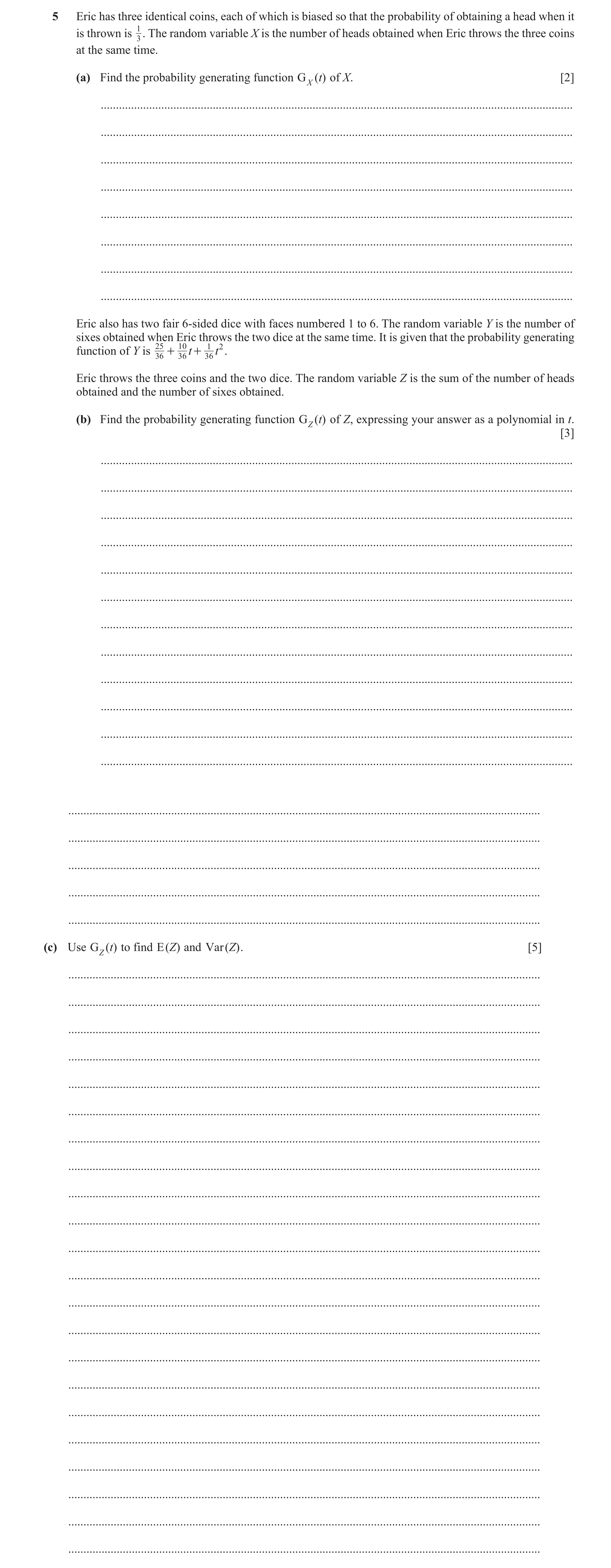
5 Eric has three identical coins, each of which is biased so that the probability of obtaining a head when it is thrown is 1. The random variable X is the number of heads obtained when Eric throws the three coins 3 at the same time. (a) Find the probability generating function GX ( )t of X. [2] … … … … … … … … Eric also has two fair 6-sided dice with faces numbered 1 to 6. The random variable Y is the number of sixes obtained when Eric throws the two dice at the same time. It is given that the probability generating function of Y is 25 + 10 t + 1 t 2 . 36 36 36 Eric throws the three coins and the two dice. The random variable Z is the sum of the number of heads obtained and the number of sixes obtained. (b) Find the probability generating function GZ ( )t of Z, expressing your answer as a polynomial in t. [3] … … … … … … … … … … … … … … … … … (c) Use GZ ( )t to find E ( Z ) and Var ( Z) . [5] … … … … … … … … … … … … … … … … … … … … … …
10 marks
Mark scheme: 5(a) Probabilities: 278 , 1227 , 276 , 271 for 0, 1, 2, 3 heads B1 27 8 + 1227 t + 276 t 2 + 271 t 3 B1 FT FT their probabilities to form a 4-term cubic. Must have p = 1. 2 ( 3 3 + 13 t ) scores B2. 2 5(b) M1 Attempt to multiply their G X (t ) and their GY ( t ) . ( 27 8 + 1227 t + 276 t 2 + 271 t 3 )( 36 25 + 1036 t + 361 t 2 ) 1 2 3 4 5 M1 Expand to form polynomial of degree 5 (need not be simplified). 200 + 380t + 278t + 97 t + 16t + t 972 ( ) A1 CWO 3 15(c) 380 + 556t + 291t 2 + 64t 3 + 5t 4 M1 Attempt at differentiating their GZ ( t ) . G 'Z ( t ) = 972 ( ) 1296 t ) . E ( Z ) = G 'Z (1) = 972 = 34 A1 FT FT their GZ ( 1 556 + 582t + 192t 2 + 20t 3 M1 Attempt at differentiating their G'Z ( t ) . G ''Z ( t ) = 972 ( ) 1350 4 4 Use correct formula using their G 'Z (1) and their G ''Z (1) . Var ( Z ) = 972 + 34 − ( 3 = 1825 + 34 − ( 3 ) 2 ) 2 M1 17 18 = 0.944 A1 CWO 5
This question in 9231/44 May/June 2025
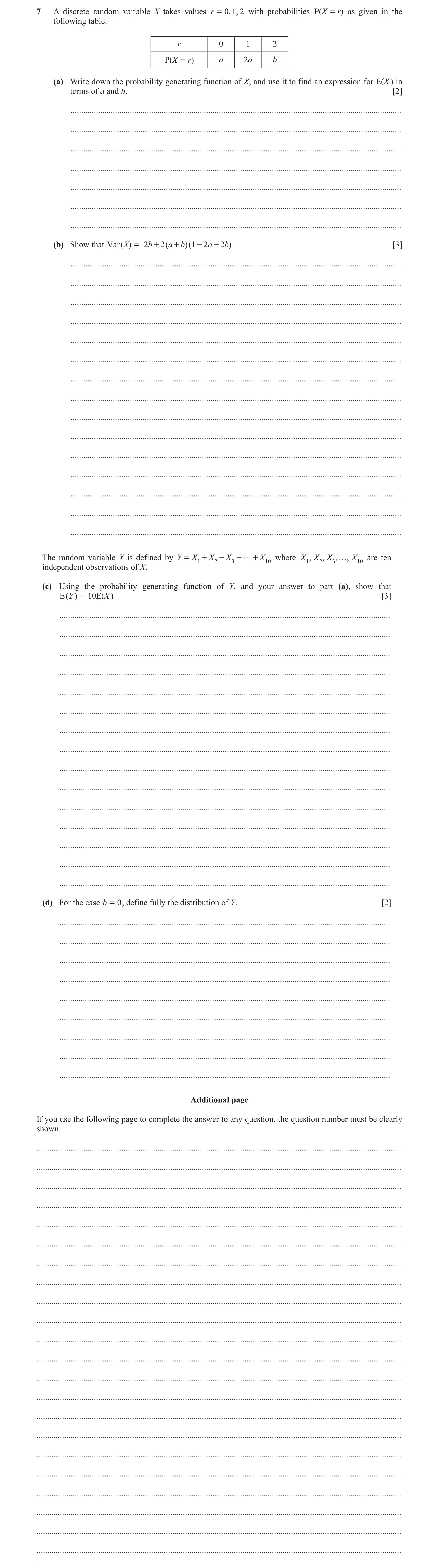
Q30 · A discrete random variable X takes values r = 0, 1, 2 with probabilities P( X = r) as… 9231/41 Oct/Nov 2025
7 A discrete random variable X takes values r = 0, 1, 2 with probabilities P( X = r) as given in the following table. r 0 1 2 P( X = r) a 2a b (a) Write down the probability generating function of X, and use it to find an expression for E(X ) in terms of a and b. [2] … … … … … … … (b) Show that Var ( X ) = 2b + 2 ( a + b)( 1 - 2a - 2 b) . [3] … … … … … … … … … … … … … … … The random variable Y is defined by Y = X + X + X + g + X where X , X , X , f, X are ten 1 2 3 10 1 2 3 10 independent observations of X. (c) Using the probability generating function of Y, and your answer to part (a), show that E ( Y ) = 10E( X ) . [3] … … … … … … … … … … … … … … … (d) For the case b = 0 , define fully the distribution of Y. [2] … … … … … … … … … Additional page If you use the following page to complete the answer to any question, the question number must be clearly shown. … … … … … … … … … … … … … … … … … … … … … …
10 marks
Mark scheme: 7(a) 2 B1 G X ( t ) = a + 2at + bt ' B1 G X ( t ) = 2 a + 2bt ' E ( X ) = G X (1) = 2 a + 2b 2 7(b) '' B1 G X ( t ) = 2b 2 M1 Use correct formula with their expressions. Var ( X ) = 2b + ( 2a + 2b ) − ( 2a + 2b ) 2 A1 AG, shown convincingly. 2b + ( 2 a + 2b ) − ( 2 a + 2b ) = 2b + ( 2 a + 2b ) (1 − ( 2 a + 2b ) ) = 2b + 2( a + b )(1 − 2 a − 2b ) Alternative method for question 7(b) 2 2 2 2 B1 E X = 0 a + 1 2a + 2 b = 2a + 4b ( ) 2 M1 Use correct formula with their expressions. Var ( X ) = ( 2a + 4b ) − ( 2a + 2b ) ( 2 a + 4b ) − ( 2 a + 2b ) 2 = 2b + 2 a + 2b − (2 a + 2b ) 2 A1 AG, shown convincingly. = 2b + ( 2 a + 2b ) (1 − ( 2 a + 2b ) ) = 2b + 2( a + b )(1 − 2 a − 2b) 3 7(c) 10 G X ( t ) . a + 2 at + bt 2 G Y ( t ) = ( ) B1 FT FT their 9 GY ( t ) and evaluate at t = 1 . a + 2 at + bt 2 G Y ' ( t ) = 20 ( a + bt )( ) M1 Attempt to differentiate their E ( Y ) = 20 ( a + b )( 3a + b )9 3a + b =1 , hence E ( Y ) = 20 ( a + b ) = 10E ( X ) . A1 3a + b = 1 since total probability is 1, OE. 3 7(d) Binomial *B1 Uses PGF to identify binomial. 2 DB1 Identifies binomial with correct parameters. B 10, 3 2
This question in 9231/41 Oct/Nov 2025
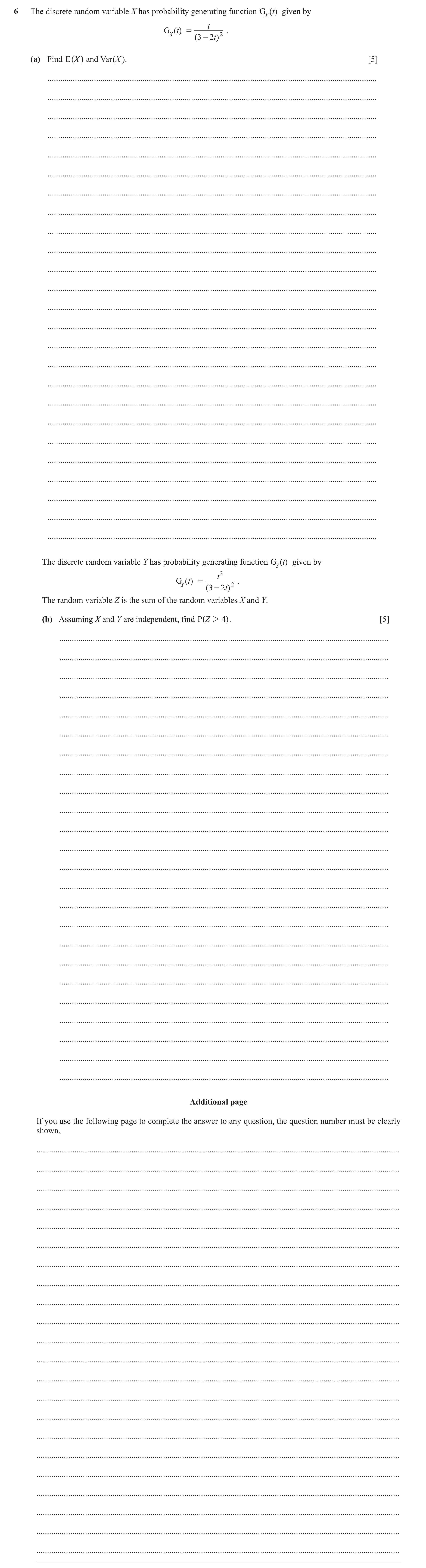
Q31 · The discrete random variable X has probability generating function GX ()t given by t G… 9231/42 Oct/Nov 2025
6 The discrete random variable X has probability generating function GX ()t given by t G ()t = . X ( 3 - 2t) 2 (a) Find E ( X ) and Var (X ). [5] … … … … … … … … … … … … … … … … … … … … … … … … … The discrete random variable Y has probability generating function GY ()t given by t 2 G ()t = . Y ( 3 - 2t) 2 The random variable Z is the sum of the random variables X and Y. (b) Assuming X and Y are independent, find P ( Z 2 4 ) . [5] … … … … … … … … … … … … … … … … … … … … … … … … Additional page If you use the following page to complete the answer to any question, the question number must be clearly shown. … … … … … … … … … … … … … … … … … … … … … …
10 marks
Mark scheme: 6(a) X ( t ) . ' ( 3 − 2t ) 2 + 4 ( 3 − 2t ) t 3 + 2t M1 Attempt to differentiate G G X ( t ) = 4 = 3 ' 1) . ( 3 − 2t ) ( 3 − 2t ) May be implied by expressions for G X ( ' A1 E ( X ) = G X (1) = 5 Attempt to differentiate GX' ( t ) . '' 2 ( 3 − 2t ) 3 + 6 ( 3 + 2t )( 3 − 2t ) 2 24 + 8t M1 G X ( t ) = 6 = 4 '' G X (1) . ( 3 − 2t ) ( 3 − 2t ) May be implied by expressions for '' ' ' 2 M1 Use correct formula using their values. = 32 + 5 − 25 Var ( X ) = G X (1) + G X (1) − ( G X (1) ) 12 A1 CWO Var ( X ) = 5 6(b) t 3 1 3 2 M1 Multiply and attempt at binomial expansion. t ( 1 + ( −4 )( − 3 t ) +) G Z ( t ) = 4 = 81 ( 3 − 2t ) P ( Z = 4 ) = their coefficient of 4t . M1 Attempt at finding their coefficient of 3t or 4t . Either seen earns M1. OR P ( Z = 3 ) = their coefficient of 3t . 1 A1 Both values seen. 8 and P ( Z = 4 ) = 243 P ( Z = 3) = 81 P ( Z 4 ) = 1 − ' 243 8 '− ' 811 ' M1 Attempt to find P ( Z 4 ) using their values. 232 A1 AWRT 0.955. P ( Z 4 ) = 243 Note: considering the expansions of the probability generating functions for X and Y separately, then finding P ( Z 4 ) = 1 − P ( Z ≤ 4 ) with P ( Z ≤ 4 ) = P ( X = 1, Y = 2 ) + P ( X = 1, Y = 3 ) + P ( X = 2, Y = 2 ) earns full credit. 5
This question in 9231/42 Oct/Nov 2025
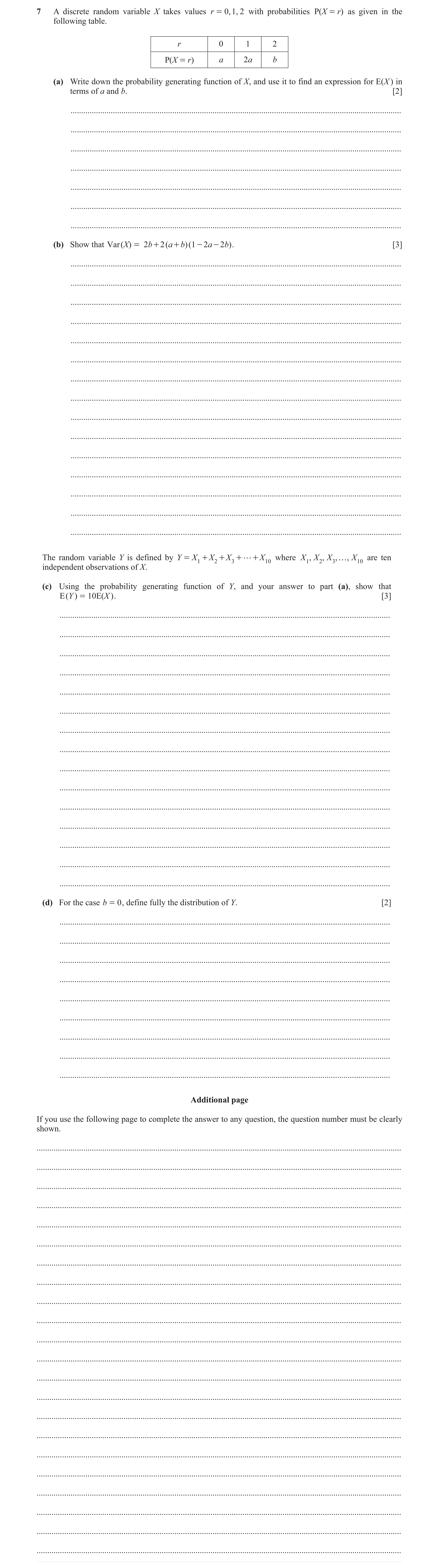
Q32 · A discrete random variable X takes values r = 0, 1, 2 with probabilities P( X = r) as… 9231/43 Oct/Nov 2025
7 A discrete random variable X takes values r = 0, 1, 2 with probabilities P( X = r) as given in the following table. r 0 1 2 P( X = r) a 2a b (a) Write down the probability generating function of X, and use it to find an expression for E(X ) in terms of a and b. [2] … … … … … … … (b) Show that Var ( X ) = 2b + 2 ( a + b)( 1 - 2a - 2 b) . [3] … … … … … … … … … … … … … … … The random variable Y is defined by Y = X + X + X + g + X where X , X , X , f, X are ten 1 2 3 10 1 2 3 10 independent observations of X. (c) Using the probability generating function of Y, and your answer to part (a), show that E ( Y ) = 10E( X ) . [3] … … … … … … … … … … … … … … … (d) For the case b = 0 , define fully the distribution of Y. [2] … … … … … … … … … Additional page If you use the following page to complete the answer to any question, the question number must be clearly shown. … … … … … … … … … … … … … … … … … … … … … …
10 marks
Mark scheme: 7(a) 2 B1 G X ( t ) = a + 2at + bt ' B1 G X ( t ) = 2 a + 2bt ' E ( X ) = G X (1) = 2 a + 2b 2 7(b) '' B1 G X ( t ) = 2b 2 M1 Use correct formula with their expressions. Var ( X ) = 2b + ( 2a + 2b ) − ( 2a + 2b ) 2 A1 AG, shown convincingly. 2b + ( 2 a + 2b ) − ( 2 a + 2b ) = 2b + ( 2 a + 2b ) (1 − ( 2 a + 2b ) ) = 2b + 2( a + b )(1 − 2 a − 2b ) Alternative method for question 7(b) 2 2 2 2 B1 E X = 0 a + 1 2a + 2 b = 2a + 4b ( ) 2 M1 Use correct formula with their expressions. Var ( X ) = ( 2a + 4b ) − ( 2a + 2b ) ( 2 a + 4b ) − ( 2 a + 2b ) 2 = 2b + 2 a + 2b − (2 a + 2b ) 2 A1 AG, shown convincingly. = 2b + ( 2 a + 2b ) (1 − ( 2 a + 2b ) ) = 2b + 2( a + b )(1 − 2 a − 2b) 3 7(c) 10 G X ( t ) . a + 2 at + bt 2 G Y ( t ) = ( ) B1 FT FT their 9 GY ( t ) and evaluate at t = 1 . a + 2 at + bt 2 G Y ' ( t ) = 20 ( a + bt )( ) M1 Attempt to differentiate their E ( Y ) = 20 ( a + b )( 3a + b )9 3a + b =1 , hence E ( Y ) = 20 ( a + b ) = 10E ( X ) . A1 3a + b = 1 since total probability is 1, OE. 3 7(d) Binomial *B1 Uses PGF to identify binomial. 2 DB1 Identifies binomial with correct parameters. B 10, 3 2
This question in 9231/43 Oct/Nov 2025
![Question 11: The random variable X is such that P ( X = r) = kr 2 for r = 1, 2, 3, 4, where k is a constant. (a) Find the value of k. [1] ..............…](https://img.pastlit.com/crops/5a35a165-9d9b-4365-aebd-b3101b3e710b/q5.webp)
 10
10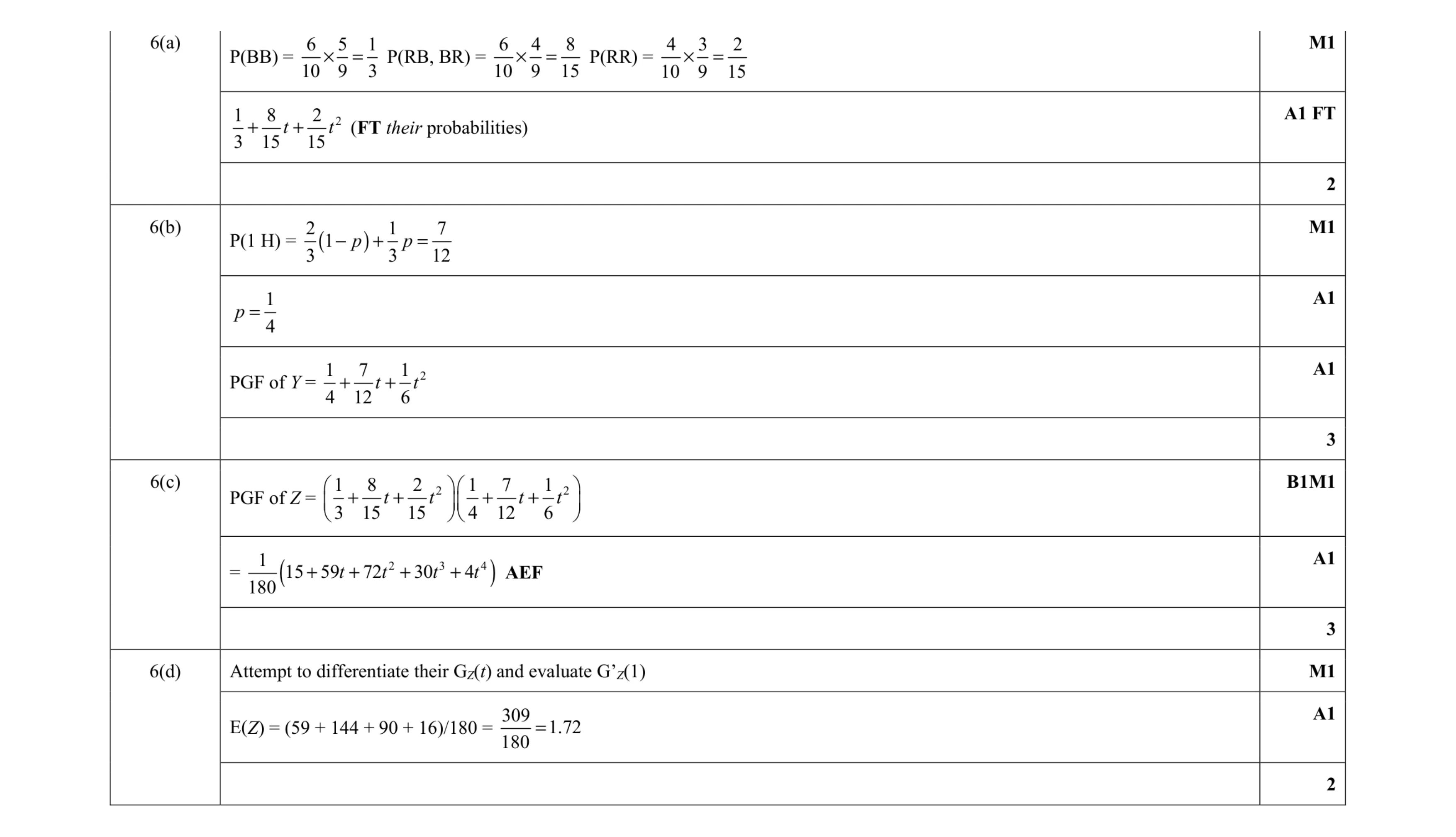 10
10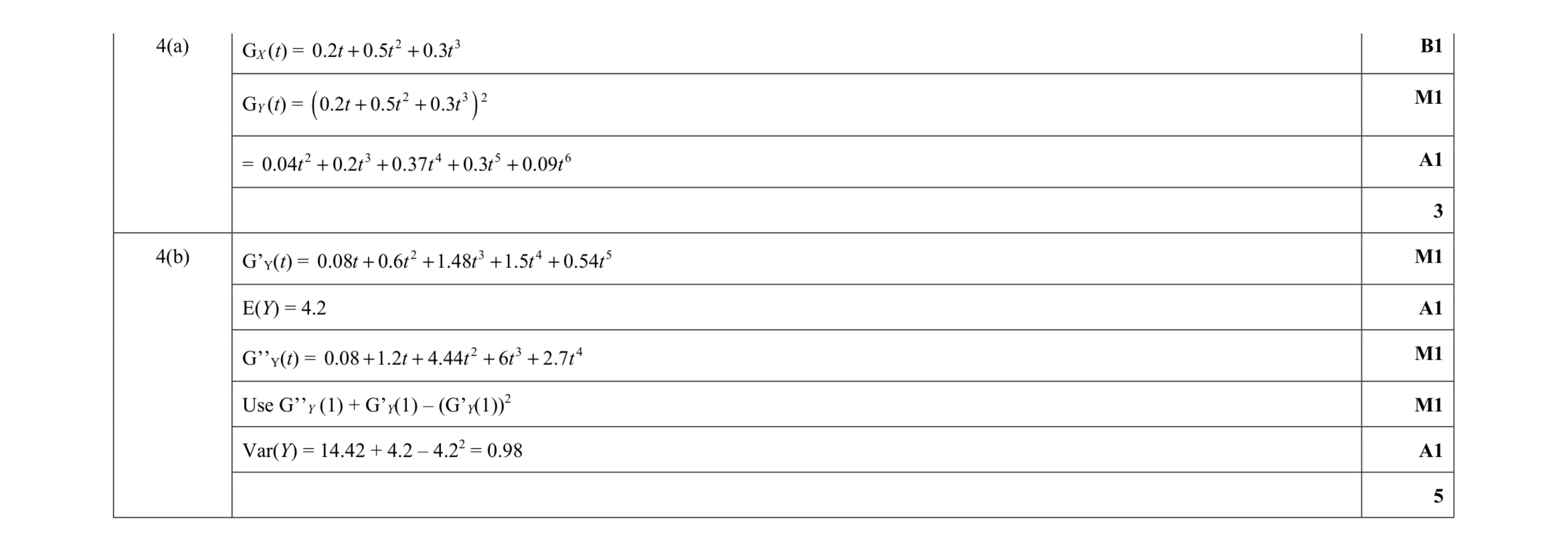 8
8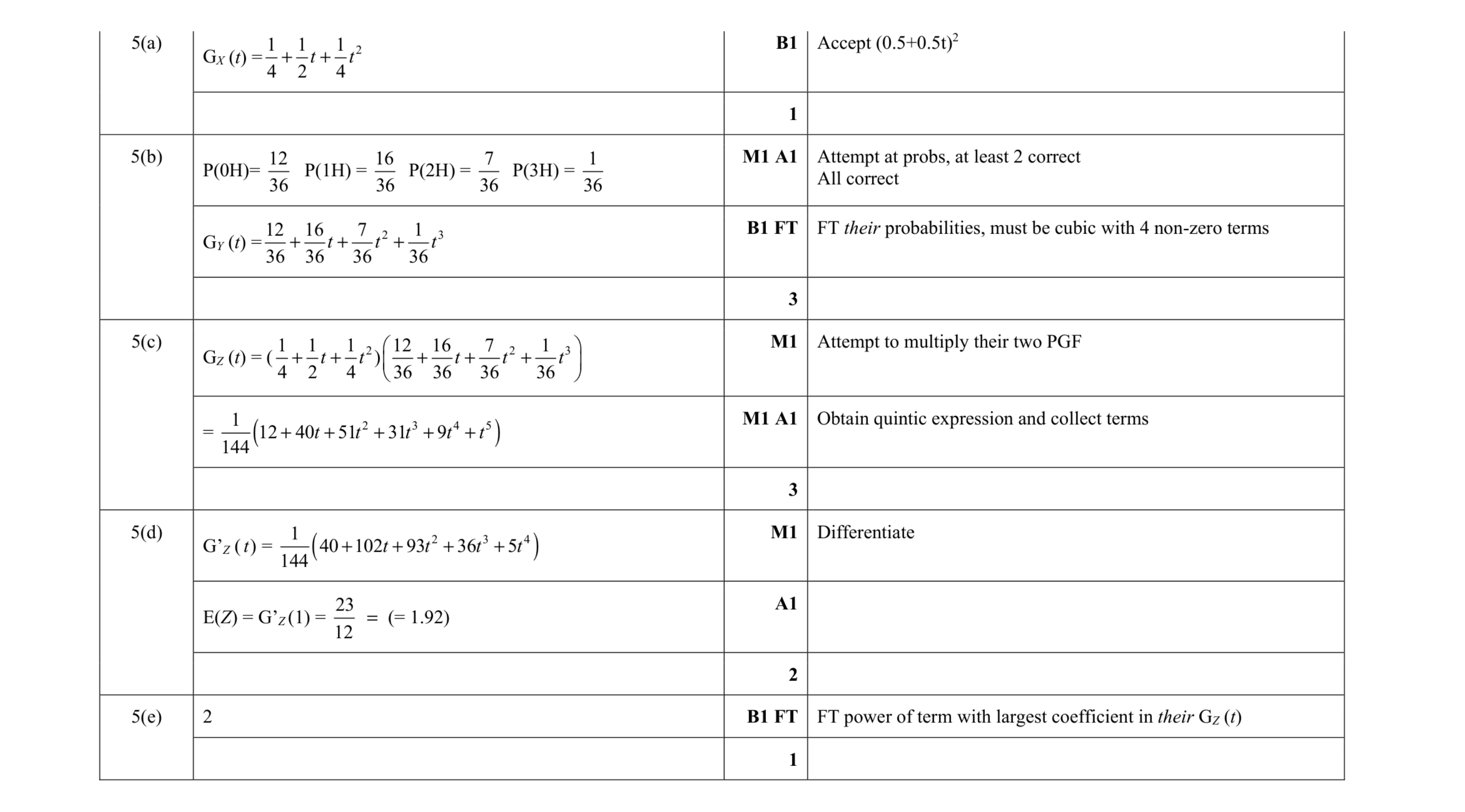 10
10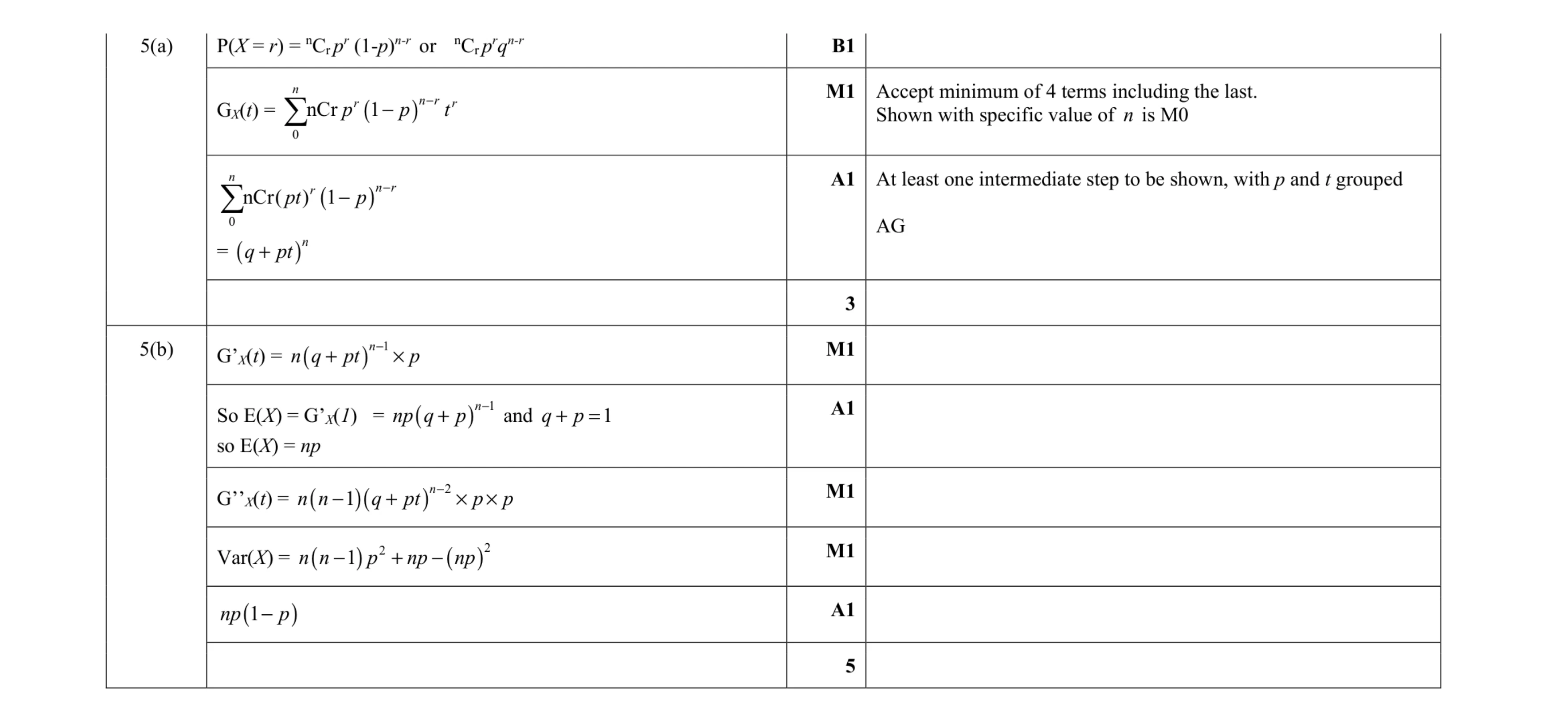 8
8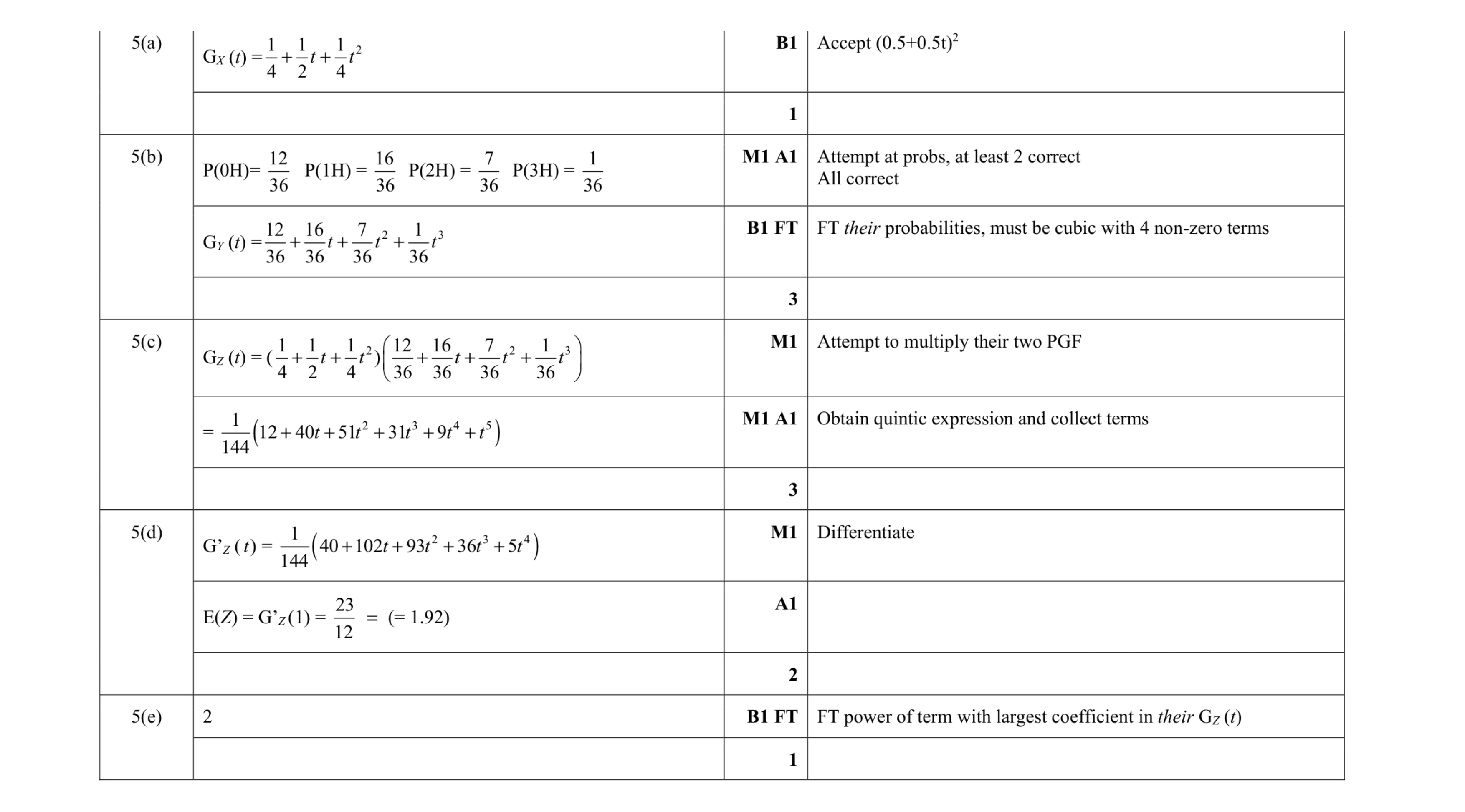 10
10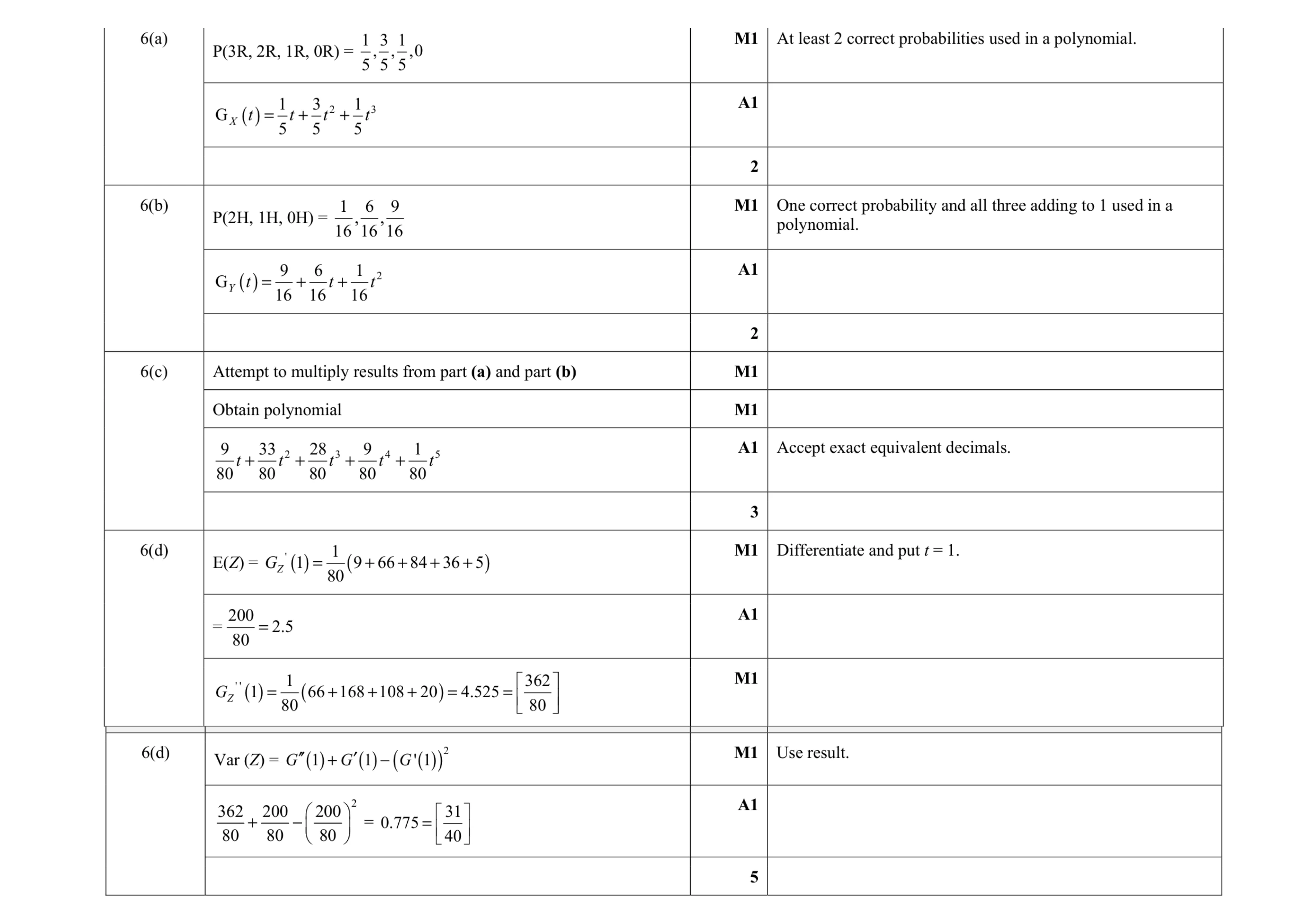 12
12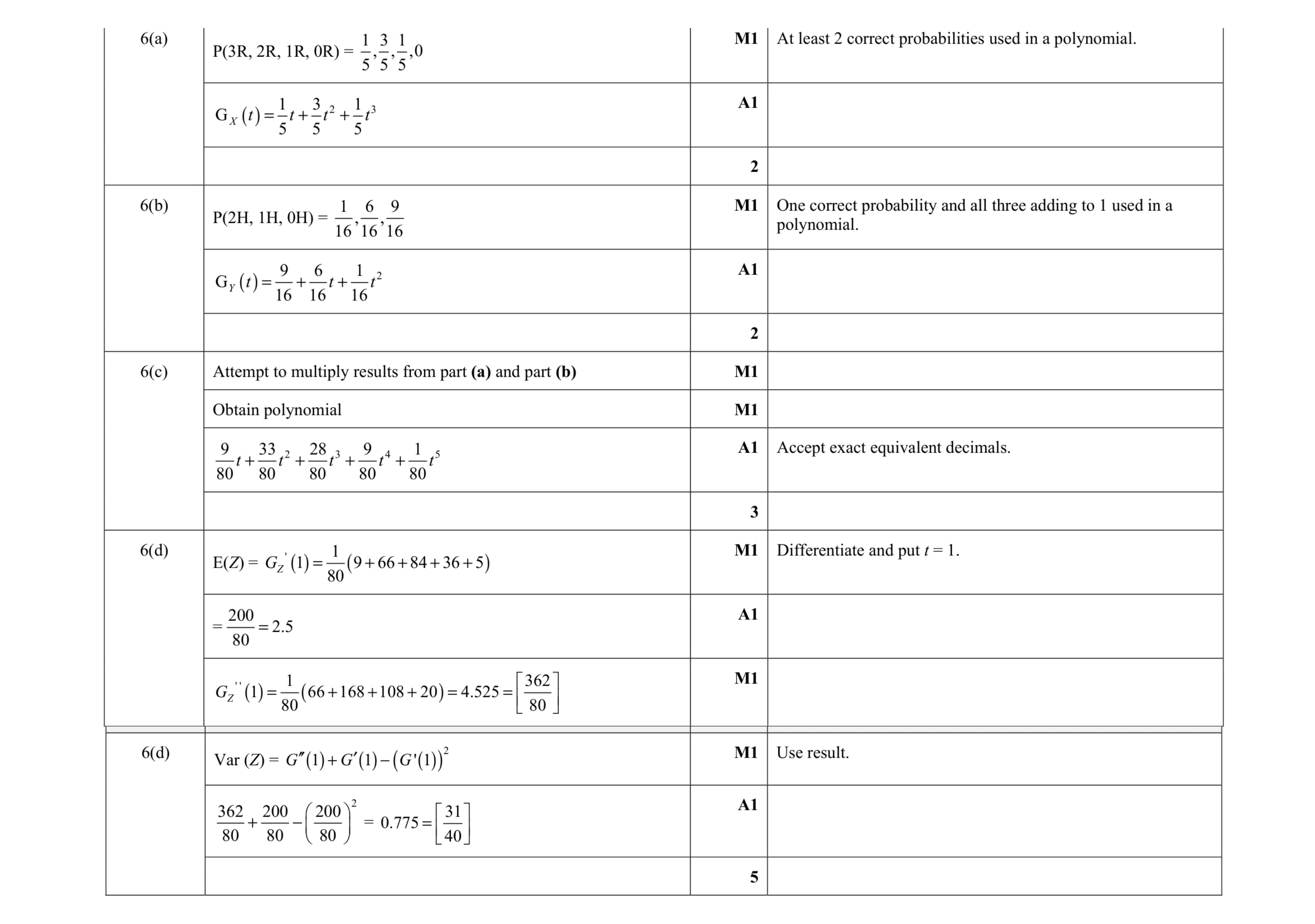 12
12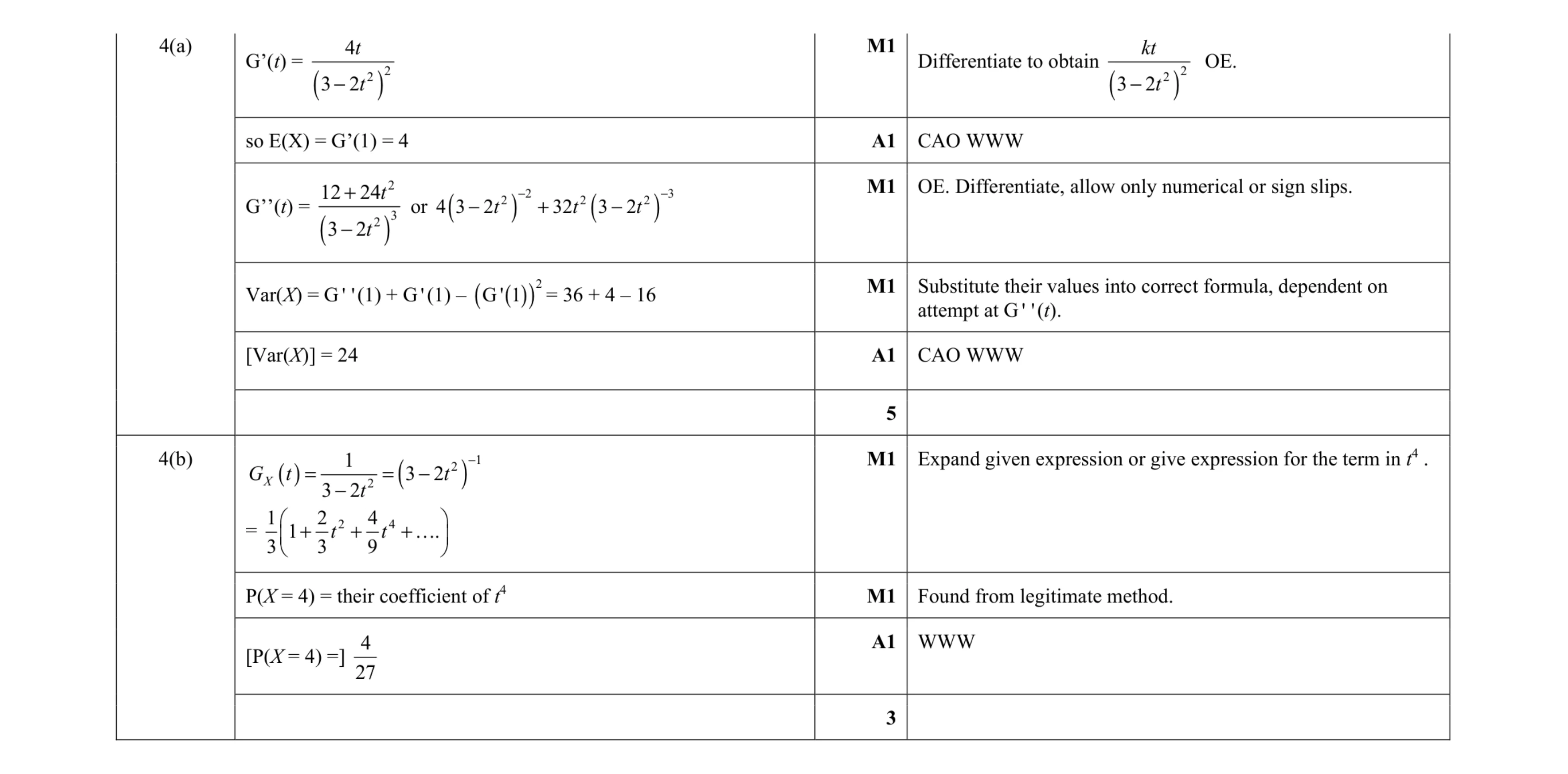 8
8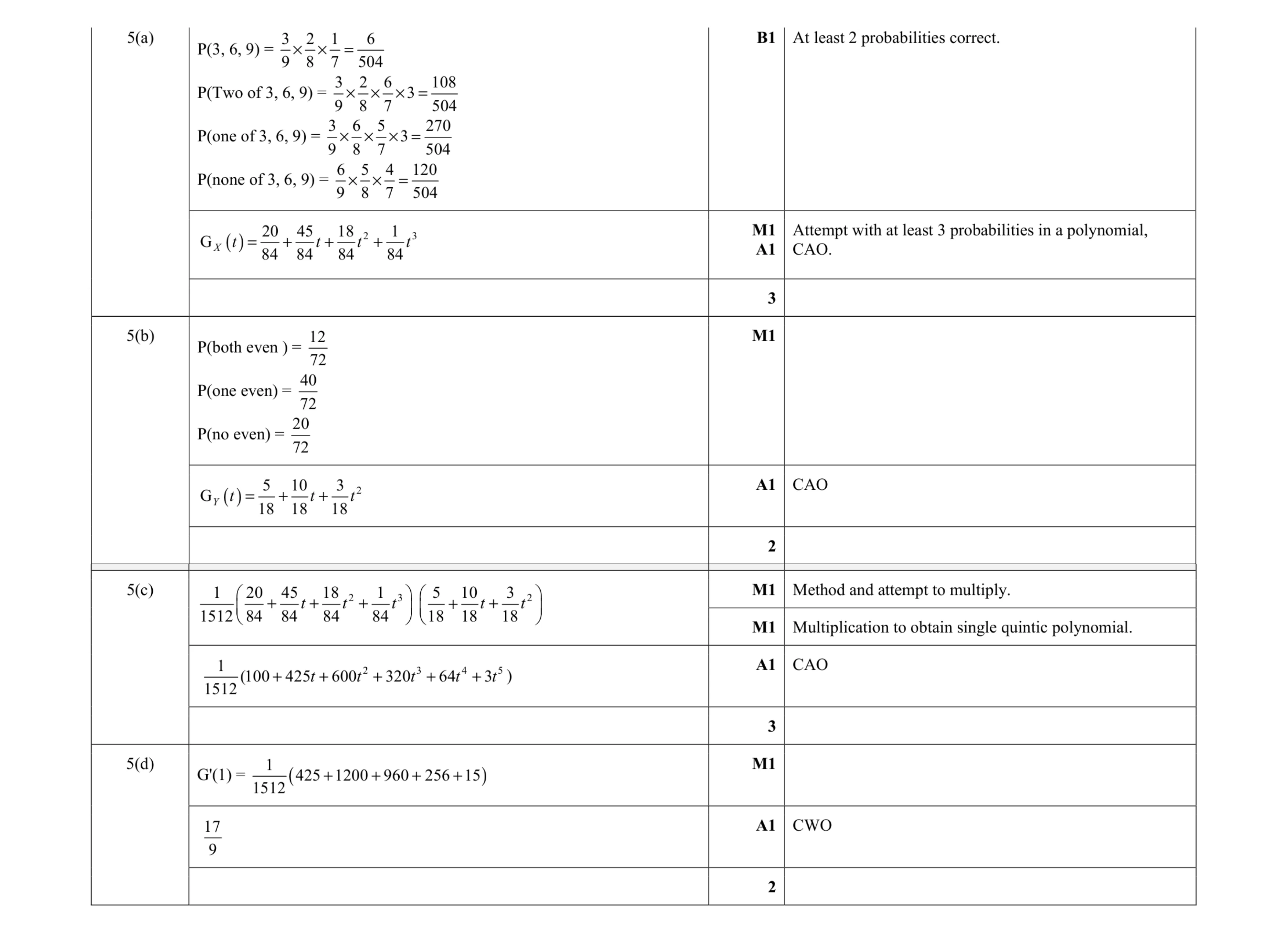 10
10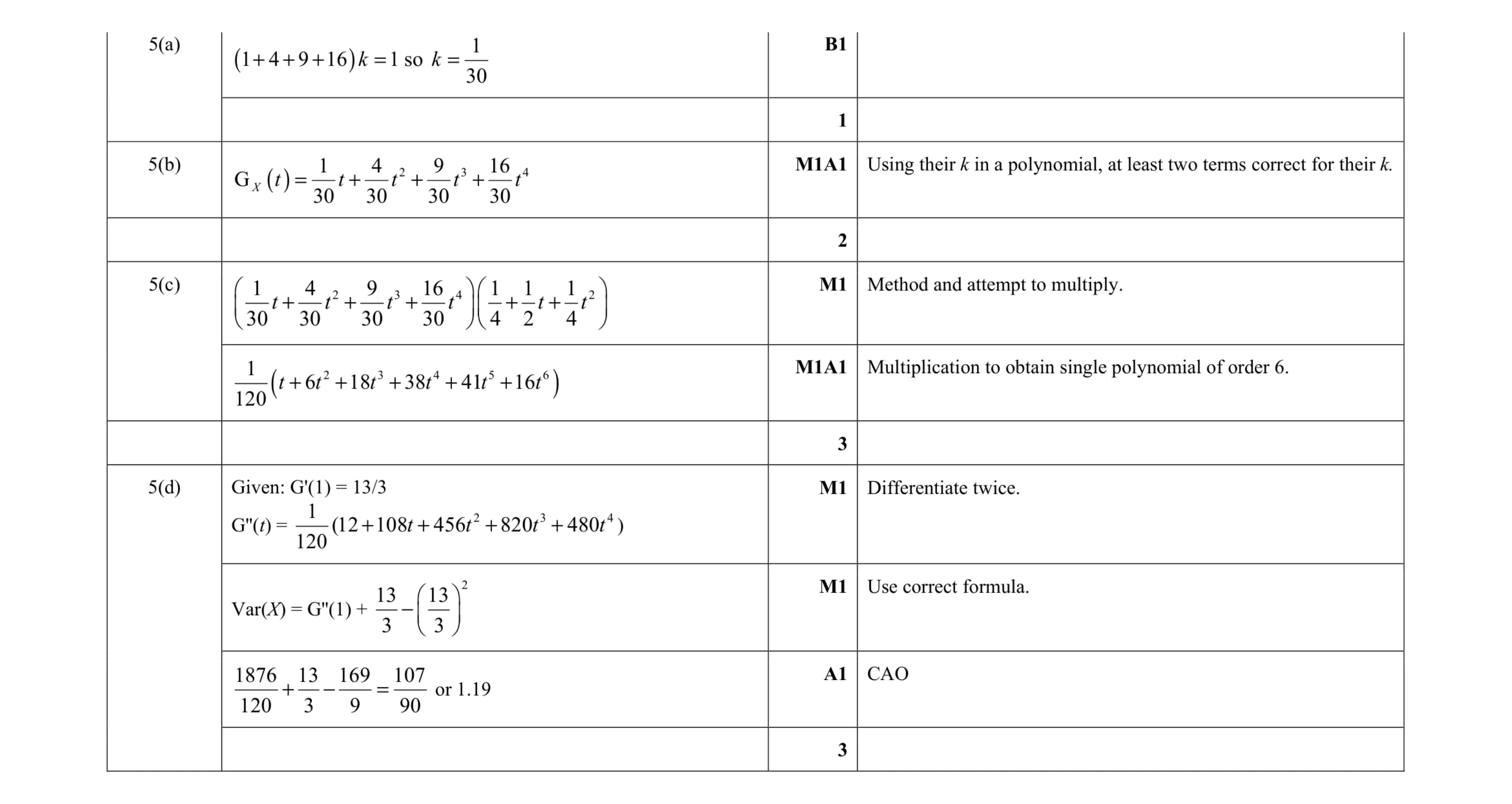 9
9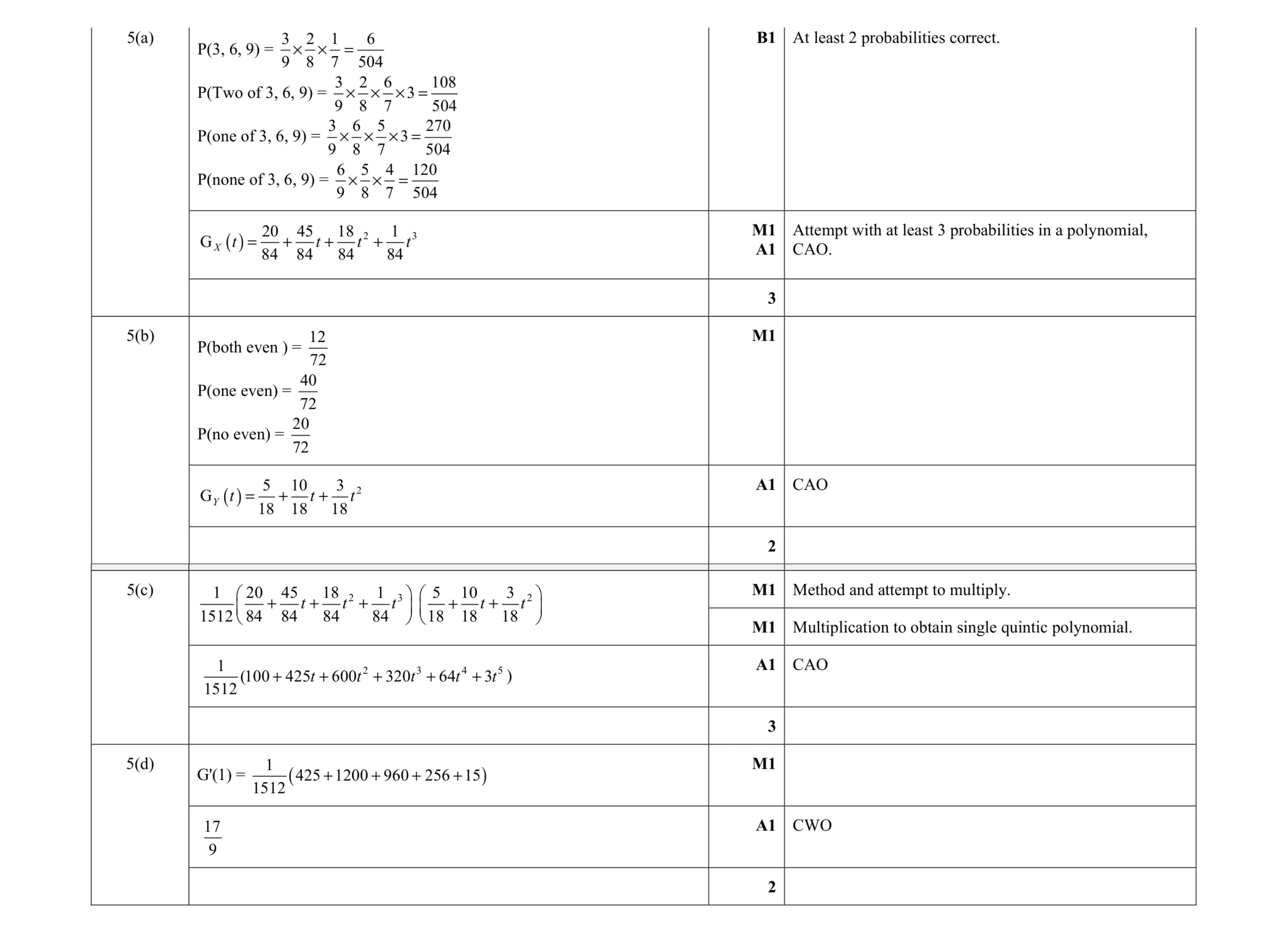 10
10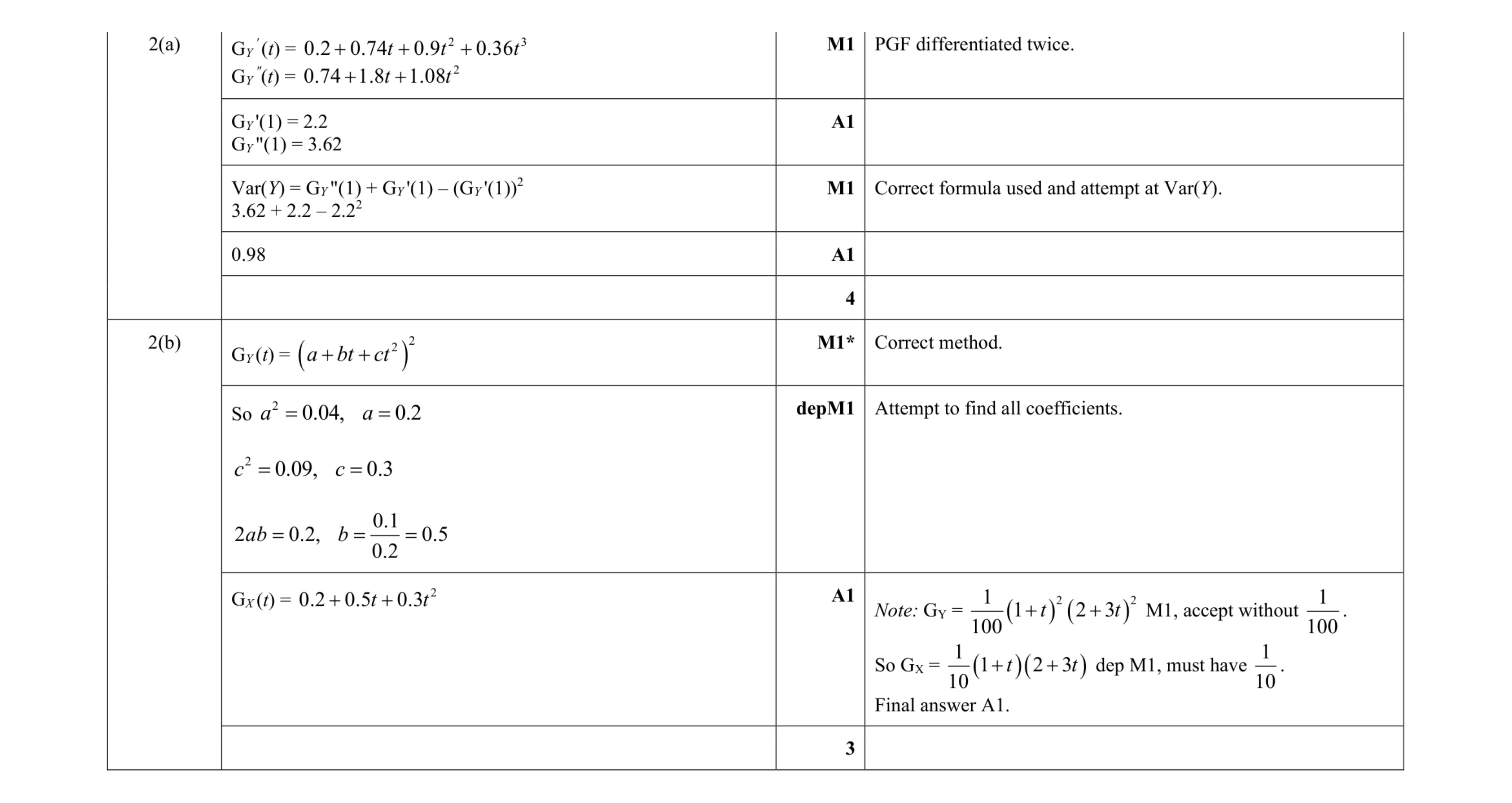 7
7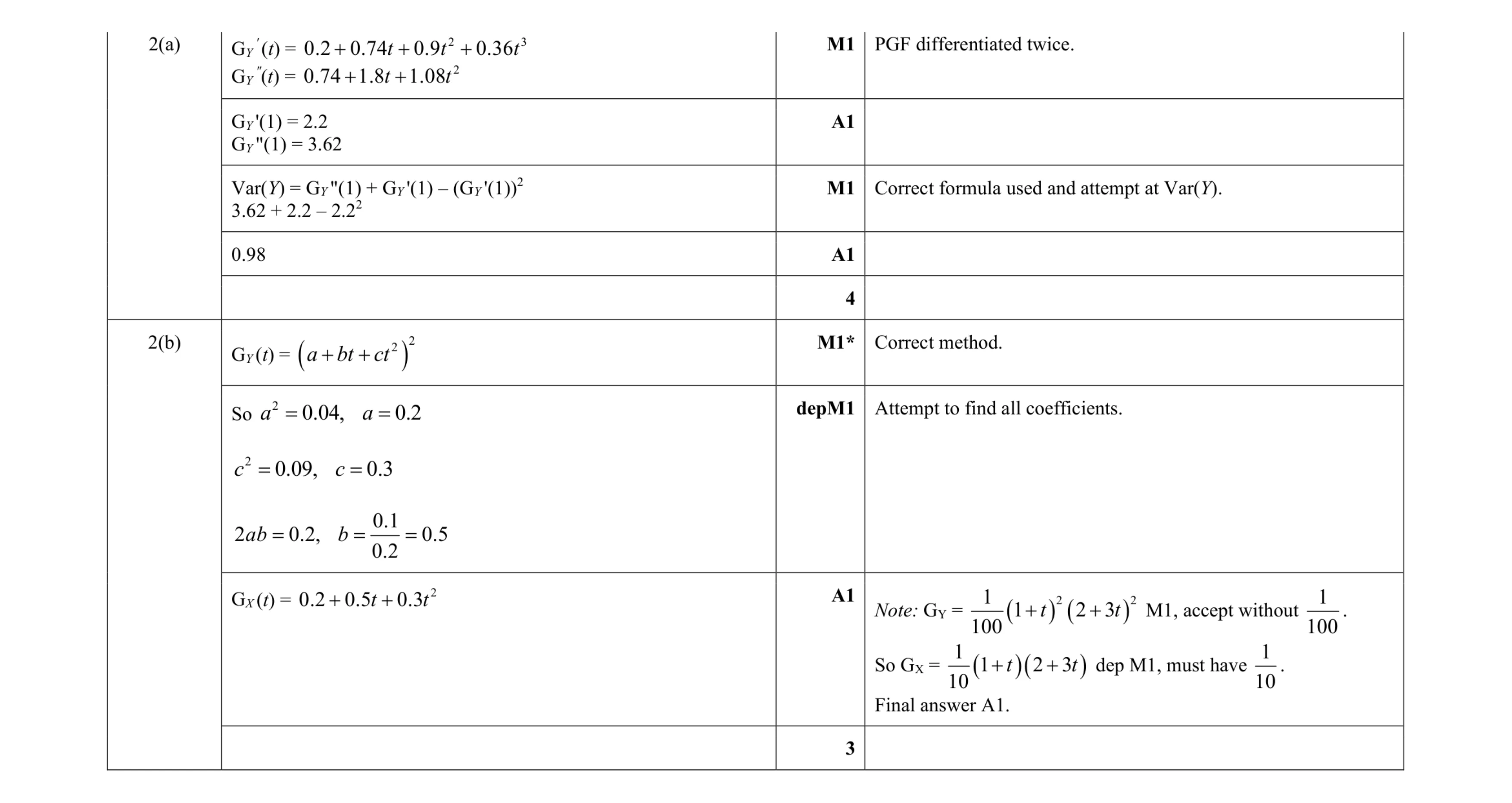 7
7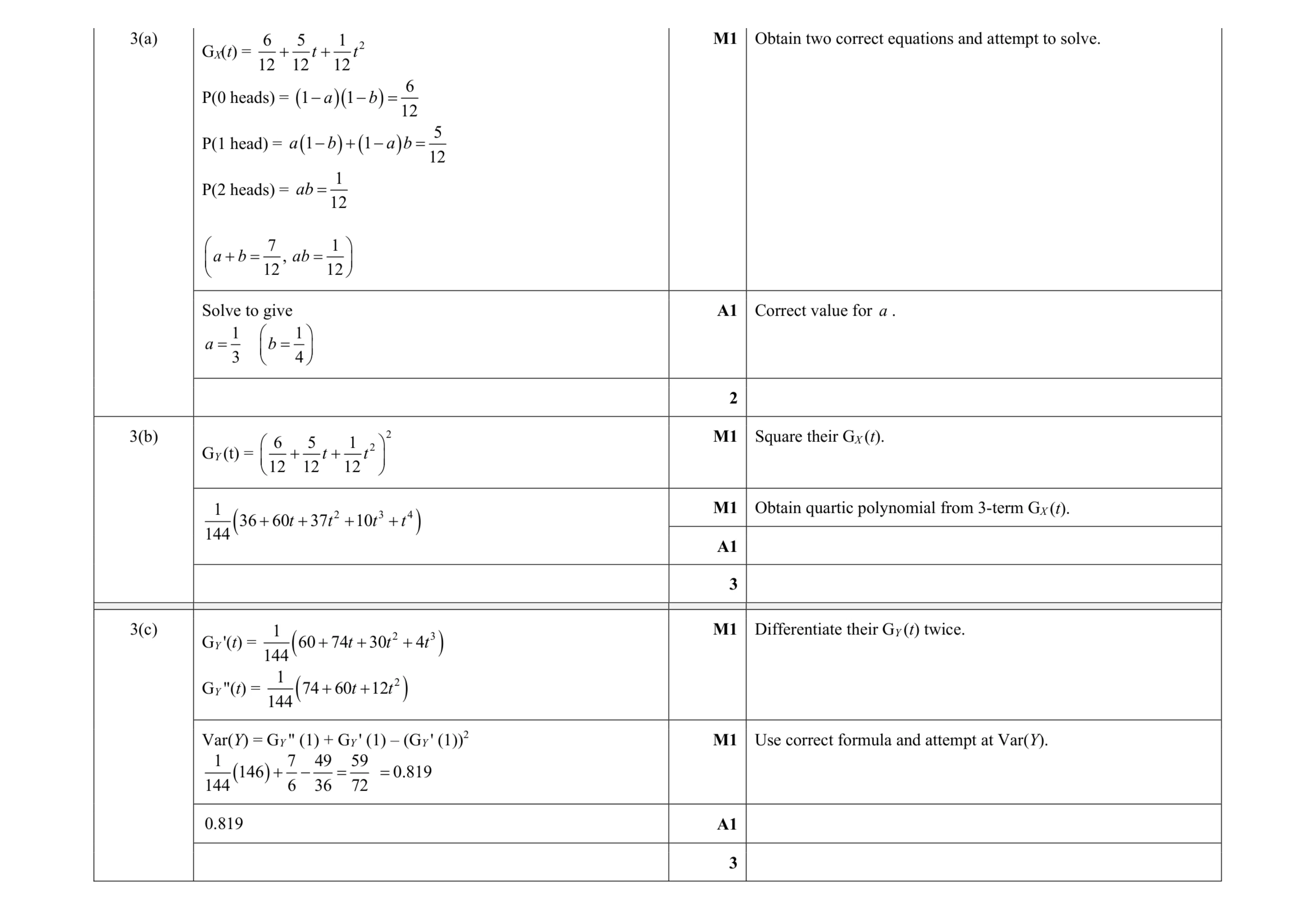 8
8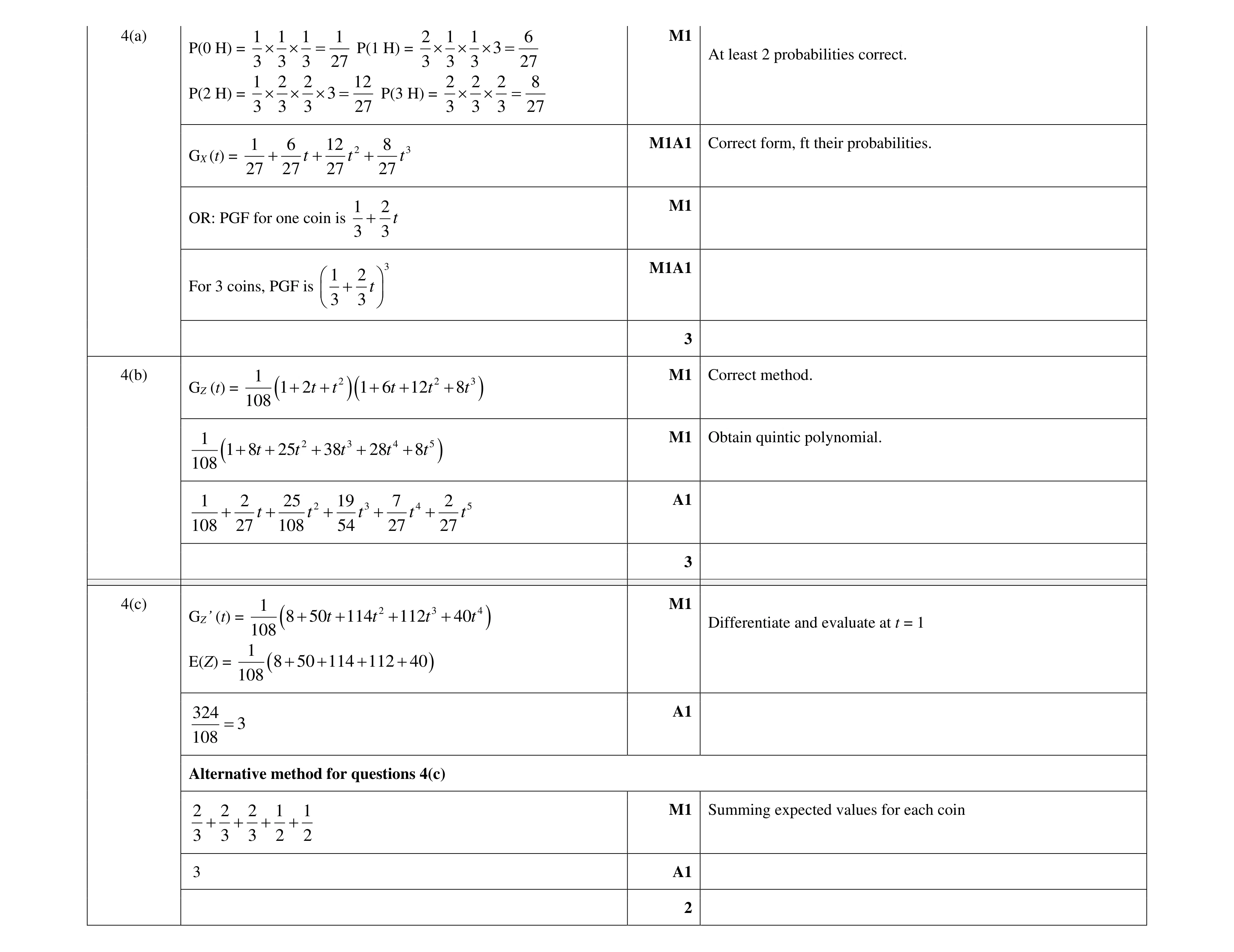 8
8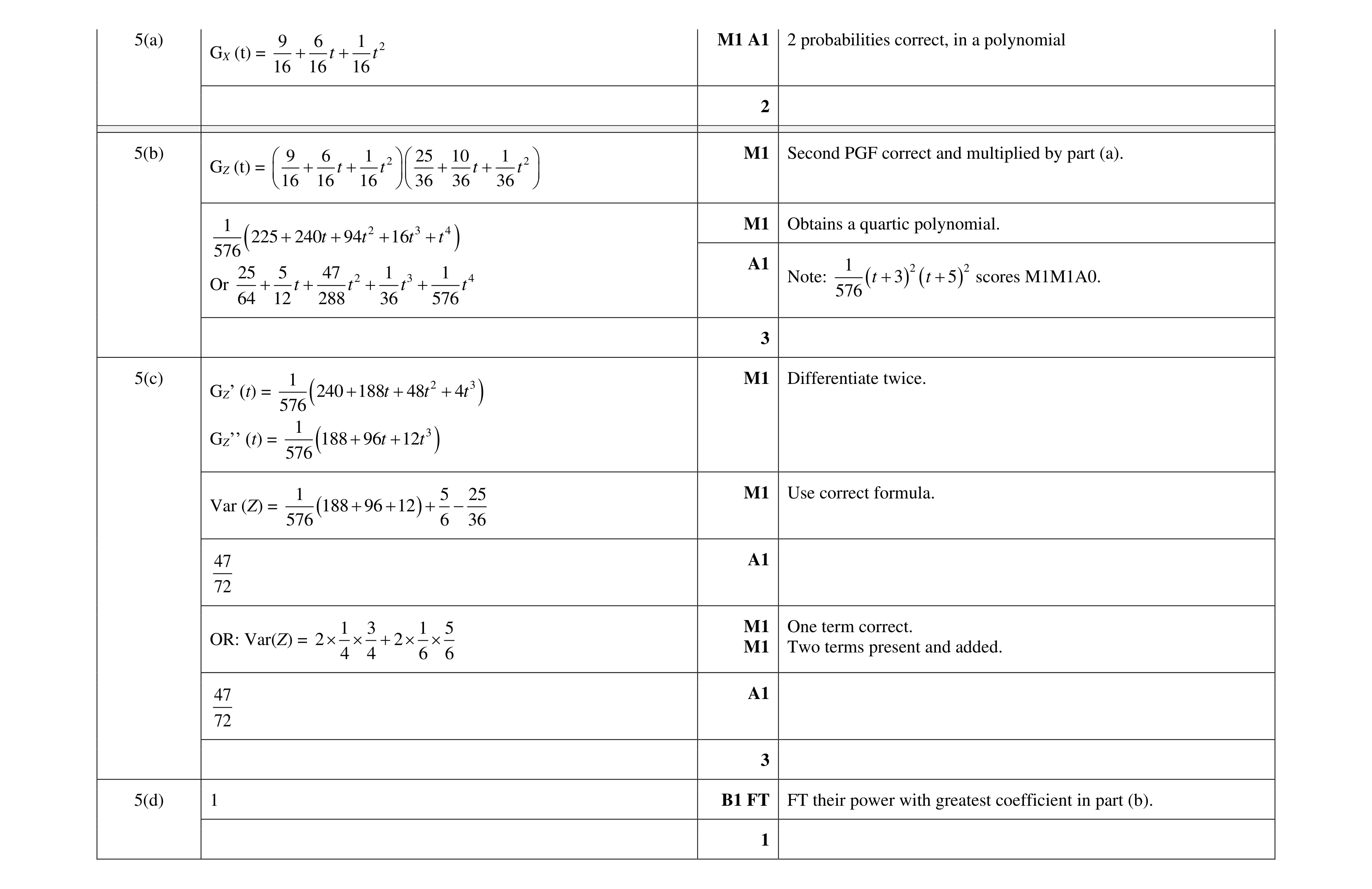 9
9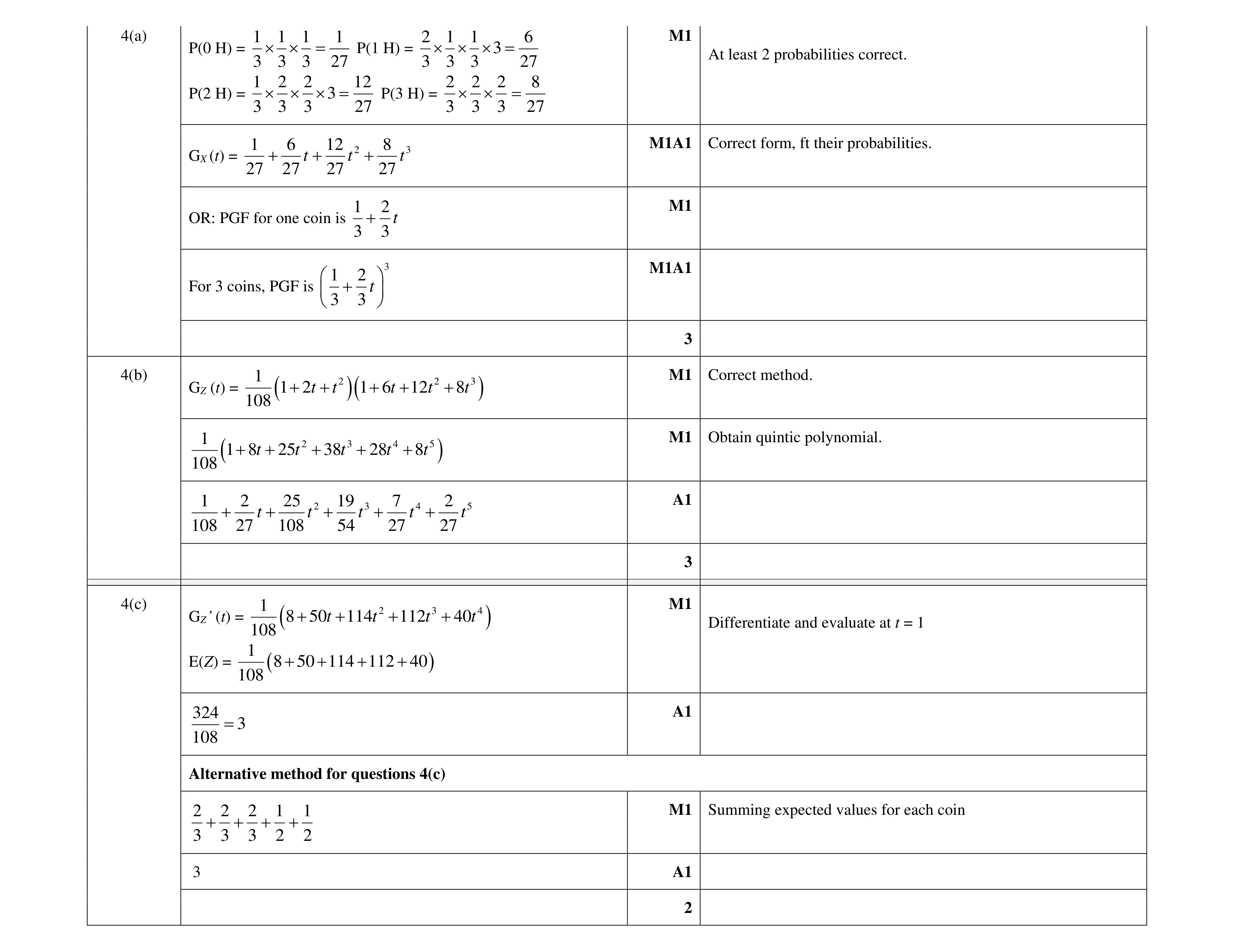 8
8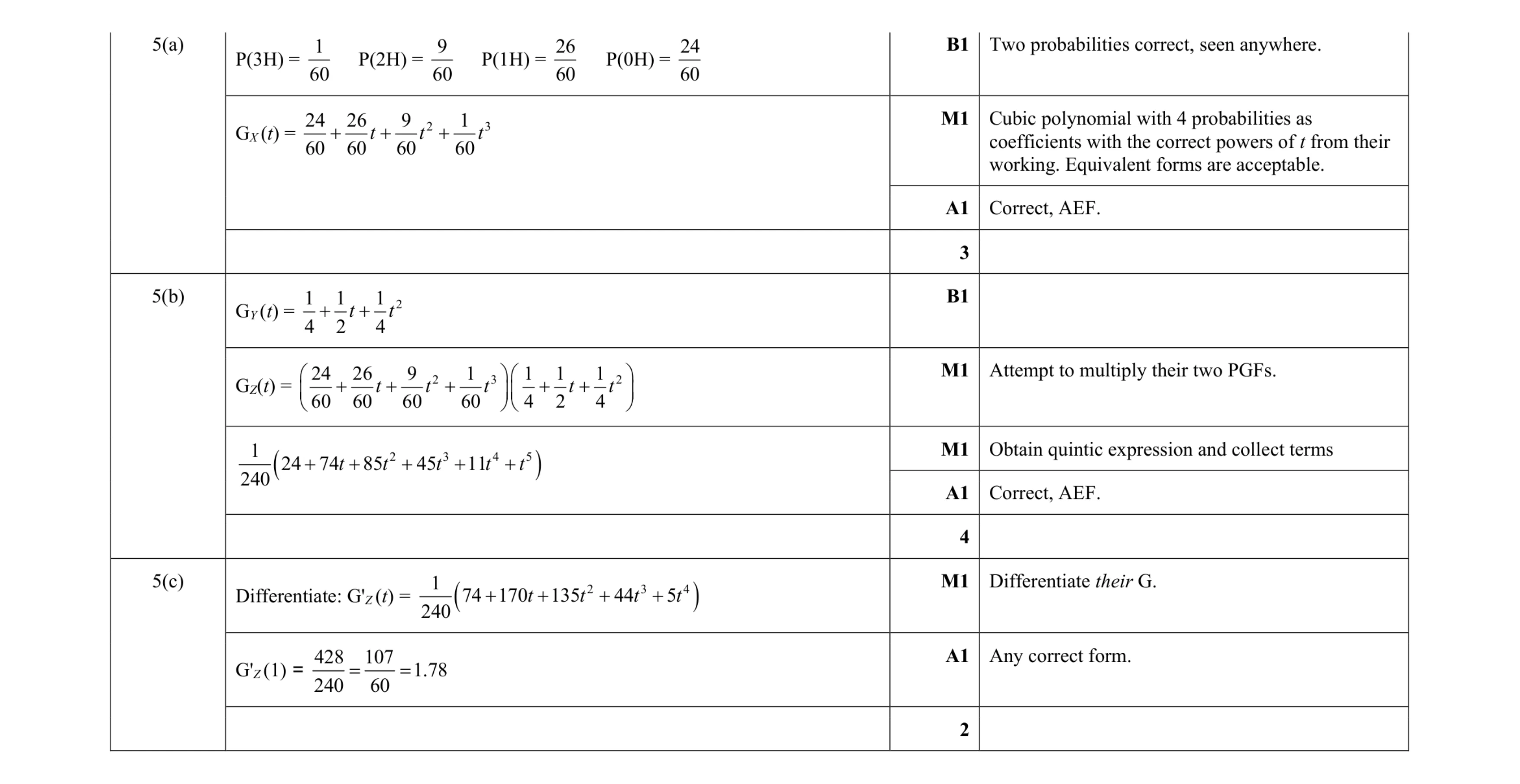 9
9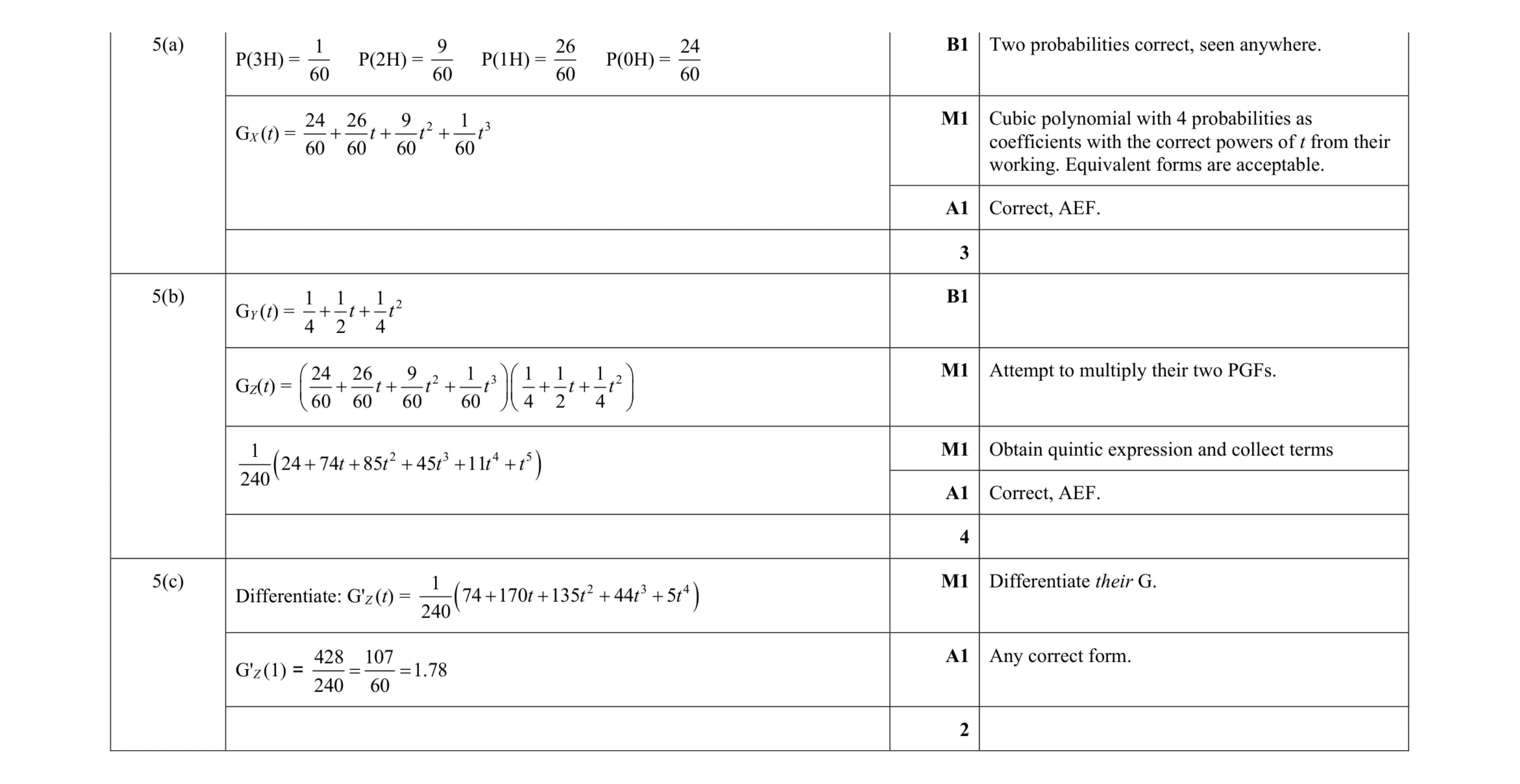 9
9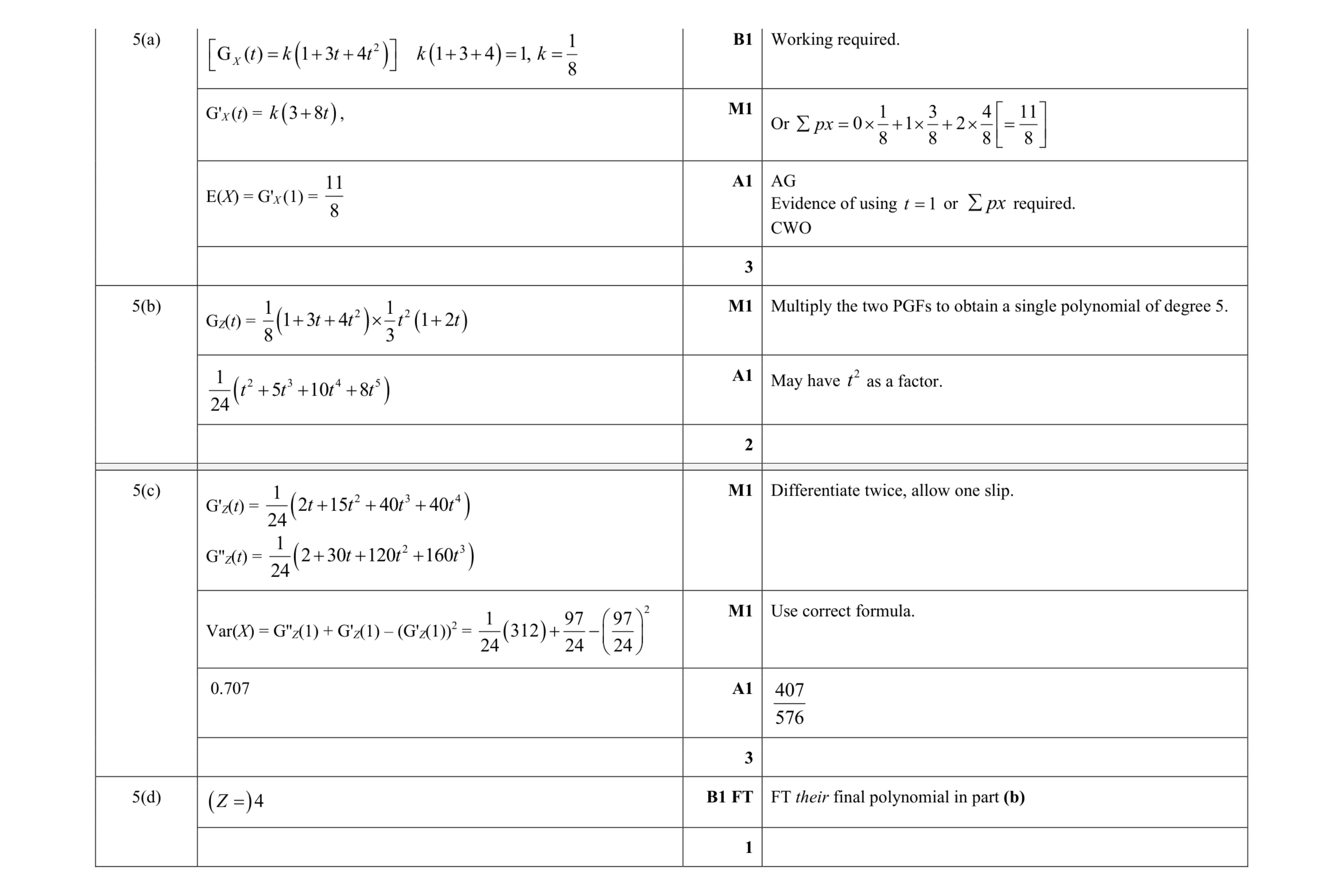 9
9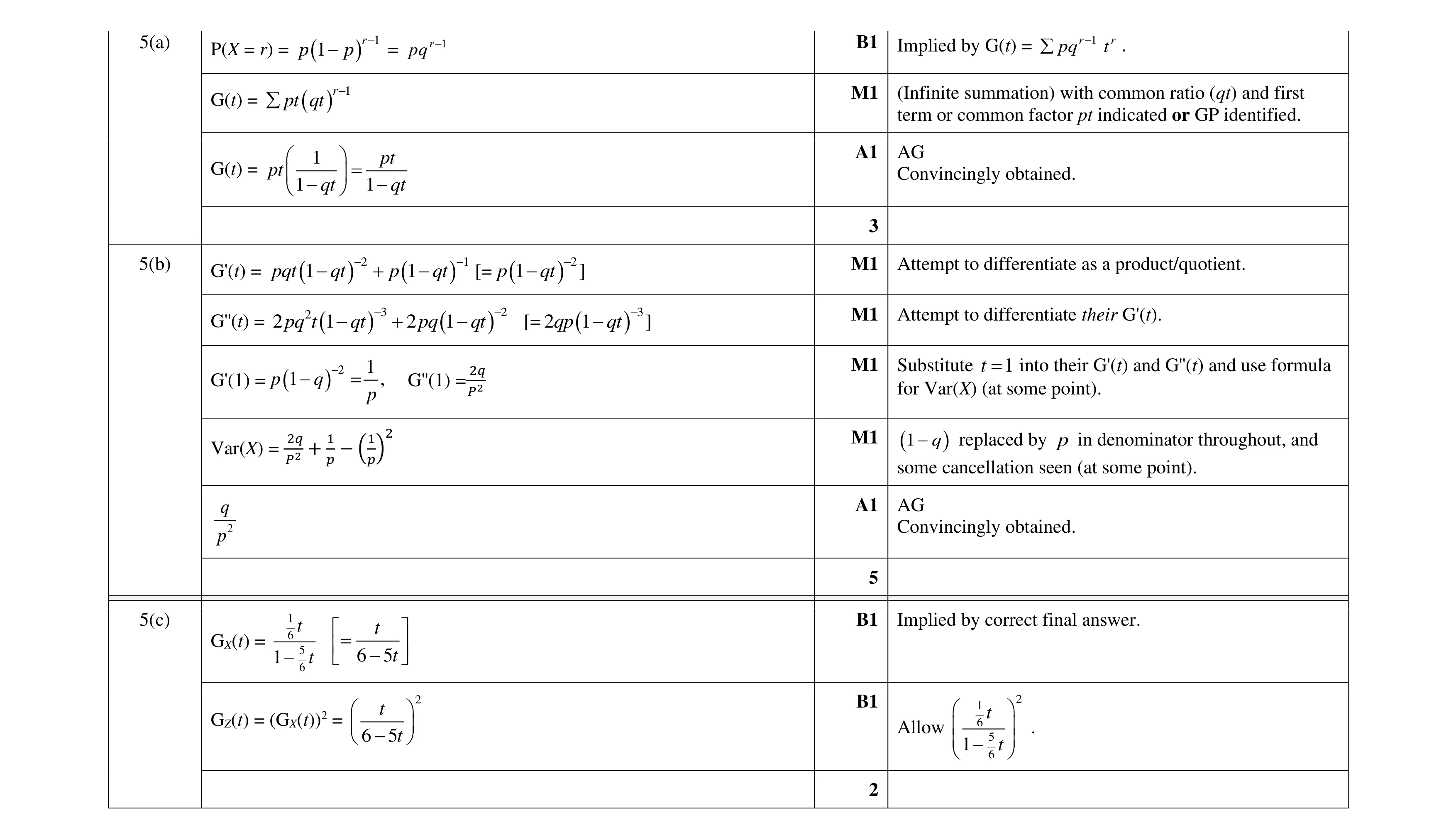 10
10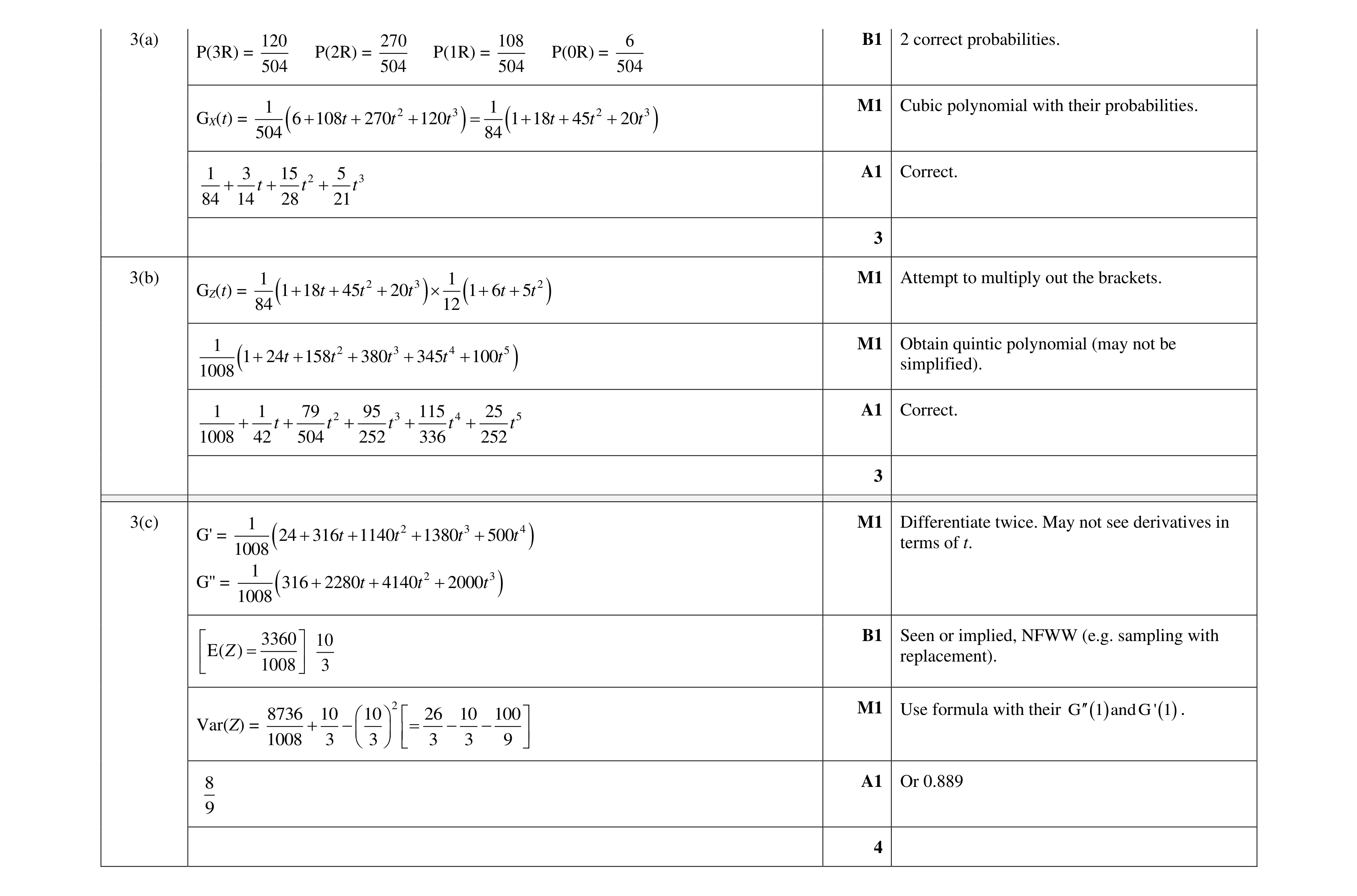 10
10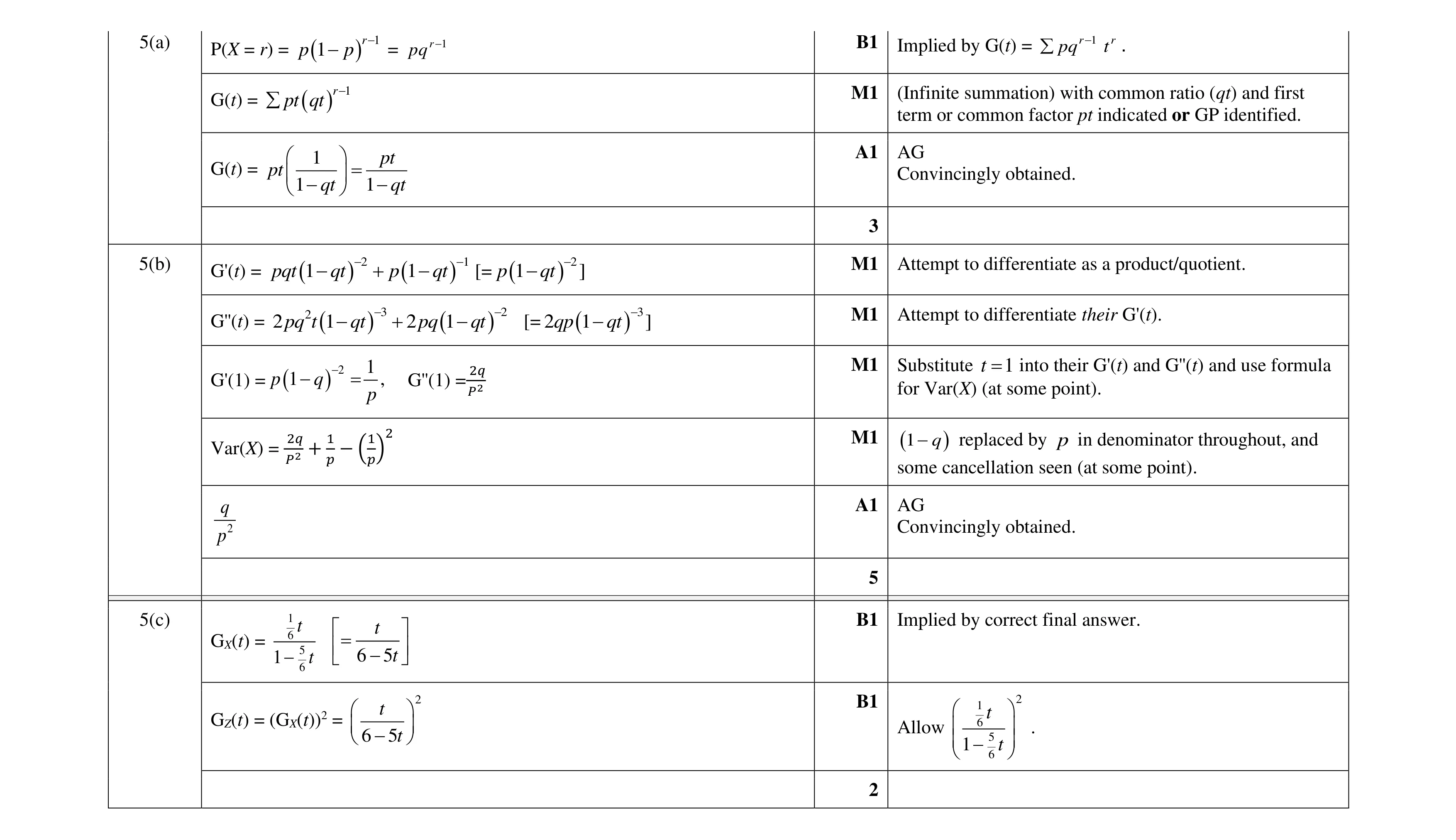 10
10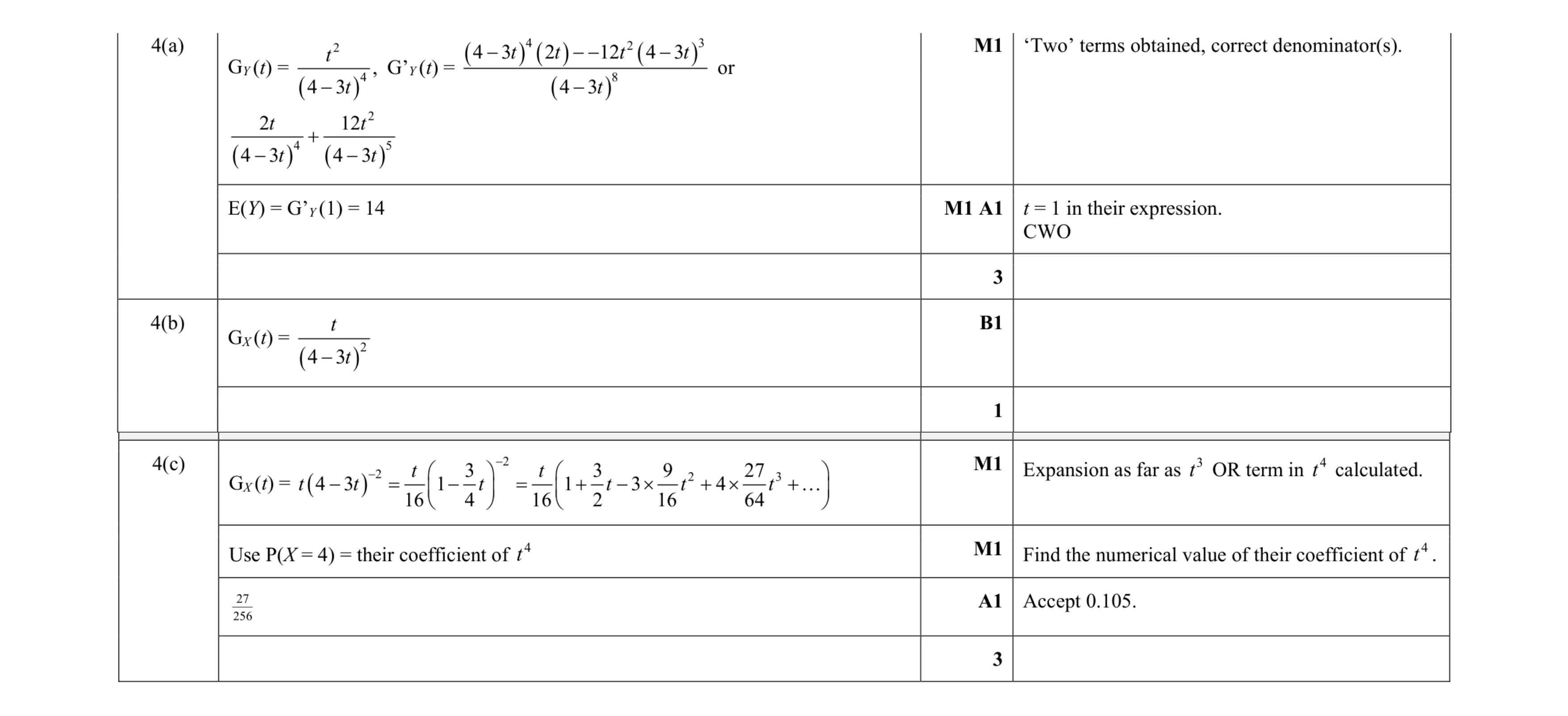 7
7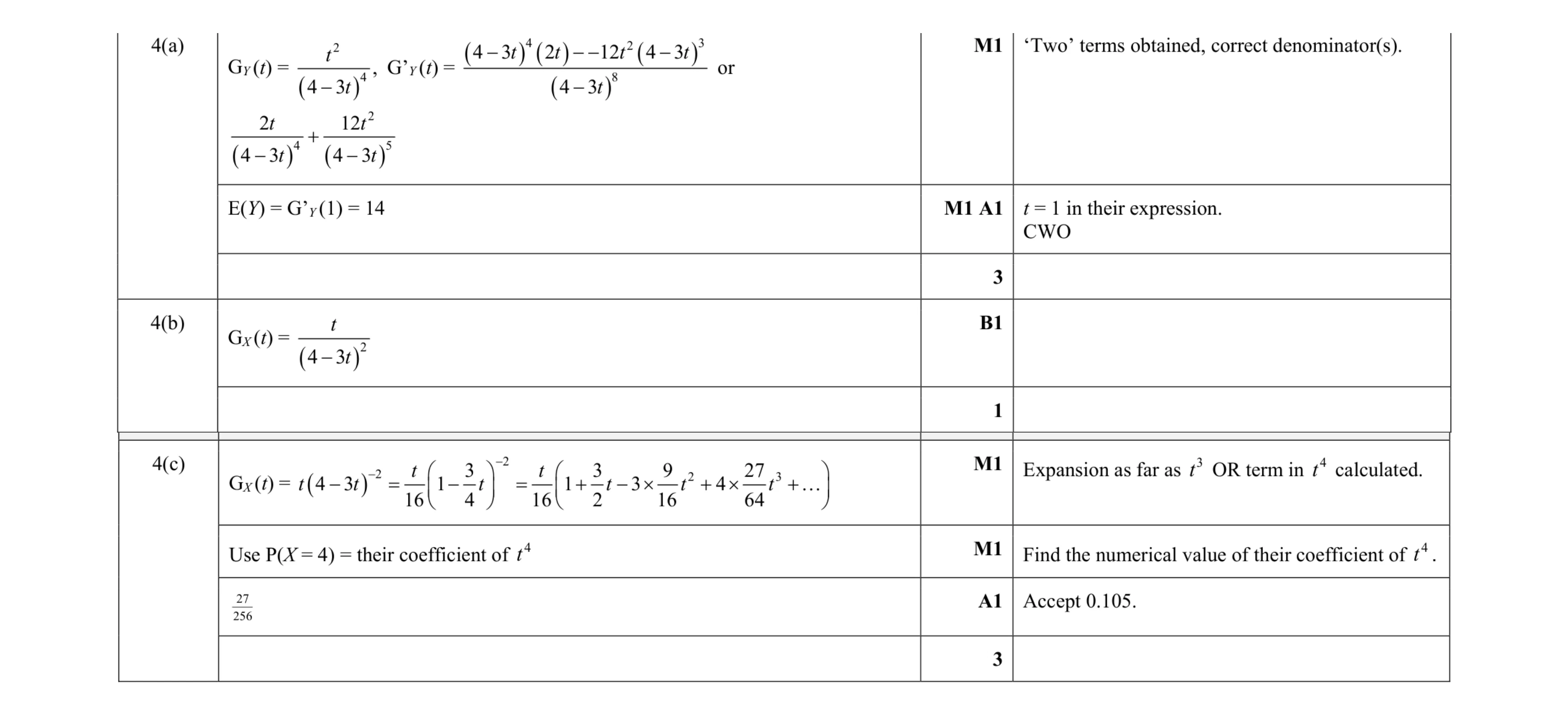 7
7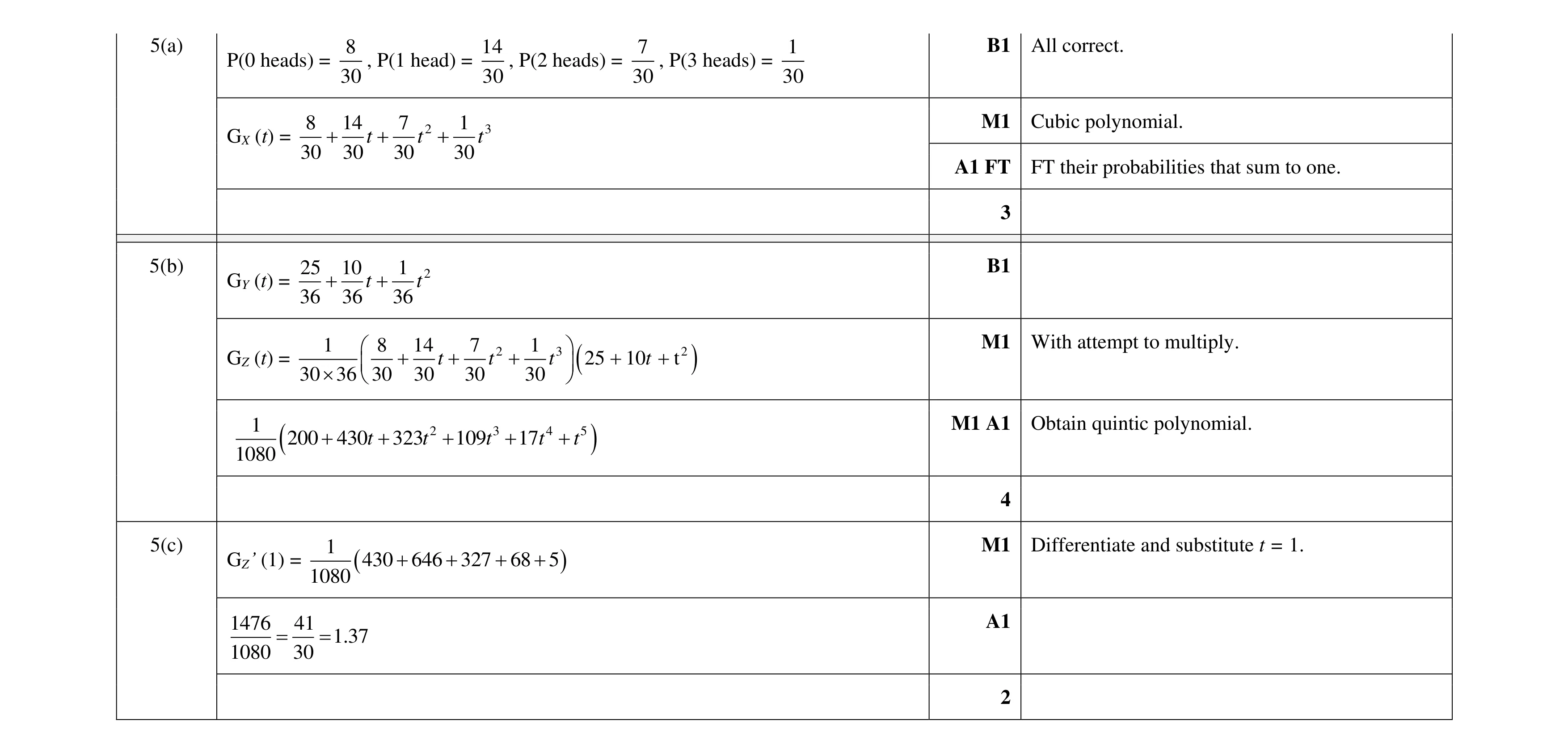 9
9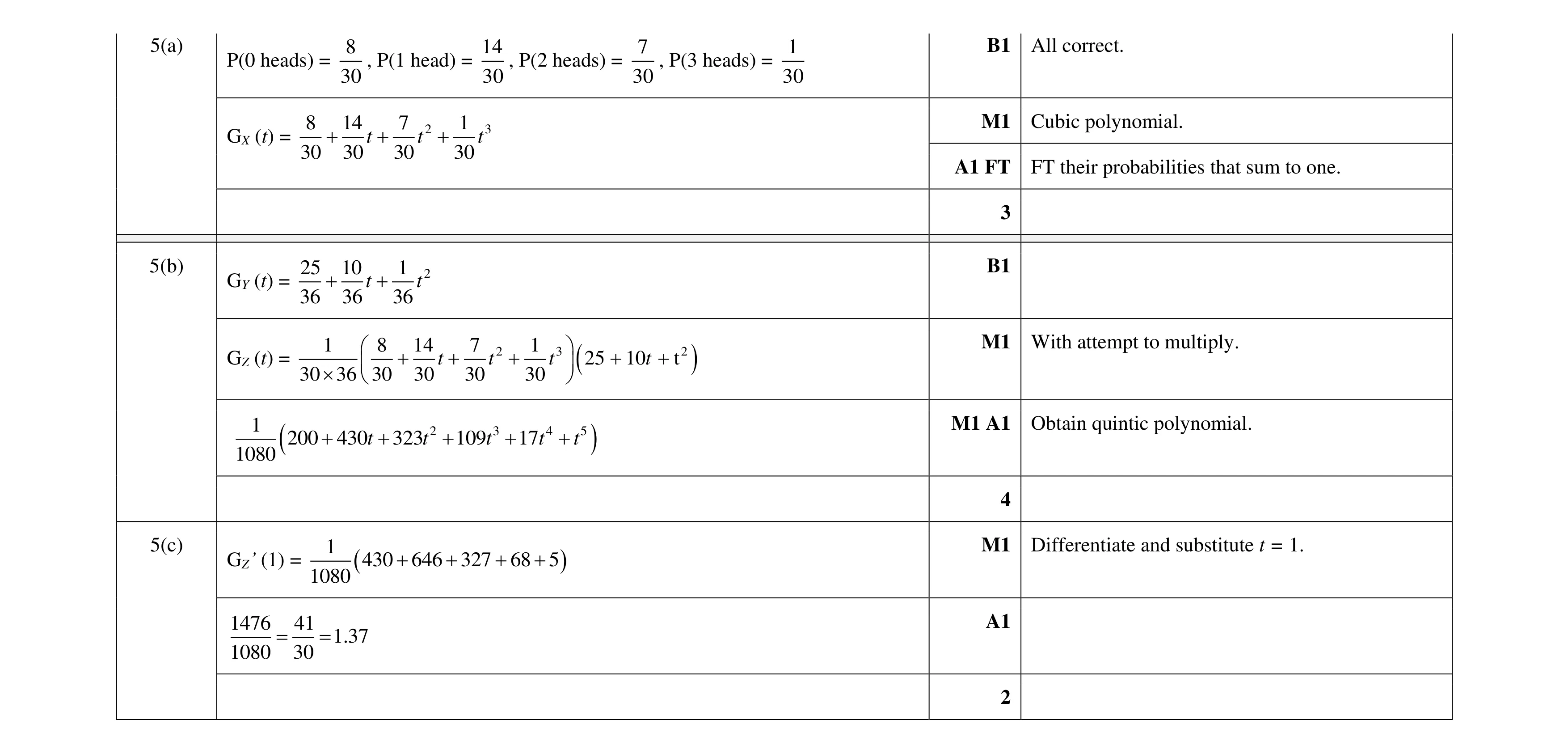 9
9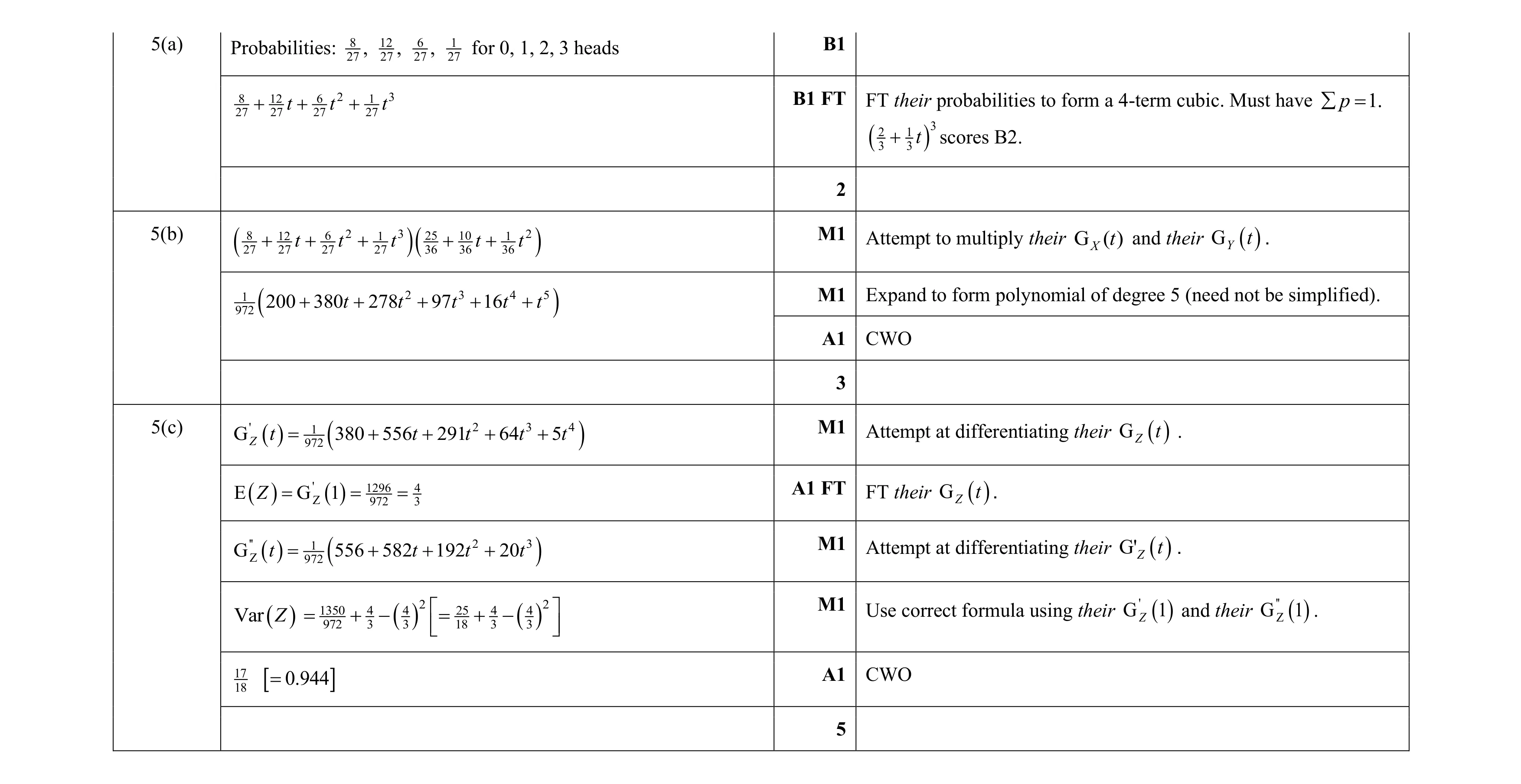 10
10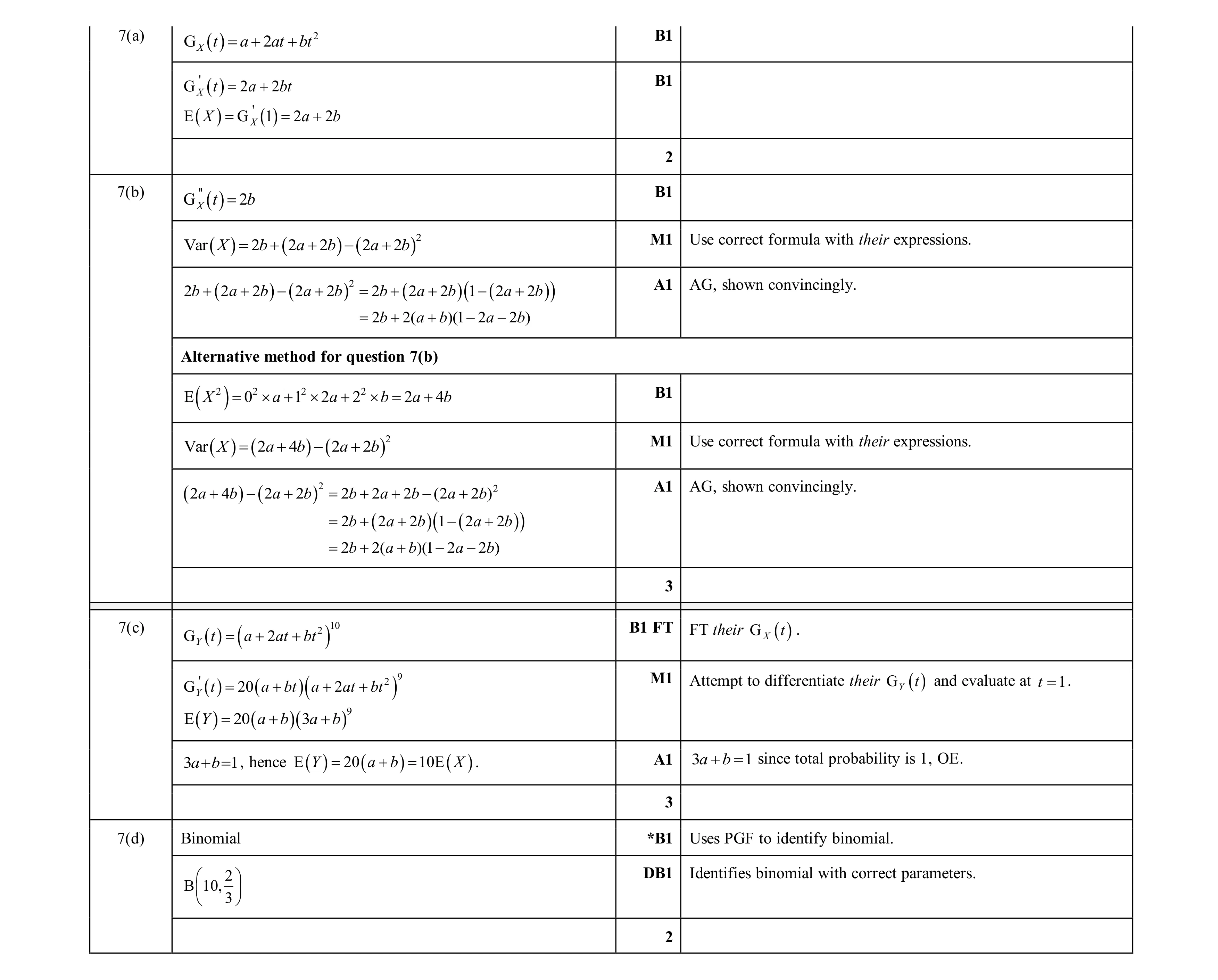 10
10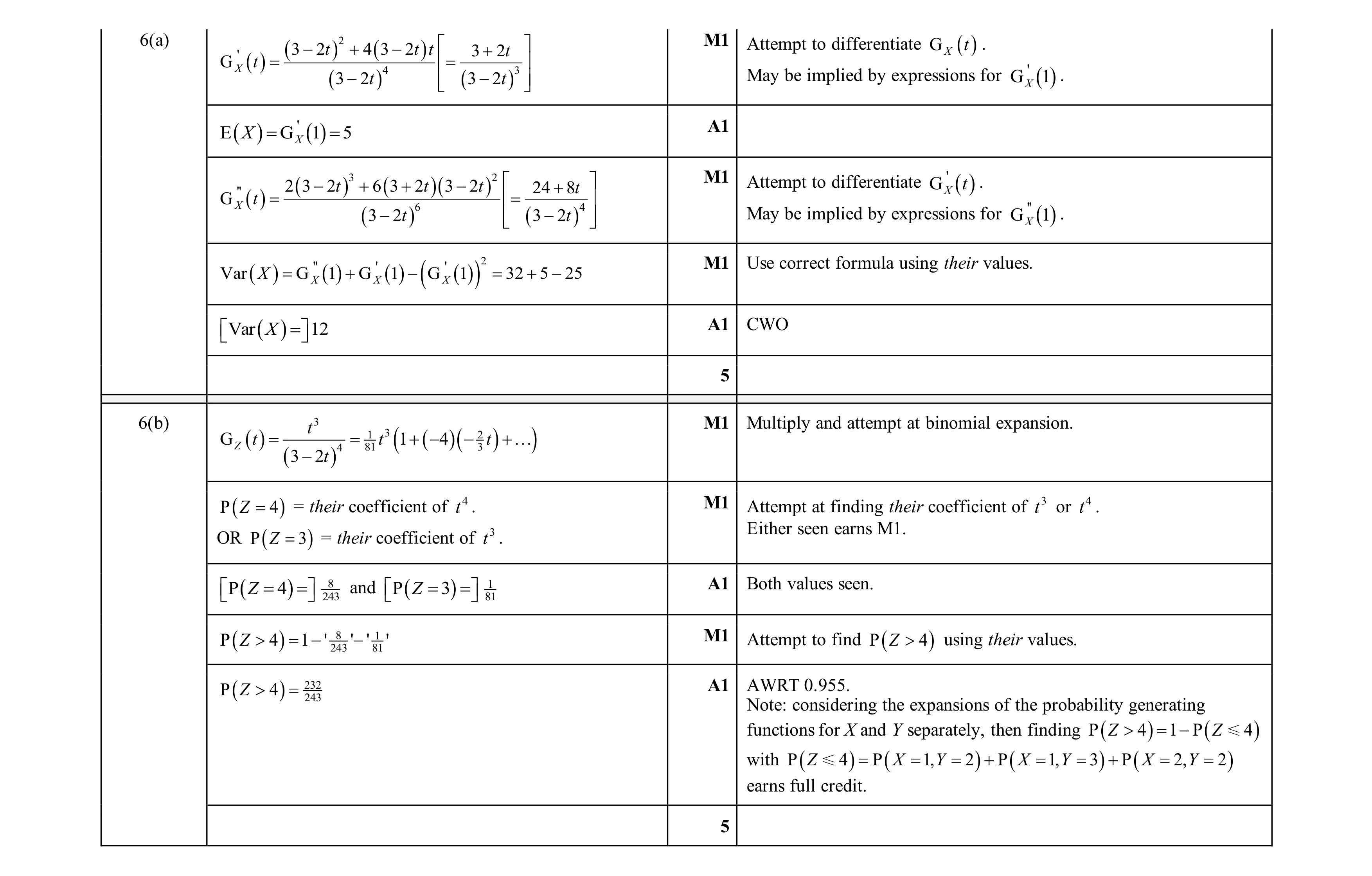 10
10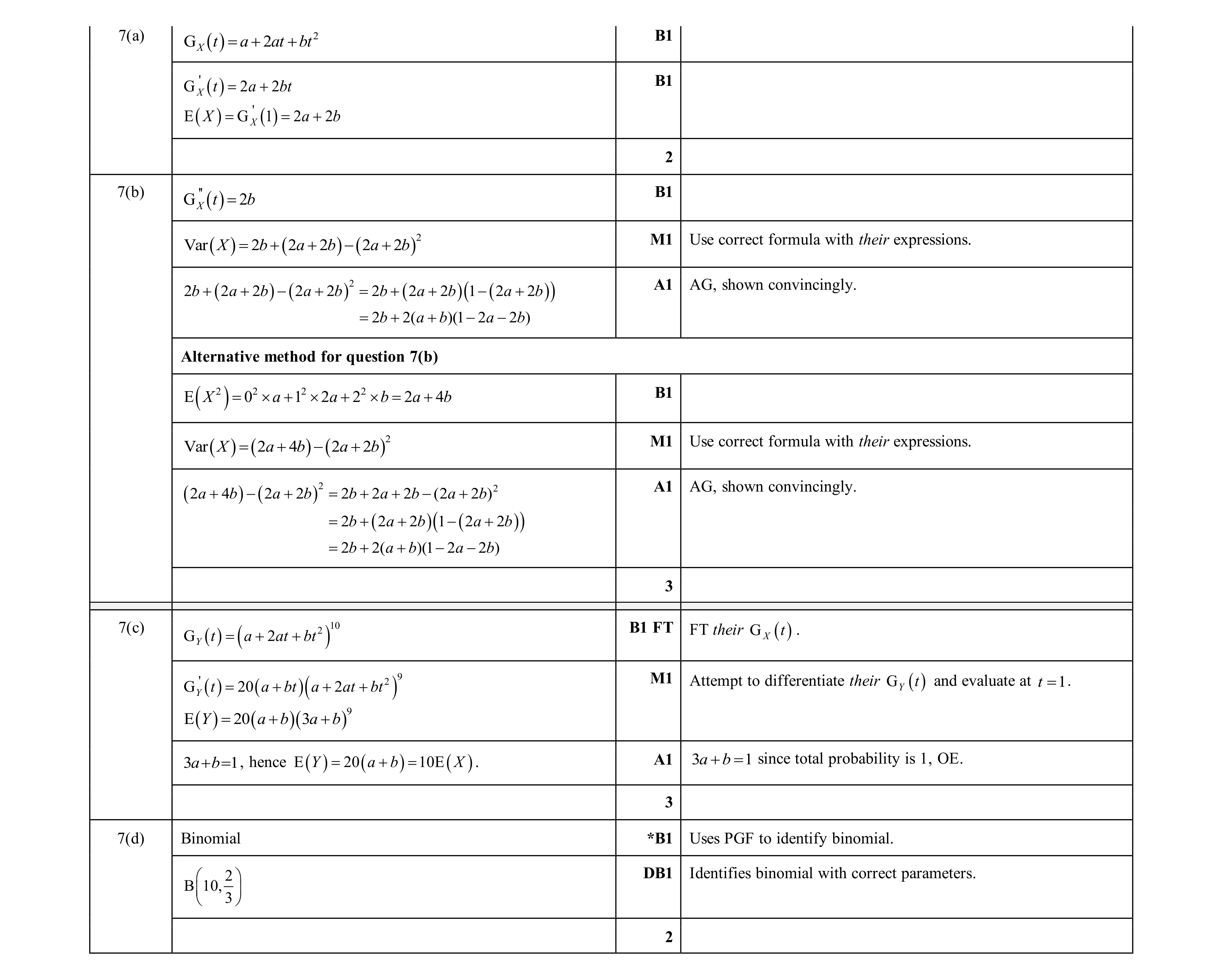 10
10