Questions as text
Q1 · One end of a light elastic spring, of natural length a and modulus of elasticity 5mg, is… 9231/31 May/June 2020
3 One end of a light elastic spring, of natural length a and modulus of elasticity 5mg, is attached to a fixed point A. The other end of the spring is attached to a particle P of mass m. The spring hangs with P vertically below A. The particle P is released from rest in the position where the extension of the spring is 12 a . (a) Show that the initial acceleration of P is 32 g upwards. [3] … … … … … … … … … … … … … … … … … … … … … … … … (b) Find the speed of P when the spring first returns to its natural length. [4] … … … … … … … … … … … … … … … … … … … … … … … … … …
7 marks
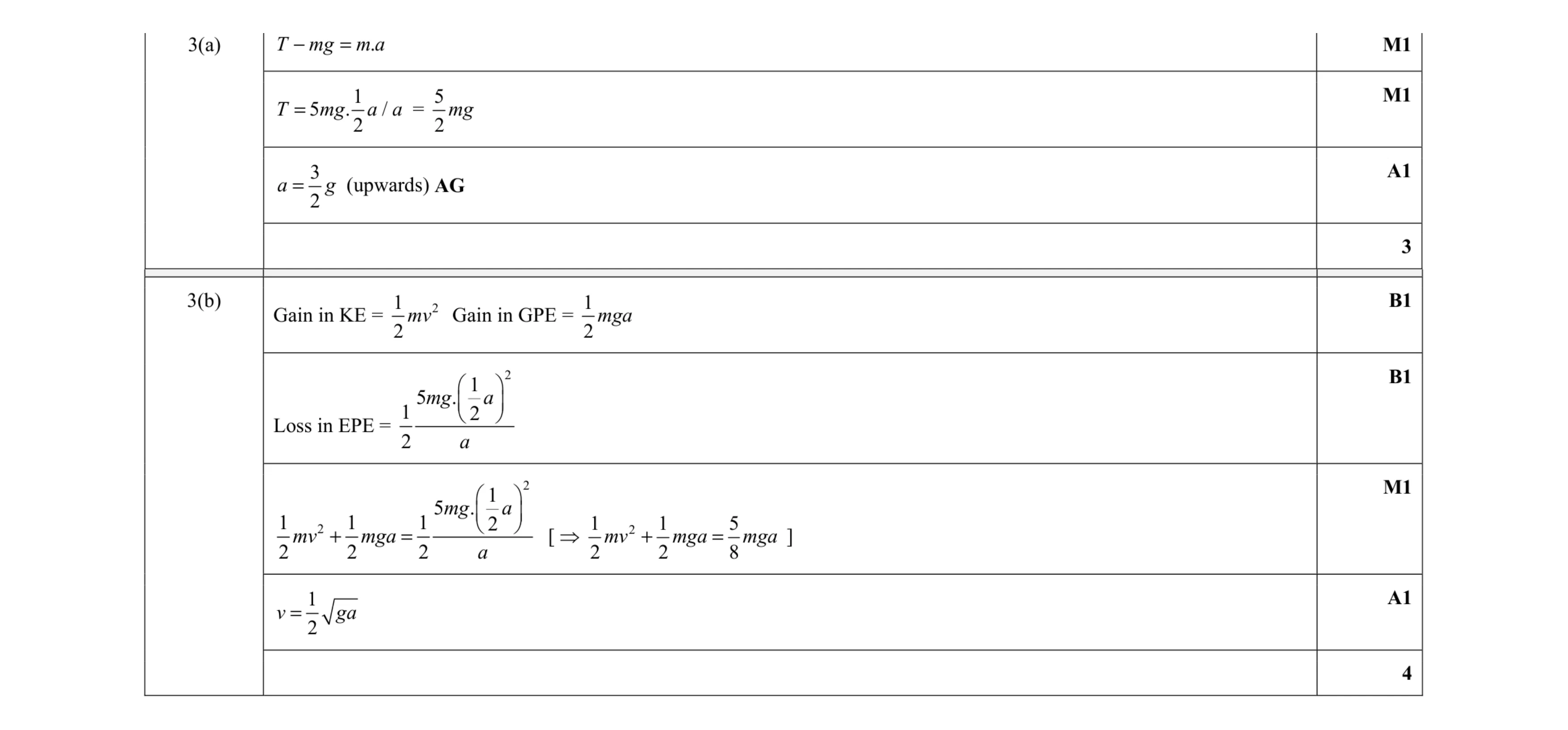
Mark scheme: 3(a) − = 1 5 . / 2 = T mg a a = 5 2 mg M1 3 2 = a g (upwards) AG A1 3 Question Answer Marks 3(b) Gain in KE = 2 1 2 mv Gain in GPE = 1 2 mga B1 Loss in EPE = 2 1 5 . 1 2 2 mg a a B1 2 2 1 5 . 1 1 1 2 2 2 2 + = mg a mv mga a [ 2 1 1 5 2 2 8 + = mv mga mga ] M1 1 2 = v ga A1 4
This question in 9231/31 May/June 2020
Q2 · One end of a light elastic spring, of natural length a and modulus of elasticity 5mg, is… 9231/32 May/June 2020
3 One end of a light elastic spring, of natural length a and modulus of elasticity 5mg, is attached to a fixed point A. The other end of the spring is attached to a particle P of mass m. The spring hangs with P vertically below A. The particle P is released from rest in the position where the extension of the spring is 12 a . (a) Show that the initial acceleration of P is 32 g upwards. [3] … … … … … … … … … … … … … … … … … … … … … … … … (b) Find the speed of P when the spring first returns to its natural length. [4] … … … … … … … … … … … … … … … … … … … … … … … … … …
7 marks
Mark scheme: 3(a) − = 1 5 . / 2 = T mg a a = 5 2 mg M1 3 2 = a g (upwards) AG A1 3 Question Answer Marks 3(b) Gain in KE = 2 1 2 mv Gain in GPE = 1 2 mga B1 Loss in EPE = 2 1 5 . 1 2 2 mg a a B1 2 2 1 5 . 1 1 1 2 2 2 2 + = mg a mv mga a [ 2 1 1 5 2 2 8 + = mv mga mga ] M1 1 2 = v ga A1 4
This question in 9231/32 May/June 2020
Q3 · 4 3 ga a A B O One end of a light spring of natural length a and modulus of elasticity… 9231/33 May/June 2020
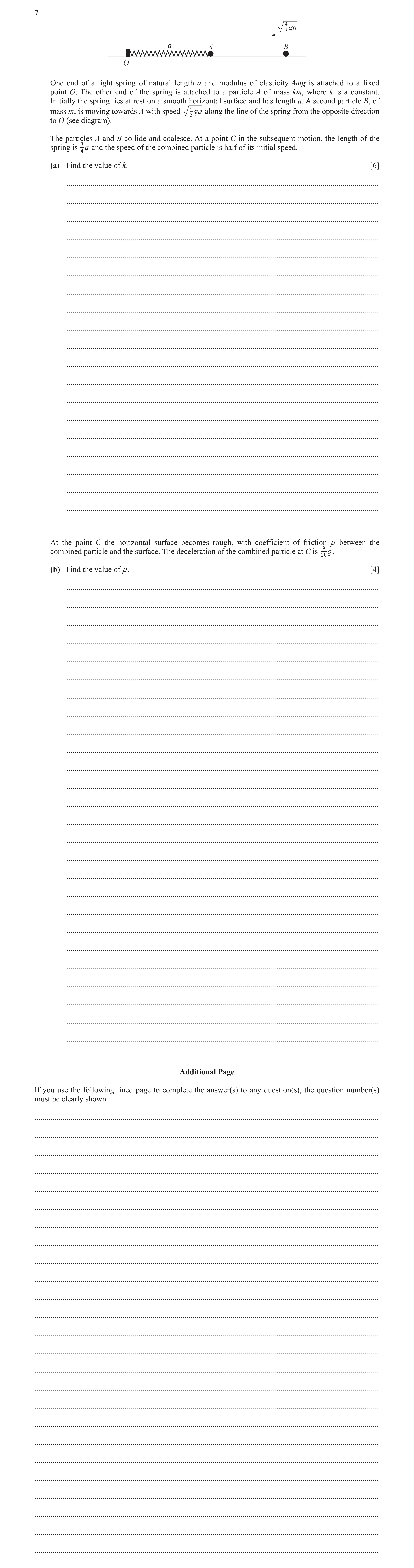
7 4 3 ga a A B O One end of a light spring of natural length a and modulus of elasticity 4mg is attached to a fixed point O. The other end of the spring is attached to a particle A of mass km, where k is a constant. Initially the spring lies at rest on a smooth horizontal surface and has length a. A second particle B, of mass m, is moving towards A with speed 43 ga along the line of the spring from the opposite direction to O (see diagram). The particles A and B collide and coalesce. At a point C in the subsequent motion, the length of the spring is 34 a and the speed of the combined particle is half of its initial speed. (a) Find the value of k. [6] … … … … … … … … … … … … … … … … … … … At the point C the horizontal surface becomes rough, with coefficient of friction n between the combined particle and the surface. The deceleration of the combined particle at C is 209 g . (b) Find the value of n. [4] … … … … … … … … … … … … … … … … … … … … … … … … … … Additional Page If you use the following lined page to complete the answer(s) to any question(s), the question number(s) must be clearly shown. … … … … … … … … … … … … … … … … … … … … … … … … …
10 marks
Mark scheme: 7(a) Collision: ( )1 + = k mv mu so 1 = + u v k B1 Loss in KE = ( ) 2 2 1 1 1 2 4 + − m k v v B1 Gain in EPE = ½ .4mg/a. 2 4 a B1 So, ( ) ( ) 2 2 1 3 . . 1 2 4 8 1 + = + u mga m k k M1 Use value of u and solve M1 3 = k A1 6 Question Answer Marks 7(b) 9 4 . 20 + = g T F m M1 4 9 4 . 5 a mg mg F a + = M1 4 / 5 μ = R mg and compare with 4 = R mg B1 1 5 μ = A1 4
This question in 9231/33 May/June 2020
Q4 · A particle P of mass m is placed on a fixed smooth plane which is inclined at an angle i… 9231/31 Oct/Nov 2020
1 A particle P of mass m is placed on a fixed smooth plane which is inclined at an angle i to the horizontal. A light spring, of natural length a and modulus of elasticity 3mg, has one end attached to P and the other end attached to a fixed point O at the top of the plane. The spring lies along a line of greatest slope of the plane. The system is released from rest with the spring at its natural length. Find, in terms of a and i, an expression for the greatest extension of the spring in the subsequent motion. [3] … … … … … … … … … … … … … … … … … … … … … … … …
3 marks
Mark scheme: 1 Gain in EPE = 2 1 3 . 2 mgx a Loss in GPE = sin mgx θ Equate M1 Equate energies 2 sin 3 x a θ = A1 Using forces scores B0M0A0 3
This question in 9231/31 Oct/Nov 2020
Q5 · One end of a light elastic string, of natural length a and modulus of elasticity k, is… 9231/32 Oct/Nov 2020
6 One end of a light elastic string, of natural length a and modulus of elasticity k, is attached to a particle P of mass m. The other end of the string is attached to a fixed point Q. The particle P is projected vertically upwards from Q. When P is moving upwards and at a distance 43 a directly above Q, it has a speed 2ga . At this point, its acceleration is 73 g downwards. Show that k = 4mg and find in terms of a the greatest height above Q reached by P. [8] … … … … … … … … … … … … … … … … … … … … … … … … … … … … … … … … … … … … … … … … … … … … … … … … … … … … …
8 marks
Mark scheme: 6 7 .3 T mg m g + = M1 With 3 a T k a = giving 4 k mg = A1 AG Let greatest height above Q be 4 3 a x + Gain in GPE = mgx and Loss in KE = ½ m.2ga B1 The length being found may be expressed as the total extension of the string or the greatest height above Q. GPE and KE Gain in EPE = 2 2 1 4 . 2 3 3 mg a a x a + − B1 EPE Note: initial EPE = 2 9 mga 2 2 2 4 2 2 3 9 9 mg ax a a x mgx mga a + + − + = M1 A1 Energy equation, correct number of terms 2 2 7 2 0 3 ax x a + − = M1 Simplify to quadratic 1 3 x a = so greatest height is 5 3 a A1
This question in 9231/32 Oct/Nov 2020
Q6 · A particle P of mass m is placed on a fixed smooth plane which is inclined at an angle i… 9231/33 Oct/Nov 2020
1 A particle P of mass m is placed on a fixed smooth plane which is inclined at an angle i to the horizontal. A light spring, of natural length a and modulus of elasticity 3mg, has one end attached to P and the other end attached to a fixed point O at the top of the plane. The spring lies along a line of greatest slope of the plane. The system is released from rest with the spring at its natural length. Find, in terms of a and i, an expression for the greatest extension of the spring in the subsequent motion. [3] … … … … … … … … … … … … … … … … … … … … … … … …
3 marks
Mark scheme: 1 Gain in EPE = 2 1 3 . 2 mgx a Loss in GPE = sin mgx θ Equate M1 Equate energies 2 sin 3 x a θ = A1 Using forces scores B0M0A0 3
This question in 9231/33 Oct/Nov 2020
Q7 · One end of a light elastic string, of natural length a and modulus of elasticity kmg, is… 9231/31 May/June 2021
3 One end of a light elastic string, of natural length a and modulus of elasticity kmg, is attached to a fixed point A. The other end of the string is attached to a particle P of mass 4m. The particle P hangs in equilibrium a distance x vertically below A. 4a (a) Show that k = . [1] x - a … … … … An additional particle, of mass 2m, is now attached to P and the combined particle is released from rest at the original equilibrium position of P. When the combined particle has descended a distance 13 a , its speed is 13 ga . (b) Find x in terms of a. [6] … … … … … … … … … … … … … … … … … …
7 marks
Mark scheme: 3(a) Use Hooke’s Law: ( ) 4 kmg x a mg a − = leading to 4a k x a = − B1 AG. Shown convincingly. 1 3(b) Gain in KE + gain in EPE = loss in GPE B1 One correct EPE term seen. ( ) 2 2 1 1 6 6 2 9 2 3 3 ga kmg a a m x a x a mg a × × + + − − − = × M1 A1 All 3 types of energy included in energy equation. All terms correct. Simplify and substitute for k from part (a) M1 Obtain linear equation in x and a M1 5 3 = x a A1 (k = 6) 6
This question in 9231/31 May/June 2021
Q8 · One end of a light elastic string, of natural length a and modulus of elasticity kmg, is… 9231/32 May/June 2021
3 One end of a light elastic string, of natural length a and modulus of elasticity kmg, is attached to a fixed point A. The other end of the string is attached to a particle P of mass 4m. The particle P hangs in equilibrium a distance x vertically below A. 4a (a) Show that k = . [1] x - a … … … … An additional particle, of mass 2m, is now attached to P and the combined particle is released from rest at the original equilibrium position of P. When the combined particle has descended a distance 13 a , its speed is 13 ga . (b) Find x in terms of a. [6] … … … … … … … … … … … … … … … … … …
7 marks
Mark scheme: 3(a) Use Hooke’s Law: ( ) 4 kmg x a mg a − = leading to 4a k x a = − B1 AG. Shown convincingly. 1 3(b) Gain in KE + gain in EPE = loss in GPE B1 One correct EPE term seen. ( ) 2 2 1 1 6 6 2 9 2 3 3 ga kmg a a m x a x a mg a × × + + − − − = × M1 A1 All 3 types of energy included in energy equation. All terms correct. Simplify and substitute for k from part (a) M1 Obtain linear equation in x and a M1 5 3 = x a A1 (k = 6) 6
This question in 9231/32 May/June 2021
Q9 · One end of a light elastic string of natural length 0.8 m and modulus of elasticity 36 N… 9231/33 May/June 2021
2 One end of a light elastic string of natural length 0.8 m and modulus of elasticity 36 N is attached to a fixed point O on a smooth plane. The plane is inclined at an angle a to the horizontal, where sin a = 35 . A particle P of mass 2 kg is attached to the other end of the string. The string lies along a line of greatest slope of the plane with the particle below the level of O. The particle is projected with speed 2 ms -1 directly down the plane from the position where OP is equal to the natural length of the string. Find the maximum extension of the string during the subsequent motion. [5] … … … … … … … … … … … … … … … … … … … … … … … …
5 marks
Mark scheme: 2 2 1 36 2 0.8 x × (= 2 22.5 ) x B1 EPE correct. Loss in GPE + loss in KE = gain in EPE 2 1 1 36 sin 2 2 2 0.8 x x mg m α + × = × *M1 Energy equation with only GPE, EPE and KE terms, allow sign errors, allow missing g for M1 only, weight must be resolved (allow sin or cos). All terms correct A1 2 6 1 9 5 5 4 + = x x [leading to 2 45 24 4 0 − − = x x ] DM1 Simplify to 3-term quadratic and attempt to solve. ( )( ) 3 2 15 2 0 − + = x x 2 3 = x only A1 5 Question Answer Marks Guidance B1 May be embedded.
This question in 9231/33 May/June 2021
Q10 · A light elastic string has natural length a and modulus of elasticity 12mg 9231/31 Oct/Nov 2021
3 A light elastic string has natural length a and modulus of elasticity 12mg . One end of the string is attached to a fixed point O. The other end of the string is attached to a particle of mass m. The particle hangs in equilibrium vertically below O. The particle is pulled vertically down and released from rest with the extension of the string equal to e, where e 2 13 a . In the subsequent motion the particle has speed 2ga when it has ascended a distance 13 a. Find e in terms of a. [6] … … … … … … … … … … … … … … … … … … … … … … … …
6 marks
Mark scheme: 3 Loss in EPE = 2 2 1 12 1 12 2 2 3 × − × × − mge mg a e a a ( ) 2 6 3 = − mg e a B1 Either term correct. Gain in KE = 2 1 2 mv and Gain in GPE = 3 mga B1 Gain in KE + Gain in GPE = Loss in EPE M1 KE, GPE and at least one EPE term. ( ) 2 1 2 6 2 3 3 + = − mga mg mv e a A1 All terms correct. Simplify to a linear equation in e. M1 1 2 = e a A1 6
This question in 9231/31 Oct/Nov 2021
Q11 · A light spring AB has natural length a and modulus of elasticity 5mg 9231/32 Oct/Nov 2021
2 A light spring AB has natural length a and modulus of elasticity 5mg. The end A of the spring is attached to a fixed point on a smooth horizontal surface. A particle P of mass m is attached to the end B of the spring. The spring and particle P are at rest on the surface. Another particle Q of mass km is moving with speed 4ga along the horizontal surface towards P in the direction BA. The particles P and Q collide directly and coalesce. In the subsequent motion the greatest amount by which the spring is compressed is 15 a . Find the value of k. [6] … … … … … … … … … … … … … … … … … … … … … … …
6 marks
Mark scheme: 2 At the collision of P and Q: ( ) + = m km v kmu M1 Momentum conserved, allow missing k on RHS. So ( ) 4 1 = + k ga v k A1 EPE = 2 1 5 2 5 mg a a × × 10 mga = B1 Loss in KE = Gain in EPE: ( ) 2 2 1 1 5 1 2 2 5 mg a m k v a + = × × M1 Energy equation, LHS correct, EPE dimensionally correct. Substitute for v and rearrange to form quadratic equation in k 2 20 1 = + k k M1 1 4 = k A1 6
This question in 9231/32 Oct/Nov 2021
Q12 · A light elastic string has natural length a and modulus of elasticity 12mg 9231/33 Oct/Nov 2021
3 A light elastic string has natural length a and modulus of elasticity 12mg . One end of the string is attached to a fixed point O. The other end of the string is attached to a particle of mass m. The particle hangs in equilibrium vertically below O. The particle is pulled vertically down and released from rest with the extension of the string equal to e, where e 2 13 a . In the subsequent motion the particle has speed 2ga when it has ascended a distance 13 a. Find e in terms of a. [6] … … … … … … … … … … … … … … … … … … … … … … … …
6 marks
Mark scheme: 3 Loss in EPE = 2 2 1 12 1 12 2 2 3 × − × × − mge mg a e a a ( ) 2 6 3 = − mg e a B1 Either term correct. Gain in KE = 2 1 2 mv and Gain in GPE = 3 mga B1 Gain in KE + Gain in GPE = Loss in EPE M1 KE, GPE and at least one EPE term. ( ) 2 1 2 6 2 3 3 + = − mga mg mv e a A1 All terms correct. Simplify to a linear equation in e. M1 1 2 = e a A1 6
This question in 9231/33 Oct/Nov 2021
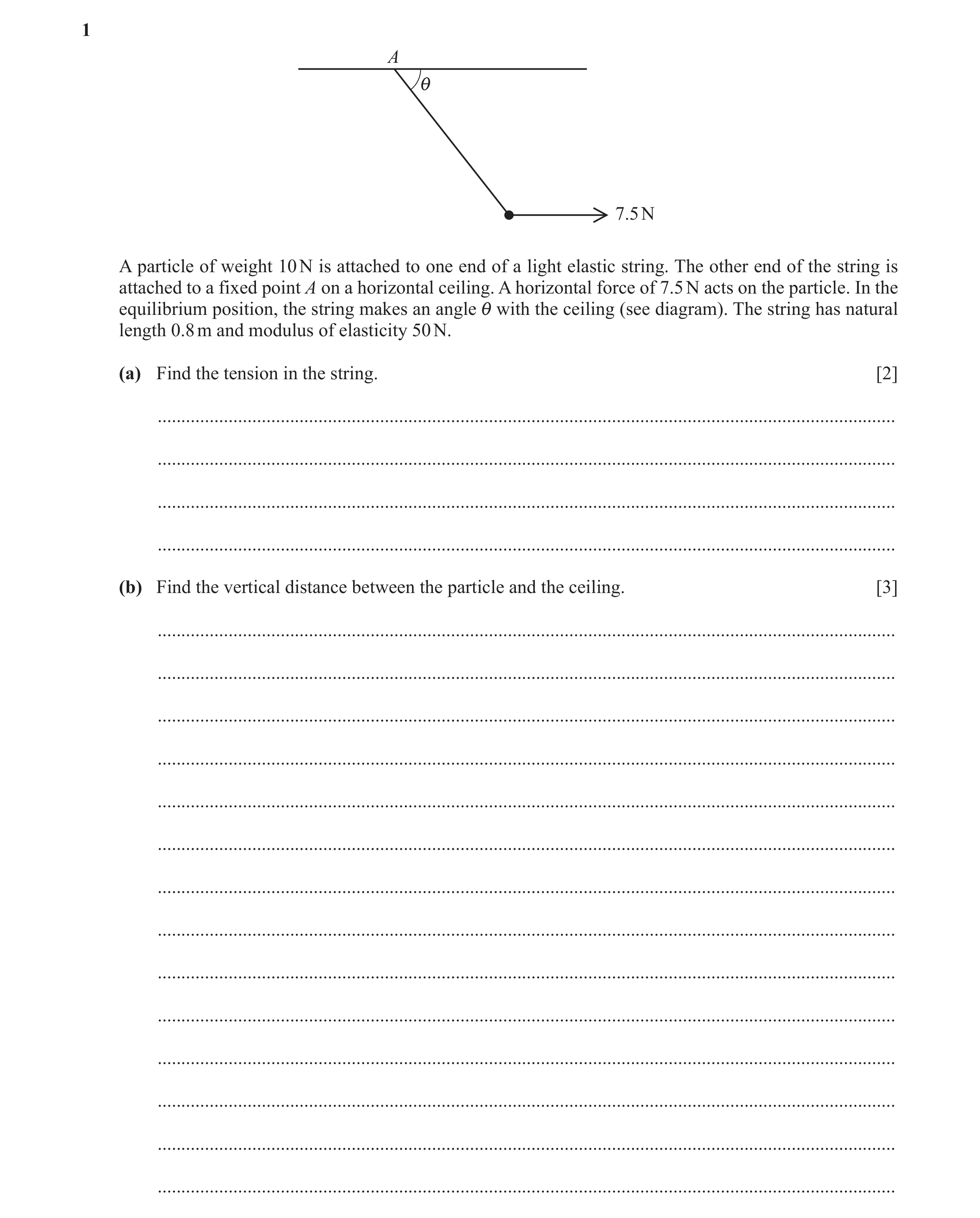
Q13 · A i 7.5 N A particle of weight 10 N is attached to one end of a light elastic string 9231/31 May/June 2022
1 A i 7.5 N A particle of weight 10 N is attached to one end of a light elastic string. The other end of the string is attached to a fixed point A on a horizontal ceiling. A horizontal force of 7.5 N acts on the particle. In the equilibrium position, the string makes an angle i with the ceiling (see diagram). The string has natural length 0.8 m and modulus of elasticity 50 N. (a) Find the tension in the string. [2] … … … … (b) Find the vertical distance between the particle and the ceiling. [3] … … … … … … … … … … … … … …
5 marks
Mark scheme: 1(a) B1 1 2 2 2 7.5 10 T = 12.5 N B1 2 1(b) Hooke’s law: 50 0.8 x T , 0.2 x B1 10 0.8 sin 1 12.5 x M1 4 Vertical distance 0.8 5 A1 3
This question in 9231/31 May/June 2022
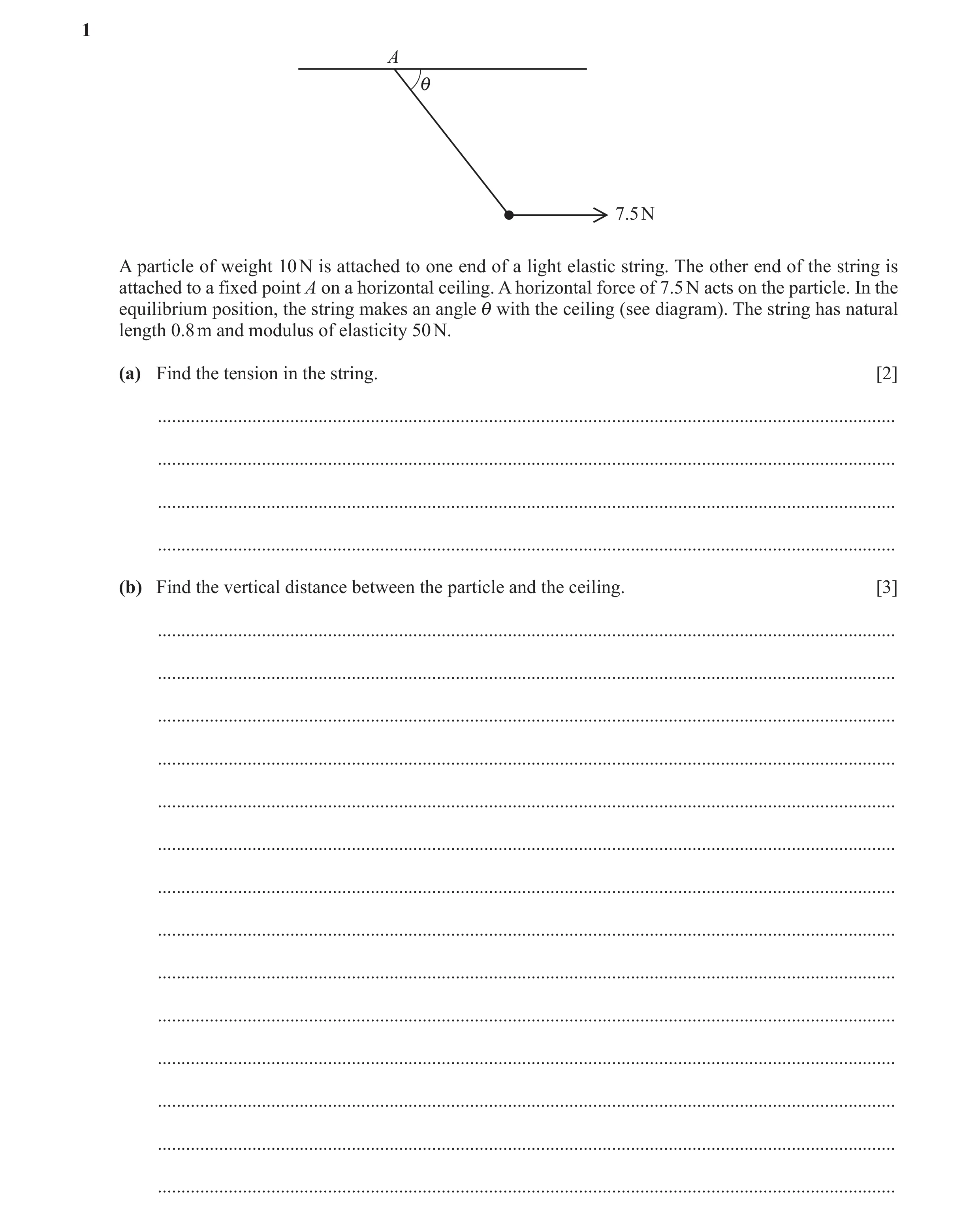
Q14 · A i 7.5 N A particle of weight 10 N is attached to one end of a light elastic string 9231/32 May/June 2022
1 A i 7.5 N A particle of weight 10 N is attached to one end of a light elastic string. The other end of the string is attached to a fixed point A on a horizontal ceiling. A horizontal force of 7.5 N acts on the particle. In the equilibrium position, the string makes an angle i with the ceiling (see diagram). The string has natural length 0.8 m and modulus of elasticity 50 N. (a) Find the tension in the string. [2] … … … … (b) Find the vertical distance between the particle and the ceiling. [3] … … … … … … … … … … … … … …
5 marks
Mark scheme: 1(a) B1 1 2 2 2 7.5 10 T = 12.5 N B1 2 1(b) Hooke’s law: 50 0.8 x T , 0.2 x B1 10 0.8 sin 1 12.5 x M1 4 Vertical distance 0.8 5 A1 3
This question in 9231/32 May/June 2022
Q15 · A particle P of mass m is attached to one end of a light elastic string of natural length… 9231/33 May/June 2022
2 A particle P of mass m is attached to one end of a light elastic string of natural length a and modulus of elasticity 43 mg . The other end of the string is attached to a fixed point O on a rough horizontal surface. The particle is at rest on the surface with the string at its natural length. The coefficient of friction between P and the surface is 1.3 The particle is projected along the surface in the direction OP with a speed of 12 ga . Find the greatest extension of the string during the subsequent motion. [5] … … … … … … … … … … … … … … … … … … … … … … … …
5 marks
Mark scheme: 2 2 4 1 3 . 2 mg x a 1 3mgx B1 Work term correct Loss in KE = gain in EPE + work done against friction 2 2 4 1 1 1 3 2 2 3 mg mv x mgx a M1 Energy equation with 3 terms, allow sign error. 2 2 1 1 1 3 2 4 3 g ga x gx a 2 2 16 8 3 0 x ax a 4 4 3 0 x a x a M1 Obtain and attempt to solve a 3-term quadratic equation. 1 4 x a A1 5
This question in 9231/33 May/June 2022
Q16 · A light elastic string has natural length a and modulus of elasticity 4 mg 9231/31 Oct/Nov 2022
2 A light elastic string has natural length a and modulus of elasticity 4 mg. One end of the string is fixed to a point O on a smooth horizontal surface. A particle P of mass m is attached to the other end of the string. The particle P is projected along the surface in the direction OP. When the length of the string is 5 4 a , the speed of P is v. When the length of the string is 32 a , the speed of P is 12 v . (a) Find an expression for v in terms of a and g. [4] … … … … … … … … … … … … … (b) Find, in terms of g, the acceleration of P when the stretched length of the string is 32 a . [2] … … … … … … … … … … …
6 marks
Mark scheme: 2(a) Loss in KE = Gain in EPE, so B1 EPE terms correct. 1 2 1 v 2 1 4 mg 1 2 1 2 mv − m = a − a M1 All 4 terms and no extras. 2 2 2 2 a 2 4 3 2 4mg 3 2 M1 Simplify. mv = a 4 a 16 v 2 = ag , v = ag A1 4 2(b) 4 mg 1 M1 Hooke’s law: tension = a (= 2 mg ) a 2 2mg A1 Accept -2g. Acceleration = = 2 g m 2
This question in 9231/31 Oct/Nov 2022
Q17 · One end of a light elastic string, of natural length a and modulus of elasticity 163 Mg… 9231/32 Oct/Nov 2022
3 One end of a light elastic string, of natural length a and modulus of elasticity 163 Mg , is attached to a fixed point O. A particle P of mass 4M is attached to the other end of the string and hangs vertically in equilibrium. Another particle of mass 2M is attached to P and the combined particle is then released from rest. The speed of the combined particle when it has descended a distance 14 a is v. Find an expression for v in terms of g and a. [6] … … … … … … … … … … … … … … … … … … … … … … … … … … … … … … … … … … … … … … … … … … … … … … … … … … … …
6 marks
Mark scheme: 3 16 B1 Mge 3 3 In equilibrium, = 4 Mg , e = a a 4 In subsequent motion, M1 Energy equation with GPE and KE terms correct and at least one Loss in GPE = gain in EPE + gain in KE EPE term. Dimensionally correct. 6 Mga 1 16 Mg 2 3a 2 1 2 B1 EPE correct. = . . . a − + .6 Mv 4 2 3 a 2 4 A1 All correct. 3Mga 8 Mg 7 2 2 M1 Attempt to find v in terms of a and g. = . a + 3Mv etc 2 3a 16 ga 2 1 A1 = 3v , v = ga 3 3 6
This question in 9231/32 Oct/Nov 2022
Q18 · A light elastic string has natural length a and modulus of elasticity 4 mg 9231/33 Oct/Nov 2022
2 A light elastic string has natural length a and modulus of elasticity 4 mg. One end of the string is fixed to a point O on a smooth horizontal surface. A particle P of mass m is attached to the other end of the string. The particle P is projected along the surface in the direction OP. When the length of the string is 5 4 a , the speed of P is v. When the length of the string is 32 a , the speed of P is 12 v . (a) Find an expression for v in terms of a and g. [4] … … … … … … … … … … … … … (b) Find, in terms of g, the acceleration of P when the stretched length of the string is 32 a . [2] … … … … … … … … … … …
6 marks
Mark scheme: 2(a) Loss in KE = Gain in EPE, so B1 EPE terms correct. 1 2 1 v 2 1 4 mg 1 2 1 2 mv − m = a − a M1 All 4 terms and no extras. 2 2 2 2 a 2 4 3 2 4mg 3 2 M1 Simplify. mv = a 4 a 16 v 2 = ag , v = ag A1 4 2(b) 4 mg 1 M1 Hooke’s law: tension = a (= 2 mg ) a 2 2mg A1 Accept -2g. Acceleration = = 2 g m 2
This question in 9231/33 Oct/Nov 2022
Q19 · One end of a light elastic string, of natural length a and modulus of elasticity 3mg, is… 9231/31 May/June 2023
1 One end of a light elastic string, of natural length a and modulus of elasticity 3mg, is attached to a fixed point O. The other end of the string is attached to a particle P of mass m. The string hangs with P vertically below O. The particle P is pulled vertically downwards so that the extension of the string is 2a. The particle P is then released from rest. (a) Find the speed of P when it is at a distance 34 a below O. [3] … … … … … … … … … … … … (b) Find the initial acceleration of P when it is released from rest. [2] … … … … … … … … … … … …
5 marks
Mark scheme: 1(a) 2 3 2 2 mg a a 2 2 1 3 3 3 2 2 4 2 mg mv mg a a a a M1 Dimensionally correct energy equation. Must have one KE, one EPE term and at least one GPE. Allow sign errors. 15 2 v ag 2.74 ag A1 AEF 3 1(b) T mg mA and 3 2 mg T a a M1 N2L and Hooke’s law Acceleration = 5g [upwards] A1 Allow 50 or 5g 2
This question in 9231/31 May/June 2023
Q20 · One end of a light elastic string, of natural length a and modulus of elasticity 3mg, is… 9231/32 May/June 2023
1 One end of a light elastic string, of natural length a and modulus of elasticity 3mg, is attached to a fixed point O. The other end of the string is attached to a particle P of mass m. The string hangs with P vertically below O. The particle P is pulled vertically downwards so that the extension of the string is 2a. The particle P is then released from rest. (a) Find the speed of P when it is at a distance 34 a below O. [3] … … … … … … … … … … … … (b) Find the initial acceleration of P when it is released from rest. [2] … … … … … … … … … … … …
5 marks
Mark scheme: 1(a) 2 3 2 2 mg a a 2 2 1 3 3 3 2 2 4 2 mg mv mg a a a a M1 Dimensionally correct energy equation. Must have one KE, one EPE term and at least one GPE. Allow sign errors. 15 2 v ag 2.74 ag A1 AEF 3 1(b) T mg mA and 3 2 mg T a a M1 N2L and Hooke’s law Acceleration = 5g [upwards] A1 Allow 50 or 5g 2
This question in 9231/32 May/June 2023
Q21 · One end of a light elastic string, of natural length a and modulus of elasticity mmg , is… 9231/33 May/June 2023
2 One end of a light elastic string, of natural length a and modulus of elasticity mmg , is attached to a fixed point O. The string lies on a smooth horizontal surface. A particle P of mass m is attached to the other end of the string. The particle P is projected in the direction OP. When the length of the string is 4 3 a , the speed of P is 2ag . When the length of the string is 53 a , the speed of P is 12 2ag . Find the value of m. [4] … … … … … … … … … … … … … … … … … … … … … … … …
4 marks
Mark scheme: 2 2 2 2 2 1 1 2 1 2 2 4 3 3 mg v m v a a a M1 Kinetic energy = elastic potential energy, 4 terms, dimensionally correct, allow sign errors. 2 2 1 1 1 2 1 2 2 2 2 3 3 mg m ag ag a a a A1 With v substituted. Solve [ 2 3 3 ] 4 9 v g a M1 Solve to find value for dependent on energy equation with 3 or 4 terms 9 2 A1 SCB2 for 9 2 mg if given not used 4
This question in 9231/33 May/June 2023
Q22 · One end of a light elastic string, of natural length 12a and modulus of elasticity kmg… 9231/33 May/June 2023
5 One end of a light elastic string, of natural length 12a and modulus of elasticity kmg, is attached to a fixed point O. The other end of the string is attached to a particle of mass m. The particle moves with constant speed 32 3ag in a horizontal circle with centre at a distance 12a below O. The string is inclined at an angle i to the downward vertical through O. (a) Find, in terms of a, the extension of the string. [5] … … … … … … … … … … … … … … … … … … … … … … … … (b) Find the value of k. [3] … … … … … … … … … … … … … … … … … … … … … … … … … … …
8 marks
Mark scheme: 5(a) cos T mg 2 27 sin 4 mv ag T m r r B1 12 tan r a used M1 Divide: 27 tan , 4 12tan so 3 tan 4 M1 Finds value for tan OE. Reduces to equation in or x, no k. 9 , r a extension of string = 3a A1 Alternative method for question 5(a) Let L be stretched length of string. cos T mg B1 Or 12a T mg L 2 27 sin 4 mv ag T m r r B1 sin r L used M1 Use 12 cos a L and 0.5 2 2 144 sin L a L and eliminate T. M1 2 2 2 [ 144 81 ] 15 L a a L a , extension of string = 3a A1 5 Question Answer Marks Guidance 5(b) Hooke’s law: 12 12 kmg L a T a B1 Eliminate T: 12 12 12 kmg L a mgL a a M1 5 12 L k L a A1 3
This question in 9231/33 May/June 2023
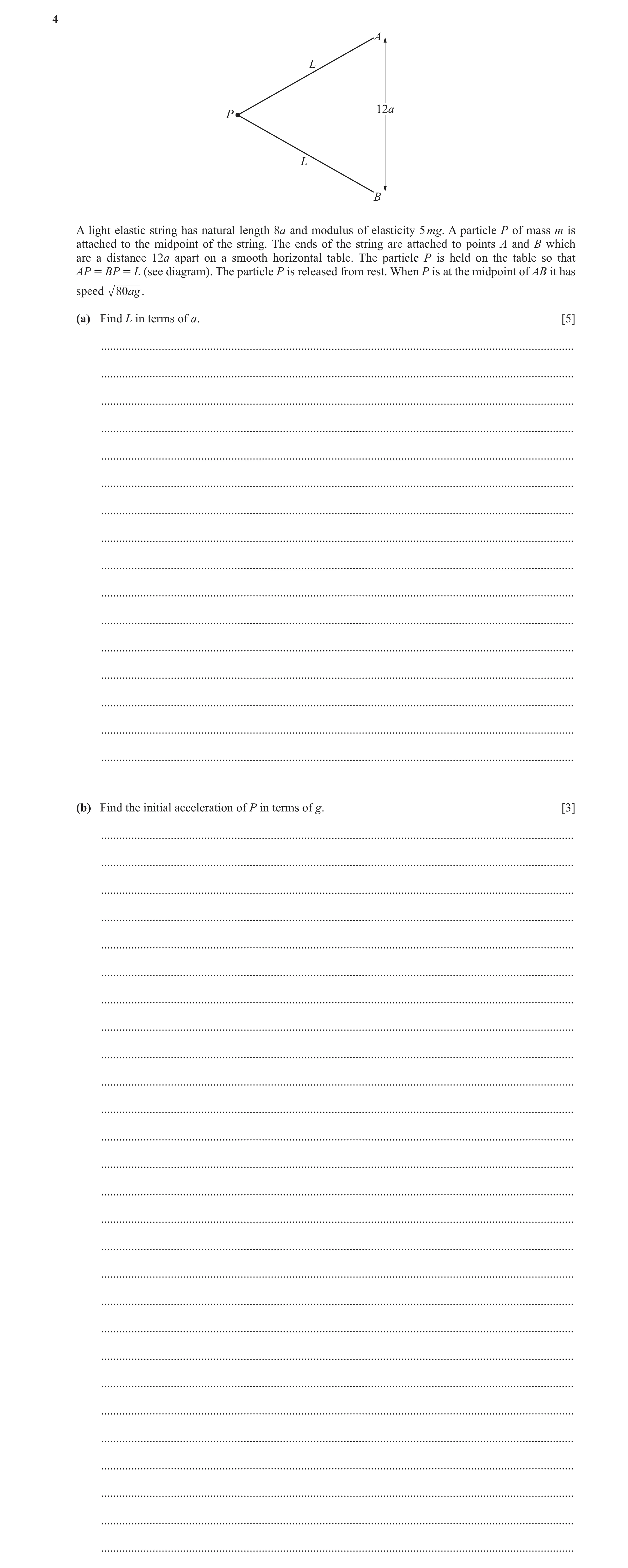
Q23 · A L 12a P L B A light elastic string has natural length 8a and modulus of elasticity 5 mg 9231/31 Oct/Nov 2023
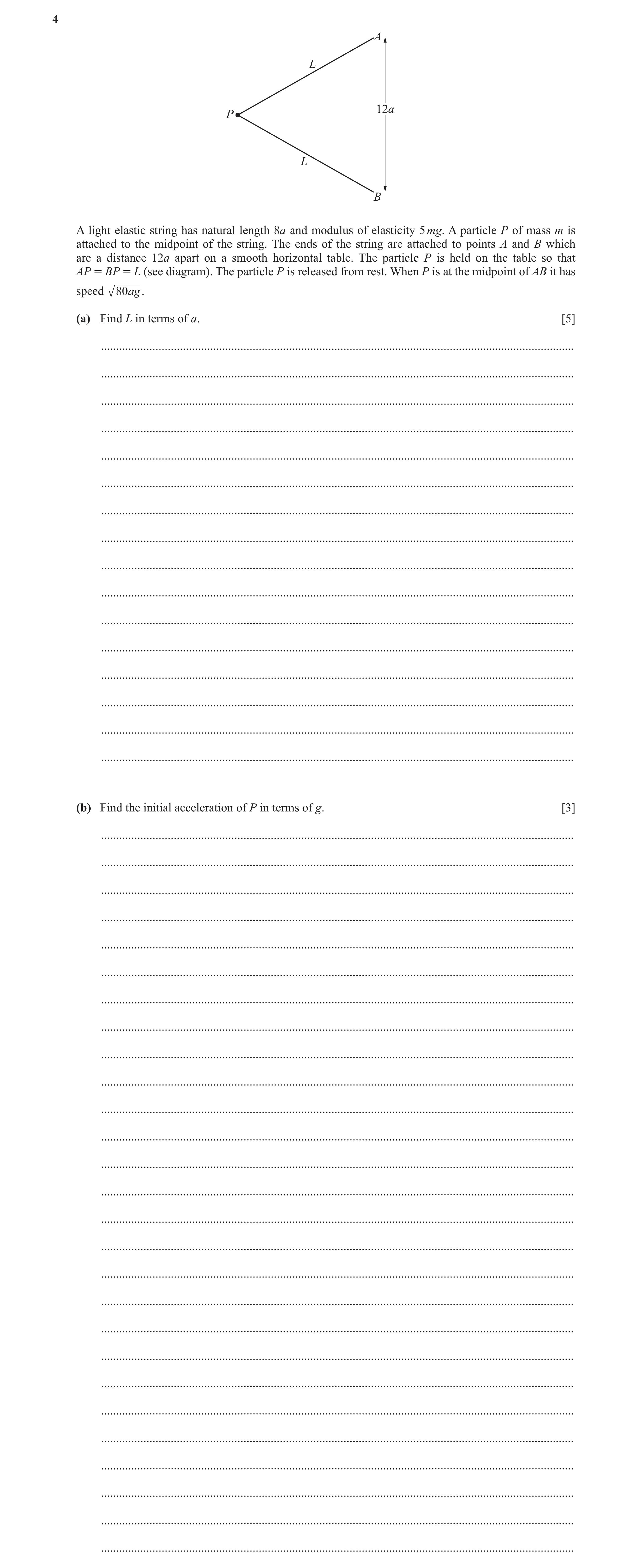
4 A L 12a P L B A light elastic string has natural length 8a and modulus of elasticity 5 mg. A particle P of mass m is attached to the midpoint of the string. The ends of the string are attached to points A and B which are a distance 12a apart on a smooth horizontal table. The particle P is held on the table so that AP = BP = L (see diagram). The particle P is released from rest. When P is at the midpoint of AB it has speed 80ag . (a) Find L in terms of a. [5] … … … … … … … … … … … … … … … … (b) Find the initial acceleration of P in terms of g. [3] … … … … … … … … … … … … … … … … … … … … … … … … … … …
8 marks
Mark scheme: 4(a) Energy equation: gain in KE = loss in EPE B1 At least one correct EPE. M1 3-term energy equation. 1 1 5mg 2 2 A1 All correct. m 80ag = ( 2 L − 8a ) − ( 4a ) ( ) 2 2 8a 4 L2 − 8aL − 20 a 2 = 0 M1 Simplify to quadratic in L. L = 10a A1 Correct single answer. 5 4(b) At P: 2T cos= m acceleration M1 5mg 15 M1 Hooke’s law: T = 12 a = mg 8a 2 Solve, acceleration = 12g A1 3
This question in 9231/31 Oct/Nov 2023
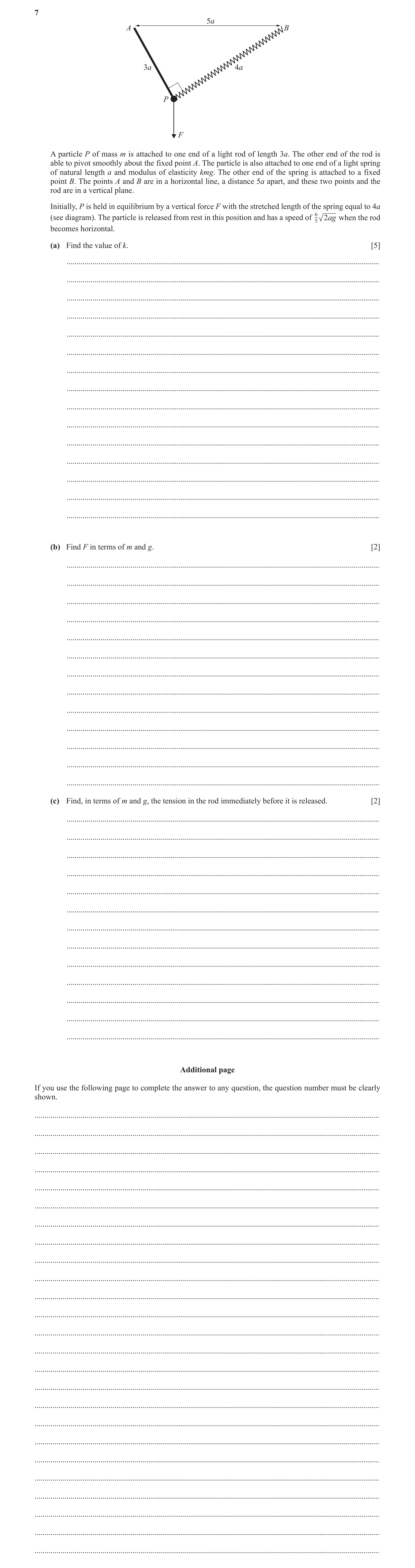
Q24 · 5a A B 3a 4a P F A particle P of mass m is attached to one end of a light rod of length 3a 9231/32 Oct/Nov 2023
7 5a A B 3a 4a P F A particle P of mass m is attached to one end of a light rod of length 3a. The other end of the rod is able to pivot smoothly about the fixed point A. The particle is also attached to one end of a light spring of natural length a and modulus of elasticity kmg. The other end of the spring is attached to a fixed point B. The points A and B are in a horizontal line, a distance 5a apart, and these two points and the rod are in a vertical plane. Initially, P is held in equilibrium by a vertical force F with the stretched length of the spring equal to 4a (see diagram). The particle is released from rest in this position and has a speed of 65 2ag when the rod becomes horizontal. (a) Find the value of k. [5] … … … … … … … … … … … … … … … (b) Find F in terms of m and g. [2] … … … … … … … … … … … … … (c) Find, in terms of m and g, the tension in the rod immediately before it is released. [2] … … … … … … … … … … … … … Additional page If you use the following page to complete the answer to any question, the question number must be clearly shown. … … … … … … … … … … … … … … … … … … … … … … … … …
9 marks
Mark scheme: 7(a) 2 B1 1 6 Gain in KE = m 2ag and Gain in GPE = mg 3a sin 2 5 1 B1 kmg 2 2 2 Loss in EPE = ( 3a ) − a ( ) a 1 M1 KE, GPE and at least one EPE present, allow sign errors, 2 kmg 2 2 dimensionally correct. 1 6 2 ( 3a ) − a Energy equation: m 2 ag + mg 3a sin= ( ) 2 5 a A1 All correct. 36 12 A1 mg + mg = 4kmg 25 5 24 k = 25 5 7(b) 3a 72 M1 Hooke’s law. In lower position, tension T in spring = kmg = 3kmg = mg a 25 Perpendicular to rod, T = ( F + mg )cos 72 A1 So, ( F + mg ) cos= mg , 25 19 F = mg 5 Alternative method for question 7(b) 3a 72 M1 In lower position, tension T in spring = kmg = 3kmg = mg Hooke’s law. a 25 Eliminate T. T cos= Tsin T sin+ Tcos= F + mg 19 A1 F = mg 5 2 7(c) Let tension in rod = T ' M1 Parallel to rod, T = ( F + mg )sin 96 A1 T = mg 25 Alternative method for question 7(c) T cos= Tsin M1 At least one equation seen with their T and/or F. T sin+ Tcos= F + mg 96 A1 T = mg 25 2
This question in 9231/32 Oct/Nov 2023
Q25 · A L 12a P L B A light elastic string has natural length 8a and modulus of elasticity 5 mg 9231/33 Oct/Nov 2023
4 A L 12a P L B A light elastic string has natural length 8a and modulus of elasticity 5 mg. A particle P of mass m is attached to the midpoint of the string. The ends of the string are attached to points A and B which are a distance 12a apart on a smooth horizontal table. The particle P is held on the table so that AP = BP = L (see diagram). The particle P is released from rest. When P is at the midpoint of AB it has speed 80ag . (a) Find L in terms of a. [5] … … … … … … … … … … … … … … … … (b) Find the initial acceleration of P in terms of g. [3] … … … … … … … … … … … … … … … … … … … … … … … … … … …
8 marks
Mark scheme: 4(a) Energy equation: gain in KE = loss in EPE B1 At least one correct EPE. M1 3-term energy equation. 1 1 5mg 2 2 A1 All correct. m 80ag = ( 2 L − 8a ) − ( 4a ) ( ) 2 2 8a 4 L2 − 8aL − 20 a 2 = 0 M1 Simplify to quadratic in L. L = 10a A1 Correct single answer. 5 4(b) At P: 2T cos= m acceleration M1 5mg 15 M1 Hooke’s law: T = 12 a = mg 8a 2 Solve, acceleration = 12g A1 3
This question in 9231/33 Oct/Nov 2023
Q26 · The points A and B are at the same horizontal level a distance 4a apart 9231/31 May/June 2024
2 The points A and B are at the same horizontal level a distance 4a apart. The ends of a light elastic string, of natural length 4a and modulus of elasticity m, are attached to A and B. A particle P of mass m is attached to the midpoint of the string. The system is in equilibrium with P at a distance 3a2 below M, the midpoint of AB. (a) Find m in terms of m and g. [3] … … … … … … … … … … … … … … … … … … … … … … … … … The particle P is pulled down vertically and released from rest at a distance 8a3 below M. (b) Find, in terms of a and g, the speed of P as it passes through M in the subsequent motion. [4] … … … … … … … … … … … … … … … … … … … … … … … … … …
7 marks
Mark scheme: 2(a) T mg Hooke’s law: 5 2 2 2 4 a T a a B1 Equate and use 3 5 cos : 10 3 mg A1 3 2(b) EPE loss = 2 1 20 4 2 4 3 a a a B1 80 27 mga Energy equation: 2 1 8 80 ' ' 2 3 27 a mv mg mga M1 A1 All 3 terms required, dimensionally correct, their . 4 3 3 ga v A1 Any equivalent form. 4
This question in 9231/31 May/June 2024
Q27 · The points A and B are at the same horizontal level a distance 4a apart 9231/32 May/June 2024
2 The points A and B are at the same horizontal level a distance 4a apart. The ends of a light elastic string, of natural length 4a and modulus of elasticity m, are attached to A and B. A particle P of mass m is attached to the midpoint of the string. The system is in equilibrium with P at a distance 3a2 below M, the midpoint of AB. (a) Find m in terms of m and g. [3] … … … … … … … … … … … … … … … … … … … … … … … … … The particle P is pulled down vertically and released from rest at a distance 8a3 below M. (b) Find, in terms of a and g, the speed of P as it passes through M in the subsequent motion. [4] … … … … … … … … … … … … … … … … … … … … … … … … … …
7 marks
Mark scheme: 2(a) T mg Hooke’s law: 5 2 2 2 4 a T a a B1 Equate and use 3 5 cos : 10 3 mg A1 3 2(b) EPE loss = 2 1 20 4 2 4 3 a a a B1 80 27 mga Energy equation: 2 1 8 80 ' ' 2 3 27 a mv mg mga M1 A1 All 3 terms required, dimensionally correct, their . 4 3 3 ga v A1 Any equivalent form. 4
This question in 9231/32 May/June 2024
Q28 · A particle P of mass m kg is attached to one end of a light elastic string of natural… 9231/31 Oct/Nov 2024
3 A particle P of mass m kg is attached to one end of a light elastic string of natural length 2 m and modulus of elasticity 2mg N. The other end of the string is attached to a fixed point O. The particle P hangs in equilibrium vertically below O. The particle P is pulled down vertically a distance d m below its equilibrium position and released from rest. (a) Given that the particle just reaches O in the subsequent motion, find the value of d. [6] … … … … … … … … … … … … … … … … … … … … … … … … … (b) Hence find the speed of P when it is 2 m below O. [2] … … … … … … … … … … … … … … … … … … … … … … … … … … …
8 marks
Mark scheme: 3(a) 2 mg M1 Equilibrium position. Hooke’s law: T = extension and T = mg 2 Extension = 1 m A1 1 2mg 2 B1 EPE loss = (1 + d ) 2 2 Gain in GPE = mg ( 2 + 1 + d ) B1 1 2 M1 Equate: mg (1 + d ) = mg ( 3 + d ) 2 d = 5 A1 SC: 3 marks for final answer of 5 + 1 . SC: 2 marks for final answer of 5 + k , k 1 . 6 3(b) 1 2 1 2 mg 2 M1 GPE, KE, EPE terms. Energy equation: mV + mg (1 + d ) = (1 + d ) 2 2 2 2 2 A1 V = g d − 1 V = 40 = 2 10 ( ) Alternatively: M1 Using KE and GPE from 2 m below O to point O 1 2 mV = 2mg 2 V 2 = 4 g V = 40 = 2 10 A1 2
This question in 9231/31 Oct/Nov 2024
Q29 · A particle P of mass m is attached to one end of a light elastic spring of natural length… 9231/32 Oct/Nov 2024
2 A particle P of mass m is attached to one end of a light elastic spring of natural length a and modulus of elasticity 5mg. The other end of the spring is attached to a fixed point O. The spring hangs vertically with P below O. The particle P is pulled down vertically and released from rest when the length of the spring is 3 a . 2 Find the distance of P below O when P first comes to instantaneous rest. [4] … … … … … … … … … … … … … … … … … … … … … … … … … …
4 marks
Mark scheme: 2 1 5 mg a 2 2 B1 Both terms seen. Extension when P comes to rest is x, EPE loss = − x 2 a 2 1 5mg a 2 2 a M1 At least one EPE term and a GPE term, Energy: − x = mg − x dimensionally correct. 2 a 2 2 Solve: 20 x 2 − 8ax − a 2 = 0 M1 Obtain homogeneous quadratic equation in x and a Must come from an energy equation involving two EPE terms. Note that the correct case simplifies to a linear 5mg a equation + x = mg and this scores M1. 2 a 2 a 9 A1 x = − , so distance of P below O is a 10 10 2 Alternative method for question 2 Distance of P below O when it comes to rest comes to rest is h B1 1 5mg a 2 2 EPE loss = = − ( h − a ) 2 a 2 1 5mg a 2 2 3 M1 At least one EPE term and a GPE term, Energy: − ( h − a ) = mg a − h dimensionally correct. 2 a 2 2 20h 2 − 48ah + 27 a 2 = 0 M1 Obtain homogeneous quadratic/linear equation in h and a. Must come from an energy equation involving two EPE terms. 9 A1 (10 h − 9 a )( 2 h − 3a ) = 0, h = a 10 4
This question in 9231/32 Oct/Nov 2024
Q30 · A particle P of mass m kg is attached to one end of a light elastic string of natural… 9231/33 Oct/Nov 2024
3 A particle P of mass m kg is attached to one end of a light elastic string of natural length 2 m and modulus of elasticity 2mg N. The other end of the string is attached to a fixed point O. The particle P hangs in equilibrium vertically below O. The particle P is pulled down vertically a distance d m below its equilibrium position and released from rest. (a) Given that the particle just reaches O in the subsequent motion, find the value of d. [6] … … … … … … … … … … … … … … … … … … … … … … … … … (b) Hence find the speed of P when it is 2 m below O. [2] … … … … … … … … … … … … … … … … … … … … … … … … … … …
8 marks
Mark scheme: 3(a) 2 mg M1 Equilibrium position. Hooke’s law: T = extension and T = mg 2 Extension = 1 m A1 1 2mg 2 B1 EPE loss = (1 + d ) 2 2 Gain in GPE = mg ( 2 + 1 + d ) B1 1 2 M1 Equate: mg (1 + d ) = mg ( 3 + d ) 2 d = 5 A1 SC: 3 marks for final answer of 5 + 1 . SC: 2 marks for final answer of 5 + k , k 1 . 6 3(b) 1 2 1 2 mg 2 M1 GPE, KE, EPE terms. Energy equation: mV + mg (1 + d ) = (1 + d ) 2 2 2 2 2 A1 V = g d − 1 V = 40 = 2 10 ( ) Alternatively: M1 Using KE and GPE from 2 m below O to point O 1 2 mV = 2mg 2 V 2 = 4 g V = 40 = 2 10 A1 2
This question in 9231/33 Oct/Nov 2024
Q31 · A particle P of mass m is attached to one end of a light elastic string of natural length… 9231/33 May/June 2025
2 A particle P of mass m is attached to one end of a light elastic string of natural length a and modulus of elasticity mg. The other end of the string is attached to a fixed point O on a rough plane inclined at an angle of 30° to the horizontal. The particle P is held at rest at point O before being released. The frictional force acting on P as it slides down the plane is 11 mg . 30 (a) Find, in terms of a, the distance that P moves down the plane before coming to rest. [5] … … … … … … … … … … … … … … … … … … … … … … … … … (b) It is given that P remains at rest in this new position. Find, in terms of m and g, the magnitude of the frictional force in this position. [3] … … … … … … … … … … … … … … … … … … … … … … … … … …
8 marks
Mark scheme: 2(a) mg 2 11 M1 Energy equation with all three terms. ( x − a ) = mgx sin30 − 30 mgx Dimensionally correct. 2 a B1 Two terms correct (need not be in equation). A1 Correct energy equation. 15 x 2 − 34ax + 15a 2 = 0 M1 Simplify to three-term homogeneous quadratic equation and attempt to solve. (3 x − 5a )(5 x − 3a ) = 0 x = 53 a A1 CAO, must reject x = 53 a if seen. 5 2(b) T = 23 mg B1 F = T − mg sin30 = 23 mg − 12 mg M1 Equation for F. Allow sin/cos mix. Allow sign errors. 1 6 mg A1 3
This question in 9231/33 May/June 2025
Q32 · A light spring of natural length a and modulus of elasticity 20mg is placed so that it… 9231/34 May/June 2025
1 A light spring of natural length a and modulus of elasticity 20mg is placed so that it stands vertically on a horizontal plane. The lower end of the spring is fixed to the plane. A particle of mass m is attached to the upper end of the spring. The particle is pushed vertically downwards until the length of the spring is 3 a . The system is then 5 released from rest. Find the maximum extension of the spring in the subsequent motion. [5] … … … … … … … … … … … … … … … … … … … … … … …
5 marks
Mark scheme: Question Answer Marks Guidance 1 Energy equation: M1 Energy equation with two EPE terms and at least one GPE term, 2 2 2 dimensionally correct, allow sign errors. 20 mg ( 5 a ) 3 20 mgx + 5 mga = + mg ( a + x ) Award equivalent marks if any other x is used. 2 a 2 a B1 One correct EPE term seen anywhere. A1 Correct energy equation. 50 x 2 + 5ax − 6a 2 = 0 M1 Dependent on two EPE terms used. Simplify to 3-term quadratic with terms in 2x , ax and a 2 only. x = 103 a A1 Single correct answer. If seen, x = − 52 a must be rejected. Alternative method for question 1 Energy equation: M1 Energy equation with two EPE terms and at least one GPE term, 2 2 2 dimensionally correct, allow sign errors. 20 mg ( 5 a ) 3 20 mg ( h − a ) + 5 mga = + mgh Award equivalent marks if any other h is used. 2 a 2 a B1 One correct EPE term seen anywhere. A1 Correct energy equation. 50h2 − 95ah + 39a 2 = 0 M1 Dependent on two EPE terms used. Simplify to 3-term quadratic with terms in h 2 , ah and a 2 only. h = 1013 a , so the maximum extension is 103 a . A1 Single correct answer. If seen, h = 53 a leading to x = − 52 a must be rejected. 5
This question in 9231/34 May/June 2025
Q33 · One end of a light elastic string of natural length a and modulus of elasticity 5mg is… 9231/31 Oct/Nov 2025
4 One end of a light elastic string of natural length a and modulus of elasticity 5mg is attached to a fixed point O. Two particles, P and Q, of masses m and 4m respectively are attached to the other end of the string and they hang vertically in equilibrium. Particle Q is then detached from the string, hence releasing particle P from rest. Find, in terms of a, the length of the string when the speed of particle P is first equal to 7 ag . [6] 5 … … … … … … … … … … … … … … … … … … … … … … … … … … … … … … … … … … … … … … … … … … … … … … … … … … … … …
6 marks
Mark scheme: 4 5mge B1 In equilibrium, = 5mg , e = a . a 7 B1 At least one correct EPE term seen. Let x be the length of the string when speed of P is 5 ag . Energy equation in subsequent motion: M1 Dimensionally correct energy equation with one KE term, 5 mga 2 5 mg ( x − a ) 2 1 7 two EPE terms and at least one GPE term. − = mg ( e + a − x ) + 2 m ( 5 ag ) 2 a 2 a A1 Fully correct energy equation. 2 2 M1 Three-term homogeneous quadratic equation in x and a . 25 x − 60 ax + 27 a = 0 x = 95 a only. A1 Alternative method for question 4 5mge B1 In equilibrium, = 5mg , e = a . a Let x be the extension when P is released. B1 At least one correct EPE term seen. Energy equation in subsequent motion: 2 2 M1 Dimensionally correct energy equation with one KE term, 5mga 5mgx 1 7 − = mg ( e − x ) + 2 m ( 5 ag ) two EPE terms and at least one GPE term. 2 a 2 a A1 Fully correct energy equation. 25 x 2 − 10 ax − 8a 2 = 0 M1 Three-term homogeneous quadratic equation in x and a . 4 a only. A1 ( 5 x + 2 a )( 5 x − 4 a ) = 0, x = 5 Required length of string = 95 a . 6
This question in 9231/31 Oct/Nov 2025
Q34 · One end of a light elastic string of natural length a and modulus of elasticity 2mg is… 9231/32 Oct/Nov 2025
2 One end of a light elastic string of natural length a and modulus of elasticity 2mg is attached to a fixed point A on a rough horizontal surface. The other end of the string is attached to a particle P of mass m. The particle and string rest on the surface. The coefficient of friction between P and the surface is n. The particle P is initially held in equilibrium at a distance 4 a from A. The particle is then released from rest. 3 (a) Given that the string never becomes slack, find the minimum value of n. [3] … … … … … … … … … … … … … … … … … … … … … … … … … It is now given that n = 1 . 2 (b) Find the extension of the string when the particle comes to rest. [3] … … … … … … … … … … … … … … … … … … … … … … … … … …
6 marks
Mark scheme: 2 B1 Correct EPE seen OR correct work done by2(a) 2 mg 1 EPE = ( 3 a ) friction seen. 2 a 1 Work done by friction = mg ( 3 a ) 2 2 mg 1 1 ( 3 a ) = mg ( 3 a ) M1 Equationwork doneortermsinequalityonly. involving EPE and 2 a = 13 A1 CWO 3 2(b) Let x be the extension in the string when P comes to rest. M1 Dimensionally correct equation with two EPE 2 mg 1 ( 3 a ) 2 = 2 mg x 2 + 12 mg ( 13 a − x ) terms and1 one work done term. 2 a 2 a Use of 2 mgx as work done term can be awarded M1 only. A1 Correct energy equation. May be unsimplified. 18 x 2 − 9ax + a 2 = 0, ( 6 x − a )( 3 x − a ) = 0 x = 16 a only. A1 CWO Alternative method for question 2(b) Let x be the distance moved by P before coming to rest. M1 Dimensionally correct equation with two EPE 2 2 mg 1 2 2 mg 1 1 ( 3 a ) = ( 3 a − x ) + 2 mgx terms and1 one1 work done term. as work done term can 2 a 2 a Use of 2 mg ( 3 a − x ) be awarded M1 only. A1 Correct energy equation. May be unsimplified. 2 1 A1 CWO 6 x − ax = 0, x = 6 a Extension = 13 a − x = 16 a 3
This question in 9231/32 Oct/Nov 2025
Q35 · One end of a light elastic string of natural length a and modulus of elasticity 5mg is… 9231/33 Oct/Nov 2025
4 One end of a light elastic string of natural length a and modulus of elasticity 5mg is attached to a fixed point O. Two particles, P and Q, of masses m and 4m respectively are attached to the other end of the string and they hang vertically in equilibrium. Particle Q is then detached from the string, hence releasing particle P from rest. Find, in terms of a, the length of the string when the speed of particle P is first equal to 7 ag . [6] 5 … … … … … … … … … … … … … … … … … … … … … … … … … … … … … … … … … … … … … … … … … … … … … … … … … … … … …
6 marks
Mark scheme: 4 5mge B1 In equilibrium, = 5mg , e = a . a 7 B1 At least one correct EPE term seen. Let x be the length of the string when speed of P is 5 ag . Energy equation in subsequent motion: M1 Dimensionally correct energy equation with one KE term, 5 mga 2 5 mg ( x − a ) 2 1 7 two EPE terms and at least one GPE term. − = mg ( e + a − x ) + 2 m ( 5 ag ) 2 a 2 a A1 Fully correct energy equation. 2 2 M1 Three-term homogeneous quadratic equation in x and a . 25 x − 60 ax + 27 a = 0 x = 95 a only. A1 Alternative method for question 4 5mge B1 In equilibrium, = 5mg , e = a . a Let x be the extension when P is released. B1 At least one correct EPE term seen. Energy equation in subsequent motion: 2 2 M1 Dimensionally correct energy equation with one KE term, 5mga 5mgx 1 7 − = mg ( e − x ) + 2 m ( 5 ag ) two EPE terms and at least one GPE term. 2 a 2 a A1 Fully correct energy equation. 25 x 2 − 10 ax − 8a 2 = 0 M1 Three-term homogeneous quadratic equation in x and a . 4 a only. A1 ( 5 x + 2 a )( 5 x − 4 a ) = 0, x = 5 Required length of string = 95 a . 6
This question in 9231/33 Oct/Nov 2025
 8 / 53
 11 / 53
 12 / 53
 13 / 53
 14 / 53
 15 / 53
 16 / 53
 17 / 53
 18 / 53
 19 / 53
 20 / 53
 21 / 53
 24 / 53
 25 / 53
 26 / 53
 27 / 53
 42 / 53
 47 / 53
 7
7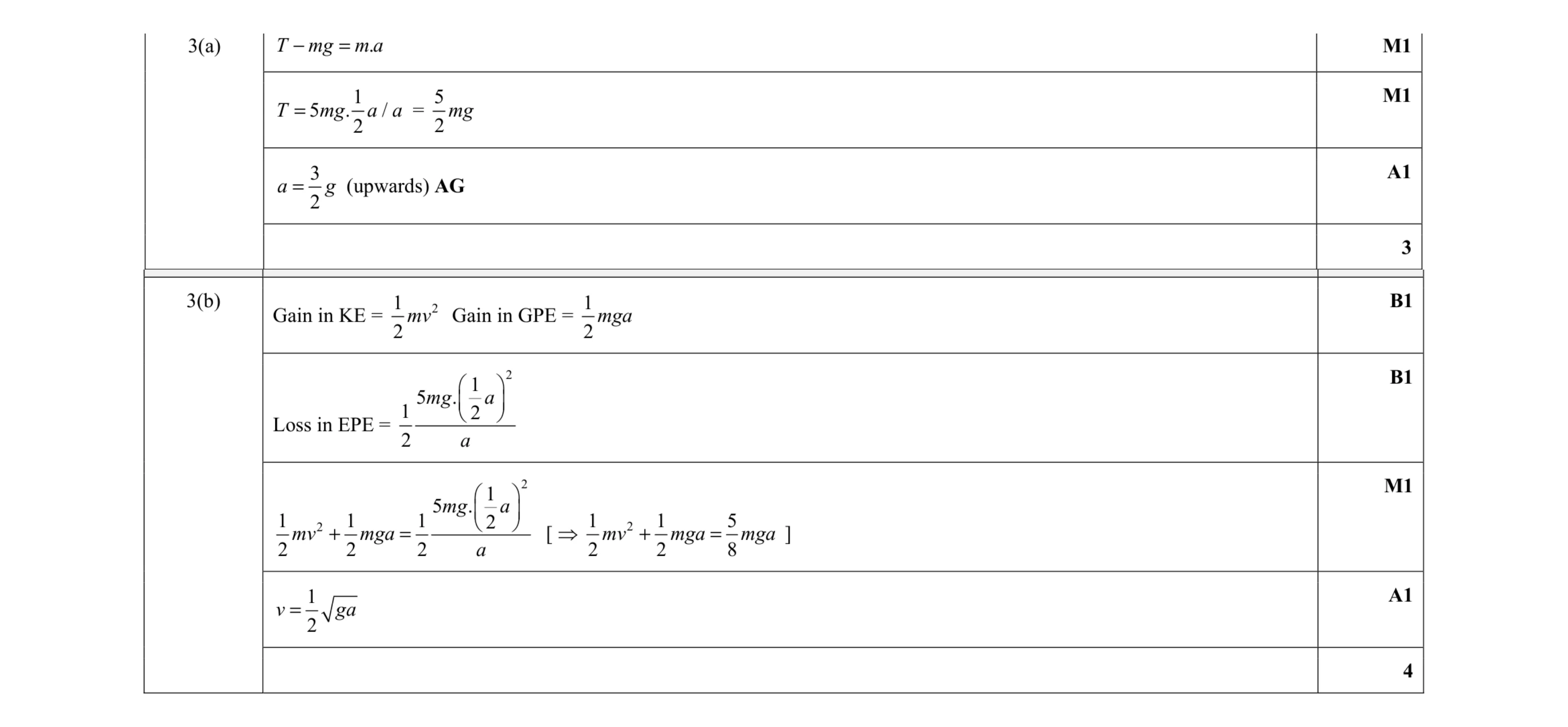 7
7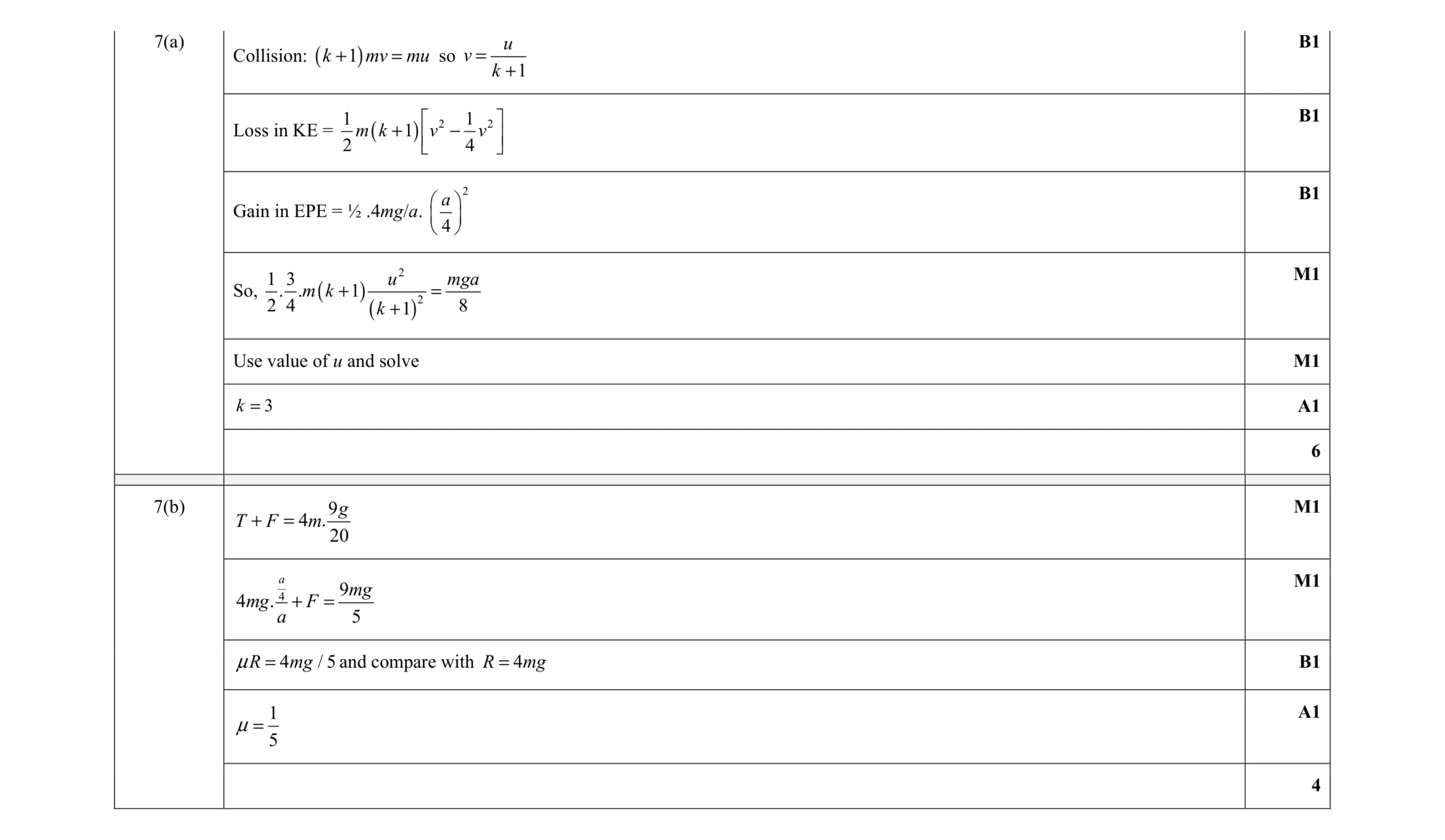 10
10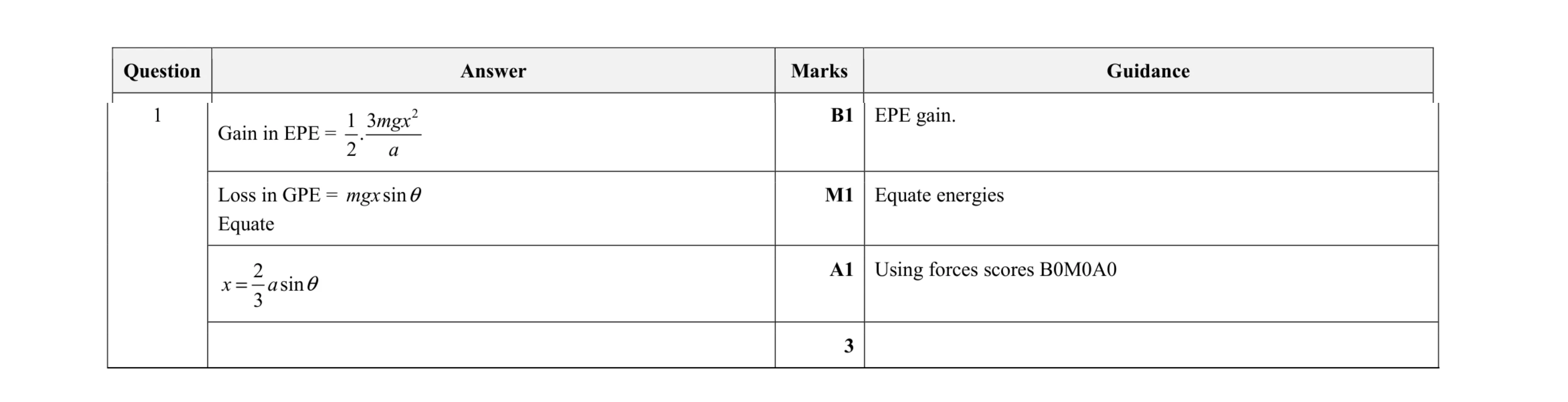 3
3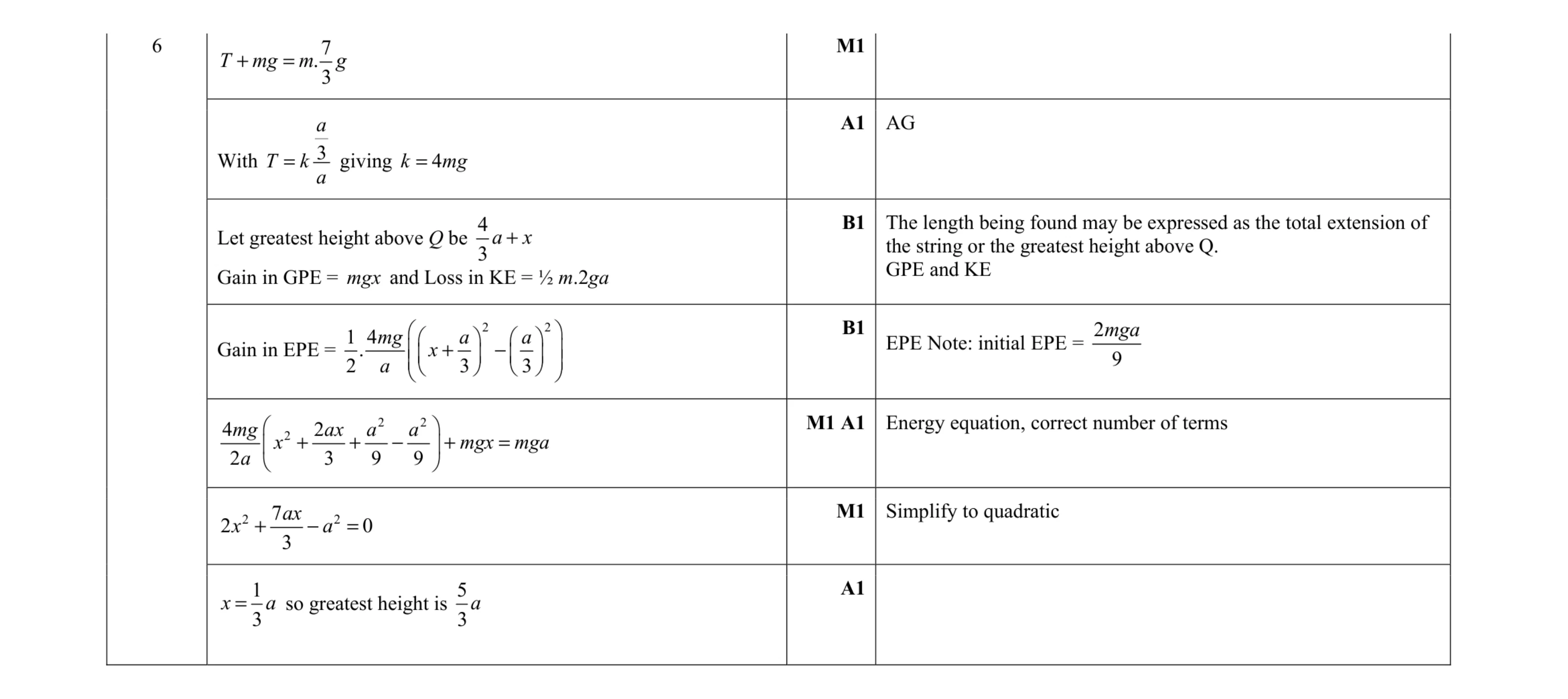 8
8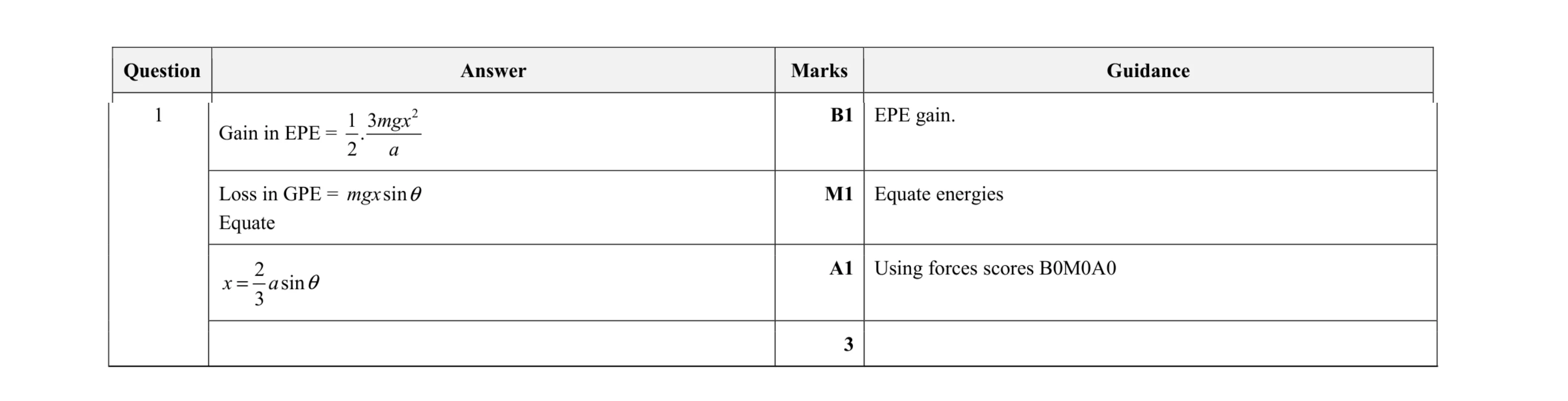 3
3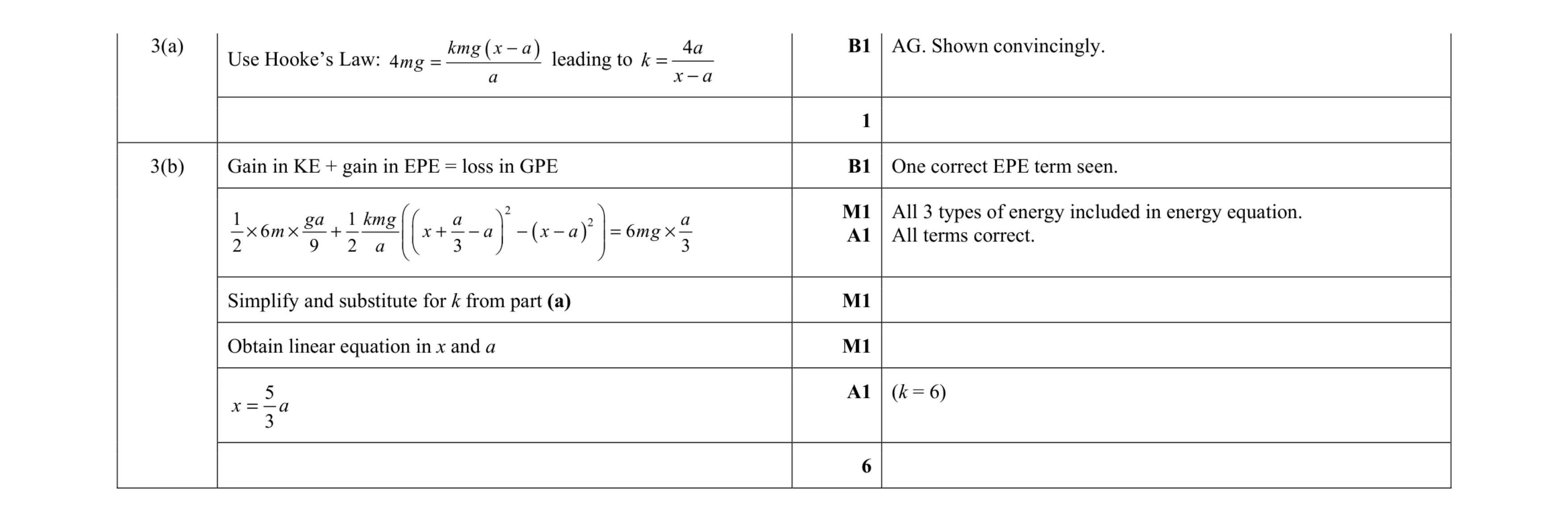 7
7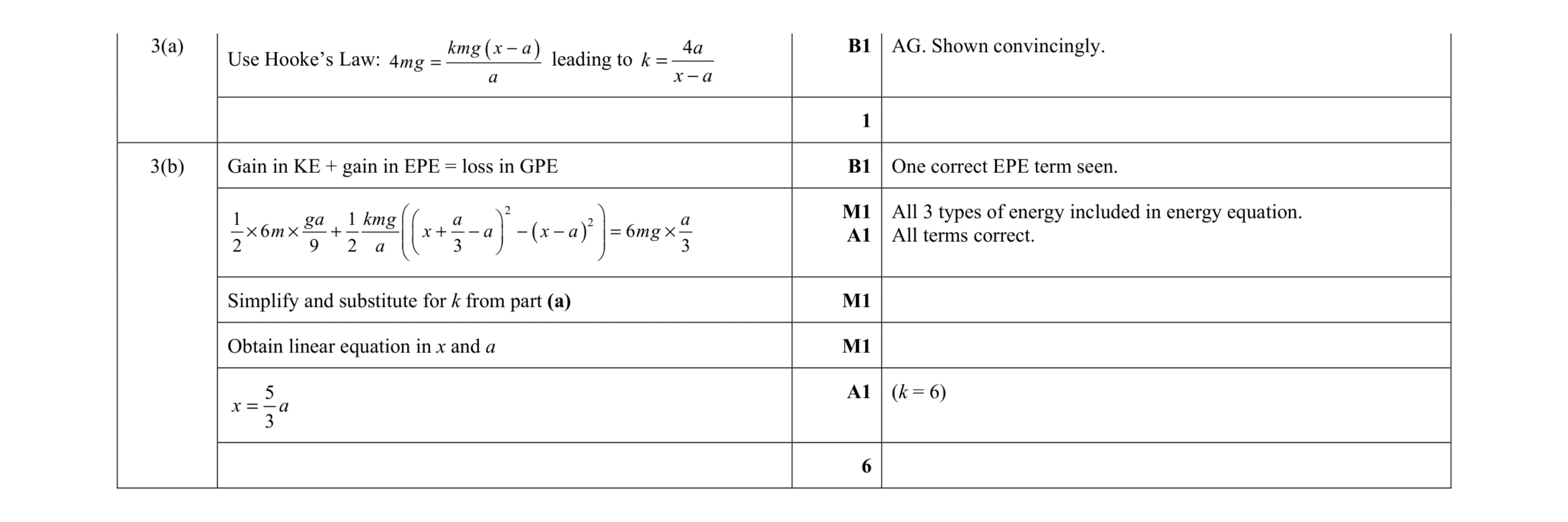 7
7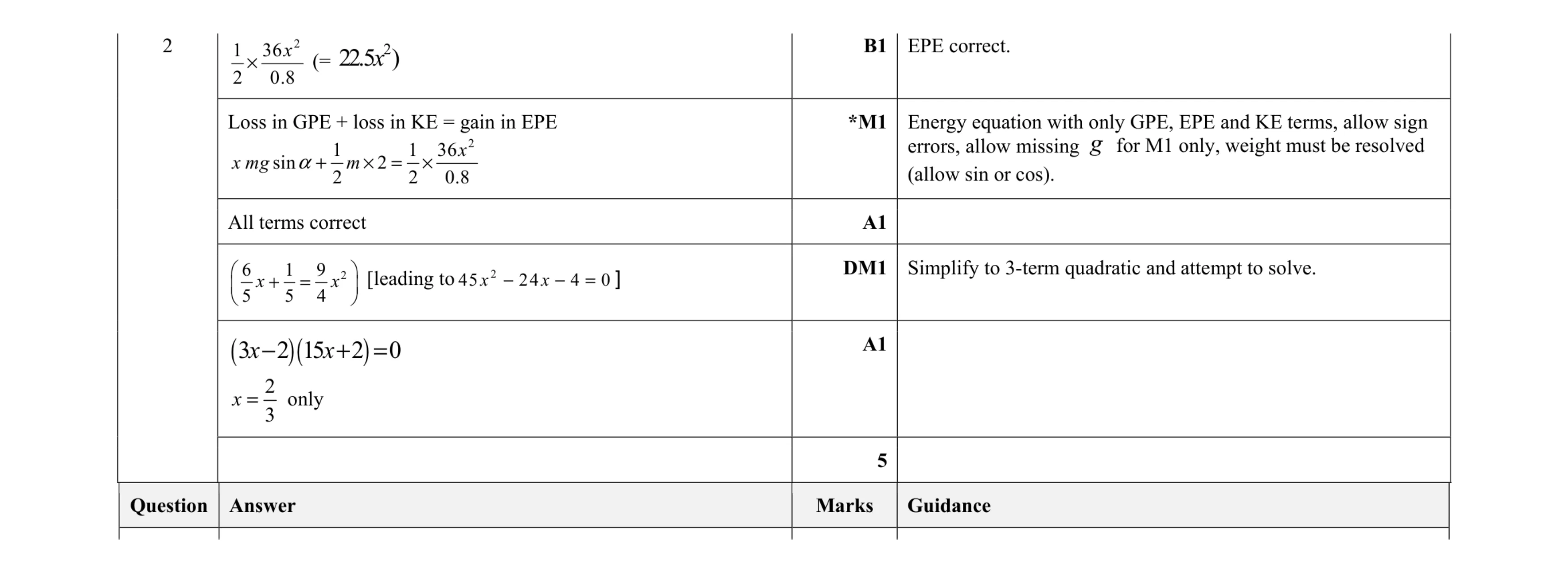 5
5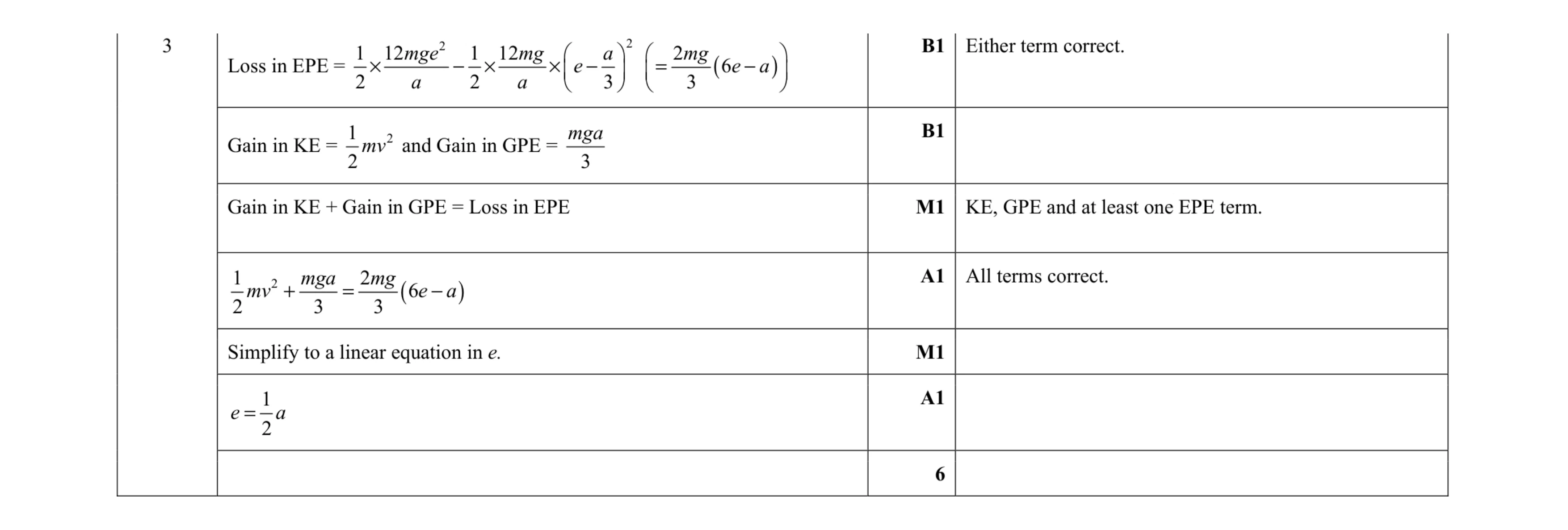 6
6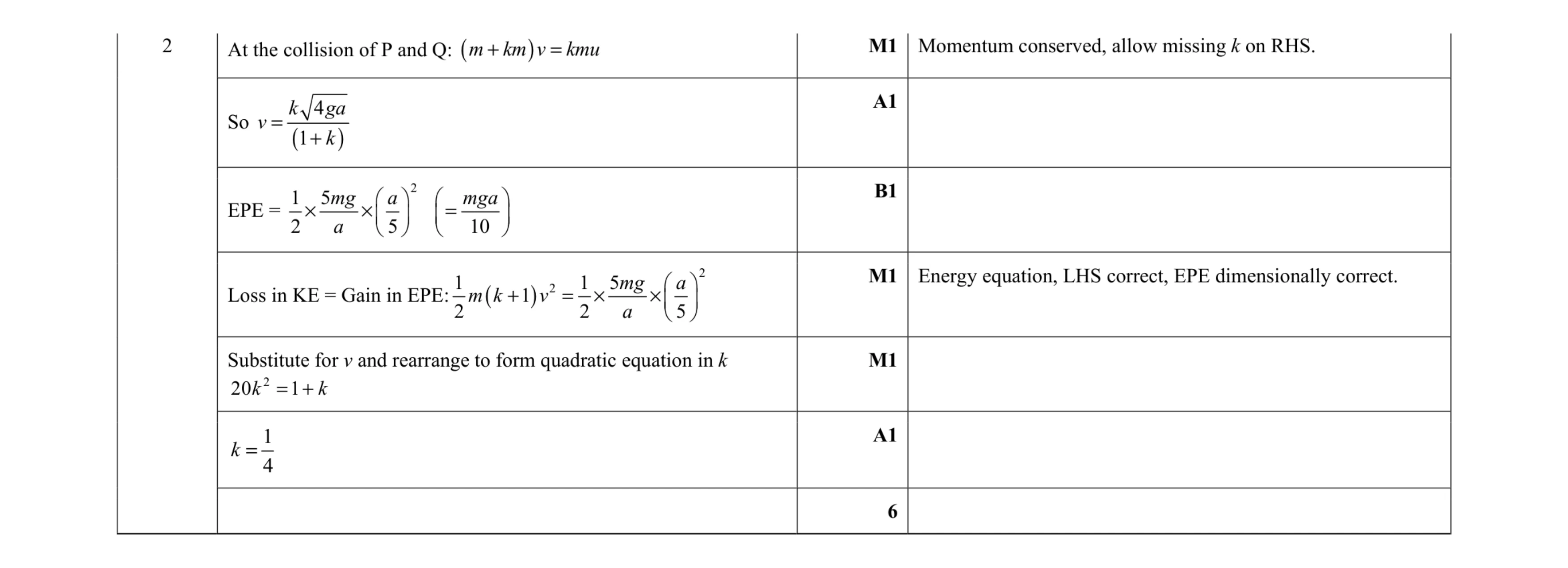 6
6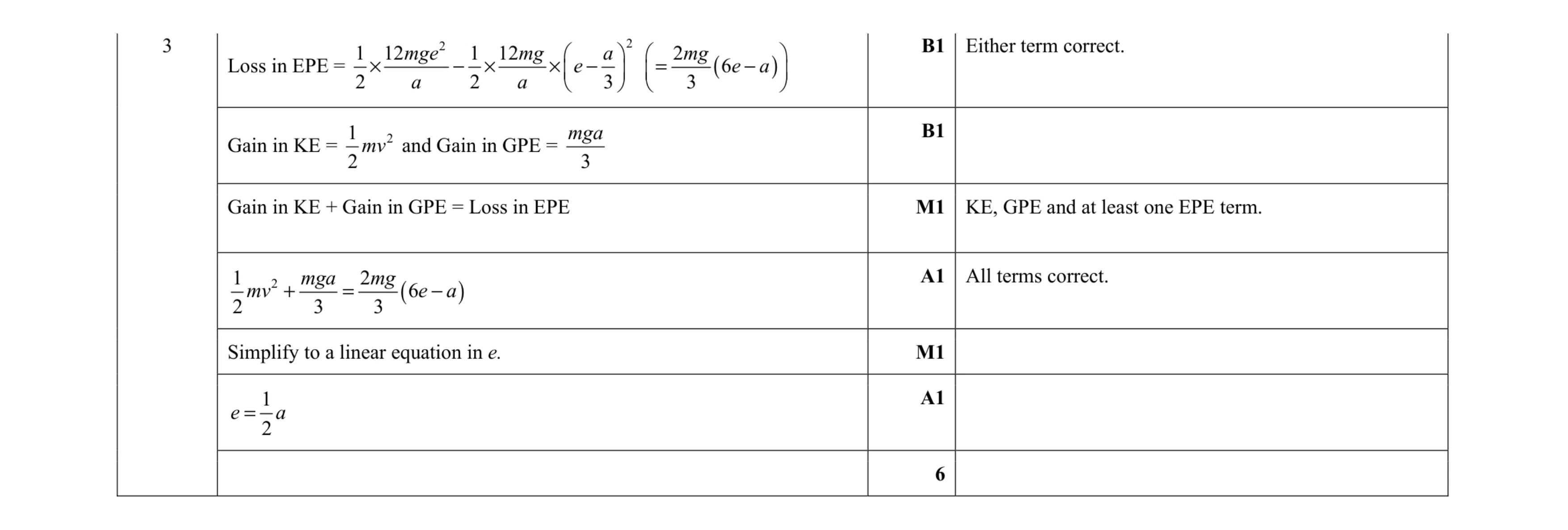 6
6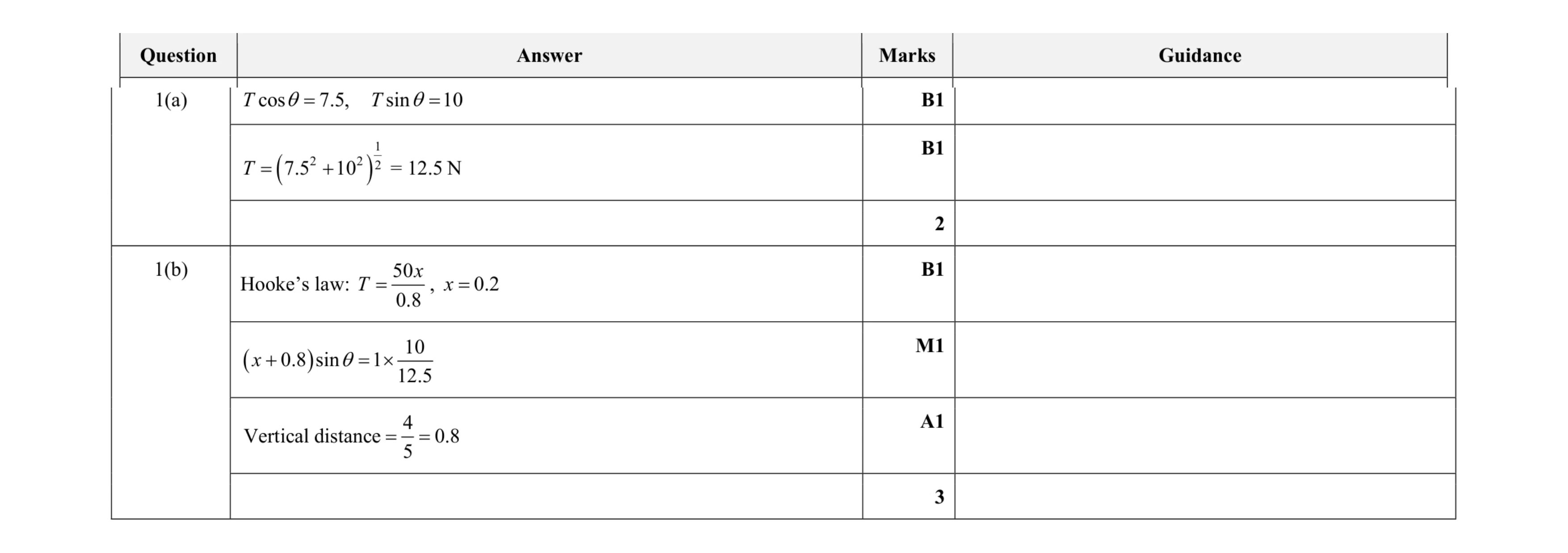 5
5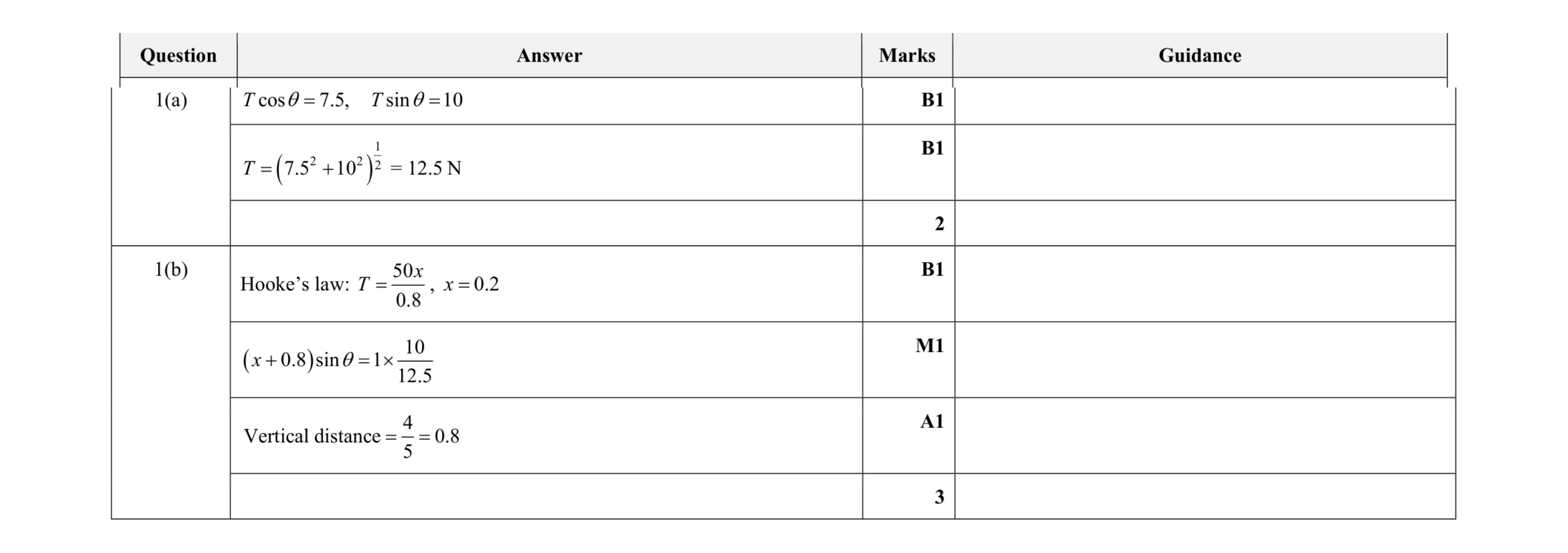 5
5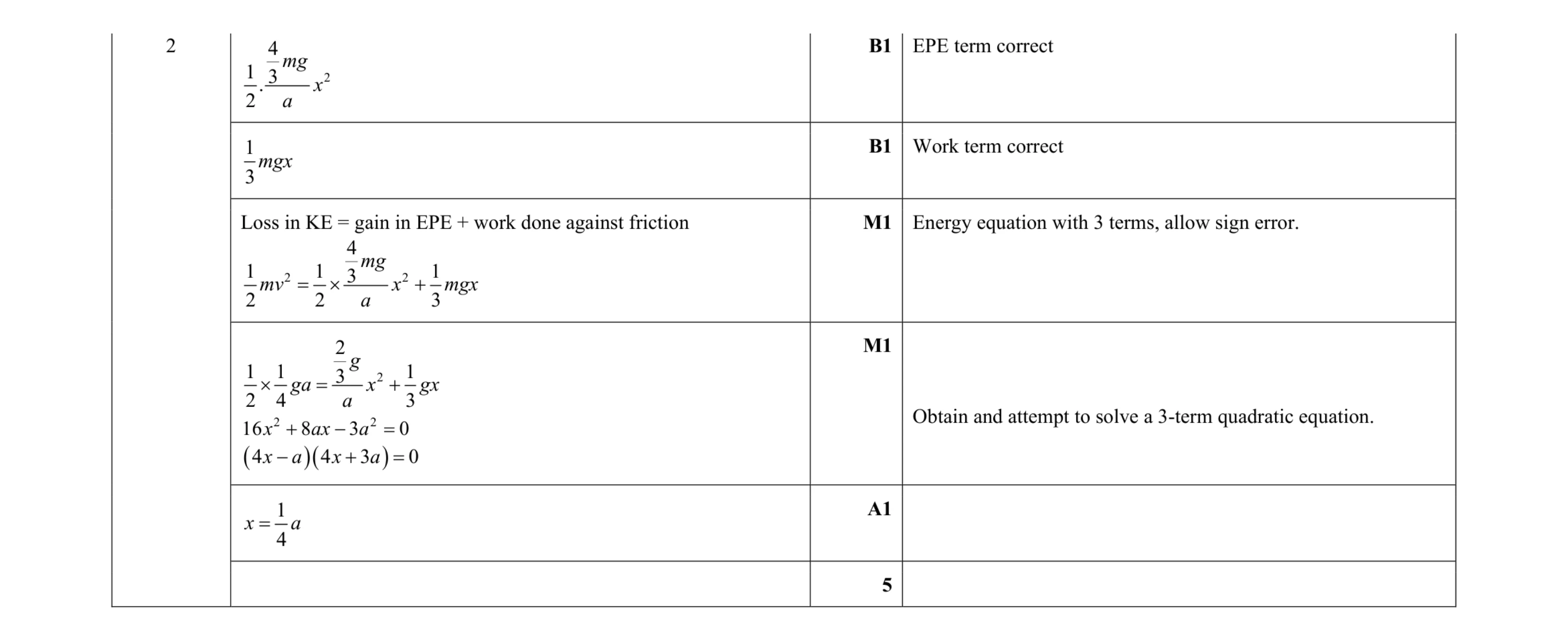 5
5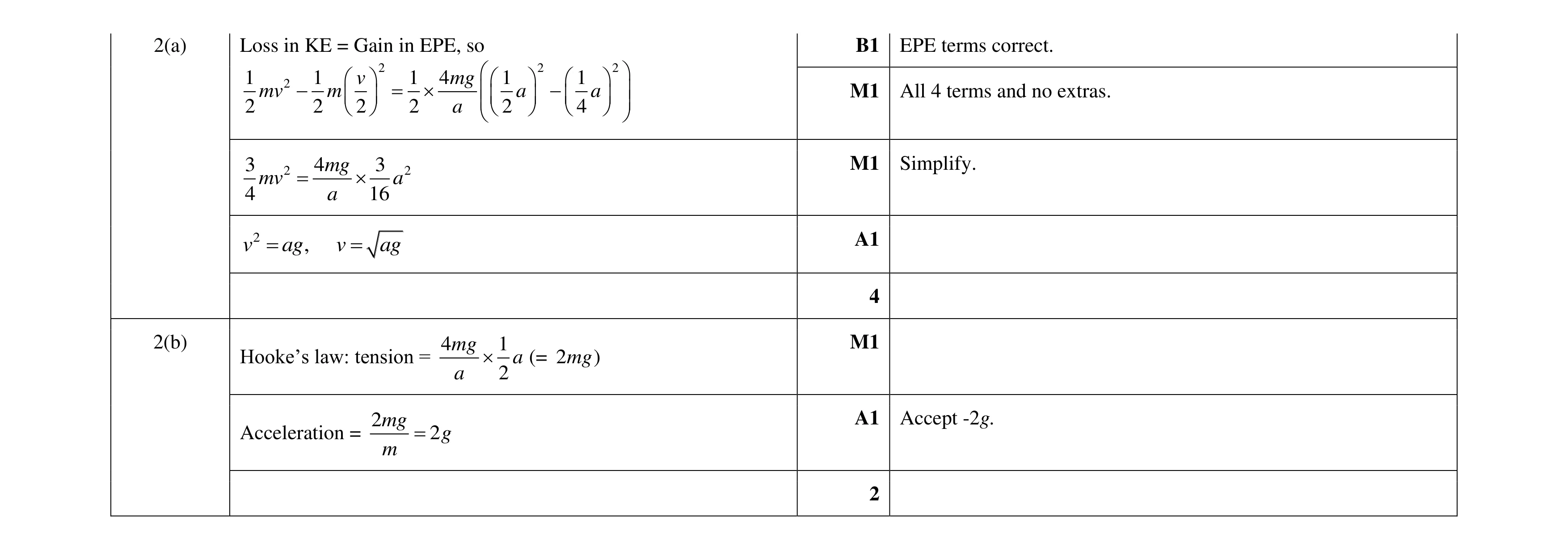 6
6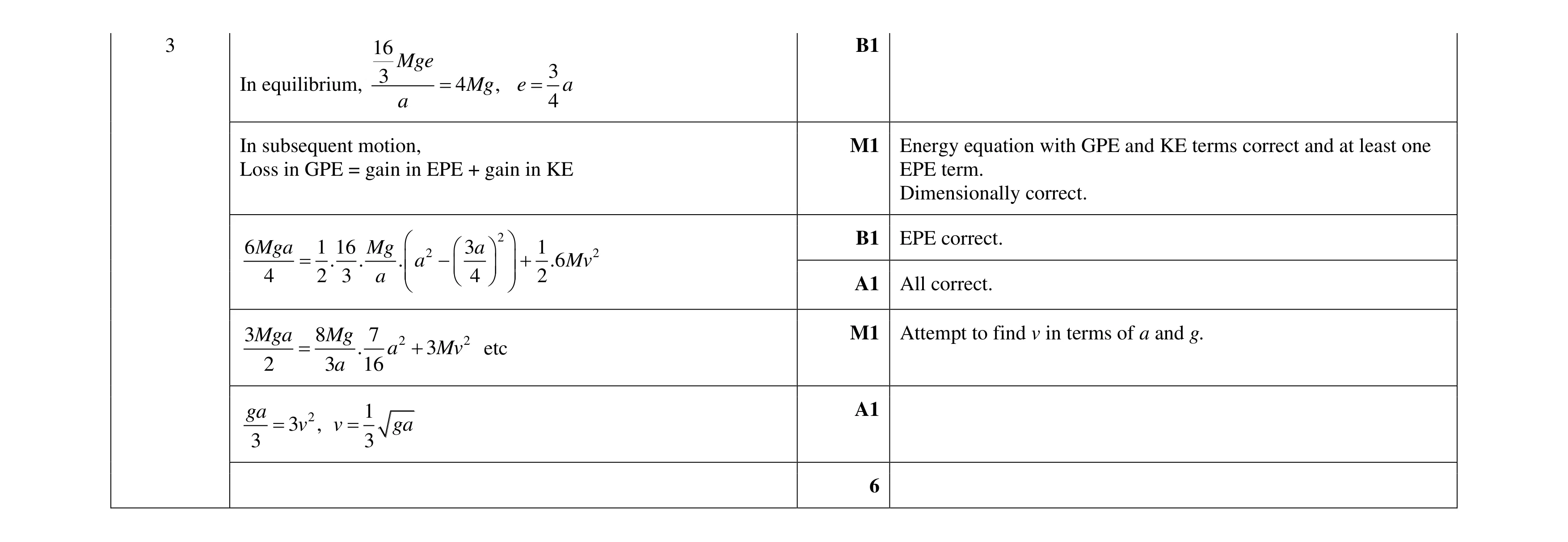 6
6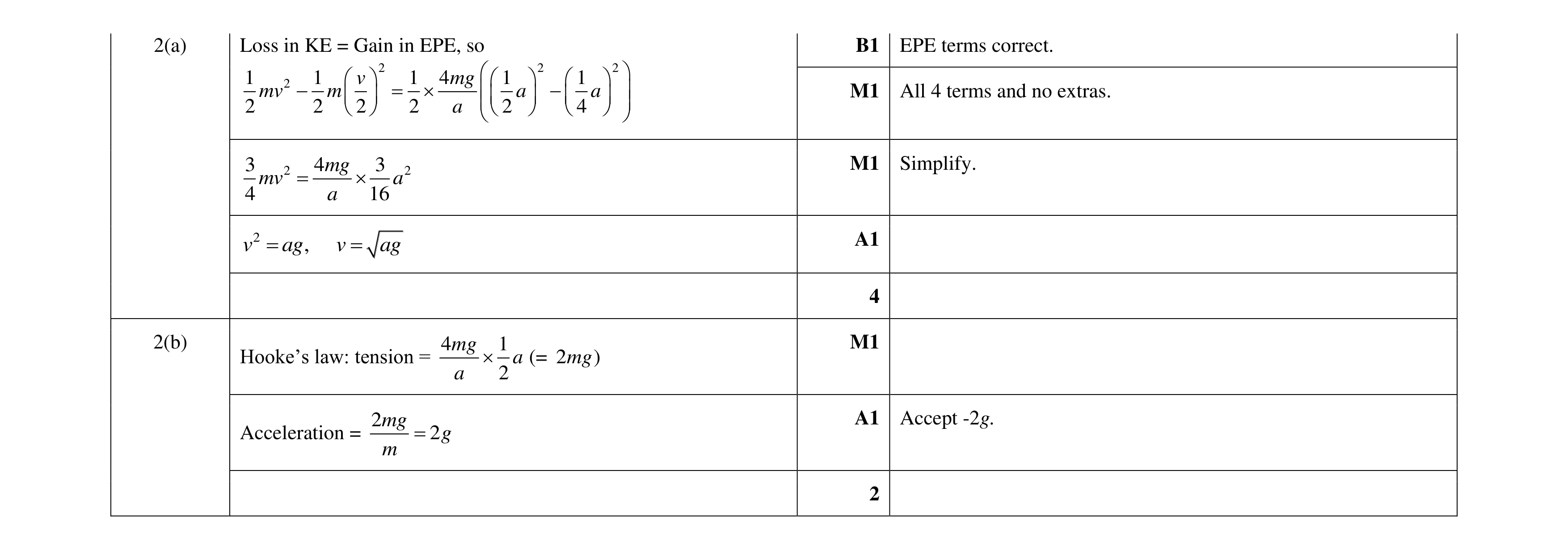 6
6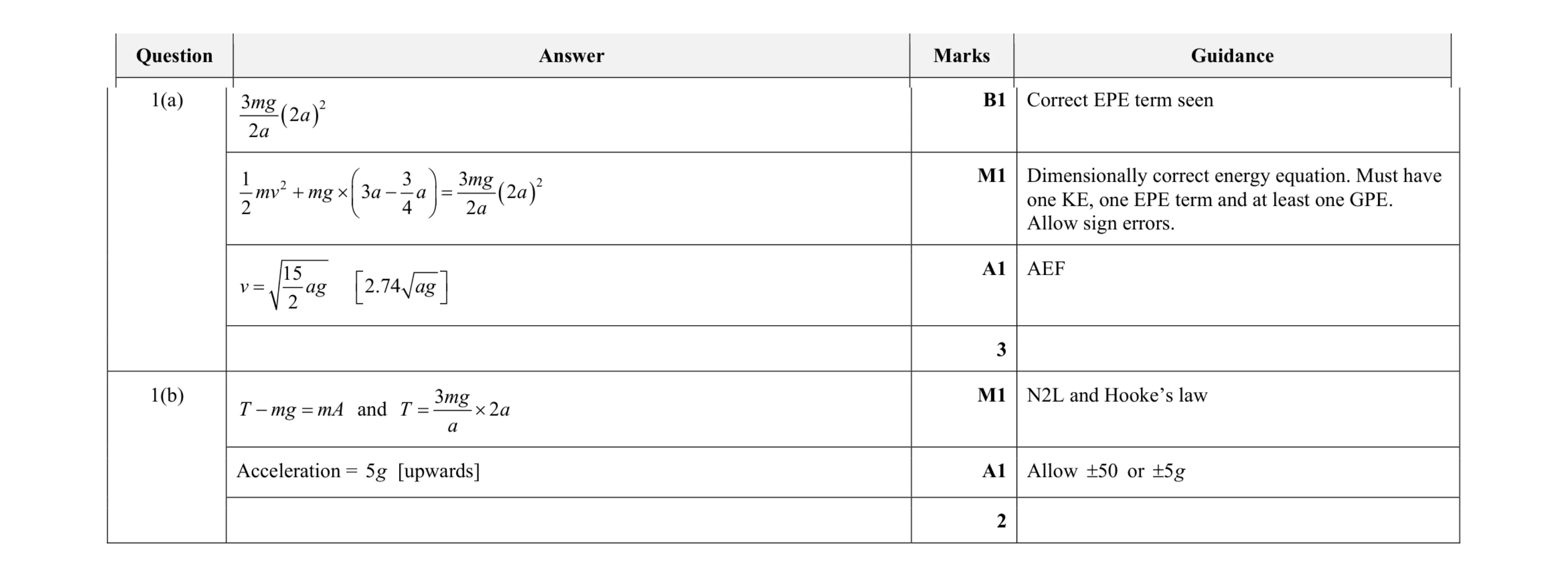 5
5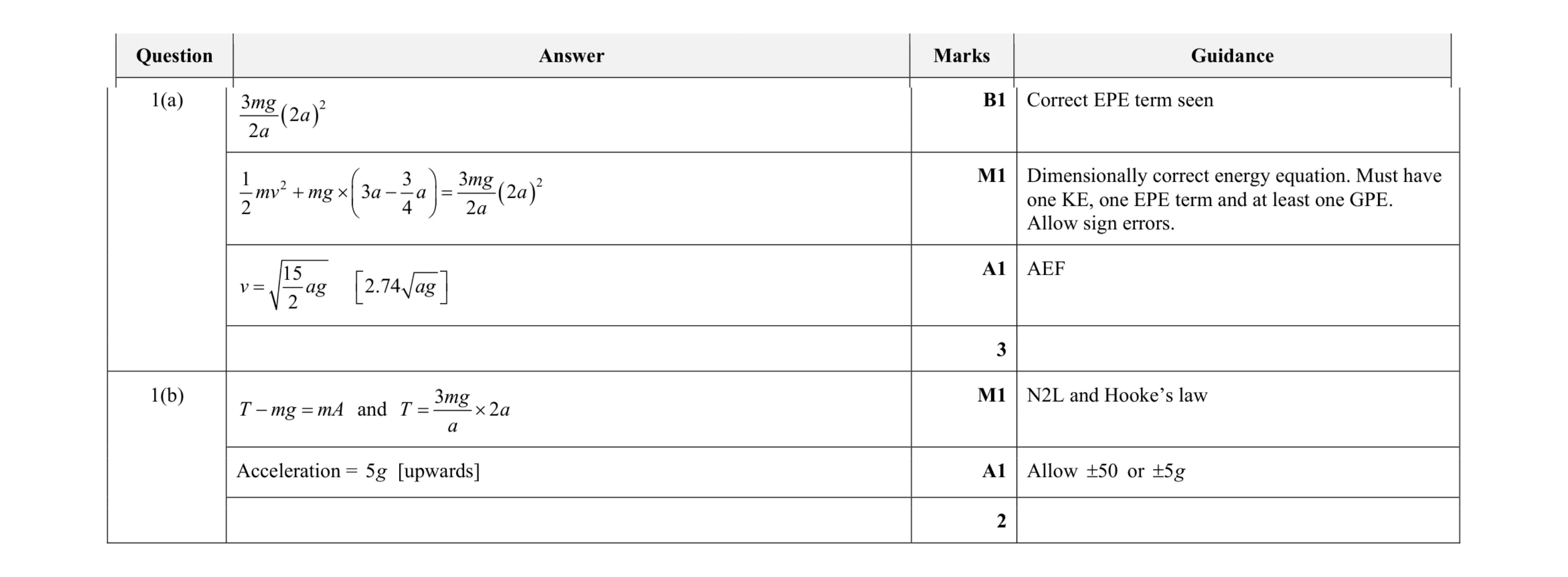 5
5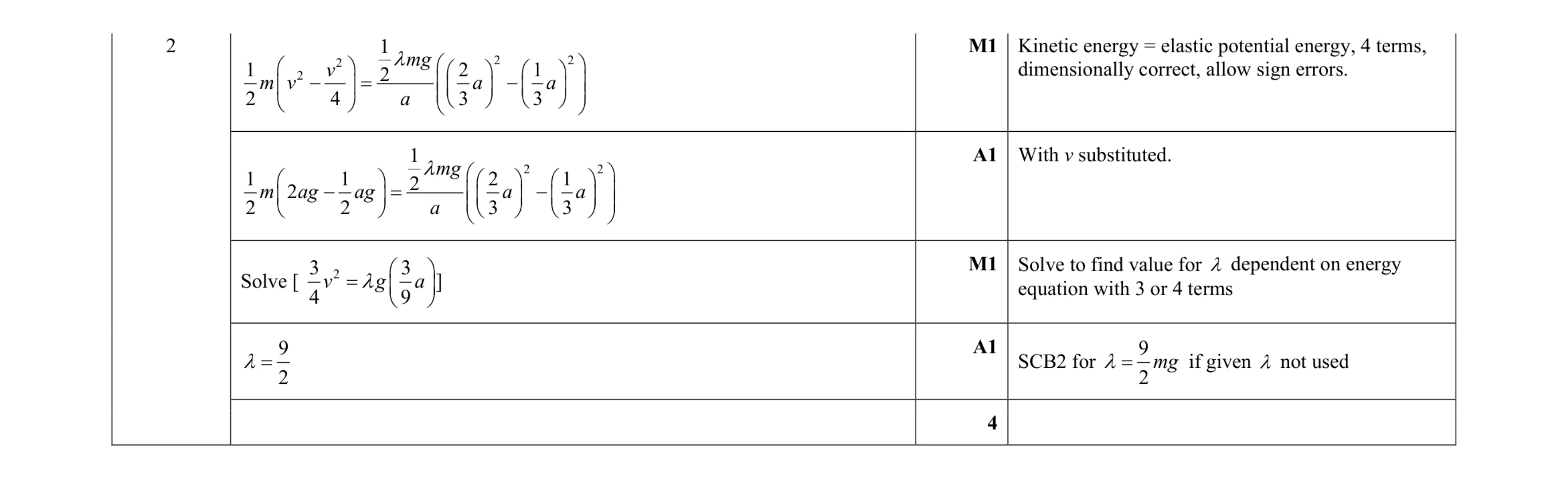 4
4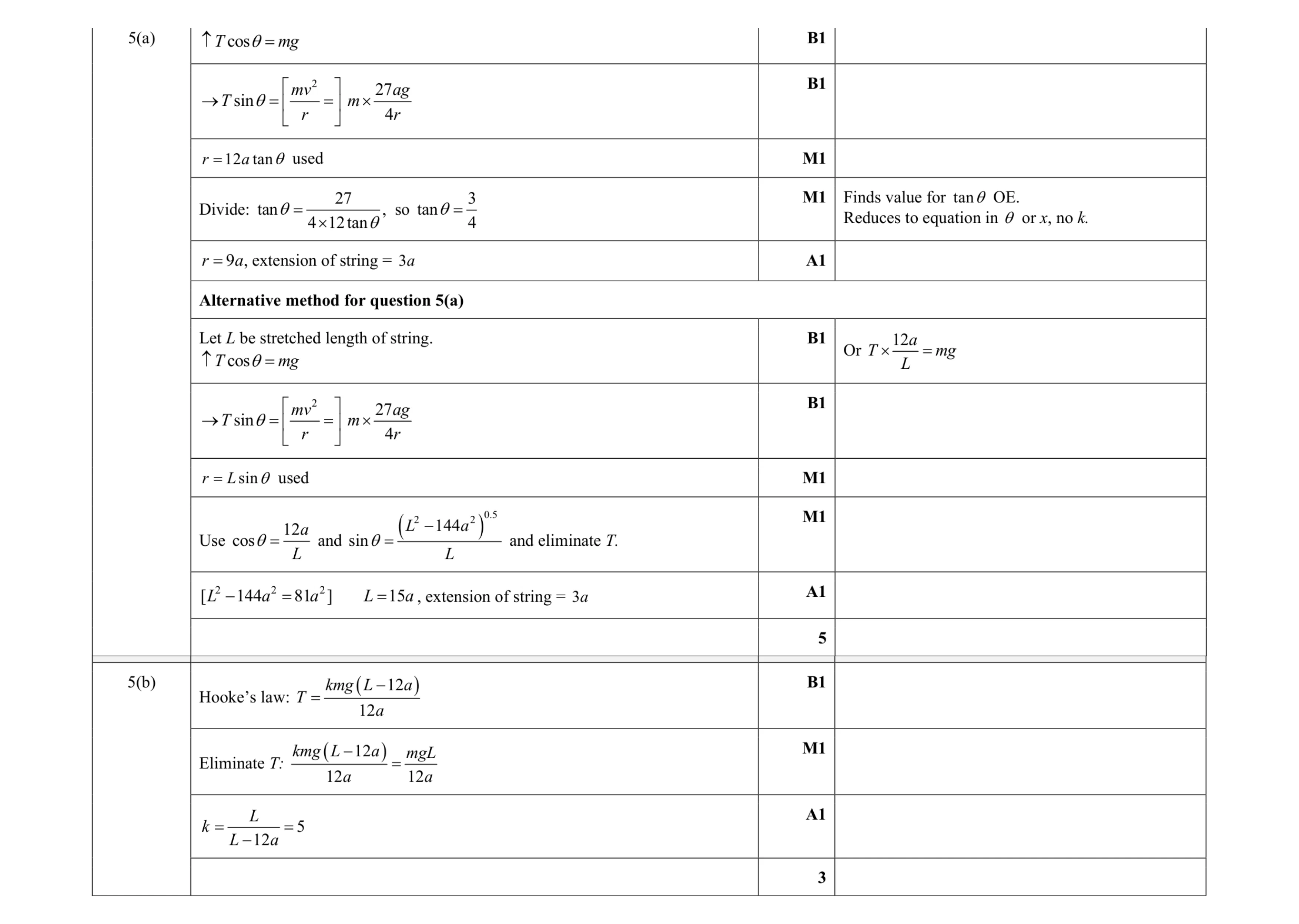 8
8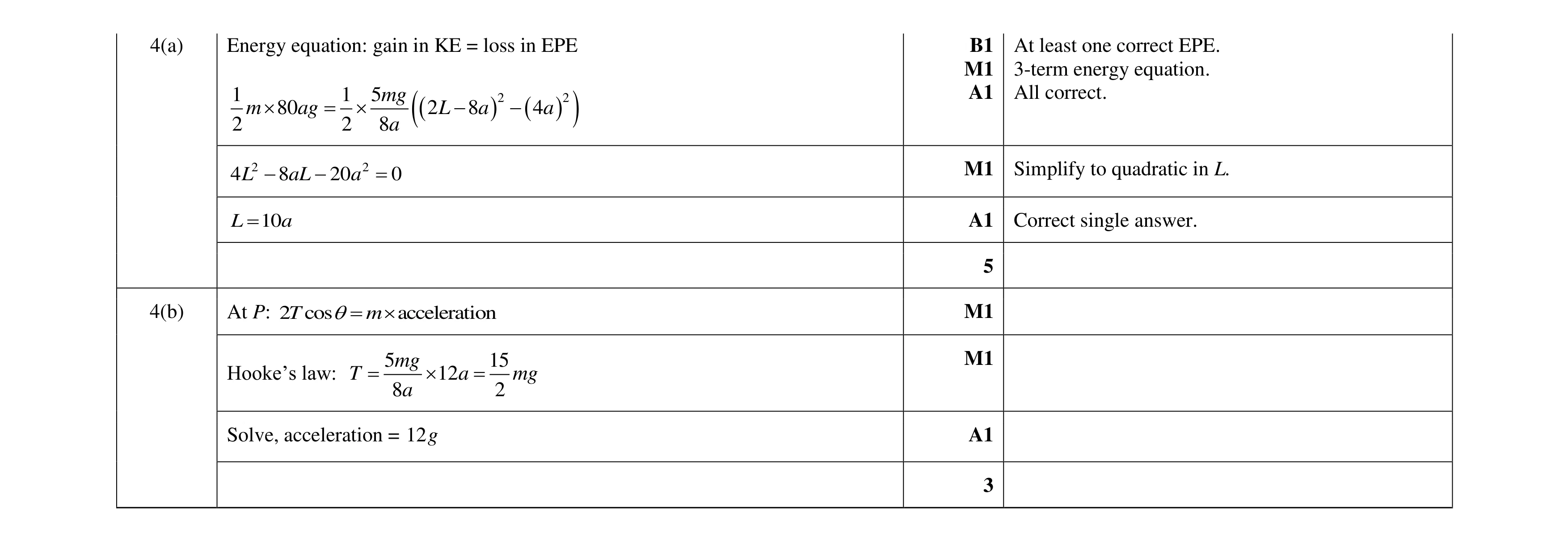 8
8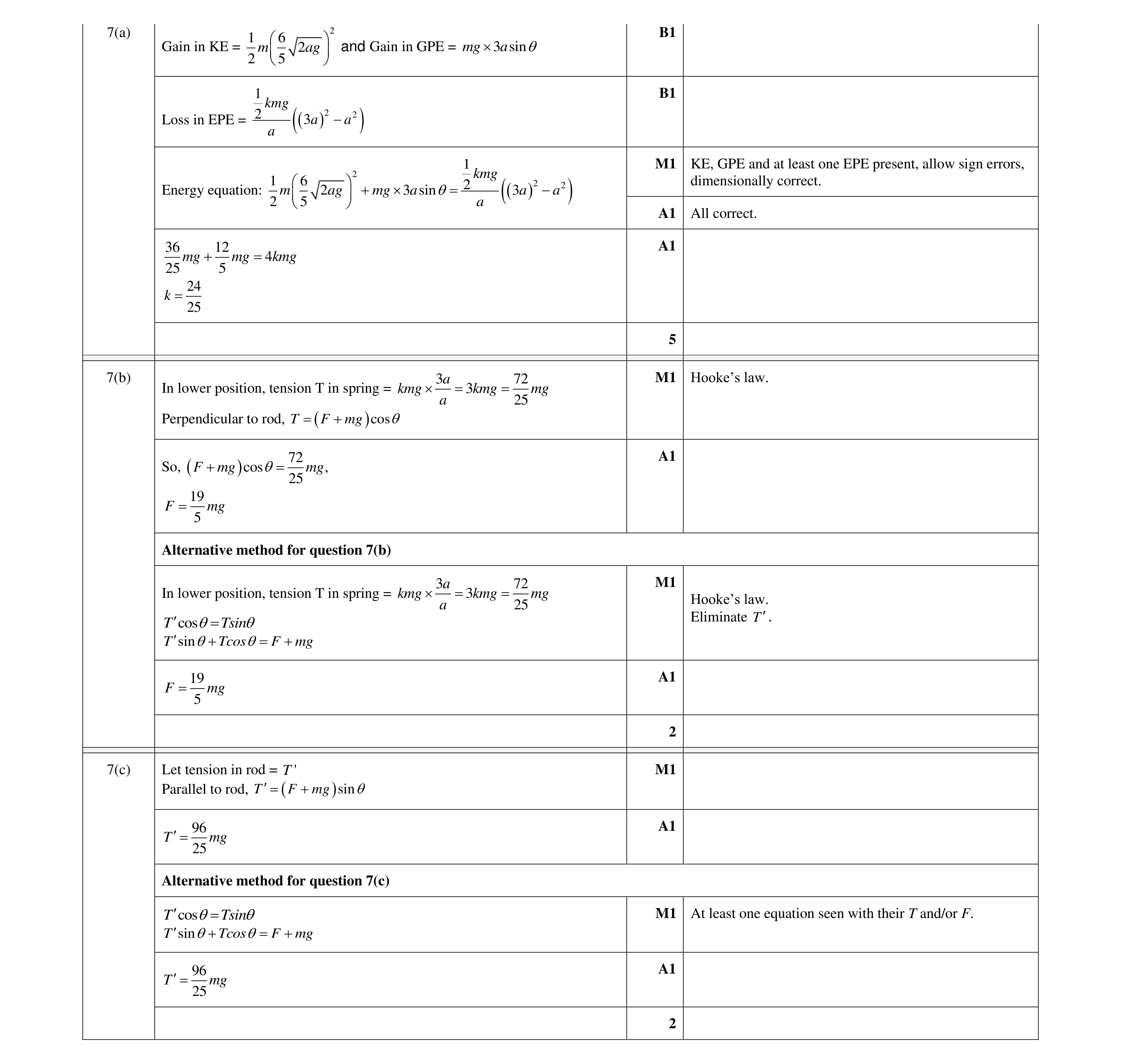 9
9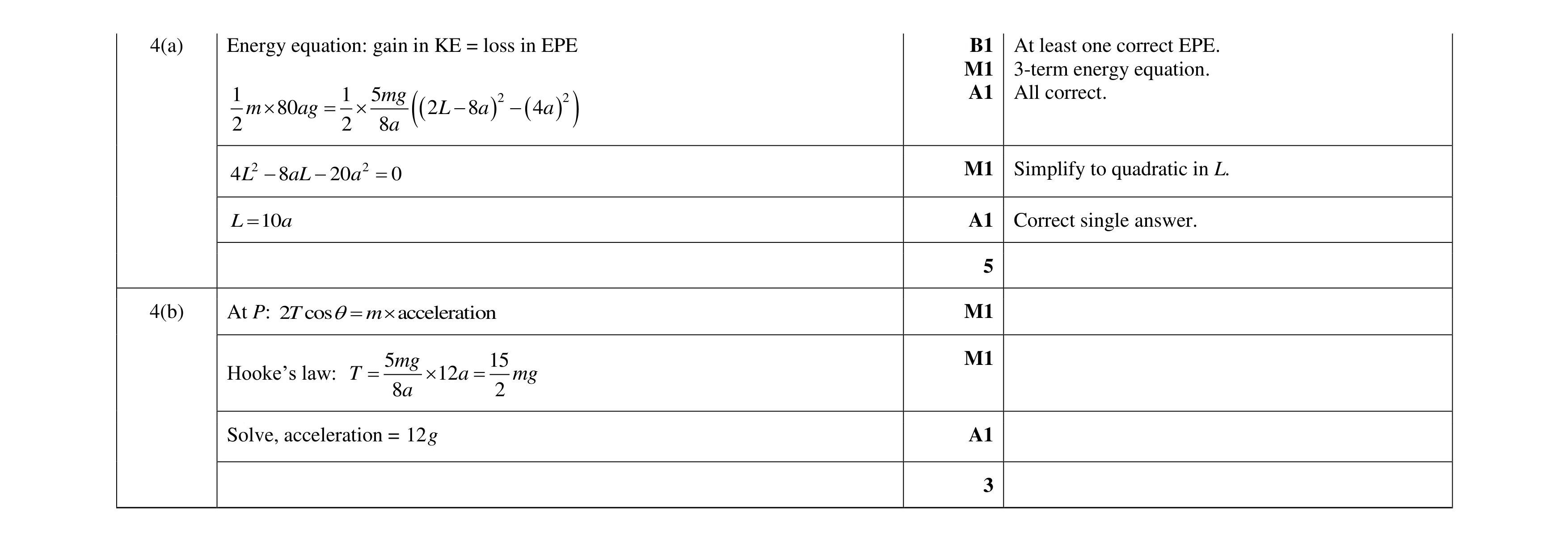 8
8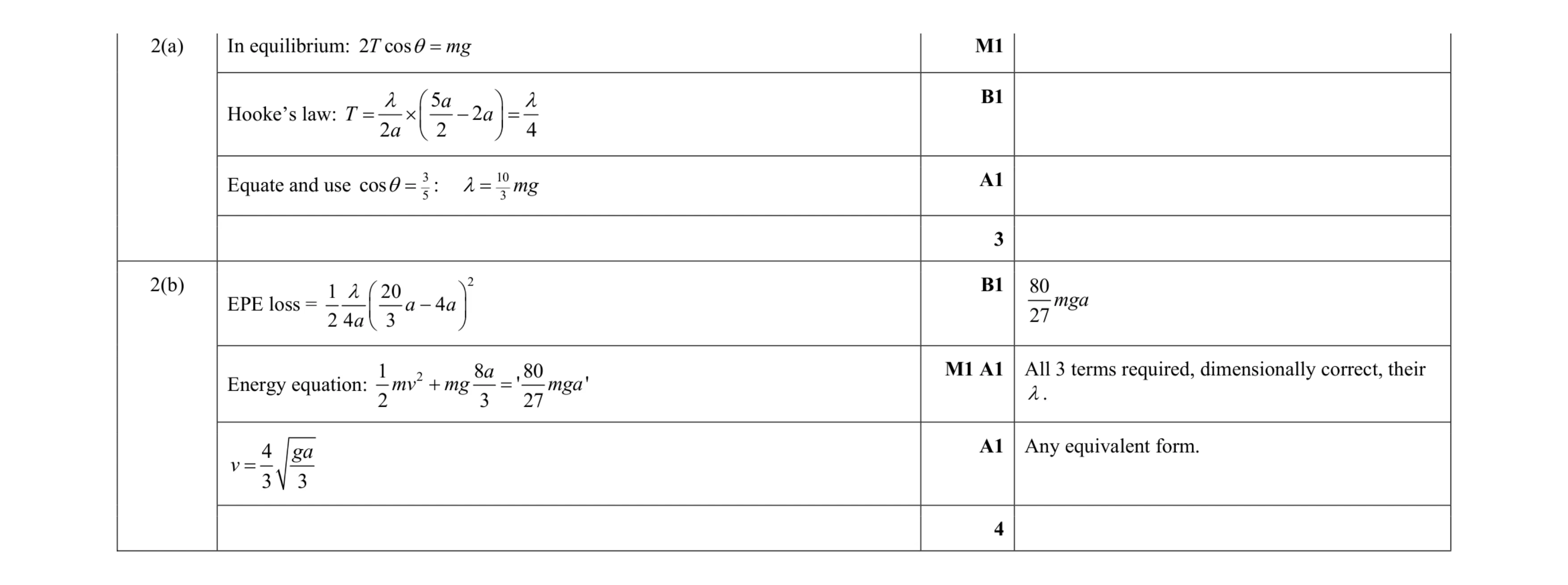 7
7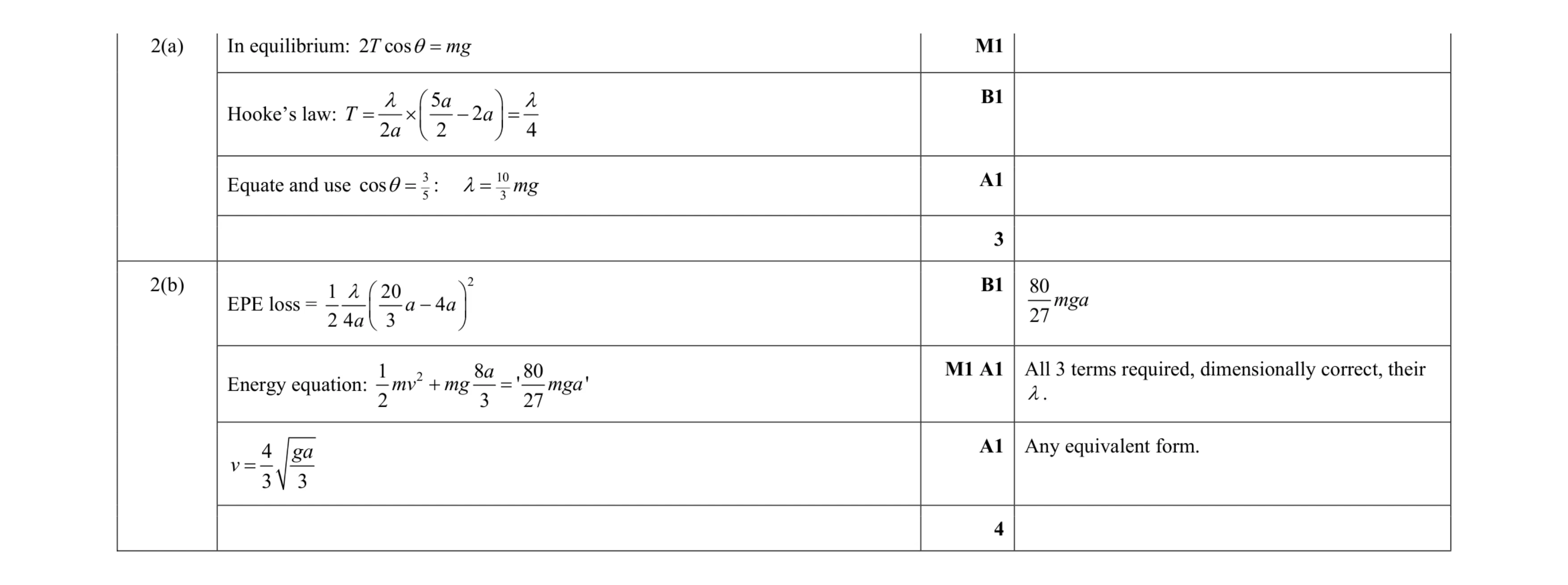 7
7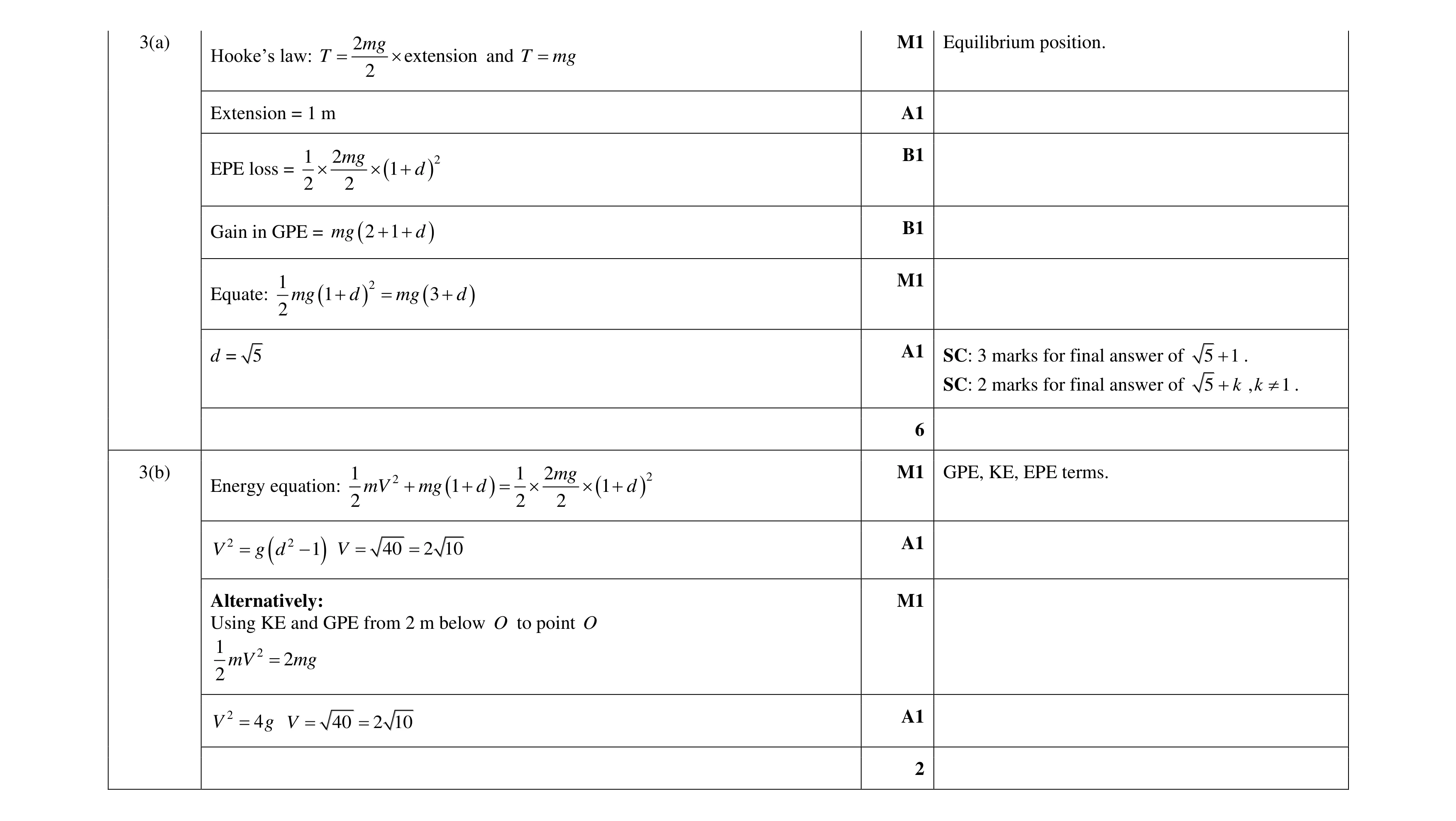 8
8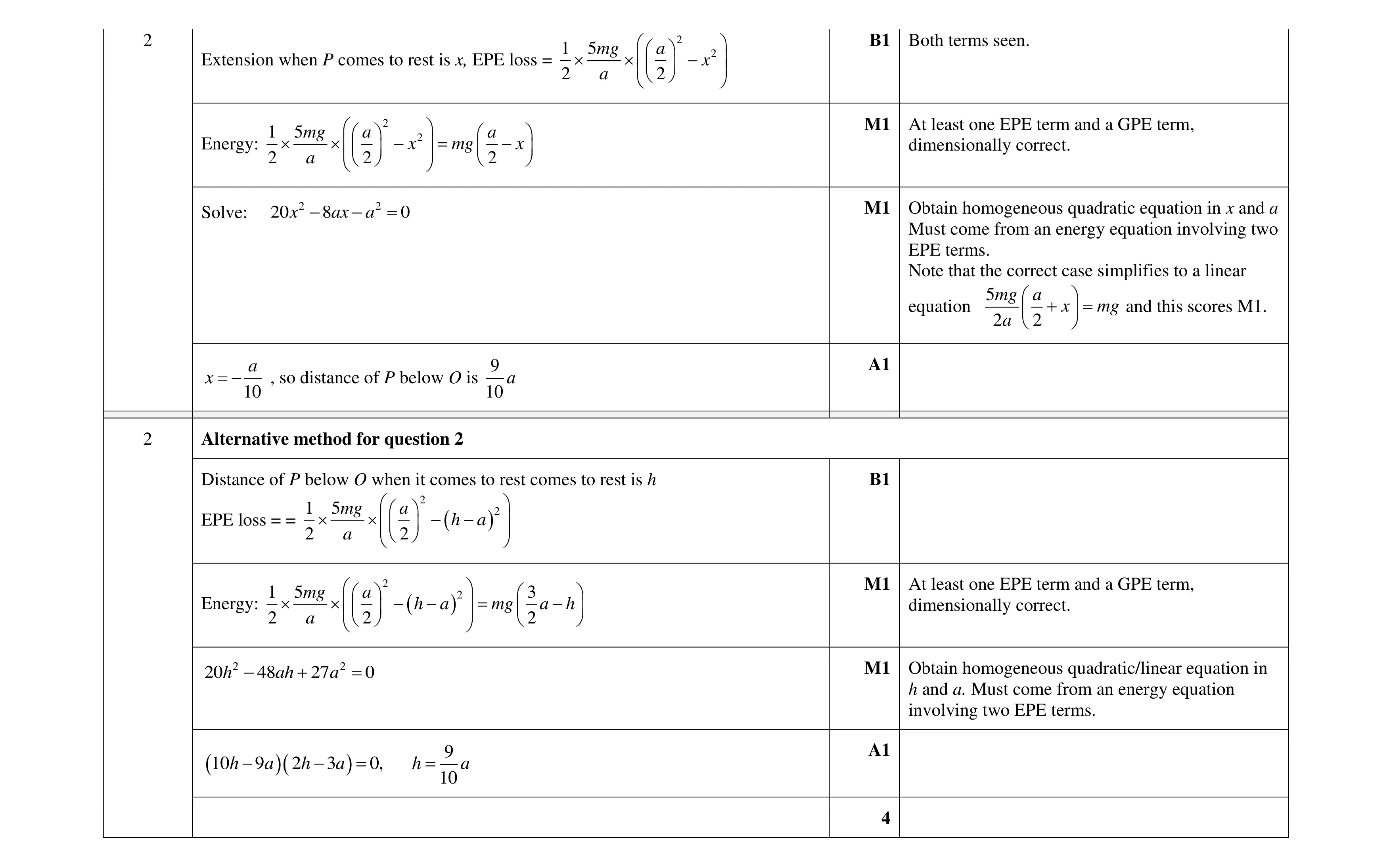 4
4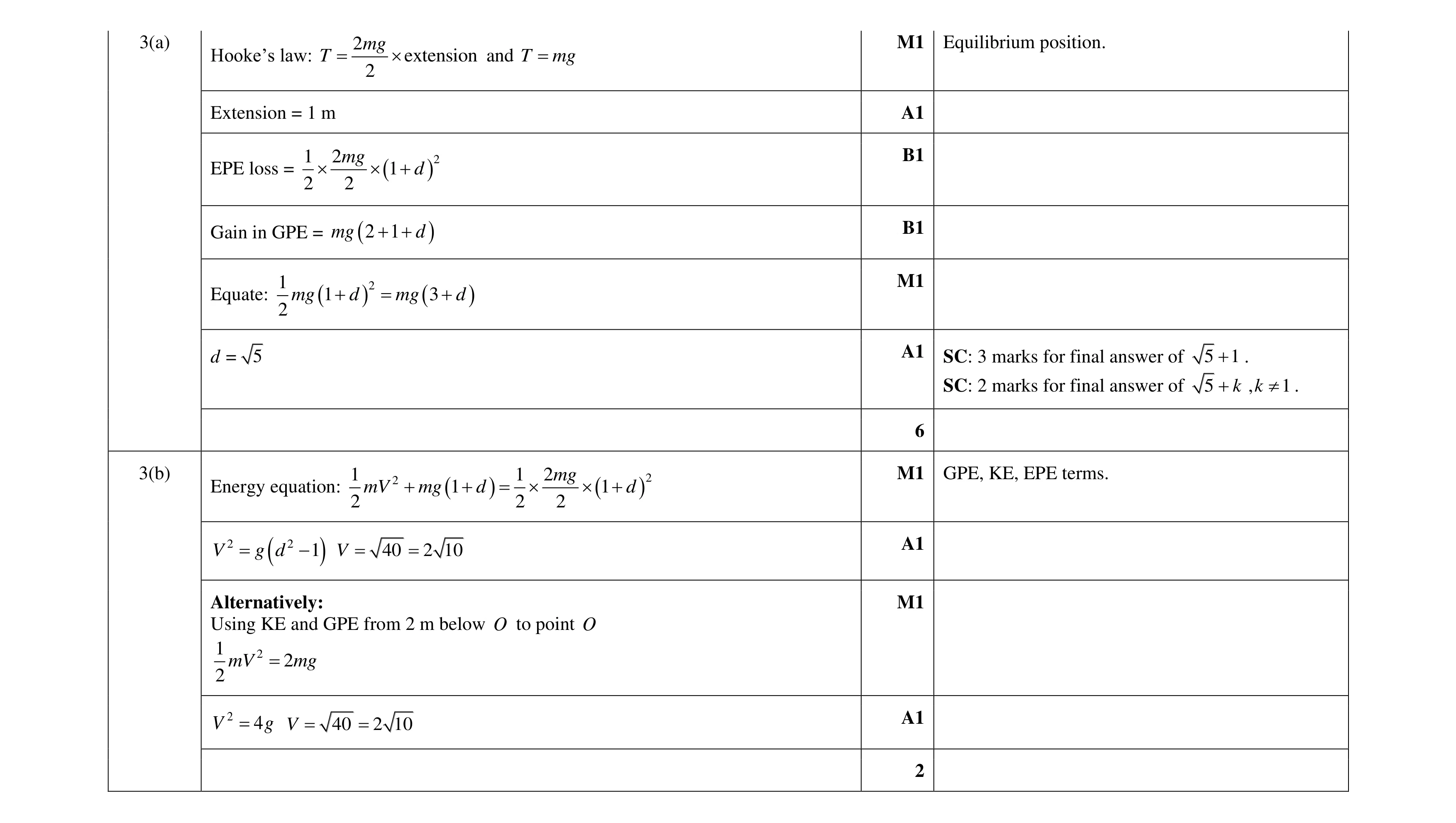 8
8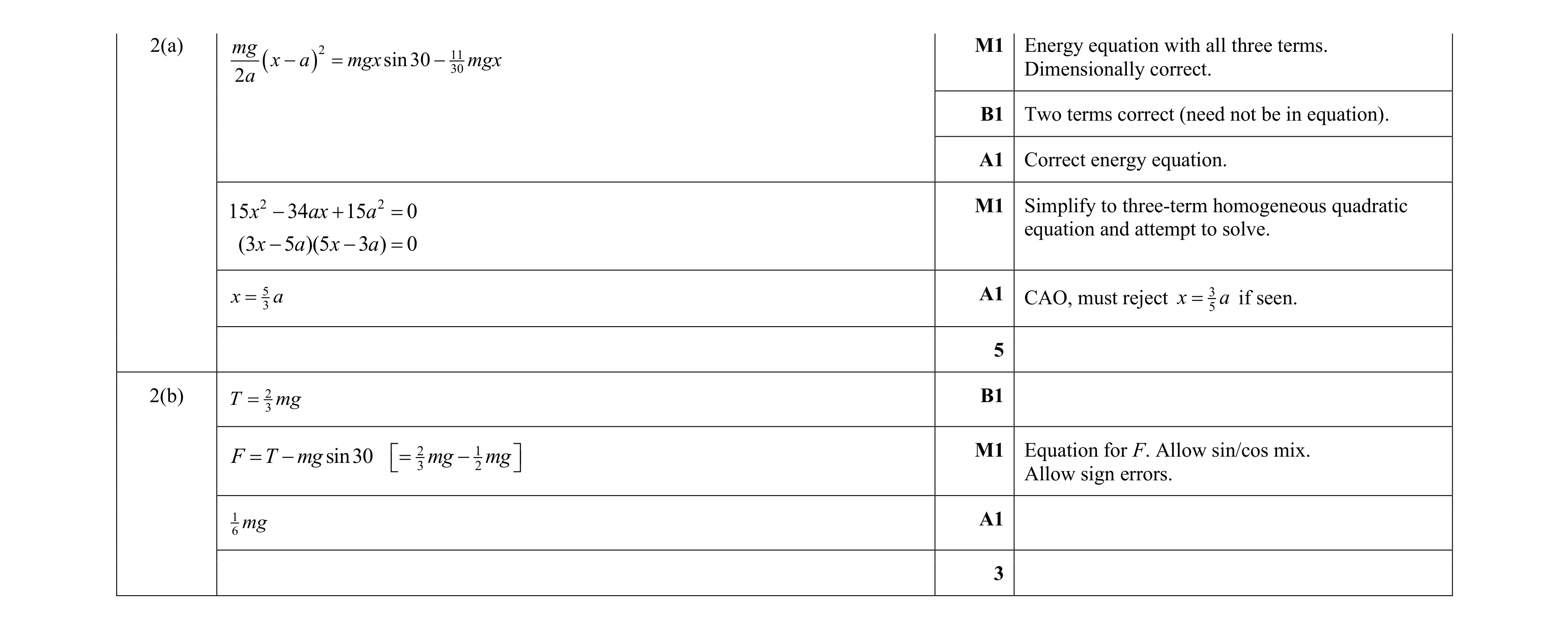 8
8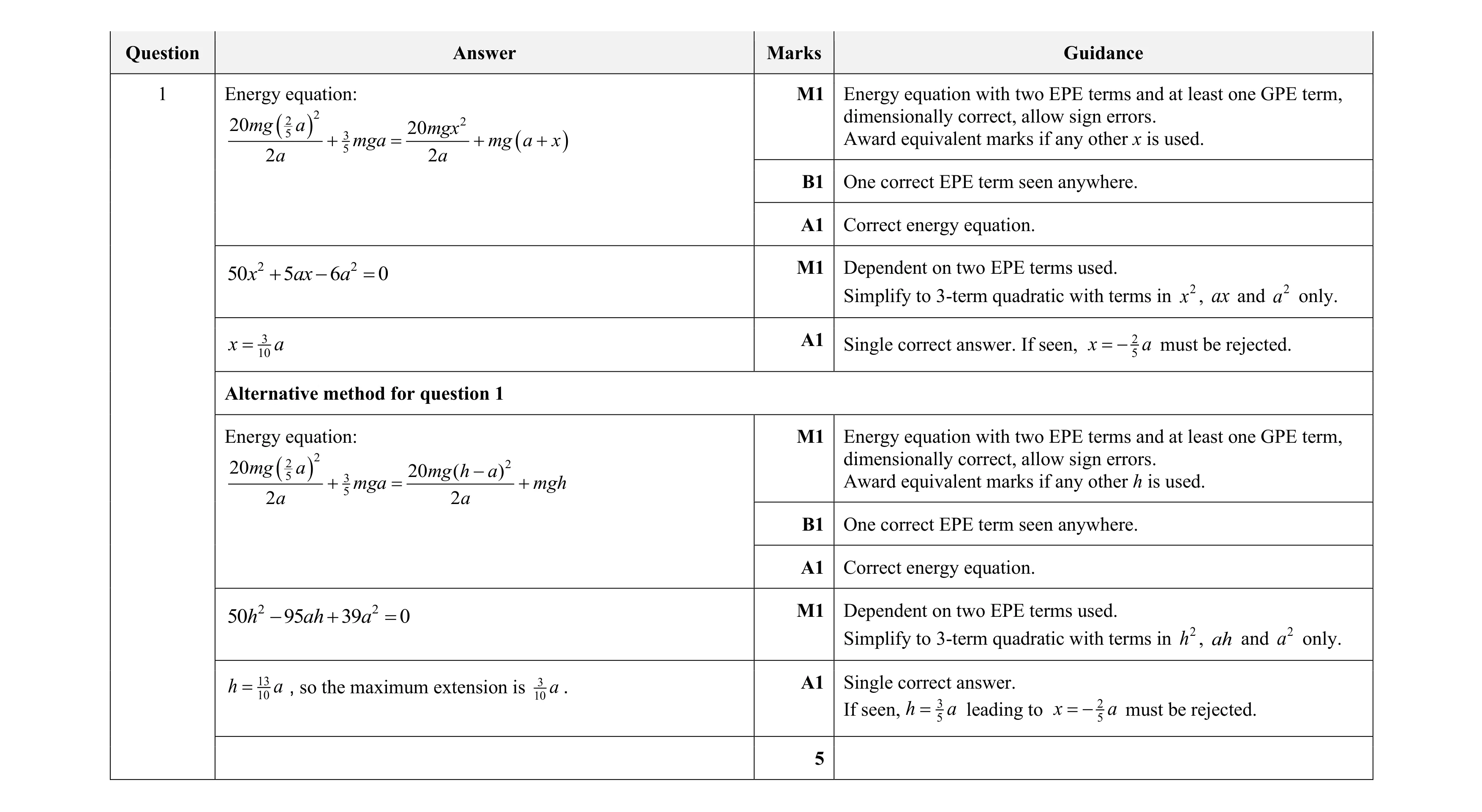 5
5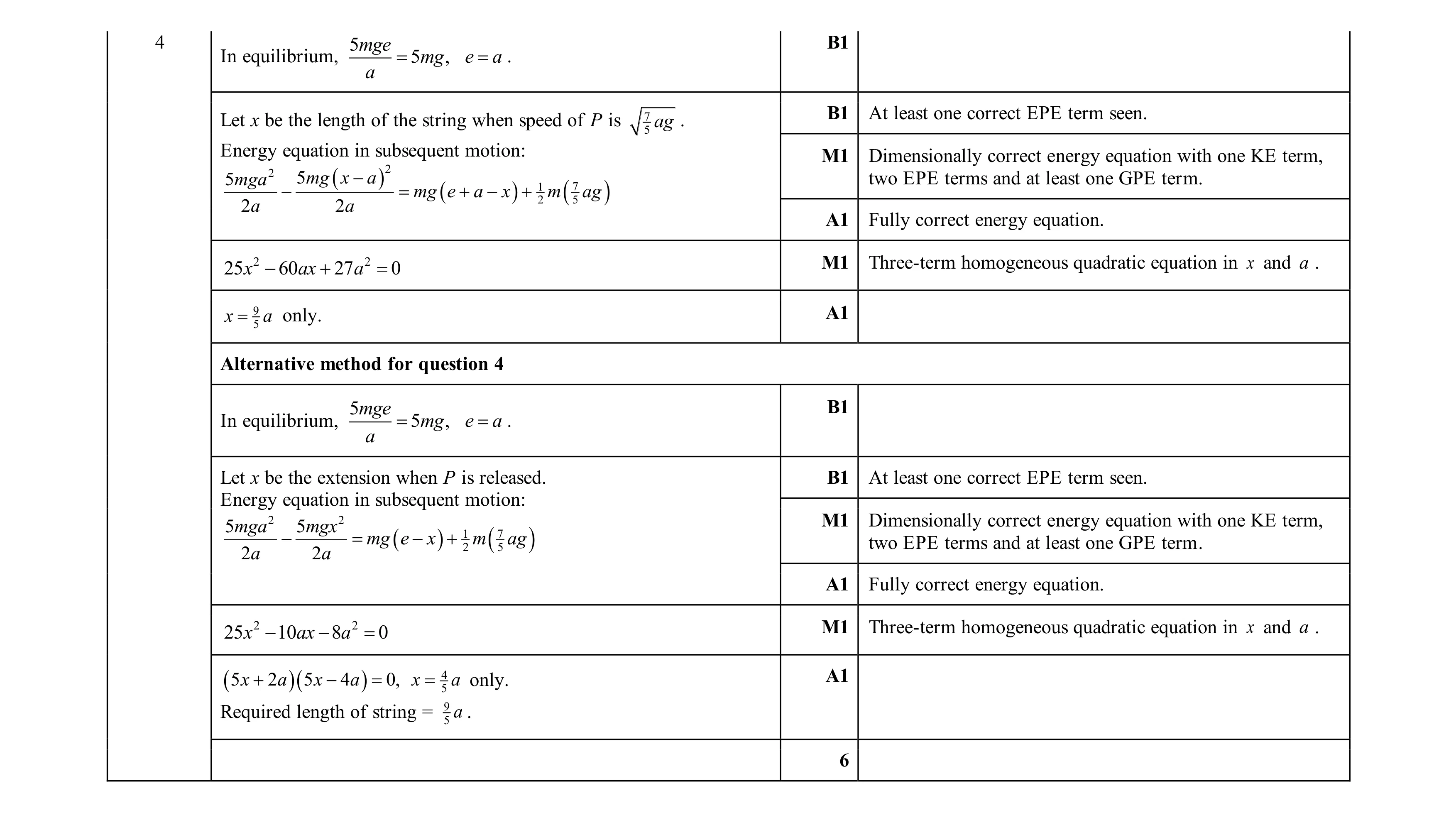 6
6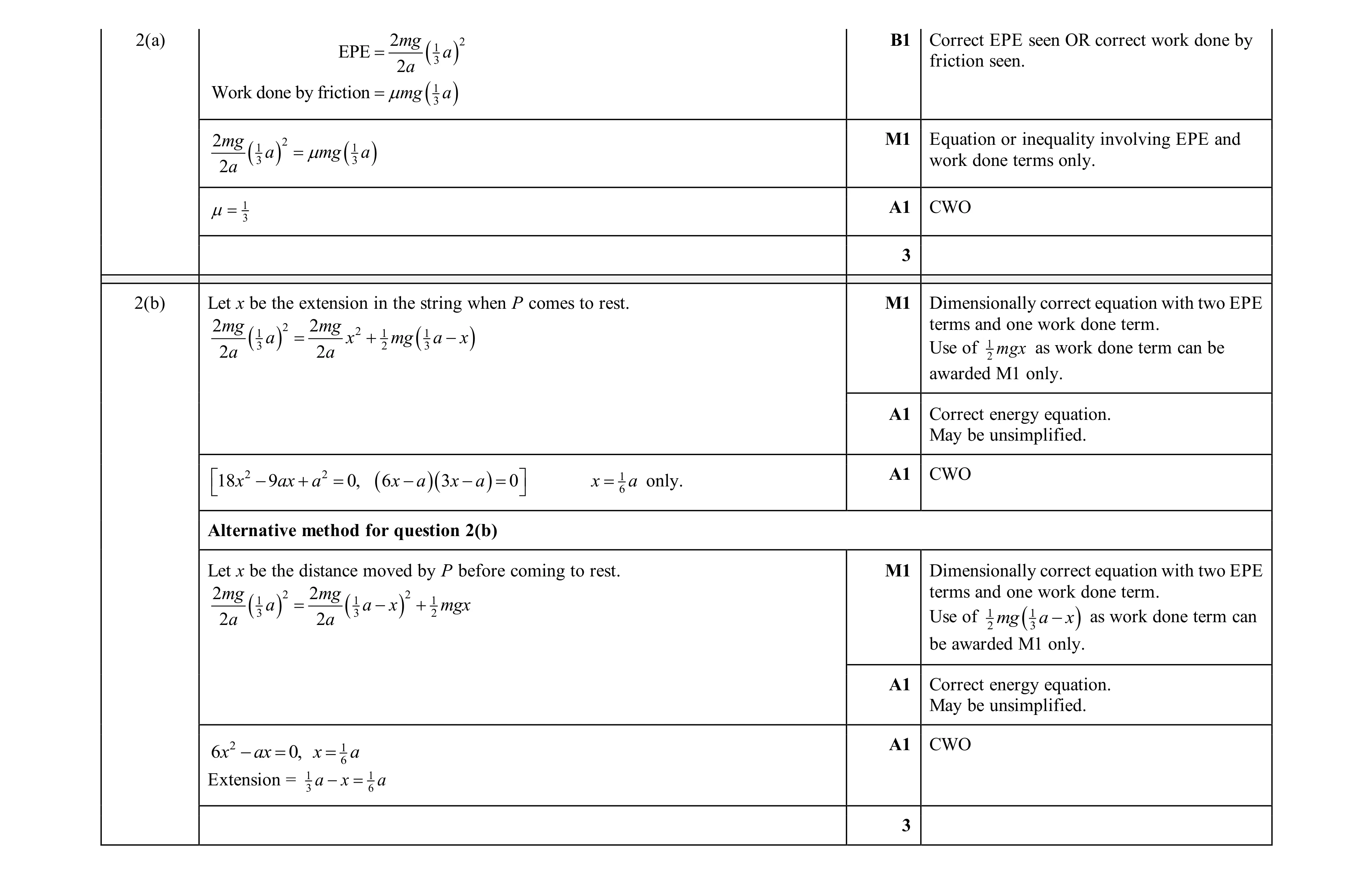 6
6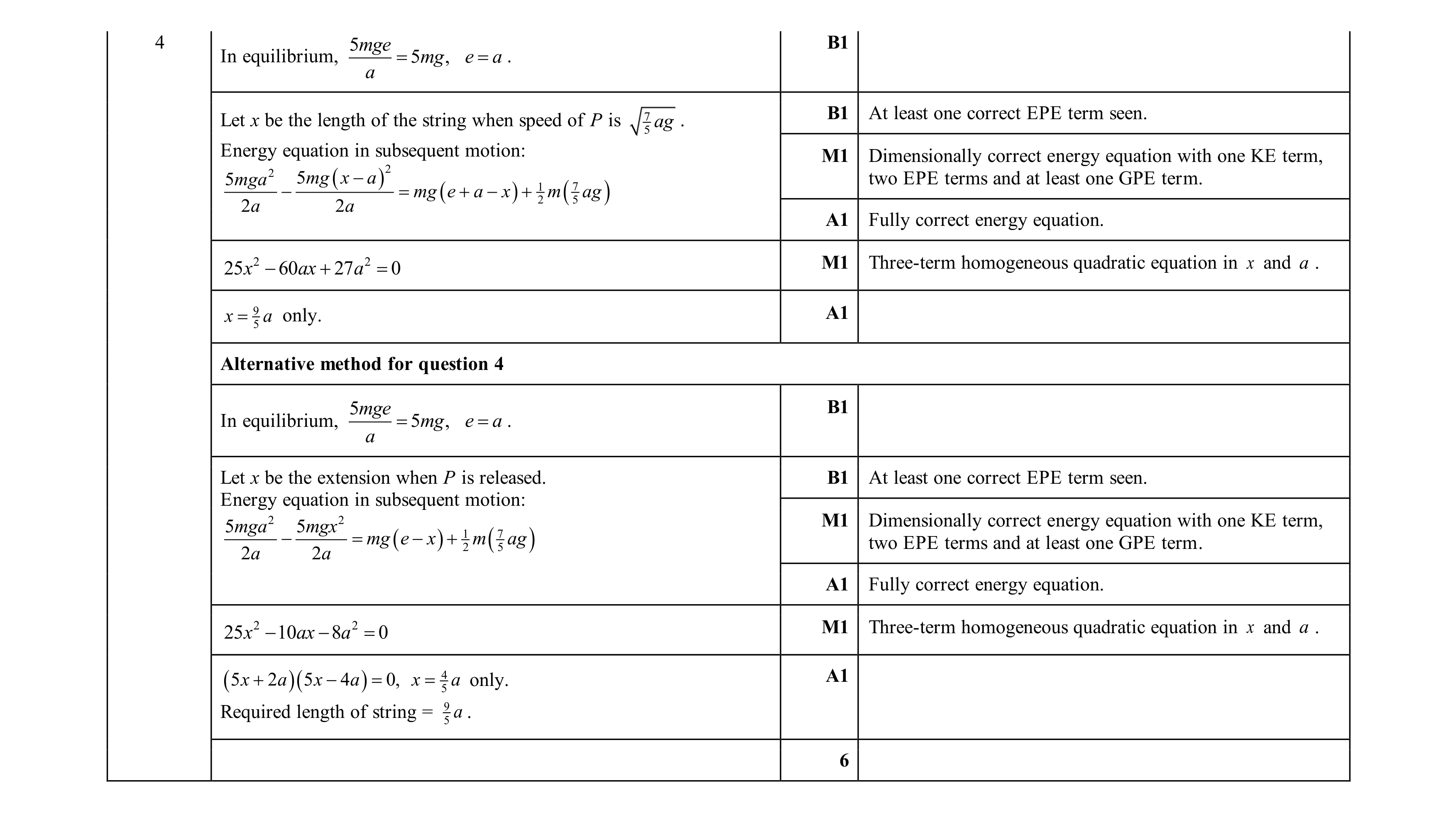 6
6