Questions as text
Q1 · A particle P is projected with speed u at an angle of 30° above the horizontal from a… 9231/31 May/June 2020
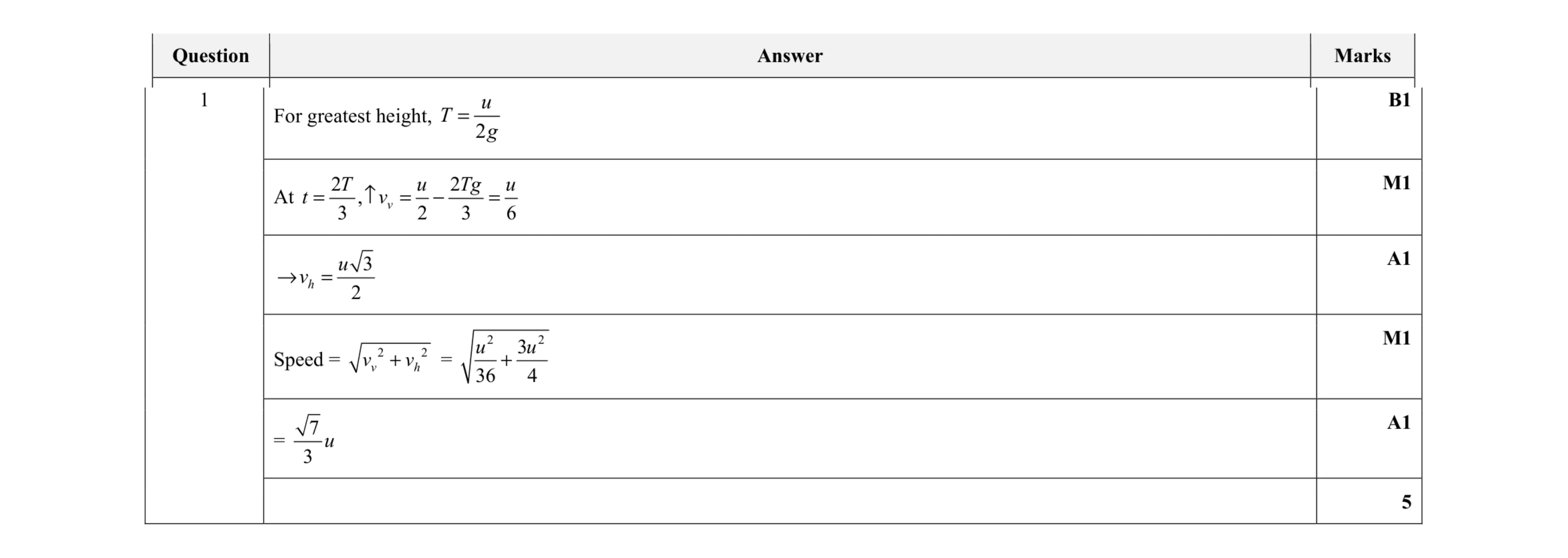
1 A particle P is projected with speed u at an angle of 30° above the horizontal from a point O on a horizontal plane and moves freely under gravity. The particle reaches its greatest height at time T after projection. Find, in terms of u, the speed of P at time 23 T after projection. [5] … … … … … … … … … … … … … … … … … … … … … … … … …
5 marks
Mark scheme: 1 For greatest height, 2 = u T g At 2 2 , 3 2 3 6 = ↑ = − = v T u Tg u t v M1 3 2 → = h u v A1 Speed = 2 2 + v h v v = 2 2 3 36 4 + u u M1 = 7 3 u A1 5
This question in 9231/31 May/June 2020
Q2 · A hollow cylinder of radius a is fixed with its axis horizontal 9231/31 May/June 2020
7 A hollow cylinder of radius a is fixed with its axis horizontal. A particle P, of mass m, moves in part of a vertical circle of radius a and centre O on the smooth inner surface of the cylinder. The speed of P when it is at the lowest point A of its motion is 72 ga . The particle P loses contact with the surface of the cylinder when OP makes an angle i with the upward vertical through O. (a) Show that i = 60° . [5] … … … … … … … … … … … … … … … … … … … … … … (b) Show that in its subsequent motion P strikes the cylinder at the point A. [5] … … … … … … … … … … … … … … … … … … … … … … … … … … Additional Page If you use the following lined page to complete the answer(s) to any question(s), the question number(s) must be clearly shown. … … … … … … … … … … … … … … … … … … … … … …
10 marks
Mark scheme: 7(a) ( ) 2 cosθ + = mv N mg a B1 ( ) 2 1 1 7 cos 2 2 2 θ − = − + ag mv m mg a a M1A1 Loses contact when N = 0, so combine and simplify M1 1 cos : 60 2 θ θ = = ° AG A1 5 Question Answer Marks 7(b) When P is vertically below O, its horizontal displacement is sin60 a , so time T = sin60 cos60 a v = 3 / a v 6 = a g M1 From (a), 2 1 2 = v ag A1 Vert: 2 3 1 . 2 2 = − v h T g T M1 3 3 3 2 2 − = −a a a A1 This corresponds to the point A A1 Alternative method for question 7(b) 2 4 3 = − x y x a M1A1 Coordinates of A: 1 3 3, 2 2 = = − x a y a B1 Substitute coordinates into 2 4 3 = − x y x a and show that these satisfy this equation M1A1 5
This question in 9231/31 May/June 2020
Q3 · A particle P is projected with speed u at an angle of 30° above the horizontal from a… 9231/32 May/June 2020
1 A particle P is projected with speed u at an angle of 30° above the horizontal from a point O on a horizontal plane and moves freely under gravity. The particle reaches its greatest height at time T after projection. Find, in terms of u, the speed of P at time 23 T after projection. [5] … … … … … … … … … … … … … … … … … … … … … … … … …
5 marks
Mark scheme: 1 For greatest height, 2 = u T g At 2 2 , 3 2 3 6 = ↑ = − = v T u Tg u t v M1 3 2 → = h u v A1 Speed = 2 2 + v h v v = 2 2 3 36 4 + u u M1 = 7 3 u A1 5
This question in 9231/32 May/June 2020
Q4 · A hollow cylinder of radius a is fixed with its axis horizontal 9231/32 May/June 2020
7 A hollow cylinder of radius a is fixed with its axis horizontal. A particle P, of mass m, moves in part of a vertical circle of radius a and centre O on the smooth inner surface of the cylinder. The speed of P when it is at the lowest point A of its motion is 72 ga . The particle P loses contact with the surface of the cylinder when OP makes an angle i with the upward vertical through O. (a) Show that i = 60° . [5] … … … … … … … … … … … … … … … … … … … … … … (b) Show that in its subsequent motion P strikes the cylinder at the point A. [5] … … … … … … … … … … … … … … … … … … … … … … … … … … Additional Page If you use the following lined page to complete the answer(s) to any question(s), the question number(s) must be clearly shown. … … … … … … … … … … … … … … … … … … … … … …
10 marks
Mark scheme: 7(a) ( ) 2 cosθ + = mv N mg a B1 ( ) 2 1 1 7 cos 2 2 2 θ − = − + ag mv m mg a a M1A1 Loses contact when N = 0, so combine and simplify M1 1 cos : 60 2 θ θ = = ° AG A1 5 Question Answer Marks 7(b) When P is vertically below O, its horizontal displacement is sin 60 a , so time T = sin60 cos60 a v = 3 / a v 6 = a g M1 From (a), 2 1 2 = v ag A1 Vert: 2 3 1 . 2 2 = − v h T g T M1 3 3 3 2 2 − = −a a a A1 This corresponds to the point A A1 Alternative method for question 7(b) 2 4 3 = − x y x a M1A1 Coordinates of A: 1 3 3, 2 2 = = − x a y a B1 Substitute coordinates into 2 4 3 = − x y x a and show that these satisfy this equation M1A1 5
This question in 9231/32 May/June 2020
Q5 · A particle P is projected with speed u at an angle i above the horizontal from a point O… 9231/33 May/June 2020
6 A particle P is projected with speed u at an angle i above the horizontal from a point O on a horizontal plane and moves freely under gravity. The direction of motion of P makes an angle a above the horizontal when P first reaches three-quarters of its greatest height. i . [6] (a) Show that tan a = 12 tan … … … … … … … … … … … … … … … … … … … … … … … … … (b) Given that tan i = 43 , find the horizontal distance travelled by P when it first reaches three-quarters of its greatest height. Give your answer in terms of u and g. [4] … … … … … … … … … … … … … … … … … … … … … … … … … … …
10 marks
Mark scheme: 6(a) Greatest height = ( ) 2 sin 2 θ u g M1A1 At ¾ greatest height, cos cos α θ → = v u M1 At ¾ greatest height, ( ) ( ) ( ) 2 2 2 sin 3 sin sin 2 .4 2 θ α θ ↑ = − u v u g g M1 1 sin sin 2 α θ = v u A1 So 1 tan tan 2 α θ = AG A1 6 Question Answer Marks 6(b) 1 4 2 tan . 2 3 3 α = = 1 sin sin 2 θ θ ↑ = − u u gt M1 2 5 = u t g A1 / cosθ → = t d u M1 = 2 6 25 u g A1 4
This question in 9231/33 May/June 2020
Q6 · A particle P is projected with speed u at an angle a above the horizontal from a point O… 9231/31 Oct/Nov 2020
5 A particle P is projected with speed u at an angle a above the horizontal from a point O on a horizontal plane and moves freely under gravity. The horizontal and vertical displacements of P from O at a subsequent time t are denoted by x and y respectively. (a) Derive the equation of the trajectory of P in the form gx 2 2 a . [3] y = x tan a - 2 sec 2u … … … … … … … … … … … … … … … The point Q is the highest point on the trajectory of P in the case where a = 45° . u 2 (b) Show that the x-coordinate of Q is . [3] 2g … … … … … … … … … … … … … (c) Find the other value of a for which P would pass through the point Q. [4] … … … … … … … … … … … … … … … … … … … … …
10 marks
Mark scheme: 5(a) α → = 2 1 sin 2 y u t gt α ↑ = − B1 Both Eliminate t: 2 1 x sin .ucos 2 ucosα x y u g α α = − M1 Eliminate 2 2 2 tan sec 2 gx y x u α α = − A1 AG 3 5(b) Greatest height = ( ) 2 sin 2 u g α = 2 4 u g M1 A1 Accept alternative methods, for example differentiate expression in (a) and equate to 0. sin 45 t u = /g so cos45. sin 45 d u u = /g = 2 2 u g A1 AG 3 Question Answer Marks Guidance 5(c) Use greatest height displacements in trajectory equation 2 2 4 2 2 2 tan sec 4 2 2 4 u u gu g g u g α α = − M1 Use equation of trajectory (substitute coordinates of Q 2 2 2 2 2 tan (1 tan ) 2 u u u α α = − + M1 Use of ( ) 2 2 sec 1 tan α α = + 2 tan 4tan 3 0 α α − + = M1 Obtain a three-term quadratic in tanα tan 1, 3 α = so 71.6 α = ° A1 Both solutions needed 4
This question in 9231/31 Oct/Nov 2020
Q7 · A particle P is projected with speed u m s-1 at an angle of i above the horizontal from a… 9231/32 Oct/Nov 2020
5 A particle P is projected with speed u m s-1 at an angle of i above the horizontal from a point O on a horizontal plane and moves freely under gravity. The horizontal and vertical displacements of P from O at a subsequent time t s are denoted by x m and y m respectively. (a) Starting from the equation of the trajectory given in the List of formulae (MF19), show that gx 2 2 i) . [1] y = x tan i - 2 ( 1 + tan 2u … … … … … … … … … When i = tan -1 2 , P passes through the point with coordinates (10, 16). (b) Show that there is no value of i for which P can pass through the point with coordinates (18, 30). [6] … … … … … … … … … … … … … … … … … … … … … … … … … … … … … … … … … … … … … … … …
7 marks
Mark scheme: 5(a) θ θ = 2 2 tan (1 2 gx y x u θ = − + tan2 ) θ Allow derived from first principles AG 1 5(b) ( ) 2 10 100 16 20 1 4 2u × = − + M1 Substitute into result (a) 2 625, ( 25 u u = = ) A1 Use equation again: ( ) 2 10 324 30 18tan 1 (tan ) 2 625 θ θ × = − + × M1 2 2.592(tan ) ) 18tan 32.592 0 θ θ − + = A1 3 term quadratic. Alternatives include: 2 54 375 679 0, t t − + = 2 324 2250 4074 0 t t − + = Discriminant = 324 4 2.592 32.592 − × × = −13.91 M1 Discriminant for alternatives: −6039 and −217404 As this is less than 0, no real solutions for θ A1 CWO 6
This question in 9231/32 Oct/Nov 2020
Q8 · A particle P is projected with speed u at an angle a above the horizontal from a point O… 9231/33 Oct/Nov 2020
5 A particle P is projected with speed u at an angle a above the horizontal from a point O on a horizontal plane and moves freely under gravity. The horizontal and vertical displacements of P from O at a subsequent time t are denoted by x and y respectively. (a) Derive the equation of the trajectory of P in the form gx 2 2 a . [3] y = x tan a - 2 sec 2u … … … … … … … … … … … … … … … The point Q is the highest point on the trajectory of P in the case where a = 45° . u 2 (b) Show that the x-coordinate of Q is . [3] 2g … … … … … … … … … … … … … (c) Find the other value of a for which P would pass through the point Q. [4] … … … … … … … … … … … … … … … … … … … … …
10 marks
Mark scheme: 5(a) α → = 2 1 sin 2 y u t gt α ↑ = − B1 Both Eliminate t: 2 1 x sin .ucos 2 ucosα x y u g α α = − M1 Eliminate 2 2 2 tan sec 2 gx y x u α α = − A1 AG 3 5(b) Greatest height = ( ) 2 sin 2 u g α = 2 4 u g M1 A1 Accept alternative methods, for example differentiate expression in (a) and equate to 0. sin 45 t u = /g so cos45. sin 45 d u u = /g = 2 2 u g A1 AG 3 Question Answer Marks Guidance 5(c) Use greatest height displacements in trajectory equation 2 2 4 2 2 2 tan sec 4 2 2 4 u u gu g g u g α α = − M1 Use equation of trajectory (substitute coordinates of Q 2 2 2 2 2 tan (1 tan ) 2 u u u α α = − + M1 Use of ( ) 2 2 sec 1 tan α α = + 2 tan 4tan 3 0 α α − + = M1 Obtain a three-term quadratic in tanα tan 1, 3 α = so 71.6 α = ° A1 Both solutions needed 4
This question in 9231/33 Oct/Nov 2020
Q9 · A particle P is projected from a point O on a horizontal plane and moves freely under… 9231/31 May/June 2021
7 A particle P is projected from a point O on a horizontal plane and moves freely under gravity. The initial velocity of P is 100ms -1 at an angle i above the horizontal, where tan i = 43 . The two times at which P’s height above the plane is H m differ by 10 s. (a) Find the value of H. [5] … … … … … … … … … … … … … … … … … … … … … … … … … (b) Find the magnitude and direction of the velocity of P one second before it strikes the plane. [4] … … … … … … … … … … … … … … … … … … … … … … … … … … … Additional Page If you use the following lined page to complete the answer(s) to any question(s), the question number(s) must be clearly shown. … … … … … … … … … … … … … … … … … … … … … … … … …
9 marks
Mark scheme: 7(a) At greatest height 0 100sinθ = −gt t = 8 A1 Therefore times at height H are 3 = t (and 13 = t ) B1 Substitute into 2 1 100sin 2 θ = − H t gt M1 195 = H A1 Alternative method to question 7(a) 2 1 100sin 2 θ ↑ = − H t gt M1 And ( ) ( ) 2 1 100sin 10 10 2 θ = + − + H t g t A1 Subtract: ( ) 1 1000sin 20 100 2 θ = + g t M1 3 = t B1 195 = H A1 Question Answer Marks Guidance 7(a) Alternative method to question 7(a) 2 1 100sin 2 θ ↑ = − H t gt B1 Difference between roots = 2 (100sin ) 2 1 2 θ −gH g M1 A1 Equate to 10 and rearrange to find H M1 195 = H A1 5 7(b) Time to required point = 15 s B1 ( ) 100sin 10 15 70 θ ↑= − × =− v 100cos 60 θ →= = v B1 Both components. Magnitude = 92.2 B1 Angle below horizontal = tan -1 (70/60) = 49.4° B1 4
This question in 9231/31 May/June 2021
Q10 · A particle P is projected from a point O on a horizontal plane and moves freely under… 9231/32 May/June 2021
7 A particle P is projected from a point O on a horizontal plane and moves freely under gravity. The initial velocity of P is 100ms -1 at an angle i above the horizontal, where tan i = 43 . The two times at which P’s height above the plane is H m differ by 10 s. (a) Find the value of H. [5] … … … … … … … … … … … … … … … … … … … … … … … … … (b) Find the magnitude and direction of the velocity of P one second before it strikes the plane. [4] … … … … … … … … … … … … … … … … … … … … … … … … … … … Additional Page If you use the following lined page to complete the answer(s) to any question(s), the question number(s) must be clearly shown. … … … … … … … … … … … … … … … … … … … … … … … … …
9 marks
Mark scheme: 7(a) At greatest height 0 100sinθ = −gt t = 8 A1 Therefore times at height H are 3 = t (and 13 = t ) B1 Substitute into 2 1 100sin 2 θ = − H t gt M1 195 = H A1 Alternative method to question 7(a) 2 1 100sin 2 θ ↑ = − H t gt M1 And ( ) ( ) 2 1 100sin 10 10 2 θ = + − + H t g t A1 Subtract: ( ) 1 1000sin 20 100 2 θ = + g t M1 3 = t B1 195 = H A1 Question Answer Marks Guidance 7(a) Alternative method to question 7(a) 2 1 100sin 2 θ ↑ = − H t gt B1 Difference between roots = 2 (100sin ) 2 1 2 θ −gH g M1 A1 Equate to 10 and rearrange to find H M1 195 = H A1 5 7(b) Time to required point = 15 s B1 ( ) 100sin 10 15 70 θ ↑= − × =− v 100cos 60 θ →= = v B1 Both components. Magnitude = 92.2 B1 Angle below horizontal = tan -1 (70/60) = 49.4° B1 4
This question in 9231/32 May/June 2021
Q11 · A particle P is projected with speed u at an angle i above the horizontal from a point O… 9231/33 May/June 2021
7 A particle P is projected with speed u at an angle i above the horizontal from a point O on a horizontal plane and moves freely under gravity. The horizontal and vertical displacements of P from O at a subsequent time t are denoted by x and y respectively. (a) Use the equation of the trajectory given in the List of formulae (MF19), together with the condition y = 0 , to establish an expression for the range R in terms of u, i and g. [2] … … … … … … … … … … … … (b) Deduce an expression for the maximum height H, in terms of u, i and g. [2] … … … … … … … … … … … … 4HIt is given that R = . 3 (c) Show that i = 60° . [1] … … … … … … It is given also that u = 40 ms -1 . (d) Find, by differentiating the equation of the trajectory or otherwise, the set of values of x for which the direction of motion makes an angle of less than 45° with the horizontal. [4] … … … … … … … … … … … … … … … … … Additional Page If you use the following lined page to complete the answer(s) to any question(s), the question number(s) must be clearly shown. … … … … … … … … … … … … … … … … … … … … … … … … …
9 marks
Mark scheme: 7(a) y = 0 in trajectory equation: ( ) 2 2 2 tan 0 2 cos θ θ − = R R g u ( ) 2 2 sin cos θ θ = u R g only A1 Any equivalent single term expression, for example: 2 2 2 sin2 2 tan , sec θ θ θ u u g g , at least one intermediate line of working, not just quoting a result. SC B1 using SUVAT. 2 7(b) 2 sin cos θ θ = u x their g and substitute in trajectory equation. M1 Or use SUVAT. ( ) 2 2 sin 2 θ = u H g A1 Single term. 2 7(c) Use 4 3 = H R and simplify: tan 3 , 60 θ θ = = ° B1 AG 1 Question Answer Marks Guidance 7(d) ( ) 2 2 tan cos θ θ = − dy gx dx u M1 Differentiate with respect to x. ( ) 2 tan 1 4 cos θ θ − = ± x used M1 Use 1 = ± dy dx as limiting case. 3 1 = + x , 3 1 = − x A1 3 1 3 1 − < < + x A1 Strict inequality, exact values. Alternative method for question 7(d) 2 1 3 , 3 2 = − = − dy y x x x dx M1 Differentiate with respect to x. 1 = ± dy dx used M1 Use 1 = ± dy dx as limiting case. 3 1 = + x , 3 1 = − x A1 3 1 3 1 − < < + x A1 Strict inequality, exact values. Question Answer Marks Guidance 7(d) Alternative method for question 7(d) When moving at 45° to horizontal, =± x y v v M1 Used, both cases considered. 40 cosθ = xv , 40sin 10 θ = − yv t ( ) 1 30 10 10 = − t , ( ) 1 30 10 10 = + t M1 3 1 = + x , 3 1 = − x A1 3 1 3 1 − < < + x A1 Strict inequality, exact values. 4
This question in 9231/33 May/June 2021
Q12 · A particle P is projected from a point O on a horizontal plane and moves freely under… 9231/31 Oct/Nov 2021
5 A particle P is projected from a point O on a horizontal plane and moves freely under gravity. Its initial speed is ums -1 and its angle of projection is sin -1 ( 45 ) above the horizontal. At time 8 s after projection, P is at the point A. At time 32 s after projection, P is at the point B. The direction of motion of P at B is perpendicular to its direction of motion at A. Find the value of u. [7] … … … … … … … … … … … … … … … … … … … … … … … … … … … … … … … … … … … … … … … … … … … … … … … … … … … … …
7 marks
Mark scheme: 5 At A: sin 8 cos θ θ ↑ − → u g u M1 Both. sin 8 tan cos θ α θ − = u g u A1 At B: sin 32 cos θ θ ↑ − → u g u M1 Both. sin 32 tan cos θ β θ − = u g u A1 sin 8 sin 32 1 cos cos θ θ θ θ − − × = − u g u g u u B1 Perpendicular directions, so tan tan 1 α β × = −. 2 320 25600 0 − + = u u M1 Simplify to a quadratic in u. 160 = u A1 7
This question in 9231/31 Oct/Nov 2021
Q13 · A particle is projected with speed u at an angle a above the horizontal from a point O on… 9231/32 Oct/Nov 2021
1 A particle is projected with speed u at an angle a above the horizontal from a point O on a horizontal plane. The particle moves freely under gravity. (a) Write down the horizontal and vertical components of the velocity of the particle at time T after projection. [2] … … … … … At time T after projection, the direction of motion of the particle is perpendicular to the direction of projection. (b) Express T in terms of u, g and a. [2] … … … … … … … … … u (c) Deduce that T 2 . [1] g … … … … … … …
5 marks
Mark scheme: 1(a) Velocity: α sinα ↑ − u gT B1 Allow 10 for g. Must be T. 2 1(b) cos sin sin cos α α α α = − − u u gT oe M1 FT Allow missing minus sign on RHS for M1. FT from (a). sinα = u T g A1 2 1(c) sin 1 α < giving > u T g B1 AG 1
This question in 9231/32 Oct/Nov 2021
Q14 · One end of a light inextensible string of length a is attached to a fixed point O 9231/32 Oct/Nov 2021
7 One end of a light inextensible string of length a is attached to a fixed point O. The other end of the string is attached to a particle P of mass m. The particle P is held vertically below O with the string taut and then projected horizontally. When the string makes an angle of 60° with the upward vertical, P becomes detached from the string. In its subsequent motion, P passes through the point A which is a distance a vertically above O. (a) The speed of P when it becomes detached from the string is V. Use the equation of the trajectory of a projectile to find V in terms of a and g. [4] … … … … … … … … … … … … … … … … … … … … … … … … (b) Find, in terms of m and g, the tension in the string immediately after P is initially projected horizontally. [4] … … … … … … … … … … … … … … … … … … … … … … … … … … … Additional Page If you use the following lined page to complete the answer(s) to any question(s), the question number(s) must be clearly shown. … … … … … … … … … … … … … … … … … … … … … … … … …
8 marks
Mark scheme: 7(a) Coordinates of A: = = − B1 ( ) 2 2 2 3 3 2 3 1 2 2 2 .4 = − a g a a V M1 Substitute their (x, y) into correct trajectory equation. Rearrange to find 2 V . M1 2 3 3 , 2 2 = = V ag V ag A1 4 7(b) ( ) 2 2 1 1 1 cos60 2 2 − = + mu mV mga M1 Energy equation. 2 9 2 = u ag A1 u is the speed at P. 2 − = m T mg u a M1 N2L 11 2 = T mg A1 4
This question in 9231/32 Oct/Nov 2021
Q15 · A particle P is projected from a point O on a horizontal plane and moves freely under… 9231/33 Oct/Nov 2021
5 A particle P is projected from a point O on a horizontal plane and moves freely under gravity. Its initial speed is ums -1 and its angle of projection is sin -1 ( 45 ) above the horizontal. At time 8 s after projection, P is at the point A. At time 32 s after projection, P is at the point B. The direction of motion of P at B is perpendicular to its direction of motion at A. Find the value of u. [7] … … … … … … … … … … … … … … … … … … … … … … … … … … … … … … … … … … … … … … … … … … … … … … … … … … … … …
7 marks
Mark scheme: 5 At A: sin 8 cos θ θ ↑ − → u g u M1 Both. sin 8 tan cos θ α θ − = u g u A1 At B: sin 32 cos θ θ ↑ − → u g u M1 Both. sin 32 tan cos θ β θ − = u g u A1 sin 8 sin 32 1 cos cos θ θ θ θ − − × = − u g u g u u B1 Perpendicular directions, so tan tan 1 α β × = −. 2 320 25600 0 − + = u u M1 Simplify to a quadratic in u. 160 = u A1 7
This question in 9231/33 Oct/Nov 2021
Q16 · Particles P and Q are projected in the same vertical plane from a point O at the top of a… 9231/31 May/June 2022
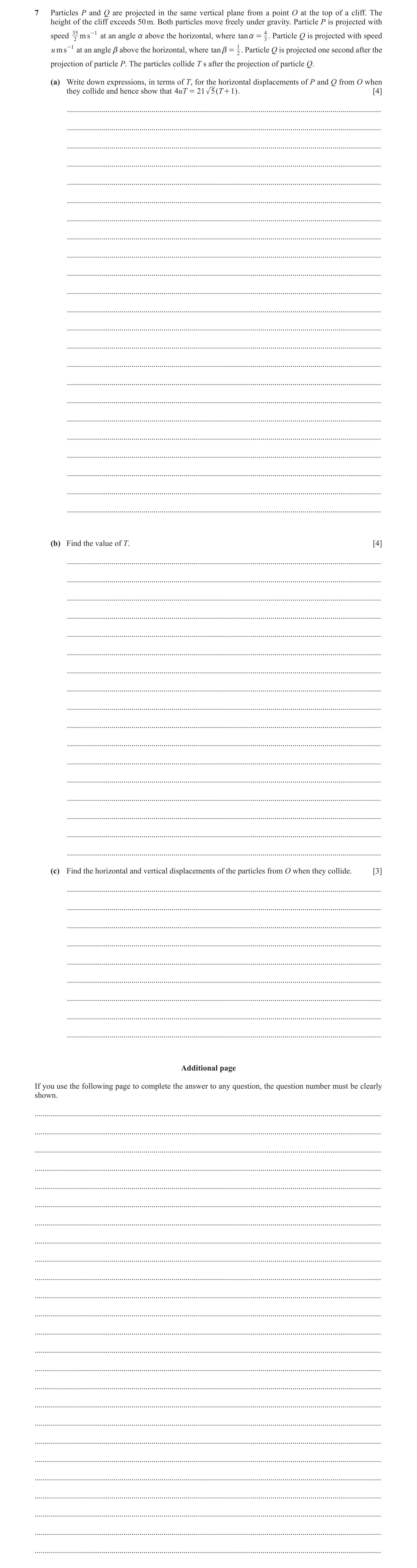
7 Particles P and Q are projected in the same vertical plane from a point O at the top of a cliff. The height of the cliff exceeds 50 m. Both particles move freely under gravity. Particle P is projected with a above the horizontal, where tan a = 3 . Particle Q is projected with speed speed 352 ms -1 at an angle 4 u m s -1 at an angle b above the horizontal, where tan b = 12 . Particle Q is projected one second after the projection of particle P. The particles collide T s after the projection of particle Q. (a) Write down expressions, in terms of T, for the horizontal displacements of P and Q from O when they collide and hence show that 4uT = 21 5 ( T + 1) . [4] … … … … … … … … … … … … … … … … … … … … … … … (b) Find the value of T. [4] … … … … … … … … … … … … … … … … … (c) Find the horizontal and vertical displacements of the particles from O when they collide. [3] … … … … … … … … … Additional page If you use the following page to complete the answer to any question, the question number must be clearly shown. … … … … … … … … … … … … … … … … … … … … … … … … …
11 marks
Mark scheme: 7(a) For Q: cos x u T For P: 35 cos 1 2 x T B1 Collision, so 35 cos 1 cos 2 T u T M1 Equate and attempt to rearrange. 35 3 2 1 2 5 5 T u T 4 21 5 1 uT T A1 AG Shown convincingly. 4 7(b) Vertical motion to collision: For Q: 2 1 sin 2 y u T gT For P: 2 35 1 sin 1 ( 1) 2 2 y T g T M1 A1 M1 for both expressions, one correct. Equate: 2 2 1 1 35 4 1 1 ( 1) 2 2 5 2 5 u T gT T g T 2 2 1 21 14 1 2 1 1 2 4 T g T T T T M1 Equate and attempt to solve 16 36 21 21, 1 5 5 T T T 3 T A1 4 Question Answer Marks Guidance 7(c) 42 x B1 24 y M1 24 y (or 24 m below O ) A1 Correct sign or in words. 3
This question in 9231/31 May/June 2022
Q17 · Particles P and Q are projected in the same vertical plane from a point O at the top of a… 9231/32 May/June 2022
7 Particles P and Q are projected in the same vertical plane from a point O at the top of a cliff. The height of the cliff exceeds 50 m. Both particles move freely under gravity. Particle P is projected with a above the horizontal, where tan a = 3 . Particle Q is projected with speed speed 352 ms -1 at an angle 4 u m s -1 at an angle b above the horizontal, where tan b = 12 . Particle Q is projected one second after the projection of particle P. The particles collide T s after the projection of particle Q. (a) Write down expressions, in terms of T, for the horizontal displacements of P and Q from O when they collide and hence show that 4uT = 21 5 ( T + 1) . [4] … … … … … … … … … … … … … … … … … … … … … … … (b) Find the value of T. [4] … … … … … … … … … … … … … … … … … (c) Find the horizontal and vertical displacements of the particles from O when they collide. [3] … … … … … … … … … Additional page If you use the following page to complete the answer to any question, the question number must be clearly shown. … … … … … … … … … … … … … … … … … … … … … … … … …
11 marks
Mark scheme: 7(a) For Q: cos x u T For P: 35 cos 1 2 x T B1 Collision, so 35 cos 1 cos 2 T u T M1 Equate and attempt to rearrange. 35 3 2 1 2 5 5 T u T 4 21 5 1 uT T A1 AG Shown convincingly. 4 7(b) Vertical motion to collision: For Q: 2 1 sin 2 y u T gT For P: 2 35 1 sin 1 ( 1) 2 2 y T g T M1 A1 M1 for both expressions, one correct. Equate: 2 2 1 1 35 4 1 1 ( 1) 2 2 5 2 5 u T gT T g T 2 2 1 21 14 1 2 1 1 2 4 T g T T T T M1 Equate and attempt to solve 16 36 21 21, 1 5 5 T T T 3 T A1 4 Question Answer Marks Guidance 7(c) 42 x B1 24 y M1 24 y (or 24 m below O ) A1 Correct sign or in words. 3
This question in 9231/32 May/June 2022
Q18 · A particle P is projected with speed 25 ms -1 at an angle i above the horizontal from a… 9231/33 May/June 2022
3 A particle P is projected with speed 25 ms -1 at an angle i above the horizontal from a point O on a horizontal plane and moves freely under gravity. After 2 s the speed of P is 15 ms -1 . (a) Find the value of sini. [5] … … … … … … … … … … … … … … … … … … … … … … … … … … (b) Find the range of the flight. [3] … … … … … … … … … … … … … … … … … … … … … … … … … … …
8 marks
Mark scheme: 3(a) Components of velocity : 25cos 25sin 2g B1 Speed = 2 2 25cos 25sin 2g M1 A1 Expression for speed or square of speed. 2 2 2 25cos 25sin 2 15 g 2 625 100 sin 4 225 g g M1 Attempt to solve and find value for sin 800 4 sin 1000 5 A1 5 3(b) Time of flight 2 25sin g = 4 (s) B1 Range = 2 25sin 25cos g M1 Any equivalent method. Range = 60 (m) A1 CWO Alternative method for question 3(b) 2 4 1 3 45 y x x B1 Equation of trajectory.. Substitute 0 y and solve M1 60 (m) A1 3
This question in 9231/33 May/June 2022
Q19 · A particle P of mass m is attached to one end of a light inextensible string of length a 9231/31 Oct/Nov 2022
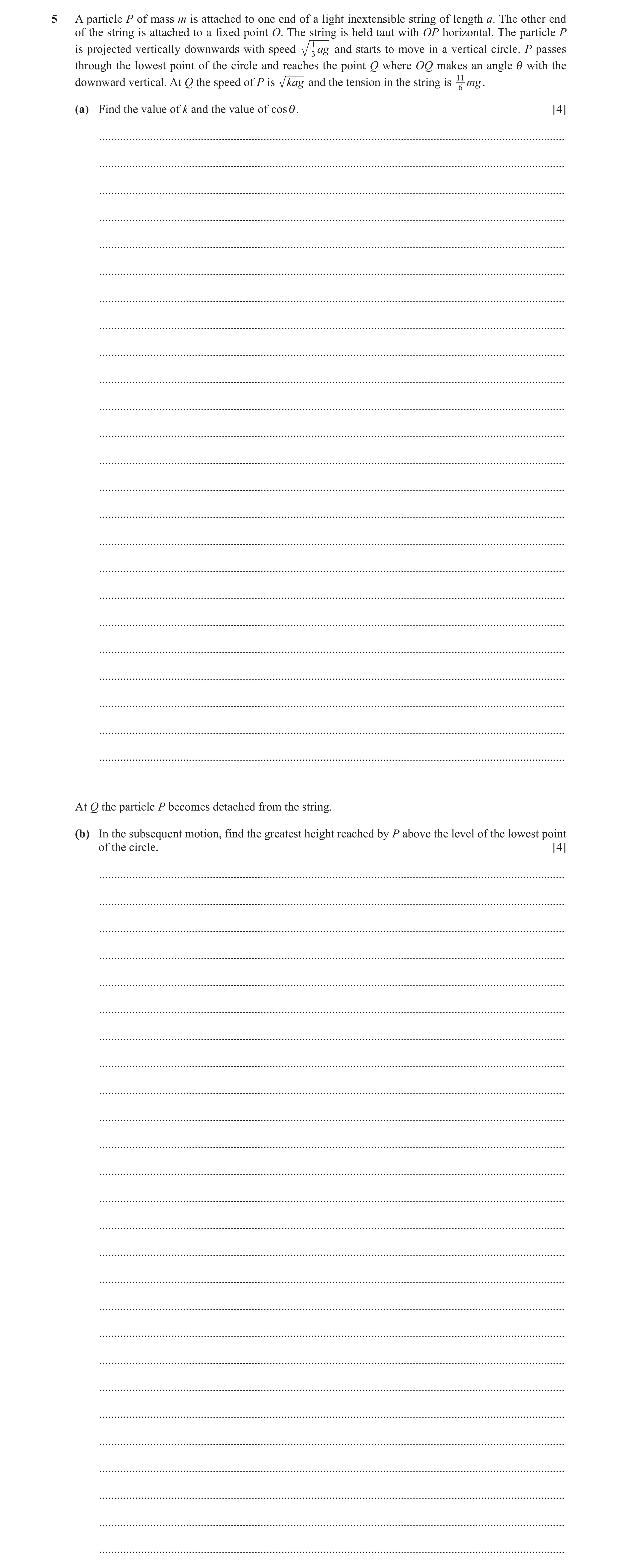
5 A particle P of mass m is attached to one end of a light inextensible string of length a. The other end of the string is attached to a fixed point O. The string is held taut with OP horizontal. The particle P is projected vertically downwards with speed 13 ag and starts to move in a vertical circle. P passes through the lowest point of the circle and reaches the point Q where OQ makes an angle i with the downward vertical. At Q the speed of P is kag and the tension in the string is 116 mg . (a) Find the value of k and the value of cosi. [4] … … … … … … … … … … … … … … … … … … … … … … … … At Q the particle P becomes detached from the string. (b) In the subsequent motion, find the greatest height reached by P above the level of the lowest point of the circle. [4] … … … … … … … … … … … … … … … … … … … … … … … … … …
8 marks
Mark scheme: 5(a) 1 2 1 2 B1 Energy equation. mv − mu = mga cos 2 2 1 kag = ag + 2 ag cos 3 m 2 B1 N2L at B. T − mg cos= v a 11 m 11 So mg − mg cos= .kag , − cos= k 6 a 6 Solve simultaneously. M1 4 1 A1 Both. k = , cos= 3 2 4 5(b) Initial speed = kag sin B1 2 M1 2 2 Use v = u + 2 as : 0 = kag sin − 2 gs ( ) 1 A1 s = a 2 1 1 A1 FT Height above lowest point = s + a − a cos = a + a − a = a 2 2 4
This question in 9231/31 Oct/Nov 2022
Q20 · A particle P is projected with speed V ms -1 at an angle 75° above the horizontal from a… 9231/31 Oct/Nov 2022
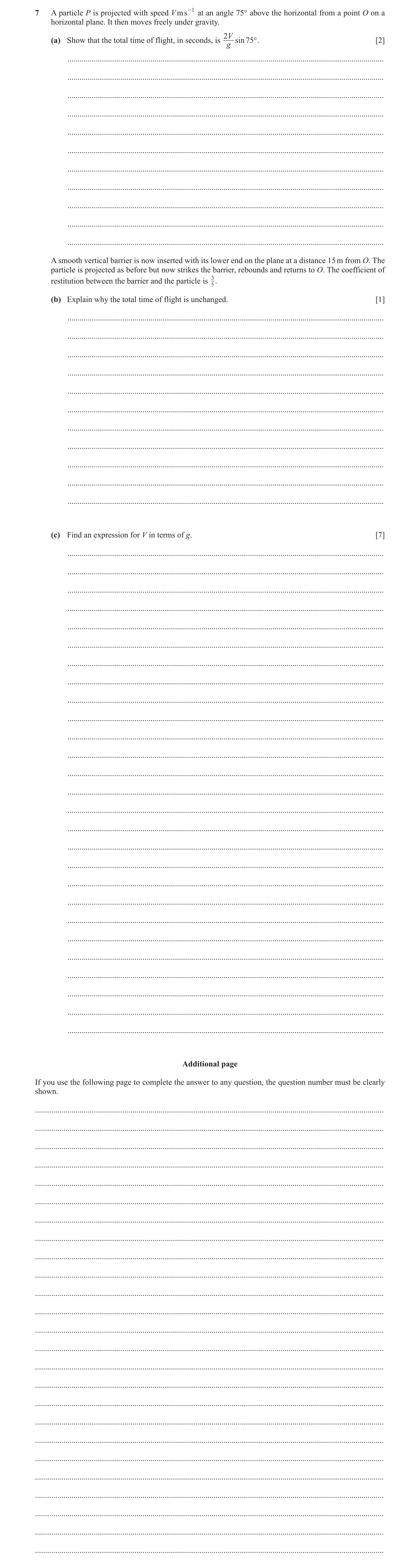
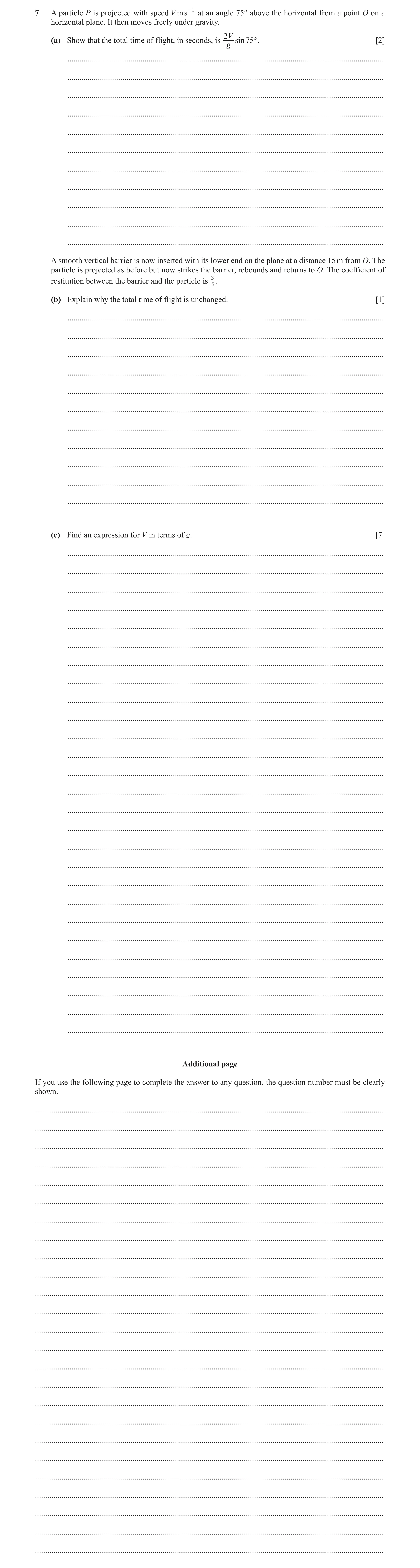
7 A particle P is projected with speed V ms -1 at an angle 75° above the horizontal from a point O on a horizontal plane. It then moves freely under gravity. 2V (a) Show that the total time of flight, in seconds, is sin 75°. [2] g … … … … … … … … … … … A smooth vertical barrier is now inserted with its lower end on the plane at a distance 15 m from O. The particle is projected as before but now strikes the barrier, rebounds and returns to O. The coefficient of restitution between the barrier and the particle is 3.5 (b) Explain why the total time of flight is unchanged. [1] … … … … … … … … … … … (c) Find an expression for V in terms of g. [7] … … … … … … … … … … … … … … … … … … … … … … … … … … … Additional page If you use the following page to complete the answer to any question, the question number must be clearly shown. … … … … … … … … … … … … … … … … … … … … … … … … …
10 marks
Mark scheme: 7(a) 1 2 M1 0 = V sin75t − gt 2 2V A1 AG t = sin75 g 2 7(b) Vertical component of velocity is unchanged. B1 1 7(c) 15 B1 Horizontally to wall, → 15 = V cos75t ; t = Vcos 75 eVcos75 B1 Speed after rebound. 15 M1 Time back to O T = eVcos 75 3 t = T 5 Vertically for whole flight: M1 2V t + T = sin75 g 15 15 2V A1 + = sin75 Vcos 75 eVcos 75 g V 2 cos75sin75 = 20 g M1 Multiply by 2: V 2 sin150 = 40 g , V 2 = 80 g A1 V = 4 5 g = 8.94 g ( ) 7
This question in 9231/31 Oct/Nov 2022
Q21 · A particle P is projected with speed u m s -1 at an angle of i above the horizontal from… 9231/32 Oct/Nov 2022
5 A particle P is projected with speed u m s -1 at an angle of i above the horizontal from a point O on a horizontal plane and moves freely under gravity. The horizontal and vertical displacements of P from O at a subsequent time t s are denoted by x m and y m respectively. (a) Show that the equation of the trajectory is given by gx 2 2 i) . [4] y = x tan i - 2 ( 1 + tan 2u … … … … … … … … … … … … … … … … … … … … … … … … In the subsequent motion P passes through the point with coordinates (30, 20). (b) Given that one possible value of tani is 4,3 find the other possible value of tani. [5] … … … … … … … … … … … … … … … … … … … … … … … … … …
9 marks
Mark scheme: 5(a) → x = u cost B1 Result quoted from MF19 scores 0/4. 1 2 B1 y = u sint − gt 2 2 M1 x 1 x Eliminate t: y = u sin − g cos 2 ucos gx 2 A1 Must be an intermediate line of working. y = x tan− (1 + tan2 ) 2 AG 2u 4 5(b) 4 30 2 4 2 M1 Substituting values correctly. 20 = 30 − 10 1 + 2 3 2u 3 u 2 = 625, u = 25 A1 Substitute back into trajectory equation, M1 Obtain a 3-term quadratic. g 30 2 2 36 2 20 = 30tan− sec = 30tan− (1 + tan ) 2.25 2 5 18tan 2− 75tan+ 68 = 0 One solution is 4, ( 3tan− 4 )( 6tan− 17 ) = 0 M1 3 17 A1 Giving tan= 6 5
This question in 9231/32 Oct/Nov 2022
Q22 · A particle P of mass m is attached to one end of a light inextensible string of length a 9231/33 Oct/Nov 2022
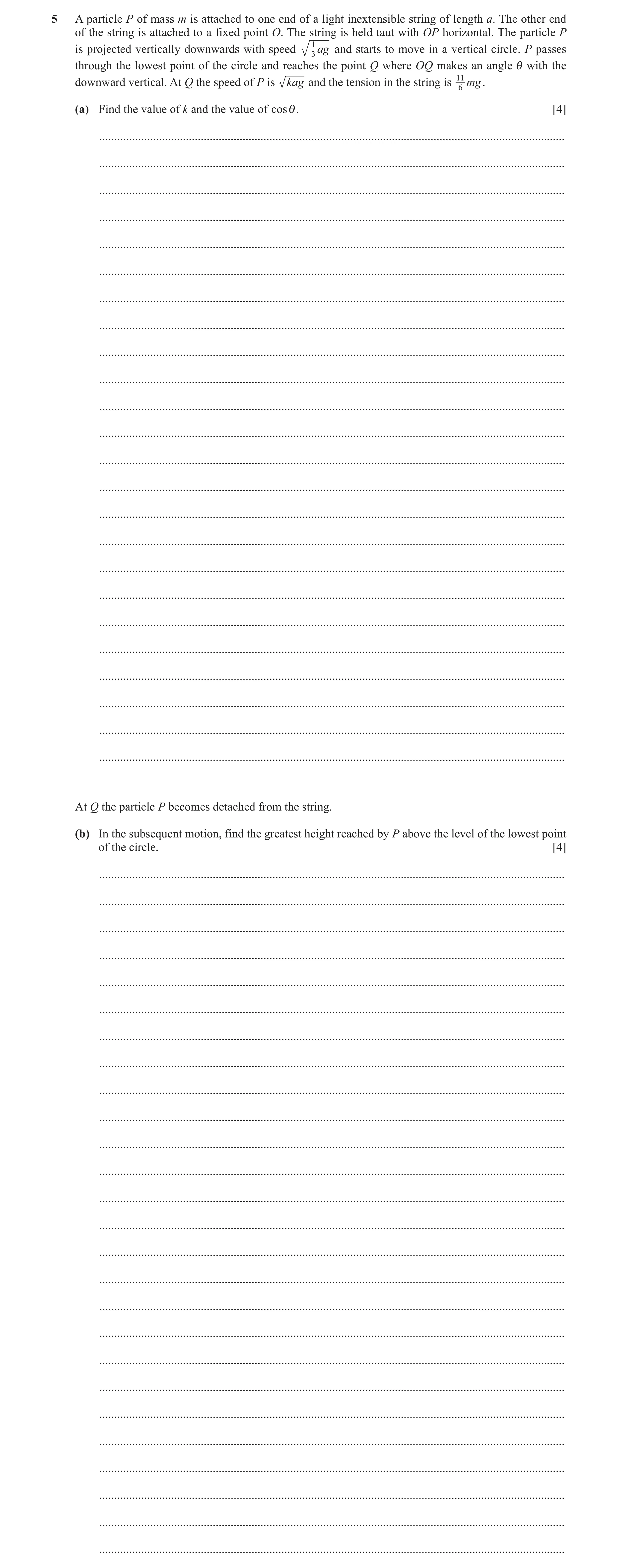
5 A particle P of mass m is attached to one end of a light inextensible string of length a. The other end of the string is attached to a fixed point O. The string is held taut with OP horizontal. The particle P is projected vertically downwards with speed 13 ag and starts to move in a vertical circle. P passes through the lowest point of the circle and reaches the point Q where OQ makes an angle i with the downward vertical. At Q the speed of P is kag and the tension in the string is 116 mg . (a) Find the value of k and the value of cosi. [4] … … … … … … … … … … … … … … … … … … … … … … … … At Q the particle P becomes detached from the string. (b) In the subsequent motion, find the greatest height reached by P above the level of the lowest point of the circle. [4] … … … … … … … … … … … … … … … … … … … … … … … … … …
8 marks
Mark scheme: 5(a) 1 2 1 2 B1 Energy equation. mv − mu = mga cos 2 2 1 kag = ag + 2 ag cos 3 m 2 B1 N2L at B. T − mg cos= v a 11 m 11 So mg − mg cos= .kag , − cos= k 6 a 6 Solve simultaneously. M1 4 1 A1 Both. k = , cos= 3 2 4 5(b) Initial speed = kag sin B1 2 M1 2 2 Use v = u + 2 as : 0 = kag sin − 2 gs ( ) 1 A1 s = a 2 1 1 A1 FT Height above lowest point = s + a − a cos = a + a − a = a 2 2 4
This question in 9231/33 Oct/Nov 2022
Q23 · A particle P is projected with speed V ms -1 at an angle 75° above the horizontal from a… 9231/33 Oct/Nov 2022
7 A particle P is projected with speed V ms -1 at an angle 75° above the horizontal from a point O on a horizontal plane. It then moves freely under gravity. 2V (a) Show that the total time of flight, in seconds, is sin 75°. [2] g … … … … … … … … … … … A smooth vertical barrier is now inserted with its lower end on the plane at a distance 15 m from O. The particle is projected as before but now strikes the barrier, rebounds and returns to O. The coefficient of restitution between the barrier and the particle is 3.5 (b) Explain why the total time of flight is unchanged. [1] … … … … … … … … … … … (c) Find an expression for V in terms of g. [7] … … … … … … … … … … … … … … … … … … … … … … … … … … … Additional page If you use the following page to complete the answer to any question, the question number must be clearly shown. … … … … … … … … … … … … … … … … … … … … … … … … …
10 marks
Mark scheme: 7(a) 1 2 M1 0 = V sin75t − gt 2 2V A1 AG t = sin75 g 2 7(b) Vertical component of velocity is unchanged. B1 1 7(c) 15 B1 Horizontally to wall, → 15 = V cos75t ; t = Vcos 75 eVcos75 B1 Speed after rebound. 15 M1 Time back to O T = eVcos 75 3 t = T 5 Vertically for whole flight: M1 2V t + T = sin75 g 15 15 2V A1 + = sin75 Vcos 75 eVcos 75 g V 2 cos75sin75 = 20 g M1 Multiply by 2: V 2 sin150 = 40 g , V 2 = 80 g A1 V = 4 5 g = 8.94 g ( ) 7
This question in 9231/33 Oct/Nov 2022
Q24 · At time t s, a particle P is projected with speed 40 m s -1 at an angle i above the… 9231/31 May/June 2023
7 At time t s, a particle P is projected with speed 40 m s -1 at an angle i above the horizontal from a point O on a horizontal plane and moves freely under gravity. The greatest height achieved by P during its flight is H m and the corresponding time is T s. (a) Obtain expressions for H and T in terms of i. [2] … … … … … … During the time between t = T and t = 3, P descends a distance 14 H . (b) Find the value of i. [4] … … … … … … … … … … … … … … … … … (c) Find the speed of P when t = 3. [3] … … … … … … … … … … … … … … … … … … … … … … … … … … … Additional page If you use the following page to complete the answer to any question, the question number must be clearly shown. … … … … … … … … … … … … … … … … … … … … … … … … …
9 marks
Mark scheme: 7(a) 2 80sin H or 2 800sin g 4sin T or 40sin g B1 2 7(b) Between t T and 3 t 2 1 1 10 3 4 2 H T M1 A1 No extra terms. Use results from part (a) 2 2 1 80sin 5 3 4sin 4 2 4sin 8sin 3 0 M1 Substitute their expressions for H and T from part (a) and obtain a quadratic equation in sin with no more than three terms. 1 sin 2 , 30 A1 Single answer. NFWW. Alternative method for question 7 part (b) 2 3 1 3 40 3 sin 10 3 4 2 H y M1 A1 120 sin 45 Use results from (a): 2 380sin 120 sin 45 4 2 4sin 8sin 3 0 M1 Substitute their expressions for H and T from part (a) and obtain a quadratic equation in sin with no more than three terms. 1 sin 2 , 30 A1 Single answer. NFWW. 4 Question Answer Marks Guidance 7(c) When 3 t speeds 40cos and 40sin 10 3 B1 Square and add to find square of speed: 2 2 2 20 3 10 v M1 Must be numerical. 2 1300, 10 13 v v [= 36.1] A1 3
This question in 9231/31 May/June 2023
Q25 · At time t s, a particle P is projected with speed 40 m s -1 at an angle i above the… 9231/32 May/June 2023
7 At time t s, a particle P is projected with speed 40 m s -1 at an angle i above the horizontal from a point O on a horizontal plane and moves freely under gravity. The greatest height achieved by P during its flight is H m and the corresponding time is T s. (a) Obtain expressions for H and T in terms of i. [2] … … … … … … During the time between t = T and t = 3, P descends a distance 14 H . (b) Find the value of i. [4] … … … … … … … … … … … … … … … … … (c) Find the speed of P when t = 3. [3] … … … … … … … … … … … … … … … … … … … … … … … … … … … Additional page If you use the following page to complete the answer to any question, the question number must be clearly shown. … … … … … … … … … … … … … … … … … … … … … … … … …
9 marks
Mark scheme: 7(a) 2 80sin H or 2 800sin g 4sin T or 40sin g B1 2 7(b) Between t T and 3 t 2 1 1 10 3 4 2 H T M1 A1 No extra terms. Use results from part (a) 2 2 1 80sin 5 3 4sin 4 2 4sin 8sin 3 0 M1 Substitute their expressions for H and T from part (a) and obtain a quadratic equation in sin with no more than three terms. 1 sin 2 , 30 A1 Single answer. NFWW. Alternative method for question 7 part (b) 2 3 1 3 40 3 sin 10 3 4 2 H y M1 A1 120 sin 45 Use results from (a): 2 380sin 120 sin 45 4 2 4sin 8sin 3 0 M1 Substitute their expressions for H and T from part (a) and obtain a quadratic equation in sin with no more than three terms. 1 sin 2 , 30 A1 Single answer. NFWW. 4 Question Answer Marks Guidance 7(c) When 3 t speeds 40cos and 40sin 10 3 B1 Square and add to find square of speed: 2 2 2 20 3 10 v M1 Must be numerical. 2 1300, 10 13 v v [= 36.1] A1 3
This question in 9231/32 May/June 2023
Q26 · The points O and P are on a horizontal plane, a distance 8 m apart 9231/33 May/June 2023
7 The points O and P are on a horizontal plane, a distance 8 m apart. A ball is thrown from O with speed u m s -1 at an angle i above the horizontal, where tan i = 43 . At the same instant, a model aircraft is launched with speed 5 m s -1 parallel to the horizontal plane from a point 4 m vertically above P. The model aircraft moves in the same vertical plane as the ball and in the same horizontal direction as the ball. The model aircraft moves horizontally with a constant speed of 5 m s -1 . After T s, the ball and the model aircraft collide. (a) Find the value of T. [6] … … … … … … … … … … … … … … … … … … … … … … … (b) Find the direction in which the ball is moving immediately before the collision. [3] … … … … … … … … … … … … … … … … … … … … … … … … … … … Additional page If you use the following page to complete the answer to any question, the question number must be clearly shown. … … … … … … … … … … … … … … … … … … … … … … … … …
9 marks
Mark scheme: 7(a) For aircraft, 5 d T For ball, 2 1 4 sin 10 2 u T T B1 To point of collision. For ball, cos 8 5 8 u T d T B1 Eliminate u: 2 2 5 4 5 4 1 4 10 , 5 2 4 T u T T u T and 5 5 8 3 T u T 2 3 4 5 4 5 8 T T *M1 Dependent on LHS of second B1 being 4, expression involving only T 2 3 4 4 0 T T DM1 Dependent on previous M1. Obtain and solve 3-term quadratic. 2 T A1 Single correct answer. 6 Note 8 d used leads to 2 3 T B1B1B0M1M1A0 Question Answer Marks Guidance 7(b) 1 sin 10 tan cos u T u M1 OE Accept ‘tan = ……’ 1 8 tan 9 A1 OE Direction is 41.6° below the horizontal A1 CAO Note: 8 d used leads to 20.9 above the horizontal. 3
This question in 9231/33 May/June 2023
Q27 · A particle P is projected with speed u ms -1 at an angle i above the horizontal from a… 9231/31 Oct/Nov 2023
5 A particle P is projected with speed u ms -1 at an angle i above the horizontal from a point O on a horizontal plane and moves freely under gravity. During its flight P passes through the point which is a horizontal distance 3a from O and a vertical distance 38 a above the horizontal plane. It is given that tan i = 13 . (a) Show that u 2 = 8ag . [2] … … … … … … … … … … … … A particle Q is projected with speed V ms -1 at an angle a above the horizontal from O at the instant when P is at its highest point. Particles P and Q both land at the same point on the horizontal plane at the same time. (b) Find V in terms of a and g. [7] … … … … … … … … … … … … … … … … … … … … … … … … … … … … … … … … … … … … …
9 marks
Mark scheme: 5(a) 2 M1 Use equation of trajectory: y = x tan −gx sec 2: 2u 2 3 1 ( 3a ) 2 1 a = 3a − g 1 + 2 8 3 2u 9 5 5 ga 2 A1 At least one step of working. a = , u = 8 ga 2 AG 8 u 2 5(b) 2u sin B1 For P, time of flight T = g For P, range = Tu cos B1 1 1 B1 For Q, time of flight = 2T , so range = 2 TV cos Equate: V cos= 2u cos (1) 1 2 M1 gT 1 2 4V sin For Q vertically: 0 = V sin T − , so T = 2 4 g Equate with result for P: A1 4V sin 2u sin 1 = so V sin= u sin (2) g g 2 2 2 2 1 2 M1 From (1) and (2): V = u 4 ( cos) + ( sin) 4 2 2 9 1 1 145 2 A1 V = u 4 + = u 10 4 10 40 V = 29ag 7
This question in 9231/31 Oct/Nov 2023
Q28 · A particle P is projected with speed u at an angle a above the horizontal from a point O… 9231/32 Oct/Nov 2023
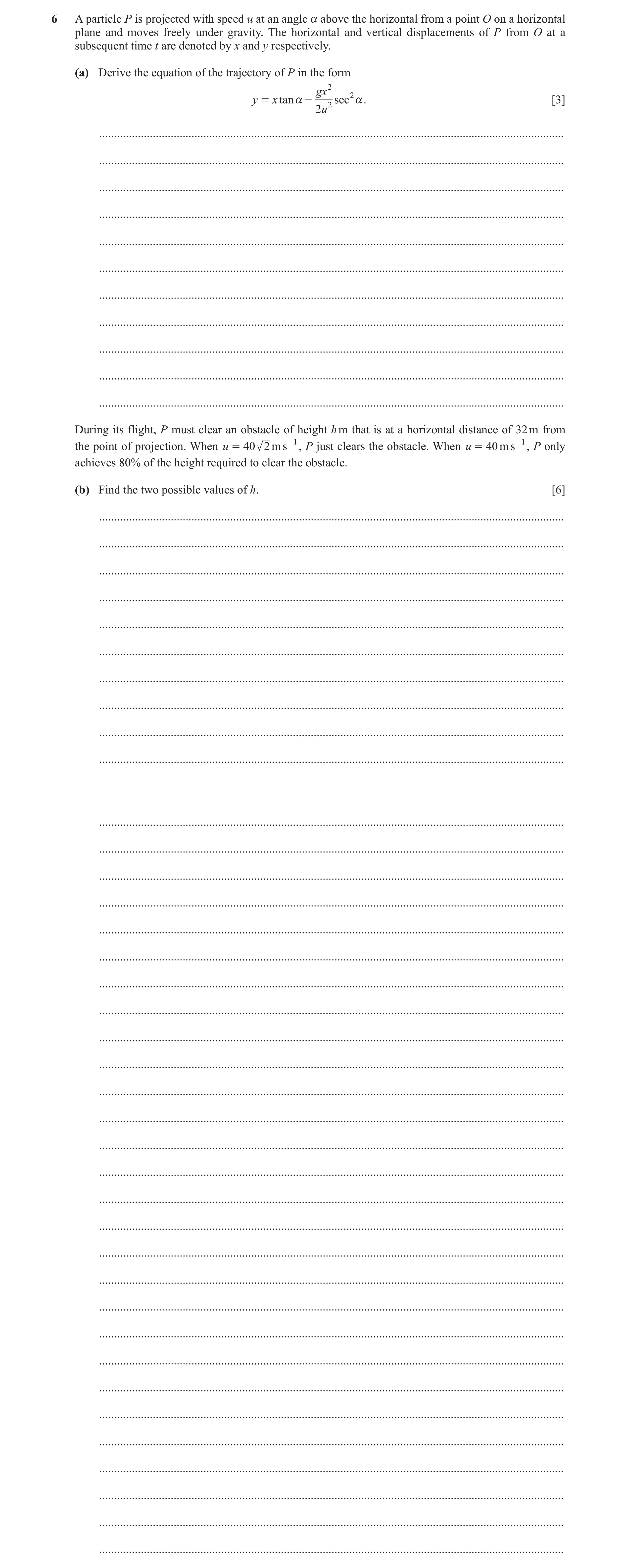
6 A particle P is projected with speed u at an angle a above the horizontal from a point O on a horizontal plane and moves freely under gravity. The horizontal and vertical displacements of P from O at a subsequent time t are denoted by x and y respectively. (a) Derive the equation of the trajectory of P in the form gx 2 2 a . [3] y = x tan a - 2 sec 2u … … … … … … … … … … … During its flight, P must clear an obstacle of height h m that is at a horizontal distance of 32 m from the point of projection. When u = 40 2 m s -1 , P just clears the obstacle. When u = 40 m s -1 , P only achieves 80% of the height required to clear the obstacle. (b) Find the two possible values of h. [6] … … … … … … … … … … … … … … … … … … … … … … … … … … … … … … … … … … … … … …
9 marks
Mark scheme: 6(a) → x = u cost 1 2 B1 Both correct. y = u sint − gt 2 2 M1 Eliminate. x 1 x Eliminate t: y = u sin − g ucos 2 ucosα gx 2 2 A1 y = x tan − sec AG 2 2u 3 6(b) 4 g 32 2 2 16 2 B1 h = 32tan − sec [= 32tan− sec ] 2 5 2 40 5 g 32 2 2 8 2 B1 h = 32tan− sec [= 32tan− sec ] 2 5 2 40 2 ( ) 8 2 5 16 2 M1 Equate expressions for h and obtain a 3-term quadratic in 32tan− sec = (32tan− sec ) tan. 5 4 5 8 2 2 32t − 1 + t = 40t − 4 1 + t ( ) ( ) 5 3t 2 − 10t + 3 = 0 1 A1 Both correct t = 3, 3 h = 80 M1 For using their value of t to work out one value of h. 80 h = A1 Both correct 9 6
This question in 9231/32 Oct/Nov 2023
Q29 · A particle P is projected with speed u ms -1 at an angle i above the horizontal from a… 9231/33 Oct/Nov 2023
5 A particle P is projected with speed u ms -1 at an angle i above the horizontal from a point O on a horizontal plane and moves freely under gravity. During its flight P passes through the point which is a horizontal distance 3a from O and a vertical distance 38 a above the horizontal plane. It is given that tan i = 13 . (a) Show that u 2 = 8ag . [2] … … … … … … … … … … … … A particle Q is projected with speed V ms -1 at an angle a above the horizontal from O at the instant when P is at its highest point. Particles P and Q both land at the same point on the horizontal plane at the same time. (b) Find V in terms of a and g. [7] … … … … … … … … … … … … … … … … … … … … … … … … … … … … … … … … … … … … …
9 marks
Mark scheme: 5(a) 2 M1 Use equation of trajectory: y = x tan −gx sec 2: 2u 2 3 1 ( 3a ) 2 1 a = 3a − g 1 + 2 8 3 2u 9 5 5 ga 2 A1 At least one step of working. a = , u = 8 ga 2 AG 8 u 2 5(b) 2u sin B1 For P, time of flight T = g For P, range = Tu cos B1 1 1 B1 For Q, time of flight = 2T , so range = 2 TV cos Equate: V cos= 2u cos (1) 1 2 M1 gT 1 2 4V sin For Q vertically: 0 = V sin T − , so T = 2 4 g Equate with result for P: A1 4V sin 2u sin 1 = so V sin= u sin (2) g g 2 2 2 2 1 2 M1 From (1) and (2): V = u 4 ( cos) + ( sin) 4 2 2 9 1 1 145 2 A1 V = u 4 + = u 10 4 10 40 V = 29ag 7
This question in 9231/33 Oct/Nov 2023
Q30 · At time t = 0 seconds, a particle P is projected with speed u m s -1 at an angle 60°… 9231/31 May/June 2024
3 At time t = 0 seconds, a particle P is projected with speed u m s -1 at an angle 60° above the horizontal from a point O. In the subsequent motion P moves freely under gravity. The direction of motion of P when t = 5 is perpendicular to its direction of motion when t = 15 . Find the value of u. [5] … … … … … … … … … … … … … … … … … … … … … … … … … … … … … … … … … … … … … … … … … … … … … … … … … … … … …
5 marks
Mark scheme: 3 u u B1 If is direction of velocity at sin60 5 5, tan cos60 u g t u M1* Accept equivalent for 15 t . For perpendicular directions, sin60 5 sin60 15 1 cos60 cos60 u g u g u u M1dep Multiply two expressions involving relevant velocities and equate to – 1. Simplify: 3 1 2 2 2 2 4 4 75 10 3 0, 100 3 7500 0 u g ug u u u M1 Simplify to quadratic in u (may see g ). 5 3 u g A1 OE. Accept 50 3 or 86.6. 5
This question in 9231/31 May/June 2024
Q31 · A smooth sphere with centre O and of radius a is fixed to a horizontal plane 9231/31 May/June 2024
7 A smooth sphere with centre O and of radius a is fixed to a horizontal plane. A particle P of mass m is projected horizontally from the highest point of the sphere with speed u, so that it begins to move along the surface of the sphere. The particle P loses contact with the sphere at the point Q on the sphere, where OQ makes an angle i with the upward vertical through O. u 2 + 2ag (a) Show that cos i = . [4] 3ag … … … … … … … … … … … … … … … … … … … … … … … … … It is given that cos i = 56 . (b) Find, in terms of a and g, an expression for the vertical component of the velocity of P just before it hits the horizontal plane to which the sphere is fixed. [3] … … … … … … … … … … … … … … … (c) Find an expression for the time taken by P to fall from Q to the plane. Give your answer in the a form k , stating the value of k correct to 3 significant figures. [2] g … … … … … … … … … Additional page If you use the following page to complete the answer to any question, the question number must be clearly shown. … … … … … … … … … … … … … … … … … … … … … …
9 marks
Mark scheme: 7(a) Energy: 1 1 2 2 2 2 1 cos mu mv mga *M1 m must be present, dimensionally correct, no missing terms. Allow sin instead of cos . Allow sign errors. N2L: 2 cosmv mg a B1 No reaction when P loses contact. Eliminate 2 v DM1 2 2 cos 3 u ag ag A1 AG 4 7(b) Vertical component of velocity of P when it leaves the sphere: sin v 55 216 ag *B1 Must not come from u . 2 2 sin 2 1 cos V v g a DM1 Use of 2 2 ' 2 . v u as Allow sin for cos. Allow sign errors. 847 216 ag V A1 AEF 3 Question Answer Marks Guidance 7(c) 1 847 55 216 216 ag ag t g M1 1 847 55 1.48 6 6 a a g g A1 2
This question in 9231/31 May/June 2024
Q32 · At time t = 0 seconds, a particle P is projected with speed u m s -1 at an angle 60°… 9231/32 May/June 2024
3 At time t = 0 seconds, a particle P is projected with speed u m s -1 at an angle 60° above the horizontal from a point O. In the subsequent motion P moves freely under gravity. The direction of motion of P when t = 5 is perpendicular to its direction of motion when t = 15 . Find the value of u. [5] … … … … … … … … … … … … … … … … … … … … … … … … … … … … … … … … … … … … … … … … … … … … … … … … … … … … …
5 marks
Mark scheme: 3 u u B1 If is direction of velocity at sin60 5 5, tan cos60 u g t u M1* Accept equivalent for 15 t . For perpendicular directions, sin60 5 sin60 15 1 cos60 cos60 u g u g u u M1dep Multiply two expressions involving relevant velocities and equate to – 1. Simplify: 3 1 2 2 2 2 4 4 75 10 3 0, 100 3 7500 0 u g ug u u u M1 Simplify to quadratic in u (may see g ). 5 3 u g A1 OE. Accept 50 3 or 86.6. 5
This question in 9231/32 May/June 2024
Q33 · A smooth sphere with centre O and of radius a is fixed to a horizontal plane 9231/32 May/June 2024
7 A smooth sphere with centre O and of radius a is fixed to a horizontal plane. A particle P of mass m is projected horizontally from the highest point of the sphere with speed u, so that it begins to move along the surface of the sphere. The particle P loses contact with the sphere at the point Q on the sphere, where OQ makes an angle i with the upward vertical through O. u 2 + 2ag (a) Show that cos i = . [4] 3ag … … … … … … … … … … … … … … … … … … … … … … … … … It is given that cos i = 56 . (b) Find, in terms of a and g, an expression for the vertical component of the velocity of P just before it hits the horizontal plane to which the sphere is fixed. [3] … … … … … … … … … … … … … … … (c) Find an expression for the time taken by P to fall from Q to the plane. Give your answer in the a form k , stating the value of k correct to 3 significant figures. [2] g … … … … … … … … … Additional page If you use the following page to complete the answer to any question, the question number must be clearly shown. … … … … … … … … … … … … … … … … … … … … … …
9 marks
Mark scheme: 7(a) Energy: 1 1 2 2 2 2 1 cos mu mv mga *M1 m must be present, dimensionally correct, no missing terms. Allow sin instead of cos . Allow sign errors. N2L: 2 cosmv mg a B1 No reaction when P loses contact. Eliminate 2 v DM1 2 2 cos 3 u ag ag A1 AG 4 7(b) Vertical component of velocity of P when it leaves the sphere: sin v 55 216 ag *B1 Must not come from u . 2 2 sin 2 1 cos V v g a DM1 Use of 2 2 ' 2 . v u as Allow sin for cos. Allow sign errors. 847 216 ag V A1 AEF 3 Question Answer Marks Guidance 7(c) 1 847 55 216 216 ag ag t g M1 1 847 55 1.48 6 6 a a g g A1 2
This question in 9231/32 May/June 2024
Q34 · A particle P is projected with speed u m s -1 at an angle tan -1 2 above the horizontal… 9231/31 Oct/Nov 2024
1 A particle P is projected with speed u m s -1 at an angle tan -1 2 above the horizontal from a point O on a horizontal plane and moves freely under gravity. When P has travelled a distance 56 m horizontally from O, it is at a vertical height H m above the plane. When P has travelled a distance 84 m horizontally from O, it is at a vertical height 1H m above the plane. 2 Find, in either order, the value of u and the value of H. [5] … … … … … … … … … … … … … … … … … … … … … … … …
5 marks
Mark scheme: Question Answer Marks Guidance 1 1 M1 For one equation with one error. Use equation of trajectory with point (56, H) or 84, H 2 A1 Both correct. 5 g 2 1 5 g 2 H = 112 − 56 or H = 168 − 84 2u 2 2 2u 2 Eliminate to find u or H M1 u = 35 A1 H = 48 A1 5
This question in 9231/31 Oct/Nov 2024
Q35 · A particle P is projected with speed u at an angle tan -1 b 4 l above the horizontal from… 9231/31 Oct/Nov 2024
7 A particle P is projected with speed u at an angle tan -1 b 4 l above the horizontal from a point O on a 3 horizontal plane and moves freely under gravity. When P is moving horizontally, it strikes a smooth inclined plane at the point A. This plane is inclined to the horizontal at an angle a, and the line of greatest slope through A lies in the vertical plane through O and A. As a result of the impact, P moves vertically upwards. The coefficient of restitution between P and the inclined plane is e. (a) Show that e tan 2a = 1. [4] … … … … … … … … … … … … … … … … … … … … … … … In its subsequent motion, the greatest height reached by P above A is 3 of the vertical height of A 16 above the horizontal plane. (b) Find the value of e. [6] … … … … … … … … … … … … … … … … … … … … … … … … … Additional page If you use the following page to complete the answer to any question, the question number must be clearly shown. … … … … … … … … … … … … … … … … … … … … … … … … …
10 marks
Mark scheme: 7(a) When P strikes plane, velocity is →u cos, M1 3 5u 3 3 Before impact: parallel to inclined plane u cos, perpendicular to plane u sin 5 5 3 3 A1 After impact: components u cos (parallel) and eu sin (perpendicular) 5 5 3 3 M1 Since velocity is vertical after impact, tan= u cos/ eu sin 5 5 tan= 1/ e tan, e tan2 = 1 A1 AG 4 7(b) ( u sin) 2 8u 2 M1A1 Note: alternative methods. Greatest height of P before impact: H = = 2 g 25 g 3 2 2 2 M1 After impact, vertical speed of P is u ( cos) + e ( sin) 5 2 2 3 M1 Use V = U + 2 as to greatest height, equal to H 16 9 2 2 2 2 3 u ( cos) + e ( sin) = 2 g H ( ) 25 16 1 e 1 M1 Use part (a): tan = , cos= , sin = e 1 + e 1 + e Substitute to find e 2 1 A1 3e + 2e −=1 0, e = 3 6
This question in 9231/31 Oct/Nov 2024
Q36 · A particle P is projected from a point O on horizontal ground with speed u at an angle i… 9231/32 Oct/Nov 2024
5 A particle P is projected from a point O on horizontal ground with speed u at an angle i above the horizontal, where tan i = 1 . The particle P moves freely under gravity and passes through the point 3 with coordinates (3a, 4 a ) relative to horizontal and vertical axes through O in the plane of the motion. 5 (a) Use the equation of the trajectory to show that u 2 = 25ag . [2] … … … … … … … … … … … … … … … … … … … … … … … … … At the instant when P is moving horizontally, a particle Q is projected from O with speed V at an angle a above the horizontal. The particles P and Q reach the ground at the same point and at the same time. (b) Express V 2 in the form kag, where k is a rational number. [6] … … … … … … … … … … … … … … … … … … … … … … … … … …
8 marks
Mark scheme: 5(a) 4 1 g 2 1 M1 No (implied) sight of trajectory equation M0. 3a ) 1 + Use correct equation of trajectory: a = 3a − 2 ( 5 3 2u 9 4 5 ga 2 5 ga 1 2 A1 At least one step of intermediate working must be a = a − , = , u = 25 ga seen. 2 2 5 u u 5 AG 2 5(b) For P, time of flight T and range R B1 For Q, time of flight ½ T and range R 2u sin 10 a Time of flight for P or Q. T = = g g 2 3 B1 Range for P. [From motion of P, R = 25ag = ] 15a g 10 1 2 R M1 Obtain an expression for v cos. May involve u For Q: → R = v cos T , v cos= and . 2 T 2 M1 Obtain an expression for v sin. May involve u 1 1 1 1 0 = v sin T − g T , v sin= gT and . 2 2 2 4 2 2 M1 2 2 R 1 5 Square and add: v = + gT = 90ag + ag T 4 8 2 725 A1 1 v = ag gT 8 tan = 4 = 1 2 R 12 T 5(b) Alternative method for question 5(b) For P, time of flight T and range R M1 For Q, time of flight ½ T and range R Horizontal motion for P and Q T R = u cosT and R = ( v cos) 2 Both. Vertical motion for P and Q M1 gT gT 1 2 u sin= and v sin= Both, may come from using s = ut + at . 2 4 2 Equate two expressions for R: A1 6 v cos= u v cos= 2u cos 10 Equate two expressions for vertical motion: A1 1 1 v sin= u sin v sin= u 2 2 10 2 2 2 1 2 29 2 M1 Square and add: v = u 4cos + sin = u 4 8 29 725 A1 25ag = ag 8 8 6
This question in 9231/32 Oct/Nov 2024
Q37 · A particle P is projected with speed u m s -1 at an angle tan -1 2 above the horizontal… 9231/33 Oct/Nov 2024
1 A particle P is projected with speed u m s -1 at an angle tan -1 2 above the horizontal from a point O on a horizontal plane and moves freely under gravity. When P has travelled a distance 56 m horizontally from O, it is at a vertical height H m above the plane. When P has travelled a distance 84 m horizontally from O, it is at a vertical height 1H m above the plane. 2 Find, in either order, the value of u and the value of H. [5] … … … … … … … … … … … … … … … … … … … … … … … …
5 marks
Mark scheme: Question Answer Marks Guidance 1 1 M1 For one equation with one error. Use equation of trajectory with point (56, H) or 84, H 2 A1 Both correct. 5 g 2 1 5 g 2 H = 112 − 56 or H = 168 − 84 2u 2 2 2u 2 Eliminate to find u or H M1 u = 35 A1 H = 48 A1 5
This question in 9231/33 Oct/Nov 2024
Q38 · A particle P is projected with speed u at an angle tan -1 b 4 l above the horizontal from… 9231/33 Oct/Nov 2024
7 A particle P is projected with speed u at an angle tan -1 b 4 l above the horizontal from a point O on a 3 horizontal plane and moves freely under gravity. When P is moving horizontally, it strikes a smooth inclined plane at the point A. This plane is inclined to the horizontal at an angle a, and the line of greatest slope through A lies in the vertical plane through O and A. As a result of the impact, P moves vertically upwards. The coefficient of restitution between P and the inclined plane is e. (a) Show that e tan 2a = 1. [4] … … … … … … … … … … … … … … … … … … … … … … … In its subsequent motion, the greatest height reached by P above A is 3 of the vertical height of A 16 above the horizontal plane. (b) Find the value of e. [6] … … … … … … … … … … … … … … … … … … … … … … … … … Additional page If you use the following page to complete the answer to any question, the question number must be clearly shown. … … … … … … … … … … … … … … … … … … … … … … … … …
10 marks
Mark scheme: 7(a) When P strikes plane, velocity is →u cos, M1 3 5u 3 3 Before impact: parallel to inclined plane u cos, perpendicular to plane u sin 5 5 3 3 A1 After impact: components u cos (parallel) and eu sin (perpendicular) 5 5 3 3 M1 Since velocity is vertical after impact, tan= u cos/ eu sin 5 5 tan= 1/ e tan, e tan2 = 1 A1 AG 4 7(b) ( u sin) 2 8u 2 M1A1 Note: alternative methods. Greatest height of P before impact: H = = 2 g 25 g 3 2 2 2 M1 After impact, vertical speed of P is u ( cos) + e ( sin) 5 2 2 3 M1 Use V = U + 2 as to greatest height, equal to H 16 9 2 2 2 2 3 u ( cos) + e ( sin) = 2 g H ( ) 25 16 1 e 1 M1 Use part (a): tan = , cos= , sin = e 1 + e 1 + e Substitute to find e 2 1 A1 3e + 2e −=1 0, e = 3 6
This question in 9231/33 Oct/Nov 2024
Q39 · A particle P is projected from a point O with speed U at an angle 45° above the… 9231/33 May/June 2025
7 A particle P is projected from a point O with speed U at an angle 45° above the horizontal and moves freely under gravity. (a) State the vertical and horizontal components of velocity at time t. [1] … … … … … … … At time T, particle P is moving at an angle of 60° below the horizontal. U (b) Show that T = ` 2 + 6j. [3] 2g … … … … … … … … … … … … … … … … … At time T, the particle strikes a smooth horizontal plane at a point which is a horizontal distance D from O and a vertical distance H below O. (c) Find the ratio H : D. [4] … … … … … … … … … … … After striking the horizontal plane, P rebounds with speed w. The coefficient of restitution between P and the plane is 2. 3 (d) Find w in terms of U. [3] … … … … … … … … … … … … Additional page If you use the following page to complete the answer to any question, the question number must be clearly shown. … … … … … … … … … … … … … … … … … … … … … …
11 marks
Mark scheme: 7(a) yv = U sin45 − gT B1 vx = U cos45 1 7(b) v y B1 SOI = − tan60 v x U M1 Substitute values for trigonometric ratios to obtain − gT a linear equation in U and T only. 2 = − 3 U − 2 gT = − 3 U U 2 U 2U U A1 AG, shown convincingly. T = 1 + 3 = 1 + 3 = 2 + 6 ( ) ( ) ( ) 2 g 2 g 2 g 3 7(c) U B1 D in terms of U and T . D = T 2 U 1 2 B1 H in terms of U and T . H = T − 2 gT With or without modulus sign. 2 U 1 2 M1 OE 1 1 T − 2 gT 2 + 6 Obtain a numerical value, may be un-simplified. 2 U ( 2 2 − 12 ( ) ) 1 − 3 2 = = Division or ratios. 1 U T 2 2 2 With or without modulus sign. 2 H : D = 1 :1 + 3 A1 OE (for example H : D = 3 − 1:2 ), CWO 7(c) Alternative method for question 7(c) U U B1 D in terms of U and g . 2 + 6 D = ( ) 2 2 g U U 1 U 2 U 2 B1 H in terms of U and g . 2 + 6 2 + 6 = − With or without modulus sign. H = ( ) − 2 g ( ) 2 2 g 2 g 2 g 2 M1 OE U U 1 U 2 + 6 2 + 6 Obtain a numerical value, may be un-simplified. ( ) − 2 g ( ) 2 2 g 2 g 1 − 3 Division or ratios. = U U 2 With or without modulus sign. 2 + 6 ( ) 2 2 g H : D = 1 :1 + 3 A1 OE (for example H : D = 3 − 1:2 ), CWO Alternative method for question 7(c) U U B1 U 2 D = 2 + 6 1 + 3 ( ) D = ( ) 2 2 g 2 g 2 2 B1 6 2 U = U − 2 gH 2 2 U 2 M1 ( ) H = 2 g H : D = 1 :1 + 3 A1 OE (for example H : D = 3 − 1:2 ), CWO 4 7(d) 2 3 2 B1 OE, accept un-simplified. wy = U = U Allow negative sign. 3 2 3 2 M1 2 2 U 2 2 1 2 w = w y + = 3 U + 2 U 2 2 1 7 A1 CWO w = U 3 + 2 = U 6 3
This question in 9231/33 May/June 2025
Q40 · A particle P is projected with speed u at an angle a above the horizontal from a point O… 9231/34 May/June 2025
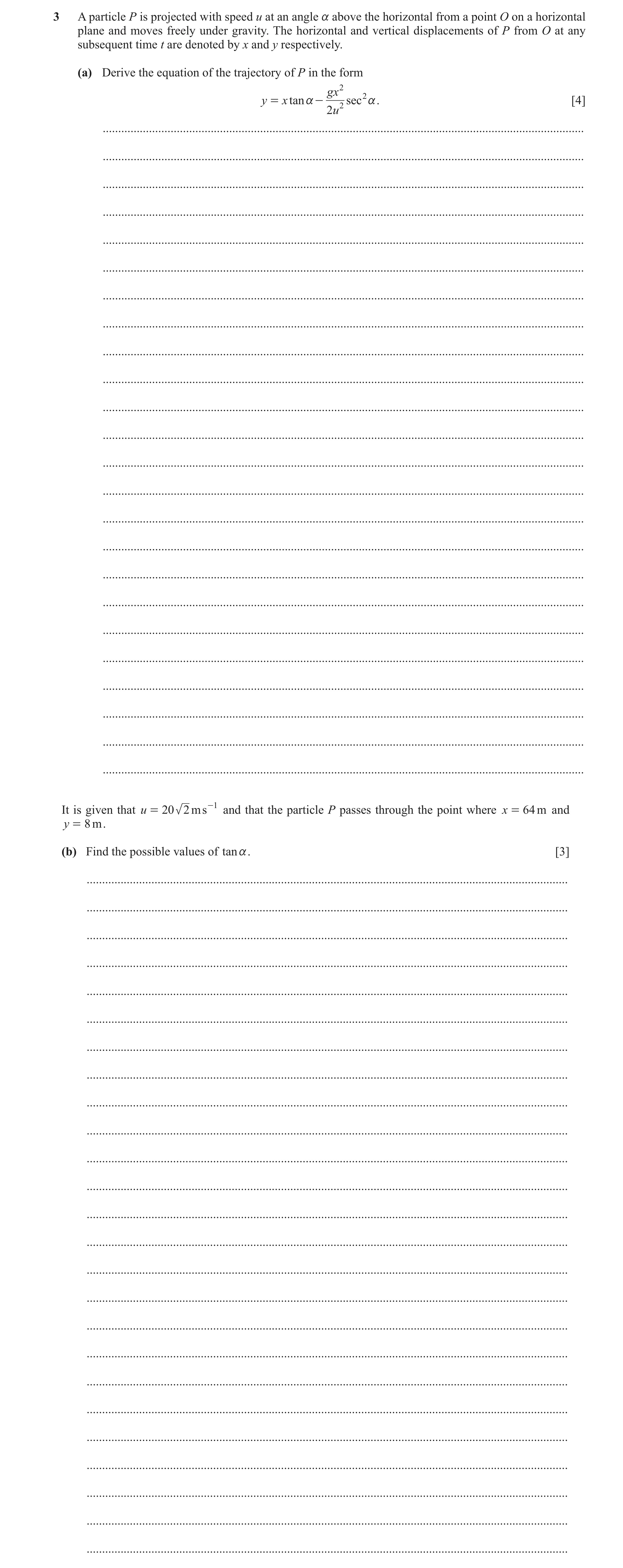
3 A particle P is projected with speed u at an angle a above the horizontal from a point O on a horizontal plane and moves freely under gravity. The horizontal and vertical displacements of P from O at any subsequent time t are denoted by x and y respectively. (a) Derive the equation of the trajectory of P in the form gx 2 2 y = x tan a - sec a . [4] 2u 2 … … … … … … … … … … … … … … … … … … … … … … … … It is given that u = 20 2 ms -1 and that the particle P passes through the point where x = 64 m and y = 8 m . (b) Find the possible values of tana. [3] … … … … … … … … … … … … … … … … … … … … … … … … …
7 marks
Mark scheme: 3(a) x B1 Explicitly stated. or t = ( → ) x = (u cos) t u cos ( ) y = (u sin ) t − 12 gt 2 B1 Explicitly stated. 2 M1 Eliminate t. x 1 x y = u sin − 2 g Must see this substitution. u cos u cos gx 2 2 A1 AG, shown convincingly. y = x tan − sec 2 Dependent on all 3 previous marks being awarded. 2u 4 3(b) 128 2 M1 May be un-simplified, must be an equation in a single 1 + tan 8 = 64tan − 5 ( ) trigonometric function. 16tan 2 − 40tan+ 21 = 0 M1 Obtain 3-term quadratic. AEF, for example 128tan 2 − 320tan+ 168 = 0 . tan = 34 , 74 A1 Both answers required. 3
This question in 9231/34 May/June 2025
Q41 · A particle P is projected from a point O on a horizontal plane and moves freely under… 9231/31 Oct/Nov 2025
7 A particle P is projected from a point O on a horizontal plane and moves freely under gravity. The initial velocity of P is 25 ms -1 at an angle i above the horizontal, where tan i = 4 . At point A, the 3 direction of motion of P makes an angle of 45° with the downward vertical through A. (a) By differentiating the equation of the trajectory or otherwise, find the coordinates of A. [5] … … … … … … … … … … … … … … … … … … … … … … … … … At point A, the particle strikes a fixed smooth barrier, rebounds, and lands on the horizontal plane. The barrier is inclined at an angle of 45° to the horizontal. (b) Find the speed of P immediately before it collides with the barrier. [3] … … … … … … … … (c) Given that the coefficient of restitution between the barrier and the particle is 1, find the horizontal 9 distance travelled by P after it strikes the barrier. [4] … … … … … … … … … … … … … … … … Additional page If you use the following page to complete the answer to any question, the question number must be clearly shown. … … … … … … … … … … … … … … … … … … … … … … … … …
12 marks
Mark scheme: 7(a) dy 2 gx M1 Valid attempt at differentiating. = tan− dx 2u 2 cos 2 dy B1 = −1 dx −=1 43 − 452 x A M1 Form equation with –1 and attempt to find a value for x A . x A = 1052 A1 52.5 or 525 . g y A = 354 A1 175 35 dy 8.75 or . SC B1 for 4 OE from setting = +1 . 2g dx Alternative method for question 7(a) Horizontally: vH = 25cos= 15 M1 Both equations, allow sign error. Vertically: Vv = 25sin− gt = 20 − gt vV B1 At A: = − tan 45 = −1 v H 20 − gt 7 M1 With RHS = –1, find value for t and x A or y A = −1, t = 2 15 x A = 1052 A1 52.5 or 525 . g y A = 354 A1 175 35 dy 8.75 or . SC B1 for 4 OE from setting = +1 . 2g dx 5 7(b) Let v be the velocity before the collision at A. B1 u x = u cos= 15 = v x v y = − v x = − 15 B1 2 2 B1 FT Speed: v x + v y = 15 2 (m s–1) 3 7(c) Let w be the velocity after the collision. M1 Correct application of NEL. w = ev = 53 2 A1 2 M1 Substitute values into trajectory equation and solve to find x. 35 gx 9 2 35 , − 4 = x tan45 − 5 x − x − 4 = 0 . OR 2 2 5 2 2 cos45 ) Complete method to find x that firstly determines the time of ( 3 ) ( the flight after the particle strikes the barrier. OR 35 4 = − 53 2 12 2 t + 12 gt 2 , t = 32 5 x = ( w cos45 ) t = 3 32 x = 52 (metres) A1 4
This question in 9231/31 Oct/Nov 2025
Q42 · A particle Q is initially positioned at a distance d vertically above a particle P 9231/32 Oct/Nov 2025
4 A particle Q is initially positioned at a distance d vertically above a particle P. Particle P is projected with speed U at an angle a above the horizontal. At the same time, Q is projected at an angle b below the horizontal. Both particles move freely under gravity. The particles collide at time T after the projections. (a) Show that d = UT ( sin a + cos a tan b ) . [4] … … … … … … … … … … … … … … … … … … … … … … … … … The particles collide when P is at its maximum height. (b) Given that a = 30° and b = 60° , find d in terms of U and g. [3] … … … … … … … … … … … … … … … … … … … … … … … … … …
7 marks
Mark scheme: 4(a) Horizontal velocities are the same: B1 B0 M0 M0 A0 for using U q = U . U q cos = U cos 1 2 1 2 M1 Apply vertical equation of motion on both T + 2 gT d = (U sin) T − 2 gT + ( U q sin) particles and combine. Ucos M1 Substitute U q and simplify. d = (Usin) T + sin T cos d = UT ( sin+ costan) A1 AG, shown convincingly. 4 4(b) Usin= gT B1 Correct equation for T. 2 M1 Substitute their expression for T in given U sin d = ( sin+ costan) result from part 4(a) OR complete method for g finding d in terms of U and g only. May include unevaluated trigonometric functions. Note: d = 2UT and U = 2 gT . 2 A1 U d = g 3
This question in 9231/32 Oct/Nov 2025
Q43 · A particle P is projected from a point O on a horizontal plane and moves freely under… 9231/33 Oct/Nov 2025
7 A particle P is projected from a point O on a horizontal plane and moves freely under gravity. The initial velocity of P is 25 ms -1 at an angle i above the horizontal, where tan i = 4 . At point A, the 3 direction of motion of P makes an angle of 45° with the downward vertical through A. (a) By differentiating the equation of the trajectory or otherwise, find the coordinates of A. [5] … … … … … … … … … … … … … … … … … … … … … … … … … At point A, the particle strikes a fixed smooth barrier, rebounds, and lands on the horizontal plane. The barrier is inclined at an angle of 45° to the horizontal. (b) Find the speed of P immediately before it collides with the barrier. [3] … … … … … … … … (c) Given that the coefficient of restitution between the barrier and the particle is 1, find the horizontal 9 distance travelled by P after it strikes the barrier. [4] … … … … … … … … … … … … … … … … Additional page If you use the following page to complete the answer to any question, the question number must be clearly shown. … … … … … … … … … … … … … … … … … … … … … … … … …
12 marks
Mark scheme: 7(a) dy 2 gx M1 Valid attempt at differentiating. = tan− dx 2u 2 cos 2 dy B1 = −1 dx −=1 43 − 452 x A M1 Form equation with –1 and attempt to find a value for x A . x A = 1052 A1 52.5 or 525 . g y A = 354 A1 175 35 dy 8.75 or . SC B1 for 4 OE from setting = +1 . 2g dx Alternative method for question 7(a) Horizontally: vH = 25cos= 15 M1 Both equations, allow sign error. Vertically: Vv = 25sin− gt = 20 − gt vV B1 At A: = − tan 45 = −1 v H 20 − gt 7 M1 With RHS = –1, find value for t and x A or y A = −1, t = 2 15 x A = 1052 A1 52.5 or 525 . g y A = 354 A1 175 35 dy 8.75 or . SC B1 for 4 OE from setting = +1 . 2g dx 5 7(b) Let v be the velocity before the collision at A. B1 u x = u cos= 15 = v x v y = − v x = − 15 B1 2 2 B1 FT Speed: v x + v y = 15 2 (m s–1) 3 7(c) Let w be the velocity after the collision. M1 Correct application of NEL. w = ev = 53 2 A1 2 M1 Substitute values into trajectory equation and solve to find x. 35 gx 9 2 35 , − 4 = x tan45 − 5 x − x − 4 = 0 . OR 2 2 5 2 2 cos45 ) Complete method to find x that firstly determines the time of ( 3 ) ( the flight after the particle strikes the barrier. OR 35 4 = − 53 2 12 2 t + 12 gt 2 , t = 32 5 x = ( w cos45 ) t = 3 32 x = 52 (metres) A1 4
This question in 9231/33 Oct/Nov 2025
 1 / 95
 5 / 95





 26 / 95












 74 / 95

 80 / 95




 5
5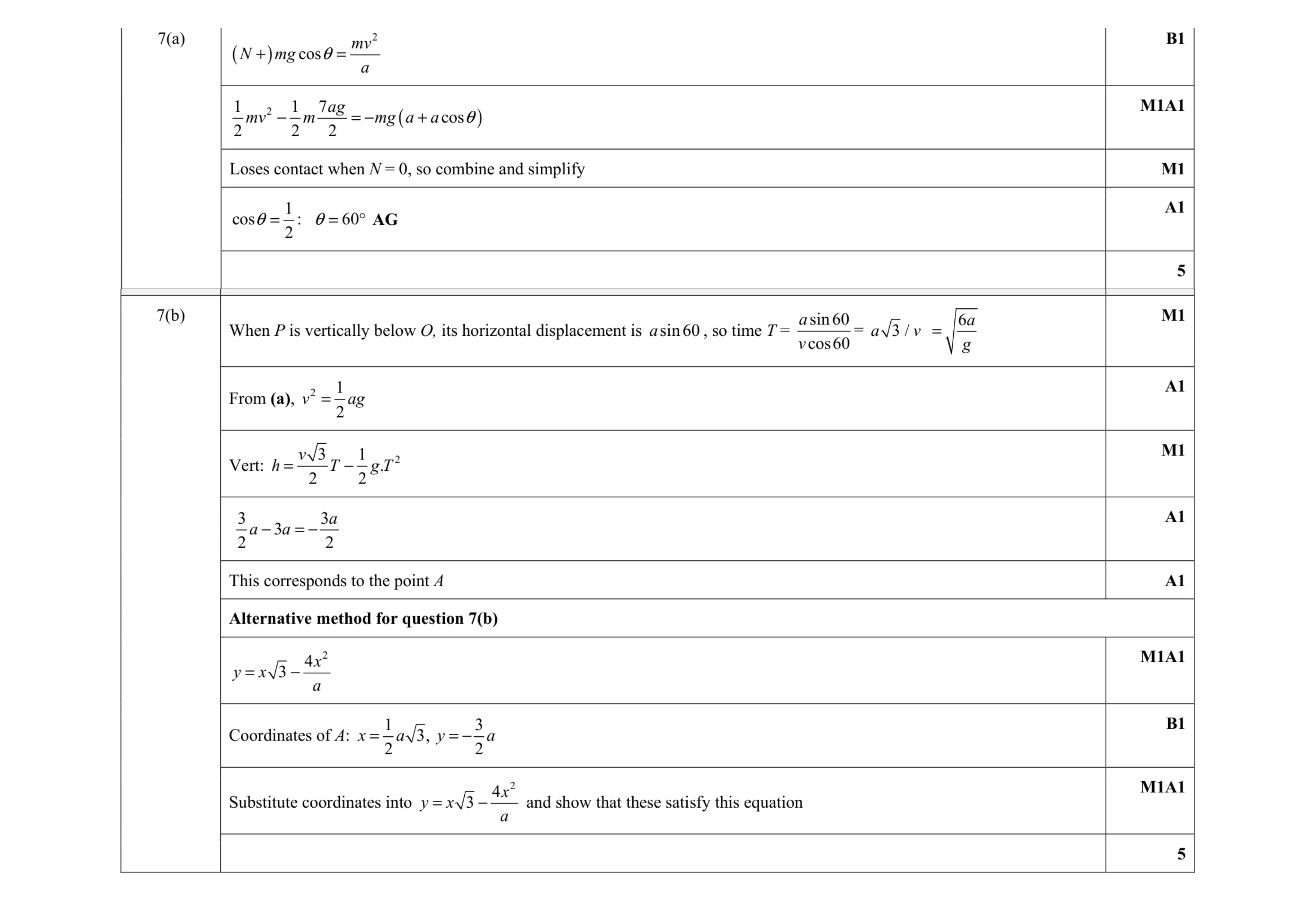 10
10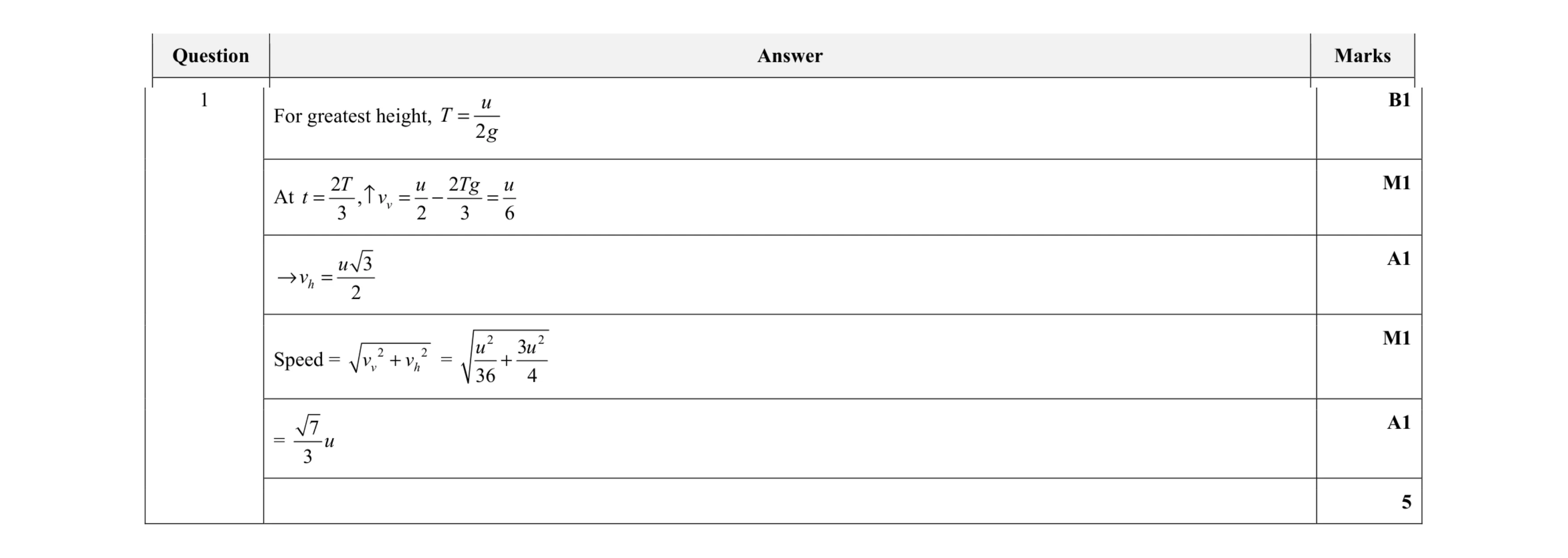 5
5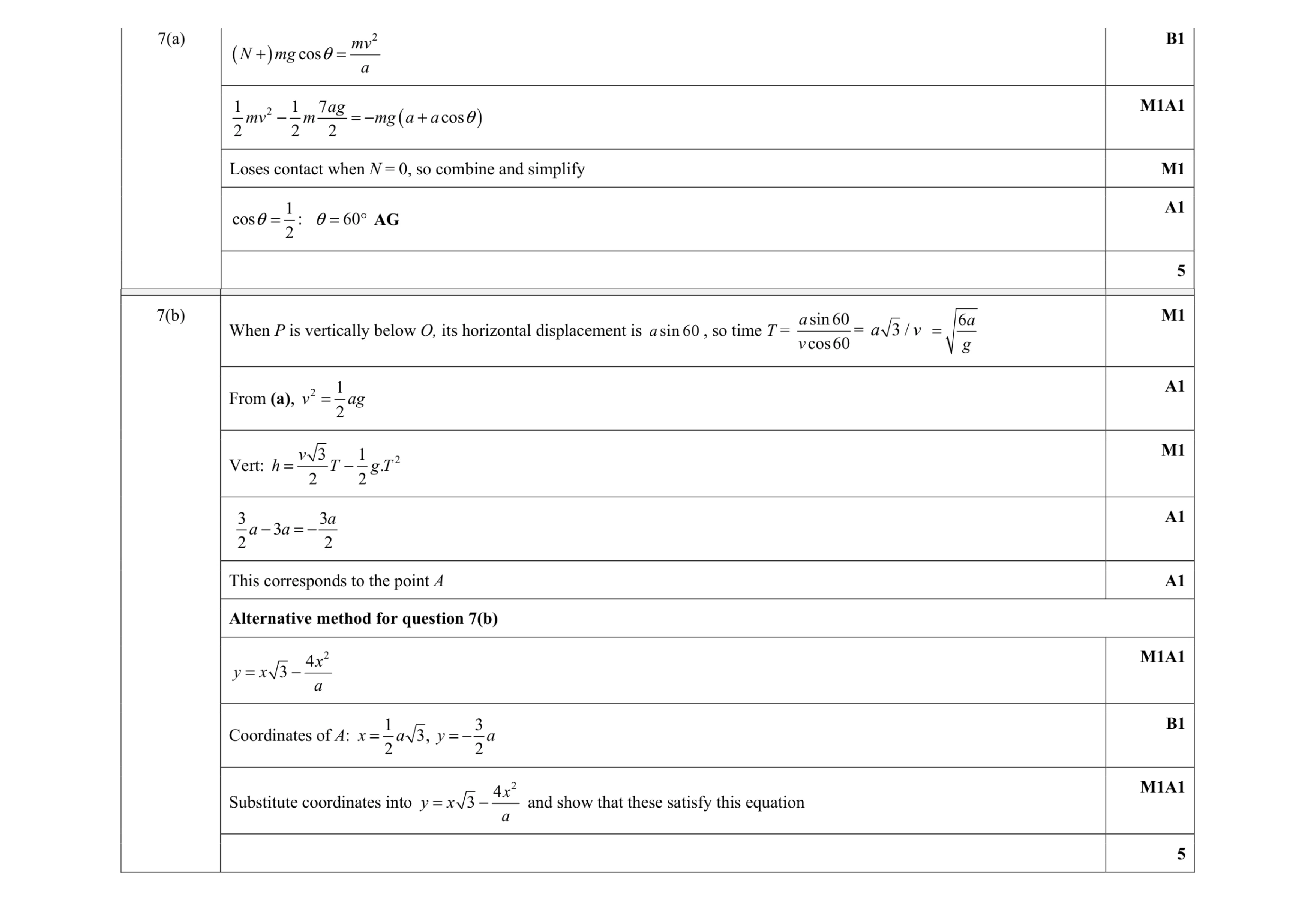 10
10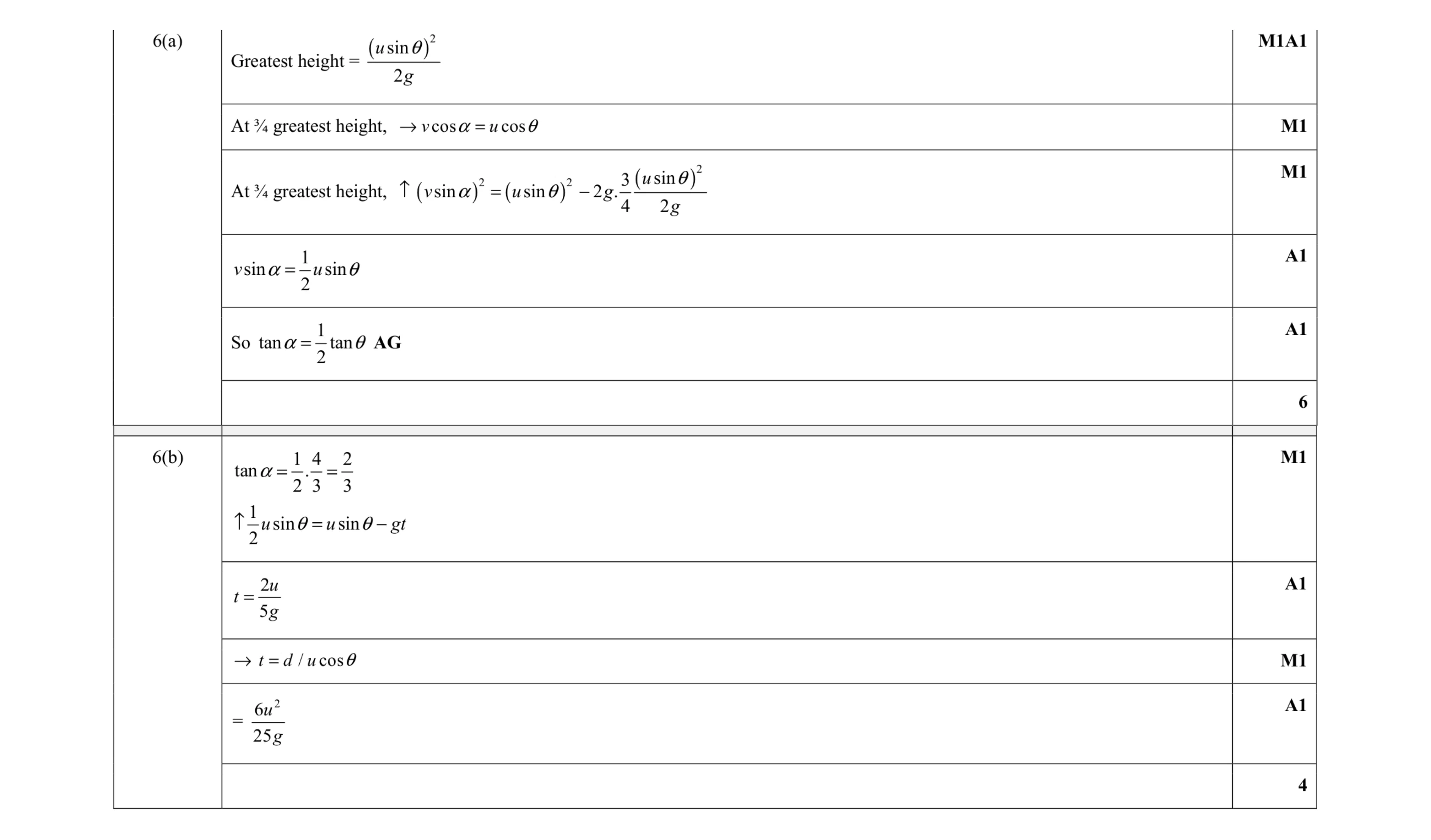 10
10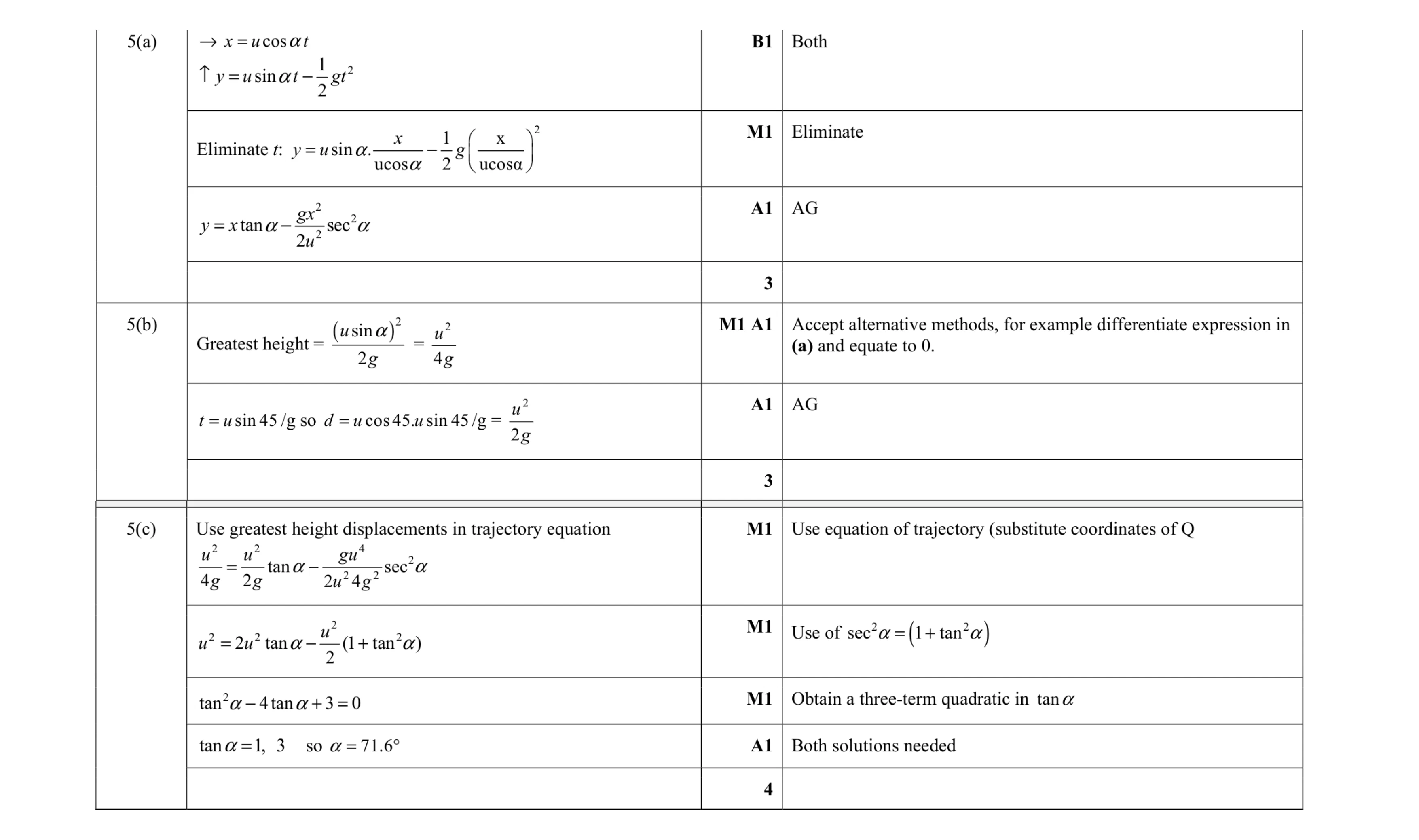 10
10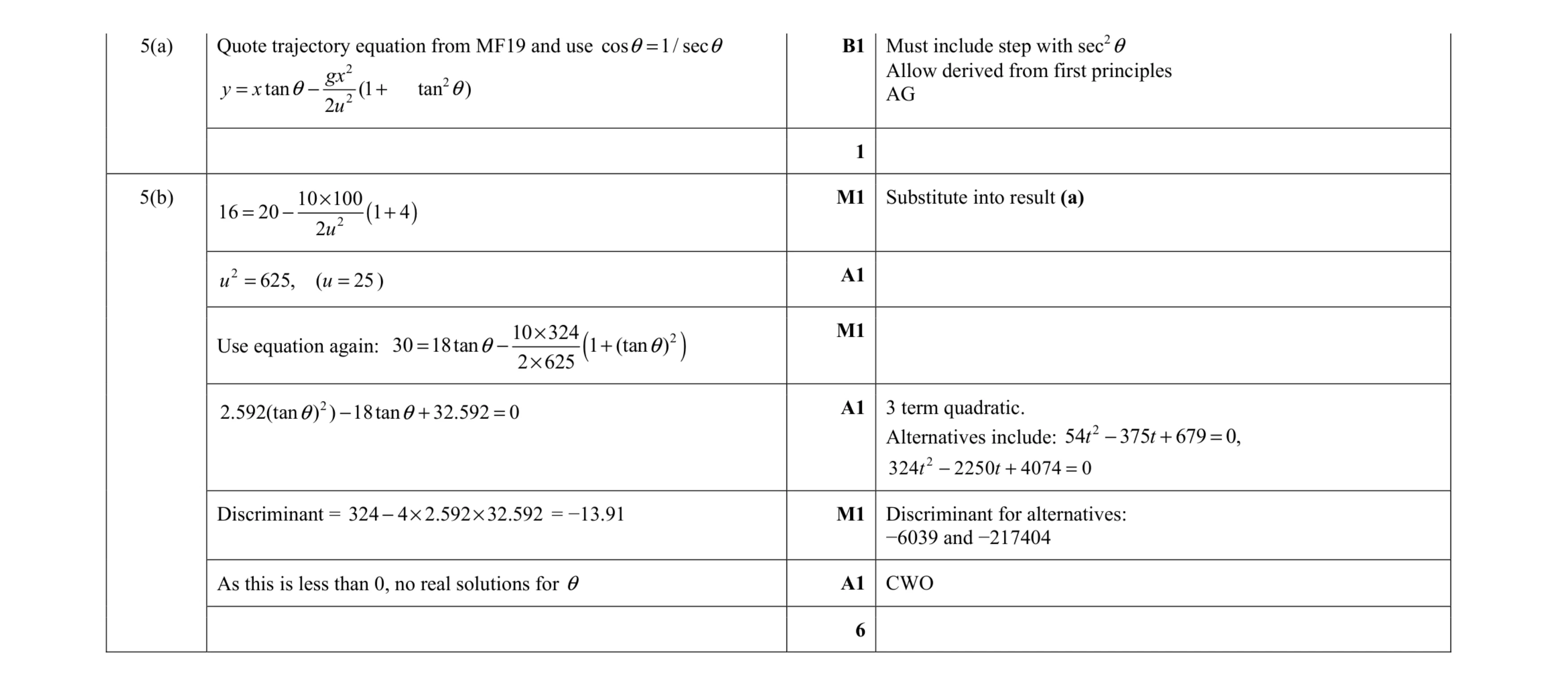 7
7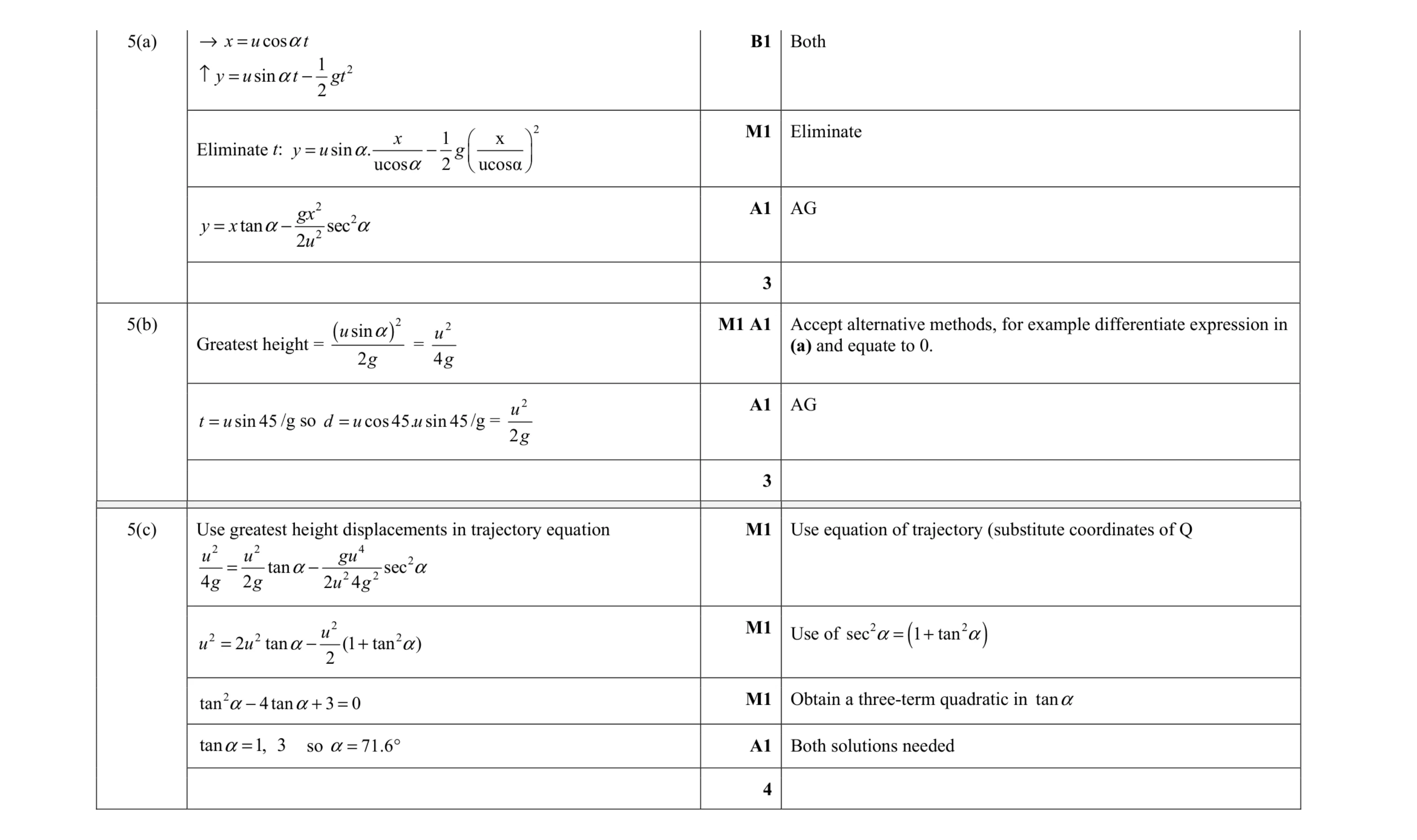 10
10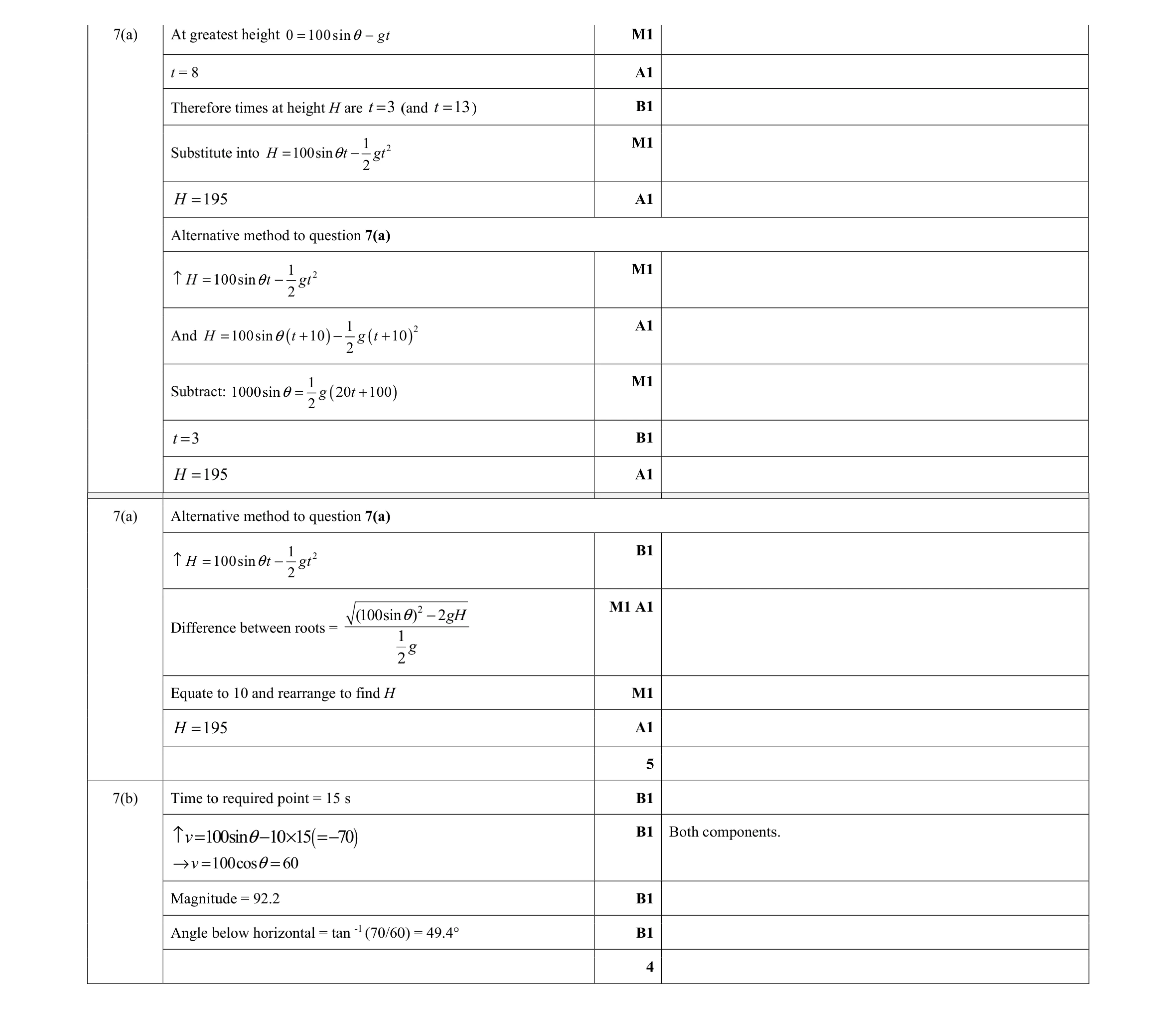 9
9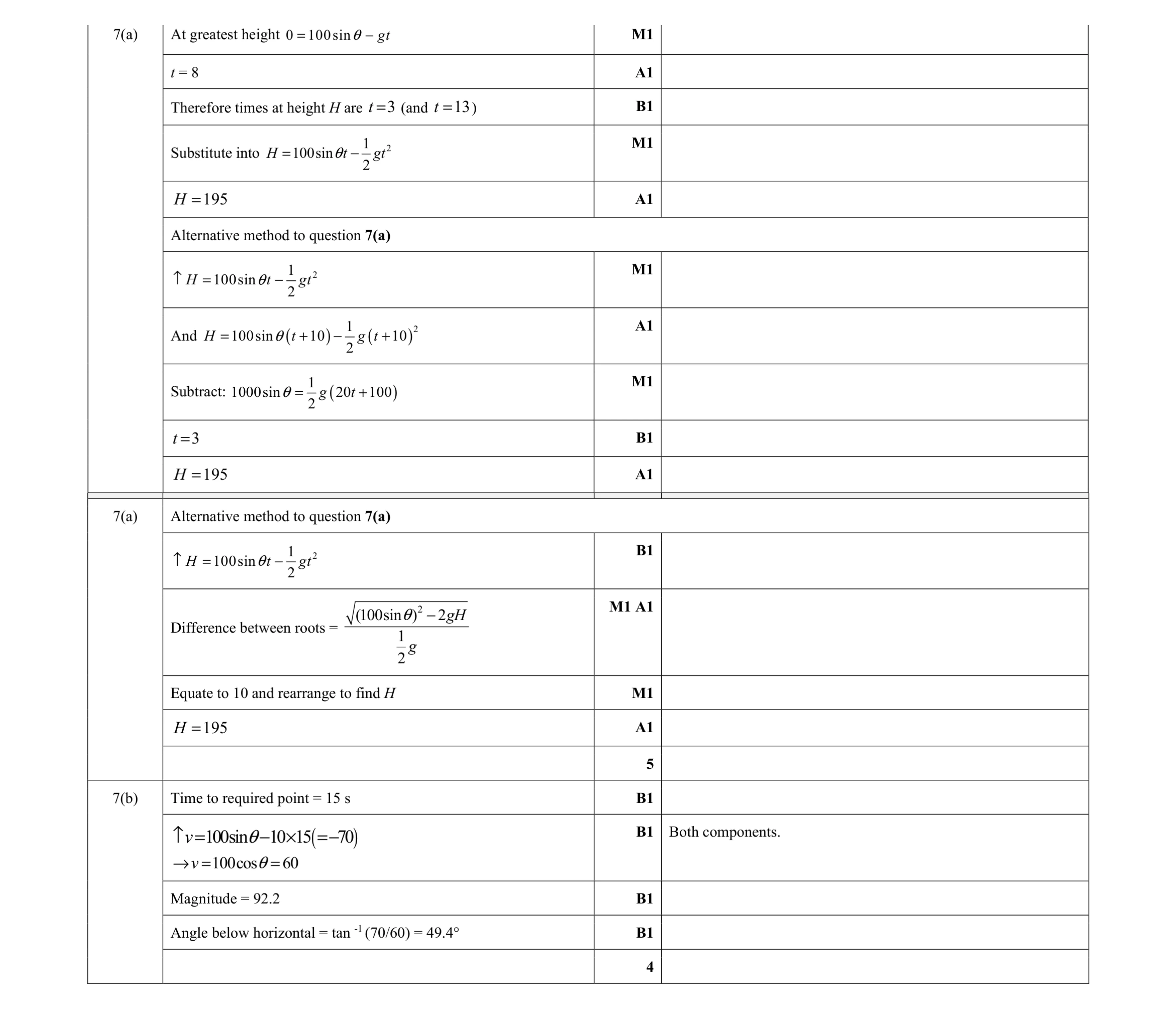 9
9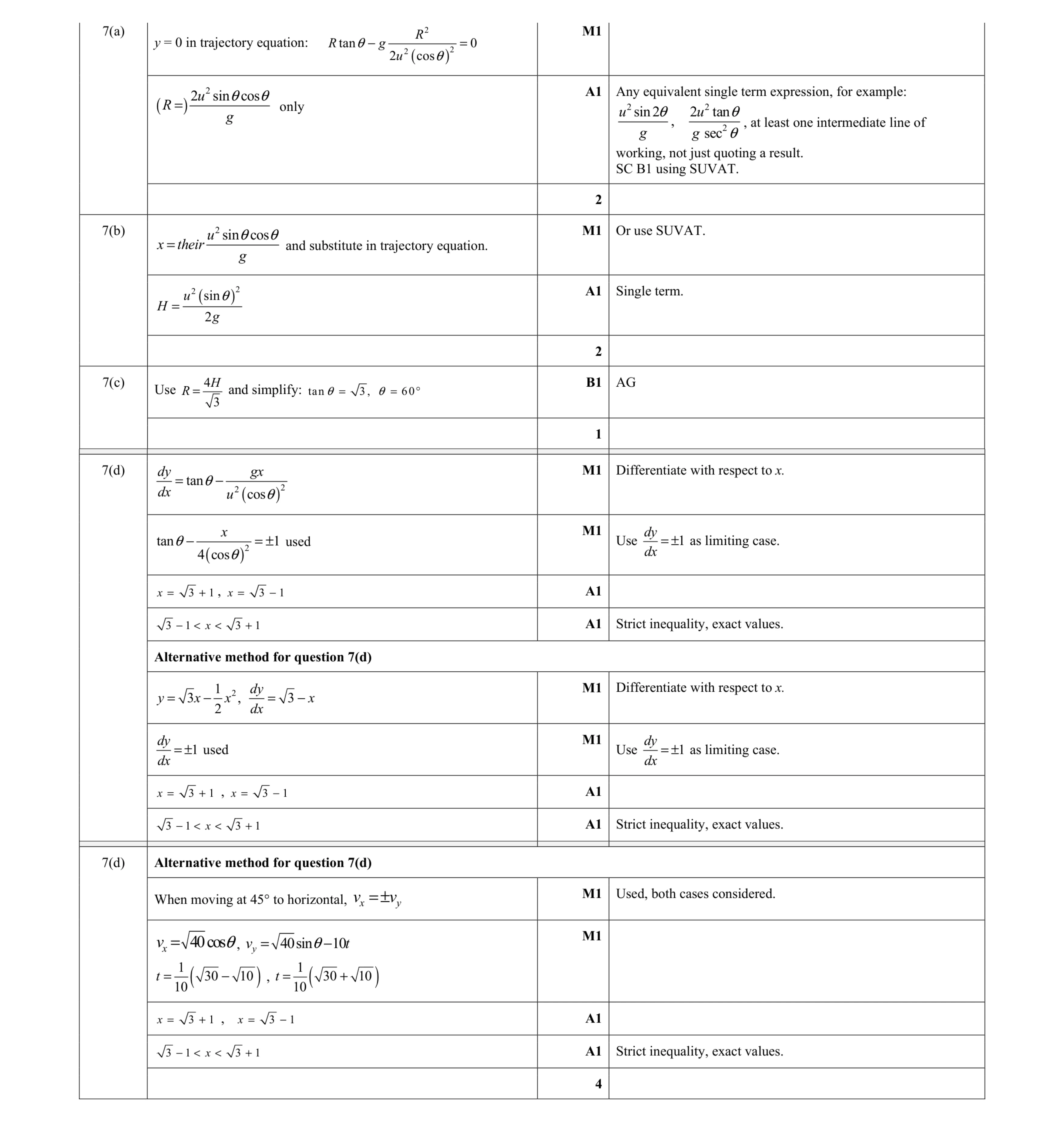 9
9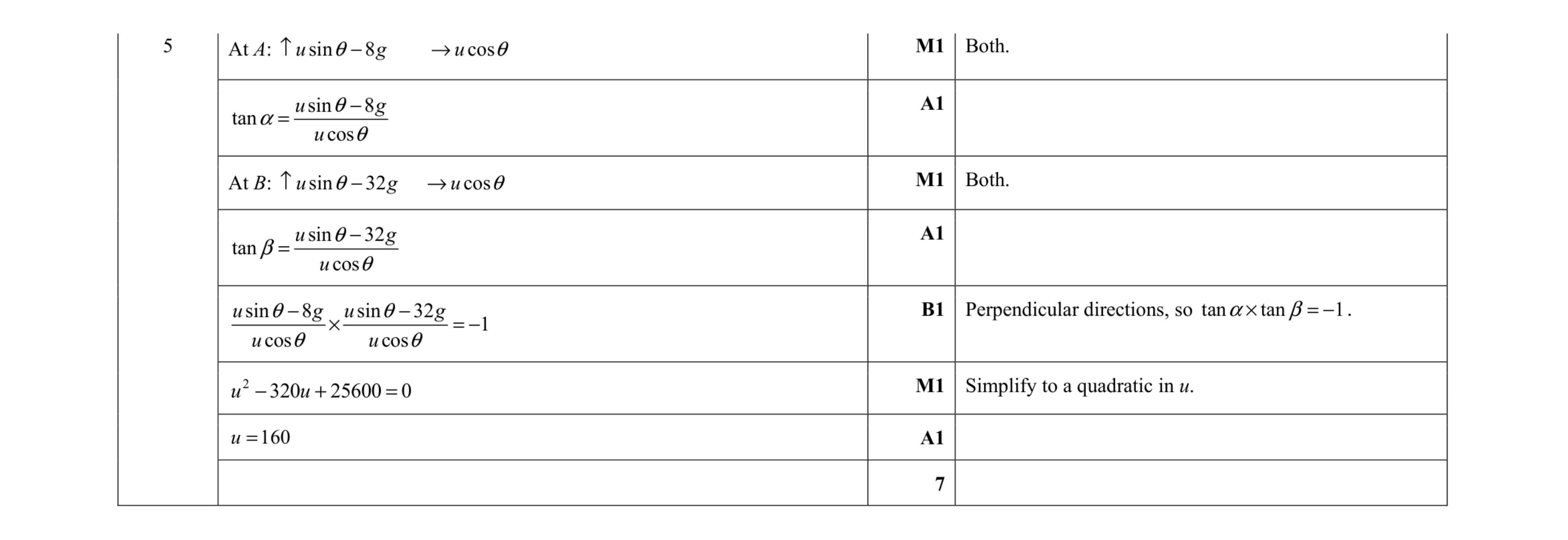 7
7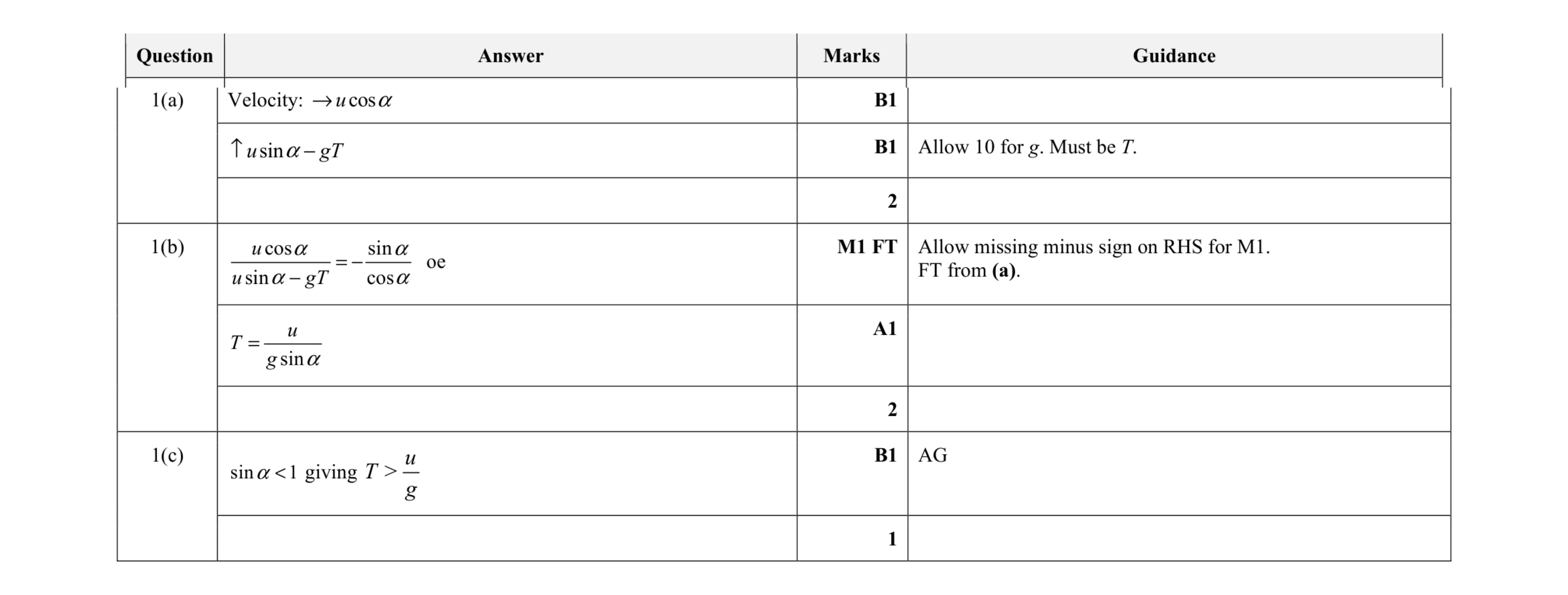 5
5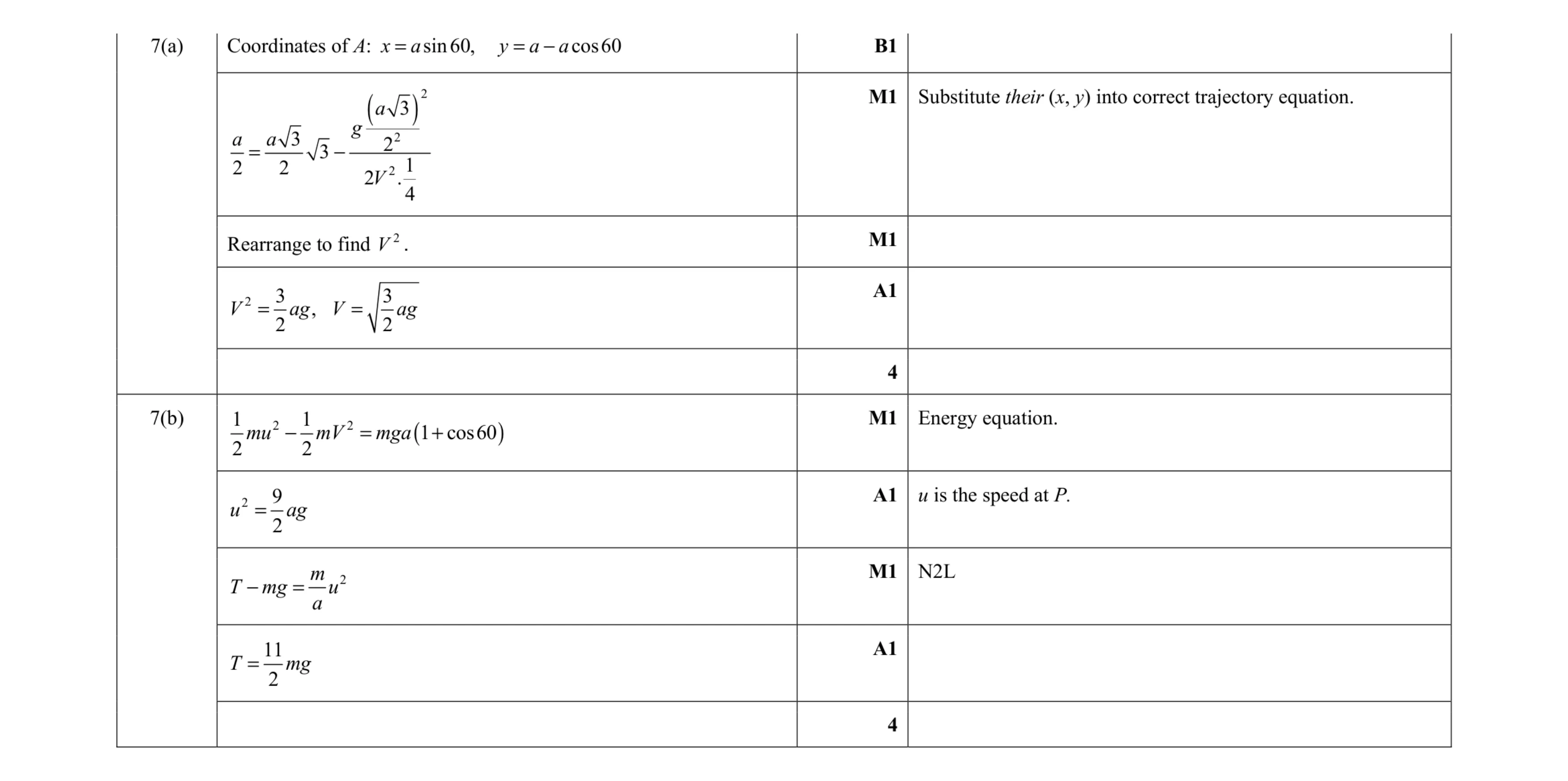 8
8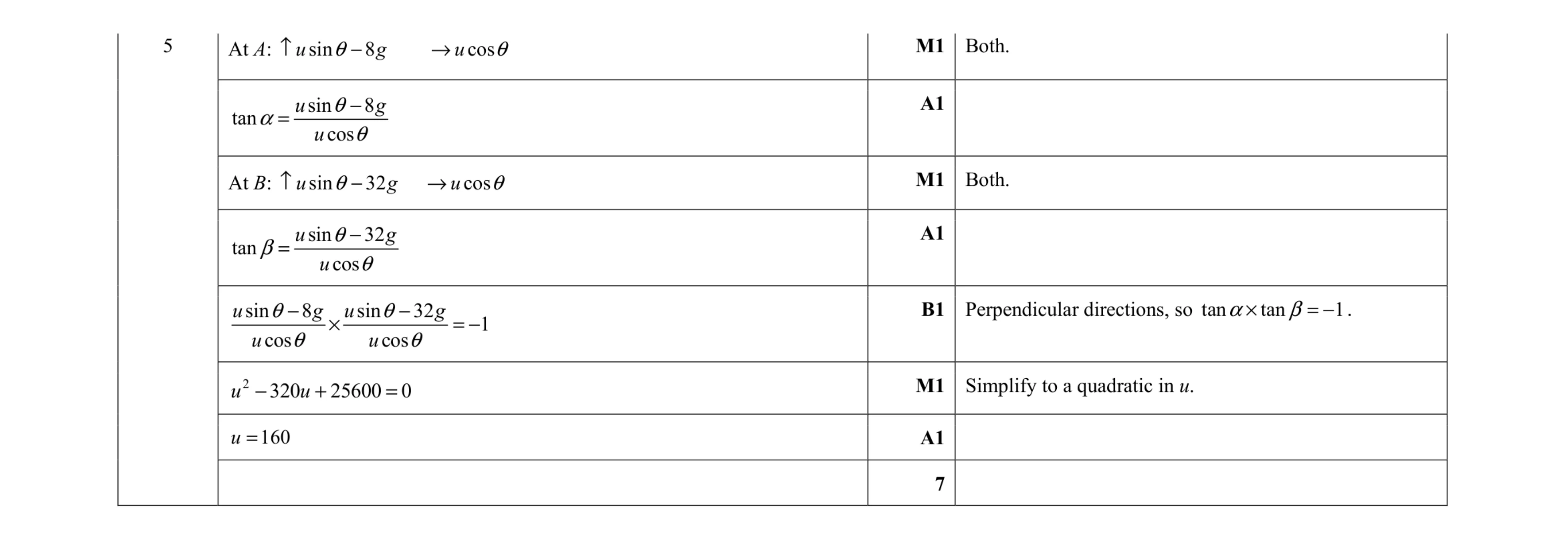 7
7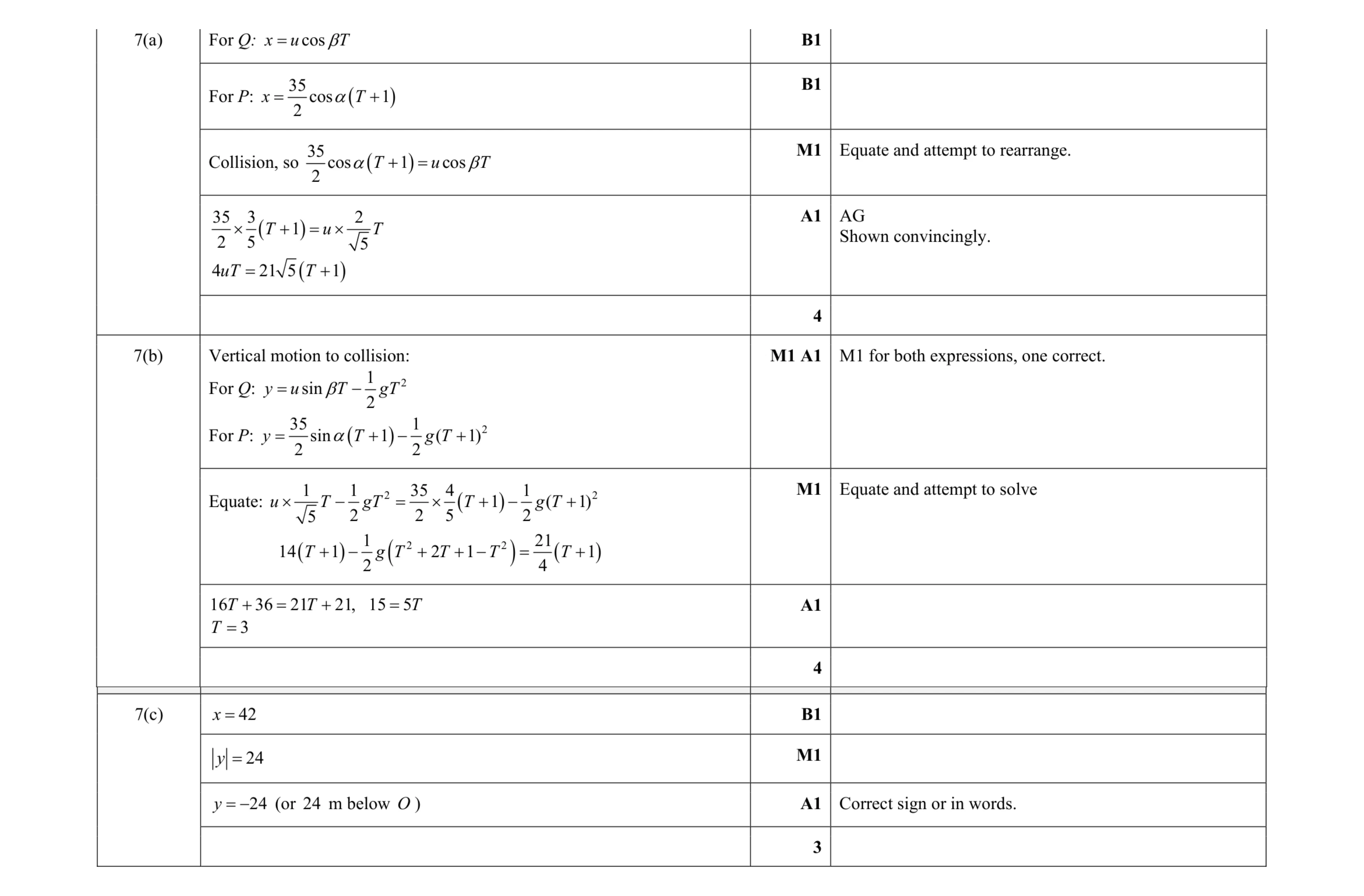 11
11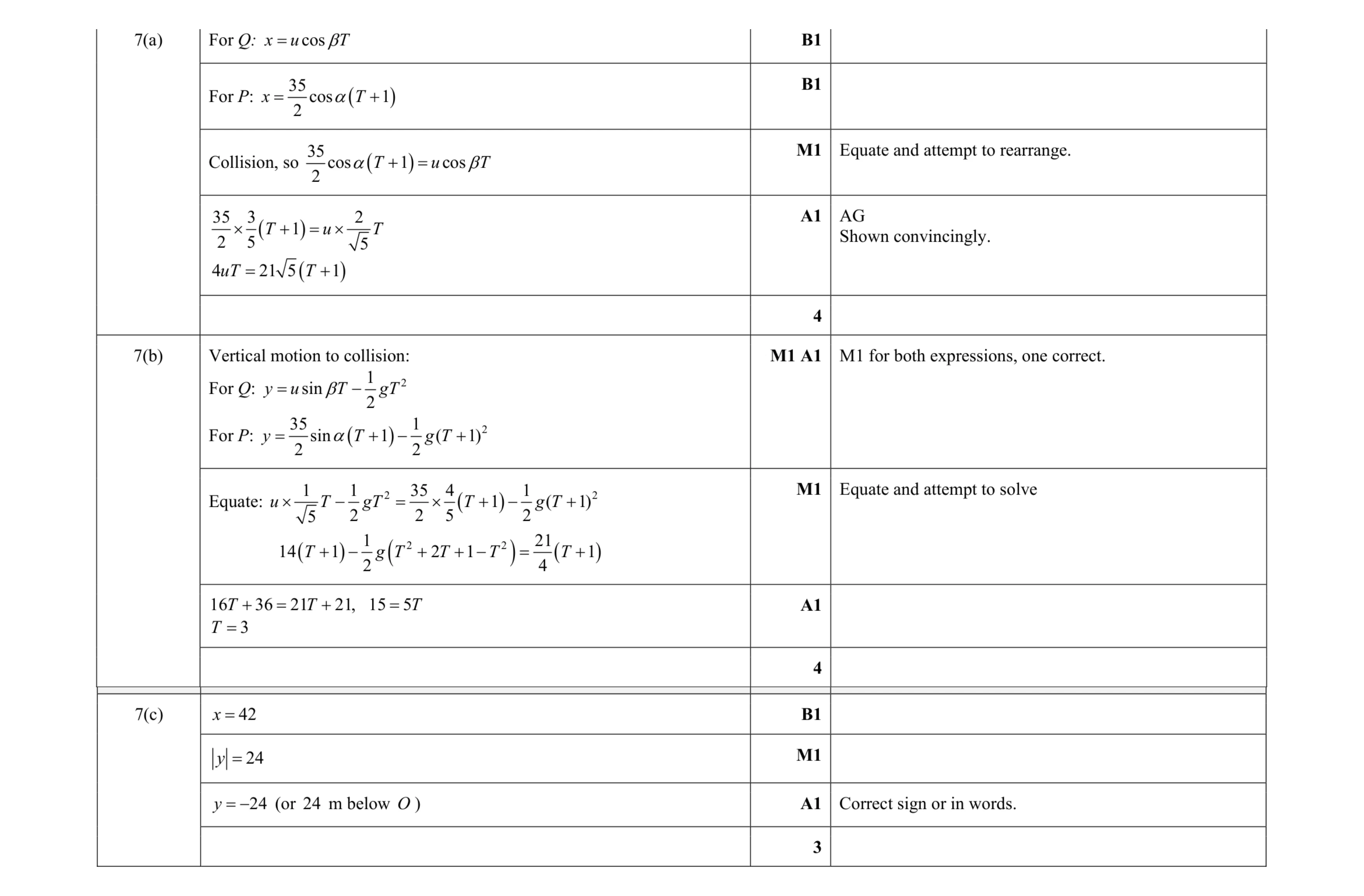 11
11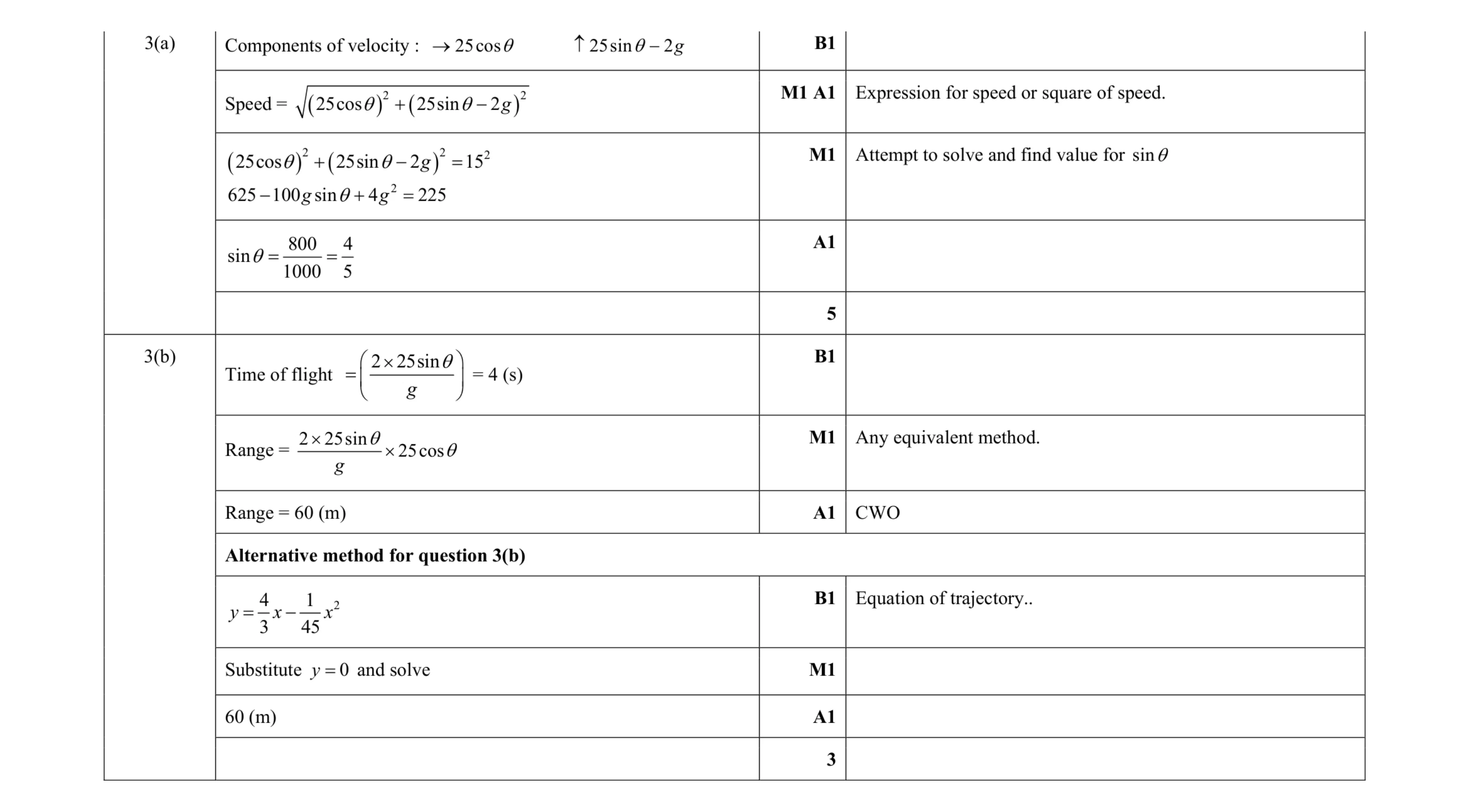 8
8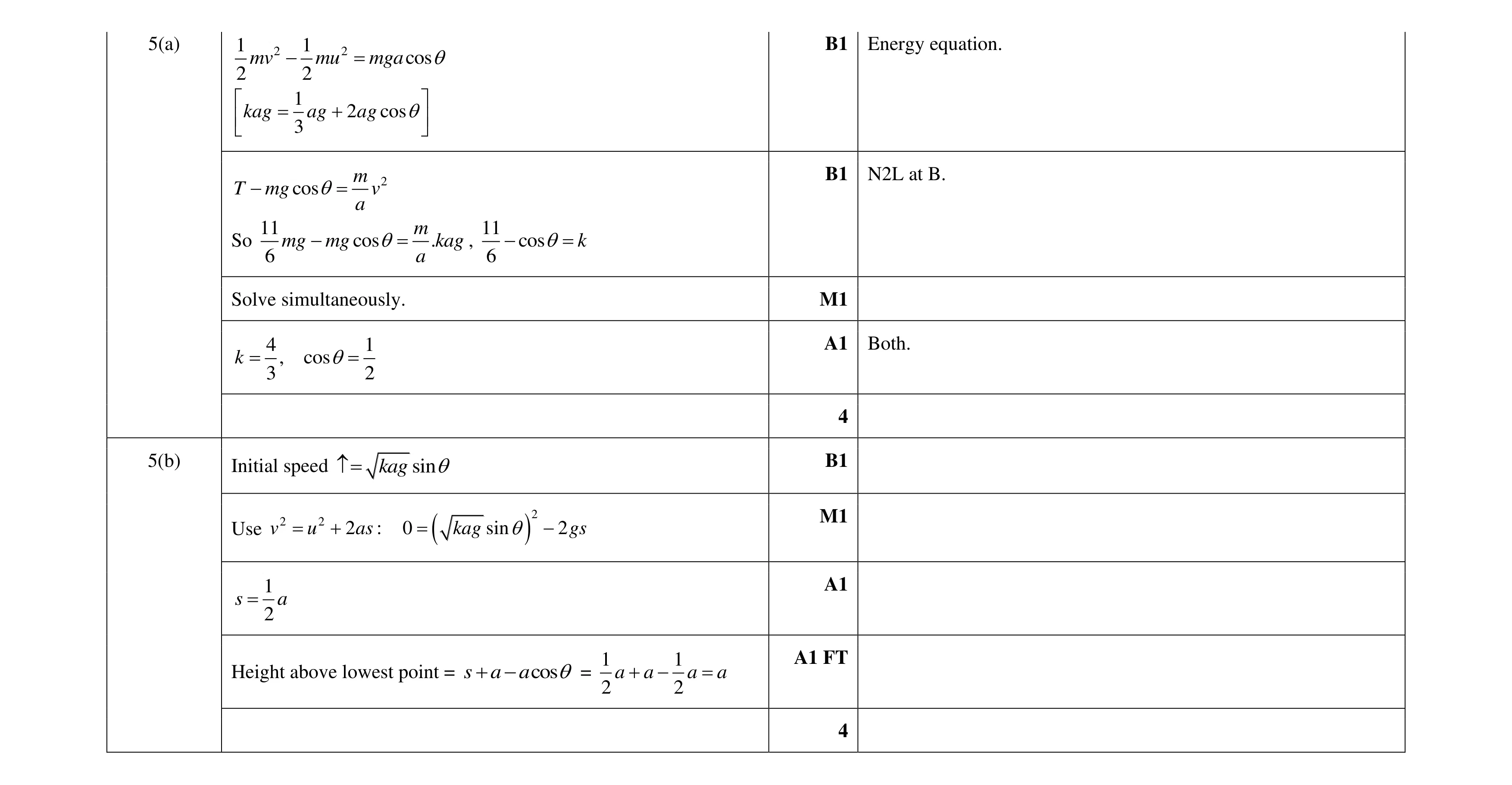 8
8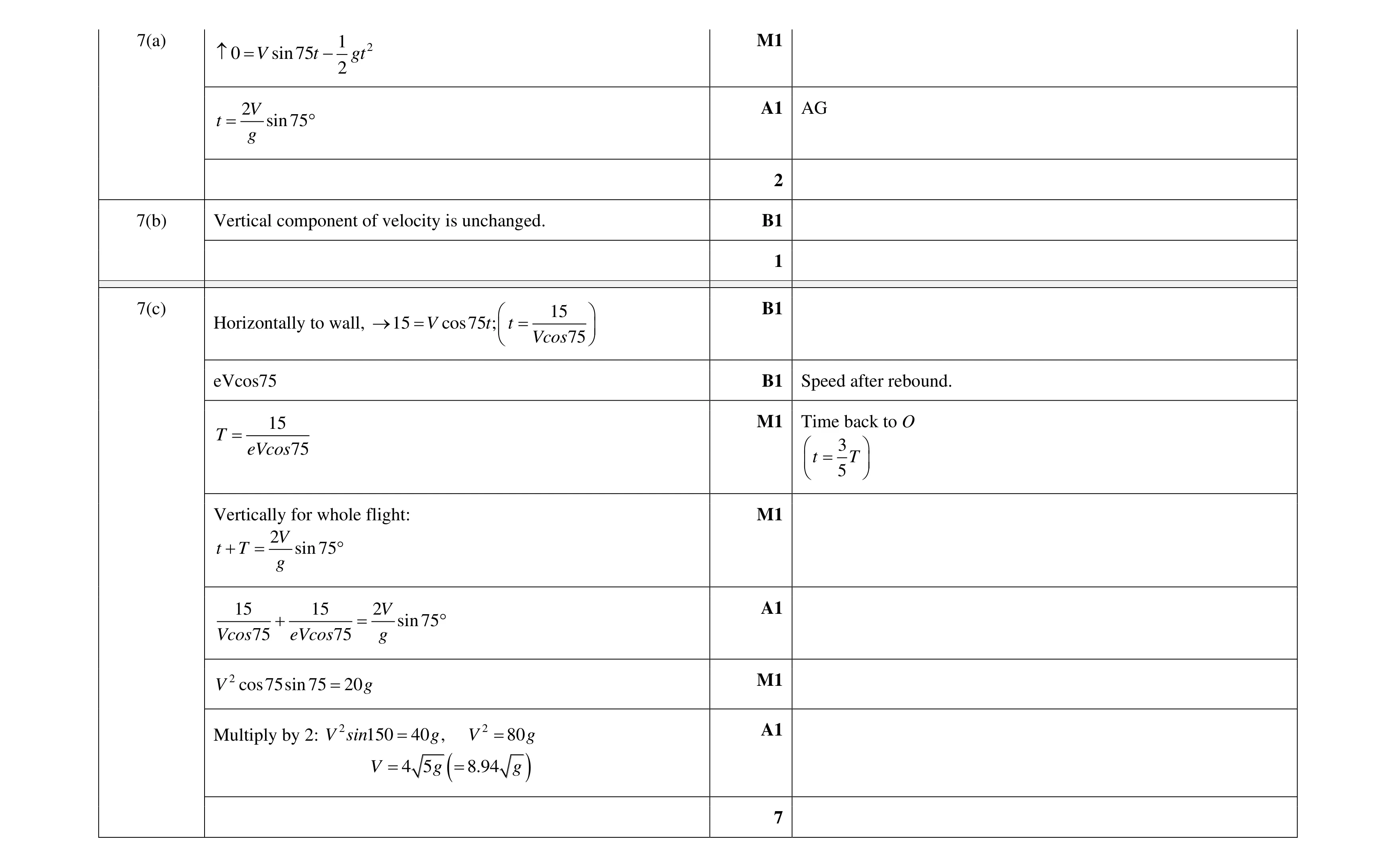 10
10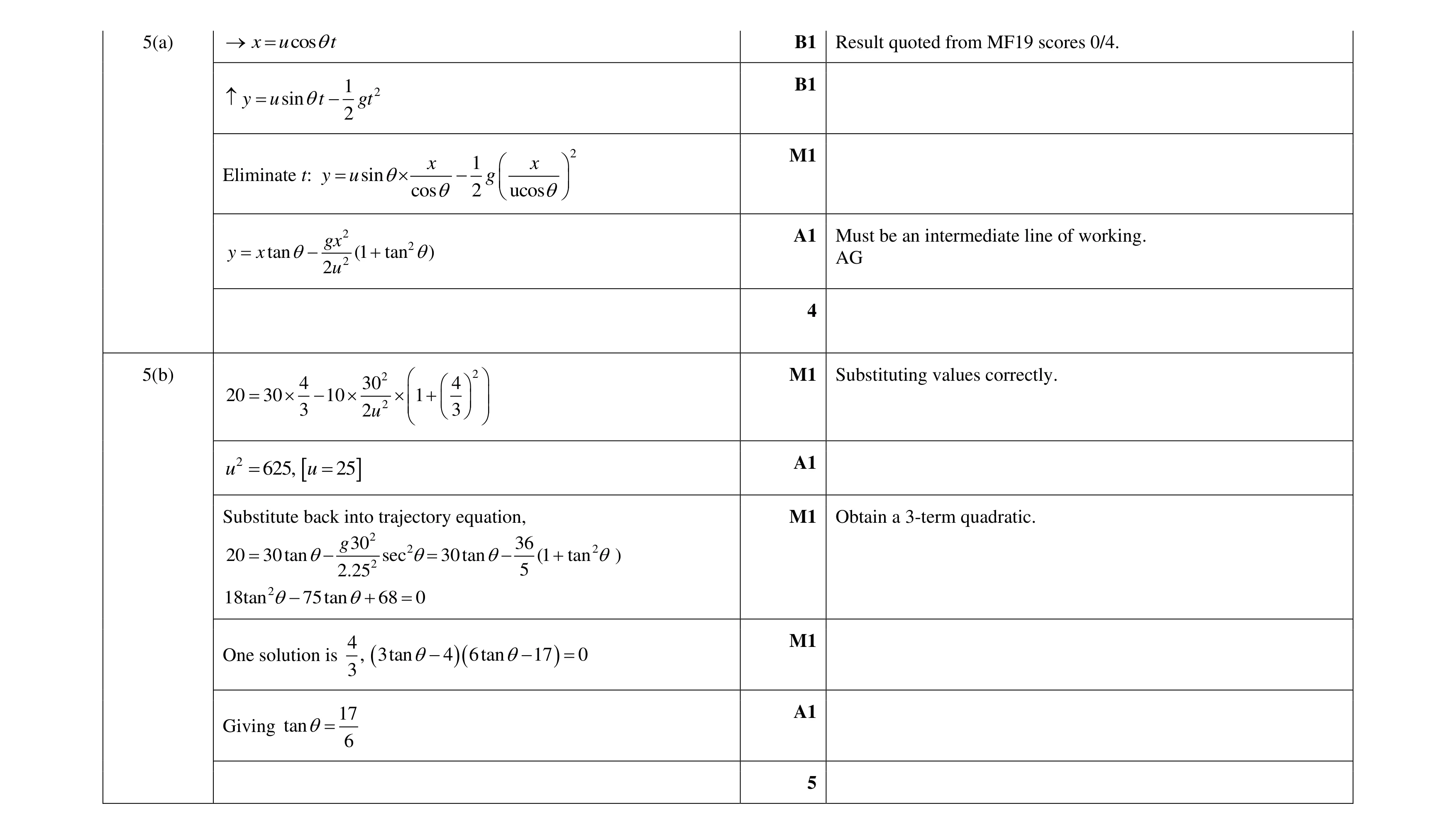 9
9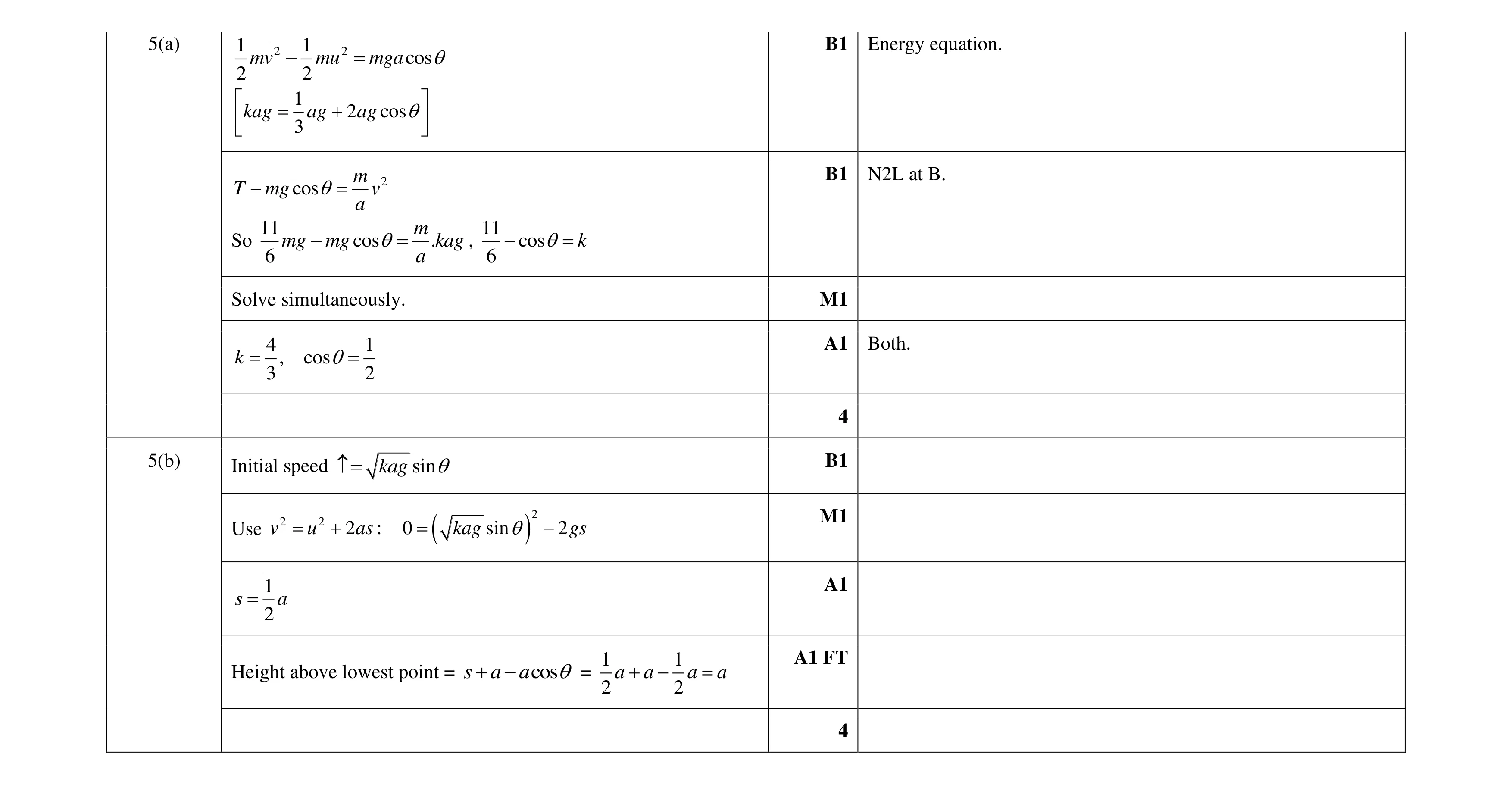 8
8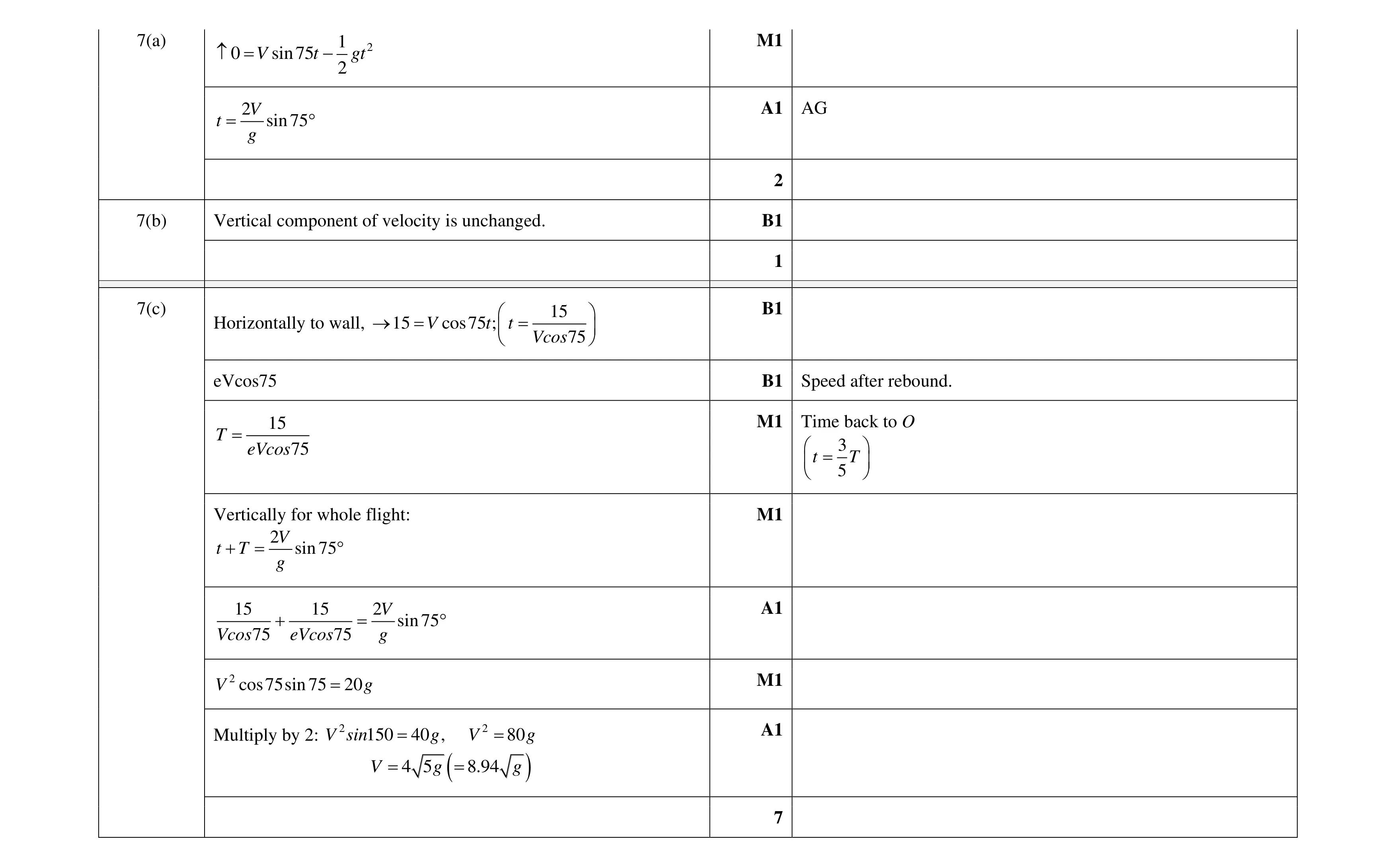 10
10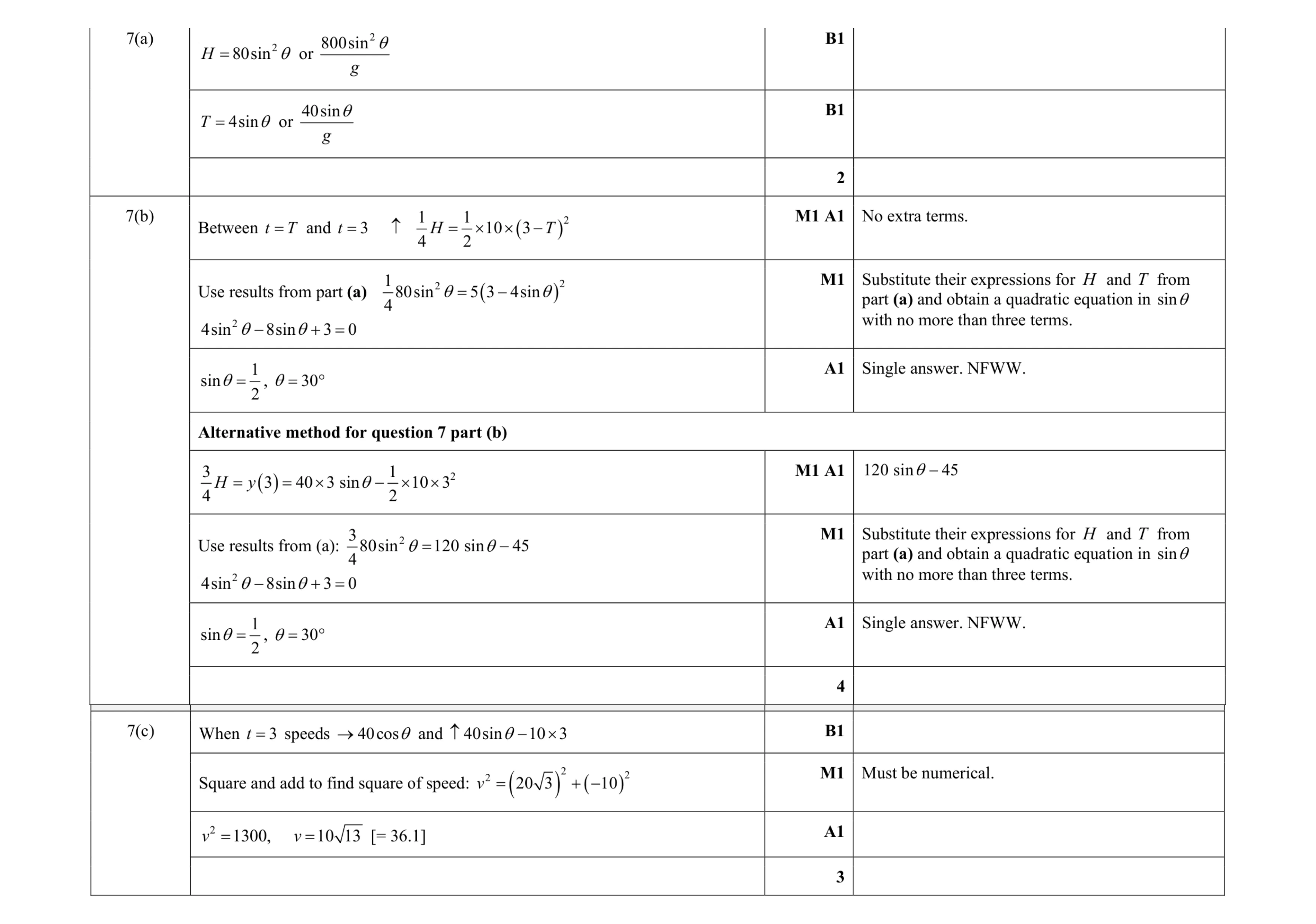 9
9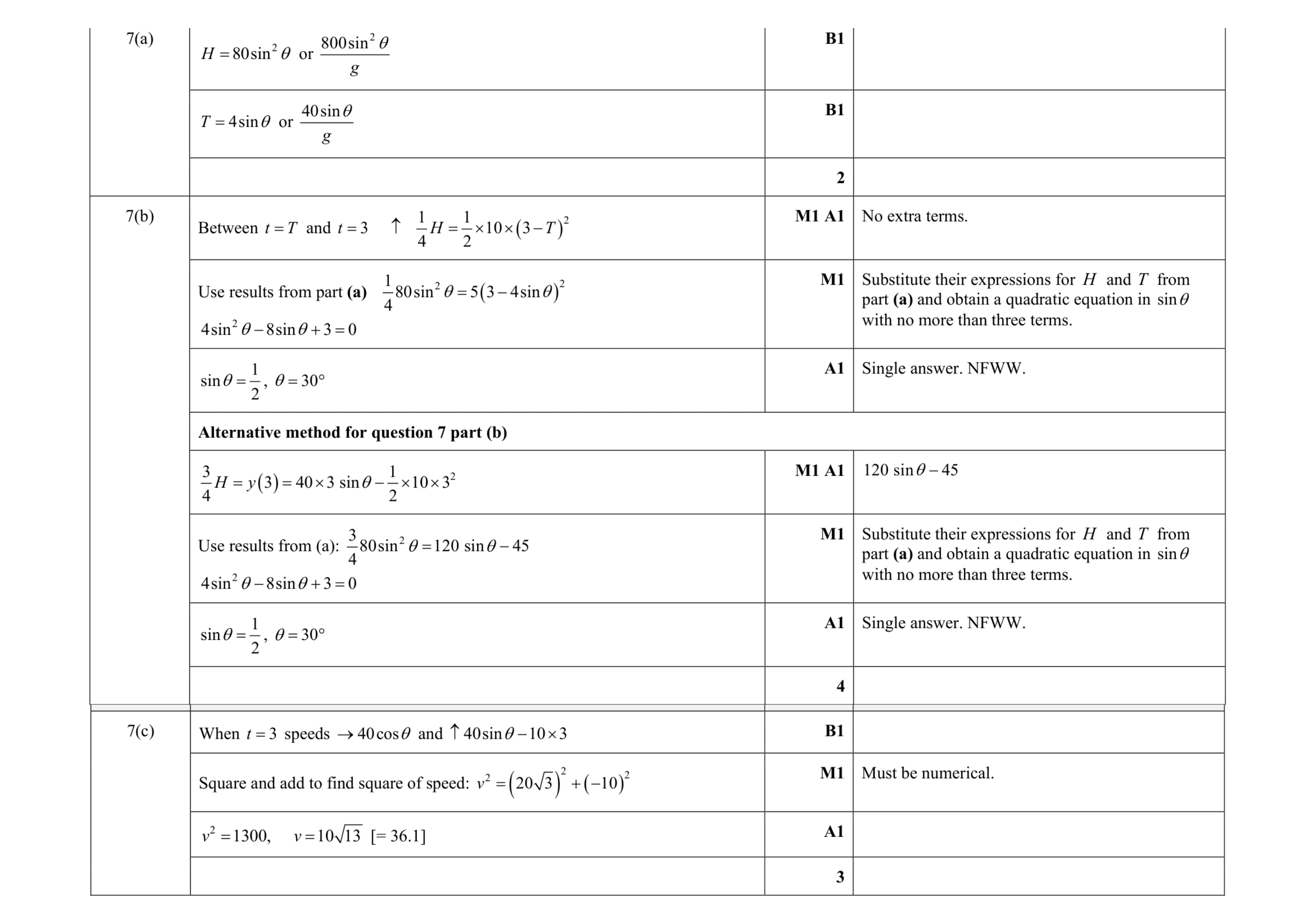 9
9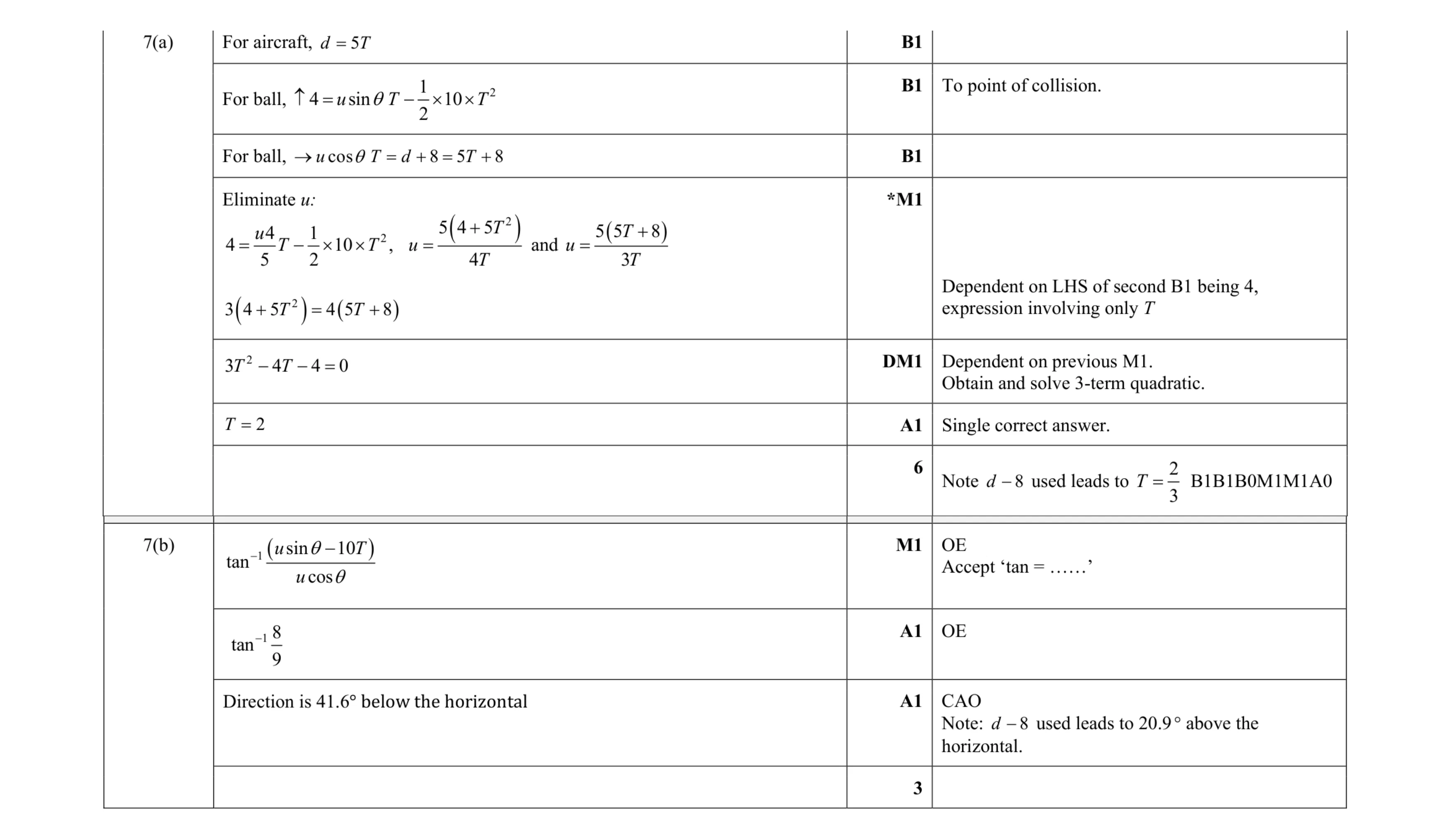 9
9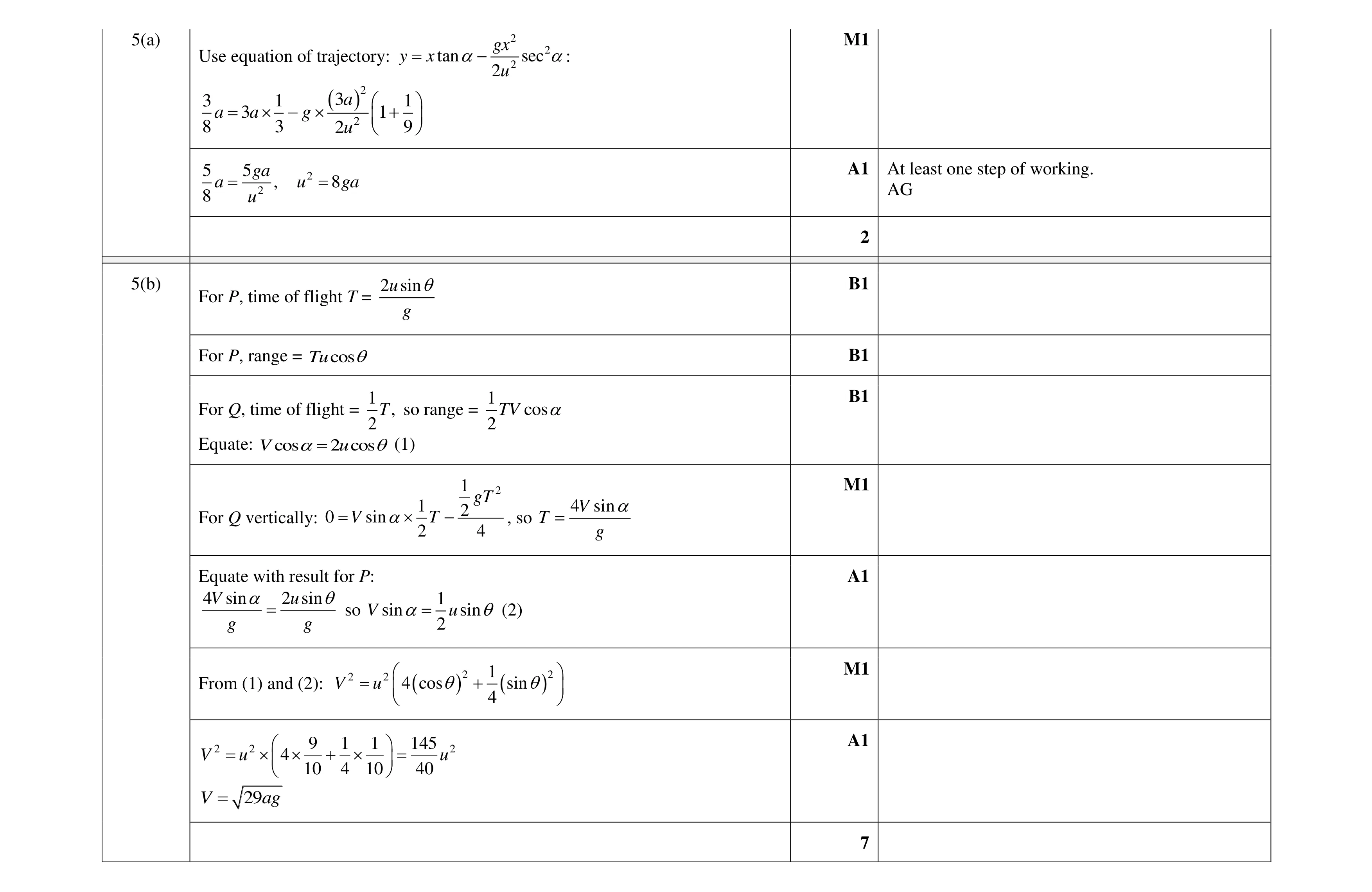 9
9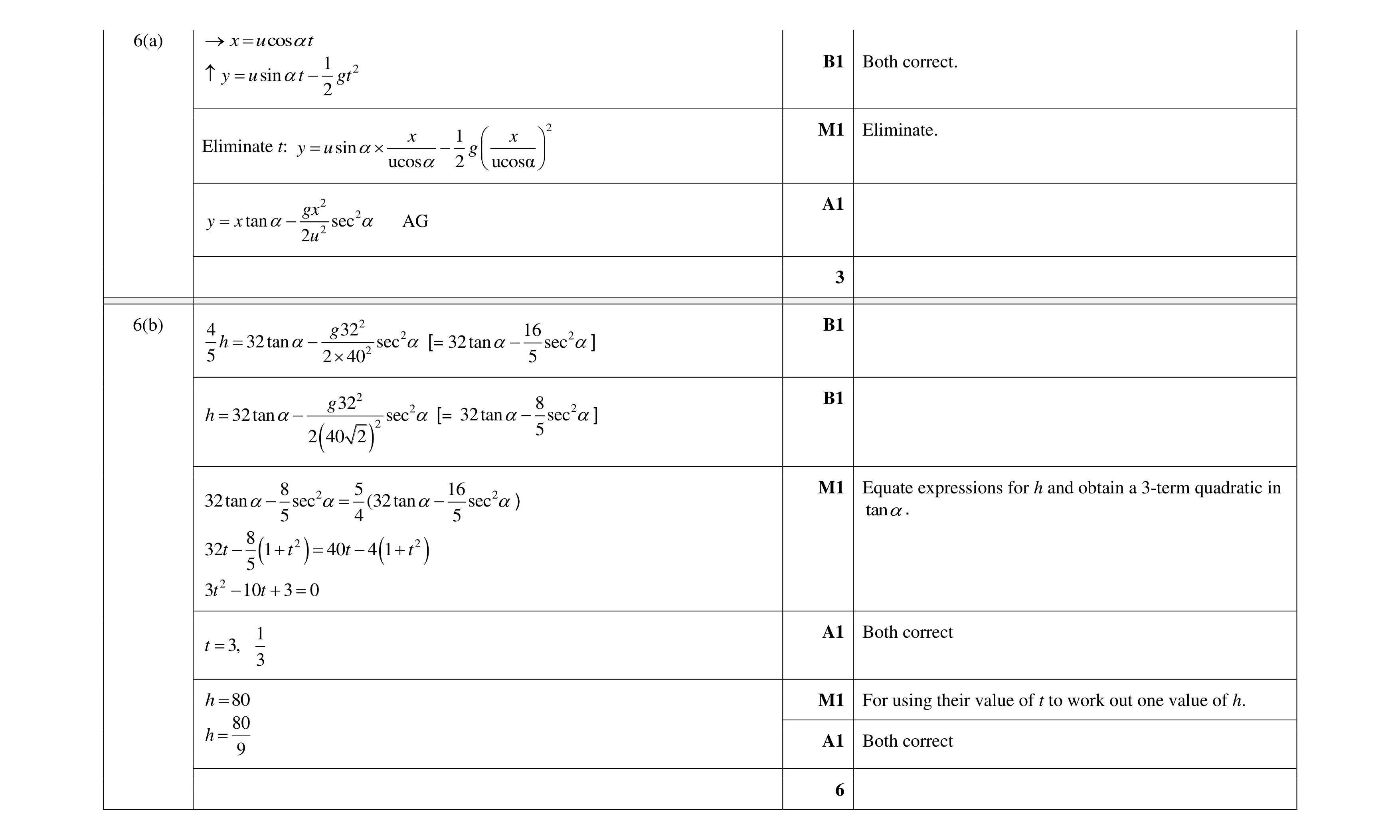 9
9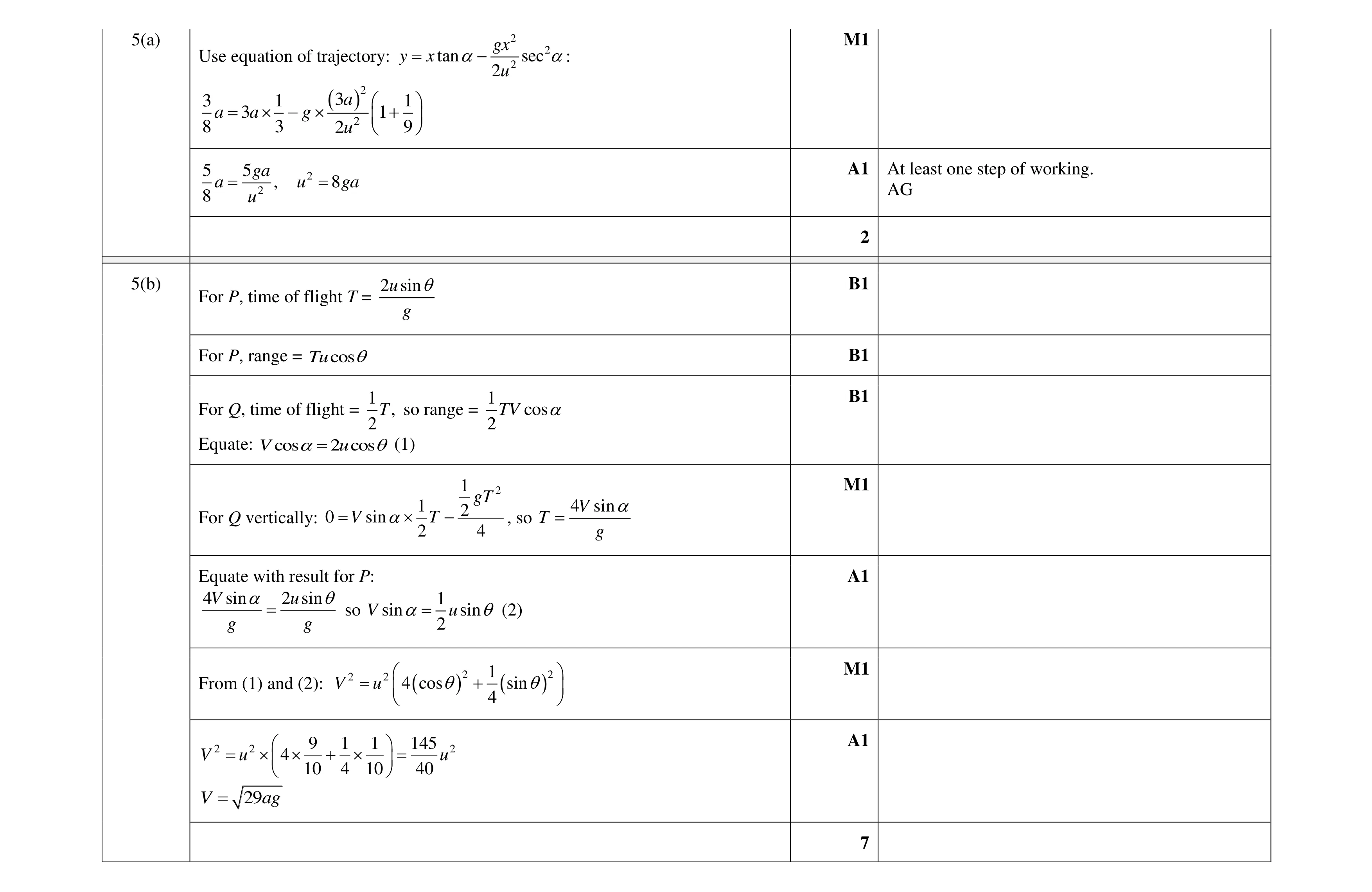 9
9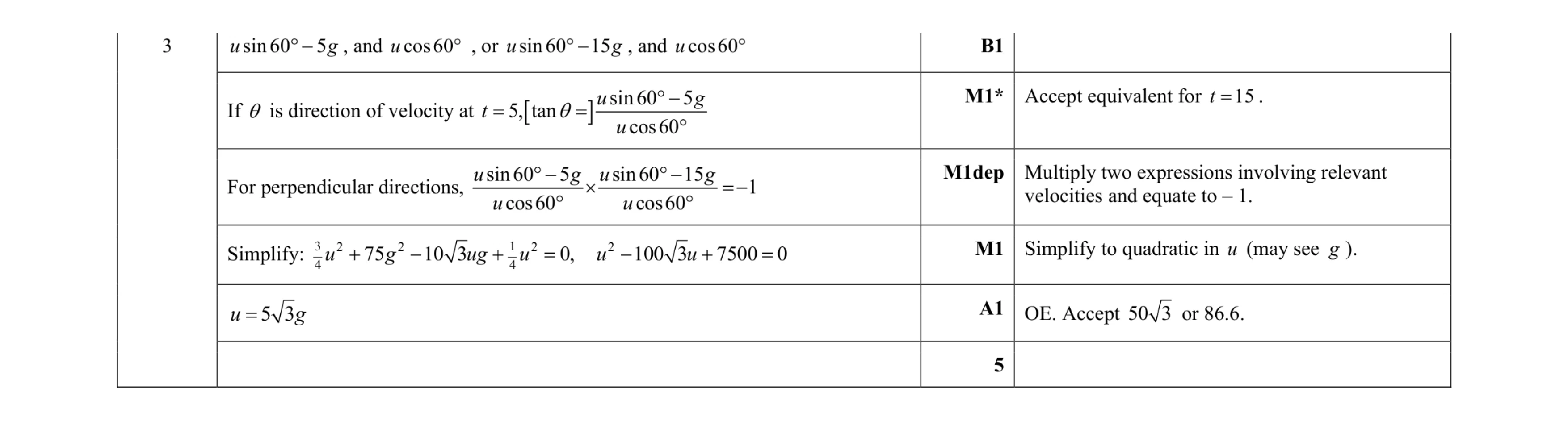 5
5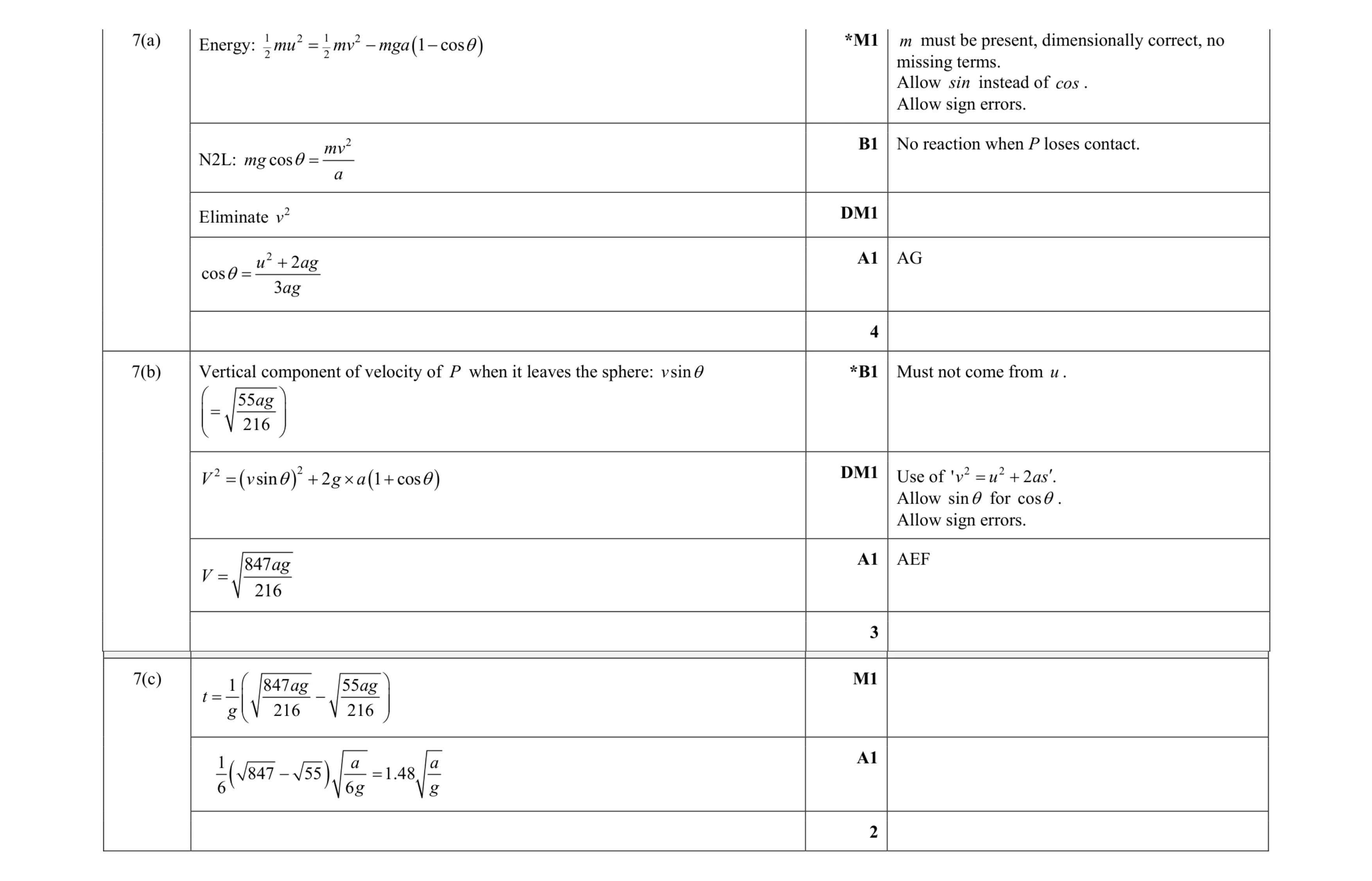 9
9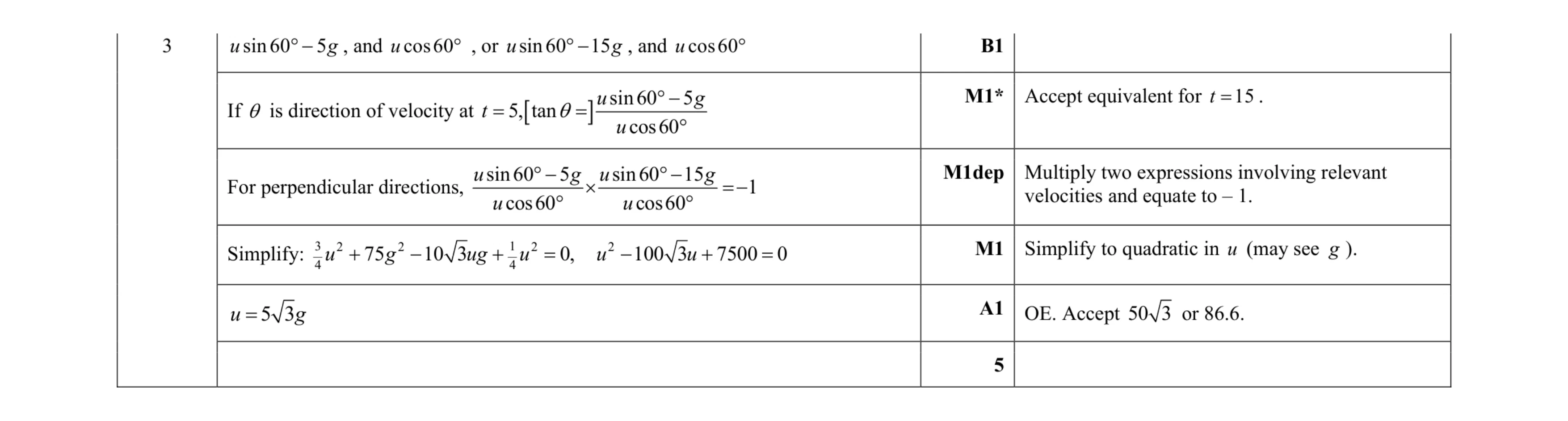 5
5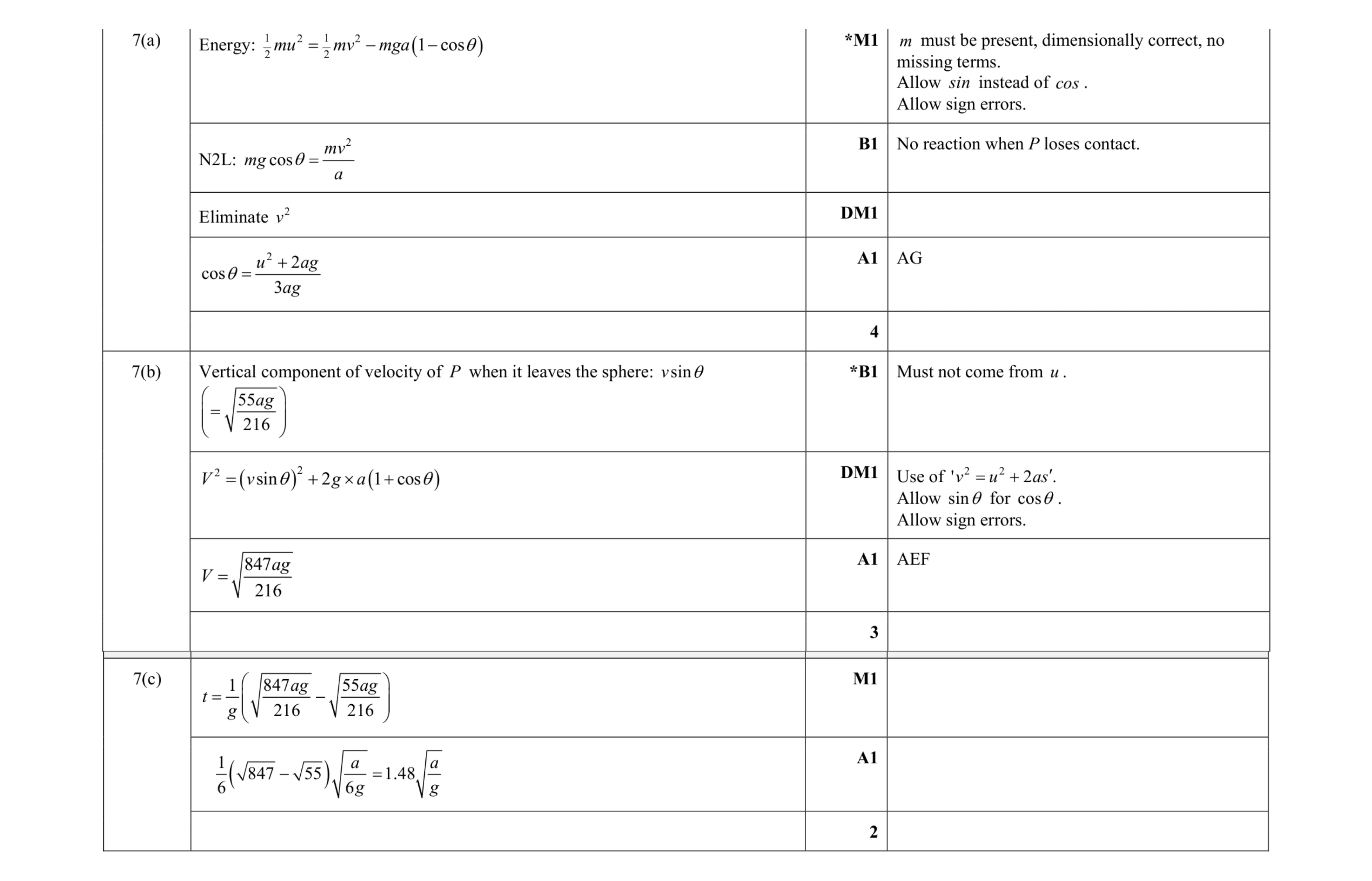 9
9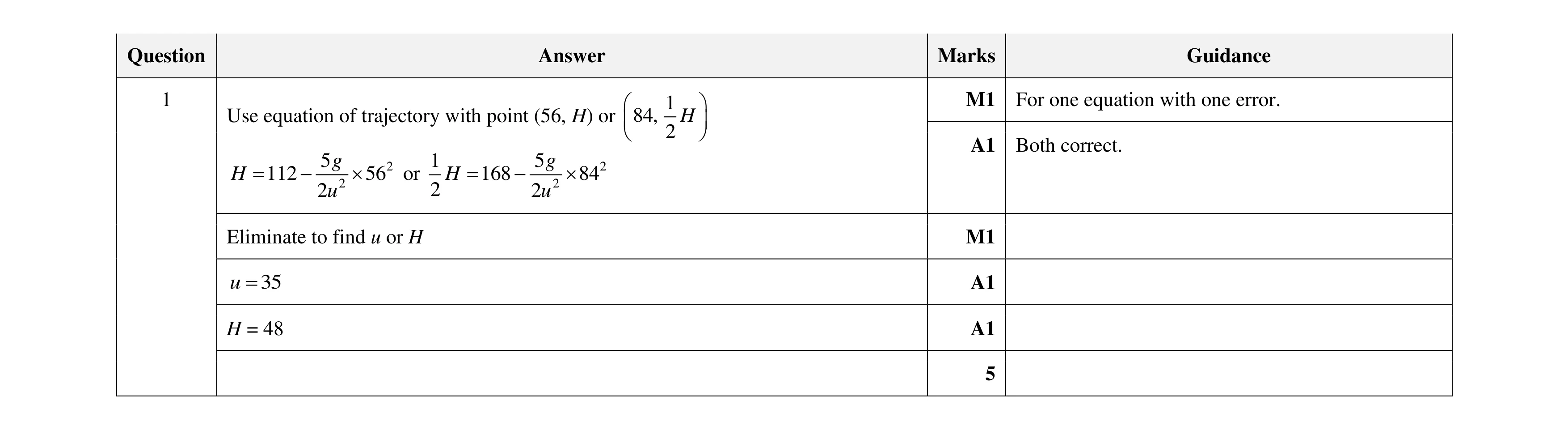 5
5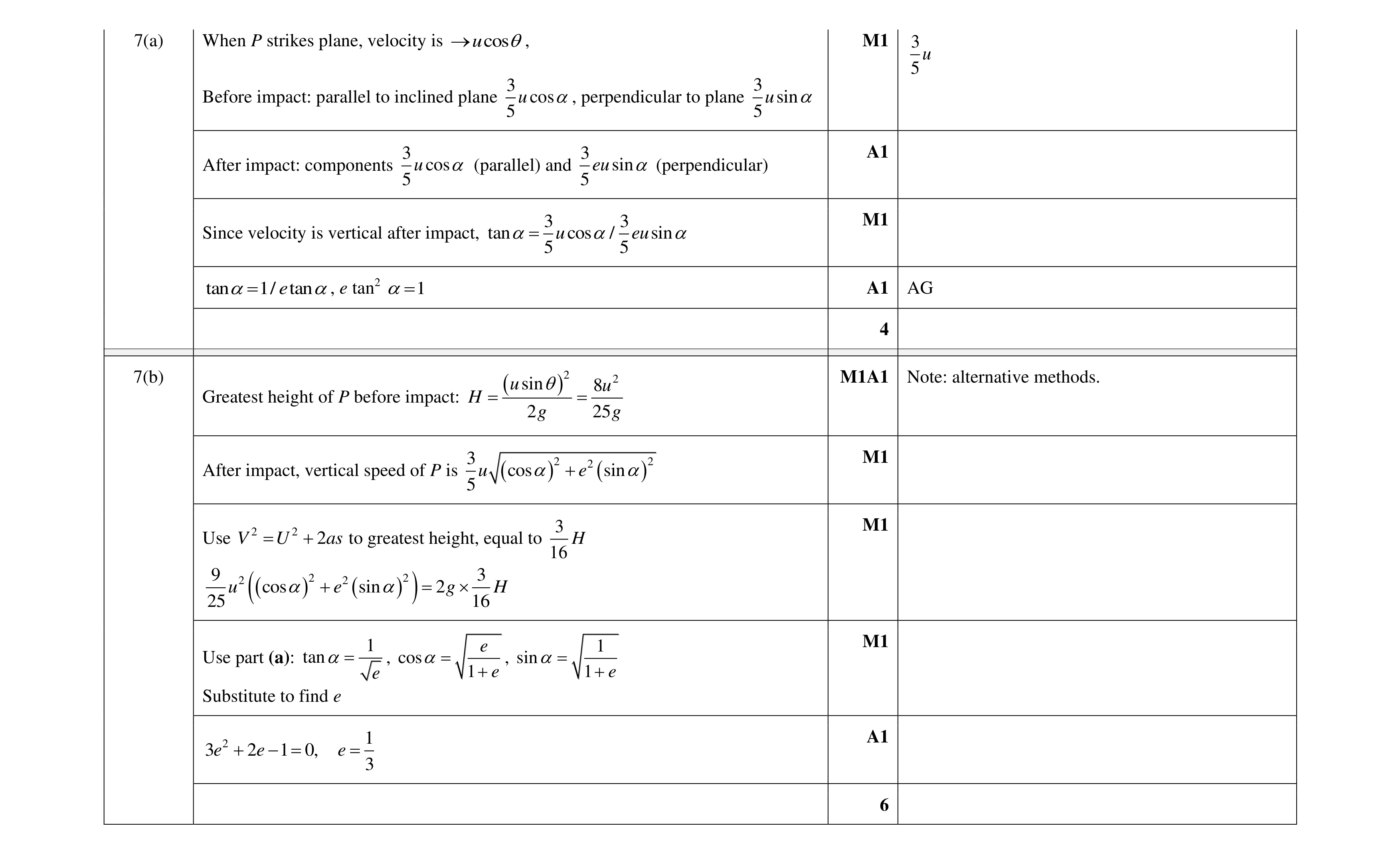 10
10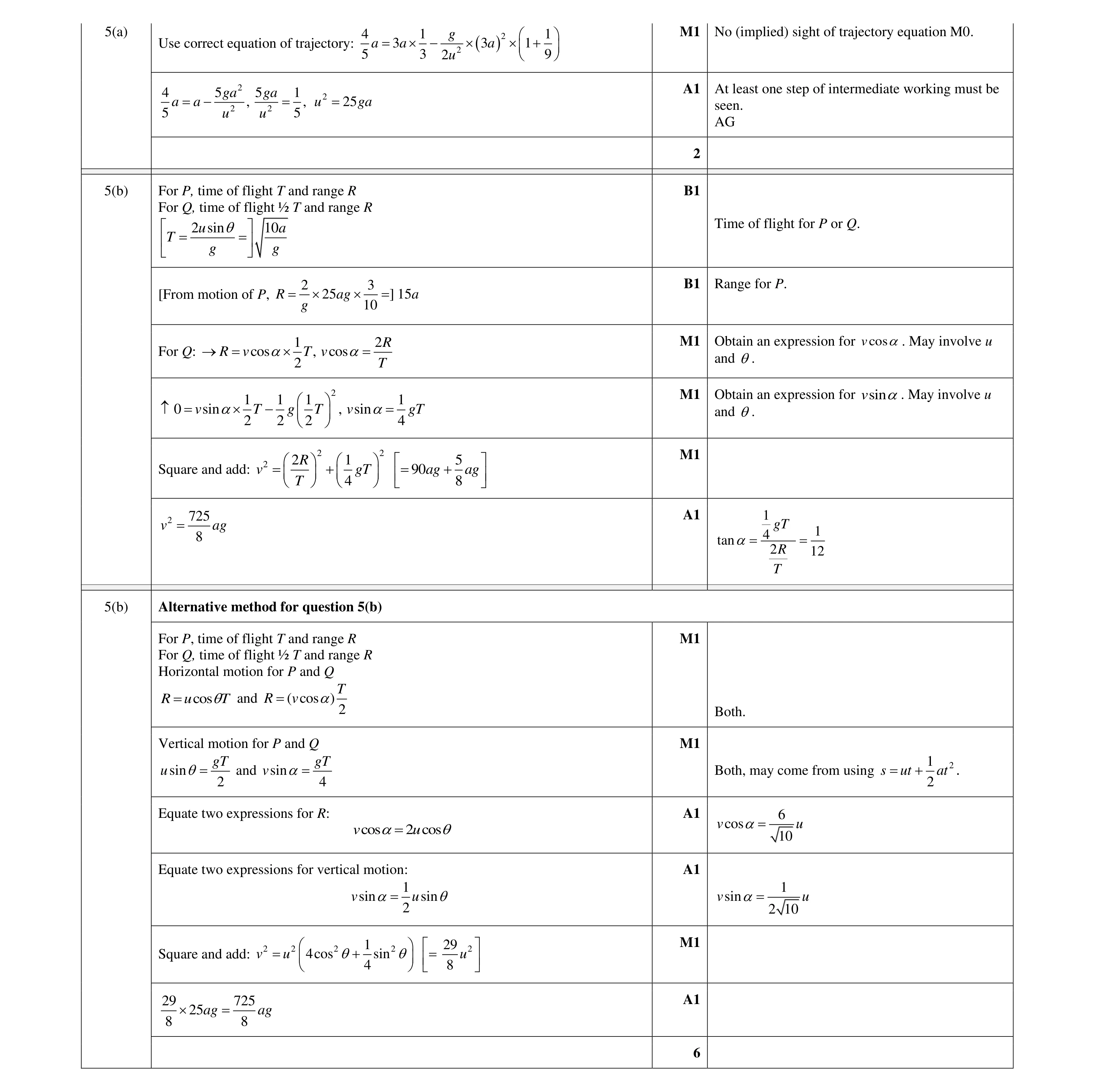 8
8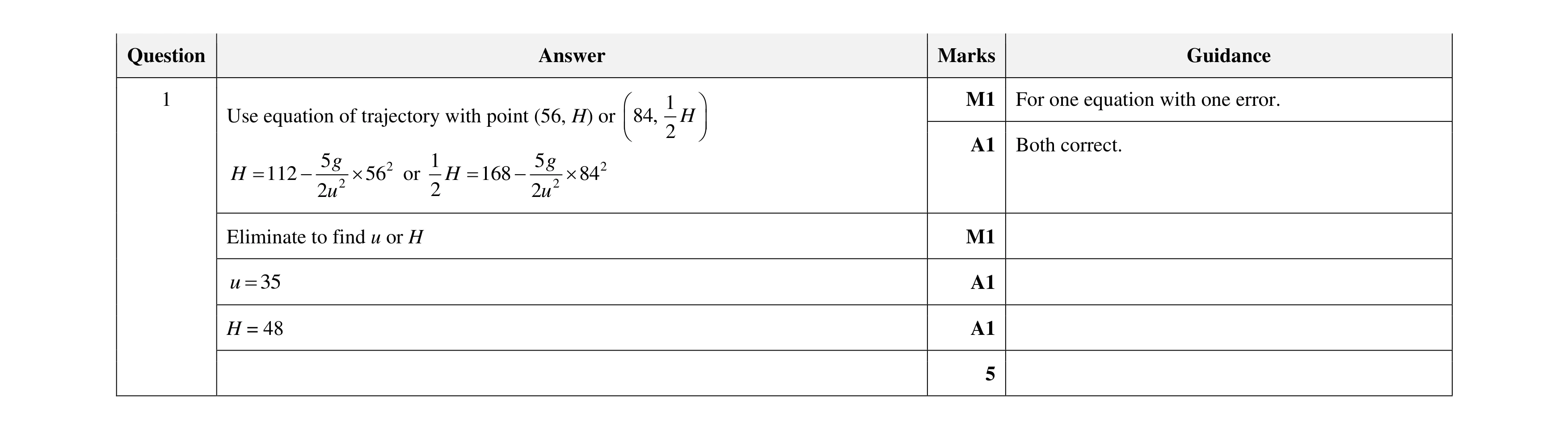 5
5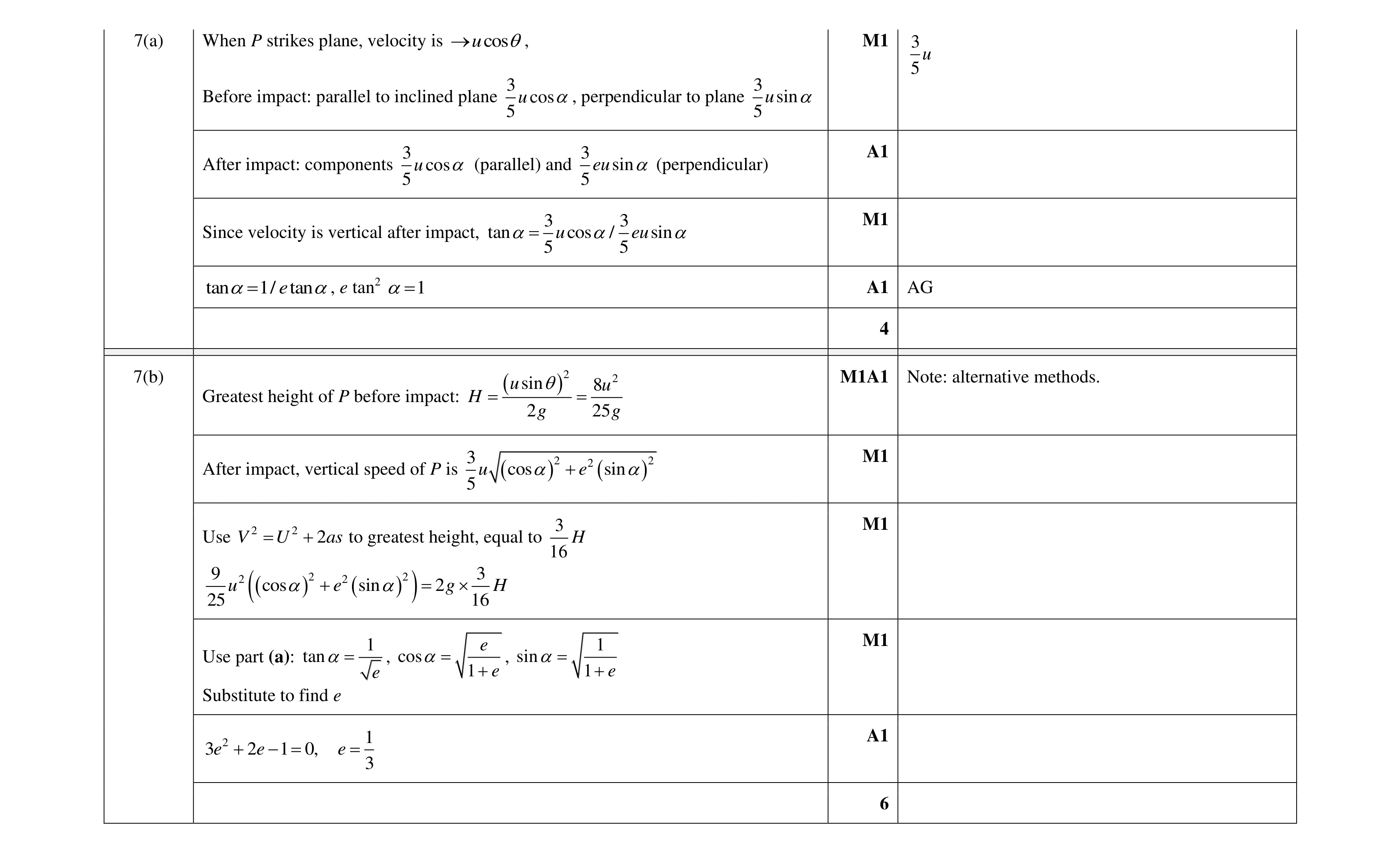 10
10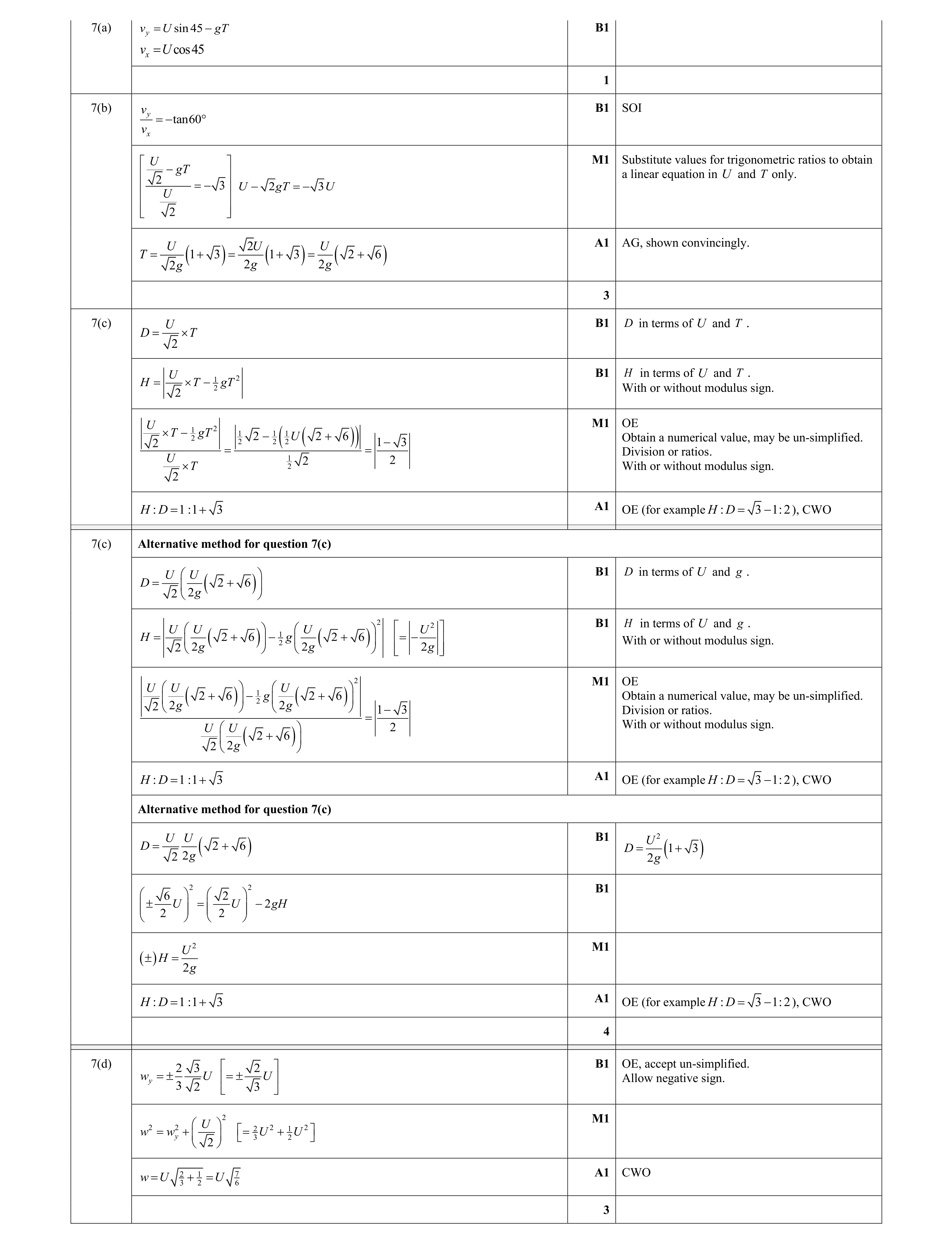 11
11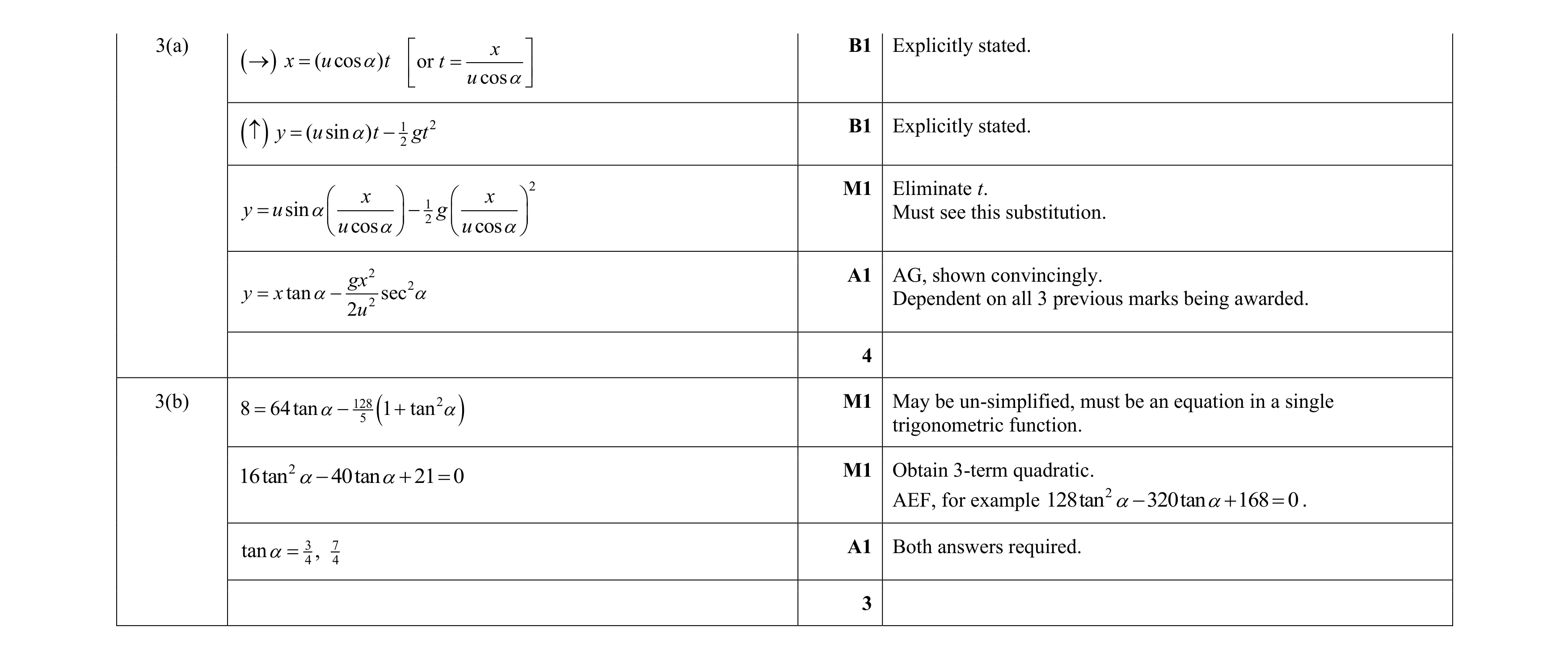 7
7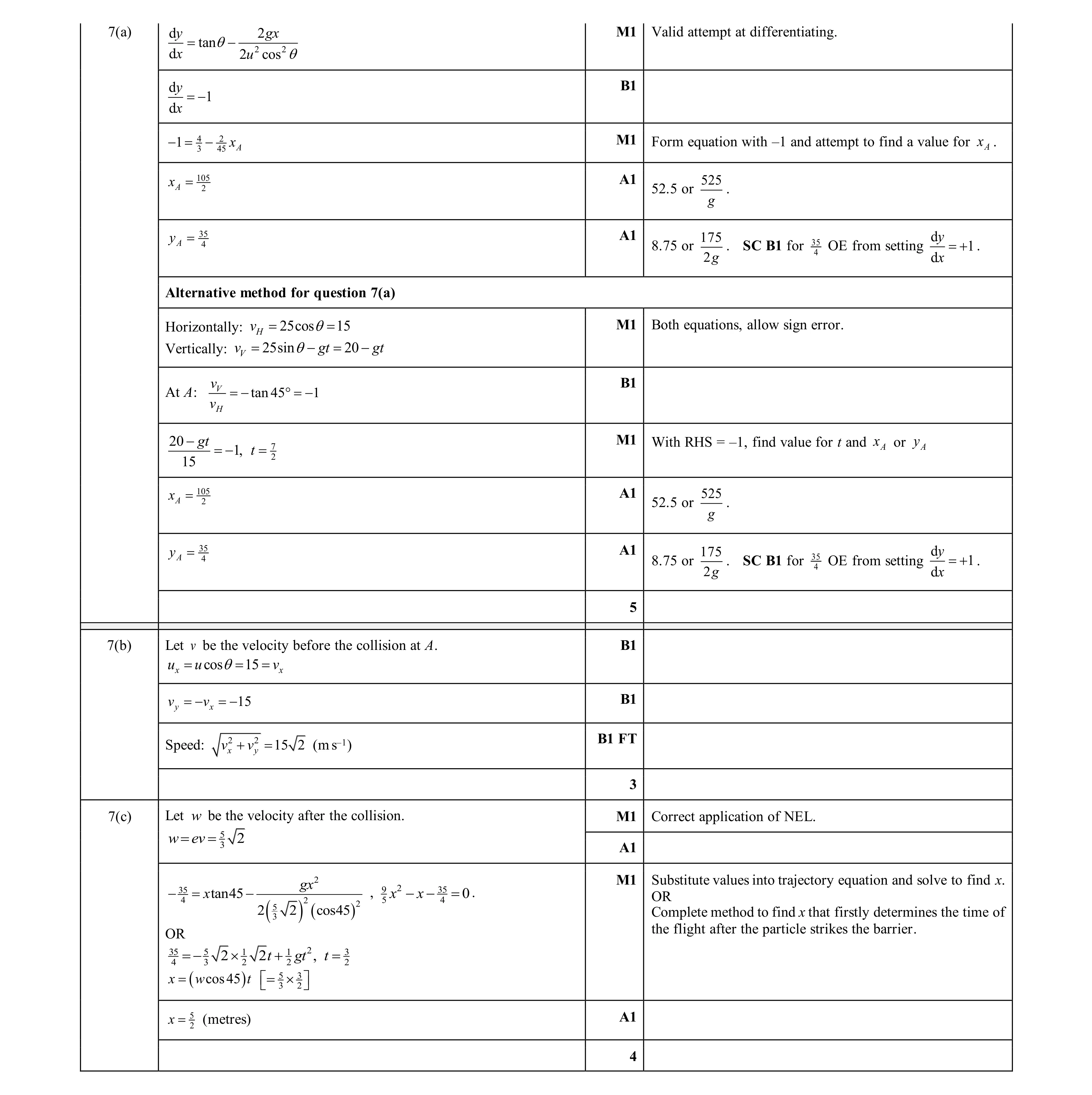 12
12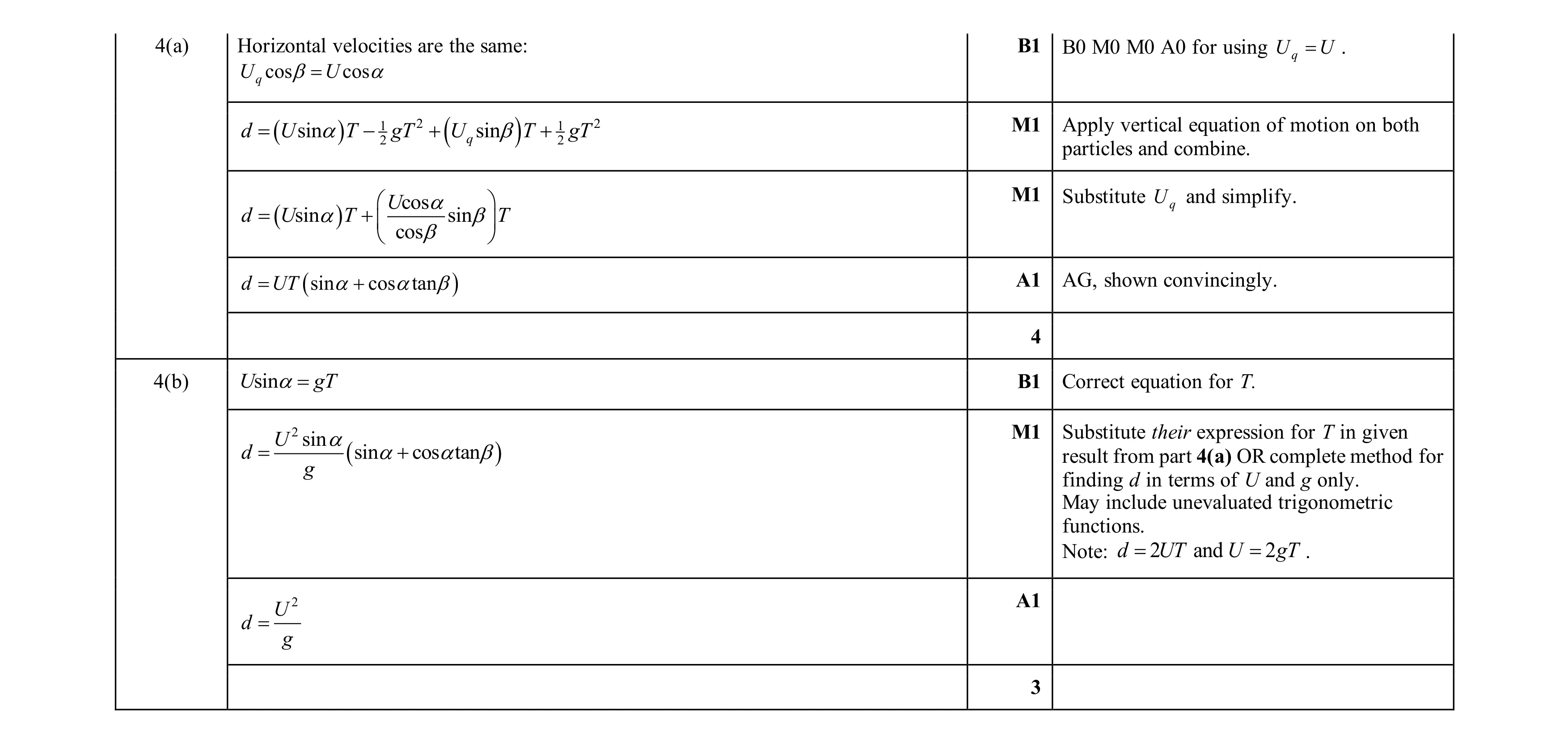 7
7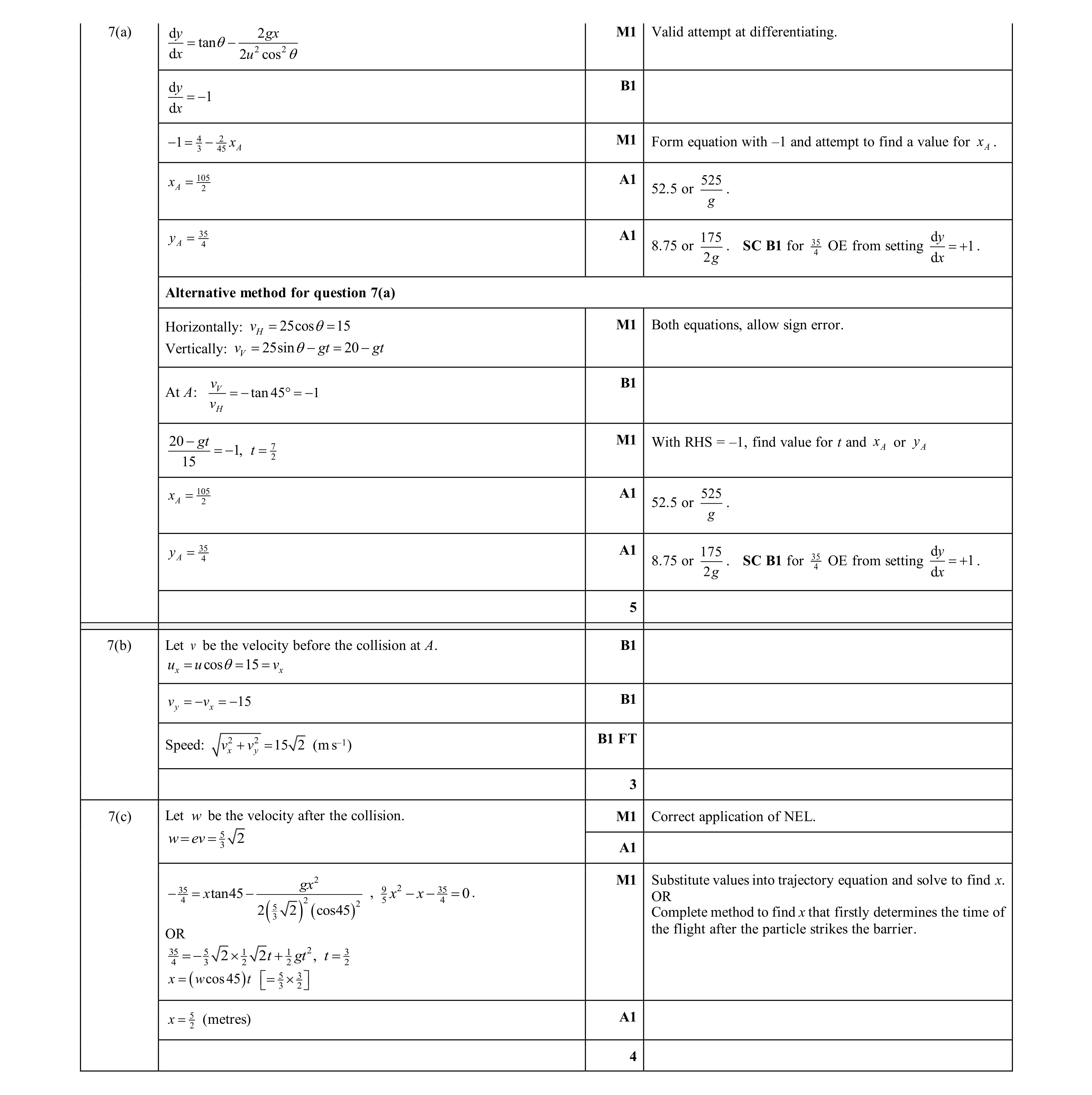 12
12