Cambridge A Level Mathematics 9709 — 2016 Oct/Nov Paper 7 · Variant 3
9709/73/O/N/16 · 6 questions · 50 marks · ≈56 min
The question paper and its mark scheme, free to read here and free to download. This is Cambridge’s own paper, exactly as it was sat.
Question paper4 pages
Mark scheme6 pages
Answers below. Sit the paper first if you are practising.
Questions as text
Q2 · Dominic wishes to choose a random sample of five students from the 150 students in his year
2 Dominic wishes to choose a random sample of five students from the 150 students in his year. He numbers the students from 1 to 150. Then he uses his calculator to generate five random numbers between 0 and 1. He multiplies each random number by 150 and rounds up to the next whole number to give a student number. (i) Dominic’s first random number is 0.392. Find the student number that is produced by this random number. [1] (ii) Dominic’s second student number is 104. Find a possible random number that would produce this student number. [1] (iii) Explain briefly why five random numbers may not be enough to produce a sample of five student numbers. [1]
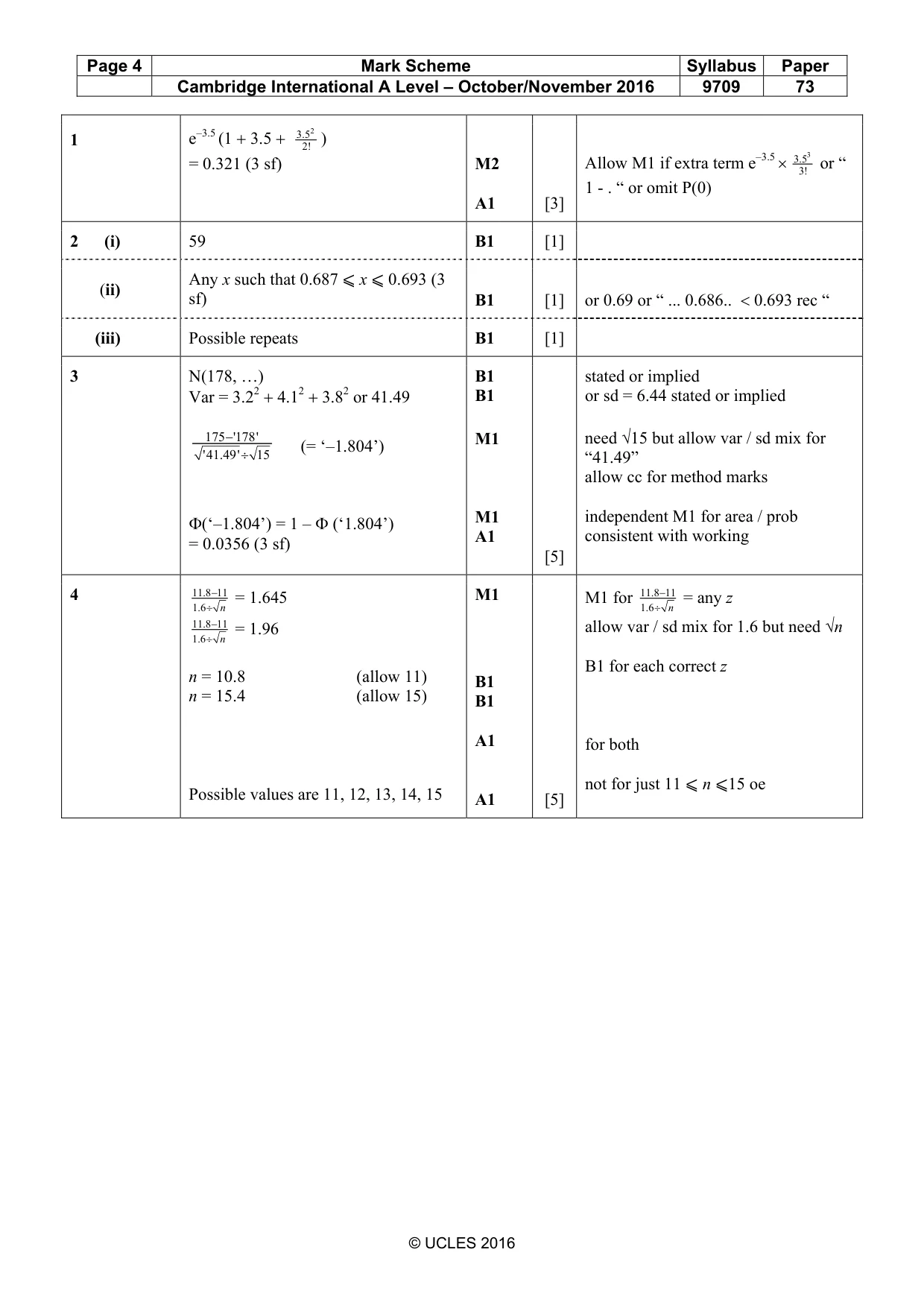
Mark scheme: 2 (i) 59 B1 [1] Any x such that 0.687 ⩽ x ⩽ 0.693 (3 (ii) sf) B1 [1] or 0.69 or “ ... 0.686.. < 0.693 rec “ (iii) Possible repeats B1 [1]
Q3 · A men’s triathlon consists of three parts: swimming, cycling and running
3 A men’s triathlon consists of three parts: swimming, cycling and running. Competitors’ times, in minutes, for the three parts can be modelled by three independent normal variables with means 34.0, 87.1 and 56.9, and standard deviations 3.2, 4.1 and 3.8, respectively. For each competitor, the total of his three times is called the race time. Find the probability that the mean race time of a random sample of 15 competitors is less than 175 minutes. [5]
Mark scheme: 3 N(178, …) B1 stated or implied Var = 3.22 + 4.12 + 3.82 or 41.49 B1 or sd = 6.44 stated or implied 175 − '178' M1 need √15 but allow var / sd mix for (= ‘–1.804’) '41.49' ÷ 15 “41.49” allow cc for method marks M1 independent M1 for area / prob Φ(‘–1.804’) = 1 – Φ (‘1.804’) A1 consistent with working = 0.0356 (3 sf) [5]
Q4 · The manufacturer of a tablet computer claims that the mean battery life is 11 hours
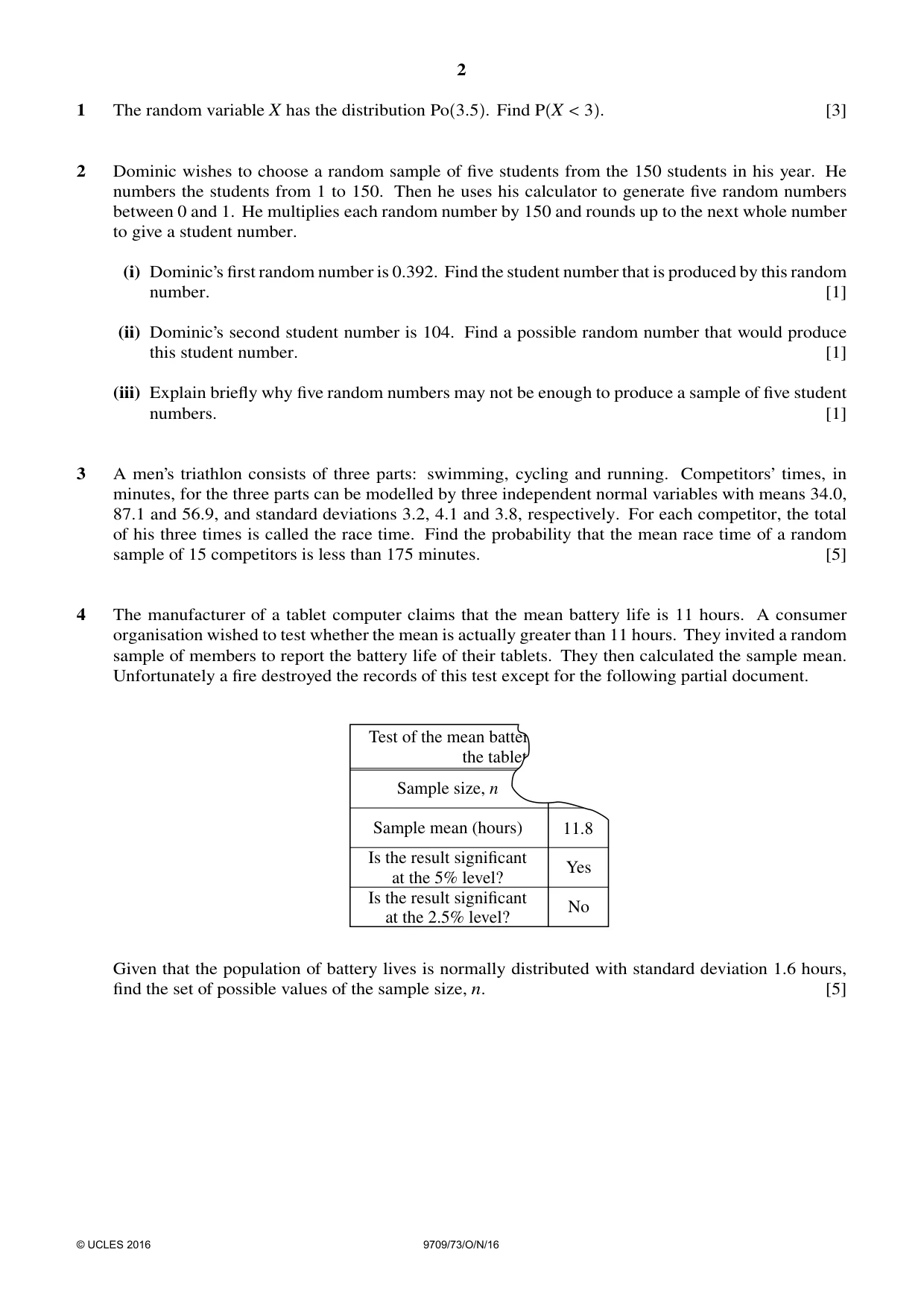
4 The manufacturer of a tablet computer claims that the mean battery life is 11 hours. A consumer organisation wished to test whether the mean is actually greater than 11 hours. They invited a random sample of members to report the battery life of their tablets. They then calculated the sample mean. Unfortunately a fire destroyed the records of this test except for the following partial document. Test of the mean battery the tablet Sample size, n Sample mean (hours) 11.8 Is the result significant Yes at the 5% level? Is the result significant No at the 2.5% level? Given that the population of battery lives is normally distributed with standard deviation 1.6 hours, find the set of possible values of the sample size, n. [5]
Mark scheme: 4 11.8 −11 = 1.645 M1 M1 for 11.8 −11 = any z 1.6 ÷ n 1.6 ÷ n 11.8 −11 = 1.96 allow var / sd mix for 1.6 but need √n 1.6 ÷ n B1 for each correct z n = 10.8 (allow 11) B1 n = 15.4 (allow 15) B1 A1 for both not for just 11 ⩽ n ⩽15 oe Possible values are 11, 12, 13, 14, 15 A1 [5]
Q5 · It is claimed that 30% of packets of Froogum contain a free gift
5 It is claimed that 30% of packets of Froogum contain a free gift. Andre thinks that the actual proportion is less than 30% and he decides to carry out a hypothesis test at the 5% significance level. He buys 20 packets of Froogum and notes the number of free gifts he obtains. (i) State null and alternative hypotheses for the test. [1] (ii) Use a binomial distribution to find the probability of a Type I error. [5] Andre finds that 3 of the 20 packets contain free gifts. (iii) Carry out the test. [2]
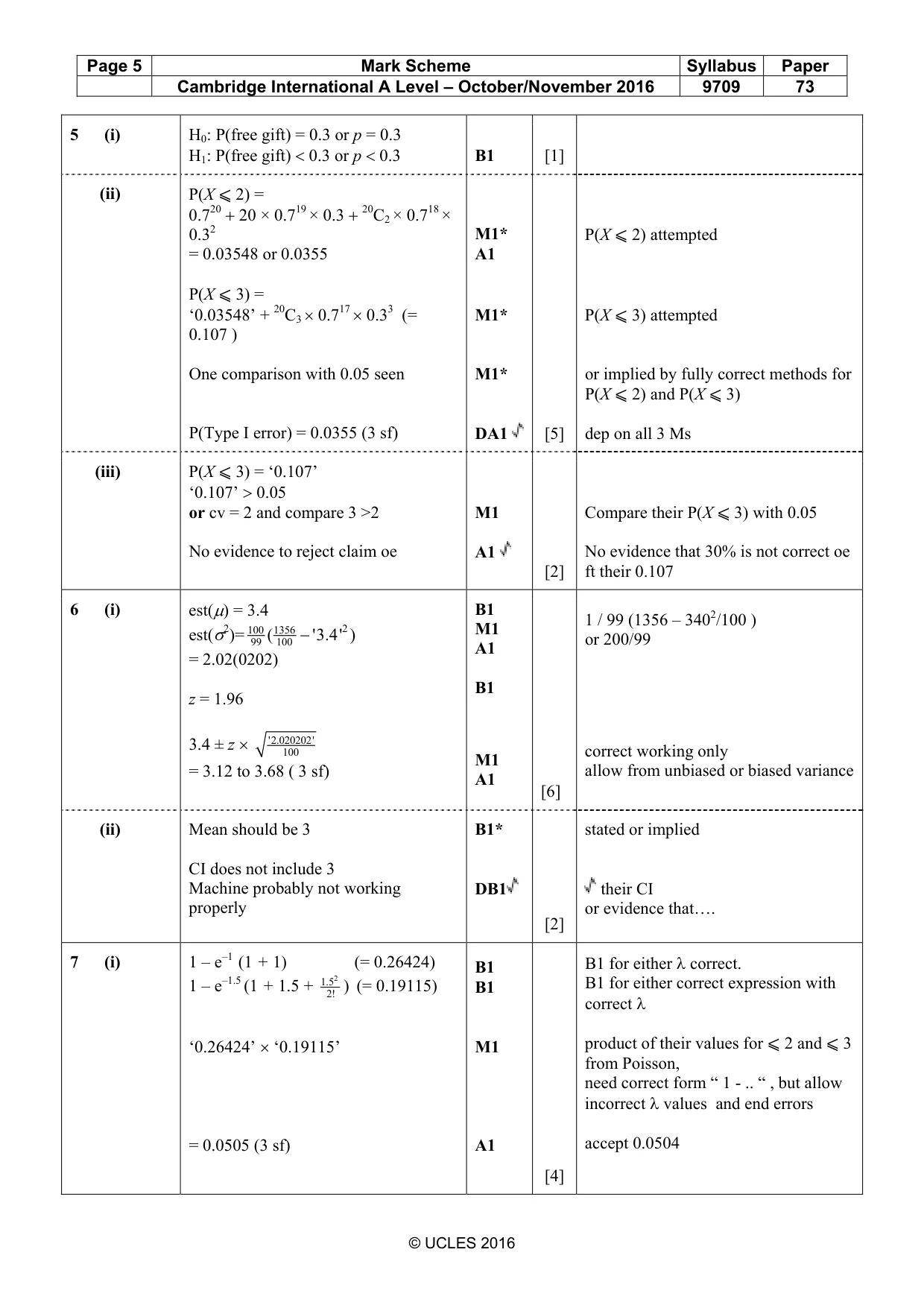
Mark scheme: 5 (i) H0: P(free gift) = 0.3 or p = 0.3 H1: P(free gift) < 0.3 or p < 0.3 B1 [1] (ii) P(X ⩽ 2) = 0.720 + 20 × 0.719 × 0.3 + 20C2 × 0.718 × 0.32 M1* P(X ⩽ 2) attempted = 0.03548 or 0.0355 A1 P(X ⩽ 3) = ‘0.03548’ + 20C3 × 0.717 × 0.33 (= M1* P(X ⩽ 3) attempted 0.107 ) One comparison with 0.05 seen M1* or implied by fully correct methods for P(X ⩽ 2) and P(X ⩽ 3) P(Type I error) = 0.0355 (3 sf) DA1 [5] dep on all 3 Ms (iii) P(X ⩽ 3) = ‘0.107’ ‘0.107’ > 0.05 or cv = 2 and compare 3 >2 M1 Compare their P(X ⩽ 3) with 0.05 No evidence to reject claim oe A1 No evidence that 30% is not correct oe [2] ft their 0.107
Q6 · A variable X takes values 1, 2, 3, 4, 5, and these values are generated at random by a…
6 A variable X takes values 1, 2, 3, 4, 5, and these values are generated at random by a machine. Each value is supposed to be equally likely, but it is suspected that the machine is not working properly. A random sample of 100 values of X, generated by the machine, gives the following results. n = 100 Σx = 340 Σx2 = 1356 (i) Find a 95% confidence interval for the population mean of the values generated by the machine. [6] (ii) Use your answer to part (i) to comment on whether the machine may be working properly. [2]
Mark scheme: 6 (i) est(µ) = 3.4 B1 1 / 99 (1356 – 3402/100 ) est(σ2)= 10099 ( 1356100 − '3.4'2 ) M1 or 200/99 A1 = 2.02(0202) B1 z = 1.96 3.4 ± z × '2.020202'100 correct working only M1 = 3.12 to 3.68 ( 3 sf) allow from unbiased or biased variance A1 [6] (ii) Mean should be 3 B1* stated or implied CI does not include 3 Machine probably not working DB1 their CI properly or evidence that…. [2] 1
Q7 · Men arrive at a clinic independently and at random, at a constant mean rate of 0.2 per…
7 Men arrive at a clinic independently and at random, at a constant mean rate of 0.2 per minute. Women arrive at the same clinic independently and at random, at a constant mean rate of 0.3 per minute. (i) Find the probability that at least 2 men and at least 3 women arrive at the clinic during a 5-minute period. [4] (ii) Find the probability that fewer than 36 people arrive at the clinic during a 1-hour period. [5] [Question 8 is printed on the next page.]
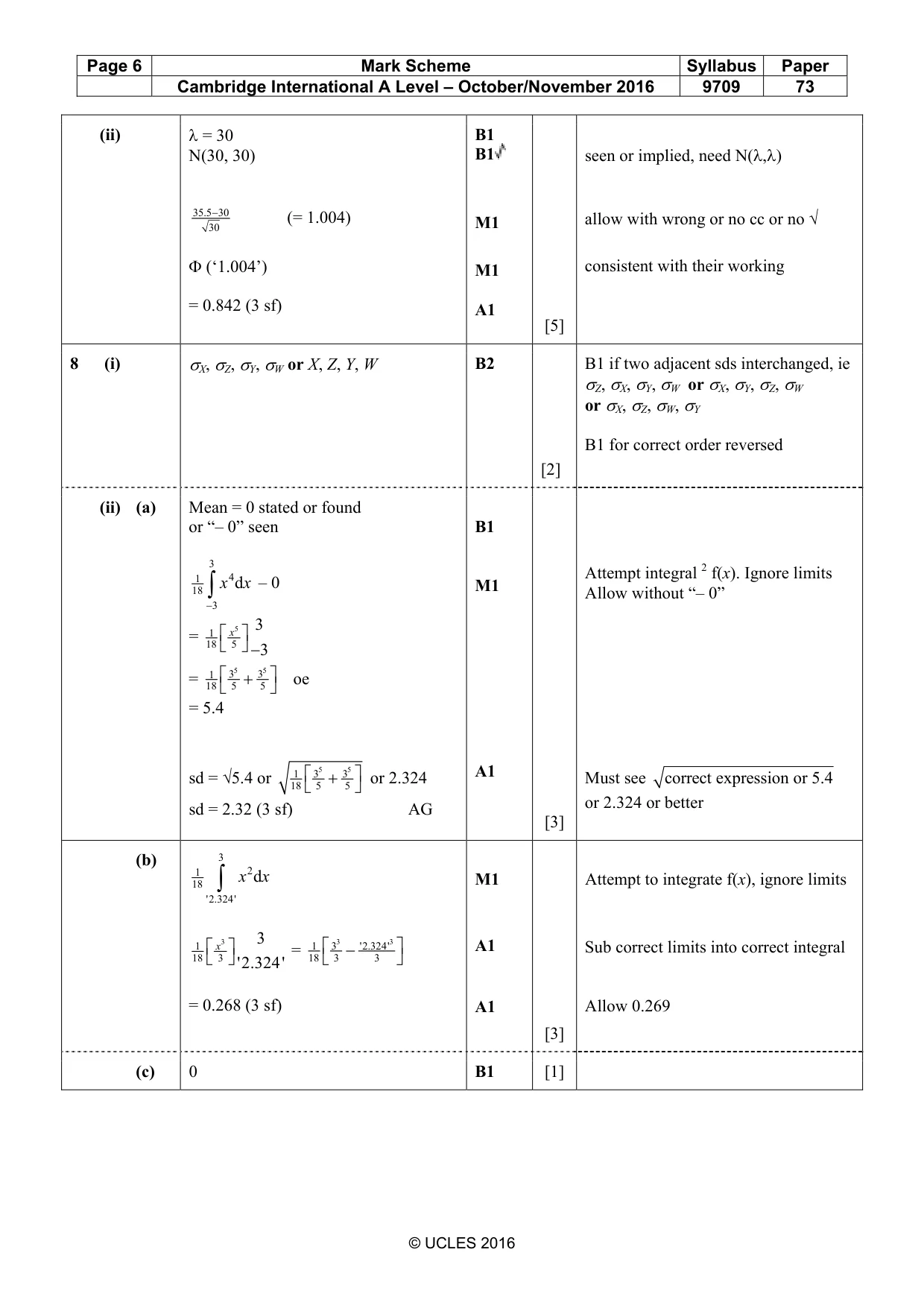
Mark scheme: 7 (i) 1 – e–1 (1 + 1) (= 0.26424) B1 B1 for either λ correct. 1 – e–1.5 (1 + 1.5 + 1.52!2 ) (= 0.19115) B1 B1 for either correct expression with correct λ ‘0.26424’ × ‘0.19115’ M1 product of their values for ⩽ 2 and ⩽ 3 from Poisson, need correct form “ 1 - .. “ , but allow incorrect λ values and end errors = 0.0505 (3 sf) A1 accept 0.0504 [4] (ii) λ = 30 B1 N(30, 30) B1 seen or implied, need N(λ,λ) 35.5 − 30 (= 1.004) M1 allow with wrong or no cc or no √ 30 Φ (‘1.004’) M1 consistent with their working = 0.842 (3 sf) A1 [5]
What was in this paper
The subtopics covered by these 6 questions, and how many questions each got. Open one in a new tab to see every Cambridge question on it.
What you needed in this session
Cambridge’s own grade thresholds for 2016 Oct/Nov, Paper 7 · Variant 3. A higher threshold means an easier paper — the bar moves with how the cohort did.