Cambridge A Level Mathematics 9709 — 2016 Oct/Nov Paper 7 · Variant 2
9709/72/O/N/16 · 5 questions · 50 marks · ≈56 min
The question paper and its mark scheme, free to read here and free to download. This is Cambridge’s own paper, exactly as it was sat.
Question paper4 pages
Mark scheme6 pages
Answers below. Sit the paper first if you are practising.
Questions as text
Q1 · The weights, in kilograms, of a random sample of eight 16-year old males are given below
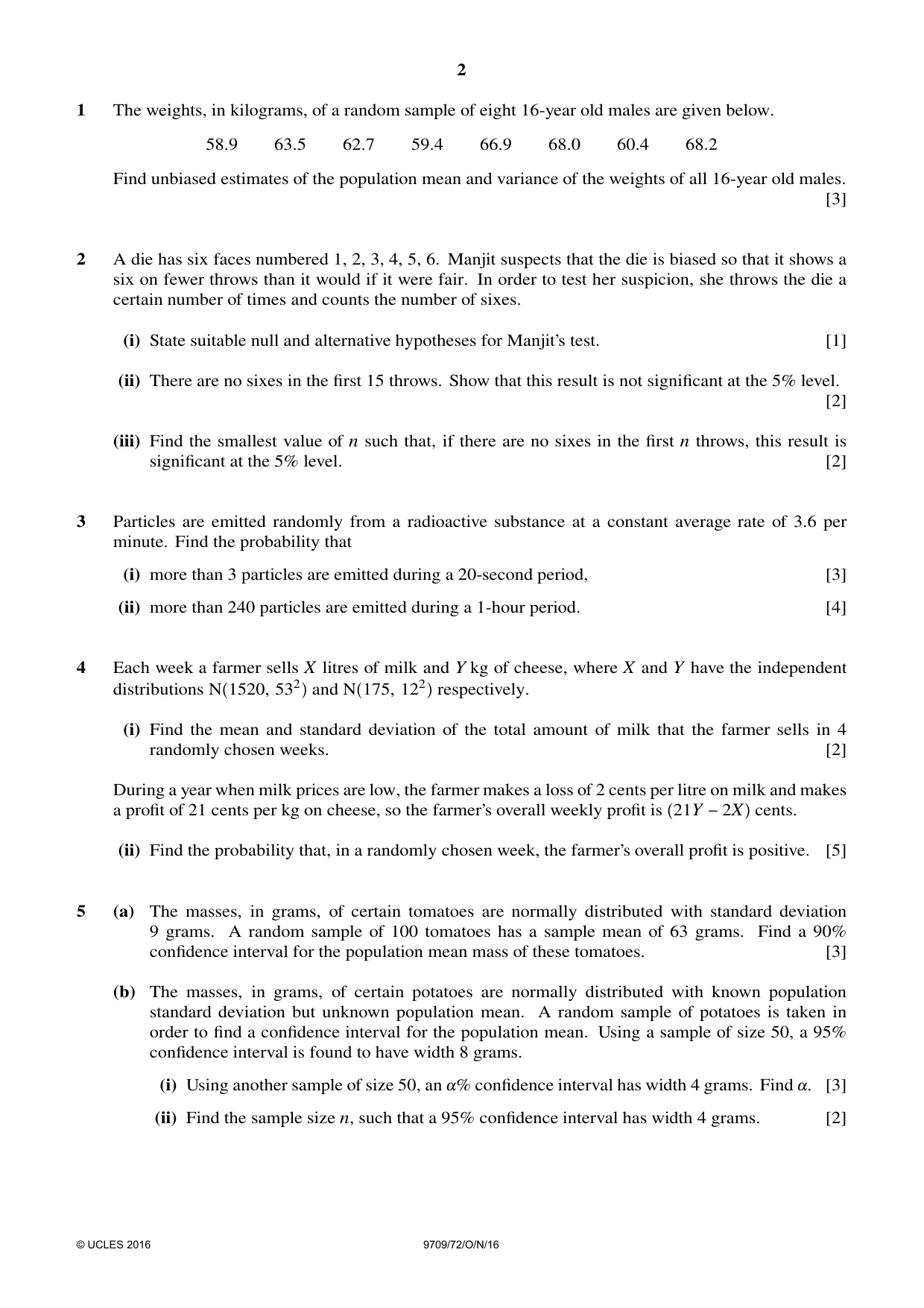
1 The weights, in kilograms, of a random sample of eight 16-year old males are given below. 58.9 63.5 62.7 59.4 66.9 68.0 60.4 68.2 Find unbiased estimates of the population mean and variance of the weights of all 16-year old males. [3]
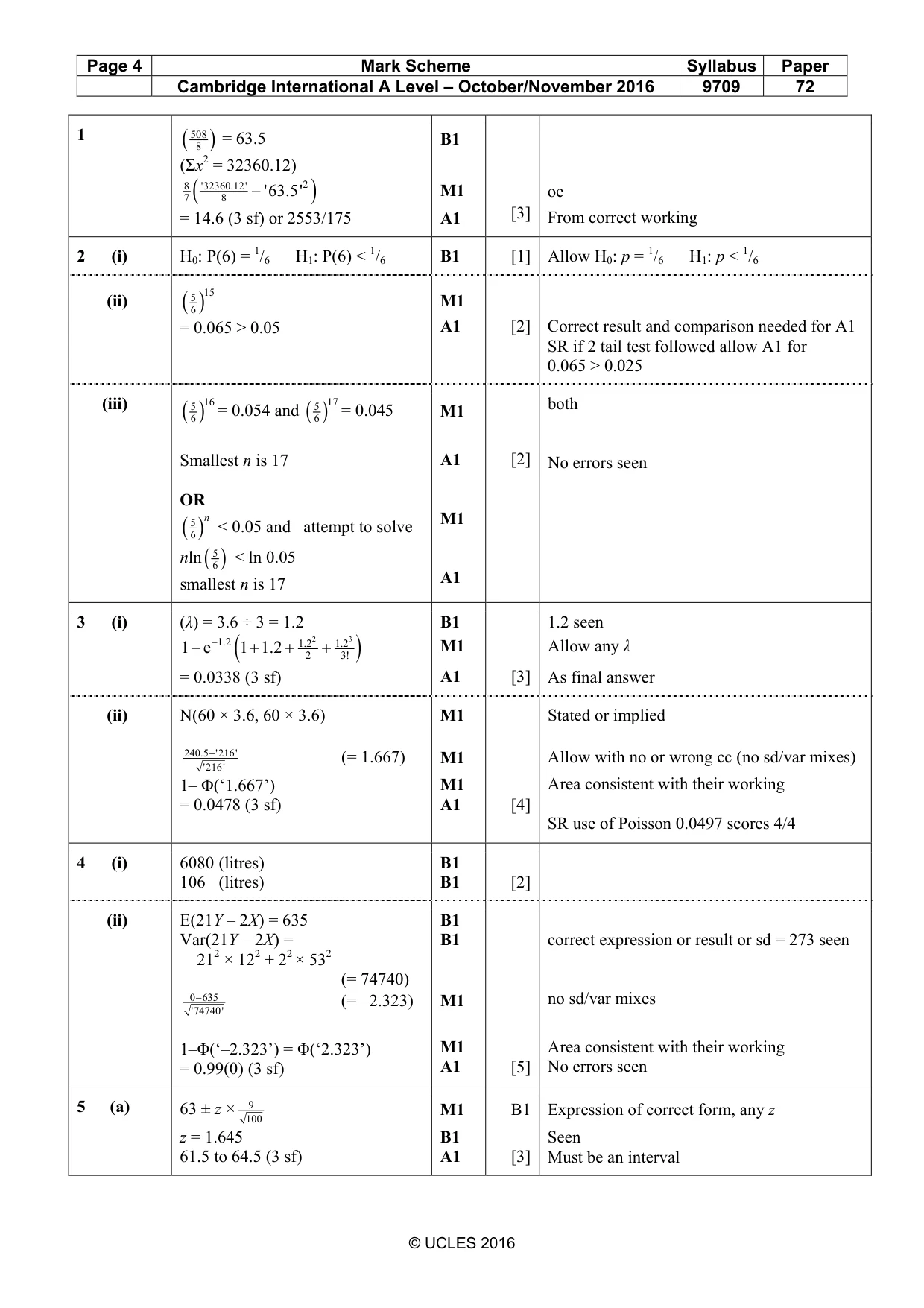
Mark scheme: 5081 ( 8 ) = 63.5 B1 (Σx2 = 32360.12) 8 '32360.12' M1 oe 7 ( 8 − '63.5' 2 ) [3] From correct working = 14.6 (3 sf) or 2553/175 A1 1 1 1 1
Q2 · A die has six faces numbered 1, 2, 3, 4, 5, 6
2 A die has six faces numbered 1, 2, 3, 4, 5, 6. Manjit suspects that the die is biased so that it shows a six on fewer throws than it would if it were fair. In order to test her suspicion, she throws the die a certain number of times and counts the number of sixes. (i) State suitable null and alternative hypotheses for Manjit’s test. [1] (ii) There are no sixes in the first 15 throws. Show that this result is not significant at the 5% level. [2] (iii) Find the smallest value of n such that, if there are no sixes in the first n throws, this result is significant at the 5% level. [2]
Mark scheme: 2 (i) H0: P(6) = 1/6 H1: P(6) < 1/6 B1 [1] Allow H0: p = 1/6 H1: p < 1/6 5 M1 (ii) 15 ( 6 ) = 0.065 > 0.05 A1 [2] Correct result and comparison needed for A1 SR if 2 tail test followed allow A1 for 0.065 > 0.025 (iii) ( 56 )16 = 0.054 and ( 56 )17 = 0.045 M1 both Smallest n is 17 A1 [2] No errors seen OR 5 ( 6 ) n < 0.05 and attempt to solve M1 5 nln( 6 ) < ln 0.05 A1 smallest n is 17
Q3 · Particles are emitted randomly from a radioactive substance at a constant average rate of…
3 Particles are emitted randomly from a radioactive substance at a constant average rate of 3.6 per minute. Find the probability that (i) more than 3 particles are emitted during a 20-second period, [3] (ii) more than 240 particles are emitted during a 1-hour period. [4]
Mark scheme: 3 (i) (λ) = 3.6 ÷ 3 = 1.2 B1 1.2 seen M1 Allow any λ 1 − e −1.2 ( 1 + 1.2 + 1.22 2 + 1.23!3 ) = 0.0338 (3 sf) A1 [3] As final answer (ii) N(60 × 3.6, 60 × 3.6) M1 Stated or implied 240.5 − '216' (= 1.667) M1 Allow with no or wrong cc (no sd/var mixes) '216' 1– Φ(‘1.667’) M1 Area consistent with their working = 0.0478 (3 sf) A1 [4] SR use of Poisson 0.0497 scores 4/4
Q5 · The masses, in grams, of certain tomatoes are normally distributed with standard…
5 (a) The masses, in grams, of certain tomatoes are normally distributed with standard deviation 9 grams. A random sample of 100 tomatoes has a sample mean of 63 grams. Find a 90% confidence interval for the population mean mass of these tomatoes. [3] (b) The masses, in grams, of certain potatoes are normally distributed with known population standard deviation but unknown population mean. A random sample of potatoes is taken in order to find a confidence interval for the population mean. Using a sample of size 50, a 95% confidence interval is found to have width 8 grams. (i) Using another sample of size 50, an !% confidence interval has width 4 grams. Find !. [3] (ii) Find the sample size n, such that a 95% confidence interval has width 4 grams. [2]
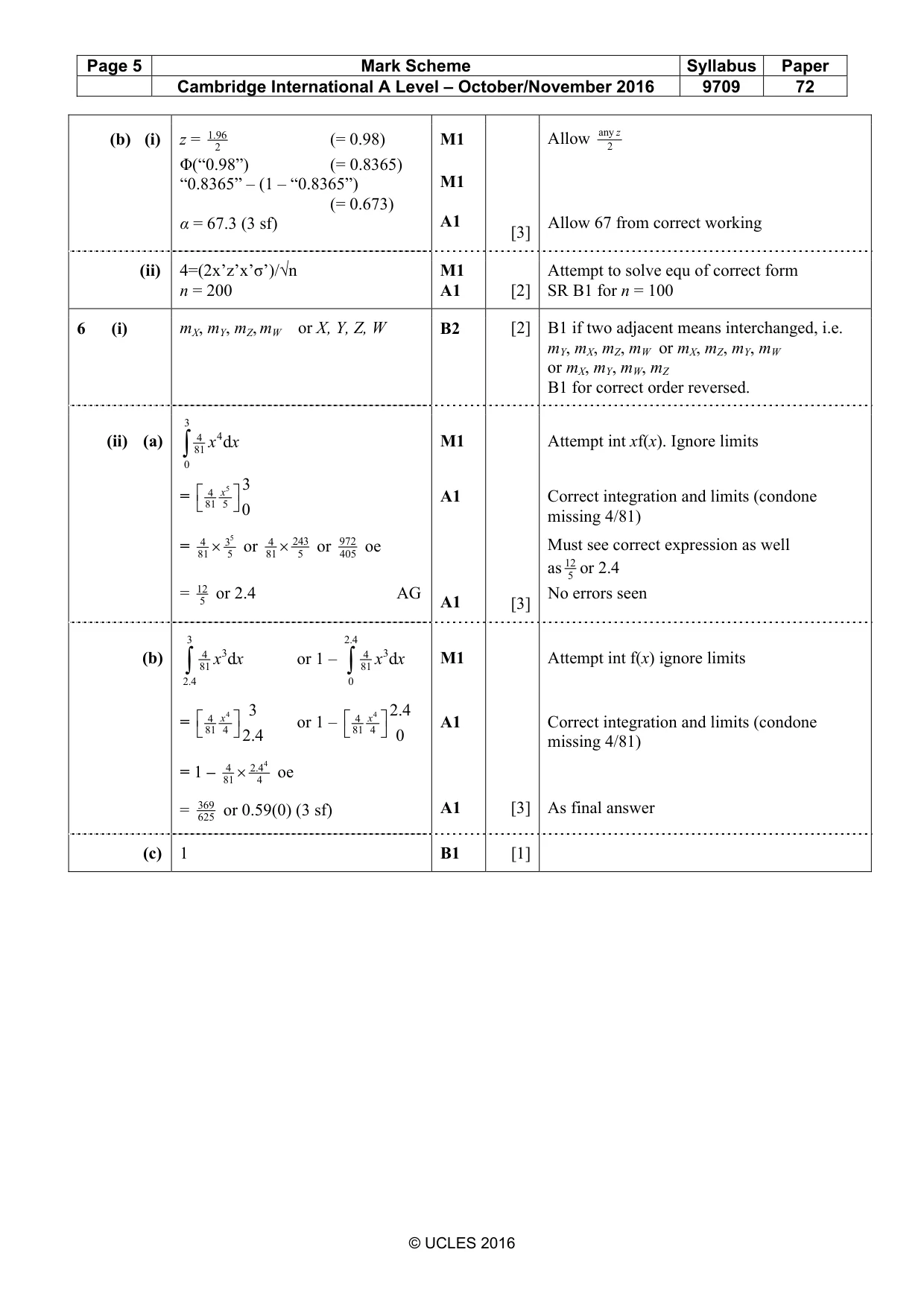
Mark scheme: 5 (a) 63 ± z × 9 M1 B1 Expression of correct form, any z 100 z = 1.645 B1 Seen 61.5 to 64.5 (3 sf) A1 [3] Must be an interval (b) (i) z = 1.962 (= 0.98) M1 Allow any2 z Φ(“0.98”) (= 0.8365) “0.8365” – (1 – “0.8365”) M1 (= 0.673) α = 67.3 (3 sf) A1 Allow 67 from correct working [3] (ii) 4=(2x’z’x’σ’)/√n M1 Attempt to solve equ of correct form n = 200 A1 [2] SR B1 for n = 100
Q7 · In the past the time, in minutes, taken for a particular rail journey has been found to…
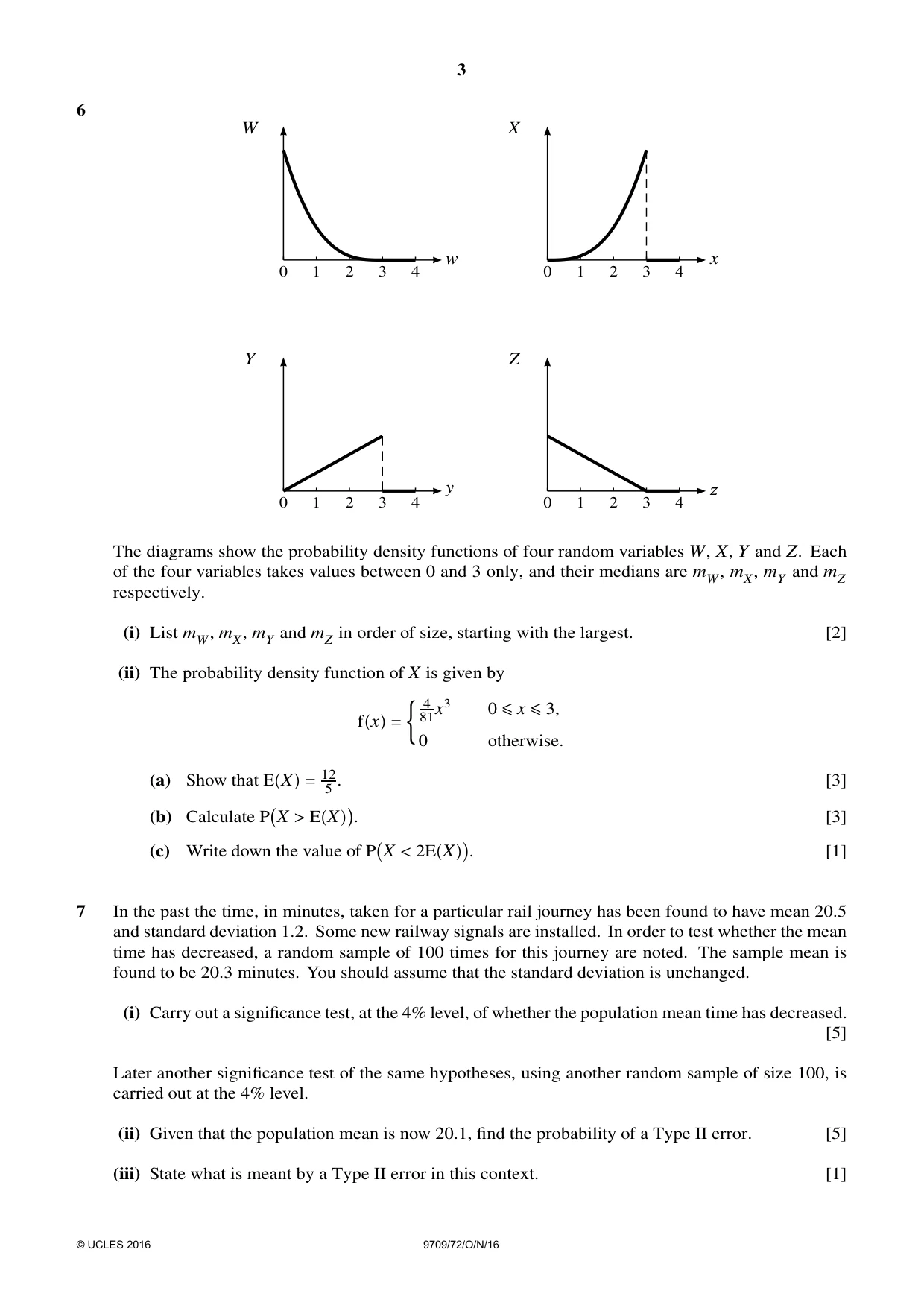
7 In the past the time, in minutes, taken for a particular rail journey has been found to have mean 20.5 and standard deviation 1.2. Some new railway signals are installed. In order to test whether the mean time has decreased, a random sample of 100 times for this journey are noted. The sample mean is found to be 20.3 minutes. You should assume that the standard deviation is unchanged. (i) Carry out a significance test, at the 4% level, of whether the population mean time has decreased. [5] Later another significance test of the same hypotheses, using another random sample of size 100, is carried out at the 4% level. (ii) Given that the population mean is now 20.1, find the probability of a Type II error. [5] (iii) State what is meant by a Type II error in this context. [1]
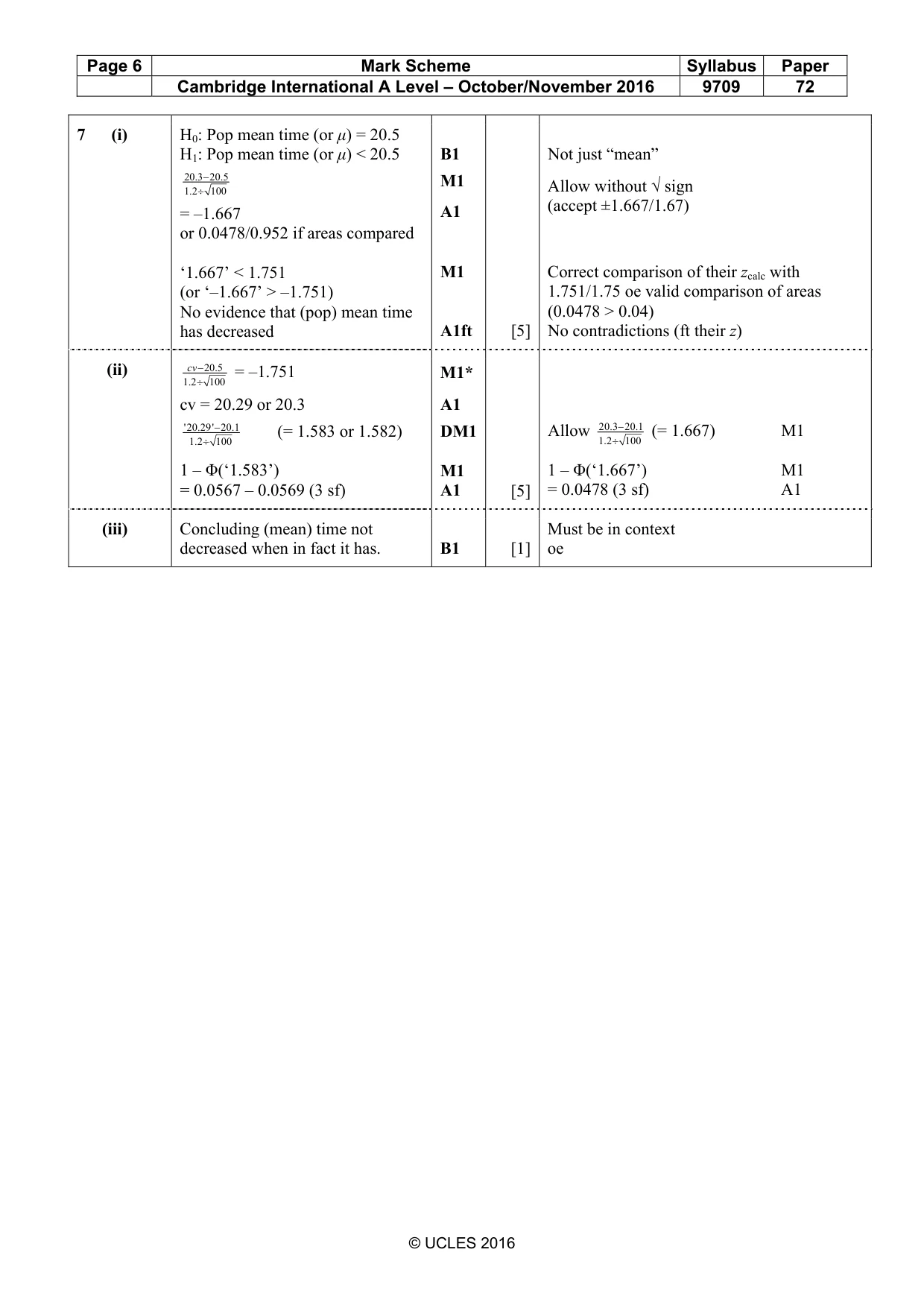
Mark scheme: 7 (i) H0: Pop mean time (or µ) = 20.5 H1: Pop mean time (or µ) < 20.5 B1 Not just “mean” 20.3 − 20.5 M1 1.2 ÷ 100 Allow without √ sign (accept ±1.667/1.67) = –1.667 A1 or 0.0478/0.952 if areas compared ‘1.667’ < 1.751 M1 Correct comparison of their zcalc with (or ‘–1.667’ > –1.751) 1.751/1.75 oe valid comparison of areas No evidence that (pop) mean time (0.0478 > 0.04) has decreased A1ft [5] No contradictions (ft their z) (ii) cv − 20.5 = –1.751 M1* 1.2 ÷ 100 cv = 20.29 or 20.3 A1 '20.29' − 20.1 (= 1.583 or 1.582) DM1 Allow 20.3 − 20.1 (= 1.667) M1 1.2 ÷ 100 1.2 ÷ 100 1 – Φ(‘1.583’) M1 1 – Φ(‘1.667’) M1 = 0.0567 – 0.0569 (3 sf) A1 [5] = 0.0478 (3 sf) A1 (iii) Concluding (mean) time not Must be in context decreased when in fact it has. B1 [1] oe
What was in this paper
The subtopics covered by these 5 questions, and how many questions each got. Open one in a new tab to see every Cambridge question on it.
What you needed in this session
Cambridge’s own grade thresholds for 2016 Oct/Nov, Paper 7 · Variant 2. A higher threshold means an easier paper — the bar moves with how the cohort did.