Cambridge A Level Mathematics 9709 — 2015 Oct/Nov Paper 7 · Variant 3
9709/73/O/N/15 · 3 questions · 50 marks · ≈56 min
The question paper and its mark scheme, free to read here and free to download. This is Cambridge’s own paper, exactly as it was sat.
Question paper4 pages
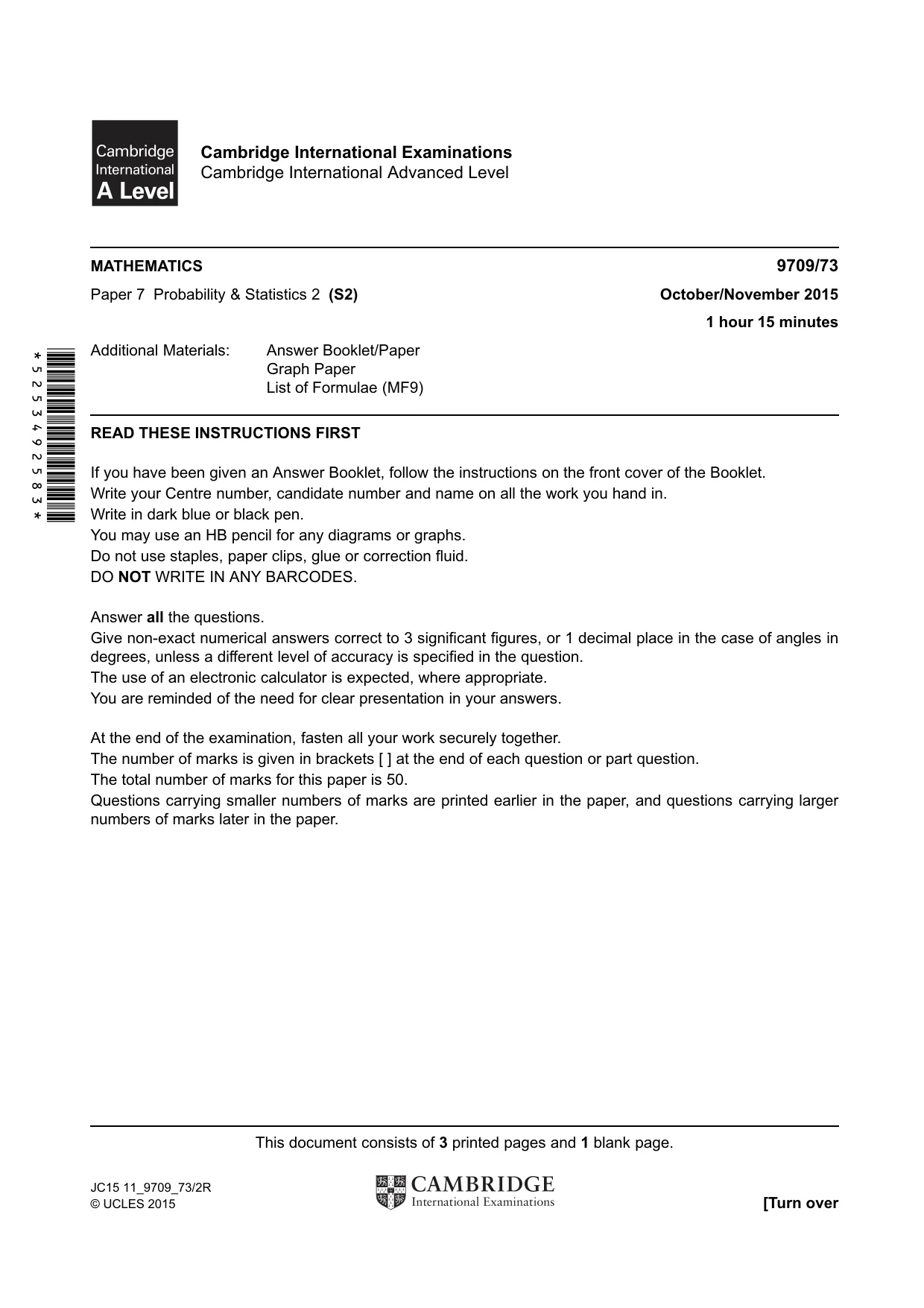
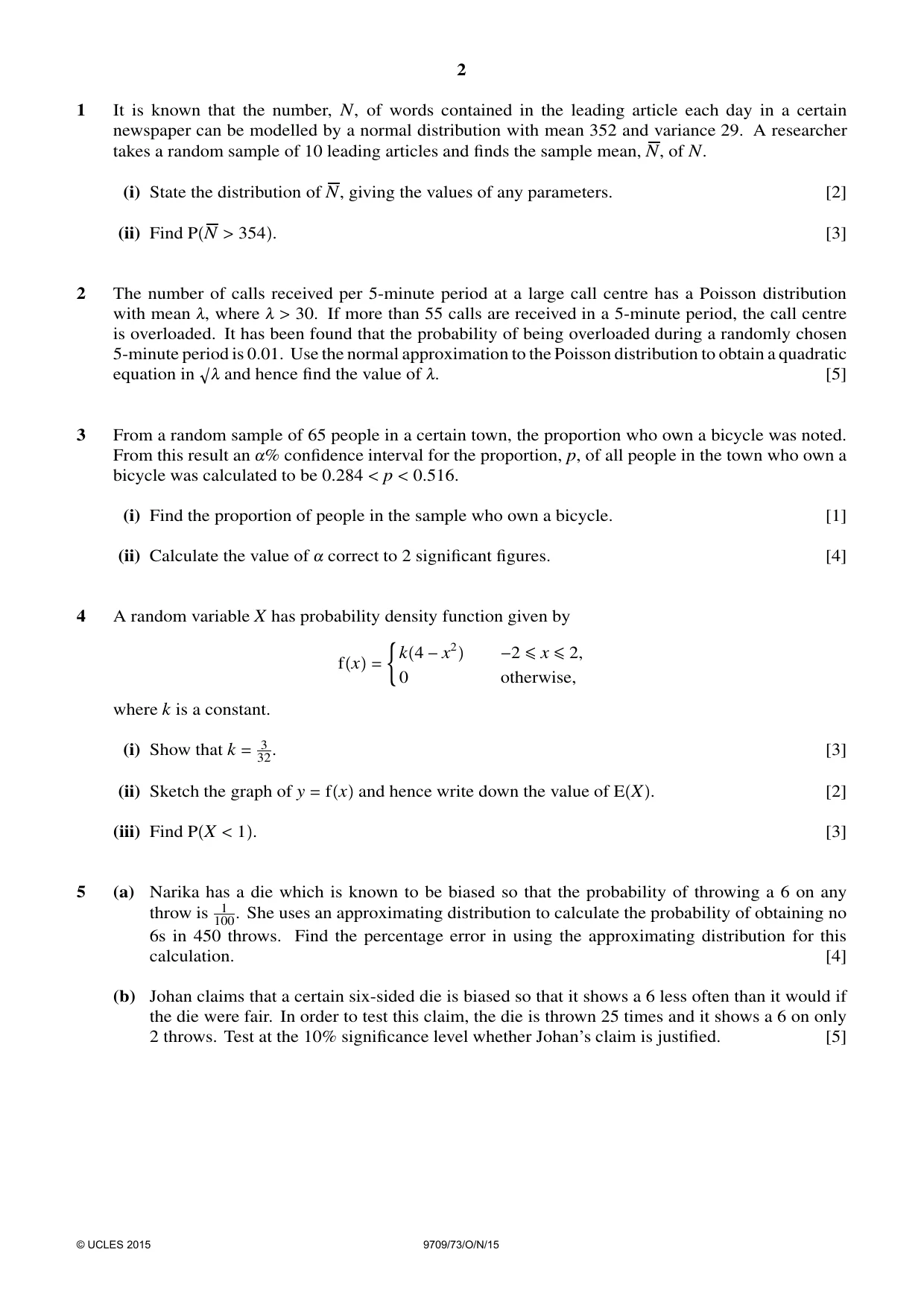
Mark scheme7 pages
Answers below. Sit the paper first if you are practising.
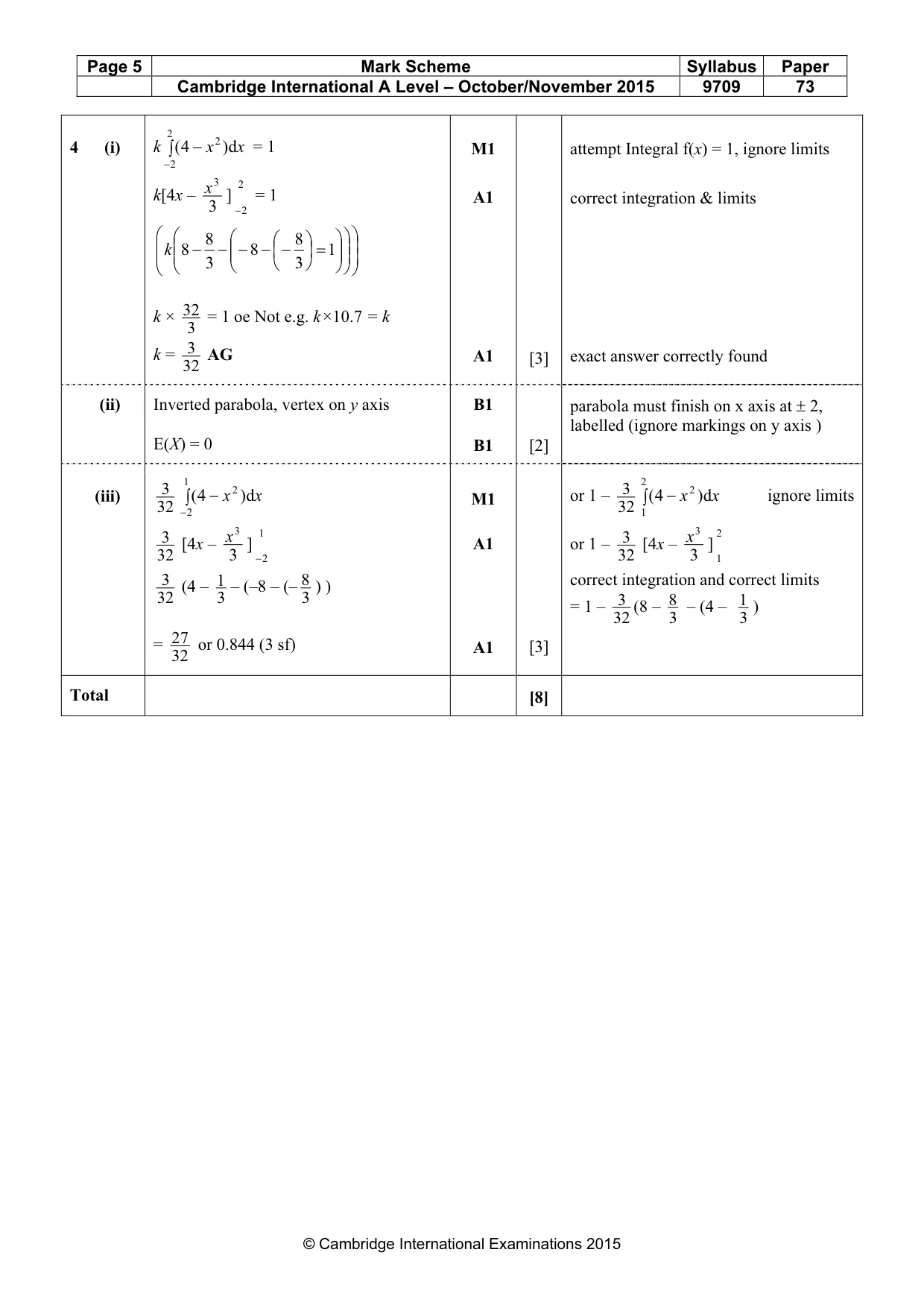
Questions as text
Q5 · Narika has a die which is known to be biased so that the probability of throwing a 6 on…
5 (a) Narika has a die which is known to be biased so that the probability of throwing a 6 on any throw is 100.1 She uses an approximating distribution to calculate the probability of obtaining no 6s in 450 throws. Find the percentage error in using the approximating distribution for this calculation. [4] (b) Johan claims that a certain six-sided die is biased so that it shows a 6 less often than it would if the die were fair. In order to test this claim, the die is thrown 25 times and it shows a 6 on only 2 throws. Test at the 10% significance level whether Johan’s claim is justified. [5]
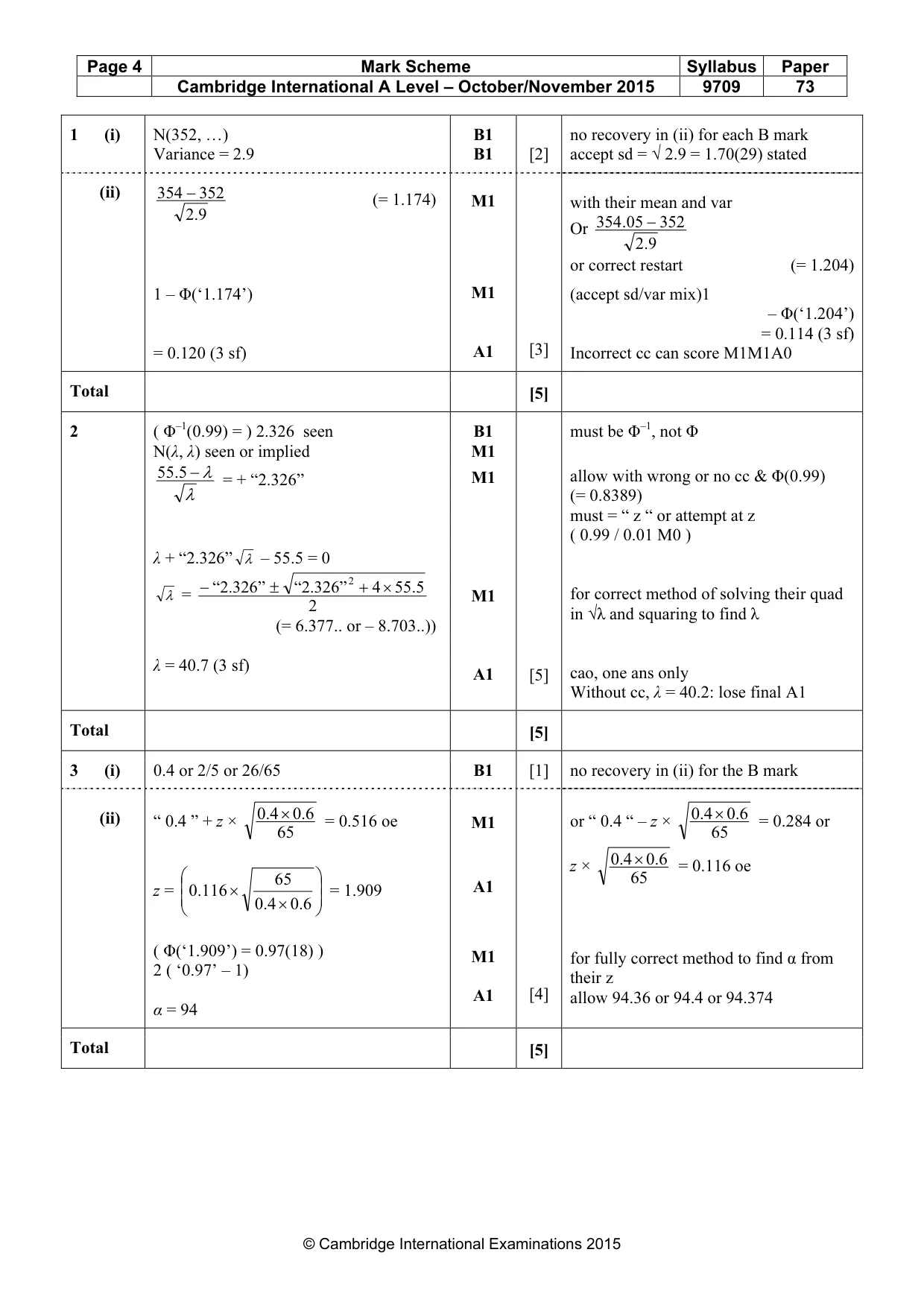
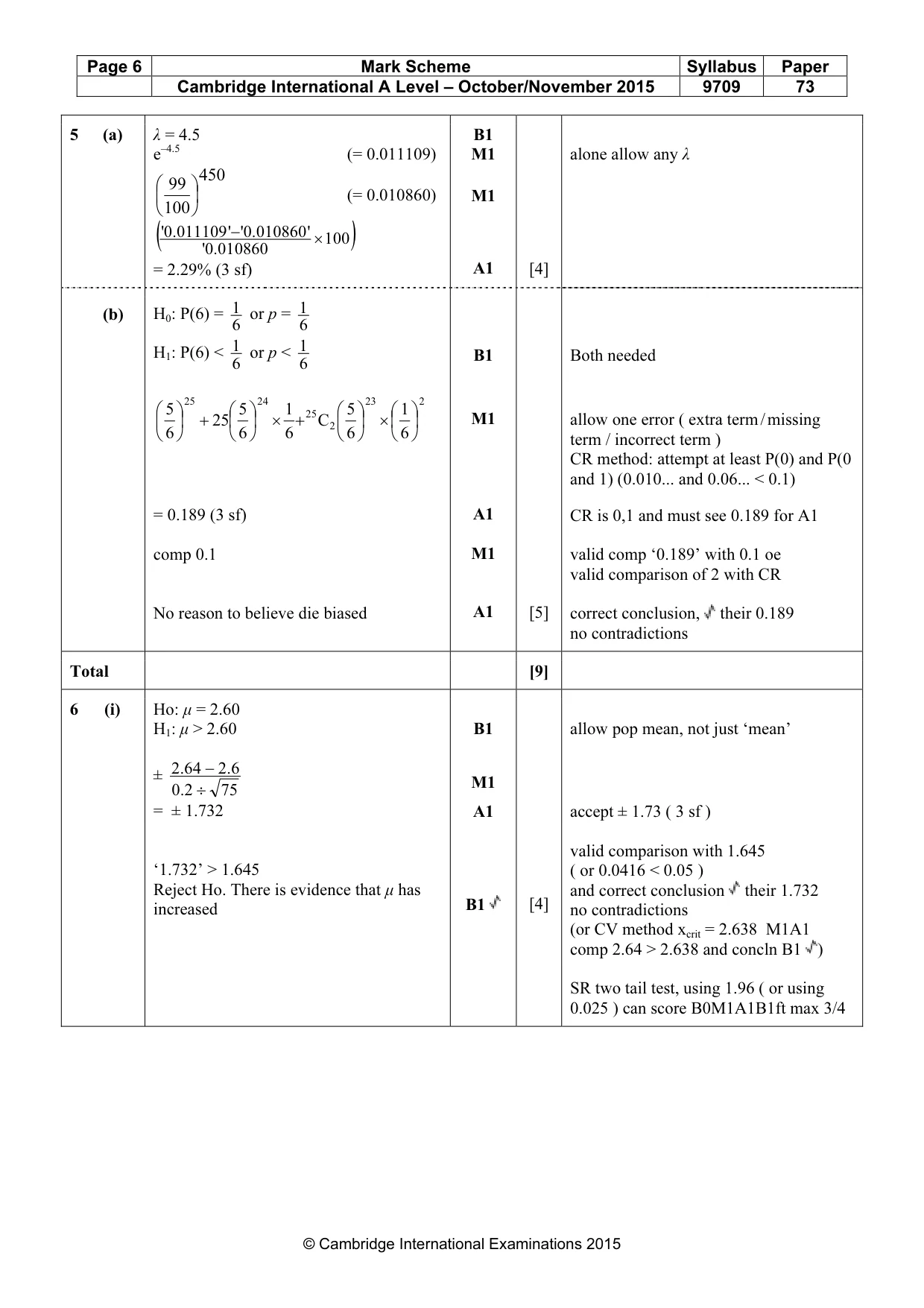
Mark scheme: 25 24 23 2 25 5 5 1 5 1
Q6 · Parcels arriving at a certain office have weights W kg, where the random variable W has…
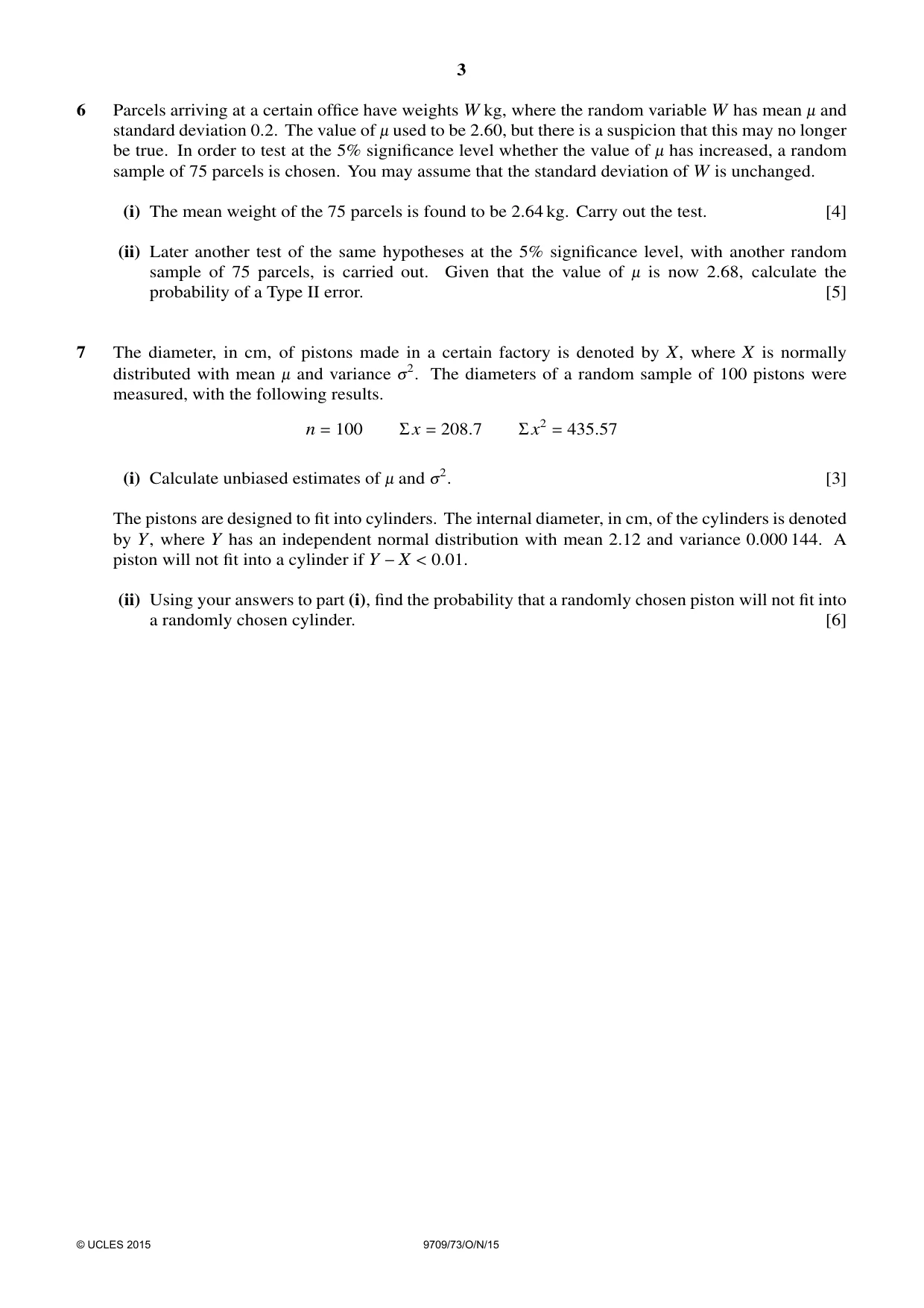
6 Parcels arriving at a certain office have weights W kg, where the random variable W has mean - and standard deviation 0.2. The value of - used to be 2.60, but there is a suspicion that this may no longer be true. In order to test at the 5% significance level whether the value of - has increased, a random sample of 75 parcels is chosen. You may assume that the standard deviation of W is unchanged. (i) The mean weight of the 75 parcels is found to be 2.64 kg. Carry out the test. [4] (ii) Later another test of the same hypotheses at the 5% significance level, with another random sample of 75 parcels, is carried out. Given that the value of - is now 2.68, calculate the probability of a Type II error. [5]
Mark scheme: + 25 + C 2 allow one error ( extra term / missing 6 6 6 6 6 term / incorrect term ) CR method: attempt at least P(0) and P(0 and 1) (0.010... and 0.06... < 0.1) = 0.189 (3 sf) A1 CR is 0,1 and must see 0.189 for A1 comp 0.1 M1 valid comp ‘0.189’ with 0.1 oe valid comparison of 2 with CR No reason to believe die biased A1 [5] correct conclusion, their 0.189 no contradictions Total [9] 6 (i) Ho: µ = 2.60 H1: µ > 2.60 B1 allow pop mean, not just ‘mean’ .2 64 − 6.2 ± M1
Q7 · The diameter, in cm, of pistons made in a certain factory is denoted by X, where X is…
7 The diameter, in cm, of pistons made in a certain factory is denoted by X, where X is normally distributed with mean - and variance 32. The diameters of a random sample of 100 pistons were measured, with the following results. n = 100 Σx = 208.7 Σx2 = 435.57 (i) Calculate unbiased estimates of - and 32. [3] The pistons are designed to fit into cylinders. The internal diameter, in cm, of the cylinders is denoted by Y, where Y has an independent normal distribution with mean 2.12 and variance 0.000 144. A piston will not fit into a cylinder if Y −X < 0.01. (ii) Using your answers to part (i), find the probability that a randomly chosen piston will not fit into a randomly chosen cylinder. [6]
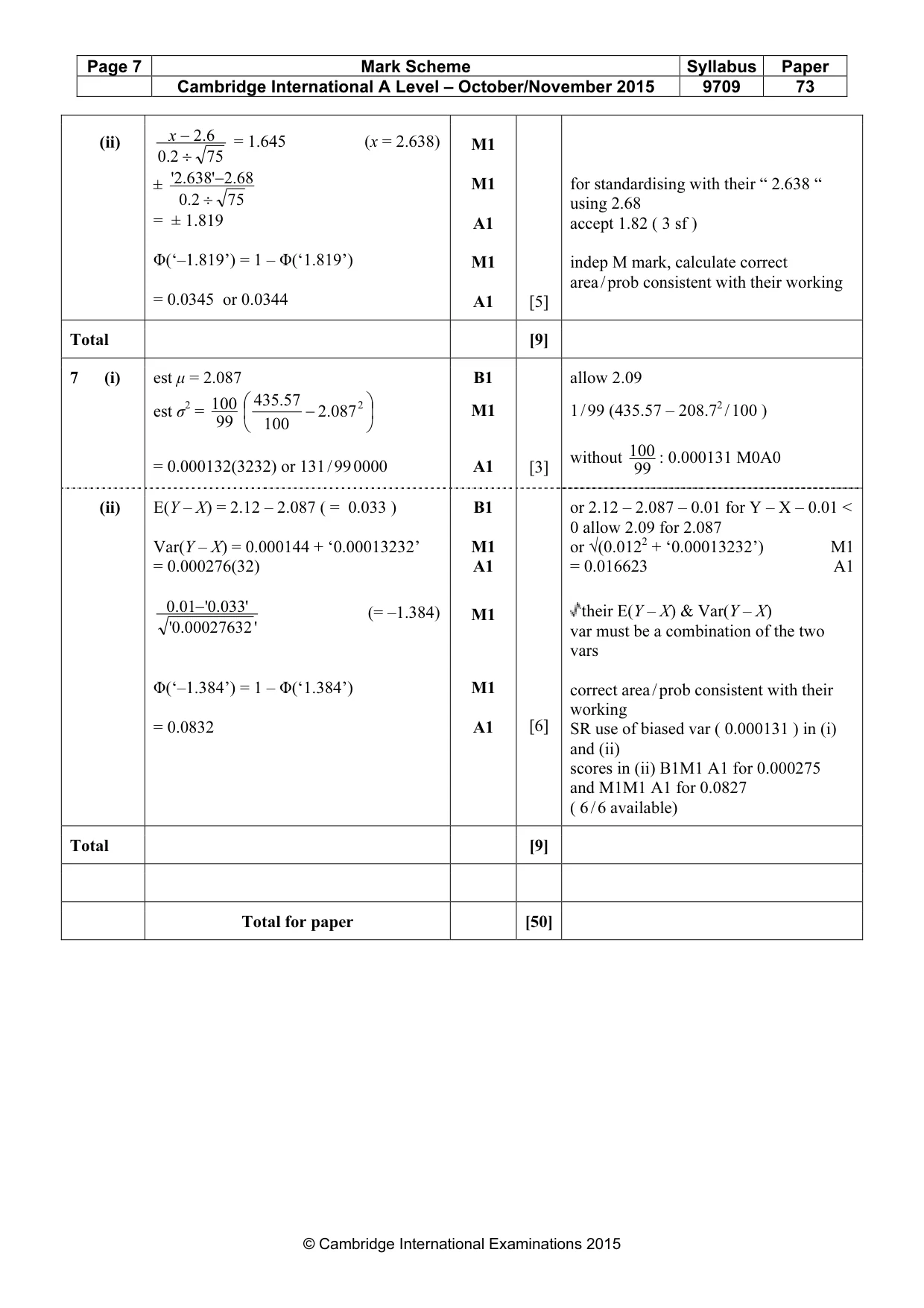
Mark scheme: 7 (i) est µ = 2.087 B1 allow 2.09 100 435.57 2 est σ2 = − .2087 M1 1 / 99 (435.57 – 208.72 / 100 ) 99 100 100 without : 0.000131 M0A0 = 0.000132(3232) or 131 / 99 0000 A1 [3] 99 (ii) E(Y – X) = 2.12 – 2.087 ( = 0.033 ) B1 or 2.12 – 2.087 – 0.01 for Y – X – 0.01 < 0 allow 2.09 for 2.087 Var(Y – X) = 0.000144 + ‘0.00013232’ M1 or √(0.0122 + ‘0.00013232’) M1 = 0.000276(32) A1 = 0.016623 A1 .0 01− .0' 033' (= –1.384) M1 their E(Y – X) & Var(Y – X) .0' 00027632 ' var must be a combination of the two vars Φ(‘–1.384’) = 1 – Φ(‘1.384’) M1 correct area / prob consistent with their working = 0.0832 A1 [6] SR use of biased var ( 0.000131 ) in (i) and (ii) scores in (ii) B1M1 A1 for 0.000275 and M1M1 A1 for 0.0827 ( 6 / 6 available) Total [9] Total for paper [50]
What was in this paper
The subtopics covered by these 3 questions, and how many questions each got. Open one in a new tab to see every Cambridge question on it.
What you needed in this session
Cambridge’s own grade thresholds for 2015 Oct/Nov, Paper 7 · Variant 3. A higher threshold means an easier paper — the bar moves with how the cohort did.