Cambridge A Level Mathematics 9709 — 2015 Oct/Nov Paper 6 · Variant 3
9709/63/O/N/15 · 6 questions · 50 marks · ≈56 min
The question paper and its mark scheme, free to read here and free to download. This is Cambridge’s own paper, exactly as it was sat.
Question paper4 pages
Mark scheme6 pages
Answers below. Sit the paper first if you are practising.
Questions as text
Q2 · In country X, 25% of people have fair hair
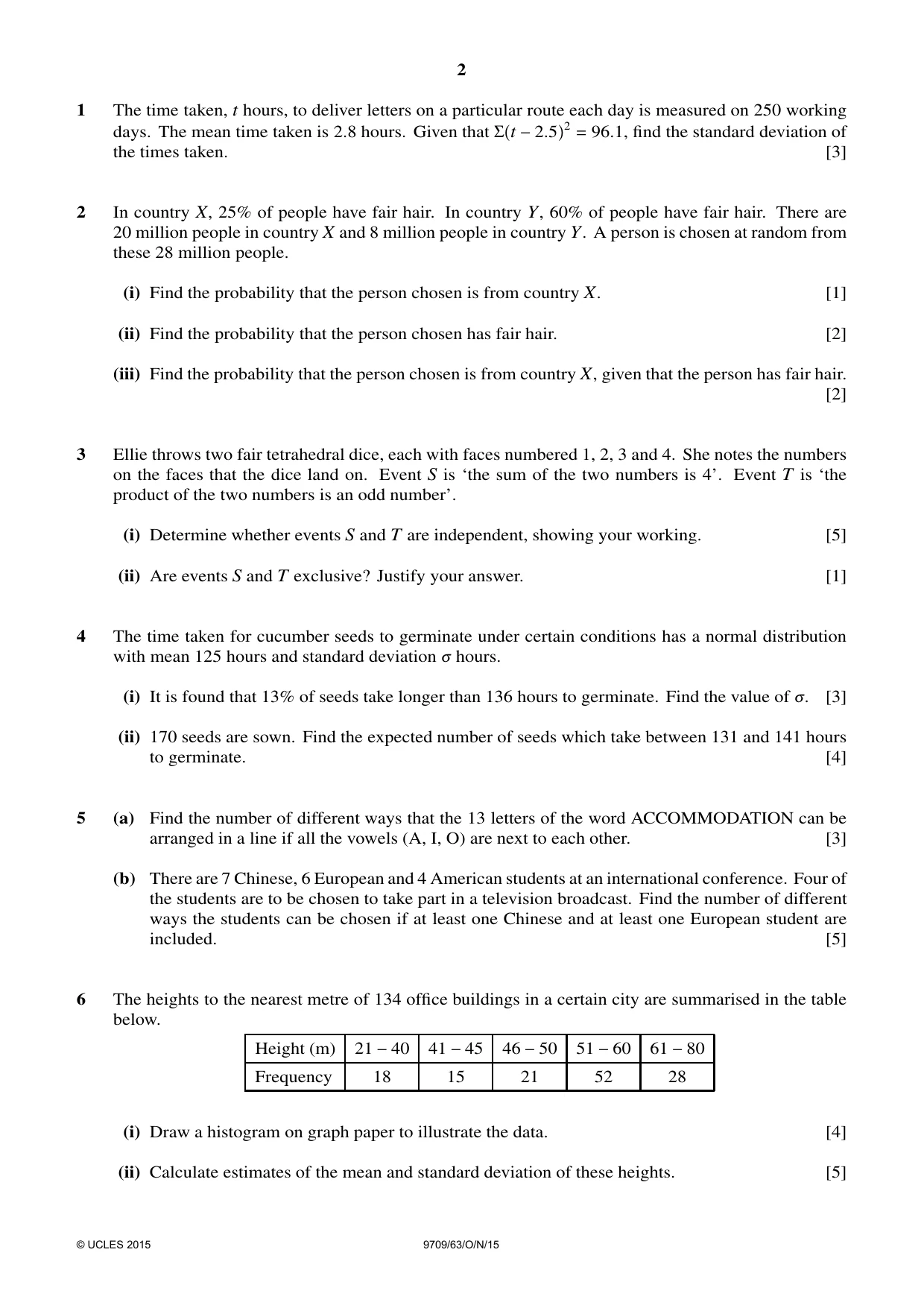
2 In country X, 25% of people have fair hair. In country Y, 60% of people have fair hair. There are 20 million people in country X and 8 million people in country Y. A person is chosen at random from these 28 million people. (i) Find the probability that the person chosen is from country X. [1] (ii) Find the probability that the person chosen has fair hair. [2] (iii) Find the probability that the person chosen is from country X, given that the person has fair hair. [2]
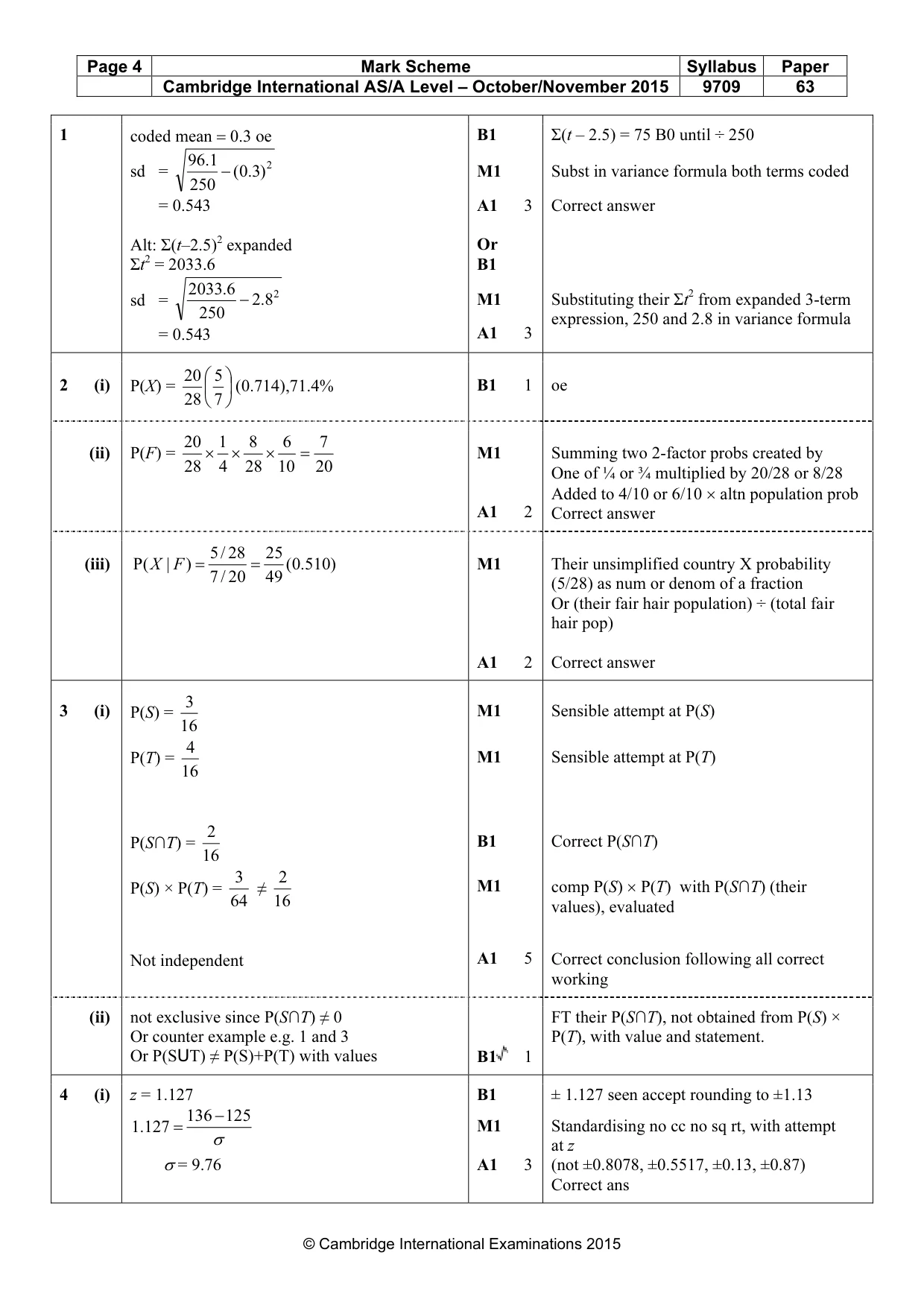
Mark scheme: 20 5 2 (i) P(X) = (0.714),71.4% B1 1 oe 28 7 20 1 8 6 7 (ii) P(F) = × × × = M1 Summing two 2-factor probs created by 28 4 28 10 20 One of ¼ or ¾ multiplied by 20/28 or 8/28 Added to 4/10 or 6/10 × altn population prob A1 2 Correct answer 5 / 28 25 (iii) P ( X | F ) = = ( .0 510) M1 Their unsimplified country X probability 7 / 20 49 (5/28) as num or denom of a fraction Or (their fair hair population) ÷ (total fair hair pop) A1 2 Correct answer 3
Q3 · Ellie throws two fair tetrahedral dice, each with faces numbered 1, 2, 3 and 4
3 Ellie throws two fair tetrahedral dice, each with faces numbered 1, 2, 3 and 4. She notes the numbers on the faces that the dice land on. Event S is ‘the sum of the two numbers is 4’. Event T is ‘the product of the two numbers is an odd number’. (i) Determine whether events S and T are independent, showing your working. [5] (ii) Are events S and T exclusive? Justify your answer. [1]
Mark scheme: 3 3 (i) P(S) = M1 Sensible attempt at P(S) 16 4 P(T) = M1 Sensible attempt at P(T) 16 2 P(S∩T) = B1 Correct P(S∩T) 16 3 2 P(S) × P(T) = ≠ M1 comp P(S) × P(T) with P(S∩T) (their 64 16 values), evaluated Not independent A1 5 Correct conclusion following all correct working (ii) not exclusive since P(S∩T) ≠ 0 FT their P(S∩T), not obtained from P(S) × Or counter example e.g. 1 and 3 P(T), with value and statement. Or P(SUT) ≠ P(S)+P(T) with values B1 1
Q4 · The time taken for cucumber seeds to germinate under certain conditions has a normal…
4 The time taken for cucumber seeds to germinate under certain conditions has a normal distribution with mean 125 hours and standard deviation 3 hours. (i) It is found that 13% of seeds take longer than 136 hours to germinate. Find the value of 3. [3] (ii) 170 seeds are sown. Find the expected number of seeds which take between 131 and 141 hours to germinate. [4]
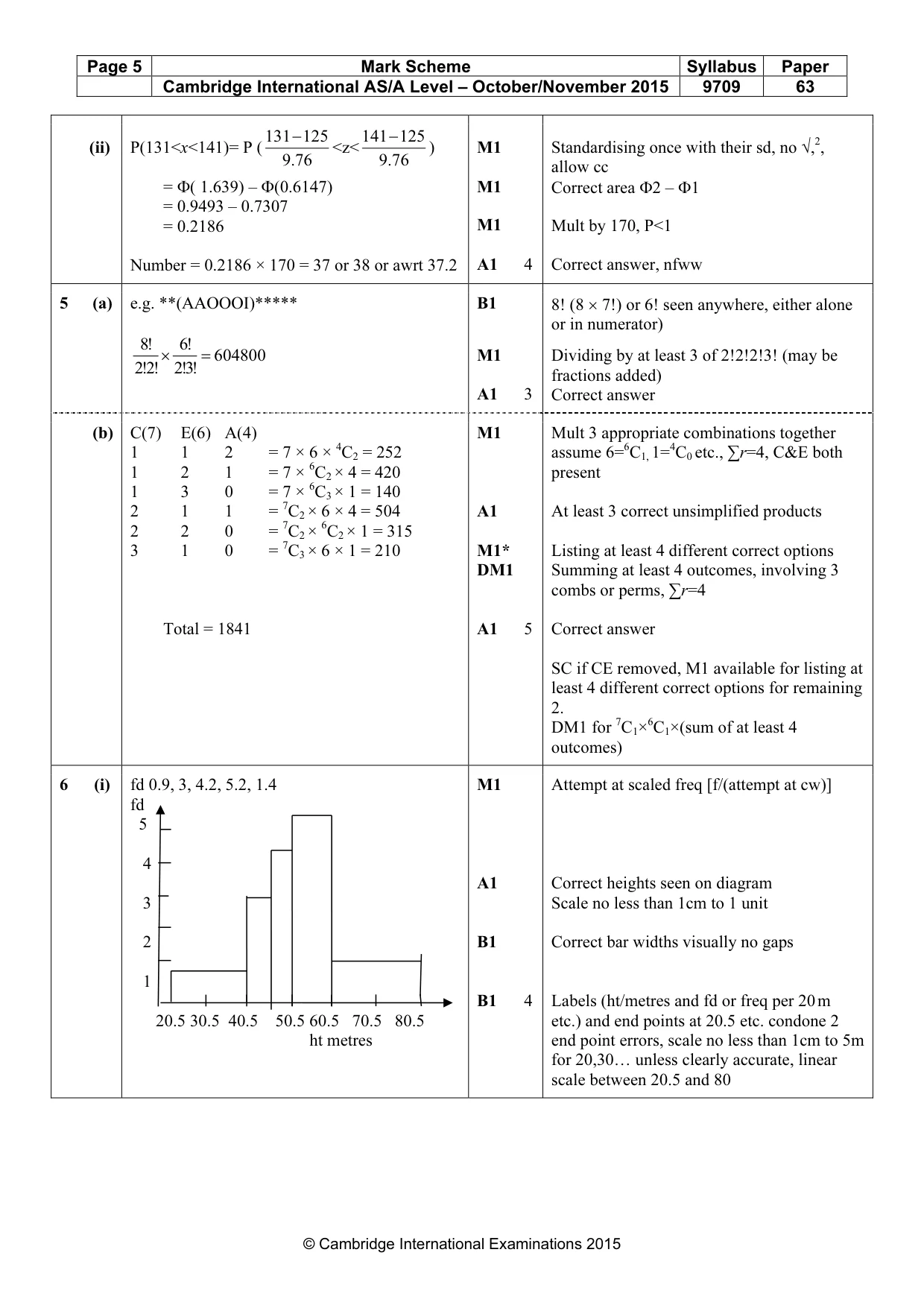
Mark scheme: 4 (i) z = 1.127 B1 ± 1.127 seen accept rounding to ±1.13 136 − 125 .1127 = M1 Standardising no cc no sq rt, with attempt σ at z σ = 9.76 A1 3 (not ±0.8078, ±0.5517, ±0.13, ±0.87) Correct ans 131− 125 141− 125 (ii) P(131<x<141)= P ( <z< ) M1 Standardising once with their sd, no √,2, .976 .9 76 allow cc = Φ( 1.639) – Φ(0.6147) M1 Correct area Φ2 – Φ1 = 0.9493 – 0.7307 = 0.2186 M1 Mult by 170, P<1 Number = 0.2186 × 170 = 37 or 38 or awrt 37.2 A1 4 Correct answer, nfww
Q5 · Find the number of different ways that the 13 letters of the word ACCOMMODATION can be…
5 (a) Find the number of different ways that the 13 letters of the word ACCOMMODATION can be arranged in a line if all the vowels (A, I, O) are next to each other. [3] (b) There are 7 Chinese, 6 European and 4 American students at an international conference. Four of the students are to be chosen to take part in a television broadcast. Find the number of different ways the students can be chosen if at least one Chinese and at least one European student are included. [5]
Mark scheme: 5 (a) e.g. **(AAOOOI)***** B1 8! (8 × 7!) or 6! seen anywhere, either alone or in numerator) !8 !6 × = 604800 M1 Dividing by at least 3 of 2!2!2!3! (may be !2!2 !3!2 fractions added) A1 3 Correct answer (b) C(7) E(6) A(4) M1 Mult 3 appropriate combinations together 1 1 2 = 7 × 6 × 4C2 = 252 assume 6=6C1, 1=4C0 etc., ∑r=4, C&E both 1 2 1 = 7 × 6C2 × 4 = 420 present 1 3 0 = 7 × 6C3 × 1 = 140 2 1 1 = 7C2 × 6 × 4 = 504 A1 At least 3 correct unsimplified products 2 2 0 = 7C2 × 6C2 × 1 = 315 3 1 0 = 7C3 × 6 × 1 = 210 M1* Listing at least 4 different correct options DM1 Summing at least 4 outcomes, involving 3 combs or perms, ∑r=4 Total = 1841 A1 5 Correct answer SC if CE removed, M1 available for listing at least 4 different correct options for remaining 2. DM1 for 7C1×6C1×(sum of at least 4 outcomes)
Q6 · The heights to the nearest metre of 134 office buildings in a certain city are summarised…
6 The heights to the nearest metre of 134 office buildings in a certain city are summarised in the table below. Height (m) 21 −40 41 −45 46 −50 51 −60 61 −80 Frequency 18 15 21 52 28 (i) Draw a histogram on graph paper to illustrate the data. [4] (ii) Calculate estimates of the mean and standard deviation of these heights. [5]
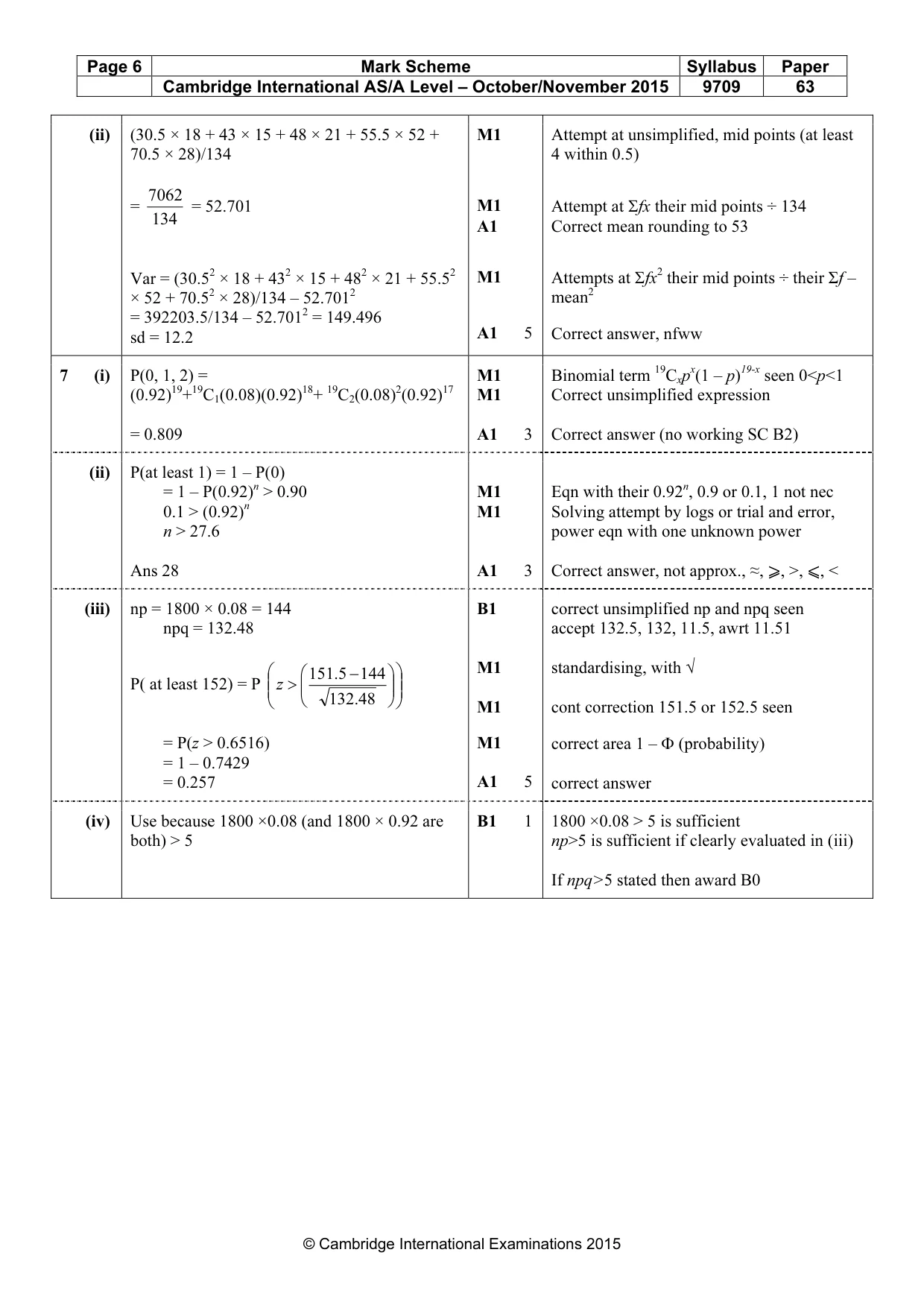
Mark scheme: 6 (i) fd 0.9, 3, 4.2, 5.2, 1.4 M1 Attempt at scaled freq [f/(attempt at cw)] fd 5 4 A1 Correct heights seen on diagram 3 Scale no less than 1cm to 1 unit 2 B1 Correct bar widths visually no gaps 1 B1 4 Labels (ht/metres and fd or freq per 20 m 20.5 30.5 40.5 50.5 60.5 70.5 80.5 etc.) and end points at 20.5 etc. condone 2 ht metres end point errors, scale no less than 1cm to 5m for 20,30… unless clearly accurate, linear scale between 20.5 and 80 (ii) (30.5 × 18 + 43 × 15 + 48 × 21 + 55.5 × 52 + M1 Attempt at unsimplified, mid points (at least 70.5 × 28)/134 4 within 0.5) 7062 = = 52.701 M1 Attempt at Σfx their mid points ÷ 134 134 A1 Correct mean rounding to 53 Var = (30.52 × 18 + 432 × 15 + 482 × 21 + 55.52 M1 Attempts at Σfx2 their mid points ÷ their Σf – × 52 + 70.52 × 28)/134 – 52.7012 mean2 = 392203.5/134 – 52.7012 = 149.496 A1 5 Correct answer, nfww sd = 12.2 19 19
Q7 · A factory makes water pistols, 8% of which do not work properly
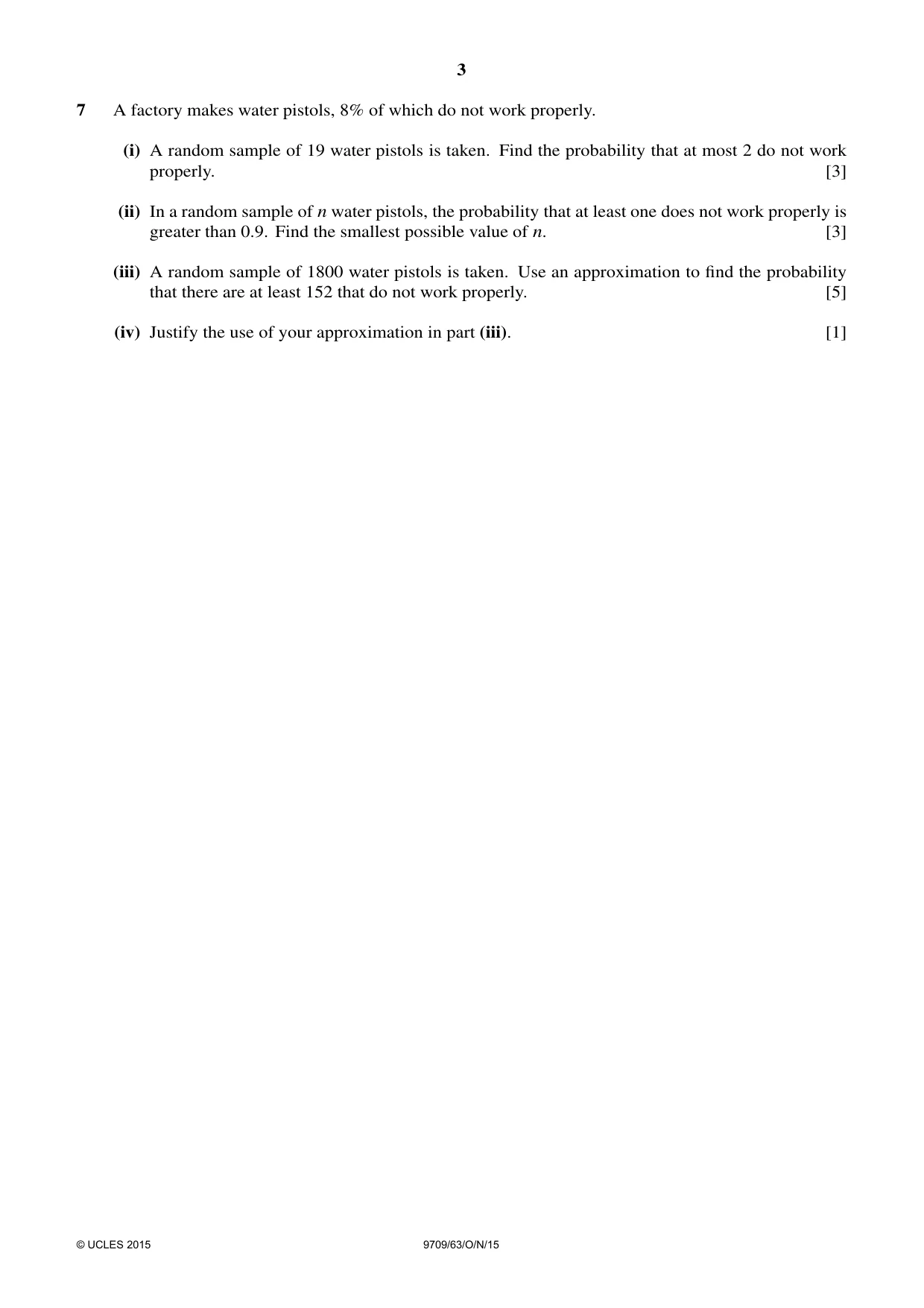
7 A factory makes water pistols, 8% of which do not work properly. (i) A random sample of 19 water pistols is taken. Find the probability that at most 2 do not work properly. [3] (ii) In a random sample of n water pistols, the probability that at least one does not work properly is greater than 0.9. Find the smallest possible value of n. [3] (iii) A random sample of 1800 water pistols is taken. Use an approximation to find the probability that there are at least 152 that do not work properly. [5] (iv) Justify the use of your approximation in part (iii). [1]
Mark scheme: 7 (i) P(0, 1, 2) = M1 Binomial term 19Cxpx(1 – p)19-x seen 0<p<1 (0.92)19+19C1(0.08)(0.92)18+ 19C2(0.08)2(0.92)17 M1 Correct unsimplified expression = 0.809 A1 3 Correct answer (no working SC B2) (ii) P(at least 1) = 1 – P(0) = 1 – P(0.92)n > 0.90 M1 Eqn with their 0.92n, 0.9 or 0.1, 1 not nec 0.1 > (0.92)n M1 Solving attempt by logs or trial and error, n > 27.6 power eqn with one unknown power Ans 28 A1 3 Correct answer, not approx., ≈, ⩾, >, ⩽, < (iii) np = 1800 × 0.08 = 144 B1 correct unsimplified np and npq seen npq = 132.48 accept 132.5, 132, 11.5, awrt 11.51 1515. − 144 M1 standardising, with √ P( at least 152) = P z > 132.48 M1 cont correction 151.5 or 152.5 seen = P(z > 0.6516) M1 correct area 1 – Φ (probability) = 1 – 0.7429 = 0.257 A1 5 correct answer (iv) Use because 1800 ×0.08 (and 1800 × 0.92 are B1 1 1800 ×0.08 > 5 is sufficient both) > 5 np>5 is sufficient if clearly evaluated in (iii) If npq>5 stated then award B0
What was in this paper
The subtopics covered by these 6 questions, and how many questions each got. Open one in a new tab to see every Cambridge question on it.
What you needed in this session
Cambridge’s own grade thresholds for 2015 Oct/Nov, Paper 6 · Variant 3. A higher threshold means an easier paper — the bar moves with how the cohort did.