Cambridge A Level Mathematics 9709 — 2015 Oct/Nov Paper 6 · Variant 2
9709/62/O/N/15 · 4 questions · 50 marks · ≈56 min
The question paper and its mark scheme, free to read here and free to download. This is Cambridge’s own paper, exactly as it was sat.
Question paper4 pages
Mark scheme6 pages
Answers below. Sit the paper first if you are practising.
Questions as text
Q2 · A committee of 6 people is to be chosen at random from 7 men and 9 women
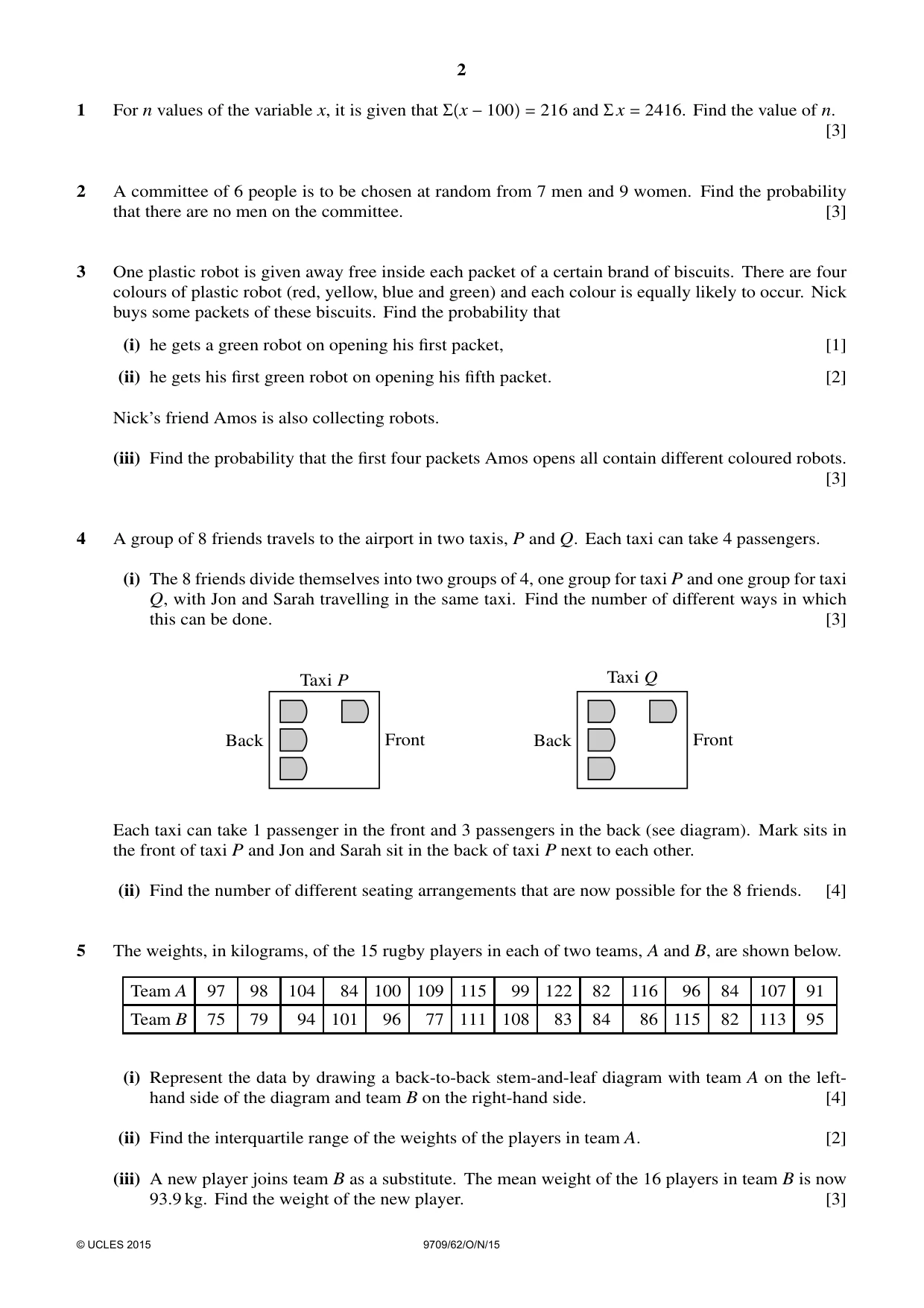
2 A committee of 6 people is to be chosen at random from 7 men and 9 women. Find the probability that there are no men on the committee. [3]
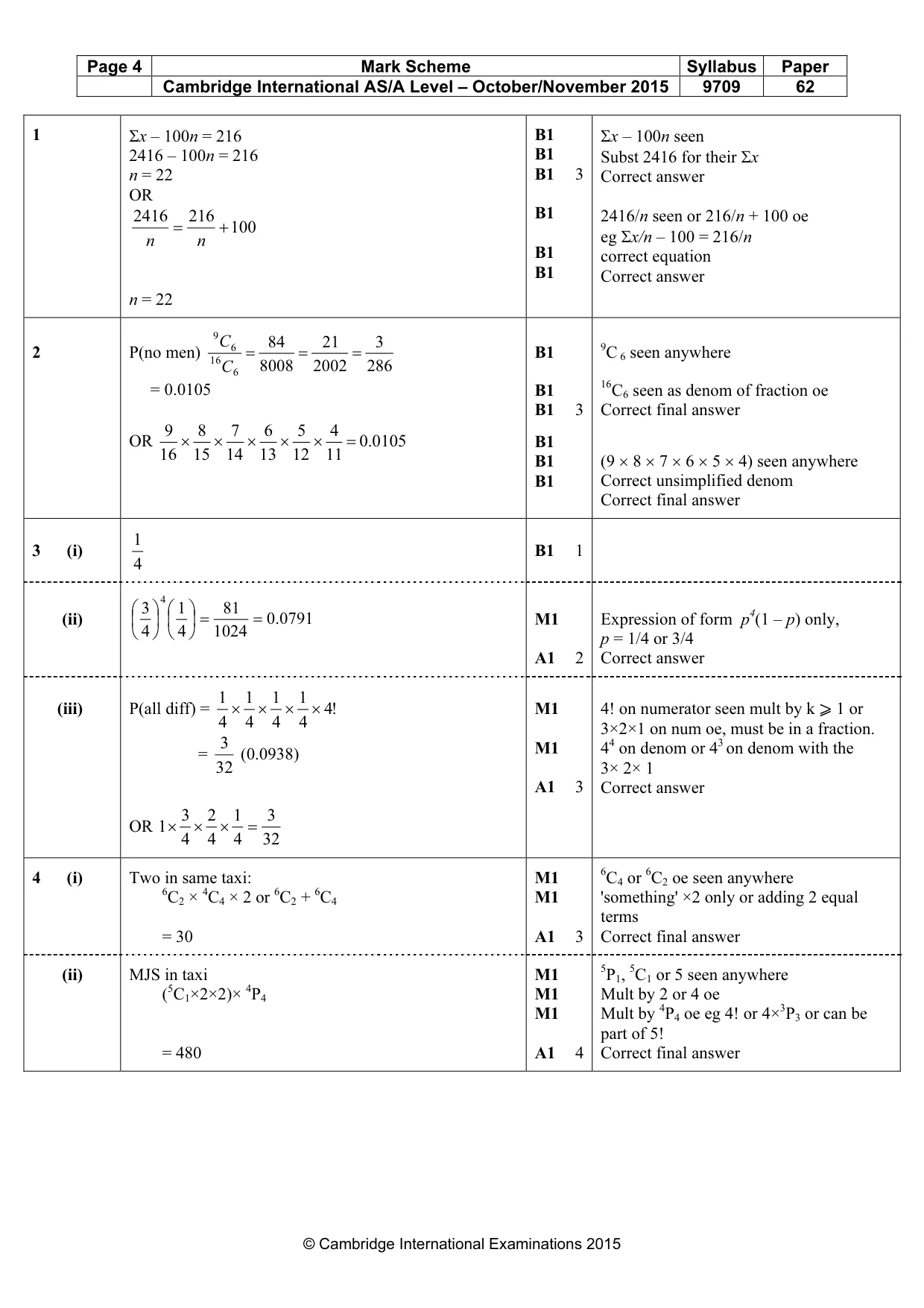
Mark scheme: C 6 84 21 3 2 P(no men) 16 = = = B1 9C 6 seen anywhere C 6 8008 2002 286 = 0.0105 B1 16C6 seen as denom of fraction oe B1 3 Correct final answer 9 8 7 6 5 4 OR × × × × × = .00105 B1 16 15 14 13 12 11 B1 (9 × 8 × 7 × 6 × 5 × 4) seen anywhere B1 Correct unsimplified denom Correct final answer 1
Q3 · One plastic robot is given away free inside each packet of a certain brand of biscuits
3 One plastic robot is given away free inside each packet of a certain brand of biscuits. There are four colours of plastic robot (red, yellow, blue and green) and each colour is equally likely to occur. Nick buys some packets of these biscuits. Find the probability that (i) he gets a green robot on opening his first packet, [1] (ii) he gets his first green robot on opening his fifth packet. [2] Nick’s friend Amos is also collecting robots. (iii) Find the probability that the first four packets Amos opens all contain different coloured robots. [3]
Mark scheme: 1 3 (i) B1 1 4 4 3 1 81 (ii) = = .0 0791 M1 Expression of form p4(1 – p) only, 4 4 1024 p = 1/4 or 3/4 A1 2 Correct answer 1 1 1 1 (iii) P(all diff) = × × × × !4 M1 4! on numerator seen mult by k ⩾ 1 or 4 4 4 4 3×2×1 on num oe, must be in a fraction. 3 M1 44 on denom or 43 on denom with the = (0.0938) 32 3× 2× 1 A1 3 Correct answer 3 2 1 3 OR 1 × × × = 4 4 4 32 6 6
Q4 · A group of 8 friends travels to the airport in two taxis, P and Q
4 A group of 8 friends travels to the airport in two taxis, P and Q. Each taxi can take 4 passengers. (i) The 8 friends divide themselves into two groups of 4, one group for taxi P and one group for taxi Q, with Jon and Sarah travelling in the same taxi. Find the number of different ways in which this can be done. [3] Taxi P Taxi Q Back Front Back Front Each taxi can take 1 passenger in the front and 3 passengers in the back (see diagram). Mark sits in the front of taxi P and Jon and Sarah sit in the back of taxi P next to each other. (ii) Find the number of different seating arrangements that are now possible for the 8 friends. [4]
Mark scheme: 4 (i) Two in same taxi: M1 6C4 or 6C2 oe seen anywhere 6C2 × 4C4 × 2 or 6C2 + 6C4 M1 'something' ×2 only or adding 2 equal terms = 30 A1 3 Correct final answer (ii) MJS in taxi M1 5P1, 5C1 or 5 seen anywhere (5C1×2×2)× 4P4 M1 Mult by 2 or 4 oe M1 Mult by 4P4 oe eg 4! or 4×3P3 or can be part of 5! = 480 A1 4 Correct final answer
Q5 · The weights, in kilograms, of the 15 rugby players in each of two teams, A and B, are…
5 The weights, in kilograms, of the 15 rugby players in each of two teams, A and B, are shown below. Team A 97 98 104 84 100 109 115 99 122 82 116 96 84 107 91 Team B 75 79 94 101 96 77 111 108 83 84 86 115 82 113 95 (i) Represent the data by drawing a back-to-back stem-and-leaf diagram with team A on the left- hand side of the diagram and team B on the right-hand side. [4] (ii) Find the interquartile range of the weights of the players in team A. [2] (iii) A new player joins team B as a substitute. The mean weight of the 16 players in team B is now 93.9 kg. Find the weight of the new player. [3]
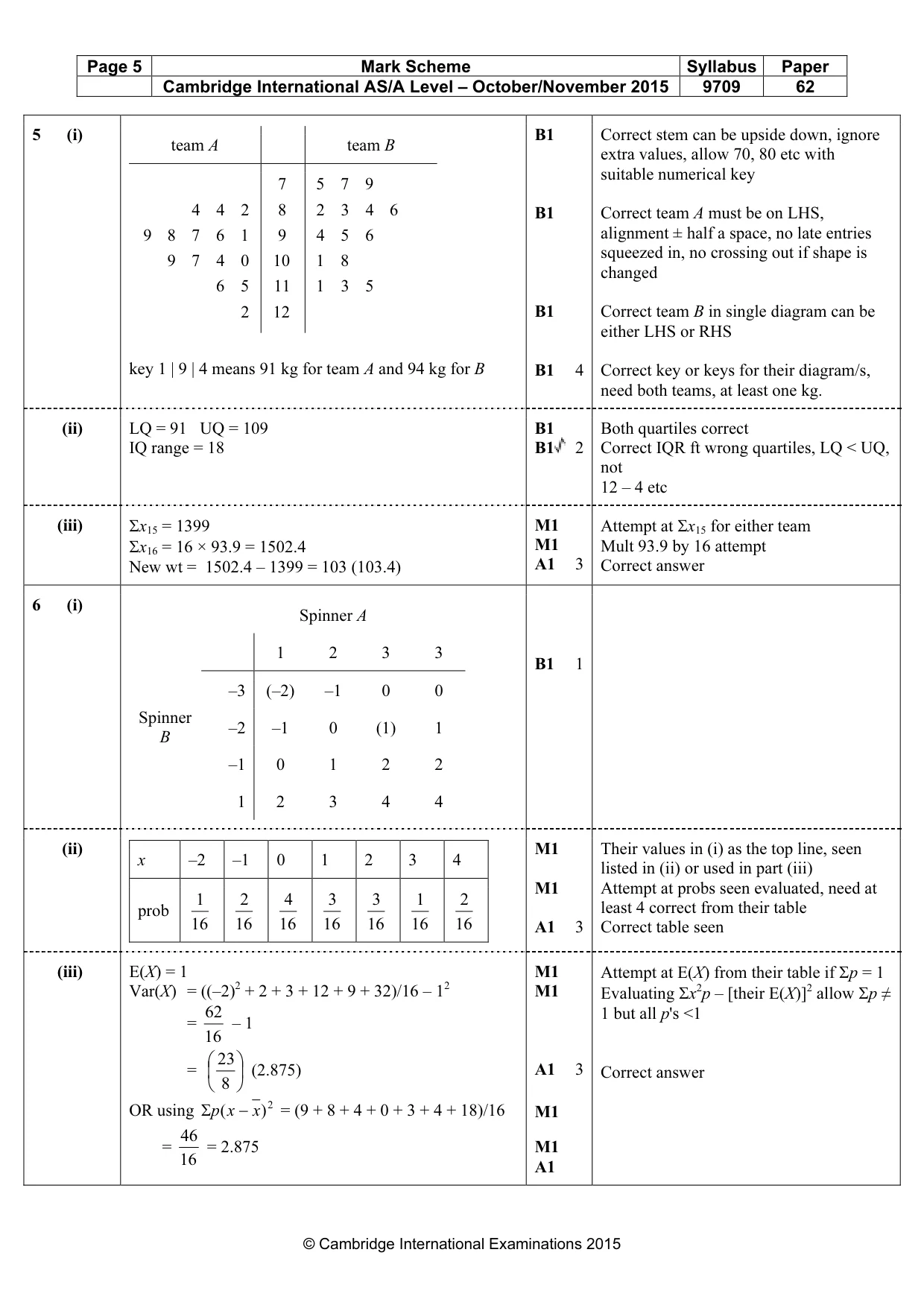
Mark scheme: 5 (i) B1 Correct stem can be upside down, ignore team A team B extra values, allow 70, 80 etc with suitable numerical key 7 5 7 9 4 4 2 8 2 3 4 6 B1 Correct team A must be on LHS, 9 8 7 6 1 9 4 5 6 alignment ± half a space, no late entries squeezed in, no crossing out if shape is 9 7 4 0 10 1 8 changed 6 5 11 1 3 5 2 12 B1 Correct team B in single diagram can be either LHS or RHS key 1 | 9 | 4 means 91 kg for team A and 94 kg for B B1 4 Correct key or keys for their diagram/s, need both teams, at least one kg. (ii) LQ = 91 UQ = 109 B1 Both quartiles correct IQ range = 18 B1 2 Correct IQR ft wrong quartiles, LQ < UQ, not 12 – 4 etc (iii) Σx15 = 1399 M1 Attempt at Σx15 for either team Σx16 = 16 × 93.9 = 1502.4 M1 Mult 93.9 by 16 attempt New wt = 1502.4 – 1399 = 103 (103.4) A1 3 Correct answer
What was in this paper
The subtopics covered by these 4 questions, and how many questions each got. Open one in a new tab to see every Cambridge question on it.
What you needed in this session
Cambridge’s own grade thresholds for 2015 Oct/Nov, Paper 6 · Variant 2. A higher threshold means an easier paper — the bar moves with how the cohort did.