Cambridge A Level Mathematics 9709 — 2014 Oct/Nov Paper 5 · Variant 3
9709/53/O/N/14 · 4 questions · 50 marks · ≈56 min
The question paper and its mark scheme, free to read here and free to download. This is Cambridge’s own paper, exactly as it was sat.
Question paper4 pages
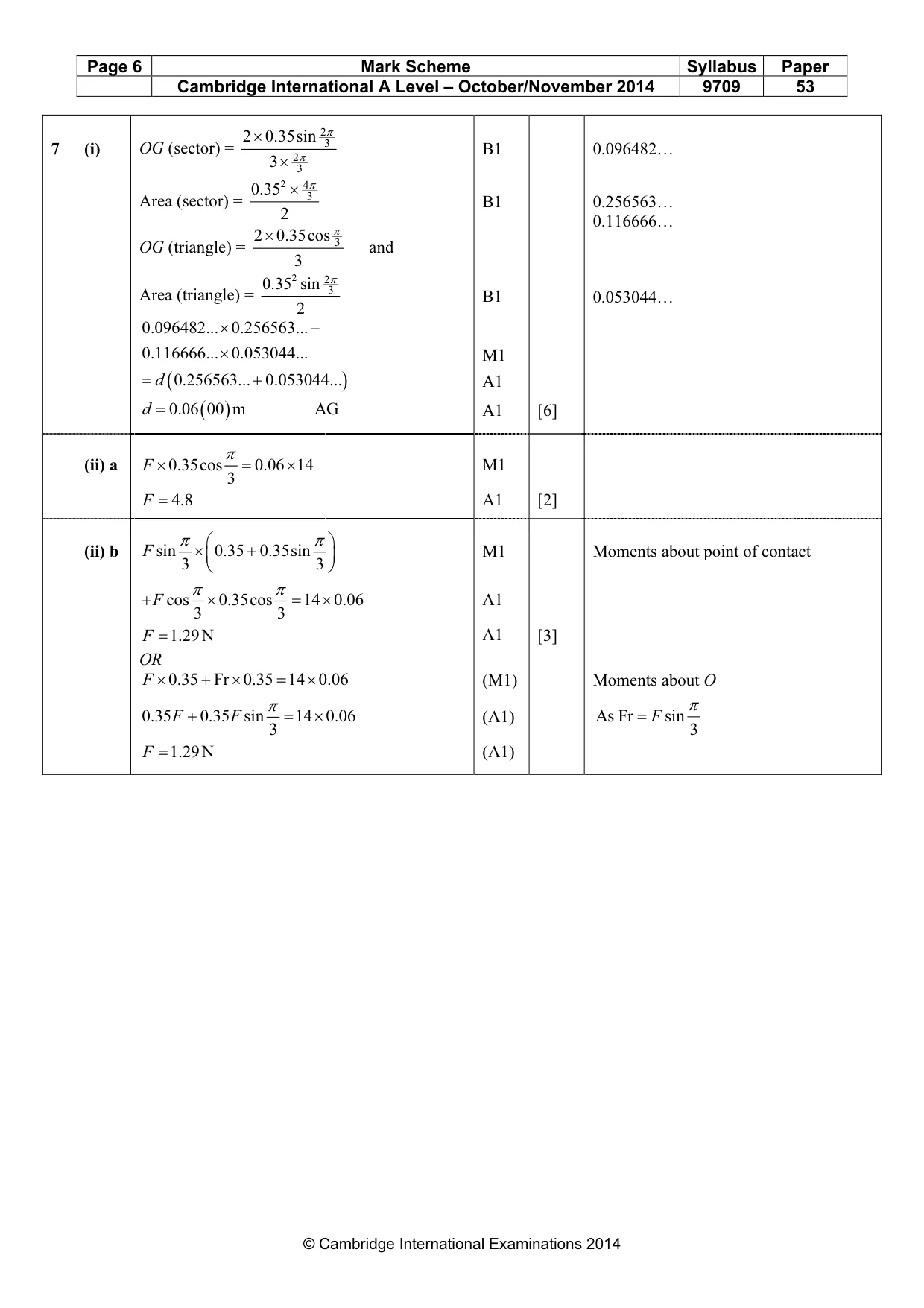
Mark scheme6 pages
Answers below. Sit the paper first if you are practising.
Questions as text
Q1 · A golf ball B is projected from a point O on horizontal ground
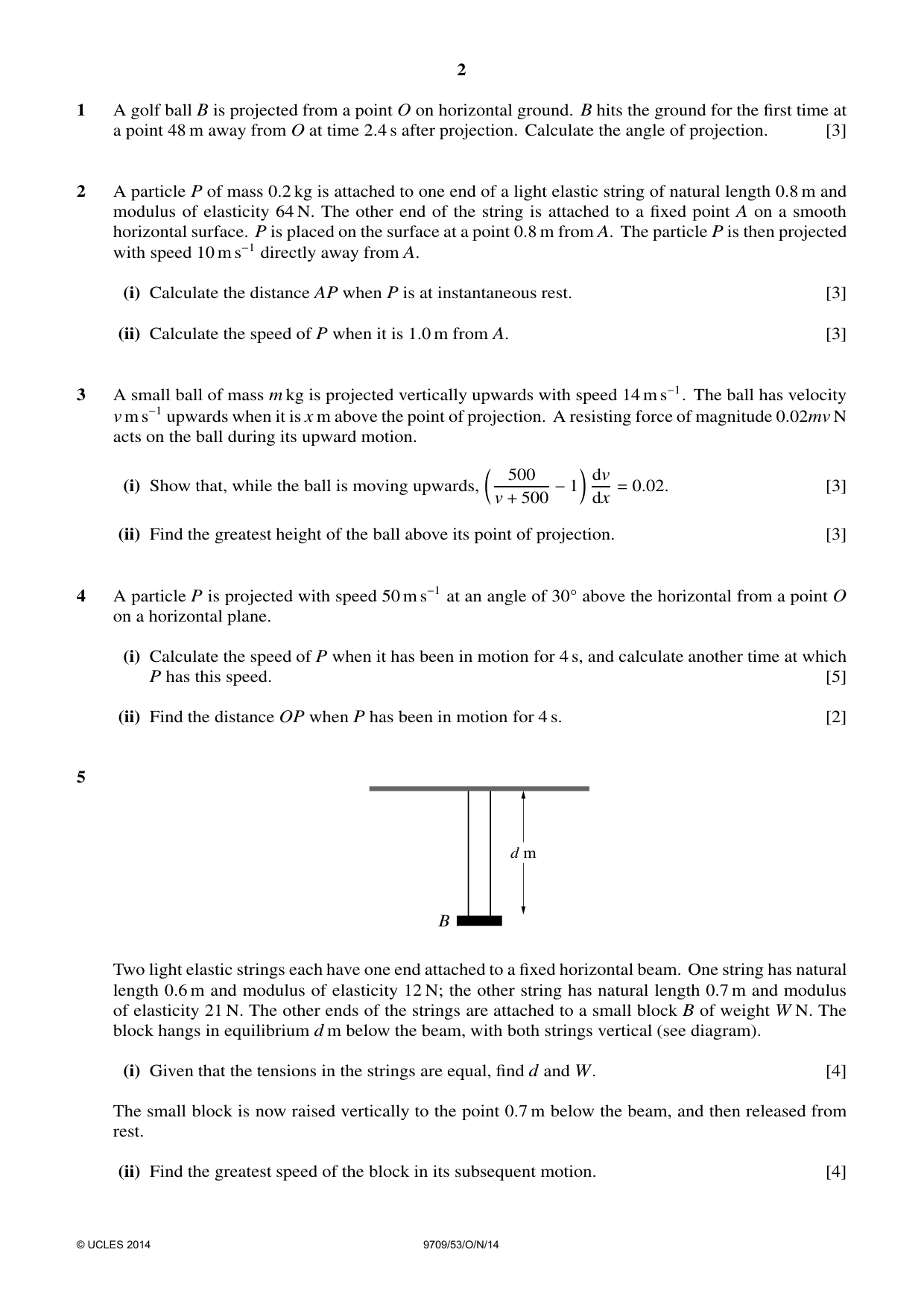
1 A golf ball B is projected from a point O on horizontal ground. B hits the ground for the first time at a point 48 m away from O at time 2.4 s after projection. Calculate the angle of projection. [3]
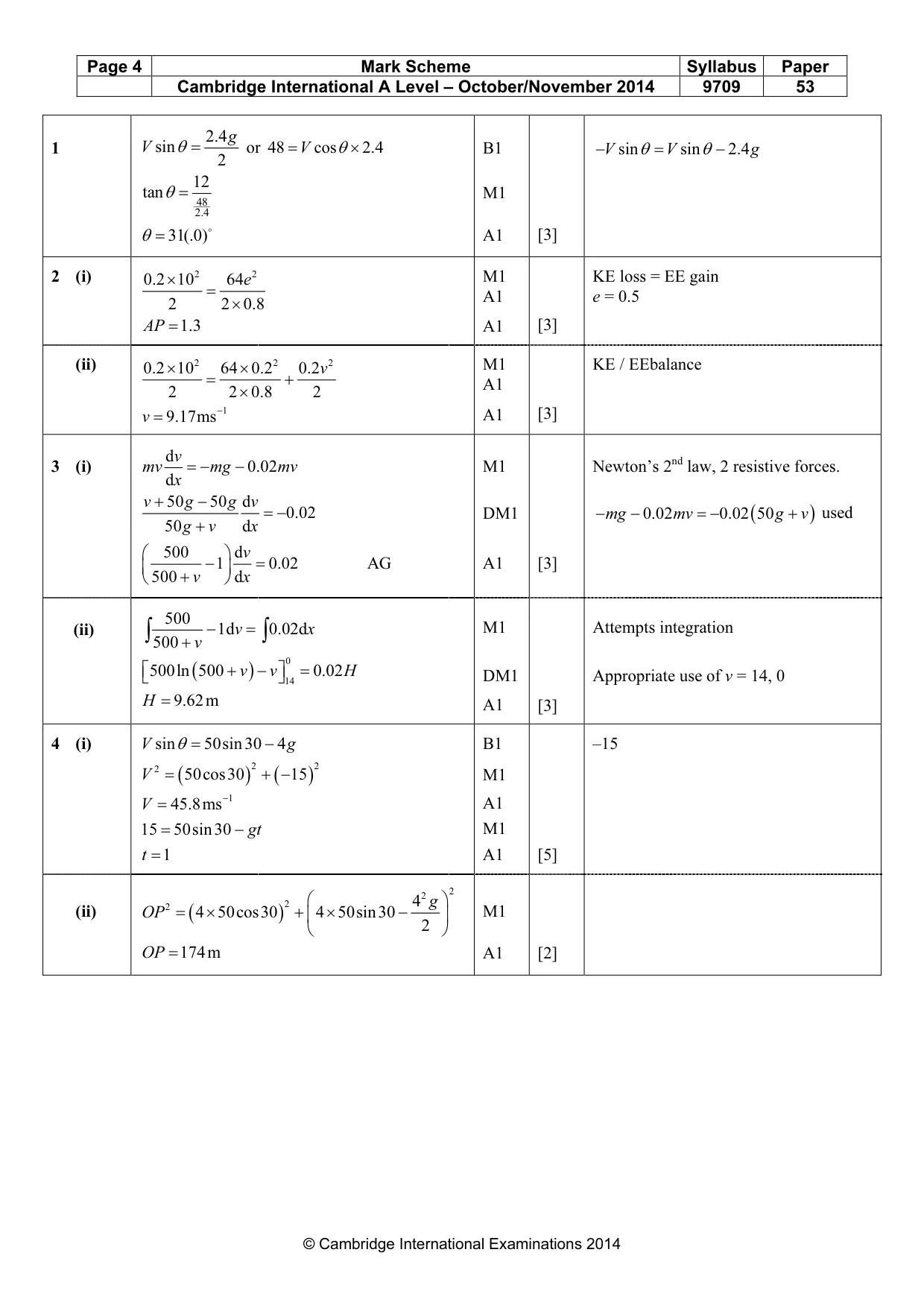
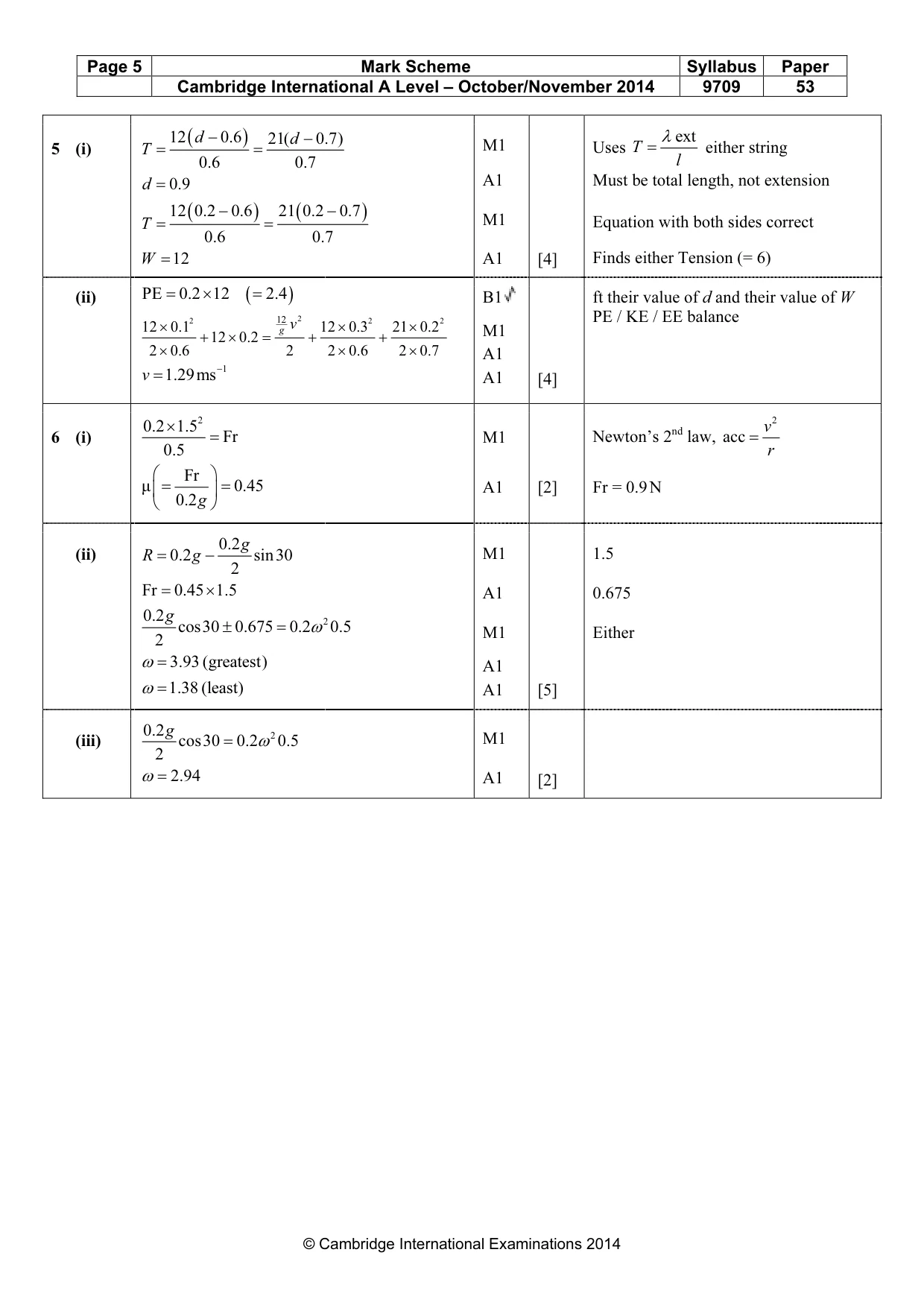
Mark scheme: 2.4 g 1 V sin θ = or 48 = V cos θ × 2.4 B1 −V sin θ = V sin θ − 2.4 g 2 12 tan θ = M1 48 2.4 θ = 31(.0) o A1 [3]
Q2 · A particle P of mass 0.2 kg is attached to one end of a light elastic string of natural…
2 A particle P of mass 0.2 kg is attached to one end of a light elastic string of natural length 0.8 m and modulus of elasticity 64 N. The other end of the string is attached to a fixed point A on a smooth horizontal surface. P is placed on the surface at a point 0.8 m from A. The particle P is then projected with speed 10 m s−1 directly away from A. (i) Calculate the distance AP when P is at instantaneous rest. [3] (ii) Calculate the speed of P when it is 1.0 m from A. [3]
Mark scheme: 2 (i) 0.2 × 10 2 64 e 2 M1 KE loss = EE gain = A1 e = 0.5 2 2 × 0.8 AP = 1.3 A1 [3] (ii) 0.2 × 10 2 64 × 0.2 2 0.2v 2 M1 KE / EEbalance = + A1 2 2 × 0.8 2 v = 9.17ms −1 A1 [3] dv d
Q3 · A small ball of mass m kg is projected vertically upwards with speed 14 m s−1
3 A small ball of mass m kg is projected vertically upwards with speed 14 m s−1. The ball has velocity v m s−1 upwards when it is x m above the point of projection. A resisting force of magnitude 0.02mv N acts on the ball during its upward motion. @ A 500 dv (i) Show that, while the ball is moving upwards, −1 = 0.02. [3] v + 500 dx (ii) Find the greatest height of the ball above its point of projection. [3]
Mark scheme: dv 3 (i) mv = − mg − 0.02 mv M1 Newton’s 2nd law, 2 resistive forces. dx v + 50 g − 50 g d v = −0.02 DM1 − mg − 0.02 mv = −0.02 ( 50 g + v ) used 50 g + v d x 500 dv − 1 = 0.02 AG A1 [3] 500 + v dx 500 (ii) ∫ 500 + v − 1dv = ∫ 0.02d x M1 Attempts integration = 0.02 H DM1 Appropriate use of v = 14, 0 500ln ( 500 + v ) −v 140 H = 9.62m A1 [3]
Q4 · A particle P is projected with speed 50 m s−1 at an angle of 30Å above the horizontal…
4 A particle P is projected with speed 50 m s−1 at an angle of 30Å above the horizontal from a point O on a horizontal plane. (i) Calculate the speed of P when it has been in motion for 4 s, and calculate another time at which P has this speed. [5] (ii) Find the distance OP when P has been in motion for 4 s. [2]
Mark scheme: 4 (i) V sin θ = 50sin30 − 4 g B1 –15 V 2 = ( 50cos30 ) 2 + ( −15 ) 2 M1 V = 45.8ms − 1 A1 15 = 50sin30 − gt M1 t = 1 A1 [5] 2 2 2 4 2 g (ii) OP = ( 4 × 50cos30 ) + 4 × 50sin30 − M1 2 OP = 174m A1 [2] ( )
What was in this paper
The subtopics covered by these 4 questions, and how many questions each got. Open one in a new tab to see every Cambridge question on it.
What you needed in this session
Cambridge’s own grade thresholds for 2014 Oct/Nov, Paper 5 · Variant 3. A higher threshold means an easier paper — the bar moves with how the cohort did.