Cambridge A Level Mathematics 9709 — 2014 Oct/Nov Paper 5 · Variant 2
9709/52/O/N/14 · 7 questions · 50 marks · ≈56 min
The question paper and its mark scheme, free to read here and free to download. This is Cambridge’s own paper, exactly as it was sat.
Question paper4 pages
Mark scheme6 pages
Answers below. Sit the paper first if you are practising.
Questions as text
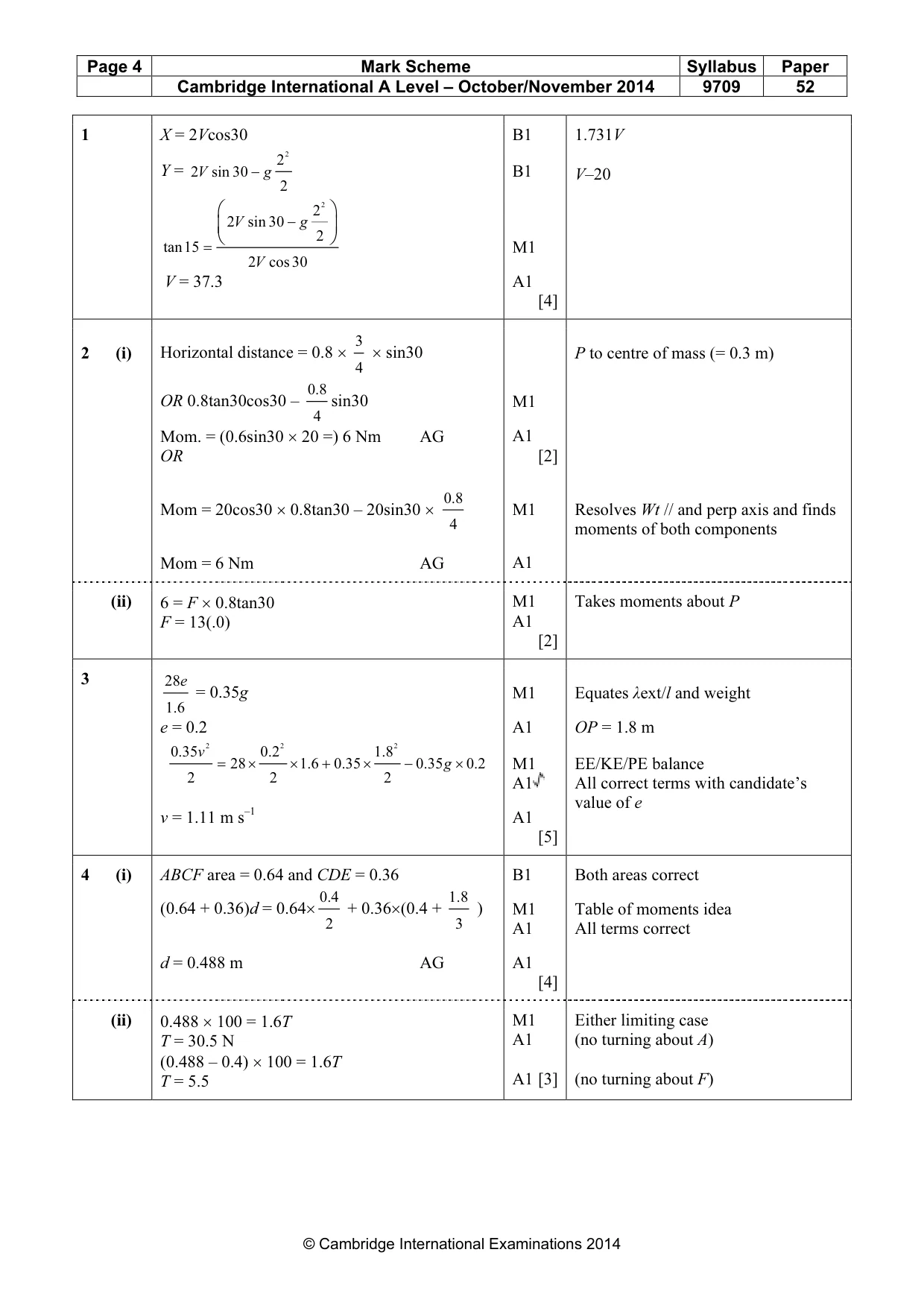
Q1 · A particle P is projected with speed V m s−1 at an angle of 30Å above the horizontal from…
1 A particle P is projected with speed V m s−1 at an angle of 30Å above the horizontal from a point O on horizontal ground. At the instant 2 s after projection, OP makes an angle of 15Å above the horizontal. Calculate V. [4]
Mark scheme: 1 X = 2Vcos30 B1 1.731V 22 Y = 2V sin 30 − g B1 V–20 2 22 2V sin 30 − g 2 tan15 = M1 2V cos30 V = 37.3 A1 [4] 3
Q2 · F N V 30Å 0.8 m P A uniform solid cone with height 0.8 m and semi-vertical angle 30Å has…
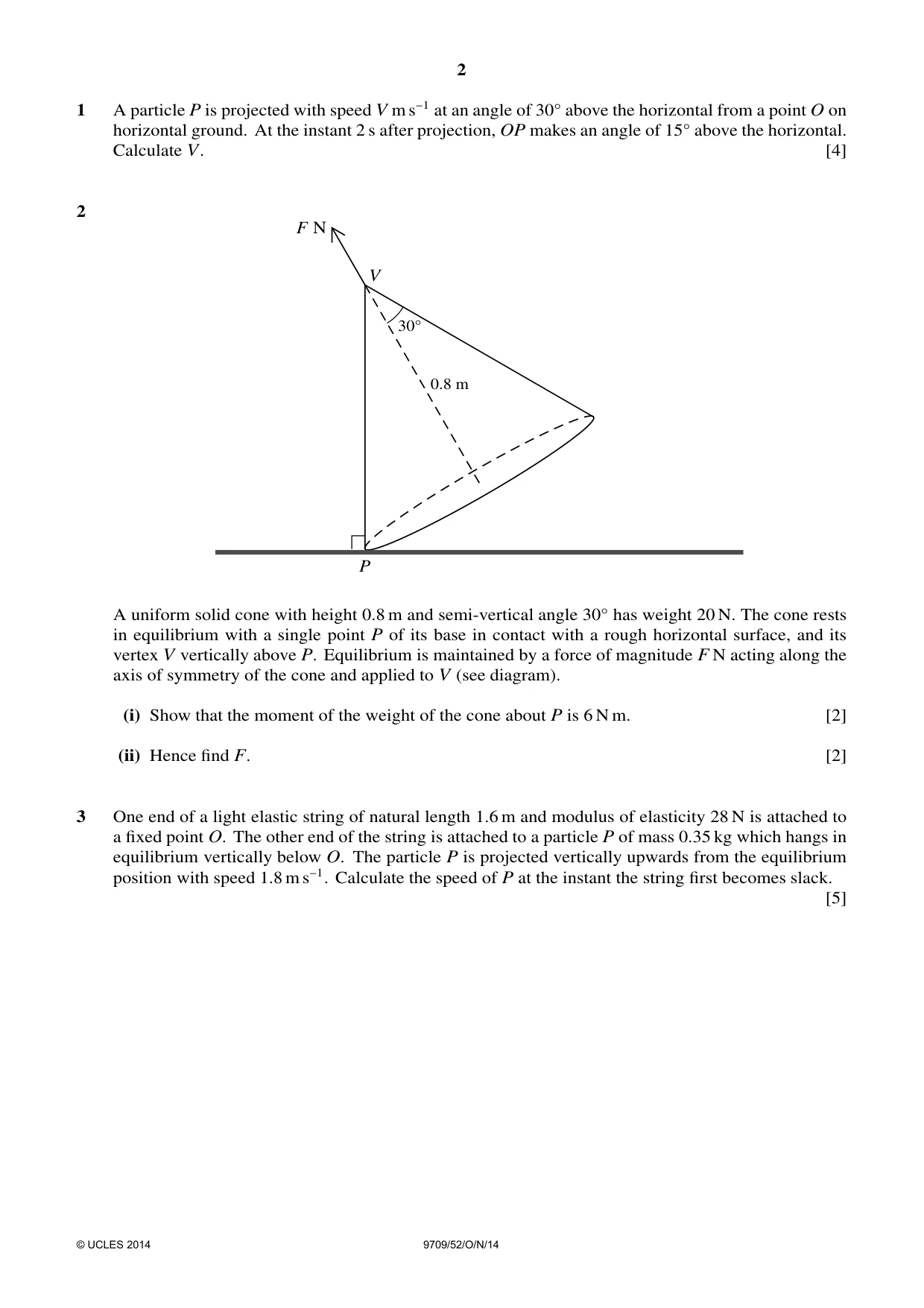
2 F N V 30Å 0.8 m P A uniform solid cone with height 0.8 m and semi-vertical angle 30Å has weight 20 N. The cone rests in equilibrium with a single point P of its base in contact with a rough horizontal surface, and its vertex V vertically above P. Equilibrium is maintained by a force of magnitude F N acting along the axis of symmetry of the cone and applied to V (see diagram). (i) Show that the moment of the weight of the cone about P is 6 N m. [2] (ii) Hence find F. [2]
Mark scheme: 3 2 (i) Horizontal distance = 0.8 × × sin30 P to centre of mass (= 0.3 m) 4 0.8 OR 0.8tan30cos30 – sin30 M1 4 Mom. = (0.6sin30 × 20 =) 6 Nm AG A1 OR [2] 0.8 Mom = 20cos30 × 0.8tan30 – 20sin30 × M1 Resolves Wt // and perp axis and finds 4 moments of both components Mom = 6 Nm AG A1 (ii) 6 = F × 0.8tan30 M1 Takes moments about P F = 13(.0) A1 [2]
Q3 · One end of a light elastic string of natural length 1.6 m and modulus of elasticity 28 N…
3 One end of a light elastic string of natural length 1.6 m and modulus of elasticity 28 N is attached to a fixed point O. The other end of the string is attached to a particle P of mass 0.35 kg which hangs in equilibrium vertically below O. The particle P is projected vertically upwards from the equilibrium position with speed 1.8 m s−1. Calculate the speed of P at the instant the string first becomes slack. [5]
Mark scheme: 3 28 e = 0.35g M1 Equates λext/l and weight 1.6 e = 0.2 A1 OP = 1.8 m 0.35 v 2 0.2 2 1.8 2 = 28 × × 1.6 + 0.35 × − 0.35 g × 0.2 M1 EE/KE/PE balance 2 2 2 A1 All correct terms with candidate’s value of e v = 1.11 m s–1 A1 [5]
Q4 · B C 1.8 m D T N 0.4 m E 1.6 m A F 0.4 m ABCDEF is the cross-section through the centre of…
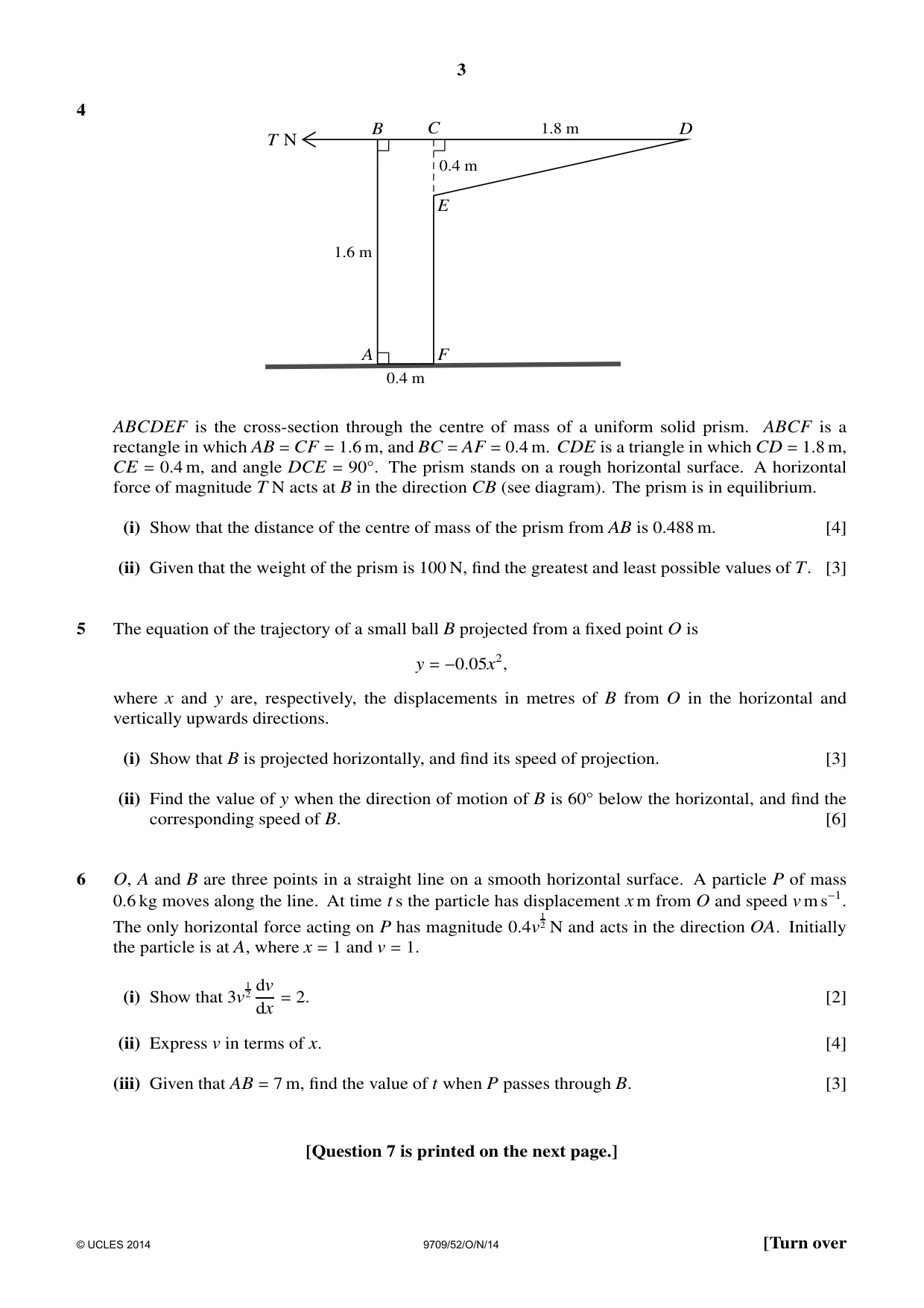
4 B C 1.8 m D T N 0.4 m E 1.6 m A F 0.4 m ABCDEF is the cross-section through the centre of mass of a uniform solid prism. ABCF is a rectangle in which AB = CF = 1.6 m, and BC = AF = 0.4 m. CDE is a triangle in which CD = 1.8 m, CE = 0.4 m, and angle DCE = 90Å. The prism stands on a rough horizontal surface. A horizontal force of magnitude T N acts at B in the direction CB (see diagram). The prism is in equilibrium. (i) Show that the distance of the centre of mass of the prism from AB is 0.488 m. [4] (ii) Given that the weight of the prism is 100 N, find the greatest and least possible values of T. [3]
Mark scheme: 4 (i) ABCF area = 0.64 and CDE = 0.36 B1 Both areas correct 0.4 1.8 (0.64 + 0.36)d = 0.64× + 0.36×(0.4 + ) M1 Table of moments idea 2 3 A1 All terms correct d = 0.488 m AG A1 [4] (ii) 0.488 × 100 = 1.6T M1 Either limiting case T = 30.5 N A1 (no turning about A) (0.488 – 0.4) × 100 = 1.6T T = 5.5 A1 [3] (no turning about F)
Q5 · The equation of the trajectory of a small ball B projected from a fixed point O is y =…
5 The equation of the trajectory of a small ball B projected from a fixed point O is y = −0.05x2, where x and y are, respectively, the displacements in metres of B from O in the horizontal and vertically upwards directions. (i) Show that B is projected horizontally, and find its speed of projection. [3] (ii) Find the value of y when the direction of motion of B is 60Å below the horizontal, and find the corresponding speed of B. [6]
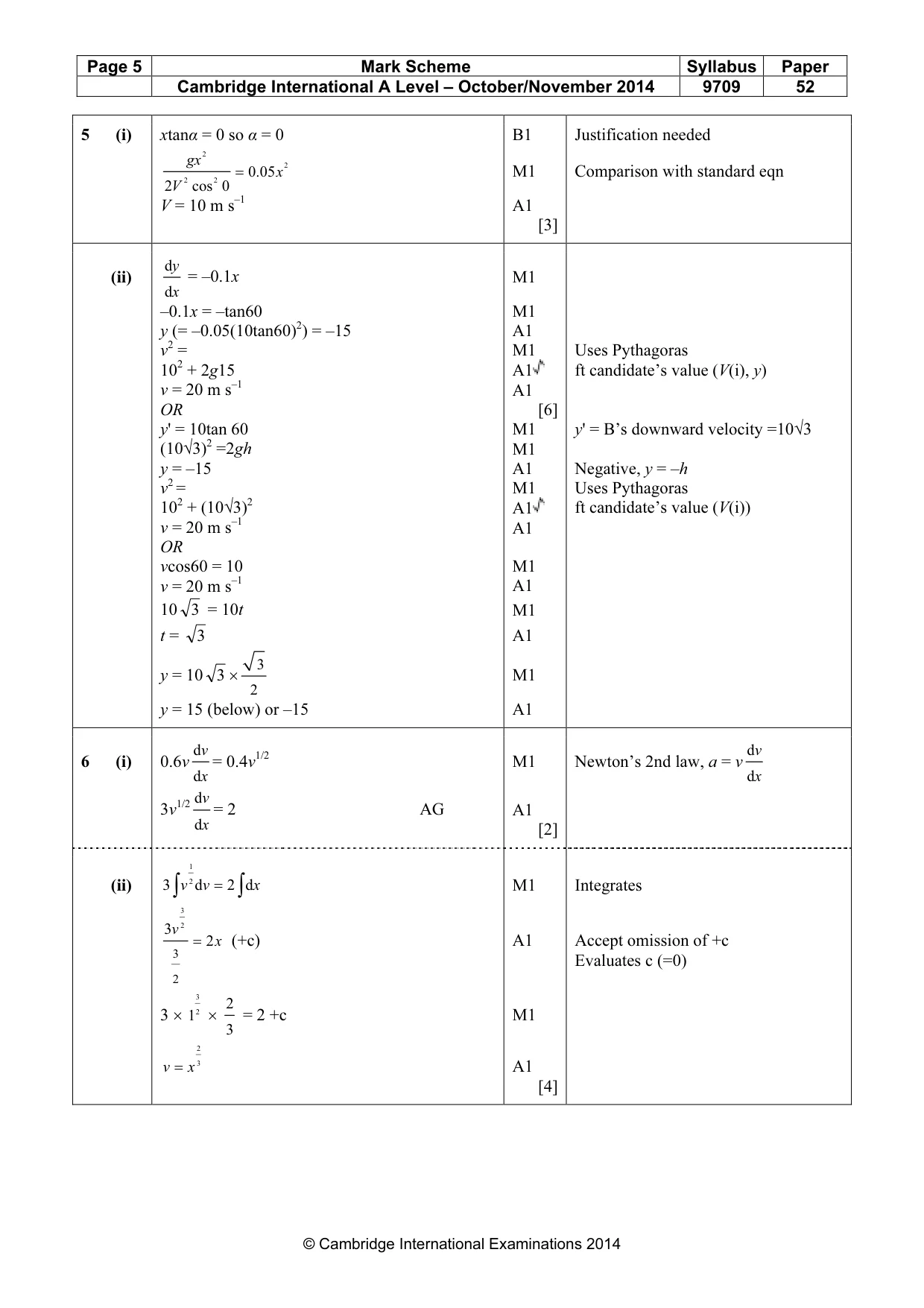
Mark scheme: 5 (i) xtanα = 0 so α = 0 B1 Justification needed gx 2 2 2 2 = 0.05 x M1 Comparison with standard eqn 2V cos 0 V = 10 m s–1 A1 [3] dy (ii) = –0.1x M1 dx –0.1x = –tan60 M1 y (= –0.05(10tan60)2) = –15 A1 v2 = M1 Uses Pythagoras 102 + 2g15 A1 ft candidate’s value (V(i), y) v = 20 m s–1 A1 OR [6] y' = 10tan 60 M1 y' = B’s downward velocity =10√3 (10√3)2 =2gh M1 y = –15 A1 Negative, y = –h v2 = M1 Uses Pythagoras 102 + (10√3)2 A1 ft candidate’s value (V(i)) v = 20 m s–1 A1 OR vcos60 = 10 M1 v = 20 m s–1 A1 10 3 = 10t M1 t = 3 A1 3 y = 10 3 × M1 2 y = 15 (below) or –15 A1 dv 1/2 dv
Q6 · O, A and B are three points in a straight line on a smooth horizontal surface
6 O, A and B are three points in a straight line on a smooth horizontal surface. A particle P of mass 0.6 kg moves along the line. At time t s the particle has displacement x m from O and speed v m s−1. 1 The only horizontal force acting on P has magnitude 0.4v 2 N and acts in the direction OA. Initially the particle is at A, where x = 1 and v = 1. 1 dv (i) Show that 3v 2 = 2. [2] dx (ii) Express v in terms of x. [4] (iii) Given that AB = 7 m, find the value of t when P passes through B. [3] [Question 7 is printed on the next page.]
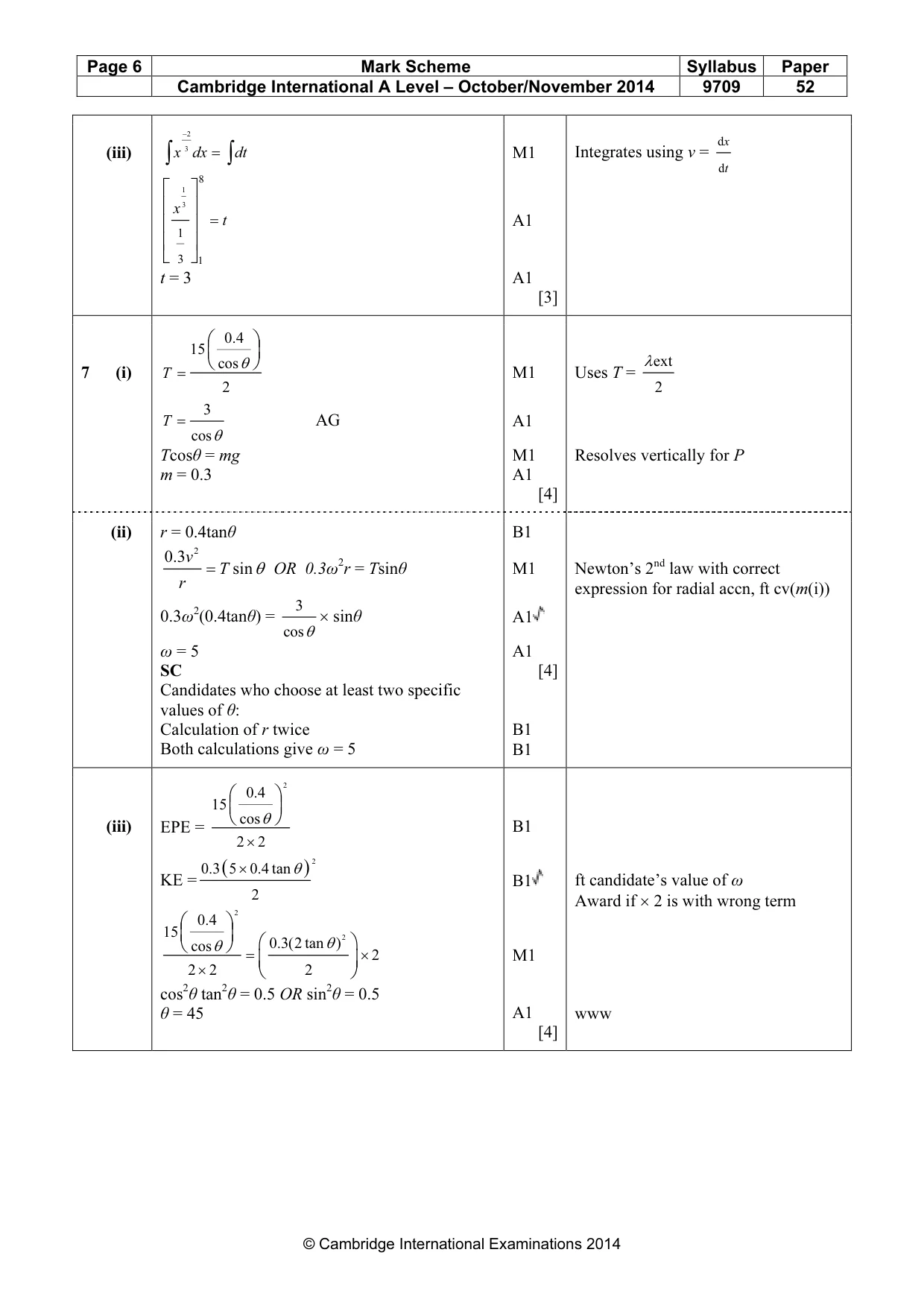
Mark scheme: dv dv 6 (i) 0.6v = 0.4v1/2 M1 Newton’s 2nd law, a = v dx dx dv 3v1/2 = 2 AG A1 dx [2] 1 (ii) 3 ∫ v 2 dv = 2 ∫ dx M1 Integrates 3 3v 2 = 2 x (+c) A1 Accept omission of +c 3 Evaluates c (=0) 2 3 2 3 × 21 × = 2 +c M1 3 2 v = x 3 A1 [4] − 2 d x (iii) ∫ x 3 dx = ∫ dt M1 Integrates using v = d t 8 1 x 3 = t A1 1 3 1 t = 3 A1 [3] 0.4 15 cosθ λ ext
Q7 · A 2 m R 0.4 m 1 P 7 rad s−1 One end of a light elastic string with modulus of elasticity…
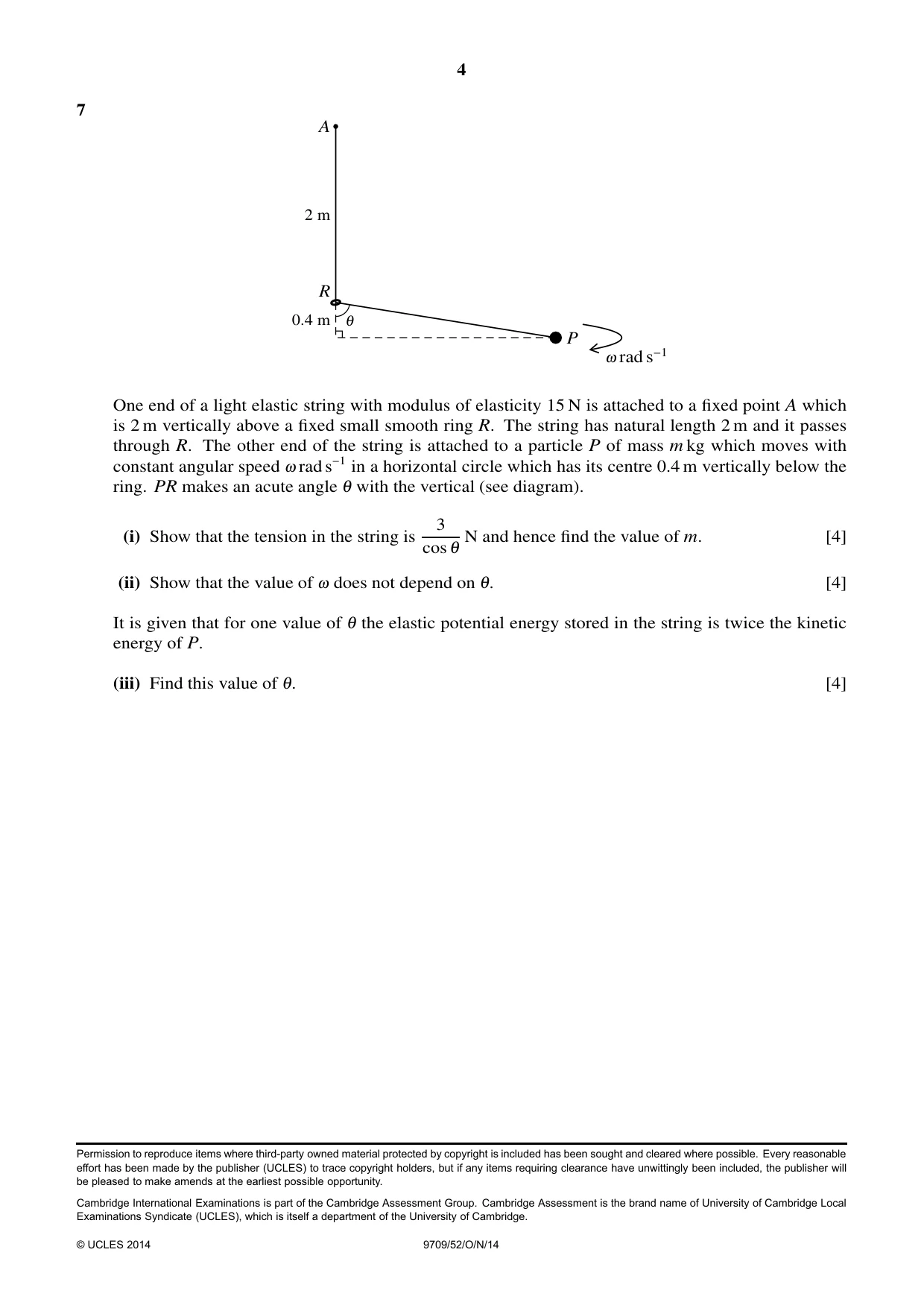
7 A 2 m R 0.4 m 1 P 7 rad s−1 One end of a light elastic string with modulus of elasticity 15 N is attached to a fixed point A which is 2 m vertically above a fixed small smooth ring R. The string has natural length 2 m and it passes through R. The other end of the string is attached to a particle P of mass m kg which moves with constant angular speed 7 rad s−1 in a horizontal circle which has its centre 0.4 m vertically below the ring. PR makes an acute angle 1 with the vertical (see diagram). 3 (i) Show that the tension in the string is N and hence find the value of m. [4] cos 1 (ii) Show that the value of 7 does not depend on 1. [4] It is given that for one value of 1 the elastic potential energy stored in the string is twice the kinetic energy of P. (iii) Find this value of 1. [4]
Mark scheme: cos θ λ ext 7 (i) T = M1 Uses T = 2 2 3 T = AG A1 cos θ Tcosθ = mg M1 Resolves vertically for P m = 0.3 A1 [4] (ii) r = 0.4tanθ B1 0.3v 2 = T sin θ OR 0.3ω2r = Tsinθ M1 Newton’s 2nd law with correct r expression for radial accn, ft cv(m(i)) 3 0.3ω2(0.4tanθ) = × sinθ A1 cosθ ω = 5 A1 SC [4] Candidates who choose at least two specific values of θ: Calculation of r twice B1 Both calculations give ω = 5 B1 0.4 2 15 cos θ (iii) EPE = B1 2 × 2 0.3 ( 5 × 0.4 tan θ ) 2 KE = B1 ft candidate’s value of ω 2 Award if × 2 is with wrong term 0.4 2 15 2 cos θ 0.3(2 tan θ ) = × 2 M1 2 × 2 2 cos2θ tan2θ = 0.5 OR sin2θ = 0.5 θ = 45 A1 www [4]
What was in this paper
The subtopics covered by these 7 questions, and how many questions each got. Open one in a new tab to see every Cambridge question on it.
What you needed in this session
Cambridge’s own grade thresholds for 2014 Oct/Nov, Paper 5 · Variant 2. A higher threshold means an easier paper — the bar moves with how the cohort did.