Cambridge A Level Mathematics 9709 — 2014 Oct/Nov Paper 2 · Variant 2
9709/22/O/N/14 · 3 questions · 50 marks · ≈56 min
The question paper and its mark scheme, free to read here and free to download. This is Cambridge’s own paper, exactly as it was sat.
Question paper4 pages
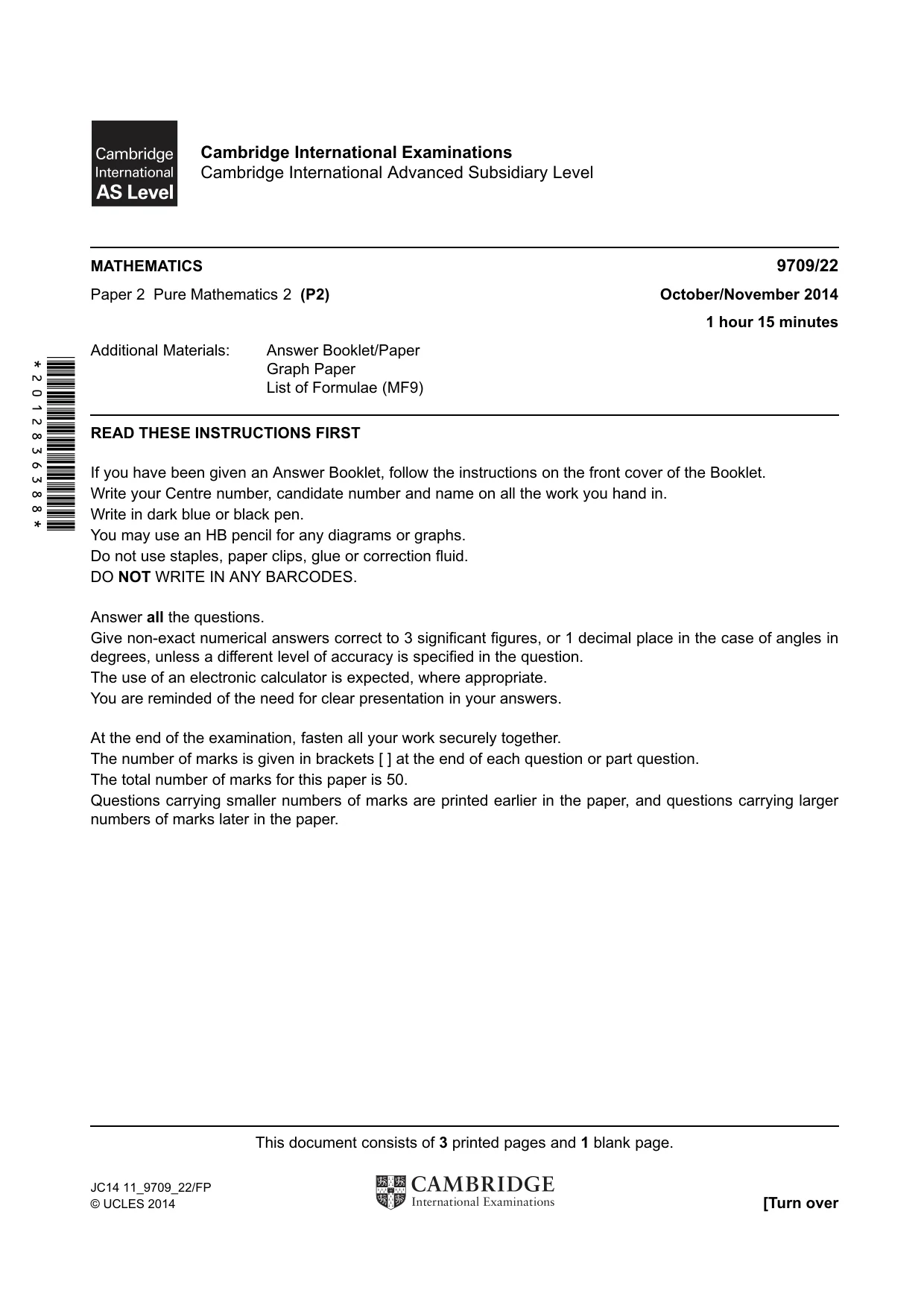
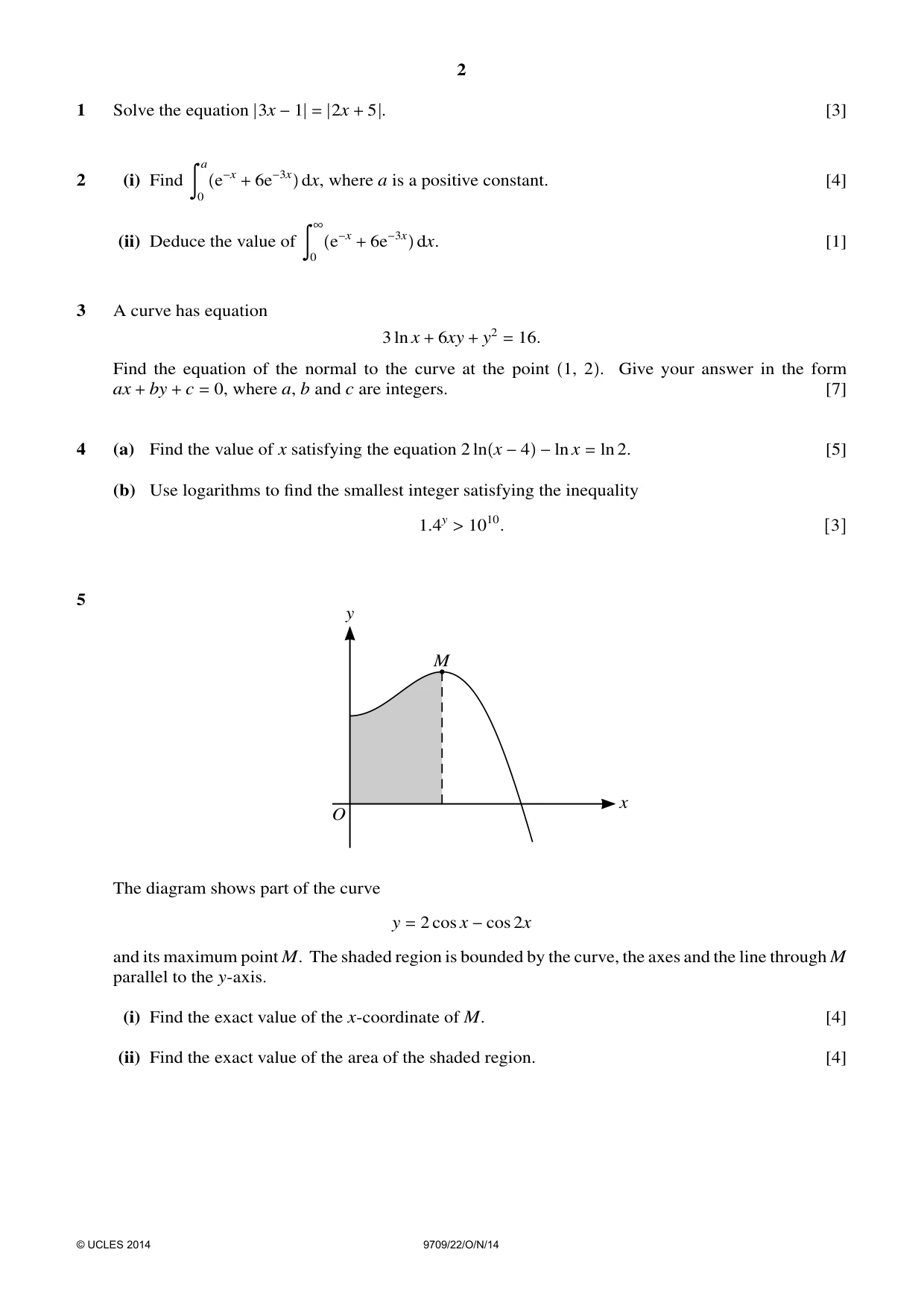
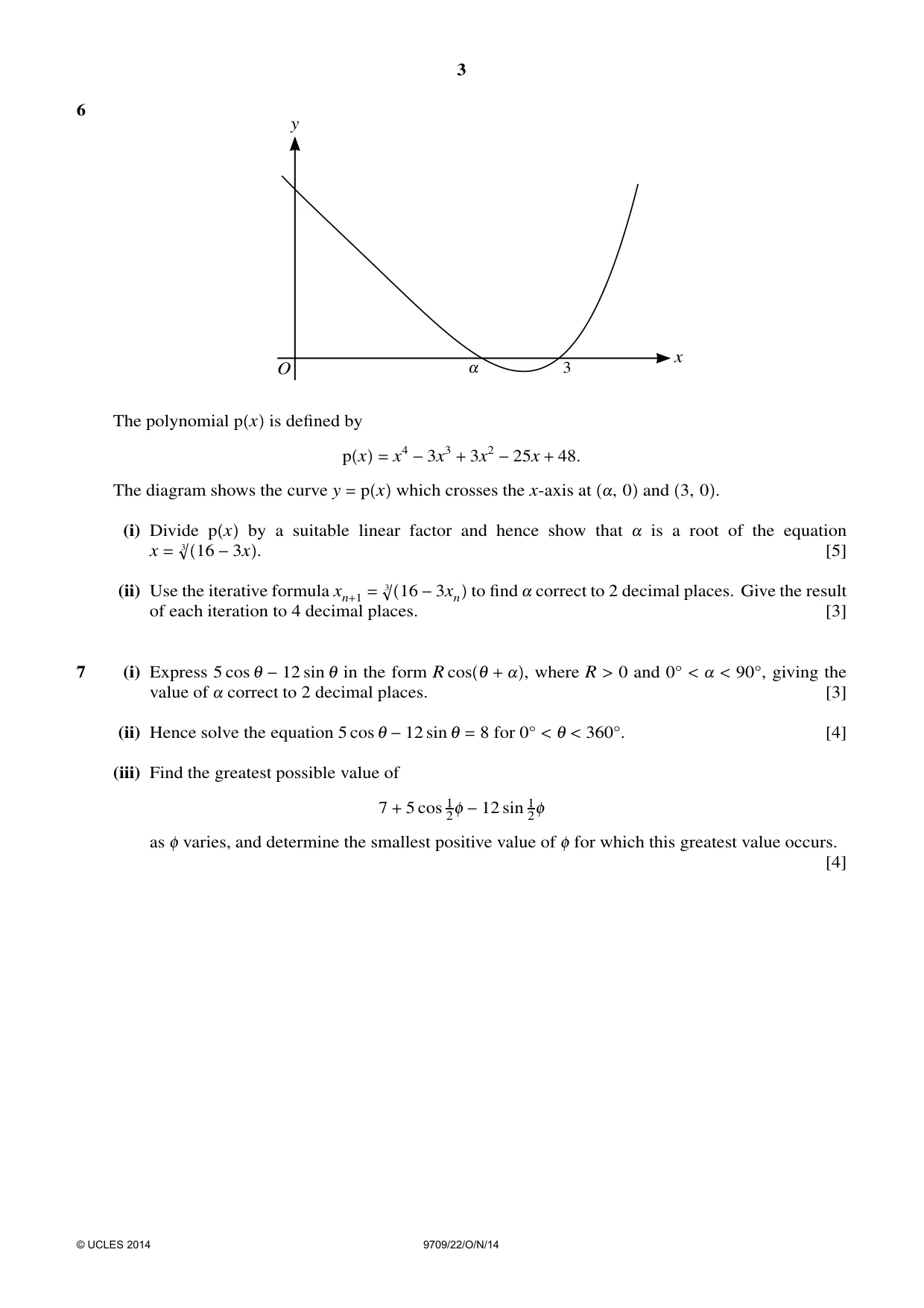

Mark scheme5 pages
Answers below. Sit the paper first if you are practising.
Questions as text
Q1 · Solve the equation 3x 2x 5
1 Solve the equation 3x 2x 5 . [3] −1 = +
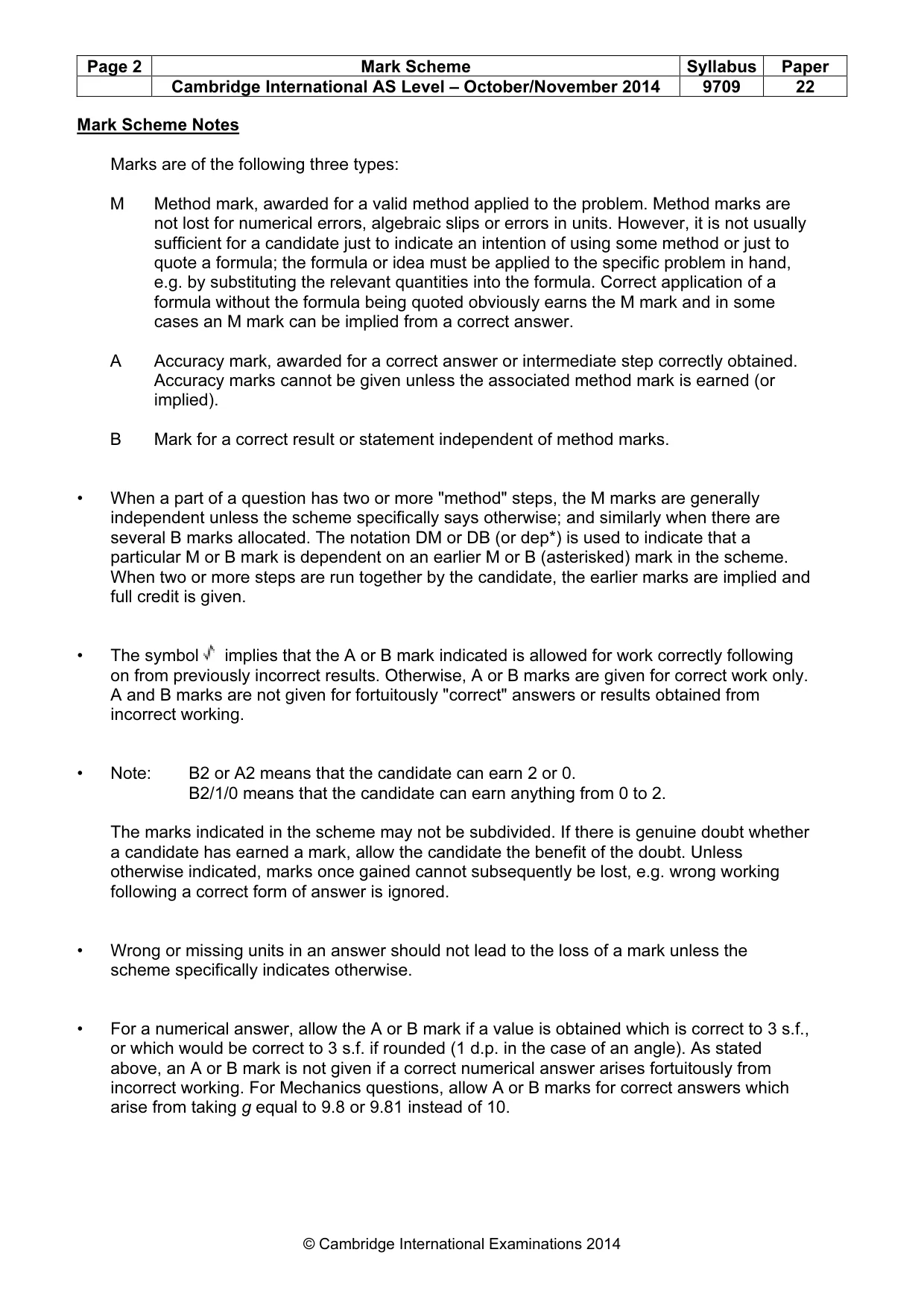
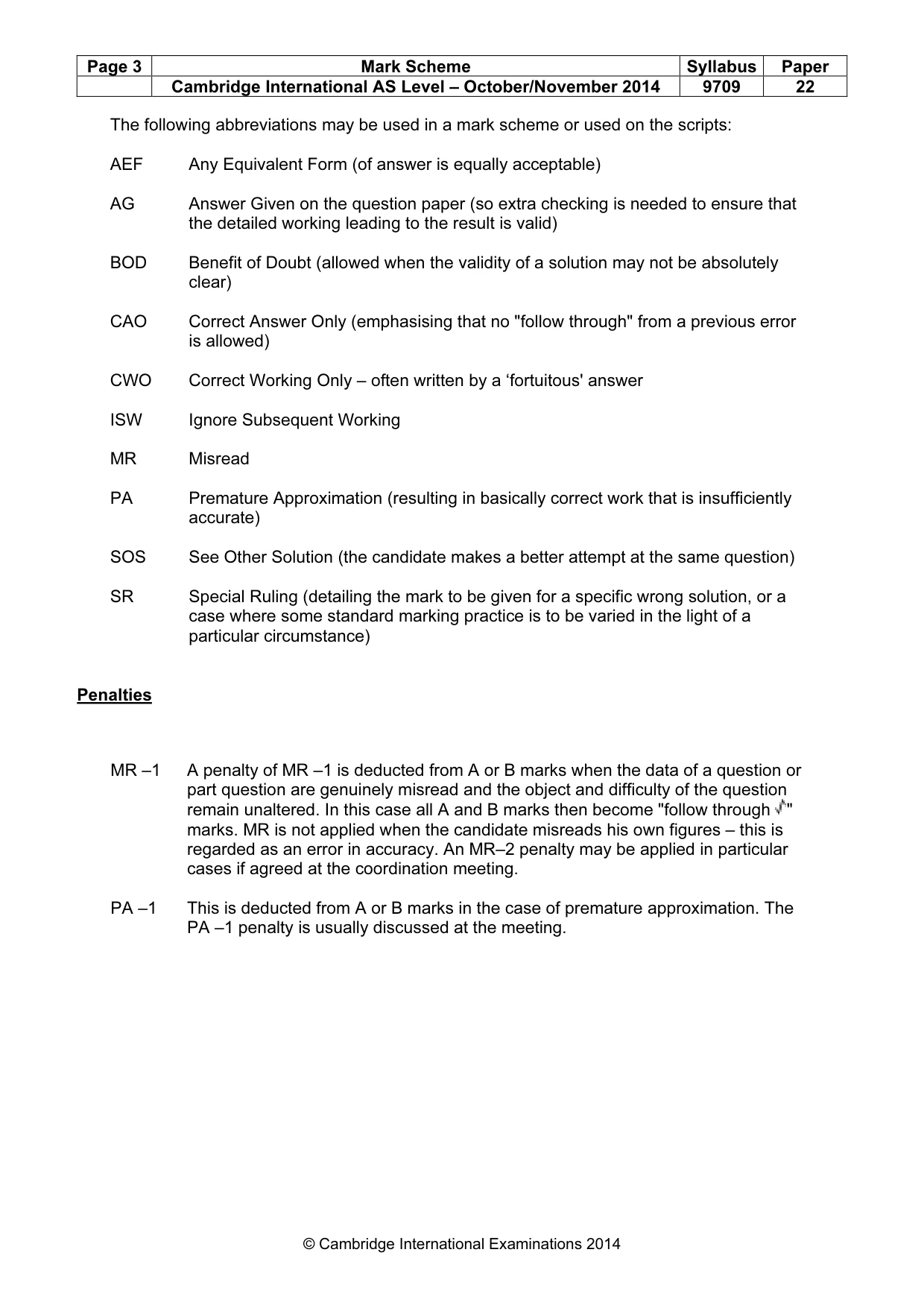
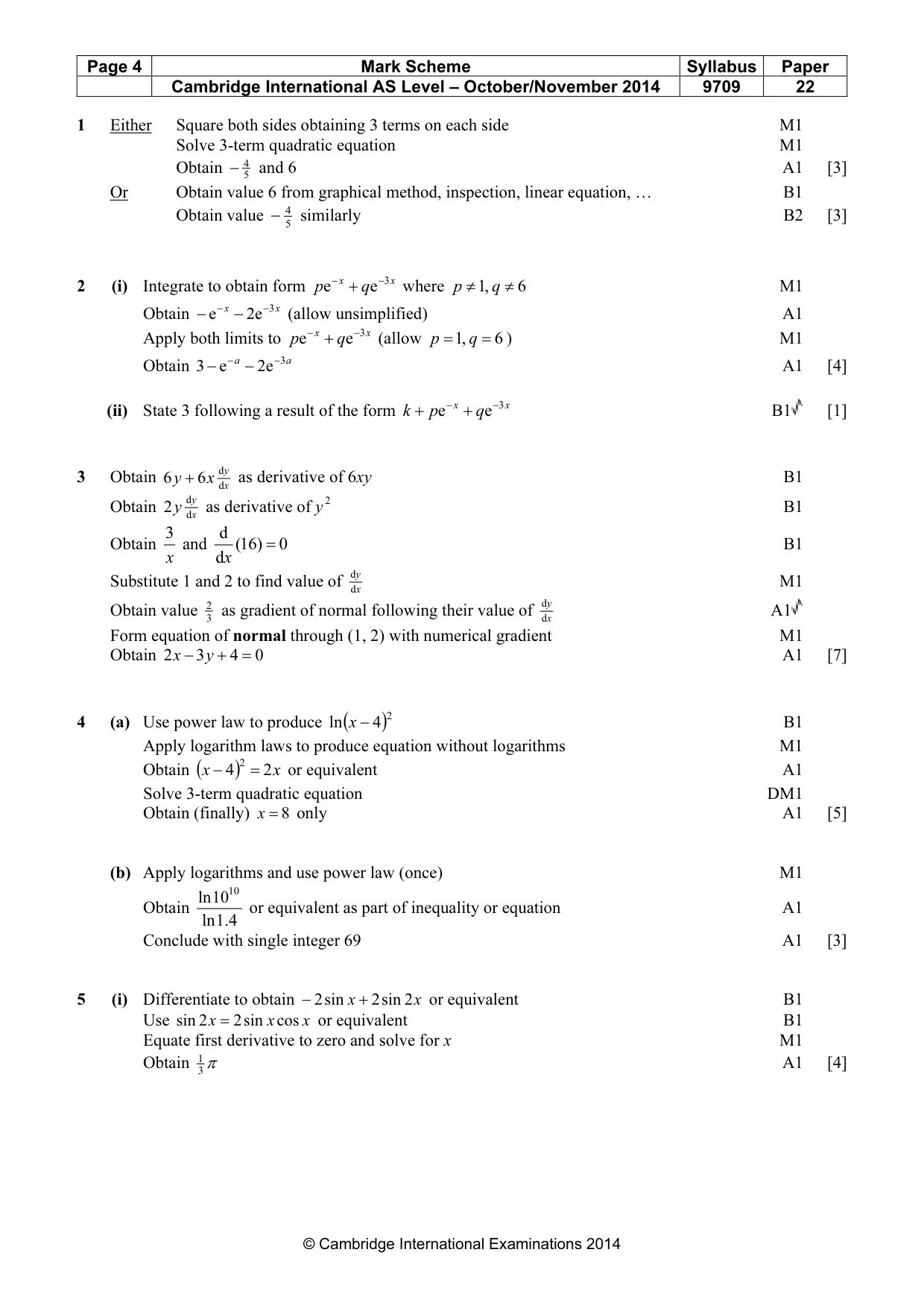
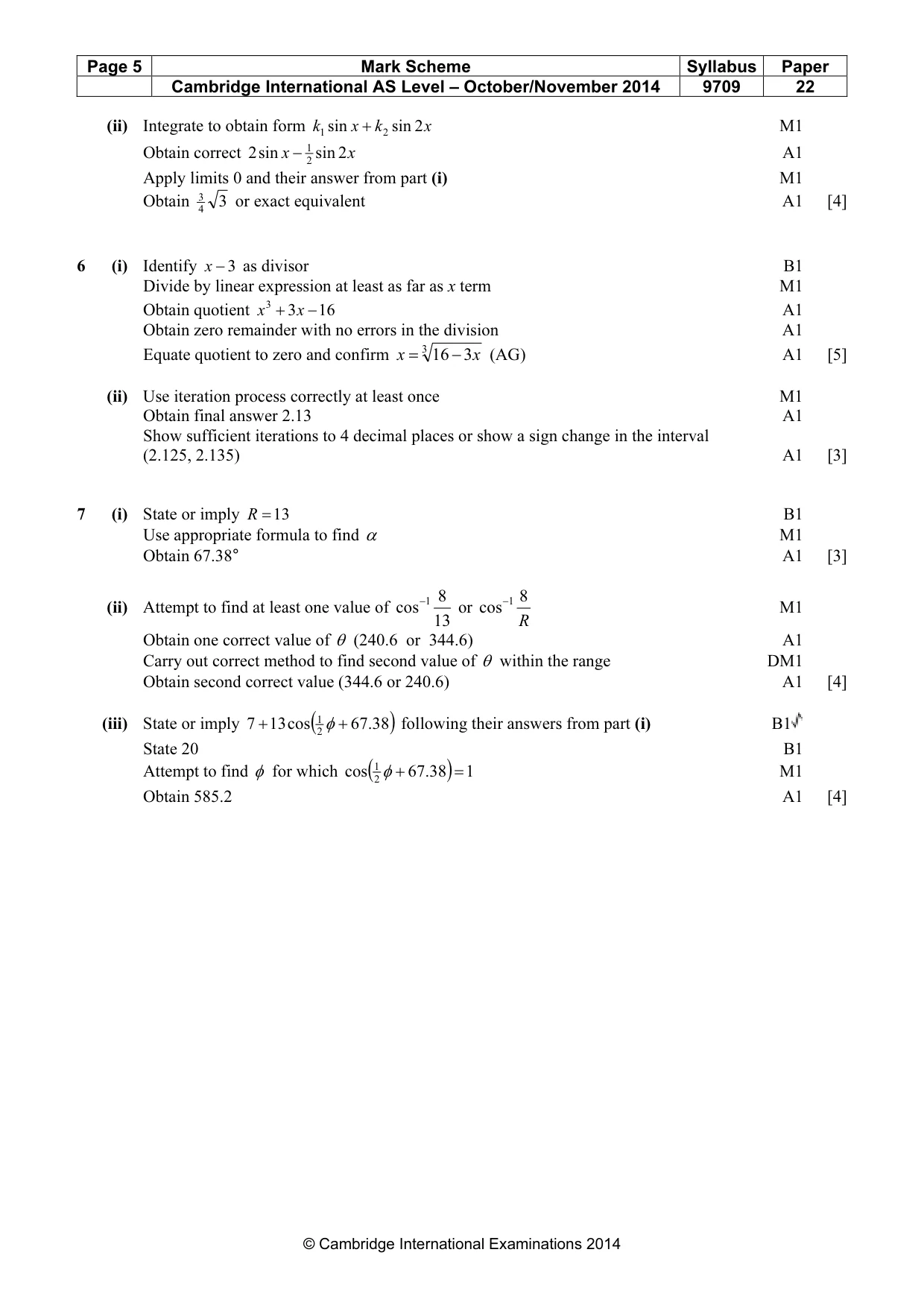
Mark scheme: 1 Either Square both sides obtaining 3 terms on each side M1 Solve 3-term quadratic equation M1 Obtain − 54 and 6 A1 [3] Or Obtain value 6 from graphical method, inspection, linear equation, … B1 Obtain value − 54 similarly B2 [3] 3
Q4 · Find the value of x satisfying the equation 2 ln x x ln 2
4 (a) Find the value of x satisfying the equation 2 ln x x ln 2. [5] −4 −ln = (b) Use logarithms to find the smallest integer satisfying the inequality 1.4y 1010. >
Mark scheme: 4 (a) Use power law to produce ln ( x − 4 )2 B1 Apply logarithm laws to produce equation without logarithms M1 Obtain ( x − 4 )2 = 2 x or equivalent A1 Solve 3-term quadratic equation DM1 Obtain (finally) x = 8 only A1 [5] (b) Apply logarithms and use power law (once) M1 ln 1010 Obtain or equivalent as part of inequality or equation A1 ln 4.1 Conclude with single integer 69 A1 [3]
Q5 · Y M x O The diagram shows part of the curve y 2 cos x 2x = −cos and its maximum point M
5 y M x O The diagram shows part of the curve y 2 cos x 2x = −cos and its maximum point M. The shaded region is bounded by the curve, the axes and the line through M parallel to the y-axis. (i) Find the exact value of the x-coordinate of M. [4] (ii) Find the exact value of the area of the shaded region. [4]
Mark scheme: 5 (i) Differentiate to obtain − 2 sin x + 2 sin 2 x or equivalent B1 Use sin 2 x = 2 sin x cos x or equivalent B1 Equate first derivative to zero and solve for x M1 Obtain 13 π A1 [4] (ii) Integrate to obtain form k1 sin x + k 2 sin 2 x M1 Obtain correct 2 sin x − 12 sin 2 x A1 Apply limits 0 and their answer from part (i) M1 Obtain 34 3 or exact equivalent A1 [4]
What was in this paper
The subtopics covered by these 3 questions, and how many questions each got. Open one in a new tab to see every Cambridge question on it.
What you needed in this session
Cambridge’s own grade thresholds for 2014 Oct/Nov, Paper 2 · Variant 2. A higher threshold means an easier paper — the bar moves with how the cohort did.