Cambridge A Level Mathematics 9709 — 2014 May/June Paper 6 · Variant 3
9709/63/M/J/14 · 4 questions · 50 marks · ≈56 min
The question paper and its mark scheme, free to read here and free to download. This is Cambridge’s own paper, exactly as it was sat.
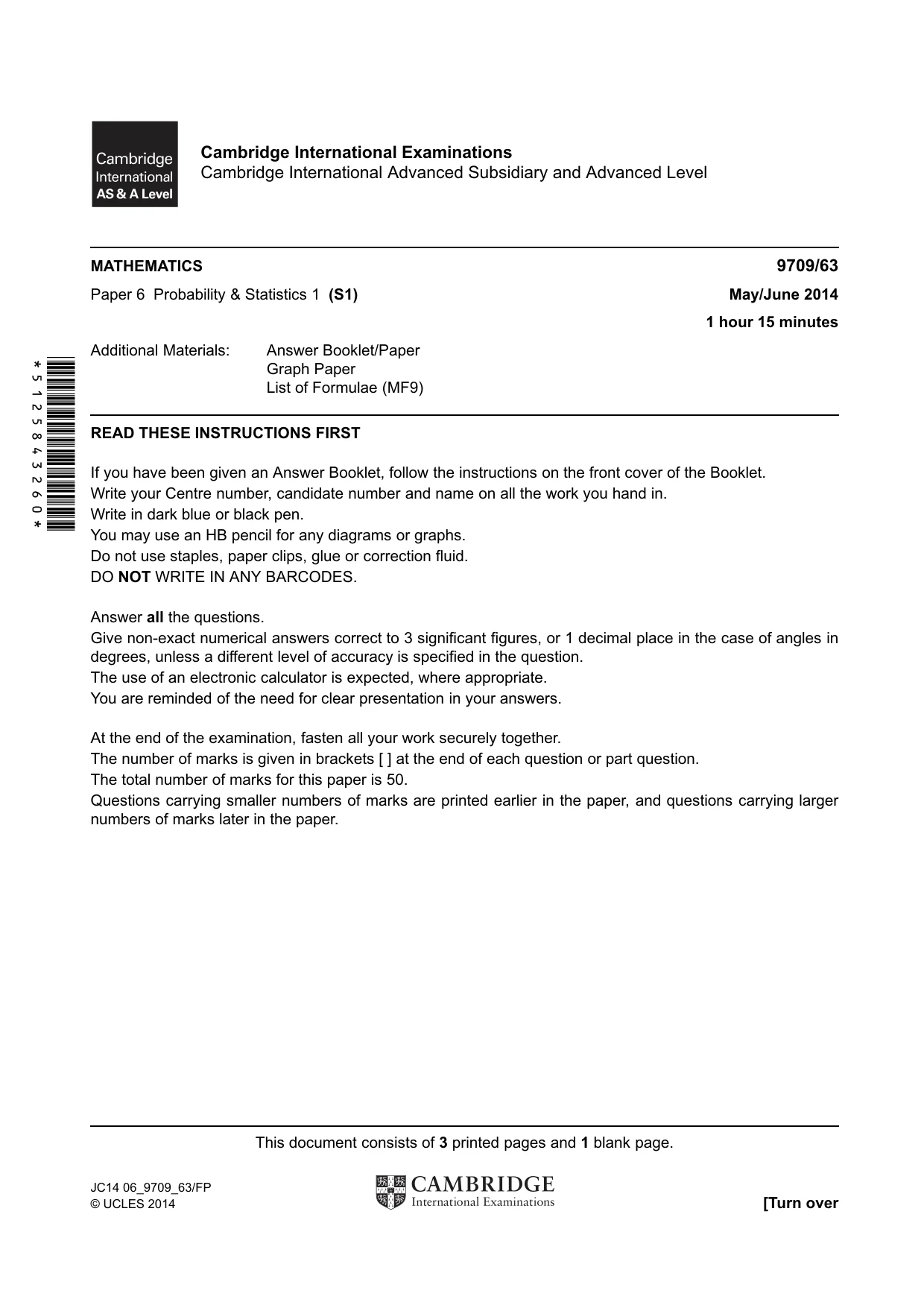
Question paper4 pages

Mark scheme6 pages
Answers below. Sit the paper first if you are practising.
Questions as text
Q4 · The heights, x cm, of a group of 28 people were measured
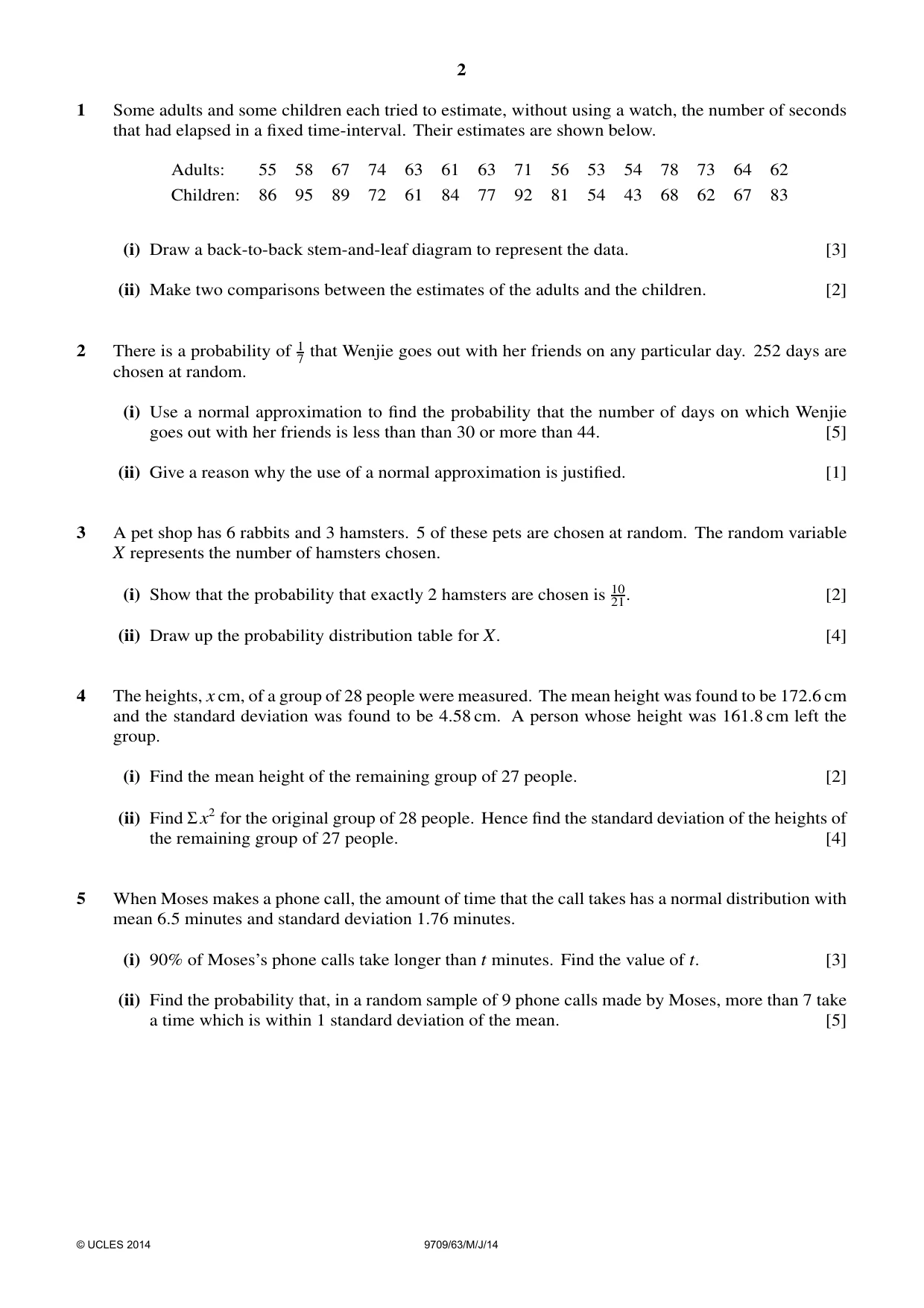
4 The heights, x cm, of a group of 28 people were measured. The mean height was found to be 172.6 cm and the standard deviation was found to be 4.58 cm. A person whose height was 161.8 cm left the group. (i) Find the mean height of the remaining group of 27 people. [2] (ii) Find Σx2 for the original group of 28 people. Hence find the standard deviation of the heights of the remaining group of 27 people. [4]
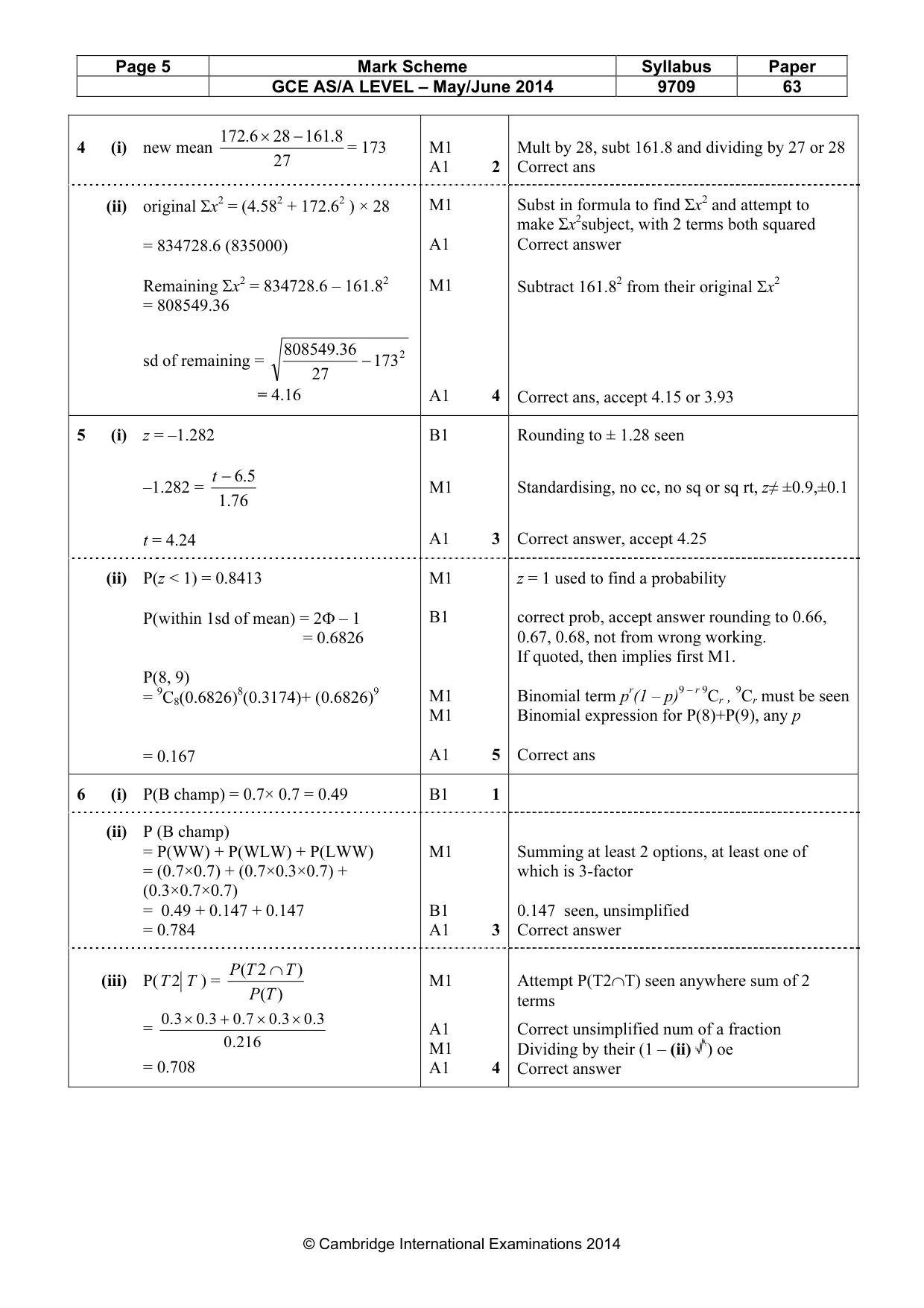
Mark scheme: 1726. × 28 − 1618. 4 (i) new mean = 173 M1 Mult by 28, subt 161.8 and dividing by 27 or 28 27 A1 2 Correct ans (ii) original Σx2 = (4.582 + 172.62 ) × 28 M1 Subst in formula to find Σx2 and attempt to make Σx2subject, with 2 terms both squared = 834728.6 (835000) A1 Correct answer Remaining Σx2 = 834728.6 – 161.82 M1 Subtract 161.82 from their original Σx2 = 808549.36 808549.36 2 sd of remaining = − 173 27 = 4.16 A1 4 Correct ans, accept 4.15 or 3.93
Q5 · When Moses makes a phone call, the amount of time that the call takes has a normal…
5 When Moses makes a phone call, the amount of time that the call takes has a normal distribution with mean 6.5 minutes and standard deviation 1.76 minutes. (i) 90% of Moses’s phone calls take longer than t minutes. Find the value of t. [3] (ii) Find the probability that, in a random sample of 9 phone calls made by Moses, more than 7 take a time which is within 1 standard deviation of the mean. [5]
Mark scheme: 5 (i) z = –1.282 B1 Rounding to ± 1.28 seen t − 5.6 –1.282 = M1 Standardising, no cc, no sq or sq rt, z≠ ±0.9,±0.1 .176 t = 4.24 A1 3 Correct answer, accept 4.25 (ii) P(z < 1) = 0.8413 M1 z = 1 used to find a probability P(within 1sd of mean) = 2Φ – 1 B1 correct prob, accept answer rounding to 0.66, = 0.6826 0.67, 0.68, not from wrong working. If quoted, then implies first M1. P(8, 9) – r = 9C8(0.6826)8(0.3174)+ (0.6826)9 M1 Binomial term pr(1 – p)9 9Cr , 9Cr must be seen M1 Binomial expression for P(8)+P(9), any p = 0.167 A1 5 Correct ans
Q6 · Tom and Ben play a game repeatedly
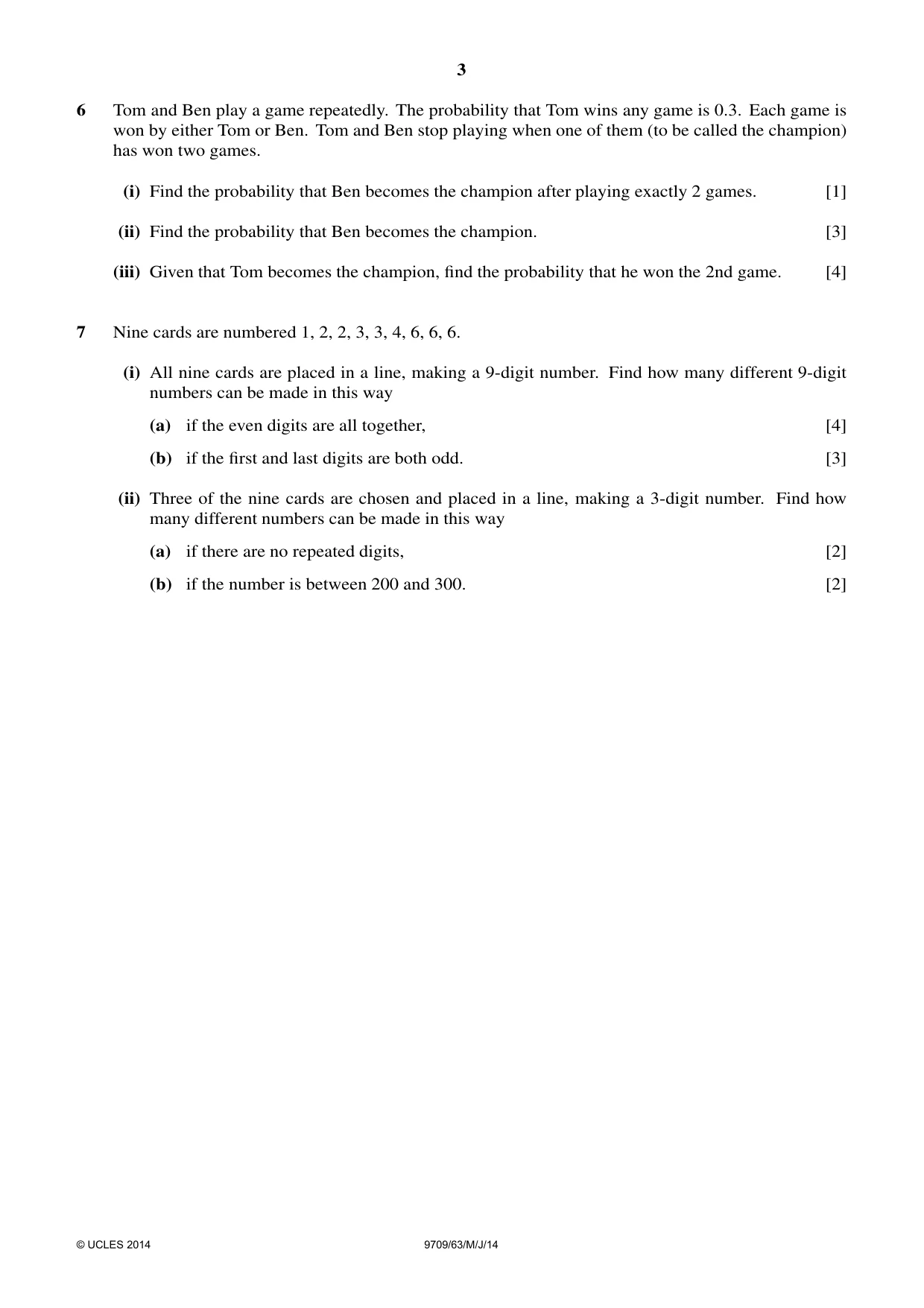
6 Tom and Ben play a game repeatedly. The probability that Tom wins any game is 0.3. Each game is won by either Tom or Ben. Tom and Ben stop playing when one of them (to be called the champion) has won two games. (i) Find the probability that Ben becomes the champion after playing exactly 2 games. [1] (ii) Find the probability that Ben becomes the champion. [3] (iii) Given that Tom becomes the champion, find the probability that he won the 2nd game. [4]
Mark scheme: 6 (i) P(B champ) = 0.7× 0.7 = 0.49 B1 1 (ii) P (B champ) = P(WW) + P(WLW) + P(LWW) M1 Summing at least 2 options, at least one of = (0.7×0.7) + (0.7×0.3×0.7) + which is 3-factor (0.3×0.7×0.7) = 0.49 + 0.147 + 0.147 B1 0.147 seen, unsimplified = 0.784 A1 3 Correct answer P (T 2 ∩ T ) (iii) P( T2 T ) = M1 Attempt P(T2∩T) seen anywhere sum of 2 P (T ) terms 3.0 × 3.0 + 7.0 × 3.0 × 3.0 = A1 Correct unsimplified num of a fraction .0 216 M1 Dividing by their (1 – (ii) ) oe = 0.708 A1 4 Correct answer GCE AS/A LEVEL – May/June 2014 9709 63
Q7 · Nine cards are numbered 1, 2, 2, 3, 3, 4, 6, 6, 6
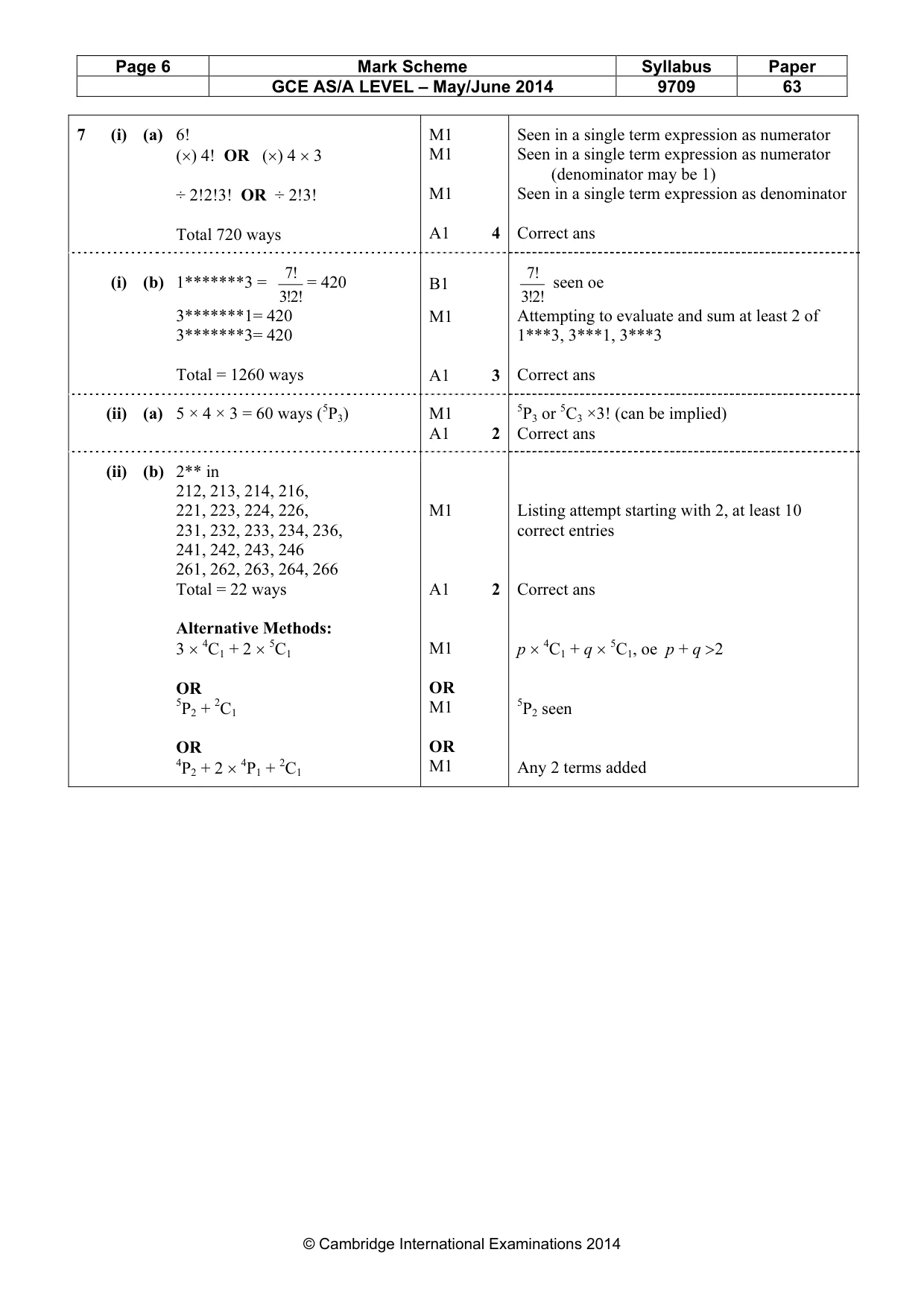
7 Nine cards are numbered 1, 2, 2, 3, 3, 4, 6, 6, 6. (i) All nine cards are placed in a line, making a 9-digit number. Find how many different 9-digit numbers can be made in this way (a) if the even digits are all together, [4] (b) if the first and last digits are both odd. [3] (ii) Three of the nine cards are chosen and placed in a line, making a 3-digit number. Find how many different numbers can be made in this way (a) if there are no repeated digits, [2] (b) if the number is between 200 and 300. [2]
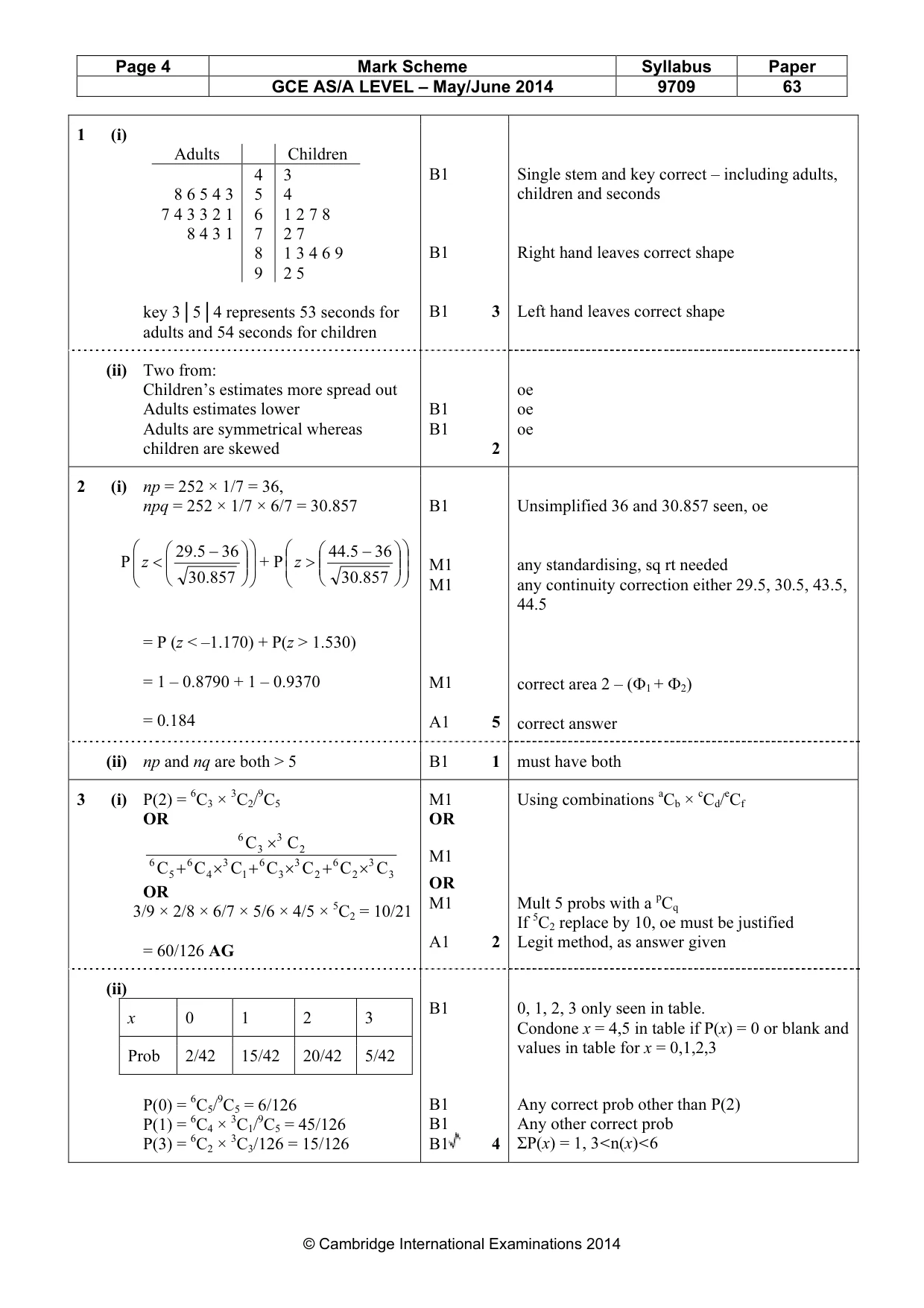
Mark scheme: 7 (i) (a) 6! M1 Seen in a single term expression as numerator (×) 4! OR (×) 4 × 3 M1 Seen in a single term expression as numerator (denominator may be 1) ÷ 2!2!3! OR ÷ 2!3! M1 Seen in a single term expression as denominator Total 720 ways A1 4 Correct ans !7 !7 (i) (b) 1*******3 = = 420 B1 seen oe !2!3 !2!3 3*******1= 420 M1 Attempting to evaluate and sum at least 2 of 3*******3= 420 1***3, 3***1, 3***3 Total = 1260 ways A1 3 Correct ans (ii) (a) 5 × 4 × 3 = 60 ways (5P3) M1 5P3 or 5C3 ×3! (can be implied) A1 2 Correct ans (ii) (b) 2** in 212, 213, 214, 216, 221, 223, 224, 226, M1 Listing attempt starting with 2, at least 10 231, 232, 233, 234, 236, correct entries 241, 242, 243, 246 261, 262, 263, 264, 266 Total = 22 ways A1 2 Correct ans Alternative Methods: 3 × 4C1 + 2 × 5C1 M1 p × 4C1 + q × 5C1, oe p + q >2 OR OR 5P2 + 2C1 M1 5P2 seen OR OR 4P2 + 2 × 4P1 + 2C1 M1 Any 2 terms added
What was in this paper
The subtopics covered by these 4 questions, and how many questions each got. Open one in a new tab to see every Cambridge question on it.
What you needed in this session
Cambridge’s own grade thresholds for 2014 May/June, Paper 6 · Variant 3. A higher threshold means an easier paper — the bar moves with how the cohort did.