Cambridge A Level Mathematics 9709 — 2012 Oct/Nov Paper 5 · Variant 3
9709/53/O/N/12 · 1 question · 50 marks · ≈56 min
The question paper and its mark scheme, free to read here and free to download. This is Cambridge’s own paper, exactly as it was sat.
Question paper4 pages
Mark scheme6 pages
Answers below. Sit the paper first if you are practising.
Questions as text
Q1 · A 30° O 0.6 m B F N A circular object is formed from a uniform semicircular lamina of…
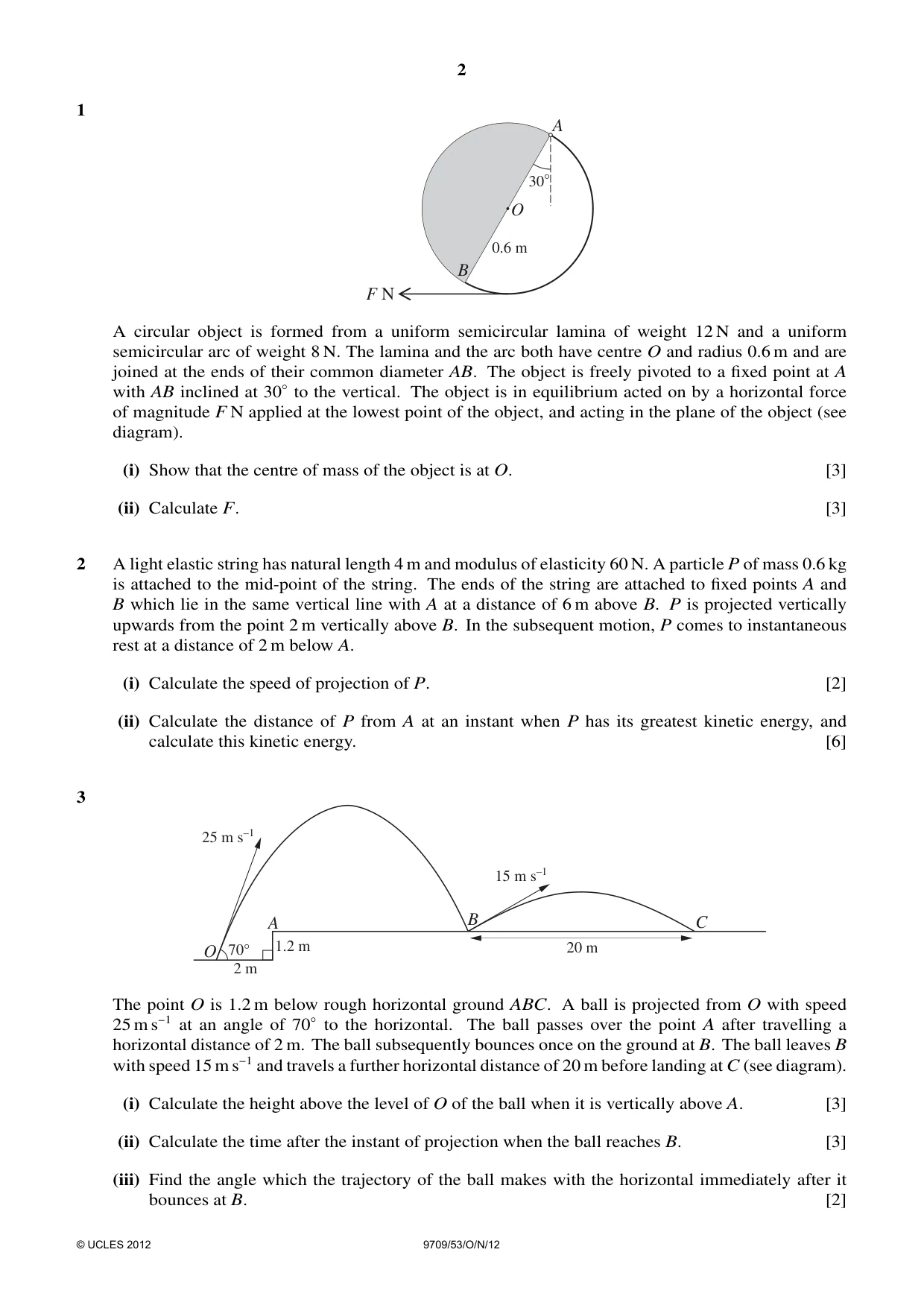
1 A 30° O 0.6 m B F N A circular object is formed from a uniform semicircular lamina of weight 12 N and a uniform semicircular arc of weight 8 N. The lamina and the arc both have centre O and radius 0.6 m and are joined at the ends of their common diameter AB. The object is freely pivoted to a fixed point at A with AB inclined at 30◦to the vertical. The object is in equilibrium acted on by a horizontal force of magnitude F N applied at the lowest point of the object, and acting in the plane of the object (see diagram). (i) Show that the centre of mass of the object is at O. [3] (ii) Calculate F. [3]
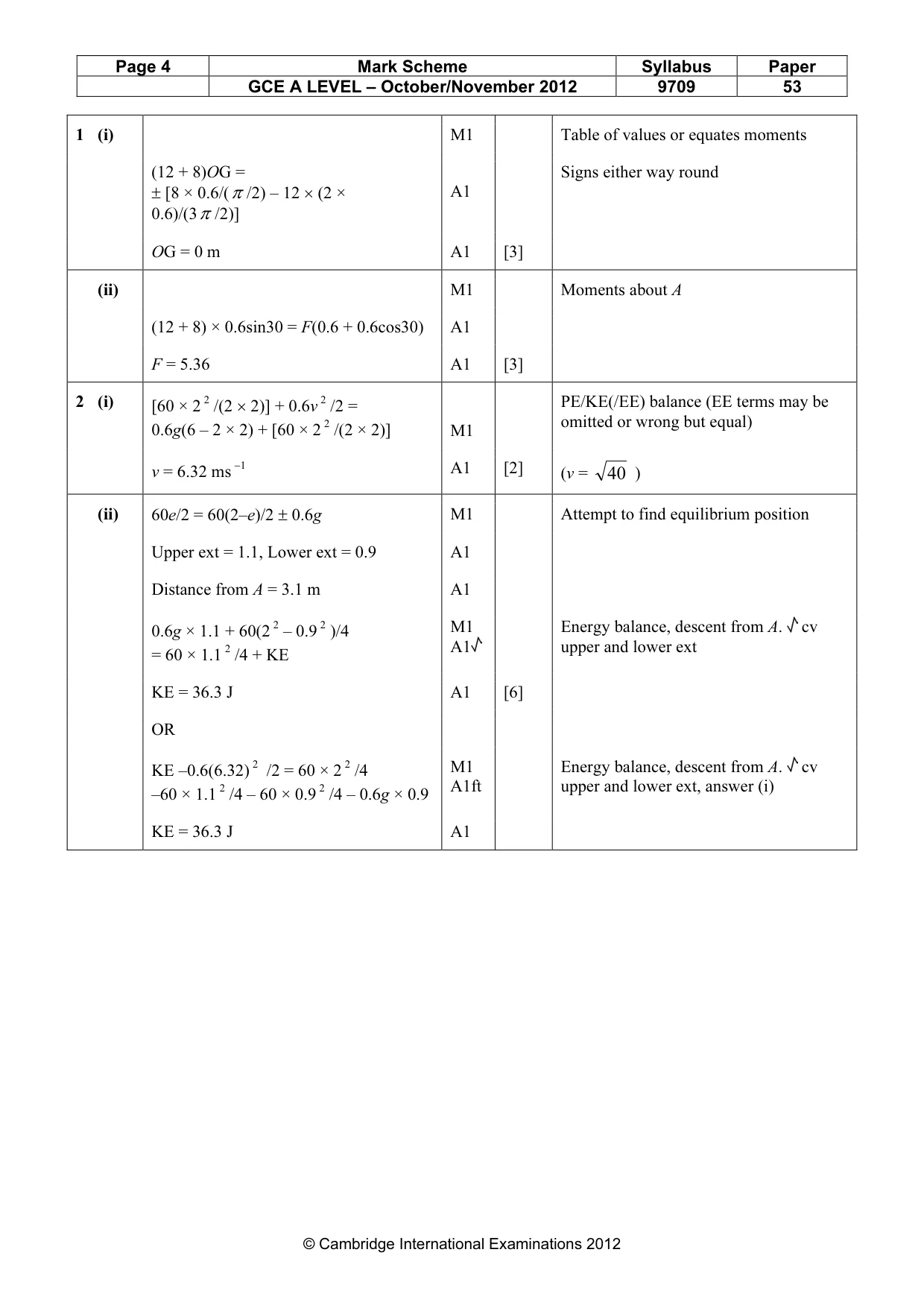
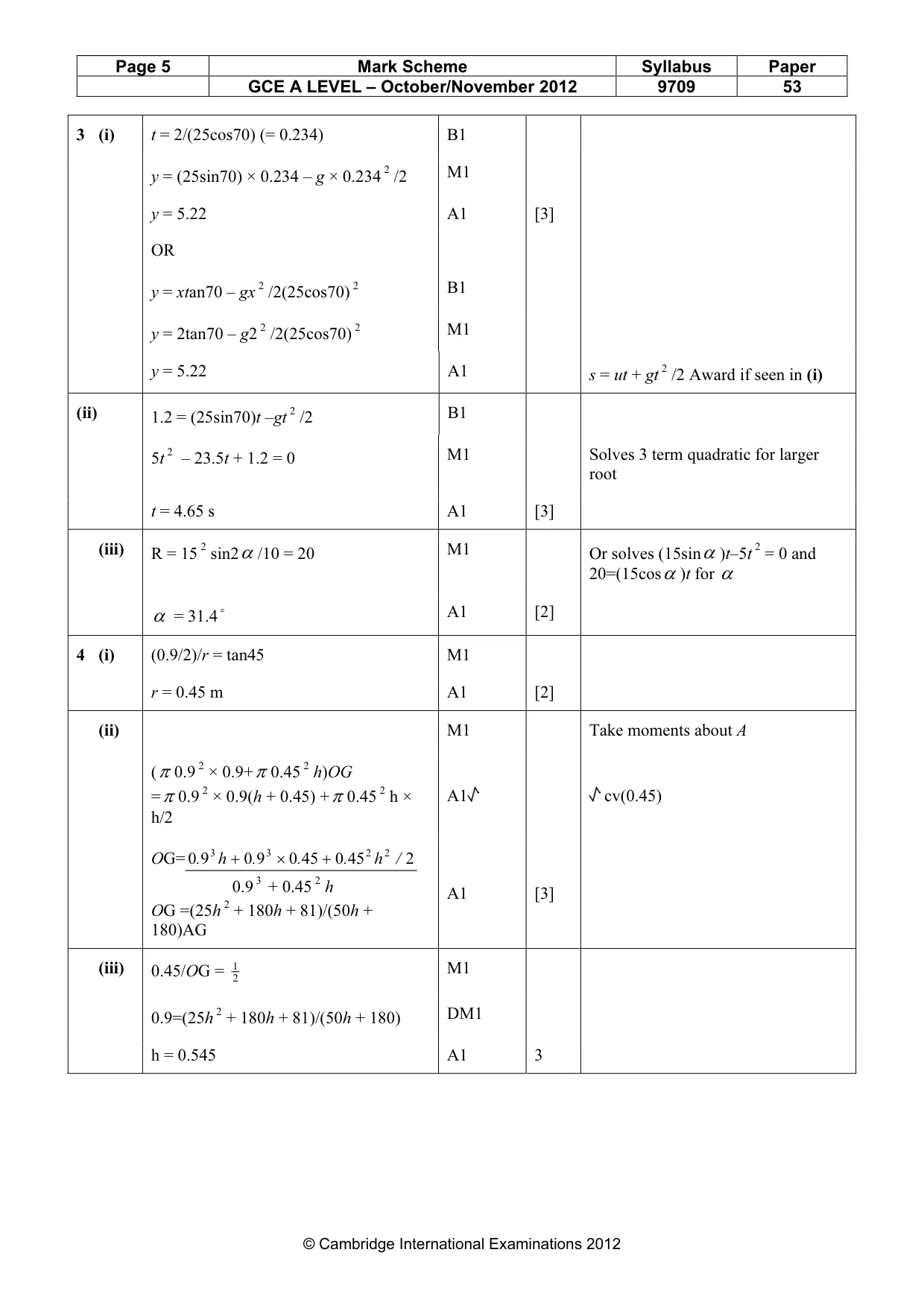
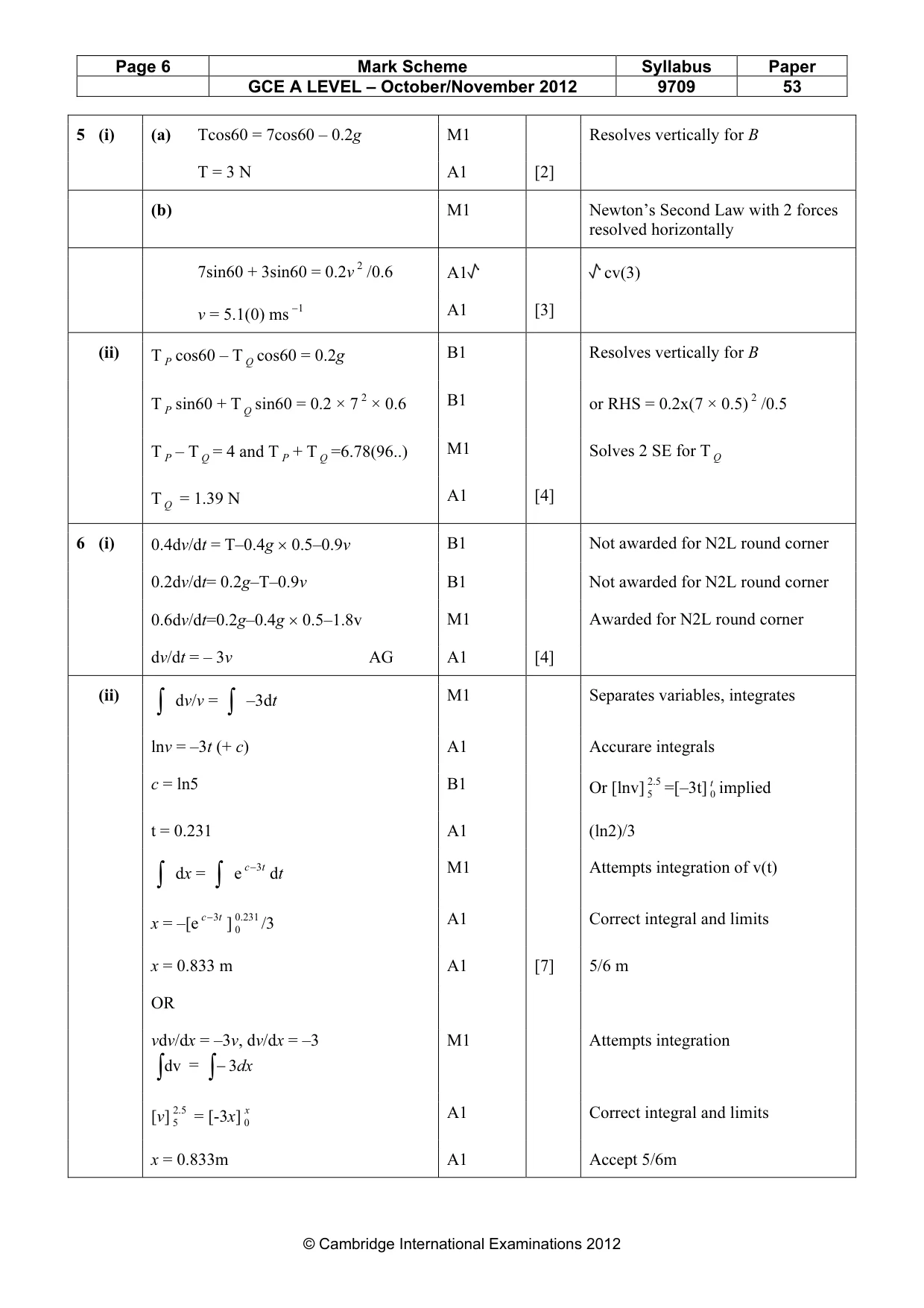
Mark scheme: v = 6.32 ms − 1 A1 [2] (v = 40 ) (ii) 60e/2 = 60(2–e)/2 ± 0.6g M1 Attempt to find equilibrium position Upper ext = 1.1, Lower ext = 0.9 A1 Distance from A = 3.1 m A1 0.6g × 1.1 + 60(2 2 – 0.9 2 )/4 M1 Energy balance, descent from A. cv 2 A1 upper and lower ext = 60 × 1.1 /4 + KE KE = 36.3 J A1 [6] OR KE –0.6(6.32) 2 /2 = 60 × 2 2 /4 M1 Energy balance, descent from A. cv 2 2 A1ft upper and lower ext, answer (i) –60 × 1.1 /4 – 60 × 0.9 /4 – 0.6g × 0.9 KE = 36.3 J A1 GCE A LEVEL – October/November 2012 9709 53 3 (i) t = 2/(25cos70) (= 0.234) B1 y = (25sin70) × 0.234 – g × 0.234 2 /2 M1 y = 5.22 A1 [3] OR y = xtan70 – gx 2 /2(25cos70) 2 B1 y = 2tan70 – g2 2 /2(25cos70) 2 M1 y = 5.22 A1 s = ut + gt 2 /2 Award if seen in (i) (ii) 1.2 = (25sin70)t –gt 2 /2 B1 5t 2 – 23.5t + 1.2 = 0 M1 Solves 3 term quadratic for larger root t = 4.65 s A1 [3] (iii) R = 15 2 sin2α /10 = 20 M1 Or solves (15sinα )t–5t 2 = 0 and 20=(15cosα )t for α α = 31.4 o A1 [2] 4 (i) (0.9/2)/r = tan45 M1 r = 0.45 m A1 [2] (ii) M1 Take moments about A (π 0.9 2 × 0.9+π 0.45 2 h)OG =π 0.9 2 × 0.9(h + 0.45) +π 0.45 2 h × A1 cv(0.45) h/2
What was in this paper
The subtopics covered by these 1 questions, and how many questions each got. Open one in a new tab to see every Cambridge question on it.
What you needed in this session
Cambridge’s own grade thresholds for 2012 Oct/Nov, Paper 5 · Variant 3. A higher threshold means an easier paper — the bar moves with how the cohort did.