Cambridge A Level Mathematics 9709 — 2012 May/June Paper 7 · Variant 2
9709/72/M/J/12 · 50 marks · ≈56 min
The question paper and its mark scheme, free to read here and free to download. This is Cambridge’s own paper, exactly as it was sat.
Question paper4 pages
Mark scheme6 pages
Answers below. Sit the paper first if you are practising.
Paper as text
Question paper, page 1
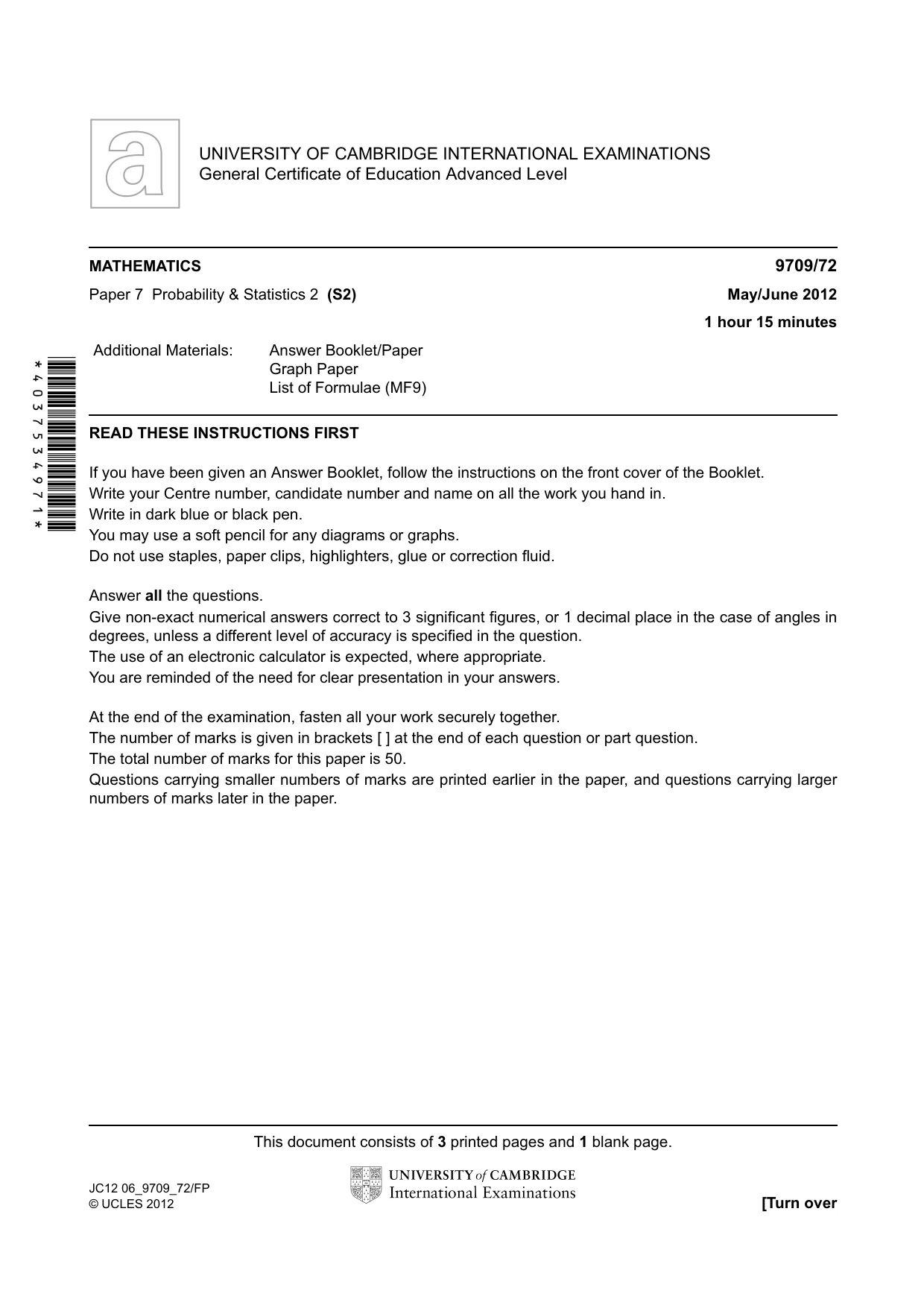
*4037534971* UNIVERSITY OF CAMBRIDGE INTERNATIONAL EXAMINATIONS General Certificate of Education Advanced Level MATHEMATICS 9709/72 Paper 7 Probability & Statistics 2 (S2) May/June 2012 1 hour 15 minutes Additional Materials: Answer Booklet/Paper Graph Paper List of Formulae (MF9) READ THESE INSTRUCTIONS FIRST If you have been given an Answer Booklet, follow the instructions on the front cover of the Booklet. Write your Centre number, candidate number and name on all the work you hand in. Write in dark blue or black pen. You may use a soft pencil for any diagrams or graphs. Do not use staples, paper clips, highlighters, glue or correction fluid. Answer all the questions. Give non-exact numerical answers correct to 3 significant figures, or 1 decimal place in the case of angles in degrees, unless a different level of accuracy is specified in the question. The use of an electronic calculator is expected, where appropriate. You are reminded of the need for clear presentation in your answers. At the end of the examination, fasten all your work securely together. The number of marks is given in brackets [ ] at the end of each question or part question. The total number of marks for this paper is 50. Questions carrying smaller numbers of marks are printed earlier in the paper, and questions carrying larger numbers of marks later in the paper. This document consists of 3 printed pages and 1 blank page. JC12 06_9709_72/FP © UCLES 2012 [Turn over
Question paper, page 2
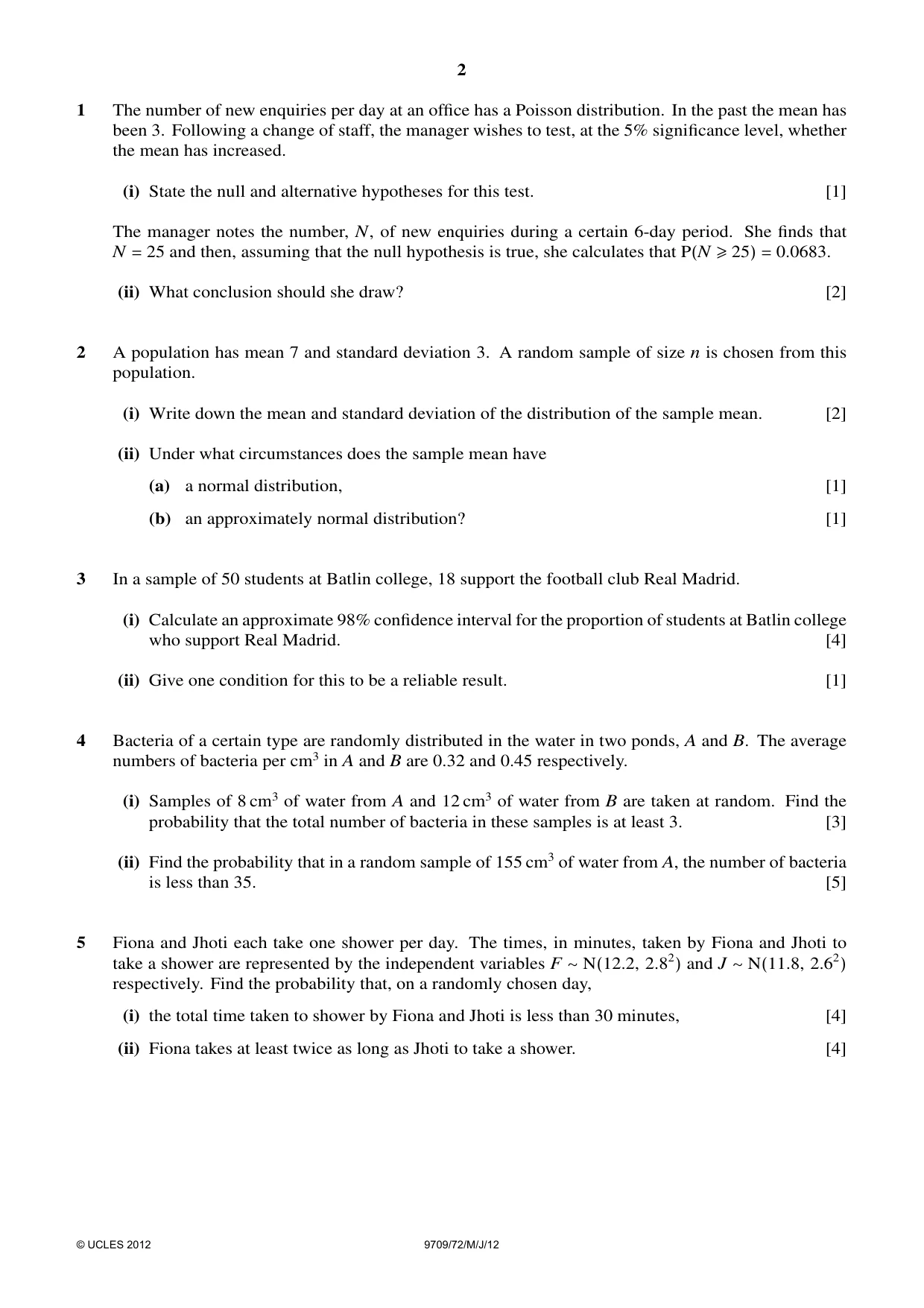
2 1 The number of new enquiries per day at an office has a Poisson distribution. In the past the mean has been 3. Following a change of staff, the manager wishes to test, at the 5% significance level, whether the mean has increased. (i) State the null and alternative hypotheses for this test. [1] The manager notes the number, N, of new enquiries during a certain 6-day period. She finds that N = 25 and then, assuming that the null hypothesis is true, she calculates that P(N ≥25) = 0.0683. (ii) What conclusion should she draw? [2] 2 A population has mean 7 and standard deviation 3. A random sample of size n is chosen from this population. (i) Write down the mean and standard deviation of the distribution of the sample mean. [2] (ii) Under what circumstances does the sample mean have (a) a normal distribution, [1] (b) an approximately normal distribution? [1] 3 In a sample of 50 students at Batlin college, 18 support the football club Real Madrid. (i) Calculate an approximate 98% confidence interval for the proportion of students at Batlin college who support Real Madrid. [4] (ii) Give one condition for this to be a reliable result. [1] 4 Bacteria of a certain type are randomly distributed in the water in two ponds, A and B. The average numbers of bacteria per cm3 in A and B are 0.32 and 0.45 respectively. (i) Samples of 8 cm3 of water from A and 12 cm3 of water from B are taken at random. Find the probability that the total number of bacteria in these samples is at least 3. [3] (ii) Find the probability that in a random sample of 155 cm3 of water from A, the number of bacteria is less than 35. [5] 5 Fiona and Jhoti each take one shower per day. The times, in minutes, taken by Fiona and Jhoti to take a shower are represented by the independent variables F ∼N(12.2, 2.82) and J ∼N(11.8, 2.62) respectively. Find the probability that, on a randomly chosen day, (i) the total time taken to shower by Fiona and Jhoti is less than 30 minutes, [4] (ii) Fiona takes at least twice as long as Jhoti to take a shower. [4] © UCLES 2012 9709/72/M/J/12
Question paper, page 3
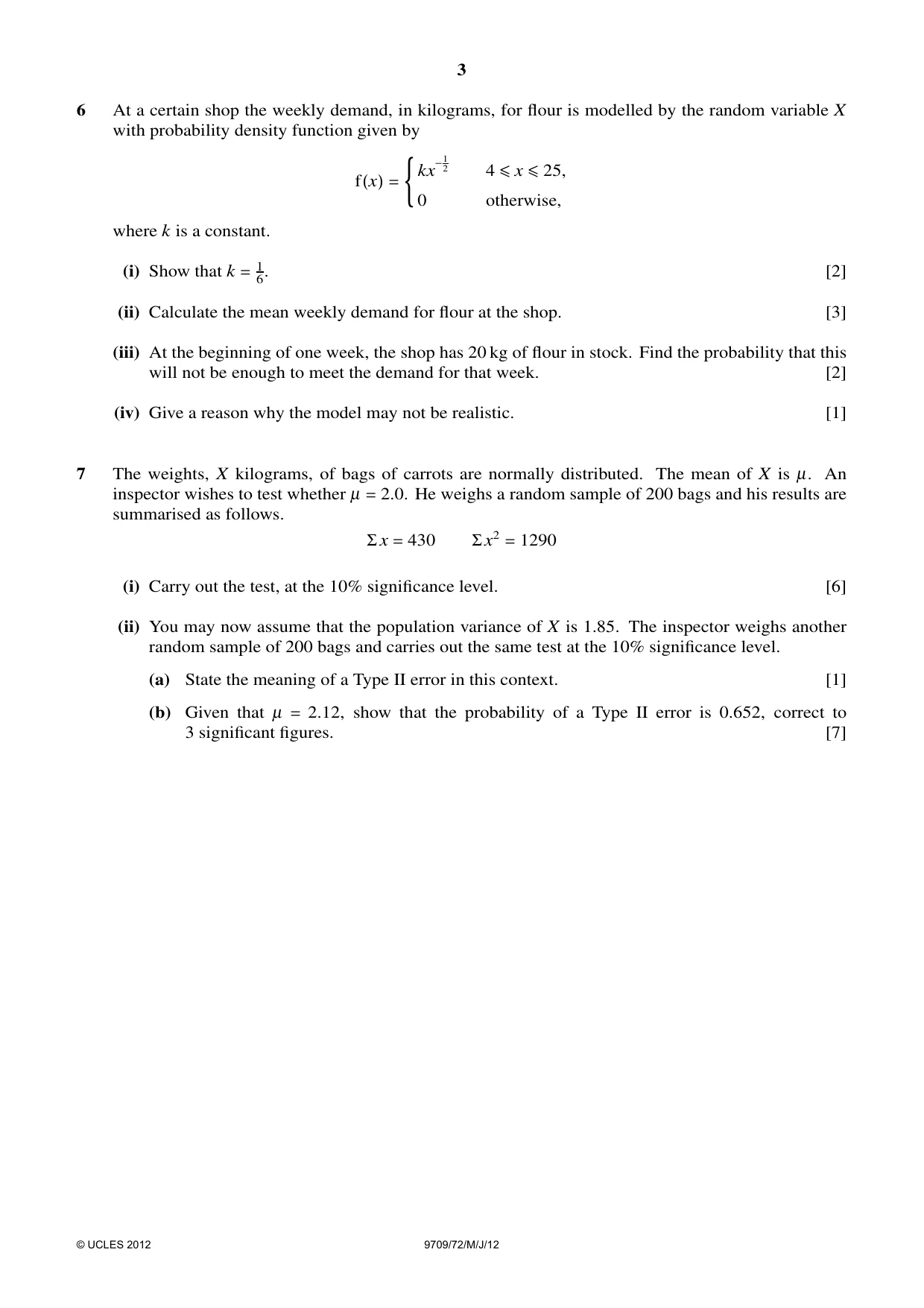
3 6 At a certain shop the weekly demand, in kilograms, for flour is modelled by the random variable X with probability density function given by f(x) = ( kx −1 2 4 ≤x ≤25, 0 otherwise, where k is a constant. (i) Show that k = 1 6. [2] (ii) Calculate the mean weekly demand for flour at the shop. [3] (iii) At the beginning of one week, the shop has 20 kg of flour in stock. Find the probability that this will not be enough to meet the demand for that week. [2] (iv) Give a reason why the model may not be realistic. [1] 7 The weights, X kilograms, of bags of carrots are normally distributed. The mean of X is µ. An inspector wishes to test whether µ = 2.0. He weighs a random sample of 200 bags and his results are summarised as follows. Σx = 430 Σx2 = 1290 (i) Carry out the test, at the 10% significance level. [6] (ii) You may now assume that the population variance of X is 1.85. The inspector weighs another random sample of 200 bags and carries out the same test at the 10% significance level. (a) State the meaning of a Type II error in this context. [1] (b) Given that µ = 2.12, show that the probability of a Type II error is 0.652, correct to 3 significant figures. [7] © UCLES 2012 9709/72/M/J/12
Question paper, page 4
4 BLANK PAGE Permission to reproduce items where third-party owned material protected by copyright is included has been sought and cleared where possible. Every reasonable effort has been made by the publisher (UCLES) to trace copyright holders, but if any items requiring clearance have unwittingly been included, the publisher will be pleased to make amends at the earliest possible opportunity. University of Cambridge International Examinations is part of the Cambridge Assessment Group. Cambridge Assessment is the brand name of University of Cambridge Local Examinations Syndicate (UCLES), which is itself a department of the University of Cambridge. 9709/72/M/J/12
Mark scheme, page 1
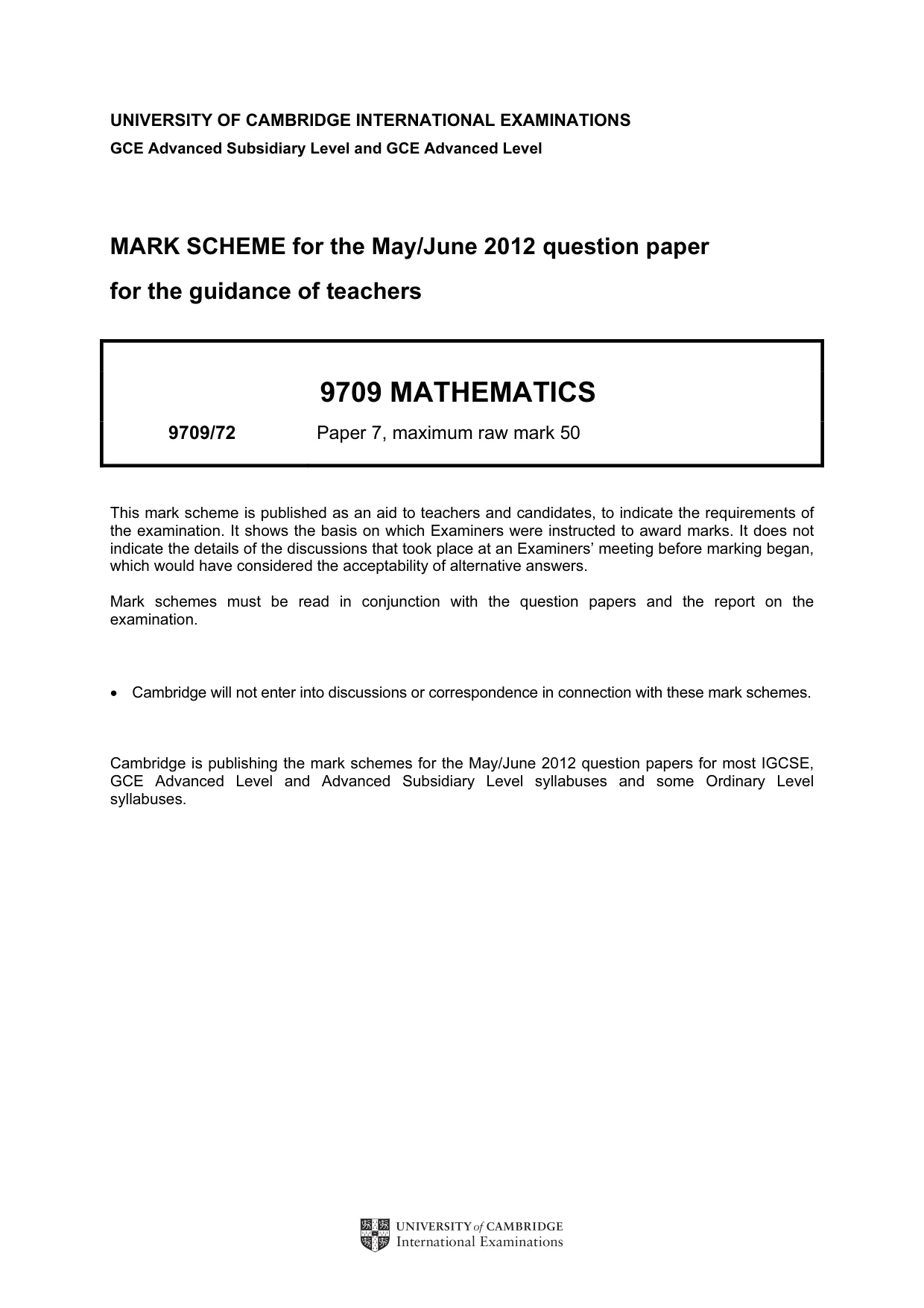
UNIVERSITY OF CAMBRIDGE INTERNATIONAL EXAMINATIONS GCE Advanced Subsidiary Level and GCE Advanced Level MARK SCHEME for the May/June 2012 question paper for the guidance of teachers 9709 MATHEMATICS 9709/72 Paper 7, maximum raw mark 50 This mark scheme is published as an aid to teachers and candidates, to indicate the requirements of the examination. It shows the basis on which Examiners were instructed to award marks. It does not indicate the details of the discussions that took place at an Examiners’ meeting before marking began, which would have considered the acceptability of alternative answers. Mark schemes must be read in conjunction with the question papers and the report on the examination. • Cambridge will not enter into discussions or correspondence in connection with these mark schemes. Cambridge is publishing the mark schemes for the May/June 2012 question papers for most IGCSE, GCE Advanced Level and Advanced Subsidiary Level syllabuses and some Ordinary Level syllabuses.
Mark scheme, page 2
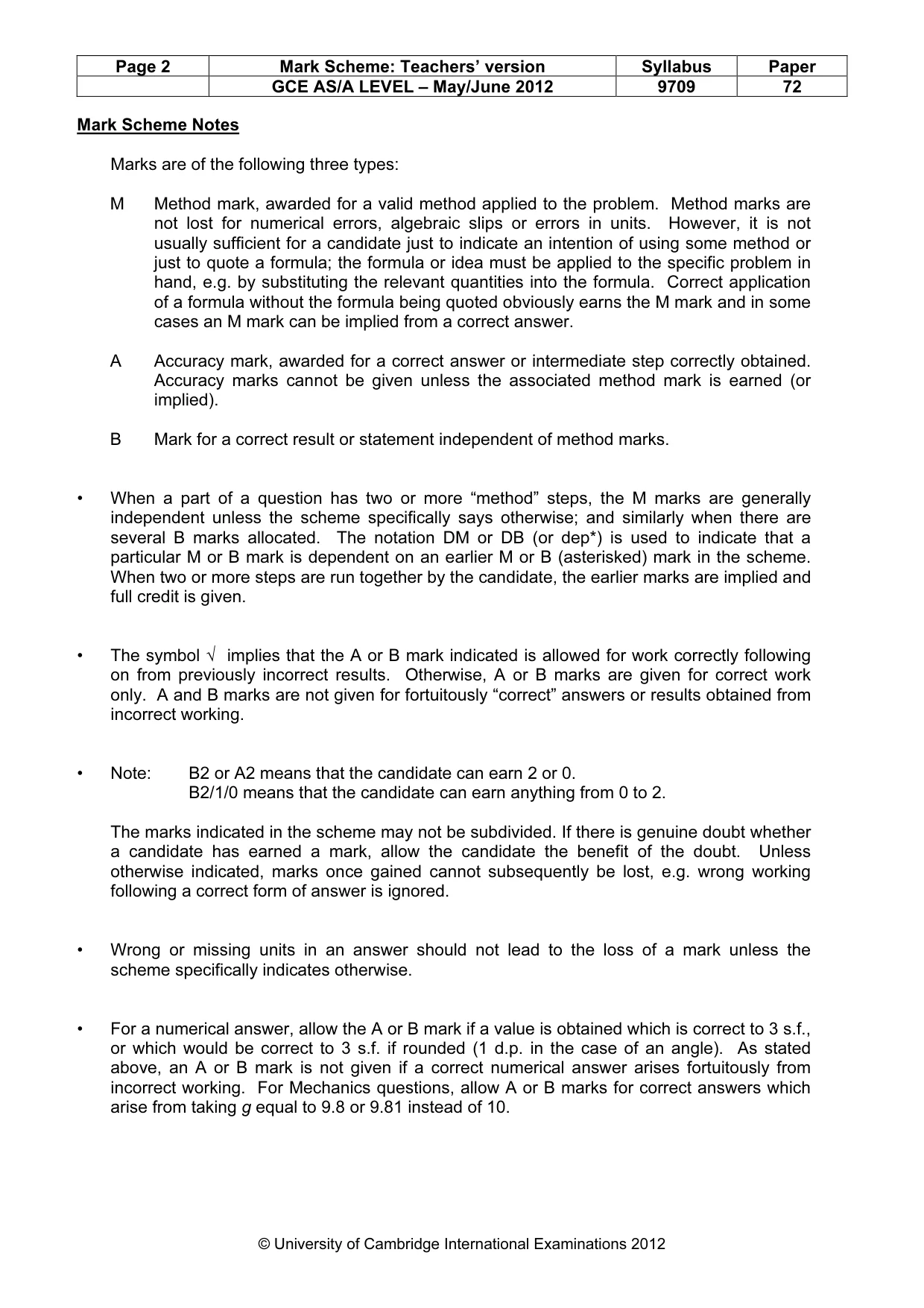
Page 2 Mark Scheme: Teachers’ version Syllabus Paper GCE AS/A LEVEL – May/June 2012 9709 72 © University of Cambridge International Examinations 2012 Mark Scheme Notes Marks are of the following three types: M Method mark, awarded for a valid method applied to the problem. Method marks are not lost for numerical errors, algebraic slips or errors in units. However, it is not usually sufficient for a candidate just to indicate an intention of using some method or just to quote a formula; the formula or idea must be applied to the specific problem in hand, e.g. by substituting the relevant quantities into the formula. Correct application of a formula without the formula being quoted obviously earns the M mark and in some cases an M mark can be implied from a correct answer. A Accuracy mark, awarded for a correct answer or intermediate step correctly obtained. Accuracy marks cannot be given unless the associated method mark is earned (or implied). B Mark for a correct result or statement independent of method marks. • When a part of a question has two or more “method” steps, the M marks are generally independent unless the scheme specifically says otherwise; and similarly when there are several B marks allocated. The notation DM or DB (or dep*) is used to indicate that a particular M or B mark is dependent on an earlier M or B (asterisked) mark in the scheme. When two or more steps are run together by the candidate, the earlier marks are implied and full credit is given. • The symbol √ implies that the A or B mark indicated is allowed for work correctly following on from previously incorrect results. Otherwise, A or B marks are given for correct work only. A and B marks are not given for fortuitously “correct” answers or results obtained from incorrect working. • Note: B2 or A2 means that the candidate can earn 2 or 0. B2/1/0 means that the candidate can earn anything from 0 to 2. The marks indicated in the scheme may not be subdivided. If there is genuine doubt whether a candidate has earned a mark, allow the candidate the benefit of the doubt. Unless otherwise indicated, marks once gained cannot subsequently be lost, e.g. wrong working following a correct form of answer is ignored. • Wrong or missing units in an answer should not lead to the loss of a mark unless the scheme specifically indicates otherwise. • For a numerical answer, allow the A or B mark if a value is obtained which is correct to 3 s.f., or which would be correct to 3 s.f. if rounded (1 d.p. in the case of an angle). As stated above, an A or B mark is not given if a correct numerical answer arises fortuitously from incorrect working. For Mechanics questions, allow A or B marks for correct answers which arise from taking g equal to 9.8 or 9.81 instead of 10.
Mark scheme, page 3
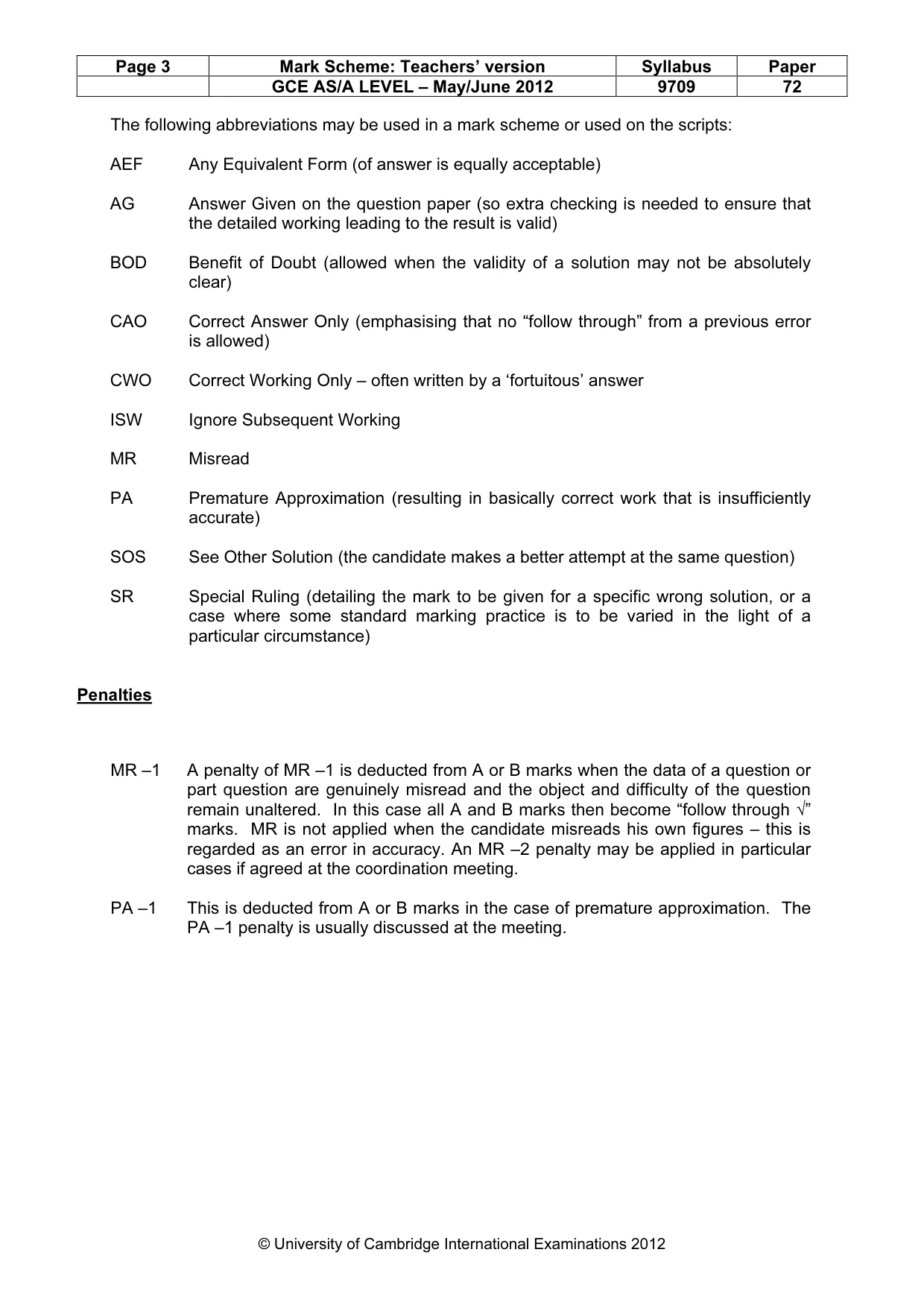
Page 3 Mark Scheme: Teachers’ version Syllabus Paper GCE AS/A LEVEL – May/June 2012 9709 72 © University of Cambridge International Examinations 2012 The following abbreviations may be used in a mark scheme or used on the scripts: AEF Any Equivalent Form (of answer is equally acceptable) AG Answer Given on the question paper (so extra checking is needed to ensure that the detailed working leading to the result is valid) BOD Benefit of Doubt (allowed when the validity of a solution may not be absolutely clear) CAO Correct Answer Only (emphasising that no “follow through” from a previous error is allowed) CWO Correct Working Only – often written by a ‘fortuitous’ answer ISW Ignore Subsequent Working MR Misread PA Premature Approximation (resulting in basically correct work that is insufficiently accurate) SOS See Other Solution (the candidate makes a better attempt at the same question) SR Special Ruling (detailing the mark to be given for a specific wrong solution, or a case where some standard marking practice is to be varied in the light of a particular circumstance) Penalties MR –1 A penalty of MR –1 is deducted from A or B marks when the data of a question or part question are genuinely misread and the object and difficulty of the question remain unaltered. In this case all A and B marks then become “follow through √” marks. MR is not applied when the candidate misreads his own figures – this is regarded as an error in accuracy. An MR –2 penalty may be applied in particular cases if agreed at the coordination meeting. PA –1 This is deducted from A or B marks in the case of premature approximation. The PA –1 penalty is usually discussed at the meeting.
Mark scheme, page 4
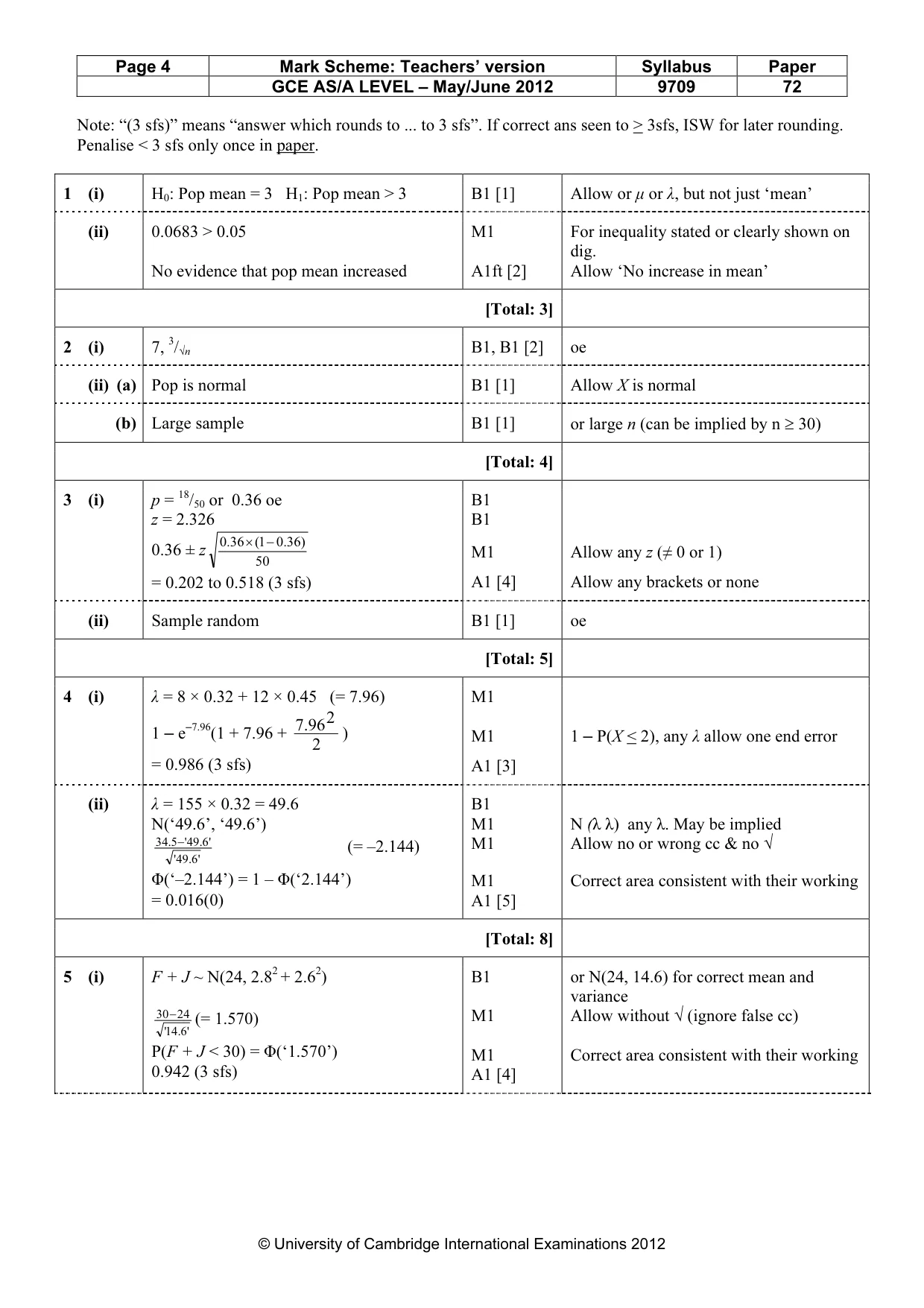
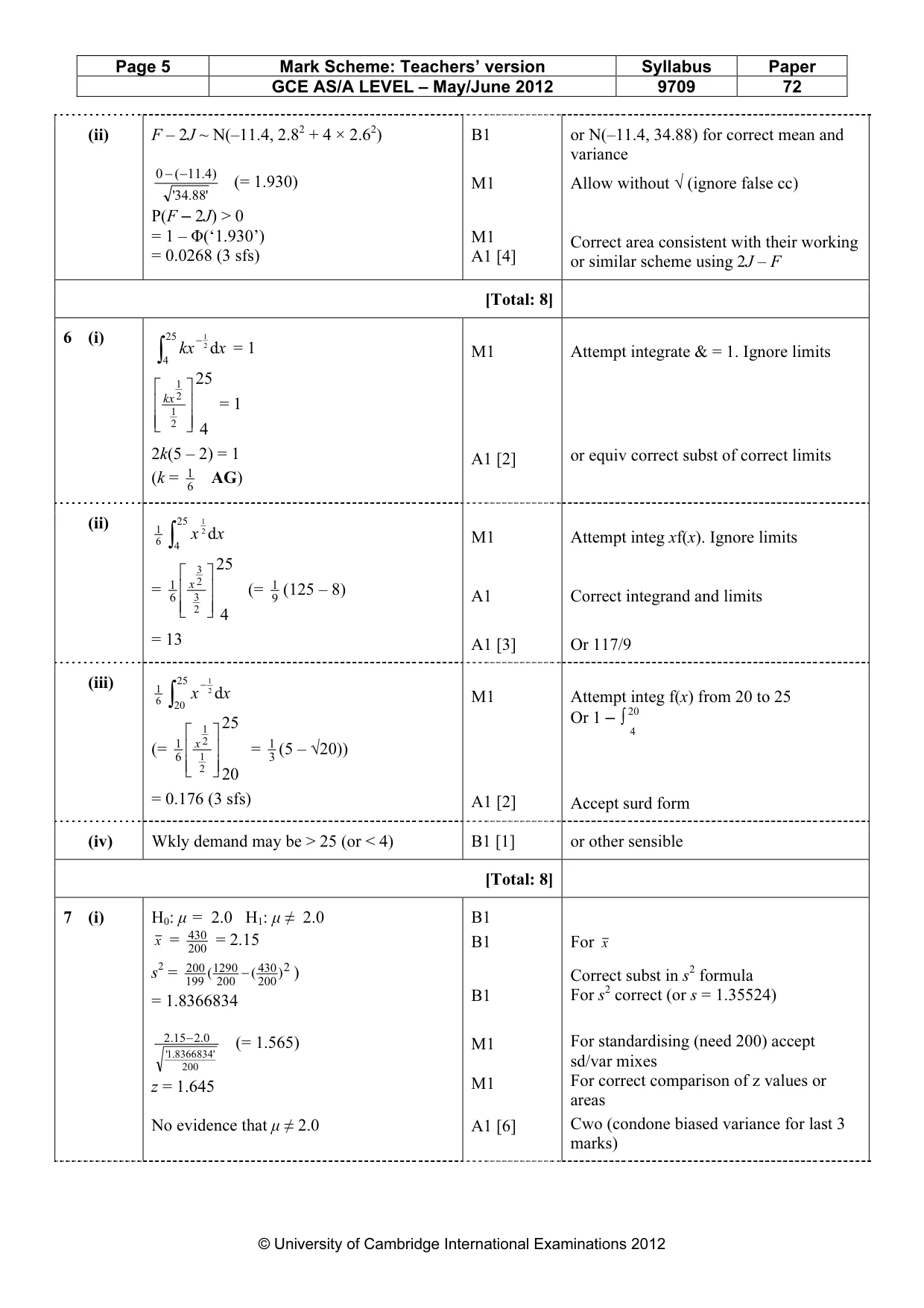
Page 4 Mark Scheme: Teachers’ version Syllabus Paper GCE AS/A LEVEL – May/June 2012 9709 72 © University of Cambridge International Examinations 2012 Note: “(3 sfs)” means “answer which rounds to ... to 3 sfs”. If correct ans seen to > 3sfs, ISW for later rounding. Penalise < 3 sfs only once in paper. 1 (i) H0: Pop mean = 3 H1: Pop mean > 3 B1 [1] Allow or µ or λ, but not just ‘mean’ (ii) 0.0683 > 0.05 No evidence that pop mean increased M1 A1ft [2] For inequality stated or clearly shown on dig. Allow ‘No increase in mean’ [Total: 3] 2 (i) 7, 3/√n B1, B1 [2] oe (ii) (a) Pop is normal B1 [1] Allow X is normal (b) Large sample B1 [1] or large n (can be implied by n ≥ 30) [Total: 4] 3 (i) p = 18/50 or 0.36 oe z = 2.326 0.36 ± z 50 ) 36 .0 1( 36 .0 − × = 0.202 to 0.518 (3 sfs) B1 B1 M1 A1 [4] Allow any z (≠ 0 or 1) Allow any brackets or none (ii) Sample random B1 [1] oe [Total: 5] 4 (i) λ = 8 × 0.32 + 12 × 0.45 (= 7.96) 1 – e–7.96(1 + 7.96 + 2 2 96 .7 ) = 0.986 (3 sfs) M1 M1 A1 [3] 1 – P(X < 2), any λ allow one end error (ii) λ = 155 × 0.32 = 49.6 N(‘49.6’, ‘49.6’) '6. 49 ' '6. 49 ' 5. 34 − (= –2.144) Φ(‘–2.144’) = 1 – Φ(‘2.144’) = 0.016(0) B1 M1 M1 M1 A1 [5] N (λ λ) any λ. May be implied Allow no or wrong cc & no √ Correct area consistent with their working [Total: 8] 5 (i) F + J ~ N(24, 2.82 + 2.62) '6. 14 ' 24 30− (= 1.570) P(F + J < 30) = Φ(‘1.570’) 0.942 (3 sfs) B1 M1 M1 A1 [4] or N(24, 14.6) for correct mean and variance Allow without √ (ignore false cc) Correct area consistent with their working
Mark scheme, page 5
Page 5 Mark Scheme: Teachers’ version Syllabus Paper GCE AS/A LEVEL – May/June 2012 9709 72 © University of Cambridge International Examinations 2012 (ii) F – 2J ~ N(–11.4, 2.82 + 4 × 2.62) ' 88 . 34 ' ) 4. 11 ( 0 − − (= 1.930) P(F – 2J) > 0 = 1 – Φ(‘1.930’) = 0.0268 (3 sfs) B1 M1 M1 A1 [4] or N(–11.4, 34.88) for correct mean and variance Allow without √ (ignore false cc) Correct area consistent with their working or similar scheme using 2J – F [Total: 8] 6 (i) x kx d 25 4 2 1 ∫ − = 1 4 25 2 1 2 1 kx = 1 2k(5 – 2) = 1 (k = 6 1 AG) M1 A1 [2] Attempt integrate & = 1. Ignore limits or equiv correct subst of correct limits (ii) x x ∫ 25 4 6 1 d 2 1 = 4 25 2 3 2 3 6 1 x (= 9 1 (125 – 8) = 13 M1 A1 A1 [3] Attempt integ xf(x). Ignore limits Correct integrand and limits Or 117/9 (iii) x x d 25 20 6 1 2 1 ∫ − (= 20 25 2 1 2 1 6 1 x = 3 1 (5 – √20)) = 0.176 (3 sfs) M1 A1 [2] Attempt integ f(x) from 20 to 25 Or 1 – ∫ 20 4 Accept surd form (iv) Wkly demand may be > 25 (or < 4) B1 [1] or other sensible [Total: 8] 7 (i) H0: µ = 2.0 H1: µ ≠ 2.0 x = 200 430 = 2.15 s2 = 2 200 430 200 1290 199 200 ) ( ( − ) = 1.8366834 200 ' 1.8366834 ' 0.2 15 .2 − (= 1.565) z = 1.645 No evidence that µ ≠ 2.0 B1 B1 B1 M1 M1 A1 [6] For x Correct subst in s2 formula For s2 correct (or s = 1.35524) For standardising (need 200) accept sd/var mixes For correct comparison of z values or areas Cwo (condone biased variance for last 3 marks)
Mark scheme, page 6
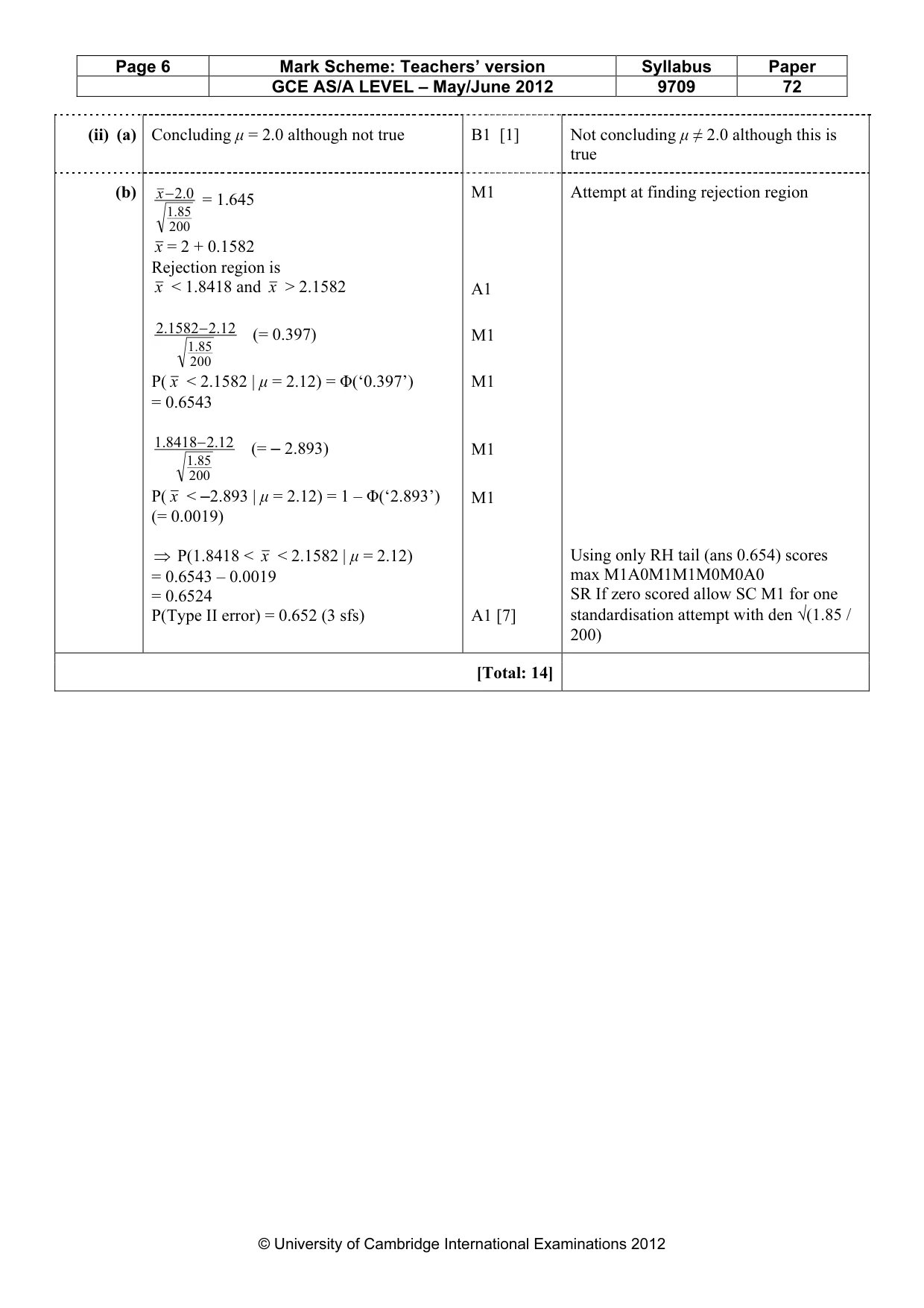
Page 6 Mark Scheme: Teachers’ version Syllabus Paper GCE AS/A LEVEL – May/June 2012 9709 72 © University of Cambridge International Examinations 2012 (ii) (a) Concluding µ = 2.0 although not true B1 [1] Not concluding µ ≠ 2.0 although this is true (b) 200 1.85 0.2 − x = 1.645 x = 2 + 0.1582 Rejection region is x < 1.8418 and x > 2.1582 200 85 .1 12 .2 1582 .2 − (= 0.397) P( x < 2.1582 | µ = 2.12) = Φ(‘0.397’) = 0.6543 200 85 .1 12 .2 8418 .1 − (= – 2.893) P( x < –2.893 | µ = 2.12) = 1 – Φ(‘2.893’) (= 0.0019) ⇒ P(1.8418 < x < 2.1582 | µ = 2.12) = 0.6543 – 0.0019 = 0.6524 P(Type II error) = 0.652 (3 sfs) M1 A1 M1 M1 M1 M1 A1 [7] Attempt at finding rejection region Using only RH tail (ans 0.654) scores max M1A0M1M1M0M0A0 SR If zero scored allow SC M1 for one standardisation attempt with den √(1.85 / 200) [Total: 14]
What you needed in this session
Cambridge’s own grade thresholds for 2012 May/June, Paper 7 · Variant 2. A higher threshold means an easier paper — the bar moves with how the cohort did.