Cambridge A Level Mathematics 9709 — 2010 Oct/Nov Paper 5 · Variant 3
9709/53/O/N/10 · 6 questions · 50 marks · ≈56 min
The question paper and its mark scheme, free to read here and free to download. This is Cambridge’s own paper, exactly as it was sat.
Question paper4 pages
Mark scheme6 pages
Answers below. Sit the paper first if you are practising.
Questions as text
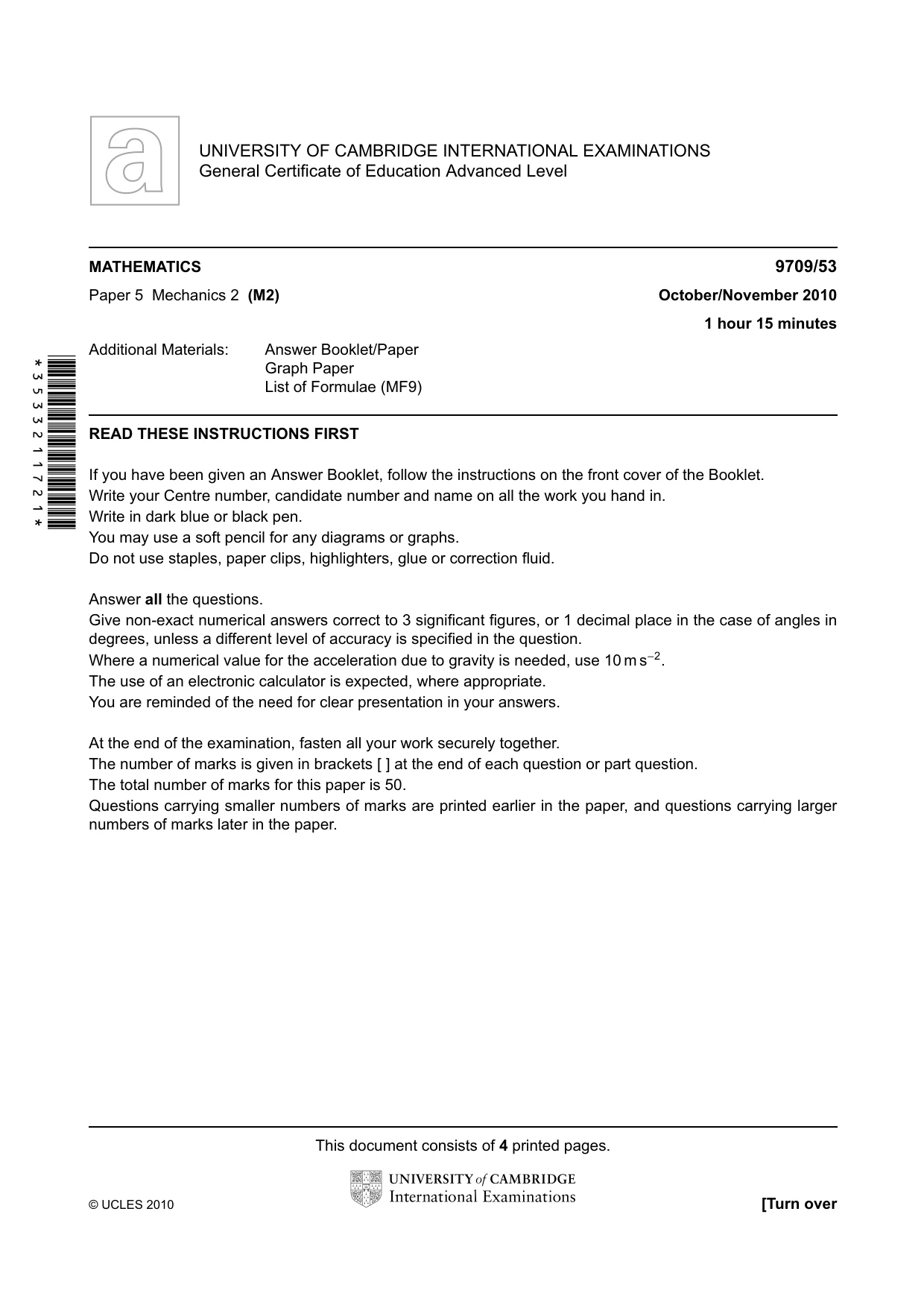
Q1 · 0.9 m D C 0.9 m A B 1.8 m ABCD is a uniform lamina with AB = 1.8 m, AD = DC = 0.9 m, and…
1 0.9 m D C 0.9 m A B 1.8 m ABCD is a uniform lamina with AB = 1.8 m, AD = DC = 0.9 m, and AD perpendicular to AB and DC (see diagram). (i) Find the distance of the centre of mass of the lamina from AB and the distance from AD. [4] The lamina is freely suspended at A and hangs in equilibrium. (ii) Calculate the angle between AB and the vertical. [2]
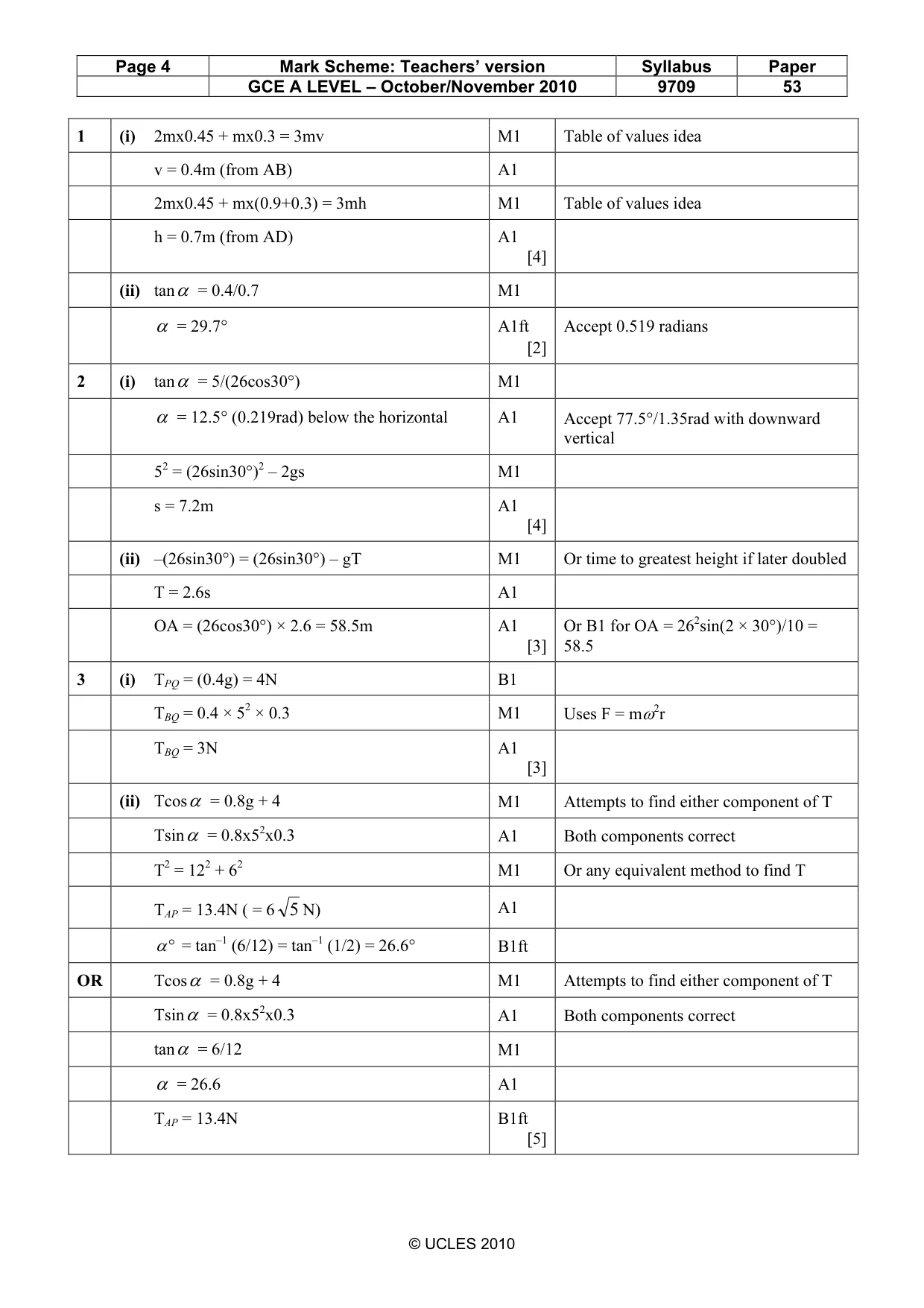
Mark scheme: 1 (i) 2mx0.45 + mx0.3 = 3mv M1 Table of values idea v = 0.4m (from AB) A1 2mx0.45 + mx(0.9+0.3) = 3mh M1 Table of values idea h = 0.7m (from AD) A1 [4] (ii) tanα = 0.4/0.7 M1 α = 29.7° A1ft Accept 0.519 radians [2]
Q2 · A particle P is projected with speed 26 m s−1 at an angle of 30◦above the horizontal from…
2 A particle P is projected with speed 26 m s−1 at an angle of 30◦above the horizontal from a point O on a horizontal plane. (i) For the instant when the vertical component of the velocity of P is 5 m s−1 downwards, find the direction of motion of P and the height of P above the plane. [4] (ii) P strikes the plane at the point A. Calculate the time taken by P to travel from O to A and the distance OA. [3]
Mark scheme: 2 (i) tanα = 5/(26cos30°) M1 α = 12.5° (0.219rad) below the horizontal A1 Accept 77.5°/1.35rad with downward vertical 52 = (26sin30°)2 – 2gs M1 s = 7.2m A1 [4] (ii) –(26sin30°) = (26sin30°) – gT M1 Or time to greatest height if later doubled T = 2.6s A1 OA = (26cos30°) × 2.6 = 58.5m A1 Or B1 for OA = 262sin(2 × 30°)/10 = [3] 58.5
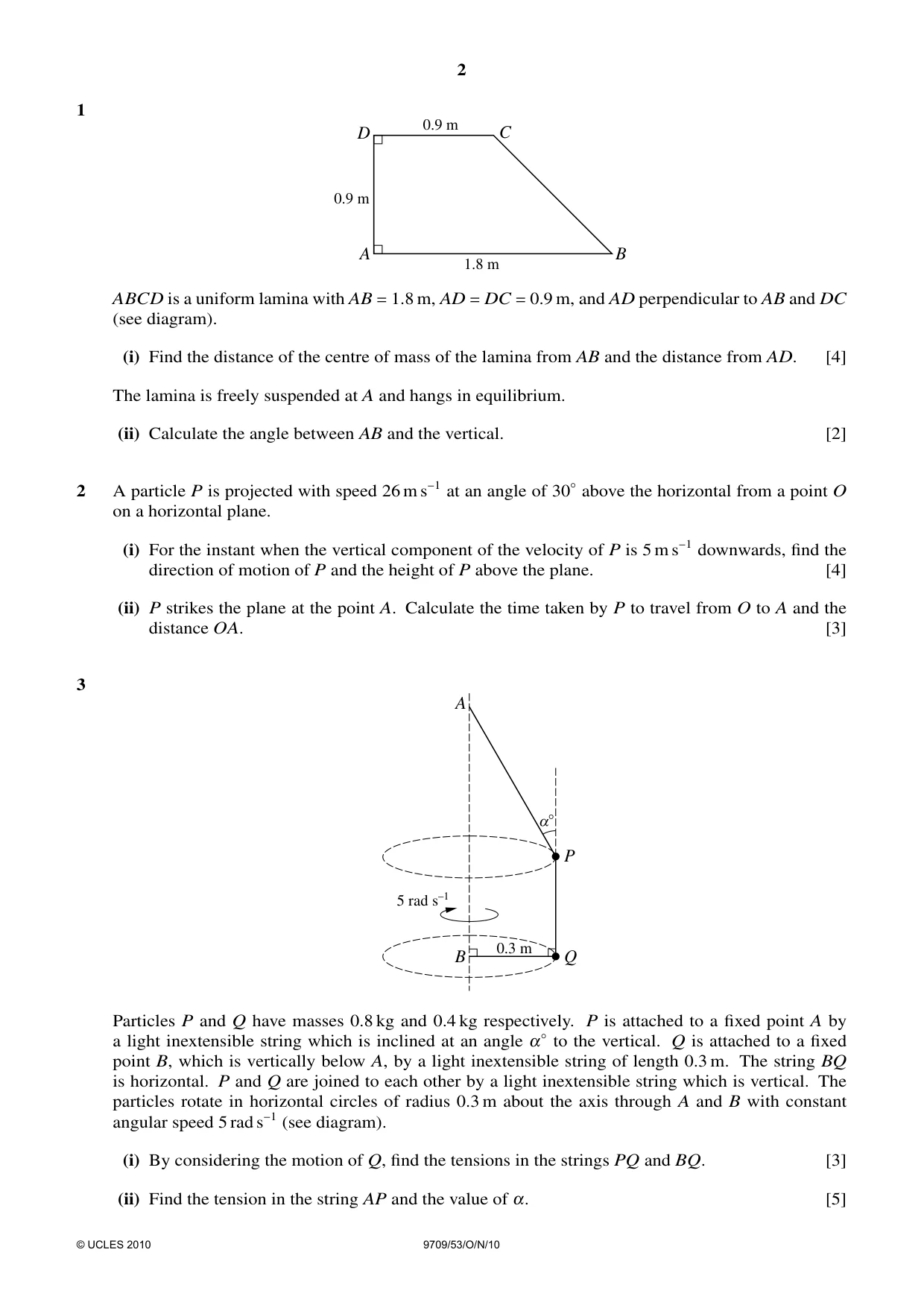
Q3 · A a° P 5 rad s–1 0.3 m B Q Particles P and Q have masses 0.8 kg and 0.4 kg respectively
3 A a° P 5 rad s–1 0.3 m B Q Particles P and Q have masses 0.8 kg and 0.4 kg respectively. P is attached to a fixed point A by a light inextensible string which is inclined at an angle α◦to the vertical. Q is attached to a fixed point B, which is vertically below A, by a light inextensible string of length 0.3 m. The string BQ is horizontal. P and Q are joined to each other by a light inextensible string which is vertical. The particles rotate in horizontal circles of radius 0.3 m about the axis through A and B with constant angular speed 5 rad s−1 (see diagram). (i) By considering the motion of Q, find the tensions in the strings PQ and BQ. [3] (ii) Find the tension in the string AP and the value of α. [5]
Mark scheme: 3 (i) TPQ = (0.4g) = 4N B1 TBQ = 0.4 × 52 × 0.3 M1 Uses F = mω2r TBQ = 3N A1 [3] (ii) Tcosα = 0.8g + 4 M1 Attempts to find either component of T Tsinα = 0.8x52x0.3 A1 Both components correct T2 = 122 + 62 M1 Or any equivalent method to find T TAP = 13.4N ( = 6 5 N) A1 α ° = tan–1 (6/12) = tan–1 (1/2) = 26.6° B1ft OR Tcosα = 0.8g + 4 M1 Attempts to find either component of T Tsinα = 0.8x52x0.3 A1 Both components correct tanα = 6/12 M1 α = 26.6 A1 TAP = 13.4N B1ft [5] GCE A LEVEL – October/November 2010 9709 53
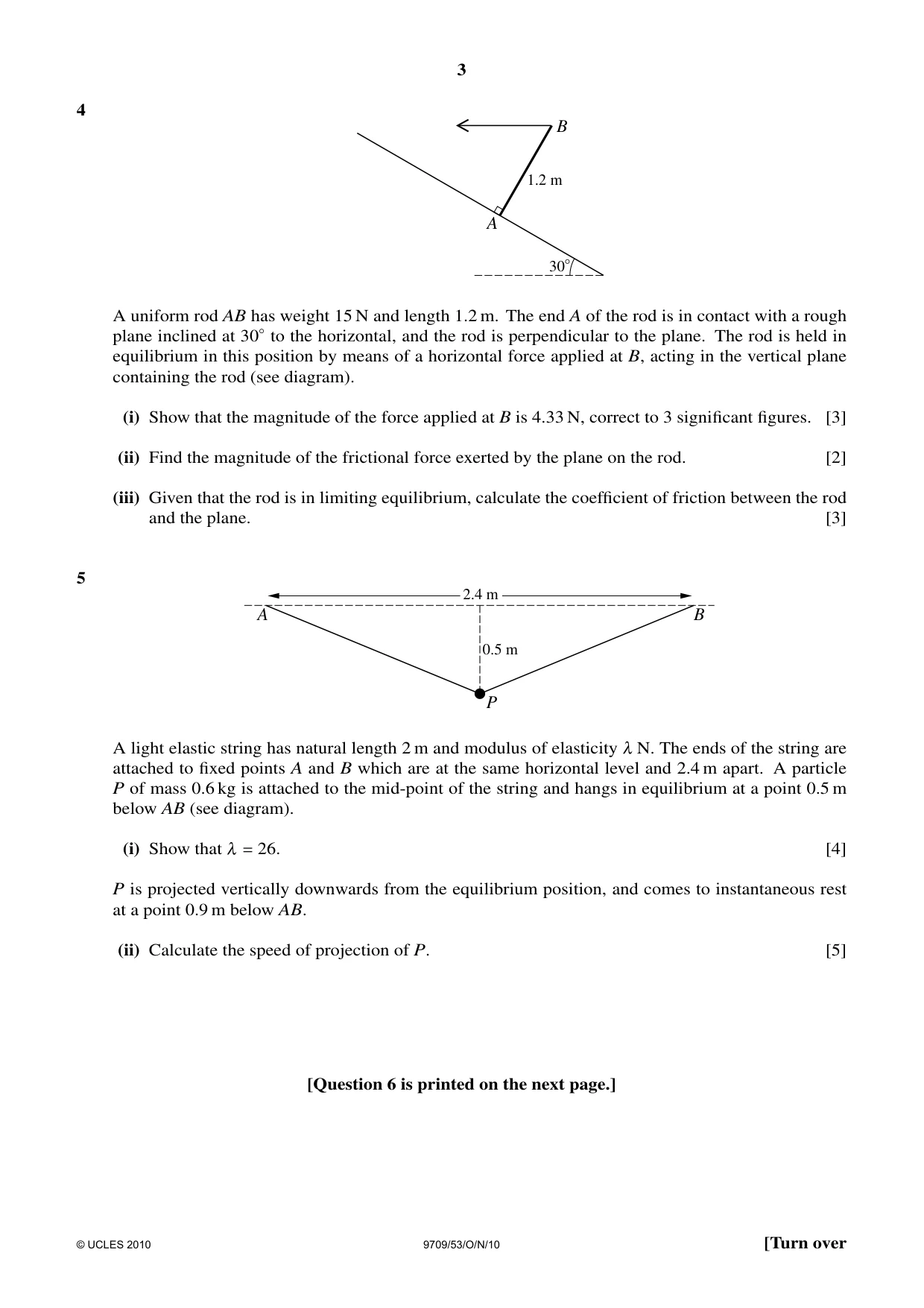
Q4 · B 1.2 m A 30° A uniform rod AB has weight 15 N and length 1.2 m
4 B 1.2 m A 30° A uniform rod AB has weight 15 N and length 1.2 m. The end A of the rod is in contact with a rough plane inclined at 30◦to the horizontal, and the rod is perpendicular to the plane. The rod is held in equilibrium in this position by means of a horizontal force applied at B, acting in the vertical plane containing the rod (see diagram). (i) Show that the magnitude of the force applied at B is 4.33 N, correct to 3 significant figures. [3] (ii) Find the magnitude of the frictional force exerted by the plane on the rod. [2] (iii) Given that the rod is in limiting equilibrium, calculate the coefficient of friction between the rod and the plane. [3]
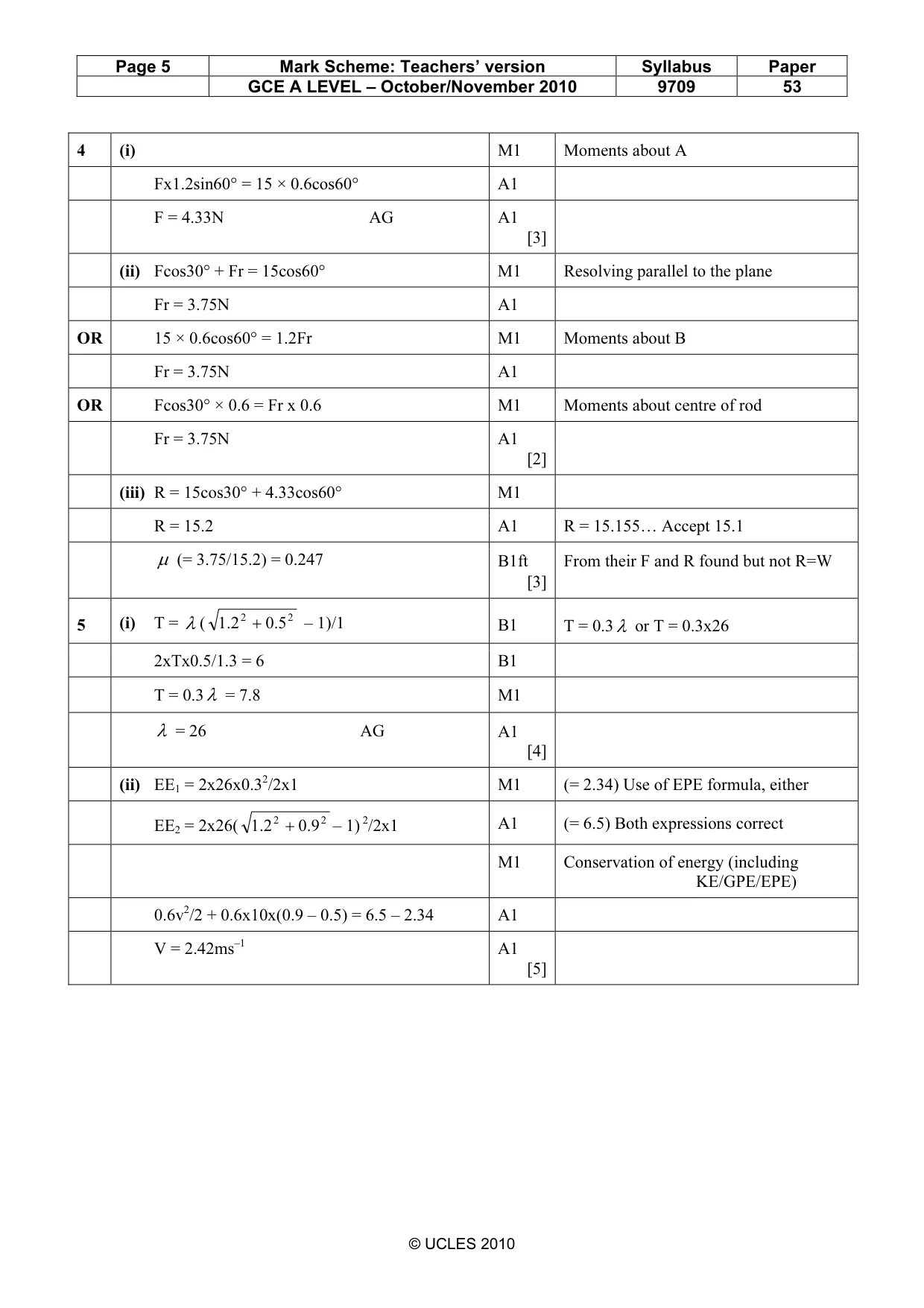
Mark scheme: 4 (i) M1 Moments about A Fx1.2sin60° = 15 × 0.6cos60° A1 F = 4.33N AG A1 [3] (ii) Fcos30° + Fr = 15cos60° M1 Resolving parallel to the plane Fr = 3.75N A1 OR 15 × 0.6cos60° = 1.2Fr M1 Moments about B Fr = 3.75N A1 OR Fcos30° × 0.6 = Fr x 0.6 M1 Moments about centre of rod Fr = 3.75N A1 [2] (iii) R = 15cos30° + 4.33cos60° M1 R = 15.2 A1 R = 15.155… Accept 15.1 µ (= 3.75/15.2) = 0.247 B1ft From their F and R found but not R=W [3] λ ( 2 2 )/
Q5 · 2.4 m A B 0.5 m P A light elastic string has natural length 2 m and modulus of elasticity…
5 2.4 m A B 0.5 m P A light elastic string has natural length 2 m and modulus of elasticity λ N. The ends of the string are attached to fixed points A and B which are at the same horizontal level and 2.4 m apart. A particle P of mass 0.6 kg is attached to the mid-point of the string and hangs in equilibrium at a point 0.5 m below AB (see diagram). (i) Show that λ = 26. [4] P is projected vertically downwards from the equilibrium position, and comes to instantaneous rest at a point 0.9 m below AB. (ii) Calculate the speed of projection of P. [5] [Question 6 is printed on the next page.]
Mark scheme: 5 (i) T = λ ( 2.1 2 + 5.0 2 – 1)/1 B1 T = 0.3λ or T = 0.3x26 2xTx0.5/1.3 = 6 B1 T = 0.3λ = 7.8 M1 λ = 26 AG A1 [4] (ii) EE1 = 2x26x0.32/2x1 M1 (= 2.34) Use of EPE formula, either EE2 = 2x26( 2.1 2 + 9.0 2 – 1) 2/2x1 A1 (= 6.5) Both expressions correct M1 Conservation of energy (including KE/GPE/EPE) 0.6v2/2 + 0.6x10x(0.9 – 0.5) = 6.5 – 2.34 A1 V = 2.42ms–1 A1 [5] GCE A LEVEL – October/November 2010 9709 53
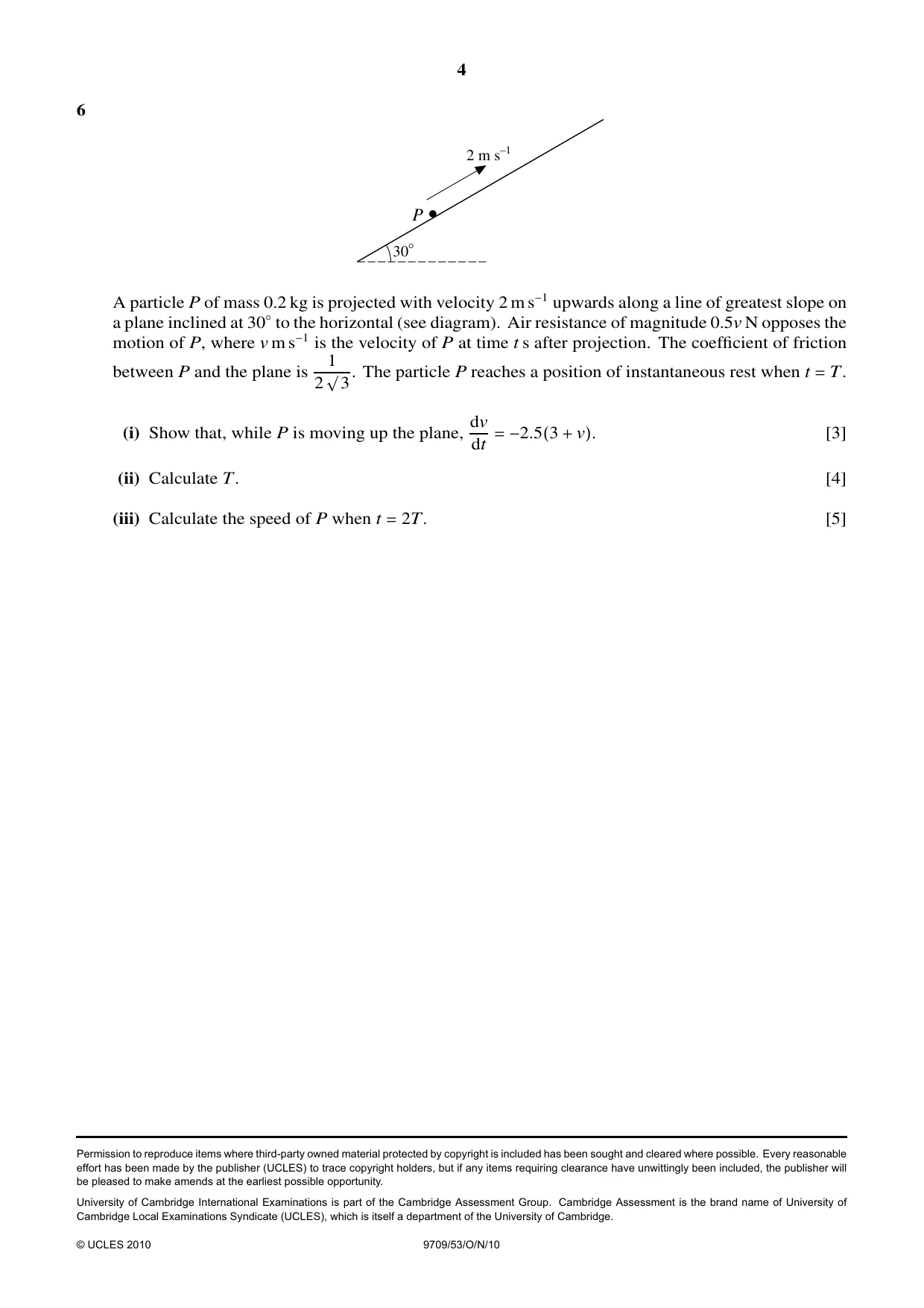
Q6 · 2 m s–1 P 30° A particle P of mass 0.2 kg is projected with velocity 2 m s−1 upwards…
6 2 m s–1 P 30° A particle P of mass 0.2 kg is projected with velocity 2 m s−1 upwards along a line of greatest slope on a plane inclined at 30◦to the horizontal (see diagram). Air resistance of magnitude 0.5v N opposes the motion of P, where v m s−1 is the velocity of P at time t s after projection. The coefficient of friction 1 between P and the plane is 2 √3. The particle P reaches a position of instantaneous rest when t = T. dv (i) Show that, while P is moving up the plane, dt = −2.5(3 + v). [3] (ii) Calculate T. [4] (iii) Calculate the speed of P when t = 2T. [5]
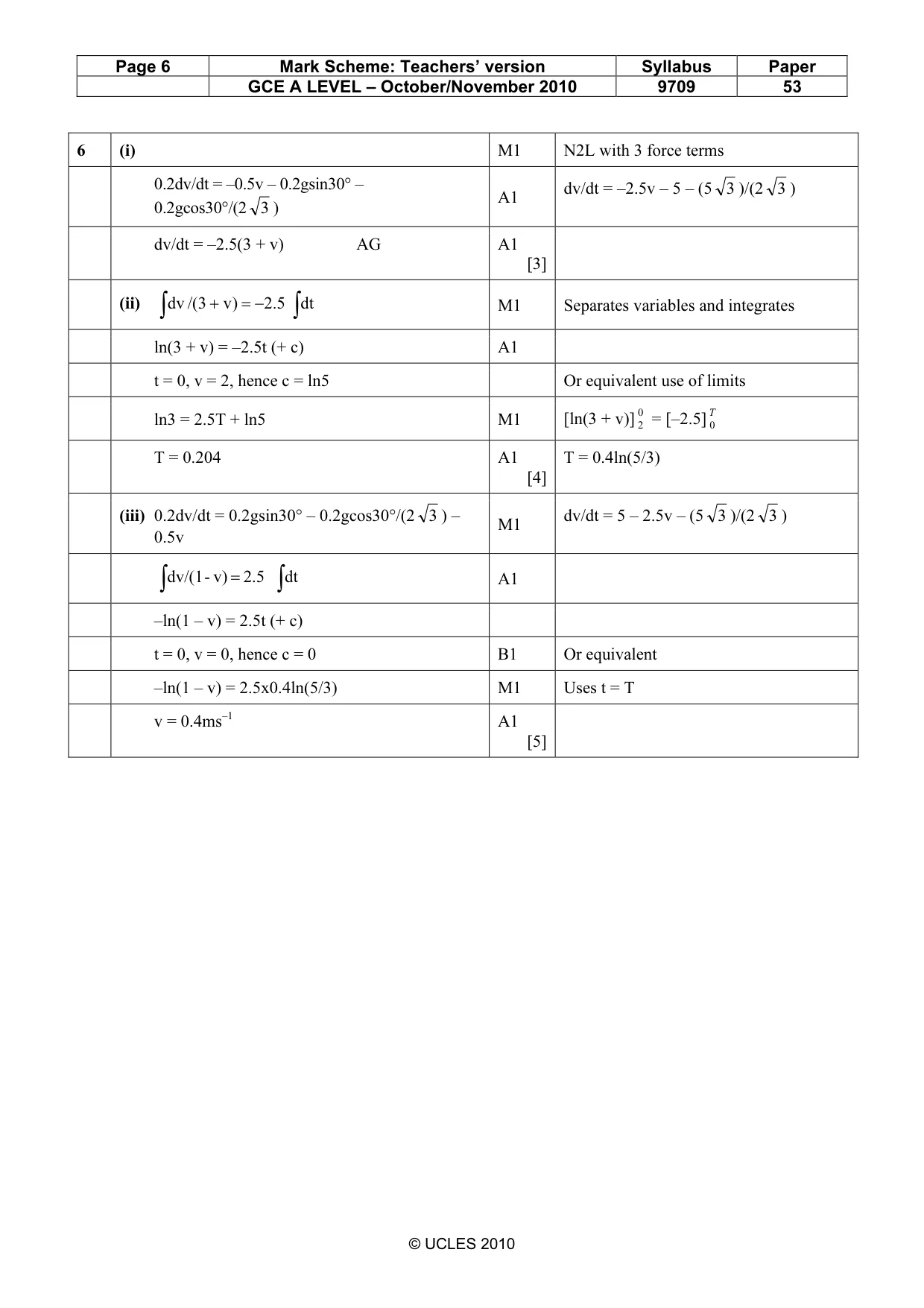
Mark scheme: 6 (i) M1 N2L with 3 force terms 0.2dv/dt = –0.5v – 0.2gsin30° – dv/dt = –2.5v – 5 – (5 3 )/(2 3 ) A1 0.2gcos30°/(2 3 ) dv/dt = –2.5(3 + v) AG A1 [3] M1 Separates variables and integrates (ii) ∫ dv /(3 + v ) = −5.2 ∫dt ln(3 + v) = –2.5t (+ c) A1 t = 0, v = 2, hence c = ln5 Or equivalent use of limits ln3 = 2.5T + ln5 M1 [ln(3 + v)] 02 = [–2.5] T0 T = 0.204 A1 T = 0.4ln(5/3) [4] (iii) 0.2dv/dt = 0.2gsin30° – 0.2gcos30°/(2 3 ) – dv/dt = 5 – 2.5v – (5 3 )/(2 3 ) M1 0.5v A1 ∫ dv/(1 - v) = 2.5 ∫dt –ln(1 – v) = 2.5t (+ c) t = 0, v = 0, hence c = 0 B1 Or equivalent –ln(1 – v) = 2.5x0.4ln(5/3) M1 Uses t = T v = 0.4ms–1 A1 [5]
What was in this paper
The subtopics covered by these 6 questions, and how many questions each got. Open one in a new tab to see every Cambridge question on it.
What you needed in this session
Cambridge’s own grade thresholds for 2010 Oct/Nov, Paper 5 · Variant 3. A higher threshold means an easier paper — the bar moves with how the cohort did.