Cambridge A Level Mathematics 9709 — 2010 Oct/Nov Paper 5 · Variant 1
9709/51/O/N/10 · 6 questions · 50 marks · ≈56 min
The question paper and its mark scheme, free to read here and free to download. This is Cambridge’s own paper, exactly as it was sat.
Question paper4 pages
Mark scheme6 pages
Answers below. Sit the paper first if you are practising.
Questions as text
Q1 · A horizontal circular disc rotates with constant angular speed 9 rad s−1 about its centre…
1 A horizontal circular disc rotates with constant angular speed 9 rad s−1 about its centre O. A particle of mass 0.05 kg is placed on the disc at a distance 0.4 m from O. The particle moves with the disc and no sliding takes place. Calculate the magnitude of the resultant force exerted on the particle by the disc. [3]
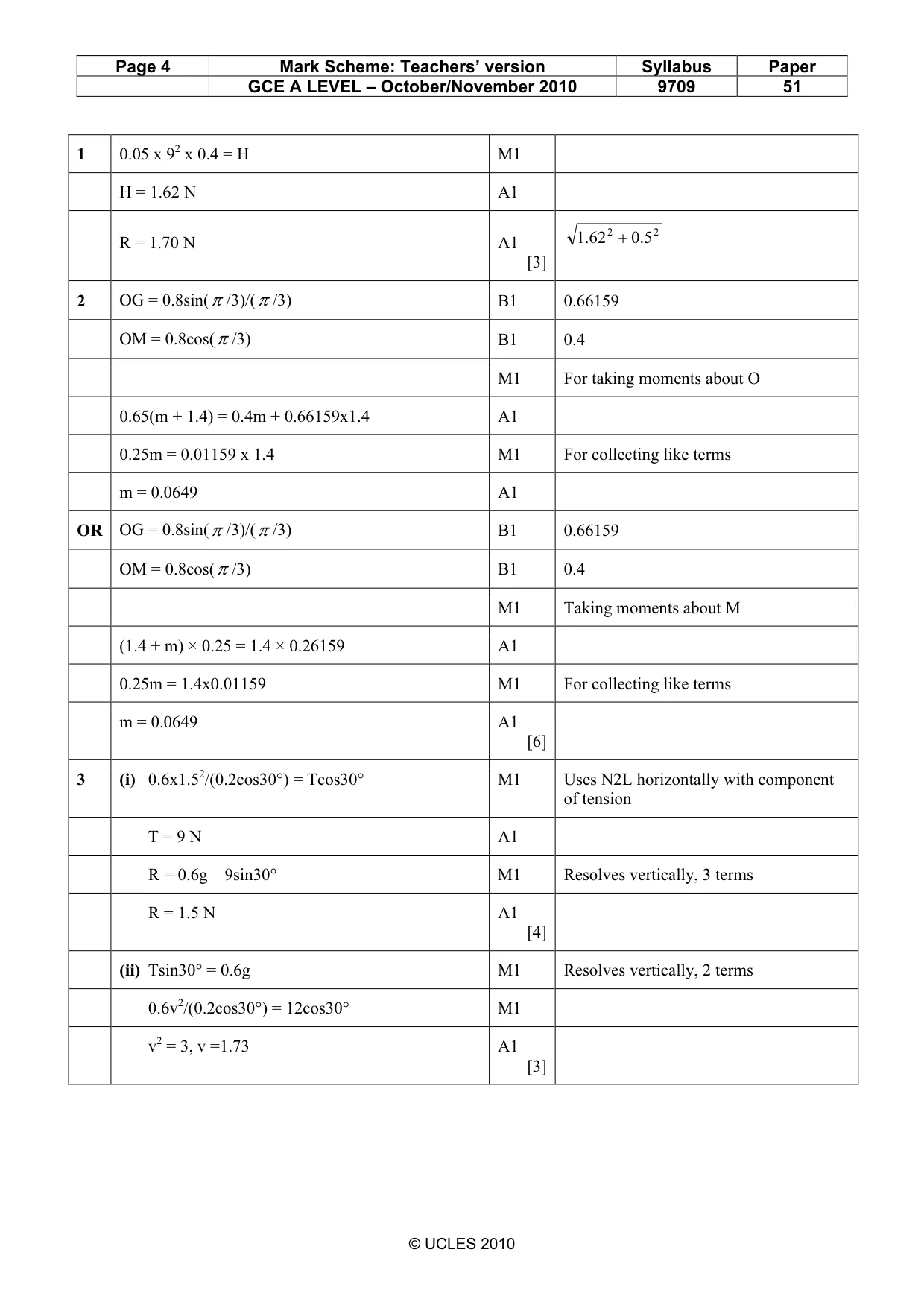
Mark scheme: 1 0.05 x 92 x 0.4 = H M1 H = 1.62 N A1 .1 62 2 + 5.0 2 R = 1.70 N A1 [3]
Q2 · A 0.8 m O 23 p rad B A bow consists of a uniform curved portion AB of mass 1.4 kg, and a…
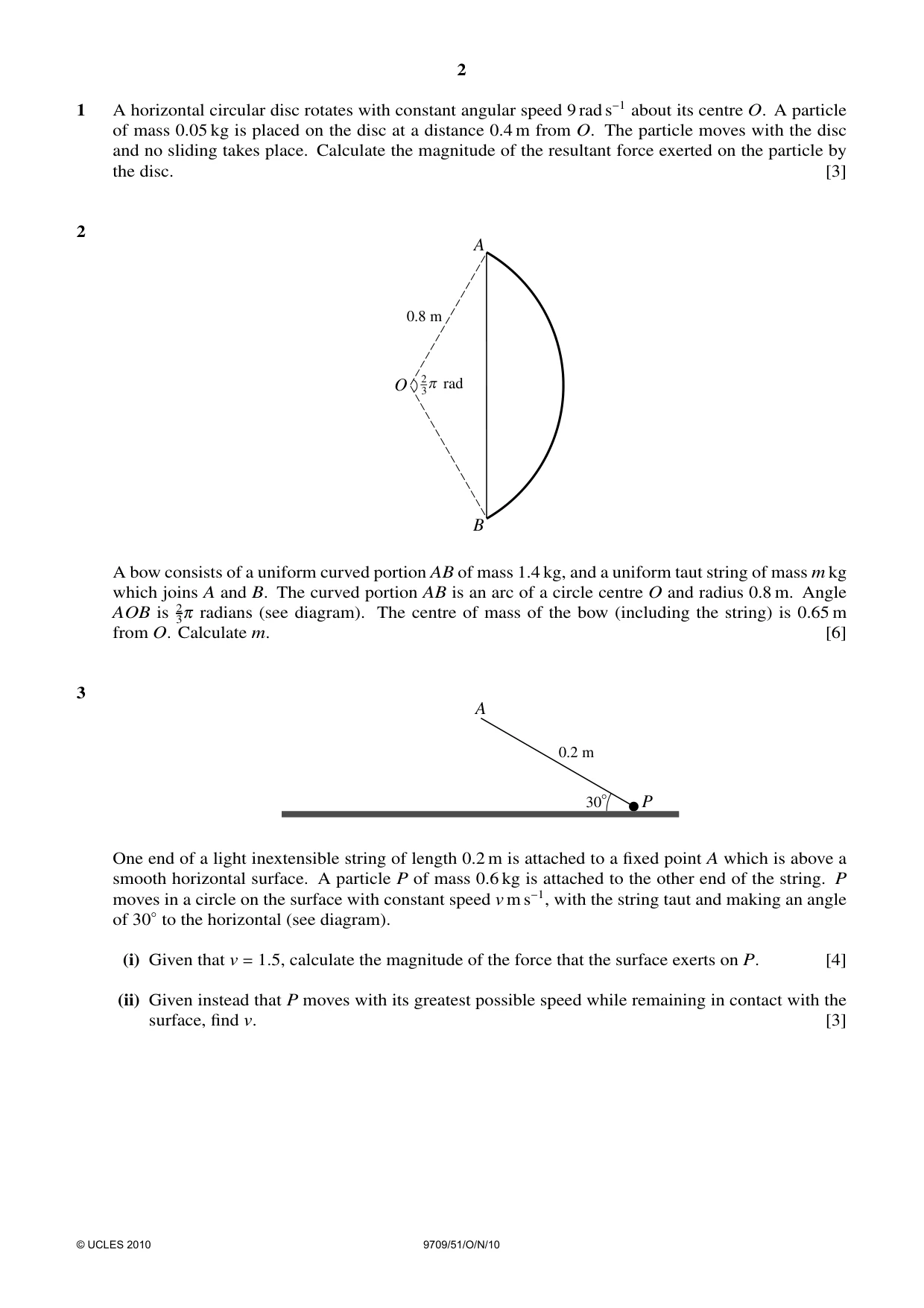
2 A 0.8 m O 23 p rad B A bow consists of a uniform curved portion AB of mass 1.4 kg, and a uniform taut string of mass m kg which joins A and B. The curved portion AB is an arc of a circle centre O and radius 0.8 m. Angle AOB is 23π radians (see diagram). The centre of mass of the bow (including the string) is 0.65 m from O. Calculate m. [6]
Mark scheme: 2 OG = 0.8sin(π /3)/(π /3) B1 0.66159 OM = 0.8cos(π /3) B1 0.4 M1 For taking moments about O 0.65(m + 1.4) = 0.4m + 0.66159x1.4 A1 0.25m = 0.01159 x 1.4 M1 For collecting like terms m = 0.0649 A1 OR OG = 0.8sin(π /3)/(π /3) B1 0.66159 OM = 0.8cos(π /3) B1 0.4 M1 Taking moments about M (1.4 + m) × 0.25 = 1.4 × 0.26159 A1 0.25m = 1.4x0.01159 M1 For collecting like terms m = 0.0649 A1 [6] 2
Q3 · A 0.2 m 30° P One end of a light inextensible string of length 0.2 m is attached to a…
3 A 0.2 m 30° P One end of a light inextensible string of length 0.2 m is attached to a fixed point A which is above a smooth horizontal surface. A particle P of mass 0.6 kg is attached to the other end of the string. P moves in a circle on the surface with constant speed v m s−1, with the string taut and making an angle of 30◦to the horizontal (see diagram). (i) Given that v = 1.5, calculate the magnitude of the force that the surface exerts on P. [4] (ii) Given instead that P moves with its greatest possible speed while remaining in contact with the surface, find v. [3]
Mark scheme: 3 (i) 0.6x1.52/(0.2cos30°) = Tcos30° M1 Uses N2L horizontally with component of tension T = 9 N A1 R = 0.6g – 9sin30° M1 Resolves vertically, 3 terms R = 1.5 N A1 [4] (ii) Tsin30° = 0.6g M1 Resolves vertically, 2 terms 0.6v2/(0.2cos30°) = 12cos30° M1 v2 = 3, v =1.73 A1 [3] GCE A LEVEL – October/November 2010 9709 51
Q4 · B 1.7 m 220 N A 0.8 m 70 N A uniform beam AB has length 2 m and weight 70 N
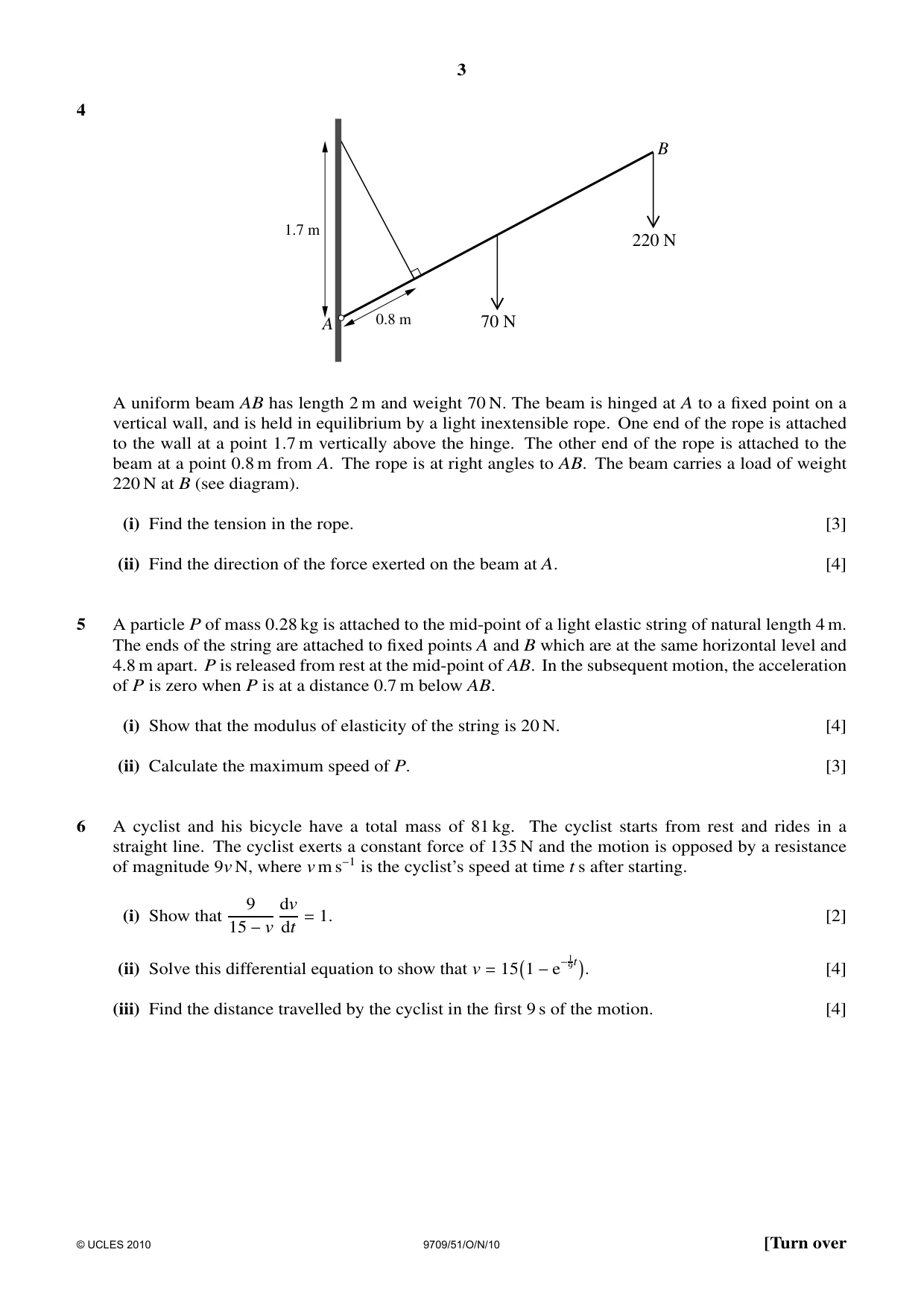
4 B 1.7 m 220 N A 0.8 m 70 N A uniform beam AB has length 2 m and weight 70 N. The beam is hinged at A to a fixed point on a vertical wall, and is held in equilibrium by a light inextensible rope. One end of the rope is attached to the wall at a point 1.7 m vertically above the hinge. The other end of the rope is attached to the beam at a point 0.8 m from A. The rope is at right angles to AB. The beam carries a load of weight 220 N at B (see diagram). (i) Find the tension in the rope. [3] (ii) Find the direction of the force exerted on the beam at A. [4]
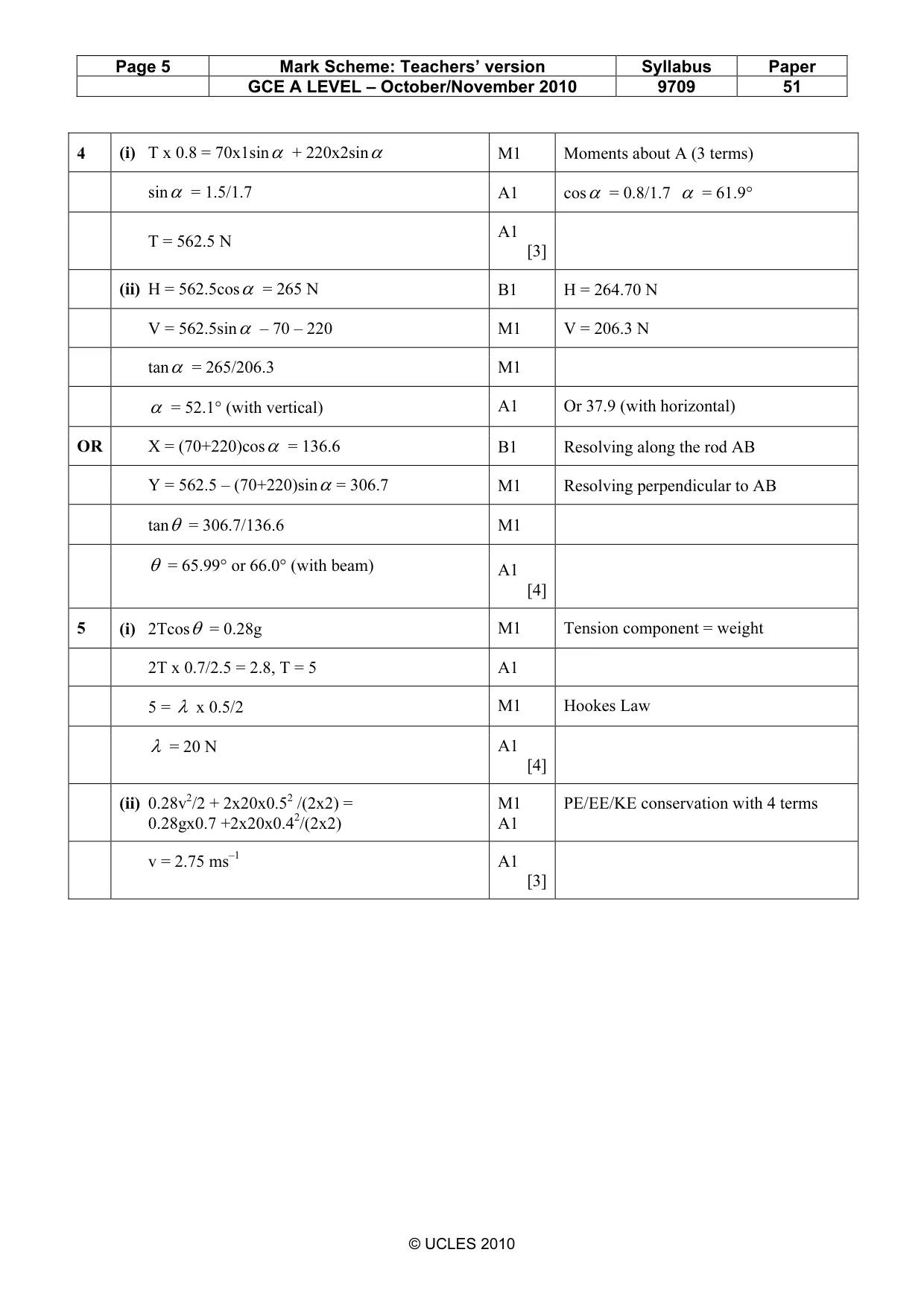
Mark scheme: 4 (i) T x 0.8 = 70x1sinα + 220x2sinα M1 Moments about A (3 terms) sinα = 1.5/1.7 A1 cosα = 0.8/1.7 α = 61.9° A1 T = 562.5 N [3] (ii) H = 562.5cosα = 265 N B1 H = 264.70 N V = 562.5sinα – 70 – 220 M1 V = 206.3 N tanα = 265/206.3 M1 α = 52.1° (with vertical) A1 Or 37.9 (with horizontal) OR X = (70+220)cosα = 136.6 B1 Resolving along the rod AB Y = 562.5 – (70+220)sinα = 306.7 M1 Resolving perpendicular to AB tanθ = 306.7/136.6 M1 θ = 65.99° or 66.0° (with beam) A1 [4]
Q5 · A particle P of mass 0.28 kg is attached to the mid-point of a light elastic string of…
5 A particle P of mass 0.28 kg is attached to the mid-point of a light elastic string of natural length 4 m. The ends of the string are attached to fixed points A and B which are at the same horizontal level and 4.8 m apart. P is released from rest at the mid-point of AB. In the subsequent motion, the acceleration of P is zero when P is at a distance 0.7 m below AB. (i) Show that the modulus of elasticity of the string is 20 N. [4] (ii) Calculate the maximum speed of P. [3]
Mark scheme: 5 (i) 2Tcosθ = 0.28g M1 Tension component = weight 2T x 0.7/2.5 = 2.8, T = 5 A1 5 = λ x 0.5/2 M1 Hookes Law λ = 20 N A1 [4] (ii) 0.28v2/2 + 2x20x0.52 /(2x2) = M1 PE/EE/KE conservation with 4 terms 0.28gx0.7 +2x20x0.42/(2x2) A1 v = 2.75 ms–1 A1 [3] GCE A LEVEL – October/November 2010 9709 51
Q7 · 10 m s–1 A 45° 30° O A particle P is projected from a point O with initial speed 10 m s−1…
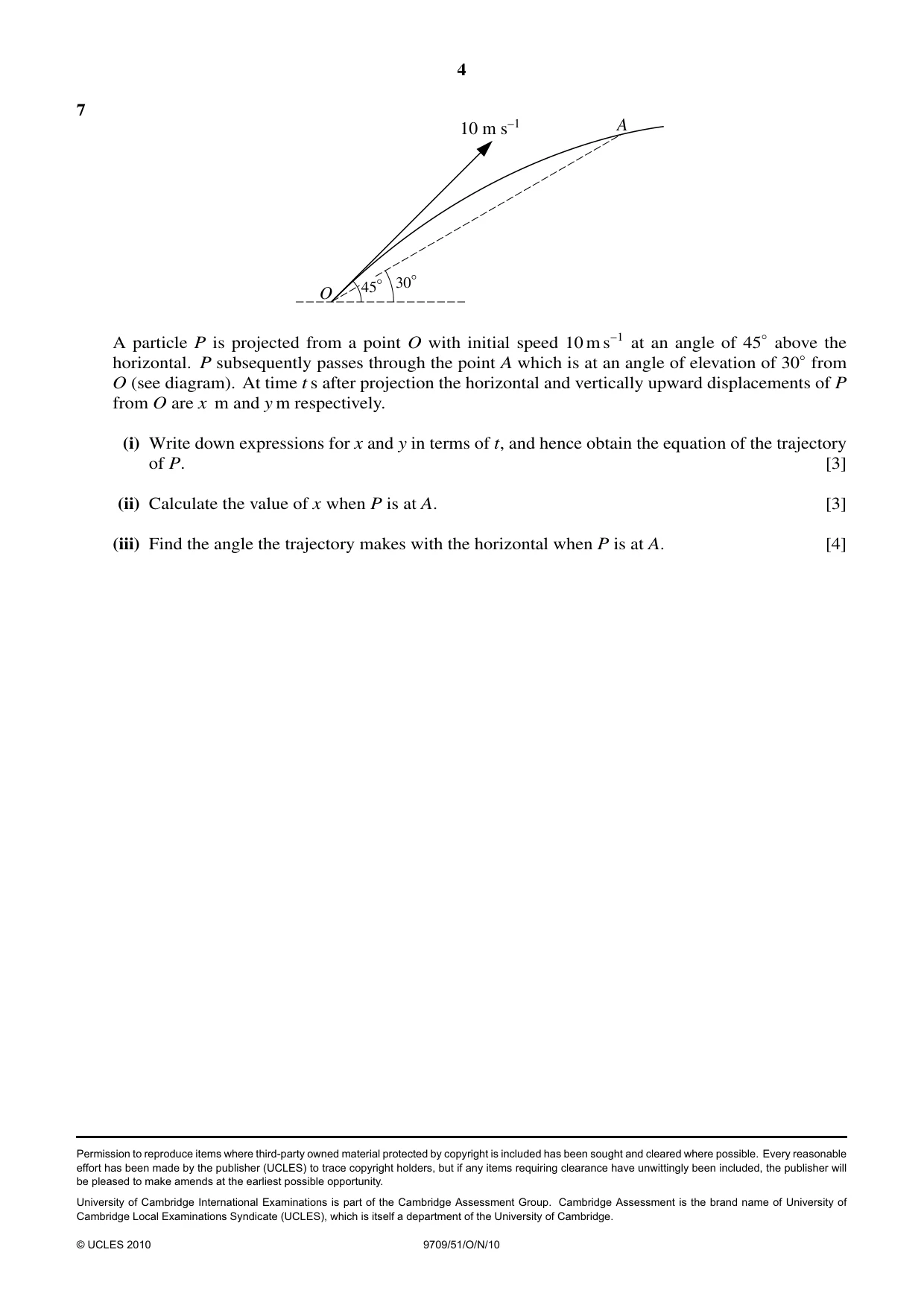
7 10 m s–1 A 45° 30° O A particle P is projected from a point O with initial speed 10 m s−1 at an angle of 45◦above the horizontal. P subsequently passes through the point A which is at an angle of elevation of 30◦from O (see diagram). At time t s after projection the horizontal and vertically upward displacements of P from O are x m and y m respectively. (i) Write down expressions for x and y in terms of t, and hence obtain the equation of the trajectory of P. [3] (ii) Calculate the value of x when P is at A. [3] (iii) Find the angle the trajectory makes with the horizontal when P is at A. [4]
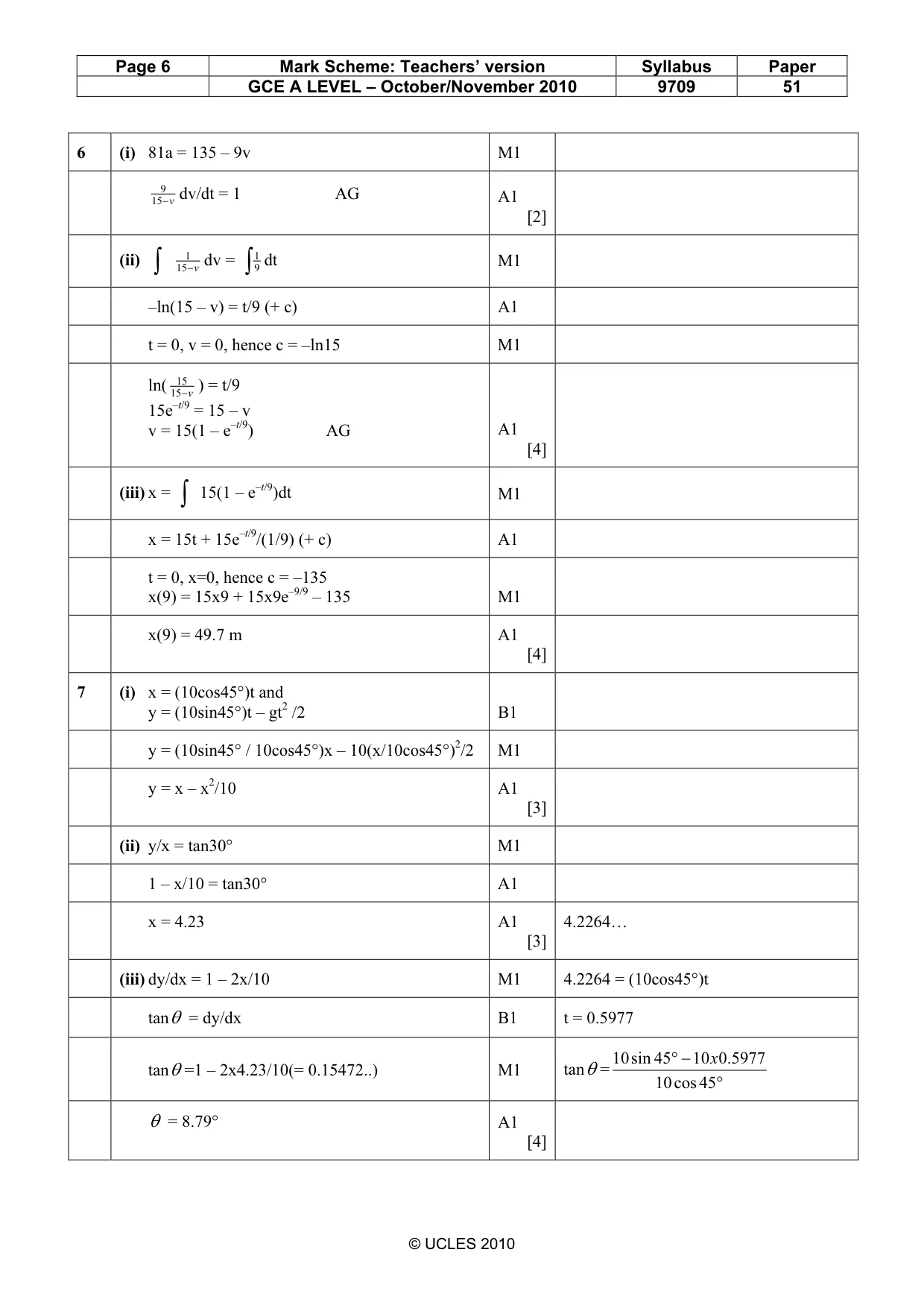
Mark scheme: 7 (i) x = (10cos45°)t and y = (10sin45°)t – gt2 /2 B1 y = (10sin45° / 10cos45°)x – 10(x/10cos45°)2/2 M1 y = x – x2/10 A1 [3] (ii) y/x = tan30° M1 1 – x/10 = tan30° A1 x = 4.23 A1 4.2264… [3] (iii) dy/dx = 1 – 2x/10 M1 4.2264 = (10cos45°)t tanθ = dy/dx B1 t = 0.5977 10 sin 45° − 10 x .05977 tanθ =1 – 2x4.23/10(= 0.15472..) M1 tanθ = 10 cos 45° θ = 8.79° A1 [4]
What was in this paper
The subtopics covered by these 6 questions, and how many questions each got. Open one in a new tab to see every Cambridge question on it.
What you needed in this session
Cambridge’s own grade thresholds for 2010 Oct/Nov, Paper 5 · Variant 1. A higher threshold means an easier paper — the bar moves with how the cohort did.