Cambridge A Level Mathematics 9709 — 2002 May/June Paper 6 · Variant 1
9709/61/M/J/02
The question paper and its mark scheme, free to read here and free to download. This is Cambridge’s own paper, exactly as it was sat.
Question paper4 pages

Mark scheme3 pages
Answers below. Sit the paper first if you are practising.
Paper as text
Question paper, page 1
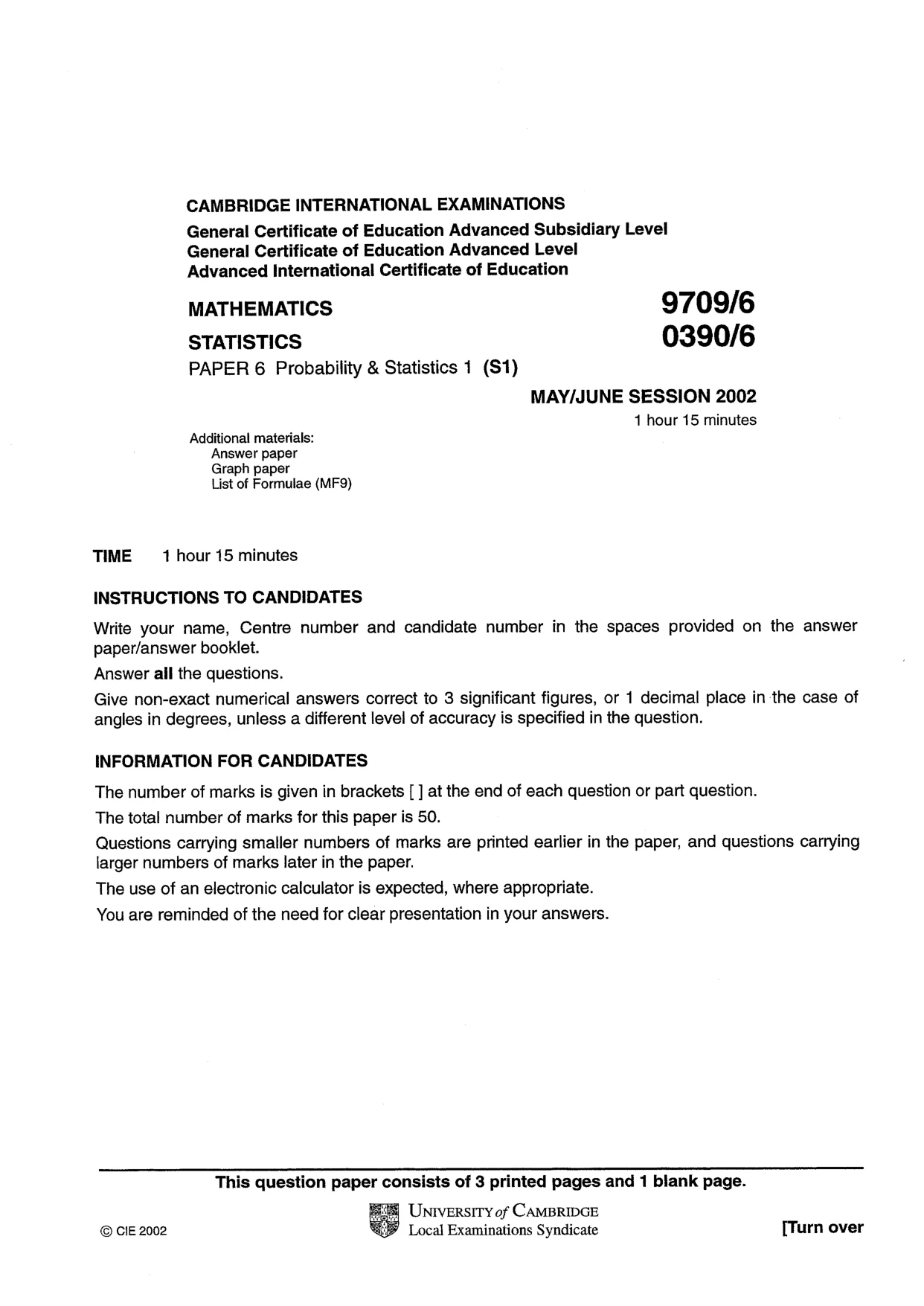
CAMBRIDGE INTERNATIONAL EXAMINATIONS General Certificate of Education Advanced Subsidiary Level General Certificate of Education Advanced Level Advanced International Certificate of Education MATHEMATICS 9709/6 STATISTICS 0390/6 PAPER 6 Probability & Statistics 1 (S1) MAY/JUNE SESSION 2002 1 hour 15 minutes Additional materials: Answer paper Graph paper List of Formulae (MF9) TIME = 1: hour 15 minutes INSTRUCTIONS TO CANDIDATES Write your name, Centre number and candidate number in the spaces provided on the answer paper/answer booklet. Answer all the questions. Give non-exact numerical answers correct to 3 significant figures, or 1 decimal place in the case of angles in degrees, unless a different level of accuracy is specified in the question. INFORMATION FOR CANDIDATES The number of marks is given in brackets [ ] at the end of each question or part question. The total number of marks for this paper is 50. Questions carrying smaller numbers of marks are printed earlier in the paper, and questions carrying larger numbers of marks later in the paper. The use of an electronic calculator is expected, where appropriate. You are reminded of the need for clear presentation in your answers. This question paper consists of 3 printed pages and 1 blank page. UNIVERSITY of CAMBRIDGE © CIE 2002 Local Examinations Syndicate [Turn over
Question paper, page 2
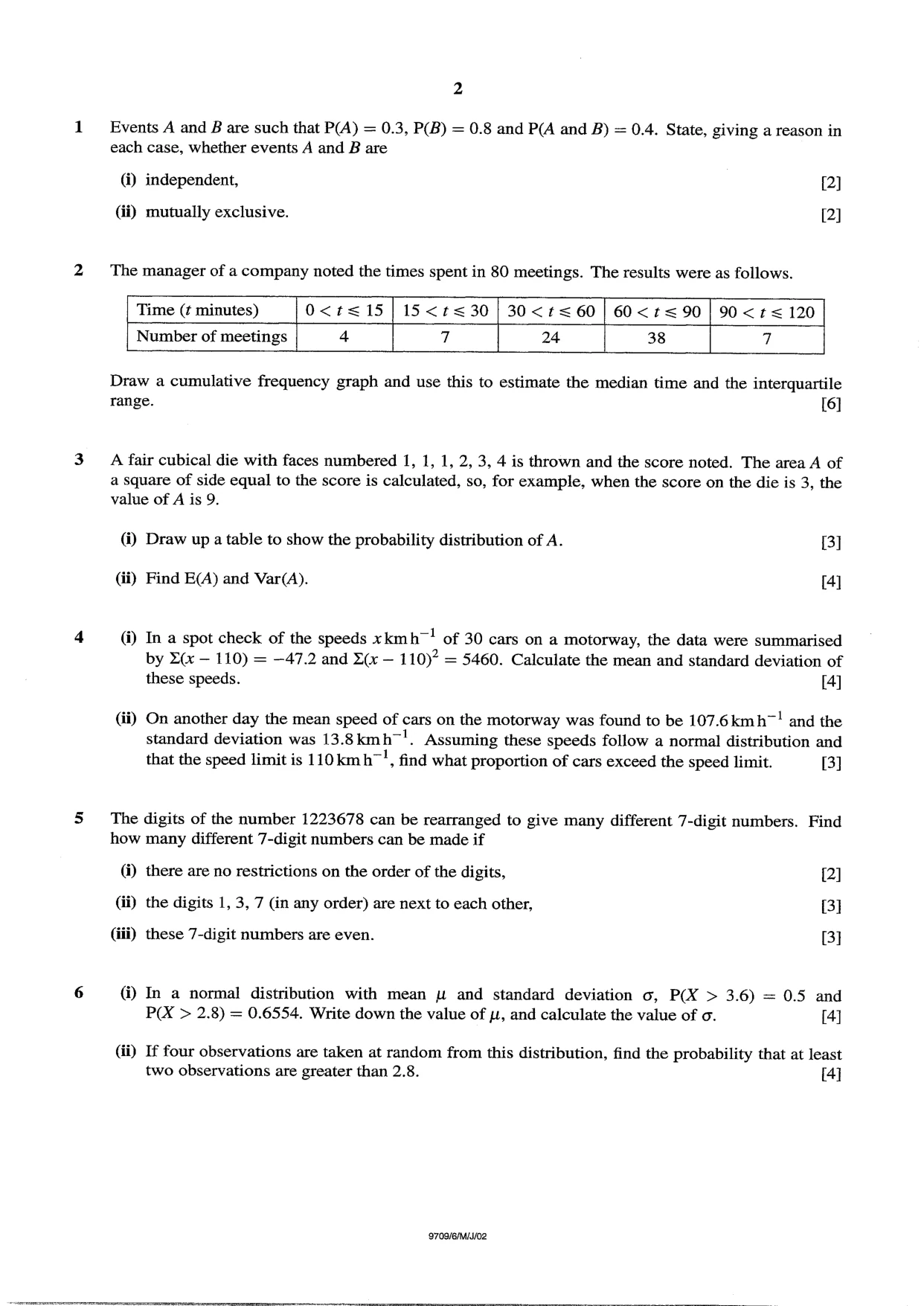
2 Events A and B are such that P(A) = 0.3, P(B) = 0.8 and P(A and B) = 0.4. State, giving a reason in each case, whether events A and B are (i) independent, 2) (ii) mutually exclusive. 2] The manager of a company noted the times spent in 80 meetings. The results were as follows. Time (¢ minutes) 0<t<15 | 15<1<30 | 30<t< 60 | 60<1¢< 90 | 90<r< 120 Number of meetings 4 7 24 38 7 Draw a cumulative frequency graph and use this to estimate the median time and the interquartile range. [6] A fair cubical die with faces numbered 1, 1, 1, 2, 3, 4 is thrown and the score noted. The area A of a square of side equal to the score is calculated, so, for example, when the score on the die is 3, the value of A is 9. @ Draw up a table to show the probability distribution of A. [3] (ii) Find E(A) and Var(A). [4] () In a spot check of the speeds xkmh™! of 30 cars on a motorway, the data were summarised by X(x — 110) = —47.2 and E(x — 110)? = 5460. Calculate the mean and standard deviation of these speeds. [4] (ii) On another day the mean speed of cars on the motorway was found to be 107.6kmh™! and the standard deviation was 13.8kmh7!. Assuming these speeds follow a normal distribution and that the speed limit is 110 km ho}, find what proportion of cars exceed the speed limit. [3] The digits of the number 1223678 can be rearranged to give many different 7-digit numbers. Find how many different 7-digit numbers can be made if (i) there are no restrictions on the order of the digits, [2] (ii) the digits 1, 3, 7 (in any order) are next to each other, [3] (iii) these 7-digit numbers are even. [3] @) In a normal distribution with mean y and standard deviation o, P(X > 3.6) = 0.5 and P(X > 2.8) = 0.6554. Write down the value of j1, and calculate the value of o. [4] (ii) If four observations are taken at random from this distribution, find the probability that at least two observations are greater than 2.8. [4] 9709/6/MiN02
Question paper, page 3
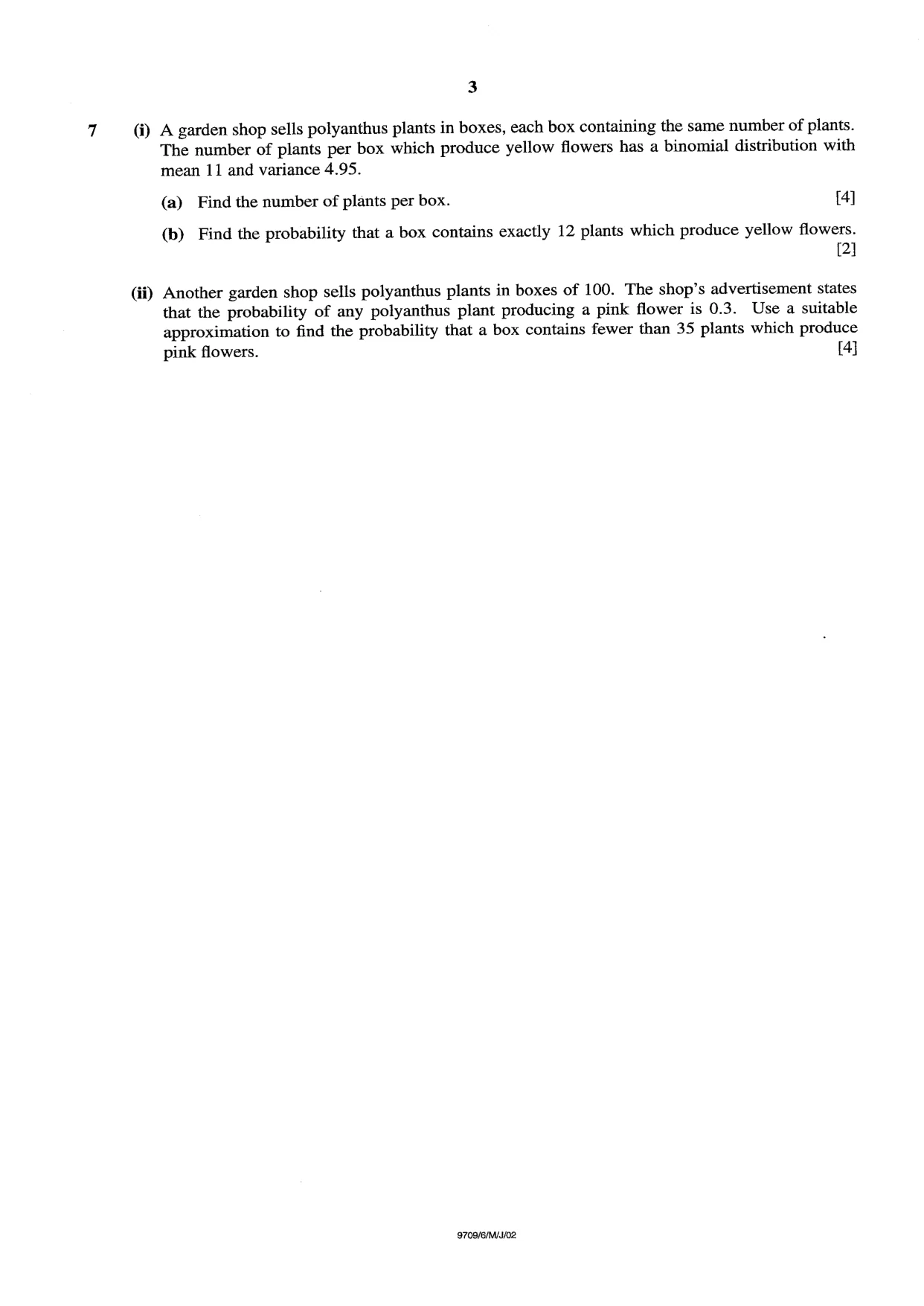
7 @ Gi) 3 A garden shop sells polyanthus plants in boxes, each box containing the same number of plants. The number of plants per box which produce yellow flowers has a binomial distribution with mean 11 and variance 4.95. (a) Find the number of plants per box. {4] (b) Find the probability that a box contains exactly 12 plants which produce yellow flowers. [2] Another garden shop sells polyanthus plants in boxes of 100. The shop’s advertisement states that the probability of any polyanthus plant producing a pink flower is 0.3. Use a suitable approximation to find the probability that a box contains fewer than 35 plants which produce pink flowers. [4] 9709/6/Mis/02
Mark scheme, page 1
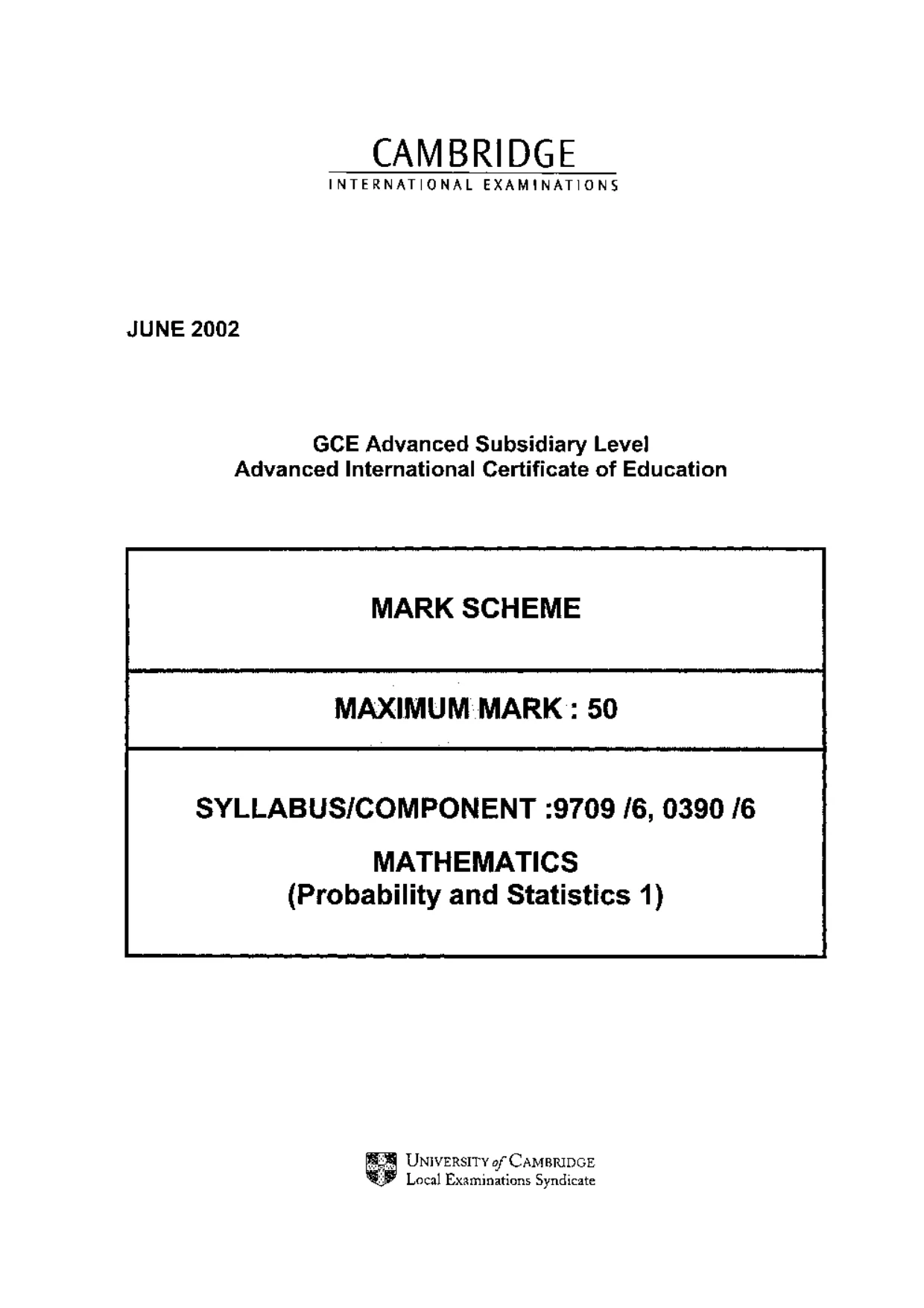
CAMBRIDGE INTERNATIONAL EXAMINATIONS JUNE 2002 GCE Advanced Subsidiary Level Advanced International Certificate of Education MAXIMUM MARK : 50 SYLLABUS/COMPONENT :9709 /6, 0390 /6 MATHEMATICS (Probability and Statistics 1} (28 UNiversity of CAMBRIDGE " [S Local Examinations Syndicate
Mark scheme, page 2
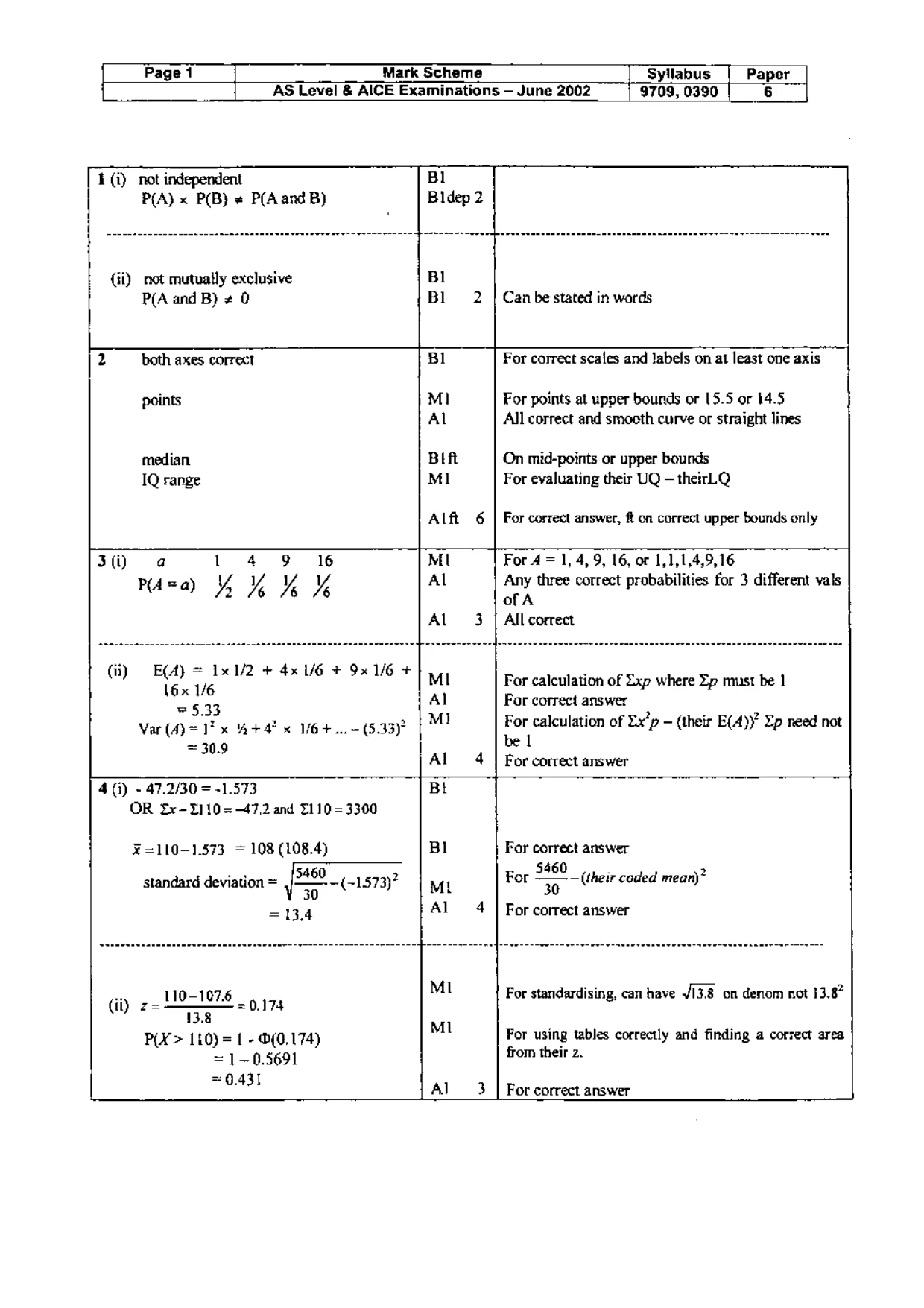
{ Page i I Mark Scheme | AS Level & AICE Examinations — June 2002 Syllabus Paper | |. 9709, 0390 6 | 1 (i) not independent P(A) x P(B} # P(A and B) {ii} not mutuaily exclusive P(A and B) # 0 both axes correct points Can be stated in words For correct scales and labels on at least one axis For points at upper bounds or 15.5 or 14.5 All correct and smooth curve or straight lines On mid-points or upper bounds For evaluating their UQ — theirLQ For correct answer, ft on correct upper bounds only rm) Q > 2 a (ii) E(A) = 1x 1/2 + 4x U6 + 9x 1/6 + 16x 1/6 ye 4At4 x 16 4...- (5.33) = 30.9 For A = 1, 4, 9, 16, or 1,1,1,4,9,16 Any three correct probabilities for 3 different vals of A All correct For calculation of Exp where Zp must be 1 For correct answer For calculation of Ix'p ~ (their E(.4)P <p need not be 1 For correct answer 4 (i) - 47.2/30 = -1.573 OR fx-E]10=-47,2 and £110 = 3300 ¥=110-1.573 = 108 (108.4) BI standard deviation = , 0 (1573)? Mi =134 Al 110-1076 (ii) = So 0.17 PLY> 110) = 1 - (0,174) = 1-0.5691 = 0.431 Al For correct answer For “ —(their coded mean)* For correct answer For standardising, can have V13.8 on denom not 13.8? For using tables correctly and finding a correct area from their 2. For correct answer
Mark scheme, page 3
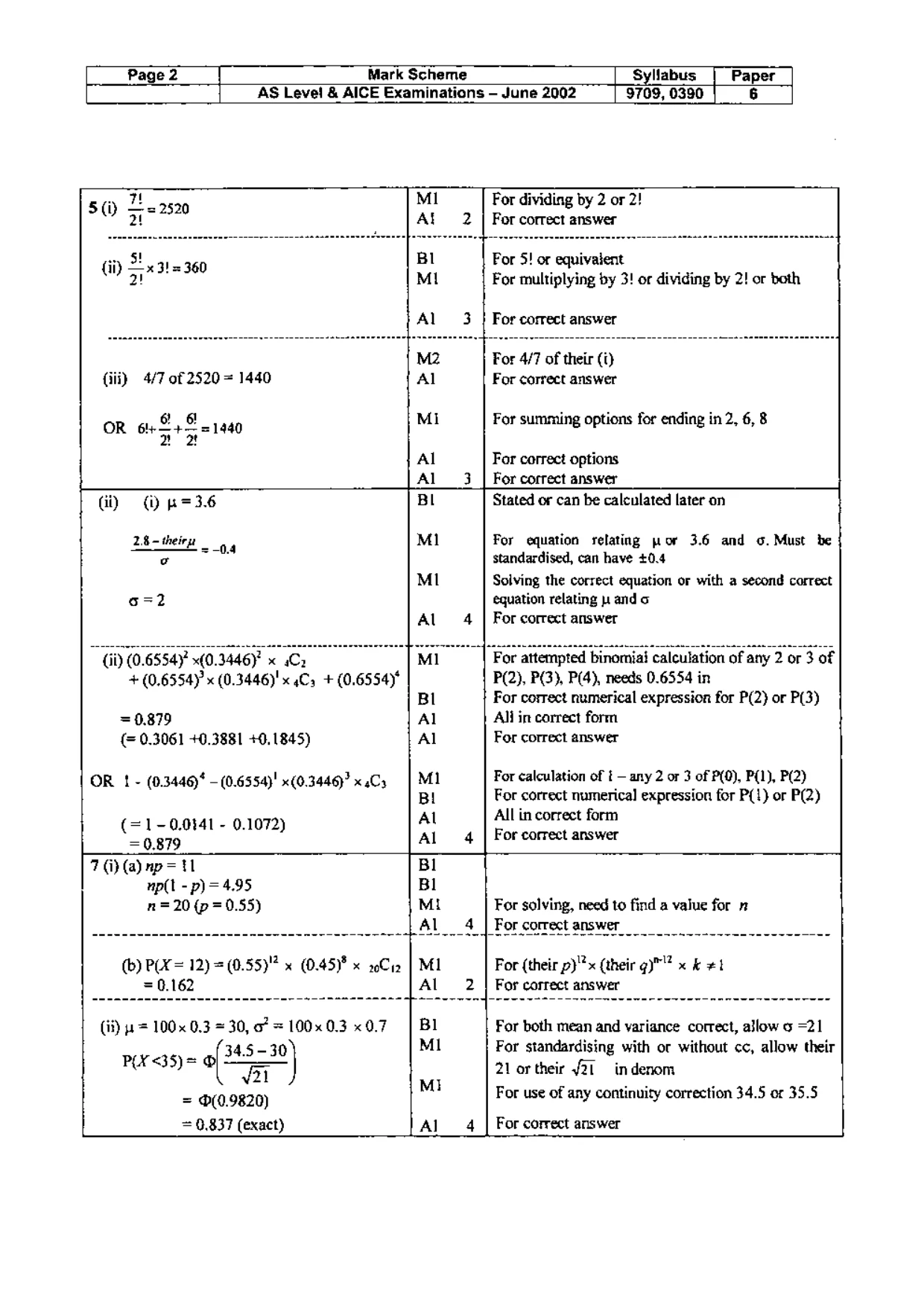
Page 2 Mark Scheme [_ Sylfabus Paper [ AS Level & AICE Examinations — June 2002 [_9709, 0390 6 For dividing by 2 or 2! For correct answer . 7! 5) ay 7 2520 For 5! or equivalent iy Sate i) 3% 3! = 360 For multiplying by 3! or dividing by 2! or both For correct answer For 4/7 of their (i) (iii) 4/7 of 2520 = 1440 For correct answer OR 6 $ + $ =1440 For summing options for ending in 2, 6, 8 For correct options For correct answer Stated or can be calculated later on @) @ n=36 28-theirn For equation relating por 3.6 and o. Must be o of standardised, can have £0.4 Solving the correct equation or with a second correct o=2 equation relating 1 and o For correct answer (ii) (0.6554y' «(0.3446 x sCz For attempted binomiai calculation of any 2 or 3 of + (0.6554) x (0.3446)! x 4C3 + (0.6554)* P(2), P(3}, P(4), needs 0.6554 in For correct numerical expression for P(2} or P(3) Allin correct form For correct answer = 0.879 (= 0.3061 +0.3881 +0.1845) For calculation of t — any 2 or 3 of P(0), P(1), P(2) For correct numerical expression for P(!) or P(2) All in correct form For correct answer OR 1 - (0.3446) — (0.6554)! x(0.3446)° x4C3 (=1- 0.0141 - 0.1072) = 0.879 7 (i) (a) mp=i1 np(t - p)=4.95 n=20{p =0.55) For solving, need to find a value for n For correct answer (b) P(X = 12) = 0.55)" x (0.45)* x 202 = 0.162 For (their p)"*x (their g)”"? x k #1 For correct answer (ii) ps = 100 x 0,3 = 30, o” = 100x 0.3 «0.7 For both mean and variance correct, allow o =21 34.5-30 For standardising with or without cc, allow their PUY <35) = of 4) 21 or their 21 indenom = (0.9820) For use of any continuity correction 34.5 or 35.5 = 0.837 (exact) For correct answer