Cambridge A Level Mathematics 9709 — 2001 Oct/Nov Paper 6 · Variant 1
9709/61/O/N/01
The question paper and its mark scheme, free to read here and free to download. This is Cambridge’s own paper, exactly as it was sat.
Question paper4 pages

Mark scheme4 pages
Answers below. Sit the paper first if you are practising.
Paper as text
Question paper, page 1
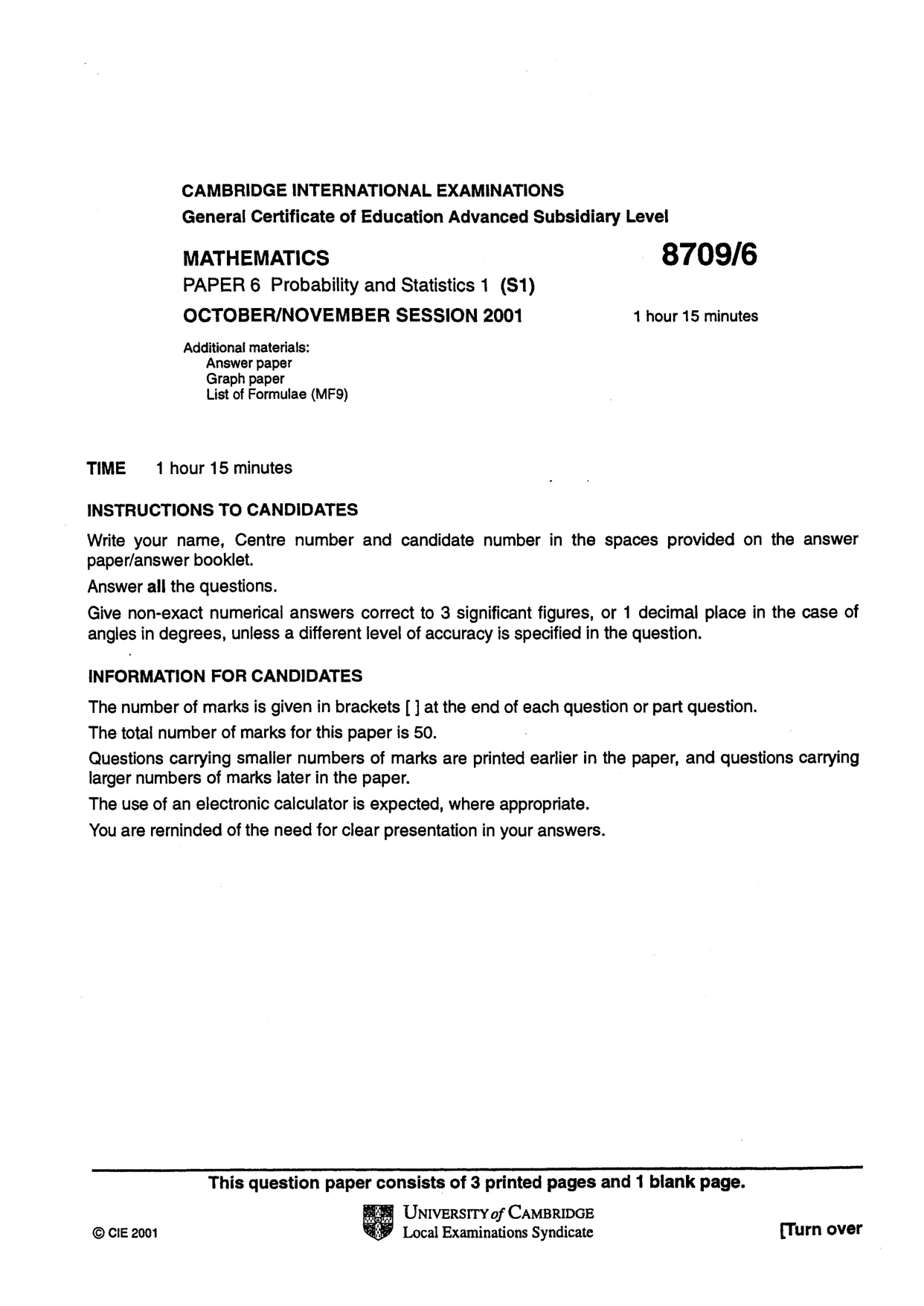
CAMBRIDGE INTERNATIONAL EXAMINATIONS General Certificate of Education Advanced Subsidiary Level MATHEMATICS 8709/6 PAPER 6 Probability and Statistics 1 (S1) OCTOBER/NOVEMBER SESSION 2001 1 hour 15 minutes Additional materials: Answer paper Graph paper List of Formulae (MF9) TIME 1 hour 15 minutes INSTRUCTIONS TO CANDIDATES Write your name, Centre number and candidate number in the spaces provided on the answer paper/answer booklet. Answer all the questions. Give non-exact numerical answers correct to 3 significant figures, or 1 decimal place in the case of angles in degrees, unless a different level of accuracy is specified in the question. INFORMATION FOR CANDIDATES The number of marks is given in brackets [ ] at the end of each question or part question. The total number of marks for this paper is 50. Questions carrying smaller numbers of marks are printed earlier in the paper, and questions carrying larger numbers of marks later in the paper. The use of an electronic calculator is expected, where appropriate. You are rerninded of the need for clear presentation in your answers. This question paper consists of 3 printed pages and 1 blank page. UNIVERSITY of CAMBRIDGE Local Examinations Syndicate {Turn over © CIE 2001
Question paper, page 2
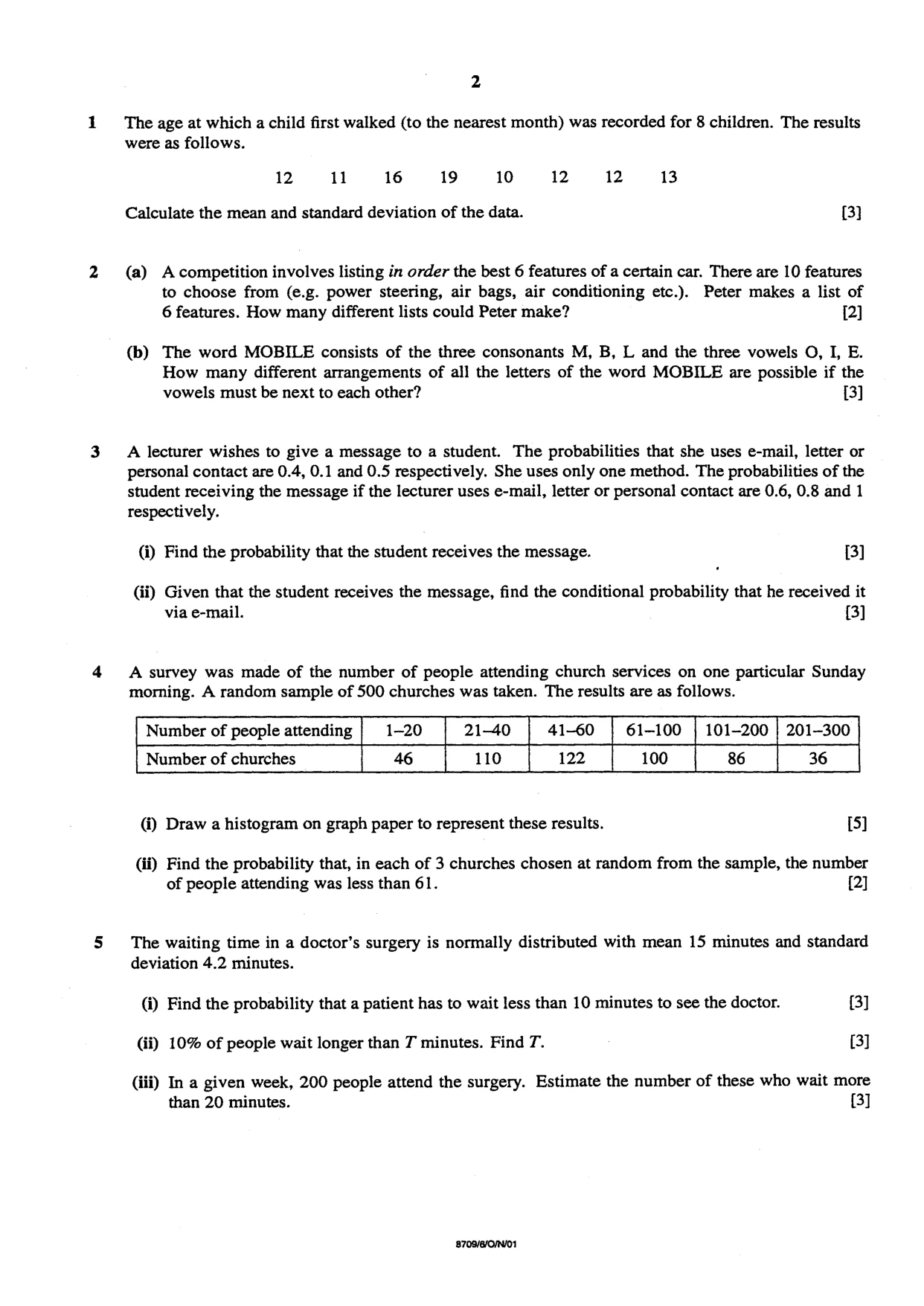
2 1 The age at which a child first walked (to the nearest month) was recorded for 8 children. The results were as follows. 12 11 16 19 10 12 12 13 Calculate the mean and standard deviation of the data. (3) 2 (a) Acompetition involves listing in order the best 6 features of a certain car. There are 10 features to choose from (e.g. power steering, air bags, air conditioning etc.). Peter makes a list of 6 features. How many different lists could Peter make? [2] (b) The word MOBILE consists of the three consonants M, B, L and the three vowels O, I, E. How many different arrangements of all the letters of the word MOBILE are possible if the vowels must be next to each other? [3] 3 +A lecturer wishes to give a message to a student. The probabilities that she uses e-mail, letter or personal contact are 0.4, 0.1 and 0.5 respectively. She uses only one method. The probabilities of the student receiving the message if the lecturer uses e-mail, letter or personal contact are 0.6, 0.8 and 1 respectively. (i) Find the probability that the student receives the message. [3] (ii) Given that the student receives the message, find the conditional probability that he received it via e-mail. (3] 4 A survey was made of the number of people attending church services on one particular Sunday morning. A random sample of 500 churches was taken. The results are as follows. Number of people attending 1-20 | 21-40 41-60 61-100 | 101-200 201-300 | | Number of churches 46 | 110 122 100 86 36 (@ Draw a histogram on graph paper to represent these results. [5] (ii) Find the probability that, in each of 3 churches chosen at random from the sample, the number of people attending was less than 61. {2] 5 The waiting time in a doctor’s surgery is normally distributed with mean 15 minutes and standard deviation 4.2 minutes. (i) Find the probability that a patient has to wait less than 10 minutes to see the doctor. (3] (ii) 10% of people wait longer than T minutes. Find T. (3] (iii) In a given week, 200 people attend the surgery. Estimate the number of these who wait more than 20 minutes. {3] 8709/6/0RW01
Question paper, page 3
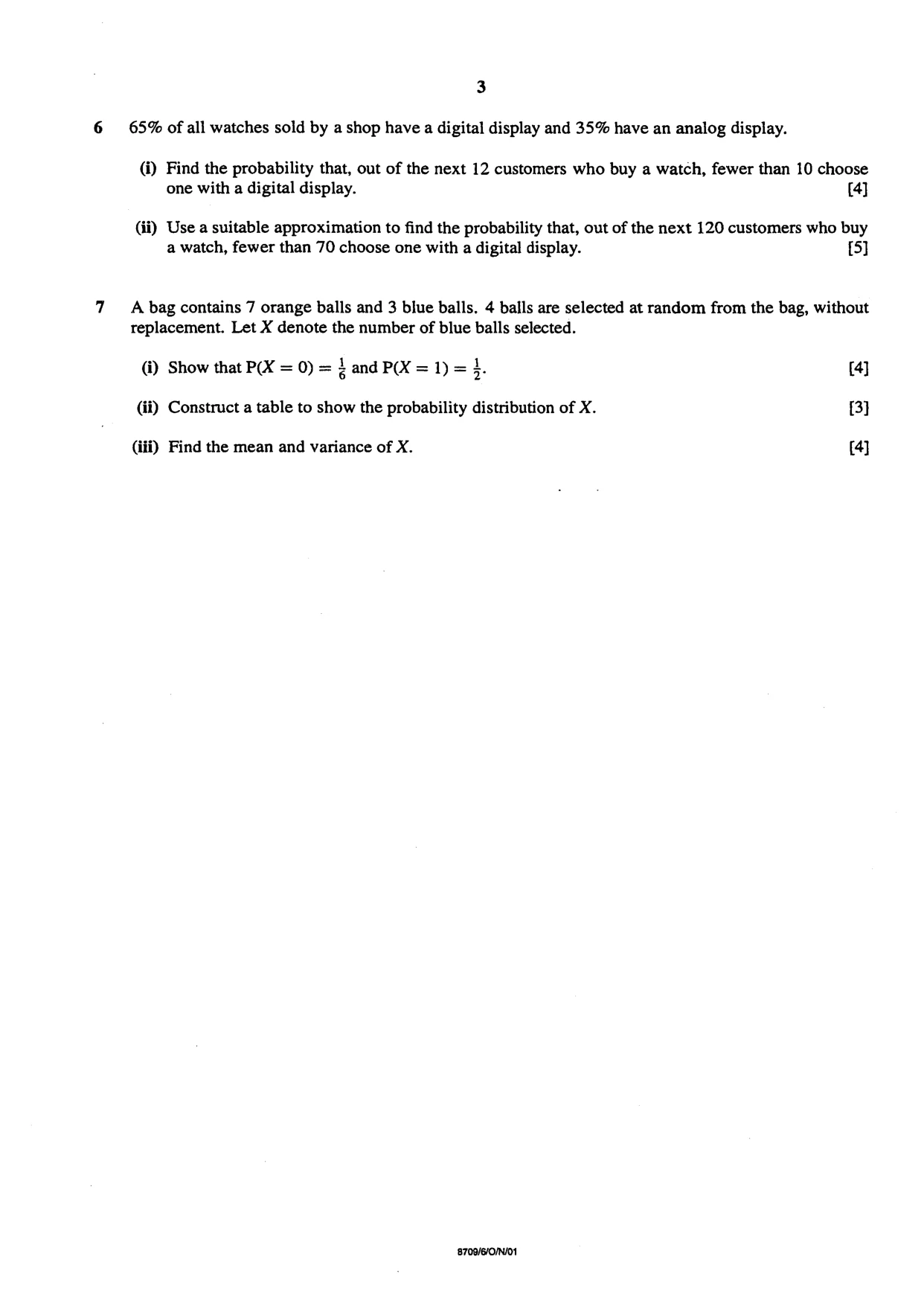
3 65% of all watches sold by a shop have a digital display and 35% have an analog display. (i) Find the probability that, out of the next 12 customers who buy a watch, fewer than 10 choose one with a digital display. [4] (ii) Use a suitable approximation to find the probability that, out of the next 120 customers who buy a watch, fewer than 70 choose one with a digital display. {5] A bag contains 7 orange balls and 3 blue balls. 4 balls are selected at random from the bag, without replacement. Let X denote the number of blue balls selected. (i) Show that P(X = 0) = Fa and P(X = 1) = 4. [4] (ii) Construct a table to show the probability distribution of X. {3} (iii) Find the mean and variance of X. [4] 8709/6/07W01
Mark scheme, page 1
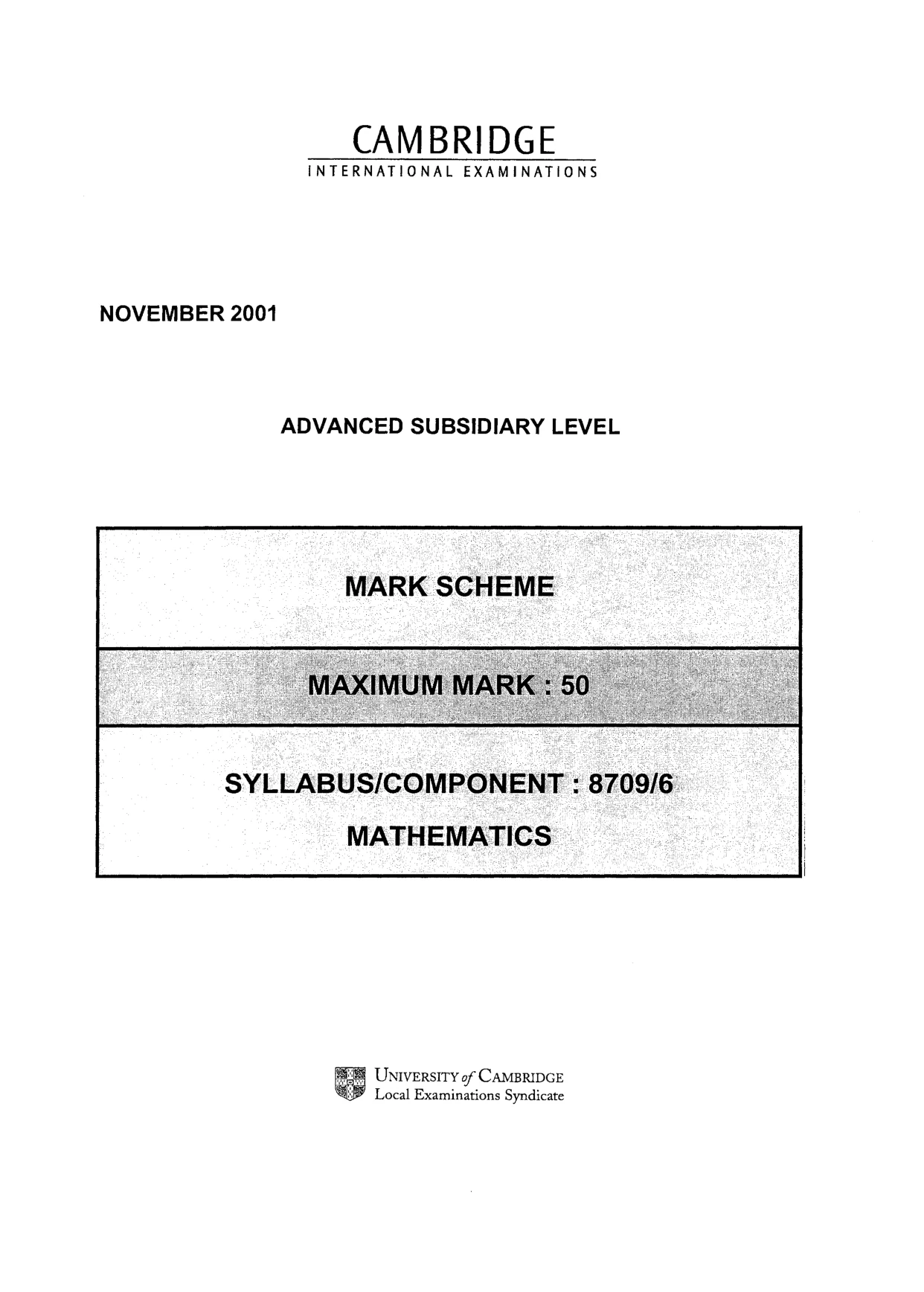
CAMBRIDGE INTERNATIONAL EXAMINATIONS NOVEMBER 2001 ADVANCED SUBSIDIARY LEVEL MARK SCHEME SYLLABUS/COMPONENT : 8709/6 MATHEMATICS P58] University of CAMBRIDGE 8) Local Examinations Syndicate
Mark scheme, page 2
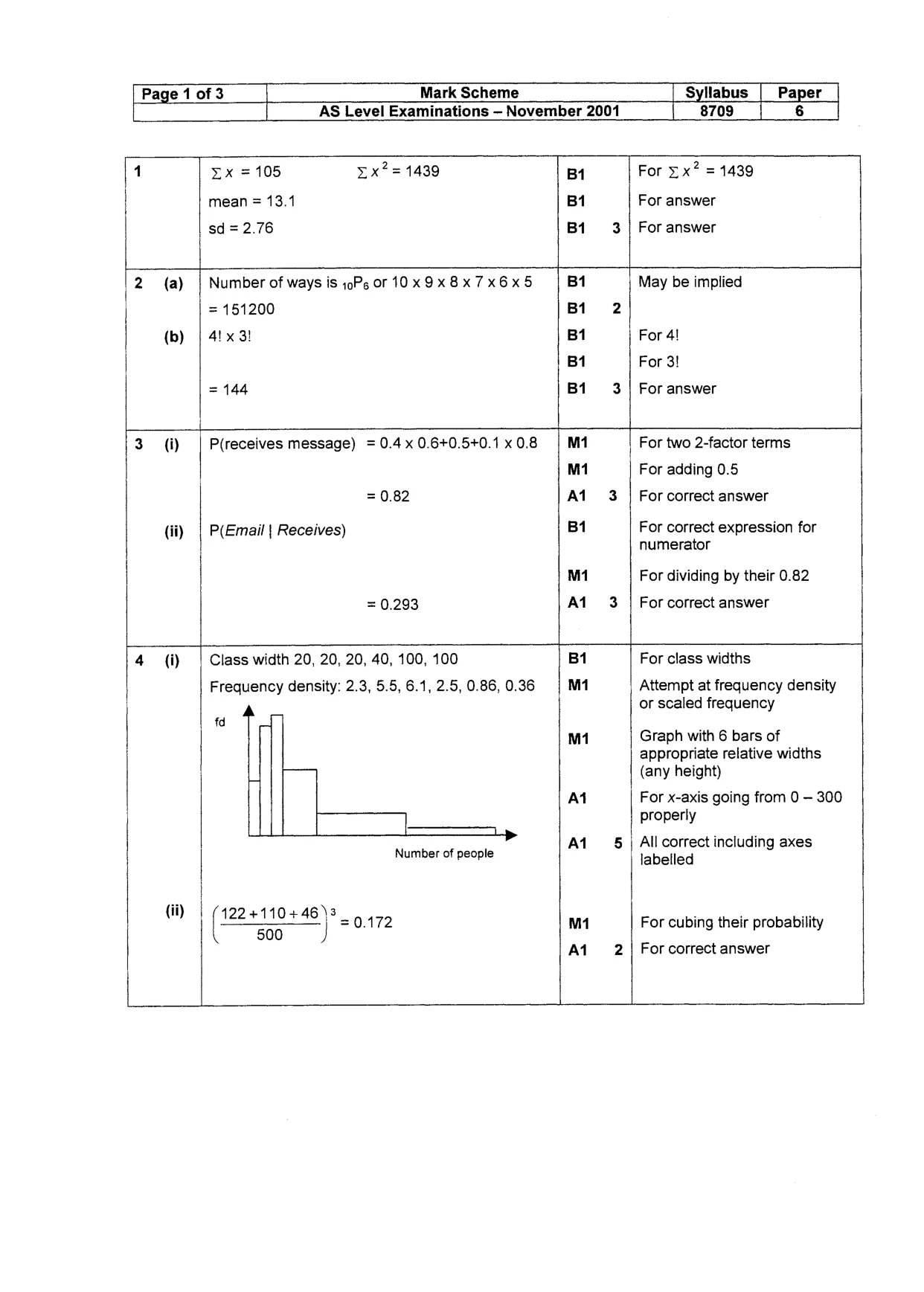
Page 1 of 3 Mark Scheme Syllabus AS Level Examinations — November 2001 Paper 8709 6 Al Ex = 105 Dx? = 1439 B1 For 5x? = 1439 mean = 13.1 B1 For answer sd = 2.76 B1 For answer 2 (a) | Number of ways is ;oP. or 10x 9x8x7x6x5 B1 May be implied = 151200 B1 (b) | 4!x 3! B1 For 4! B1 For 3! = 144 B1 For answer 3 (i) P(receives message) = 0.4 x 0.6+0.5+0.1 x 0.8 M1 For two 2-factor terms M1 For adding 0.5 = 0.82 Al For correct answer (ii) | P(Email | Receives) B1 For correct expression for numerator M1 For dividing by their 0.82 = 0.293 Al For correct answer 4 (i) Class width 20, 20, 20, 40, 100, 100 B1 For class widths Frequency density: 2.3, 5.5, 6.1, 2.5, 0.86, 0.36 M1 Attempt at frequency density A or scaled frequency fd M1 Graph with 6 bars of appropriate relative widths (any height) Al For x-axis going from 0 — 300 properly —————p» , . Al All correct including axes Number of people labelled ii 3 (i) (Beer = 0.172 M1 For cubing their probability For correct answer
Mark scheme, page 3
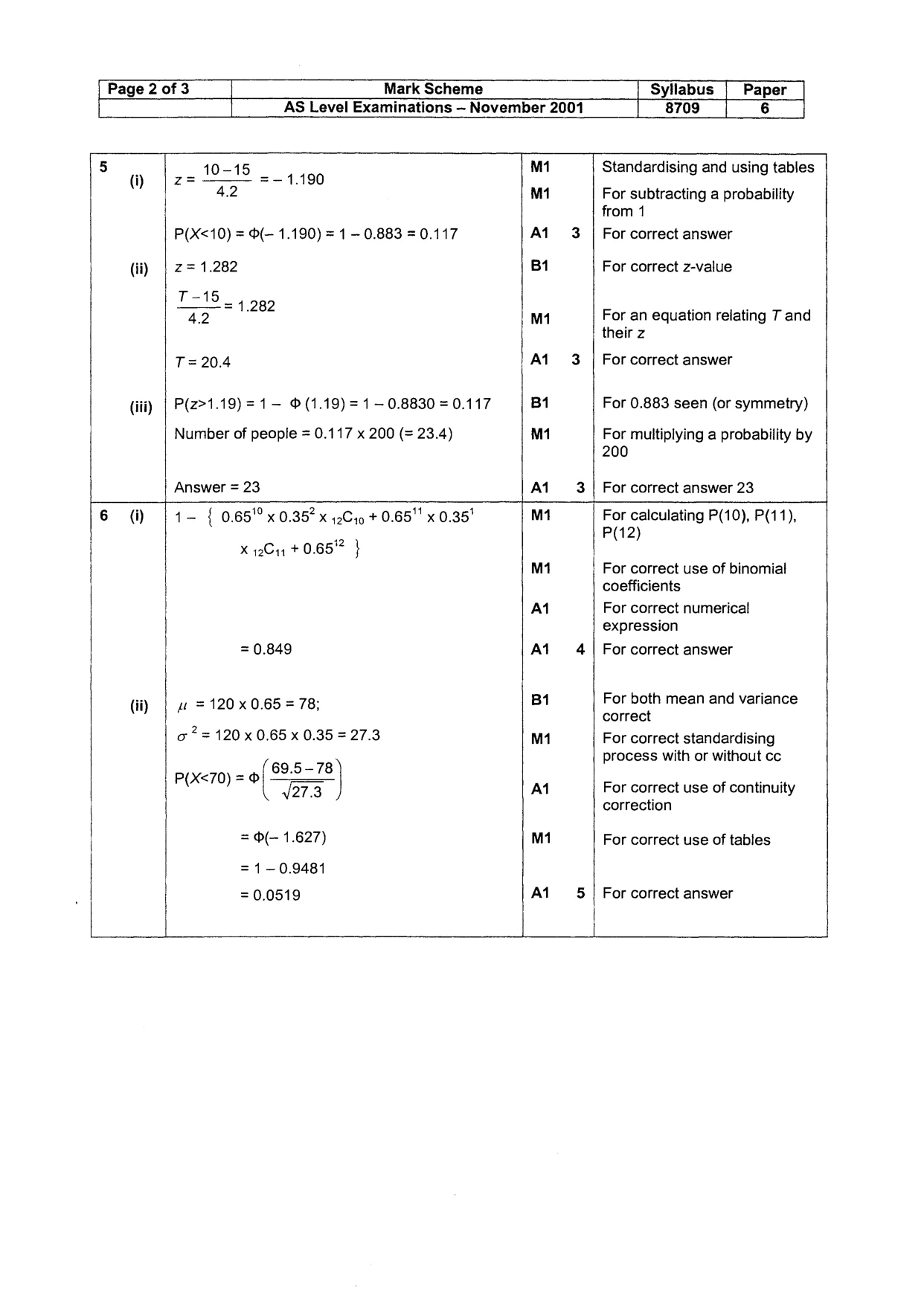
Page 2 of 3 Mark Scheme Syllabus | Paper AS Level Examinations — November 2001 8709 6 5 10-15 M1 Standardising and using tables (i) | z= =- 1.190 - M1 For subtracting a probability from 1 P(X<10) = O(— 1.190) = 1 — 0.883 = 0.117 At For correct answer (ii) | 2= 1.282 B1 For correct z-value T-15_ 42 1.262 M1 For an equation relating T and their z T=20.4 At For correct answer (iii) | P(z>1.19) = 1— (1.19) = 1 - 0.8830 = 0.117 B1 For 0.883 seen (or symmetry) Number of people = 0.117 x 200 (= 23.4) M1 For multiplying a probability by 200 Answer = 23 A1 For correct answer 23 6 (i) | 1 - { 0.65" x 0.35? x y2Cy9 + 0.65" x 0.35" M1 For calculating P(10), P(11), P(12) X 12C11 + 0.65" } M1 For correct use of binomial coefficients Al For correct numerical expression = 0.849 Al For correct answer (ii) | « = 120 x 0.65 = 78; B1 For both mean and variance , correct o* = 120 x 0.65 x 0.35 = 27.3 M1 For correct standardising process with or without cc P(xe70) = | 825-78 Al For correct use of continuity correction = 0(— 1.627) M1 For correct use of tables =1-0.9481 = 0.0519 Al For correct answer
Mark scheme, page 4
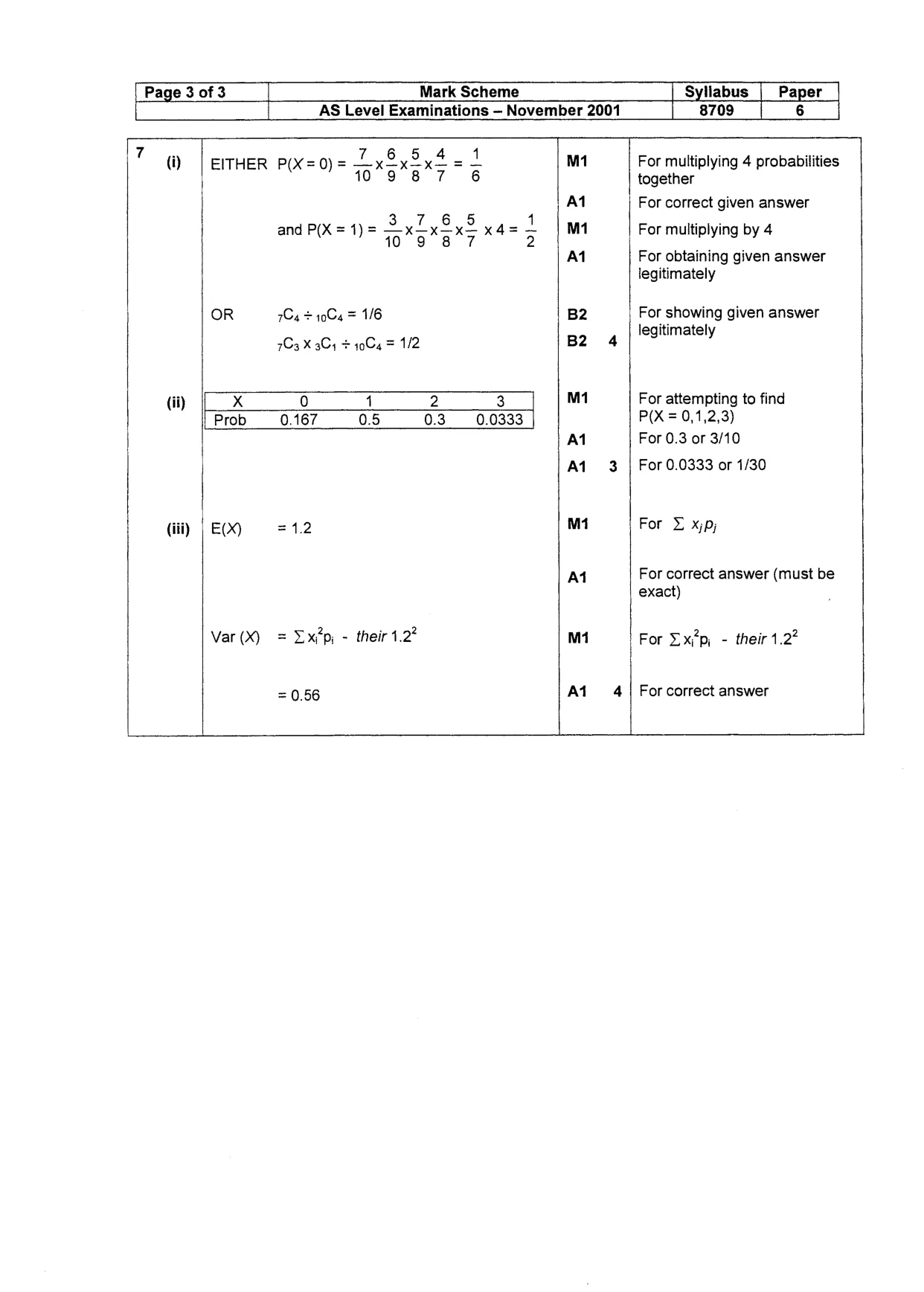
Syllabus Paper 6 8709 M1 A1 M1 Al B2 B2 M1 Al Al M1 At M1 Ai Page 3 of 3 Mark Scheme AS Level Examinations - November 2001 (i) | EITHER P(X = 0) = ty 85,4 et 10 98 7 6 and P(X = 1) = 3y7, 8,5 x4= 1 10 9 8 7 2 OR 7C4 = 10Ca = 1/6 7C3 X 3Cy + 10Cy = 1/2 (ii) x 0 1 2 3 Prob 0.167, 0.5 0.3 0.0333 (iii) |E(X) = 1.2 Var (X) = Exp; - their 1.2? = 0.56 For multiplying 4 probabilities together For correct given answer For multiplying by 4 For obtaining given answer legitimately For showing given answer legitimately For attempting to find P(X = 0,1,2,3) For 0.3 or 3/10 For 0.0333 or 1/30 For & xjp; For correct answer (must be exact) For ©x;’p, - their 1.2? For correct answer