Cambridge A Level Mathematics 9709 — 2001 Oct/Nov Paper 4 · Variant 1
9709/41/O/N/01
The question paper and its mark scheme, free to read here and free to download. This is Cambridge’s own paper, exactly as it was sat.
Question paper4 pages
Mark scheme4 pages
Answers below. Sit the paper first if you are practising.
Paper as text
Question paper, page 1
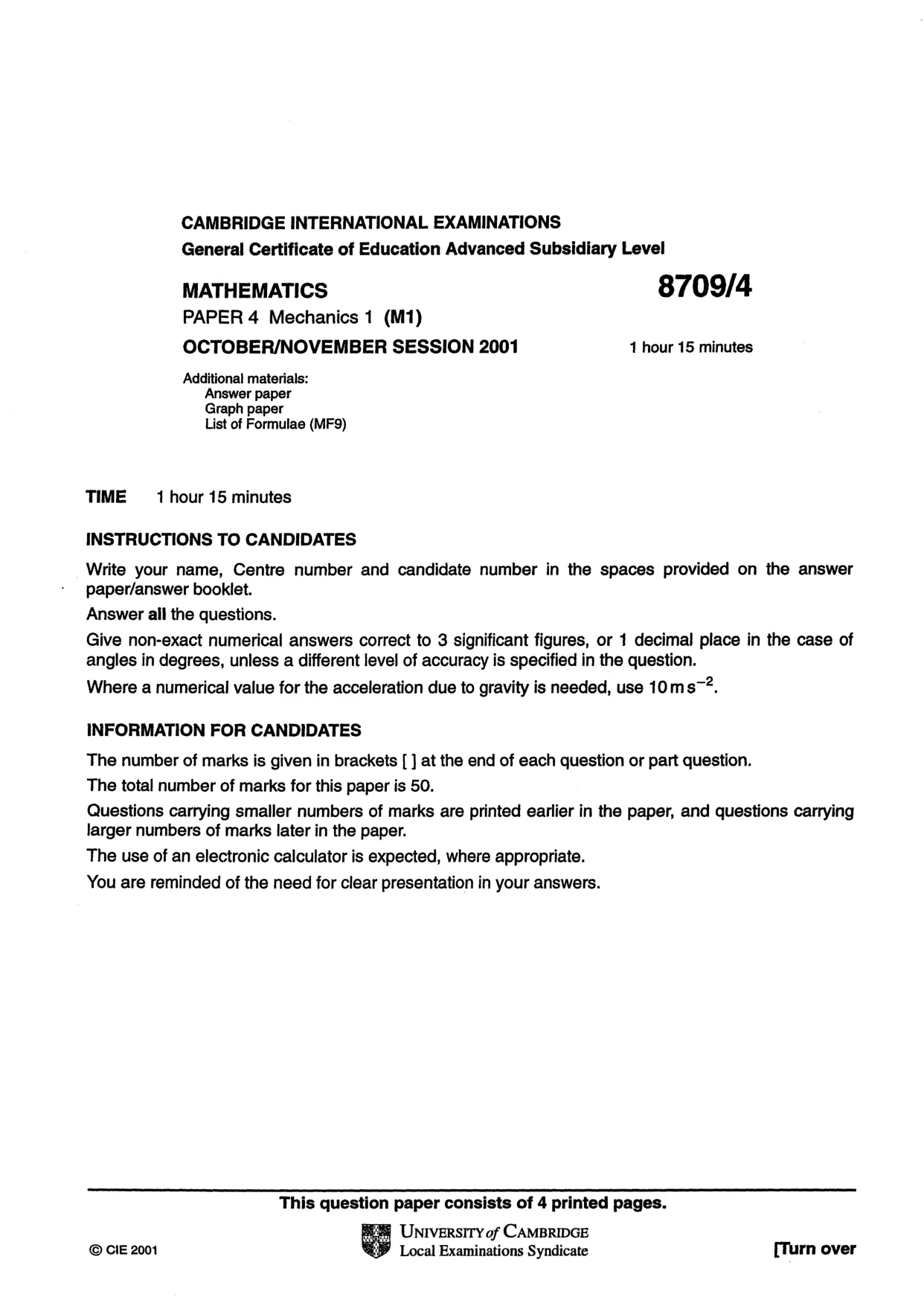
CAMBRIDGE INTERNATIONAL EXAMINATIONS General Certificate of Education Advanced Subsidiary Level MATHEMATICS 8709/4 PAPER 4 Mechanics 1 (M1) OCTOBER/NOVEMBER SESSION 2001 1 hour 15 minutes Additional materials: Answer paper Graph paper List of Formulae (MF9) TIME —=1 hour 15 minutes INSTRUCTIONS TO CANDIDATES Write your name, Centre number and candidate number in the spaces provided on the answer Ppaper/answer booklet. Answer all the questions. Give non-exact numerical answers correct to 3 significant figures, or 1 decimal place in the case of angles in degrees, unless a different level of accuracy is specified in the question. Where a numerical value for the acceleration due to gravity is needed, use 10ms~*. INFORMATION FOR CANDIDATES The number of marks is given in brackets [ ] at the end of each question or part question. The total number of marks for this paper is 50. Questions carrying smaller numbers of marks are printed earlier in the paper, and questions carrying larger numbers of marks later in the paper. The use of an electronic calculator is expected, where appropriate. You are reminded of the need for clear presentation in your answers. This question paper consists of 4 printed pages. Untversiry of CAMBRIDGE © CIE 2001 Local Examinations Syndicate [Turn over
Question paper, page 2
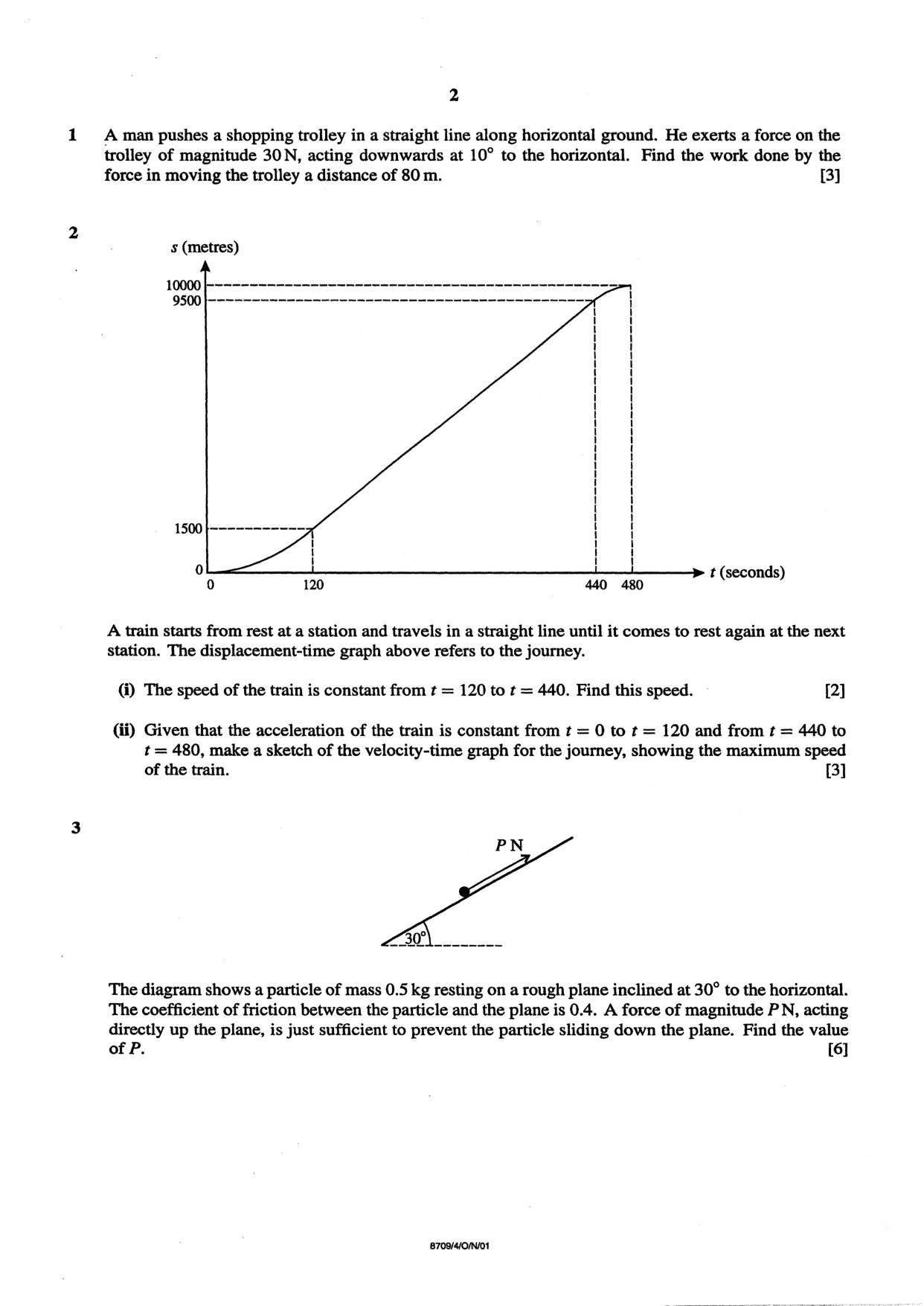
1 2 A man pushes a shopping trolley in a straight line along horizontal ground. He exerts a force on the trolley of magnitude 30N, acting downwards at 10° to the horizontal. Find the work done by the force in moving the trolley a distance of 80 m. [3] t (seconds) A train starts from rest at a station and travels in a straight line until it comes to rest again at the next station. The displacement-time graph above refers to the journey. (i) The speed of the train is constant from t = 120 to t = 440. Find this speed. [2] (ii) Given that the acceleration of the train is constant from t = 0 to t = 120 and from t = 440 to t = 480, make a sketch of the velocity-time graph for the journey, showing the maximum speed of the train. 3] LN \_ The diagram shows a particle of mass 0.5 kg resting on a rough plane inclined at 30° to the horizontal. The coefficient of friction between the particle and the plane is 0.4. A force of magnitude PN, acting directly up the plane, is just sufficient to prevent the particle sliding down the plane. Find the value of P. [6] 8709/4/0/N/01
Question paper, page 3
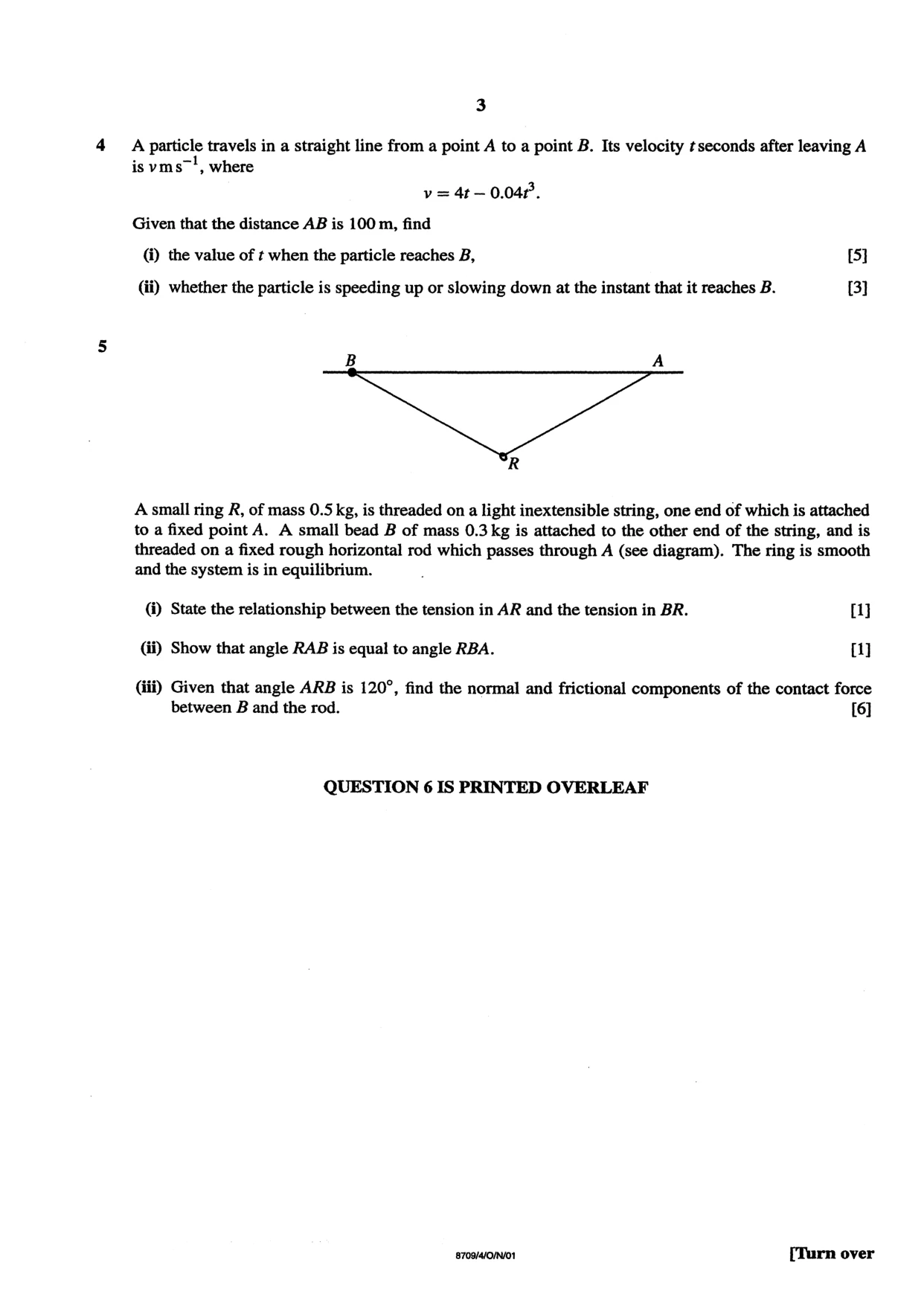
3 4 A particle travels in a straight line from a point A to a point B. Its velocity tseconds after leaving A isvm s7, where v= 4t— 0.047. Given that the distance AB is 100 m, find @ the value of ¢ when the particle reaches B, [5] (ii) whether the particle is speeding up or slowing down at the instant that it reaches B. (3] 5 B A R A small ring R, of mass 0.5 kg, is threaded on a light inextensible string, one end of which is attached to a fixed point A. A small bead B of mass 0.3 kg is attached to the other end of the string, and is threaded on a fixed rough horizontal rod which passes through A (see diagram). The ring is smooth and the system is in equilibrium. (i) State the relationship between the tension in AR and the tension in BR. (1) (ii) Show that angle RAB is equal to angle RBA. [1] (iii) Given that angle ARB is 120°, find the normal and frictional components of the contact force between B and the rod. [6] QUESTION 6 IS PRINTED OVERLEAF 8709/4/0/N/01 [Turn over
Question paper, page 4
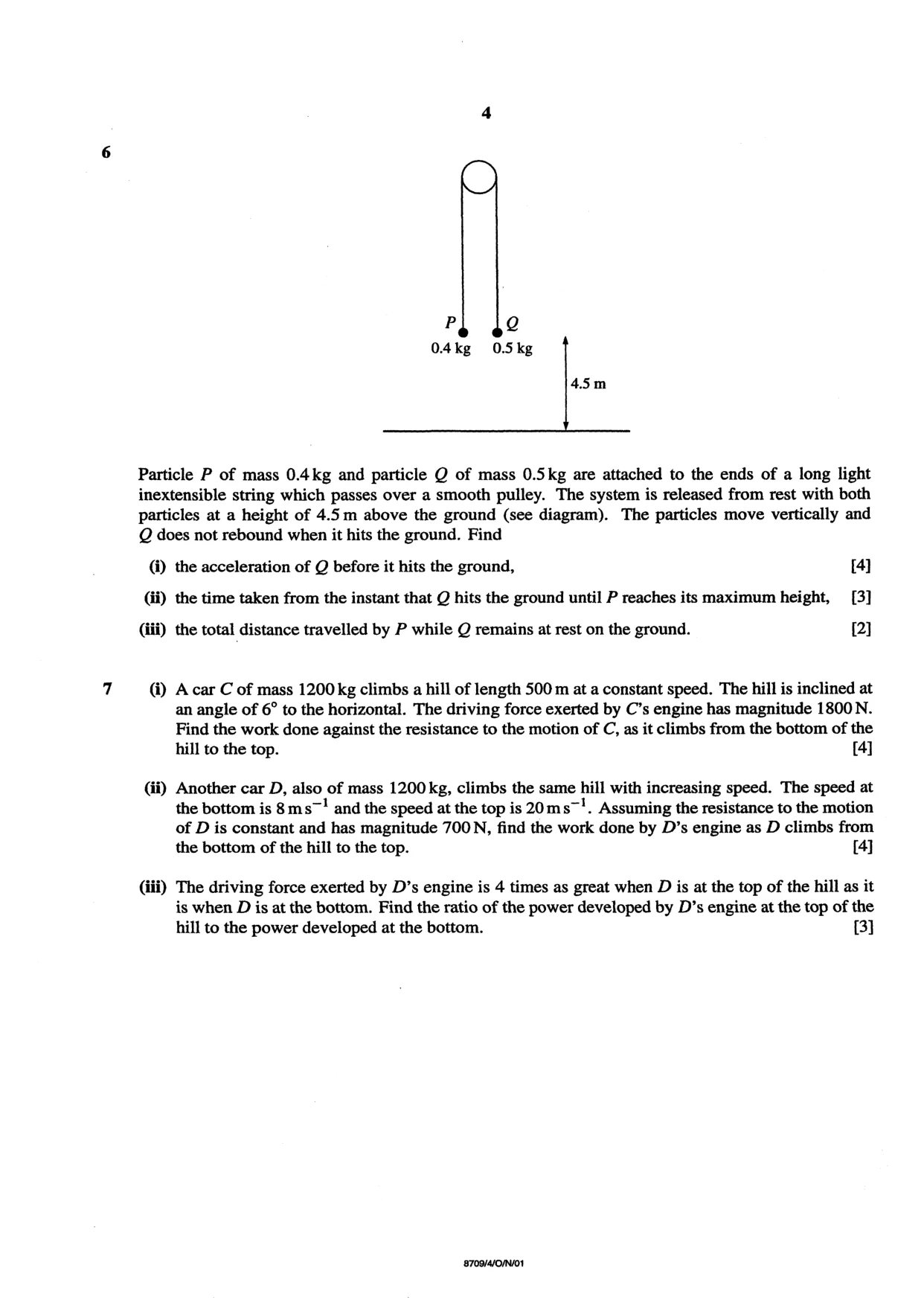
P Q O4kg O5kg 45m Particle P of mass 0.4kg and particle Q of mass 0.5kg are attached to the ends of a long light inextensible string which passes over a smooth pulley. The system is released from rest with both particles at a height of 4.5m above the ground (see diagram). The particles move vertically and Q does not rebound when it hits the ground. Find (i) the acceleration of Q before it hits the ground, [4] (ii) the time taken from the instant that Q hits the ground until P reaches its maximum height, [3] (iii) the total distance travelled by P while Q remains at rest on the ground. [2] @ Acar C of mass 1200 kg climbs a hill of length 500 m at a constant speed. The hill is inclined at an angle of 6° to the horizontal. The driving force exerted by C’s engine has magnitude 1800 N. Find the work done against the resistance to the motion of C, as it climbs from the bottom of the hill to the top. [4] (ii) Another car D, also of mass 1200kg, climbs the same hill with increasing speed. The speed at the bottom is 8ms~! and the speed at the top is 20ms~!. Assuming the resistance to the motion of D is constant and has magnitude 700N, find the work done by D’s engine as D climbs from the bottom of the hill to the top. [4] (iii) The driving force exerted by D’s engine is 4 times as great when D is at the top of the hill as it is when D is at the bottom. Find the ratio of the power developed by D’s engine at the top of the hill to the power developed at the bottom. [3] 8709/4/0/N/01
Mark scheme, page 1
CAMBRIDGE INTERNATIONAL EXAMINATIONS NOVEMBER 2001 ADVANCED SUBSIDIARY LEVEL MARK SCHEME — SYLLABUS/COMPONENT : 8709/4 MATHEMATICS (833 University of CAMBRIDGE 9% Local Examinations Syndicate
Mark scheme, page 2
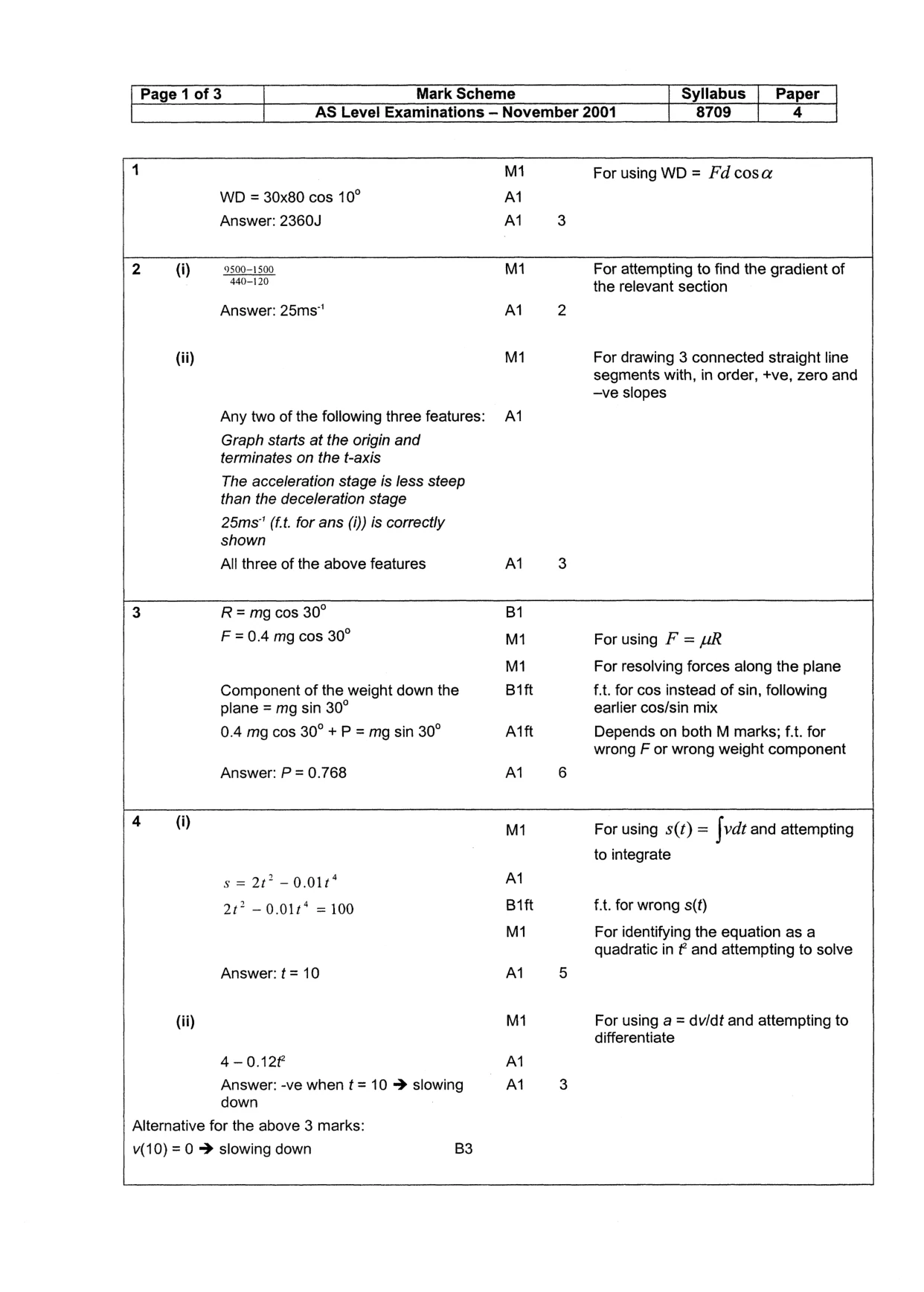
Page 1 of 3 Mark Scheme Syllabus | Paper AS Level Examinations — November 2001 8709 4 1 M1 For using WD = Fd cosa WD = 30x80 cos 10° At Answer: 2360J Al 2 (i) 9500-1500 M1 For attempting to find the gradient of 440-120 the relevant section Answer: 25ms" Al (ii) M1 For drawing 3 connected straight line segments with, in order, +ve, zero and -ve slopes Any two of the following three features: A1 Graph starts at the origin and terminates on the t-axis The acceleration stage is less steep than the deceleration stage 25ms" (f.t. for ans (i)) is correctly shown All three of the above features Al 3 R= mg cos 30° B1 F =0.4 mg cos 30° M1 For using F = uR M1 For resolving forces along the plane Component of the weight down the Bift f.t. for cos instead of sin, following plane = mg sin 30° earlier cos/sin mix 0.4 mg cos 30° + P = mg sin 30° Atft Depends on both M marks; f.t. for wrong F or wrong weight component Answer: P = 0.768 Al 4 i) M1 For using s(t) = foae and attempting to integrate s = 207 -0.0104 Al 2t? -0.014* =100 Bift f.t. for wrong s(t) M1 For identifying the equation as a quadratic in f and attempting to solve Answer: t= 10 Al (ii) M1 For using a = dv/dt and attempting to differentiate 4-0.12F Al Answer: -ve when t = 10 ® slowing Al down Alternative for the above 3 marks: v(10) = 0 > slowing down B3
Mark scheme, page 3
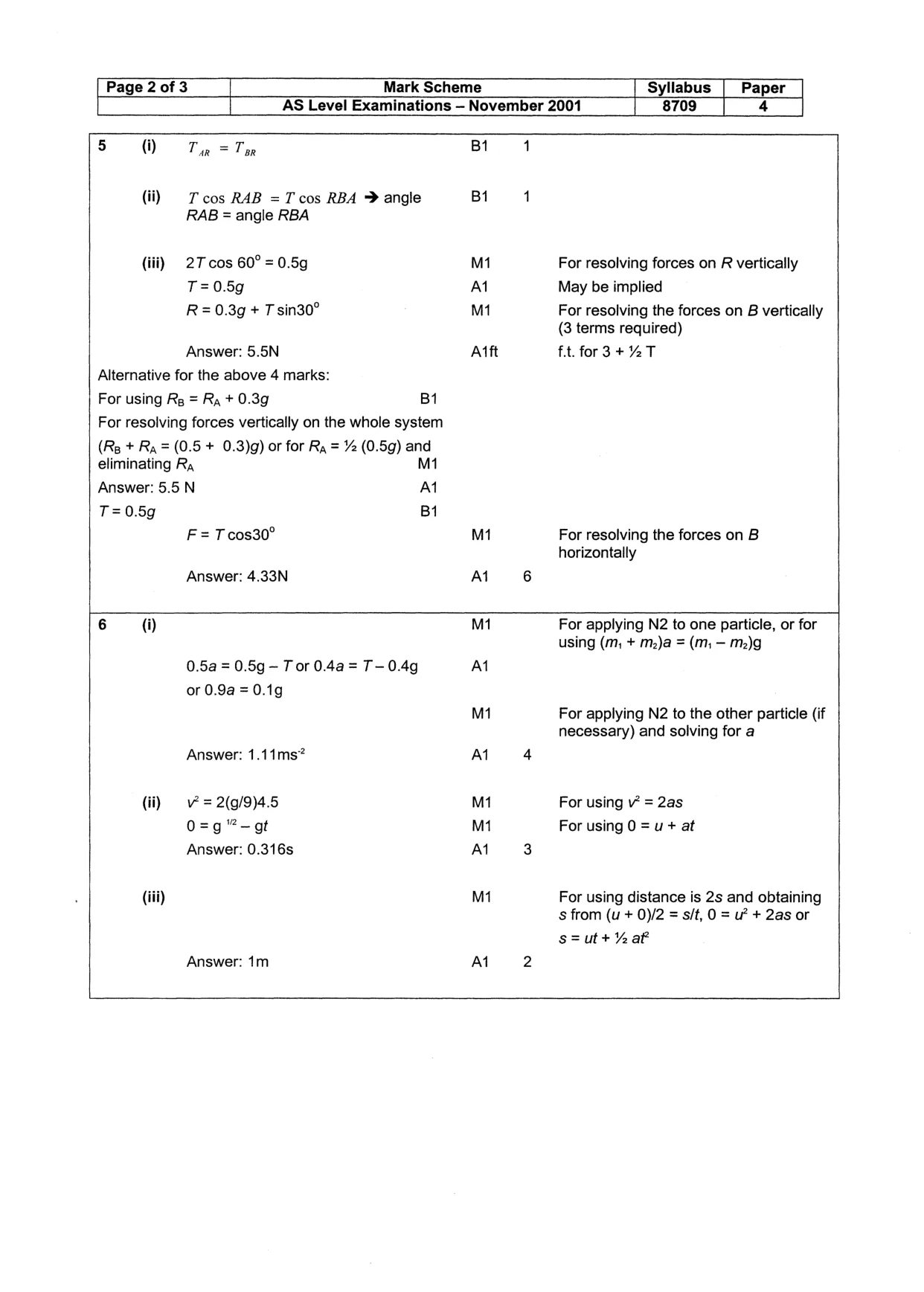
Page 2 of 3 Mark Scheme Syllabus | Paper AS Level Examinations — November 2001 8709 4 5 (i) Ta = Top B1 (ii) cos RAB =T cos RBA > angle B1 RAB = angle RBA (iii) 27 cos 60° = 0.5g M1 For resolving forces on R vertically T=0.59 Al May be implied R=0.3g + Tsin30° M1 For resolving the forces on B vertically (3 terms required) Answer: 5.5N Alft ft. for 3+ %T Alternative for the above 4 marks: For using Rg = Ra + 0.39 B1 For resolving forces vertically on the whole system (Re + Ra = (0.5 + 0.3)g) or for Ra = % (0.5g) and eliminating Ra M1 Answer: 5.5 N Al T=0.59 BI F = Tco0s30° M1 For resolving the forces on B horizontally Answer: 4.33N Al 6 (i) M1 For applying N2 to one particle, or for using (m, + m,)a = (m; — m2)g 0.5a = 0.5g — Tor 0.4a = T-0.4g Al or 0.9a = 0.19 M1 For applying N2 to the other particle (if necessary) and solving for a Answer: 1.11ms? Al (ii) =v =2(g/9)4.5 M1 For using Vv = 2as 0=g"-gt M1 For using 0 = u + at Answer: 0.316s Al (iii) M1 For using distance is 2s and obtaining s from (u + 0)/2 = s/t, 0 = u’ + 2as or s=ut+ %at Answer: 1m Al
Mark scheme, page 4
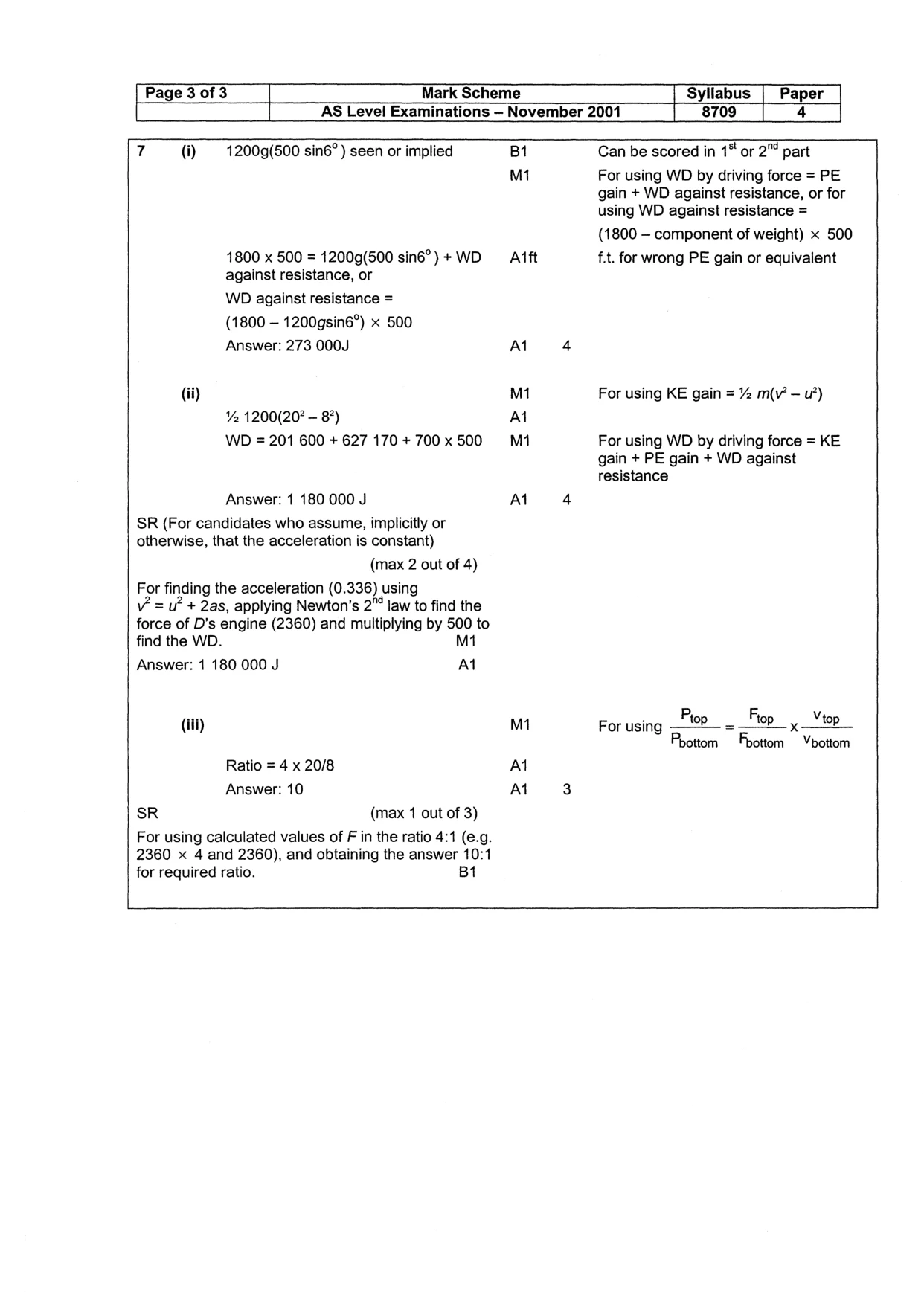
Page 3 of 3 Mark Scheme Syllabus | Paper AS Level Examinations — November 2001 8709 4 7 (i) 1200g(500 sin6° ) seen or implied B1 Can be scored in 1* or 2" part M1 1800 x 500 = 1200g(500 sin6°) + WD Alft against resistance, or WD against resistance = (1800 — 1200gsin6°) x 500 Answer: 273 000J Al (ii) M1 Ye 1200(20? — 8’) Al WD = 201 600 + 627 170+ 700x500 M1 Answer: 1 180 000 J Al SR (For candidates who assume, implicitly or otherwise, that the acceleration is constant) (max 2 out of 4) For finding the acceleration (0.336) using Vv =u’ + 2as, applying Newton's 2 law to find the force of D’s engine (2360) and multiplying by 500 to 1 find the WD. M Answer: 1 180 000 J Al (iii) M1 Ratio = 4 x 20/8 Al Answer: 10 Al SR (max 1 out of 3) For using calculated values of F in the ratio 4:1 (e.g. 2360 x 4 and 2360), and obtaining the answer 10:1 for required ratio. B1 For using WD by driving force = PE gain + WD against resistance, or for using WD against resistance = (1800 — component of weight) x 500 f.t. for wrong PE gain or equivalent For using KE gain = % m(v* — u*) For using WD by driving force = KE gain + PE gain + WD against resistance P, F, Vv For using —2P— = —1P_ x top __ Pot ttom —Fhottam —Vbottom