Cambridge A Level Marine Science 9693 — 2021 May/June Paper 1 · Variant 2
9693/12/M/J/21 · 75 marks · ≈84 min
The question paper and its mark scheme, free to read here and free to download. This is Cambridge’s own paper, exactly as it was sat.
Question paper16 pages

Mark scheme11 pages
Answers below. Sit the paper first if you are practising.
Paper as text
Question paper, page 1
This document has 16 pages. Any blank pages are indicated. Cambridge International AS & A Level * 8 8 5 3 4 8 2 7 5 6 * DC (KN/FC) 201096/3 © UCLES 2021 [Turn over MARINE SCIENCE 9693/12 Paper 1 AS Structured Questions May/June 2021 1 hour 30 minutes You must answer on the question paper. No additional materials are needed. INSTRUCTIONS ● Answer all questions. ● Use a black or dark blue pen. You may use an HB pencil for any diagrams or graphs. ● Write your name, centre number and candidate number in the boxes at the top of the page. ● Write your answer to each question in the space provided. ● Do not use an erasable pen or correction fluid. ● Do not write on any bar codes. ● You may use a calculator. ● You should show all your working and use appropriate units. INFORMATION ● The total mark for this paper is 75. ● The number of marks for each question or part question is shown in brackets [ ].
Question paper, page 2
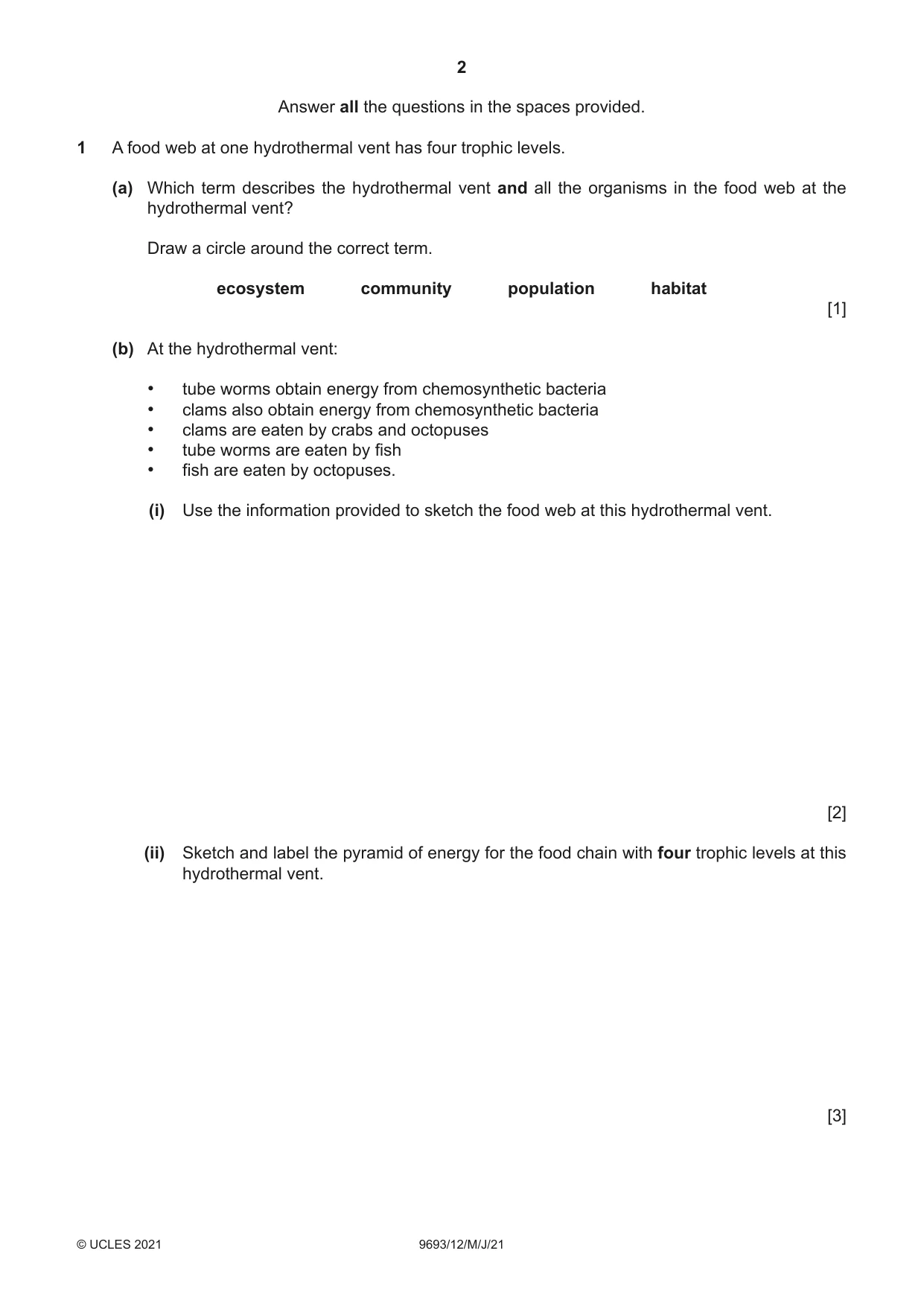
2 9693/12/M/J/21 © UCLES 2021 Answer all the questions in the spaces provided. 1 A food web at one hydrothermal vent has four trophic levels. (a) Which term describes the hydrothermal vent and all the organisms in the food web at the hydrothermal vent? Draw a circle around the correct term. ecosystem community population habitat [1] (b) At the hydrothermal vent: • tube worms obtain energy from chemosynthetic bacteria • clams also obtain energy from chemosynthetic bacteria • clams are eaten by crabs and octopuses • tube worms are eaten by fish • fish are eaten by octopuses. (i) Use the information provided to sketch the food web at this hydrothermal vent. [2] (ii) Sketch and label the pyramid of energy for the food chain with four trophic levels at this hydrothermal vent. [3]
Question paper, page 3
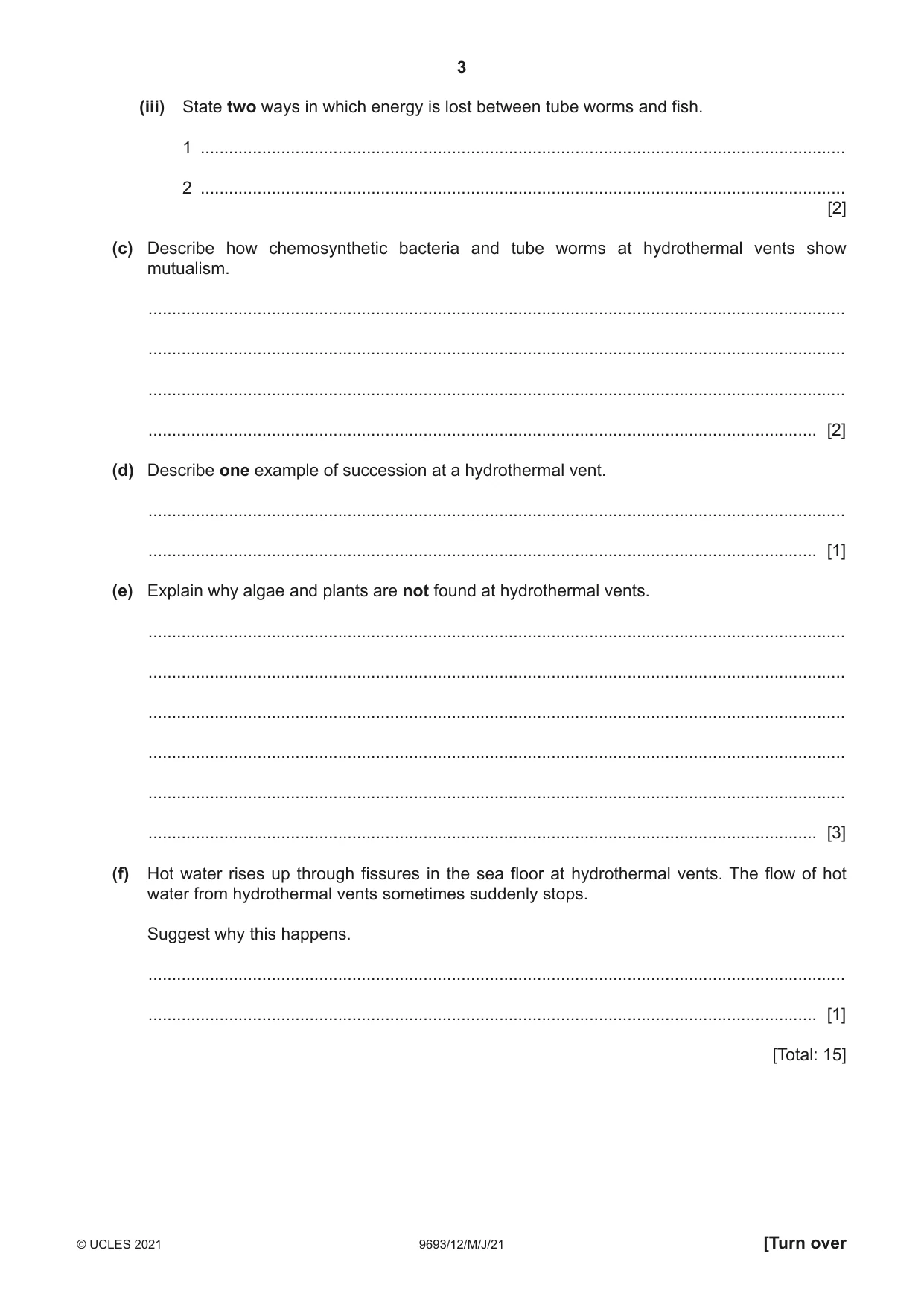
3 9693/12/M/J/21 © UCLES 2021 [Turn over (iii) State two ways in which energy is lost between tube worms and fish. 1 … 2 … [2] (c) Describe how chemosynthetic bacteria and tube worms at hydrothermal vents show mutualism. … … … … [2] (d) Describe one example of succession at a hydrothermal vent. … … [1] (e) Explain why algae and plants are not found at hydrothermal vents. … … … … … … [3] (f) Hot water rises up through fissures in the sea floor at hydrothermal vents. The flow of hot water from hydrothermal vents sometimes suddenly stops. Suggest why this happens. … … [1] [Total: 15]
Question paper, page 4
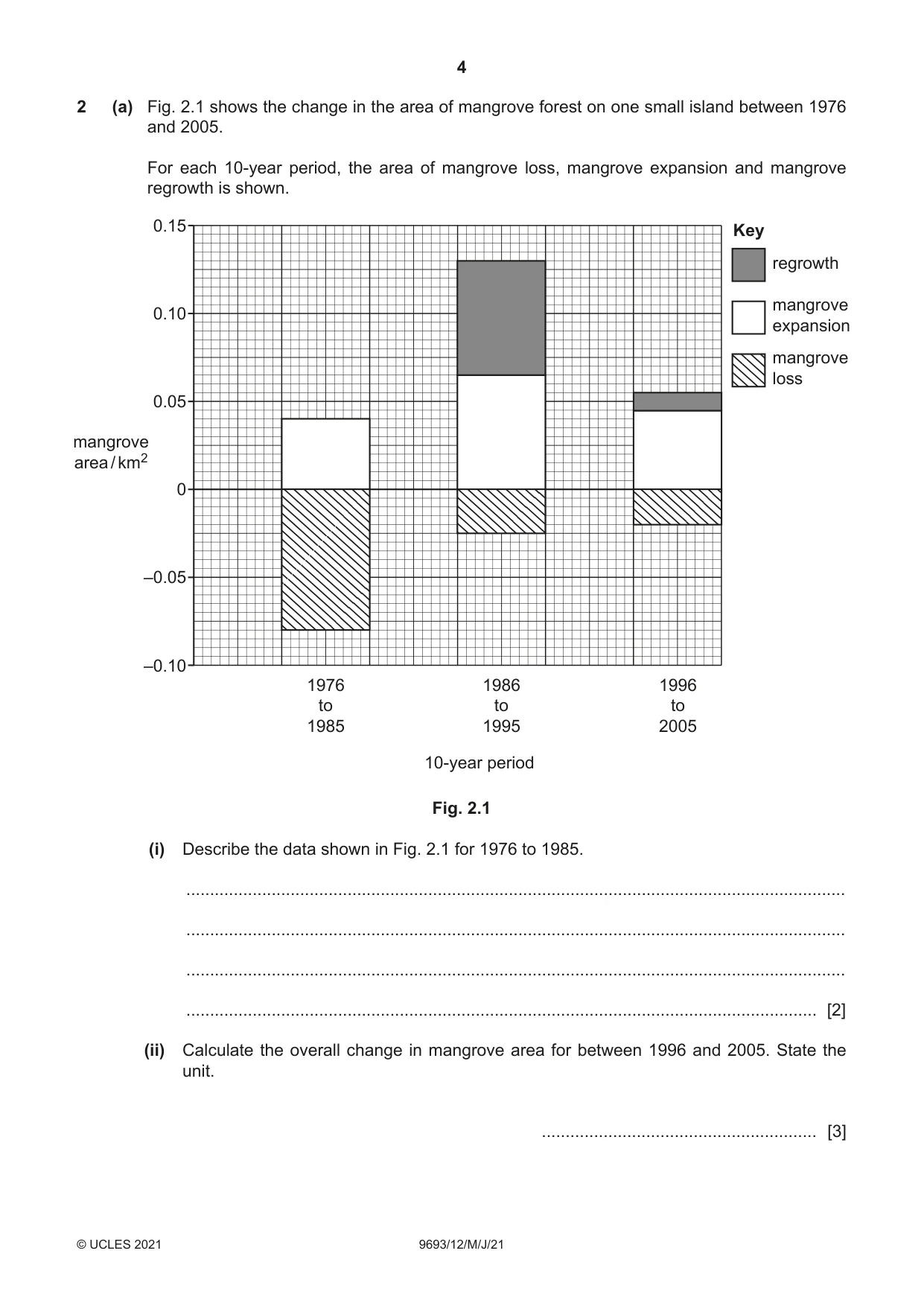
4 9693/12/M/J/21 © UCLES 2021 2 (a) Fig. 2.1 shows the change in the area of mangrove forest on one small island between 1976 and 2005. For each 10-year period, the area of mangrove loss, mangrove expansion and mangrove regrowth is shown. –0.10 1976 to 1985 1986 to 1995 10-year period Key regrowth mangrove expansion mangrove loss 1996 to 2005 –0.05 0 0.05 mangrove area / km2 0.10 0.15 Fig. 2.1 (i) Describe the data shown in Fig. 2.1 for 1976 to 1985. … … … … [2] (ii) Calculate the overall change in mangrove area for between 1996 and 2005. State the unit. … [3]
Question paper, page 5
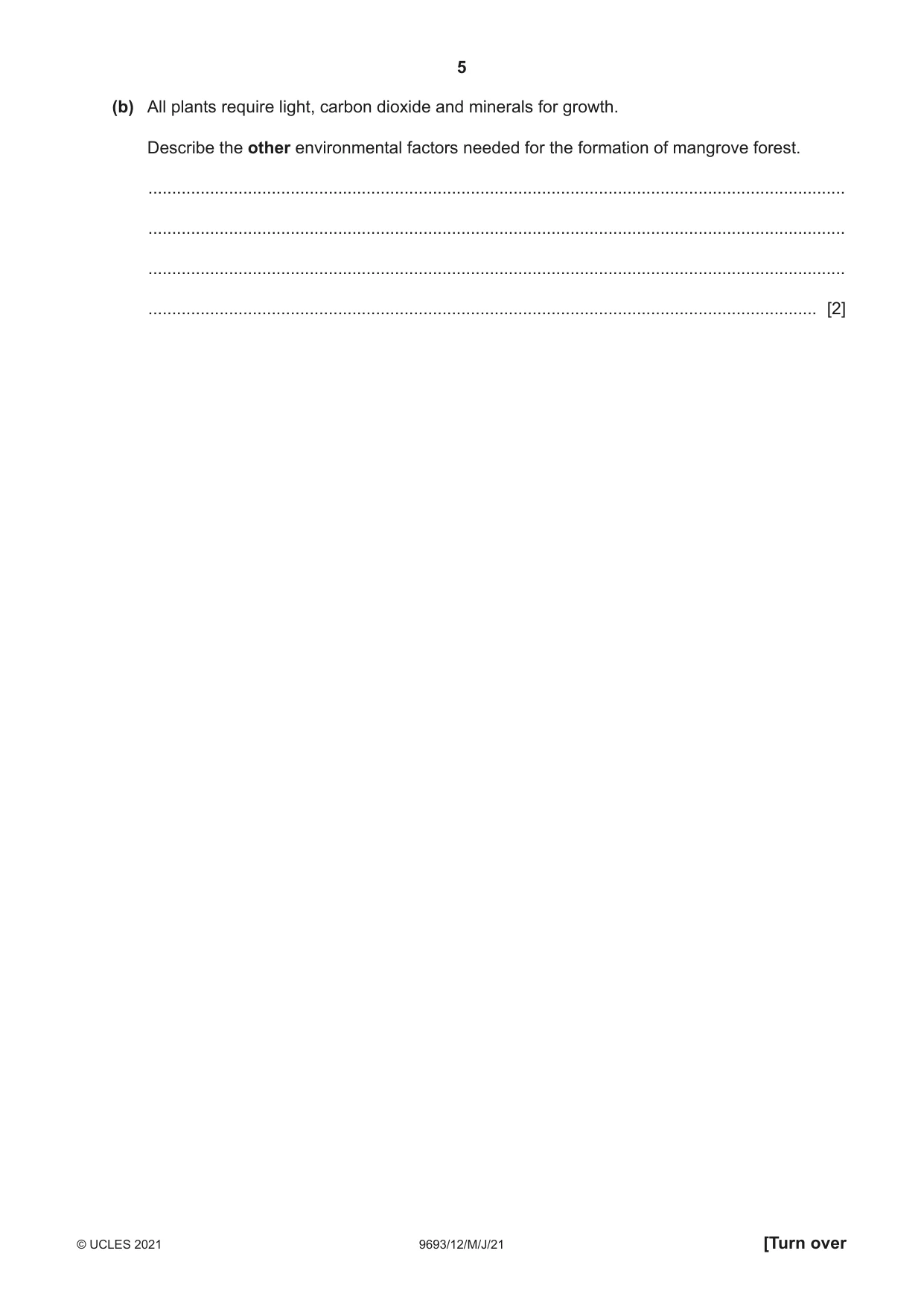
5 9693/12/M/J/21 © UCLES 2021 [Turn over (b) All plants require light, carbon dioxide and minerals for growth. Describe the other environmental factors needed for the formation of mangrove forest. … … … … [2]
Question paper, page 6
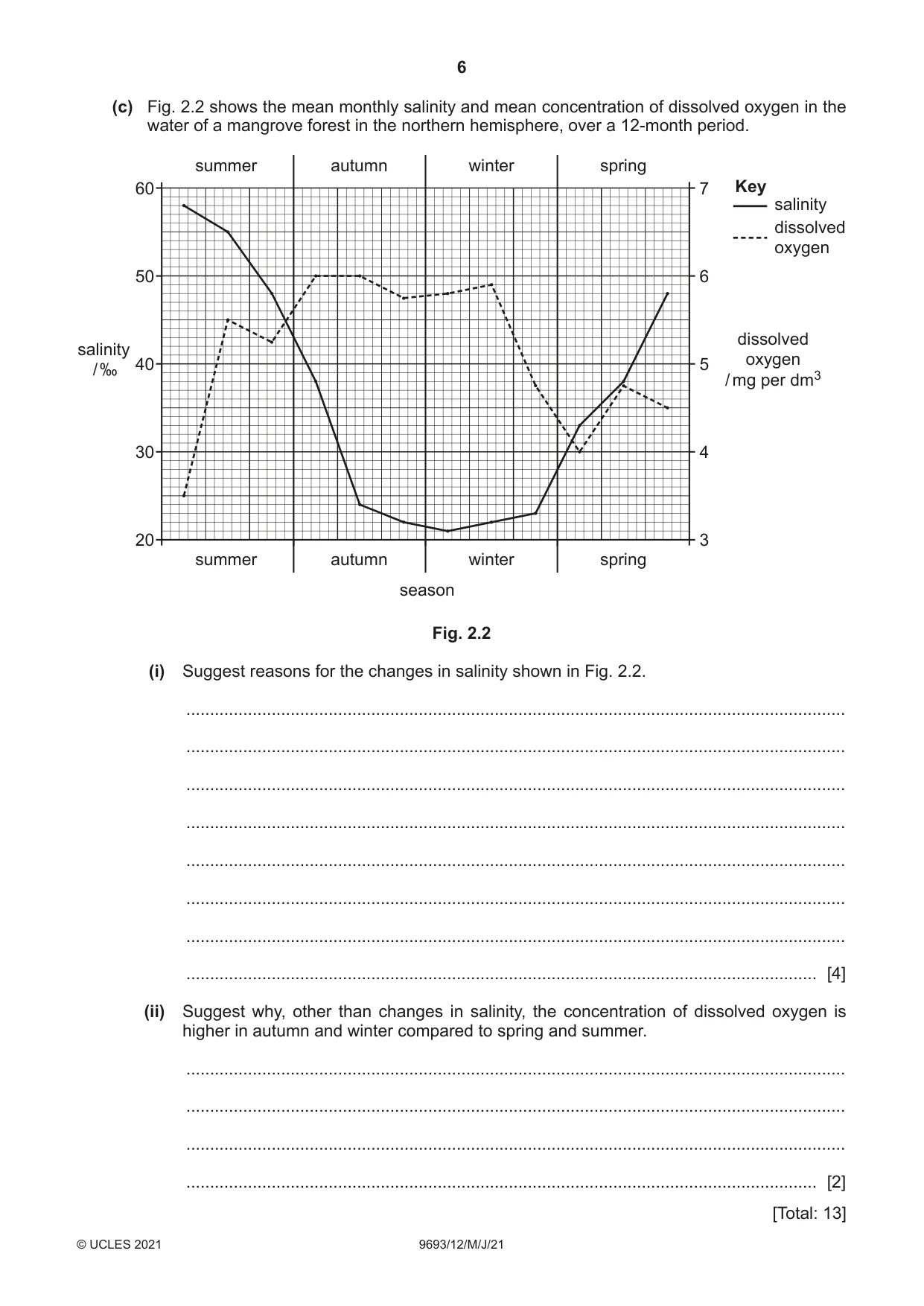
6 9693/12/M/J/21 © UCLES 2021 (c) Fig. 2.2 shows the mean monthly salinity and mean concentration of dissolved oxygen in the water of a mangrove forest in the northern hemisphere, over a 12-month period. 20 summer autumn season Key salinity dissolved oxygen winter spring summer autumn winter spring 30 40 50 salinity / ‰ dissolved oxygen / mg per dm3 60 3 4 5 6 7 Fig. 2.2 (i) Suggest reasons for the changes in salinity shown in Fig. 2.2. … … … … … … … … [4] (ii) Suggest why, other than changes in salinity, the concentration of dissolved oxygen is higher in autumn and winter compared to spring and summer. … … … … [2] [Total: 13]
Question paper, page 7
7 9693/12/M/J/21 © UCLES 2021 [Turn over BLANK PAGE
Question paper, page 8
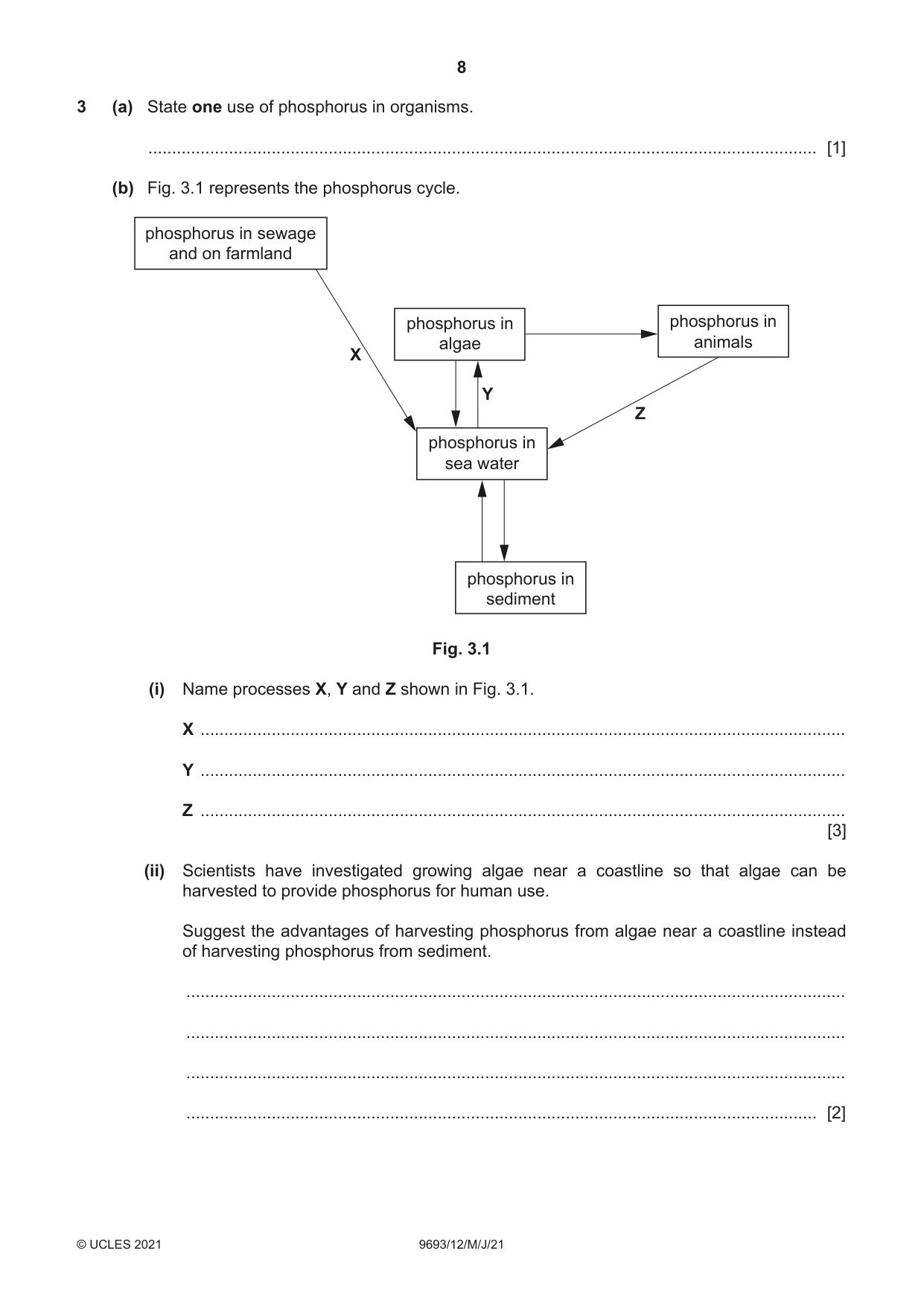
8 9693/12/M/J/21 © UCLES 2021 3 (a) State one use of phosphorus in organisms. … [1] (b) Fig. 3.1 represents the phosphorus cycle. phosphorus in sewage and on farmland phosphorus in algae phosphorus in animals phosphorus in sea water X Y Z phosphorus in sediment Fig. 3.1 (i) Name processes X, Y and Z shown in Fig. 3.1. X … Y … Z … [3] (ii) Scientists have investigated growing algae near a coastline so that algae can be harvested to provide phosphorus for human use. Suggest the advantages of harvesting phosphorus from algae near a coastline instead of harvesting phosphorus from sediment. … … … … [2]
Question paper, page 9
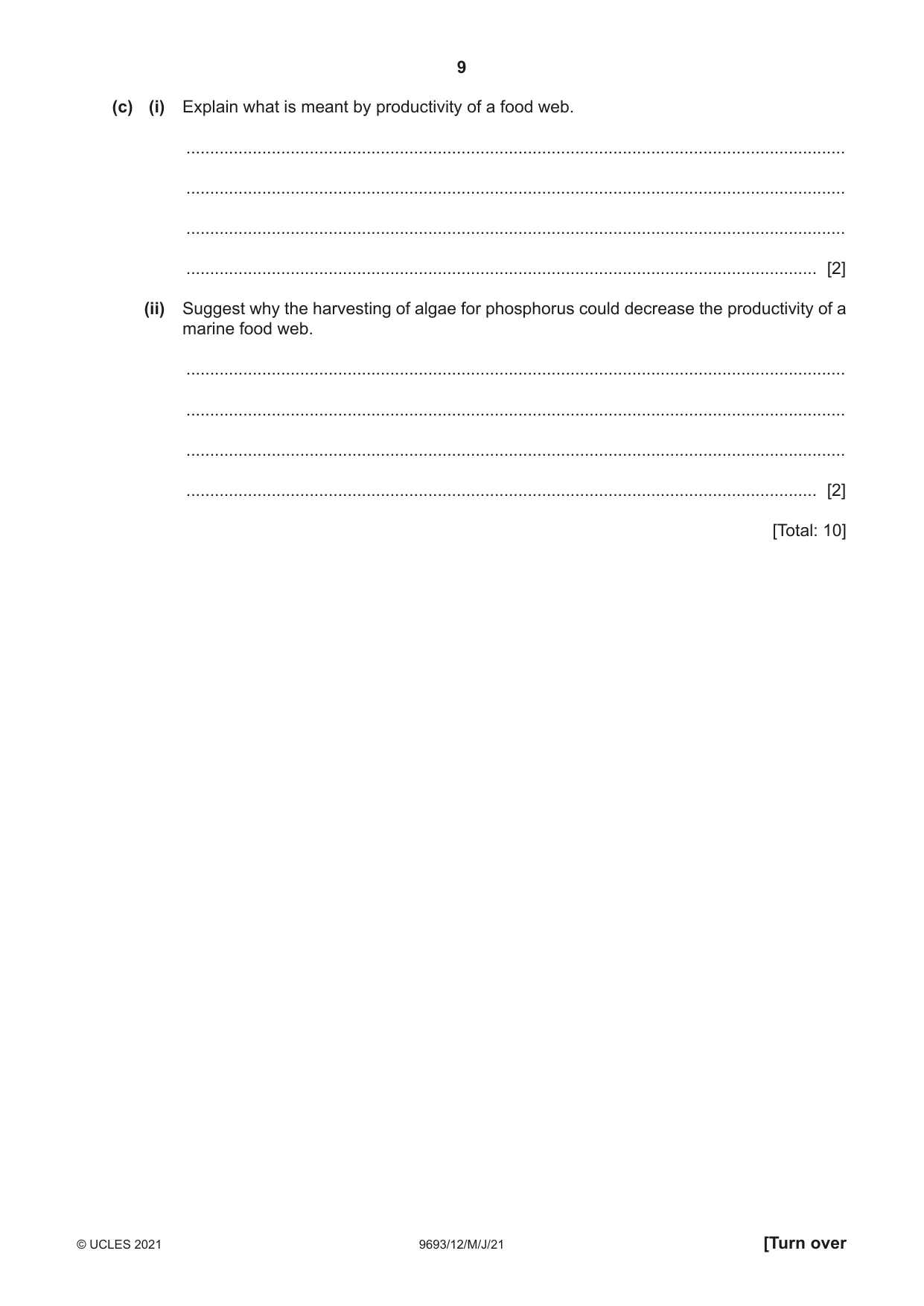
9 9693/12/M/J/21 © UCLES 2021 [Turn over (c) (i) Explain what is meant by productivity of a food web. … … … … [2] (ii) Suggest why the harvesting of algae for phosphorus could decrease the productivity of a marine food web. … … … … [2] [Total: 10]
Question paper, page 10
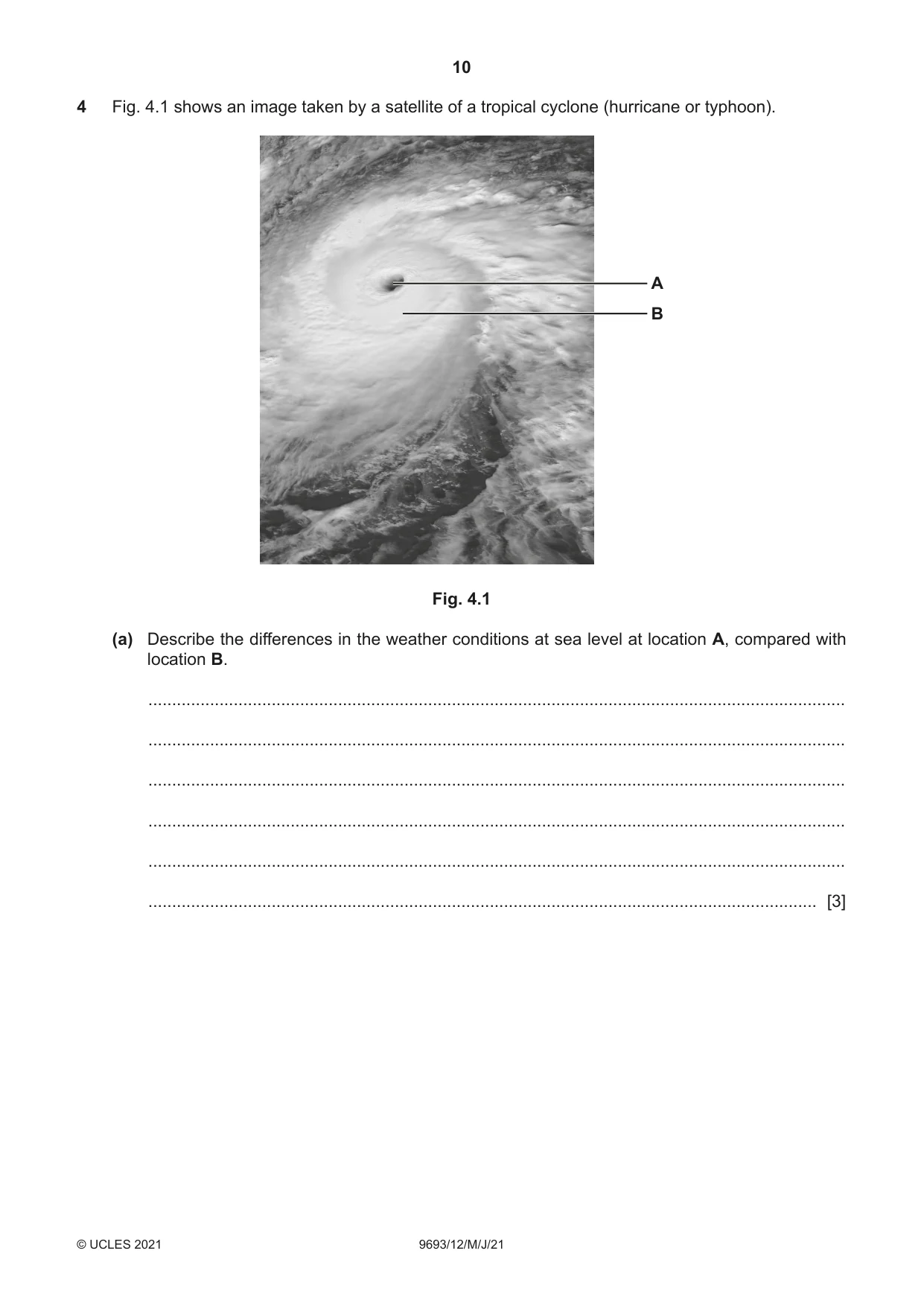
10 9693/12/M/J/21 © UCLES 2021 4 Fig. 4.1 shows an image taken by a satellite of a tropical cyclone (hurricane or typhoon). A B Fig. 4.1 (a) Describe the differences in the weather conditions at sea level at location A, compared with location B. … … … … … … [3]
Question paper, page 11
11 9693/12/M/J/21 © UCLES 2021 [Turn over (b) Maximum wind speed in a tropical cyclone is used to predict the damage that may be caused when the tropical cyclone reaches coastal communities. (i) List three factors that can affect the maximum wind speed in a tropical cyclone. 1 … 2 … 3 … [3] (ii) Other than wind speed, suggest two pieces of information about a tropical cyclone that are needed to predict the extent of storm damage. 1 … 2 … [2] (c) Suggest how the impact of a tropical cyclone on coastal communities can be reduced. … … … … [2] [Total: 10]
Question paper, page 12
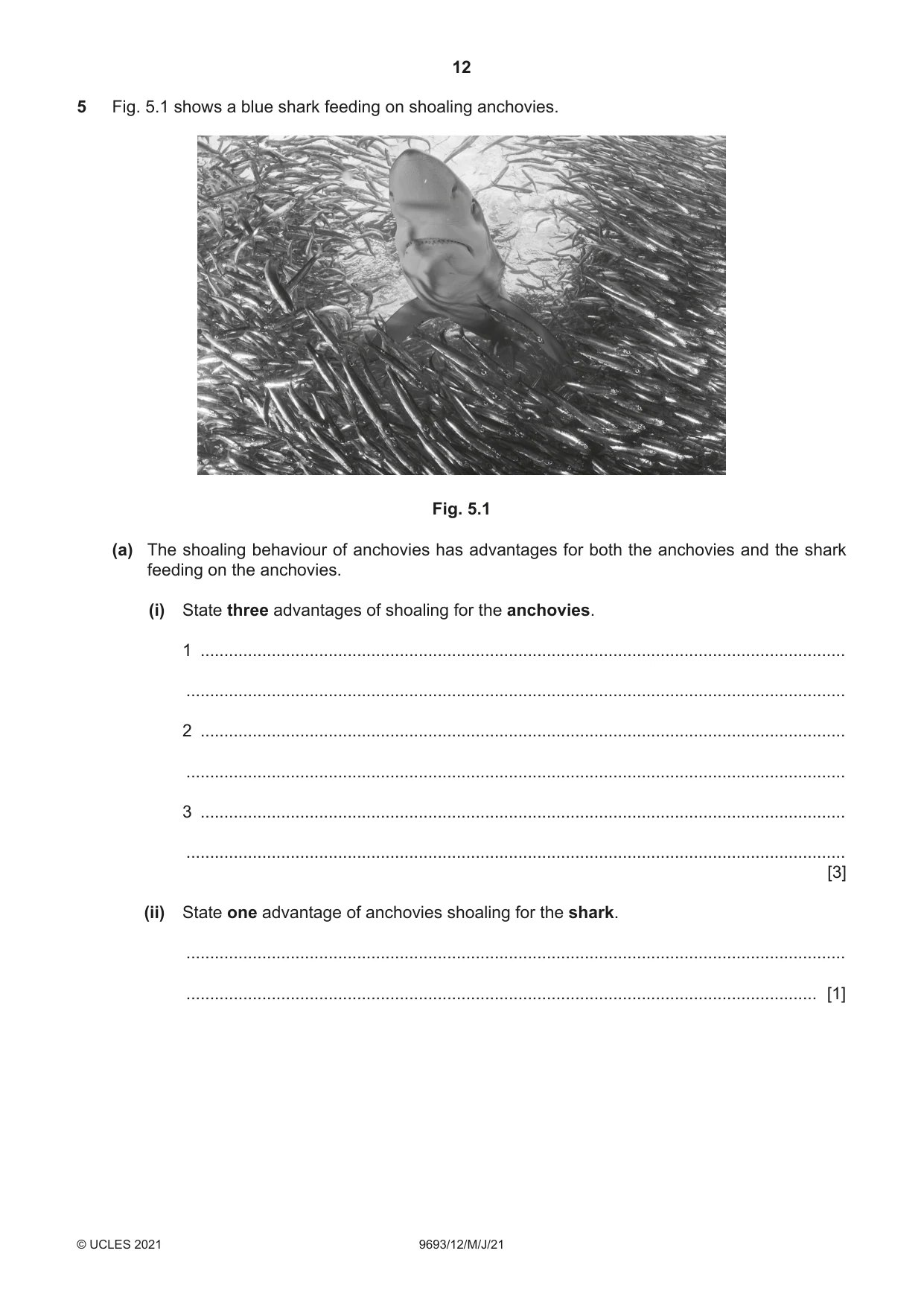
12 9693/12/M/J/21 © UCLES 2021 5 Fig. 5.1 shows a blue shark feeding on shoaling anchovies. Fig. 5.1 (a) The shoaling behaviour of anchovies has advantages for both the anchovies and the shark feeding on the anchovies. (i) State three advantages of shoaling for the anchovies. 1 … … 2 … … 3 … … [3] (ii) State one advantage of anchovies shoaling for the shark. … … [1]
Question paper, page 13
13 9693/12/M/J/21 © UCLES 2021 [Turn over (b) Anchovies feed on microscopic algae called phytoplankton. During El Niño events, changes in the anchovy population have been recorded in the Pacific Ocean. Explain how an El Niño event could affect the population of blue sharks. … … … … … … … … [4] (c) (i) Define parasitism. … … … … … … [3] (ii) Suggest why parasites are more common on fish that shoal than on fish that do not shoal. … … … … [2] [Total: 13]
Question paper, page 14
14 9693/12/M/J/21 © UCLES 2021 6 (a) (i) Outline the theory of plate tectonics. … … … … … … [3] (ii) Describe three types of evidence to support the theory of plate tectonics. 1 … … 2 … … 3 … … [3]
Question paper, page 15
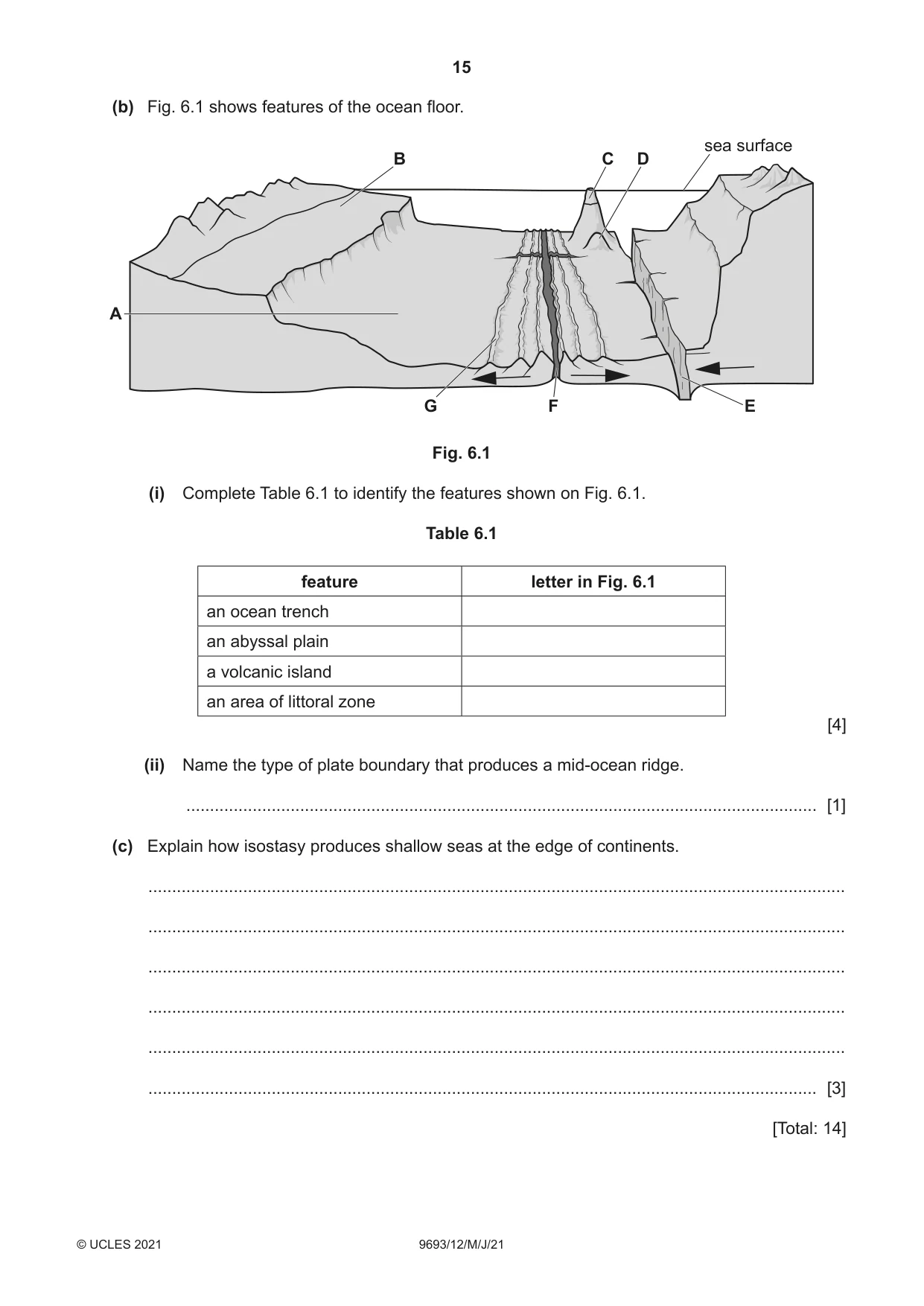
15 9693/12/M/J/21 © UCLES 2021 (b) Fig. 6.1 shows features of the ocean floor. A B C D sea surface F G E Fig. 6.1 (i) Complete Table 6.1 to identify the features shown on Fig. 6.1. Table 6.1 feature letter in Fig. 6.1 an ocean trench an abyssal plain a volcanic island an area of littoral zone [4] (ii) Name the type of plate boundary that produces a mid-ocean ridge. … [1] (c) Explain how isostasy produces shallow seas at the edge of continents. … … … … … … [3] [Total: 14]
Question paper, page 16
16 9693/12/M/J/21 © UCLES 2021 Permission to reproduce items where third-party owned material protected by copyright is included has been sought and cleared where possible. Every reasonable effort has been made by the publisher (UCLES) to trace copyright holders, but if any items requiring clearance have unwittingly been included, the publisher will be pleased to make amends at the earliest possible opportunity. To avoid the issue of disclosure of answer-related information to candidates, all copyright acknowledgements are reproduced online in the Cambridge Assessment International Education Copyright Acknowledgements Booklet. This is produced for each series of examinations and is freely available to download at www.cambridgeinternational.org after the live examination series. Cambridge Assessment International Education is part of the Cambridge Assessment Group. Cambridge Assessment is the brand name of the University of Cambridge Local Examinations Syndicate (UCLES), which itself is a department of the University of Cambridge. BLANK PAGE
Mark scheme, page 1
This document consists of 11 printed pages. © UCLES 2021 [Turn over Cambridge International AS & A Level MARINE SCIENCE 9693/12 Paper 1 AS Structured Questions May/June 2021 MARK SCHEME Maximum Mark: 75 Published This mark scheme is published as an aid to teachers and candidates, to indicate the requirements of the examination. It shows the basis on which Examiners were instructed to award marks. It does not indicate the details of the discussions that took place at an Examiners’ meeting before marking began, which would have considered the acceptability of alternative answers. Mark schemes should be read in conjunction with the question paper and the Principal Examiner Report for Teachers. Cambridge International will not enter into discussions about these mark schemes. Cambridge International is publishing the mark schemes for the May/June 2021 series for most Cambridge IGCSE™, Cambridge International A and AS Level components and some Cambridge O Level components.
Mark scheme, page 2
9693/12 Cambridge International AS & A Level – Mark Scheme PUBLISHED May/June 2021 © UCLES 2021 Page 2 of 11 Generic Marking Principles These general marking principles must be applied by all examiners when marking candidate answers. They should be applied alongside the specific content of the mark scheme or generic level descriptors for a question. Each question paper and mark scheme will also comply with these marking principles. GENERIC MARKING PRINCIPLE 1: Marks must be awarded in line with: • the specific content of the mark scheme or the generic level descriptors for the question • the specific skills defined in the mark scheme or in the generic level descriptors for the question • the standard of response required by a candidate as exemplified by the standardisation scripts. GENERIC MARKING PRINCIPLE 2: Marks awarded are always whole marks (not half marks, or other fractions). GENERIC MARKING PRINCIPLE 3: Marks must be awarded positively: • marks are awarded for correct/valid answers, as defined in the mark scheme. However, credit is given for valid answers which go beyond the scope of the syllabus and mark scheme, referring to your Team Leader as appropriate • marks are awarded when candidates clearly demonstrate what they know and can do • marks are not deducted for errors • marks are not deducted for omissions • answers should only be judged on the quality of spelling, punctuation and grammar when these features are specifically assessed by the question as indicated by the mark scheme. The meaning, however, should be unambiguous. GENERIC MARKING PRINCIPLE 4: Rules must be applied consistently, e.g. in situations where candidates have not followed instructions or in the application of generic level descriptors.
Mark scheme, page 3
9693/12 Cambridge International AS & A Level – Mark Scheme PUBLISHED May/June 2021 © UCLES 2021 Page 3 of 11 GENERIC MARKING PRINCIPLE 5: Marks should be awarded using the full range of marks defined in the mark scheme for the question (however; the use of the full mark range may be limited according to the quality of the candidate responses seen). GENERIC MARKING PRINCIPLE 6: Marks awarded are based solely on the requirements as defined in the mark scheme. Marks should not be awarded with grade thresholds or grade descriptors in mind. Science-Specific Marking Principles 1 Examiners should consider the context and scientific use of any keywords when awarding marks. Although keywords may be present, marks should not be awarded if the keywords are used incorrectly. 2 The examiner should not choose between contradictory statements given in the same question part, and credit should not be awarded for any correct statement that is contradicted within the same question part. Wrong science that is irrelevant to the question should be ignored. 3 Although spellings do not have to be correct, spellings of syllabus terms must allow for clear and unambiguous separation from other syllabus terms with which they may be confused (e.g. ethane / ethene, glucagon / glycogen, refraction / reflection). 4 The error carried forward (ecf) principle should be applied, where appropriate. If an incorrect answer is subsequently used in a scientifically correct way, the candidate should be awarded these subsequent marking points. Further guidance will be included in the mark scheme where necessary and any exceptions to this general principle will be noted. 5 ‘List rule’ guidance For questions that require n responses (e.g. State two reasons …): • The response should be read as continuous prose, even when numbered answer spaces are provided. • Any response marked ignore in the mark scheme should not count towards n. • Incorrect responses should not be awarded credit but will still count towards n. • Read the entire response to check for any responses that contradict those that would otherwise be credited. Credit should not be awarded for any responses that are contradicted within the rest of the response. Where two responses contradict one another, this should be treated as a single incorrect response. • Non-contradictory responses after the first n responses may be ignored even if they include incorrect science.
Mark scheme, page 4
9693/12 Cambridge International AS & A Level – Mark Scheme PUBLISHED May/June 2021 © UCLES 2021 Page 4 of 11 6 Calculation specific guidance Correct answers to calculations should be given full credit even if there is no working or incorrect working, unless the question states ‘show your working’. For questions in which the number of significant figures required is not stated, credit should be awarded for correct answers when rounded by the examiner to the number of significant figures given in the mark scheme. This may not apply to measured values. For answers given in standard form (e.g. a × 10n) in which the convention of restricting the value of the coefficient (a) to a value between 1 and 10 is not followed, credit may still be awarded if the answer can be converted to the answer given in the mark scheme. Unless a separate mark is given for a unit, a missing or incorrect unit will normally mean that the final calculation mark is not awarded. Exceptions to this general principle will be noted in the mark scheme. 7 Guidance for chemical equations Multiples / fractions of coefficients used in chemical equations are acceptable unless stated otherwise in the mark scheme. State symbols given in an equation should be ignored unless asked for in the question or stated otherwise in the mark scheme.
Mark scheme, page 5
9693/12 Cambridge International AS & A Level – Mark Scheme PUBLISHED May/June 2021 © UCLES 2021 Page 5 of 11 • This mark scheme will use the following abbreviations: ; separates marking points / separates alternatives within a marking point () contents of brackets are not required but should be implied / the contents set the context of the answer R reject A accept (answers that are correctly cued by the question or guidance you have received) I ignore (mark as if this material was not present) AW alternative wording (where responses vary more than usual, accept other ways of expressing the same idea) AVP alternative valid point (where a greater than usual variety of responses is expected) ORA or reverse argument underline actual word underlined must be used by the candidate (grammatical variants excepted) MAX indicates the maximum number of marks that can be awarded + statements on both sides of the + are needed for that mark OR separates two different routes to a mark point and only one should be awarded ECF error carried forward (credit an operation from a previous incorrect response)
Mark scheme, page 6
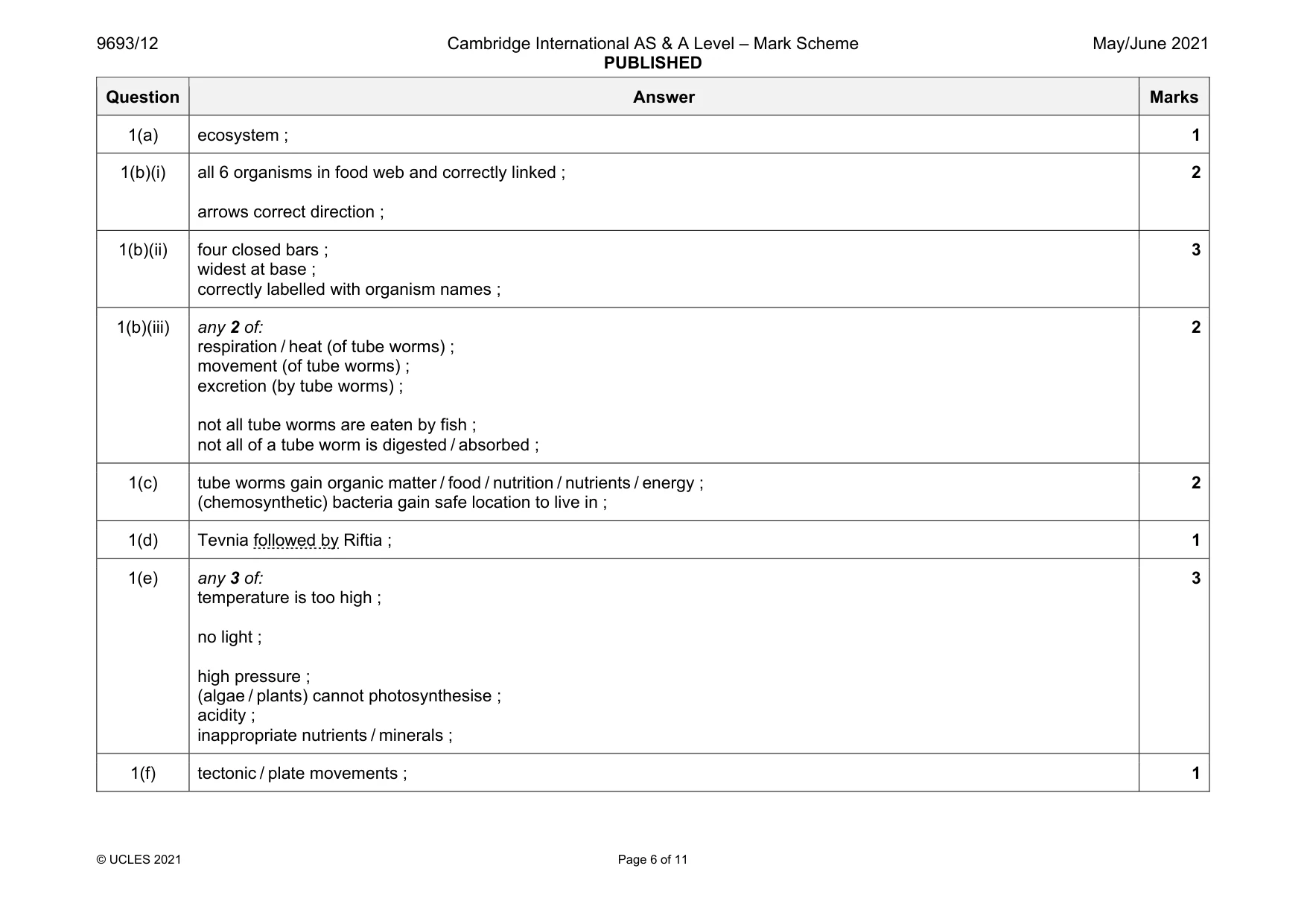
9693/12 Cambridge International AS & A Level – Mark Scheme PUBLISHED May/June 2021 © UCLES 2021 Page 6 of 11 Question Answer Marks 1(a) ecosystem ; 1 1(b)(i) all 6 organisms in food web and correctly linked ; arrows correct direction ; 2 1(b)(ii) four closed bars ; widest at base ; correctly labelled with organism names ; 3 1(b)(iii) any 2 of: respiration / heat (of tube worms) ; movement (of tube worms) ; excretion (by tube worms) ; not all tube worms are eaten by fish ; not all of a tube worm is digested / absorbed ; 2 1(c) tube worms gain organic matter / food / nutrition / nutrients / energy ; (chemosynthetic) bacteria gain safe location to live in ; 2 1(d) Tevnia followed by Riftia ; 1 1(e) any 3 of: temperature is too high ; no light ; high pressure ; (algae / plants) cannot photosynthesise ; acidity ; inappropriate nutrients / minerals ; 3 1(f) tectonic / plate movements ; 1
Mark scheme, page 7
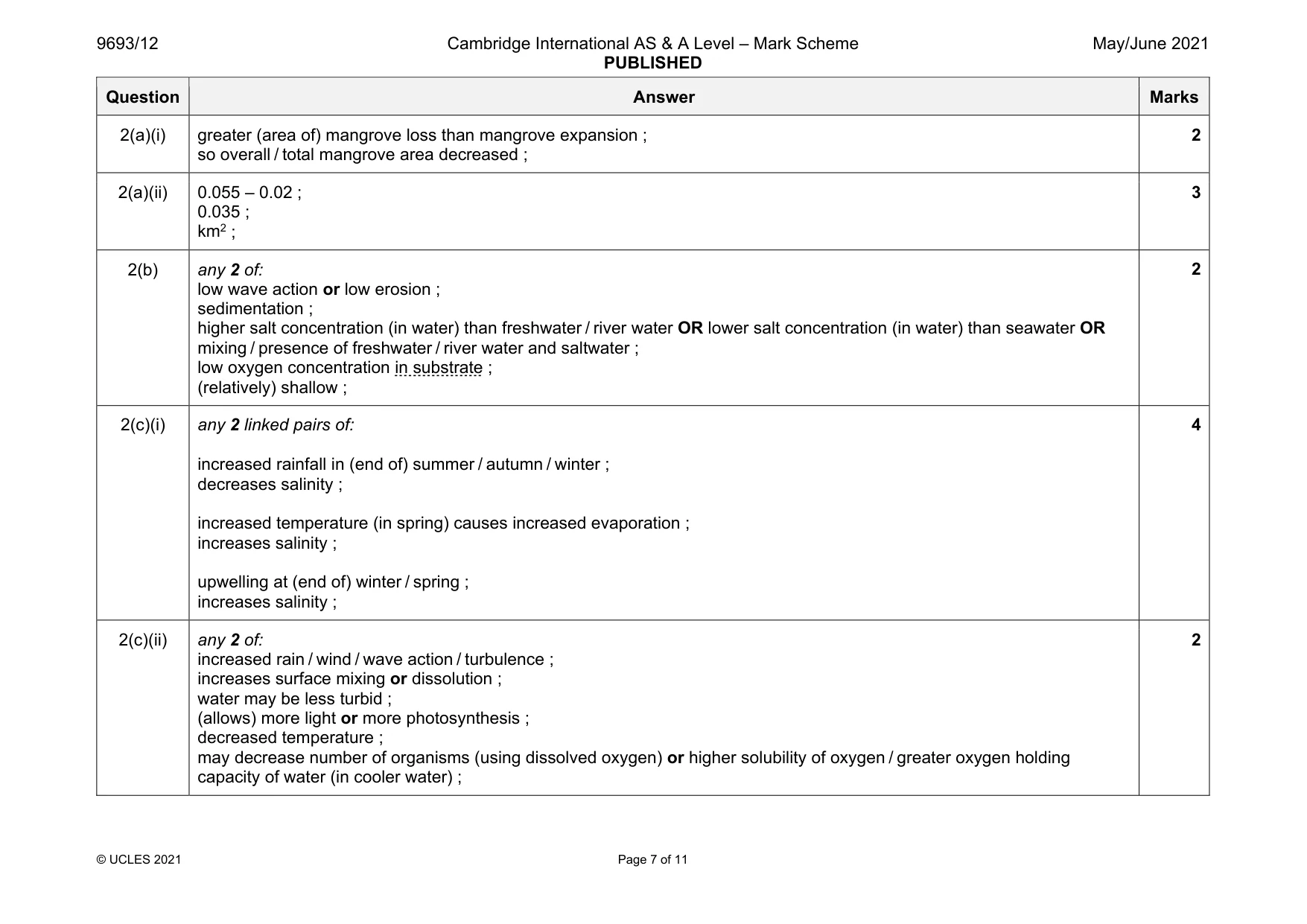
9693/12 Cambridge International AS & A Level – Mark Scheme PUBLISHED May/June 2021 © UCLES 2021 Page 7 of 11 Question Answer Marks 2(a)(i) greater (area of) mangrove loss than mangrove expansion ; so overall / total mangrove area decreased ; 2 2(a)(ii) 0.055 – 0.02 ; 0.035 ; km2 ; 3 2(b) any 2 of: low wave action or low erosion ; sedimentation ; higher salt concentration (in water) than freshwater / river water OR lower salt concentration (in water) than seawater OR mixing / presence of freshwater / river water and saltwater ; low oxygen concentration in substrate ; (relatively) shallow ; 2 2(c)(i) any 2 linked pairs of: increased rainfall in (end of) summer / autumn / winter ; decreases salinity ; increased temperature (in spring) causes increased evaporation ; increases salinity ; upwelling at (end of) winter / spring ; increases salinity ; 4 2(c)(ii) any 2 of: increased rain / wind / wave action / turbulence ; increases surface mixing or dissolution ; water may be less turbid ; (allows) more light or more photosynthesis ; decreased temperature ; may decrease number of organisms (using dissolved oxygen) or higher solubility of oxygen / greater oxygen holding capacity of water (in cooler water) ; 2
Mark scheme, page 8
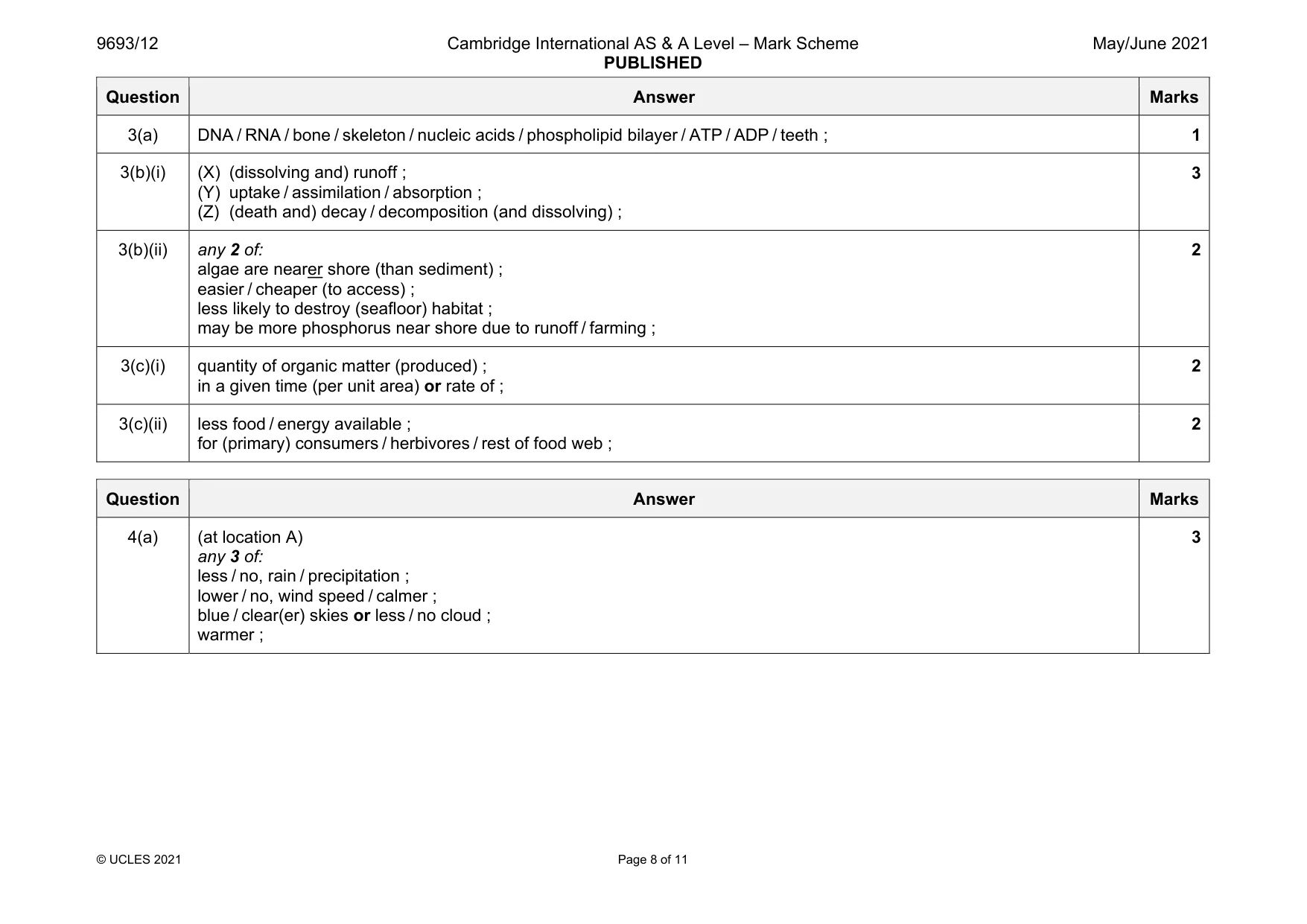
9693/12 Cambridge International AS & A Level – Mark Scheme PUBLISHED May/June 2021 © UCLES 2021 Page 8 of 11 Question Answer Marks 3(a) DNA / RNA / bone / skeleton / nucleic acids / phospholipid bilayer / ATP / ADP / teeth ; 1 3(b)(i) (X) (dissolving and) runoff ; (Y) uptake / assimilation / absorption ; (Z) (death and) decay / decomposition (and dissolving) ; 3 3(b)(ii) any 2 of: algae are nearer shore (than sediment) ; easier / cheaper (to access) ; less likely to destroy (seafloor) habitat ; may be more phosphorus near shore due to runoff / farming ; 2 3(c)(i) quantity of organic matter (produced) ; in a given time (per unit area) or rate of ; 2 3(c)(ii) less food / energy available ; for (primary) consumers / herbivores / rest of food web ; 2 Question Answer Marks 4(a) (at location A) any 3 of: less / no, rain / precipitation ; lower / no, wind speed / calmer ; blue / clear(er) skies or less / no cloud ; warmer ; 3
Mark scheme, page 9
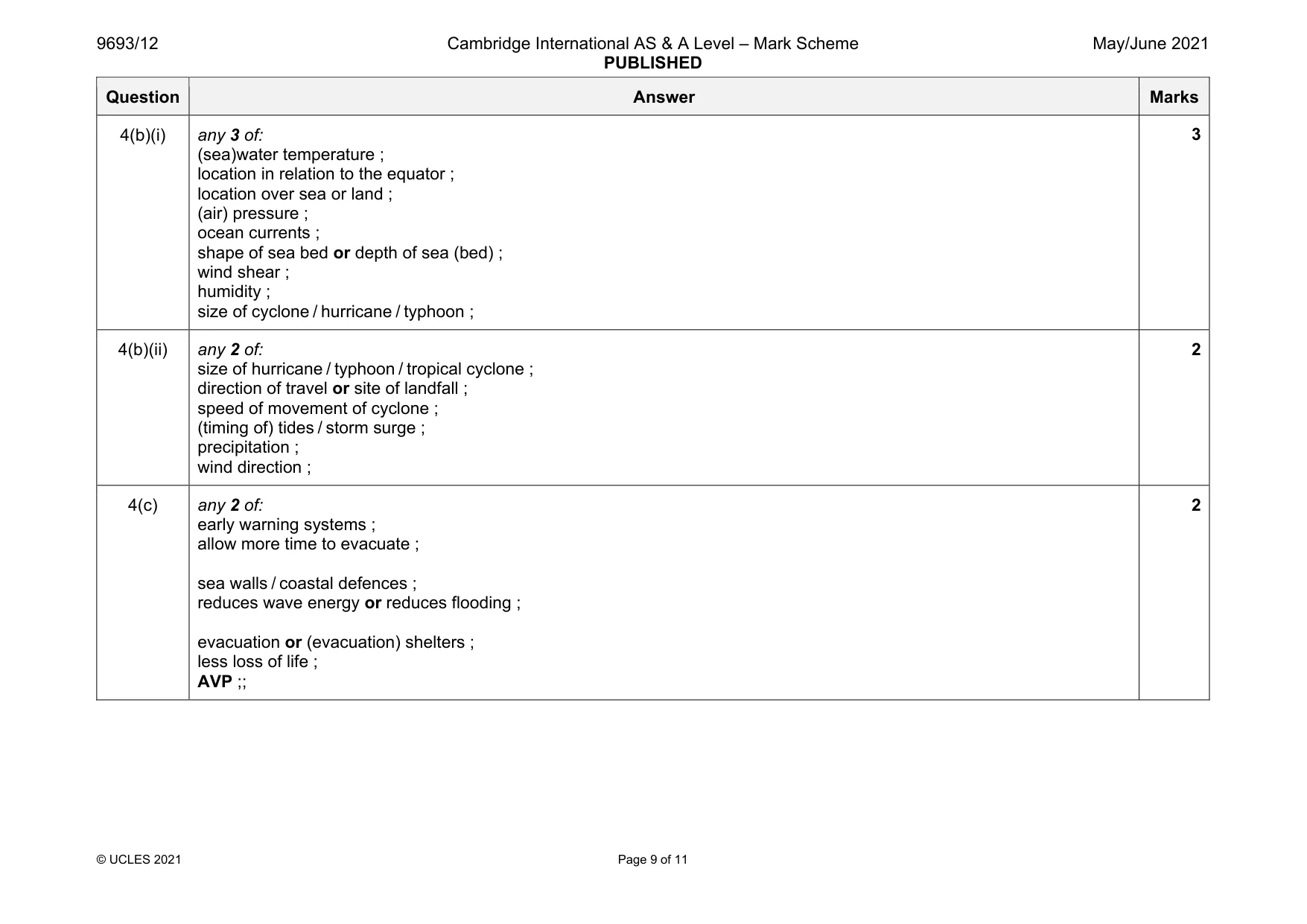
9693/12 Cambridge International AS & A Level – Mark Scheme PUBLISHED May/June 2021 © UCLES 2021 Page 9 of 11 Question Answer Marks 4(b)(i) any 3 of: (sea)water temperature ; location in relation to the equator ; location over sea or land ; (air) pressure ; ocean currents ; shape of sea bed or depth of sea (bed) ; wind shear ; humidity ; size of cyclone / hurricane / typhoon ; 3 4(b)(ii) any 2 of: size of hurricane / typhoon / tropical cyclone ; direction of travel or site of landfall ; speed of movement of cyclone ; (timing of) tides / storm surge ; precipitation ; wind direction ; 2 4(c) any 2 of: early warning systems ; allow more time to evacuate ; sea walls / coastal defences ; reduces wave energy or reduces flooding ; evacuation or (evacuation) shelters ; less loss of life ; AVP ;; 2
Mark scheme, page 10
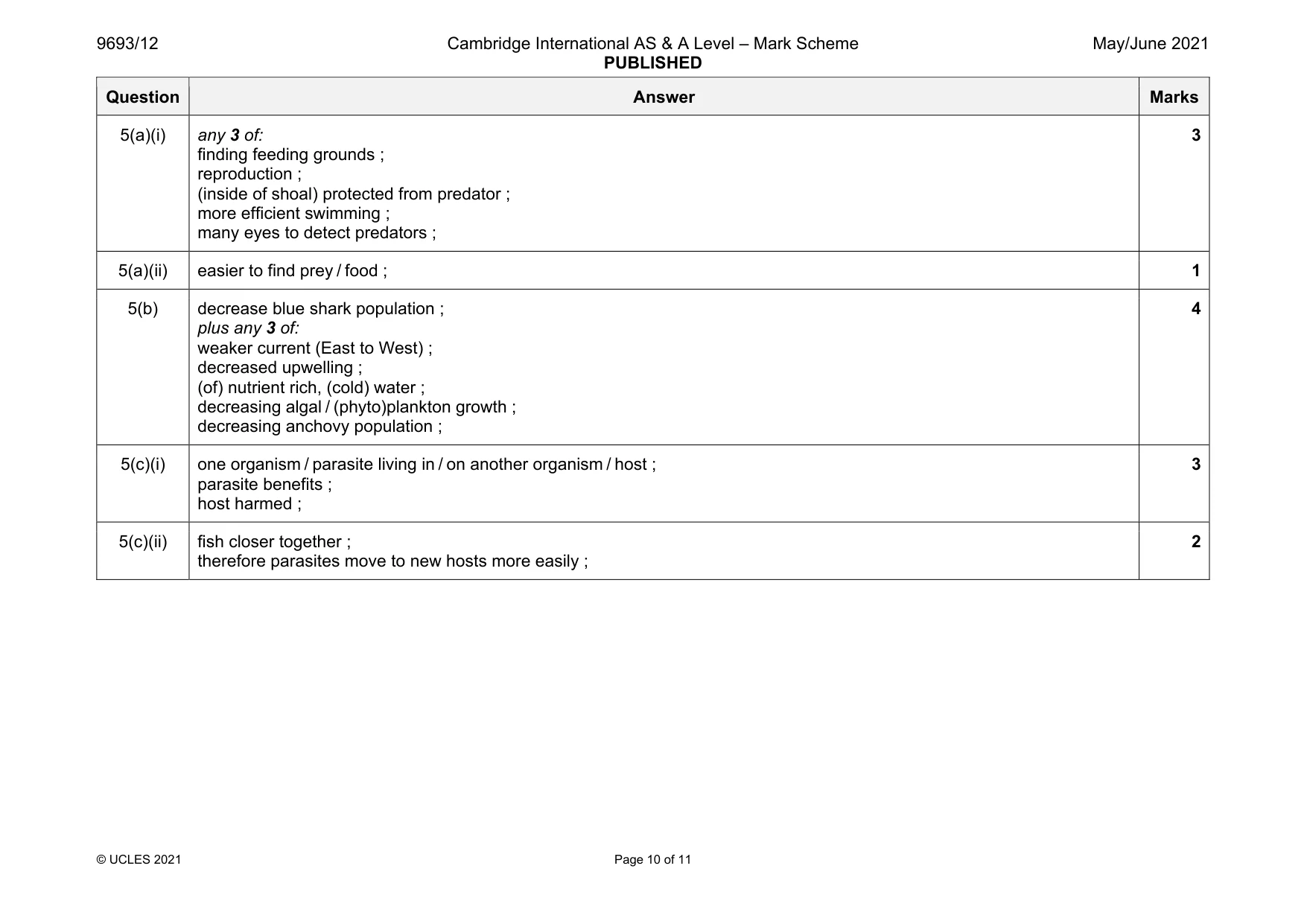
9693/12 Cambridge International AS & A Level – Mark Scheme PUBLISHED May/June 2021 © UCLES 2021 Page 10 of 11 Question Answer Marks 5(a)(i) any 3 of: finding feeding grounds ; reproduction ; (inside of shoal) protected from predator ; more efficient swimming ; many eyes to detect predators ; 3 5(a)(ii) easier to find prey / food ; 1 5(b) decrease blue shark population ; plus any 3 of: weaker current (East to West) ; decreased upwelling ; (of) nutrient rich, (cold) water ; decreasing algal / (phyto)plankton growth ; decreasing anchovy population ; 4 5(c)(i) one organism / parasite living in / on another organism / host ; parasite benefits ; host harmed ; 3 5(c)(ii) fish closer together ; therefore parasites move to new hosts more easily ; 2
Mark scheme, page 11
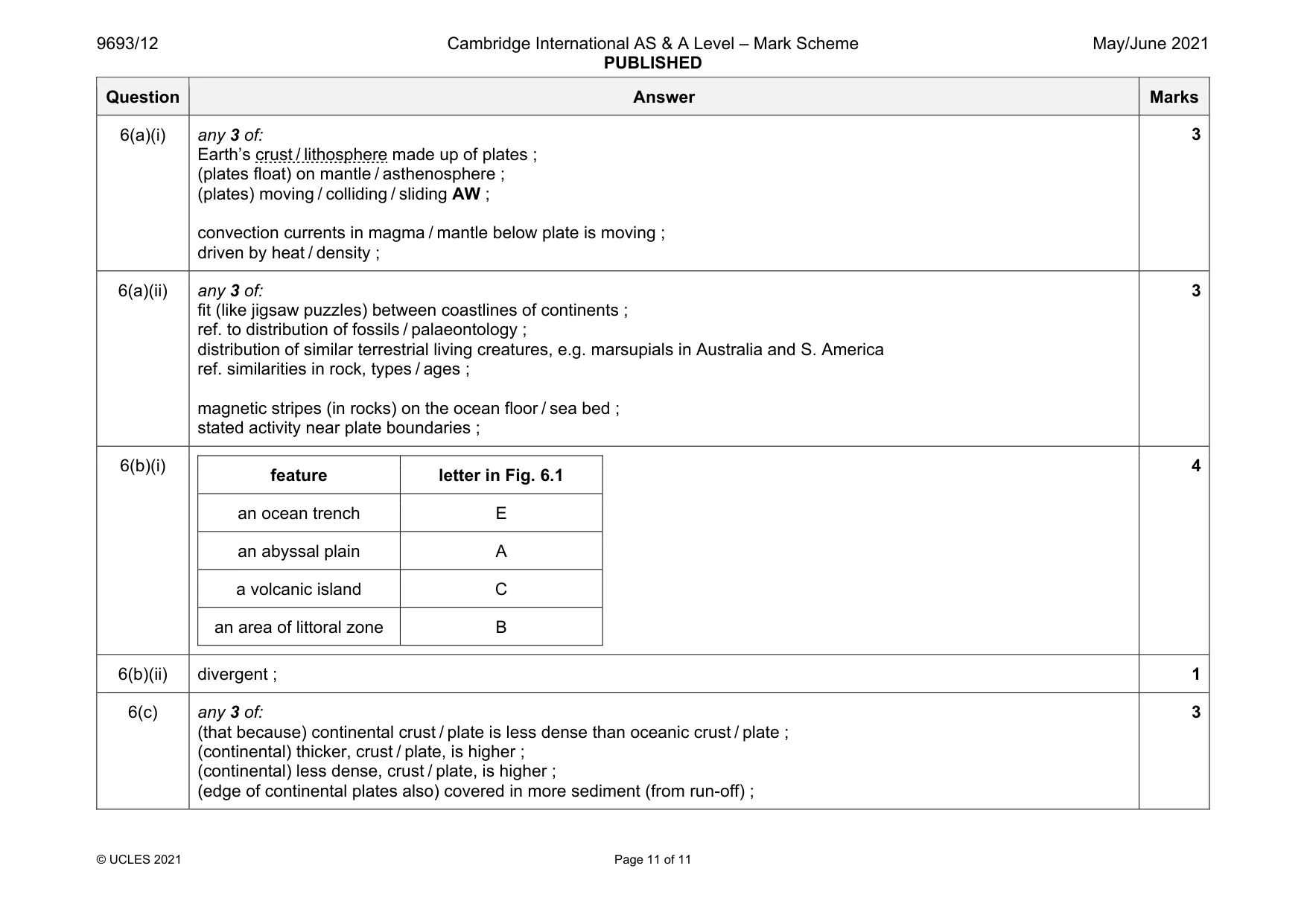
9693/12 Cambridge International AS & A Level – Mark Scheme PUBLISHED May/June 2021 © UCLES 2021 Page 11 of 11 Question Answer Marks 6(a)(i) any 3 of: Earth’s crust / lithosphere made up of plates ; (plates float) on mantle / asthenosphere ; (plates) moving / colliding / sliding AW ; convection currents in magma / mantle below plate is moving ; driven by heat / density ; 3 6(a)(ii) any 3 of: fit (like jigsaw puzzles) between coastlines of continents ; ref. to distribution of fossils / palaeontology ; distribution of similar terrestrial living creatures, e.g. marsupials in Australia and S. America ref. similarities in rock, types / ages ; magnetic stripes (in rocks) on the ocean floor / sea bed ; stated activity near plate boundaries ; 3 6(b)(i) feature letter in Fig. 6.1 an ocean trench E an abyssal plain A a volcanic island C an area of littoral zone B 4 6(b)(ii) divergent ; 1 6(c) any 3 of: (that because) continental crust / plate is less dense than oceanic crust / plate ; (continental) thicker, crust / plate, is higher ; (continental) less dense, crust / plate, is higher ; (edge of continental plates also) covered in more sediment (from run-off) ; 3
What you needed in this session
Cambridge’s own grade thresholds for 2021 May/June, Paper 1 · Variant 2. A higher threshold means an easier paper — the bar moves with how the cohort did.