Cambridge A Level Marine Science 9693 — 2017 Oct/Nov Paper 1 · Variant 1
9693/11/O/N/17 · 75 marks · ≈84 min
The question paper and its mark scheme, free to read here and free to download. This is Cambridge’s own paper, exactly as it was sat.
Question paper20 pages


Mark scheme12 pages
Answers below. Sit the paper first if you are practising.
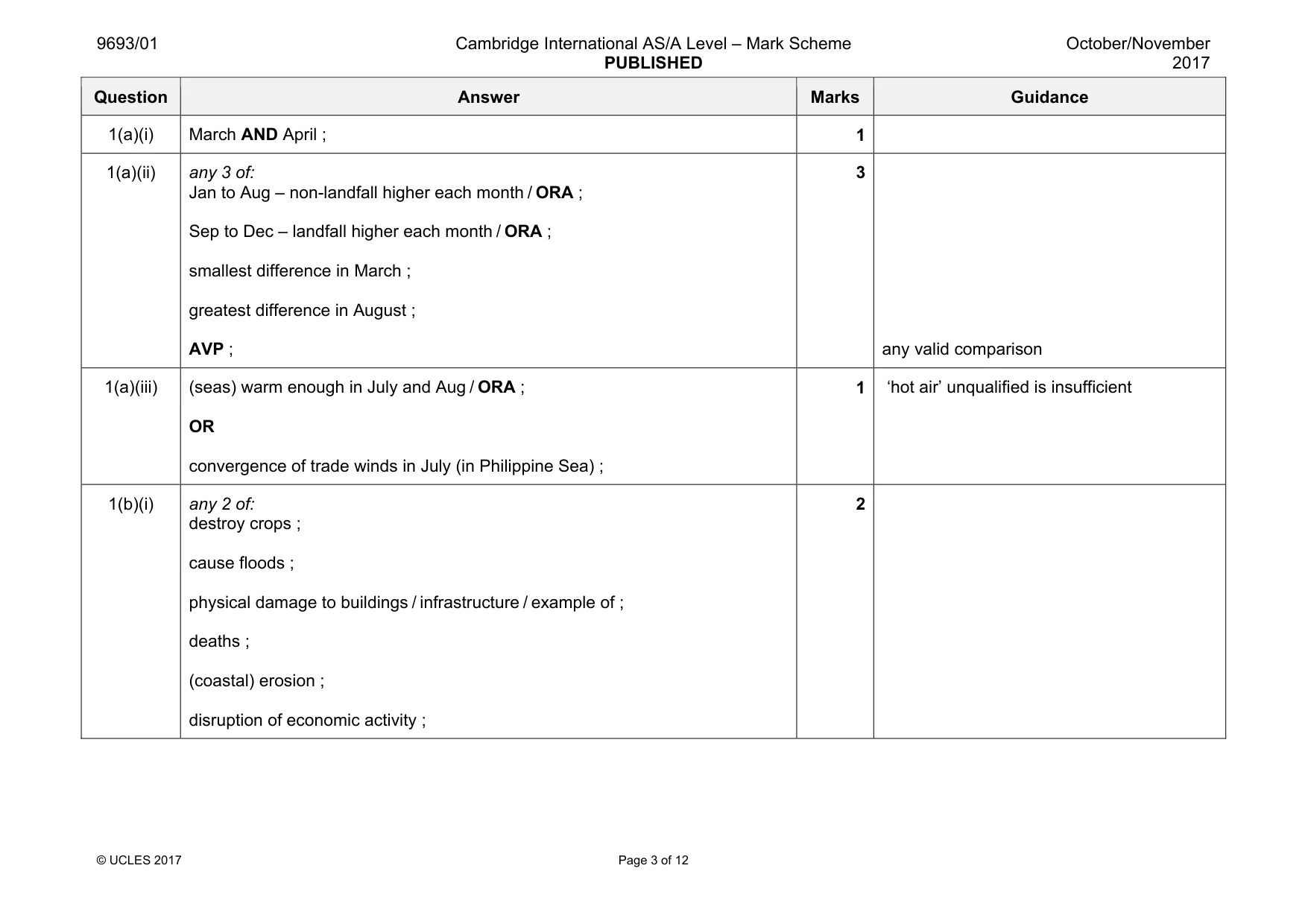
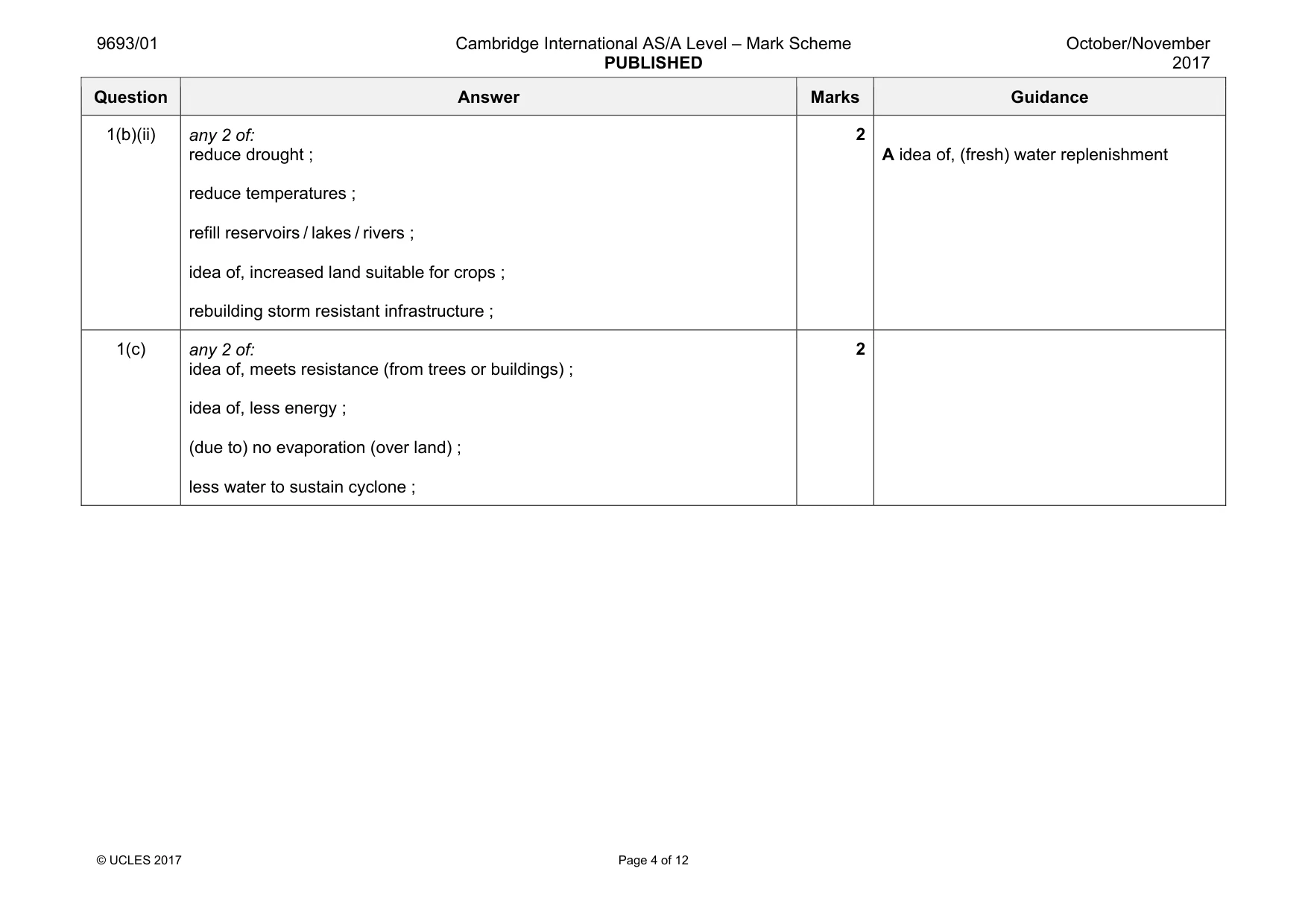
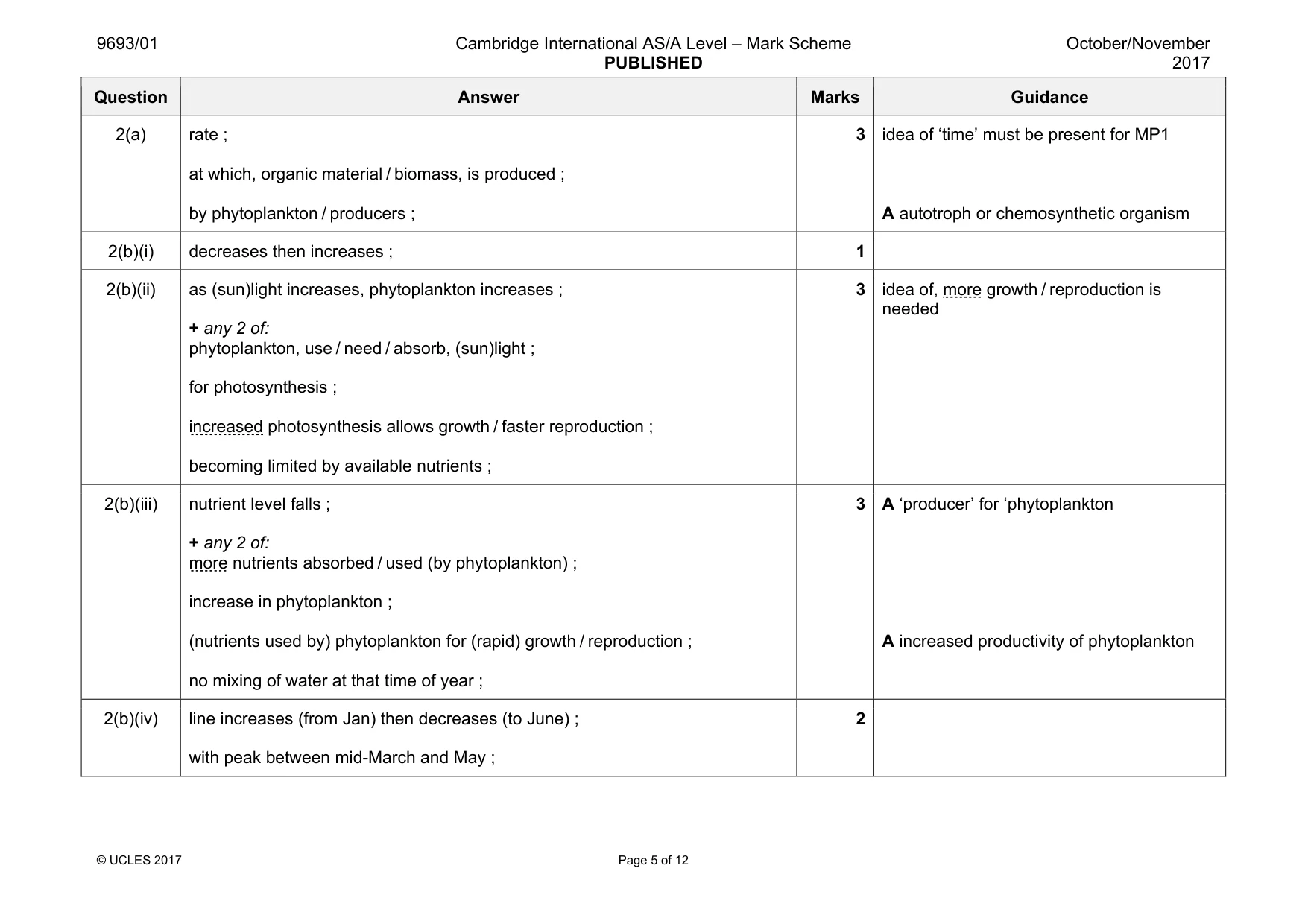
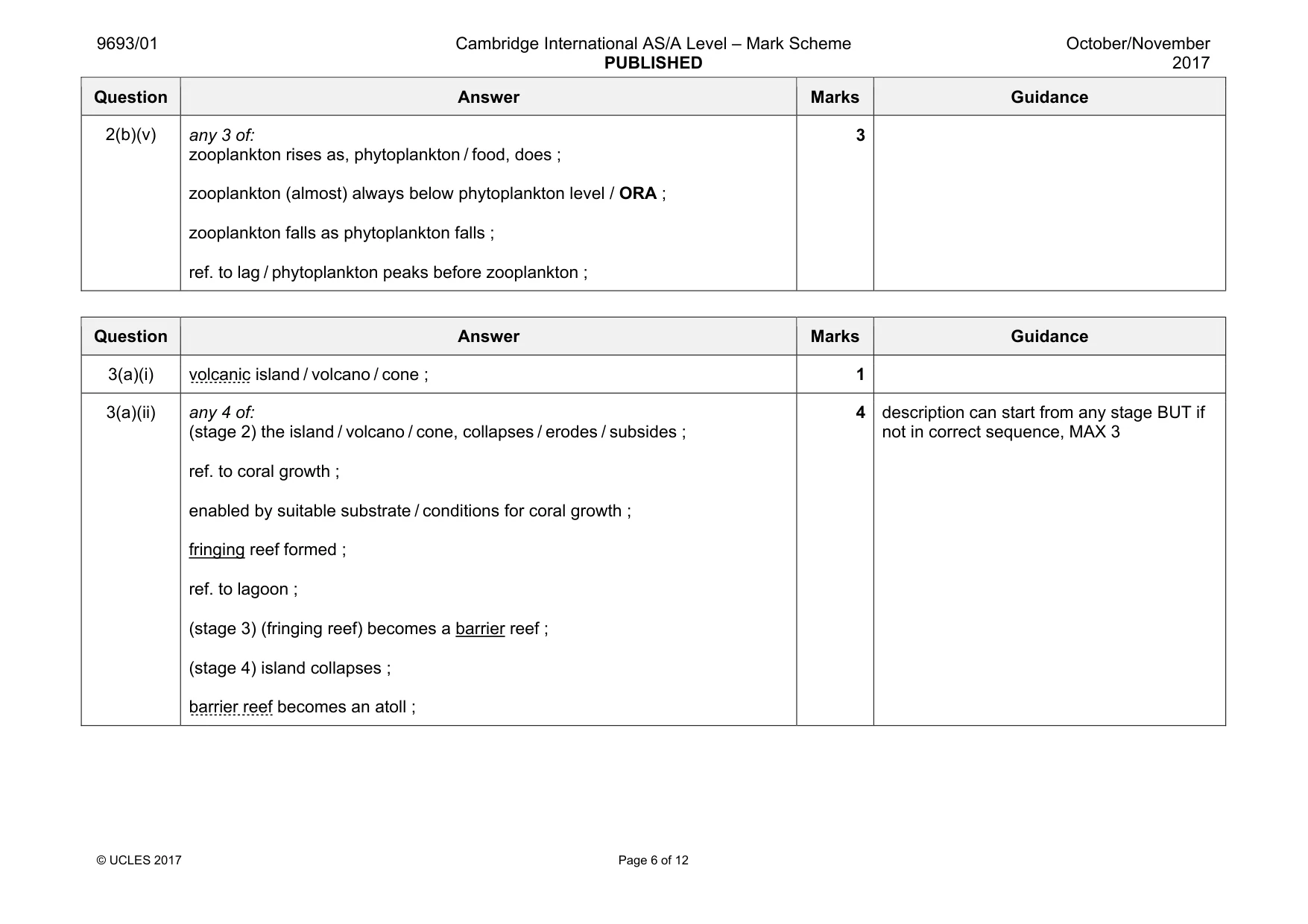
Paper as text
Question paper, page 1
* 2 5 5 4 6 5 6 7 3 2 * This document consists of 16 printed pages and 4 blank pages. DC (ST/SG) 137779/3 © UCLES 2017 [Turn over Cambridge International Examinations Cambridge International Advanced Subsidiary and Advanced Level MARINE SCIENCE 9693/01 Paper 1 AS Structured Questions October/November 2017 1 hour 30 minutes Candidates answer on the Question Paper. No Additional Materials are required. READ THESE INSTRUCTIONS FIRST Write your Centre number, candidate number and name on all the work you hand in. Write in dark blue or black pen. You may use an HB pencil for any diagrams or graphs. Do not use staples, paper clips, glue or correction fluid. DO NOT WRITE IN ANY BARCODES. Answer all questions. Write your answers in the spaces provided on the Question Paper. Electronic calculators may be used. You may lose marks if you do not show your working or if you do not use appropriate units. At the end of the examination, fasten all your work securely together. The number of marks is given in brackets [ ] at the end of each question or part question.
Question paper, page 2
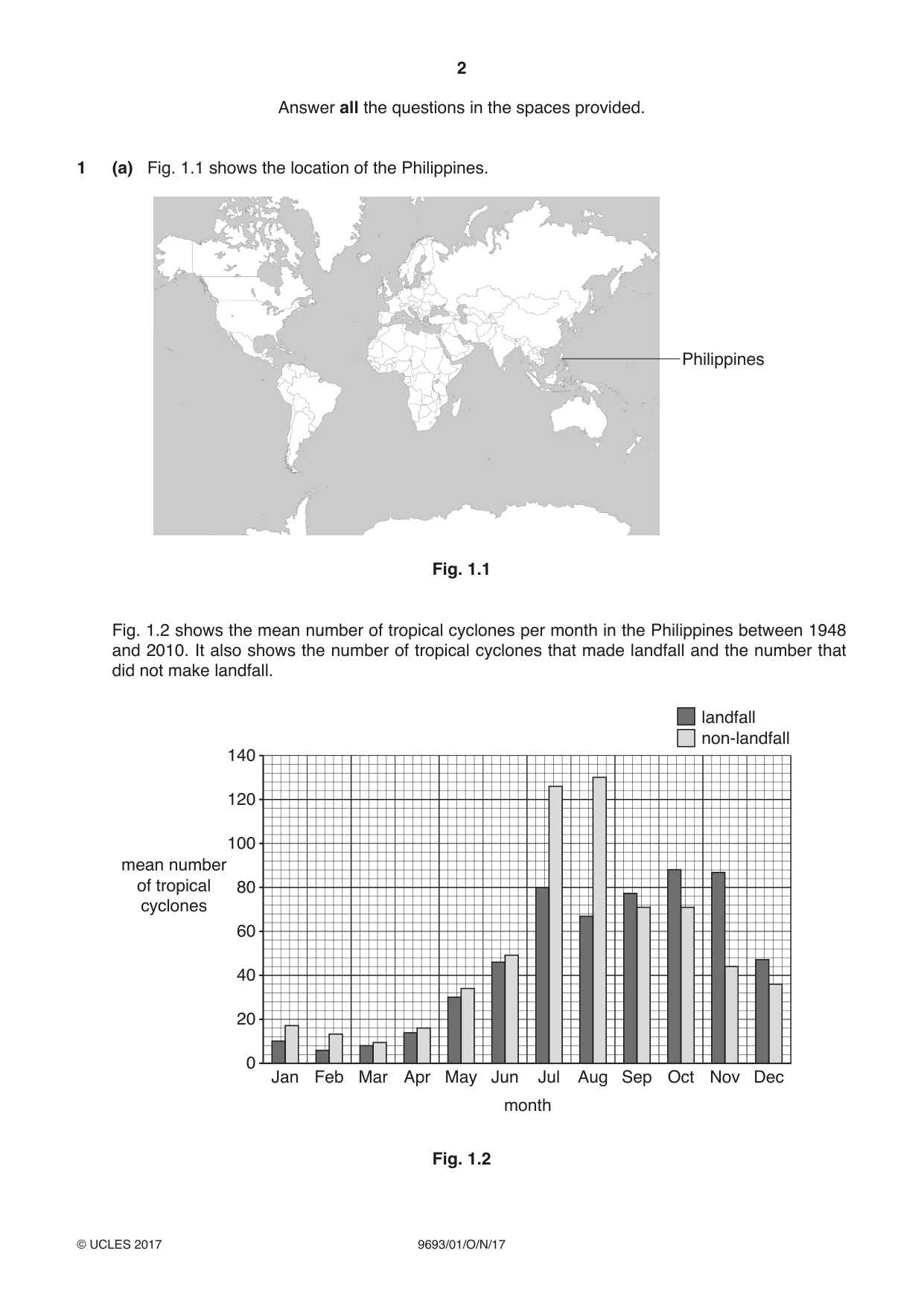
2 9693/01/O/N/17 © UCLES 2017 Answer all the questions in the spaces provided. 1 (a) Fig. 1.1 shows the location of the Philippines. Philippines Fig. 1.1 Fig. 1.2 shows the mean number of tropical cyclones per month in the Philippines between 1948 and 2010. It also shows the number of tropical cyclones that made landfall and the number that did not make landfall. Jan 0 20 40 60 80 100 mean number of tropical cyclones 120 140 Feb Mar Apr May Jun month Jul Aug Sep Oct Nov Dec landfall non-landfall Fig. 1.2
Question paper, page 3
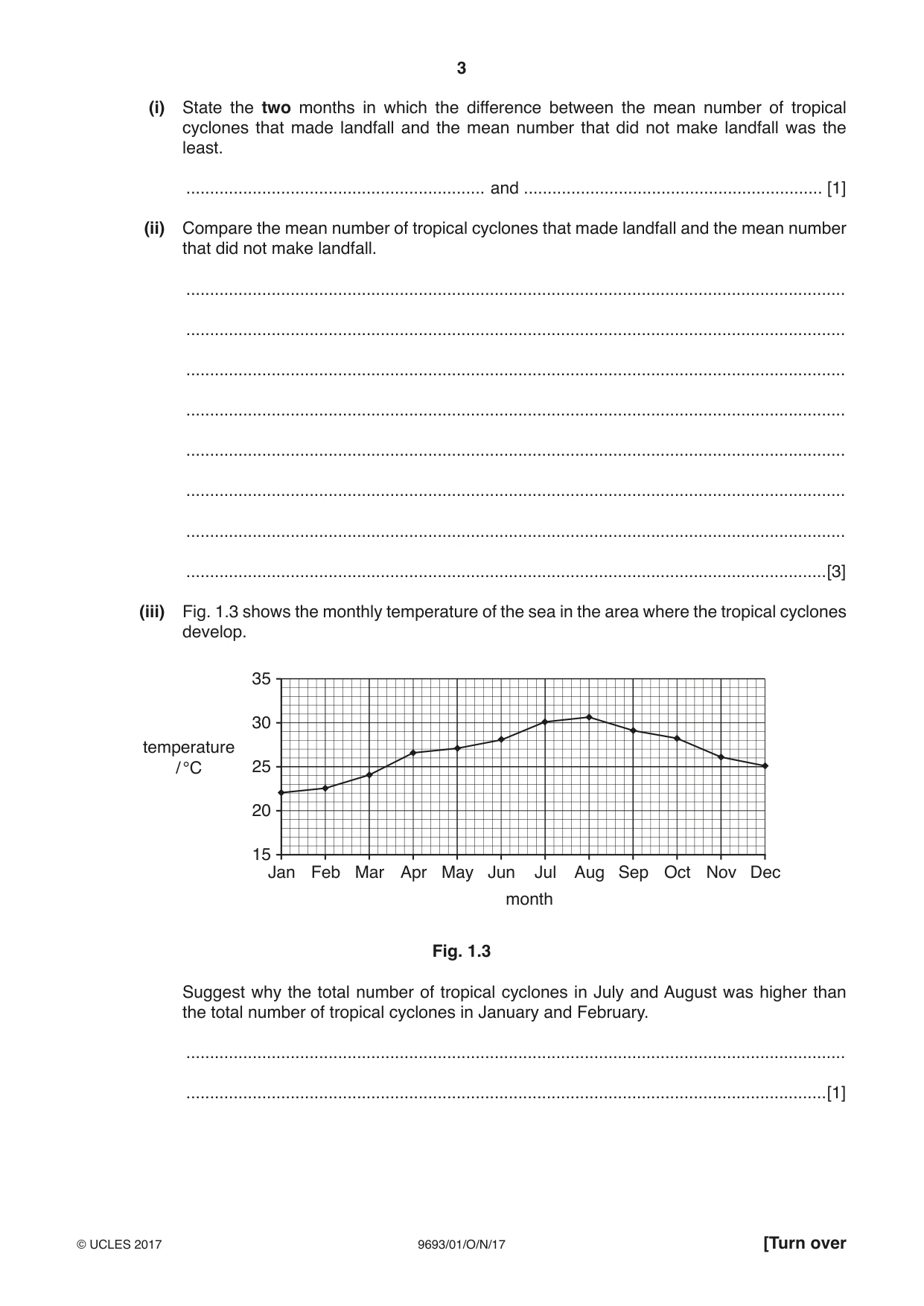
3 9693/01/O/N/17 © UCLES 2017 [Turn over (i) State the two months in which the difference between the mean number of tropical cyclones that made landfall and the mean number that did not make landfall was the least. … and … [1] (ii) Compare the mean number of tropical cyclones that made landfall and the mean number that did not make landfall. … … … … … … … …[3] (iii) Fig. 1.3 shows the monthly temperature of the sea in the area where the tropical cyclones develop. Jan 15 20 25 30 35 Feb Mar Apr May Jun month Jul Aug Sep Oct Nov Dec temperature / °C Fig. 1.3 Suggest why the total number of tropical cyclones in July and August was higher than the total number of tropical cyclones in January and February. … …[1]
Question paper, page 4
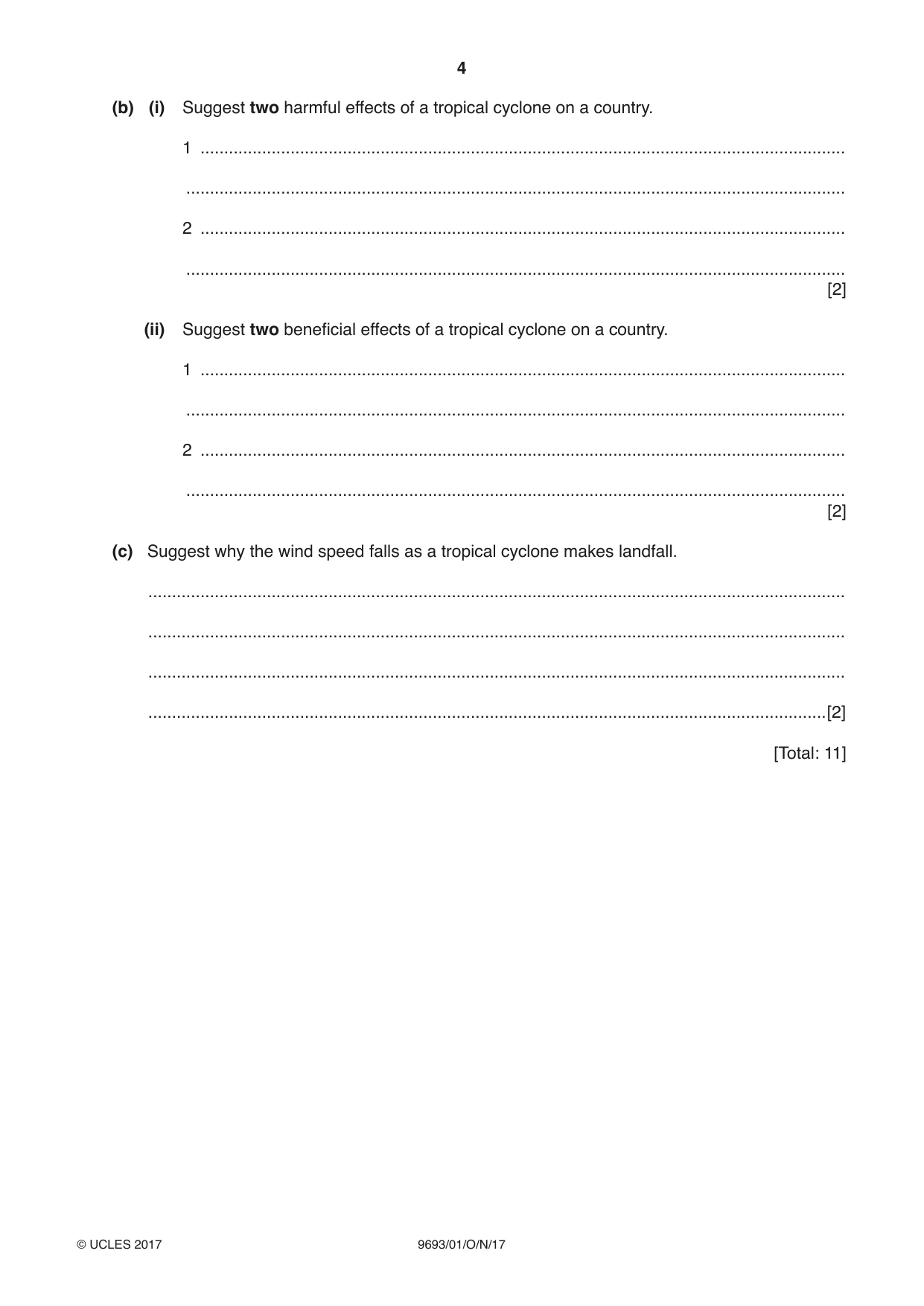
4 9693/01/O/N/17 © UCLES 2017 (b) (i) Suggest two harmful effects of a tropical cyclone on a country. 1 … … 2 … … [2] (ii) Suggest two beneficial effects of a tropical cyclone on a country. 1 … … 2 … … [2] (c) Suggest why the wind speed falls as a tropical cyclone makes landfall. … … … …[2] [Total: 11]
Question paper, page 5
5 9693/01/O/N/17 © UCLES 2017 [Turn over BLANK PAGE
Question paper, page 6
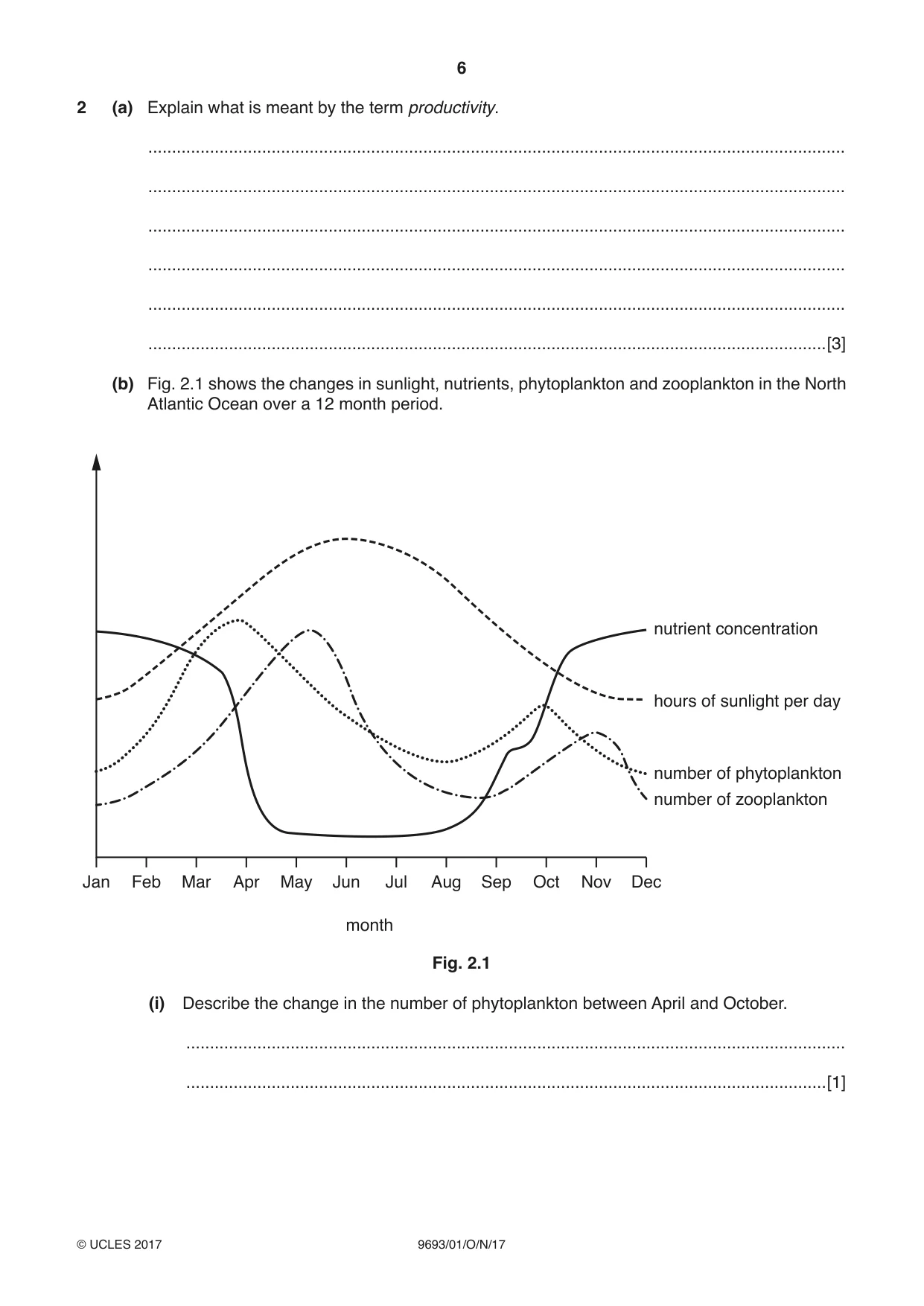
6 9693/01/O/N/17 © UCLES 2017 2 (a) Explain what is meant by the term productivity. … … … … … …[3] (b) Fig. 2.1 shows the changes in sunlight, nutrients, phytoplankton and zooplankton in the North Atlantic Ocean over a 12 month period. Jan Feb Mar Apr May Jun month Jul Aug Sep Oct Nov Dec nutrient concentration hours of sunlight per day number of phytoplankton number of zooplankton Fig. 2.1 (i) Describe the change in the number of phytoplankton between April and October. … …[1]
Question paper, page 7
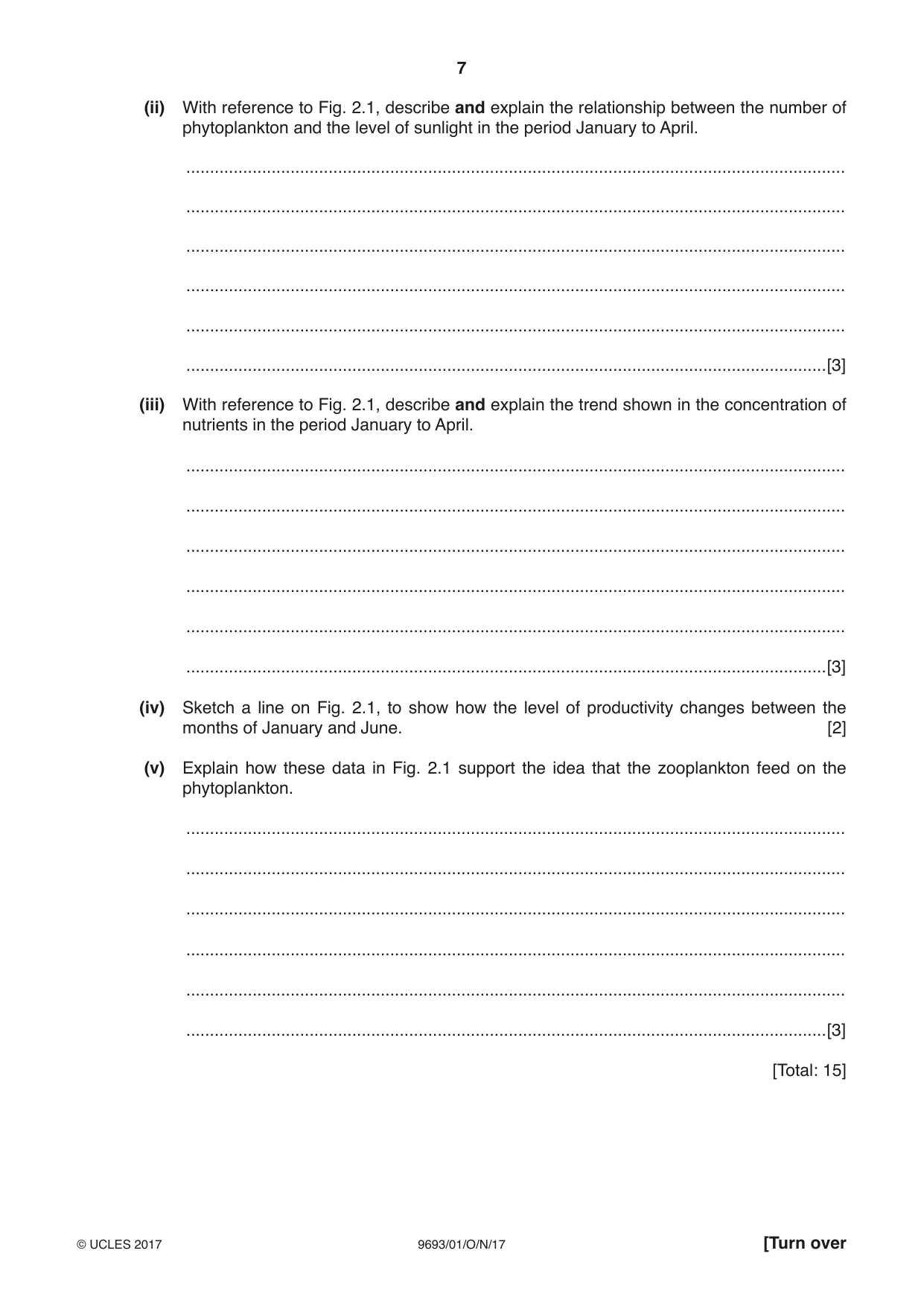
7 9693/01/O/N/17 © UCLES 2017 [Turn over (ii) With reference to Fig. 2.1, describe and explain the relationship between the number of phytoplankton and the level of sunlight in the period January to April. … … … … … …[3] (iii) With reference to Fig. 2.1, describe and explain the trend shown in the concentration of nutrients in the period January to April. … … … … … …[3] (iv) Sketch a line on Fig. 2.1, to show how the level of productivity changes between the months of January and June. [2] (v) Explain how these data in Fig. 2.1 support the idea that the zooplankton feed on the phytoplankton. … … … … … …[3] [Total: 15]
Question paper, page 8
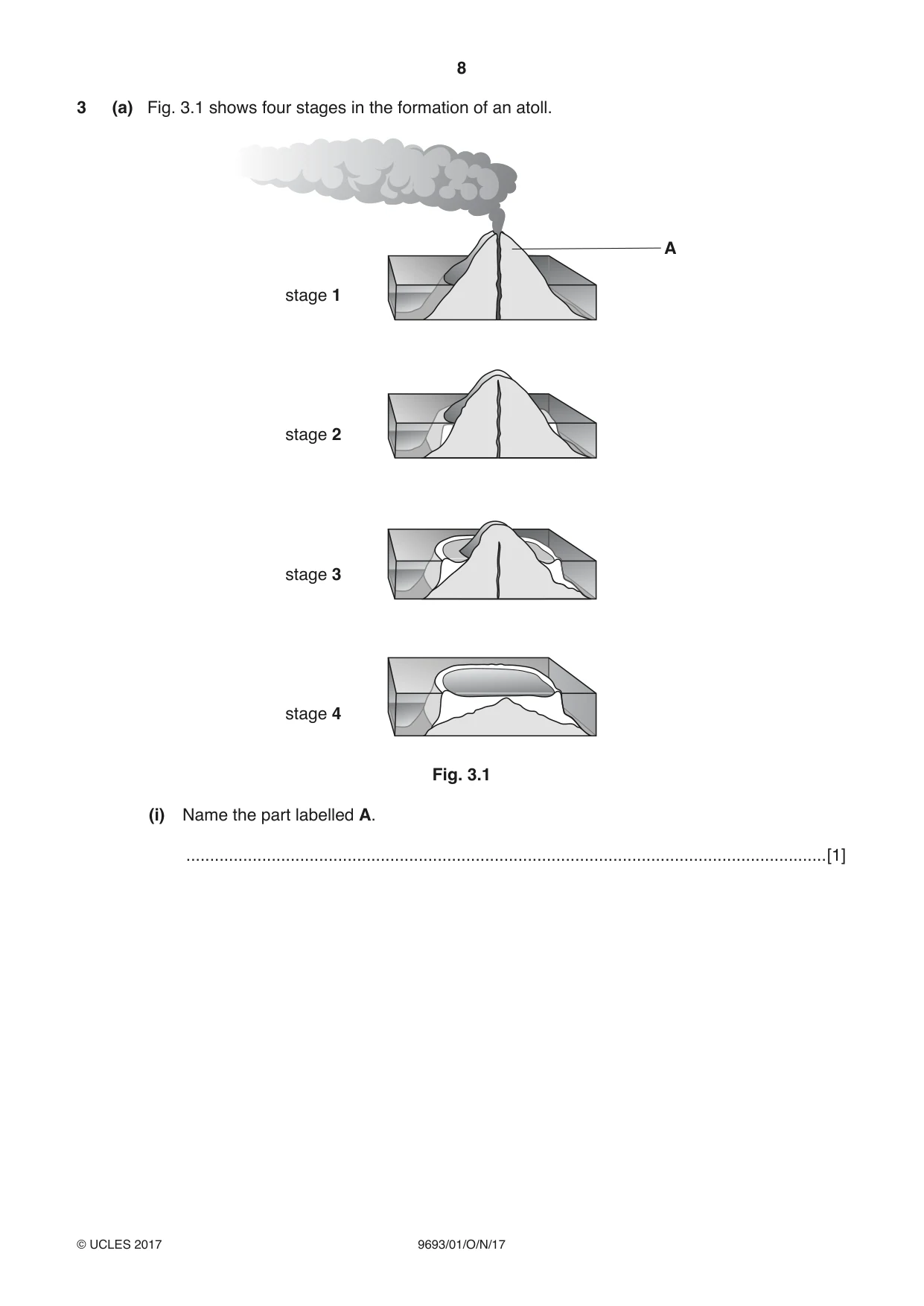
8 9693/01/O/N/17 © UCLES 2017 3 (a) Fig. 3.1 shows four stages in the formation of an atoll. stage 2 stage 3 stage 4 stage 1 A Fig. 3.1 (i) Name the part labelled A. …[1]
Question paper, page 9
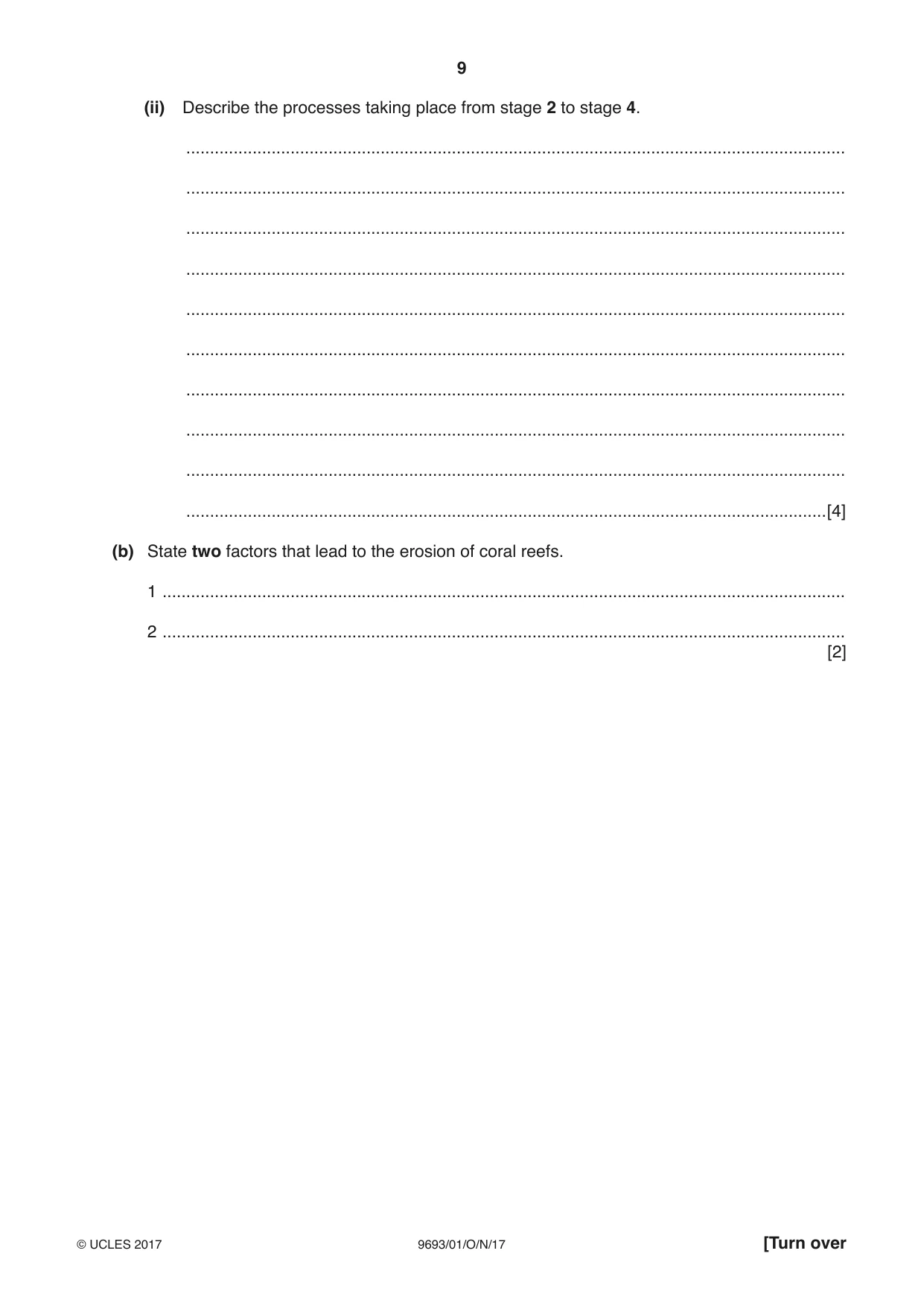
9 9693/01/O/N/17 © UCLES 2017 [Turn over (ii) Describe the processes taking place from stage 2 to stage 4. … … … … … … … … … …[4] (b) State two factors that lead to the erosion of coral reefs. 1 … 2 … [2]
Question paper, page 10
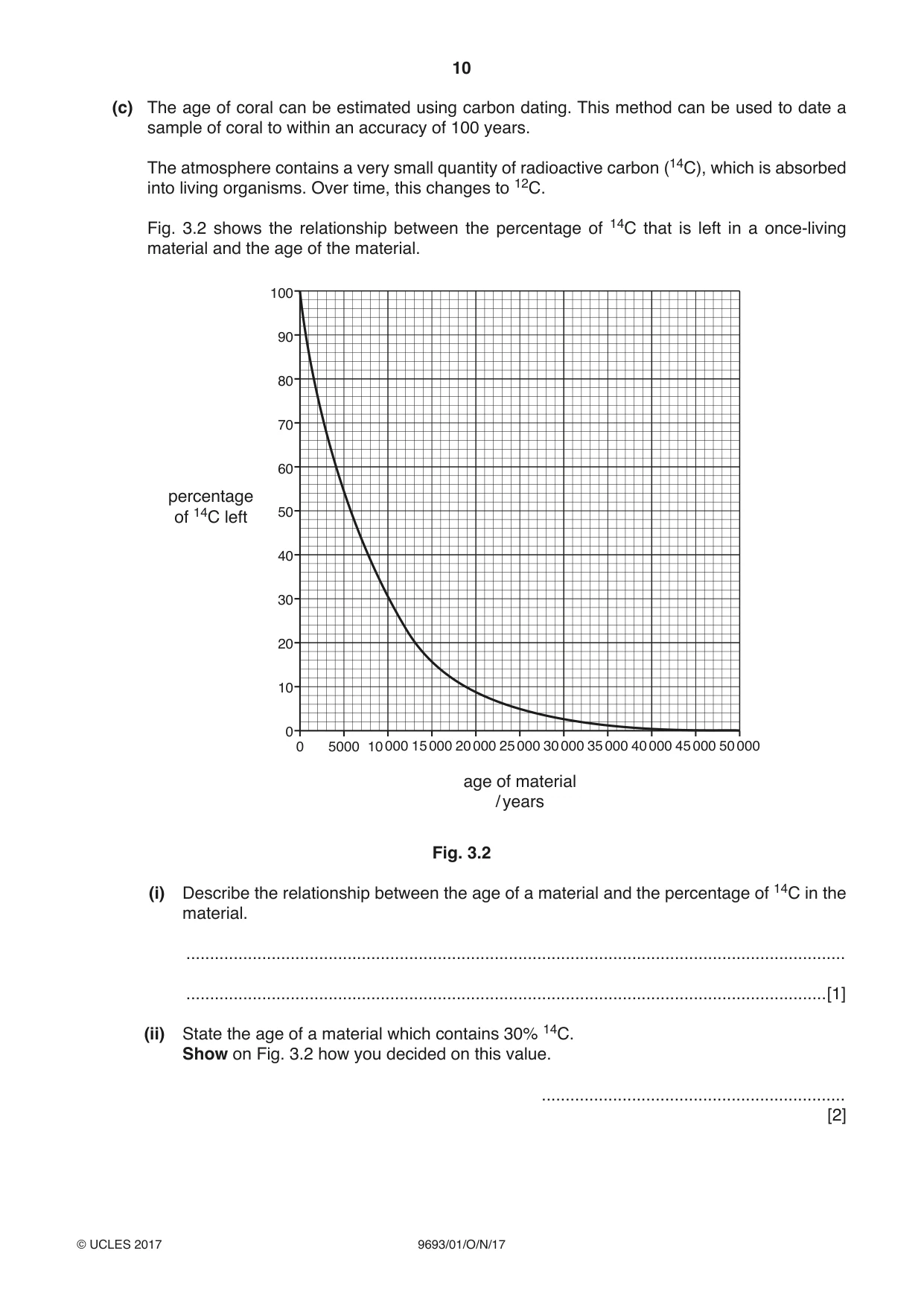
10 9693/01/O/N/17 © UCLES 2017 (c) The age of coral can be estimated using carbon dating. This method can be used to date a sample of coral to within an accuracy of 100 years. The atmosphere contains a very small quantity of radioactive carbon (14C), which is absorbed into living organisms. Over time, this changes to 12C. Fig. 3.2 shows the relationship between the percentage of 14C that is left in a once-living material and the age of the material. 100 90 80 70 60 50 40 30 20 10 0 0 5000 10 000 15 000 20 000 25 000 age of material / years 30 000 35 000 40 000 45 000 50 000 percentage of 14C left Fig. 3.2 (i) Describe the relationship between the age of a material and the percentage of 14C in the material. … …[1] (ii) State the age of a material which contains 30% 14C. Show on Fig. 3.2 how you decided on this value. … [2]
Question paper, page 11
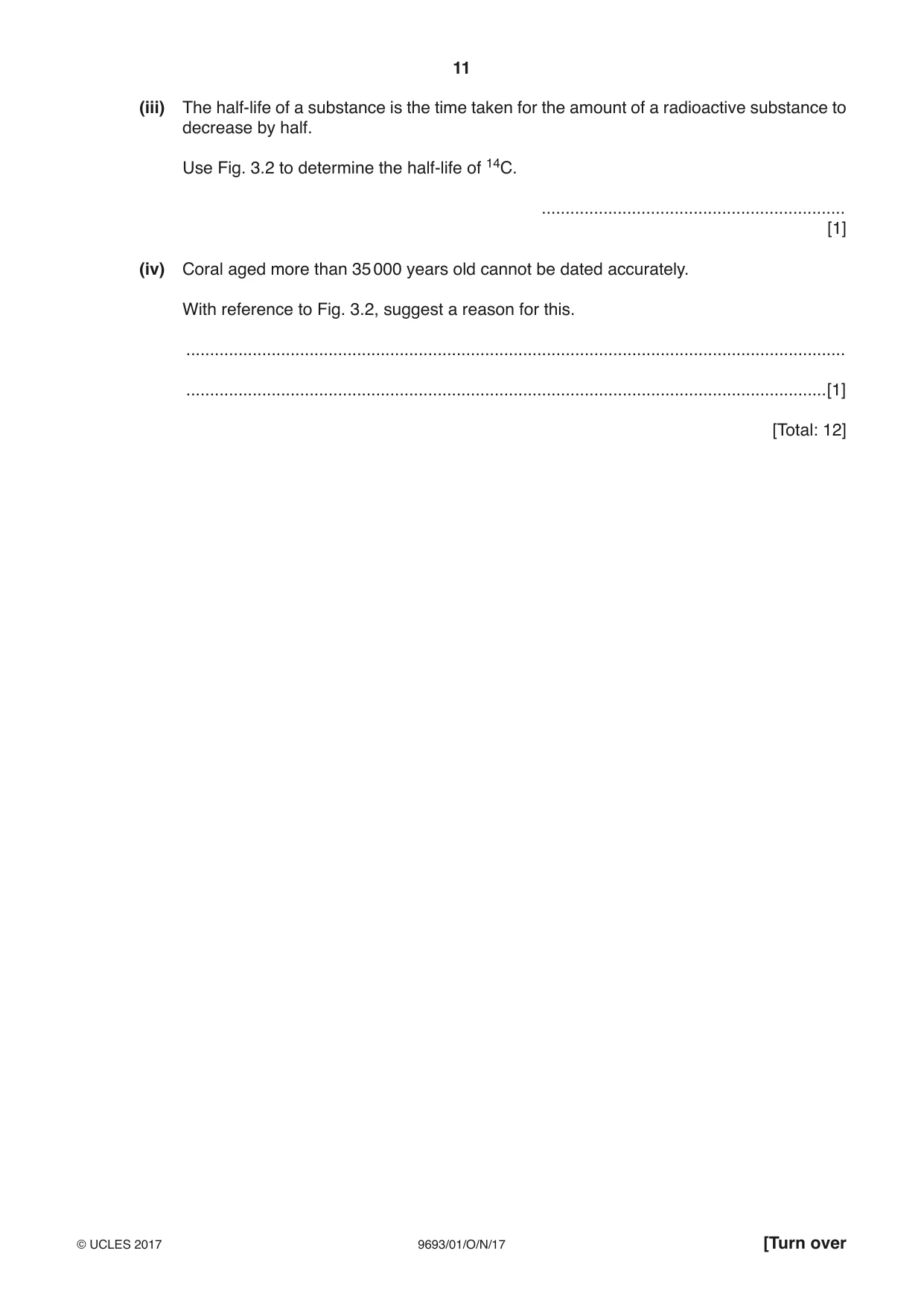
11 9693/01/O/N/17 © UCLES 2017 [Turn over (iii) The half-life of a substance is the time taken for the amount of a radioactive substance to decrease by half. Use Fig. 3.2 to determine the half-life of 14C. … [1] (iv) Coral aged more than 35 000 years old cannot be dated accurately. With reference to Fig. 3.2, suggest a reason for this. … …[1] [Total: 12]
Question paper, page 12
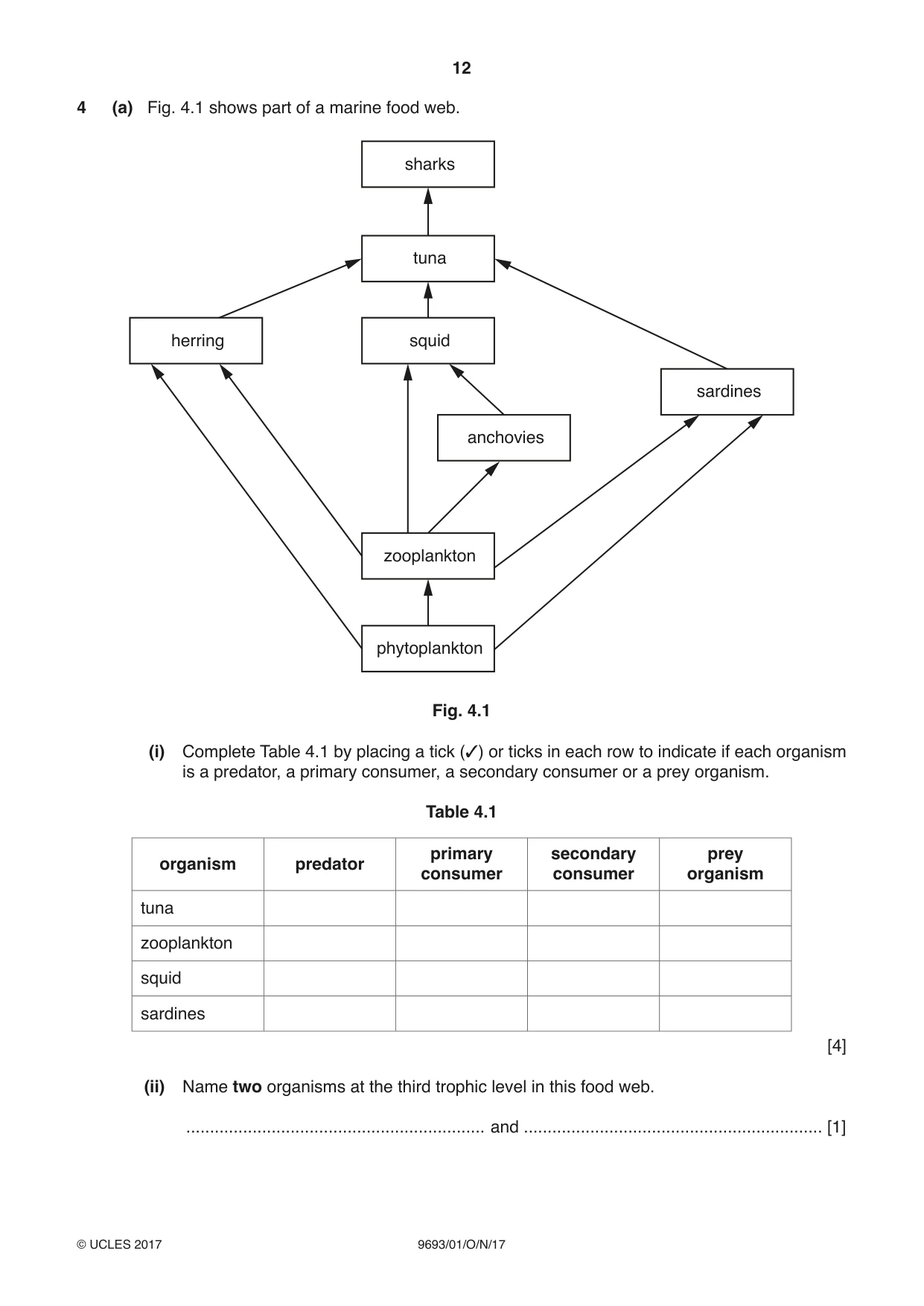
12 9693/01/O/N/17 © UCLES 2017 4 (a) Fig. 4.1 shows part of a marine food web. sharks tuna squid herring anchovies sardines zooplankton phytoplankton Fig. 4.1 (i) Complete Table 4.1 by placing a tick (3) or ticks in each row to indicate if each organism is a predator, a primary consumer, a secondary consumer or a prey organism. Table 4.1 organism predator primary consumer secondary consumer prey organism tuna zooplankton squid sardines [4] (ii) Name two organisms at the third trophic level in this food web. … and … [1]
Question paper, page 13
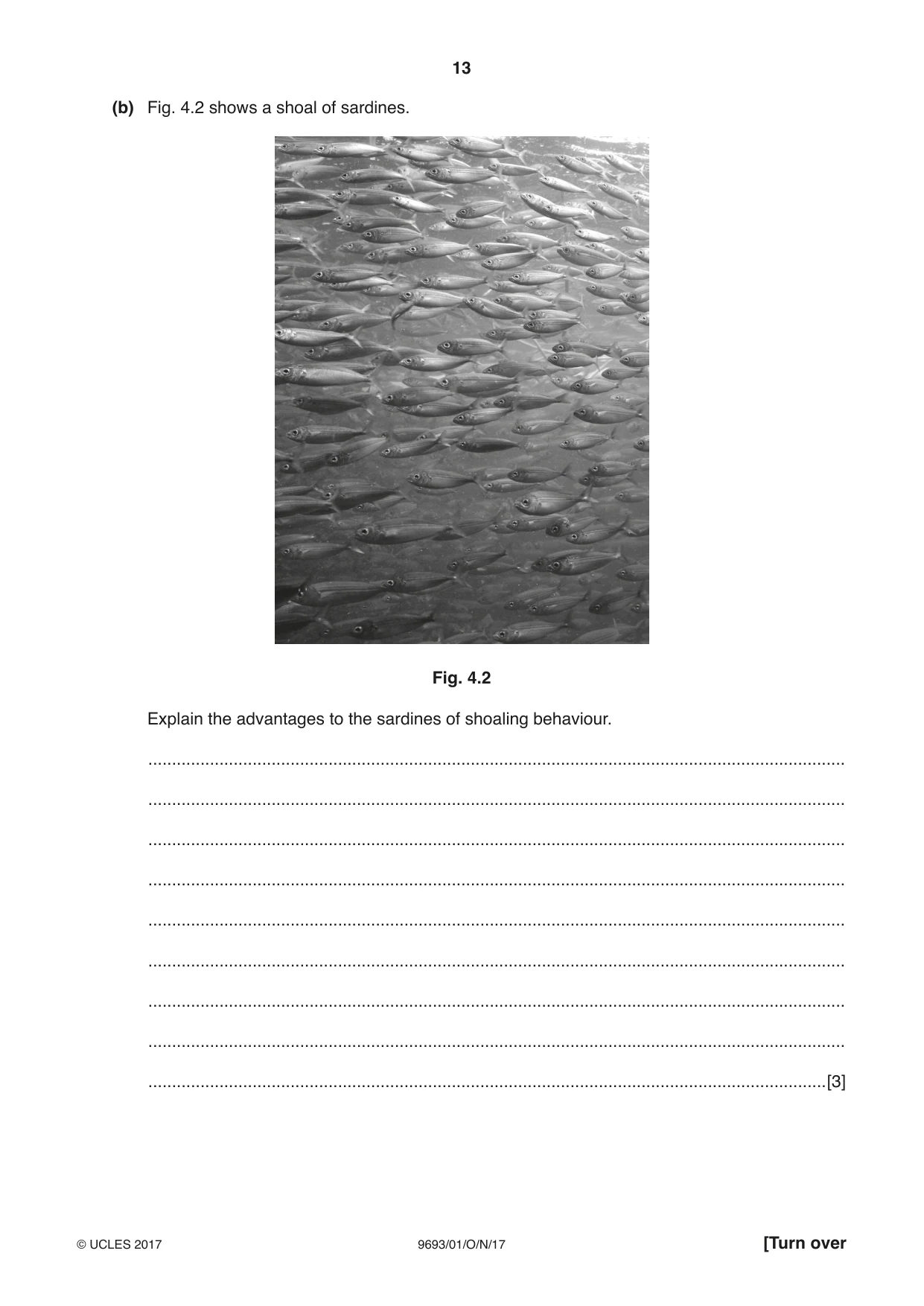
13 9693/01/O/N/17 © UCLES 2017 [Turn over (b) Fig. 4.2 shows a shoal of sardines. Fig. 4.2 Explain the advantages to the sardines of shoaling behaviour. … … … … … … … … …[3]
Question paper, page 14
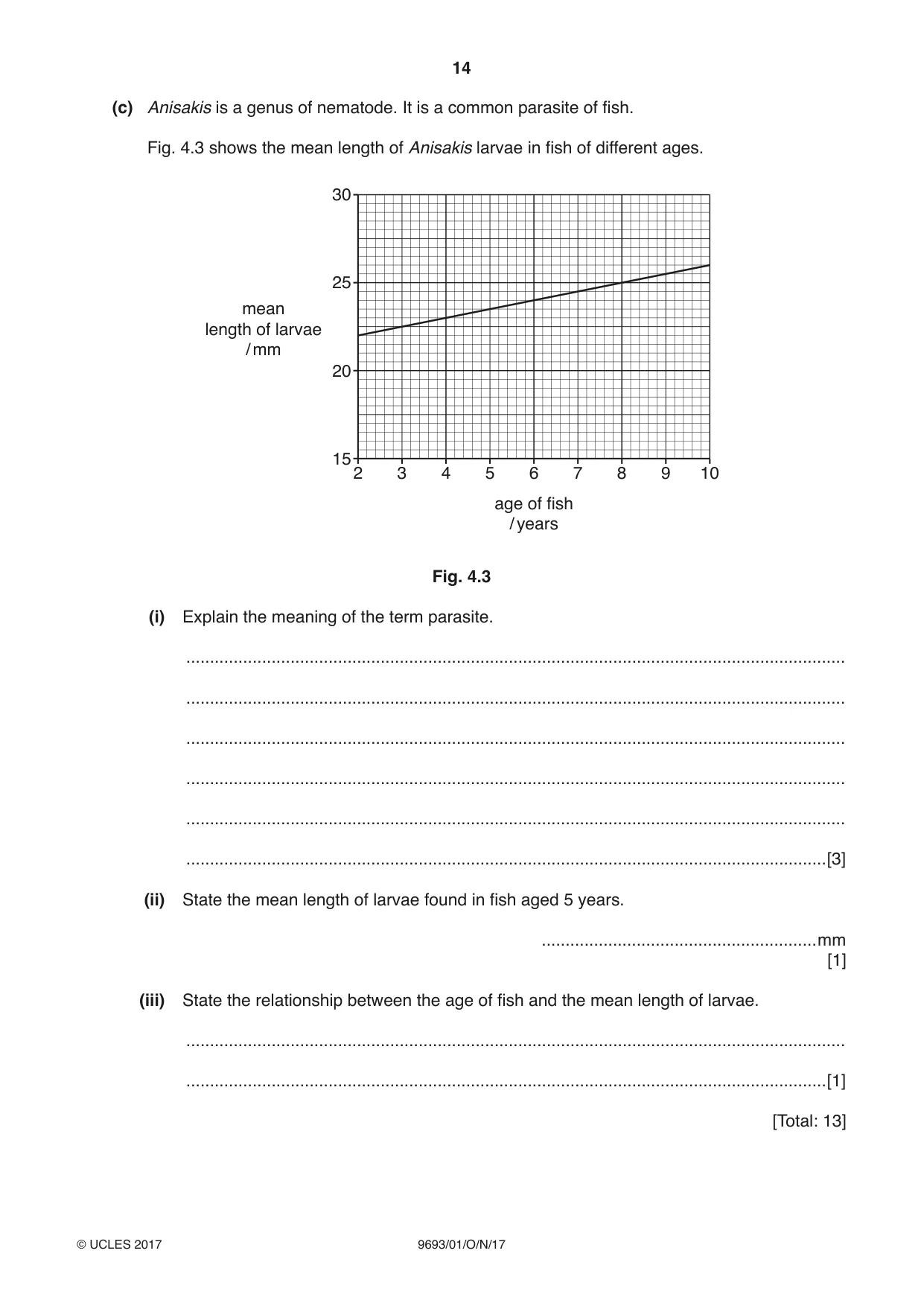
14 9693/01/O/N/17 © UCLES 2017 (c) Anisakis is a genus of nematode. It is a common parasite of fish. Fig. 4.3 shows the mean length of Anisakis larvae in fish of different ages. 2 3 4 5 6 age of fish / years 7 8 9 10 30 25 20 15 mean length of larvae / mm Fig. 4.3 (i) Explain the meaning of the term parasite. … … … … … …[3] (ii) State the mean length of larvae found in fish aged 5 years. …mm [1] (iii) State the relationship between the age of fish and the mean length of larvae. … …[1] [Total: 13]
Question paper, page 15
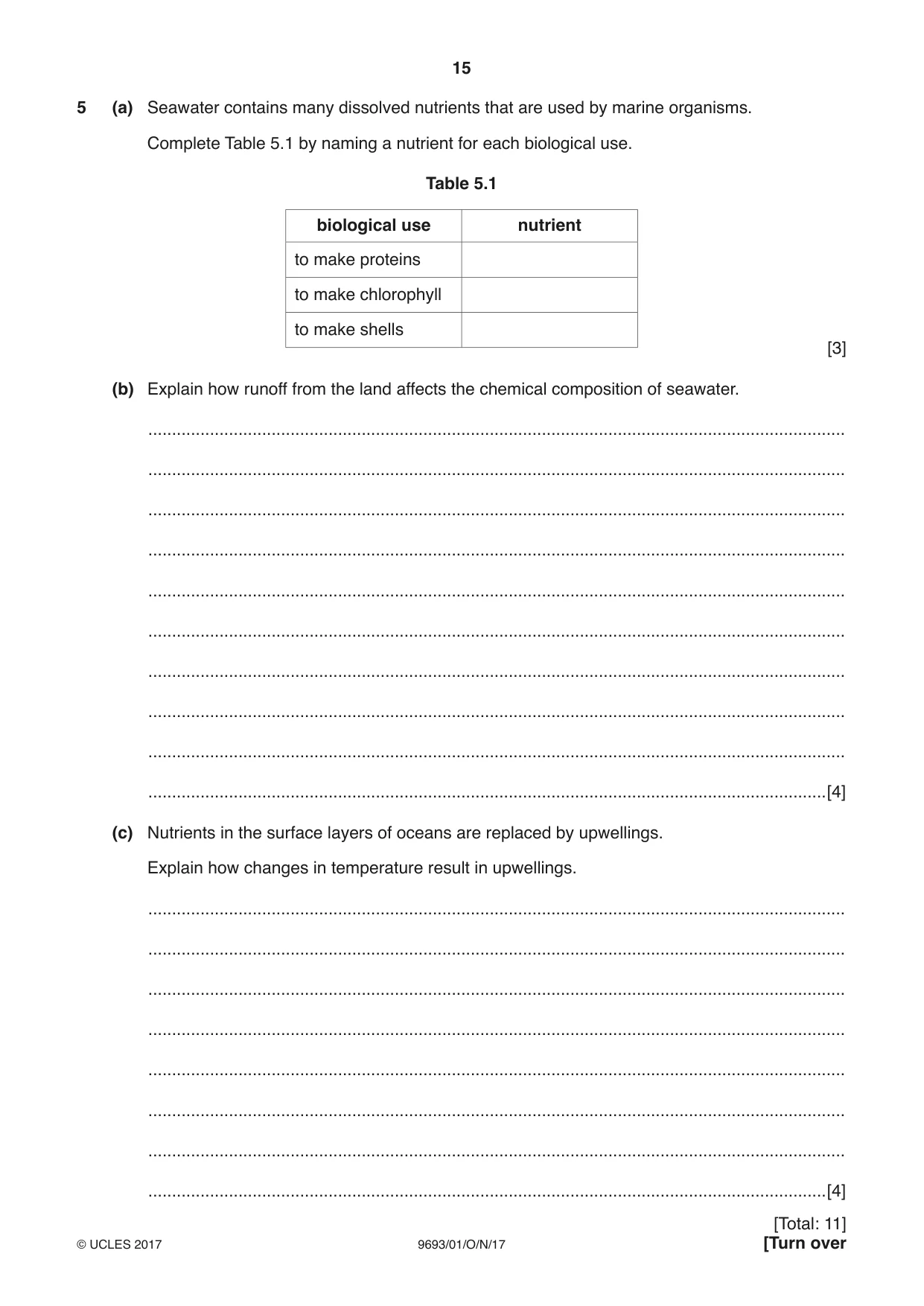
15 9693/01/O/N/17 © UCLES 2017 [Turn over 5 (a) Seawater contains many dissolved nutrients that are used by marine organisms. Complete Table 5.1 by naming a nutrient for each biological use. Table 5.1 biological use nutrient to make proteins to make chlorophyll to make shells [3] (b) Explain how runoff from the land affects the chemical composition of seawater. … … … … … … … … … …[4] (c) Nutrients in the surface layers of oceans are replaced by upwellings. Explain how changes in temperature result in upwellings. … … … … … … … …[4] [Total: 11]
Question paper, page 16
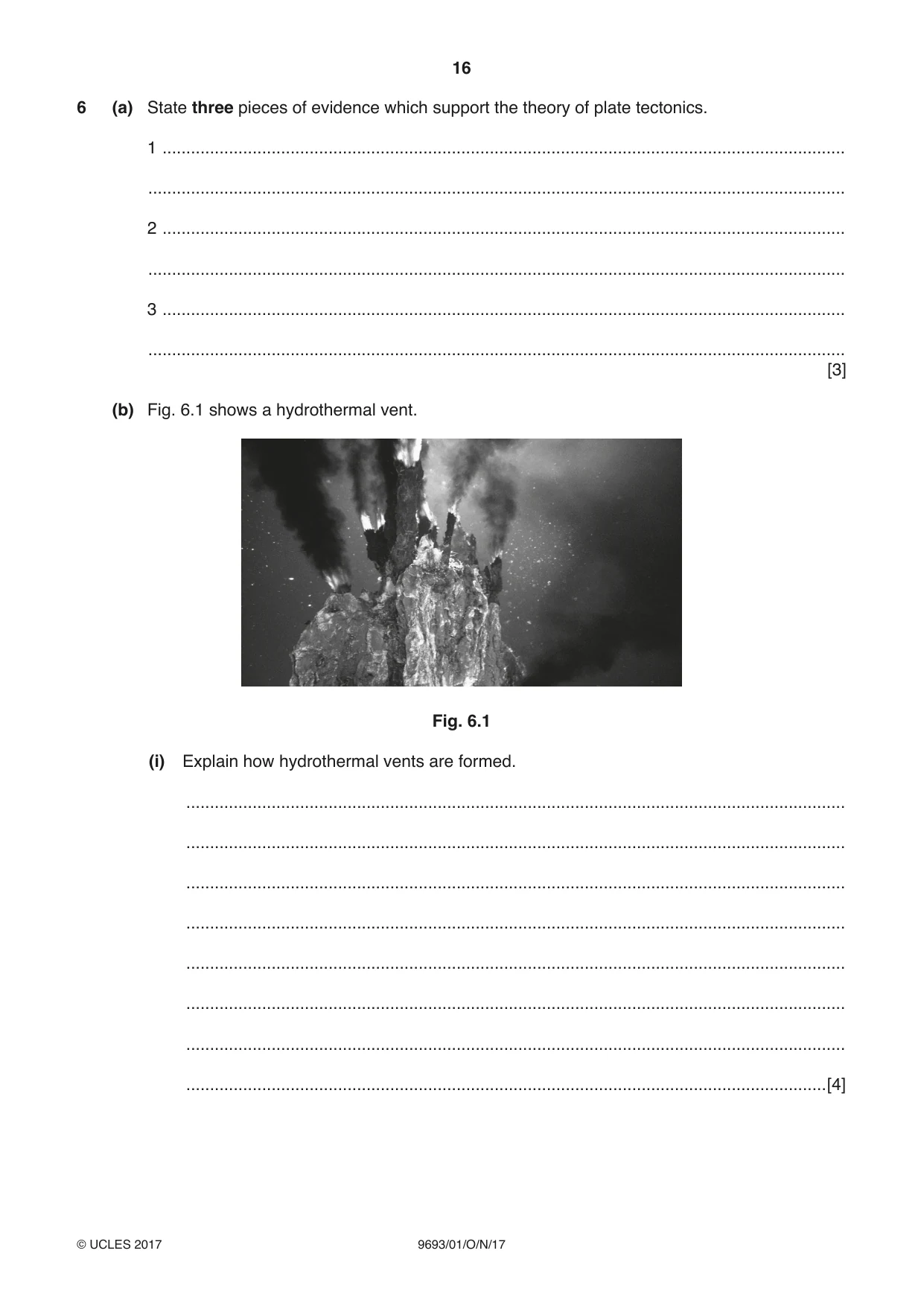
16 9693/01/O/N/17 © UCLES 2017 6 (a) State three pieces of evidence which support the theory of plate tectonics. 1 … … 2 … … 3 … … [3] (b) Fig. 6.1 shows a hydrothermal vent. Fig. 6.1 (i) Explain how hydrothermal vents are formed. … … … … … … … …[4]
Question paper, page 17
17 9693/01/O/N/17 © UCLES 2017 (ii) Suggest how conditions at a hydrothermal vent make it impossible for plants to grow. … … … … … …[3] (iii) Hydrothermal vents sustain many food chains. Describe the process that is used by organisms found at hydrothermal vents to provide energy for these food chains. … … … … … … [3] [Total: 13]
Question paper, page 18
18 9693/01/O/N/17 © UCLES 2017 BLANK PAGE
Question paper, page 19
19 9693/01/O/N/17 © UCLES 2017 BLANK PAGE
Question paper, page 20
20 9693/01/O/N/17 © UCLES 2017 Permission to reproduce items where third-party owned material protected by copyright is included has been sought and cleared where possible. Every reasonable effort has been made by the publisher (UCLES) to trace copyright holders, but if any items requiring clearance have unwittingly been included, the publisher will be pleased to make amends at the earliest possible opportunity. To avoid the issue of disclosure of answer-related information to candidates, all copyright acknowledgements are reproduced online in the Cambridge International Examinations Copyright Acknowledgements Booklet. This is produced for each series of examinations and is freely available to download at www.cie.org.uk after the live examination series. Cambridge International Examinations is part of the Cambridge Assessment Group. Cambridge Assessment is the brand name of University of Cambridge Local Examinations Syndicate (UCLES), which is itself a department of the University of Cambridge. BLANK PAGE
Mark scheme, page 1
® IGCSE is a registered trademark. This document consists of 12 printed pages. © UCLES 2017 [Turn over Cambridge Assessment International Education Cambridge International Advanced Subsidiary and Advanced Level MARINE SCIENCE 9693/01 Paper 1 AS Structured Questions October/November 2017 MARK SCHEME Maximum Mark: 75 Published This mark scheme is published as an aid to teachers and candidates, to indicate the requirements of the examination. It shows the basis on which Examiners were instructed to award marks. It does not indicate the details of the discussions that took place at an Examiners’ meeting before marking began, which would have considered the acceptability of alternative answers. Mark schemes should be read in conjunction with the question paper and the Principal Examiner Report for Teachers. Cambridge International will not enter into discussions about these mark schemes. Cambridge International is publishing the mark schemes for the October/November 2017 series for most Cambridge IGCSE®, Cambridge International A and AS Level components and some Cambridge O Level components.
Mark scheme, page 2
9693/01 Cambridge International AS/A Level – Mark Scheme PUBLISHED October/November 2017 © UCLES 2017 Page 2 of 12 This mark scheme will use the following abbreviations: ; separates marking points / separates alternatives within a marking point () contents of brackets are not required but should be implied / the contents set the context of the answer R reject A accept (answers that are correctly cued by the question or guidance you have received) I ignore (mark as if this material was not present) AW alternative wording (where responses vary more than usual, accept other ways of expressing the same idea) AVP alternative valid point (where a greater than usual variety of responses is expected) ORA or reverse argument underline actual word underlined must be used by the candidate (grammatical variants excepted) MAX indicates the maximum number of marks that can be awarded + statements on both sides of the + are needed for that mark OR separates two different routes to a mark point and only one should be awarded ECF error carried forward (credit an operation from a previous incorrect response)
Mark scheme, page 3
9693/01 Cambridge International AS/A Level – Mark Scheme PUBLISHED October/November 2017 © UCLES 2017 Page 3 of 12 Question Answer Marks Guidance 1(a)(i) March AND April ; 1 1(a)(ii) any 3 of: Jan to Aug – non-landfall higher each month / ORA ; Sep to Dec – landfall higher each month / ORA ; smallest difference in March ; greatest difference in August ; AVP ; 3 any valid comparison 1(a)(iii) (seas) warm enough in July and Aug / ORA ; OR convergence of trade winds in July (in Philippine Sea) ; 1 ‘hot air’ unqualified is insufficient 1(b)(i) any 2 of: destroy crops ; cause floods ; physical damage to buildings / infrastructure / example of ; deaths ; (coastal) erosion ; disruption of economic activity ; 2
Mark scheme, page 4
9693/01 Cambridge International AS/A Level – Mark Scheme PUBLISHED October/November 2017 © UCLES 2017 Page 4 of 12 Question Answer Marks Guidance 1(b)(ii) any 2 of: reduce drought ; reduce temperatures ; refill reservoirs / lakes / rivers ; idea of, increased land suitable for crops ; rebuilding storm resistant infrastructure ; 2 A idea of, (fresh) water replenishment 1(c) any 2 of: idea of, meets resistance (from trees or buildings) ; idea of, less energy ; (due to) no evaporation (over land) ; less water to sustain cyclone ; 2
Mark scheme, page 5
9693/01 Cambridge International AS/A Level – Mark Scheme PUBLISHED October/November 2017 © UCLES 2017 Page 5 of 12 Question Answer Marks Guidance 2(a) rate ; at which, organic material / biomass, is produced ; by phytoplankton / producers ; 3 idea of ‘time’ must be present for MP1 A autotroph or chemosynthetic organism 2(b)(i) decreases then increases ; 1 2(b)(ii) as (sun)light increases, phytoplankton increases ; + any 2 of: phytoplankton, use / need / absorb, (sun)light ; for photosynthesis ; increased photosynthesis allows growth / faster reproduction ; becoming limited by available nutrients ; 3 idea of, more growth / reproduction is needed 2(b)(iii) nutrient level falls ; + any 2 of: more nutrients absorbed / used (by phytoplankton) ; increase in phytoplankton ; (nutrients used by) phytoplankton for (rapid) growth / reproduction ; no mixing of water at that time of year ; 3 A ‘producer’ for ‘phytoplankton A increased productivity of phytoplankton 2(b)(iv) line increases (from Jan) then decreases (to June) ; with peak between mid-March and May ; 2
Mark scheme, page 6
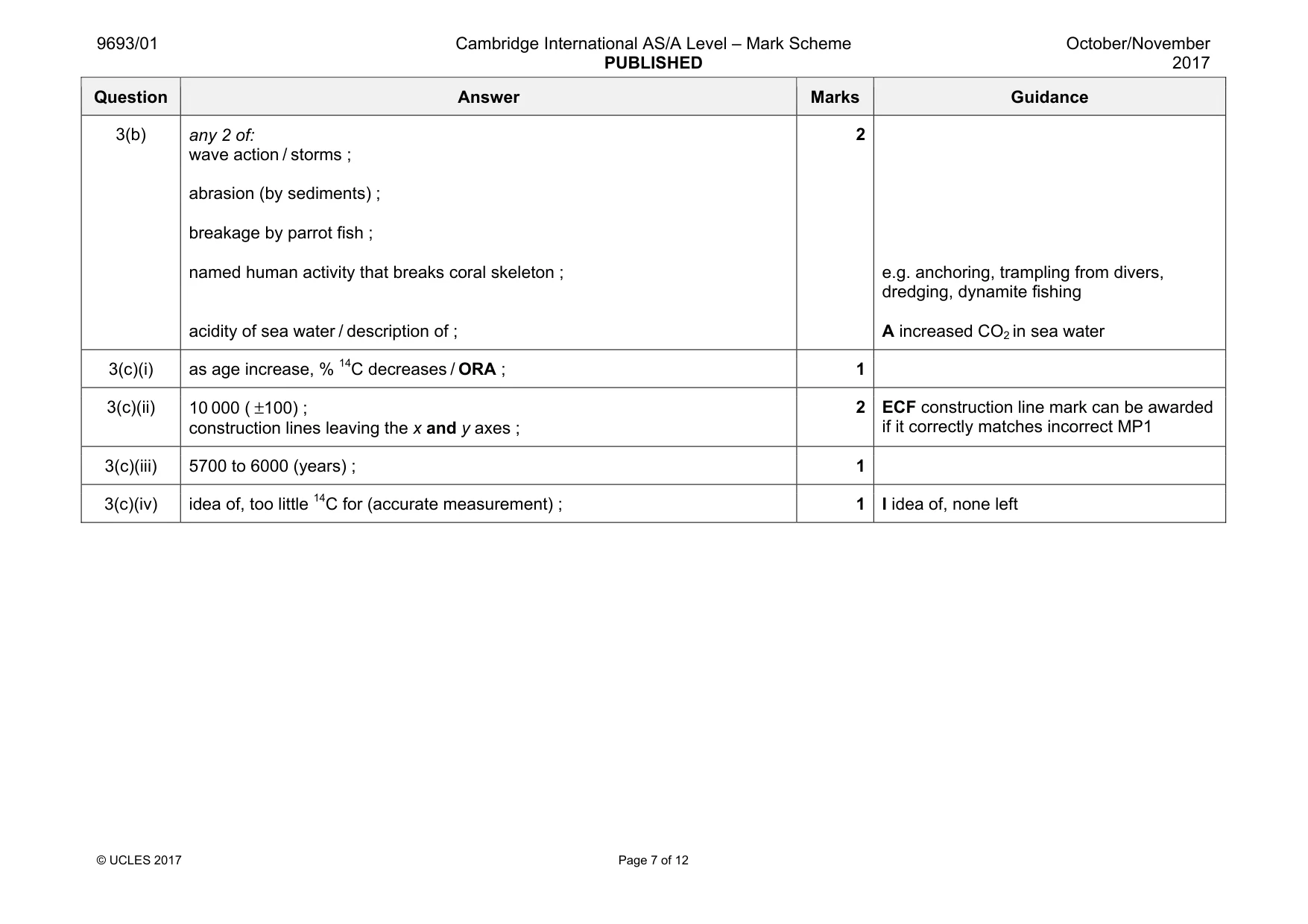
9693/01 Cambridge International AS/A Level – Mark Scheme PUBLISHED October/November 2017 © UCLES 2017 Page 6 of 12 Question Answer Marks Guidance 2(b)(v) any 3 of: zooplankton rises as, phytoplankton / food, does ; zooplankton (almost) always below phytoplankton level / ORA ; zooplankton falls as phytoplankton falls ; ref. to lag / phytoplankton peaks before zooplankton ; 3 Question Answer Marks Guidance 3(a)(i) volcanic island / volcano / cone ; 1 3(a)(ii) any 4 of: (stage 2) the island / volcano / cone, collapses / erodes / subsides ; ref. to coral growth ; enabled by suitable substrate / conditions for coral growth ; fringing reef formed ; ref. to lagoon ; (stage 3) (fringing reef) becomes a barrier reef ; (stage 4) island collapses ; barrier reef becomes an atoll ; 4 description can start from any stage BUT if not in correct sequence, MAX 3
Mark scheme, page 7
9693/01 Cambridge International AS/A Level – Mark Scheme PUBLISHED October/November 2017 © UCLES 2017 Page 7 of 12 Question Answer Marks Guidance 3(b) any 2 of: wave action / storms ; abrasion (by sediments) ; breakage by parrot fish ; named human activity that breaks coral skeleton ; acidity of sea water / description of ; 2 e.g. anchoring, trampling from divers, dredging, dynamite fishing A increased CO2 in sea water 3(c)(i) as age increase, % 14C decreases / ORA ; 1 3(c)(ii) 10 000 ( ±100) ; construction lines leaving the x and y axes ; 2 ECF construction line mark can be awarded if it correctly matches incorrect MP1 3(c)(iii) 5700 to 6000 (years) ; 1 3(c)(iv) idea of, too little 14C for (accurate measurement) ; 1 I idea of, none left
Mark scheme, page 8
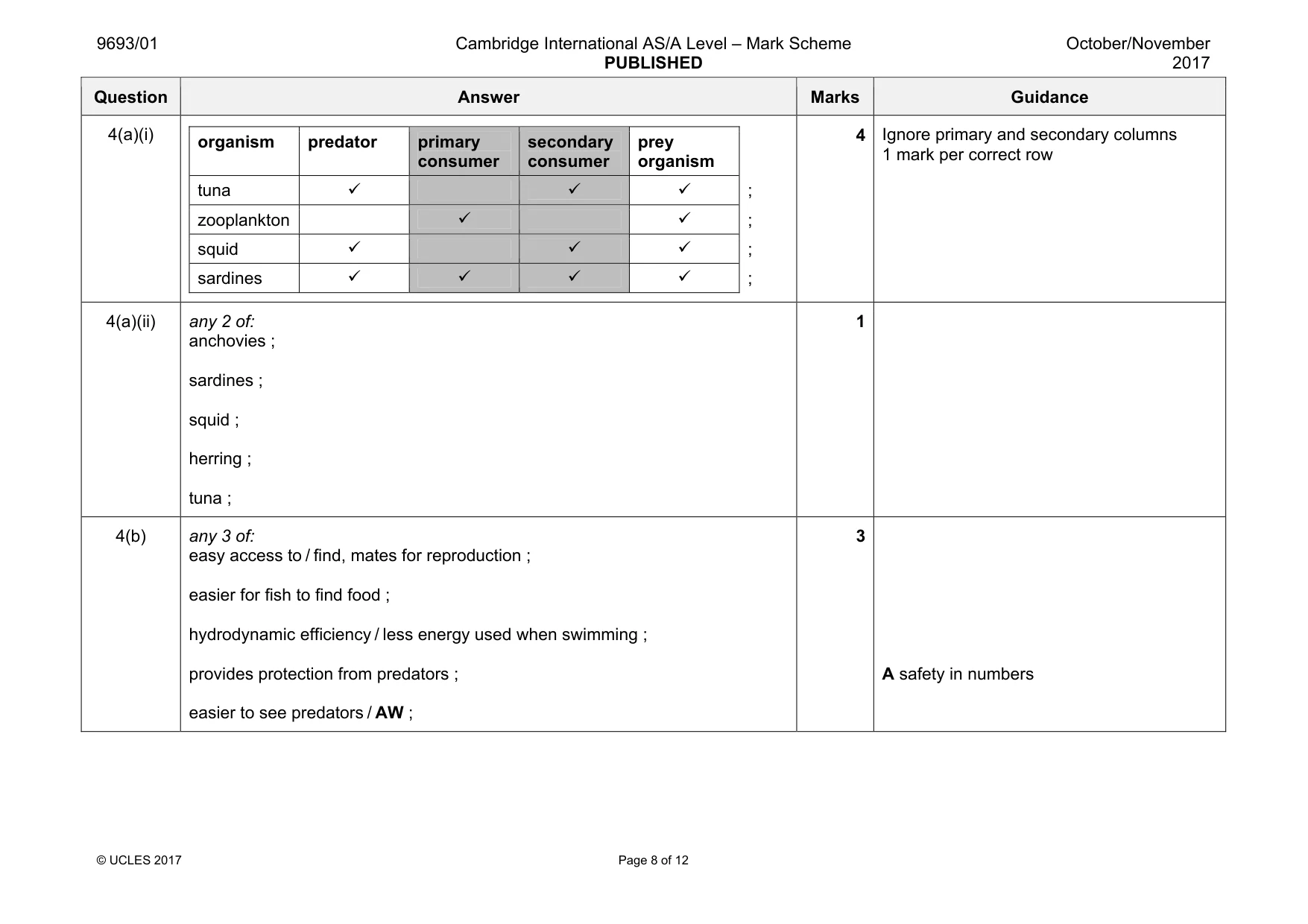
9693/01 Cambridge International AS/A Level – Mark Scheme PUBLISHED October/November 2017 © UCLES 2017 Page 8 of 12 Question Answer Marks Guidance 4(a)(i) organism predator primary consumer secondary consumer prey organism tuna 9 9 9 ; zooplankton 9 9 ; squid 9 9 9 ; sardines 9 9 9 9 ; 4 Ignore primary and secondary columns 1 mark per correct row 4(a)(ii) any 2 of: anchovies ; sardines ; squid ; herring ; tuna ; 1 4(b) any 3 of: easy access to / find, mates for reproduction ; easier for fish to find food ; hydrodynamic efficiency / less energy used when swimming ; provides protection from predators ; easier to see predators / AW ; 3 A safety in numbers
Mark scheme, page 9
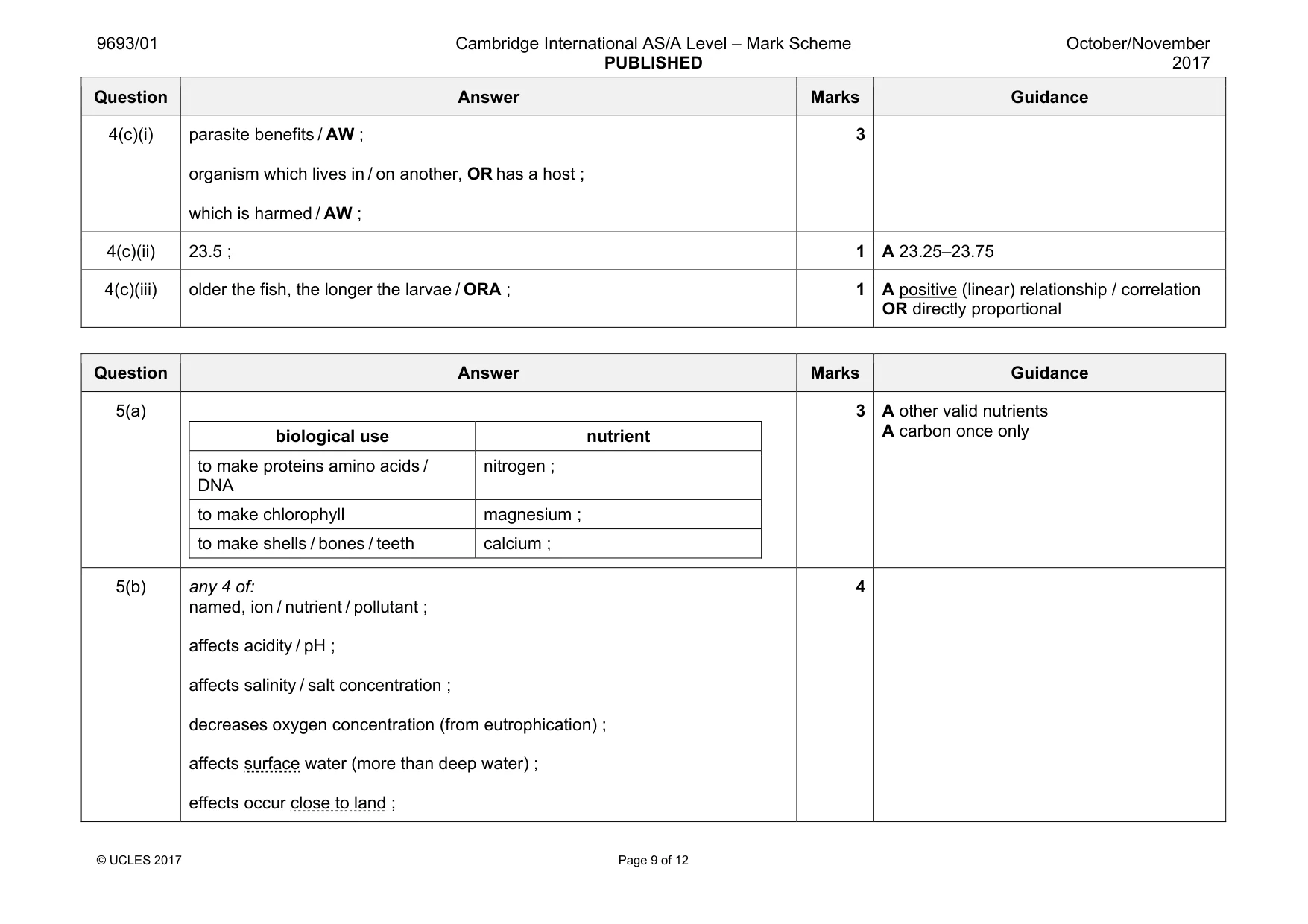
9693/01 Cambridge International AS/A Level – Mark Scheme PUBLISHED October/November 2017 © UCLES 2017 Page 9 of 12 Question Answer Marks Guidance 4(c)(i) parasite benefits / AW ; organism which lives in / on another, OR has a host ; which is harmed / AW ; 3 4(c)(ii) 23.5 ; 1 A 23.25–23.75 4(c)(iii) older the fish, the longer the larvae / ORA ; 1 A positive (linear) relationship / correlation OR directly proportional Question Answer Marks Guidance 5(a) biological use nutrient to make proteins amino acids / DNA nitrogen ; to make chlorophyll magnesium ; to make shells / bones / teeth calcium ; 3 A other valid nutrients A carbon once only 5(b) any 4 of: named, ion / nutrient / pollutant ; affects acidity / pH ; affects salinity / salt concentration ; decreases oxygen concentration (from eutrophication) ; affects surface water (more than deep water) ; effects occur close to land ; 4
Mark scheme, page 10
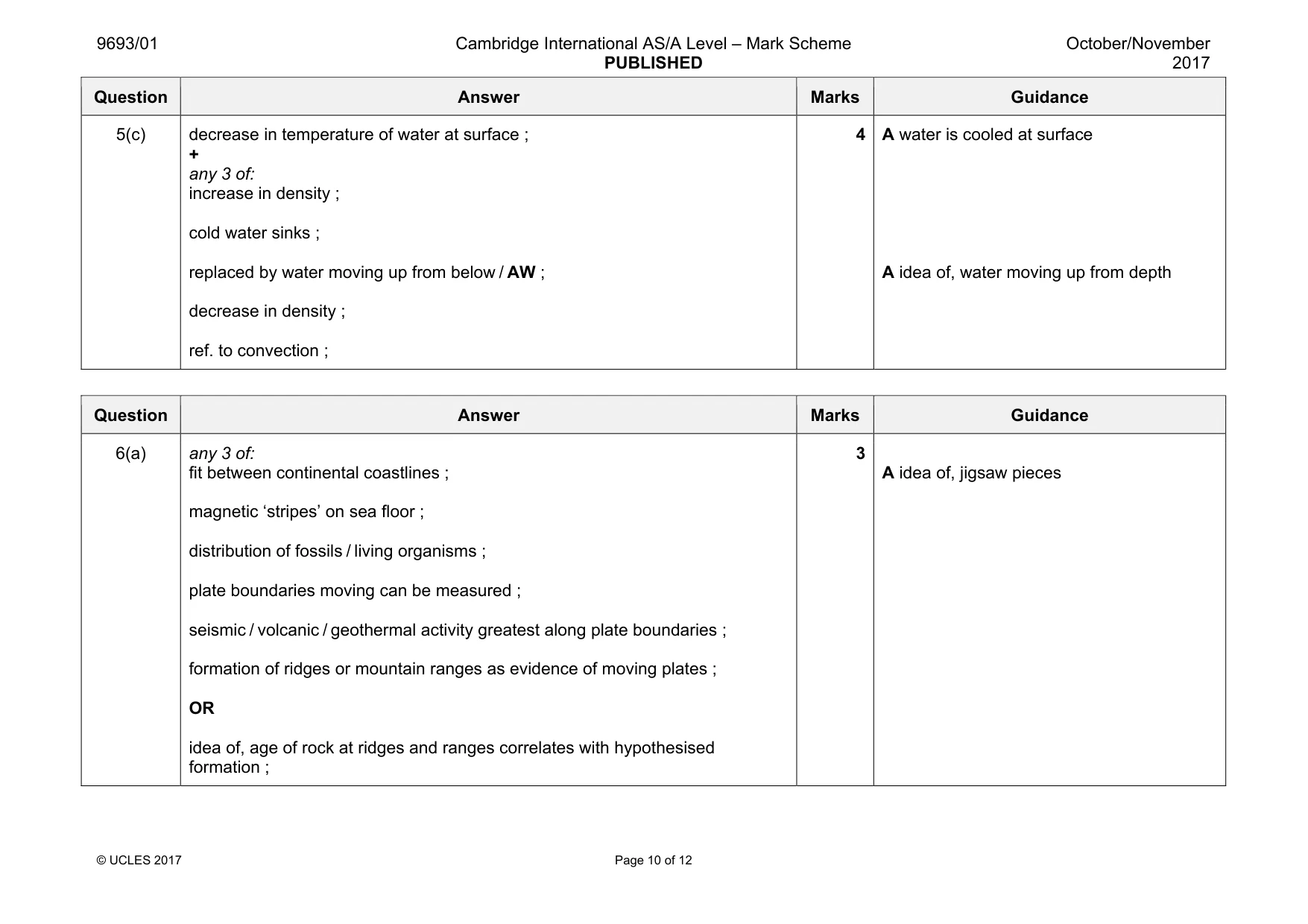
9693/01 Cambridge International AS/A Level – Mark Scheme PUBLISHED October/November 2017 © UCLES 2017 Page 10 of 12 Question Answer Marks Guidance 5(c) decrease in temperature of water at surface ; + any 3 of: increase in density ; cold water sinks ; replaced by water moving up from below / AW ; decrease in density ; ref. to convection ; 4 A water is cooled at surface A idea of, water moving up from depth Question Answer Marks Guidance 6(a) any 3 of: fit between continental coastlines ; magnetic ‘stripes’ on sea floor ; distribution of fossils / living organisms ; plate boundaries moving can be measured ; seismic / volcanic / geothermal activity greatest along plate boundaries ; formation of ridges or mountain ranges as evidence of moving plates ; OR idea of, age of rock at ridges and ranges correlates with hypothesised formation ; 3 A idea of, jigsaw pieces
Mark scheme, page 11
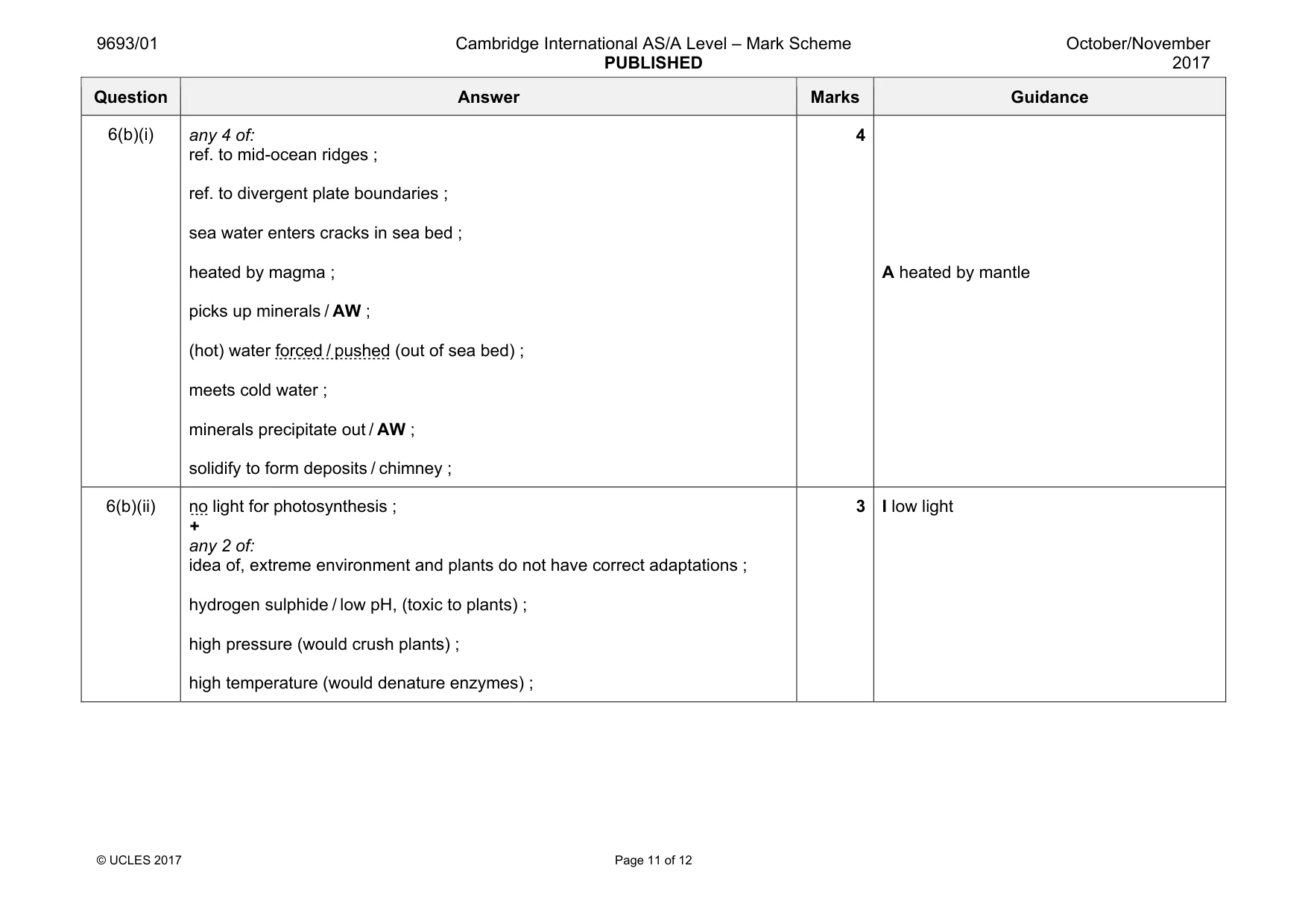
9693/01 Cambridge International AS/A Level – Mark Scheme PUBLISHED October/November 2017 © UCLES 2017 Page 11 of 12 Question Answer Marks Guidance 6(b)(i) any 4 of: ref. to mid-ocean ridges ; ref. to divergent plate boundaries ; sea water enters cracks in sea bed ; heated by magma ; picks up minerals / AW ; (hot) water forced / pushed (out of sea bed) ; meets cold water ; minerals precipitate out / AW ; solidify to form deposits / chimney ; 4 A heated by mantle 6(b)(ii) no light for photosynthesis ; + any 2 of: idea of, extreme environment and plants do not have correct adaptations ; hydrogen sulphide / low pH, (toxic to plants) ; high pressure (would crush plants) ; high temperature (would denature enzymes) ; 3 I low light
Mark scheme, page 12
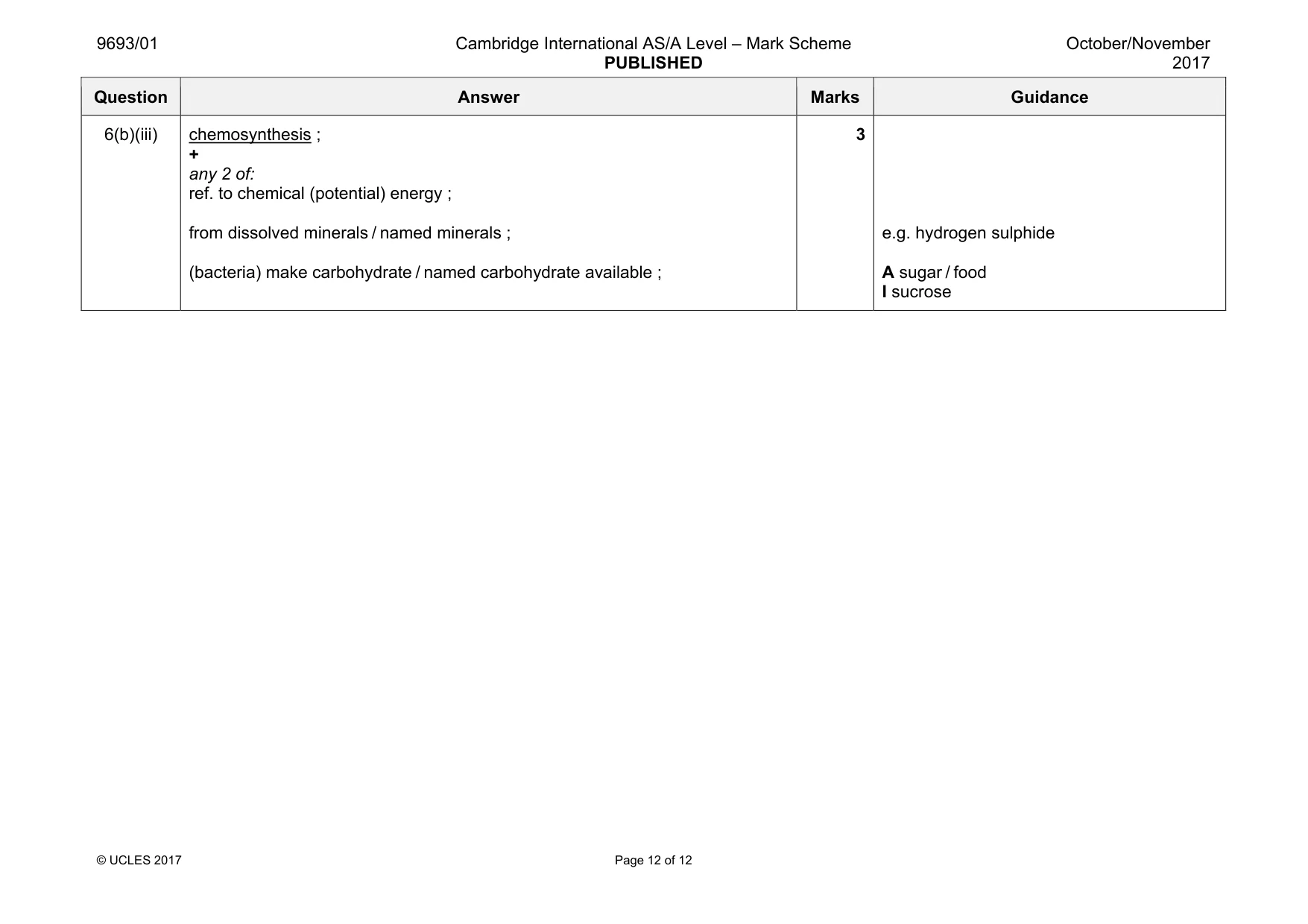
9693/01 Cambridge International AS/A Level – Mark Scheme PUBLISHED October/November 2017 © UCLES 2017 Page 12 of 12 Question Answer Marks Guidance 6(b)(iii) chemosynthesis ; + any 2 of: ref. to chemical (potential) energy ; from dissolved minerals / named minerals ; (bacteria) make carbohydrate / named carbohydrate available ; 3 e.g. hydrogen sulphide A sugar / food I sucrose
What you needed in this session
Cambridge’s own grade thresholds for 2017 Oct/Nov, Paper 1 · Variant 1. A higher threshold means an easier paper — the bar moves with how the cohort did.