Cambridge A Level Marine Science 9693 — 2016 Oct/Nov Paper 1 · Variant 1
9693/11/O/N/16 · 75 marks · ≈84 min
The question paper and its mark scheme, free to read here and free to download. This is Cambridge’s own paper, exactly as it was sat.
Question paper16 pages

Mark scheme12 pages
Answers below. Sit the paper first if you are practising.
Paper as text
Question paper, page 1
This document consists of 14 printed pages and 2 blank pages. DC (NF/FD) 117778/4 © UCLES 2016 [Turn over Cambridge International Examinations Cambridge International Advanced Subsidiary and Advanced Level * 0 6 2 7 4 3 3 7 9 6 * MARINE SCIENCE 9693/01 Paper 1 AS Structured Questions October/November 2016 1 hour 30 minutes Candidates answer on the Question Paper. No Additional Materials are required. READ THESE INSTRUCTIONS FIRST Write your Centre number, candidate number and name on all the work you hand in. Write in dark blue or black pen. You may use an HB pencil for any diagrams or graphs. Do not use staples, paper clips, glue or correction fluid. DO NOT WRITE IN ANY BARCODES. Answer all questions. Write your answers in the spaces provided on the Question Paper. Electronic calculators may be used. You may lose marks if you do not show your working or if you do not use appropriate units. At the end of the examination, fasten all your work securely together. The number of marks is given in brackets [ ] at the end of each question or part question.
Question paper, page 2
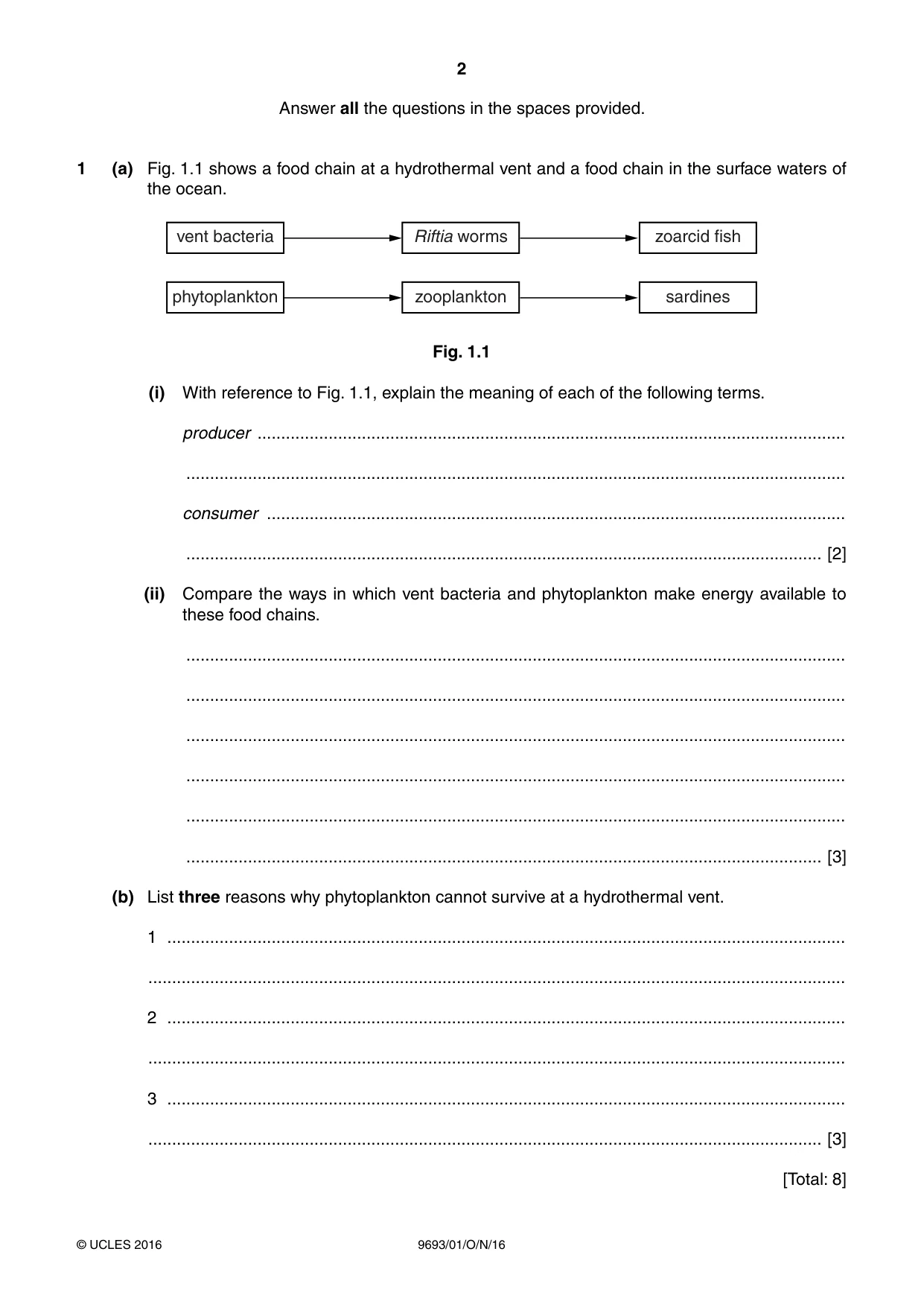
2 9693/01/O/N/16 © UCLES 2016 Answer all the questions in the spaces provided. 1 (a) Fig. 1.1 shows a food chain at a hydrothermal vent and a food chain in the surface waters of the ocean. vent bacteria phytoplankton Riftia worms zooplankton zoarcid fish sardines Fig. 1.1 (i) With reference to Fig. 1.1, explain the meaning of each of the following terms. producer … … consumer … … [2] (ii) Compare the ways in which vent bacteria and phytoplankton make energy available to these food chains. … … … … … … [3] (b) List three reasons why phytoplankton cannot survive at a hydrothermal vent. 1 … … 2 … … 3 … … [3] [Total: 8]
Question paper, page 3
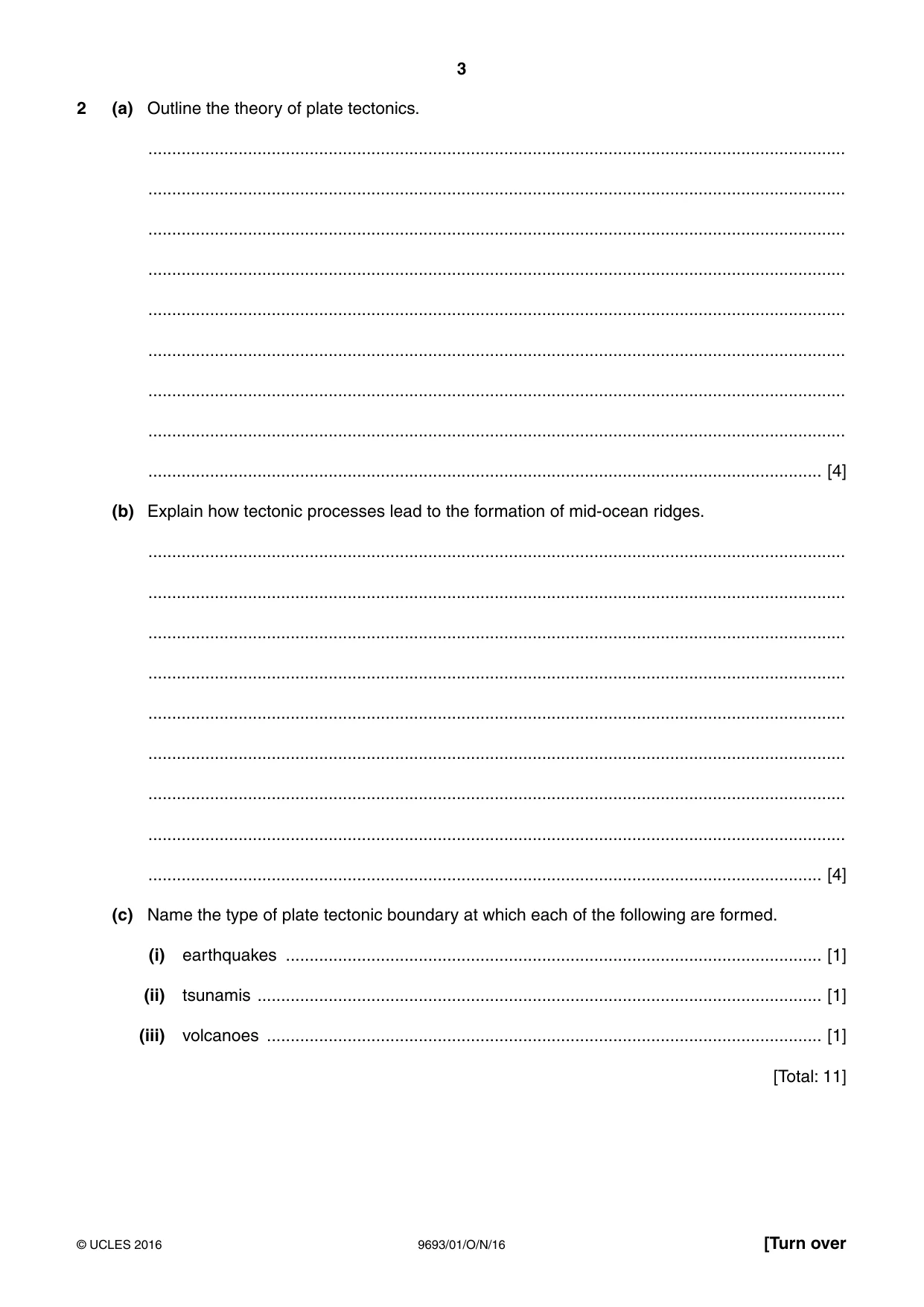
3 9693/01/O/N/16 © UCLES 2016 [Turn over 2 (a) Outline the theory of plate tectonics. … … … … … … … … … [4] (b) Explain how tectonic processes lead to the formation of mid-ocean ridges. … … … … … … … … … [4] (c) Name the type of plate tectonic boundary at which each of the following are formed. (i) earthquakes … [1] (ii) tsunamis … [1] (iii) volcanoes … [1] [Total: 11]
Question paper, page 4
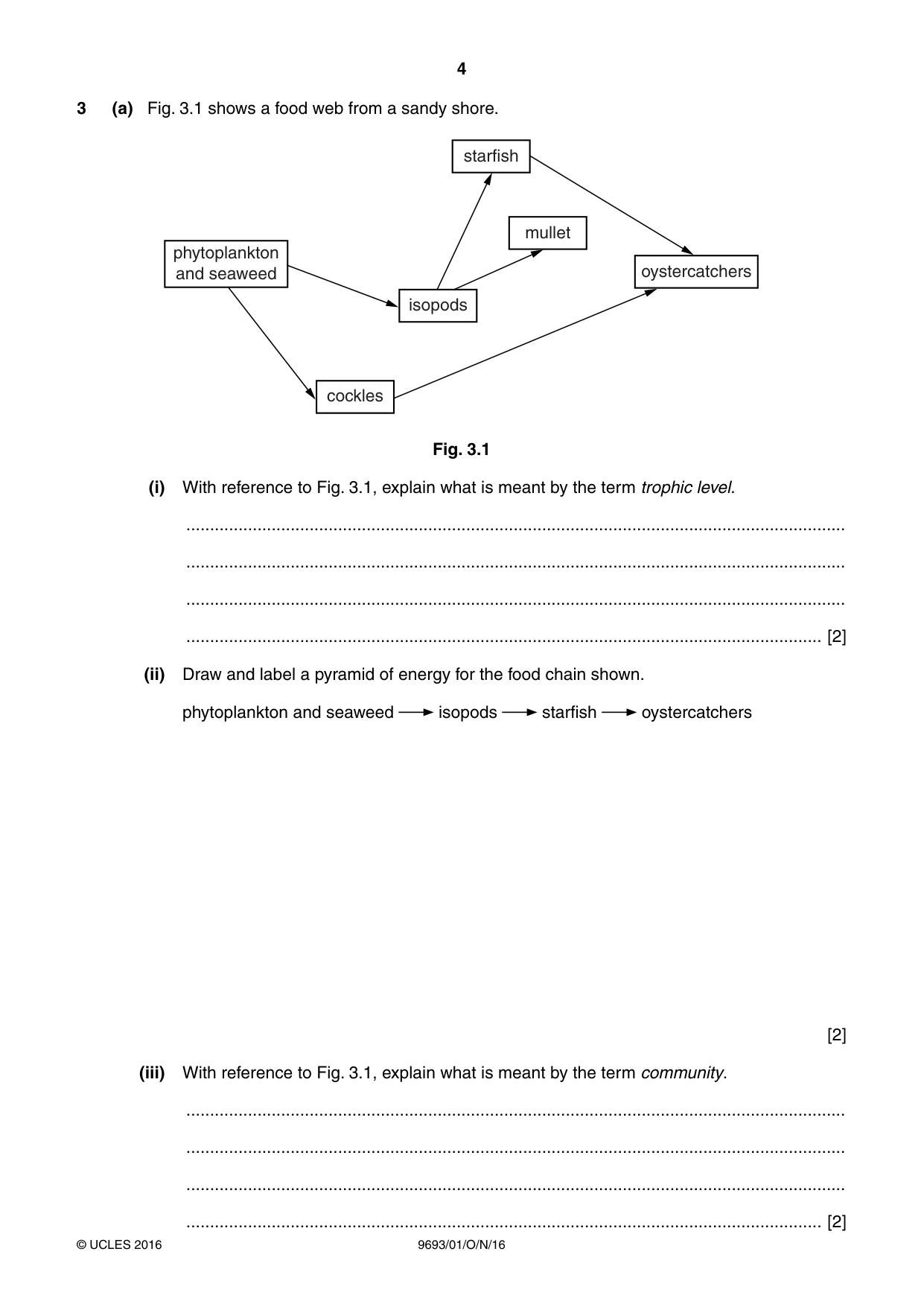
4 9693/01/O/N/16 © UCLES 2016 3 (a) Fig. 3.1 shows a food web from a sandy shore. phytoplankton and seaweed isopods starfish mullet oystercatchers cockles Fig. 3.1 (i) With reference to Fig. 3.1, explain what is meant by the term trophic level. … … … … [2] (ii) Draw and label a pyramid of energy for the food chain shown. phytoplankton and seaweed isopods starfish oystercatchers [2] (iii) With reference to Fig. 3.1, explain what is meant by the term community. … … … … [2]
Question paper, page 5
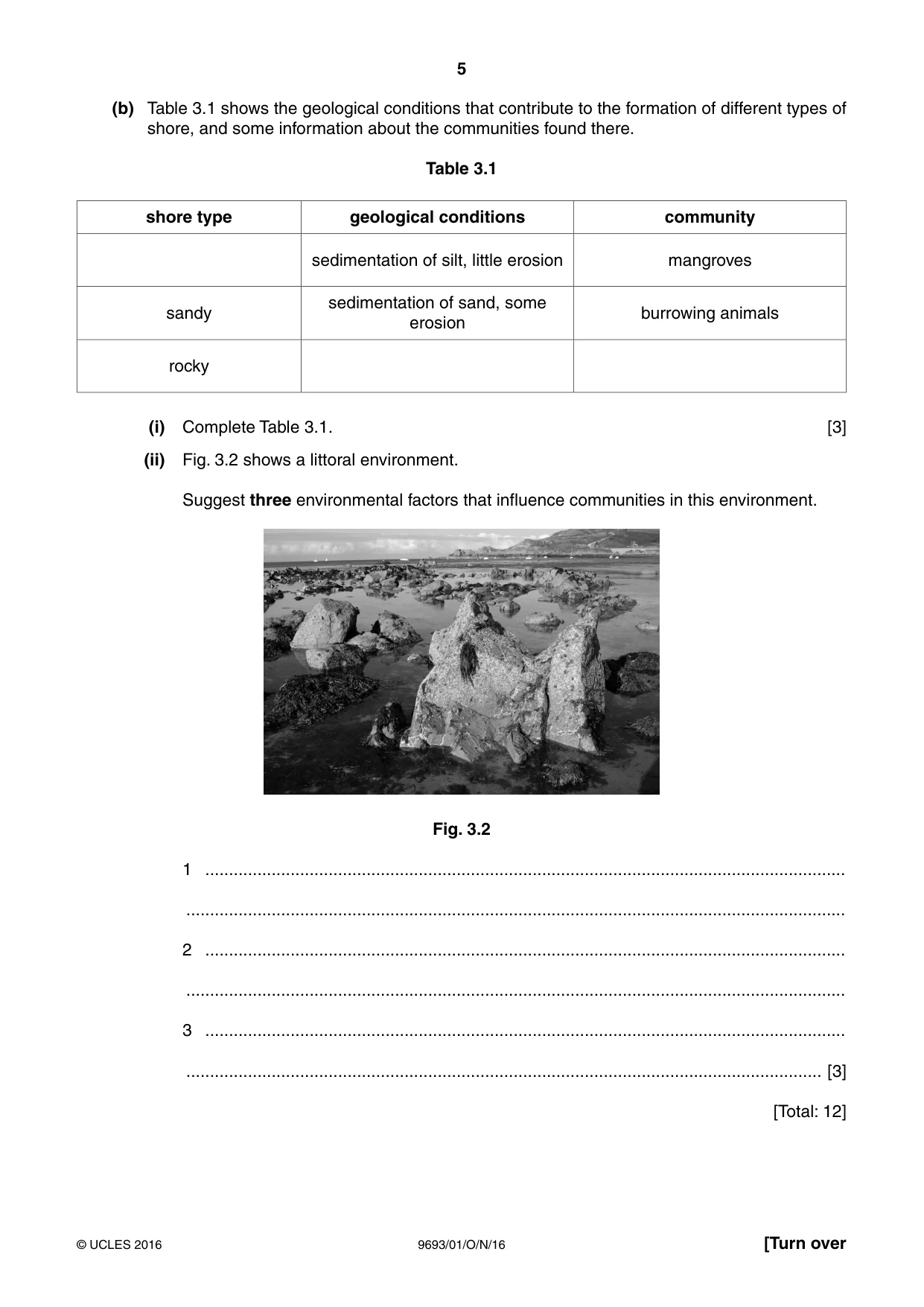
5 9693/01/O/N/16 © UCLES 2016 [Turn over (b) Table 3.1 shows the geological conditions that contribute to the formation of different types of shore, and some information about the communities found there. Table 3.1 shore type geological conditions community sedimentation of silt, little erosion mangroves sandy sedimentation of sand, some erosion burrowing animals rocky (i) Complete Table 3.1. [3] (ii) Fig. 3.2 shows a littoral environment. Suggest three environmental factors that influence communities in this environment. Fig. 3.2 1 … … 2 … … 3 … … [3] [Total: 12]
Question paper, page 6
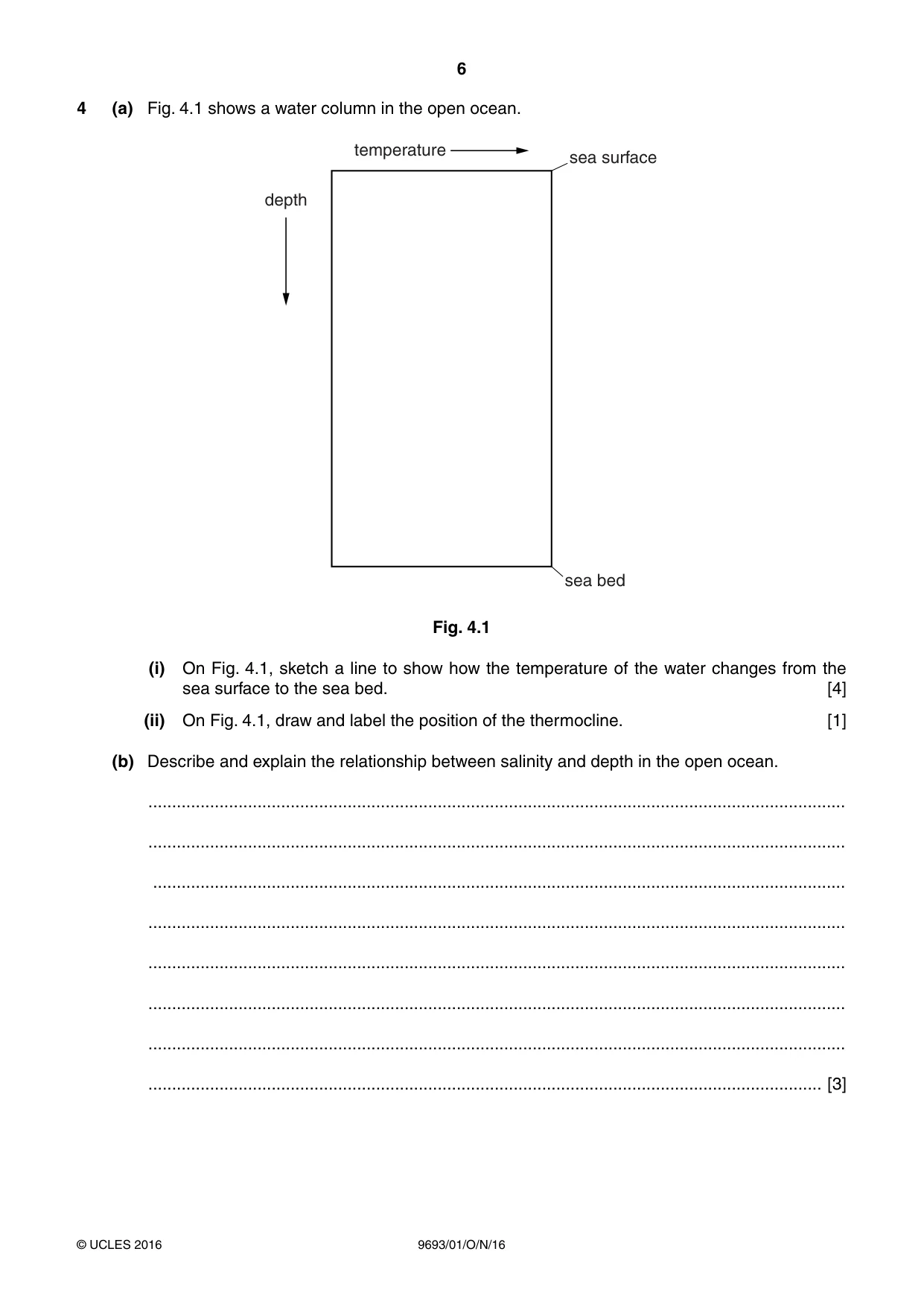
6 9693/01/O/N/16 © UCLES 2016 4 (a) Fig. 4.1 shows a water column in the open ocean. temperature sea surface sea bed depth Fig. 4.1 (i) On Fig. 4.1, sketch a line to show how the temperature of the water changes from the sea surface to the sea bed. [4] (ii) On Fig. 4.1, draw and label the position of the thermocline. [1] (b) Describe and explain the relationship between salinity and depth in the open ocean. … … … … … … … … [3]
Question paper, page 7
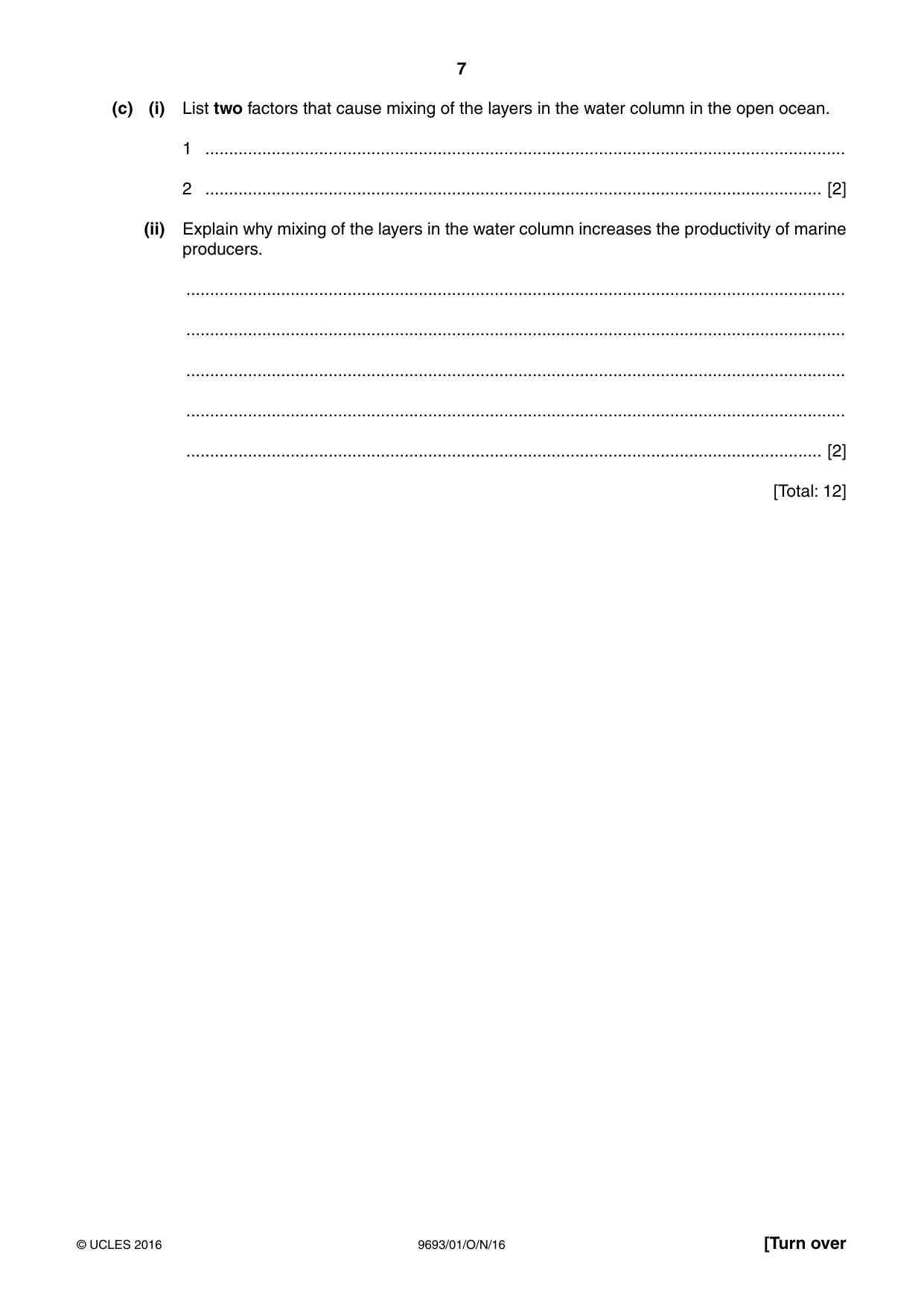
7 9693/01/O/N/16 © UCLES 2016 [Turn over (c) (i) List two factors that cause mixing of the layers in the water column in the open ocean. 1 … 2 … [2] (ii) Explain why mixing of the layers in the water column increases the productivity of marine producers. … … … … … [2] [Total: 12]
Question paper, page 8
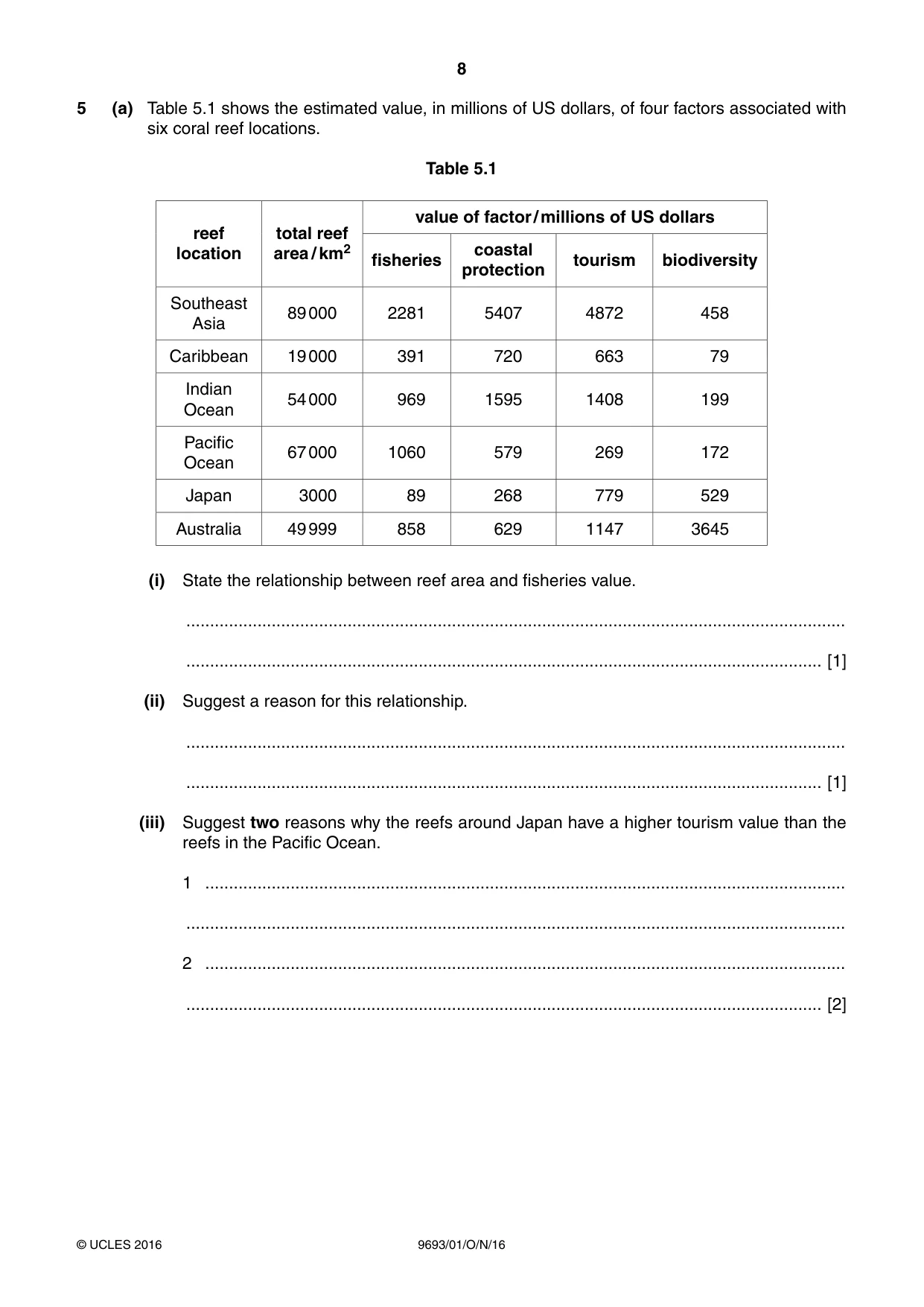
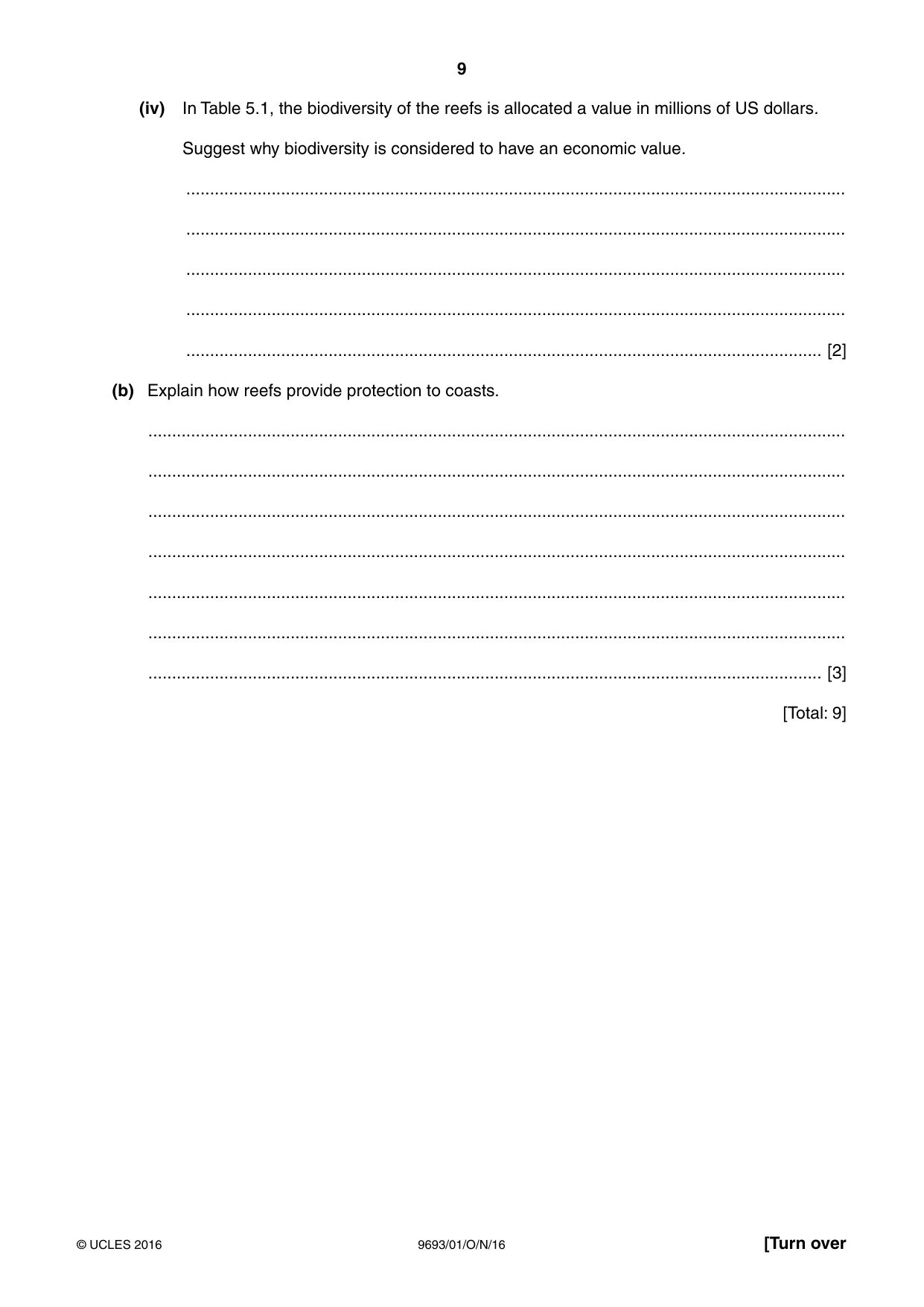
8 9693/01/O/N/16 © UCLES 2016 5 (a) Table 5.1 shows the estimated value, in millions of US dollars, of four factors associated with six coral reef locations. Table 5.1 reef location total reef area / km2 value of factor / millions of US dollars fisheries coastal protection tourism biodiversity Southeast Asia 89 000 2281 5407 4872 458 Caribbean 19 000 391 720 663 79 Indian Ocean 54 000 969 1595 1408 199 Pacific Ocean 67 000 1060 579 269 172 Japan 3000 89 268 779 529 Australia 49 999 858 629 1147 3645 (i) State the relationship between reef area and fisheries value. … … [1] (ii) Suggest a reason for this relationship. … … [1] (iii) Suggest two reasons why the reefs around Japan have a higher tourism value than the reefs in the Pacific Ocean. 1 … … 2 … … [2]
Question paper, page 9
9 9693/01/O/N/16 © UCLES 2016 [Turn over (iv) In Table 5.1, the biodiversity of the reefs is allocated a value in millions of US dollars. Suggest why biodiversity is considered to have an economic value. … … … … … [2] (b) Explain how reefs provide protection to coasts. … … … … … … … [3] [Total: 9]
Question paper, page 10
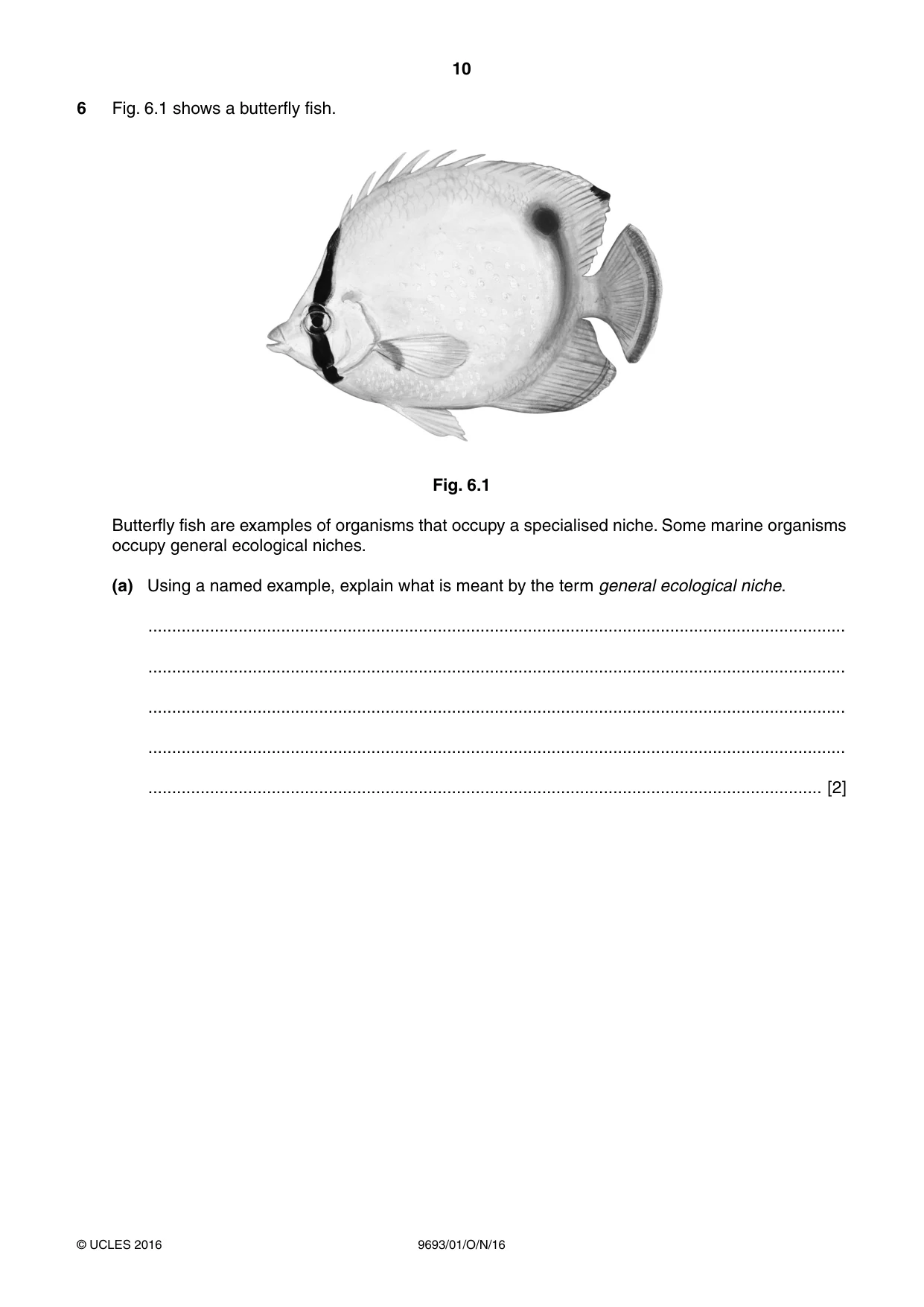
10 9693/01/O/N/16 © UCLES 2016 6 Fig. 6.1 shows a butterfly fish. Fig. 6.1 Butterfly fish are examples of organisms that occupy a specialised niche. Some marine organisms occupy general ecological niches. (a) Using a named example, explain what is meant by the term general ecological niche. … … … … … [2]
Question paper, page 11
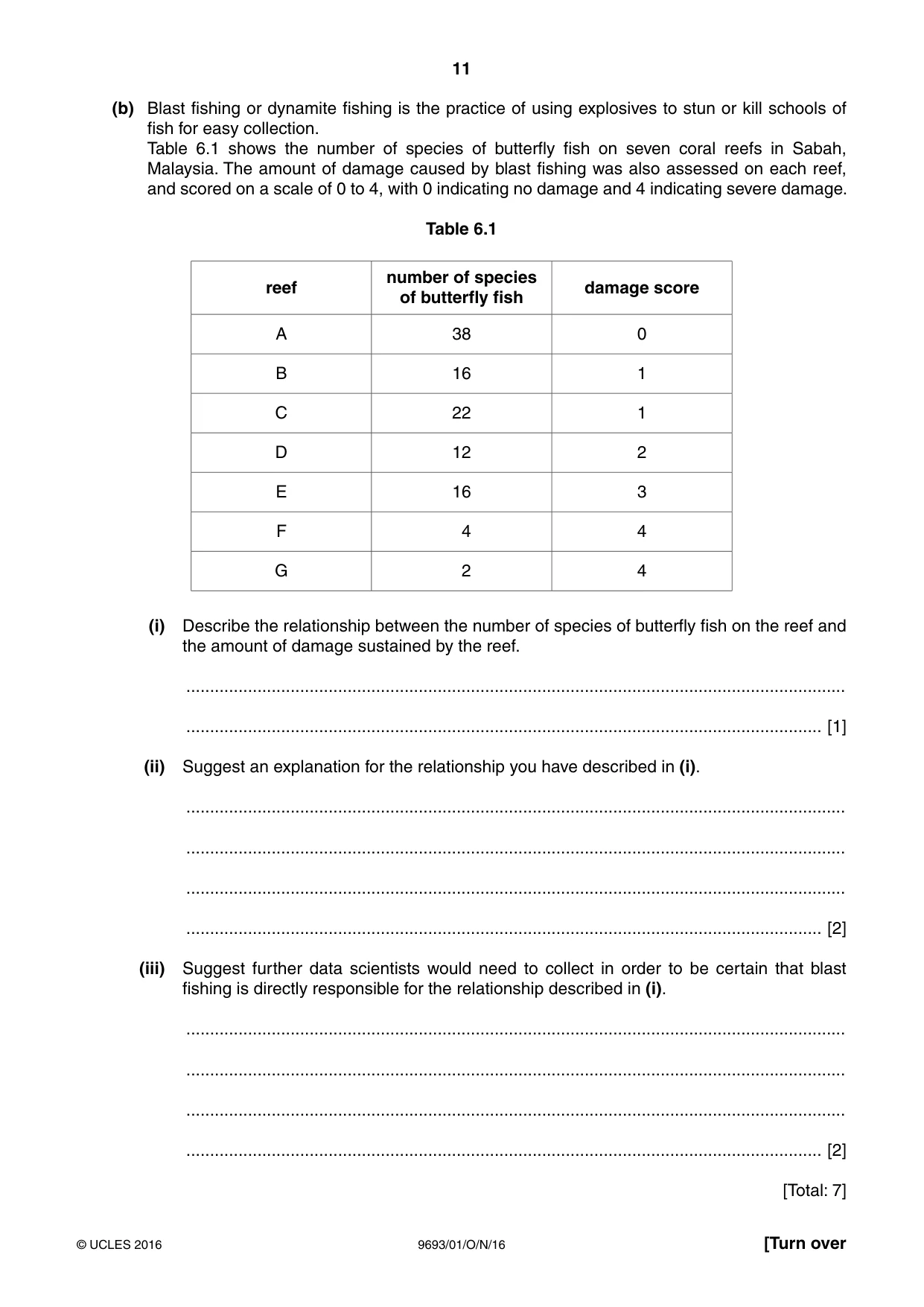
11 9693/01/O/N/16 © UCLES 2016 [Turn over (b) Blast fishing or dynamite fishing is the practice of using explosives to stun or kill schools of fish for easy collection. Table 6.1 shows the number of species of butterfly fish on seven coral reefs in Sabah, Malaysia. The amount of damage caused by blast fishing was also assessed on each reef, and scored on a scale of 0 to 4, with 0 indicating no damage and 4 indicating severe damage. Table 6.1 reef number of species of butterfly fish damage score A 38 0 B 16 1 C 22 1 D 12 2 E 16 3 F 4 4 G 2 4 (i) Describe the relationship between the number of species of butterfly fish on the reef and the amount of damage sustained by the reef. … … [1] (ii) Suggest an explanation for the relationship you have described in (i). … … … … [2] (iii) Suggest further data scientists would need to collect in order to be certain that blast fishing is directly responsible for the relationship described in (i). … … … … [2] [Total: 7]
Question paper, page 12
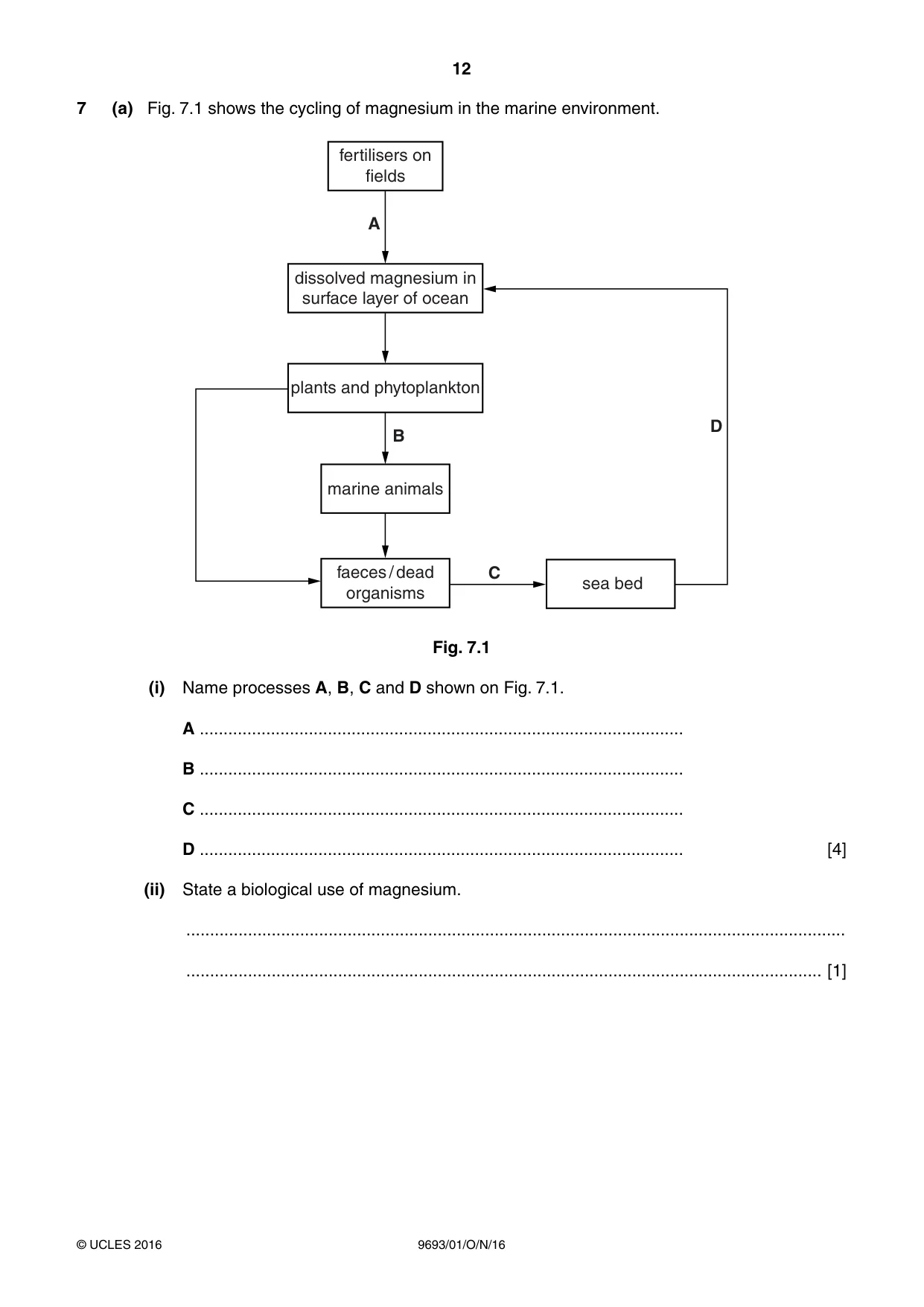
12 9693/01/O/N/16 © UCLES 2016 7 (a) Fig. 7.1 shows the cycling of magnesium in the marine environment. fertilisers on fields dissolved magnesium in surface layer of ocean plants and phytoplankton marine animals faeces / dead organisms sea bed A B C D Fig. 7.1 (i) Name processes A, B, C and D shown on Fig. 7.1. A … B … C … D … [4] (ii) State a biological use of magnesium. … … [1]
Question paper, page 13
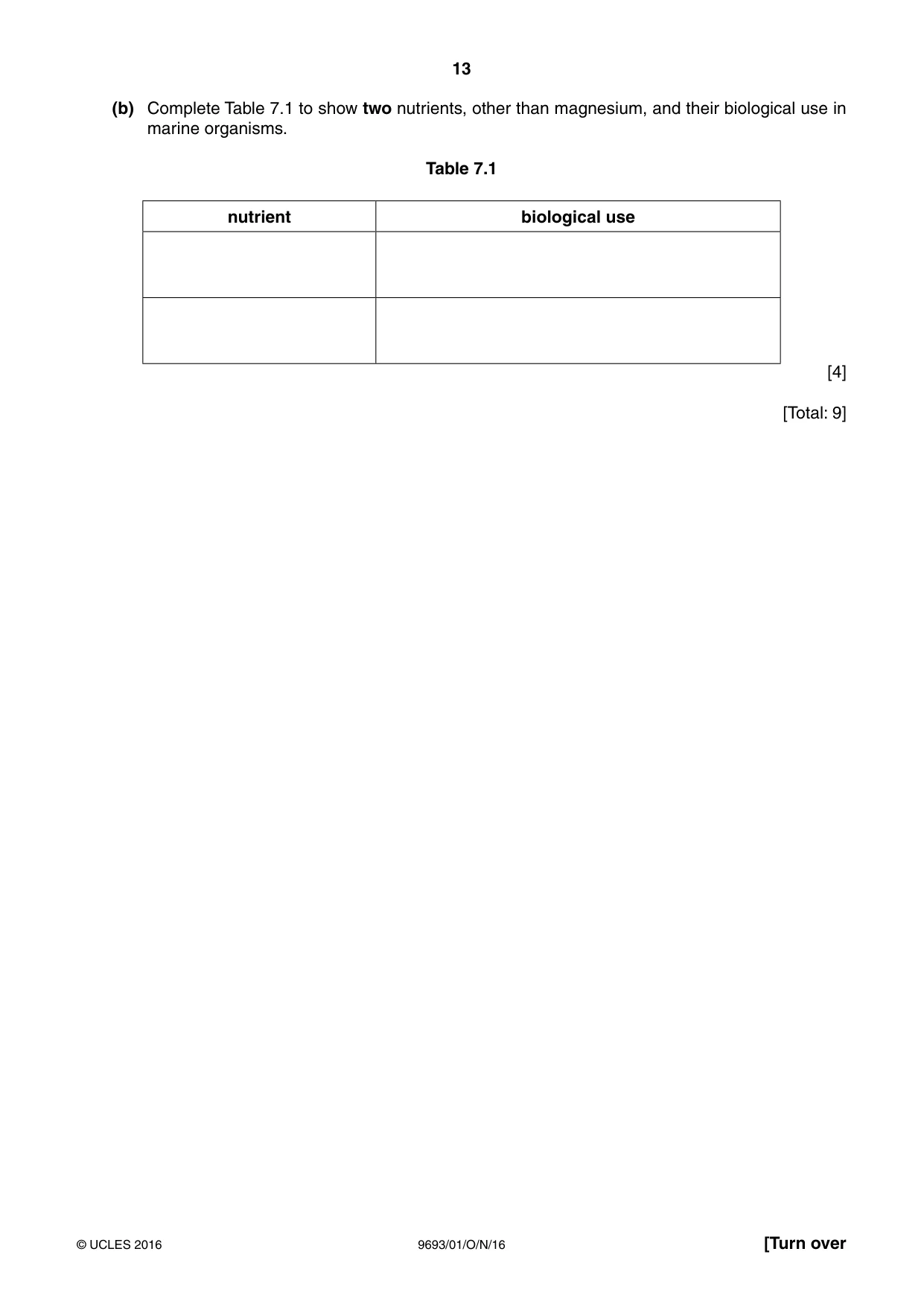
13 9693/01/O/N/16 © UCLES 2016 [Turn over (b) Complete Table 7.1 to show two nutrients, other than magnesium, and their biological use in marine organisms. Table 7.1 nutrient biological use [4] [Total: 9]
Question paper, page 14
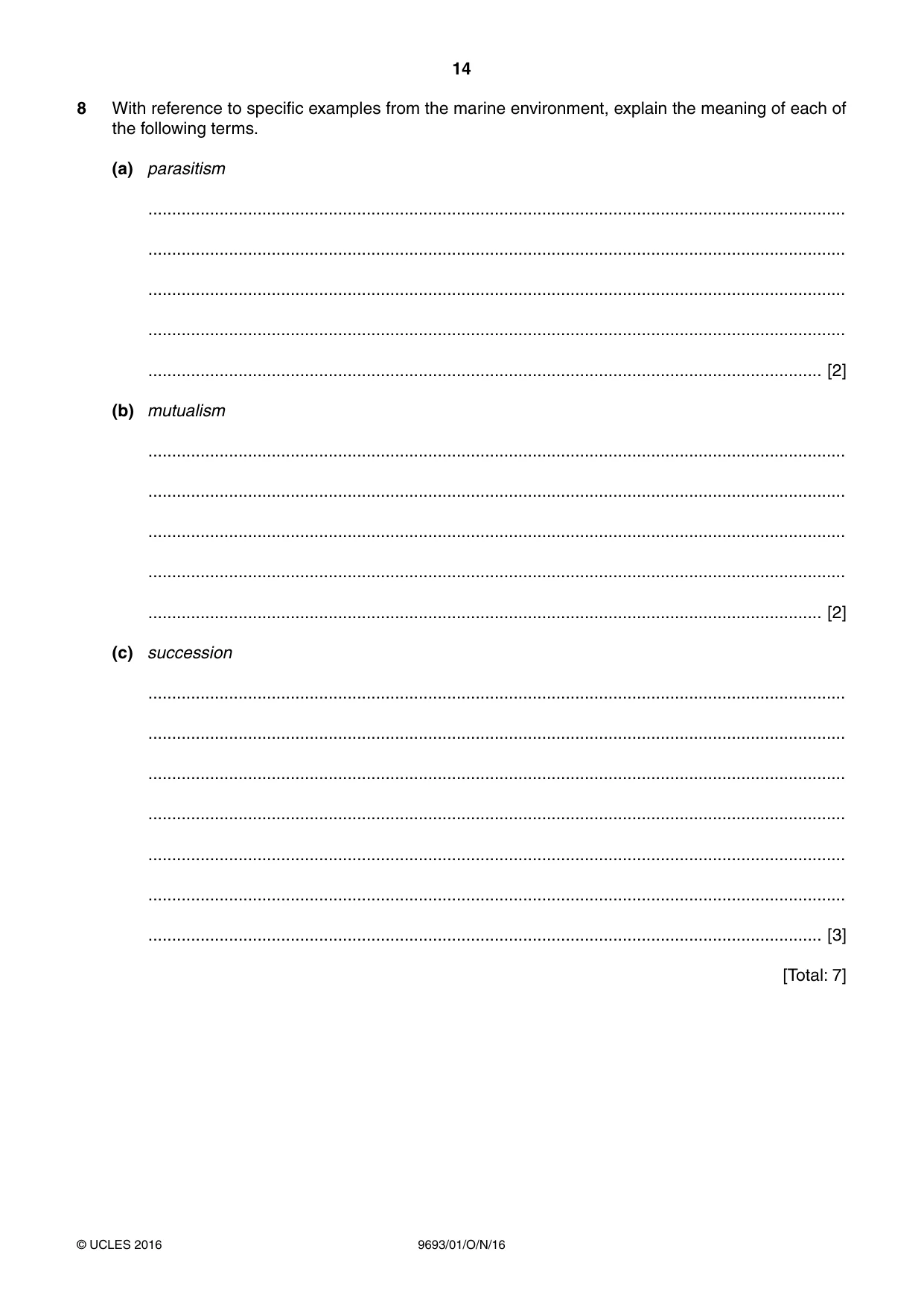
14 9693/01/O/N/16 © UCLES 2016 8 With reference to specific examples from the marine environment, explain the meaning of each of the following terms. (a) parasitism … … … … … [2] (b) mutualism … … … … … [2] (c) succession … … … … … … … [3] [Total: 7]
Question paper, page 15
15 9693/01/O/N/16 © UCLES 2016 BLANK PAGE
Question paper, page 16
16 9693/01/O/N/16 © UCLES 2016 Permission to reproduce items where third-party owned material protected by copyright is included has been sought and cleared where possible. Every reasonable effort has been made by the publisher (UCLES) to trace copyright holders, but if any items requiring clearance have unwittingly been included, the publisher will be pleased to make amends at the earliest possible opportunity. To avoid the issue of disclosure of answer-related information to candidates, all copyright acknowledgements are reproduced online in the Cambridge International Examinations Copyright Acknowledgements Booklet. This is produced for each series of examinations and is freely available to download at www.cie.org.uk after the live examination series. Cambridge International Examinations is part of the Cambridge Assessment Group. Cambridge Assessment is the brand name of University of Cambridge Local Examinations Syndicate (UCLES), which is itself a department of the University of Cambridge. BLANK PAGE
Mark scheme, page 1
® IGCSE is the registered trademark of Cambridge International Examinations. This document consists of 12 printed pages. © UCLES 2016 [Turn over Cambridge International Examinations Cambridge International Advanced Subsidiary and Advanced Level MARINE SCIENCE 9693/01 Paper 1 AS Structured Questions October/November 2016 MARK SCHEME Maximum Mark: 75 Published This mark scheme is published as an aid to teachers and candidates, to indicate the requirements of the examination. It shows the basis on which Examiners were instructed to award marks. It does not indicate the details of the discussions that took place at an Examiners’ meeting before marking began, which would have considered the acceptability of alternative answers. Mark schemes should be read in conjunction with the question paper and the Principal Examiner Report for Teachers. Cambridge will not enter into discussions about these mark schemes. Cambridge is publishing the mark schemes for the October/November 2016 series for most Cambridge IGCSE®, Cambridge International A and AS Level components and some Cambridge O Level components.
Mark scheme, page 2
Page 2 Mark Scheme Syllabus Paper Cambridge International AS/A Level – October/November 2016 9693 01 © UCLES 2016 This mark scheme will use the following abbreviations: ; separates marking points / separates alternatives within a marking point () contents of brackets are not required but should be implied / the contents set the context of the answer R reject A accept (answers that are correctly cued by the question or guidance you have received) I ignore (mark as if this material was not present) AW alternative wording (where responses vary more than usual, accept other ways of expressing the same idea) AVP alternative valid point (where a greater than usual variety of responses is expected) ORA or reverse argument underline actual word underlined must be used by the candidate (grammatical variants excepted) MAX indicates the maximum number of marks that can be awarded + statements on both sides of the + are needed for that mark OR separates two different routes to a mark point and only one should be awarded ECF error carried forward (credit an operation from a previous incorrect response)
Mark scheme, page 3
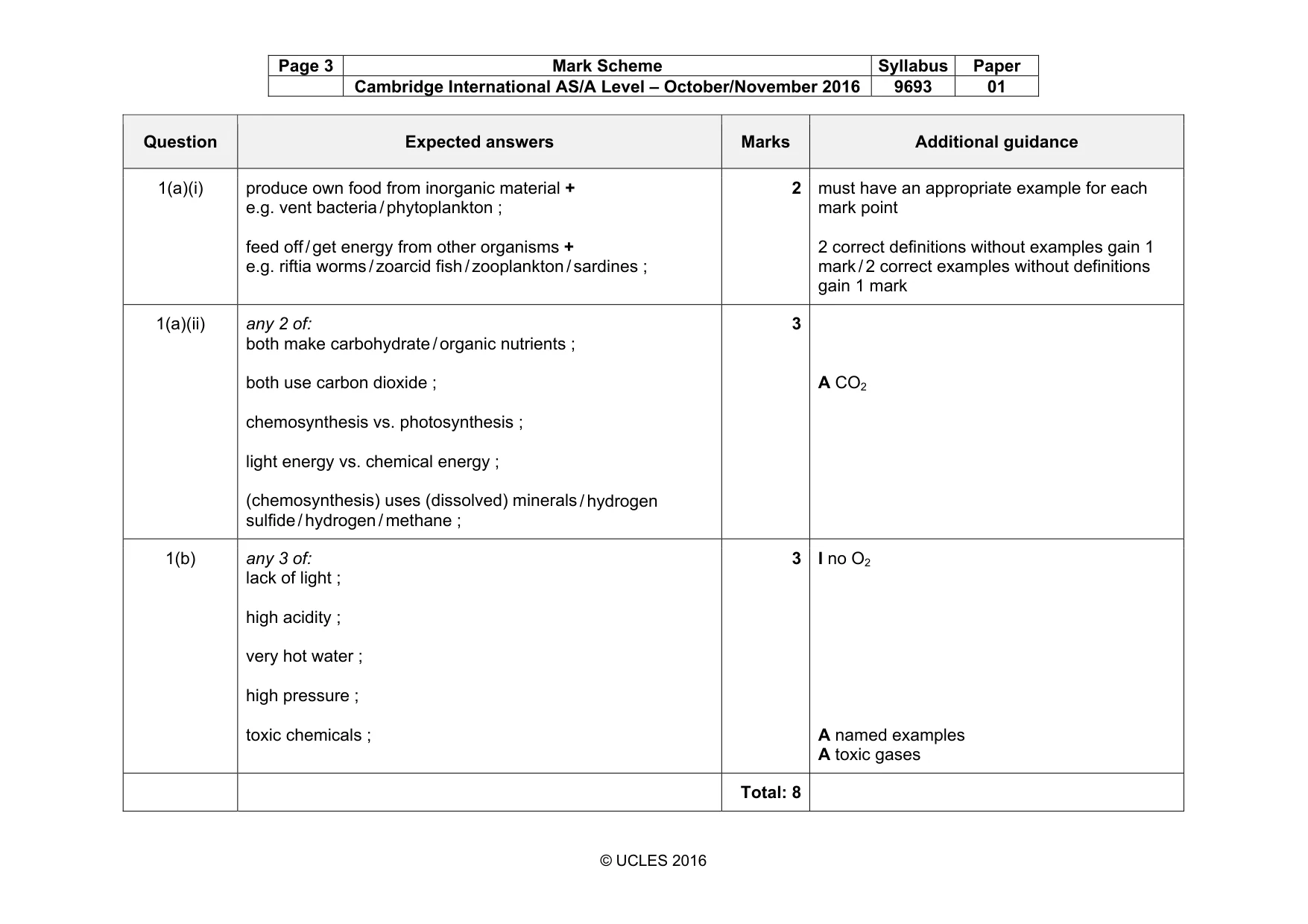
Page 3 Mark Scheme Syllabus Paper Cambridge International AS/A Level – October/November 2016 9693 01 © UCLES 2016 Question Expected answers Marks Additional guidance 1(a)(i) produce own food from inorganic material + e.g. vent bacteria / phytoplankton ; feed off / get energy from other organisms + e.g. riftia worms / zoarcid fish / zooplankton / sardines ; 2 must have an appropriate example for each mark point 2 correct definitions without examples gain 1 mark / 2 correct examples without definitions gain 1 mark 1(a)(ii) any 2 of: both make carbohydrate / organic nutrients ; both use carbon dioxide ; chemosynthesis vs. photosynthesis ; light energy vs. chemical energy ; (chemosynthesis) uses (dissolved) minerals / hydrogen sulfide / hydrogen / methane ; 3 A CO2 1(b) any 3 of: lack of light ; high acidity ; very hot water ; high pressure ; toxic chemicals ; 3 I no O2 A named examples A toxic gases Total: 8
Mark scheme, page 4
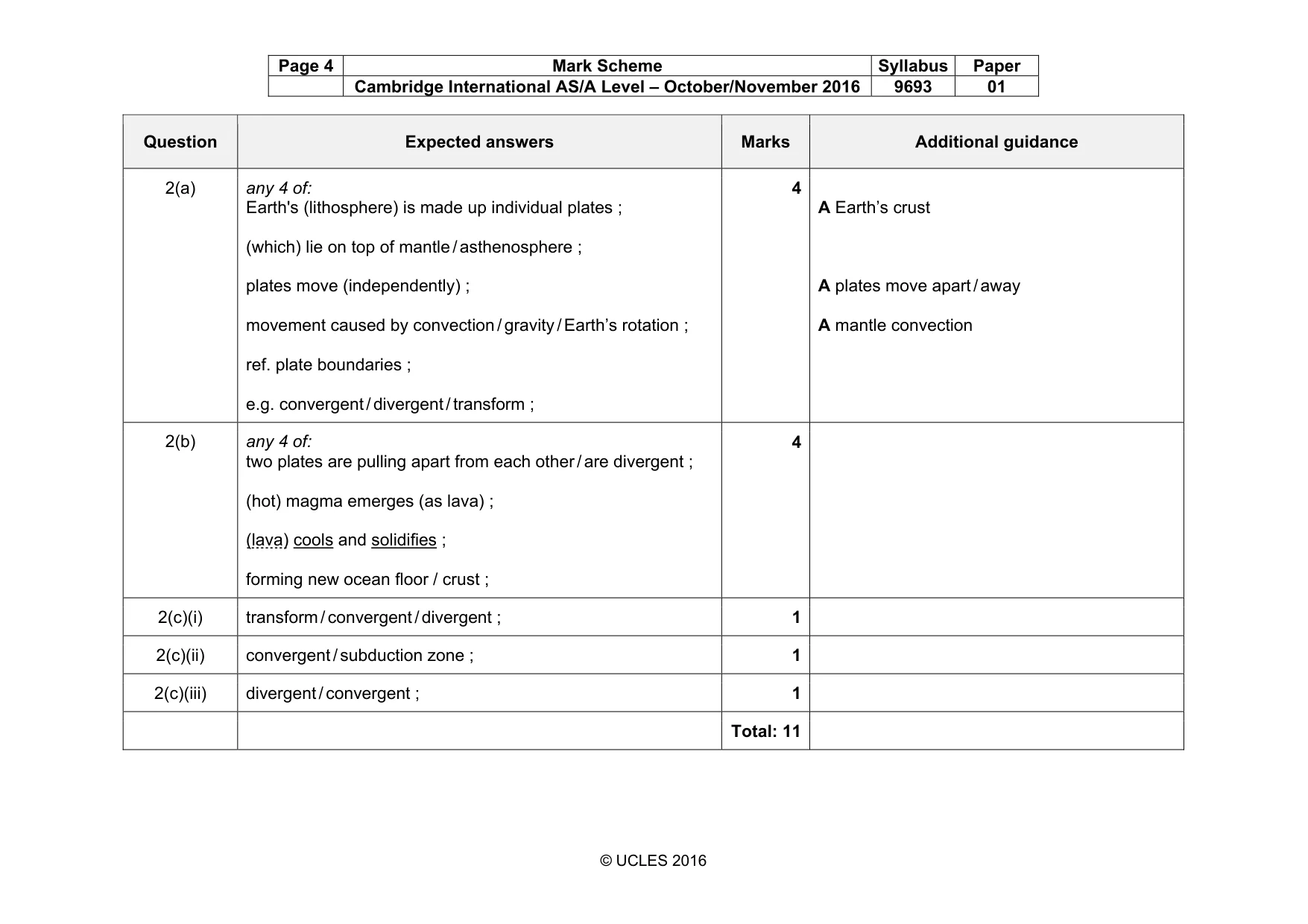
Page 4 Mark Scheme Syllabus Paper Cambridge International AS/A Level – October/November 2016 9693 01 © UCLES 2016 Question Expected answers Marks Additional guidance 2(a) any 4 of: Earth's (lithosphere) is made up individual plates ; (which) lie on top of mantle / asthenosphere ; plates move (independently) ; movement caused by convection / gravity / Earth’s rotation ; ref. plate boundaries ; e.g. convergent / divergent / transform ; 4 A Earth’s crust A plates move apart / away A mantle convection 2(b) any 4 of: two plates are pulling apart from each other / are divergent ; (hot) magma emerges (as lava) ; (lava) cools and solidifies ; forming new ocean floor / crust ; 4 2(c)(i) transform / convergent / divergent ; 1 2(c)(ii) convergent / subduction zone ; 1 2(c)(iii) divergent / convergent ; 1 Total: 11
Mark scheme, page 5
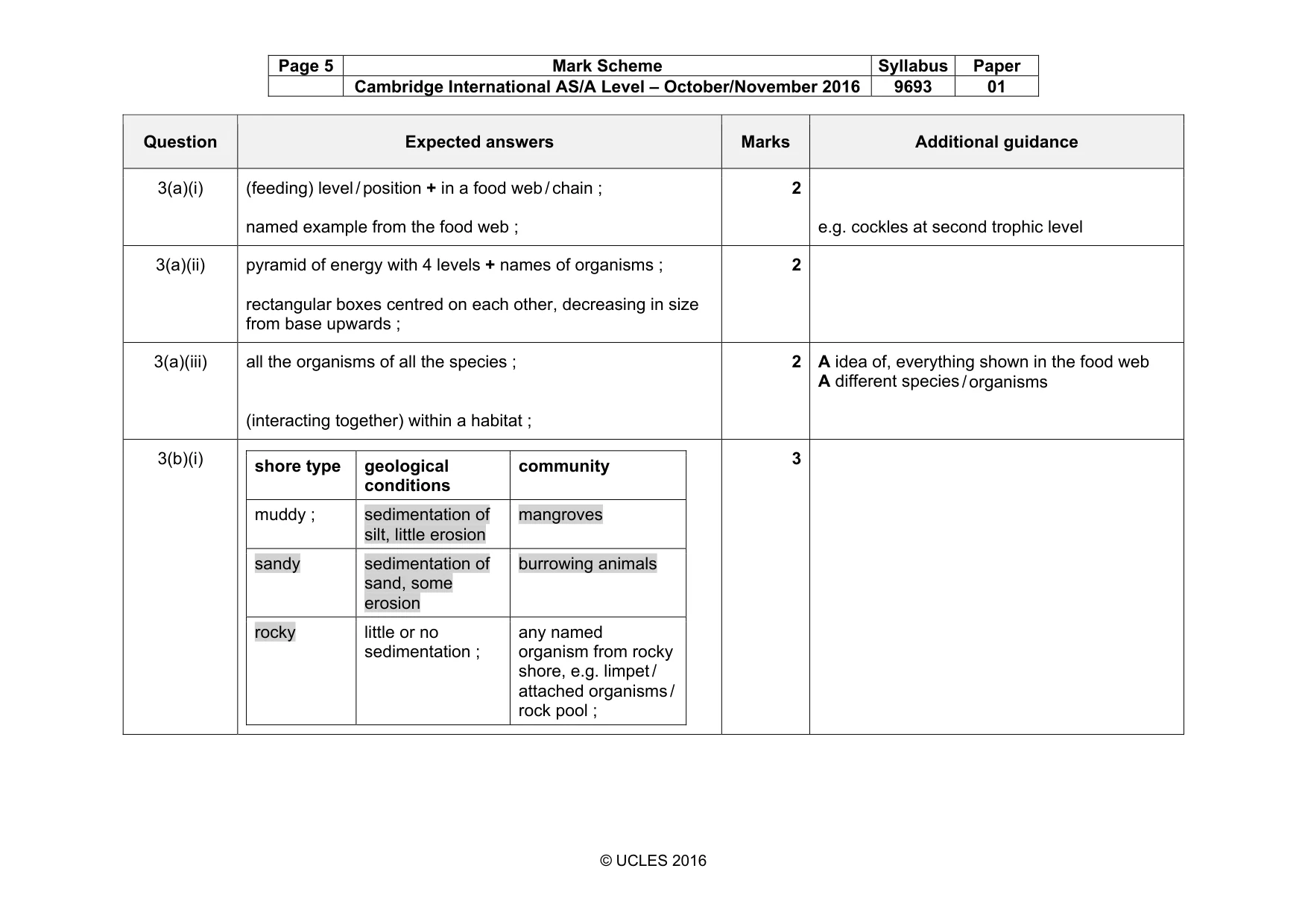
Page 5 Mark Scheme Syllabus Paper Cambridge International AS/A Level – October/November 2016 9693 01 © UCLES 2016 Question Expected answers Marks Additional guidance 3(a)(i) (feeding) level / position + in a food web / chain ; named example from the food web ; 2 e.g. cockles at second trophic level 3(a)(ii) pyramid of energy with 4 levels + names of organisms ; rectangular boxes centred on each other, decreasing in size from base upwards ; 2 3(a)(iii) all the organisms of all the species ; (interacting together) within a habitat ; 2 A idea of, everything shown in the food web A different species / organisms 3(b)(i) shore type geological conditions community muddy ; sedimentation of silt, little erosion mangroves sandy sedimentation of sand, some erosion burrowing animals rocky little or no sedimentation ; any named organism from rocky shore, e.g. limpet / attached organisms / rock pool ; 3
Mark scheme, page 6
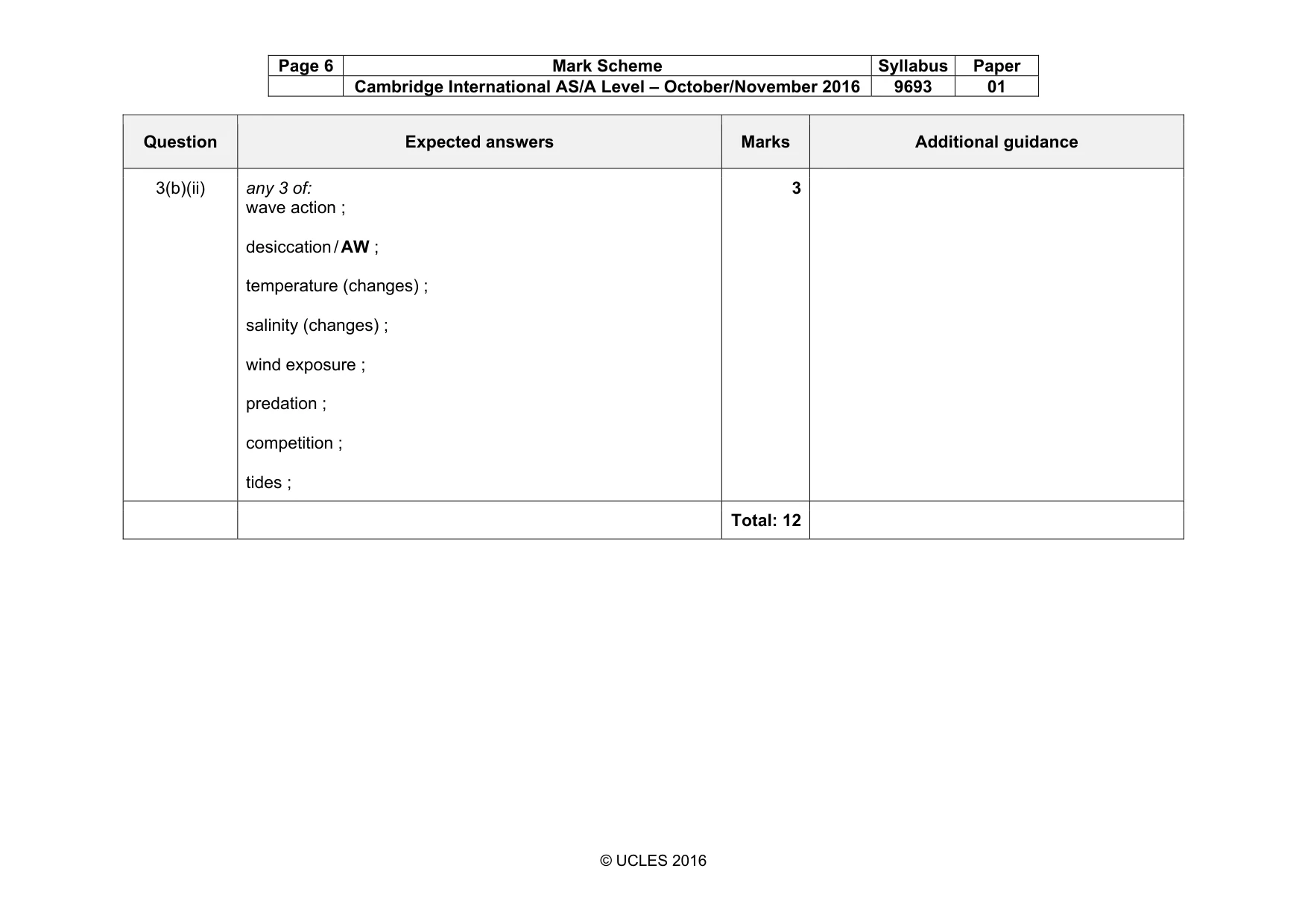
Page 6 Mark Scheme Syllabus Paper Cambridge International AS/A Level – October/November 2016 9693 01 © UCLES 2016 Question Expected answers Marks Additional guidance 3(b)(ii) any 3 of: wave action ; desiccation / AW ; temperature (changes) ; salinity (changes) ; wind exposure ; predation ; competition ; tides ; 3 Total: 12
Mark scheme, page 7
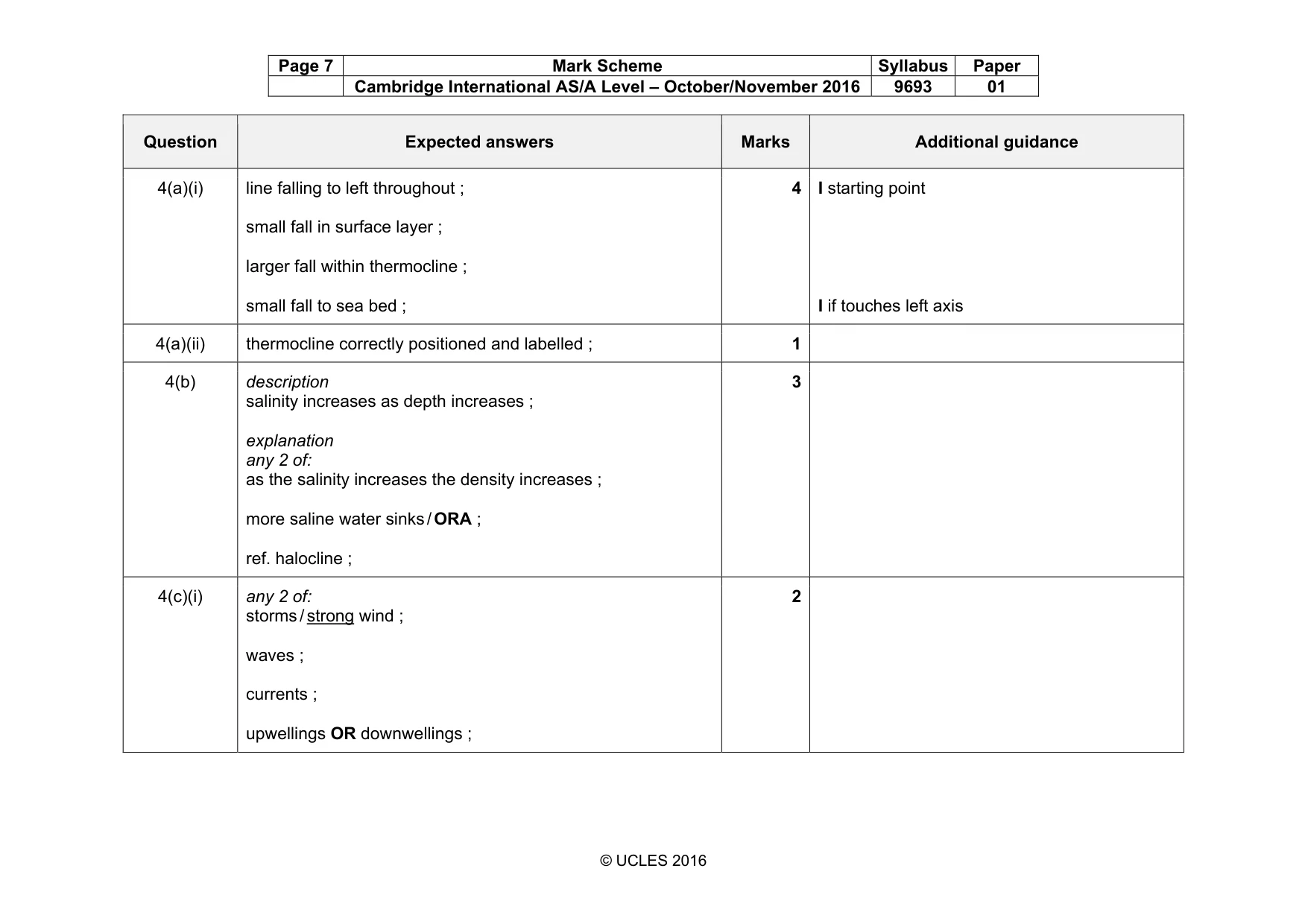
Page 7 Mark Scheme Syllabus Paper Cambridge International AS/A Level – October/November 2016 9693 01 © UCLES 2016 Question Expected answers Marks Additional guidance 4(a)(i) line falling to left throughout ; small fall in surface layer ; larger fall within thermocline ; small fall to sea bed ; 4 I starting point I if touches left axis 4(a)(ii) thermocline correctly positioned and labelled ; 1 4(b) description salinity increases as depth increases ; explanation any 2 of: as the salinity increases the density increases ; more saline water sinks / ORA ; ref. halocline ; 3 4(c)(i) any 2 of: storms / strong wind ; waves ; currents ; upwellings OR downwellings ; 2
Mark scheme, page 8
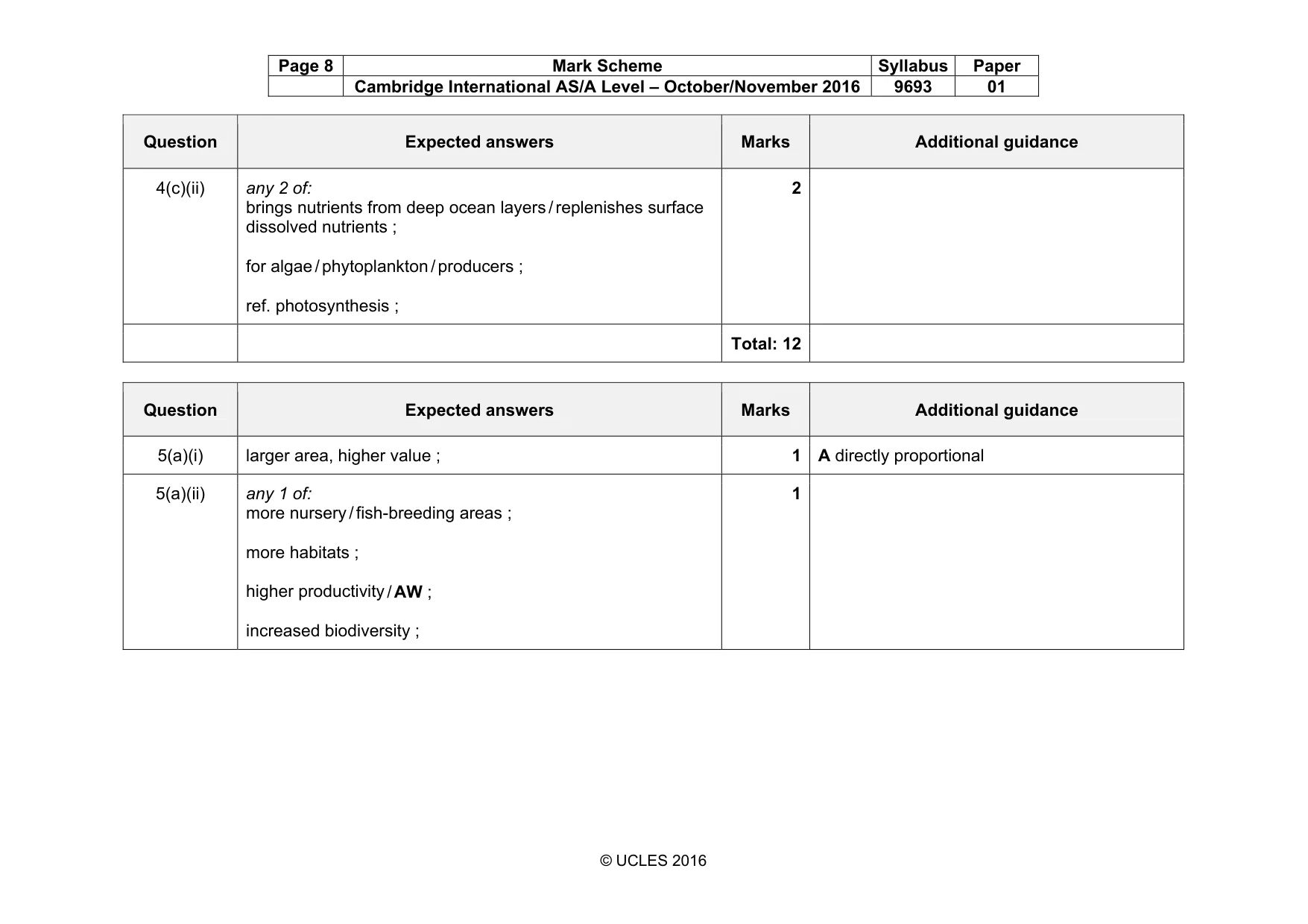
Page 8 Mark Scheme Syllabus Paper Cambridge International AS/A Level – October/November 2016 9693 01 © UCLES 2016 Question Expected answers Marks Additional guidance 4(c)(ii) any 2 of: brings nutrients from deep ocean layers / replenishes surface dissolved nutrients ; for algae / phytoplankton / producers ; ref. photosynthesis ; 2 Total: 12 Question Expected answers Marks Additional guidance 5(a)(i) larger area, higher value ; 1 A directly proportional 5(a)(ii) any 1 of: more nursery / fish-breeding areas ; more habitats ; higher productivity / AW ; increased biodiversity ; 1
Mark scheme, page 9
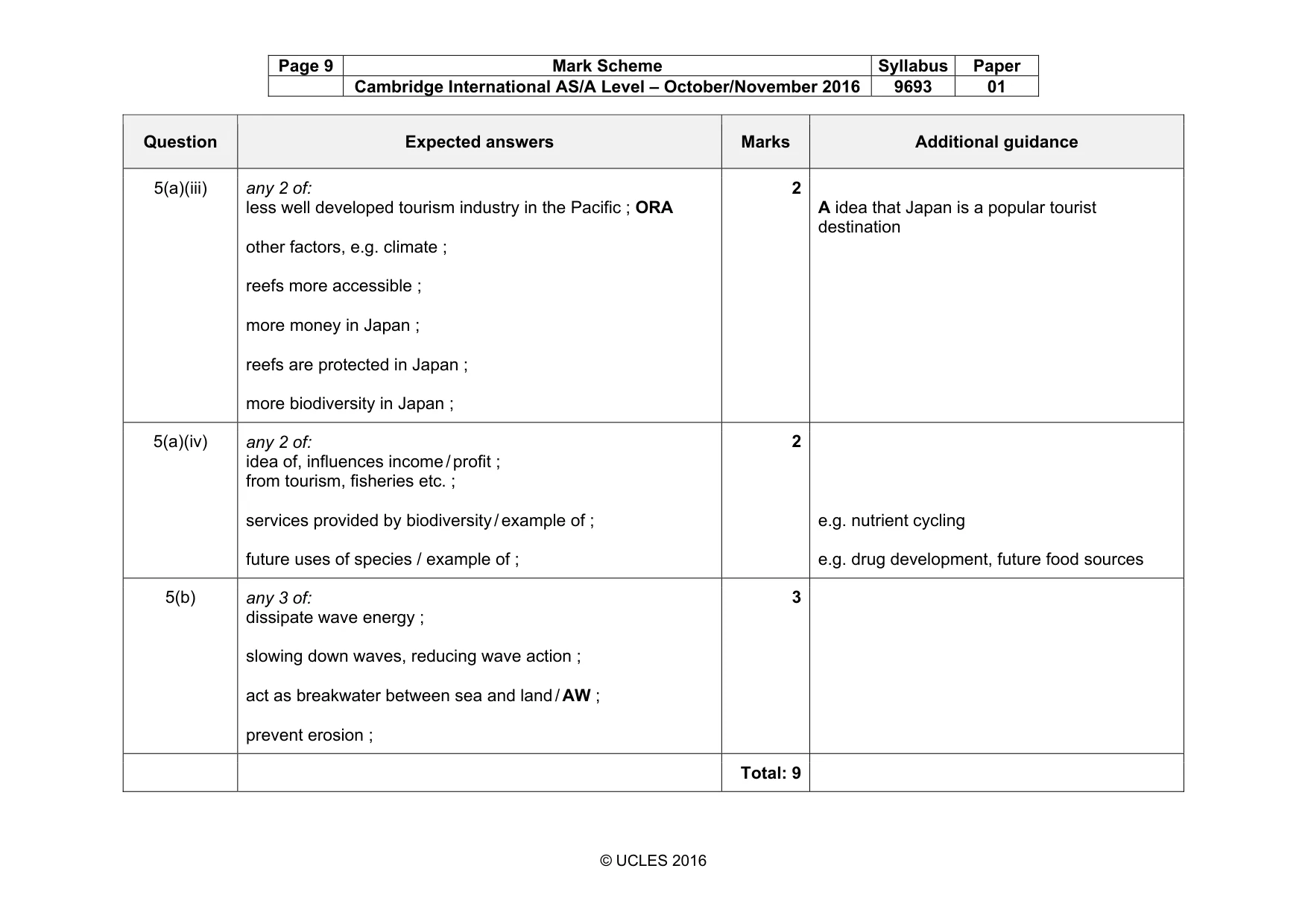
Page 9 Mark Scheme Syllabus Paper Cambridge International AS/A Level – October/November 2016 9693 01 © UCLES 2016 Question Expected answers Marks Additional guidance 5(a)(iii) any 2 of: less well developed tourism industry in the Pacific ; ORA other factors, e.g. climate ; reefs more accessible ; more money in Japan ; reefs are protected in Japan ; more biodiversity in Japan ; 2 A idea that Japan is a popular tourist destination 5(a)(iv) any 2 of: idea of, influences income / profit ; from tourism, fisheries etc. ; services provided by biodiversity / example of ; future uses of species / example of ; 2 e.g. nutrient cycling e.g. drug development, future food sources 5(b) any 3 of: dissipate wave energy ; slowing down waves, reducing wave action ; act as breakwater between sea and land / AW ; prevent erosion ; 3 Total: 9
Mark scheme, page 10
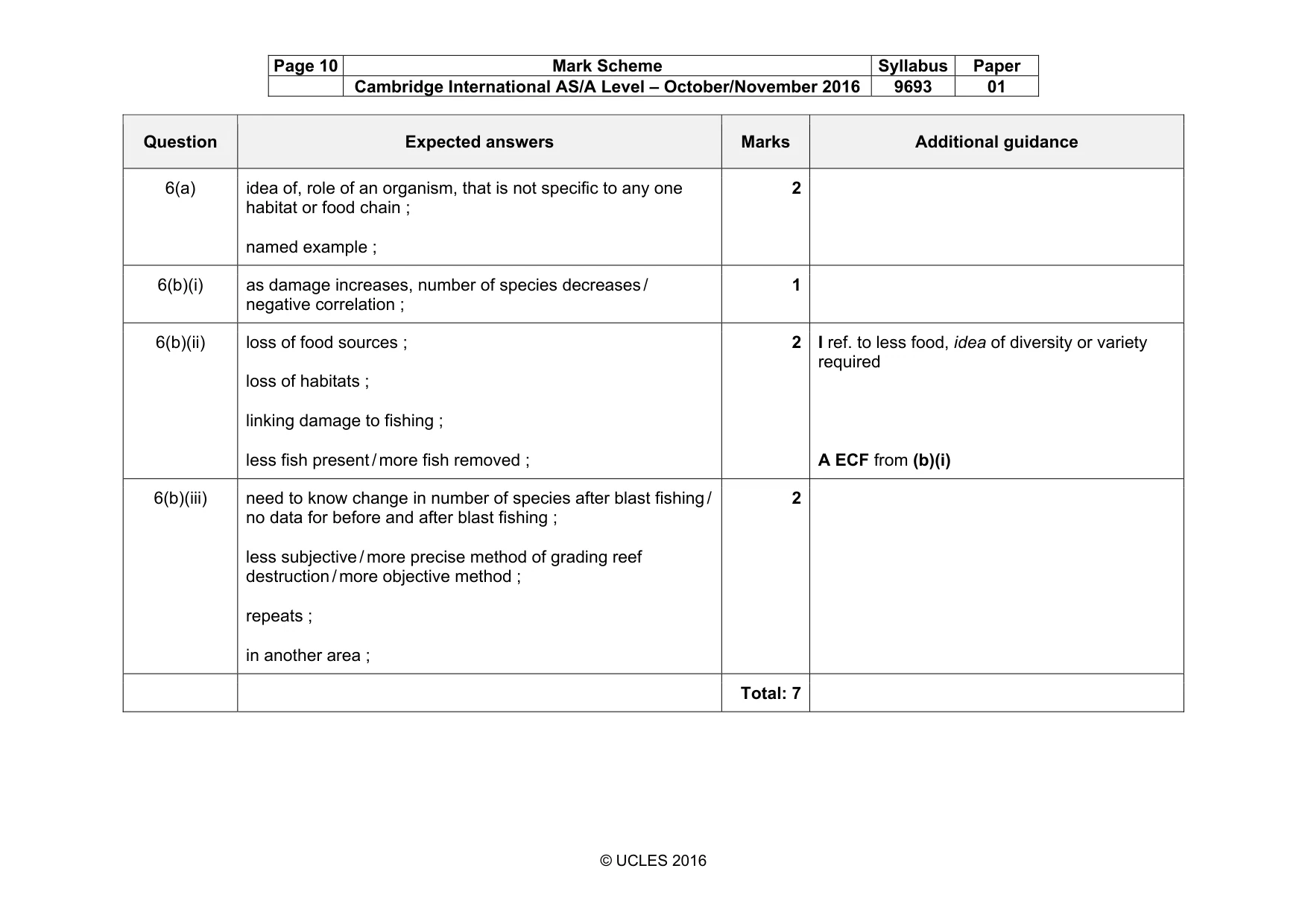
Page 10 Mark Scheme Syllabus Paper Cambridge International AS/A Level – October/November 2016 9693 01 © UCLES 2016 Question Expected answers Marks Additional guidance 6(a) idea of, role of an organism, that is not specific to any one habitat or food chain ; named example ; 2 6(b)(i) as damage increases, number of species decreases / negative correlation ; 1 6(b)(ii) loss of food sources ; loss of habitats ; linking damage to fishing ; less fish present / more fish removed ; 2 I ref. to less food, idea of diversity or variety required A ECF from (b)(i) 6(b)(iii) need to know change in number of species after blast fishing / no data for before and after blast fishing ; less subjective / more precise method of grading reef destruction / more objective method ; repeats ; in another area ; 2 Total: 7
Mark scheme, page 11
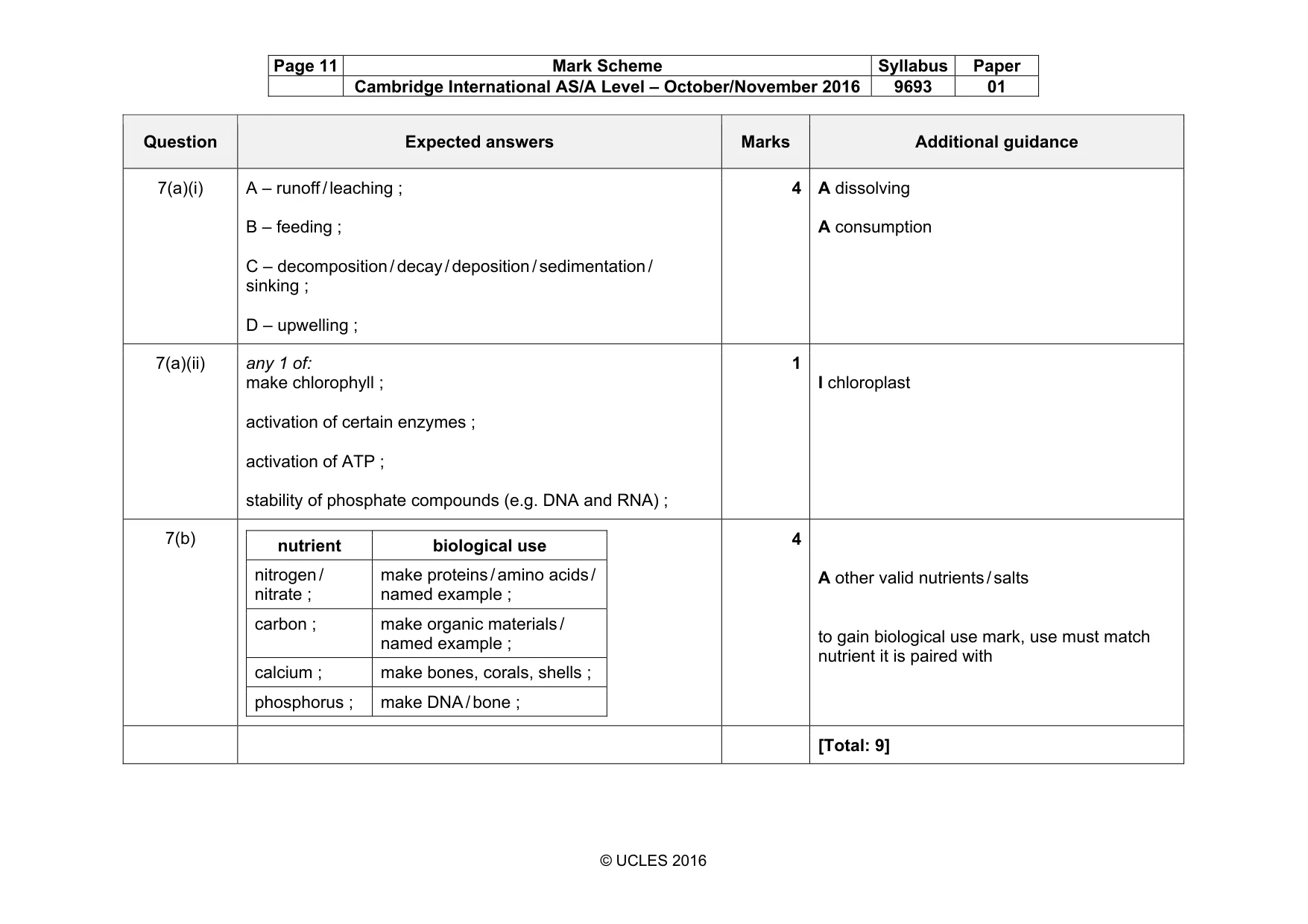
Page 11 Mark Scheme Syllabus Paper Cambridge International AS/A Level – October/November 2016 9693 01 © UCLES 2016 Question Expected answers Marks Additional guidance 7(a)(i) A – runoff / leaching ; B – feeding ; C – decomposition / decay / deposition / sedimentation / sinking ; D – upwelling ; 4 A dissolving A consumption 7(a)(ii) any 1 of: make chlorophyll ; activation of certain enzymes ; activation of ATP ; stability of phosphate compounds (e.g. DNA and RNA) ; 1 I chloroplast 7(b) nutrient biological use nitrogen / nitrate ; make proteins / amino acids / named example ; carbon ; make organic materials / named example ; calcium ; make bones, corals, shells ; phosphorus ; make DNA / bone ; 4 A other valid nutrients / salts to gain biological use mark, use must match nutrient it is paired with [Total: 9]
Mark scheme, page 12
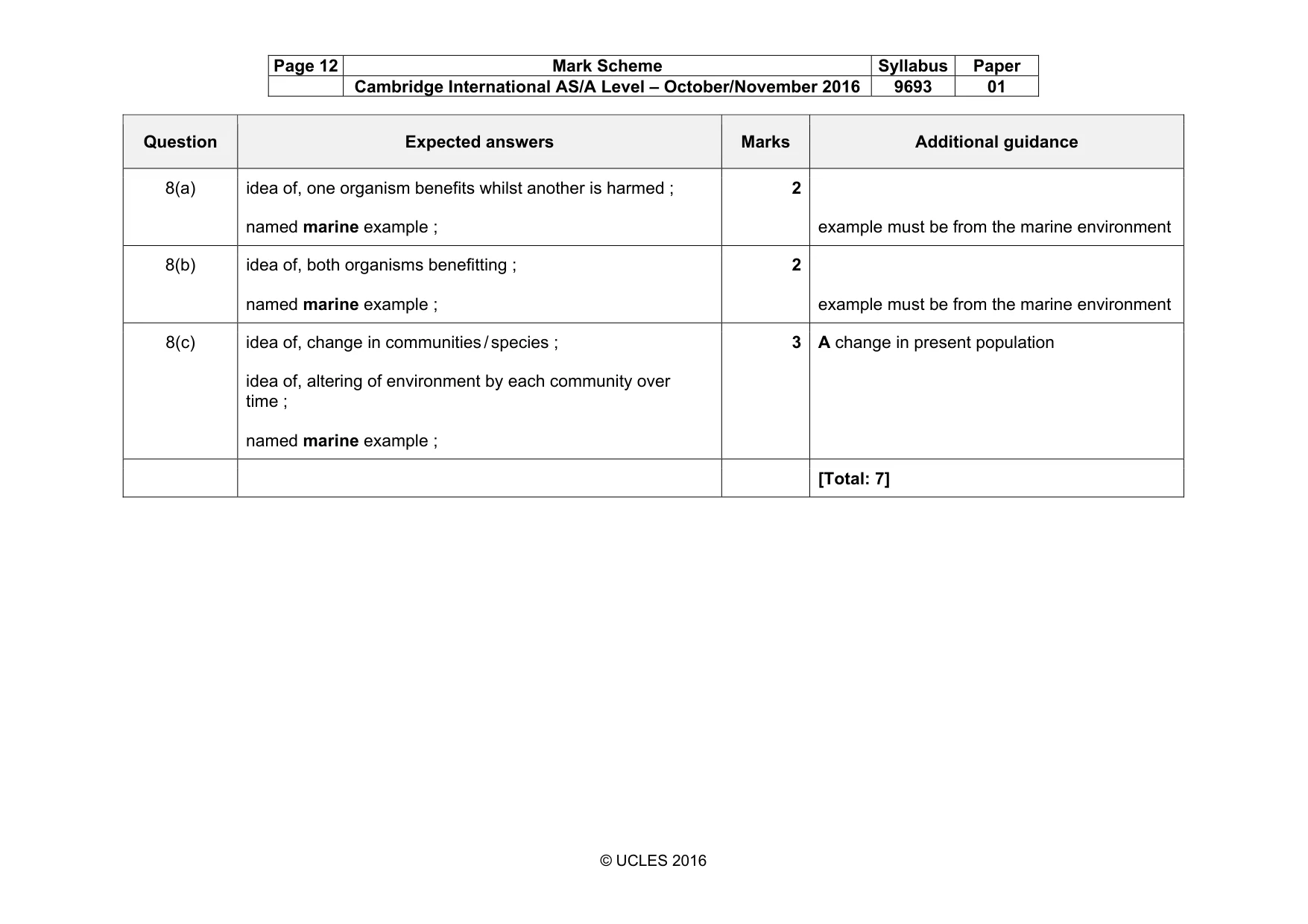
Page 12 Mark Scheme Syllabus Paper Cambridge International AS/A Level – October/November 2016 9693 01 © UCLES 2016 Question Expected answers Marks Additional guidance 8(a) idea of, one organism benefits whilst another is harmed ; named marine example ; 2 example must be from the marine environment 8(b) idea of, both organisms benefitting ; named marine example ; 2 example must be from the marine environment 8(c) idea of, change in communities / species ; idea of, altering of environment by each community over time ; named marine example ; 3 A change in present population [Total: 7]
What you needed in this session
Cambridge’s own grade thresholds for 2016 Oct/Nov, Paper 1 · Variant 1. A higher threshold means an easier paper — the bar moves with how the cohort did.