Cambridge A Level Marine Science 9693 — 2015 Oct/Nov Paper 1 · Variant 1
9693/11/O/N/15 · 75 marks · ≈84 min
The question paper and its mark scheme, free to read here and free to download. This is Cambridge’s own paper, exactly as it was sat.
Question paper16 pages

Mark scheme9 pages
Answers below. Sit the paper first if you are practising.
Paper as text
Question paper, page 1
This document consists of 15 printed pages and 1 blank page. DC (ST/JG) 98815/3 © UCLES 2015 [Turn over Cambridge International Examinations Cambridge International Advanced Subsidiary and Advanced Level * 3 6 9 2 6 1 3 3 3 0 * MARINE SCIENCE 9693/01 Paper 1 AS Structured Questions October/November 2015 1 hour 30 minutes Candidates answer on the Question Paper. No Additional Materials are required. READ THESE INSTRUCTIONS FIRST Write your Centre number, candidate number and name on all the work you hand in. Write in dark blue or black pen. You may use an HB pencil for any diagrams or graphs. Do not use staples, paper clips, glue or correction fluid. DO NOT WRITE IN ANY BARCODES. Answer all questions. Write your answers in the spaces provided on the Question Paper. Electronic calculators may be used. You may lose marks if you do not show your working or if you do not use appropriate units. At the end of the examination, fasten all your work securely together. The number of marks is given in brackets [ ] at the end of each question or part question.
Question paper, page 2
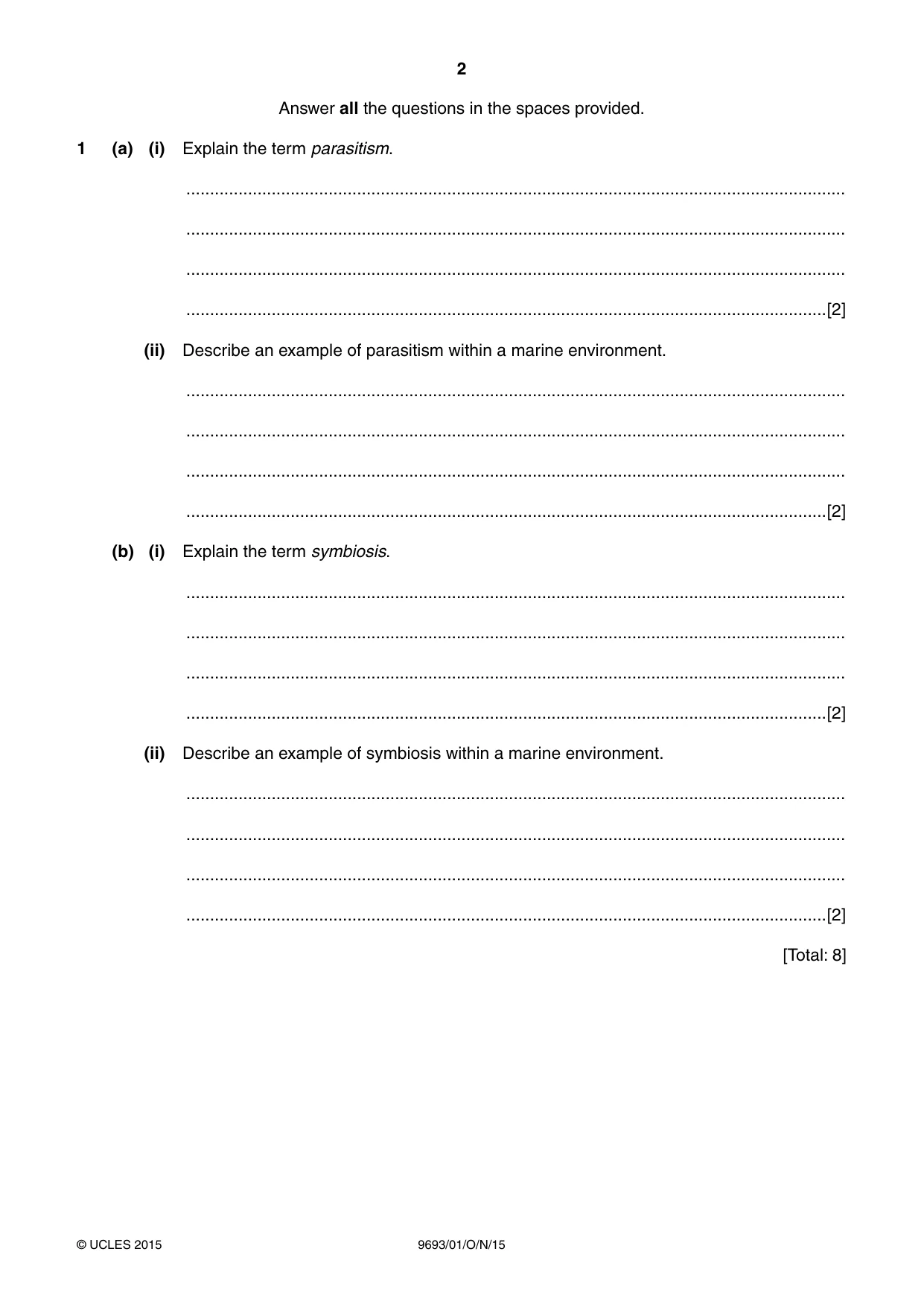
2 9693/01/O/N/15 © UCLES 2015 Answer all the questions in the spaces provided. 1 (a) (i) Explain the term parasitism. … … … …[2] (ii) Describe an example of parasitism within a marine environment. … … … …[2] (b) (i) Explain the term symbiosis. … … … …[2] (ii) Describe an example of symbiosis within a marine environment. … … … …[2] [Total: 8]
Question paper, page 3
3 9693/01/O/N/15 © UCLES 2015 [Turn over Question 2 begins on page 4
Question paper, page 4
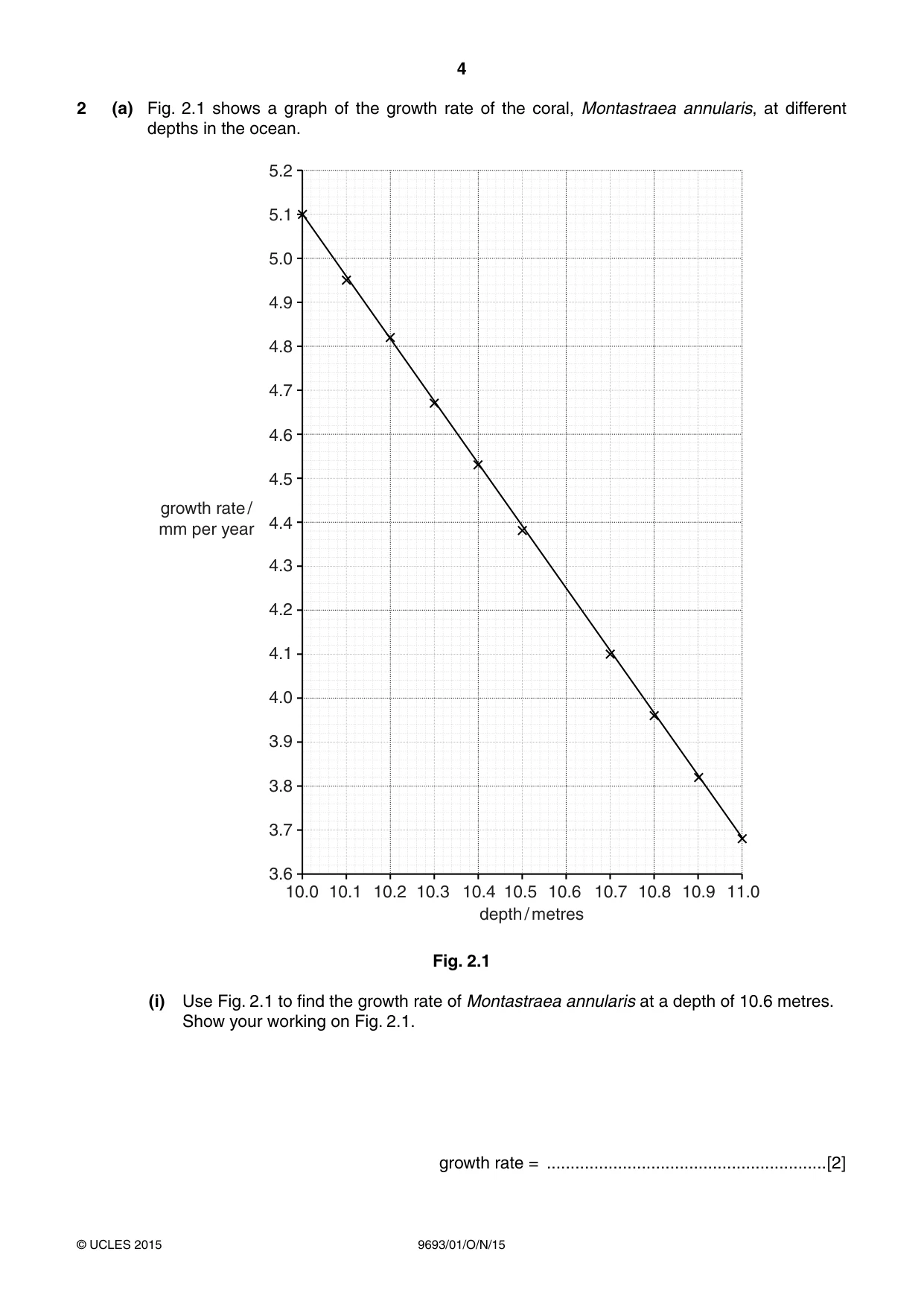
4 9693/01/O/N/15 © UCLES 2015 2 (a) Fig. 2.1 shows a graph of the growth rate of the coral, Montastraea annularis, at different depths in the ocean. 10.0 3.6 3.7 3.8 3.9 4.0 4.1 4.2 4.3 4.4 4.5 4.6 4.7 4.8 4.9 5.0 5.1 5.2 10.1 10.2 10.3 10.4 10.5 10.6 10.7 10.8 10.9 11.0 growth rate / mm per year depth / metres Fig. 2.1 (i) Use Fig. 2.1 to find the growth rate of Montastraea annularis at a depth of 10.6 metres. Show your working on Fig. 2.1. growth rate = …[2]
Question paper, page 5
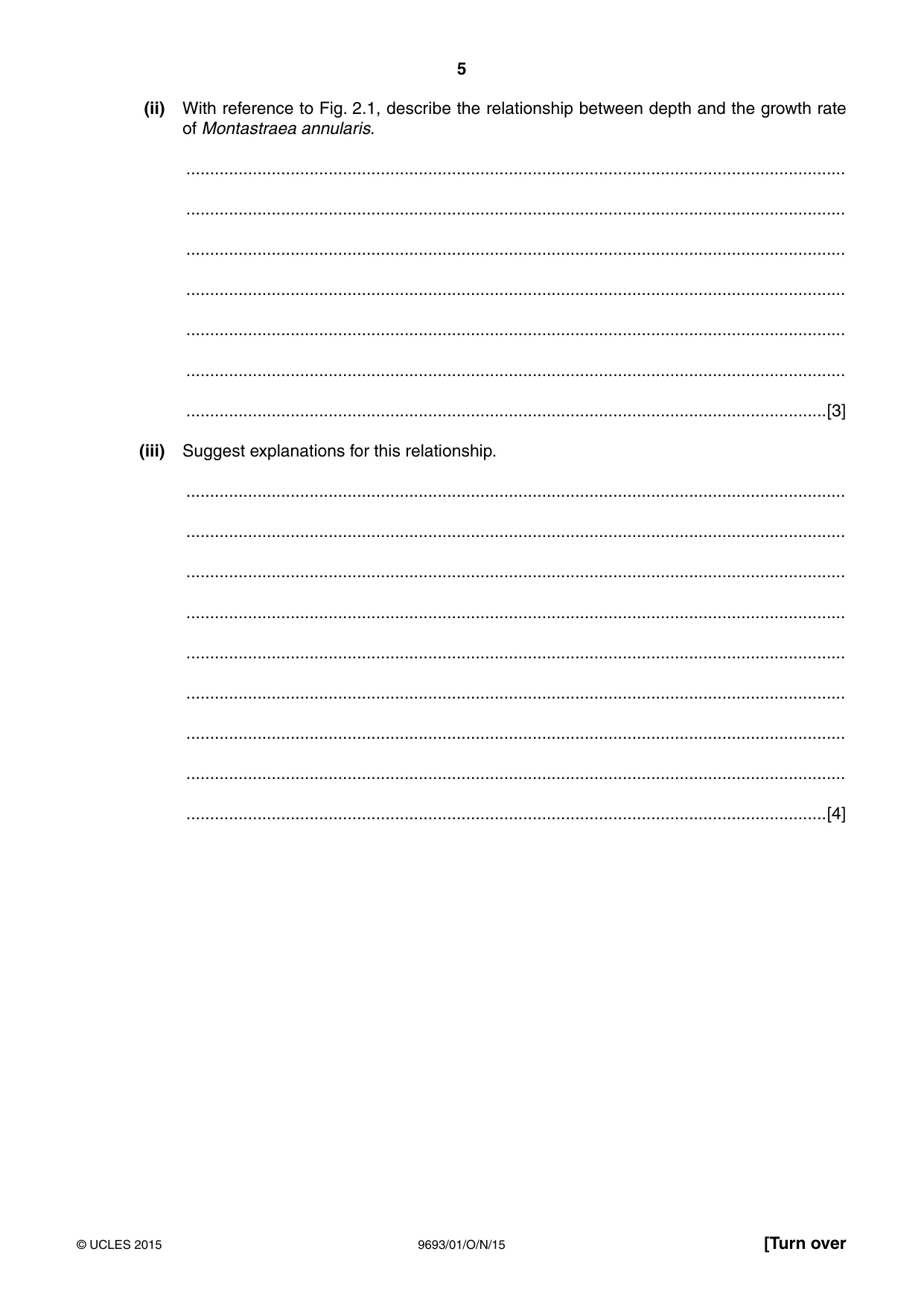
5 9693/01/O/N/15 © UCLES 2015 [Turn over (ii) With reference to Fig. 2.1, describe the relationship between depth and the growth rate of Montastraea annularis. … … … … … … …[3] (iii) Suggest explanations for this relationship. … … … … … … … … …[4]
Question paper, page 6
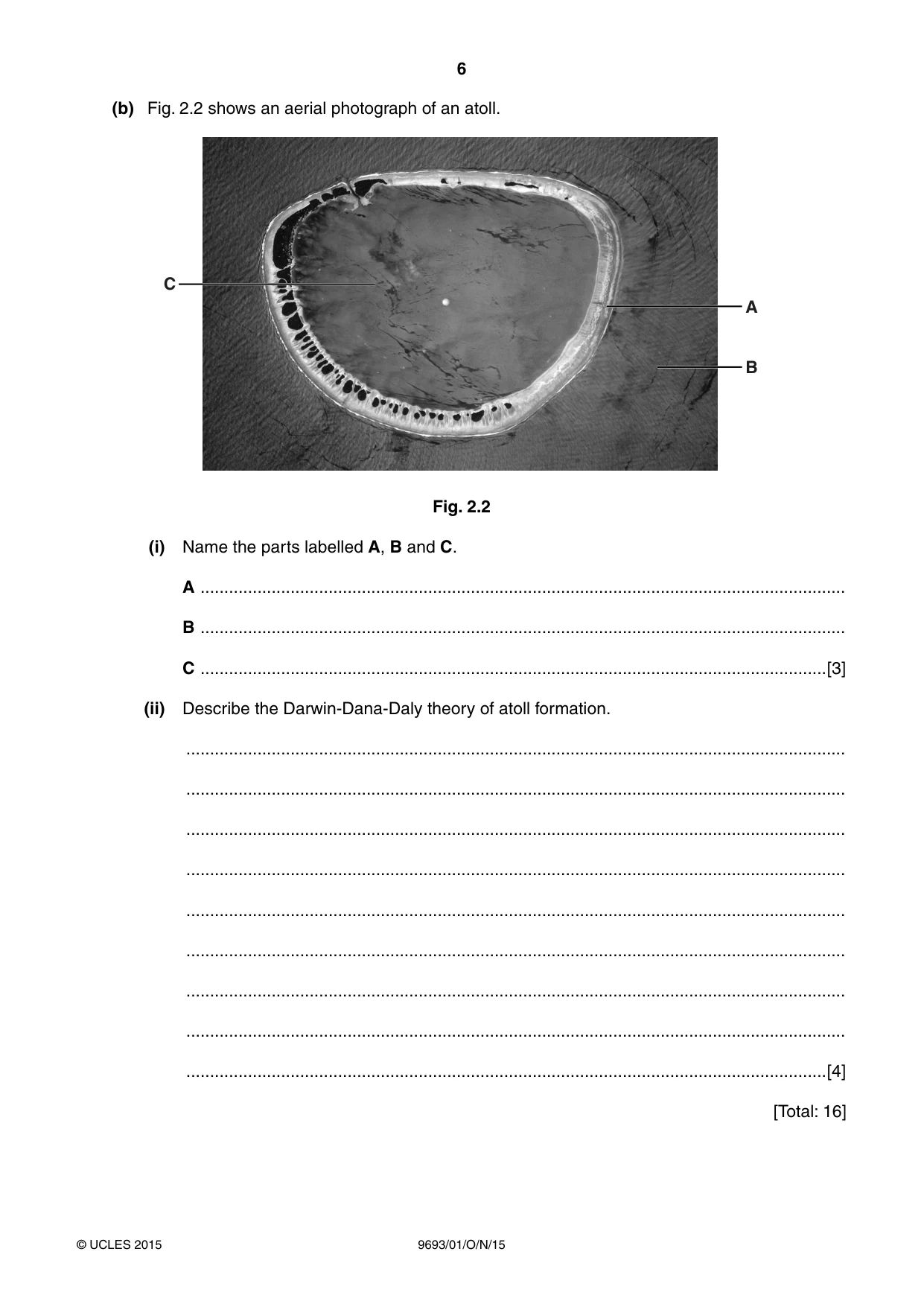
6 9693/01/O/N/15 © UCLES 2015 (b) Fig. 2.2 shows an aerial photograph of an atoll. A C B Fig. 2.2 (i) Name the parts labelled A, B and C. A … B … C …[3] (ii) Describe the Darwin-Dana-Daly theory of atoll formation. … … … … … … … … …[4] [Total: 16]
Question paper, page 7
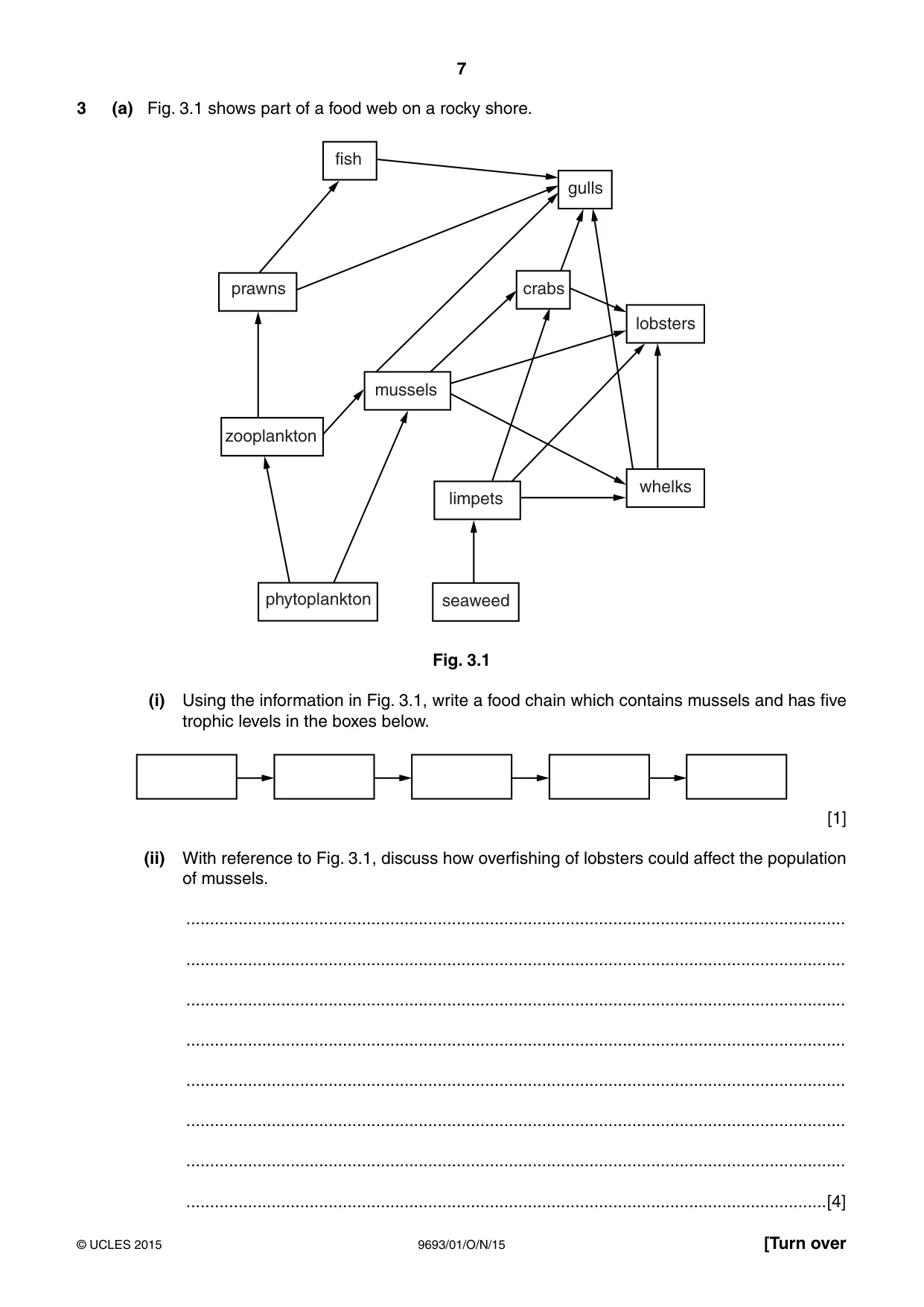
7 9693/01/O/N/15 © UCLES 2015 [Turn over 3 (a) Fig. 3.1 shows part of a food web on a rocky shore. fish gulls prawns crabs lobsters zooplankton mussels limpets whelks phytoplankton seaweed Fig. 3.1 (i) Using the information in Fig. 3.1, write a food chain which contains mussels and has five trophic levels in the boxes below. [1] (ii) With reference to Fig. 3.1, discuss how overfishing of lobsters could affect the population of mussels. … … … … … … … …[4]
Question paper, page 8
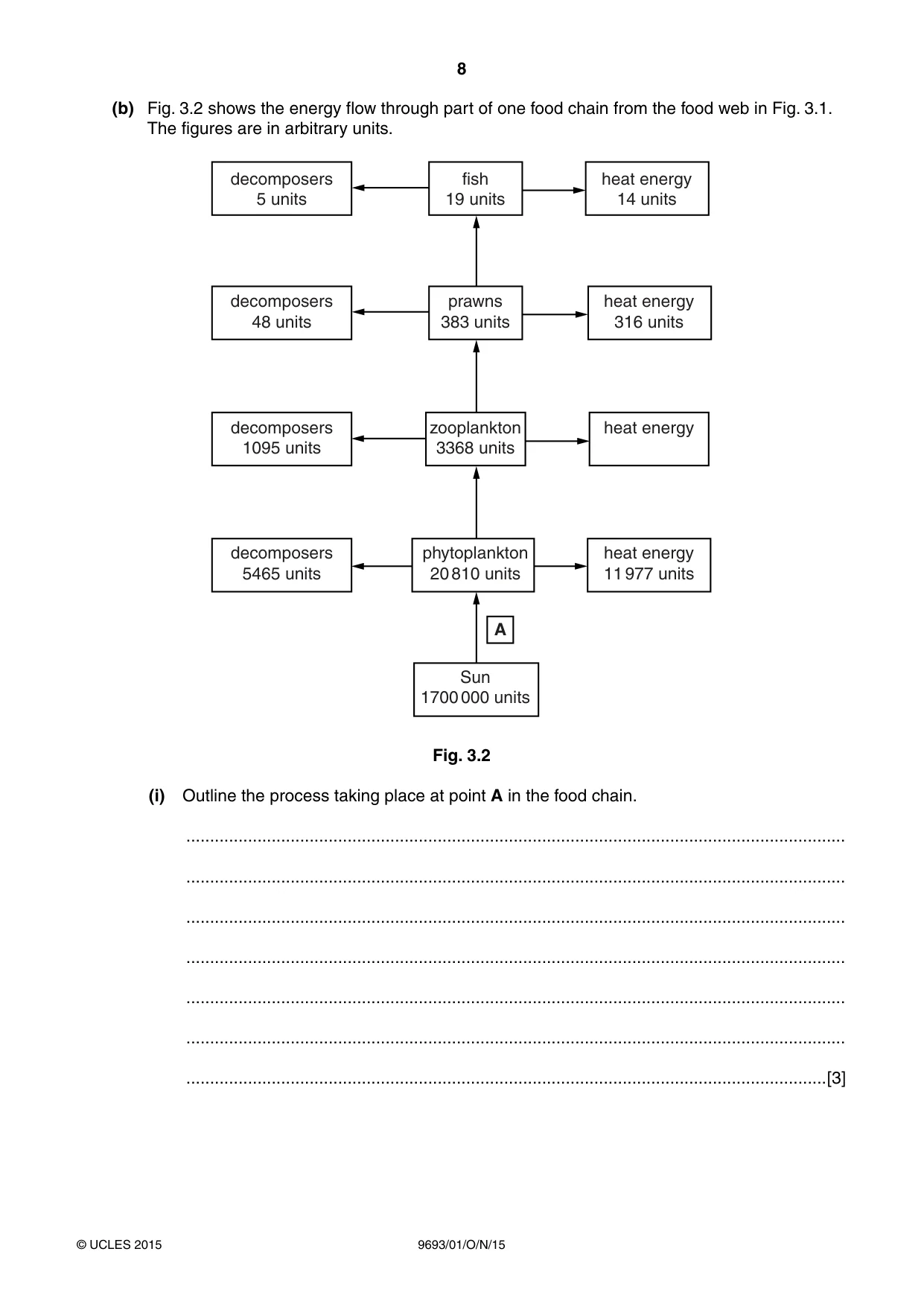
8 9693/01/O/N/15 © UCLES 2015 (b) Fig. 3.2 shows the energy flow through part of one food chain from the food web in Fig. 3.1. The figures are in arbitrary units. decomposers 5 units fish 19 units heat energy 14 units decomposers 48 units prawns 383 units heat energy 316 units decomposers 1095 units zooplankton 3368 units heat energy decomposers 5465 units phytoplankton 20 810 units Sun 1700 000 units heat energy 11 977 units A Fig. 3.2 (i) Outline the process taking place at point A in the food chain. … … … … … … …[3]
Question paper, page 9
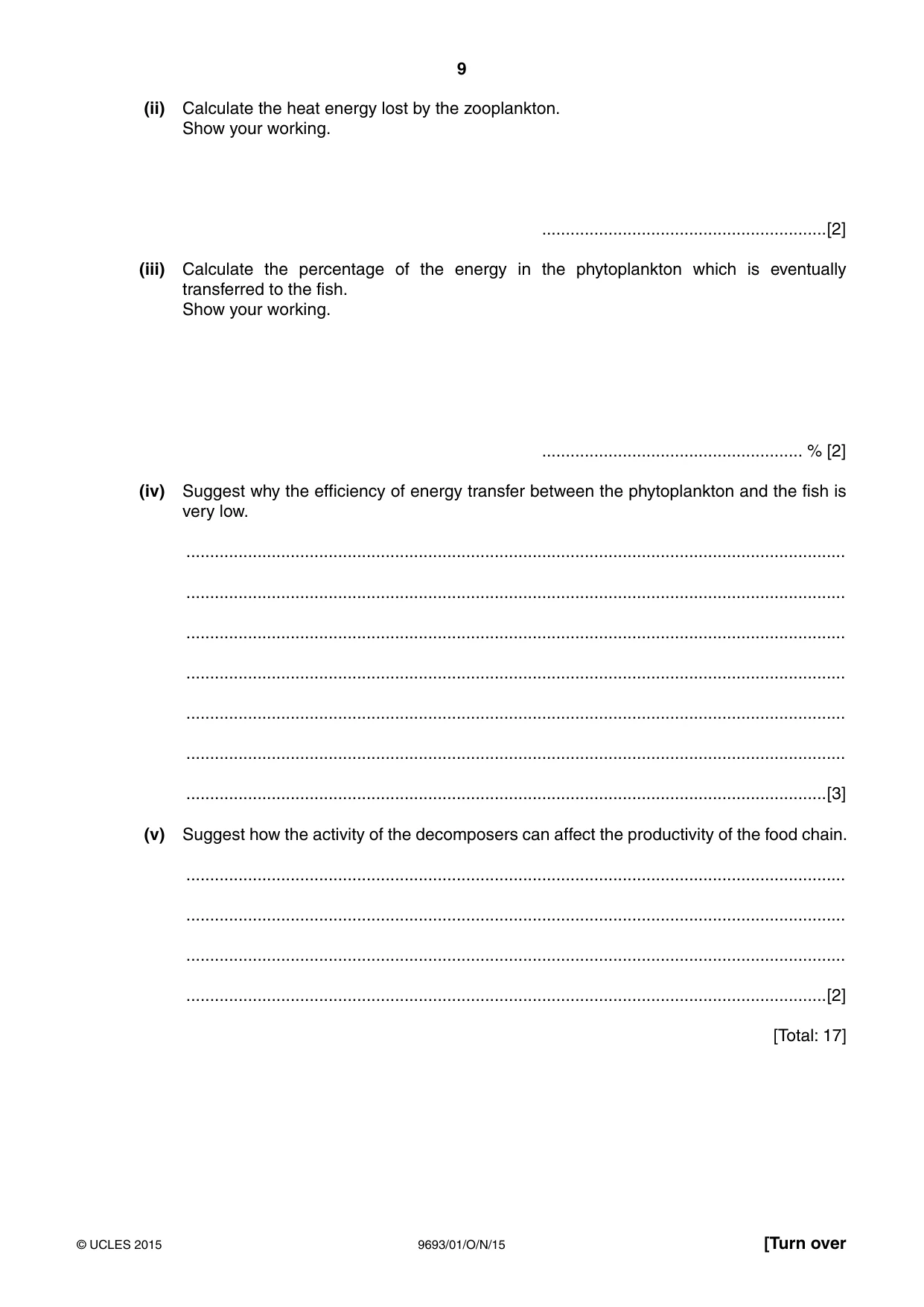
9 9693/01/O/N/15 © UCLES 2015 [Turn over (ii) Calculate the heat energy lost by the zooplankton. Show your working. …[2] (iii) Calculate the percentage of the energy in the phytoplankton which is eventually transferred to the fish. Show your working. … % [2] (iv) Suggest why the efficiency of energy transfer between the phytoplankton and the fish is very low. … … … … … … …[3] (v) Suggest how the activity of the decomposers can affect the productivity of the food chain. … … … …[2] [Total: 17]
Question paper, page 10
10 9693/01/O/N/15 © UCLES 2015 4 (a) State what is meant by the term salinity. … …[1] (b) (i) State a biological use for each of these ions found in sea water. magnesium … … calcium … … nitrate … …[3] (ii) State two sources of the ions present in sea water. 1 … … 2 … …[2] (iii) State two natural processes which remove ions from sea water. 1 … … 2 … …[2]
Question paper, page 11
11 9693/01/O/N/15 © UCLES 2015 [Turn over (c) (i) Suggest an explanation for each of these observations regarding the salinity of sea water. The sea water in Florida Bay has a mean salinity of 41.2 parts per thousand in summer and a mean salinity of 24.8 parts per thousand in winter. … … … …[2] (ii) Some parts of the Arctic Ocean have a mean salinity of 30.0 parts per thousand in summer, compared to a mean salinity of 35.0 parts per thousand in other oceans. … … … …[2] [Total: 12]
Question paper, page 12
12 9693/01/O/N/15 © UCLES 2015 5 (a) (i) Explain the meaning of the term estuary. … … … …[2] (ii) Organisms need to be specially adapted to survive the conditions present in an estuarine environment. State two conditions in an estuary to which organisms need to be adapted. 1 … … 2 … …[2]
Question paper, page 13
13 9693/01/O/N/15 © UCLES 2015 [Turn over (b) Fig. 5.1 shows photographs of three different types of littoral zone. The photograph in Fig. 5.1A has been taken from space. A B C Fig. 5.1 (i) Name the three types of littoral zone shown in Fig. 5.1. A … B … C …[3]
Question paper, page 14
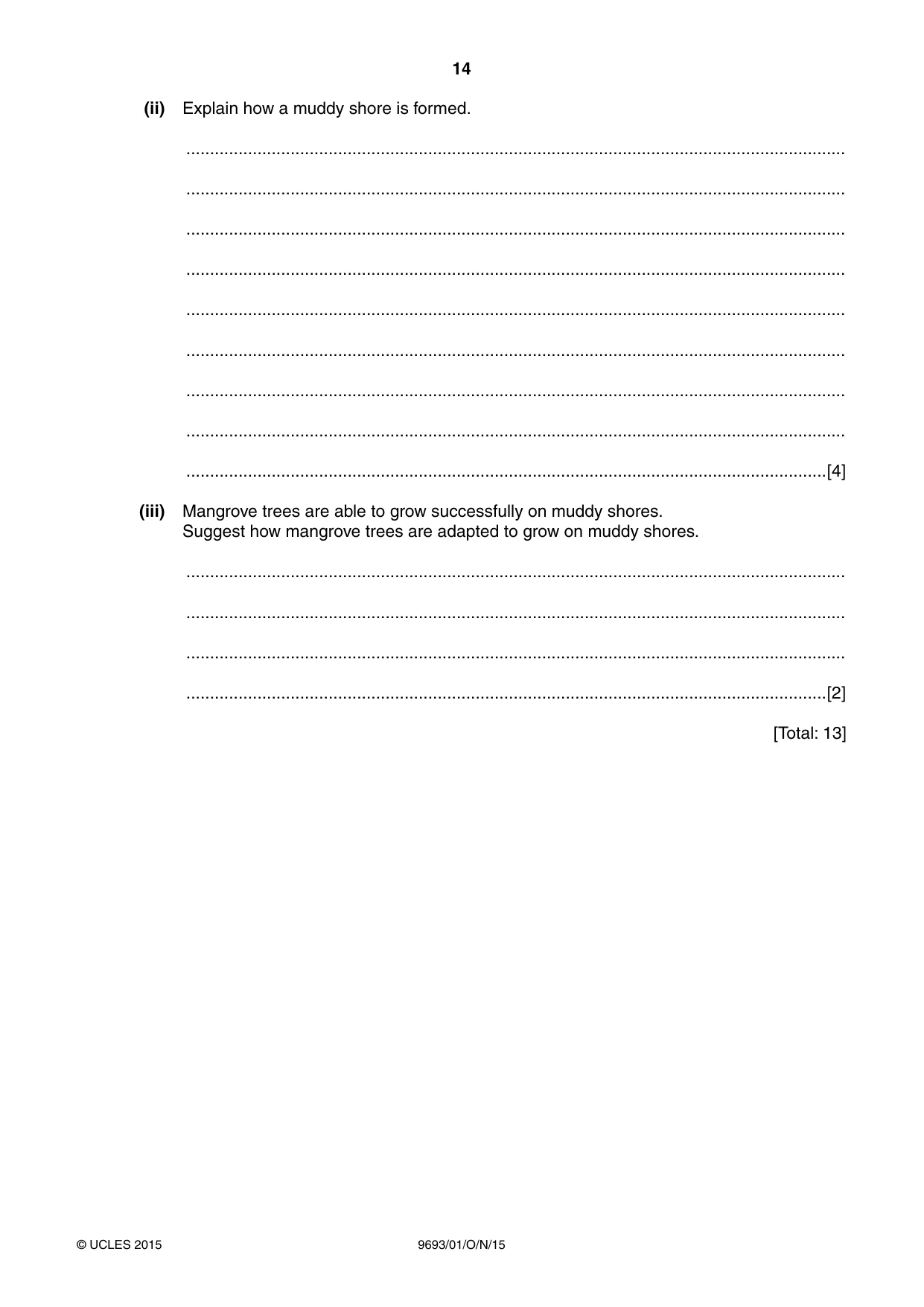
14 9693/01/O/N/15 © UCLES 2015 (ii) Explain how a muddy shore is formed. … … … … … … … … …[4] (iii) Mangrove trees are able to grow successfully on muddy shores. Suggest how mangrove trees are adapted to grow on muddy shores. … … … …[2] [Total: 13]
Question paper, page 15
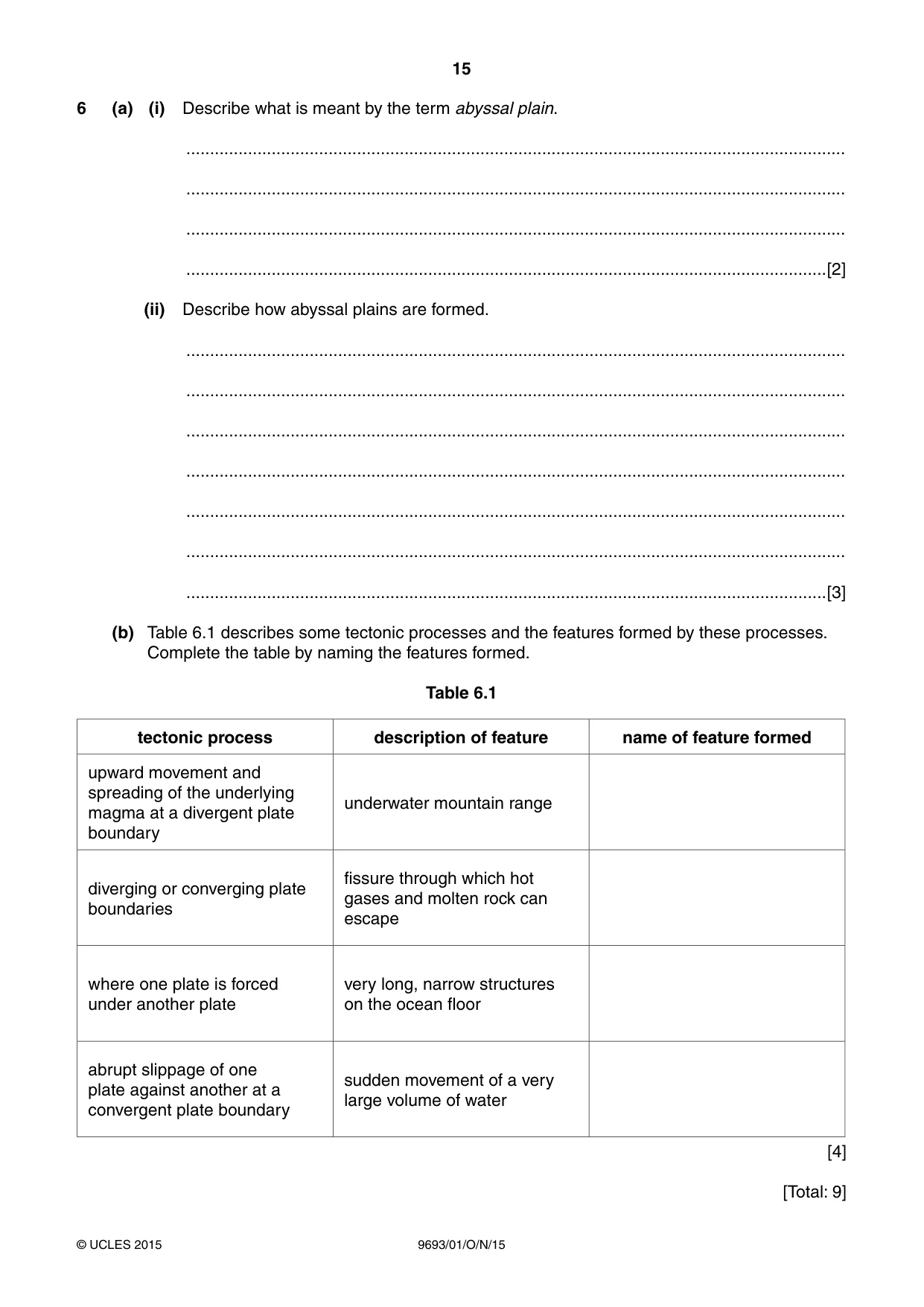
15 9693/01/O/N/15 © UCLES 2015 6 (a) (i) Describe what is meant by the term abyssal plain. … … … …[2] (ii) Describe how abyssal plains are formed. … … … … … … …[3] (b) Table 6.1 describes some tectonic processes and the features formed by these processes. Complete the table by naming the features formed. Table 6.1 tectonic process description of feature name of feature formed upward movement and spreading of the underlying magma at a divergent plate boundary underwater mountain range diverging or converging plate boundaries fissure through which hot gases and molten rock can escape where one plate is forced under another plate very long, narrow structures on the ocean floor abrupt slippage of one plate against another at a convergent plate boundary sudden movement of a very large volume of water [4] [Total: 9]
Question paper, page 16
16 9693/01/O/N/15 © UCLES 2015 Permission to reproduce items where third-party owned material protected by copyright is included has been sought and cleared where possible. Every reasonable effort has been made by the publisher (UCLES) to trace copyright holders, but if any items requiring clearance have unwittingly been included, the publisher will be pleased to make amends at the earliest possible opportunity. To avoid the issue of disclosure of answer-related information to candidates, all copyright acknowledgements are reproduced online in the Cambridge International Examinations Copyright Acknowledgements Booklet. This is produced for each series of examinations and is freely available to download at www.cie.org.uk after the live examination series. Cambridge International Examinations is part of the Cambridge Assessment Group. Cambridge Assessment is the brand name of University of Cambridge Local Examinations Syndicate (UCLES), which is itself a department of the University of Cambridge. BLANK PAGE
Mark scheme, page 1
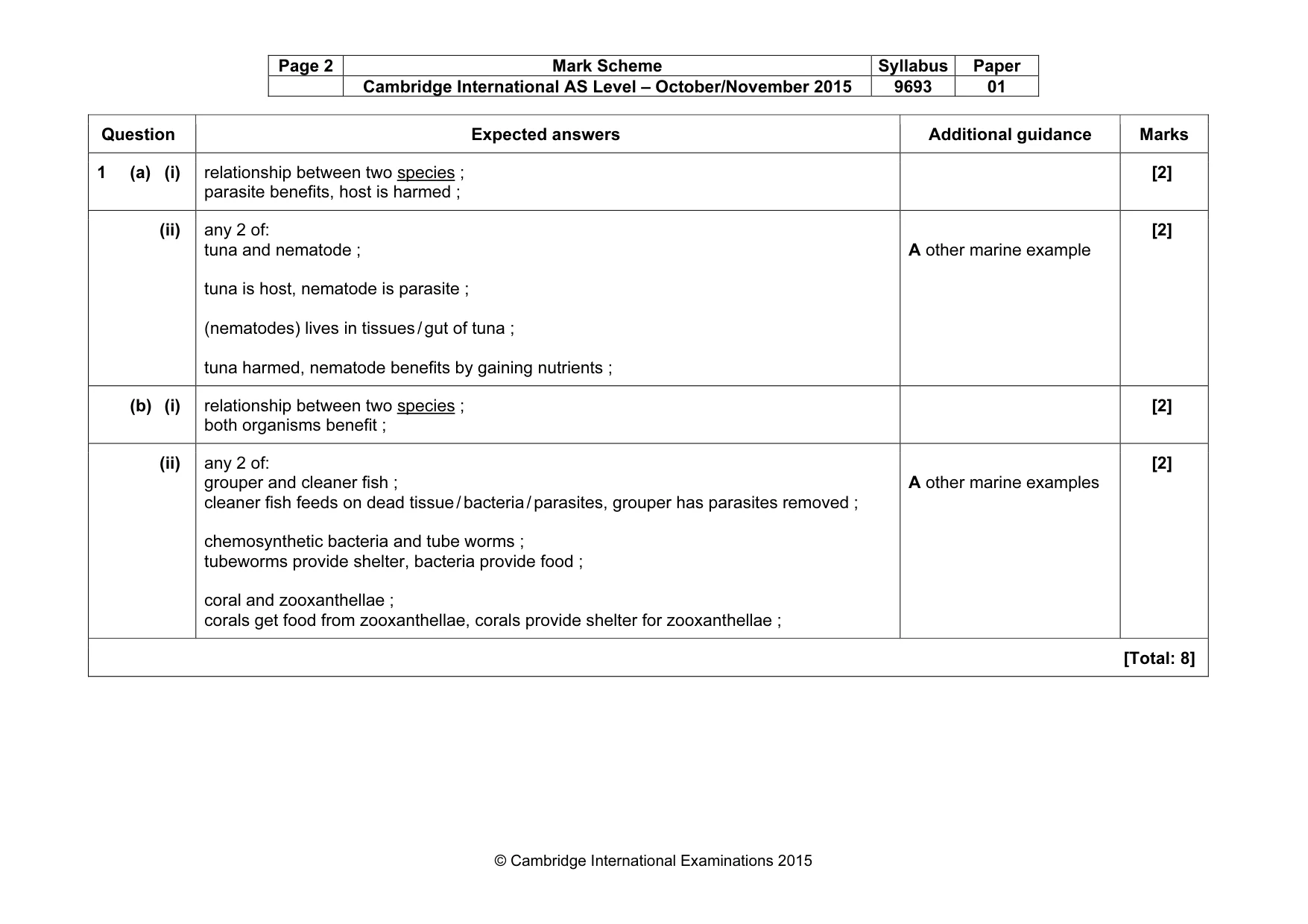
® IGCSE is the registered trademark of Cambridge International Examinations. CAMBRIDGE INTERNATIONAL EXAMINATIONS Cambridge International Advanced Subsidiary Level MARK SCHEME for the October/November 2015 series 9693 MARINE SCIENCE 9693/01 Paper 1 (AS Structured Questions), maximum raw mark 75 This mark scheme is published as an aid to teachers and candidates, to indicate the requirements of the examination. It shows the basis on which Examiners were instructed to award marks. It does not indicate the details of the discussions that took place at an Examiners’ meeting before marking began, which would have considered the acceptability of alternative answers. Mark schemes should be read in conjunction with the question paper and the Principal Examiner Report for Teachers. Cambridge will not enter into discussions about these mark schemes. Cambridge is publishing the mark schemes for the October/November 2015 series for most Cambridge IGCSE®, Cambridge International A and AS Level components and some Cambridge O Level components.
Mark scheme, page 2
Page 2 Mark Scheme Syllabus Paper Cambridge International AS Level – October/November 2015 9693 01 © Cambridge International Examinations 2015 Question Expected answers Additional guidance Marks 1 (a) (i) relationship between two species ; parasite benefits, host is harmed ; [2] (ii) any 2 of: tuna and nematode ; tuna is host, nematode is parasite ; (nematodes) lives in tissues / gut of tuna ; tuna harmed, nematode benefits by gaining nutrients ; A other marine example [2] (b) (i) relationship between two species ; both organisms benefit ; [2] (ii) any 2 of: grouper and cleaner fish ; cleaner fish feeds on dead tissue / bacteria / parasites, grouper has parasites removed ; chemosynthetic bacteria and tube worms ; tubeworms provide shelter, bacteria provide food ; coral and zooxanthellae ; corals get food from zooxanthellae, corals provide shelter for zooxanthellae ; A other marine examples [2] [Total: 8]
Mark scheme, page 3
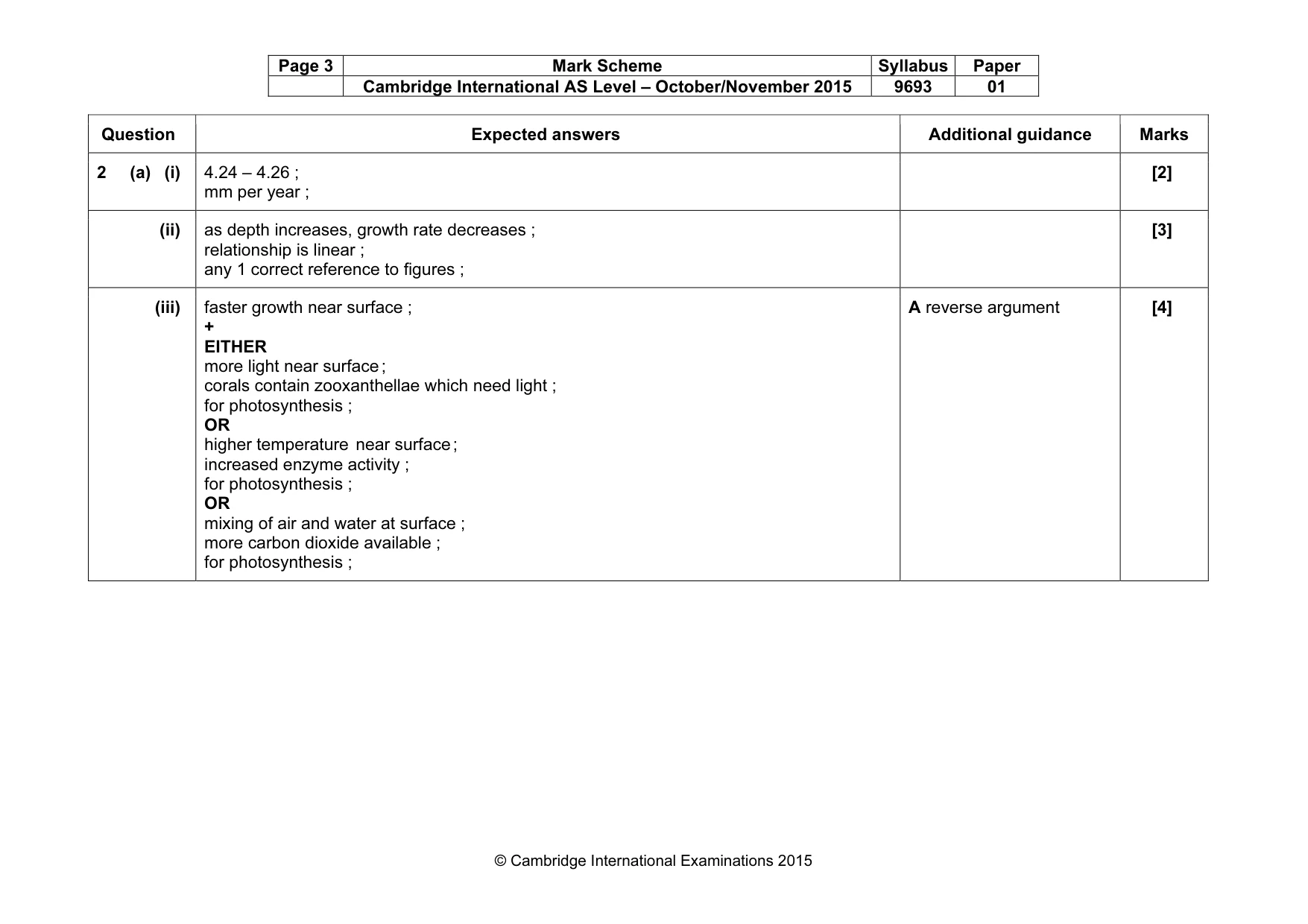
Page 3 Mark Scheme Syllabus Paper Cambridge International AS Level – October/November 2015 9693 01 © Cambridge International Examinations 2015 Question Expected answers Additional guidance Marks 2 (a) (i) 4.24 – 4.26 ; mm per year ; [2] (ii) as depth increases, growth rate decreases ; relationship is linear ; any 1 correct reference to figures ; [3] (iii) faster growth near surface ; + EITHER more light near surface ; corals contain zooxanthellae which need light ; for photosynthesis ; OR higher temperature near surface ; increased enzyme activity ; for photosynthesis ; OR mixing of air and water at surface ; more carbon dioxide available ; for photosynthesis ; A reverse argument [4]
Mark scheme, page 4
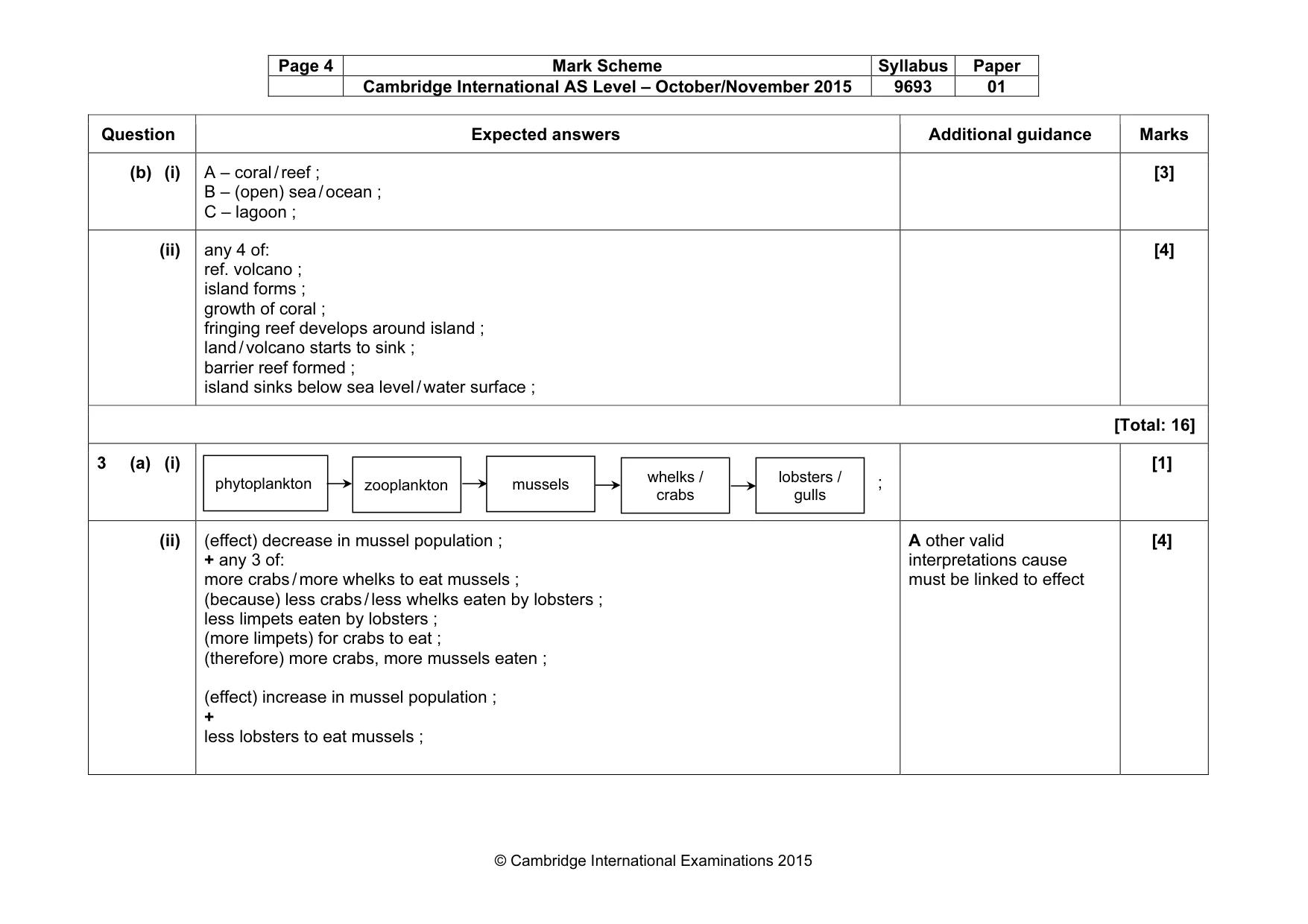
Page 4 Mark Scheme Syllabus Paper Cambridge International AS Level – October/November 2015 9693 01 © Cambridge International Examinations 2015 Question Expected answers Additional guidance Marks (b) (i) A – coral / reef ; B – (open) sea / ocean ; C – lagoon ; [3] (ii) any 4 of: ref. volcano ; island forms ; growth of coral ; fringing reef develops around island ; land / volcano starts to sink ; barrier reef formed ; island sinks below sea level / water surface ; [4] [Total: 16] 3 (a) (i) ; [1] (ii) (effect) decrease in mussel population ; + any 3 of: more crabs / more whelks to eat mussels ; (because) less crabs / less whelks eaten by lobsters ; less limpets eaten by lobsters ; (more limpets) for crabs to eat ; (therefore) more crabs, more mussels eaten ; (effect) increase in mussel population ; + less lobsters to eat mussels ; A other valid interpretations cause must be linked to effect [4] phytoplankton zooplankton whelks / crabs mussels lobsters / gulls
Mark scheme, page 5
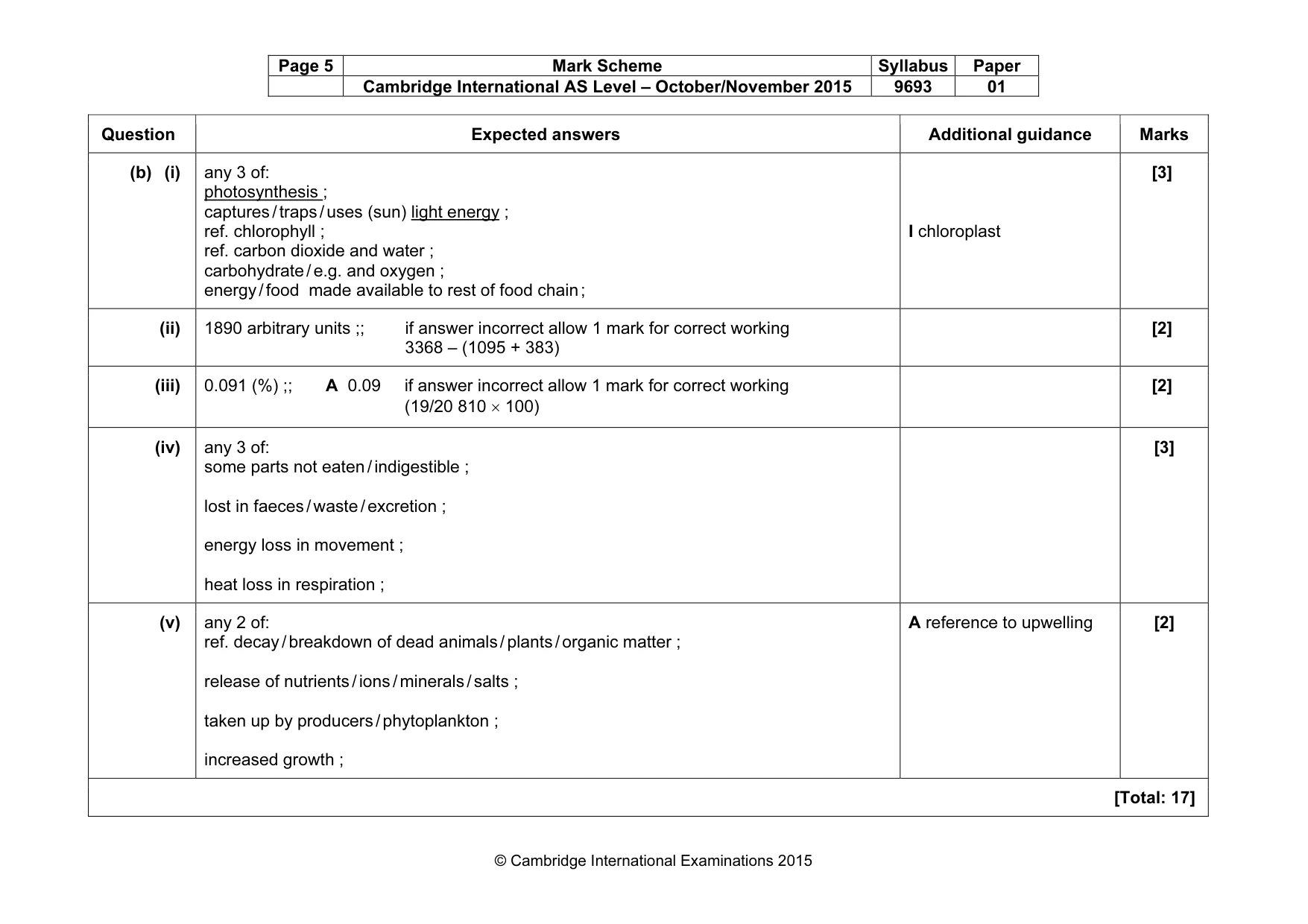
Page 5 Mark Scheme Syllabus Paper Cambridge International AS Level – October/November 2015 9693 01 © Cambridge International Examinations 2015 Question Expected answers Additional guidance Marks (b) (i) any 3 of: photosynthesis ; captures / traps / uses (sun) light energy ; ref. chlorophyll ; ref. carbon dioxide and water ; carbohydrate / e.g. and oxygen ; energy / food made available to rest of food chain ; I chloroplast [3] (ii) 1890 arbitrary units ;; if answer incorrect allow 1 mark for correct working 3368 – (1095 + 383) [2] (iii) 0.091 (%) ;; A 0.09 if answer incorrect allow 1 mark for correct working (19/20 810 × 100) [2] (iv) any 3 of: some parts not eaten / indigestible ; lost in faeces / waste / excretion ; energy loss in movement ; heat loss in respiration ; [3] (v) any 2 of: ref. decay / breakdown of dead animals / plants / organic matter ; release of nutrients / ions / minerals / salts ; taken up by producers / phytoplankton ; increased growth ; A reference to upwelling [2] [Total: 17]
Mark scheme, page 6
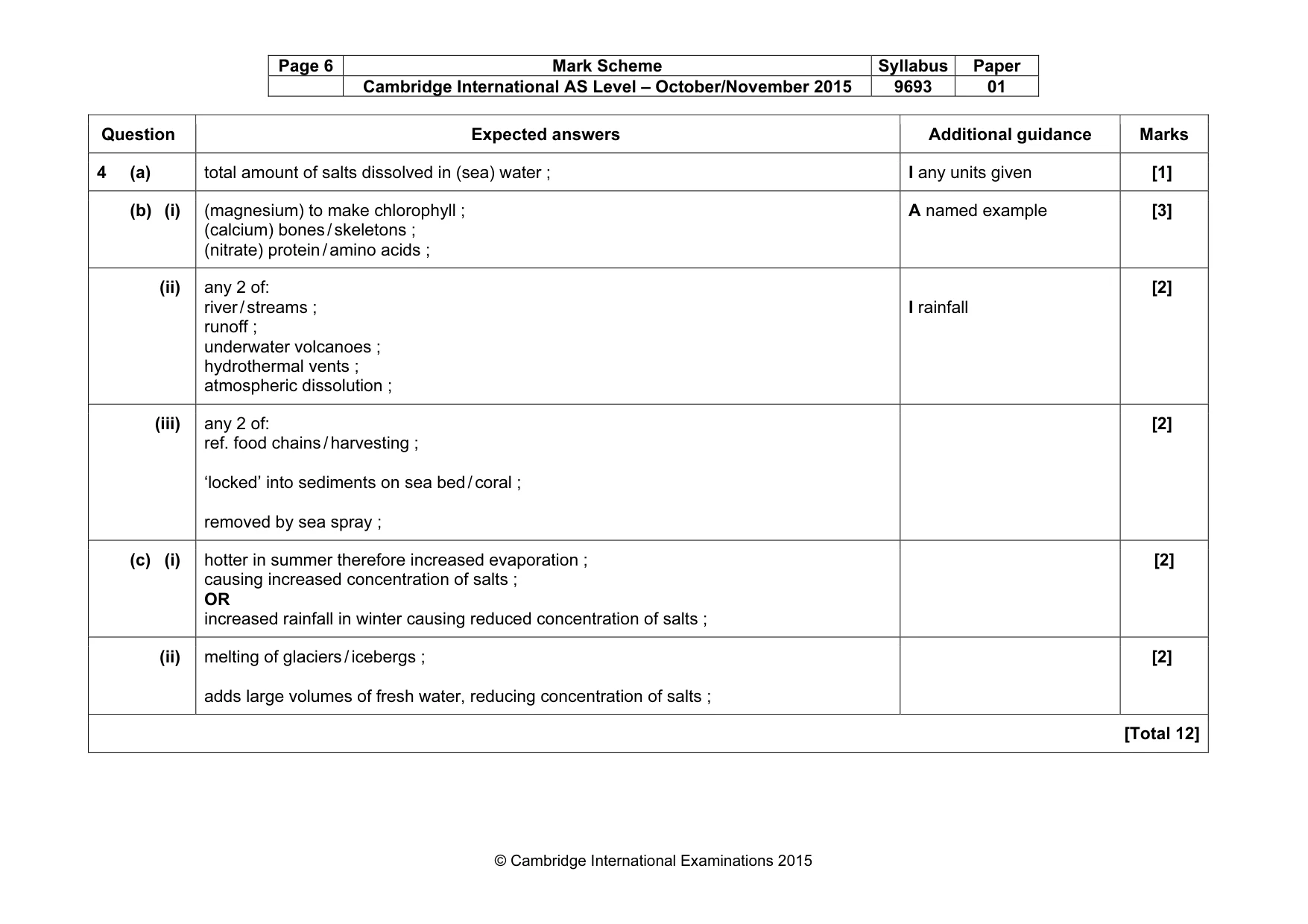
Page 6 Mark Scheme Syllabus Paper Cambridge International AS Level – October/November 2015 9693 01 © Cambridge International Examinations 2015 Question Expected answers Additional guidance Marks 4 (a) total amount of salts dissolved in (sea) water ; I any units given [1] (b) (i) (magnesium) to make chlorophyll ; (calcium) bones / skeletons ; (nitrate) protein / amino acids ; A named example [3] (ii) any 2 of: river / streams ; runoff ; underwater volcanoes ; hydrothermal vents ; atmospheric dissolution ; I rainfall [2] (iii) any 2 of: ref. food chains / harvesting ; ‘locked’ into sediments on sea bed / coral ; removed by sea spray ; [2] (c) (i) hotter in summer therefore increased evaporation ; causing increased concentration of salts ; OR increased rainfall in winter causing reduced concentration of salts ; [2] (ii) melting of glaciers / icebergs ; adds large volumes of fresh water, reducing concentration of salts ; [2] [Total 12]
Mark scheme, page 7
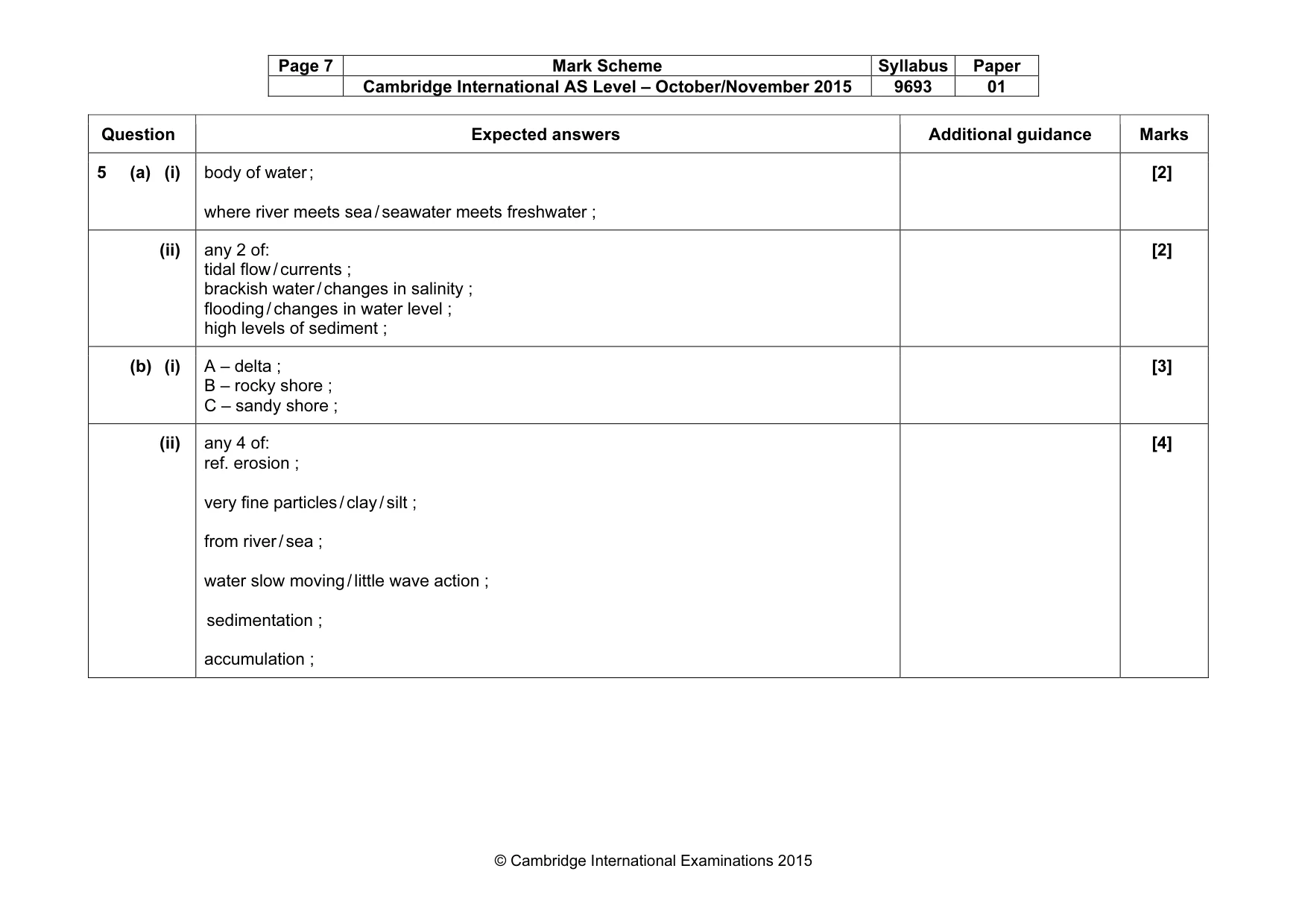
Page 7 Mark Scheme Syllabus Paper Cambridge International AS Level – October/November 2015 9693 01 © Cambridge International Examinations 2015 Question Expected answers Additional guidance Marks 5 (a) (i) body of water ; where river meets sea / seawater meets freshwater ; [2] (ii) any 2 of: tidal flow / currents ; brackish water / changes in salinity ; flooding / changes in water level ; high levels of sediment ; [2] (b) (i) A – delta ; B – rocky shore ; C – sandy shore ; [3] (ii) any 4 of: ref. erosion ; very fine particles / clay / silt ; from river / sea ; water slow moving / little wave action ; sedimentation ; accumulation ; [4]
Mark scheme, page 8
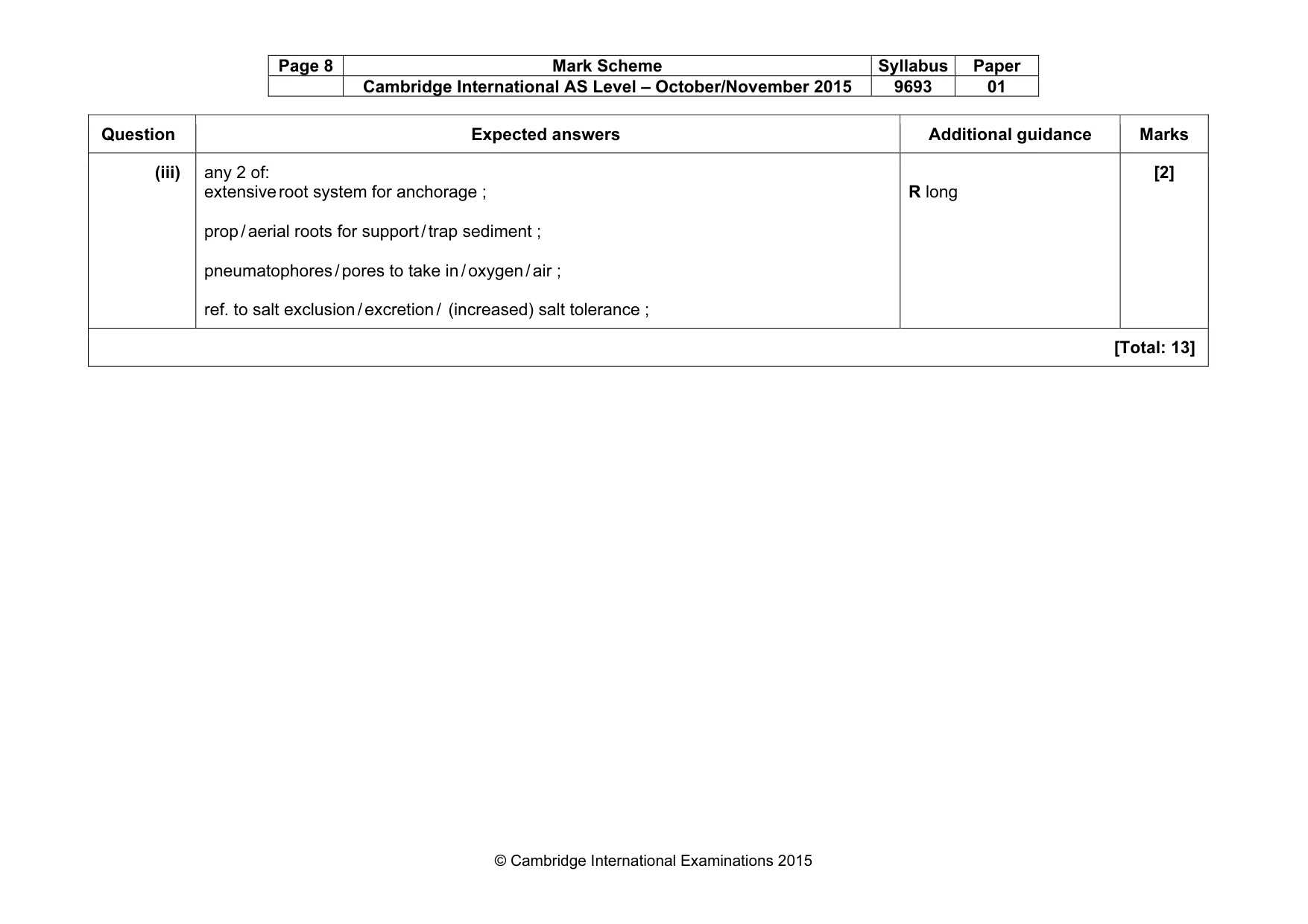
Page 8 Mark Scheme Syllabus Paper Cambridge International AS Level – October/November 2015 9693 01 © Cambridge International Examinations 2015 Question Expected answers Additional guidance Marks (iii) any 2 of: extensive root system for anchorage ; prop / aerial roots for support / trap sediment ; pneumatophores / pores to take in / oxygen / air ; ref. to salt exclusion / excretion / (increased) salt tolerance ; R long [2] [Total: 13]
Mark scheme, page 9
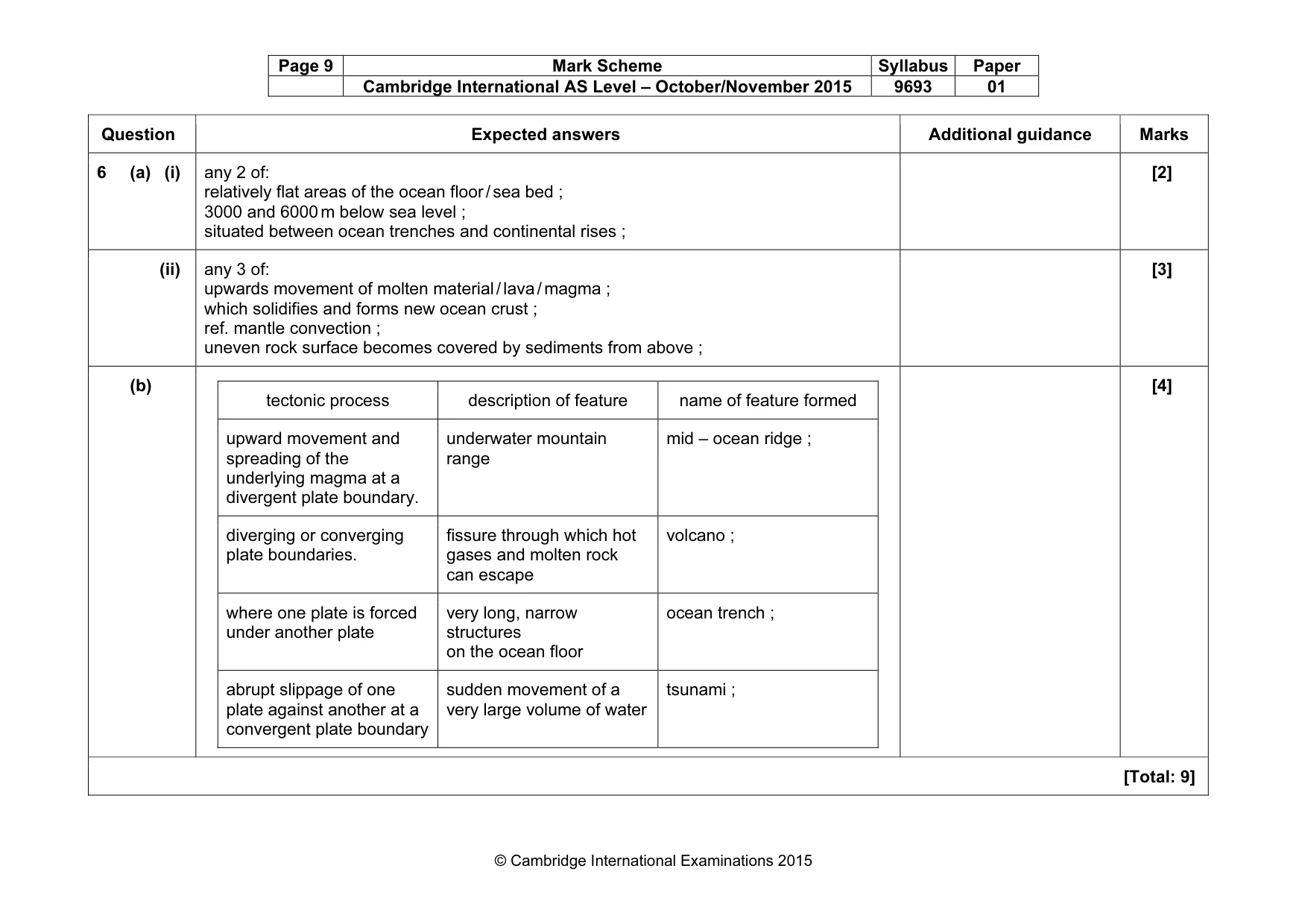
Page 9 Mark Scheme Syllabus Paper Cambridge International AS Level – October/November 2015 9693 01 © Cambridge International Examinations 2015 Question Expected answers Additional guidance Marks 6 (a) (i) any 2 of: relatively flat areas of the ocean floor / sea bed ; 3000 and 6000 m below sea level ; situated between ocean trenches and continental rises ; [2] (ii) any 3 of: upwards movement of molten material / lava / magma ; which solidifies and forms new ocean crust ; ref. mantle convection ; uneven rock surface becomes covered by sediments from above ; [3] (b) tectonic process description of feature name of feature formed upward movement and spreading of the underlying magma at a divergent plate boundary. underwater mountain range mid – ocean ridge ; diverging or converging plate boundaries. fissure through which hot gases and molten rock can escape volcano ; where one plate is forced under another plate very long, narrow structures on the ocean floor ocean trench ; abrupt slippage of one plate against another at a convergent plate boundary sudden movement of a very large volume of water tsunami ; [4] [Total: 9]
What you needed in this session
Cambridge’s own grade thresholds for 2015 Oct/Nov, Paper 1 · Variant 1. A higher threshold means an easier paper — the bar moves with how the cohort did.