Cambridge A Level Marine Science 9693 — 2015 May/June Paper 1 · Variant 1
9693/11/M/J/15 · 75 marks · ≈84 min
The question paper and its mark scheme, free to read here and free to download. This is Cambridge’s own paper, exactly as it was sat.
Question paper16 pages
Mark scheme8 pages
Answers below. Sit the paper first if you are practising.
Paper as text
Question paper, page 1
This document consists of 16 printed pages. DC (SJF/SW) 93473/6 © UCLES 2015 [Turn over Cambridge International Examinations Cambridge International Advanced Subsidiary and Advanced Level * 5 7 8 8 9 6 7 9 7 9 * MARINE SCIENCE 9693/01 Paper 1 AS Structured Questions May/June 2015 1 hour 30 minutes Candidates answer on the Question Paper. No Additional Materials are required. READ THESE INSTRUCTIONS FIRST Write your Centre number, candidate number and name on all the work you hand in. Write in dark blue or black pen. You may use an HB pencil for any diagrams or graphs. Do not use staples, paper clips, glue or correction fluid. DO NOT WRITE IN ANY BARCODES. Answer all questions. Write your answers in the spaces provided on the Question Paper. Electronic calculators may be used. You may lose marks if you do not show your working or if you do not use appropriate units. At the end of the examination, fasten all your work securely together. The number of marks is given in brackets [ ] at the end of each question or part question.
Question paper, page 2
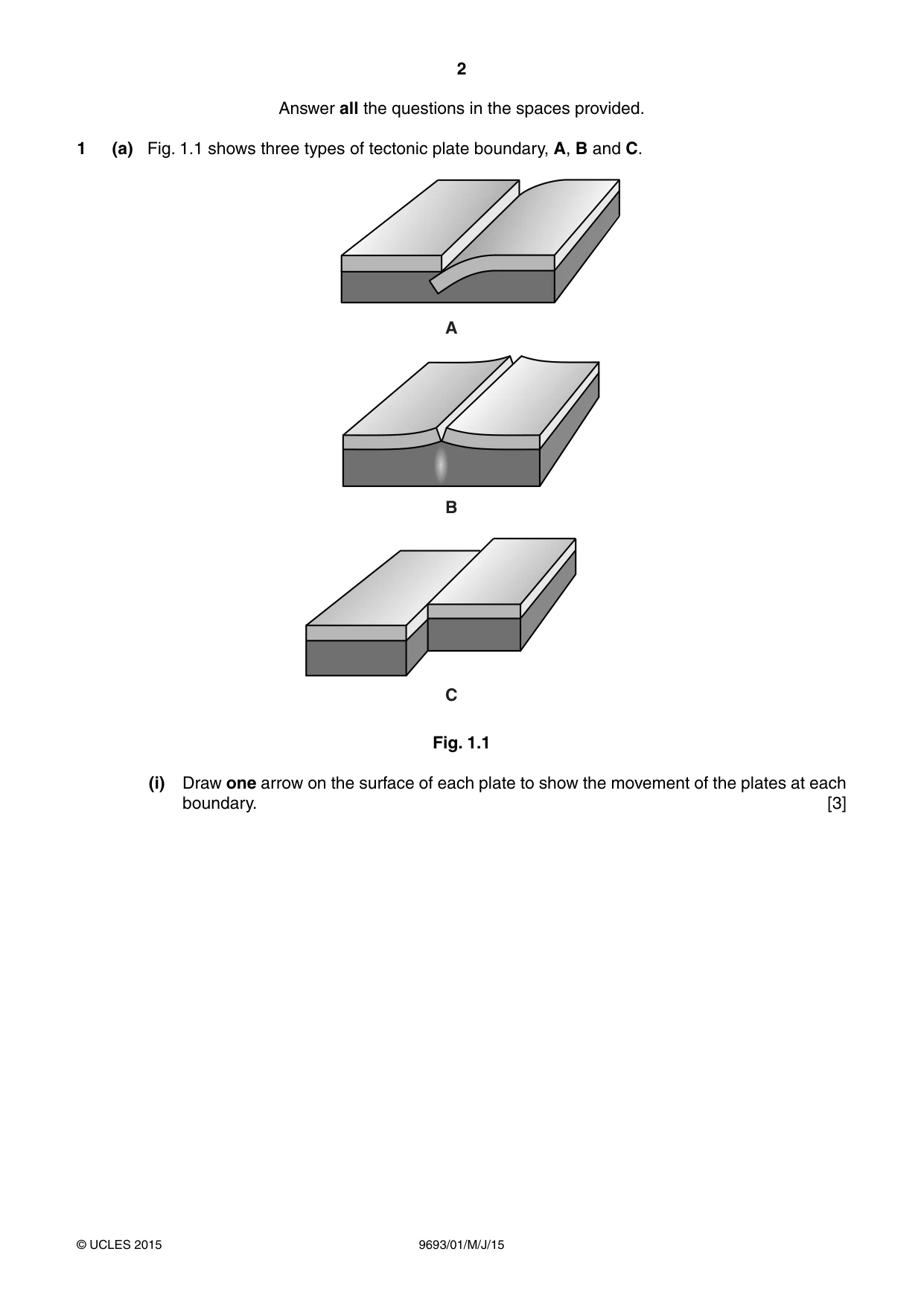
2 9693/01/M/J/15 © UCLES 2015 Answer all the questions in the spaces provided. 1 (a) Fig. 1.1 shows three types of tectonic plate boundary, A, B and C. A B C Fig. 1.1 (i) Draw one arrow on the surface of each plate to show the movement of the plates at each boundary. [3]
Question paper, page 3
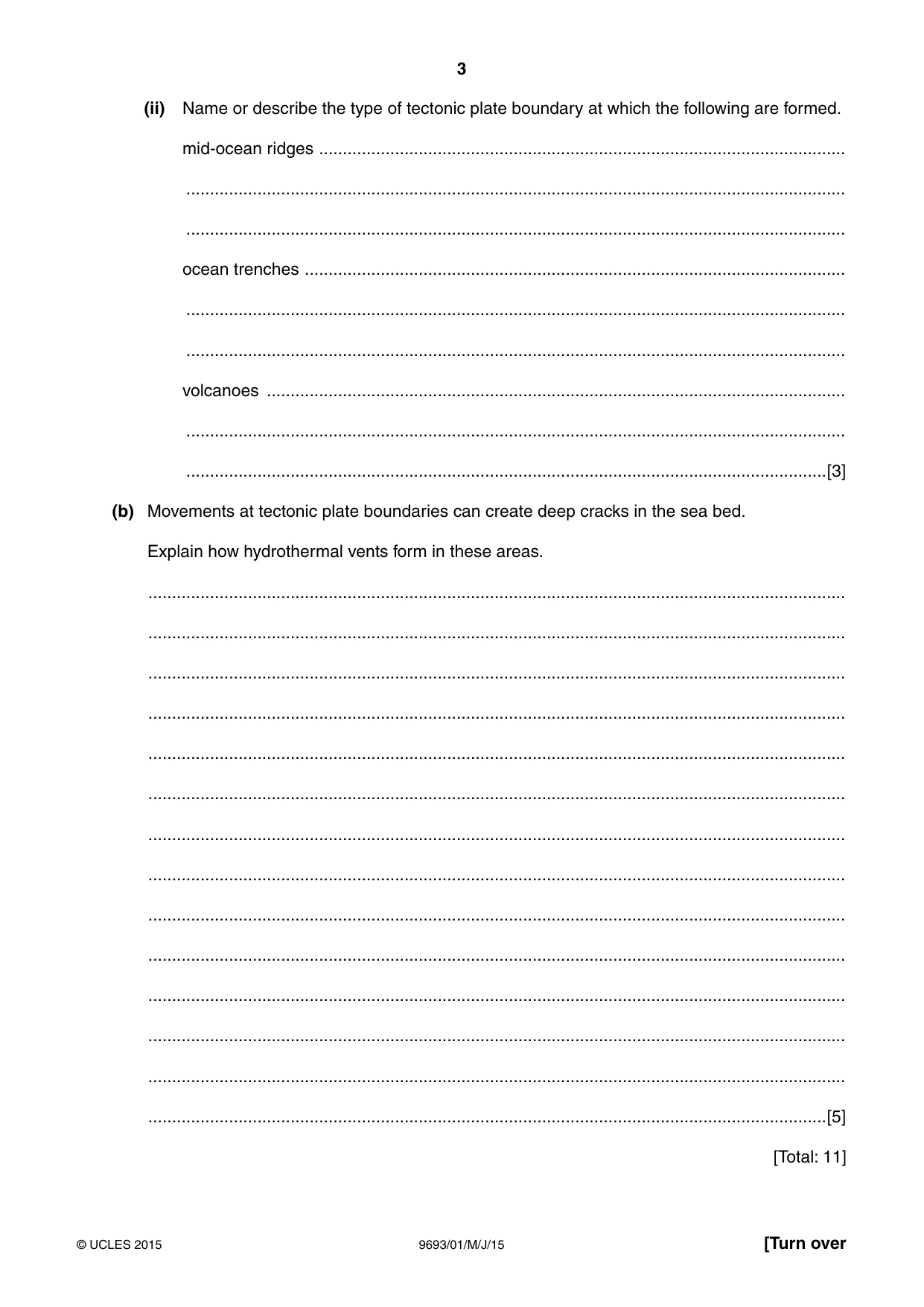
3 9693/01/M/J/15 © UCLES 2015 [Turn over (ii) Name or describe the type of tectonic plate boundary at which the following are formed. mid-ocean ridges … … … ocean trenches … … … volcanoes … … …[3] (b) Movements at tectonic plate boundaries can create deep cracks in the sea bed. Explain how hydrothermal vents form in these areas. … … … … … … … … … … … … … …[5] [Total: 11]
Question paper, page 4
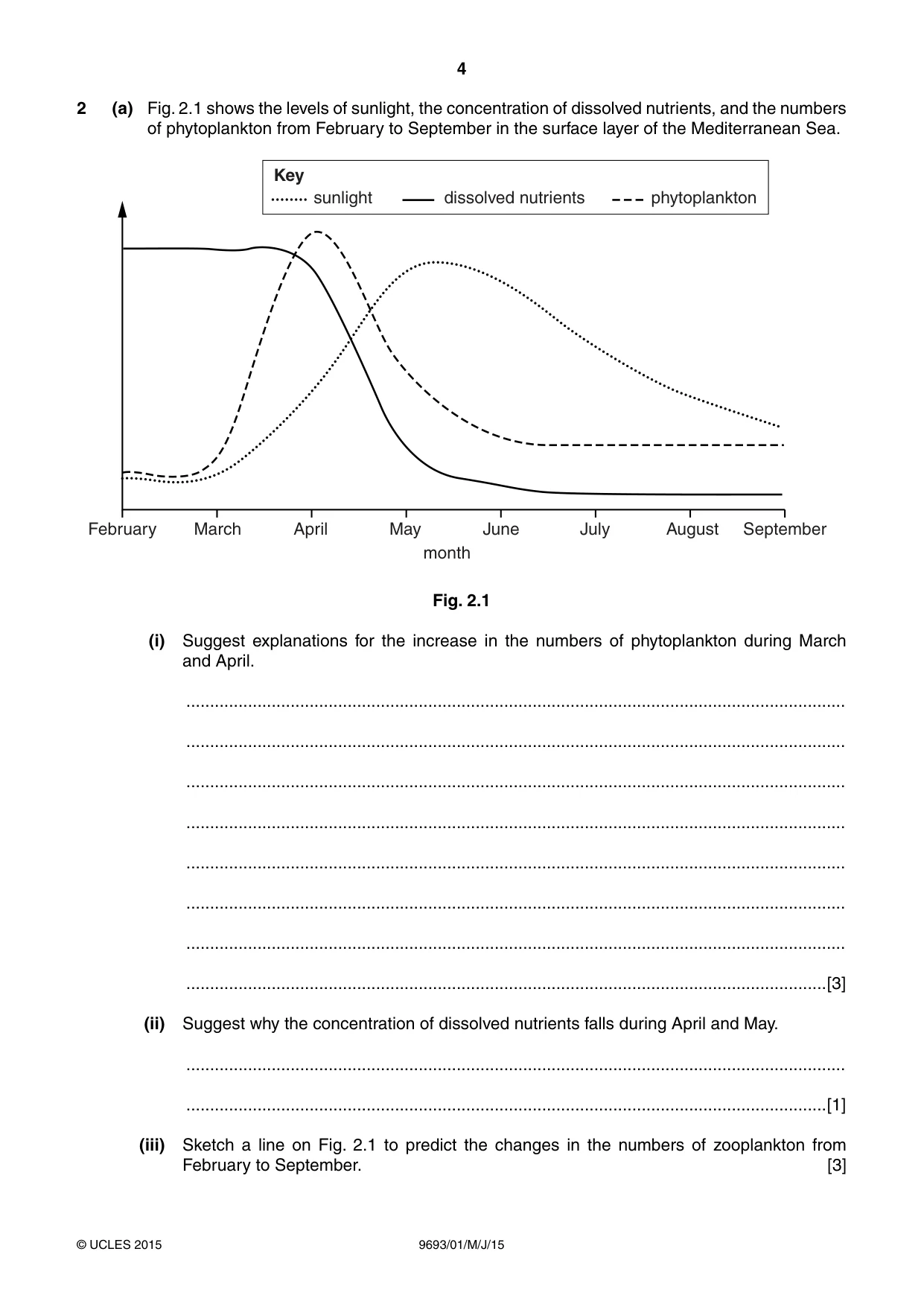
4 9693/01/M/J/15 © UCLES 2015 2 (a) Fig. 2.1 shows the levels of sunlight, the concentration of dissolved nutrients, and the numbers of phytoplankton from February to September in the surface layer of the Mediterranean Sea. February March April May June month sunlight dissolved nutrients Key phytoplankton July August September Fig. 2.1 (i) Suggest explanations for the increase in the numbers of phytoplankton during March and April. … … … … … … … …[3] (ii) Suggest why the concentration of dissolved nutrients falls during April and May. … …[1] (iii) Sketch a line on Fig. 2.1 to predict the changes in the numbers of zooplankton from February to September. [3]
Question paper, page 5
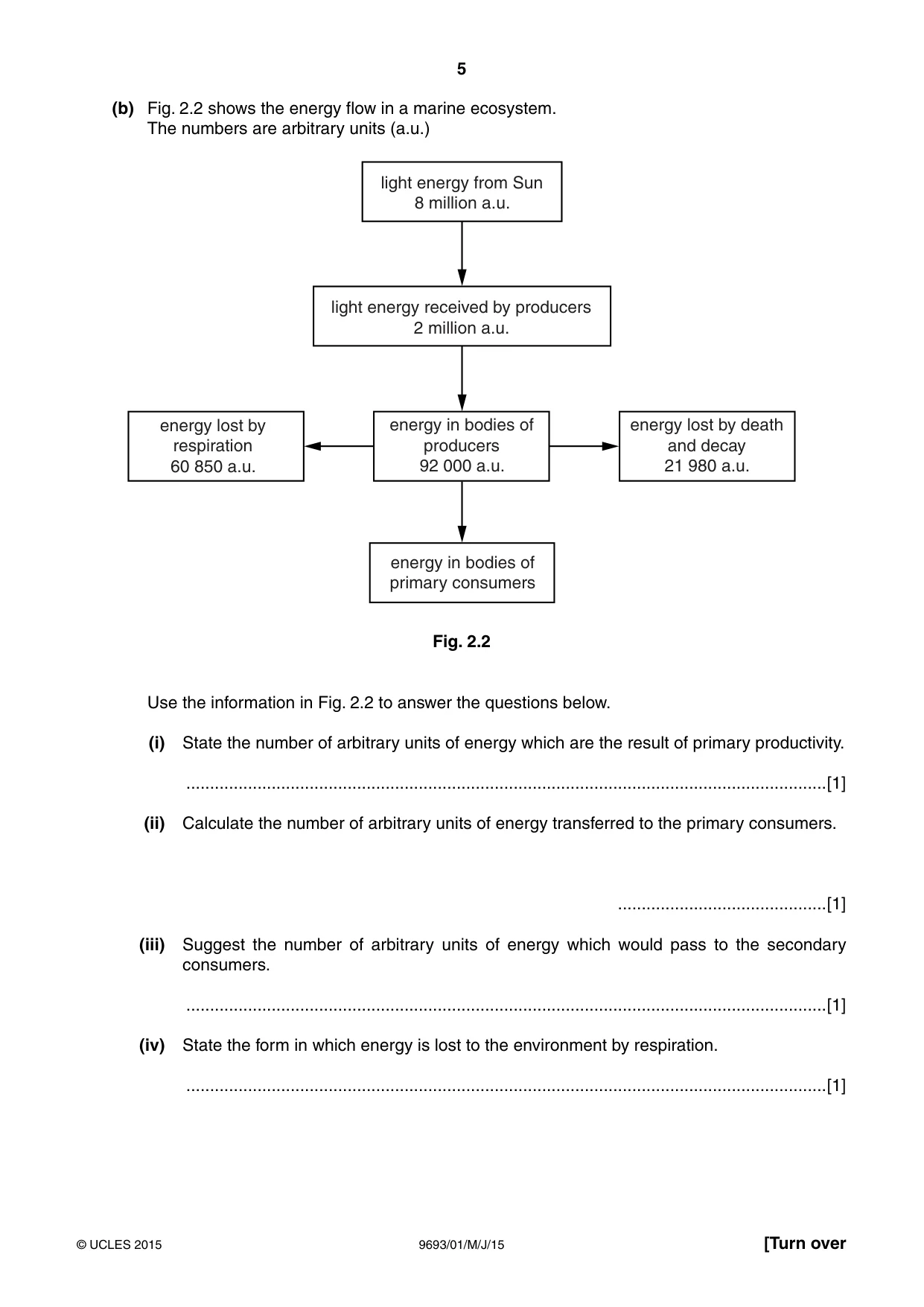
5 9693/01/M/J/15 © UCLES 2015 [Turn over (b) Fig. 2.2 shows the energy flow in a marine ecosystem. The numbers are arbitrary units (a.u.) light energy from Sun 8 million a.u. light energy received by producers 2 million a.u. energy in bodies of producers 92 000 a.u. energy lost by death and decay 21 980 a.u. energy lost by respiration 60 850 a.u. energy in bodies of primary consumers Fig. 2.2 Use the information in Fig. 2.2 to answer the questions below. (i) State the number of arbitrary units of energy which are the result of primary productivity. …[1] (ii) Calculate the number of arbitrary units of energy transferred to the primary consumers. …[1] (iii) Suggest the number of arbitrary units of energy which would pass to the secondary consumers. …[1] (iv) State the form in which energy is lost to the environment by respiration. …[1]
Question paper, page 6
6 9693/01/M/J/15 © UCLES 2015 (c) Describe the similarities and differences between chemosynthesis and photosynthesis. similarities … … … … … differences … … … … …[4] [Total: 15]
Question paper, page 7
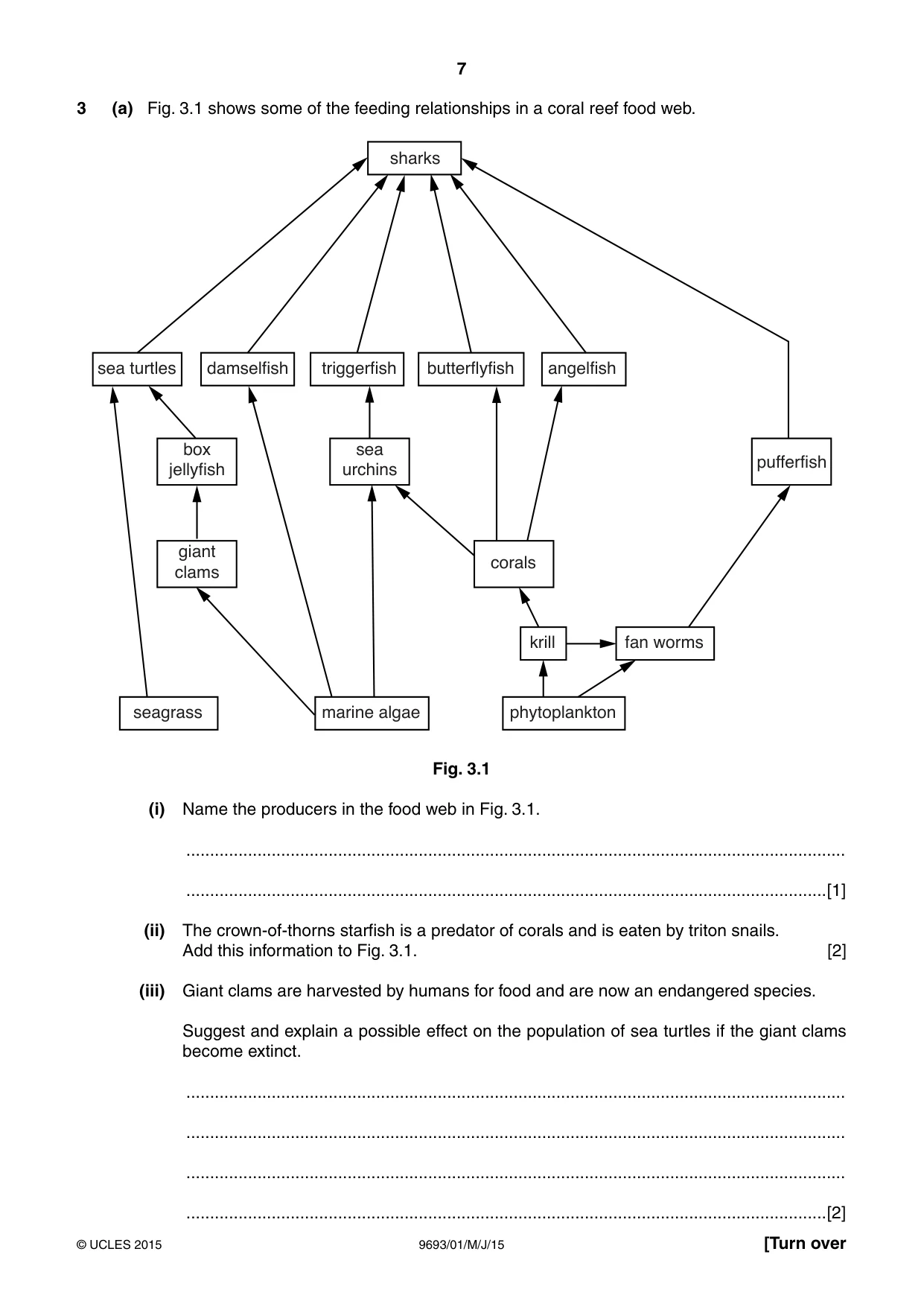
7 9693/01/M/J/15 © UCLES 2015 [Turn over 3 (a) Fig. 3.1 shows some of the feeding relationships in a coral reef food web. sea turtles damselfish triggerfish butterflyfish angelfish box jellyfish giant clams sea urchins sharks pufferfish fan worms phytoplankton marine algae seagrass krill corals Fig. 3.1 (i) Name the producers in the food web in Fig. 3.1. … …[1] (ii) The crown-of-thorns starfish is a predator of corals and is eaten by triton snails. Add this information to Fig. 3.1. [2] (iii) Giant clams are harvested by humans for food and are now an endangered species. Suggest and explain a possible effect on the population of sea turtles if the giant clams become extinct. … … … …[2]
Question paper, page 8
8 9693/01/M/J/15 © UCLES 2015 (iv) Explain why sharks are said to occupy general ecological niches. … … … … … …[3] (b) Suggest and explain why tropical corals do not normally live in water at a depth of 60 metres or more. … … … … … …[3] [Total: 11]
Question paper, page 9
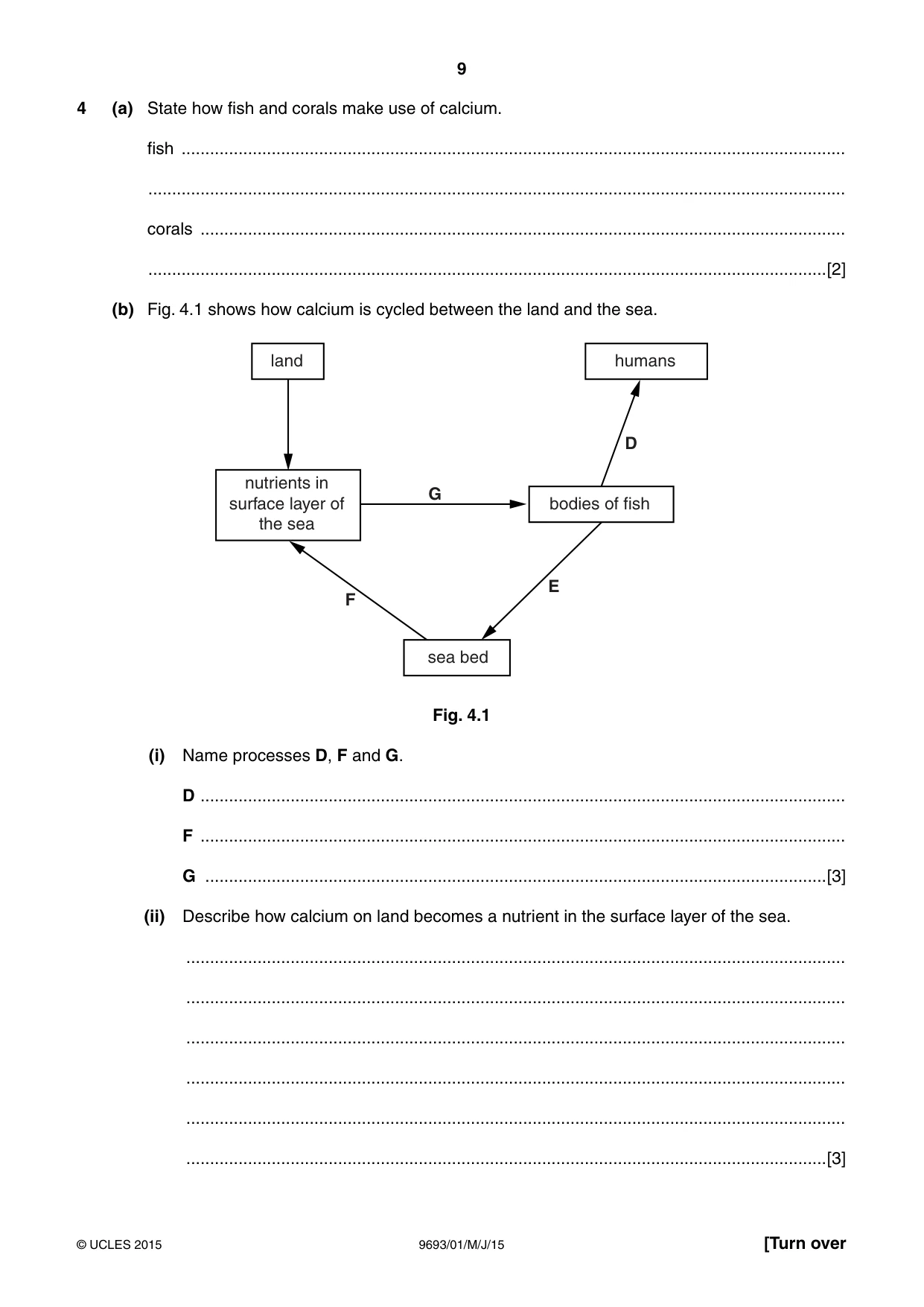
9 9693/01/M/J/15 © UCLES 2015 [Turn over 4 (a) State how fish and corals make use of calcium. fish … … corals … …[2] (b) Fig. 4.1 shows how calcium is cycled between the land and the sea. land humans nutrients in surface layer of the sea bodies of fish sea bed G F E D Fig. 4.1 (i) Name processes D, F and G. D … F … G …[3] (ii) Describe how calcium on land becomes a nutrient in the surface layer of the sea. … … … … … …[3]
Question paper, page 10
10 9693/01/M/J/15 © UCLES 2015 (iii) Describe process E. … … … … … …[3] [Total: 11]
Question paper, page 11
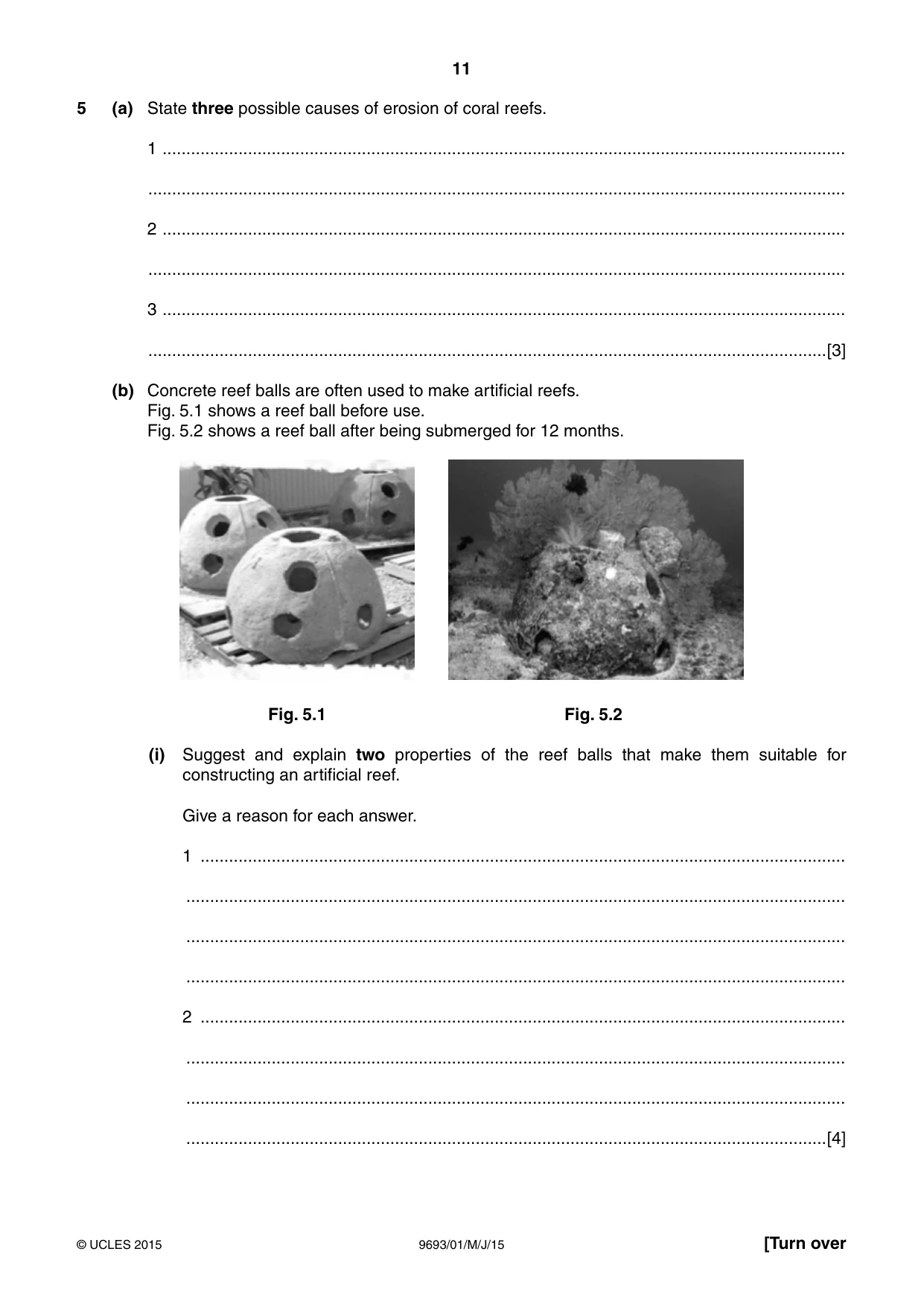
11 9693/01/M/J/15 © UCLES 2015 [Turn over 5 (a) State three possible causes of erosion of coral reefs. 1 … … 2 … … 3 … …[3] (b) Concrete reef balls are often used to make artificial reefs. Fig. 5.1 shows a reef ball before use. Fig. 5.2 shows a reef ball after being submerged for 12 months. Fig. 5.1 Fig. 5.2 (i) Suggest and explain two properties of the reef balls that make them suitable for constructing an artificial reef. Give a reason for each answer. 1 … … … … 2 … … … …[4]
Question paper, page 12
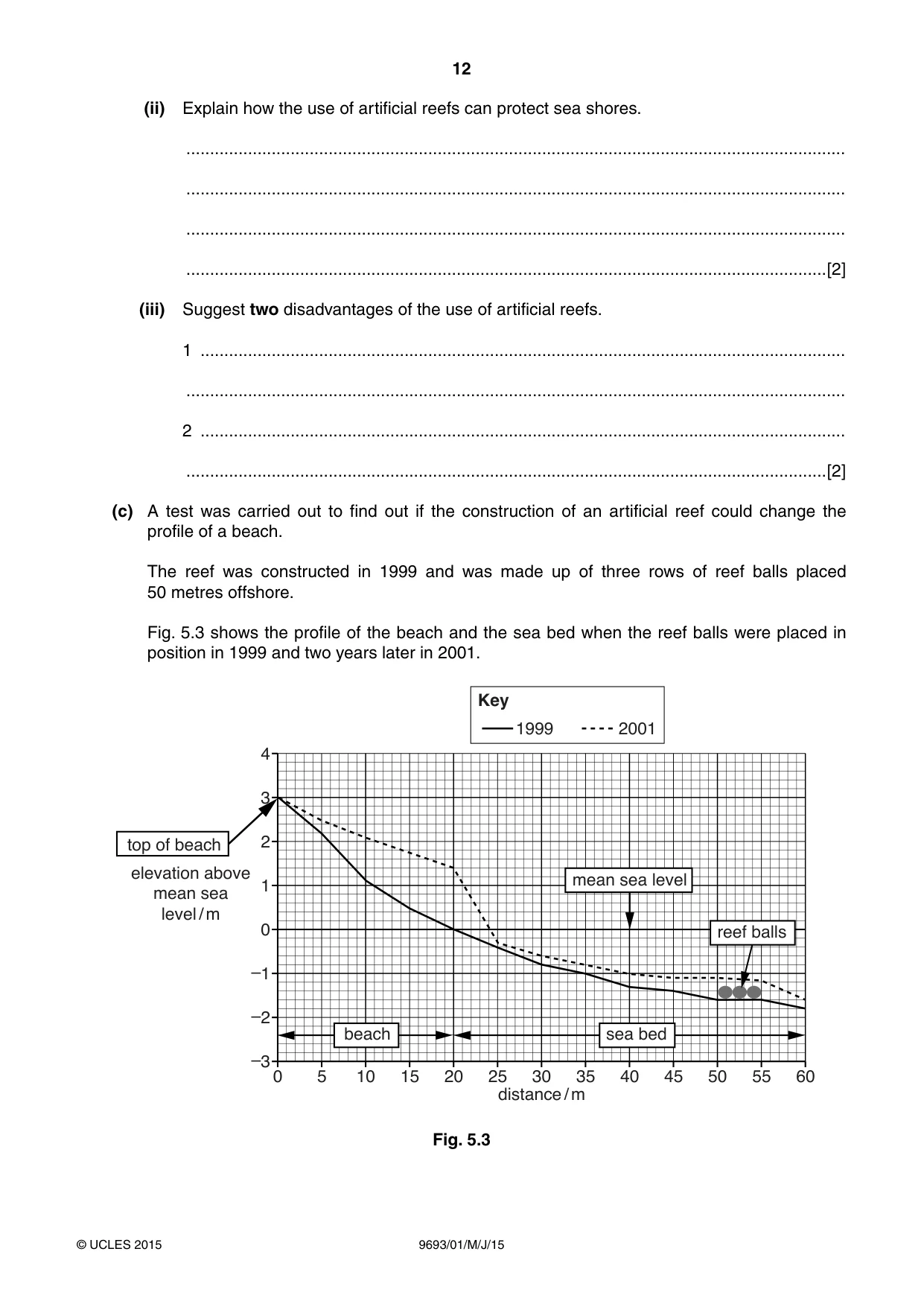
12 9693/01/M/J/15 © UCLES 2015 (ii) Explain how the use of artificial reefs can protect sea shores. … … … …[2] (iii) Suggest two disadvantages of the use of artificial reefs. 1 … … 2 … …[2] (c) A test was carried out to find out if the construction of an artificial reef could change the profile of a beach. The reef was constructed in 1999 and was made up of three rows of reef balls placed 50 metres offshore. Fig. 5.3 shows the profile of the beach and the sea bed when the reef balls were placed in position in 1999 and two years later in 2001. 0 –3 –2 –1 0 1 2 3 4 5 10 15 20 25 30 distance / m elevation above mean sea level / m 35 40 45 50 55 60 1999 2001 Key beach sea bed reef balls mean sea level top of beach Fig. 5.3
Question paper, page 13
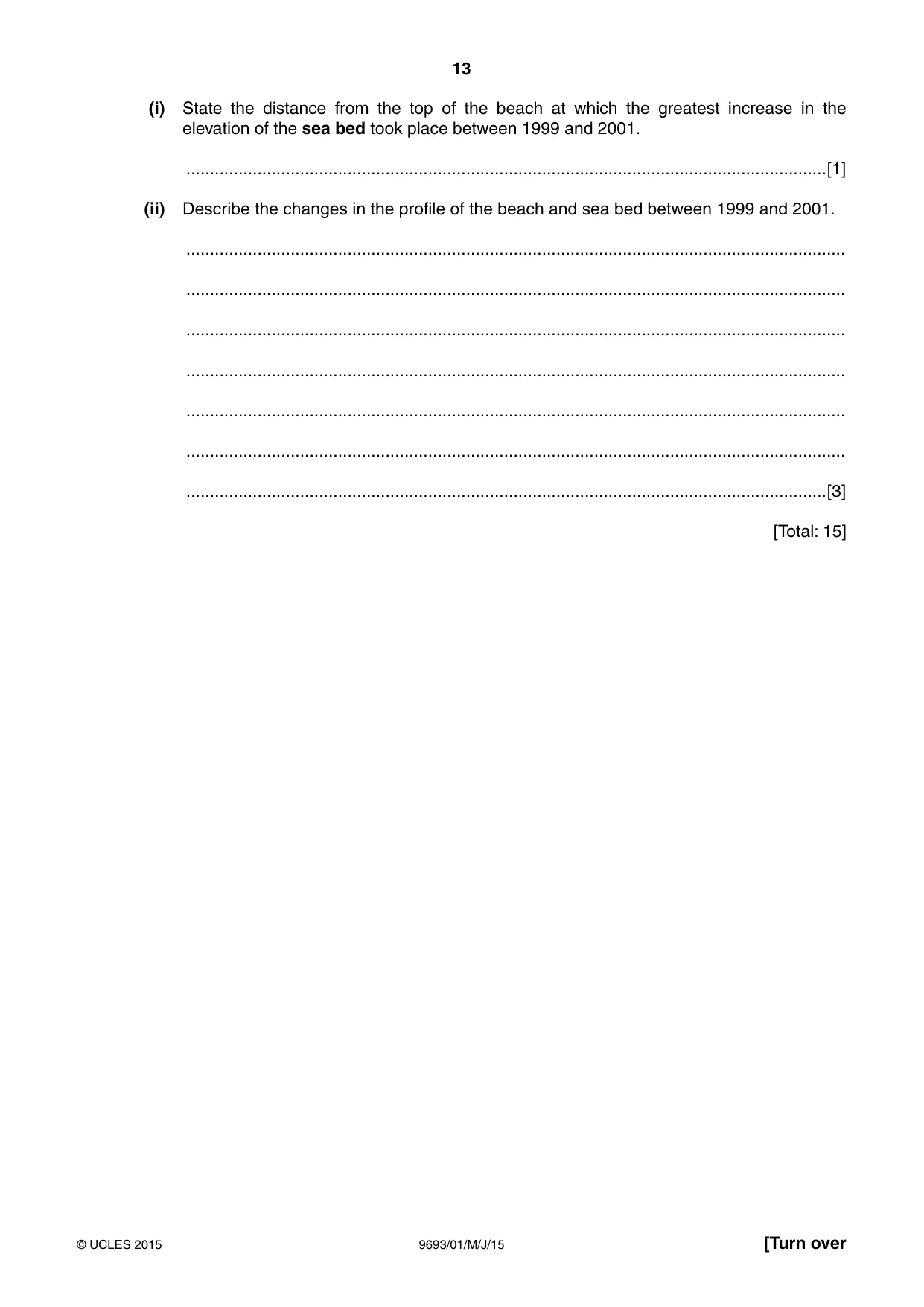
13 9693/01/M/J/15 © UCLES 2015 [Turn over (i) State the distance from the top of the beach at which the greatest increase in the elevation of the sea bed took place between 1999 and 2001. …[1] (ii) Describe the changes in the profile of the beach and sea bed between 1999 and 2001. … … … … … … …[3] [Total: 15]
Question paper, page 14
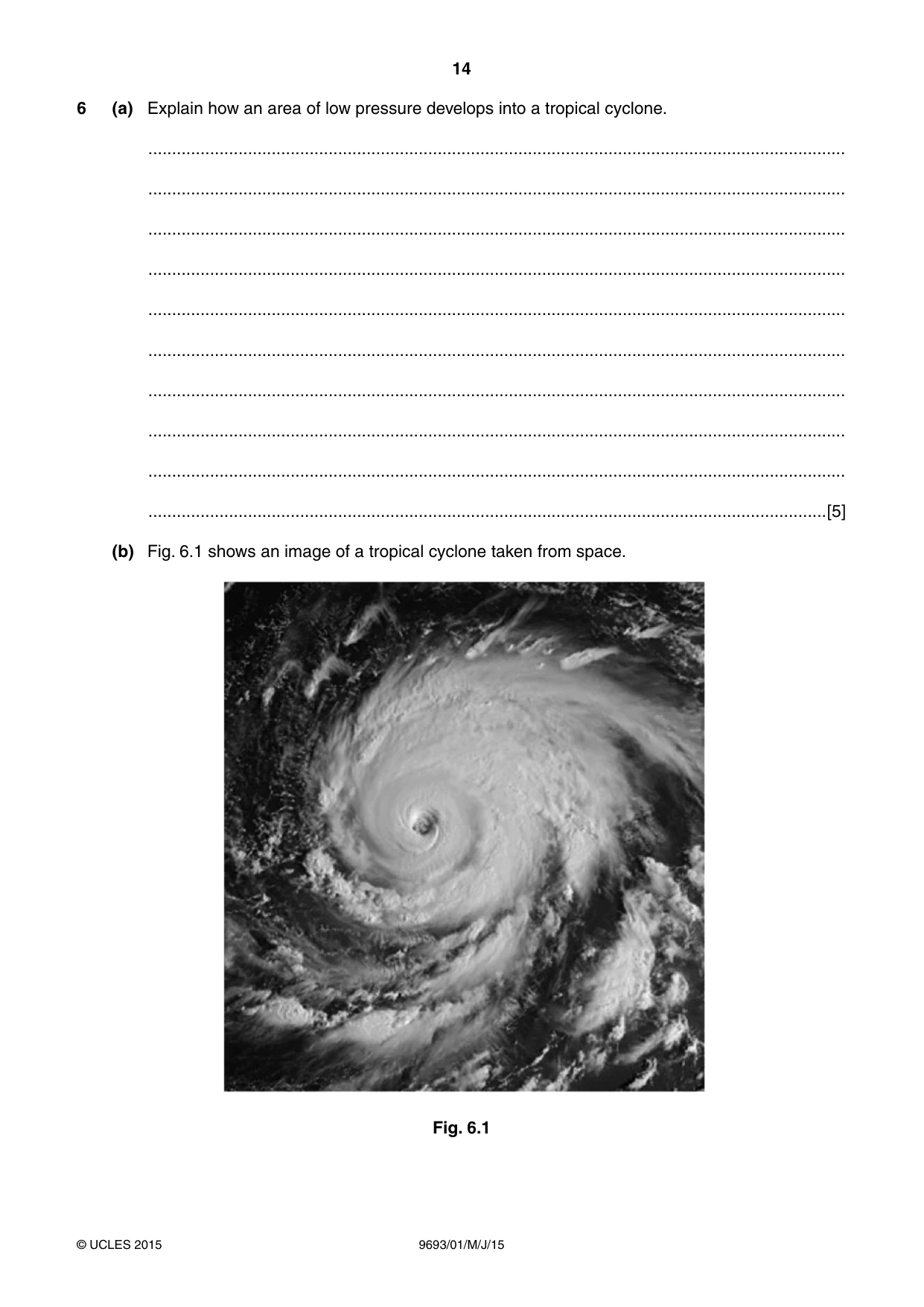
14 9693/01/M/J/15 © UCLES 2015 6 (a) Explain how an area of low pressure develops into a tropical cyclone. … … … … … … … … … …[5] (b) Fig. 6.1 shows an image of a tropical cyclone taken from space. Fig. 6.1
Question paper, page 15
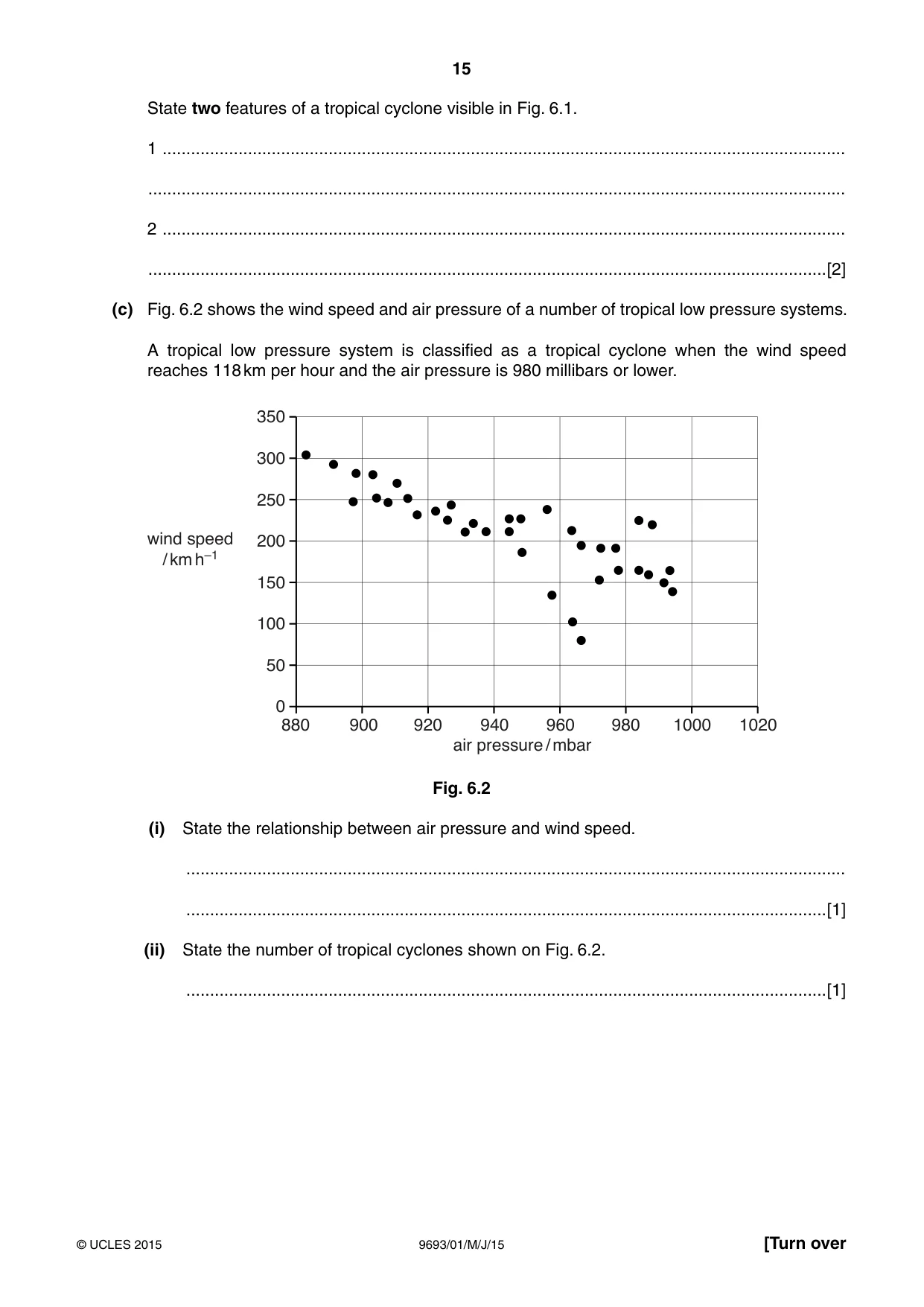
15 9693/01/M/J/15 © UCLES 2015 [Turn over State two features of a tropical cyclone visible in Fig. 6.1. 1 … … 2 … …[2] (c) Fig. 6.2 shows the wind speed and air pressure of a number of tropical low pressure systems. A tropical low pressure system is classified as a tropical cyclone when the wind speed reaches 118 km per hour and the air pressure is 980 millibars or lower. 880 0 50 100 150 200 250 300 350 900 920 940 960 air pressure / mbar wind speed / km h–1 980 1000 1020 Fig. 6.2 (i) State the relationship between air pressure and wind speed. … …[1] (ii) State the number of tropical cyclones shown on Fig. 6.2. …[1]
Question paper, page 16
16 9693/01/M/J/15 © UCLES 2015 Permission to reproduce items where third-party owned material protected by copyright is included has been sought and cleared where possible. Every reasonable effort has been made by the publisher (UCLES) to trace copyright holders, but if any items requiring clearance have unwittingly been included, the publisher will be pleased to make amends at the earliest possible opportunity. To avoid the issue of disclosure of answer-related information to candidates, all copyright acknowledgements are reproduced online in the Cambridge International Examinations Copyright Acknowledgements Booklet. This is produced for each series of examinations and is freely available to download at www.cie.org.uk after the live examination series. Cambridge International Examinations is part of the Cambridge Assessment Group. Cambridge Assessment is the brand name of University of Cambridge Local Examinations Syndicate (UCLES), which is itself a department of the University of Cambridge. (d) Explain how tropical cyclones may have beneficial effects on human coastal communities. … … … … … …[3] [Total: 12]
Mark scheme, page 1
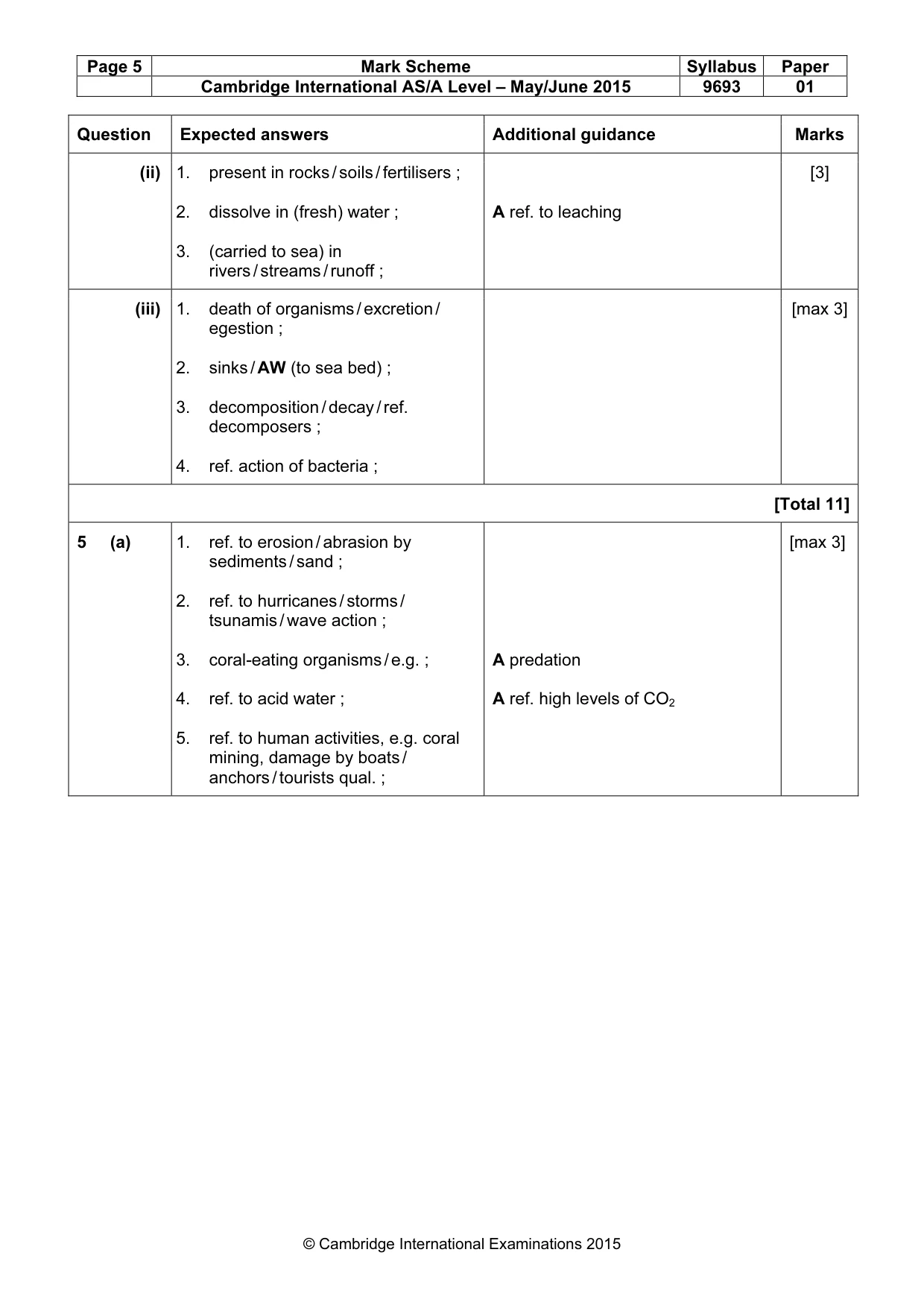
® IGCSE is the registered trademark of Cambridge International Examinations. CAMBRIDGE INTERNATIONAL EXAMINATIONS Cambridge International Advanced Subsidiary and Advanced Level MARK SCHEME for the May/June 2015 series 9693 MARINE SCIENCE 9693/01 Paper 1 (AS Structured Questions), maximum raw mark 75 This mark scheme is published as an aid to teachers and candidates, to indicate the requirements of the examination. It shows the basis on which Examiners were instructed to award marks. It does not indicate the details of the discussions that took place at an Examiners’ meeting before marking began, which would have considered the acceptability of alternative answers. Mark schemes should be read in conjunction with the question paper and the Principal Examiner Report for Teachers. Cambridge will not enter into discussions about these mark schemes. Cambridge is publishing the mark schemes for the May/June 2015 series for most Cambridge IGCSE®, Cambridge International A and AS Level components and some Cambridge O Level components.
Mark scheme, page 2
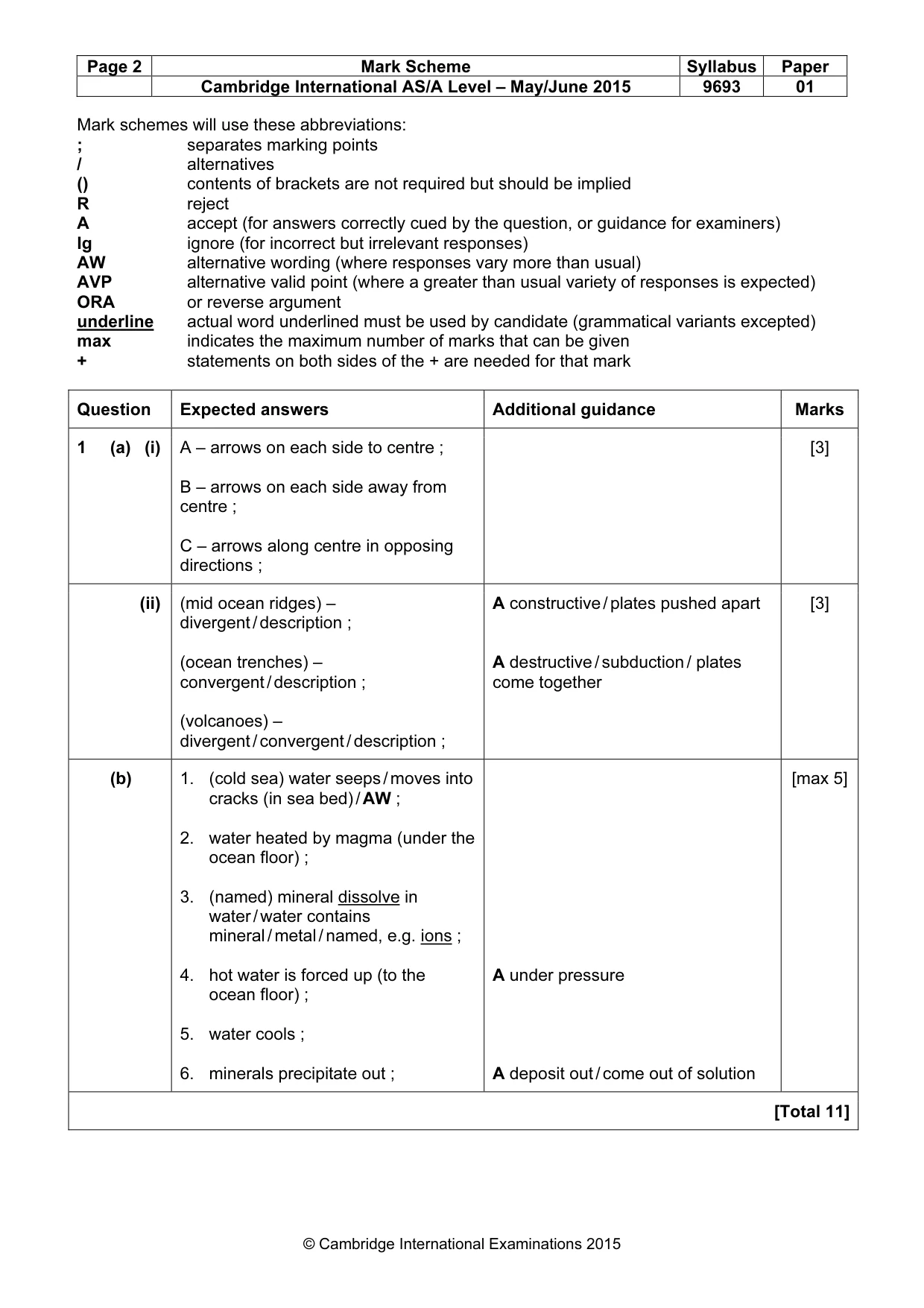
Page 2 Mark Scheme Syllabus Paper Cambridge International AS/A Level – May/June 2015 9693 01 © Cambridge International Examinations 2015 Mark schemes will use these abbreviations: ; separates marking points / alternatives () contents of brackets are not required but should be implied R reject A accept (for answers correctly cued by the question, or guidance for examiners) Ig ignore (for incorrect but irrelevant responses) AW alternative wording (where responses vary more than usual) AVP alternative valid point (where a greater than usual variety of responses is expected) ORA or reverse argument underline actual word underlined must be used by candidate (grammatical variants excepted) max indicates the maximum number of marks that can be given + statements on both sides of the + are needed for that mark Question Expected answers Additional guidance Marks 1 (a) (i) A – arrows on each side to centre ; B – arrows on each side away from centre ; C – arrows along centre in opposing directions ; [3] (ii) (mid ocean ridges) – divergent / description ; (ocean trenches) – convergent / description ; (volcanoes) – divergent / convergent / description ; A constructive / plates pushed apart A destructive / subduction / plates come together [3] (b) 1. (cold sea) water seeps / moves into cracks (in sea bed) / AW ; 2. water heated by magma (under the ocean floor) ; 3. (named) mineral dissolve in water / water contains mineral / metal / named, e.g. ions ; 4. hot water is forced up (to the ocean floor) ; 5. water cools ; 6. minerals precipitate out ; A under pressure A deposit out / come out of solution [max 5] [Total 11]
Mark scheme, page 3
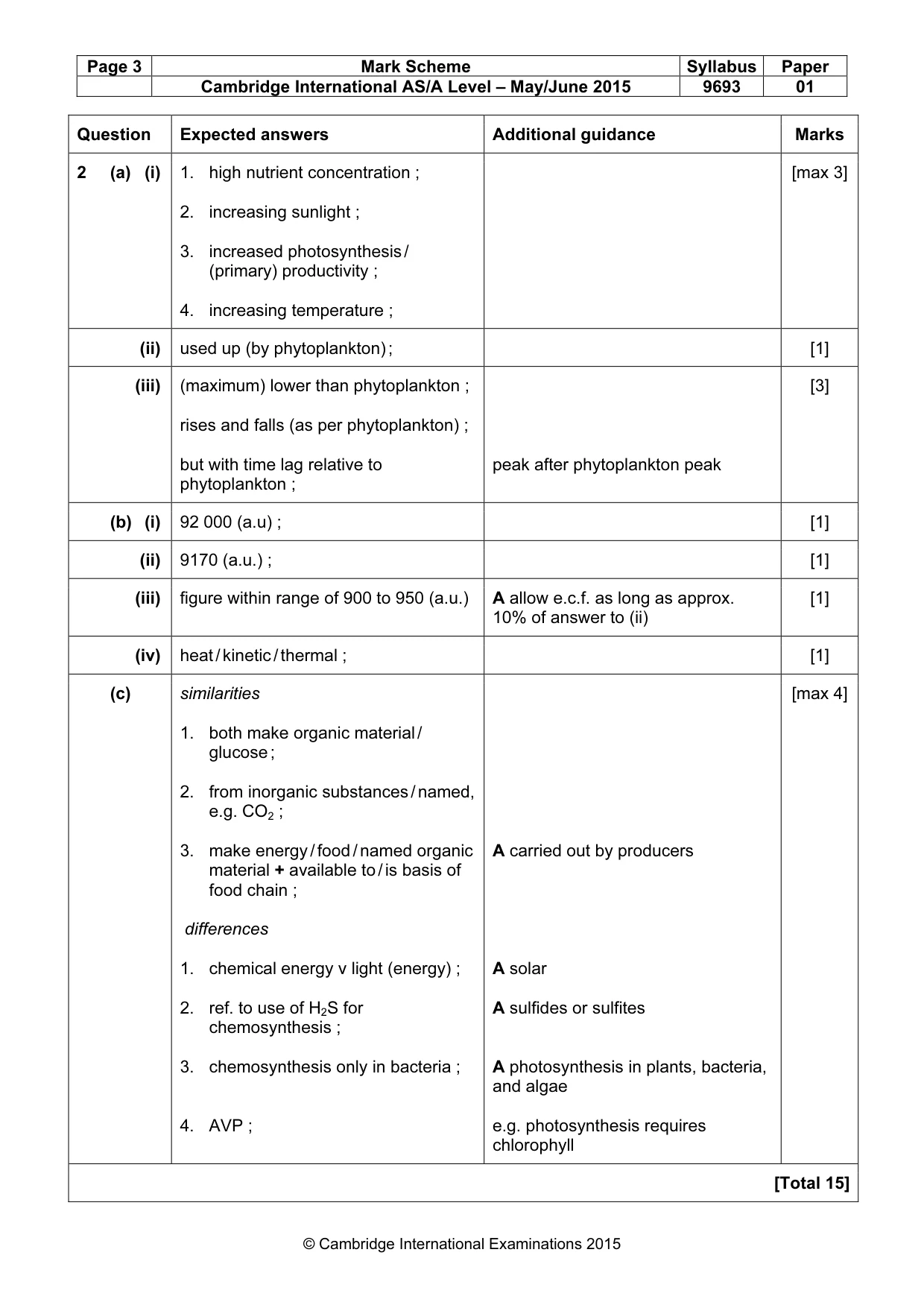
Page 3 Mark Scheme Syllabus Paper Cambridge International AS/A Level – May/June 2015 9693 01 © Cambridge International Examinations 2015 Question Expected answers Additional guidance Marks 2 (a) (i) 1. high nutrient concentration ; 2. increasing sunlight ; 3. increased photosynthesis / (primary) productivity ; 4. increasing temperature ; [max 3] (ii) used up (by phytoplankton) ; [1] (iii) (maximum) lower than phytoplankton ; rises and falls (as per phytoplankton) ; but with time lag relative to phytoplankton ; peak after phytoplankton peak [3] (b) (i) 92 000 (a.u) ; [1] (ii) 9170 (a.u.) ; [1] (iii) figure within range of 900 to 950 (a.u.) A allow e.c.f. as long as approx. 10% of answer to (ii) [1] (iv) heat / kinetic / thermal ; [1] (c) similarities 1. both make organic material / glucose ; 2. from inorganic substances / named, e.g. CO2 ; 3. make energy / food / named organic material + available to / is basis of food chain ; differences 1. chemical energy v light (energy) ; 2. ref. to use of H2S for chemosynthesis ; 3. chemosynthesis only in bacteria ; 4. AVP ; A carried out by producers A solar A sulfides or sulfites A photosynthesis in plants, bacteria, and algae e.g. photosynthesis requires chlorophyll [max 4] [Total 15]
Mark scheme, page 4
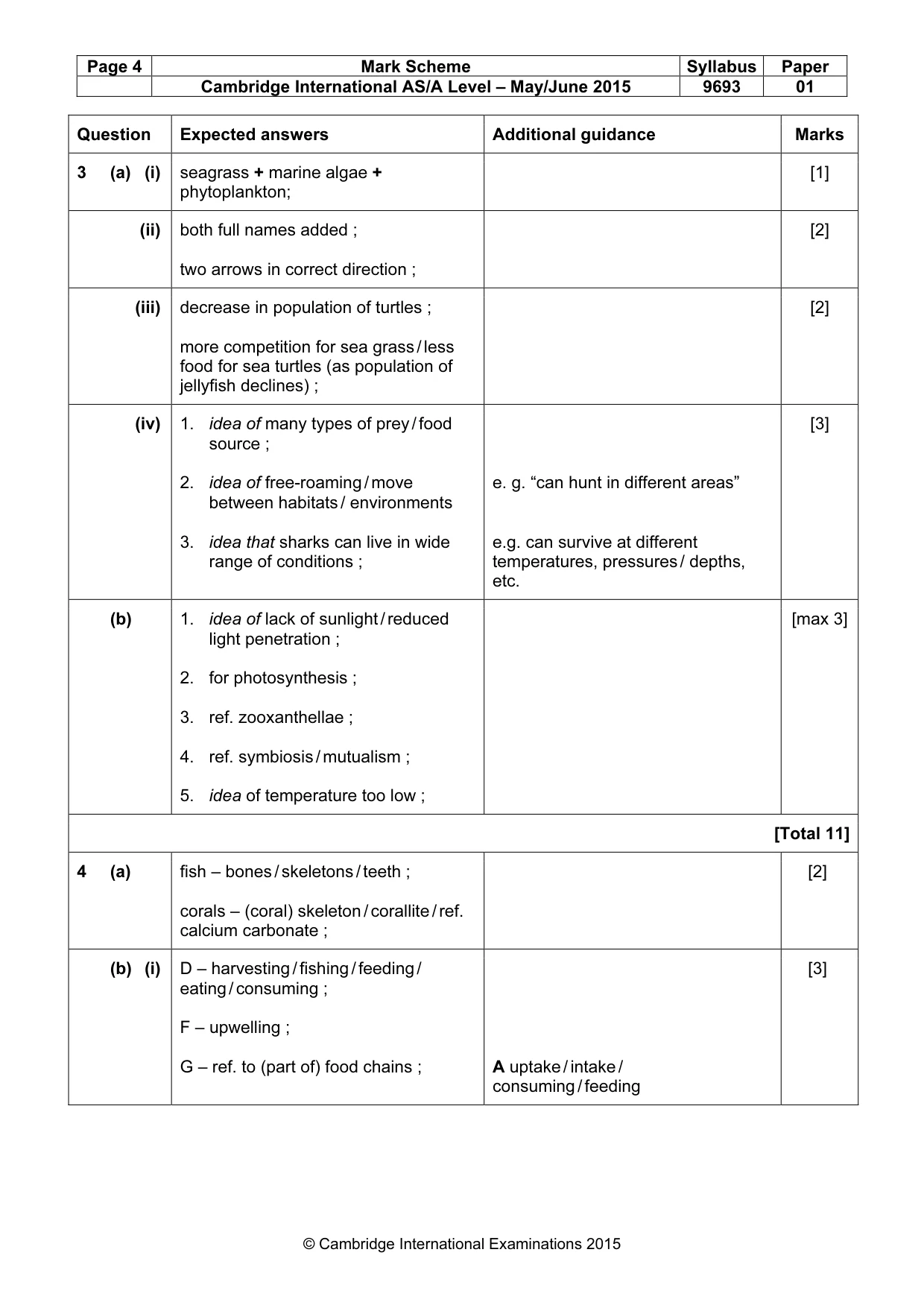
Page 4 Mark Scheme Syllabus Paper Cambridge International AS/A Level – May/June 2015 9693 01 © Cambridge International Examinations 2015 Question Expected answers Additional guidance Marks 3 (a) (i) seagrass + marine algae + phytoplankton; [1] (ii) both full names added ; two arrows in correct direction ; [2] (iii) decrease in population of turtles ; more competition for sea grass / less food for sea turtles (as population of jellyfish declines) ; [2] (iv) 1. idea of many types of prey / food source ; 2. idea of free-roaming / move between habitats / environments 3. idea that sharks can live in wide range of conditions ; e. g. “can hunt in different areas” e.g. can survive at different temperatures, pressures / depths, etc. [3] (b) 1. idea of lack of sunlight / reduced light penetration ; 2. for photosynthesis ; 3. ref. zooxanthellae ; 4. ref. symbiosis / mutualism ; 5. idea of temperature too low ; [max 3] [Total 11] 4 (a) fish – bones / skeletons / teeth ; corals – (coral) skeleton / corallite / ref. calcium carbonate ; [2] (b) (i) D – harvesting / fishing / feeding / eating / consuming ; F – upwelling ; G – ref. to (part of) food chains ; A uptake / intake / consuming / feeding [3]
Mark scheme, page 5
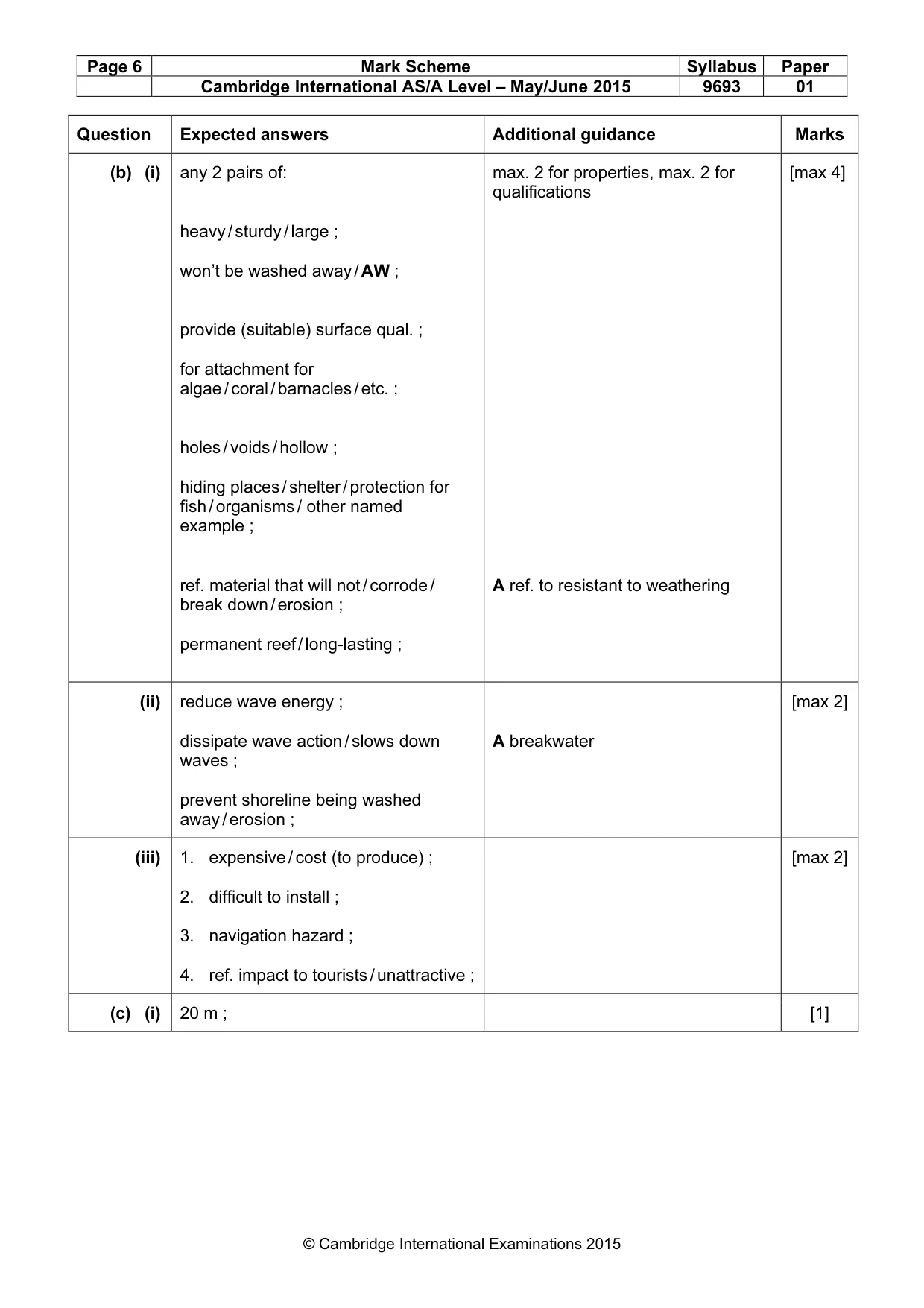
Page 5 Mark Scheme Syllabus Paper Cambridge International AS/A Level – May/June 2015 9693 01 © Cambridge International Examinations 2015 Question Expected answers Additional guidance Marks (ii) 1. present in rocks / soils / fertilisers ; 2. dissolve in (fresh) water ; 3. (carried to sea) in rivers / streams / runoff ; A ref. to leaching [3] (iii) 1. death of organisms / excretion / egestion ; 2. sinks / AW (to sea bed) ; 3. decomposition / decay / ref. decomposers ; 4. ref. action of bacteria ; [max 3] [Total 11] 5 (a) 1. ref. to erosion / abrasion by sediments / sand ; 2. ref. to hurricanes / storms / tsunamis / wave action ; 3. coral-eating organisms / e.g. ; 4. ref. to acid water ; 5. ref. to human activities, e.g. coral mining, damage by boats / anchors / tourists qual. ; A predation A ref. high levels of CO2 [max 3]
Mark scheme, page 6
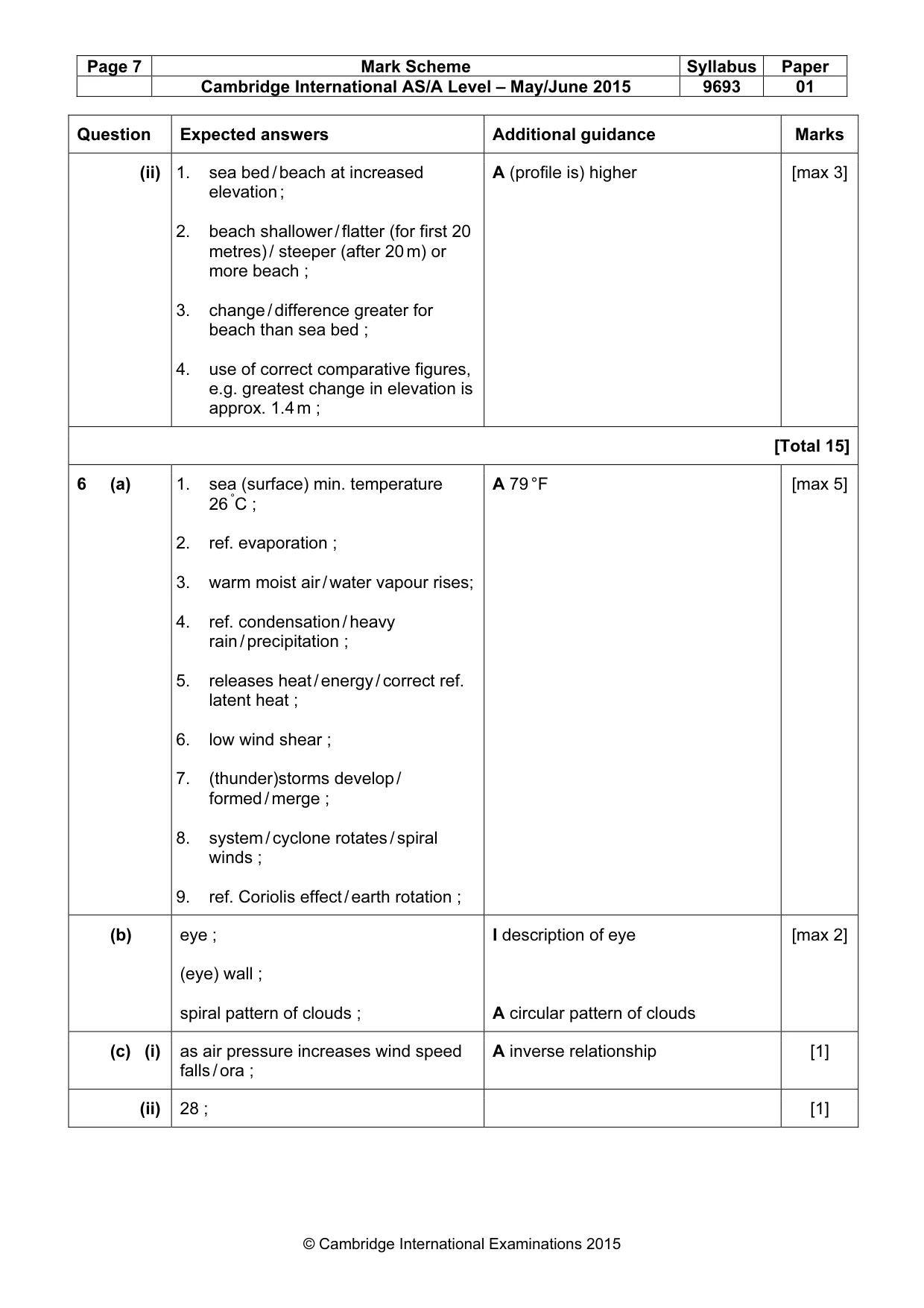
Page 6 Mark Scheme Syllabus Paper Cambridge International AS/A Level – May/June 2015 9693 01 © Cambridge International Examinations 2015 Question Expected answers Additional guidance Marks (b) (i) any 2 pairs of: heavy / sturdy / large ; won’t be washed away / AW ; provide (suitable) surface qual. ; for attachment for algae / coral / barnacles / etc. ; holes / voids / hollow ; hiding places / shelter / protection for fish / organisms / other named example ; ref. material that will not / corrode / break down / erosion ; permanent reef / long-lasting ; max. 2 for properties, max. 2 for qualifications A ref. to resistant to weathering [max 4] (ii) reduce wave energy ; dissipate wave action / slows down waves ; prevent shoreline being washed away / erosion ; A breakwater [max 2] (iii) 1. expensive / cost (to produce) ; 2. difficult to install ; 3. navigation hazard ; 4. ref. impact to tourists / unattractive ; [max 2] (c) (i) 20 m ; [1]
Mark scheme, page 7
Page 7 Mark Scheme Syllabus Paper Cambridge International AS/A Level – May/June 2015 9693 01 © Cambridge International Examinations 2015 Question Expected answers Additional guidance Marks (ii) 1. sea bed / beach at increased elevation ; 2. beach shallower / flatter (for first 20 metres) / steeper (after 20 m) or more beach ; 3. change / difference greater for beach than sea bed ; 4. use of correct comparative figures, e.g. greatest change in elevation is approx. 1.4 m ; A (profile is) higher [max 3] [Total 15] 6 (a) 1. sea (surface) min. temperature 26 °C ; 2. ref. evaporation ; 3. warm moist air / water vapour rises; 4. ref. condensation / heavy rain / precipitation ; 5. releases heat / energy / correct ref. latent heat ; 6. low wind shear ; 7. (thunder)storms develop / formed / merge ; 8. system / cyclone rotates / spiral winds ; 9. ref. Coriolis effect / earth rotation ; A 79 °F [max 5] (b) eye ; (eye) wall ; spiral pattern of clouds ; I description of eye A circular pattern of clouds [max 2] (c) (i) as air pressure increases wind speed falls / ora ; A inverse relationship [1] (ii) 28 ; [1]
Mark scheme, page 8
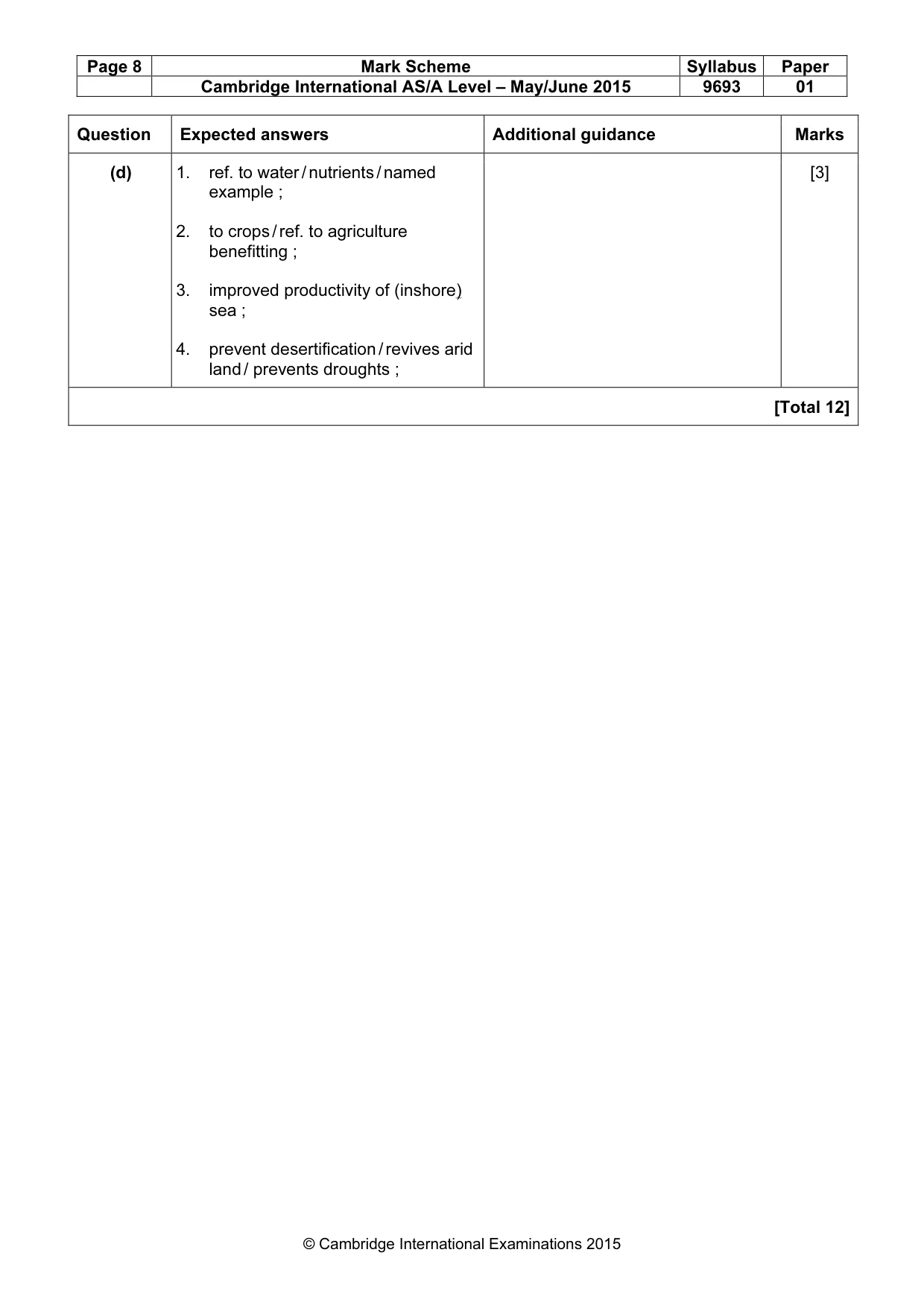
Page 8 Mark Scheme Syllabus Paper Cambridge International AS/A Level – May/June 2015 9693 01 © Cambridge International Examinations 2015 Question Expected answers Additional guidance Marks (d) 1. ref. to water / nutrients / named example ; 2. to crops / ref. to agriculture benefitting ; 3. improved productivity of (inshore) sea ; 4. prevent desertification / revives arid land / prevents droughts ; [3] [Total 12]
What you needed in this session
Cambridge’s own grade thresholds for 2015 May/June, Paper 1 · Variant 1. A higher threshold means an easier paper — the bar moves with how the cohort did.