Cambridge A Level Marine Science 9693 — 2014 May/June Paper 1 · Variant 1
9693/11/M/J/14 · 75 marks · ≈84 min
The question paper and its mark scheme, free to read here and free to download. This is Cambridge’s own paper, exactly as it was sat.
Question paper16 pages

Mark scheme7 pages
Answers below. Sit the paper first if you are practising.
Paper as text
Question paper, page 1
This document consists of 14 printed pages and 2 blank pages. DC (CW/SW) 84355/3 © UCLES 2014 [Turn over Cambridge International Examinations Cambridge International Advanced Subsidiary and Advanced Level * 6 6 5 8 6 7 4 3 9 3 * MARINE SCIENCE 9693/01 Paper 1 AS Structured Questions May/June 2014 1 hour 30 minutes Candidates answer on the Question Paper. No Additional Materials are required. READ THESE INSTRUCTIONS FIRST Write your Centre number, candidate number and name on all the work you hand in. Write in dark blue or black pen. You may use an HB pencil for any diagrams or graphs. Do not use staples, paper clips, glue or correction fluid. DO NOT WRITE IN ANY BARCODES. Answer all questions. Electronic calculators may be used. You may lose marks if you do not show your working or if you do not use appropriate units. At the end of the examination, fasten all your work securely together. The number of marks is given in brackets [ ] at the end of each question or part question.
Question paper, page 2
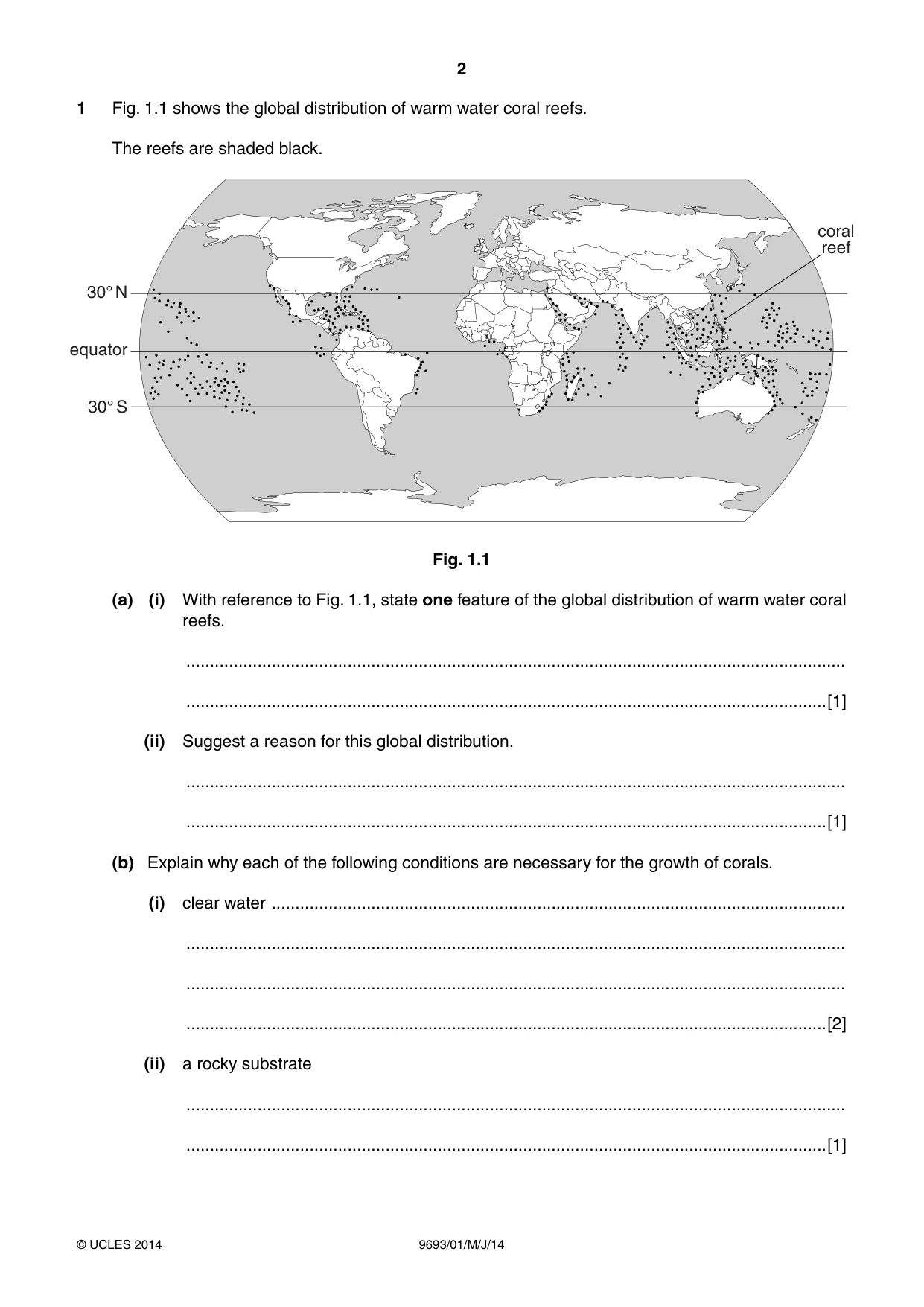
2 9693/01/M/J/14 © UCLES 2014 1 Fig. 1.1 shows the global distribution of warm water coral reefs. The reefs are shaded black. 30° N equator 30° S coral reef Fig. 1.1 (a) (i) With reference to Fig. 1.1, state one feature of the global distribution of warm water coral reefs. … …[1] (ii) Suggest a reason for this global distribution. … …[1] (b) Explain why each of the following conditions are necessary for the growth of corals. (i) clear water … … … …[2] (ii) a rocky substrate … …[1]
Question paper, page 3
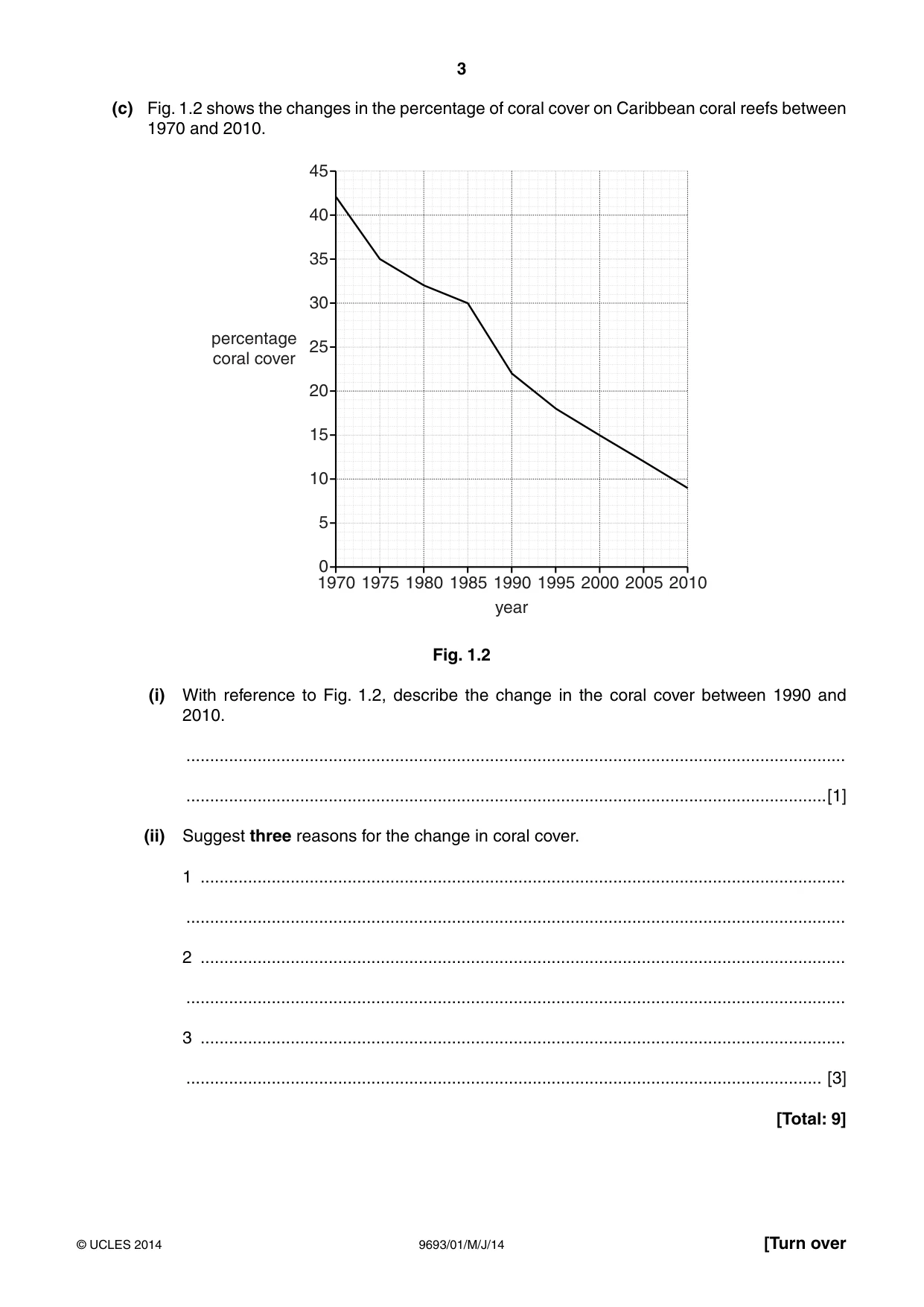
3 9693/01/M/J/14 © UCLES 2014 [Turn over (c) Fig. 1.2 shows the changes in the percentage of coral cover on Caribbean coral reefs between 1970 and 2010. 0 5 10 15 20 25 30 35 40 45 1975 1985 1995 2005 1970 1980 1990 2000 2010 year percentage coral cover Fig. 1.2 (i) With reference to Fig. 1.2, describe the change in the coral cover between 1990 and 2010. … …[1] (ii) Suggest three reasons for the change in coral cover. 1 … … 2 … … 3 … … [3] [Total: 9]
Question paper, page 4
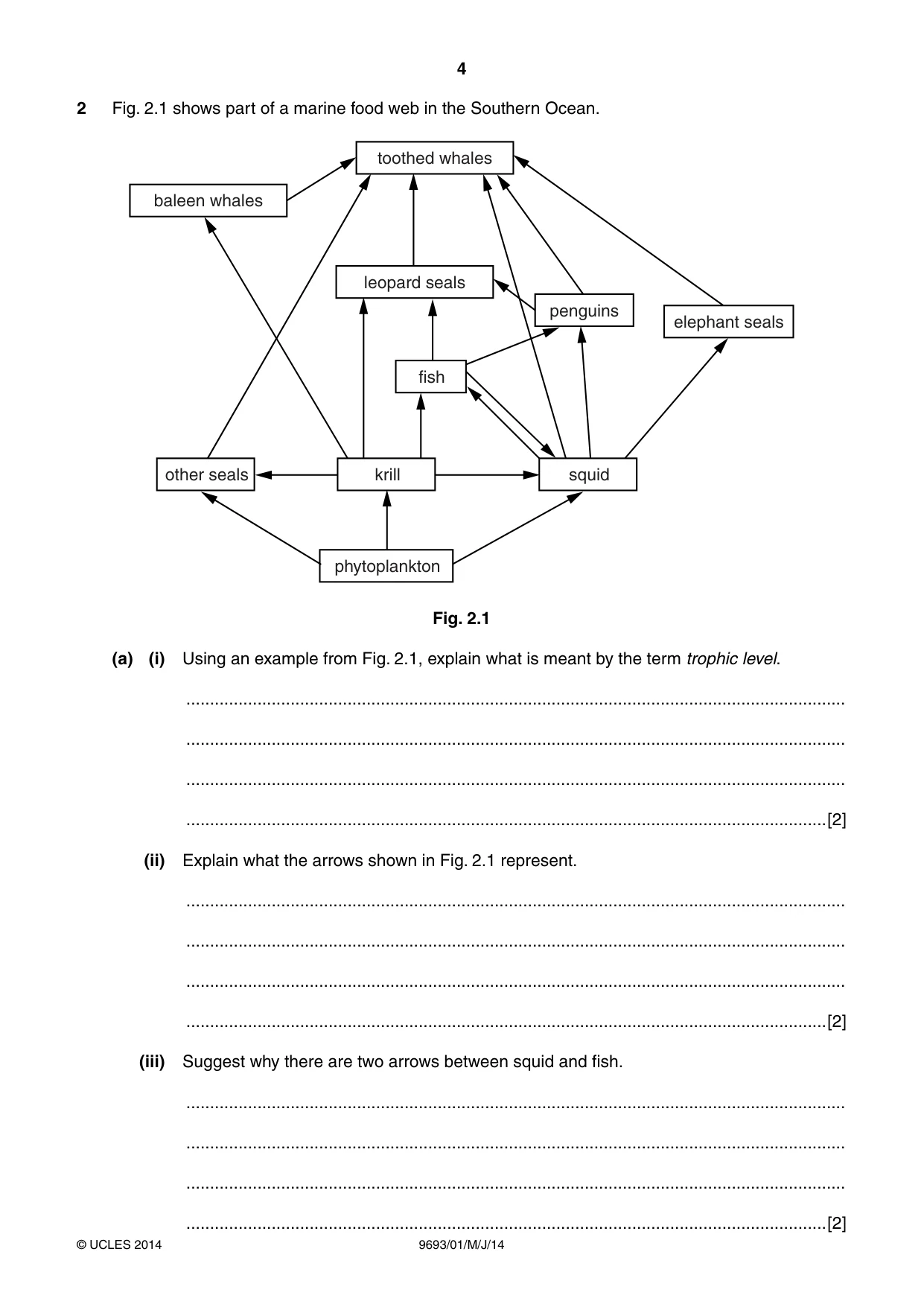
4 9693/01/M/J/14 © UCLES 2014 2 Fig. 2.1 shows part of a marine food web in the Southern Ocean. toothed whales leopard seals fish krill phytoplankton other seals squid penguins elephant seals baleen whales Fig. 2.1 (a) (i) Using an example from Fig. 2.1, explain what is meant by the term trophic level. … … … …[2] (ii) Explain what the arrows shown in Fig. 2.1 represent. … … … …[2] (iii) Suggest why there are two arrows between squid and fish. … … … …[2]
Question paper, page 5
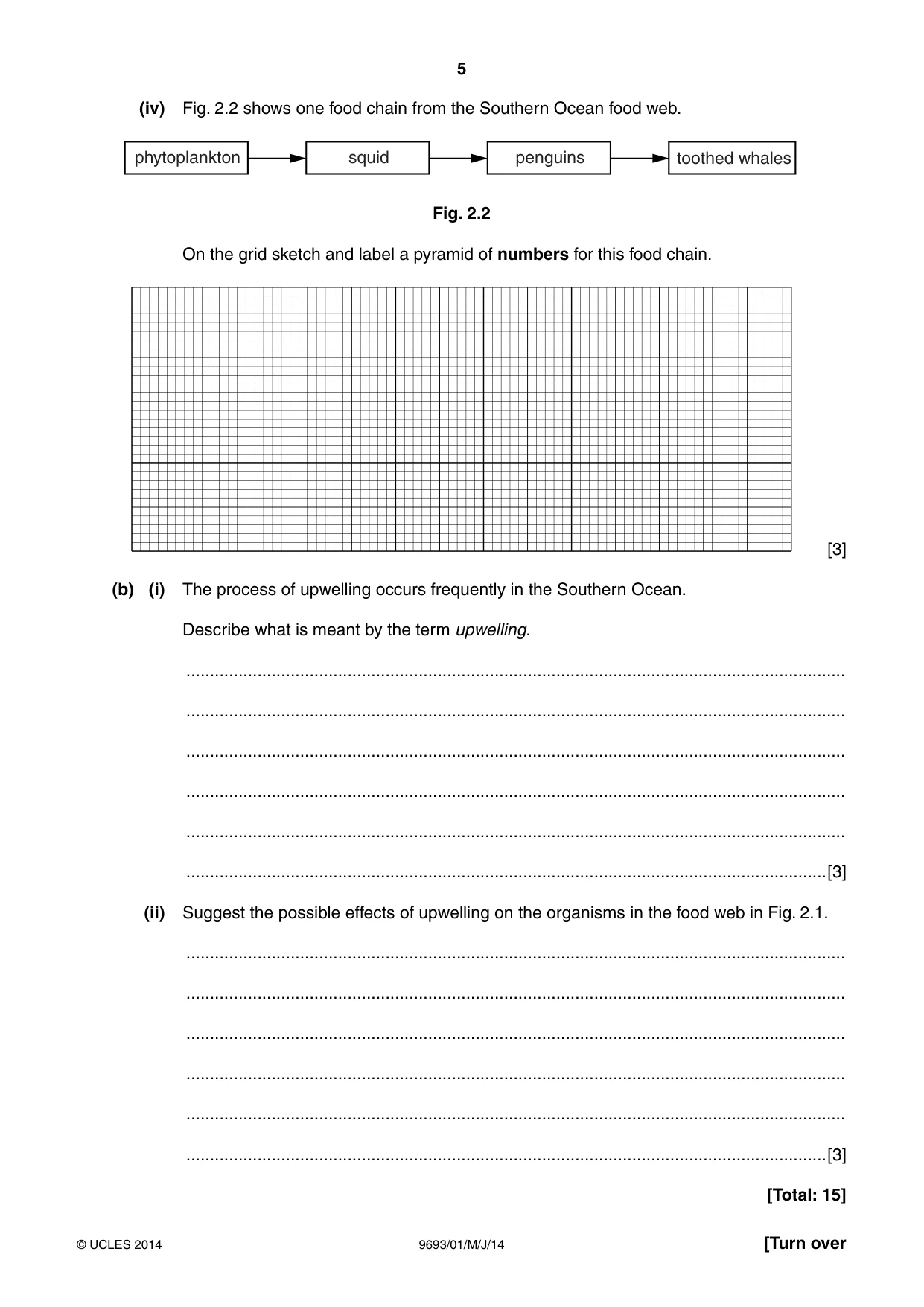
5 9693/01/M/J/14 © UCLES 2014 [Turn over (iv) Fig. 2.2 shows one food chain from the Southern Ocean food web. phytoplankton squid penguins toothed whales Fig. 2.2 On the grid sketch and label a pyramid of numbers for this food chain. [3] (b) (i) The process of upwelling occurs frequently in the Southern Ocean. Describe what is meant by the term upwelling. … … … … … …[3] (ii) Suggest the possible effects of upwelling on the organisms in the food web in Fig. 2.1. … … … … … …[3] [Total: 15]
Question paper, page 6
6 9693/01/M/J/14 © UCLES 2014 BLANK PAGE
Question paper, page 7
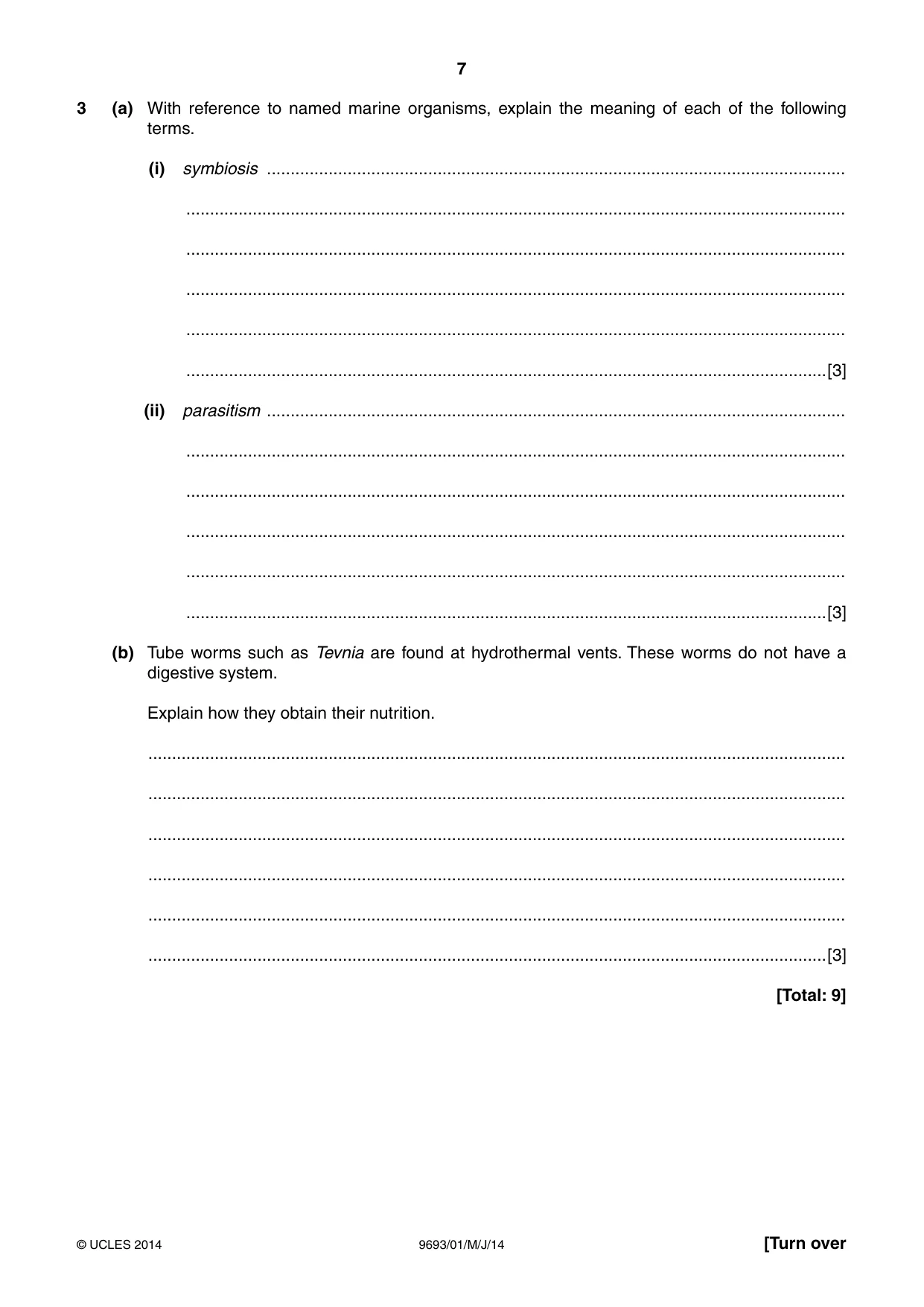
7 9693/01/M/J/14 © UCLES 2014 [Turn over 3 (a) With reference to named marine organisms, explain the meaning of each of the following terms. (i) symbiosis … … … … … …[3] (ii) parasitism … … … … … …[3] (b) Tube worms such as Tevnia are found at hydrothermal vents. These worms do not have a digestive system. Explain how they obtain their nutrition. … … … … … …[3] [Total: 9]
Question paper, page 8
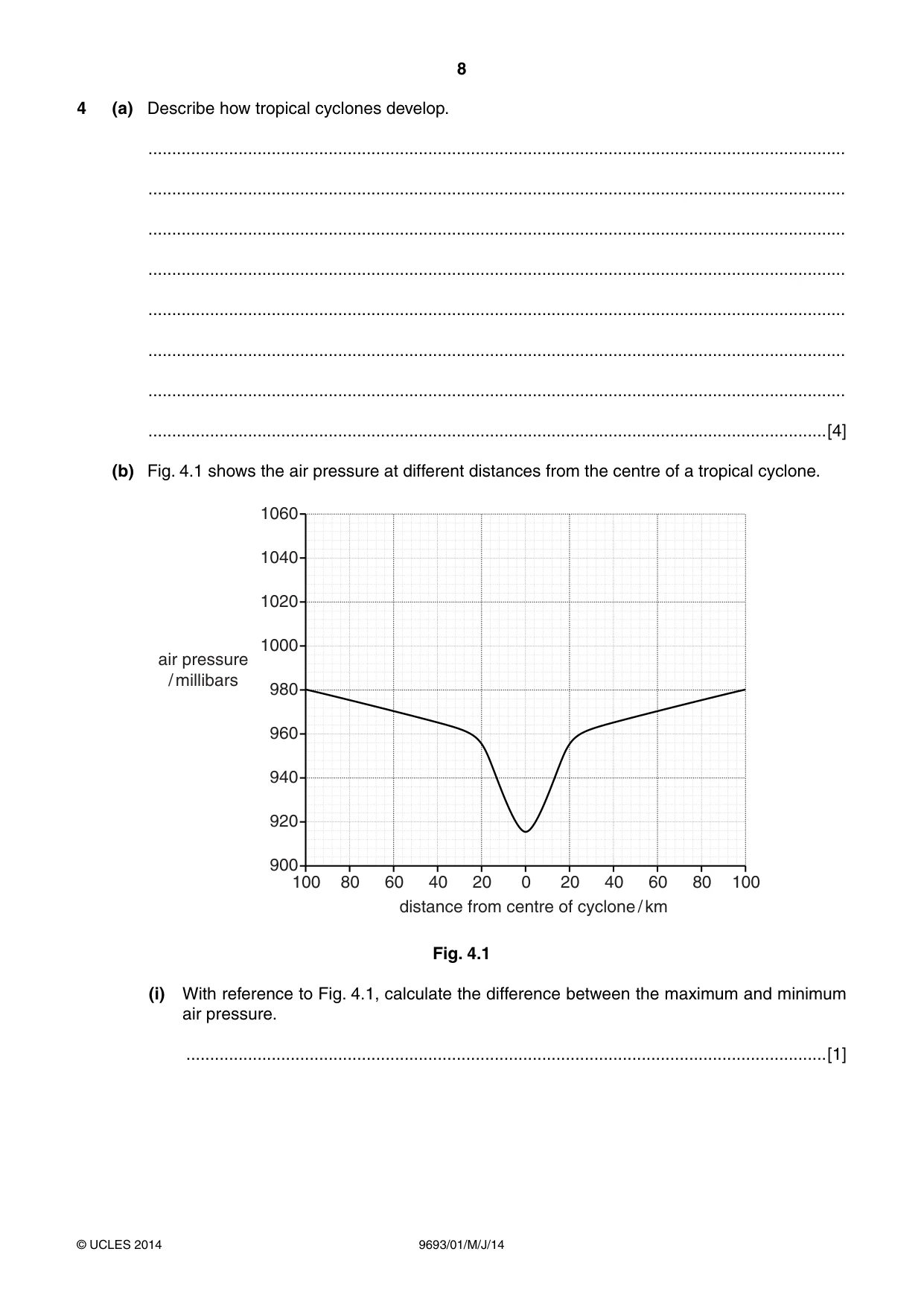
8 9693/01/M/J/14 © UCLES 2014 4 (a) Describe how tropical cyclones develop. … … … … … … … …[4] (b) Fig. 4.1 shows the air pressure at different distances from the centre of a tropical cyclone. 900 920 940 960 980 1000 1020 1040 1060 80 40 0 40 100 60 20 20 60 80 100 distance from centre of cyclone / km air pressure / millibars Fig. 4.1 (i) With reference to Fig. 4.1, calculate the difference between the maximum and minimum air pressure. …[1]
Question paper, page 9
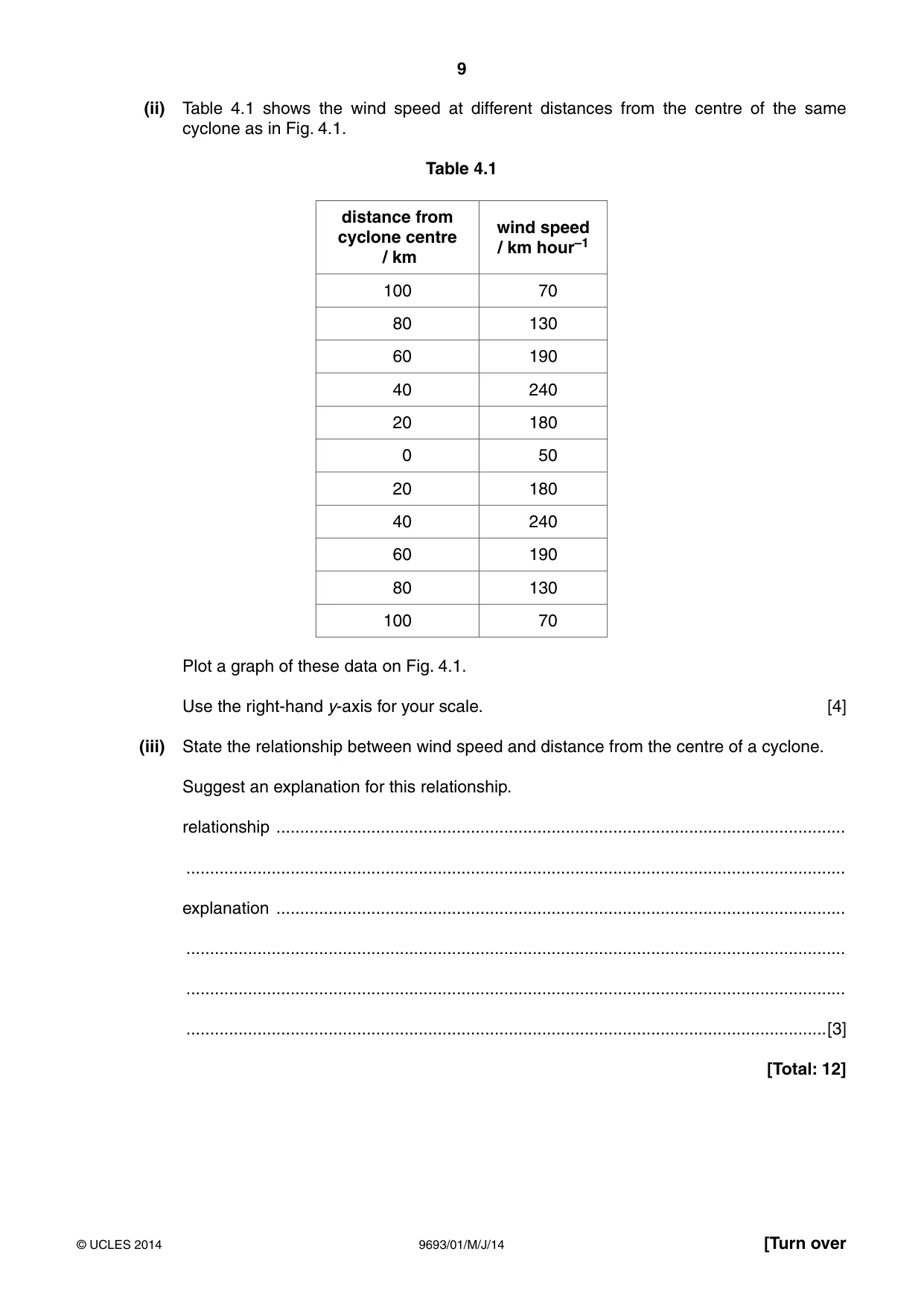
9 9693/01/M/J/14 © UCLES 2014 [Turn over (ii) Table 4.1 shows the wind speed at different distances from the centre of the same cyclone as in Fig. 4.1. Table 4.1 distance from cyclone centre / km wind speed / km hour–1 100 70 80 130 60 190 40 240 20 180 0 50 20 180 40 240 60 190 80 130 100 70 Plot a graph of these data on Fig. 4.1. Use the right-hand y-axis for your scale. [4] (iii) State the relationship between wind speed and distance from the centre of a cyclone. Suggest an explanation for this relationship. relationship … … explanation … … … …[3] [Total: 12]
Question paper, page 10
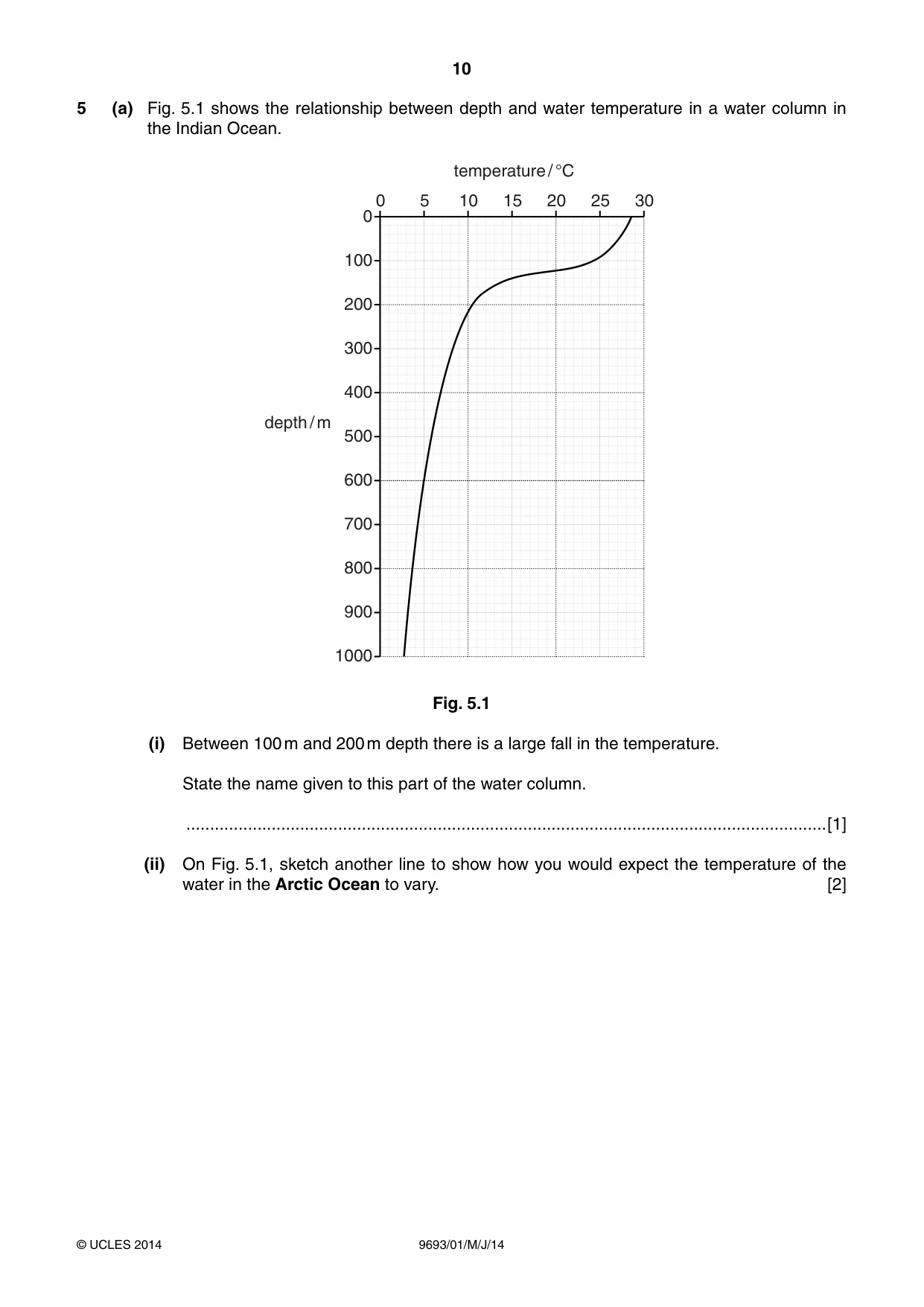
10 9693/01/M/J/14 © UCLES 2014 5 (a) Fig. 5.1 shows the relationship between depth and water temperature in a water column in the Indian Ocean. 600 700 800 900 1000 500 400 300 200 100 0 5 15 25 0 10 20 30 temperature / °C depth / m Fig. 5.1 (i) Between 100 m and 200 m depth there is a large fall in the temperature. State the name given to this part of the water column. …[1] (ii) On Fig. 5.1, sketch another line to show how you would expect the temperature of the water in the Arctic Ocean to vary. [2]
Question paper, page 11
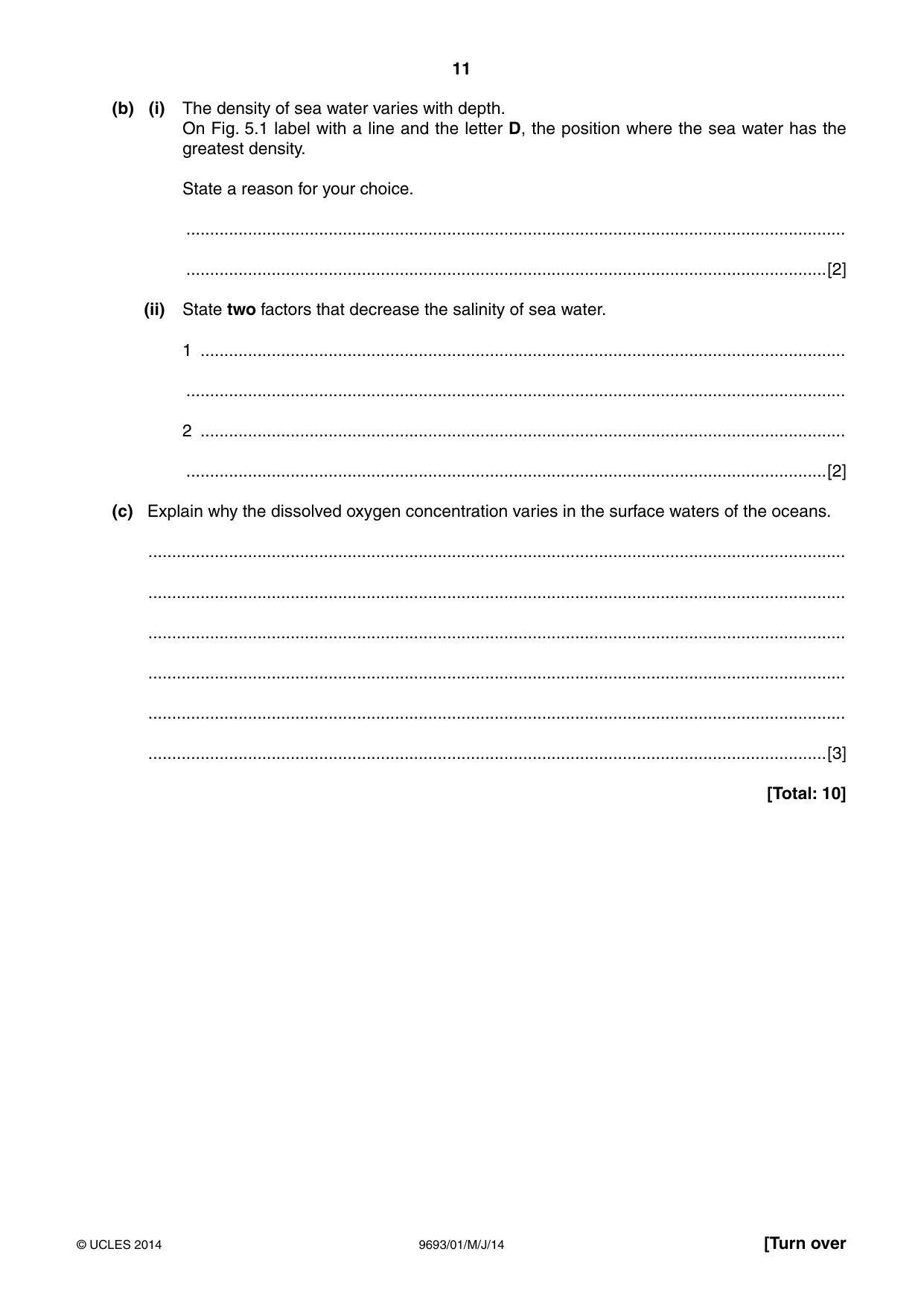
11 9693/01/M/J/14 © UCLES 2014 [Turn over (b) (i) The density of sea water varies with depth. On Fig. 5.1 label with a line and the letter D, the position where the sea water has the greatest density. State a reason for your choice. … …[2] (ii) State two factors that decrease the salinity of sea water. 1 … … 2 … …[2] (c) Explain why the dissolved oxygen concentration varies in the surface waters of the oceans. … … … … … …[3] [Total: 10]
Question paper, page 12
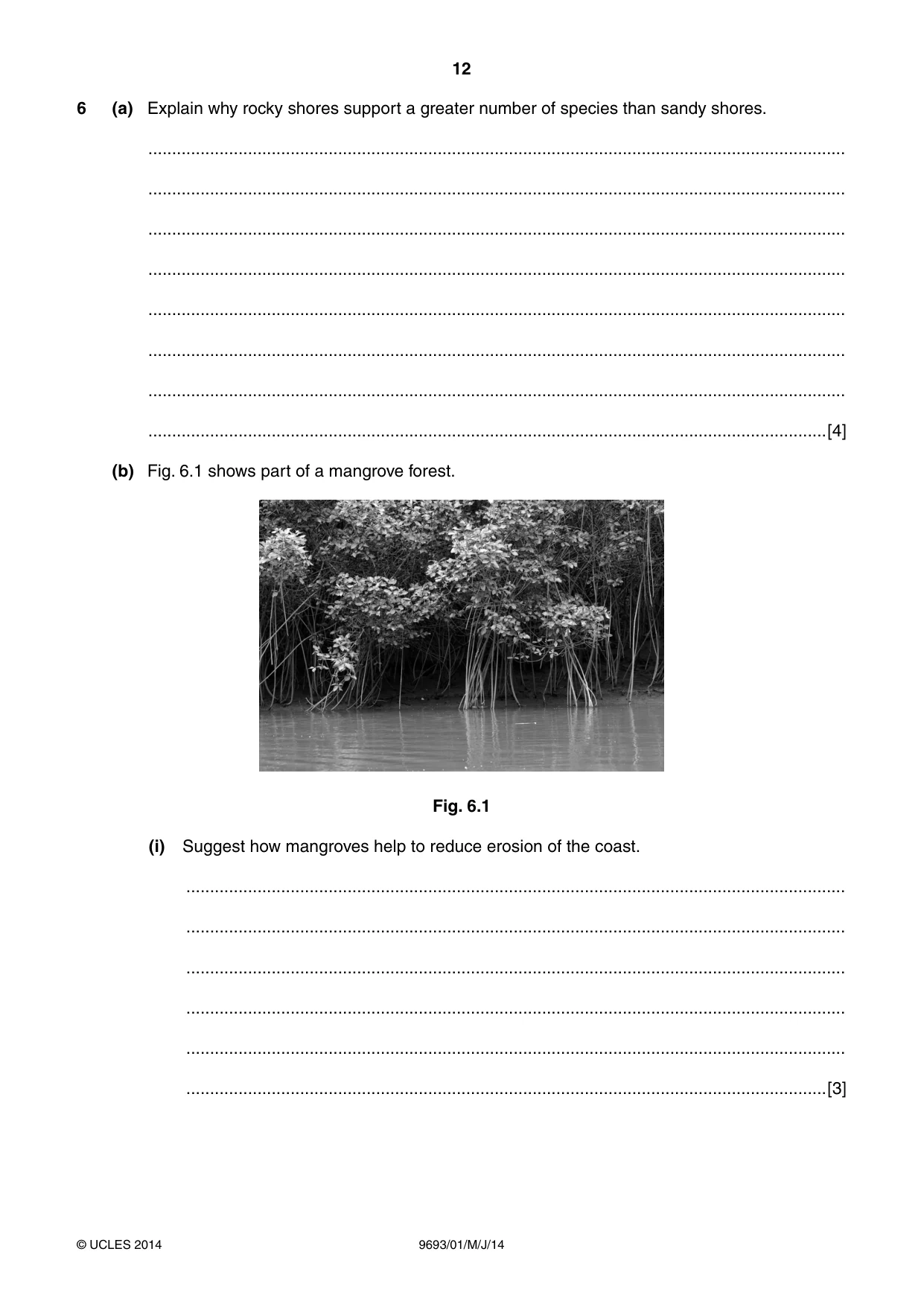
12 9693/01/M/J/14 © UCLES 2014 6 (a) Explain why rocky shores support a greater number of species than sandy shores. … … … … … … … …[4] (b) Fig. 6.1 shows part of a mangrove forest. Fig. 6.1 (i) Suggest how mangroves help to reduce erosion of the coast. … … … … … …[3]
Question paper, page 13
13 9693/01/M/J/14 © UCLES 2014 [Turn over (ii) The world total area of mangrove forest has fallen from 18.8 million hectares in 1980 to 15.2 million hectares in 2005. Suggest three reasons for this fall. 1 … … 2 … … 3 … …[3] [Total: 10]
Question paper, page 14
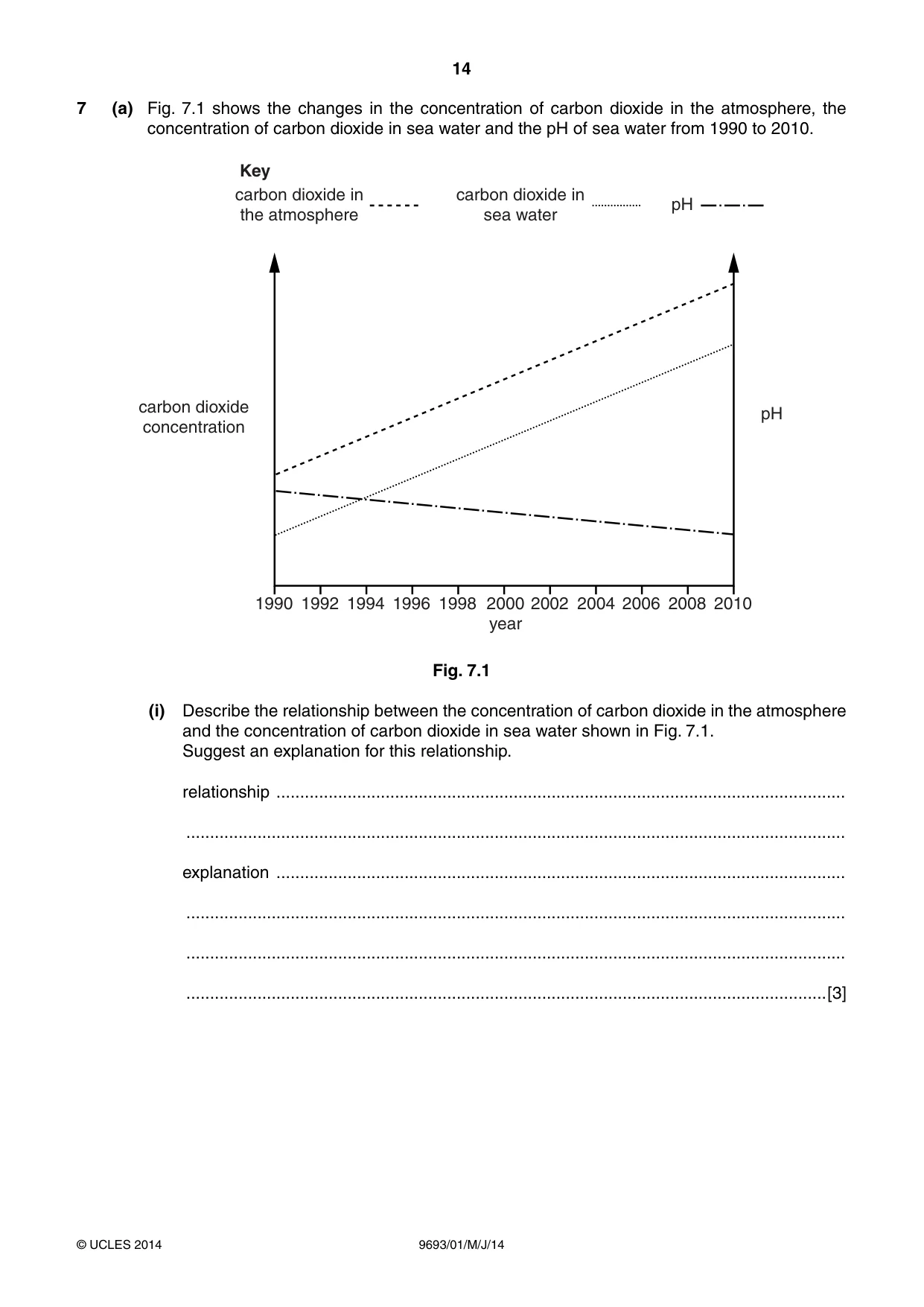
14 9693/01/M/J/14 © UCLES 2014 7 (a) Fig. 7.1 shows the changes in the concentration of carbon dioxide in the atmosphere, the concentration of carbon dioxide in sea water and the pH of sea water from 1990 to 2010. 1990 1992 1994 1996 1998 2000 year carbon dioxide concentration pH 2002 2004 2006 2008 2010 carbon dioxide in the atmosphere Key carbon dioxide in sea water pH Fig. 7.1 (i) Describe the relationship between the concentration of carbon dioxide in the atmosphere and the concentration of carbon dioxide in sea water shown in Fig. 7.1. Suggest an explanation for this relationship. relationship … … explanation … … … …[3]
Question paper, page 15
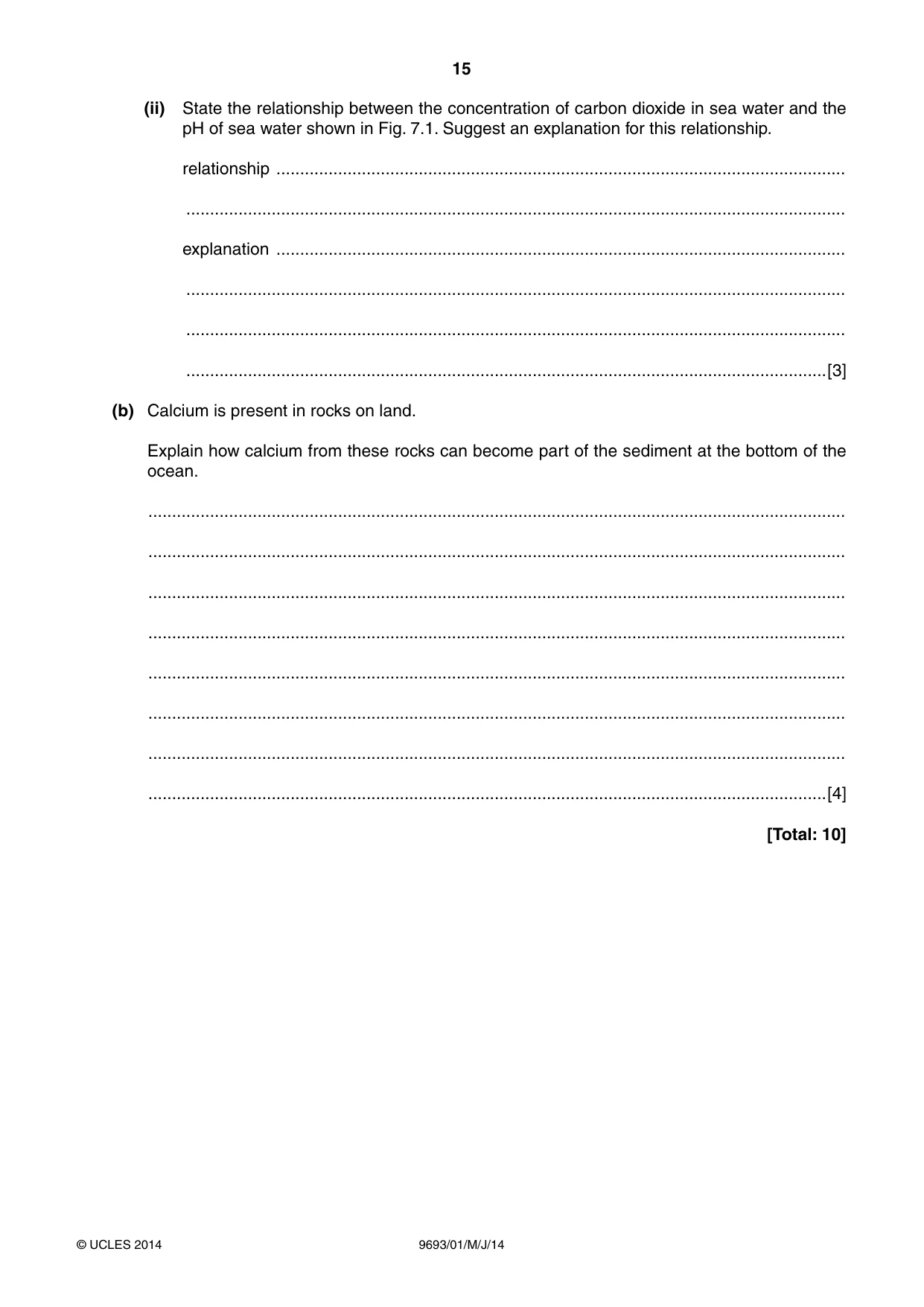
15 9693/01/M/J/14 © UCLES 2014 (ii) State the relationship between the concentration of carbon dioxide in sea water and the pH of sea water shown in Fig. 7.1. Suggest an explanation for this relationship. relationship … … explanation … … … …[3] (b) Calcium is present in rocks on land. Explain how calcium from these rocks can become part of the sediment at the bottom of the ocean. … … … … … … … …[4] [Total: 10]
Question paper, page 16
16 9693/01/M/J/14 © UCLES 2014 BLANK PAGE Copyright Acknowledgements: Question 1 Figure 1.1 © NASA; http://www.nasa.gov/. Question 6b Figure 6.1 © Science Photo Library Reference code C001/6128; Martin Shields; http://www.sciencephoto.com/search?subtype=keywords&searchstring=c001%2F6128&media_type=images&license=all&channel=all. Permission to reproduce items where third-party owned material protected by copyright is included has been sought and cleared where possible. Every reasonable effort has been made by the publisher (UCLES) to trace copyright holders, but if any items requiring clearance have unwittingly been included, the publisher will be pleased to make amends at the earliest possible opportunity. Cambridge International Examinations is part of the Cambridge Assessment Group. Cambridge Assessment is the brand name of University of Cambridge Local Examinations Syndicate (UCLES), which is itself a department of the University of Cambridge.
Mark scheme, page 1
CAMBRIDGE INTERNATIONAL EXAMINATIONS GCE Advanced Subsidiary Level and GCE Advanced Level MARK SCHEME for the May/June 2014 series 9693 MARINE SCIENCE 9693/01 Paper 1 (AS Structured Questions), maximum raw mark 75 This mark scheme is published as an aid to teachers and candidates, to indicate the requirements of the examination. It shows the basis on which Examiners were instructed to award marks. It does not indicate the details of the discussions that took place at an Examiners’ meeting before marking began, which would have considered the acceptability of alternative answers. Mark schemes should be read in conjunction with the question paper and the Principal Examiner Report for Teachers. Cambridge will not enter into discussions about these mark schemes. Cambridge is publishing the mark schemes for the May/June 2014 series for most IGCSE, GCE Advanced Level and Advanced Subsidiary Level components and some Ordinary Level components.
Mark scheme, page 2
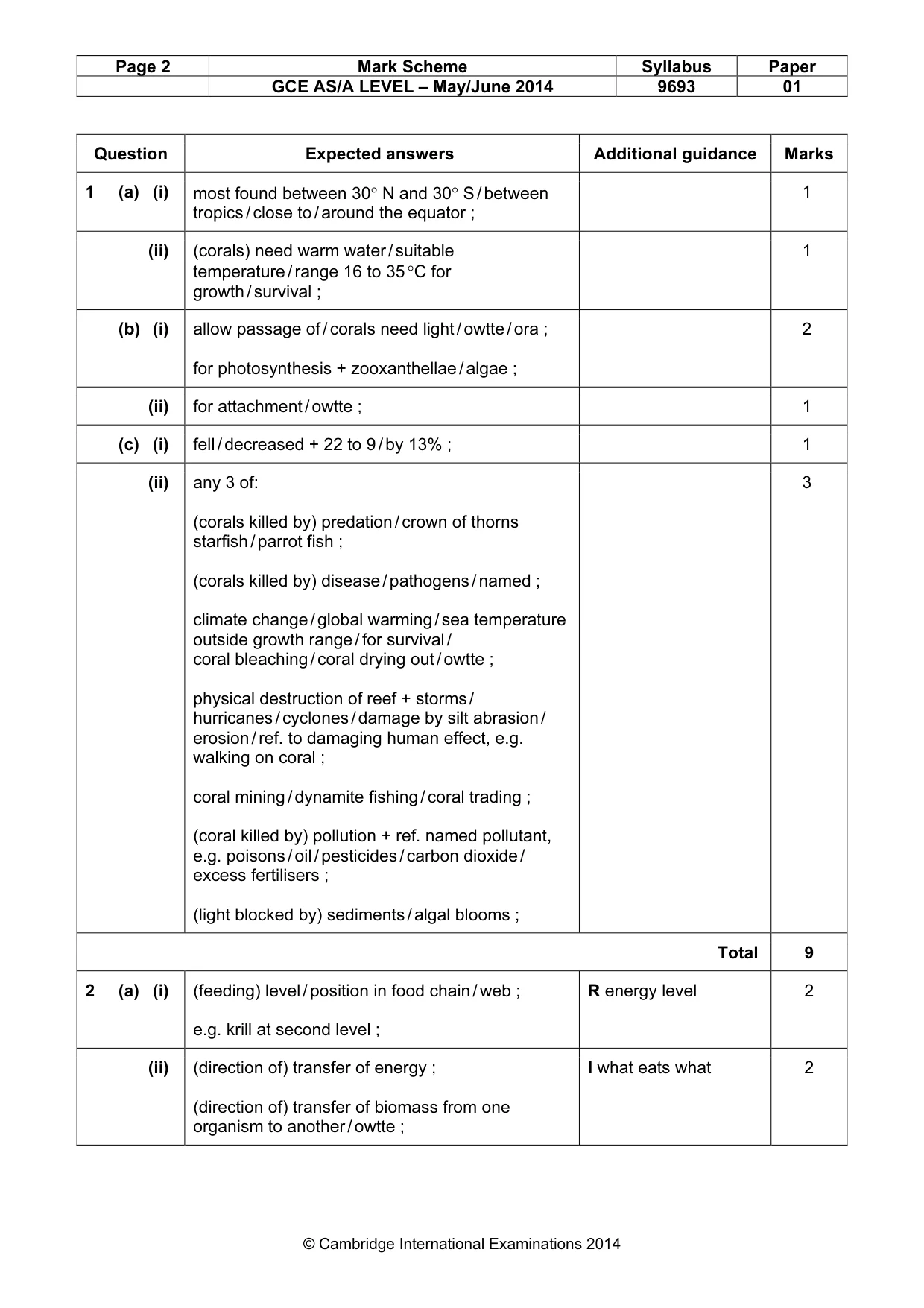
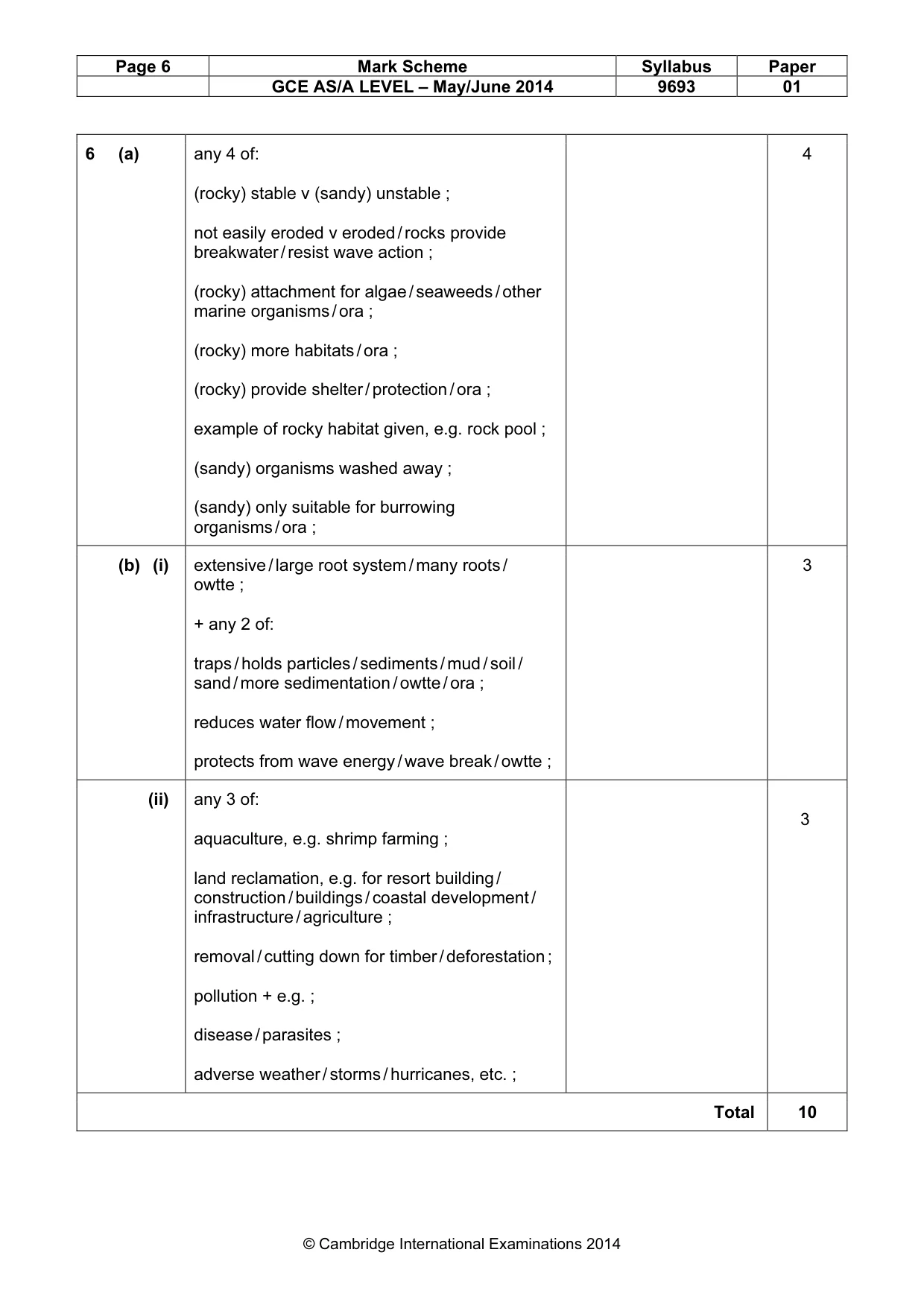
Page 2 Mark Scheme Syllabus Paper GCE AS/A LEVEL – May/June 2014 9693 01 © Cambridge International Examinations 2014 Question Expected answers Additional guidance Marks 1 (a) (i) most found between 30° N and 30° S / between tropics / close to / around the equator ; 1 (ii) (corals) need warm water / suitable temperature / range 16 to 35 °C for growth / survival ; 1 (b) (i) allow passage of / corals need light / owtte / ora ; for photosynthesis + zooxanthellae / algae ; 2 (ii) for attachment / owtte ; 1 (c) (i) fell / decreased + 22 to 9 / by 13% ; 1 (ii) any 3 of: (corals killed by) predation / crown of thorns starfish / parrot fish ; (corals killed by) disease / pathogens / named ; climate change / global warming / sea temperature outside growth range / for survival / coral bleaching / coral drying out / owtte ; physical destruction of reef + storms / hurricanes / cyclones / damage by silt abrasion / erosion / ref. to damaging human effect, e.g. walking on coral ; coral mining / dynamite fishing / coral trading ; (coral killed by) pollution + ref. named pollutant, e.g. poisons / oil / pesticides / carbon dioxide / excess fertilisers ; (light blocked by) sediments / algal blooms ; 3 Total 9 2 (a) (i) (feeding) level / position in food chain / web ; e.g. krill at second level ; R energy level 2 (ii) (direction of) transfer of energy ; (direction of) transfer of biomass from one organism to another / owtte ; I what eats what 2
Mark scheme, page 3
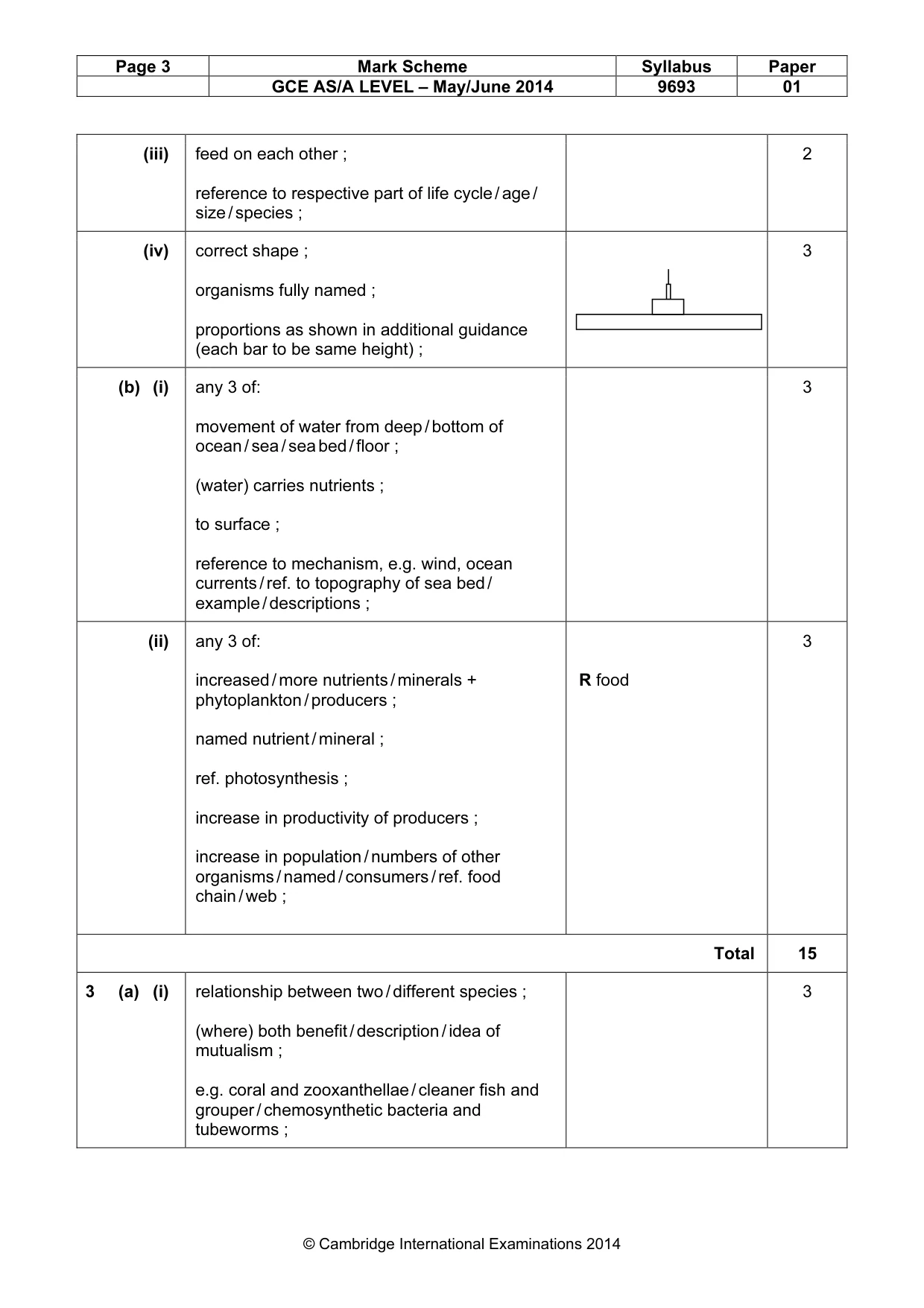
Page 3 Mark Scheme Syllabus Paper GCE AS/A LEVEL – May/June 2014 9693 01 © Cambridge International Examinations 2014 (iii) feed on each other ; reference to respective part of life cycle / age / size / species ; 2 (iv) correct shape ; organisms fully named ; proportions as shown in additional guidance (each bar to be same height) ; 3 (b) (i) any 3 of: movement of water from deep / bottom of ocean / sea / sea bed / floor ; (water) carries nutrients ; to surface ; reference to mechanism, e.g. wind, ocean currents / ref. to topography of sea bed / example / descriptions ; 3 (ii) any 3 of: increased / more nutrients / minerals + phytoplankton / producers ; named nutrient / mineral ; ref. photosynthesis ; increase in productivity of producers ; increase in population / numbers of other organisms / named / consumers / ref. food chain / web ; R food 3 Total 15 3 (a) (i) relationship between two / different species ; (where) both benefit / description / idea of mutualism ; e.g. coral and zooxanthellae / cleaner fish and grouper / chemosynthetic bacteria and tubeworms ; 3
Mark scheme, page 4
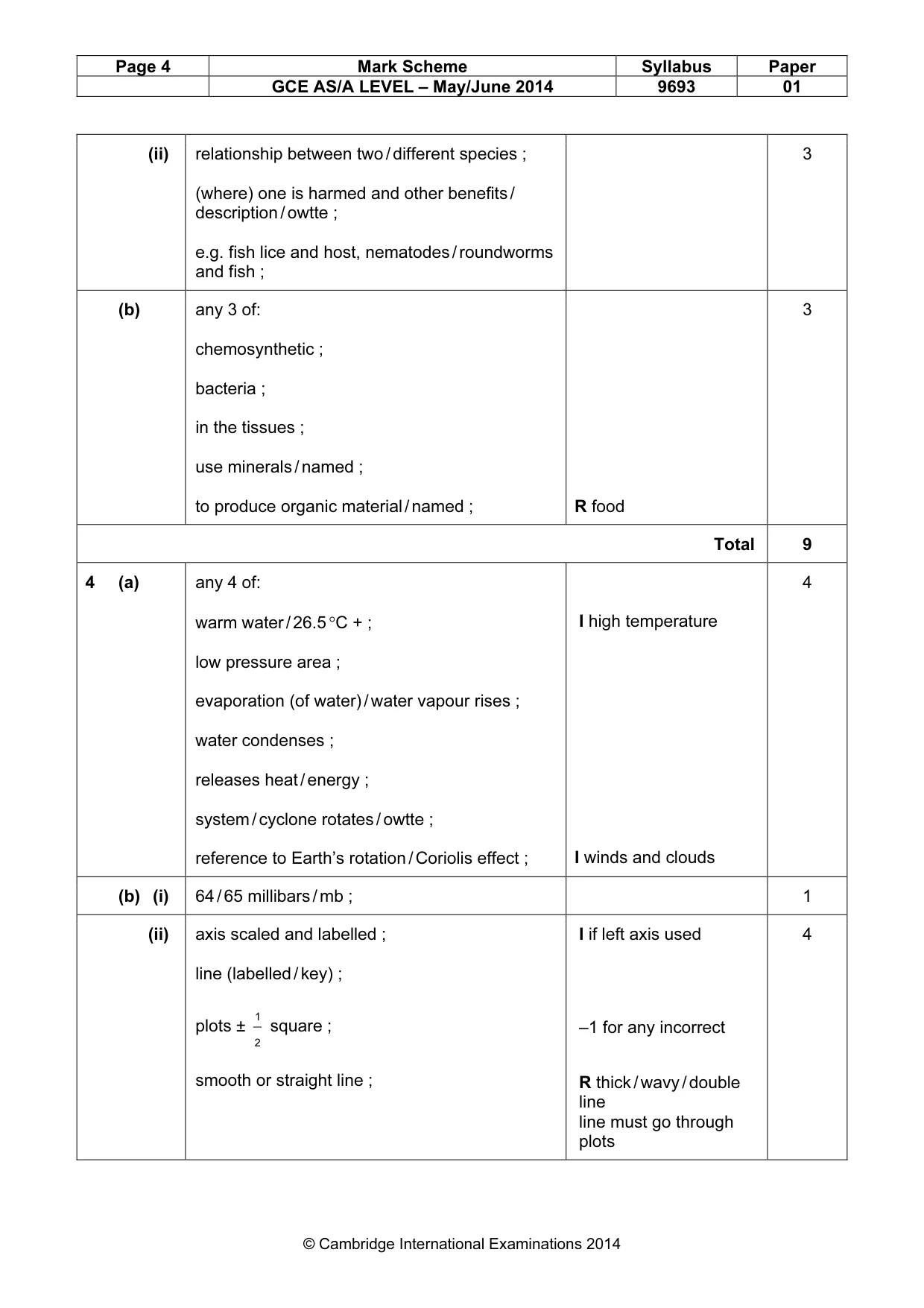
Page 4 Mark Scheme Syllabus Paper GCE AS/A LEVEL – May/June 2014 9693 01 © Cambridge International Examinations 2014 (ii) relationship between two / different species ; (where) one is harmed and other benefits / description / owtte ; e.g. fish lice and host, nematodes / roundworms and fish ; 3 (b) any 3 of: chemosynthetic ; bacteria ; in the tissues ; use minerals / named ; to produce organic material / named ; R food 3 Total 9 4 (a) any 4 of: warm water / 26.5 °C + ; low pressure area ; evaporation (of water) / water vapour rises ; water condenses ; releases heat / energy ; system / cyclone rotates / owtte ; reference to Earth’s rotation / Coriolis effect ; I high temperature I winds and clouds 4 (b) (i) 64 / 65 millibars / mb ; 1 (ii) axis scaled and labelled ; line (labelled / key) ; plots ± 2 1 square ; smooth or straight line ; I if left axis used –1 for any incorrect R thick / wavy / double line line must go through plots 4
Mark scheme, page 5
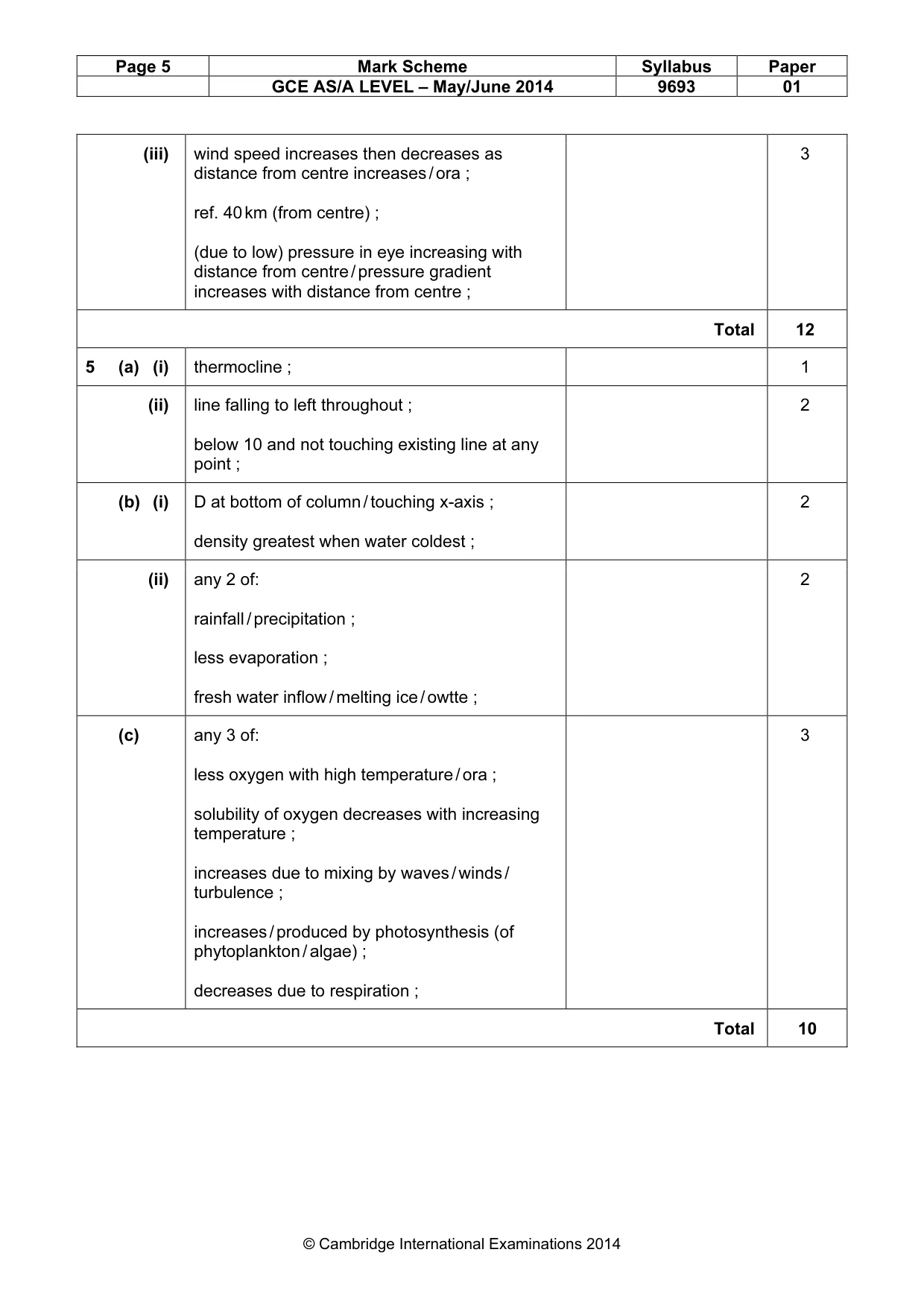
Page 5 Mark Scheme Syllabus Paper GCE AS/A LEVEL – May/June 2014 9693 01 © Cambridge International Examinations 2014 (iii) wind speed increases then decreases as distance from centre increases / ora ; ref. 40 km (from centre) ; (due to low) pressure in eye increasing with distance from centre / pressure gradient increases with distance from centre ; 3 Total 12 5 (a) (i) thermocline ; 1 (ii) line falling to left throughout ; below 10 and not touching existing line at any point ; 2 (b) (i) D at bottom of column / touching x-axis ; density greatest when water coldest ; 2 (ii) any 2 of: rainfall / precipitation ; less evaporation ; fresh water inflow / melting ice / owtte ; 2 (c) any 3 of: less oxygen with high temperature / ora ; solubility of oxygen decreases with increasing temperature ; increases due to mixing by waves / winds / turbulence ; increases / produced by photosynthesis (of phytoplankton / algae) ; decreases due to respiration ; 3 Total 10
Mark scheme, page 6
Page 6 Mark Scheme Syllabus Paper GCE AS/A LEVEL – May/June 2014 9693 01 © Cambridge International Examinations 2014 6 (a) any 4 of: (rocky) stable v (sandy) unstable ; not easily eroded v eroded / rocks provide breakwater / resist wave action ; (rocky) attachment for algae / seaweeds / other marine organisms / ora ; (rocky) more habitats / ora ; (rocky) provide shelter / protection / ora ; example of rocky habitat given, e.g. rock pool ; (sandy) organisms washed away ; (sandy) only suitable for burrowing organisms / ora ; 4 (b) (i) extensive / large root system / many roots / owtte ; + any 2 of: traps / holds particles / sediments / mud / soil / sand / more sedimentation / owtte / ora ; reduces water flow / movement ; protects from wave energy / wave break / owtte ; 3 (ii) any 3 of: aquaculture, e.g. shrimp farming ; land reclamation, e.g. for resort building / construction / buildings / coastal development / infrastructure / agriculture ; removal / cutting down for timber / deforestation ; pollution + e.g. ; disease / parasites ; adverse weather / storms / hurricanes, etc. ; 3 Total 10
Mark scheme, page 7
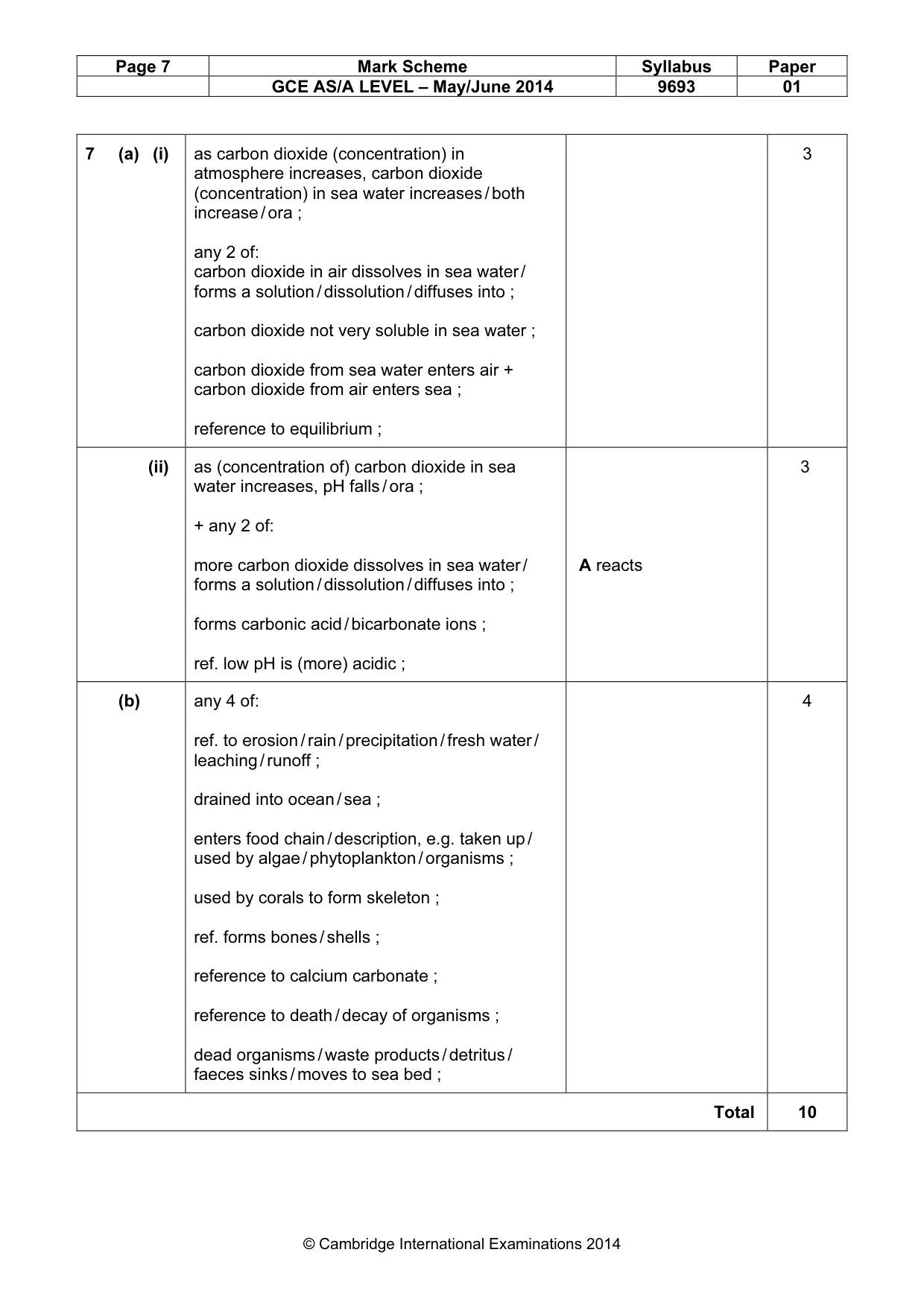
Page 7 Mark Scheme Syllabus Paper GCE AS/A LEVEL – May/June 2014 9693 01 © Cambridge International Examinations 2014 7 (a) (i) as carbon dioxide (concentration) in atmosphere increases, carbon dioxide (concentration) in sea water increases / both increase / ora ; any 2 of: carbon dioxide in air dissolves in sea water / forms a solution / dissolution / diffuses into ; carbon dioxide not very soluble in sea water ; carbon dioxide from sea water enters air + carbon dioxide from air enters sea ; reference to equilibrium ; 3 (ii) as (concentration of) carbon dioxide in sea water increases, pH falls / ora ; + any 2 of: more carbon dioxide dissolves in sea water / forms a solution / dissolution / diffuses into ; forms carbonic acid / bicarbonate ions ; ref. low pH is (more) acidic ; A reacts 3 (b) any 4 of: ref. to erosion / rain / precipitation / fresh water / leaching / runoff ; drained into ocean / sea ; enters food chain / description, e.g. taken up / used by algae / phytoplankton / organisms ; used by corals to form skeleton ; ref. forms bones / shells ; reference to calcium carbonate ; reference to death / decay of organisms ; dead organisms / waste products / detritus / faeces sinks / moves to sea bed ; 4 Total 10
What you needed in this session
Cambridge’s own grade thresholds for 2014 May/June, Paper 1 · Variant 1. A higher threshold means an easier paper — the bar moves with how the cohort did.