Cambridge A Level Law 9084 — 2019 May/June Paper 4 · Variant 2
9084/42/M/J/19 · 75 marks · ≈84 min
The question paper and its mark scheme, free to read here and free to download. This is Cambridge’s own paper, exactly as it was sat.
Question paper4 pages

Mark scheme10 pages
Answers below. Sit the paper first if you are practising.
Paper as text
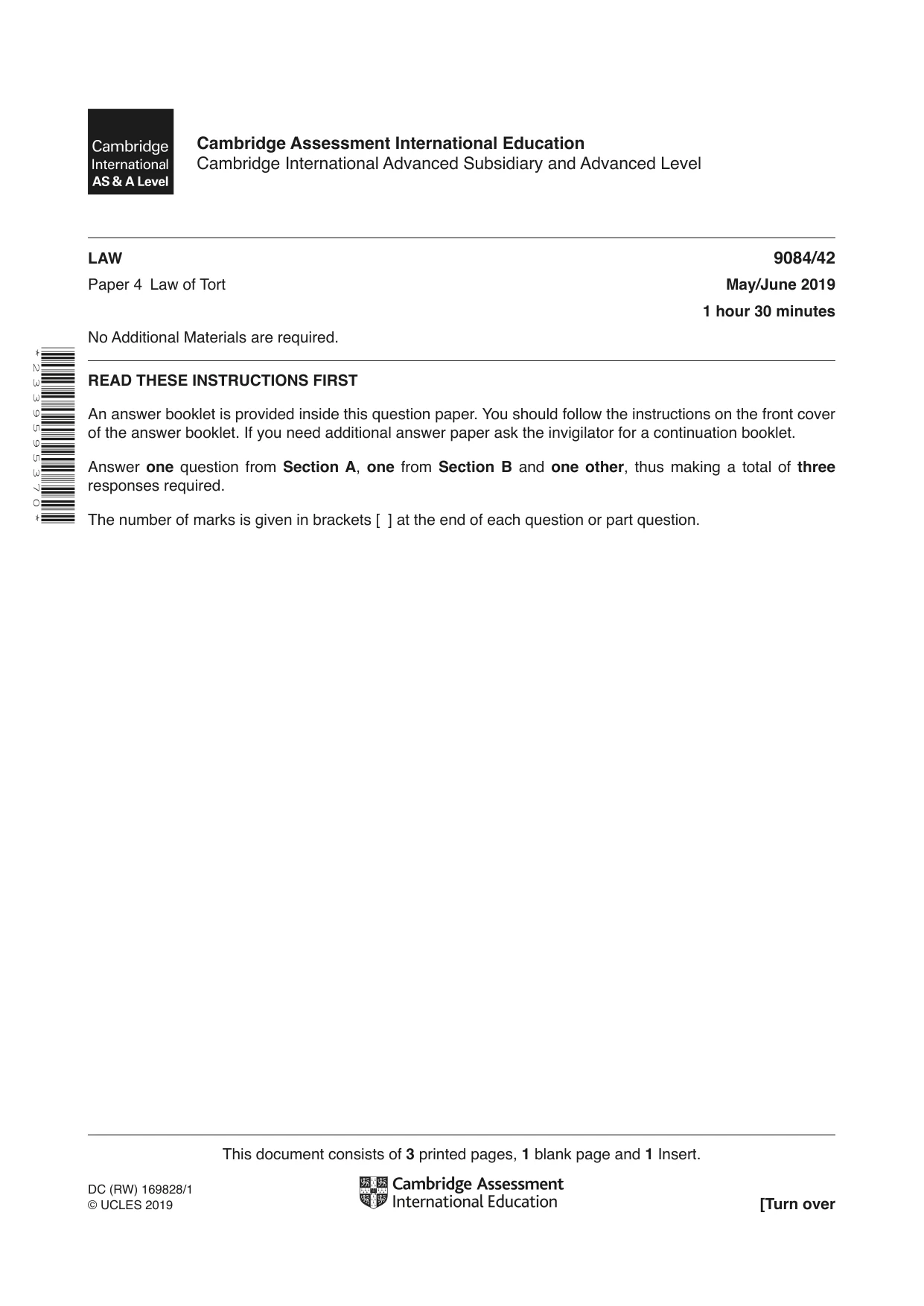
Question paper, page 1
This document consists of 3 printed pages, 1 blank page and 1 Insert. DC (RW) 169828/1 © UCLES 2019 [Turn over Cambridge Assessment International Education Cambridge International Advanced Subsidiary and Advanced Level * 2 3 3 9 5 9 5 3 7 0 * LAW 9084/42 Paper 4 Law of Tort May/June 2019 1 hour 30 minutes No Additional Materials are required. READ THESE INSTRUCTIONS FIRST An answer booklet is provided inside this question paper. You should follow the instructions on the front cover of the answer booklet. If you need additional answer paper ask the invigilator for a continuation booklet. Answer one question from Section A, one from Section B and one other, thus making a total of three responses required. The number of marks is given in brackets [ ] at the end of each question or part question.
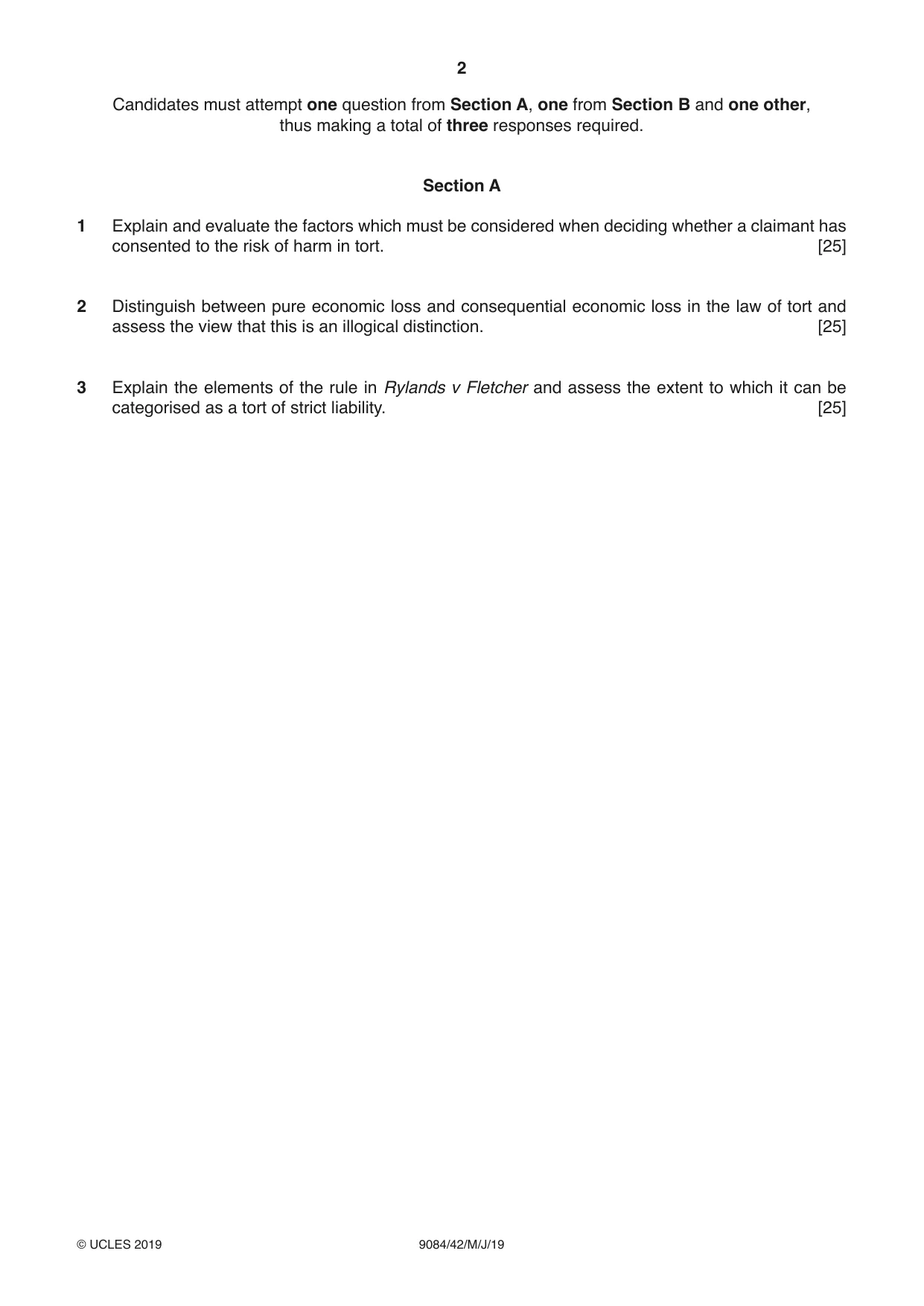
Question paper, page 2
2 9084/42/M/J/19 © UCLES 2019 Candidates must attempt one question from Section A, one from Section B and one other, thus making a total of three responses required. Section A 1 Explain and evaluate the factors which must be considered when deciding whether a claimant has consented to the risk of harm in tort. [25] 2 Distinguish between pure economic loss and consequential economic loss in the law of tort and assess the view that this is an illogical distinction. [25] 3 Explain the elements of the rule in Rylands v Fletcher and assess the extent to which it can be categorised as a tort of strict liability. [25]
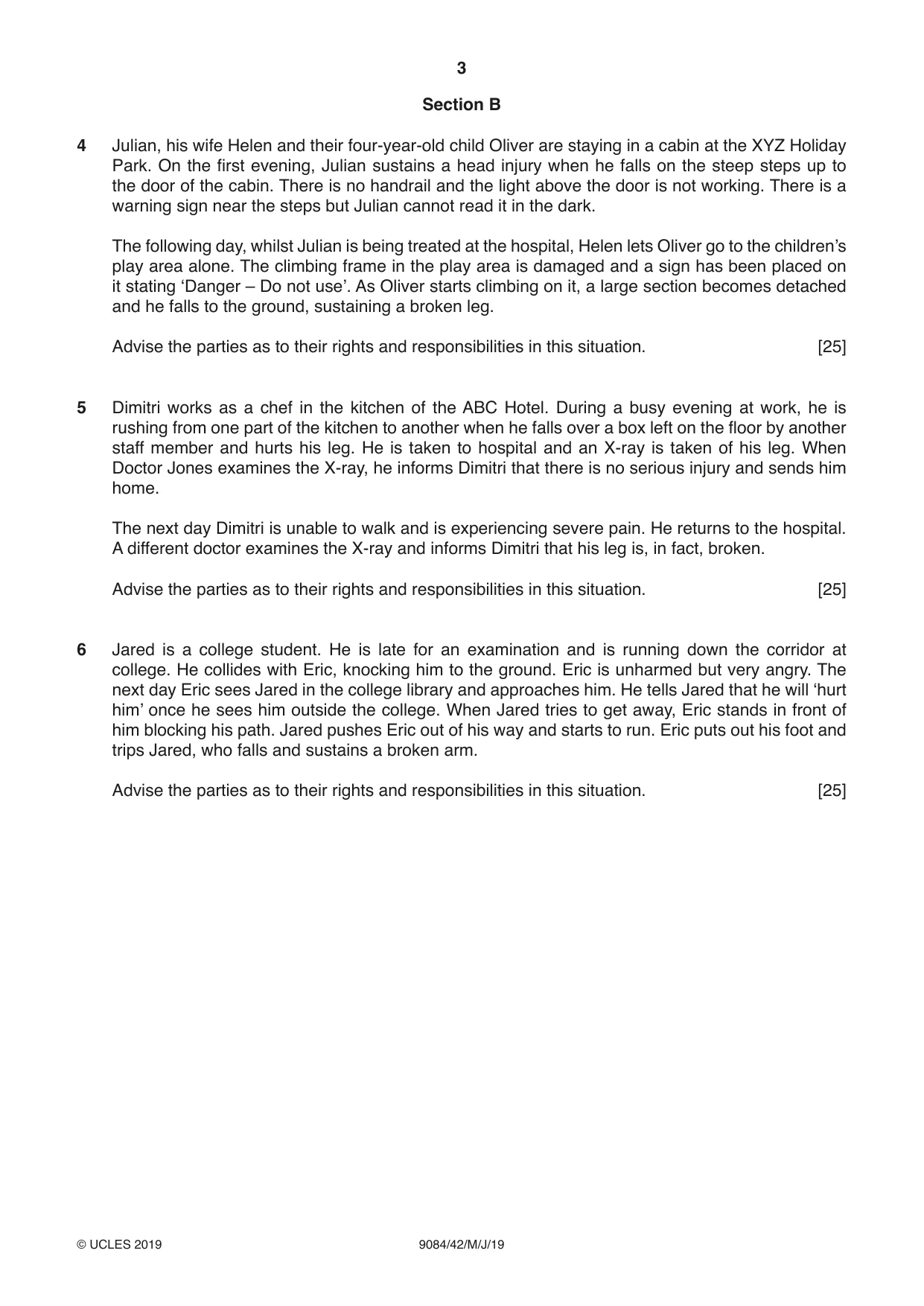
Question paper, page 3
3 9084/42/M/J/19 © UCLES 2019 Section B 4 Julian, his wife Helen and their four‑year‑old child Oliver are staying in a cabin at the XYZ Holiday Park. On the first evening, Julian sustains a head injury when he falls on the steep steps up to the door of the cabin. There is no handrail and the light above the door is not working. There is a warning sign near the steps but Julian cannot read it in the dark. The following day, whilst Julian is being treated at the hospital, Helen lets Oliver go to the children’s play area alone. The climbing frame in the play area is damaged and a sign has been placed on it stating ‘Danger – Do not use’. As Oliver starts climbing on it, a large section becomes detached and he falls to the ground, sustaining a broken leg. Advise the parties as to their rights and responsibilities in this situation. [25] 5 Dimitri works as a chef in the kitchen of the ABC Hotel. During a busy evening at work, he is rushing from one part of the kitchen to another when he falls over a box left on the floor by another staff member and hurts his leg. He is taken to hospital and an X‑ray is taken of his leg. When Doctor Jones examines the X‑ray, he informs Dimitri that there is no serious injury and sends him home. The next day Dimitri is unable to walk and is experiencing severe pain. He returns to the hospital. A different doctor examines the X‑ray and informs Dimitri that his leg is, in fact, broken. Advise the parties as to their rights and responsibilities in this situation. [25] 6 Jared is a college student. He is late for an examination and is running down the corridor at college. He collides with Eric, knocking him to the ground. Eric is unharmed but very angry. The next day Eric sees Jared in the college library and approaches him. He tells Jared that he will ‘hurt him’ once he sees him outside the college. When Jared tries to get away, Eric stands in front of him blocking his path. Jared pushes Eric out of his way and starts to run. Eric puts out his foot and trips Jared, who falls and sustains a broken arm. Advise the parties as to their rights and responsibilities in this situation. [25]
Question paper, page 4
4 9084/42/M/J/19 © UCLES 2019 BLANK PAGE Permission to reproduce items where third‑party owned material protected by copyright is included has been sought and cleared where possible. Every reasonable effort has been made by the publisher (UCLES) to trace copyright holders, but if any items requiring clearance have unwittingly been included, the publisher will be pleased to make amends at the earliest possible opportunity. To avoid the issue of disclosure of answer‑related information to candidates, all copyright acknowledgements are reproduced online in the Cambridge Assessment International Education Copyright Acknowledgements Booklet. This is produced for each series of examinations and is freely available to download at www.cambridgeinternational.org after the live examination series. Cambridge Assessment International Education is part of the Cambridge Assessment Group. Cambridge Assessment is the brand name of the University of Cambridge Local Examinations Syndicate (UCLES), which itself is a department of the University of Cambridge.
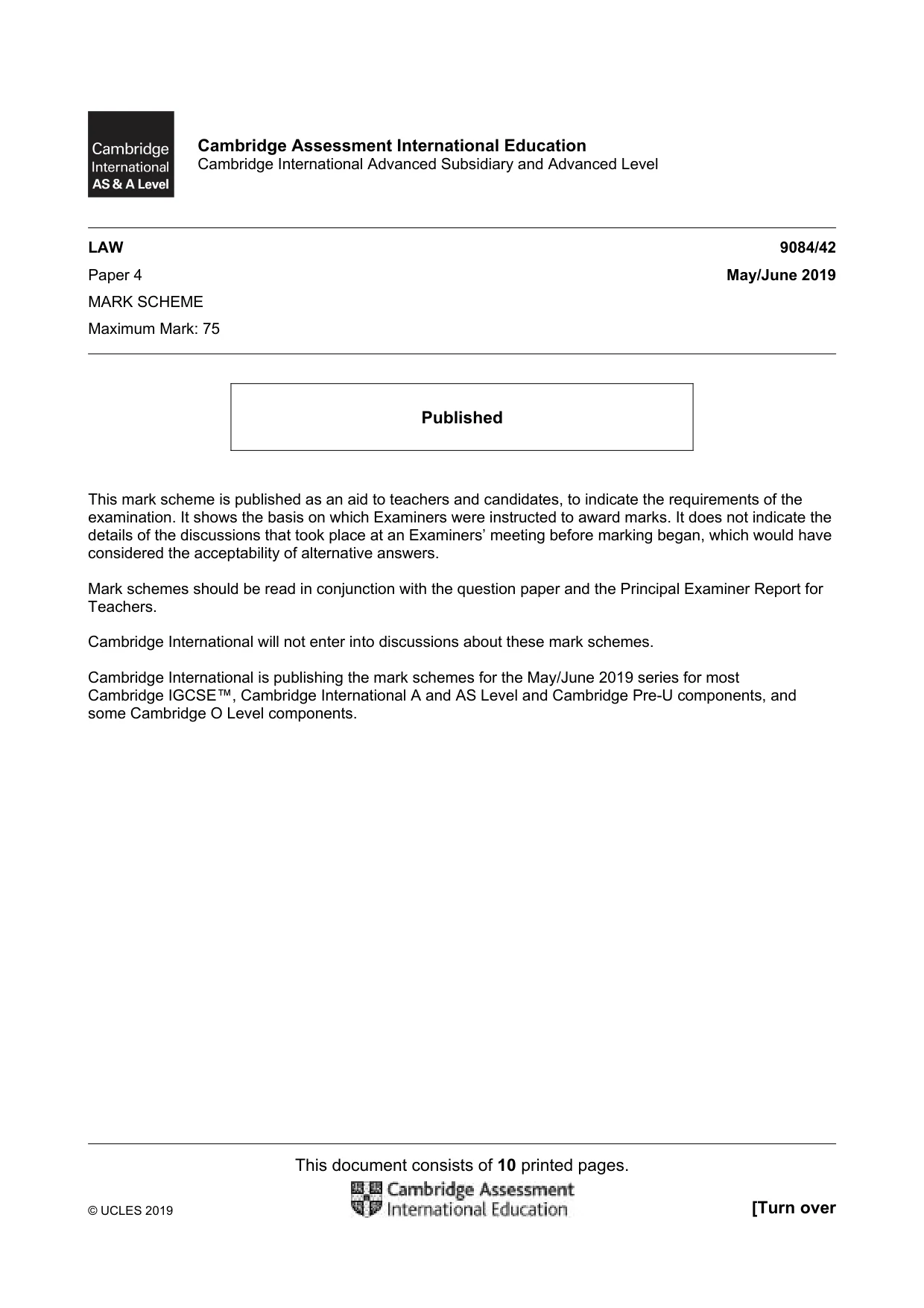
Mark scheme, page 1
This document consists of 10 printed pages. © UCLES 2019 [Turn over Cambridge Assessment International Education Cambridge International Advanced Subsidiary and Advanced Level LAW 9084/42 Paper 4 May/June 2019 MARK SCHEME Maximum Mark: 75 Published This mark scheme is published as an aid to teachers and candidates, to indicate the requirements of the examination. It shows the basis on which Examiners were instructed to award marks. It does not indicate the details of the discussions that took place at an Examiners’ meeting before marking began, which would have considered the acceptability of alternative answers. Mark schemes should be read in conjunction with the question paper and the Principal Examiner Report for Teachers. Cambridge International will not enter into discussions about these mark schemes. Cambridge International is publishing the mark schemes for the May/June 2019 series for most Cambridge IGCSE™, Cambridge International A and AS Level and Cambridge Pre-U components, and some Cambridge O Level components.
Mark scheme, page 2
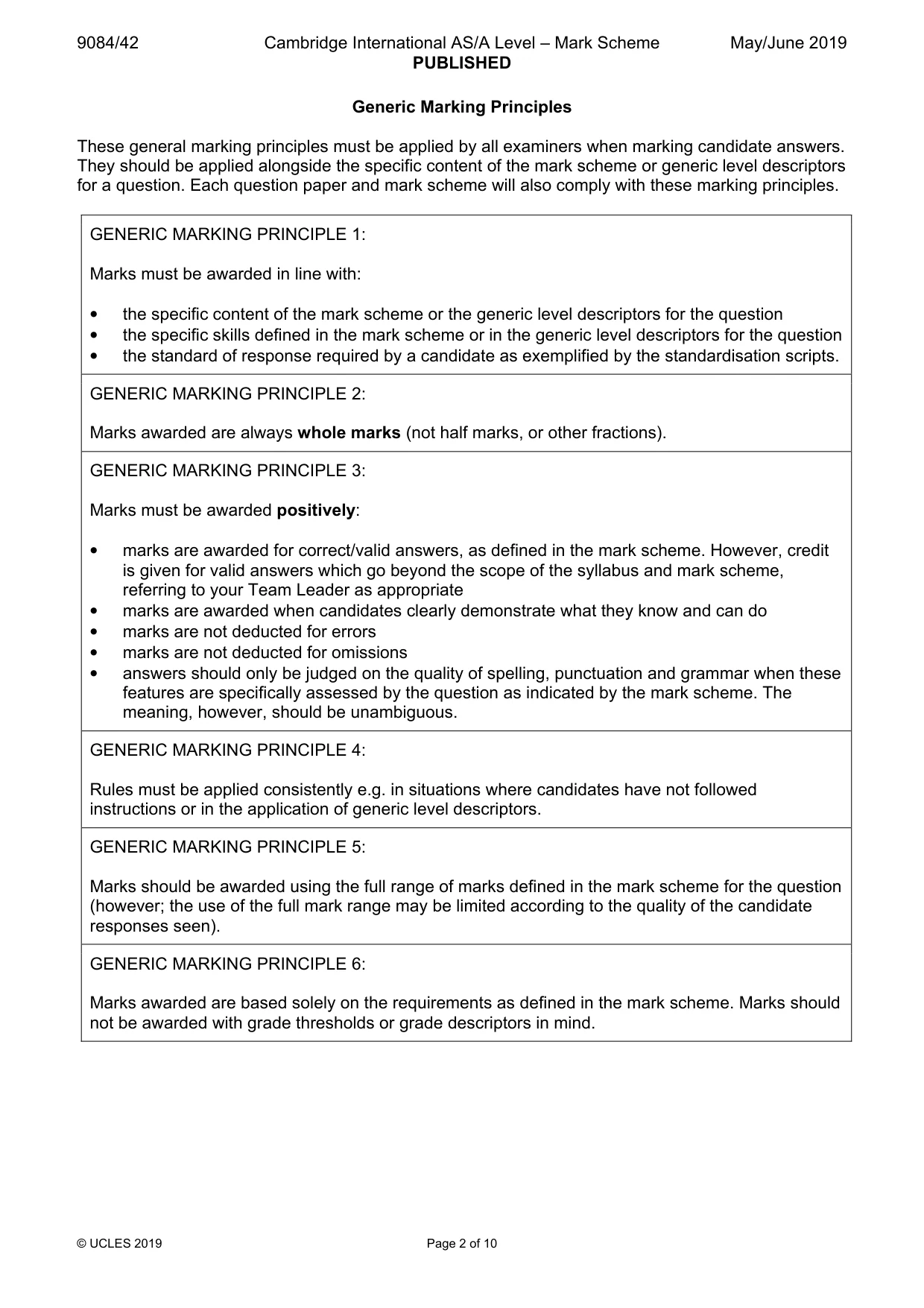
9084/42 Cambridge International AS/A Level – Mark Scheme PUBLISHED May/June 2019 © UCLES 2019 Page 2 of 10 Generic Marking Principles These general marking principles must be applied by all examiners when marking candidate answers. They should be applied alongside the specific content of the mark scheme or generic level descriptors for a question. Each question paper and mark scheme will also comply with these marking principles. GENERIC MARKING PRINCIPLE 1: Marks must be awarded in line with: • the specific content of the mark scheme or the generic level descriptors for the question • the specific skills defined in the mark scheme or in the generic level descriptors for the question • the standard of response required by a candidate as exemplified by the standardisation scripts. GENERIC MARKING PRINCIPLE 2: Marks awarded are always whole marks (not half marks, or other fractions). GENERIC MARKING PRINCIPLE 3: Marks must be awarded positively: • marks are awarded for correct/valid answers, as defined in the mark scheme. However, credit is given for valid answers which go beyond the scope of the syllabus and mark scheme, referring to your Team Leader as appropriate • marks are awarded when candidates clearly demonstrate what they know and can do • marks are not deducted for errors • marks are not deducted for omissions • answers should only be judged on the quality of spelling, punctuation and grammar when these features are specifically assessed by the question as indicated by the mark scheme. The meaning, however, should be unambiguous. GENERIC MARKING PRINCIPLE 4: Rules must be applied consistently e.g. in situations where candidates have not followed instructions or in the application of generic level descriptors. GENERIC MARKING PRINCIPLE 5: Marks should be awarded using the full range of marks defined in the mark scheme for the question (however; the use of the full mark range may be limited according to the quality of the candidate responses seen). GENERIC MARKING PRINCIPLE 6: Marks awarded are based solely on the requirements as defined in the mark scheme. Marks should not be awarded with grade thresholds or grade descriptors in mind.
Mark scheme, page 3
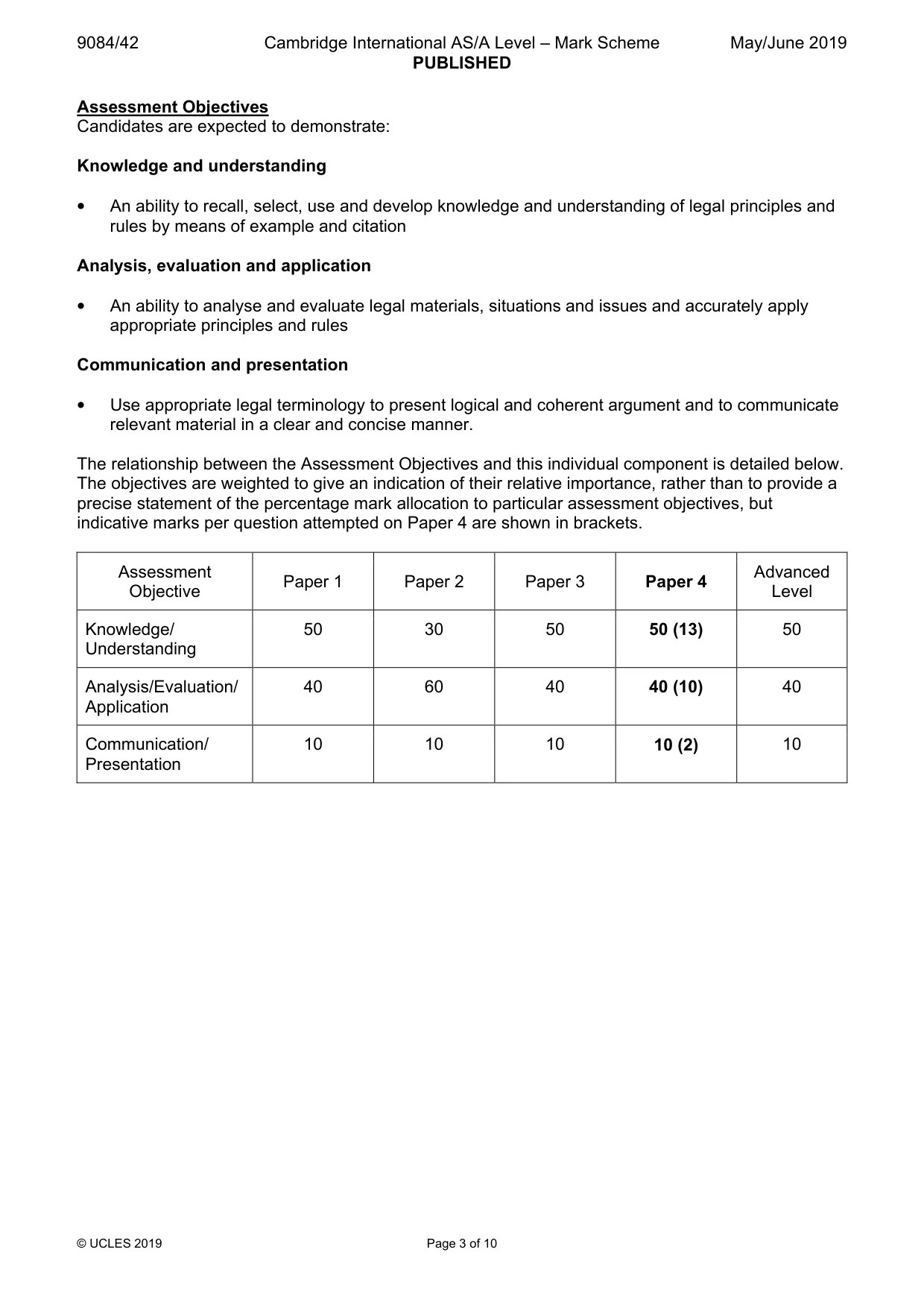
9084/42 Cambridge International AS/A Level – Mark Scheme PUBLISHED May/June 2019 © UCLES 2019 Page 3 of 10 Assessment Objectives Candidates are expected to demonstrate: Knowledge and understanding • An ability to recall, select, use and develop knowledge and understanding of legal principles and rules by means of example and citation Analysis, evaluation and application • An ability to analyse and evaluate legal materials, situations and issues and accurately apply appropriate principles and rules Communication and presentation • Use appropriate legal terminology to present logical and coherent argument and to communicate relevant material in a clear and concise manner. The relationship between the Assessment Objectives and this individual component is detailed below. The objectives are weighted to give an indication of their relative importance, rather than to provide a precise statement of the percentage mark allocation to particular assessment objectives, but indicative marks per question attempted on Paper 4 are shown in brackets. Assessment Objective Paper 1 Paper 2 Paper 3 Paper 4 Advanced Level Knowledge/ Understanding 50 30 50 50 (13) 50 Analysis/Evaluation/ Application 40 60 40 40 (10) 40 Communication/ Presentation 10 10 10 10 (2) 10
Mark scheme, page 4
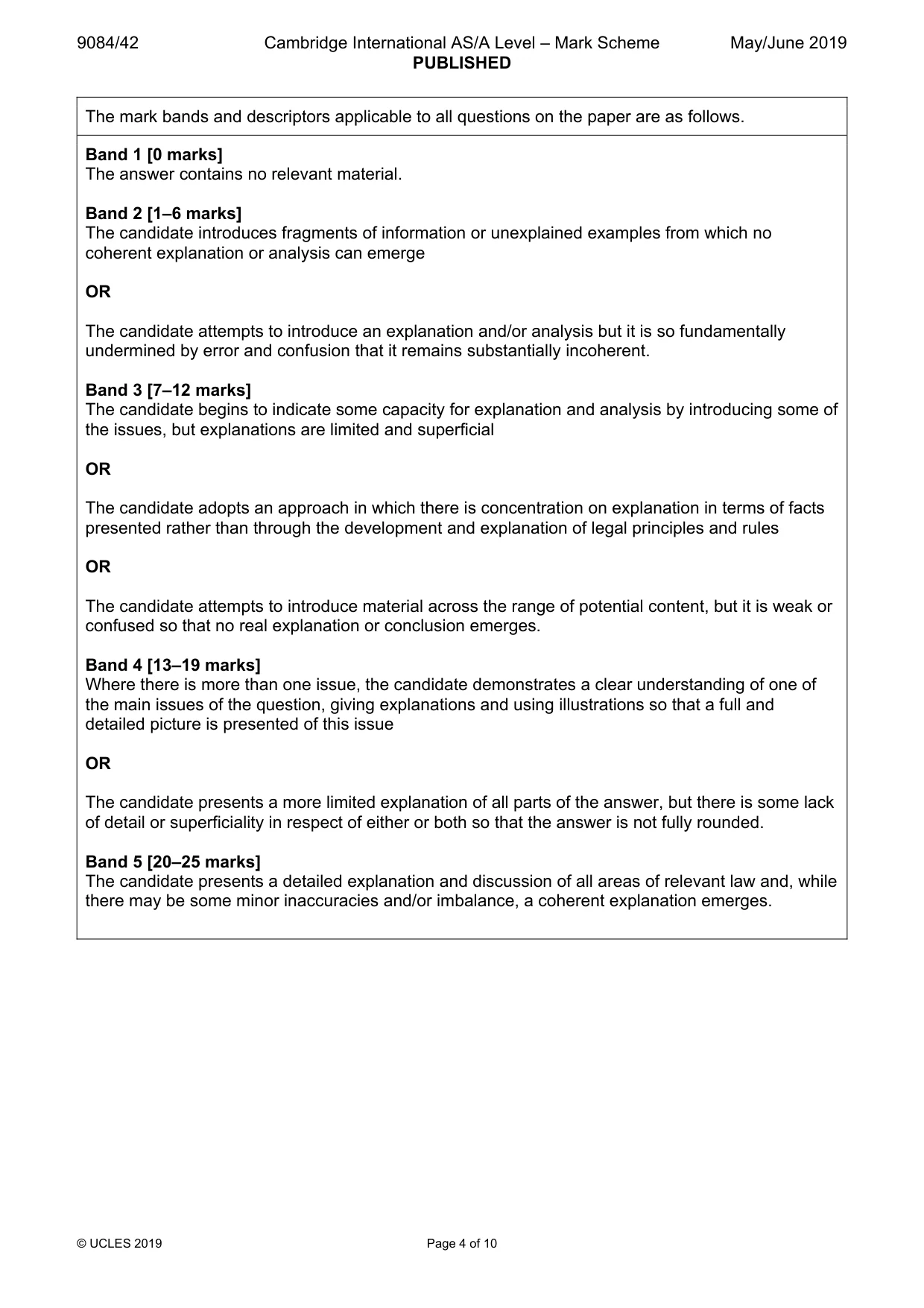
9084/42 Cambridge International AS/A Level – Mark Scheme PUBLISHED May/June 2019 © UCLES 2019 Page 4 of 10 The mark bands and descriptors applicable to all questions on the paper are as follows. Band 1 [0 marks] The answer contains no relevant material. Band 2 [1–6 marks] The candidate introduces fragments of information or unexplained examples from which no coherent explanation or analysis can emerge OR The candidate attempts to introduce an explanation and/or analysis but it is so fundamentally undermined by error and confusion that it remains substantially incoherent. Band 3 [7–12 marks] The candidate begins to indicate some capacity for explanation and analysis by introducing some of the issues, but explanations are limited and superficial OR The candidate adopts an approach in which there is concentration on explanation in terms of facts presented rather than through the development and explanation of legal principles and rules OR The candidate attempts to introduce material across the range of potential content, but it is weak or confused so that no real explanation or conclusion emerges. Band 4 [13–19 marks] Where there is more than one issue, the candidate demonstrates a clear understanding of one of the main issues of the question, giving explanations and using illustrations so that a full and detailed picture is presented of this issue OR The candidate presents a more limited explanation of all parts of the answer, but there is some lack of detail or superficiality in respect of either or both so that the answer is not fully rounded. Band 5 [20–25 marks] The candidate presents a detailed explanation and discussion of all areas of relevant law and, while there may be some minor inaccuracies and/or imbalance, a coherent explanation emerges.
Mark scheme, page 5
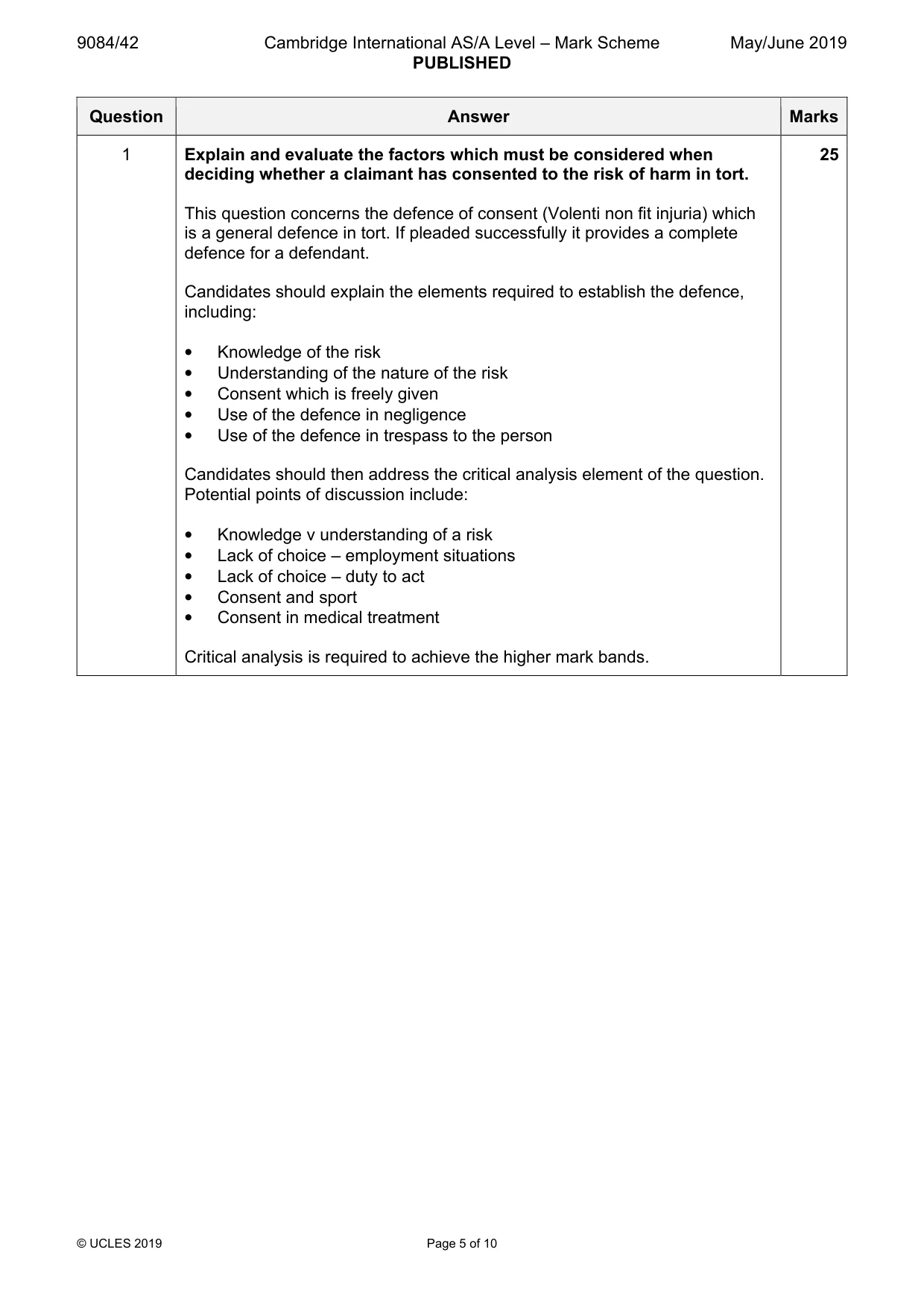
9084/42 Cambridge International AS/A Level – Mark Scheme PUBLISHED May/June 2019 © UCLES 2019 Page 5 of 10 Question Answer Marks 1 Explain and evaluate the factors which must be considered when deciding whether a claimant has consented to the risk of harm in tort. This question concerns the defence of consent (Volenti non fit injuria) which is a general defence in tort. If pleaded successfully it provides a complete defence for a defendant. Candidates should explain the elements required to establish the defence, including: • Knowledge of the risk • Understanding of the nature of the risk • Consent which is freely given • Use of the defence in negligence • Use of the defence in trespass to the person Candidates should then address the critical analysis element of the question. Potential points of discussion include: • Knowledge v understanding of a risk • Lack of choice – employment situations • Lack of choice – duty to act • Consent and sport • Consent in medical treatment Critical analysis is required to achieve the higher mark bands. 25
Mark scheme, page 6
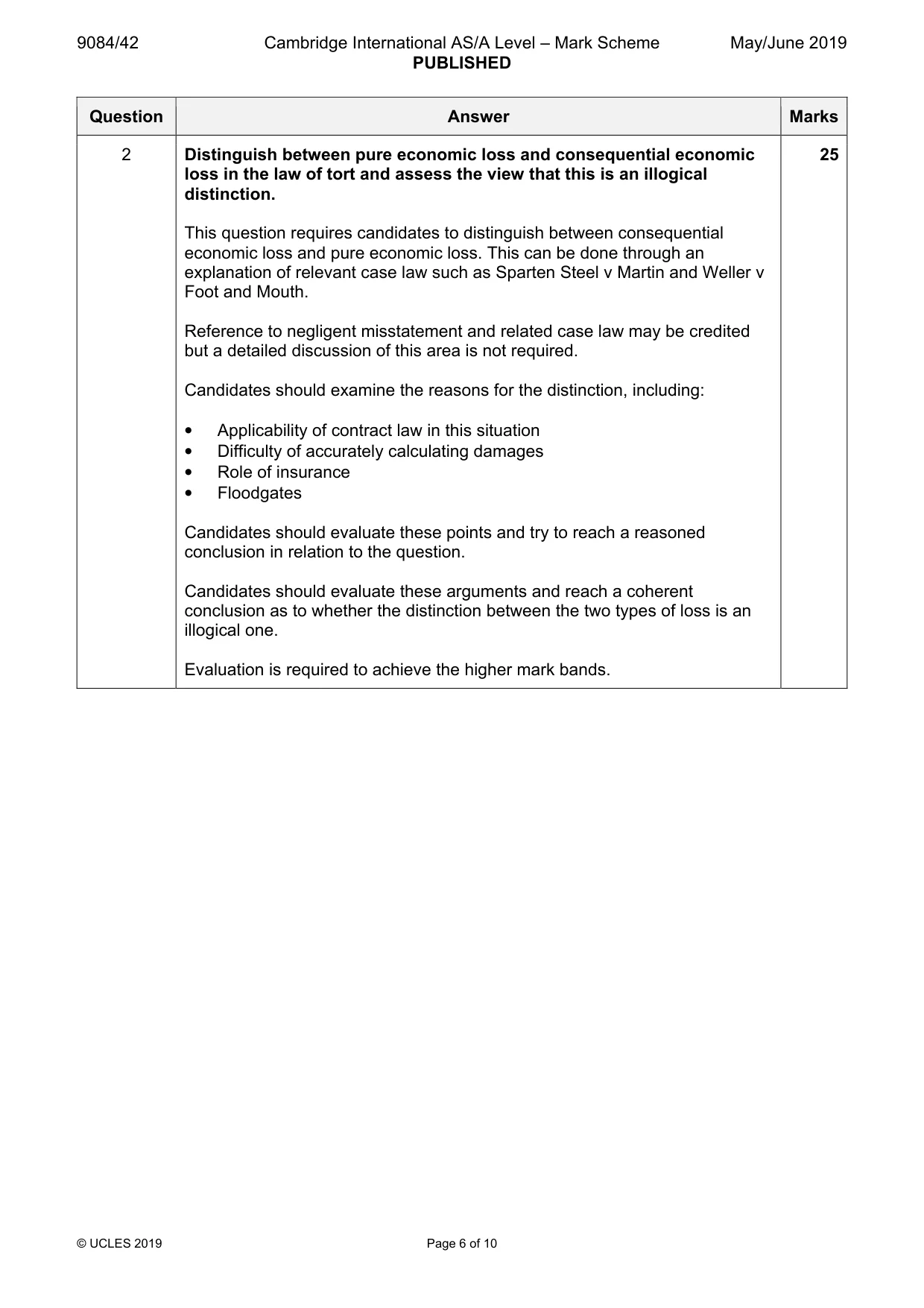
9084/42 Cambridge International AS/A Level – Mark Scheme PUBLISHED May/June 2019 © UCLES 2019 Page 6 of 10 Question Answer Marks 2 Distinguish between pure economic loss and consequential economic loss in the law of tort and assess the view that this is an illogical distinction. This question requires candidates to distinguish between consequential economic loss and pure economic loss. This can be done through an explanation of relevant case law such as Sparten Steel v Martin and Weller v Foot and Mouth. Reference to negligent misstatement and related case law may be credited but a detailed discussion of this area is not required. Candidates should examine the reasons for the distinction, including: • Applicability of contract law in this situation • Difficulty of accurately calculating damages • Role of insurance • Floodgates Candidates should evaluate these points and try to reach a reasoned conclusion in relation to the question. Candidates should evaluate these arguments and reach a coherent conclusion as to whether the distinction between the two types of loss is an illogical one. Evaluation is required to achieve the higher mark bands. 25
Mark scheme, page 7
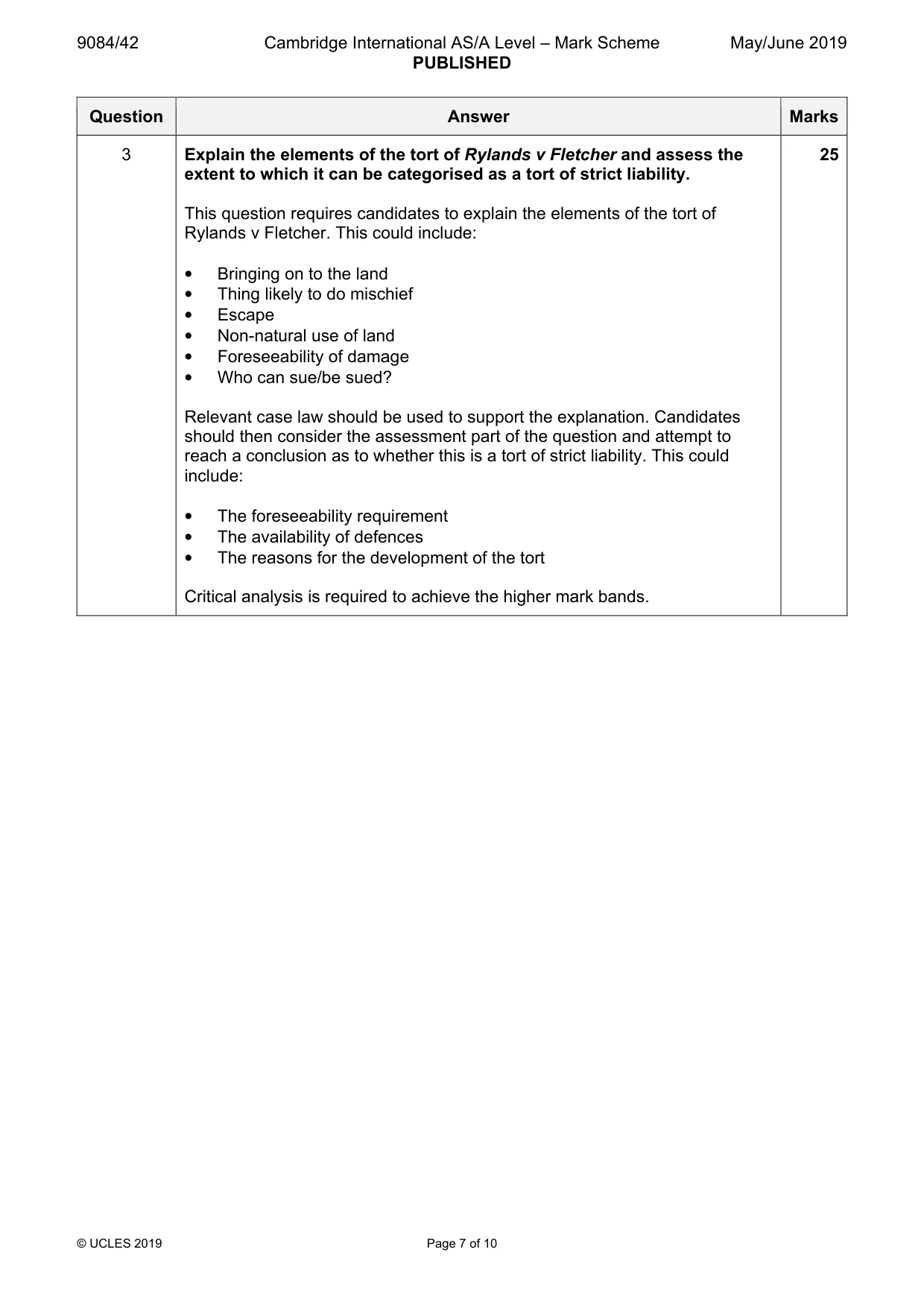
9084/42 Cambridge International AS/A Level – Mark Scheme PUBLISHED May/June 2019 © UCLES 2019 Page 7 of 10 Question Answer Marks 3 Explain the elements of the tort of Rylands v Fletcher and assess the extent to which it can be categorised as a tort of strict liability. This question requires candidates to explain the elements of the tort of Rylands v Fletcher. This could include: • Bringing on to the land • Thing likely to do mischief • Escape • Non-natural use of land • Foreseeability of damage • Who can sue/be sued? Relevant case law should be used to support the explanation. Candidates should then consider the assessment part of the question and attempt to reach a conclusion as to whether this is a tort of strict liability. This could include: • The foreseeability requirement • The availability of defences • The reasons for the development of the tort Critical analysis is required to achieve the higher mark bands. 25
Mark scheme, page 8
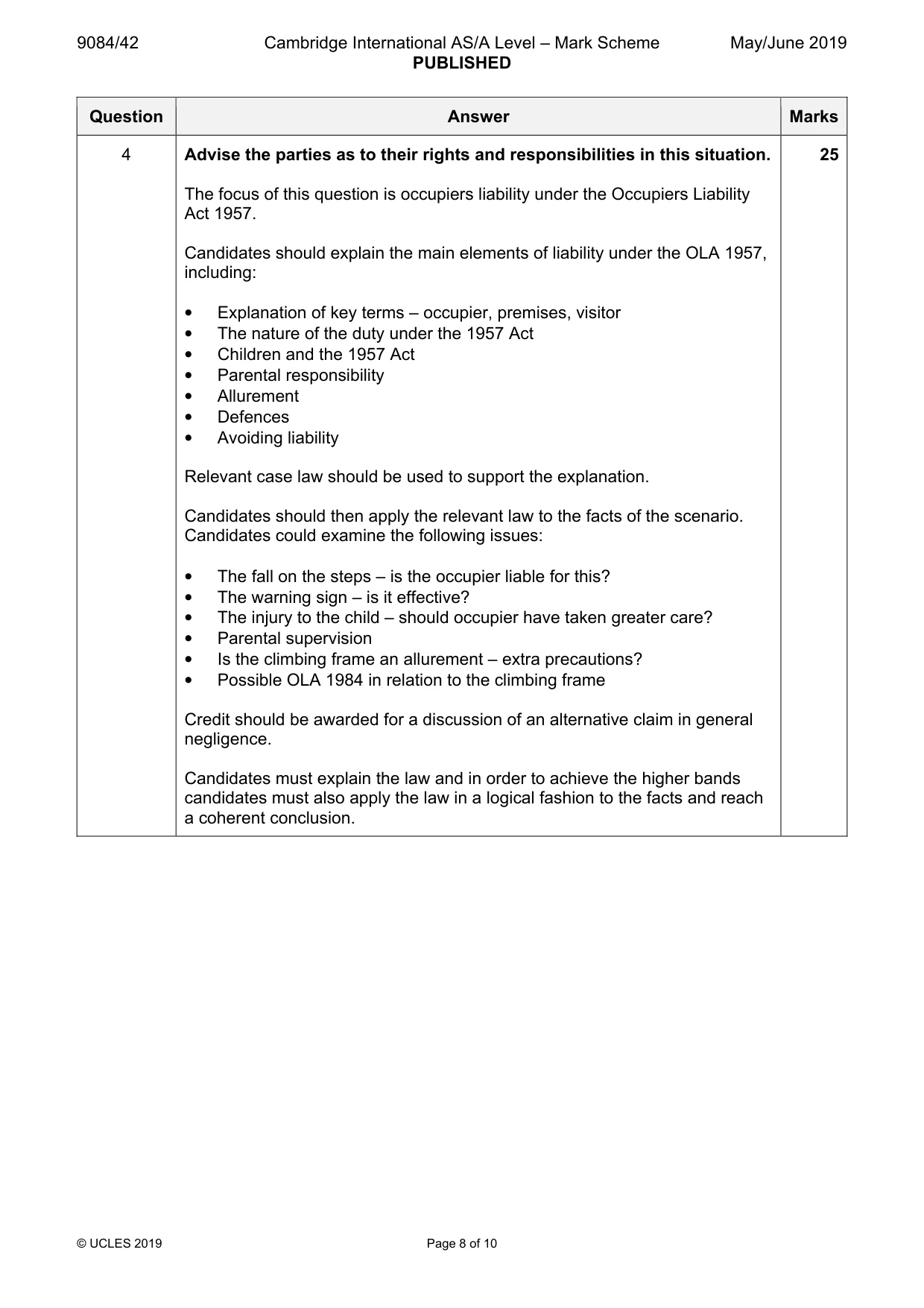
9084/42 Cambridge International AS/A Level – Mark Scheme PUBLISHED May/June 2019 © UCLES 2019 Page 8 of 10 Question Answer Marks 4 Advise the parties as to their rights and responsibilities in this situation. The focus of this question is occupiers liability under the Occupiers Liability Act 1957. Candidates should explain the main elements of liability under the OLA 1957, including: • Explanation of key terms – occupier, premises, visitor • The nature of the duty under the 1957 Act • Children and the 1957 Act • Parental responsibility • Allurement • Defences • Avoiding liability Relevant case law should be used to support the explanation. Candidates should then apply the relevant law to the facts of the scenario. Candidates could examine the following issues: • The fall on the steps – is the occupier liable for this? • The warning sign – is it effective? • The injury to the child – should occupier have taken greater care? • Parental supervision • Is the climbing frame an allurement – extra precautions? • Possible OLA 1984 in relation to the climbing frame Credit should be awarded for a discussion of an alternative claim in general negligence. Candidates must explain the law and in order to achieve the higher bands candidates must also apply the law in a logical fashion to the facts and reach a coherent conclusion. 25
Mark scheme, page 9
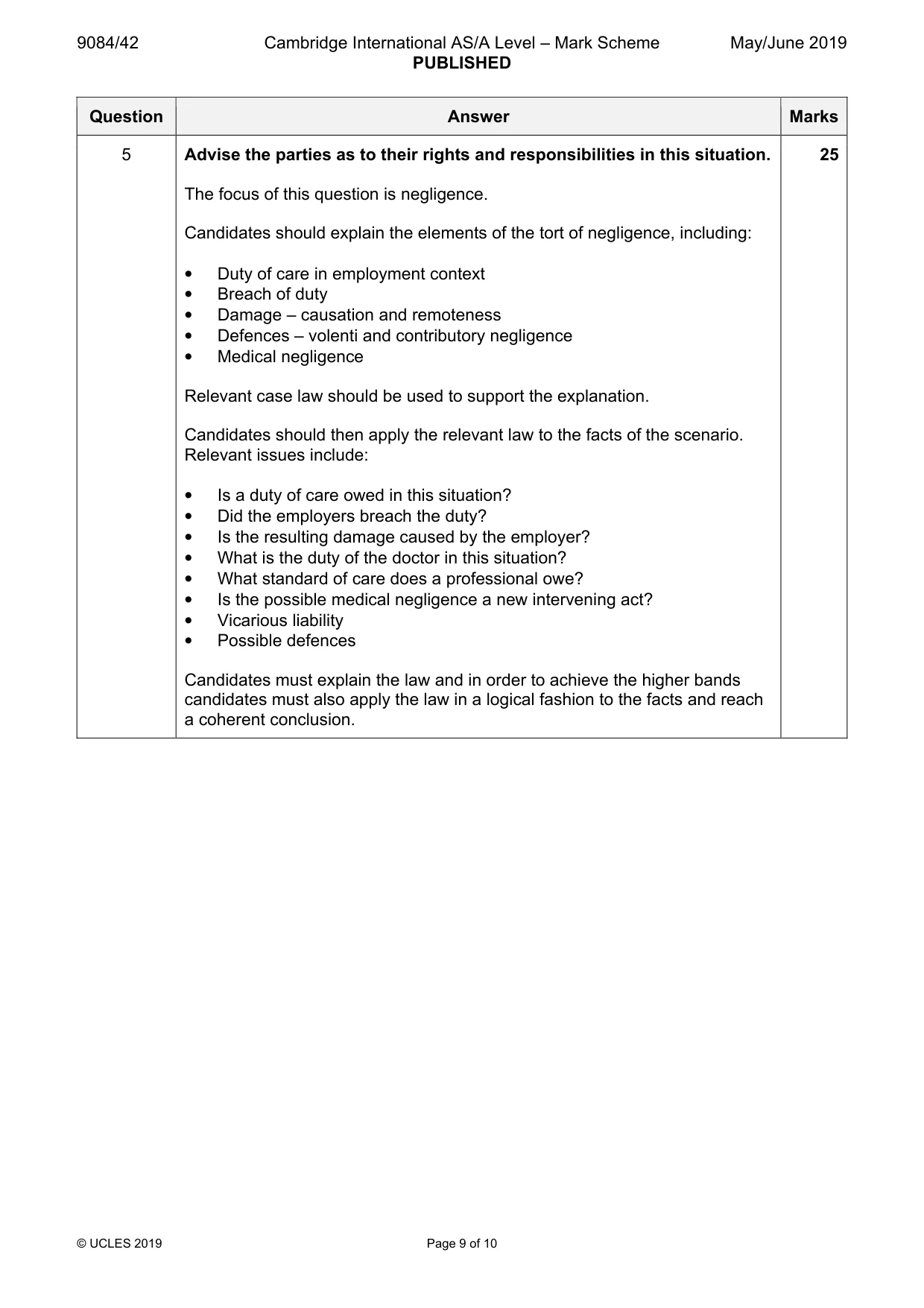
9084/42 Cambridge International AS/A Level – Mark Scheme PUBLISHED May/June 2019 © UCLES 2019 Page 9 of 10 Question Answer Marks 5 Advise the parties as to their rights and responsibilities in this situation. The focus of this question is negligence. Candidates should explain the elements of the tort of negligence, including: • Duty of care in employment context • Breach of duty • Damage – causation and remoteness • Defences – volenti and contributory negligence • Medical negligence Relevant case law should be used to support the explanation. Candidates should then apply the relevant law to the facts of the scenario. Relevant issues include: • Is a duty of care owed in this situation? • Did the employers breach the duty? • Is the resulting damage caused by the employer? • What is the duty of the doctor in this situation? • What standard of care does a professional owe? • Is the possible medical negligence a new intervening act? • Vicarious liability • Possible defences Candidates must explain the law and in order to achieve the higher bands candidates must also apply the law in a logical fashion to the facts and reach a coherent conclusion. 25
Mark scheme, page 10
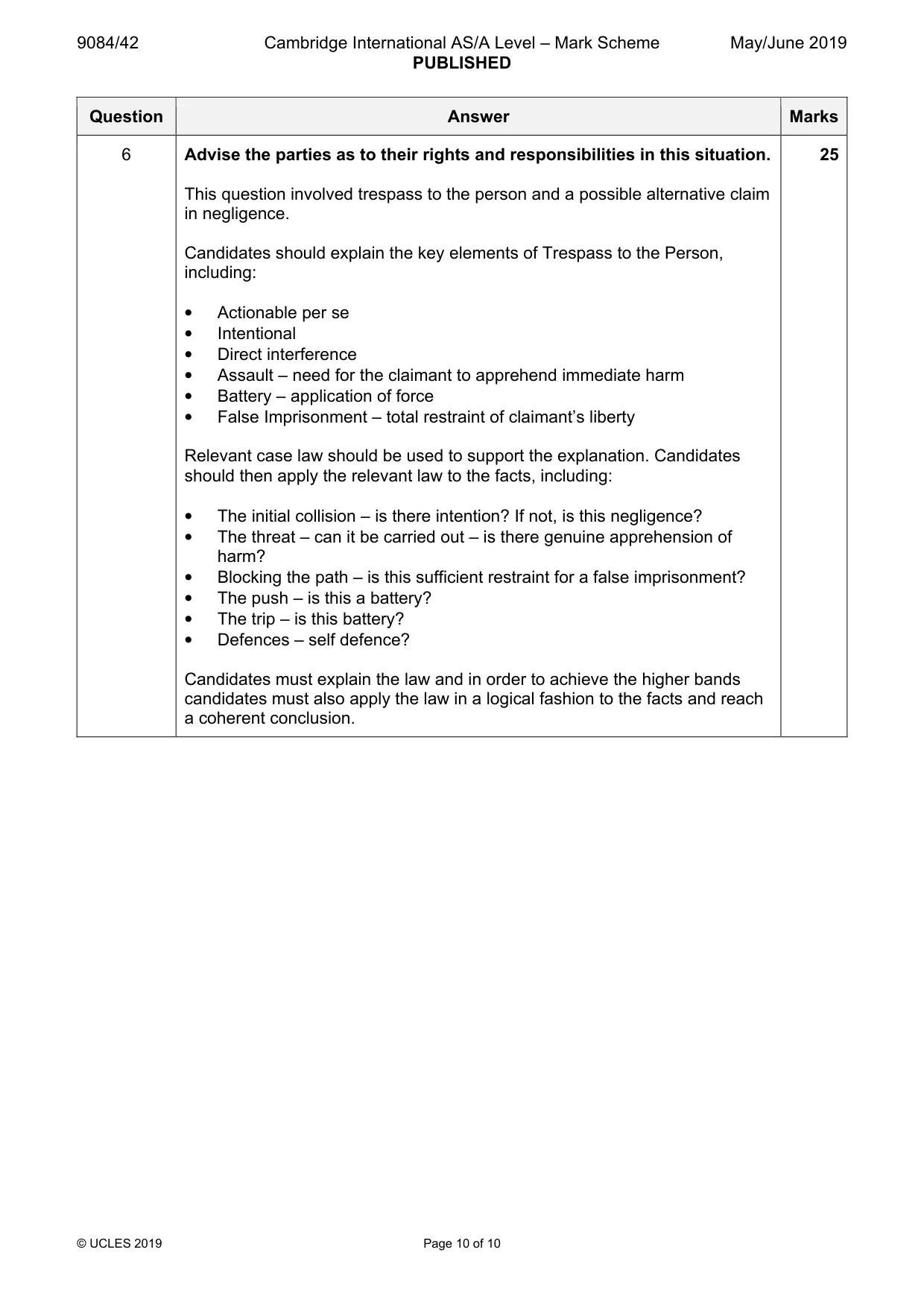
9084/42 Cambridge International AS/A Level – Mark Scheme PUBLISHED May/June 2019 © UCLES 2019 Page 10 of 10 Question Answer Marks 6 Advise the parties as to their rights and responsibilities in this situation. This question involved trespass to the person and a possible alternative claim in negligence. Candidates should explain the key elements of Trespass to the Person, including: • Actionable per se • Intentional • Direct interference • Assault – need for the claimant to apprehend immediate harm • Battery – application of force • False Imprisonment – total restraint of claimant’s liberty Relevant case law should be used to support the explanation. Candidates should then apply the relevant law to the facts, including: • The initial collision – is there intention? If not, is this negligence? • The threat – can it be carried out – is there genuine apprehension of harm? • Blocking the path – is this sufficient restraint for a false imprisonment? • The push – is this a battery? • The trip – is this battery? • Defences – self defence? Candidates must explain the law and in order to achieve the higher bands candidates must also apply the law in a logical fashion to the facts and reach a coherent conclusion. 25
What you needed in this session
Cambridge’s own grade thresholds for 2019 May/June, Paper 4 · Variant 2. A higher threshold means an easier paper — the bar moves with how the cohort did.