Cambridge A Level Law 9084 — 2016 May/June Paper 4 · Variant 2
9084/42/M/J/16 · 75 marks · ≈84 min
The question paper and its mark scheme, free to read here and free to download. This is Cambridge’s own paper, exactly as it was sat.
Question paper4 pages

Mark scheme6 pages
Answers below. Sit the paper first if you are practising.
Paper as text
Question paper, page 1
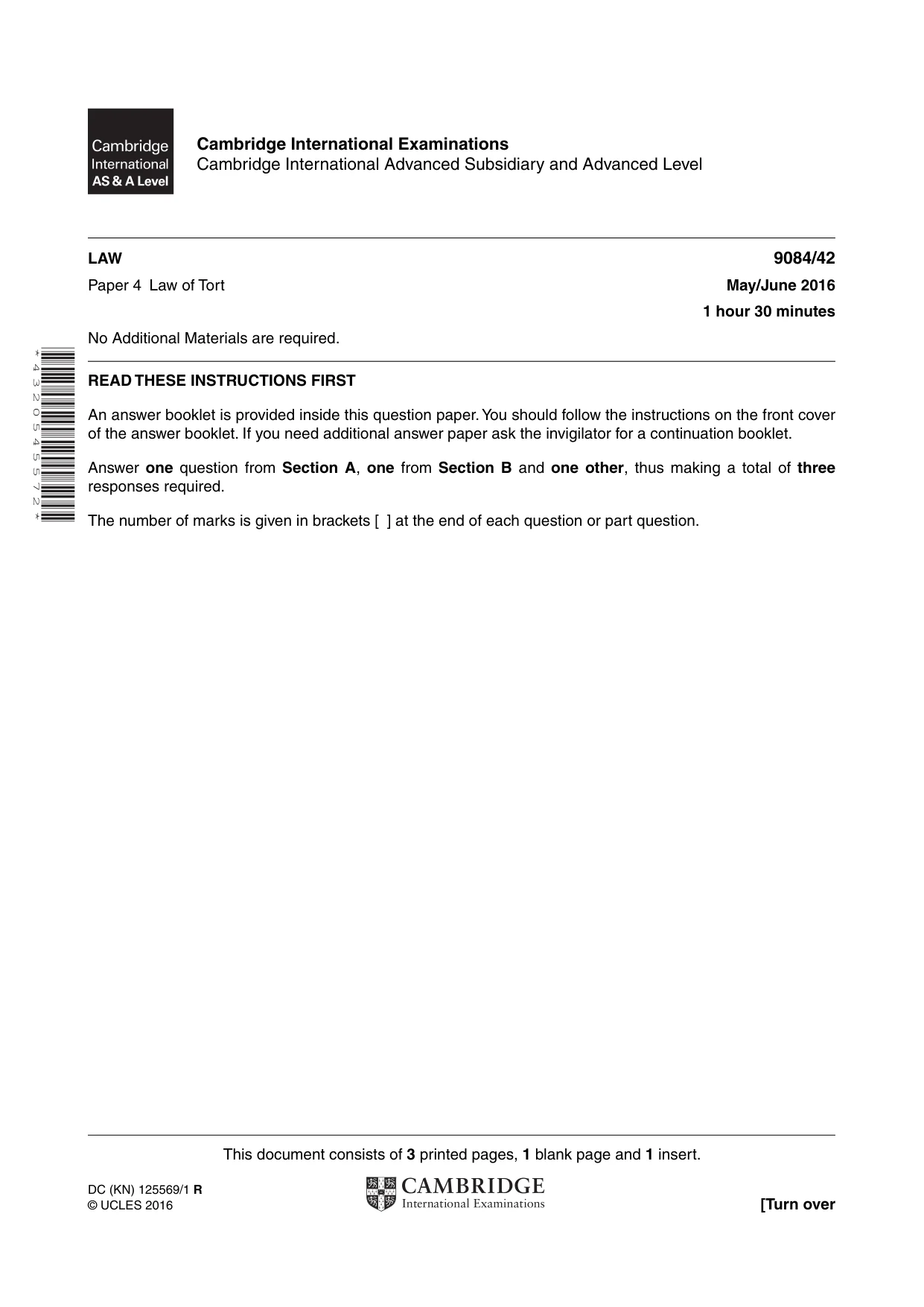
This document consists of 3 printed pages, 1 blank page and 1 insert. DC (KN) 125569/1 R © UCLES 2016 [Turn over Cambridge International Examinations Cambridge International Advanced Subsidiary and Advanced Level * 4 3 2 0 5 4 5 5 7 2 * LAW 9084/42 Paper 4 Law of Tort May/June 2016 1 hour 30 minutes No Additional Materials are required. READ THESE INSTRUCTIONS FIRST An answer booklet is provided inside this question paper. You should follow the instructions on the front cover of the answer booklet. If you need additional answer paper ask the invigilator for a continuation booklet. Answer one question from Section A, one from Section B and one other, thus making a total of three responses required. The number of marks is given in brackets [ ] at the end of each question or part question.
Question paper, page 2
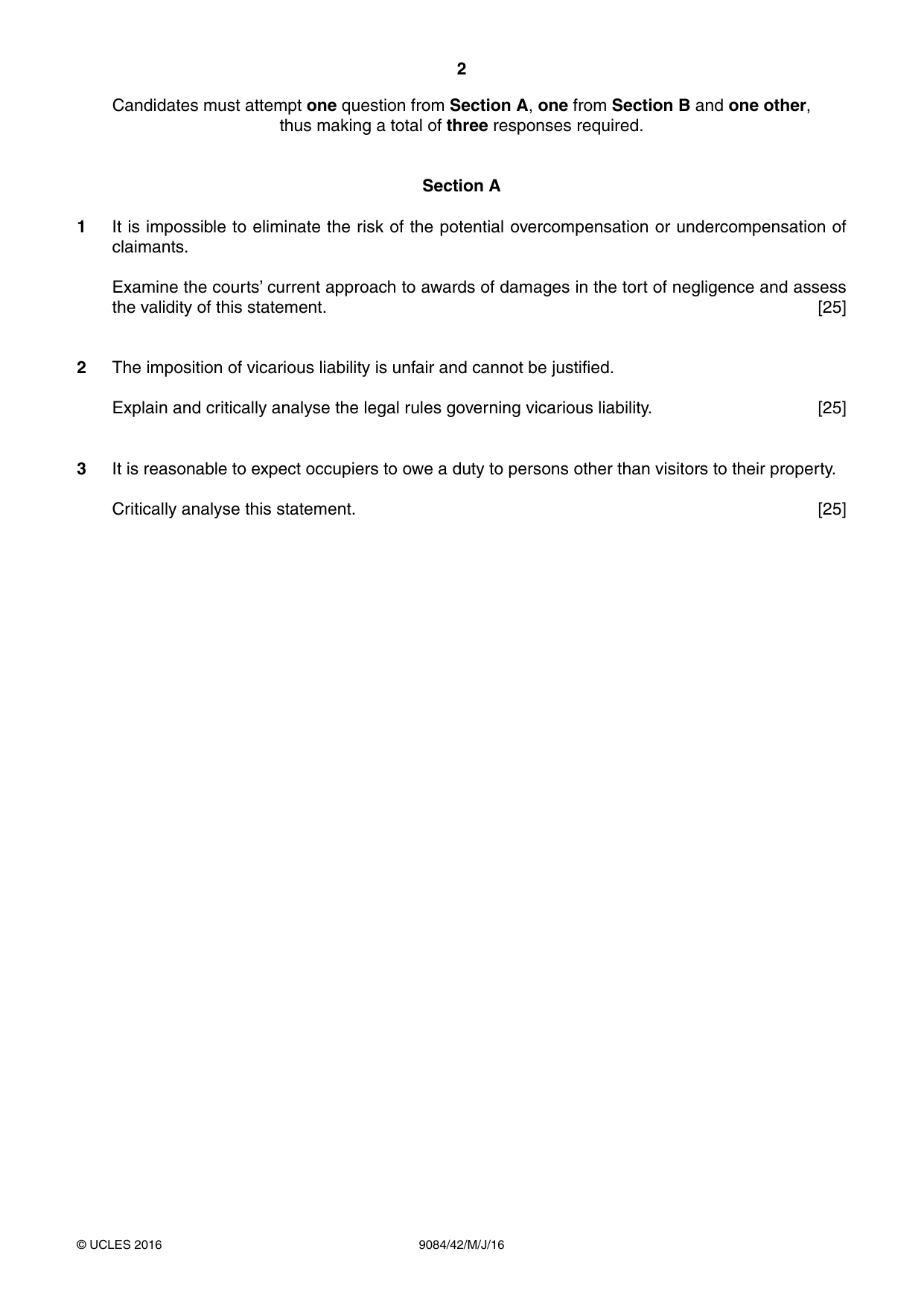
2 9084/42/M/J/16 © UCLES 2016 Candidates must attempt one question from Section A, one from Section B and one other, thus making a total of three responses required. Section A 1 It is impossible to eliminate the risk of the potential overcompensation or undercompensation of claimants. Examine the courts’ current approach to awards of damages in the tort of negligence and assess the validity of this statement. [25] 2 The imposition of vicarious liability is unfair and cannot be justified. Explain and critically analyse the legal rules governing vicarious liability. [25] 3 It is reasonable to expect occupiers to owe a duty to persons other than visitors to their property. Critically analyse this statement. [25]
Question paper, page 3
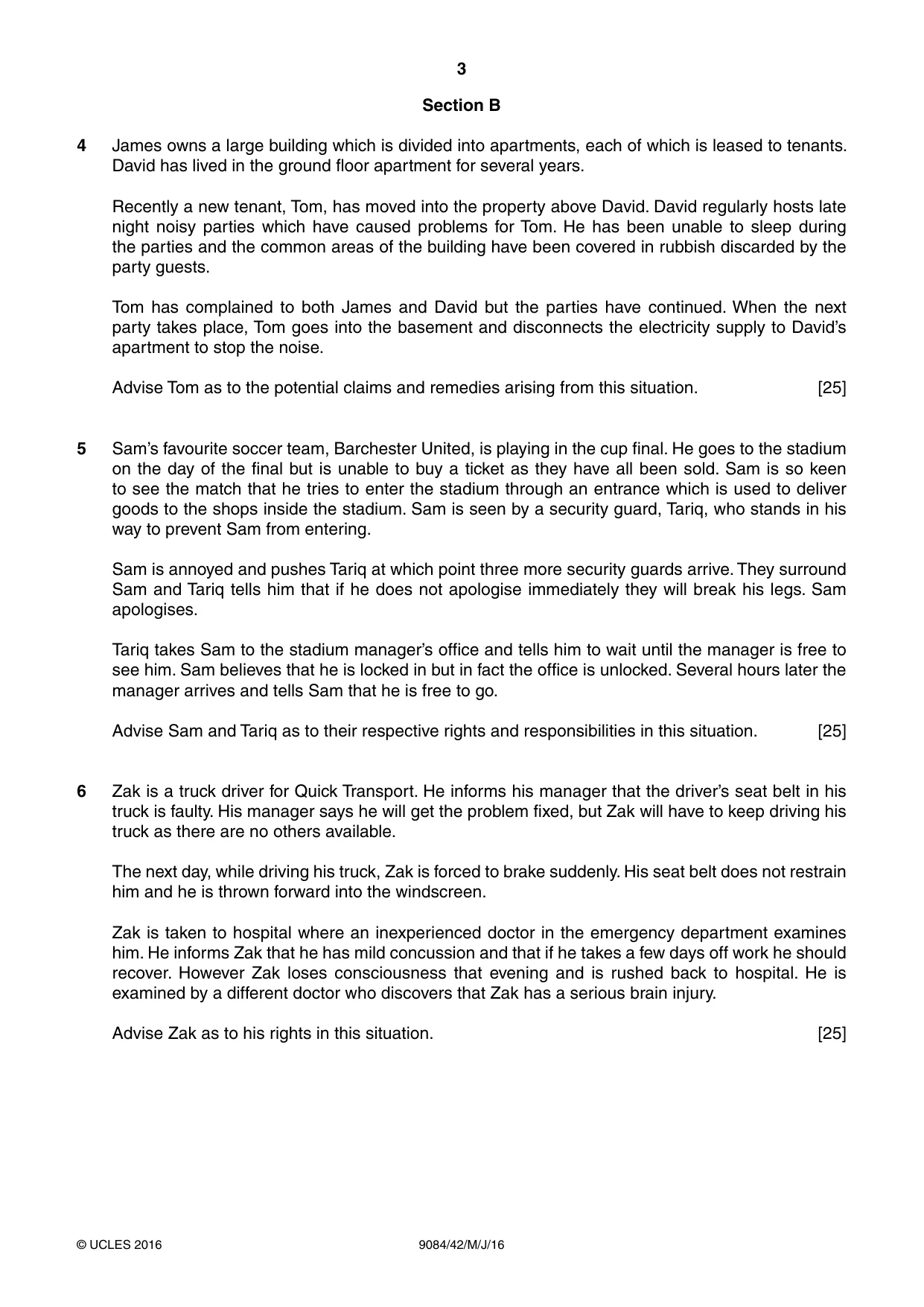
3 9084/42/M/J/16 © UCLES 2016 Section B 4 James owns a large building which is divided into apartments, each of which is leased to tenants. David has lived in the ground floor apartment for several years. Recently a new tenant, Tom, has moved into the property above David. David regularly hosts late night noisy parties which have caused problems for Tom. He has been unable to sleep during the parties and the common areas of the building have been covered in rubbish discarded by the party guests. Tom has complained to both James and David but the parties have continued. When the next party takes place, Tom goes into the basement and disconnects the electricity supply to David’s apartment to stop the noise. Advise Tom as to the potential claims and remedies arising from this situation. [25] 5 Sam’s favourite soccer team, Barchester United, is playing in the cup final. He goes to the stadium on the day of the final but is unable to buy a ticket as they have all been sold. Sam is so keen to see the match that he tries to enter the stadium through an entrance which is used to deliver goods to the shops inside the stadium. Sam is seen by a security guard, Tariq, who stands in his way to prevent Sam from entering. Sam is annoyed and pushes Tariq at which point three more security guards arrive. They surround Sam and Tariq tells him that if he does not apologise immediately they will break his legs. Sam apologises. Tariq takes Sam to the stadium manager’s office and tells him to wait until the manager is free to see him. Sam believes that he is locked in but in fact the office is unlocked. Several hours later the manager arrives and tells Sam that he is free to go. Advise Sam and Tariq as to their respective rights and responsibilities in this situation. [25] 6 Zak is a truck driver for Quick Transport. He informs his manager that the driver’s seat belt in his truck is faulty. His manager says he will get the problem fixed, but Zak will have to keep driving his truck as there are no others available. The next day, while driving his truck, Zak is forced to brake suddenly. His seat belt does not restrain him and he is thrown forward into the windscreen. Zak is taken to hospital where an inexperienced doctor in the emergency department examines him. He informs Zak that he has mild concussion and that if he takes a few days off work he should recover. However Zak loses consciousness that evening and is rushed back to hospital. He is examined by a different doctor who discovers that Zak has a serious brain injury. Advise Zak as to his rights in this situation. [25]
Question paper, page 4
4 9084/42/M/J/16 © UCLES 2016 BLANK PAGE Permission to reproduce items where third-party owned material protected by copyright is included has been sought and cleared where possible. Every reasonable effort has been made by the publisher (UCLES) to trace copyright holders, but if any items requiring clearance have unwittingly been included, the publisher will be pleased to make amends at the earliest possible opportunity. To avoid the issue of disclosure of answer-related information to candidates, all copyright acknowledgements are reproduced online in the Cambridge International Examinations Copyright Acknowledgements Booklet. This is produced for each series of examinations and is freely available to download at www.cie.org.uk after the live examination series. Cambridge International Examinations is part of the Cambridge Assessment Group. Cambridge Assessment is the brand name of University of Cambridge Local Examinations Syndicate (UCLES), which is itself a department of the University of Cambridge.
Mark scheme, page 1
® IGCSE is the registered trademark of Cambridge International Examinations. This document consists of 6 printed pages. © UCLES 2016 [Turn over Cambridge International Examinations Cambridge International Advanced Subsidiary and Advanced Level LAW 9084/42 Paper 4 May/June 2016 MARK SCHEME Maximum Mark: 75 Published This mark scheme is published as an aid to teachers and candidates, to indicate the requirements of the examination. It shows the basis on which Examiners were instructed to award marks. It does not indicate the details of the discussions that took place at an Examiners’ meeting before marking began, which would have considered the acceptability of alternative answers. Mark schemes should be read in conjunction with the question paper and the Principal Examiner Report for Teachers. Cambridge will not enter into discussions about these mark schemes. Cambridge is publishing the mark schemes for the May/June 2016 series for most Cambridge IGCSE®, Cambridge International A and AS Level components and some Cambridge O Level components.
Mark scheme, page 2
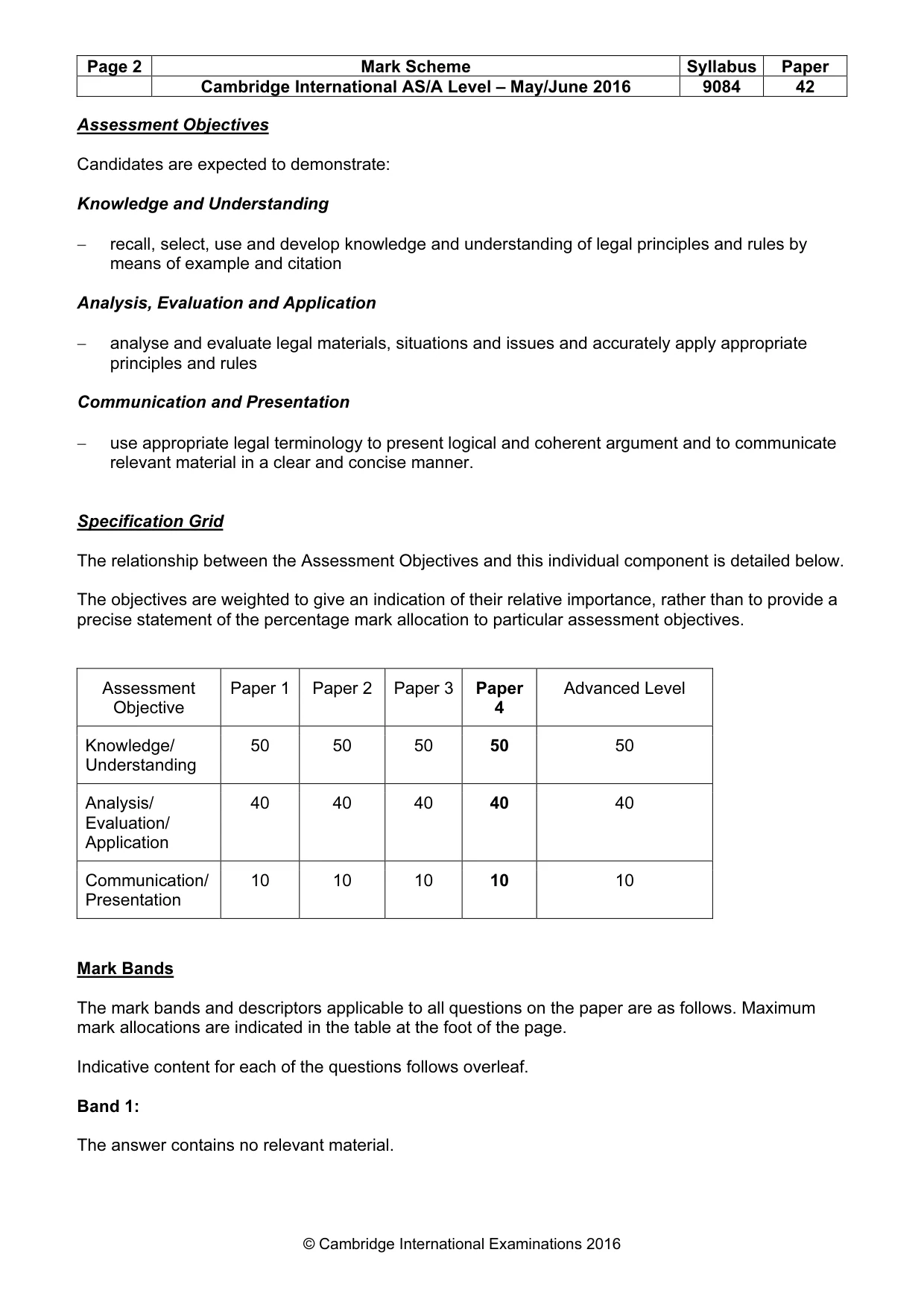
Page 2 Mark Scheme Syllabus Paper Cambridge International AS/A Level – May/June 2016 9084 42 © Cambridge International Examinations 2016 Assessment Objectives Candidates are expected to demonstrate: Knowledge and Understanding − recall, select, use and develop knowledge and understanding of legal principles and rules by means of example and citation Analysis, Evaluation and Application − analyse and evaluate legal materials, situations and issues and accurately apply appropriate principles and rules Communication and Presentation − use appropriate legal terminology to present logical and coherent argument and to communicate relevant material in a clear and concise manner. Specification Grid The relationship between the Assessment Objectives and this individual component is detailed below. The objectives are weighted to give an indication of their relative importance, rather than to provide a precise statement of the percentage mark allocation to particular assessment objectives. Assessment Objective Paper 1 Paper 2 Paper 3 Paper 4 Advanced Level Knowledge/ Understanding 50 50 50 50 50 Analysis/ Evaluation/ Application 40 40 40 40 40 Communication/ Presentation 10 10 10 10 10 Mark Bands The mark bands and descriptors applicable to all questions on the paper are as follows. Maximum mark allocations are indicated in the table at the foot of the page. Indicative content for each of the questions follows overleaf. Band 1: The answer contains no relevant material.
Mark scheme, page 3
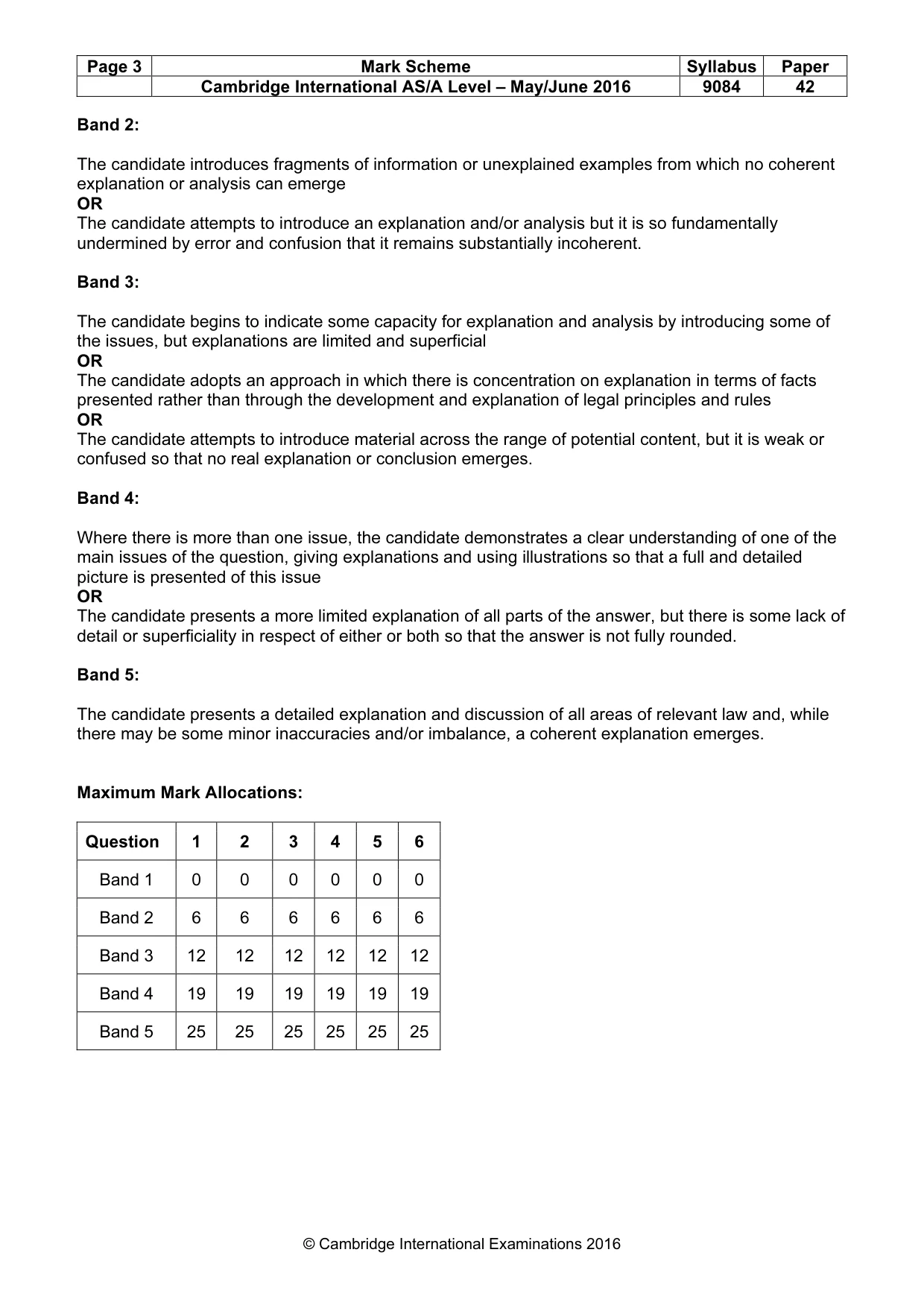
Page 3 Mark Scheme Syllabus Paper Cambridge International AS/A Level – May/June 2016 9084 42 © Cambridge International Examinations 2016 Band 2: The candidate introduces fragments of information or unexplained examples from which no coherent explanation or analysis can emerge OR The candidate attempts to introduce an explanation and/or analysis but it is so fundamentally undermined by error and confusion that it remains substantially incoherent. Band 3: The candidate begins to indicate some capacity for explanation and analysis by introducing some of the issues, but explanations are limited and superficial OR The candidate adopts an approach in which there is concentration on explanation in terms of facts presented rather than through the development and explanation of legal principles and rules OR The candidate attempts to introduce material across the range of potential content, but it is weak or confused so that no real explanation or conclusion emerges. Band 4: Where there is more than one issue, the candidate demonstrates a clear understanding of one of the main issues of the question, giving explanations and using illustrations so that a full and detailed picture is presented of this issue OR The candidate presents a more limited explanation of all parts of the answer, but there is some lack of detail or superficiality in respect of either or both so that the answer is not fully rounded. Band 5: The candidate presents a detailed explanation and discussion of all areas of relevant law and, while there may be some minor inaccuracies and/or imbalance, a coherent explanation emerges. Maximum Mark Allocations: Question 1 2 3 4 5 6 Band 1 0 0 0 0 0 0 Band 2 6 6 6 6 6 6 Band 3 12 12 12 12 12 12 Band 4 19 19 19 19 19 19 Band 5 25 25 25 25 25 25
Mark scheme, page 4
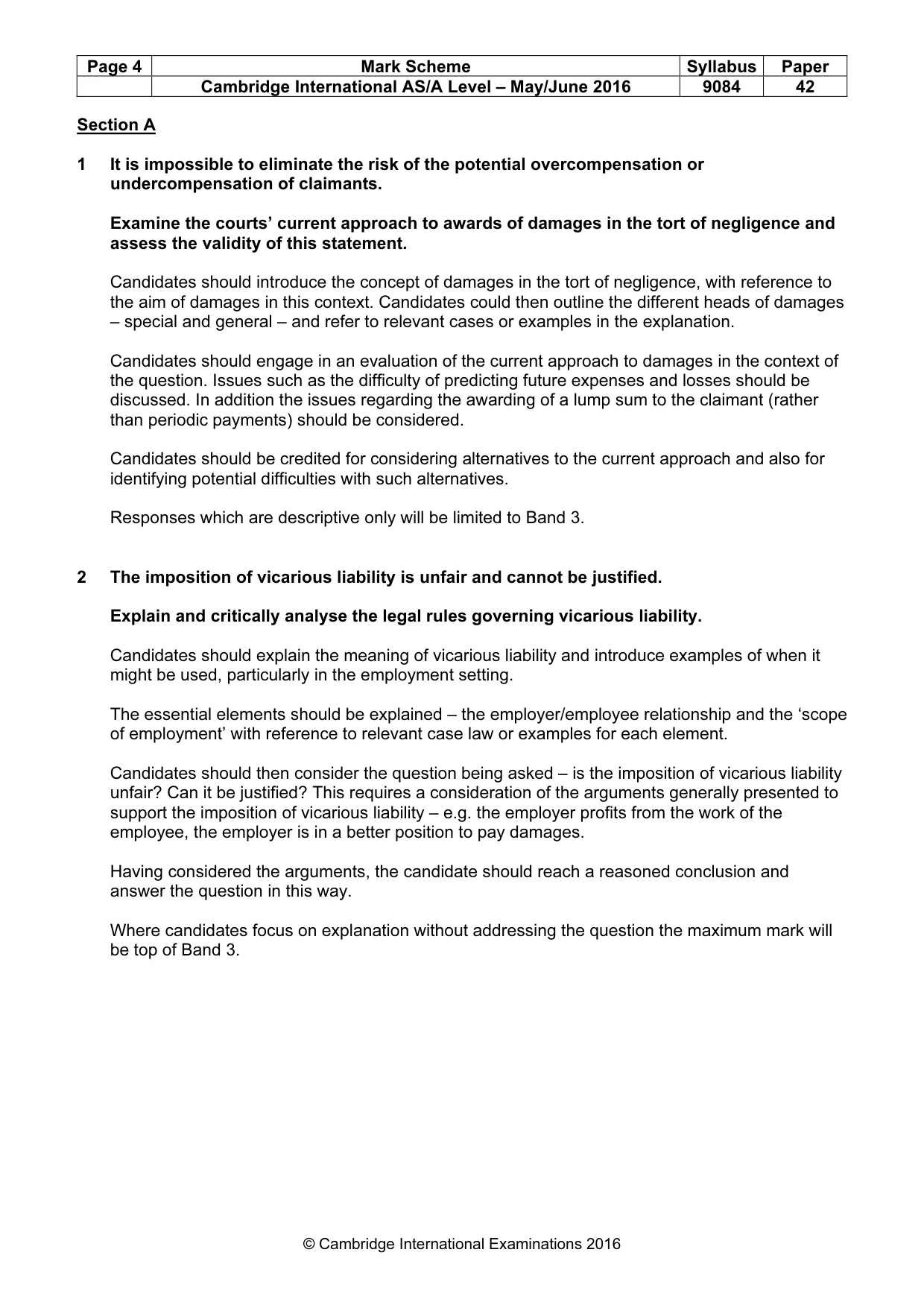
Page 4 Mark Scheme Syllabus Paper Cambridge International AS/A Level – May/June 2016 9084 42 © Cambridge International Examinations 2016 Section A 1 It is impossible to eliminate the risk of the potential overcompensation or undercompensation of claimants. Examine the courts’ current approach to awards of damages in the tort of negligence and assess the validity of this statement. Candidates should introduce the concept of damages in the tort of negligence, with reference to the aim of damages in this context. Candidates could then outline the different heads of damages – special and general – and refer to relevant cases or examples in the explanation. Candidates should engage in an evaluation of the current approach to damages in the context of the question. Issues such as the difficulty of predicting future expenses and losses should be discussed. In addition the issues regarding the awarding of a lump sum to the claimant (rather than periodic payments) should be considered. Candidates should be credited for considering alternatives to the current approach and also for identifying potential difficulties with such alternatives. Responses which are descriptive only will be limited to Band 3. 2 The imposition of vicarious liability is unfair and cannot be justified. Explain and critically analyse the legal rules governing vicarious liability. Candidates should explain the meaning of vicarious liability and introduce examples of when it might be used, particularly in the employment setting. The essential elements should be explained – the employer/employee relationship and the ‘scope of employment’ with reference to relevant case law or examples for each element. Candidates should then consider the question being asked – is the imposition of vicarious liability unfair? Can it be justified? This requires a consideration of the arguments generally presented to support the imposition of vicarious liability – e.g. the employer profits from the work of the employee, the employer is in a better position to pay damages. Having considered the arguments, the candidate should reach a reasoned conclusion and answer the question in this way. Where candidates focus on explanation without addressing the question the maximum mark will be top of Band 3.
Mark scheme, page 5
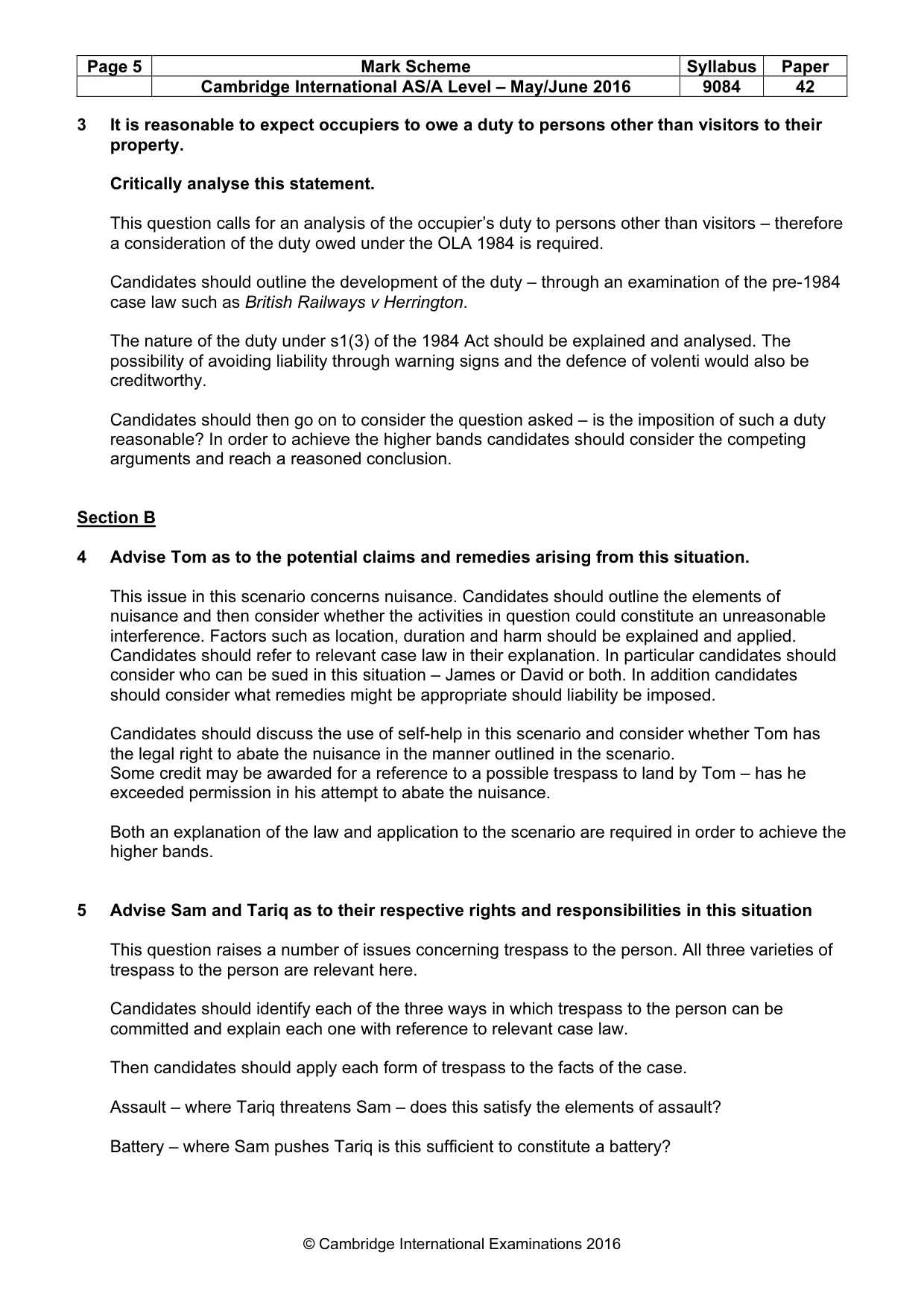
Page 5 Mark Scheme Syllabus Paper Cambridge International AS/A Level – May/June 2016 9084 42 © Cambridge International Examinations 2016 3 It is reasonable to expect occupiers to owe a duty to persons other than visitors to their property. Critically analyse this statement. This question calls for an analysis of the occupier’s duty to persons other than visitors – therefore a consideration of the duty owed under the OLA 1984 is required. Candidates should outline the development of the duty – through an examination of the pre-1984 case law such as British Railways v Herrington. The nature of the duty under s1(3) of the 1984 Act should be explained and analysed. The possibility of avoiding liability through warning signs and the defence of volenti would also be creditworthy. Candidates should then go on to consider the question asked – is the imposition of such a duty reasonable? In order to achieve the higher bands candidates should consider the competing arguments and reach a reasoned conclusion. Section B 4 Advise Tom as to the potential claims and remedies arising from this situation. This issue in this scenario concerns nuisance. Candidates should outline the elements of nuisance and then consider whether the activities in question could constitute an unreasonable interference. Factors such as location, duration and harm should be explained and applied. Candidates should refer to relevant case law in their explanation. In particular candidates should consider who can be sued in this situation – James or David or both. In addition candidates should consider what remedies might be appropriate should liability be imposed. Candidates should discuss the use of self-help in this scenario and consider whether Tom has the legal right to abate the nuisance in the manner outlined in the scenario. Some credit may be awarded for a reference to a possible trespass to land by Tom – has he exceeded permission in his attempt to abate the nuisance. Both an explanation of the law and application to the scenario are required in order to achieve the higher bands. 5 Advise Sam and Tariq as to their respective rights and responsibilities in this situation This question raises a number of issues concerning trespass to the person. All three varieties of trespass to the person are relevant here. Candidates should identify each of the three ways in which trespass to the person can be committed and explain each one with reference to relevant case law. Then candidates should apply each form of trespass to the facts of the case. Assault – where Tariq threatens Sam – does this satisfy the elements of assault? Battery – where Sam pushes Tariq is this sufficient to constitute a battery?
Mark scheme, page 6
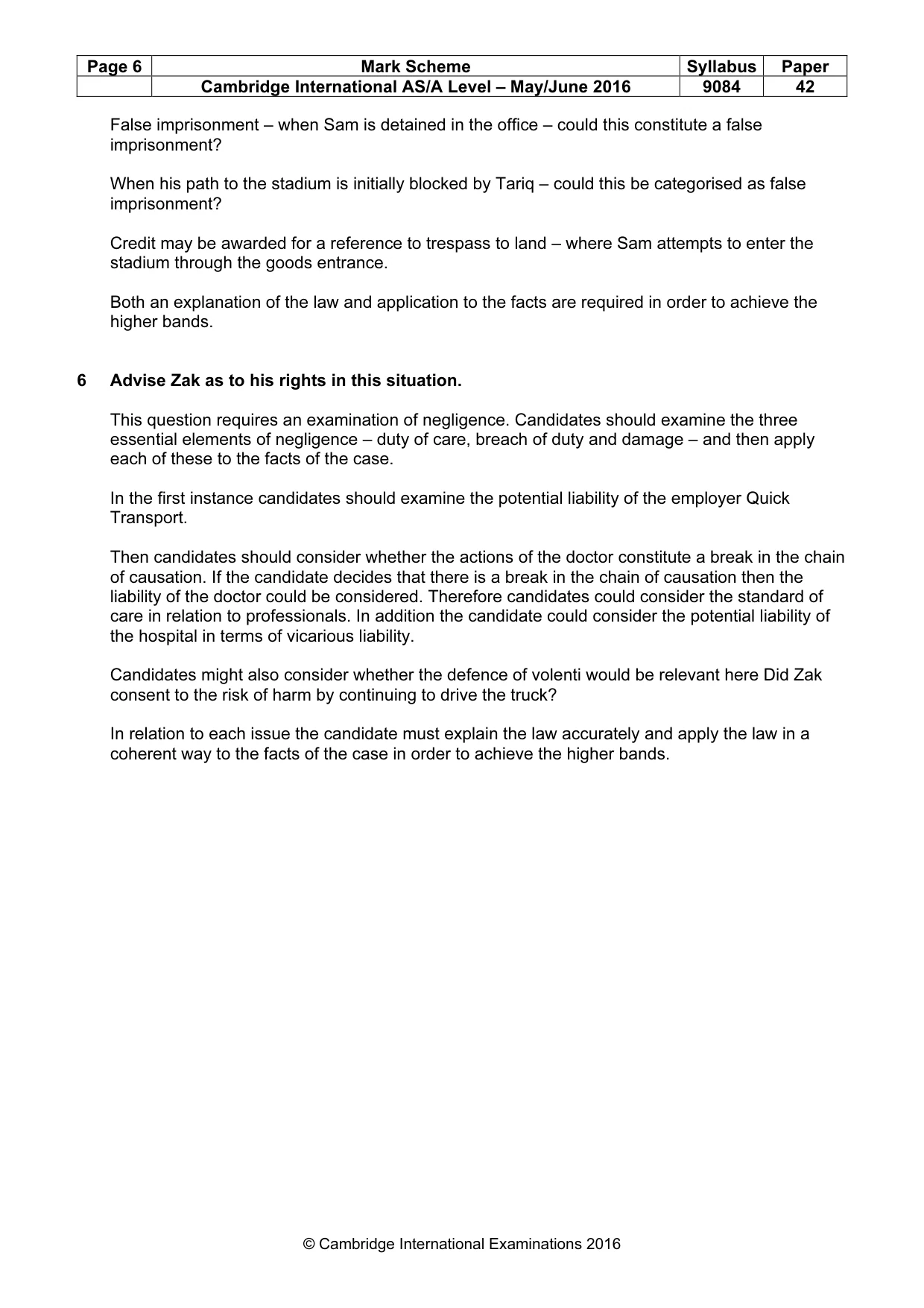
Page 6 Mark Scheme Syllabus Paper Cambridge International AS/A Level – May/June 2016 9084 42 © Cambridge International Examinations 2016 False imprisonment – when Sam is detained in the office – could this constitute a false imprisonment? When his path to the stadium is initially blocked by Tariq – could this be categorised as false imprisonment? Credit may be awarded for a reference to trespass to land – where Sam attempts to enter the stadium through the goods entrance. Both an explanation of the law and application to the facts are required in order to achieve the higher bands. 6 Advise Zak as to his rights in this situation. This question requires an examination of negligence. Candidates should examine the three essential elements of negligence – duty of care, breach of duty and damage – and then apply each of these to the facts of the case. In the first instance candidates should examine the potential liability of the employer Quick Transport. Then candidates should consider whether the actions of the doctor constitute a break in the chain of causation. If the candidate decides that there is a break in the chain of causation then the liability of the doctor could be considered. Therefore candidates could consider the standard of care in relation to professionals. In addition the candidate could consider the potential liability of the hospital in terms of vicarious liability. Candidates might also consider whether the defence of volenti would be relevant here Did Zak consent to the risk of harm by continuing to drive the truck? In relation to each issue the candidate must explain the law accurately and apply the law in a coherent way to the facts of the case in order to achieve the higher bands.
What you needed in this session
Cambridge’s own grade thresholds for 2016 May/June, Paper 4 · Variant 2. A higher threshold means an easier paper — the bar moves with how the cohort did.