Cambridge A Level Law 9084 — 2012 Oct/Nov Paper 4 · Variant 2
9084/42/O/N/12 · 75 marks · ≈84 min
The question paper and its mark scheme, free to read here and free to download. This is Cambridge’s own paper, exactly as it was sat.
Question paper4 pages

Mark scheme7 pages
Answers below. Sit the paper first if you are practising.
Paper as text
Question paper, page 1
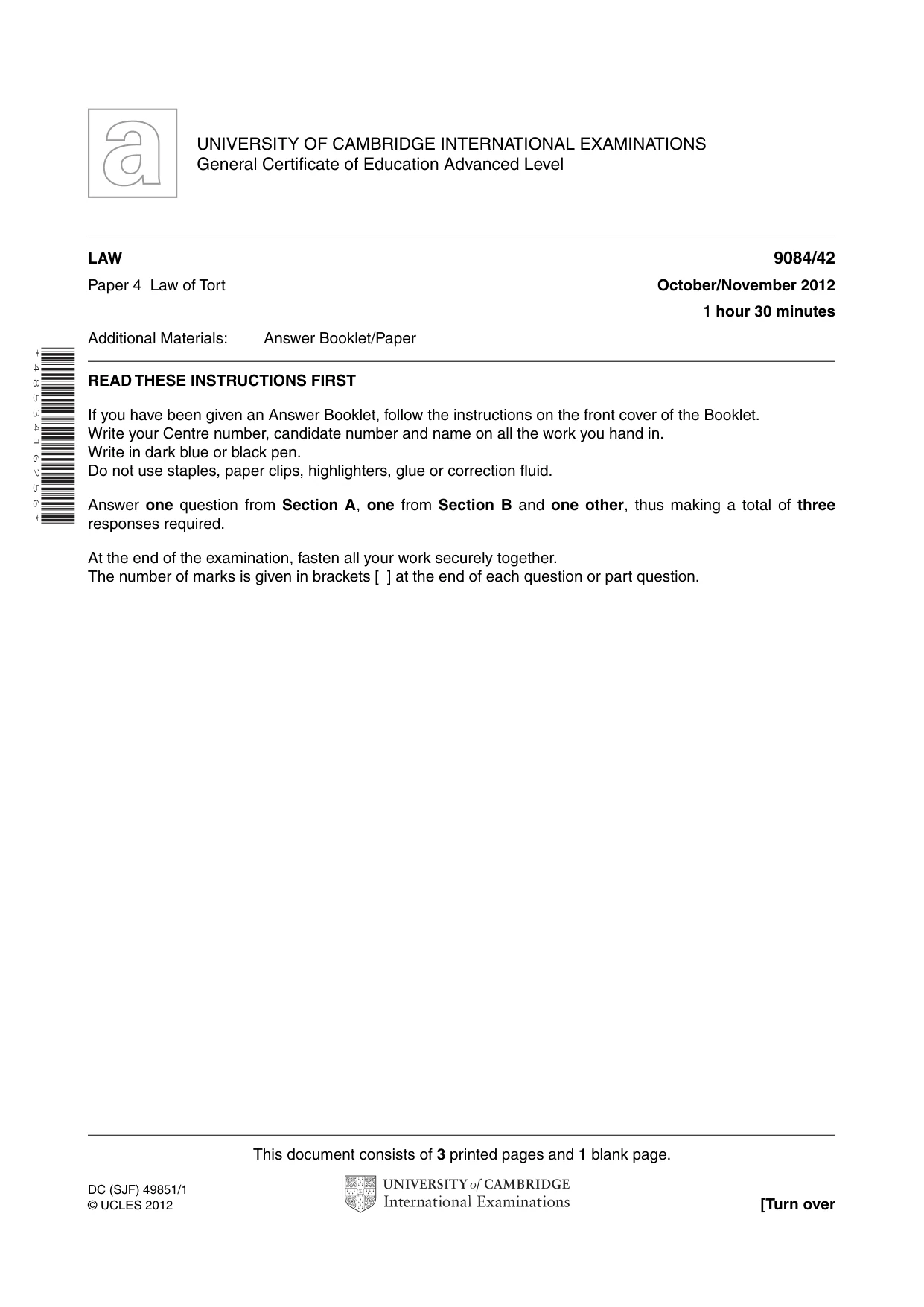
This document consists of 3 printed pages and 1 blank page. DC (SJF) 49851/1 © UCLES 2012 [Turn over UNIVERSITY OF CAMBRIDGE INTERNATIONAL EXAMINATIONS General Certificate of Education Advanced Level * 4 8 5 3 4 1 6 2 5 6 * LAW 9084/42 Paper 4 Law of Tort October/November 2012 1 hour 30 minutes Additional Materials: Answer Booklet/Paper READ THESE INSTRUCTIONS FIRST If you have been given an Answer Booklet, follow the instructions on the front cover of the Booklet. Write your Centre number, candidate number and name on all the work you hand in. Write in dark blue or black pen. Do not use staples, paper clips, highlighters, glue or correction fluid. Answer one question from Section A, one from Section B and one other, thus making a total of three responses required. At the end of the examination, fasten all your work securely together. The number of marks is given in brackets [ ] at the end of each question or part question.
Question paper, page 2
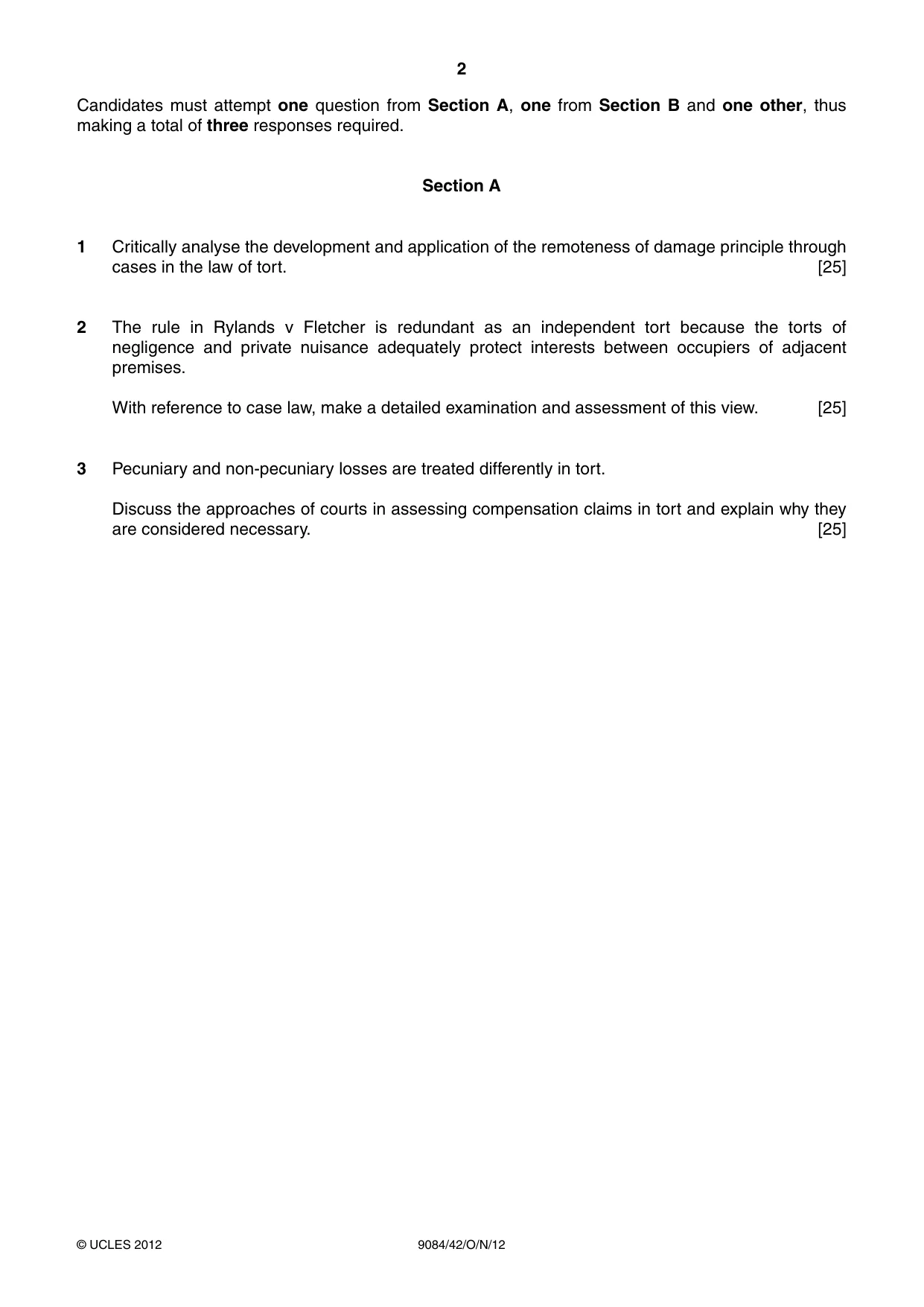
2 9084/42/O/N/12 © UCLES 2012 Candidates must attempt one question from Section A, one from Section B and one other, thus making a total of three responses required. Section A 1 Critically analyse the development and application of the remoteness of damage principle through cases in the law of tort. [25] 2 The rule in Rylands v Fletcher is redundant as an independent tort because the torts of negligence and private nuisance adequately protect interests between occupiers of adjacent premises. With reference to case law, make a detailed examination and assessment of this view. [25] 3 Pecuniary and non-pecuniary losses are treated differently in tort. Discuss the approaches of courts in assessing compensation claims in tort and explain why they are considered necessary. [25]
Question paper, page 3
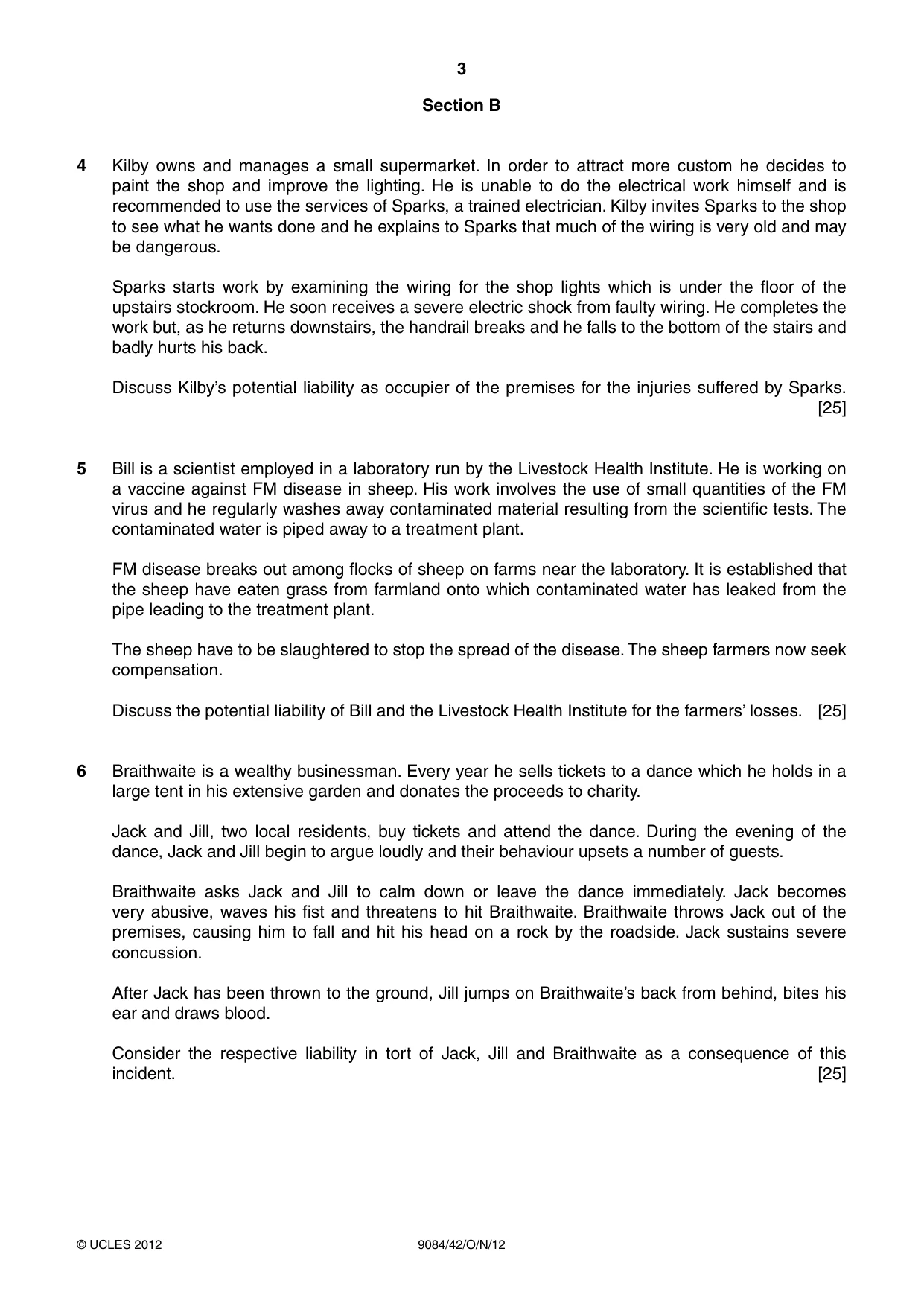
3 9084/42/O/N/12 © UCLES 2012 Section B 4 Kilby owns and manages a small supermarket. In order to attract more custom he decides to paint the shop and improve the lighting. He is unable to do the electrical work himself and is recommended to use the services of Sparks, a trained electrician. Kilby invites Sparks to the shop to see what he wants done and he explains to Sparks that much of the wiring is very old and may be dangerous. Sparks starts work by examining the wiring for the shop lights which is under the floor of the upstairs stockroom. He soon receives a severe electric shock from faulty wiring. He completes the work but, as he returns downstairs, the handrail breaks and he falls to the bottom of the stairs and badly hurts his back. Discuss Kilby’s potential liability as occupier of the premises for the injuries suffered by Sparks. [25] 5 Bill is a scientist employed in a laboratory run by the Livestock Health Institute. He is working on a vaccine against FM disease in sheep. His work involves the use of small quantities of the FM virus and he regularly washes away contaminated material resulting from the scientific tests. The contaminated water is piped away to a treatment plant. FM disease breaks out among flocks of sheep on farms near the laboratory. It is established that the sheep have eaten grass from farmland onto which contaminated water has leaked from the pipe leading to the treatment plant. The sheep have to be slaughtered to stop the spread of the disease. The sheep farmers now seek compensation. Discuss the potential liability of Bill and the Livestock Health Institute for the farmers’ losses. [25] 6 Braithwaite is a wealthy businessman. Every year he sells tickets to a dance which he holds in a large tent in his extensive garden and donates the proceeds to charity. Jack and Jill, two local residents, buy tickets and attend the dance. During the evening of the dance, Jack and Jill begin to argue loudly and their behaviour upsets a number of guests. Braithwaite asks Jack and Jill to calm down or leave the dance immediately. Jack becomes very abusive, waves his fist and threatens to hit Braithwaite. Braithwaite throws Jack out of the premises, causing him to fall and hit his head on a rock by the roadside. Jack sustains severe concussion. After Jack has been thrown to the ground, Jill jumps on Braithwaite’s back from behind, bites his ear and draws blood. Consider the respective liability in tort of Jack, Jill and Braithwaite as a consequence of this incident. [25]
Question paper, page 4
4 9084/42/O/N/12 © UCLES 2012 Permission to reproduce items where third-party owned material protected by copyright is included has been sought and cleared where possible. Every reasonable effort has been made by the publisher (UCLES) to trace copyright holders, but if any items requiring clearance have unwittingly been included, the publisher will be pleased to make amends at the earliest possible opportunity. University of Cambridge International Examinations is part of the Cambridge Assessment Group. Cambridge Assessment is the brand name of University of Cambridge Local Examinations Syndicate (UCLES), which is itself a department of the University of Cambridge. BLANK PAGE
Mark scheme, page 1
CAMBRIDGE INTERNATIONAL EXAMINATIONS GCE Advanced Level MARK SCHEME for the October/November 2012 series 9084 LAW 9084/42 Paper 4, maximum raw mark 75 This mark scheme is published as an aid to teachers and candidates, to indicate the requirements of the examination. It shows the basis on which Examiners were instructed to award marks. It does not indicate the details of the discussions that took place at an Examiners’ meeting before marking began, which would have considered the acceptability of alternative answers. Mark schemes should be read in conjunction with the question paper and the Principal Examiner Report for Teachers. Cambridge will not enter into discussions about these mark schemes. Cambridge is publishing the mark schemes for the October/November 2012 series for most IGCSE, GCE Advanced Level and Advanced Subsidiary Level components and some Ordinary Level components.
Mark scheme, page 2
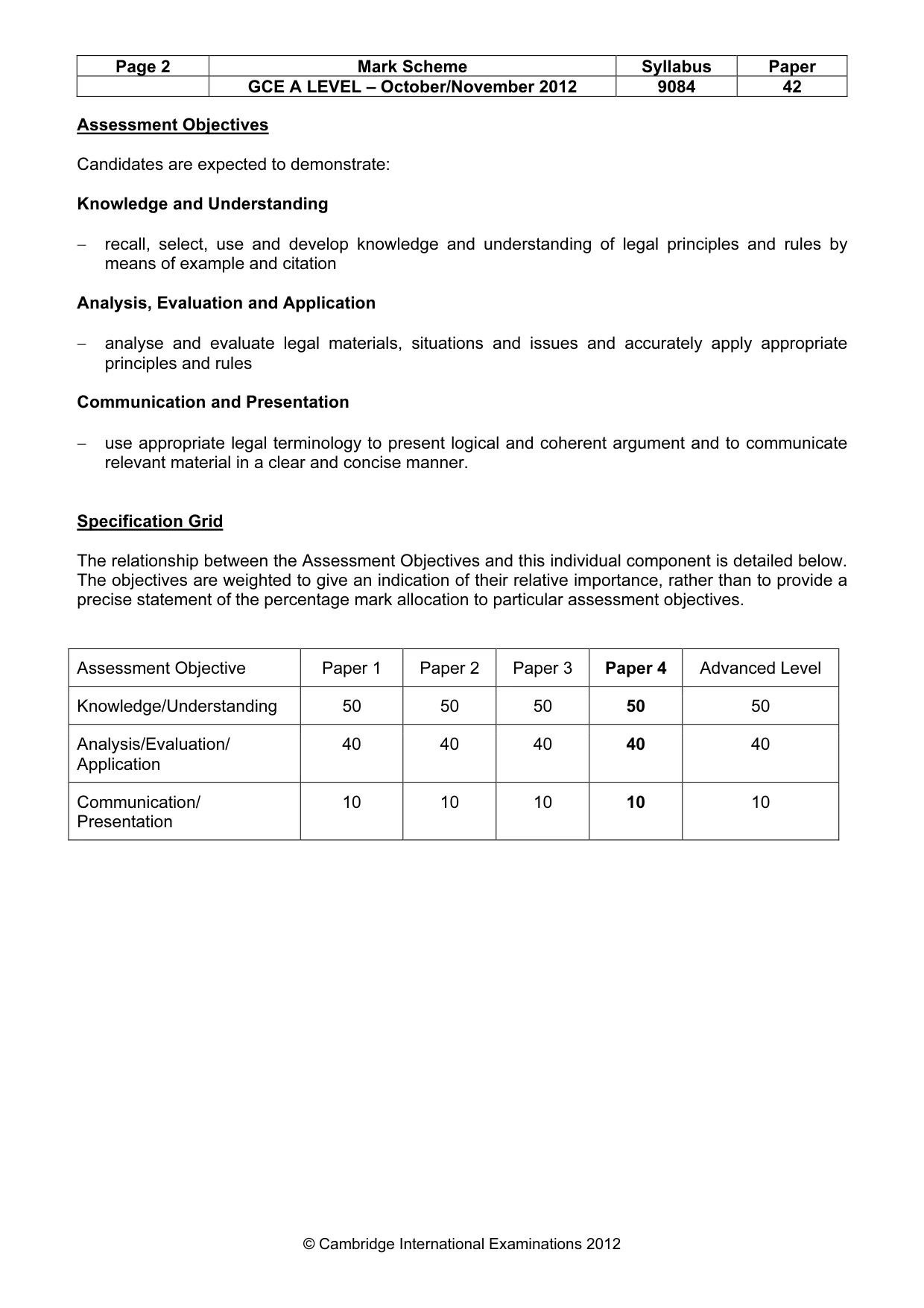
Page 2 Mark Scheme Syllabus Paper GCE A LEVEL – October/November 2012 9084 42 © Cambridge International Examinations 2012 Assessment Objectives Candidates are expected to demonstrate: Knowledge and Understanding − recall, select, use and develop knowledge and understanding of legal principles and rules by means of example and citation Analysis, Evaluation and Application − analyse and evaluate legal materials, situations and issues and accurately apply appropriate principles and rules Communication and Presentation − use appropriate legal terminology to present logical and coherent argument and to communicate relevant material in a clear and concise manner. Specification Grid The relationship between the Assessment Objectives and this individual component is detailed below. The objectives are weighted to give an indication of their relative importance, rather than to provide a precise statement of the percentage mark allocation to particular assessment objectives. Assessment Objective Paper 1 Paper 2 Paper 3 Paper 4 Advanced Level Knowledge/Understanding 50 50 50 50 50 Analysis/Evaluation/ Application 40 40 40 40 40 Communication/ Presentation 10 10 10 10 10
Mark scheme, page 3
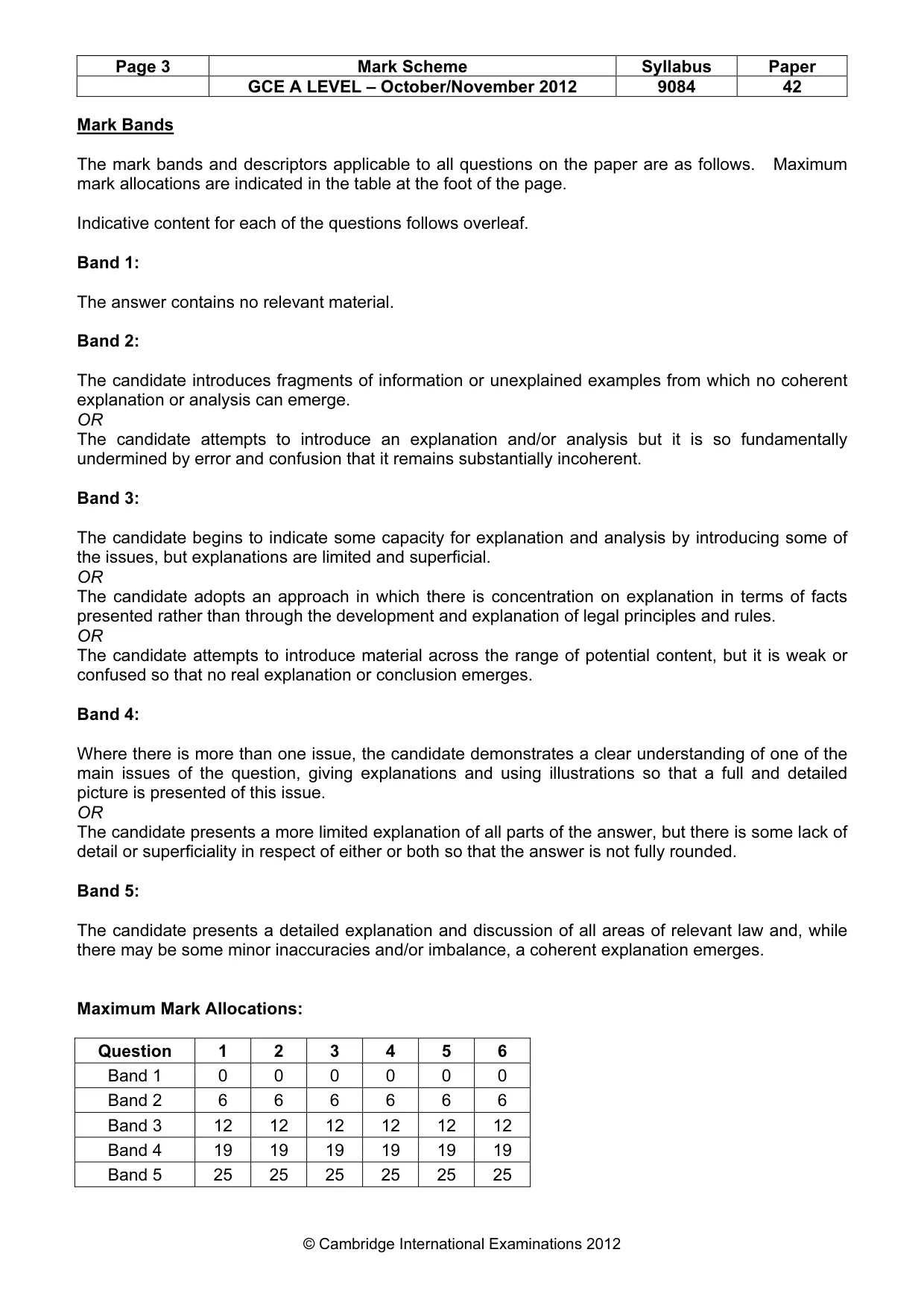
Page 3 Mark Scheme Syllabus Paper GCE A LEVEL – October/November 2012 9084 42 © Cambridge International Examinations 2012 Mark Bands The mark bands and descriptors applicable to all questions on the paper are as follows. Maximum mark allocations are indicated in the table at the foot of the page. Indicative content for each of the questions follows overleaf. Band 1: The answer contains no relevant material. Band 2: The candidate introduces fragments of information or unexplained examples from which no coherent explanation or analysis can emerge. OR The candidate attempts to introduce an explanation and/or analysis but it is so fundamentally undermined by error and confusion that it remains substantially incoherent. Band 3: The candidate begins to indicate some capacity for explanation and analysis by introducing some of the issues, but explanations are limited and superficial. OR The candidate adopts an approach in which there is concentration on explanation in terms of facts presented rather than through the development and explanation of legal principles and rules. OR The candidate attempts to introduce material across the range of potential content, but it is weak or confused so that no real explanation or conclusion emerges. Band 4: Where there is more than one issue, the candidate demonstrates a clear understanding of one of the main issues of the question, giving explanations and using illustrations so that a full and detailed picture is presented of this issue. OR The candidate presents a more limited explanation of all parts of the answer, but there is some lack of detail or superficiality in respect of either or both so that the answer is not fully rounded. Band 5: The candidate presents a detailed explanation and discussion of all areas of relevant law and, while there may be some minor inaccuracies and/or imbalance, a coherent explanation emerges. Maximum Mark Allocations: Question 1 2 3 4 5 6 Band 1 0 0 0 0 0 0 Band 2 6 6 6 6 6 6 Band 3 12 12 12 12 12 12 Band 4 19 19 19 19 19 19 Band 5 25 25 25 25 25 25
Mark scheme, page 4
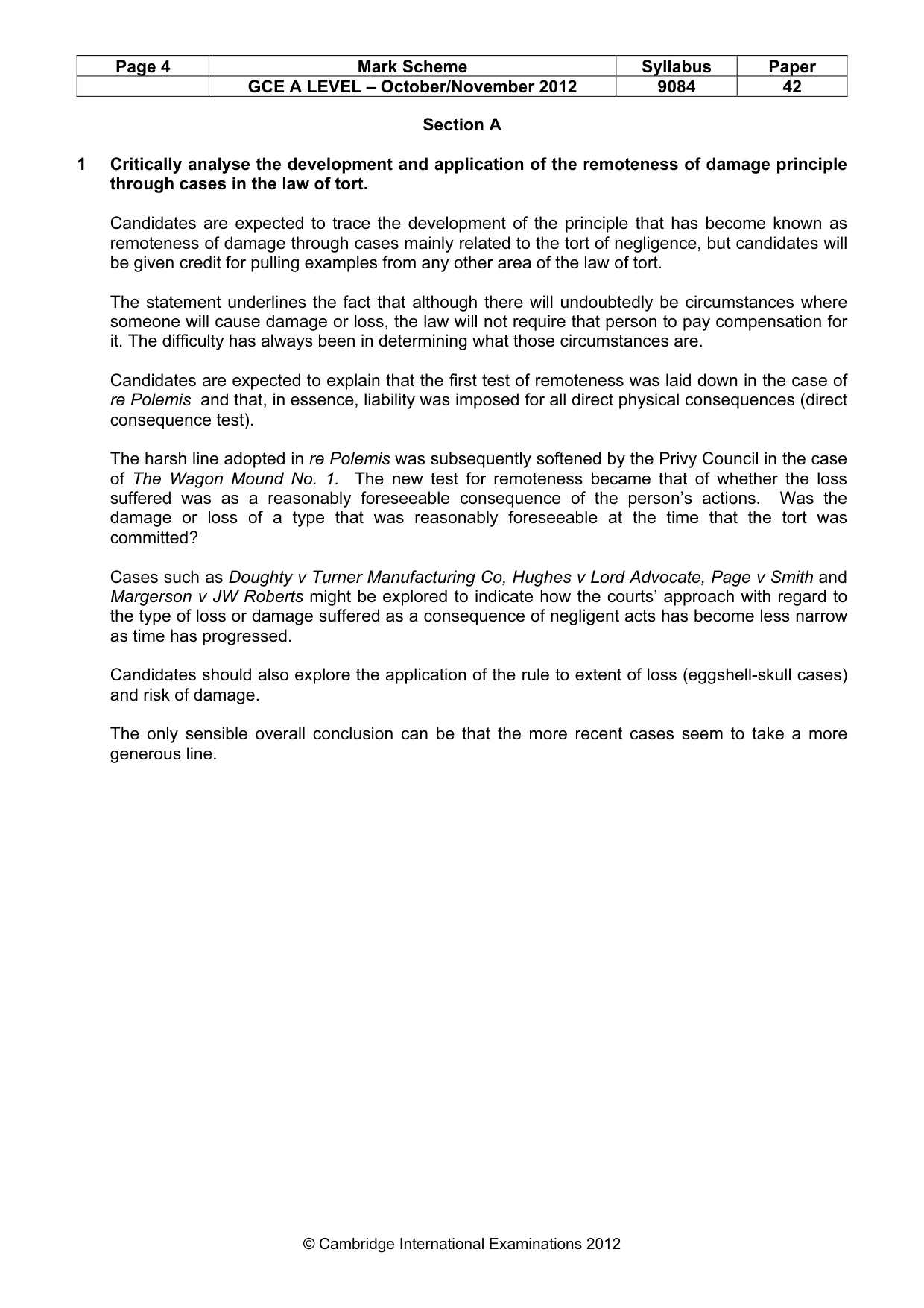
Page 4 Mark Scheme Syllabus Paper GCE A LEVEL – October/November 2012 9084 42 © Cambridge International Examinations 2012 Section A 1 Critically analyse the development and application of the remoteness of damage principle through cases in the law of tort. Candidates are expected to trace the development of the principle that has become known as remoteness of damage through cases mainly related to the tort of negligence, but candidates will be given credit for pulling examples from any other area of the law of tort. The statement underlines the fact that although there will undoubtedly be circumstances where someone will cause damage or loss, the law will not require that person to pay compensation for it. The difficulty has always been in determining what those circumstances are. Candidates are expected to explain that the first test of remoteness was laid down in the case of re Polemis and that, in essence, liability was imposed for all direct physical consequences (direct consequence test). The harsh line adopted in re Polemis was subsequently softened by the Privy Council in the case of The Wagon Mound No. 1. The new test for remoteness became that of whether the loss suffered was as a reasonably foreseeable consequence of the person’s actions. Was the damage or loss of a type that was reasonably foreseeable at the time that the tort was committed? Cases such as Doughty v Turner Manufacturing Co, Hughes v Lord Advocate, Page v Smith and Margerson v JW Roberts might be explored to indicate how the courts’ approach with regard to the type of loss or damage suffered as a consequence of negligent acts has become less narrow as time has progressed. Candidates should also explore the application of the rule to extent of loss (eggshell-skull cases) and risk of damage. The only sensible overall conclusion can be that the more recent cases seem to take a more generous line.
Mark scheme, page 5
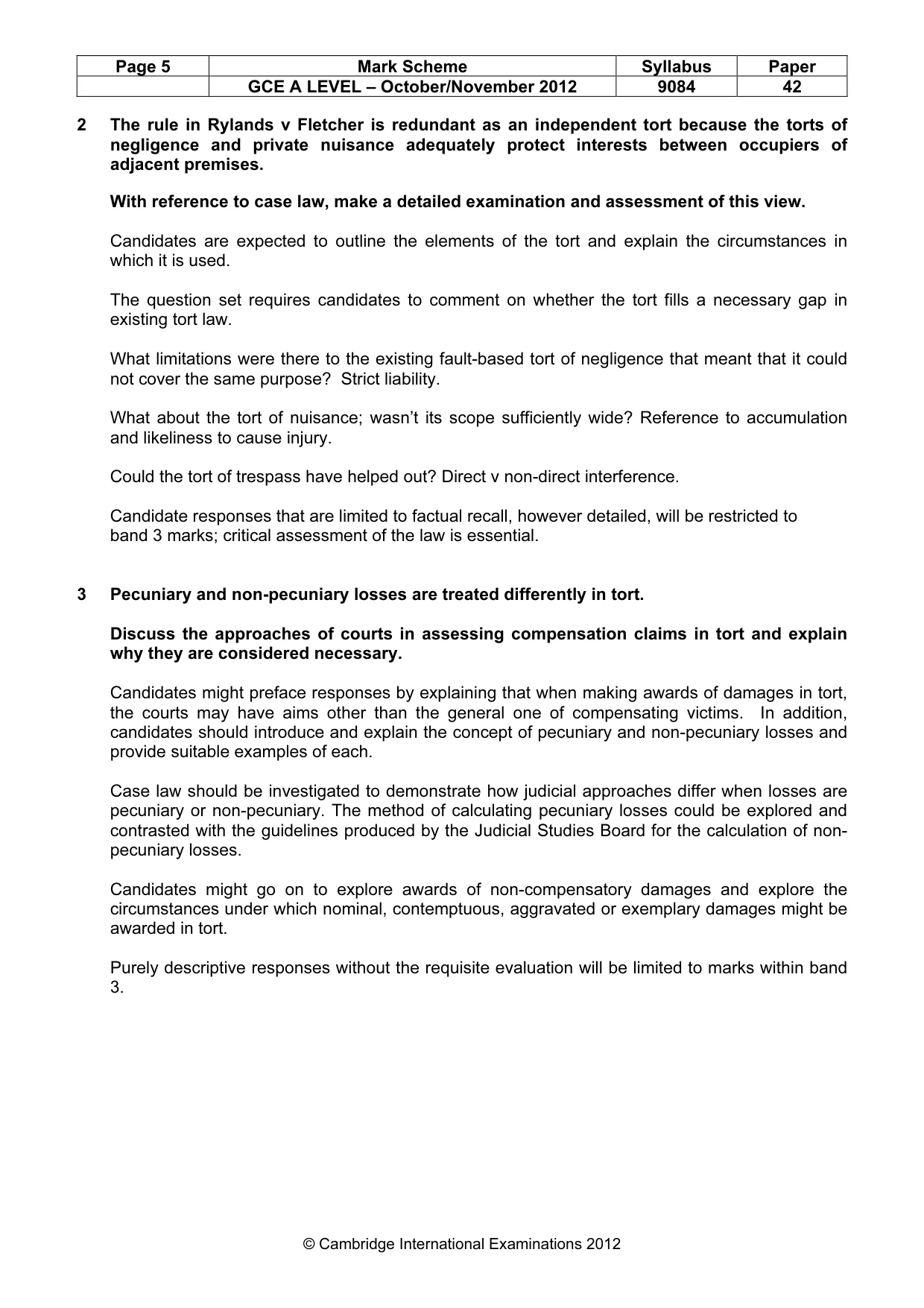
Page 5 Mark Scheme Syllabus Paper GCE A LEVEL – October/November 2012 9084 42 © Cambridge International Examinations 2012 2 The rule in Rylands v Fletcher is redundant as an independent tort because the torts of negligence and private nuisance adequately protect interests between occupiers of adjacent premises. With reference to case law, make a detailed examination and assessment of this view. Candidates are expected to outline the elements of the tort and explain the circumstances in which it is used. The question set requires candidates to comment on whether the tort fills a necessary gap in existing tort law. What limitations were there to the existing fault-based tort of negligence that meant that it could not cover the same purpose? Strict liability. What about the tort of nuisance; wasn’t its scope sufficiently wide? Reference to accumulation and likeliness to cause injury. Could the tort of trespass have helped out? Direct v non-direct interference. Candidate responses that are limited to factual recall, however detailed, will be restricted to band 3 marks; critical assessment of the law is essential. 3 Pecuniary and non-pecuniary losses are treated differently in tort. Discuss the approaches of courts in assessing compensation claims in tort and explain why they are considered necessary. Candidates might preface responses by explaining that when making awards of damages in tort, the courts may have aims other than the general one of compensating victims. In addition, candidates should introduce and explain the concept of pecuniary and non-pecuniary losses and provide suitable examples of each. Case law should be investigated to demonstrate how judicial approaches differ when losses are pecuniary or non-pecuniary. The method of calculating pecuniary losses could be explored and contrasted with the guidelines produced by the Judicial Studies Board for the calculation of non- pecuniary losses. Candidates might go on to explore awards of non-compensatory damages and explore the circumstances under which nominal, contemptuous, aggravated or exemplary damages might be awarded in tort. Purely descriptive responses without the requisite evaluation will be limited to marks within band 3.
Mark scheme, page 6
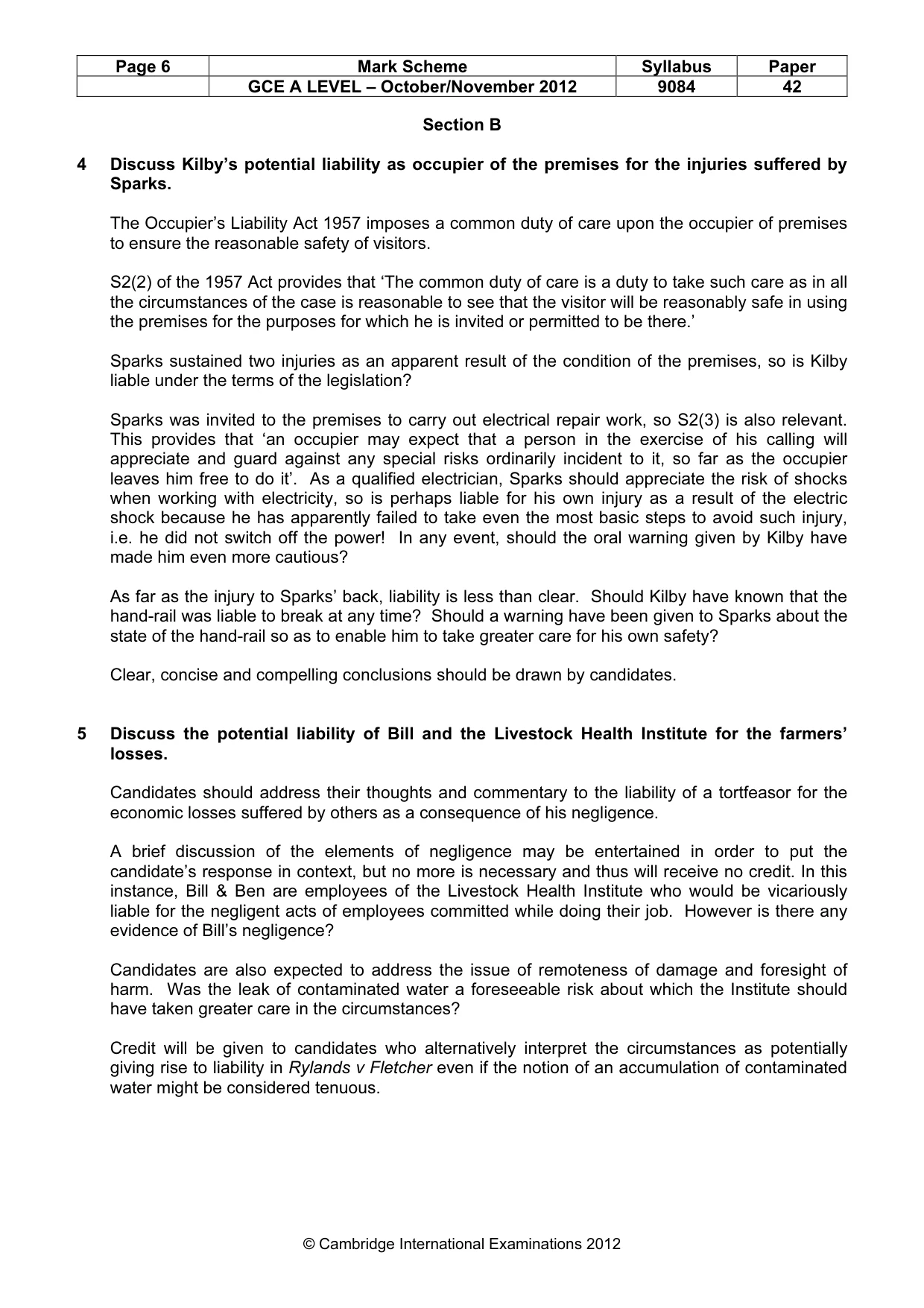
Page 6 Mark Scheme Syllabus Paper GCE A LEVEL – October/November 2012 9084 42 © Cambridge International Examinations 2012 Section B 4 Discuss Kilby’s potential liability as occupier of the premises for the injuries suffered by Sparks. The Occupier’s Liability Act 1957 imposes a common duty of care upon the occupier of premises to ensure the reasonable safety of visitors. S2(2) of the 1957 Act provides that ‘The common duty of care is a duty to take such care as in all the circumstances of the case is reasonable to see that the visitor will be reasonably safe in using the premises for the purposes for which he is invited or permitted to be there.’ Sparks sustained two injuries as an apparent result of the condition of the premises, so is Kilby liable under the terms of the legislation? Sparks was invited to the premises to carry out electrical repair work, so S2(3) is also relevant. This provides that ‘an occupier may expect that a person in the exercise of his calling will appreciate and guard against any special risks ordinarily incident to it, so far as the occupier leaves him free to do it’. As a qualified electrician, Sparks should appreciate the risk of shocks when working with electricity, so is perhaps liable for his own injury as a result of the electric shock because he has apparently failed to take even the most basic steps to avoid such injury, i.e. he did not switch off the power! In any event, should the oral warning given by Kilby have made him even more cautious? As far as the injury to Sparks’ back, liability is less than clear. Should Kilby have known that the hand-rail was liable to break at any time? Should a warning have been given to Sparks about the state of the hand-rail so as to enable him to take greater care for his own safety? Clear, concise and compelling conclusions should be drawn by candidates. 5 Discuss the potential liability of Bill and the Livestock Health Institute for the farmers’ losses. Candidates should address their thoughts and commentary to the liability of a tortfeasor for the economic losses suffered by others as a consequence of his negligence. A brief discussion of the elements of negligence may be entertained in order to put the candidate’s response in context, but no more is necessary and thus will receive no credit. In this instance, Bill & Ben are employees of the Livestock Health Institute who would be vicariously liable for the negligent acts of employees committed while doing their job. However is there any evidence of Bill’s negligence? Candidates are also expected to address the issue of remoteness of damage and foresight of harm. Was the leak of contaminated water a foreseeable risk about which the Institute should have taken greater care in the circumstances? Credit will be given to candidates who alternatively interpret the circumstances as potentially giving rise to liability in Rylands v Fletcher even if the notion of an accumulation of contaminated water might be considered tenuous.
Mark scheme, page 7
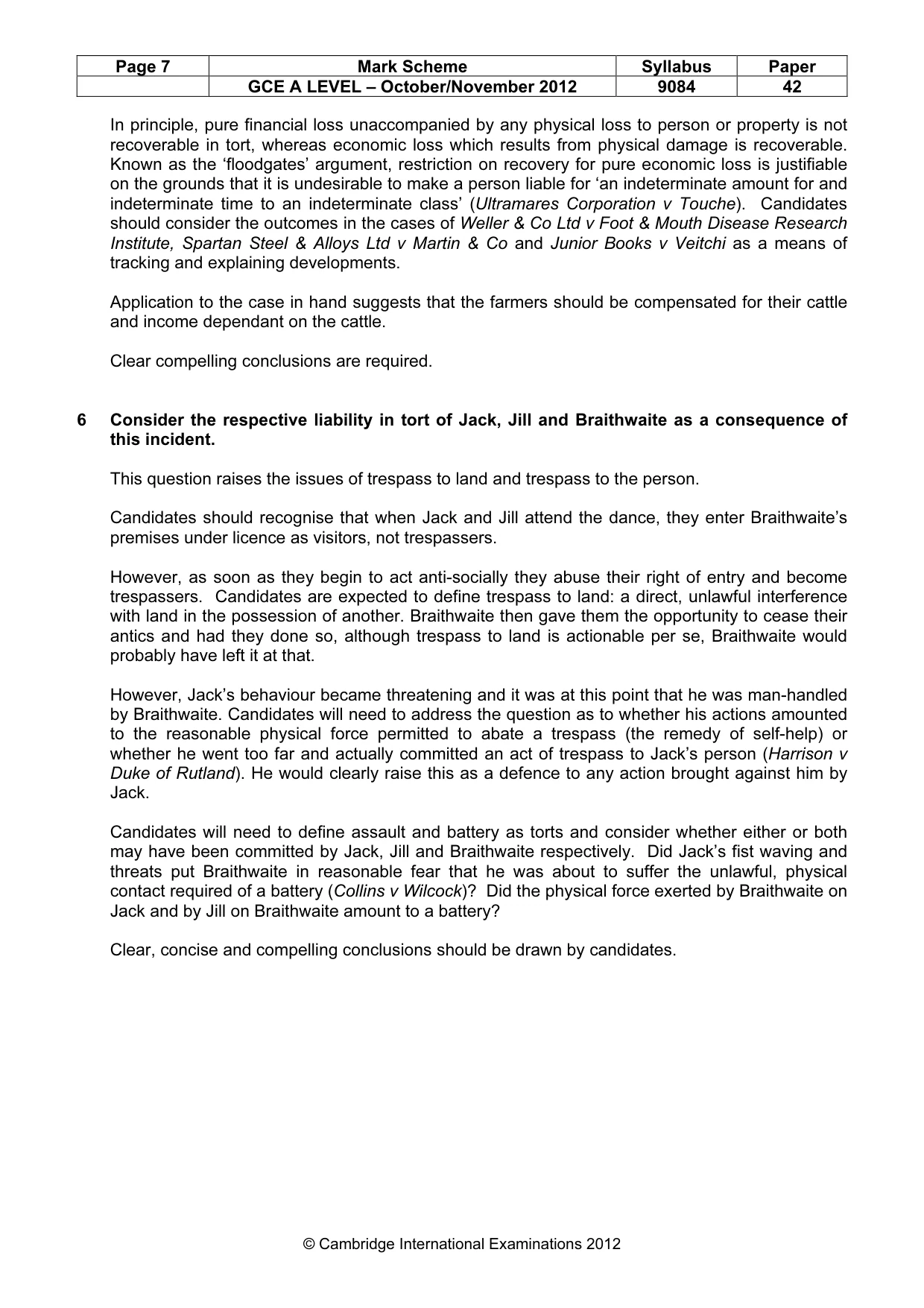
Page 7 Mark Scheme Syllabus Paper GCE A LEVEL – October/November 2012 9084 42 © Cambridge International Examinations 2012 In principle, pure financial loss unaccompanied by any physical loss to person or property is not recoverable in tort, whereas economic loss which results from physical damage is recoverable. Known as the ‘floodgates’ argument, restriction on recovery for pure economic loss is justifiable on the grounds that it is undesirable to make a person liable for ‘an indeterminate amount for and indeterminate time to an indeterminate class’ (Ultramares Corporation v Touche). Candidates should consider the outcomes in the cases of Weller & Co Ltd v Foot & Mouth Disease Research Institute, Spartan Steel & Alloys Ltd v Martin & Co and Junior Books v Veitchi as a means of tracking and explaining developments. Application to the case in hand suggests that the farmers should be compensated for their cattle and income dependant on the cattle. Clear compelling conclusions are required. 6 Consider the respective liability in tort of Jack, Jill and Braithwaite as a consequence of this incident. This question raises the issues of trespass to land and trespass to the person. Candidates should recognise that when Jack and Jill attend the dance, they enter Braithwaite’s premises under licence as visitors, not trespassers. However, as soon as they begin to act anti-socially they abuse their right of entry and become trespassers. Candidates are expected to define trespass to land: a direct, unlawful interference with land in the possession of another. Braithwaite then gave them the opportunity to cease their antics and had they done so, although trespass to land is actionable per se, Braithwaite would probably have left it at that. However, Jack’s behaviour became threatening and it was at this point that he was man-handled by Braithwaite. Candidates will need to address the question as to whether his actions amounted to the reasonable physical force permitted to abate a trespass (the remedy of self-help) or whether he went too far and actually committed an act of trespass to Jack’s person (Harrison v Duke of Rutland). He would clearly raise this as a defence to any action brought against him by Jack. Candidates will need to define assault and battery as torts and consider whether either or both may have been committed by Jack, Jill and Braithwaite respectively. Did Jack’s fist waving and threats put Braithwaite in reasonable fear that he was about to suffer the unlawful, physical contact required of a battery (Collins v Wilcock)? Did the physical force exerted by Braithwaite on Jack and by Jill on Braithwaite amount to a battery? Clear, concise and compelling conclusions should be drawn by candidates.
What you needed in this session
Cambridge’s own grade thresholds for 2012 Oct/Nov, Paper 4 · Variant 2. A higher threshold means an easier paper — the bar moves with how the cohort did.