Cambridge A Level Law 9084 — 2010 May/June Paper 4 · Variant 2
9084/42/M/J/10 · 75 marks · ≈84 min
The question paper and its mark scheme, free to read here and free to download. This is Cambridge’s own paper, exactly as it was sat.
Question paper4 pages

Mark scheme6 pages
Answers below. Sit the paper first if you are practising.
Paper as text
Question paper, page 1
This document consists of 3 printed pages and 1 blank page. DC (CW) 26022 © UCLES 2010 [Turn over UNIVERSITY OF CAMBRIDGE INTERNATIONAL EXAMINATIONS General Certificate of Education Advanced Level READ THESE INSTRUCTIONS FIRST If you have been given an Answer Booklet, follow the instructions on the front cover of the Booklet. Write your Centre number, candidate number and name on all the work you hand in. Write in dark blue or black pen. Do not use staples, paper clips, highlighters, glue or correction fluid. Answer one question from Section A, one from Section B and one other, thus making a total of three responses required. At the end of the examination, fasten all your work securely together. The number of marks is given in brackets [ ] at the end of each question or part question. * 1 3 0 9 2 0 9 1 4 5 * LAW 9084/42 Paper 4 Law of Tort May/June 2010 1 hour 30 minutes Additional Materials: Answer Booklet/Paper
Question paper, page 2
2 9084/42/M/J/10 © UCLES 2010 Candidates must attempt one question from Section A, one from Section B and one other, thus making a total of three responses required. Section A 1 The tort of trespass to the person is no longer of any real legal significance because potential claims for compensation are now more than adequately provided for elsewhere within the law. Discuss, using specific examples, the extent to which you consider this view justified. [25] 2 The distinction between primary and secondary victims was said by the Law Commission in its report on psychiatric illness to be ‘more of a hindrance than a help’ and it was said that there was ‘confusing inconsistency’. Analyse the rules relating to nervous shock and critically assess whether or not you agree with this view. [25] 3 Judges only award an injunction as a remedy when it is considered just and convenient to do so. Using examples of cases from the Law of Torts, evaluate the circumstances under which injunctions have been awarded as remedies and assess why such an award was made in preference to an award of damages. [25]
Question paper, page 3
3 9084/42/M/J/10 © UCLES 2010 Section B 4 Williams purchased a house adjacent to a local rugby football pitch in Cardiff. Rugby had been played on the pitch since 1910, but the house was built in 1969. The house was very near the pitch, so that rugby balls kicked from it frequently broke windows in the house and caused damage in the garden, despite the existence of a 5m high fence surrounding the rugby pitch. The rugby club that used the pitch, Cardiff Dragons, offered to pay for the damage caused when Williams complained, but Williams declined the offer and decided to sue in negligence and nuisance, seeking damages and an injunction. Assess the likelihood of success of Williams’ legal action. [25] 5 Jamel is an experienced motorcycle speedway rider and a member of Manchester Speedway Club. Wanting to take part in a series of races due to take place that afternoon, he visited his club at 09:30, signed up to take part in the races and then returned home for lunch. Whilst Jamel was at home, race officials put up all the signs and notices for the afternoon’s events. These notices were displayed at the entrance and at various places around the race track. They stated that motorcycle speedway racing is dangerous, that spectators should not leave the spectators’ enclosure when a race is in progress and that Manchester Speedway Club would have no liability for accidents causing either damage or personal injury howsoever caused to spectators or ticket holders. At 13:45 Jamel arrived at the club with his wife and a group of close friends. As a competitor, Jamel did not need to pay an entrance fee, but his wife and the others paid to enter as spectators. Between races, Jamel was on his way to the spectators’ enclosure when a motorcycle collided with safety fencing and hit Jamel. He later died from his injuries. Consider Manchester Speedway Club’s potential liability under the Occupier’s Liability Act 1957 and Unfair Contract Terms Act 1977 for the death of Jamel. [25] 6 Kingston is the owner and driver of a passenger coach. He is driving along when the coach suddenly swerves across the road and collides with a lorry driven by Winston which is travelling in the opposite direction. As a consequence of the collision, Winston sustains severe abdominal and head injuries and is unable to work again. Winston commences proceedings in negligence against Kingston relying on the doctrine of res ipsa loquitur (the facts speak for themselves). Kingston responds by alleging that he had to swerve to avoid a vehicle that had overtaken his coach and cut in sharply in front of it. Consider the circumstances of this case and (a) explain how the plea of res ipsa loquitur and the corresponding explanation might influence the proceedings in an action for negligence and (b) if found liable, analyse the measure of damages that might be awarded to Winston. [25]
Question paper, page 4
4 9084/42/M/J/10 © UCLES 2010 BLANK PAGE Permission to reproduce items where third-party owned material protected by copyright is included has been sought and cleared where possible. Every reasonable effort has been made by the publisher (UCLES) to trace copyright holders, but if any items requiring clearance have unwittingly been included, the publisher will be pleased to make amends at the earliest possible opportunity. University of Cambridge International Examinations is part of the Cambridge Assessment Group. Cambridge Assessment is the brand name of University of Cambridge Local Examinations Syndicate (UCLES), which is itself a department of the University of Cambridge.
Mark scheme, page 1
UNIVERSITY OF CAMBRIDGE INTERNATIONAL EXAMINATIONS GCE Advanced Level MARK SCHEME for the May/June 2010 question paper for the guidance of teachers 9084 LAW 9084/42 Paper 42, maximum raw mark 75 This mark scheme is published as an aid to teachers and candidates, to indicate the requirements of the examination. It shows the basis on which Examiners were instructed to award marks. It does not indicate the details of the discussions that took place at an Examiners’ meeting before marking began, which would have considered the acceptability of alternative answers. Mark schemes must be read in conjunction with the question papers and the report on the examination. • CIE will not enter into discussions or correspondence in connection with these mark schemes. CIE is publishing the mark schemes for the May/June 2010 question papers for most IGCSE, GCE Advanced Level and Advanced Subsidiary Level syllabuses and some Ordinary Level syllabuses.
Mark scheme, page 2
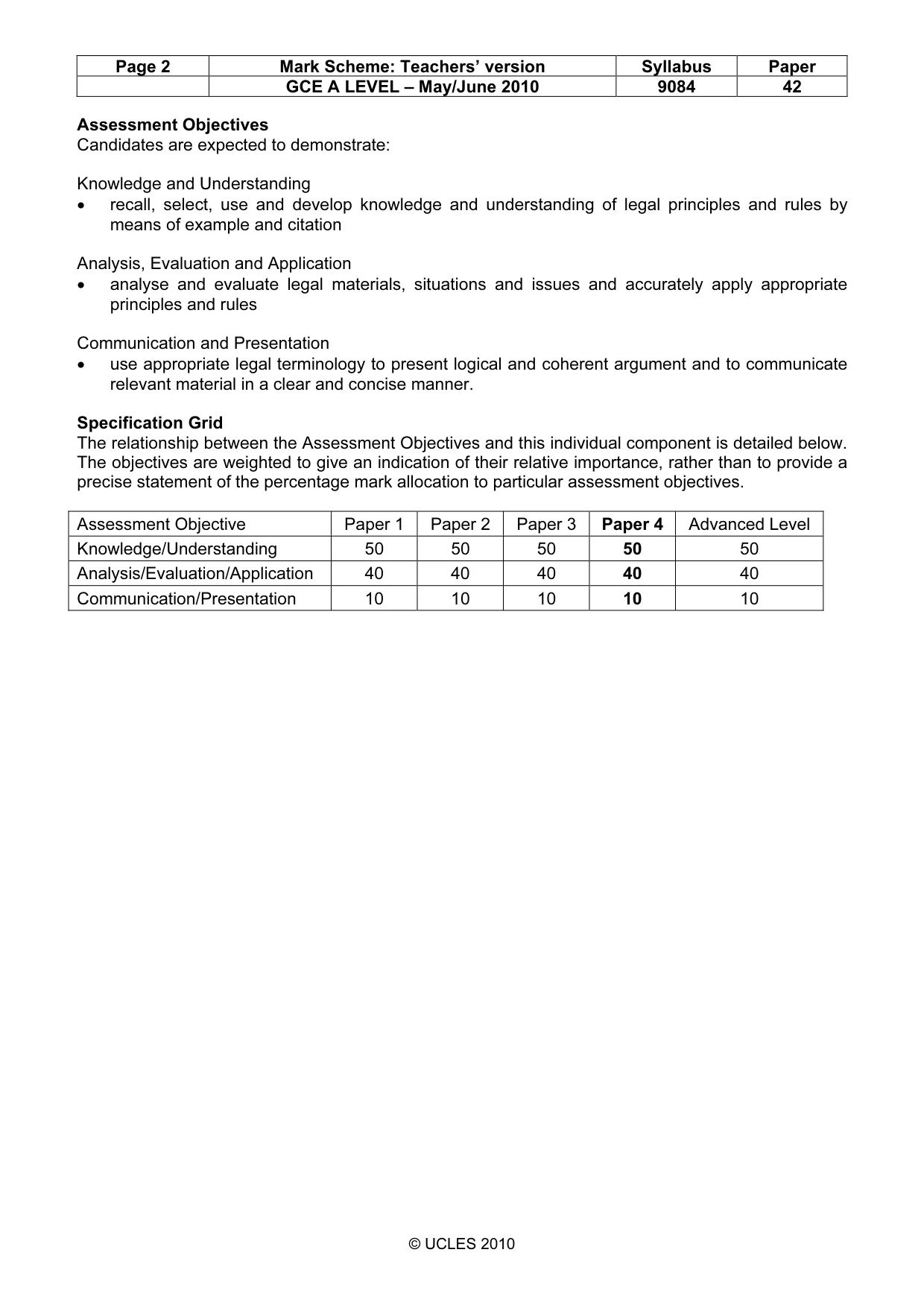
Page 2 Mark Scheme: Teachers’ version Syllabus Paper GCE A LEVEL – May/June 2010 9084 42 © UCLES 2010 Assessment Objectives Candidates are expected to demonstrate: Knowledge and Understanding • recall, select, use and develop knowledge and understanding of legal principles and rules by means of example and citation Analysis, Evaluation and Application • analyse and evaluate legal materials, situations and issues and accurately apply appropriate principles and rules Communication and Presentation • use appropriate legal terminology to present logical and coherent argument and to communicate relevant material in a clear and concise manner. Specification Grid The relationship between the Assessment Objectives and this individual component is detailed below. The objectives are weighted to give an indication of their relative importance, rather than to provide a precise statement of the percentage mark allocation to particular assessment objectives. Assessment Objective Paper 1 Paper 2 Paper 3 Paper 4 Advanced Level Knowledge/Understanding 50 50 50 50 50 Analysis/Evaluation/Application 40 40 40 40 40 Communication/Presentation 10 10 10 10 10
Mark scheme, page 3
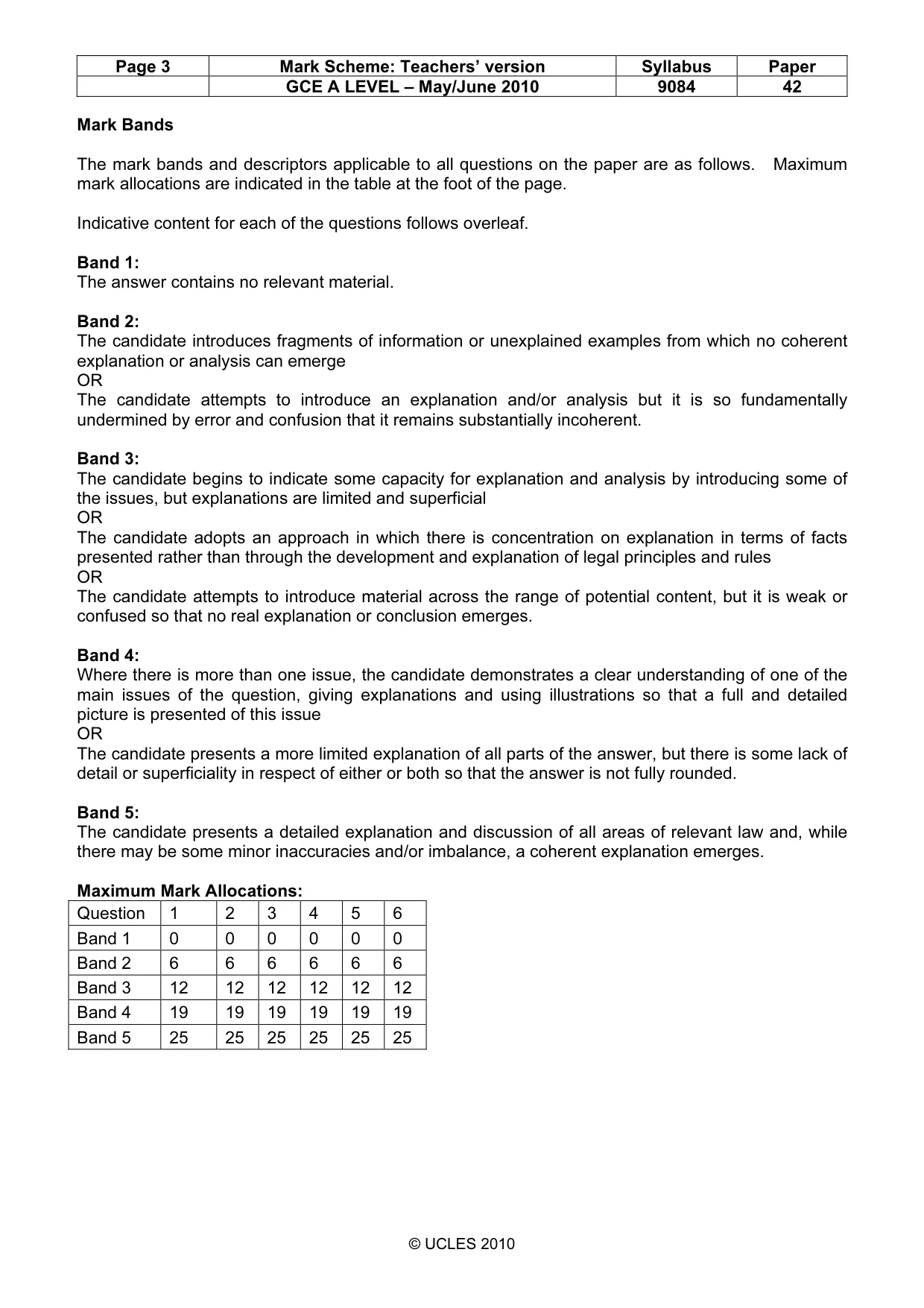
Page 3 Mark Scheme: Teachers’ version Syllabus Paper GCE A LEVEL – May/June 2010 9084 42 © UCLES 2010 Mark Bands The mark bands and descriptors applicable to all questions on the paper are as follows. Maximum mark allocations are indicated in the table at the foot of the page. Indicative content for each of the questions follows overleaf. Band 1: The answer contains no relevant material. Band 2: The candidate introduces fragments of information or unexplained examples from which no coherent explanation or analysis can emerge OR The candidate attempts to introduce an explanation and/or analysis but it is so fundamentally undermined by error and confusion that it remains substantially incoherent. Band 3: The candidate begins to indicate some capacity for explanation and analysis by introducing some of the issues, but explanations are limited and superficial OR The candidate adopts an approach in which there is concentration on explanation in terms of facts presented rather than through the development and explanation of legal principles and rules OR The candidate attempts to introduce material across the range of potential content, but it is weak or confused so that no real explanation or conclusion emerges. Band 4: Where there is more than one issue, the candidate demonstrates a clear understanding of one of the main issues of the question, giving explanations and using illustrations so that a full and detailed picture is presented of this issue OR The candidate presents a more limited explanation of all parts of the answer, but there is some lack of detail or superficiality in respect of either or both so that the answer is not fully rounded. Band 5: The candidate presents a detailed explanation and discussion of all areas of relevant law and, while there may be some minor inaccuracies and/or imbalance, a coherent explanation emerges. Maximum Mark Allocations: Question 1 2 3 4 5 6 Band 1 0 0 0 0 0 0 Band 2 6 6 6 6 6 6 Band 3 12 12 12 12 12 12 Band 4 19 19 19 19 19 19 Band 5 25 25 25 25 25 25
Mark scheme, page 4
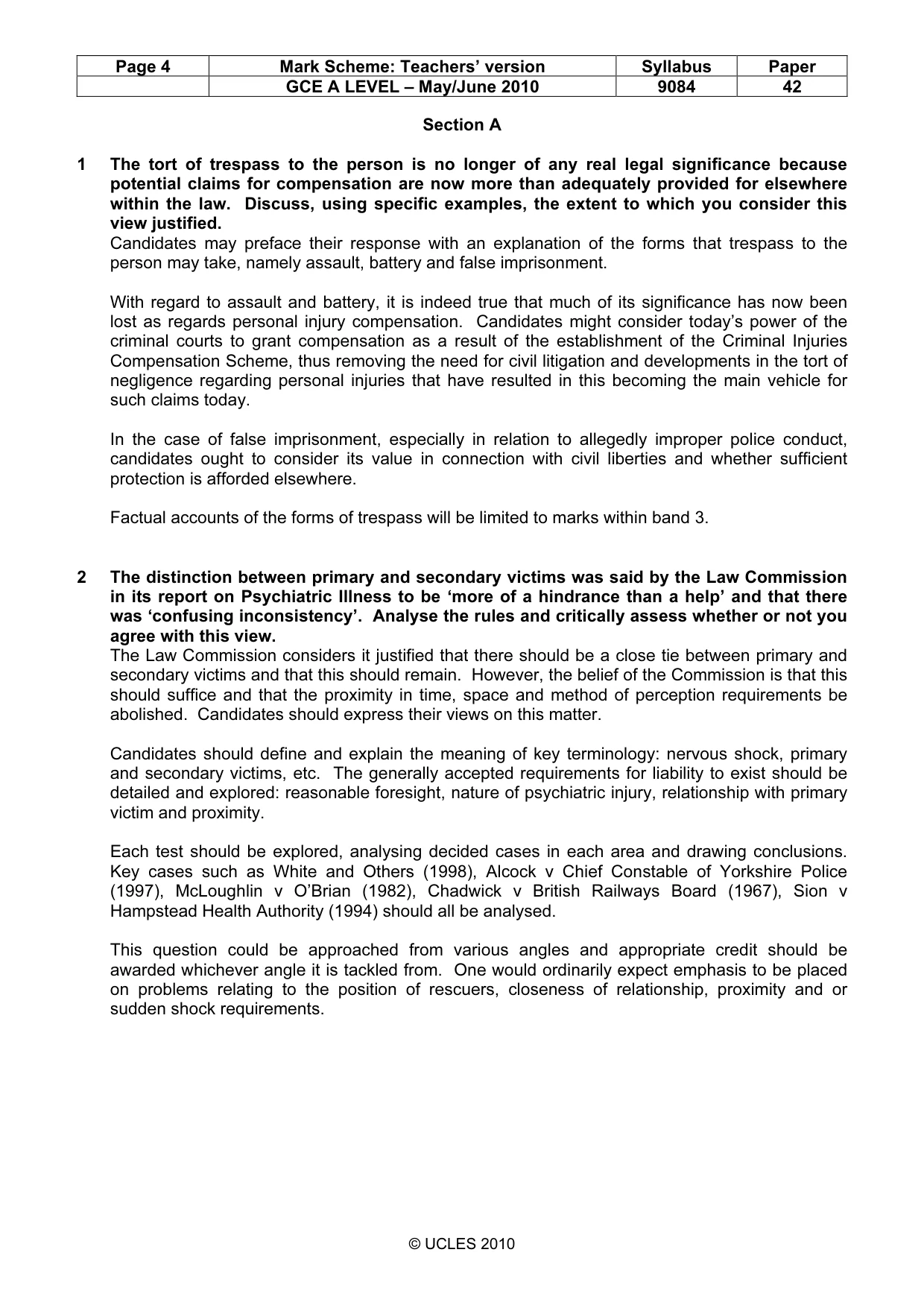
Page 4 Mark Scheme: Teachers’ version Syllabus Paper GCE A LEVEL – May/June 2010 9084 42 © UCLES 2010 Section A 1 The tort of trespass to the person is no longer of any real legal significance because potential claims for compensation are now more than adequately provided for elsewhere within the law. Discuss, using specific examples, the extent to which you consider this view justified. Candidates may preface their response with an explanation of the forms that trespass to the person may take, namely assault, battery and false imprisonment. With regard to assault and battery, it is indeed true that much of its significance has now been lost as regards personal injury compensation. Candidates might consider today’s power of the criminal courts to grant compensation as a result of the establishment of the Criminal Injuries Compensation Scheme, thus removing the need for civil litigation and developments in the tort of negligence regarding personal injuries that have resulted in this becoming the main vehicle for such claims today. In the case of false imprisonment, especially in relation to allegedly improper police conduct, candidates ought to consider its value in connection with civil liberties and whether sufficient protection is afforded elsewhere. Factual accounts of the forms of trespass will be limited to marks within band 3. 2 The distinction between primary and secondary victims was said by the Law Commission in its report on Psychiatric Illness to be ‘more of a hindrance than a help’ and that there was ‘confusing inconsistency’. Analyse the rules and critically assess whether or not you agree with this view. The Law Commission considers it justified that there should be a close tie between primary and secondary victims and that this should remain. However, the belief of the Commission is that this should suffice and that the proximity in time, space and method of perception requirements be abolished. Candidates should express their views on this matter. Candidates should define and explain the meaning of key terminology: nervous shock, primary and secondary victims, etc. The generally accepted requirements for liability to exist should be detailed and explored: reasonable foresight, nature of psychiatric injury, relationship with primary victim and proximity. Each test should be explored, analysing decided cases in each area and drawing conclusions. Key cases such as White and Others (1998), Alcock v Chief Constable of Yorkshire Police (1997), McLoughlin v O’Brian (1982), Chadwick v British Railways Board (1967), Sion v Hampstead Health Authority (1994) should all be analysed. This question could be approached from various angles and appropriate credit should be awarded whichever angle it is tackled from. One would ordinarily expect emphasis to be placed on problems relating to the position of rescuers, closeness of relationship, proximity and or sudden shock requirements.
Mark scheme, page 5
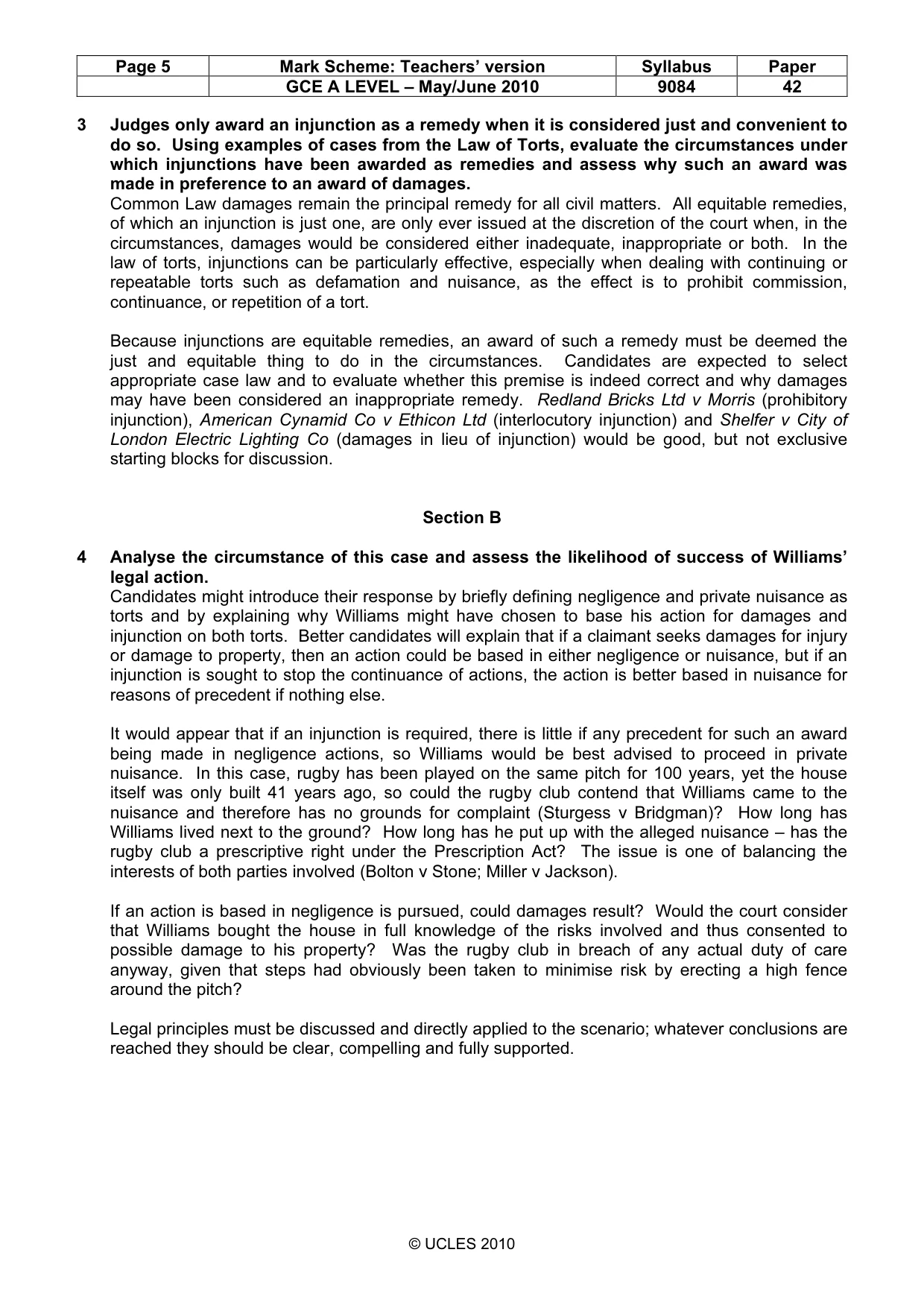
Page 5 Mark Scheme: Teachers’ version Syllabus Paper GCE A LEVEL – May/June 2010 9084 42 © UCLES 2010 3 Judges only award an injunction as a remedy when it is considered just and convenient to do so. Using examples of cases from the Law of Torts, evaluate the circumstances under which injunctions have been awarded as remedies and assess why such an award was made in preference to an award of damages. Common Law damages remain the principal remedy for all civil matters. All equitable remedies, of which an injunction is just one, are only ever issued at the discretion of the court when, in the circumstances, damages would be considered either inadequate, inappropriate or both. In the law of torts, injunctions can be particularly effective, especially when dealing with continuing or repeatable torts such as defamation and nuisance, as the effect is to prohibit commission, continuance, or repetition of a tort. Because injunctions are equitable remedies, an award of such a remedy must be deemed the just and equitable thing to do in the circumstances. Candidates are expected to select appropriate case law and to evaluate whether this premise is indeed correct and why damages may have been considered an inappropriate remedy. Redland Bricks Ltd v Morris (prohibitory injunction), American Cynamid Co v Ethicon Ltd (interlocutory injunction) and Shelfer v City of London Electric Lighting Co (damages in lieu of injunction) would be good, but not exclusive starting blocks for discussion. Section B 4 Analyse the circumstance of this case and assess the likelihood of success of Williams’ legal action. Candidates might introduce their response by briefly defining negligence and private nuisance as torts and by explaining why Williams might have chosen to base his action for damages and injunction on both torts. Better candidates will explain that if a claimant seeks damages for injury or damage to property, then an action could be based in either negligence or nuisance, but if an injunction is sought to stop the continuance of actions, the action is better based in nuisance for reasons of precedent if nothing else. It would appear that if an injunction is required, there is little if any precedent for such an award being made in negligence actions, so Williams would be best advised to proceed in private nuisance. In this case, rugby has been played on the same pitch for 100 years, yet the house itself was only built 41 years ago, so could the rugby club contend that Williams came to the nuisance and therefore has no grounds for complaint (Sturgess v Bridgman)? How long has Williams lived next to the ground? How long has he put up with the alleged nuisance – has the rugby club a prescriptive right under the Prescription Act? The issue is one of balancing the interests of both parties involved (Bolton v Stone; Miller v Jackson). If an action is based in negligence is pursued, could damages result? Would the court consider that Williams bought the house in full knowledge of the risks involved and thus consented to possible damage to his property? Was the rugby club in breach of any actual duty of care anyway, given that steps had obviously been taken to minimise risk by erecting a high fence around the pitch? Legal principles must be discussed and directly applied to the scenario; whatever conclusions are reached they should be clear, compelling and fully supported.
Mark scheme, page 6
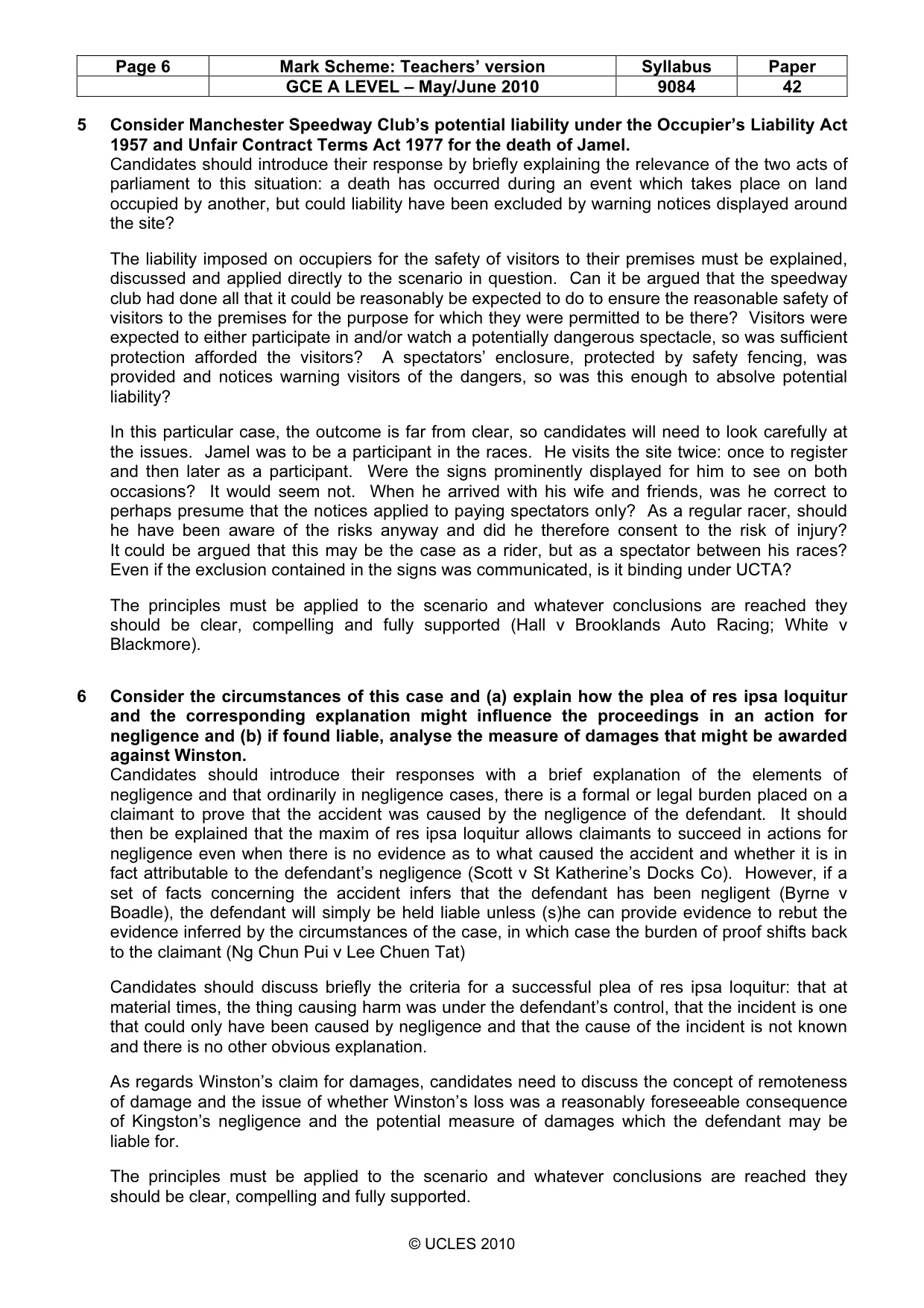
Page 6 Mark Scheme: Teachers’ version Syllabus Paper GCE A LEVEL – May/June 2010 9084 42 © UCLES 2010 5 Consider Manchester Speedway Club’s potential liability under the Occupier’s Liability Act 1957 and Unfair Contract Terms Act 1977 for the death of Jamel. Candidates should introduce their response by briefly explaining the relevance of the two acts of parliament to this situation: a death has occurred during an event which takes place on land occupied by another, but could liability have been excluded by warning notices displayed around the site? The liability imposed on occupiers for the safety of visitors to their premises must be explained, discussed and applied directly to the scenario in question. Can it be argued that the speedway club had done all that it could be reasonably be expected to do to ensure the reasonable safety of visitors to the premises for the purpose for which they were permitted to be there? Visitors were expected to either participate in and/or watch a potentially dangerous spectacle, so was sufficient protection afforded the visitors? A spectators’ enclosure, protected by safety fencing, was provided and notices warning visitors of the dangers, so was this enough to absolve potential liability? In this particular case, the outcome is far from clear, so candidates will need to look carefully at the issues. Jamel was to be a participant in the races. He visits the site twice: once to register and then later as a participant. Were the signs prominently displayed for him to see on both occasions? It would seem not. When he arrived with his wife and friends, was he correct to perhaps presume that the notices applied to paying spectators only? As a regular racer, should he have been aware of the risks anyway and did he therefore consent to the risk of injury? It could be argued that this may be the case as a rider, but as a spectator between his races? Even if the exclusion contained in the signs was communicated, is it binding under UCTA? The principles must be applied to the scenario and whatever conclusions are reached they should be clear, compelling and fully supported (Hall v Brooklands Auto Racing; White v Blackmore). 6 Consider the circumstances of this case and (a) explain how the plea of res ipsa loquitur and the corresponding explanation might influence the proceedings in an action for negligence and (b) if found liable, analyse the measure of damages that might be awarded against Winston. Candidates should introduce their responses with a brief explanation of the elements of negligence and that ordinarily in negligence cases, there is a formal or legal burden placed on a claimant to prove that the accident was caused by the negligence of the defendant. It should then be explained that the maxim of res ipsa loquitur allows claimants to succeed in actions for negligence even when there is no evidence as to what caused the accident and whether it is in fact attributable to the defendant’s negligence (Scott v St Katherine’s Docks Co). However, if a set of facts concerning the accident infers that the defendant has been negligent (Byrne v Boadle), the defendant will simply be held liable unless (s)he can provide evidence to rebut the evidence inferred by the circumstances of the case, in which case the burden of proof shifts back to the claimant (Ng Chun Pui v Lee Chuen Tat) Candidates should discuss briefly the criteria for a successful plea of res ipsa loquitur: that at material times, the thing causing harm was under the defendant’s control, that the incident is one that could only have been caused by negligence and that the cause of the incident is not known and there is no other obvious explanation. As regards Winston’s claim for damages, candidates need to discuss the concept of remoteness of damage and the issue of whether Winston’s loss was a reasonably foreseeable consequence of Kingston’s negligence and the potential measure of damages which the defendant may be liable for. The principles must be applied to the scenario and whatever conclusions are reached they should be clear, compelling and fully supported.
What you needed in this session
Cambridge’s own grade thresholds for 2010 May/June, Paper 4 · Variant 2. A higher threshold means an easier paper — the bar moves with how the cohort did.