Cambridge A Level History (pre-2015) 9697 — 2014 Oct/Nov Paper 4 · Variant 1
9697/41/O/N/14 · 100 marks · ≈113 min
The question paper and its mark scheme, free to read here and free to download. This is Cambridge’s own paper, exactly as it was sat.
Question paper2 pages
Mark scheme12 pages
Answers below. Sit the paper first if you are practising.
Paper as text
Question paper, page 1
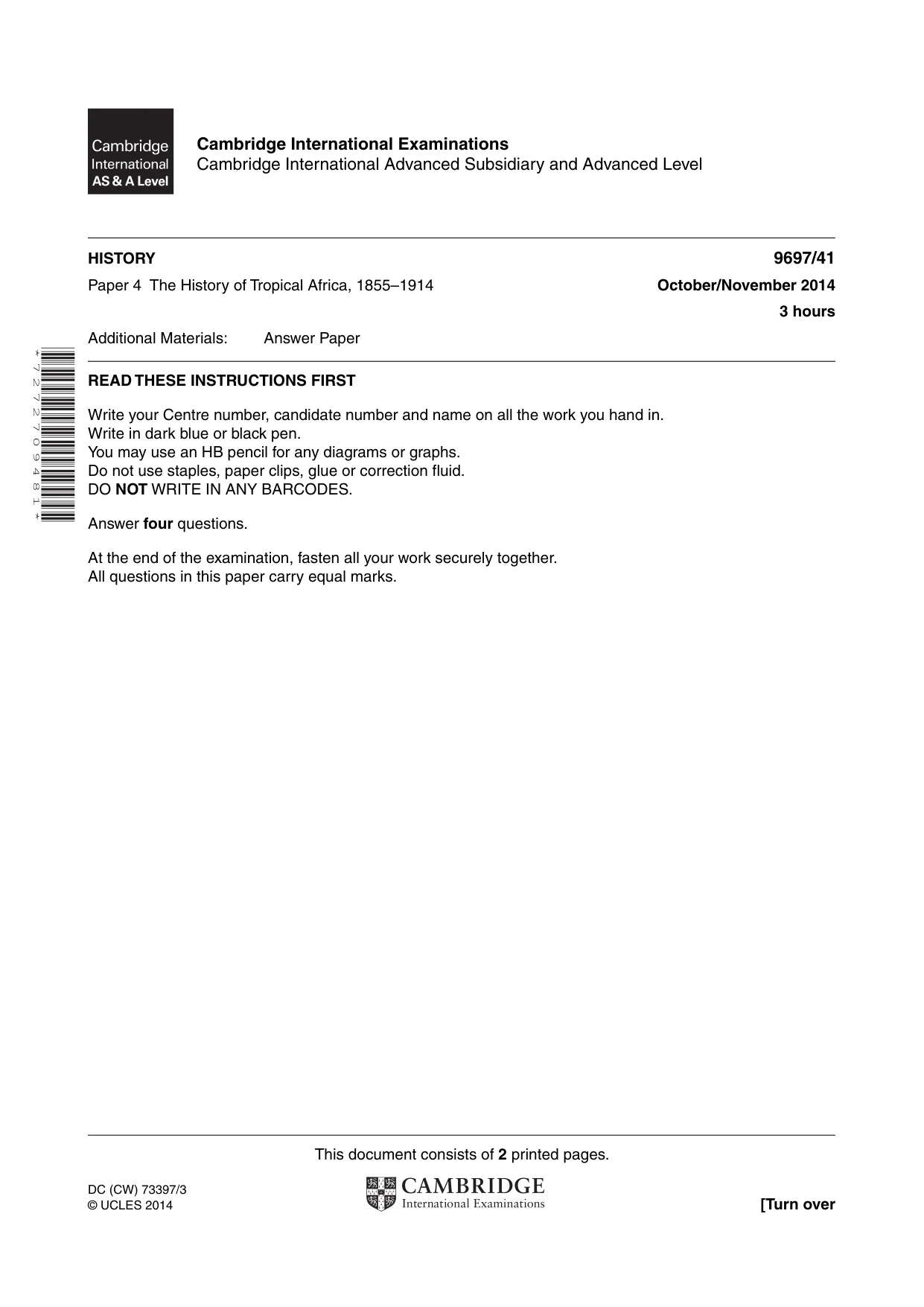
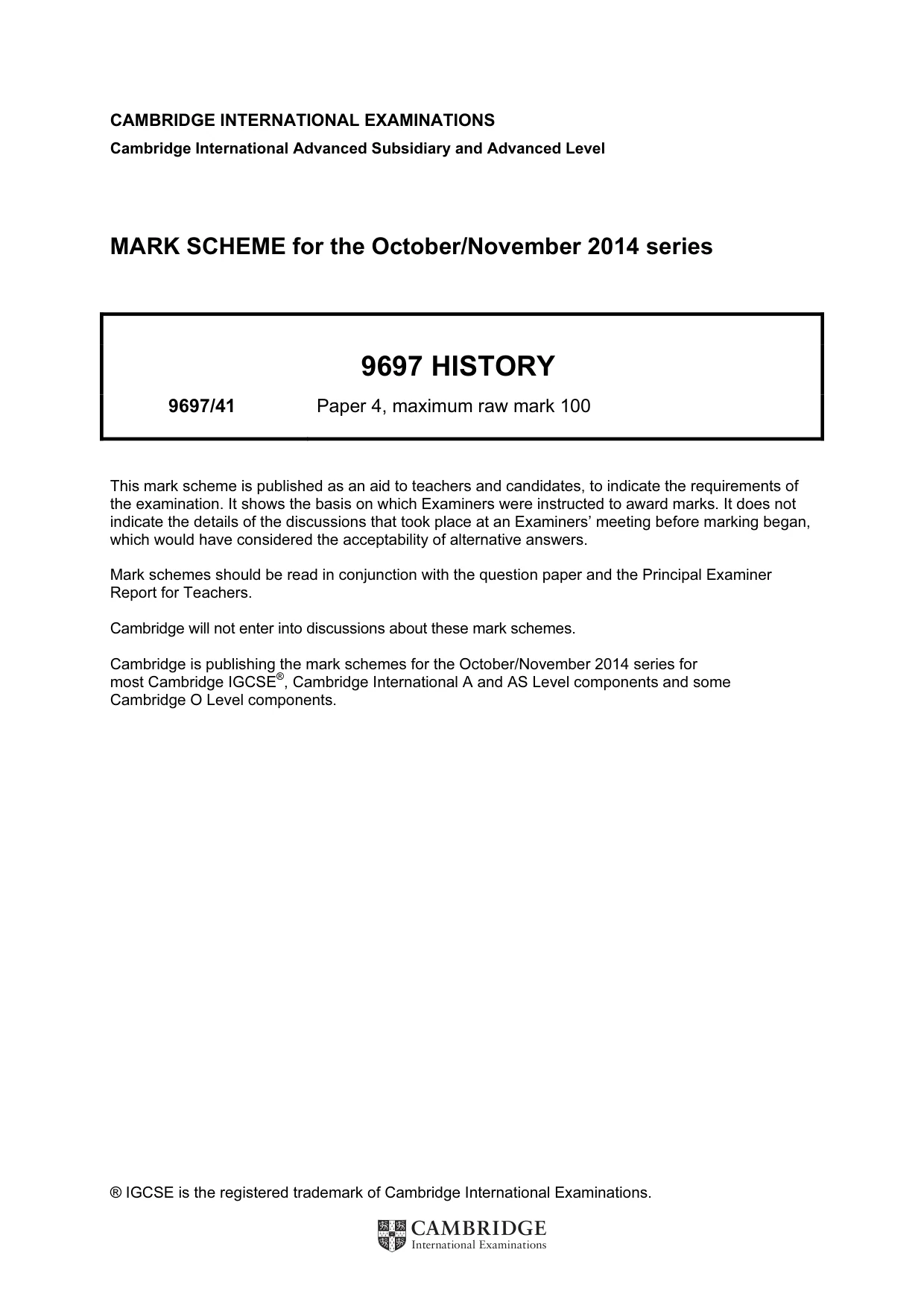
This document consists of 2 printed pages. DC (CW) 73397/3 © UCLES 2014 [Turn over Cambridge International Examinations Cambridge International Advanced Subsidiary and Advanced Level * 7 2 7 2 7 0 9 4 8 1 * HISTORY 9697/41 Paper 4 The History of Tropical Africa, 1855–1914 October/November 2014 3 hours Additional Materials: Answer Paper READ THESE INSTRUCTIONS FIRST Write your Centre number, candidate number and name on all the work you hand in. Write in dark blue or black pen. You may use an HB pencil for any diagrams or graphs. Do not use staples, paper clips, glue or correction fluid. DO NOT WRITE IN ANY BARCODES. Answer four questions. At the end of the examination, fasten all your work securely together. All questions in this paper carry equal marks.
Question paper, page 2
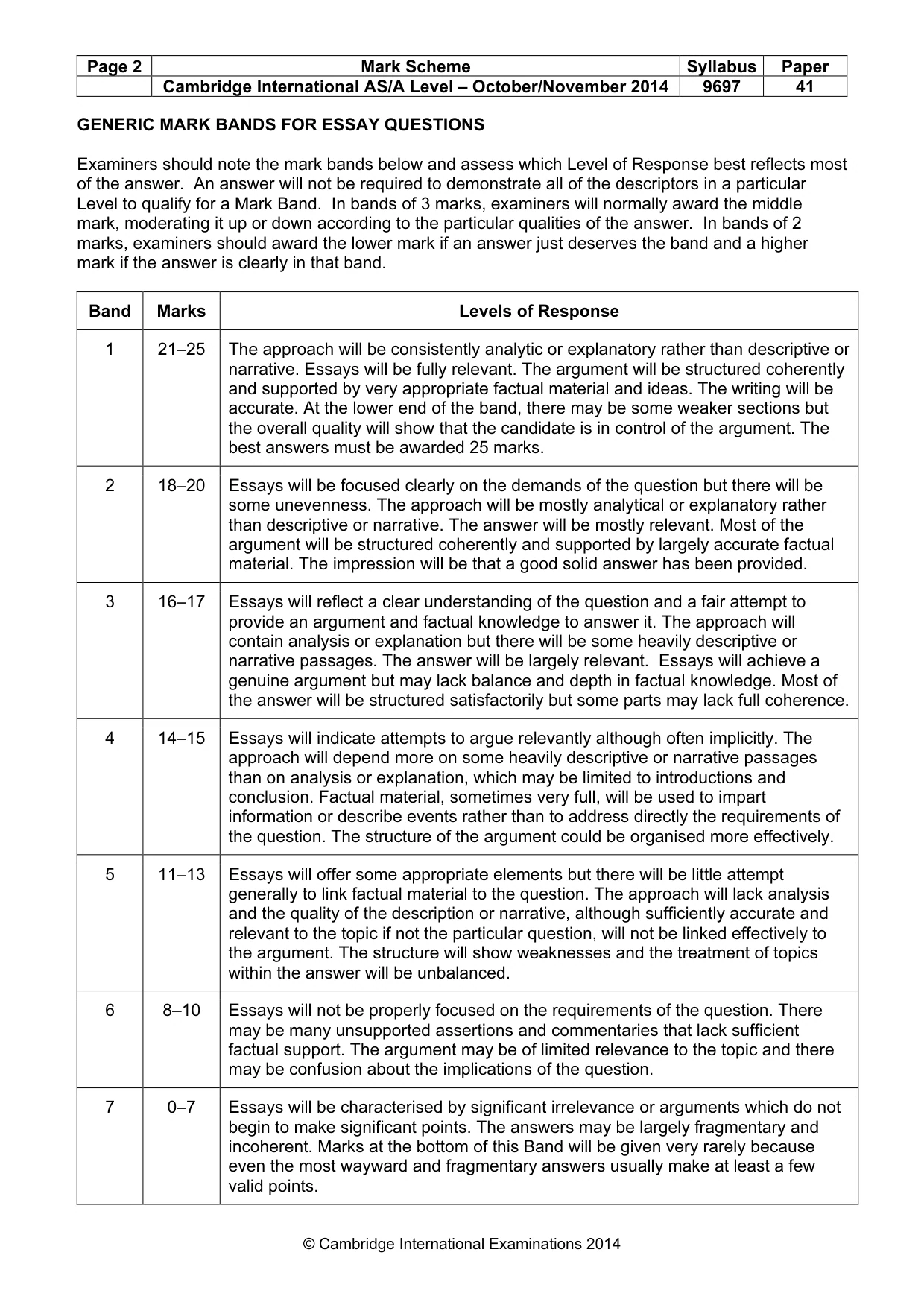
2 9697/41/O/N/14 © UCLES 2014 Answer any four questions. 1 How significant was African political leadership in enabling Dahomey and the Niger Delta states to make the successful transition from slave trade to legitimate commerce? 2 ‘The Arabs of Zanzibar had a more significant impact on East and Central Africa than the Europeans.’ How far do you agree with this statement? 3 In the period 1875 to 1900 how significant for tropical Africa were the changes in European involvement? 4 ‘Samori Touré’s military genius was the main reason he was able to resist the Europeans for so long.’ How far do you agree with this claim? 5 Evaluate the relative importance of Christian missionaries and African leadership in the political development of Buganda between 1875 and 1900. 6 Explain the main features and assess the impact of British and French colonial administration in West Africa after 1900. 7 Which ruler do you consider was the more successful in dealing with the British: Prempeh I of the Asante or Lewanika of the Lozi? 8 ‘Resentment against colonial rule was the most important cause of both the Ndebele-Shona Rising of 1896–97 and the Maji-Maji Rising of 1905–07.’ How far do you agree with this analysis? 9 Explain, with examples, the appeal of both Islam and Independent African Churches to African peoples during the colonial era. 10 Analyse the economic and social results of the building of railways in either Central or East Africa. Permission to reproduce items where third-party owned material protected by copyright is included has been sought and cleared where possible. Every reasonable effort has been made by the publisher (UCLES) to trace copyright holders, but if any items requiring clearance have unwittingly been included, the publisher will be pleased to make amends at the earliest possible opportunity. Cambridge International Examinations is part of the Cambridge Assessment Group. Cambridge Assessment is the brand name of University of Cambridge Local Examinations Syndicate (UCLES), which is itself a department of the University of Cambridge.
Mark scheme, page 1
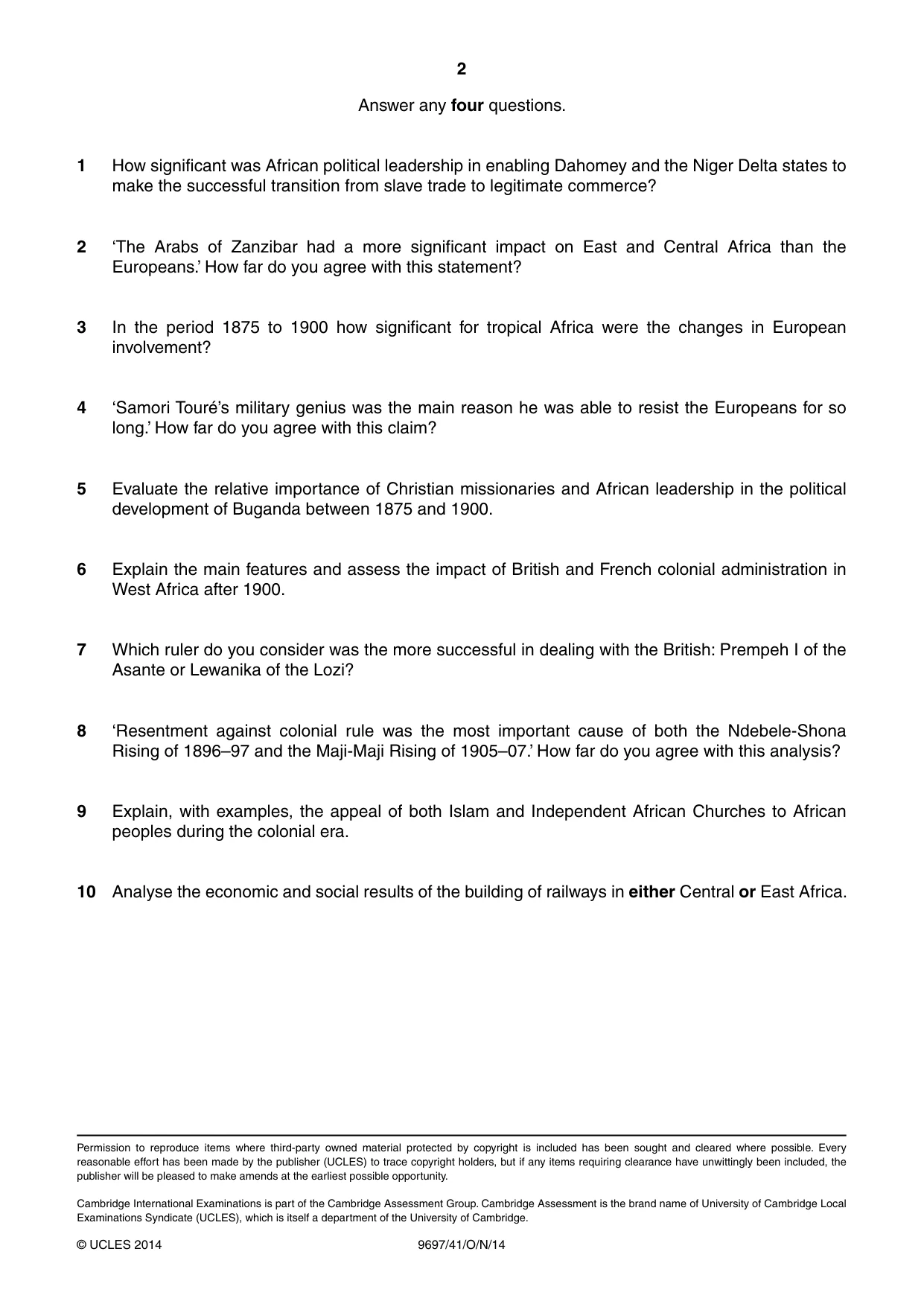
® IGCSE is the registered trademark of Cambridge International Examinations. CAMBRIDGE INTERNATIONAL EXAMINATIONS Cambridge International Advanced Subsidiary and Advanced Level MARK SCHEME for the October/November 2014 series 9697 HISTORY 9697/41 Paper 4, maximum raw mark 100 This mark scheme is published as an aid to teachers and candidates, to indicate the requirements of the examination. It shows the basis on which Examiners were instructed to award marks. It does not indicate the details of the discussions that took place at an Examiners’ meeting before marking began, which would have considered the acceptability of alternative answers. Mark schemes should be read in conjunction with the question paper and the Principal Examiner Report for Teachers. Cambridge will not enter into discussions about these mark schemes. Cambridge is publishing the mark schemes for the October/November 2014 series for most Cambridge IGCSE®, Cambridge International A and AS Level components and some Cambridge O Level components.
Mark scheme, page 2
Page 2 Mark Scheme Syllabus Paper Cambridge International AS/A Level – October/November 2014 9697 41 © Cambridge International Examinations 2014 GENERIC MARK BANDS FOR ESSAY QUESTIONS Examiners should note the mark bands below and assess which Level of Response best reflects most of the answer. An answer will not be required to demonstrate all of the descriptors in a particular Level to qualify for a Mark Band. In bands of 3 marks, examiners will normally award the middle mark, moderating it up or down according to the particular qualities of the answer. In bands of 2 marks, examiners should award the lower mark if an answer just deserves the band and a higher mark if the answer is clearly in that band. Band Marks Levels of Response 1 21–25 The approach will be consistently analytic or explanatory rather than descriptive or narrative. Essays will be fully relevant. The argument will be structured coherently and supported by very appropriate factual material and ideas. The writing will be accurate. At the lower end of the band, there may be some weaker sections but the overall quality will show that the candidate is in control of the argument. The best answers must be awarded 25 marks. 2 18–20 Essays will be focused clearly on the demands of the question but there will be some unevenness. The approach will be mostly analytical or explanatory rather than descriptive or narrative. The answer will be mostly relevant. Most of the argument will be structured coherently and supported by largely accurate factual material. The impression will be that a good solid answer has been provided. 3 16–17 Essays will reflect a clear understanding of the question and a fair attempt to provide an argument and factual knowledge to answer it. The approach will contain analysis or explanation but there will be some heavily descriptive or narrative passages. The answer will be largely relevant. Essays will achieve a genuine argument but may lack balance and depth in factual knowledge. Most of the answer will be structured satisfactorily but some parts may lack full coherence. 4 14–15 Essays will indicate attempts to argue relevantly although often implicitly. The approach will depend more on some heavily descriptive or narrative passages than on analysis or explanation, which may be limited to introductions and conclusion. Factual material, sometimes very full, will be used to impart information or describe events rather than to address directly the requirements of the question. The structure of the argument could be organised more effectively. 5 11–13 Essays will offer some appropriate elements but there will be little attempt generally to link factual material to the question. The approach will lack analysis and the quality of the description or narrative, although sufficiently accurate and relevant to the topic if not the particular question, will not be linked effectively to the argument. The structure will show weaknesses and the treatment of topics within the answer will be unbalanced. 6 8–10 Essays will not be properly focused on the requirements of the question. There may be many unsupported assertions and commentaries that lack sufficient factual support. The argument may be of limited relevance to the topic and there may be confusion about the implications of the question. 7 0–7 Essays will be characterised by significant irrelevance or arguments which do not begin to make significant points. The answers may be largely fragmentary and incoherent. Marks at the bottom of this Band will be given very rarely because even the most wayward and fragmentary answers usually make at least a few valid points.
Mark scheme, page 3
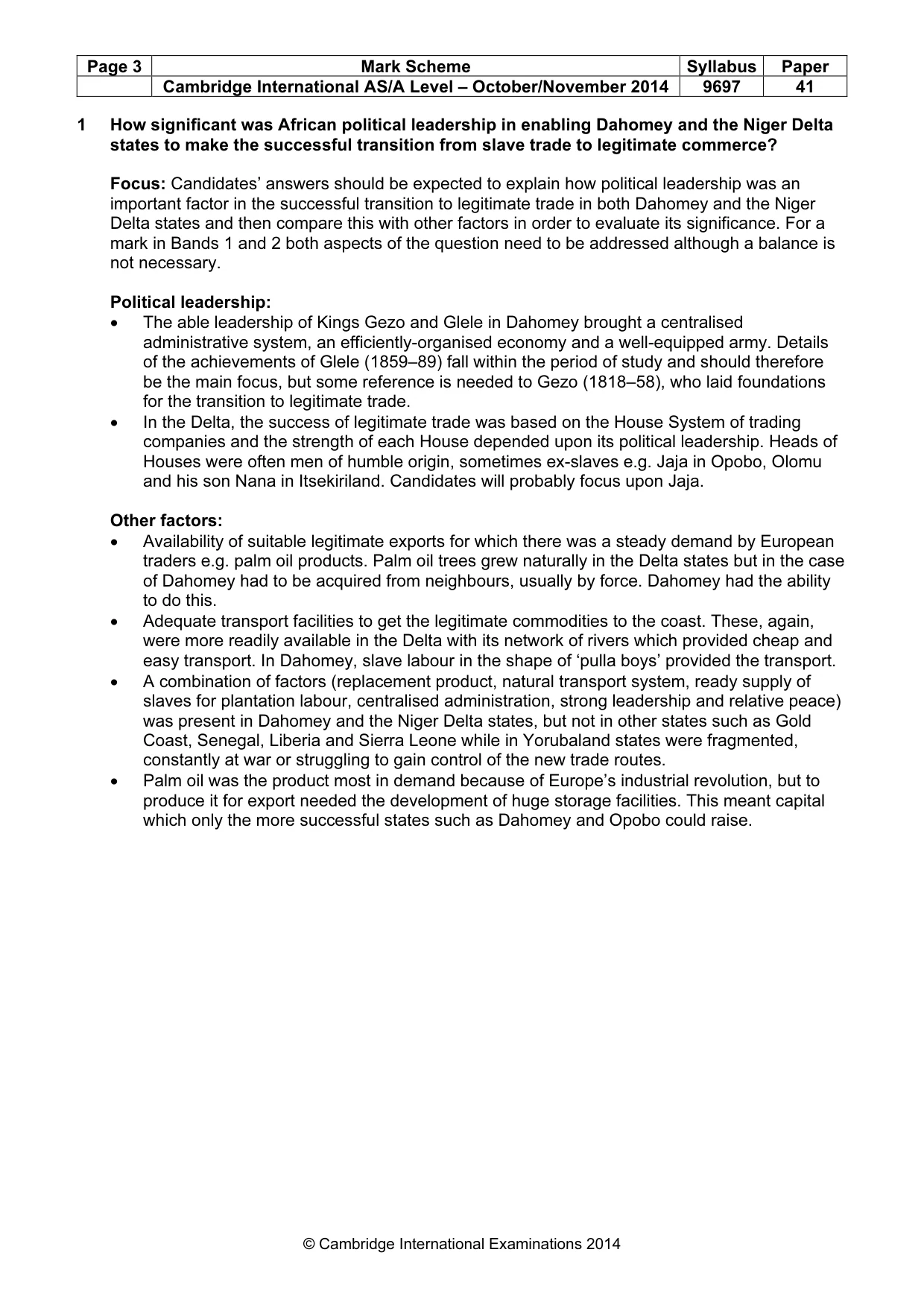
Page 3 Mark Scheme Syllabus Paper Cambridge International AS/A Level – October/November 2014 9697 41 © Cambridge International Examinations 2014 1 How significant was African political leadership in enabling Dahomey and the Niger Delta states to make the successful transition from slave trade to legitimate commerce? Focus: Candidates’ answers should be expected to explain how political leadership was an important factor in the successful transition to legitimate trade in both Dahomey and the Niger Delta states and then compare this with other factors in order to evaluate its significance. For a mark in Bands 1 and 2 both aspects of the question need to be addressed although a balance is not necessary. Political leadership: • The able leadership of Kings Gezo and Glele in Dahomey brought a centralised administrative system, an efficiently-organised economy and a well-equipped army. Details of the achievements of Glele (1859–89) fall within the period of study and should therefore be the main focus, but some reference is needed to Gezo (1818–58), who laid foundations for the transition to legitimate trade. • In the Delta, the success of legitimate trade was based on the House System of trading companies and the strength of each House depended upon its political leadership. Heads of Houses were often men of humble origin, sometimes ex-slaves e.g. Jaja in Opobo, Olomu and his son Nana in Itsekiriland. Candidates will probably focus upon Jaja. Other factors: • Availability of suitable legitimate exports for which there was a steady demand by European traders e.g. palm oil products. Palm oil trees grew naturally in the Delta states but in the case of Dahomey had to be acquired from neighbours, usually by force. Dahomey had the ability to do this. • Adequate transport facilities to get the legitimate commodities to the coast. These, again, were more readily available in the Delta with its network of rivers which provided cheap and easy transport. In Dahomey, slave labour in the shape of ‘pulla boys’ provided the transport. • A combination of factors (replacement product, natural transport system, ready supply of slaves for plantation labour, centralised administration, strong leadership and relative peace) was present in Dahomey and the Niger Delta states, but not in other states such as Gold Coast, Senegal, Liberia and Sierra Leone while in Yorubaland states were fragmented, constantly at war or struggling to gain control of the new trade routes. • Palm oil was the product most in demand because of Europe’s industrial revolution, but to produce it for export needed the development of huge storage facilities. This meant capital which only the more successful states such as Dahomey and Opobo could raise.
Mark scheme, page 4
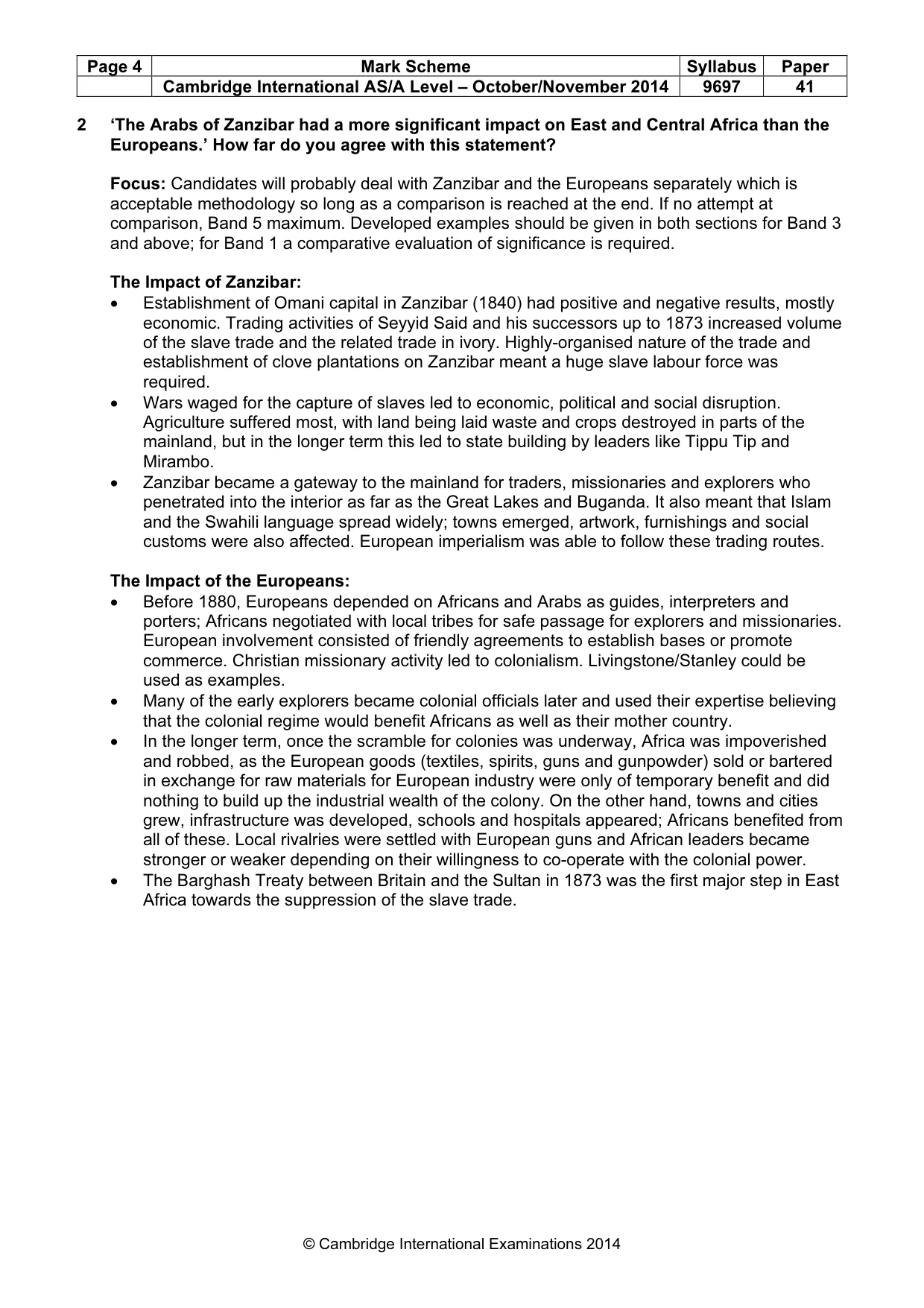
Page 4 Mark Scheme Syllabus Paper Cambridge International AS/A Level – October/November 2014 9697 41 © Cambridge International Examinations 2014 2 ‘The Arabs of Zanzibar had a more significant impact on East and Central Africa than the Europeans.’ How far do you agree with this statement? Focus: Candidates will probably deal with Zanzibar and the Europeans separately which is acceptable methodology so long as a comparison is reached at the end. If no attempt at comparison, Band 5 maximum. Developed examples should be given in both sections for Band 3 and above; for Band 1 a comparative evaluation of significance is required. The Impact of Zanzibar: • Establishment of Omani capital in Zanzibar (1840) had positive and negative results, mostly economic. Trading activities of Seyyid Said and his successors up to 1873 increased volume of the slave trade and the related trade in ivory. Highly-organised nature of the trade and establishment of clove plantations on Zanzibar meant a huge slave labour force was required. • Wars waged for the capture of slaves led to economic, political and social disruption. Agriculture suffered most, with land being laid waste and crops destroyed in parts of the mainland, but in the longer term this led to state building by leaders like Tippu Tip and Mirambo. • Zanzibar became a gateway to the mainland for traders, missionaries and explorers who penetrated into the interior as far as the Great Lakes and Buganda. It also meant that Islam and the Swahili language spread widely; towns emerged, artwork, furnishings and social customs were also affected. European imperialism was able to follow these trading routes. The Impact of the Europeans: • Before 1880, Europeans depended on Africans and Arabs as guides, interpreters and porters; Africans negotiated with local tribes for safe passage for explorers and missionaries. European involvement consisted of friendly agreements to establish bases or promote commerce. Christian missionary activity led to colonialism. Livingstone/Stanley could be used as examples. • Many of the early explorers became colonial officials later and used their expertise believing that the colonial regime would benefit Africans as well as their mother country. • In the longer term, once the scramble for colonies was underway, Africa was impoverished and robbed, as the European goods (textiles, spirits, guns and gunpowder) sold or bartered in exchange for raw materials for European industry were only of temporary benefit and did nothing to build up the industrial wealth of the colony. On the other hand, towns and cities grew, infrastructure was developed, schools and hospitals appeared; Africans benefited from all of these. Local rivalries were settled with European guns and African leaders became stronger or weaker depending on their willingness to co-operate with the colonial power. • The Barghash Treaty between Britain and the Sultan in 1873 was the first major step in East Africa towards the suppression of the slave trade.
Mark scheme, page 5
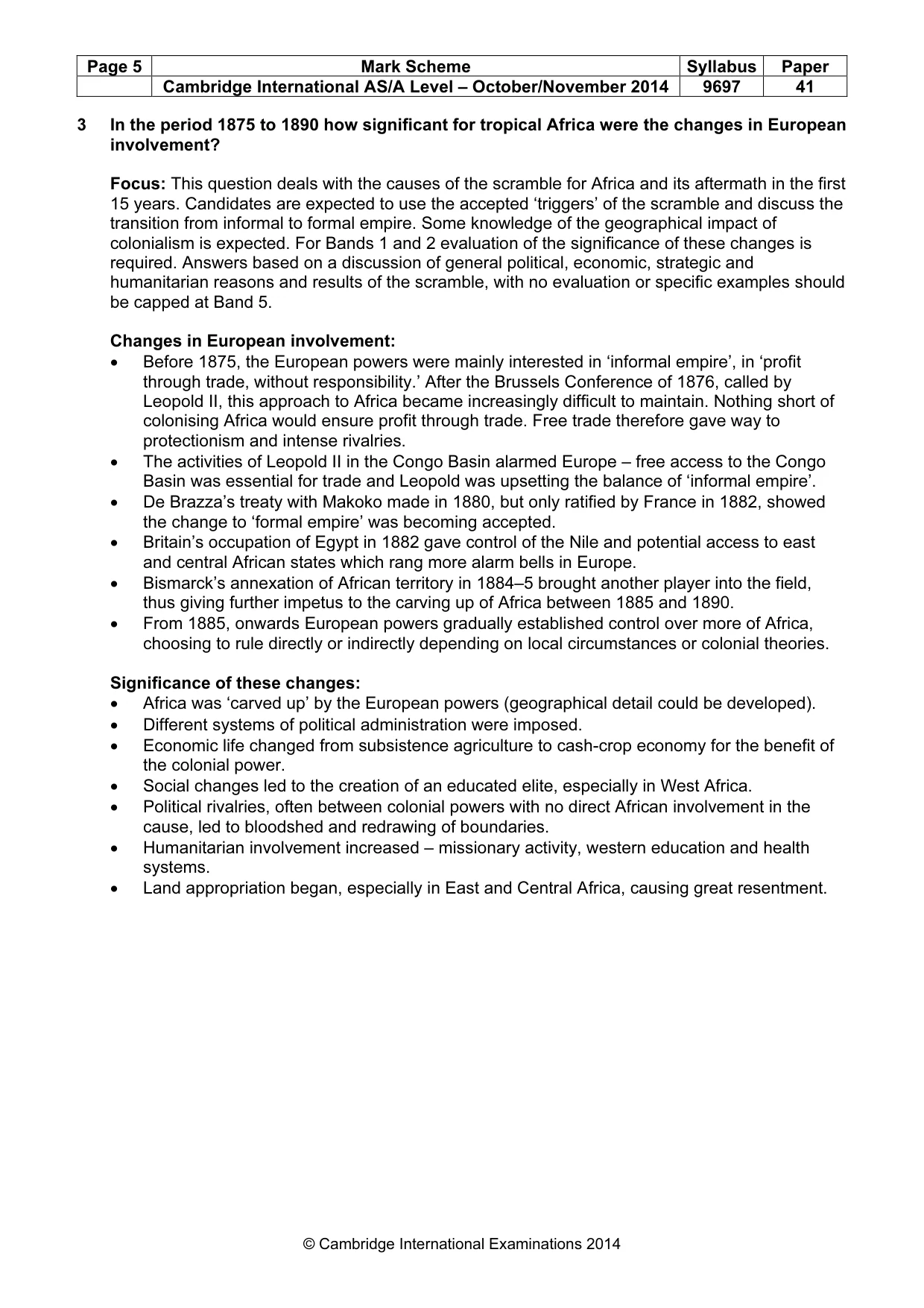
Page 5 Mark Scheme Syllabus Paper Cambridge International AS/A Level – October/November 2014 9697 41 © Cambridge International Examinations 2014 3 In the period 1875 to 1890 how significant for tropical Africa were the changes in European involvement? Focus: This question deals with the causes of the scramble for Africa and its aftermath in the first 15 years. Candidates are expected to use the accepted ‘triggers’ of the scramble and discuss the transition from informal to formal empire. Some knowledge of the geographical impact of colonialism is expected. For Bands 1 and 2 evaluation of the significance of these changes is required. Answers based on a discussion of general political, economic, strategic and humanitarian reasons and results of the scramble, with no evaluation or specific examples should be capped at Band 5. Changes in European involvement: • Before 1875, the European powers were mainly interested in ‘informal empire’, in ‘profit through trade, without responsibility.’ After the Brussels Conference of 1876, called by Leopold II, this approach to Africa became increasingly difficult to maintain. Nothing short of colonising Africa would ensure profit through trade. Free trade therefore gave way to protectionism and intense rivalries. • The activities of Leopold II in the Congo Basin alarmed Europe – free access to the Congo Basin was essential for trade and Leopold was upsetting the balance of ‘informal empire’. • De Brazza’s treaty with Makoko made in 1880, but only ratified by France in 1882, showed the change to ‘formal empire’ was becoming accepted. • Britain’s occupation of Egypt in 1882 gave control of the Nile and potential access to east and central African states which rang more alarm bells in Europe. • Bismarck’s annexation of African territory in 1884–5 brought another player into the field, thus giving further impetus to the carving up of Africa between 1885 and 1890. • From 1885, onwards European powers gradually established control over more of Africa, choosing to rule directly or indirectly depending on local circumstances or colonial theories. Significance of these changes: • Africa was ‘carved up’ by the European powers (geographical detail could be developed). • Different systems of political administration were imposed. • Economic life changed from subsistence agriculture to cash-crop economy for the benefit of the colonial power. • Social changes led to the creation of an educated elite, especially in West Africa. • Political rivalries, often between colonial powers with no direct African involvement in the cause, led to bloodshed and redrawing of boundaries. • Humanitarian involvement increased – missionary activity, western education and health systems. • Land appropriation began, especially in East and Central Africa, causing great resentment.
Mark scheme, page 6
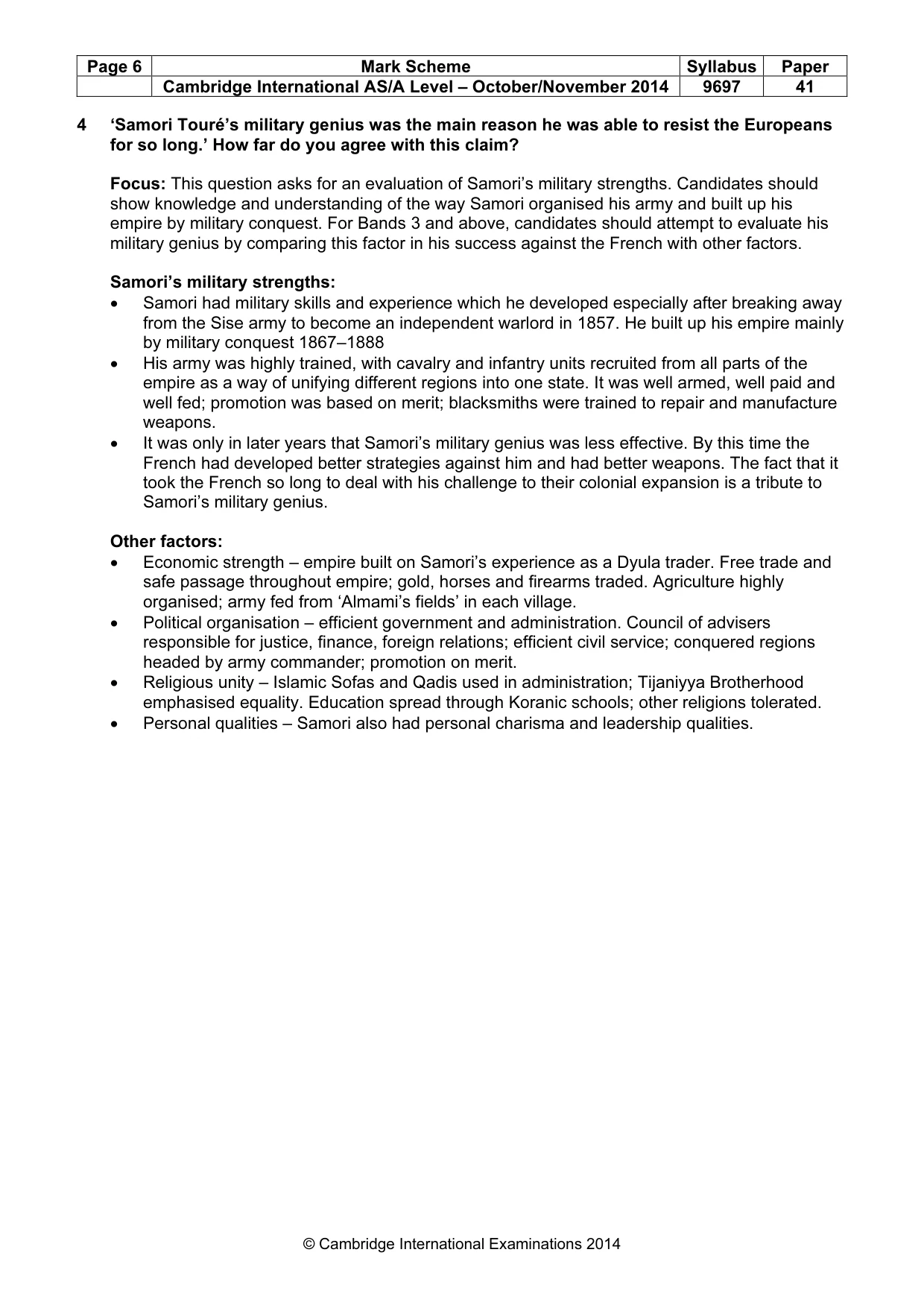
Page 6 Mark Scheme Syllabus Paper Cambridge International AS/A Level – October/November 2014 9697 41 © Cambridge International Examinations 2014 4 ‘Samori Touré’s military genius was the main reason he was able to resist the Europeans for so long.’ How far do you agree with this claim? Focus: This question asks for an evaluation of Samori’s military strengths. Candidates should show knowledge and understanding of the way Samori organised his army and built up his empire by military conquest. For Bands 3 and above, candidates should attempt to evaluate his military genius by comparing this factor in his success against the French with other factors. Samori’s military strengths: • Samori had military skills and experience which he developed especially after breaking away from the Sise army to become an independent warlord in 1857. He built up his empire mainly by military conquest 1867–1888 • His army was highly trained, with cavalry and infantry units recruited from all parts of the empire as a way of unifying different regions into one state. It was well armed, well paid and well fed; promotion was based on merit; blacksmiths were trained to repair and manufacture weapons. • It was only in later years that Samori’s military genius was less effective. By this time the French had developed better strategies against him and had better weapons. The fact that it took the French so long to deal with his challenge to their colonial expansion is a tribute to Samori’s military genius. Other factors: • Economic strength – empire built on Samori’s experience as a Dyula trader. Free trade and safe passage throughout empire; gold, horses and firearms traded. Agriculture highly organised; army fed from ‘Almami’s fields’ in each village. • Political organisation – efficient government and administration. Council of advisers responsible for justice, finance, foreign relations; efficient civil service; conquered regions headed by army commander; promotion on merit. • Religious unity – Islamic Sofas and Qadis used in administration; Tijaniyya Brotherhood emphasised equality. Education spread through Koranic schools; other religions tolerated. • Personal qualities – Samori also had personal charisma and leadership qualities.
Mark scheme, page 7
Page 7 Mark Scheme Syllabus Paper Cambridge International AS/A Level – October/November 2014 9697 41 © Cambridge International Examinations 2014 5 Evaluate the relative importance of Christian missionaries and African leadership in the political development of Buganda between 1875 and 1900. Focus: To examine the interaction between Kabaka, Katikiro, Catholics and Protestants in the history of Buganda between 1875 and 1900 and determine whether these forces drove policy or were merely reactive to it. The facts below could form a framework for argument and evaluation of each development. Good factual support and some evaluation needed for Band 3, developed consideration of multiple factors for Bands 1 and 2. • Christian missionaries first arrived in Uganda after Stanley’s visit in 1875; Mutesa welcomed them – wanted British support against Mahdists and Lubaale cult. Kabaka therefore drove policy. • 1877 – British CMS missionaries (Protestants, Ingleza) and 1878 – French White Fathers (Catholics, Fransa) arrived. Kabaka played the two groups off against each other. Catholic/Protestant rivalry used to drive policy. • 1879–84 – Kabaka Mutesa turned to Ganda gods to cure his sickness, then turned to Islam. White Fathers left Uganda because little progress made. Clearly political development limited, Kabaka’s rule opportunistic and impact of missionaries inconsistent. • Christianity appealed to the Baganda; court pages found comfort in doctrine of equality and dignity of all people and were attracted by printed word, idea of a personal saviour and also of belonging to a worldwide religion outside the restrictions of family, tribe and social status. The popularity of Christianity would therefore have influenced policy. • 1884 – Mwanga became Kabaka. His unstable character led to many missionaries and court pages being murdered 1885–6. Mwanga was influenced by Katikiro Mukasa who wanted to crush the favoured Christian pages. Thus political development was influenced by Kabaka and Katikiro. • The wave of terror at court shocked many Baganda into supporting Christians against Mwanga. So backlash of missionary influence, but political development always very erratic. • Mwanga built up powerful royal party of young Christians and Muslims which led to civil war. • Apolo Kagwa became the Katikiro and held the post for 36 years. This brought some political stability, which was due to his personal qualities. • Under Protestant Katikiro Kagwa, British missionaries were able to pave the way for colonialism. • Kabaka Mwanga supported the Catholic missionaries 1890–92 fearing influence of Imperial British East Africa Company; Fransas persuaded Mwanga to sign treaty with Germany instead of Britain in 1890 but Anglo-German Agreement declared Uganda a British sphere of influence, so the IBEA regained supremacy under Lugard. Apolo Kagwa persuaded Mwanga to accept IBEA and British protection; Lugard subdued most other areas. Protestants triumphed under Kagwa. • 1892 – Protestant victory in civil war; extra (Catholic) Katikiro appointed 1893; missionaries drove policy of land resettlement after war, but Katikiro Kagwa allowed them to. • Protestant Christianity given impetus by reading house movement, this impacted upon political development – government now strongly Protestant/British/western education influenced.
Mark scheme, page 8
Page 8 Mark Scheme Syllabus Paper Cambridge International AS/A Level – October/November 2014 9697 41 © Cambridge International Examinations 2014 6 Explain the main features and assess the impact of British and French colonial administration in West Africa after 1900. Focus: The focus should not be comparing and contrasting but on explaining and assessing the French and British systems of administration in their colonies. There should be a balance between British and French and between explanation and assessment of impact for Bands 1 and 2. Assimilation: French, idealistic, offering all Africans the opportunity to become citizens and to be accepted fully as Frenchmen; only worked when the French colonial empire was confined to 4 small communes in Senegal, became far too expensive, impracticable and later philosophically unacceptable. Impact in Communes therefore considerable – citizens elected mayors, town councillors and provincial legislature, could in theory become elected deputies in French parliament (Blaise Diagne of Senegal the only one). Impact elsewhere negligible as to become a citizen, Africans had to have one wife only, to read, write and speak fluent French, to have done military service and to have worked for French for 10 years (only 500 outside Communes became citizens before 1935). Association: French policy outside 4 Communes. African chiefs ruled but had little power: no jurisdiction in criminal cases, no control of police or prisons; collected taxes for French, given small salary in return, had to conscript Africans for forced labour and for serving in army; could be dismissed for corruption, little real power. Impact on Africans: they were classed as Subjects and had few opportunities. They paid taxes (which benefited the French government), and they did forced labour and military service; they could not publish newspapers, form political parties or join trade unions; most hated was the indigénat which virtually allowed the French administrator to imprison anyone at will; some benefits – education, some medical services, some links with France for trade. Indirect Rule: best example is northern Nigeria under Lugard where Britain ruled through the existing emirs, because it was far cheaper and more convenient. Emirs were allowed to levy taxes, run own law courts and prisons and head local government. Impact – traditional practices continued, religion not interfered with, economic system static, western education not spread, so little development; before colonial rule traditional chiefs could be removed by people if unsatisfactory, now they ruled by will of British; kings lost status. Warrant Chiefs: system used in S.E Nigeria especially among the Igbo, where traditional society had no chiefs and involved most of the people in decision-making through village democracies and supernatural sanctions. Warrant chiefs ruled through native courts, controlled forced labour and became extremely powerful and wealthy but unpopular and corrupt. Impact – chiefs being imposed upon traditional society resulted in confusion and social breakdown; western education became very significant. The Royal Niger Company: ruled Niger territories from 1886 so badly that Britain obliged to take over administration in 1899. RNC consisted of businessmen who would use violence to make profit. RNC bombarded Onitsha when Igbo decreased palm oil production and destroyed half of Asaba to teach natives a lesson. Impact – local people suffered, traditional society destroyed.
Mark scheme, page 9
Page 9 Mark Scheme Syllabus Paper Cambridge International AS/A Level – October/November 2014 9697 41 © Cambridge International Examinations 2014 7 Which ruler do you consider was the more successful in dealing with the British – Prempeh I of the Asante or Lewanika of the Lozi? Focus: Candidates will probably draw the obvious conclusion that Prempeh failed while Lewanika succeeded. Better candidates will be able to see that Prempeh posed a more serious threat and even a military expedition did not completely crush the Asante spirit, while Lewanika held off British colonisation, but in the end his powers were also seriously reduced. If only one ruler or no comparison or contrast, Band 6 maximum as the question asks for a comparative assessment. Some positive points about Prempeh and some negatives about Lewanika are expected for Bands 1 and 2. Prempeh I: aimed to revive the Asante Confederacy destroyed by the British in 1873–4, to re- establish the Asante empire, preserve the independence of his Kingdom, avoid military confrontation with the British, and be accepted as ruler of equal status to the British monarch. Successes: diplomatic ability, personal dignity, was respected by all his people and to some extent was able to revive the disbanded Confederacy. Headed diplomatic mission to London paid for by his people. When he was deported Asante showed loyalty by continuing to rebel against British control for 4 years. Limitations: lacked authority and skill in dealing with British; unable to prove the Asante not aggressive and barbaric, so was always opposed by Britain. In continuing to resist the British without the desire or the firepower to fight, he misjudged the situation; diplomatic error in opening negotiations with Samori Touré – Britain now even more alarmed by French threat and his action provoked British victory of 1896. Lewanika: aimed to preserve his territory from European powers without fighting, gain help against the Ndebele, acquire weapons for defence against Ndebele and his own indunas, open up educational opportunities for his people and consolidate development through peace relations with Europeans. Successes: managed to resist early pressure from British and Boers, showed skilled diplomacy in working with Coillard and negotiating with Lochner to safeguard Lozi interests; developed his country; able to expand his kingdom westward and obtain tribute in ivory, cattle, food crops and slaves; developed centralised state and concept of divine kingship; maintained close control of his army, created a stable government and postponed British protectorate for 20 years. Limitations: manipulated by foreigners; position much weaker after land conceded to British South Africa Company in 1900 and north-west Rhodesia established; failed to foresee long-term consequences of his seeking British protection and Coryndon Treaty; was misled/manipulated by Europeans. Comparison: neither wanted to fight the British, both attempted to achieve aims by negotiation, both very anxious to retain status and dignity of position, both had respect for British rulers, both were accorded loyalty and respect by their people, both used force to expand empire, both empires taken over by British eventually, both rulers offered no resistance. Contrast: Prempeh was trying to restore his kingdom, Lewanika to maintain his; Lewanika more successful at making treaties than Prempeh, Lewanika regarded as a friend by British, Prempeh a threat; Lewanika signed away his authority in a treaty, Prempeh suffered military conquest.
Mark scheme, page 10
Page 10 Mark Scheme Syllabus Paper Cambridge International AS/A Level – October/November 2014 9697 41 © Cambridge International Examinations 2014 8 ‘Resentment against colonial rule was the most important cause of both the Ndebele- Shona Rising of 1896–7 and the Maji-Maji Rising of 1905–7.’ How far do you agree with this analysis? An explanation of the causes of each rising is needed and an evaluation of the relative importance of factors contributing to it. For a mark in Band 3 and above, the given factor and other causes of BOTH risings need to be addressed. For Bands 1 and 2 an evaluation should address ‘How far ..?’ Causes of Ndebele-Shona Rising • Resentment against Britain and BSAC: results of 1893 war left Ndebele wanting revenge. Their military prowess had proved inadequate in the face of British firepower and strategy; indunas had no choice but to surrender, but they were not cowed. BSAC occupation of Mashonaland upset the Shona; takeover of Matabeleland by BSAC as Rhodesia hated by Ndebele – cattle taken, best land occupied, women mistreated and brutality of Company officials all serious grievances; Ndebele expected to become subservient in their own land. • Other factors: natural disasters – poor harvests, drought, locusts, rinderpest decimated cattle stocks; religious leaders, priests of Mwari cult, used these grievances to call for removal of white man. Absence of police and their defeat in the Jameson Raid persuaded Ndebele that BSAC not invincible. Shona resented their loss of trade with the Portuguese. Causes of Maji-Maji Rising • Resentment against German rule: compulsory cotton-growing programme and forced labour on plantations and estates of German settlers bitterly resented; Germans used brutal methods of recruitment of labour and police administered harsh punishments; cotton picking was hard work and Africans were unable to spend time cultivating their own food; protecting cotton from birds and vermin was difficult. Taxation and employment of Swahili Arabs as akidas and jumbes to collect taxes bitterly resented; Africans also resented German disapproval of their traditional religious practices – Christian missionaries tried to abolish witchcraft by burning sacred huts of traditional priests; mercenary soldiers in the German army abused Ngindo women – local chiefs wanted revenge for this. The Ngoni wanted to restore their military reputation after the humiliating defeat in 1897 and the murder of their war-general Chilembo. • Other factors: transformation of the Kololo snake-god cult from a traditional fertility cult into a millenarian and anti-colonial movement which crossed ethnic boundaries. Maji-Maji (magic water) was distributed throughout southern Tanzania as protection against the white man’s bullets. The movement was inspired by the charismatic religious leader Kinjikitile who prophesied new life after the overthrow of the colonial regime.
Mark scheme, page 11
Page 11 Mark Scheme Syllabus Paper Cambridge International AS/A Level – October/November 2014 9697 41 © Cambridge International Examinations 2014 9 Explain, with examples, the appeal of both Islam and Independent African Churches to African peoples during the colonial era. Focus: Candidates may choose their examples from any area of tropical Africa. The reasons for the appeal of Islam and Independent Churches may be seen as similar but the local circumstances were different and this should be identified and explained in the chosen examples. If only one religion, Band 6 maximum, basic facts without explanation of ‘appeal’, Band 5, focus on ‘appeal’ with some analysis, Band 3 and above, depending on quality of analysis and range/depth/detail of examples. Reasons Islam spread during colonial era: Islam offered an alternative to the ‘colonial’ Christianity, it accepted more African social and religious practices (e.g. polygamy), it was spread by Africans themselves and did not have long periods of instruction before converts could be accepted. The establishment of peace and the colonial infrastructure for transport and trade facilitated the spread of Islam. In Northern Nigeria the British deliberately left Islam undisturbed because they wanted the co-operation of the emirs and the French had the same tolerance in their policy of Association. Labour migration helped the spread of Islam e.g. Mossi Muslims from Upper Volta went to work in mines and on cocoa farms in Ghana, Muslim Wolof in Senegal ran groundnut farms and influenced their migrant workers. Reasons for emergence of Independent African Churches during colonial era: The style of management of mission-controlled churches linked them to the white man, to European authority and African subservience. This was particularly hard for West Africans who had run their own churches in the days before Social Darwinism became the norm. There was unease about land alienation in Malawi, also about colonial taxation policies and the use of forced labour. Mission churches were seen as linked to these colonial policies. The slow speed of Africanisation in the mission churches, e.g. the lack of African priests and the delay in promoting Africans within the church hierarchy, was generally resented. In all areas, Independent Churches were started, partly to claim better education, living standards and justice for Africans, and with the intention of making Christianity relevant to African society and culture. Examples which may be developed: • The Muridiyya Muslims in Senegal, in Northern Nigeria where Christian CMS missionaries had little impact due to colonial sponsorship of the Muslim emirs, mass conversions to Islam among the Yao in East Africa and in German-ruled Tanganyika where Swahili Arabs were used as colonial administrators. • In Malawi, Eliot Kamwana and the Watch Tower movement around Livingstonia, also Charles Domingo and the Seventh Day Baptists; John Chilembwe who founded his own Baptist Mission station and promoted black American ideas of improvement for Africans, also in Malawi. • In West Africa, the United Native African Church among the Yoruba, the work of Mojola Agbebi in Nigeria and William Wade Harris in the Ivory Coast.
Mark scheme, page 12
Page 12 Mark Scheme Syllabus Paper Cambridge International AS/A Level – October/November 2014 9697 41 © Cambridge International Examinations 2014 10 Analyse the economic and social results of the building of railways in either Central or East Africa. Focus: A reasonably detailed and accurate description of the railway network in the chosen region needs to be the base for an analysis of the results of the building of railways. Candidates who write generally without showing any knowledge of the railway network – Band 5 maximum. Economic AND social results need to be addressed, either together or separately for Band 3 and above. Quality analysis and detailed support needed for Bands 1 and 2. In addition to a detailed description of the railway network in their chosen region, candidates could base their analysis on any of the following points: Economic results: Though the reasons for the building of railways in both regions may have been primarily political – the need to consolidate claims to territory by establishing effective administration and control – the practical and longer term consequences were largely economic. Some details of the economic activities in the region will be necessary – agriculture, mining, transportation of goods for export/import. In various parts of East Africa, coffee, tea, cotton and sisal were already established as cash crops before 1914. Though many candidates may claim that there was economic exploitation rather than development, there was a boom in African farming for some years after the opening of the railways in East Africa. The Uganda railway was able to pay its way before 1914 mainly by transporting African grown produce. There was a growing emphasis on cash crops and a decline in subsistence agriculture which eventually led to food shortages. European traders were able to increase their imports with the improved facilities for distribution. In both regions much of the best land along the railway routes was eventually allocated to European settlers. Towns sprang up along the railways in both regions with Nairobi an outstanding example. Social results: Social and economic results are difficult to separate as economic and social change went hand in hand. Railway building was an important factor in encouraging Asians and Europeans to settle in Africa and pursue economic activities. Indians came to East Africa to provide labour for railway building and stayed on to become traders. Europeans moved into both regions, particularly into Kenya where they took over much African land in the ‘White Highlands’. This had obvious consequences for the displaced Africans. The Europeans brought education and health facilities; there were institutes for agricultural research and crop development, all positive results for Africans, but there were also many disadvantages for Africans: modern developments disrupted the African way of life with its well-defined social structures and systems of checks and balances; urbanisation, a major result of railway building, brought many social problems to Africa.
What you needed in this session
Cambridge’s own grade thresholds for 2014 Oct/Nov, Paper 4 · Variant 1. A higher threshold means an easier paper — the bar moves with how the cohort did.