Cambridge A Level History (pre-2015) 9697 — 2010 Oct/Nov Paper 4 · Variant 1
9697/41/O/N/10 · 100 marks · ≈113 min
The question paper and its mark scheme, free to read here and free to download. This is Cambridge’s own paper, exactly as it was sat.
Question paper2 pages
Mark scheme
No mark scheme is in the library for this paper.
Paper as text
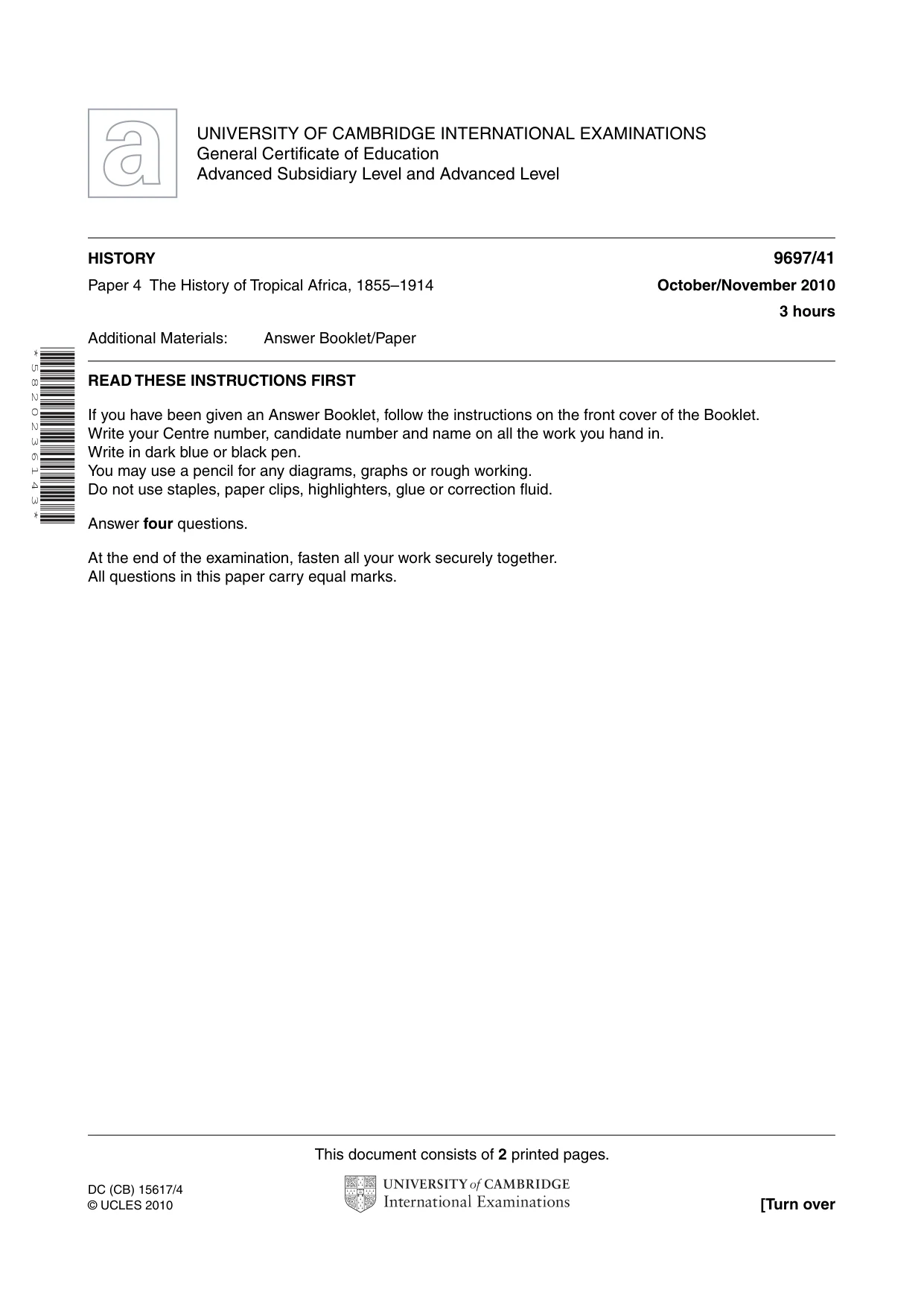
Question paper, page 1
This document consists of 2 printed pages. DC (CB) 15617/4 © UCLES 2010 [Turn over UNIVERSITY OF CAMBRIDGE INTERNATIONAL EXAMINATIONS General Certificate of Education Advanced Subsidiary Level and Advanced Level READ THESE INSTRUCTIONS FIRST If you have been given an Answer Booklet, follow the instructions on the front cover of the Booklet. Write your Centre number, candidate number and name on all the work you hand in. Write in dark blue or black pen. You may use a pencil for any diagrams, graphs or rough working. Do not use staples, paper clips, highlighters, glue or correction fluid. Answer four questions. At the end of the examination, fasten all your work securely together. All questions in this paper carry equal marks. * 5 8 2 0 2 3 6 1 4 3 * HISTORY 9697/41 Paper 4 The History of Tropical Africa, 1855–1914 October/November 2010 3 hours Additional Materials: Answer Booklet/Paper
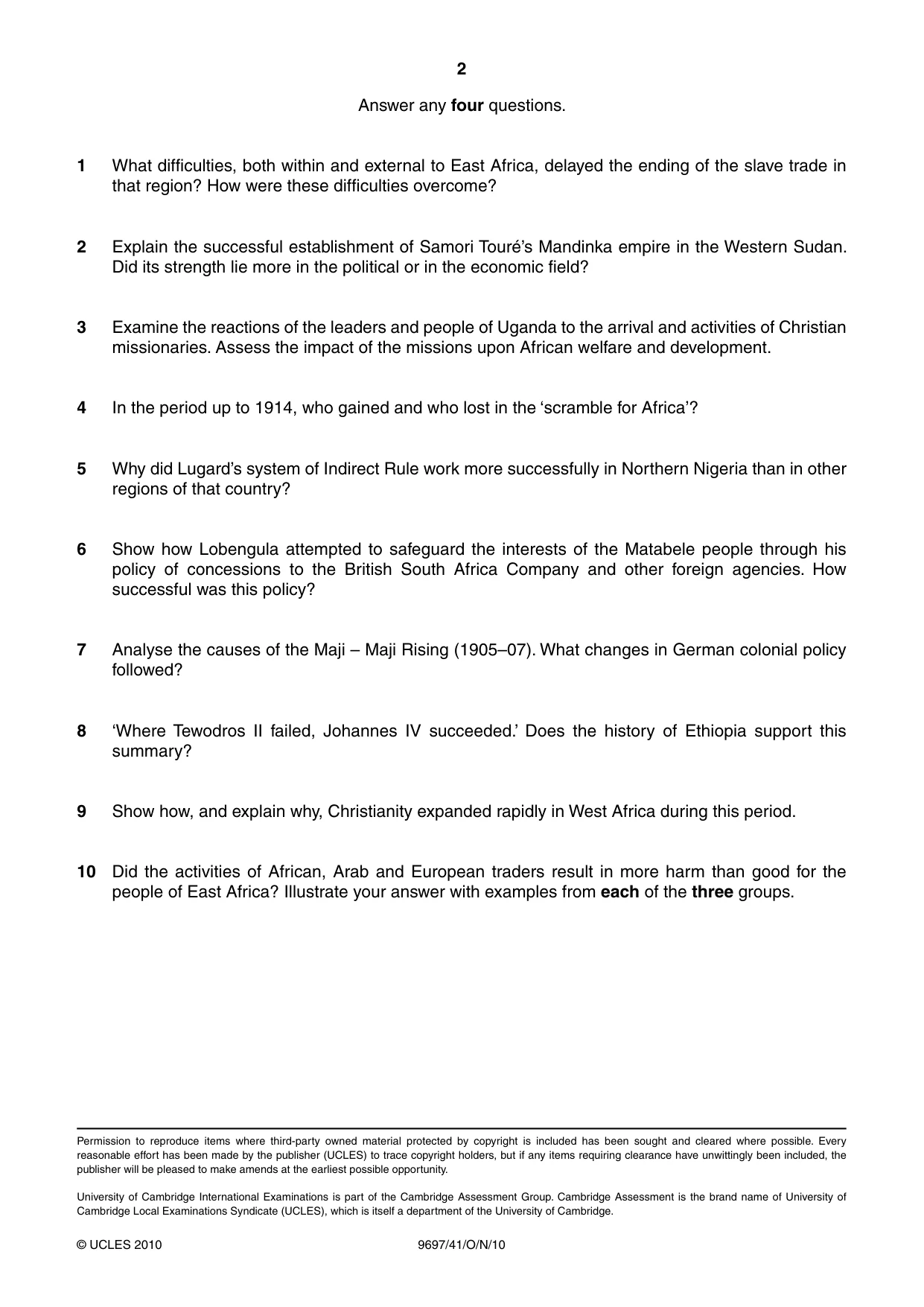
Question paper, page 2
2 9697/41/O/N/10 © UCLES 2010 Answer any four questions. 1 What difficulties, both within and external to East Africa, delayed the ending of the slave trade in that region? How were these difficulties overcome? 2 Explain the successful establishment of Samori Touré’s Mandinka empire in the Western Sudan. Did its strength lie more in the political or in the economic field? 3 Examine the reactions of the leaders and people of Uganda to the arrival and activities of Christian missionaries. Assess the impact of the missions upon African welfare and development. 4 In the period up to 1914, who gained and who lost in the ‘scramble for Africa’? 5 Why did Lugard’s system of Indirect Rule work more successfully in Northern Nigeria than in other regions of that country? 6 Show how Lobengula attempted to safeguard the interests of the Matabele people through his policy of concessions to the British South Africa Company and other foreign agencies. How successful was this policy? 7 Analyse the causes of the Maji – Maji Rising (1905–07). What changes in German colonial policy followed? 8 ‘Where Tewodros II failed, Johannes IV succeeded.’ Does the history of Ethiopia support this summary? 9 Show how, and explain why, Christianity expanded rapidly in West Africa during this period. 10 Did the activities of African, Arab and European traders result in more harm than good for the people of East Africa? Illustrate your answer with examples from each of the three groups. Permission to reproduce items where third-party owned material protected by copyright is included has been sought and cleared where possible. Every reasonable effort has been made by the publisher (UCLES) to trace copyright holders, but if any items requiring clearance have unwittingly been included, the publisher will be pleased to make amends at the earliest possible opportunity. University of Cambridge International Examinations is part of the Cambridge Assessment Group. Cambridge Assessment is the brand name of University of Cambridge Local Examinations Syndicate (UCLES), which is itself a department of the University of Cambridge.
What you needed in this session
Cambridge’s own grade thresholds for 2010 Oct/Nov, Paper 4 · Variant 1. A higher threshold means an easier paper — the bar moves with how the cohort did.