Cambridge A Level Hinduism (AS level only) 8058 — 2016 Oct/Nov Paper 1 · Variant 1
8058/11/O/N/16 · 100 marks · ≈113 min
The question paper and its mark scheme, free to read here and free to download. This is Cambridge’s own paper, exactly as it was sat.
Question paper4 pages
Mark scheme8 pages
Answers below. Sit the paper first if you are practising.
Paper as text
Question paper, page 1
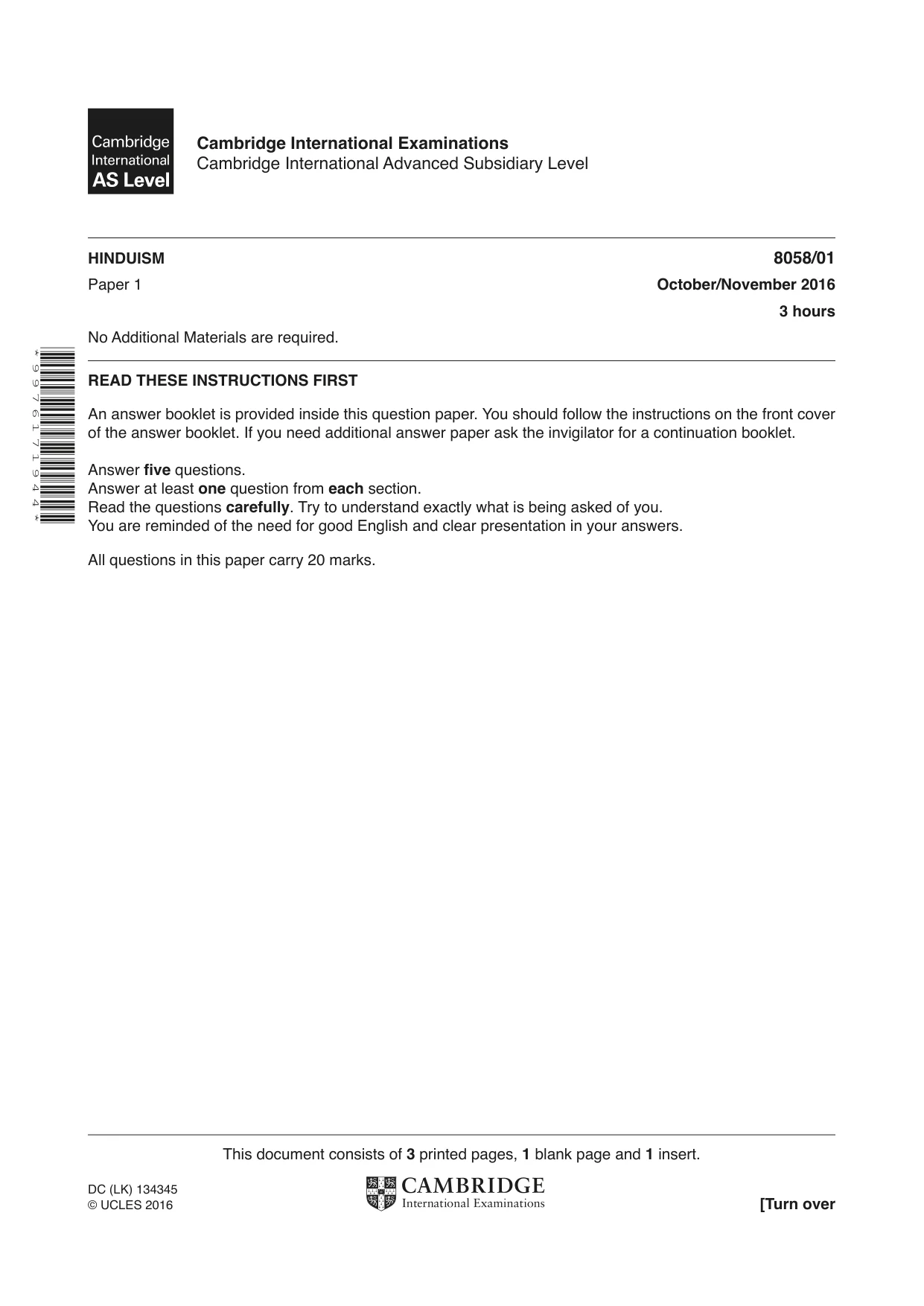
This document consists of 3 printed pages, 1 blank page and 1 insert. DC (LK) 134345 © UCLES 2016 [Turn over Cambridge International Examinations Cambridge International Advanced Subsidiary Level * 9 9 7 6 1 7 1 9 4 4 * HINDUISM 8058/01 Paper 1 October/November 2016 3 hours No Additional Materials are required. READ THESE INSTRUCTIONS FIRST An answer booklet is provided inside this question paper. You should follow the instructions on the front cover of the answer booklet. If you need additional answer paper ask the invigilator for a continuation booklet. Answer five questions. Answer at least one question from each section. Read the questions carefully. Try to understand exactly what is being asked of you. You are reminded of the need for good English and clear presentation in your answers. All questions in this paper carry 20 marks.
Question paper, page 2
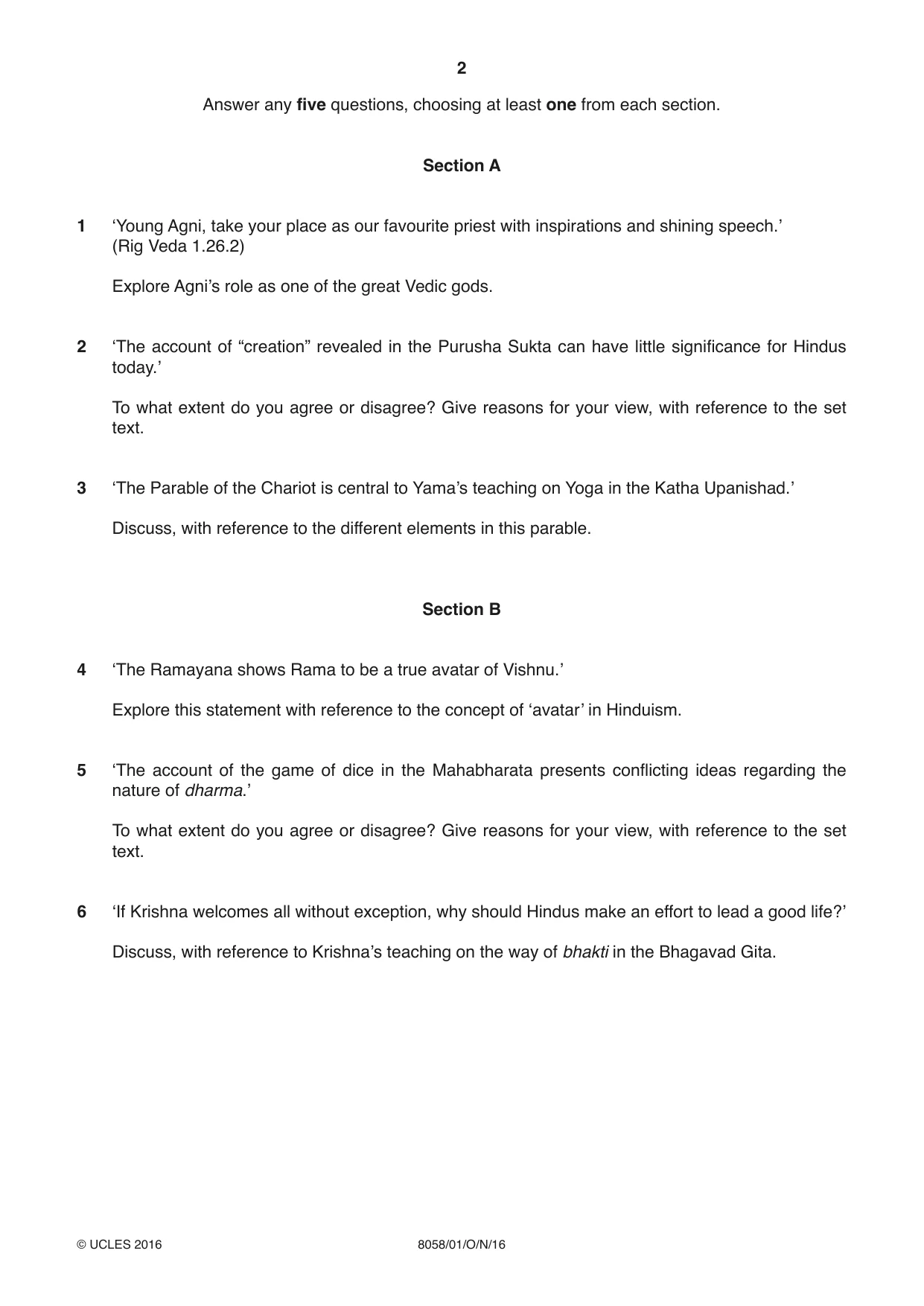
2 8058/01/O/N/16 © UCLES 2016 Answer any five questions, choosing at least one from each section. Section A 1 ‘Young Agni, take your place as our favourite priest with inspirations and shining speech.’ (Rig Veda 1.26.2) Explore Agni’s role as one of the great Vedic gods. 2 ‘The account of “creation” revealed in the Purusha Sukta can have little significance for Hindus today.’ To what extent do you agree or disagree? Give reasons for your view, with reference to the set text. 3 ‘The Parable of the Chariot is central to Yama’s teaching on Yoga in the Katha Upanishad.’ Discuss, with reference to the different elements in this parable. Section B 4 ‘The Ramayana shows Rama to be a true avatar of Vishnu.’ Explore this statement with reference to the concept of ‘avatar’ in Hinduism. 5 ‘The account of the game of dice in the Mahabharata presents conflicting ideas regarding the nature of dharma.’ To what extent do you agree or disagree? Give reasons for your view, with reference to the set text. 6 ‘If Krishna welcomes all without exception, why should Hindus make an effort to lead a good life?’ Discuss, with reference to Krishna’s teaching on the way of bhakti in the Bhagavad Gita.
Question paper, page 3
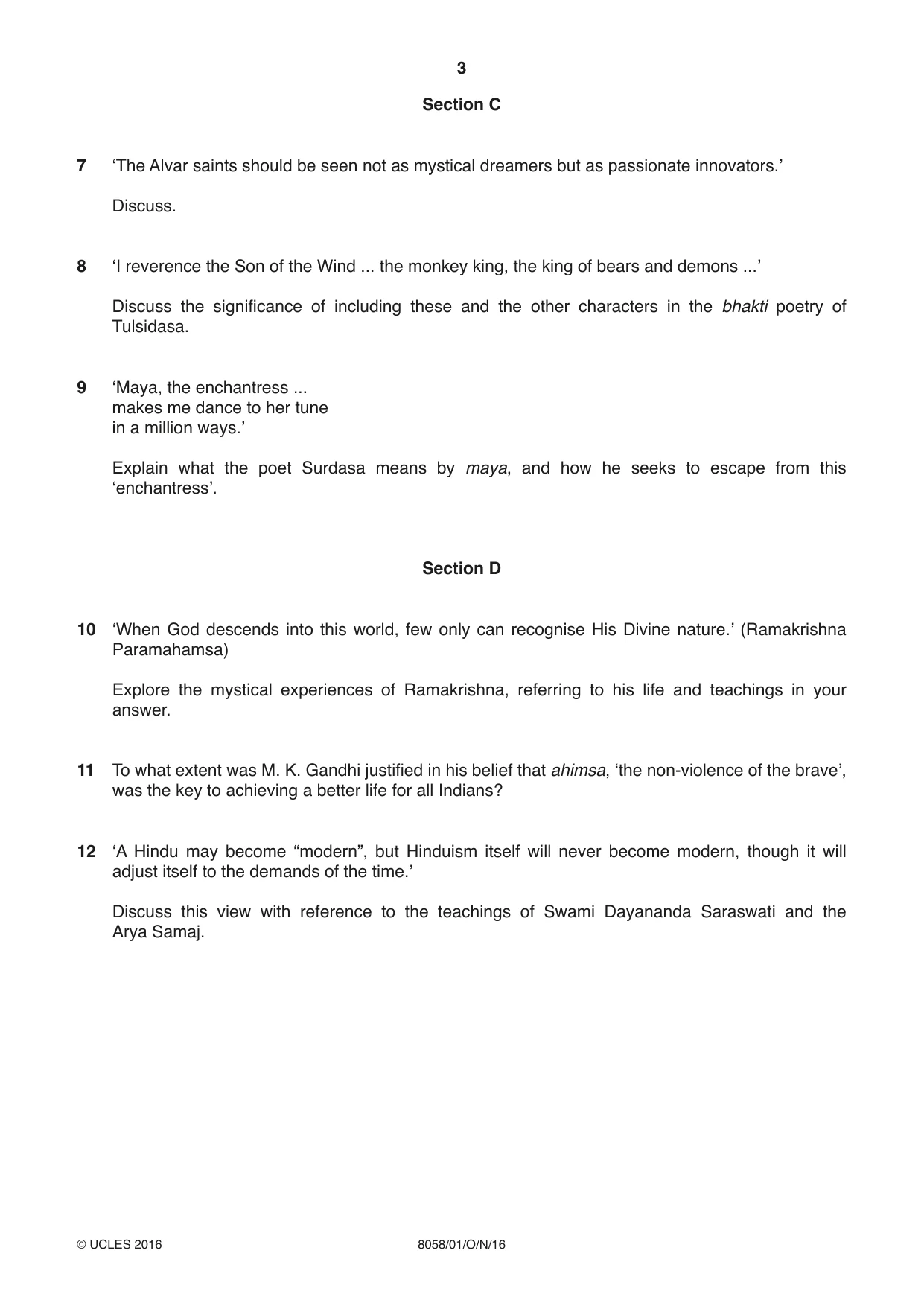
3 8058/01/O/N/16 © UCLES 2016 Section C 7 ‘The Alvar saints should be seen not as mystical dreamers but as passionate innovators.’ Discuss. 8 ‘I reverence the Son of the Wind ... the monkey king, the king of bears and demons ...’ Discuss the significance of including these and the other characters in the bhakti poetry of Tulsidasa. 9 ‘Maya, the enchantress ... makes me dance to her tune in a million ways.’ Explain what the poet Surdasa means by maya, and how he seeks to escape from this ‘enchantress’. Section D 10 ‘When God descends into this world, few only can recognise His Divine nature.’ (Ramakrishna Paramahamsa) Explore the mystical experiences of Ramakrishna, referring to his life and teachings in your answer. 11 To what extent was M. K. Gandhi justified in his belief that ahimsa, ‘the non-violence of the brave’, was the key to achieving a better life for all Indians? 12 ‘A Hindu may become “modern”, but Hinduism itself will never become modern, though it will adjust itself to the demands of the time.’ Discuss this view with reference to the teachings of Swami Dayananda Saraswati and the Arya Samaj.
Question paper, page 4
4 8058/01/O/N/16 © UCLES 2016 Permission to reproduce items where third-party owned material protected by copyright is included has been sought and cleared where possible. Every reasonable effort has been made by the publisher (UCLES) to trace copyright holders, but if any items requiring clearance have unwittingly been included, the publisher will be pleased to make amends at the earliest possible opportunity. To avoid the issue of disclosure of answer-related information to candidates, all copyright acknowledgements are reproduced online in the Cambridge International Examinations Copyright Acknowledgements Booklet. This is produced for each series of examinations and is freely available to download at www.cie.org.uk after the live examination series. Cambridge International Examinations is part of the Cambridge Assessment Group. Cambridge Assessment is the brand name of University of Cambridge Local Examinations Syndicate (UCLES), which is itself a department of the University of Cambridge. BLANK PAGE
Mark scheme, page 1
® IGCSE is the registered trademark of Cambridge International Examinations. This document consists of 8 printed pages. © UCLES 2016 [Turn over Cambridge International Examinations Cambridge International Advanced Subsidiary Level HINDUISM 8058/01 Paper 1 October/November 2016 MARK SCHEME Maximum Mark: 100 Published This mark scheme is published as an aid to teachers and candidates, to indicate the requirements of the examination. It shows the basis on which Examiners were instructed to award marks. It does not indicate the details of the discussions that took place at an Examiners’ meeting before marking began, which would have considered the acceptability of alternative answers. Mark schemes should be read in conjunction with the question paper and the Principal Examiner Report for Teachers. Cambridge will not enter into discussions about these mark schemes. Cambridge is publishing the mark schemes for the October/November 2016 series for most Cambridge IGCSE®, Cambridge International A and AS Level components and some Cambridge O Level components.
Mark scheme, page 2
Page 2 Mark Scheme Syllabus Paper Cambridge International AS Level – October/November 2016 8058 01 © UCLES 2016 CIE GUIDE TO MARKING HINDUISM AS & A LEVEL (8058 & 9014 MAURITIUS) Each essay is marked out of 20, using no half marks. Candidates should have answered five questions, at least one from each of the four Sections A–D. • If they have answered more than five questions, all answers must be marked and the five which score highest should be credited. This adjustment should be noted clearly beside the mark grid on the front of the script. • If they have answered fewer than five questions, this should be noted on the front of the script (e.g. ‘Only three questions answered’). • If they have failed to observe the rubric (e.g. by answering three questions in one Section and ignoring another Section) they should receive the highest total which is consistent with the rubric. ‘Rubric Error’ should be clearly written on the front of the script and on the script packet, along with the Candidate’s number. • If an answer has obviously been numbered wrongly or not numbered at all, it should be marked as the question it appears to be from evidence within the answer. In case of doubt, the script should be referred to the Principal Examiner. The Assessment Objectives specify the following mark breakdown for each essay: (a) knowledge of the topics and specified texts 60% (12 marks) (b) understanding of the meaning and significance of the material studied 25% (5 marks) (Obviously, both of these qualities often appear together). (c) ability to express him/herself explicitly, logically and critically in any argument 15% (3 marks) Although candidates are increasingly being encouraged to recognise the importance of using their knowledge rather than just repeating it, high standards of evaluative skill are not expected in the 8058 and 9014 mark schemes. Differentiation is best achieved by judging: • appropriate coverage of topic; • general coherence of the essay (does it ‘hang together’?); • relevance to the actual question (is the question understood, not just the topic? Is the question actually answered?); • relevance and appropriateness of quotations used (a paraphrase in the right place should score higher than an accurate quotation which is just ‘dragged in’. Sanskrit is not required but, if used, there must evidence in English that it is understood). ‘Grace marks’ should on no account be given. If an adjustment is made when the paper is considered as a whole, it must be on grounds of the quality of a specific answer or answers.
Mark scheme, page 3
Page 3 Mark Scheme Syllabus Paper Cambridge International AS Level – October/November 2016 8058 01 © UCLES 2016 Bands and Descriptors The following Descriptors should be used to aid differentiation in marking. Careful application of these should minimise the need for examiner scaling. A further aim is to use these descriptors to achieve optimum year-on-year consistency in marking. Examiners are expected to familiarise themselves with the following requirements for each Band. In marking each answer, the examiner should always be asking the following key questions: • What Band does the quality of this answer suggest? (say, Band C); • Within the correct Band, should the answer have a higher or a lower mark? (i.e. 12 or 13?). N.B. In no circumstances should marks be awarded simply on the basis of adding up ‘points made’ in the candidate’s answers. Band A 16–20* A commendable answer for an eighteen-year-old; shows a high level of detailed and accurate knowledge, displayed with confidence, clear reasoning and relevance to the question; articulate, well- constructed; For 18, 19 and 20 marks shows evidence of independent interest or background reading. *Examiners should award 19 or 20 as appropriate. A candidate’s script may not be ‘perfect’, but if it is as good as may reasonably be expected from an A level student who had studied this Syllabus then it must be highly rewarded. Band B 14 or 15 A very competent answer, with some evidence of critical judgement attempted; covers the main points in reasonable depth; relates the material coherently to the question on the paper, rather than writing about the topic in general. Band C 12 or 13 Gives an adequate list of the main relevant information, without much additional comment or explanation; possibly a fair repetition of class / teacher’s / textbook notes; answer may be uneven: good in parts but missing an important point or ignoring what the question is actually asking. Band D 10 or 11 Shows a fair understanding of the topic; material mostly relevant, although lacking in detail and/or specific examples; possible weaknesses: misses one whole aspect of the question; writes only in a narrative style, ‘telling the story’; ignores the set question apart from a final paragraph; presents material as a list rather than a sustained argument.* *When this has happened because time was running out, it is important to pay careful attention to the quality of the ‘list’ given, and to look out for clues to understanding (which can be credited).
Mark scheme, page 4
Page 4 Mark Scheme Syllabus Paper Cambridge International AS Level – October/November 2016 8058 01 © UCLES 2016 Band E 8 or 9 basic knowledge only, but what appears is fairly accurate; shows just enough understanding of the topic, though possibly not of the question being asked; possible weaknesses: a seemingly pre- prepared answer copied out; a short answer ‘padded out’ with irrelevant material; weakly argued, contains material which contradicts the accurate part, or in some other way raises doubts about the candidate’s understanding. It is particularly important to be fair at the lowest level. Differentiation must be as accurate as possible here as everywhere else across the mark range. There is a significant qualitative difference between an answer scoring 7 and one scoring 3. Marking very weak answers is difficult because they tend to be weak in different, unpredictable and idiosyncratic ways. Some are ‘last minute’ answers from good candidates, abandoned for lack of time. The following are guidelines, but answers / scripts which are particularly problematic should always be referred to the Principal Examiner. 6 or 7 knowledge too limited; answer thin on detail; understanding in doubt (of the topic itself and/ or of what is being asked); standard of writing / approach to the question is more appropriate to O Level; very short (typically, one page of script). 4 or 5 a minimal attempt made to address the topic; recognition of several key terms (e.g. karma, dharma, Upanishad); a few sentences written which show evidence of recognising the topic / or show an attempt to give a ‘common sense’ answer; short (at least half, but less than one page of script). 2 or 3 shows recognition of meaning of at least two key terms relevant to the question, even if what is written is incoherent or fails to make a point; one or two paragraphs only (perhaps half a page in total). 1 at least one sentence containing a pertinent point or key term and showing some understanding of its meaning / relevance. 0 no discernible relevance at all to the topic or the question.
Mark scheme, page 5
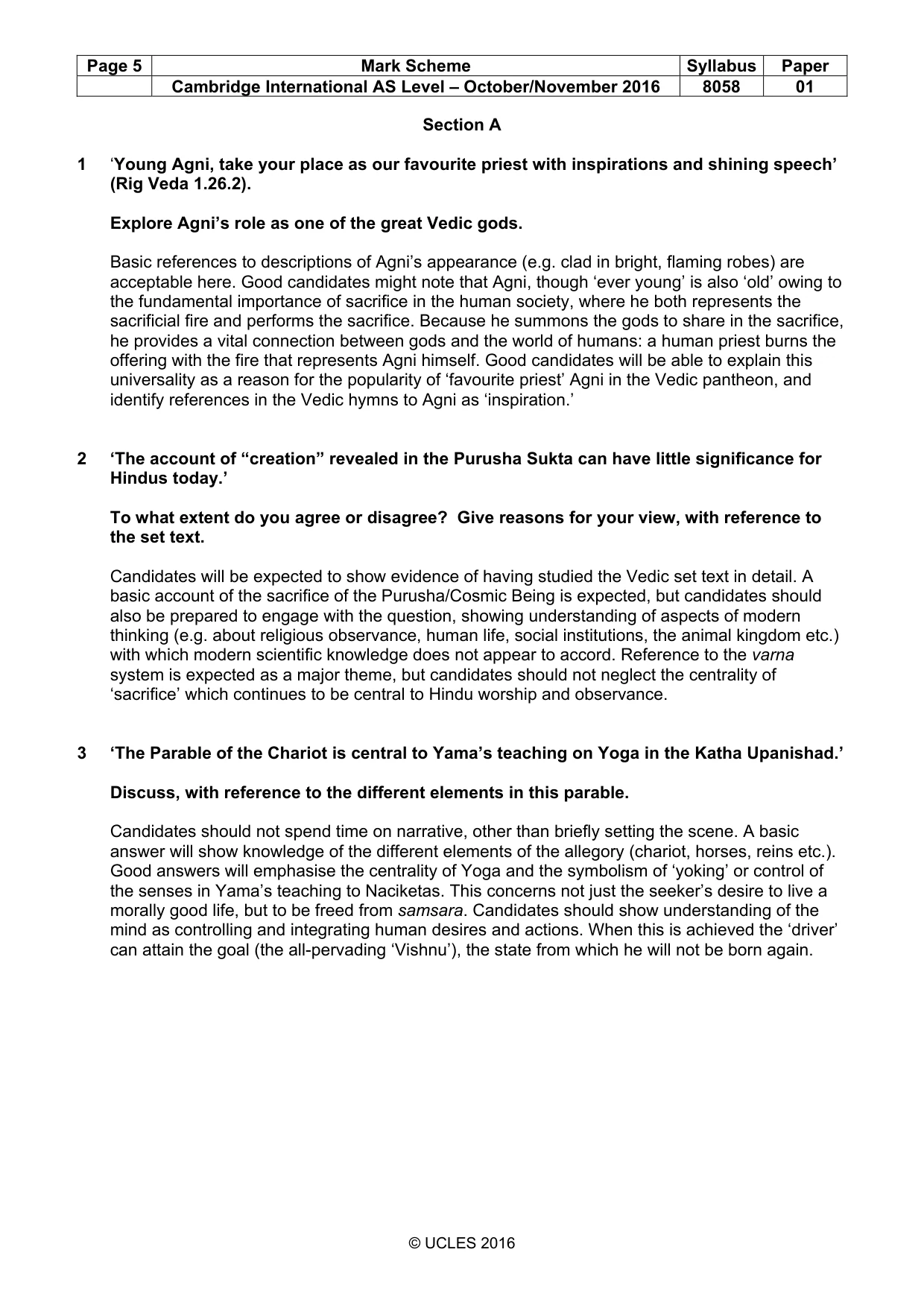
Page 5 Mark Scheme Syllabus Paper Cambridge International AS Level – October/November 2016 8058 01 © UCLES 2016 Section A 1 ‘Young Agni, take your place as our favourite priest with inspirations and shining speech’ (Rig Veda 1.26.2). Explore Agni’s role as one of the great Vedic gods. Basic references to descriptions of Agni’s appearance (e.g. clad in bright, flaming robes) are acceptable here. Good candidates might note that Agni, though ‘ever young’ is also ‘old’ owing to the fundamental importance of sacrifice in the human society, where he both represents the sacrificial fire and performs the sacrifice. Because he summons the gods to share in the sacrifice, he provides a vital connection between gods and the world of humans: a human priest burns the offering with the fire that represents Agni himself. Good candidates will be able to explain this universality as a reason for the popularity of ‘favourite priest’ Agni in the Vedic pantheon, and identify references in the Vedic hymns to Agni as ‘inspiration.’ 2 ‘The account of “creation” revealed in the Purusha Sukta can have little significance for Hindus today.’ To what extent do you agree or disagree? Give reasons for your view, with reference to the set text. Candidates will be expected to show evidence of having studied the Vedic set text in detail. A basic account of the sacrifice of the Purusha/Cosmic Being is expected, but candidates should also be prepared to engage with the question, showing understanding of aspects of modern thinking (e.g. about religious observance, human life, social institutions, the animal kingdom etc.) with which modern scientific knowledge does not appear to accord. Reference to the varna system is expected as a major theme, but candidates should not neglect the centrality of ‘sacrifice’ which continues to be central to Hindu worship and observance. 3 ‘The Parable of the Chariot is central to Yama’s teaching on Yoga in the Katha Upanishad.’ Discuss, with reference to the different elements in this parable. Candidates should not spend time on narrative, other than briefly setting the scene. A basic answer will show knowledge of the different elements of the allegory (chariot, horses, reins etc.). Good answers will emphasise the centrality of Yoga and the symbolism of ‘yoking’ or control of the senses in Yama’s teaching to Naciketas. This concerns not just the seeker’s desire to live a morally good life, but to be freed from samsara. Candidates should show understanding of the mind as controlling and integrating human desires and actions. When this is achieved the ‘driver’ can attain the goal (the all-pervading ‘Vishnu’), the state from which he will not be born again.
Mark scheme, page 6
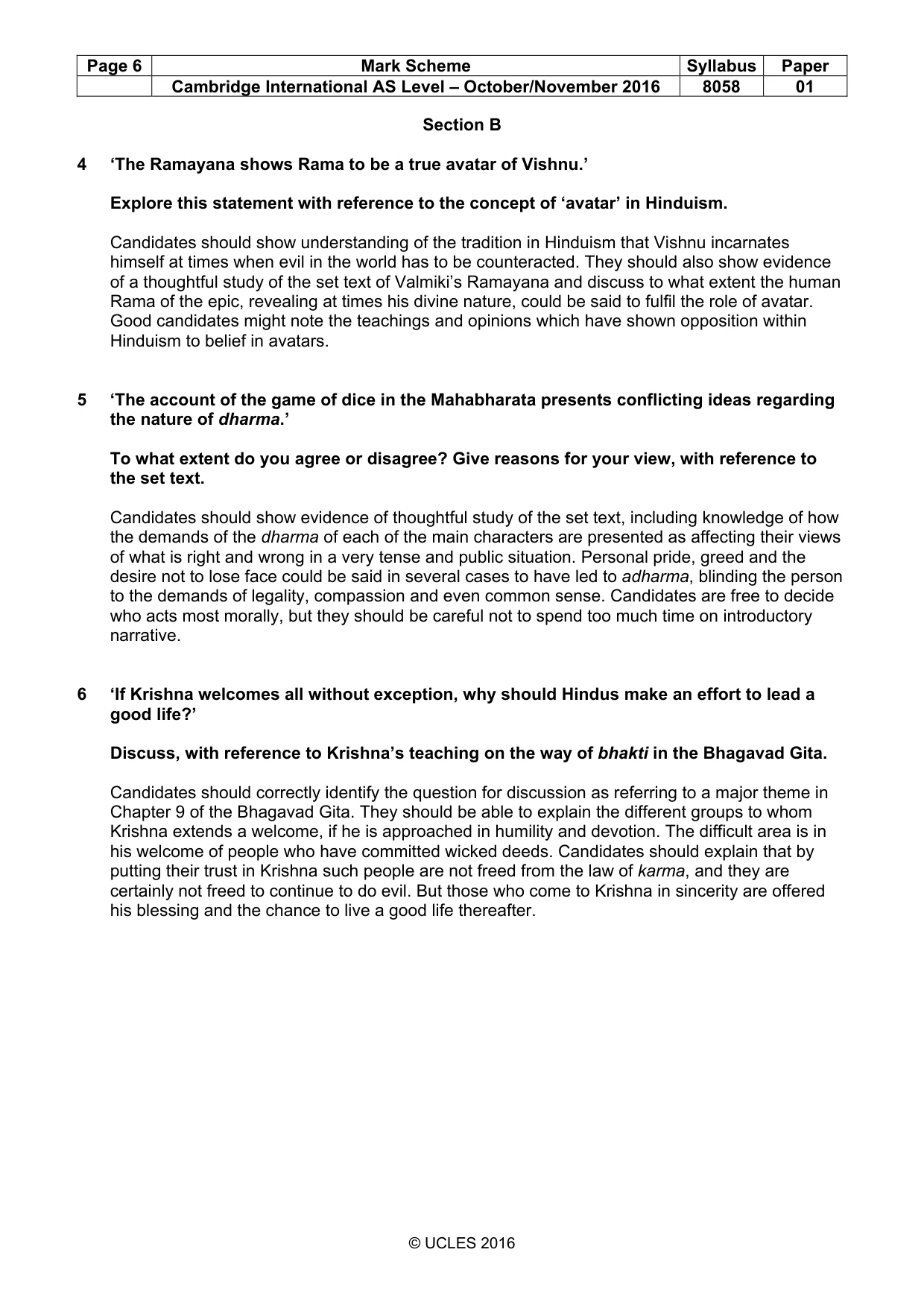
Page 6 Mark Scheme Syllabus Paper Cambridge International AS Level – October/November 2016 8058 01 © UCLES 2016 Section B 4 ‘The Ramayana shows Rama to be a true avatar of Vishnu.’ Explore this statement with reference to the concept of ‘avatar’ in Hinduism. Candidates should show understanding of the tradition in Hinduism that Vishnu incarnates himself at times when evil in the world has to be counteracted. They should also show evidence of a thoughtful study of the set text of Valmiki’s Ramayana and discuss to what extent the human Rama of the epic, revealing at times his divine nature, could be said to fulfil the role of avatar. Good candidates might note the teachings and opinions which have shown opposition within Hinduism to belief in avatars. 5 ‘The account of the game of dice in the Mahabharata presents conflicting ideas regarding the nature of dharma.’ To what extent do you agree or disagree? Give reasons for your view, with reference to the set text. Candidates should show evidence of thoughtful study of the set text, including knowledge of how the demands of the dharma of each of the main characters are presented as affecting their views of what is right and wrong in a very tense and public situation. Personal pride, greed and the desire not to lose face could be said in several cases to have led to adharma, blinding the person to the demands of legality, compassion and even common sense. Candidates are free to decide who acts most morally, but they should be careful not to spend too much time on introductory narrative. 6 ‘If Krishna welcomes all without exception, why should Hindus make an effort to lead a good life?’ Discuss, with reference to Krishna’s teaching on the way of bhakti in the Bhagavad Gita. Candidates should correctly identify the question for discussion as referring to a major theme in Chapter 9 of the Bhagavad Gita. They should be able to explain the different groups to whom Krishna extends a welcome, if he is approached in humility and devotion. The difficult area is in his welcome of people who have committed wicked deeds. Candidates should explain that by putting their trust in Krishna such people are not freed from the law of karma, and they are certainly not freed to continue to do evil. But those who come to Krishna in sincerity are offered his blessing and the chance to live a good life thereafter.
Mark scheme, page 7
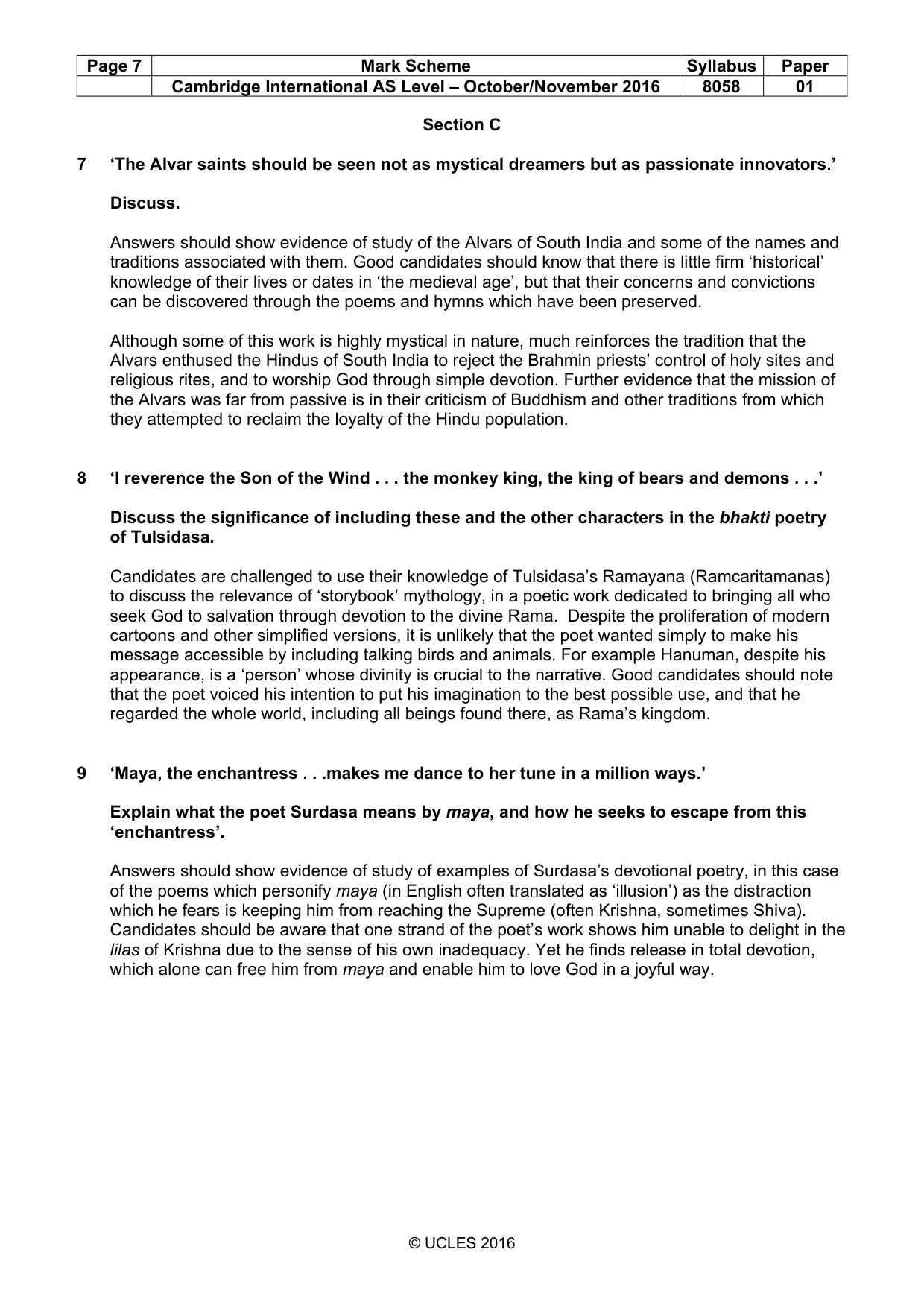
Page 7 Mark Scheme Syllabus Paper Cambridge International AS Level – October/November 2016 8058 01 © UCLES 2016 Section C 7 ‘The Alvar saints should be seen not as mystical dreamers but as passionate innovators.’ Discuss. Answers should show evidence of study of the Alvars of South India and some of the names and traditions associated with them. Good candidates should know that there is little firm ‘historical’ knowledge of their lives or dates in ‘the medieval age’, but that their concerns and convictions can be discovered through the poems and hymns which have been preserved. Although some of this work is highly mystical in nature, much reinforces the tradition that the Alvars enthused the Hindus of South India to reject the Brahmin priests’ control of holy sites and religious rites, and to worship God through simple devotion. Further evidence that the mission of the Alvars was far from passive is in their criticism of Buddhism and other traditions from which they attempted to reclaim the loyalty of the Hindu population. 8 ‘I reverence the Son of the Wind . . . the monkey king, the king of bears and demons . . .’ Discuss the significance of including these and the other characters in the bhakti poetry of Tulsidasa. Candidates are challenged to use their knowledge of Tulsidasa’s Ramayana (Ramcaritamanas) to discuss the relevance of ‘storybook’ mythology, in a poetic work dedicated to bringing all who seek God to salvation through devotion to the divine Rama. Despite the proliferation of modern cartoons and other simplified versions, it is unlikely that the poet wanted simply to make his message accessible by including talking birds and animals. For example Hanuman, despite his appearance, is a ‘person’ whose divinity is crucial to the narrative. Good candidates should note that the poet voiced his intention to put his imagination to the best possible use, and that he regarded the whole world, including all beings found there, as Rama’s kingdom. 9 ‘Maya, the enchantress . . .makes me dance to her tune in a million ways.’ Explain what the poet Surdasa means by maya, and how he seeks to escape from this ‘enchantress’. Answers should show evidence of study of examples of Surdasa’s devotional poetry, in this case of the poems which personify maya (in English often translated as ‘illusion’) as the distraction which he fears is keeping him from reaching the Supreme (often Krishna, sometimes Shiva). Candidates should be aware that one strand of the poet’s work shows him unable to delight in the lilas of Krishna due to the sense of his own inadequacy. Yet he finds release in total devotion, which alone can free him from maya and enable him to love God in a joyful way.
Mark scheme, page 8
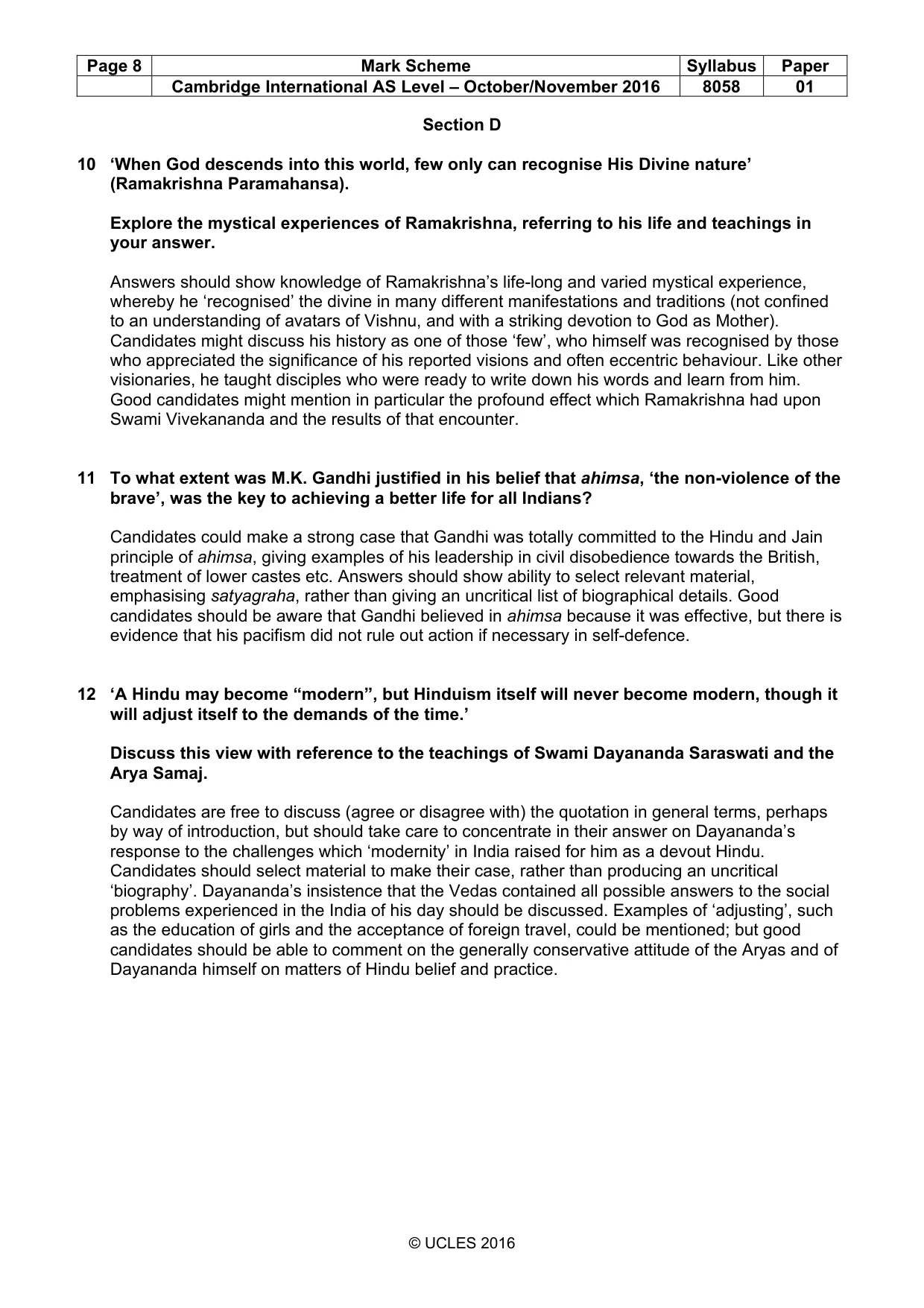
Page 8 Mark Scheme Syllabus Paper Cambridge International AS Level – October/November 2016 8058 01 © UCLES 2016 Section D 10 ‘When God descends into this world, few only can recognise His Divine nature’ (Ramakrishna Paramahansa). Explore the mystical experiences of Ramakrishna, referring to his life and teachings in your answer. Answers should show knowledge of Ramakrishna’s life-long and varied mystical experience, whereby he ‘recognised’ the divine in many different manifestations and traditions (not confined to an understanding of avatars of Vishnu, and with a striking devotion to God as Mother). Candidates might discuss his history as one of those ‘few’, who himself was recognised by those who appreciated the significance of his reported visions and often eccentric behaviour. Like other visionaries, he taught disciples who were ready to write down his words and learn from him. Good candidates might mention in particular the profound effect which Ramakrishna had upon Swami Vivekananda and the results of that encounter. 11 To what extent was M.K. Gandhi justified in his belief that ahimsa, ‘the non-violence of the brave’, was the key to achieving a better life for all Indians? Candidates could make a strong case that Gandhi was totally committed to the Hindu and Jain principle of ahimsa, giving examples of his leadership in civil disobedience towards the British, treatment of lower castes etc. Answers should show ability to select relevant material, emphasising satyagraha, rather than giving an uncritical list of biographical details. Good candidates should be aware that Gandhi believed in ahimsa because it was effective, but there is evidence that his pacifism did not rule out action if necessary in self-defence. 12 ‘A Hindu may become “modern”, but Hinduism itself will never become modern, though it will adjust itself to the demands of the time.’ Discuss this view with reference to the teachings of Swami Dayananda Saraswati and the Arya Samaj. Candidates are free to discuss (agree or disagree with) the quotation in general terms, perhaps by way of introduction, but should take care to concentrate in their answer on Dayananda’s response to the challenges which ‘modernity’ in India raised for him as a devout Hindu. Candidates should select material to make their case, rather than producing an uncritical ‘biography’. Dayananda’s insistence that the Vedas contained all possible answers to the social problems experienced in the India of his day should be discussed. Examples of ‘adjusting’, such as the education of girls and the acceptance of foreign travel, could be mentioned; but good candidates should be able to comment on the generally conservative attitude of the Aryas and of Dayananda himself on matters of Hindu belief and practice.
What you needed in this session
Cambridge’s own grade thresholds for 2016 Oct/Nov, Paper 1 · Variant 1. A higher threshold means an easier paper — the bar moves with how the cohort did.