Cambridge A Level Hinduism (AS level only) 8058 — 2011 Oct/Nov Paper 1 · Variant 1
8058/11/O/N/11 · 100 marks · ≈113 min
The question paper and its mark scheme, free to read here and free to download. This is Cambridge’s own paper, exactly as it was sat.
Question paper4 pages

Mark scheme6 pages
Answers below. Sit the paper first if you are practising.
Paper as text
Question paper, page 1
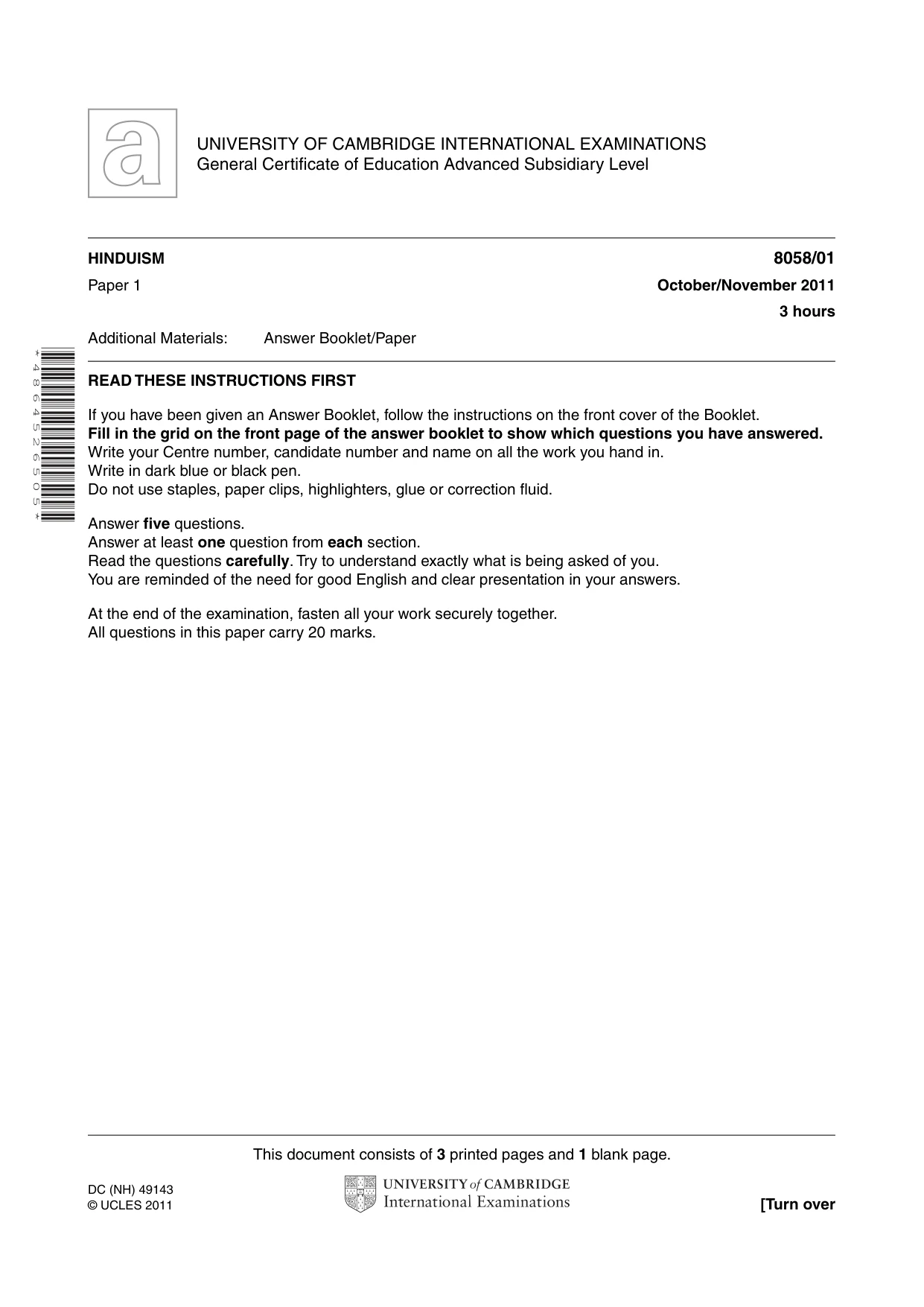
This document consists of 3 printed pages and 1 blank page. DC (NH) 49143 © UCLES 2011 [Turn over UNIVERSITY OF CAMBRIDGE INTERNATIONAL EXAMINATIONS General Certificate of Education Advanced Subsidiary Level HINDUISM 8058/01 Paper 1 October/November 2011 3 hours Additional Materials: Answer Booklet/Paper READ THESE INSTRUCTIONS FIRST If you have been given an Answer Booklet, follow the instructions on the front cover of the Booklet. Fill in the grid on the front page of the answer booklet to show which questions you have answered. Write your Centre number, candidate number and name on all the work you hand in. Write in dark blue or black pen. Do not use staples, paper clips, highlighters, glue or correction fluid. Answer five questions. Answer at least one question from each section. Read the questions carefully. Try to understand exactly what is being asked of you. You are reminded of the need for good English and clear presentation in your answers. At the end of the examination, fasten all your work securely together. All questions in this paper carry 20 marks. * 4 8 6 4 5 2 6 5 0 5 *
Question paper, page 2
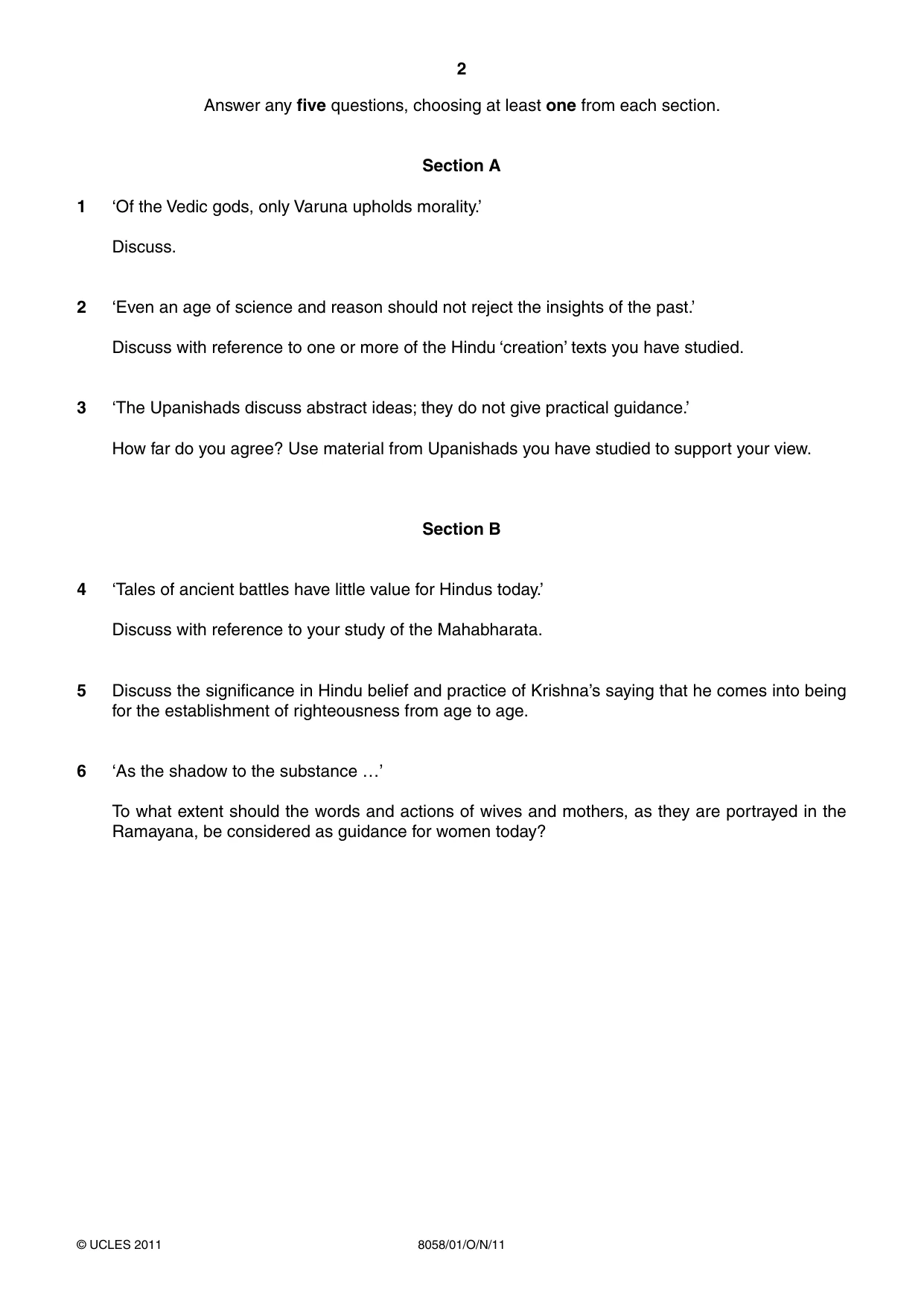
2 8058/01/O/N/11 © UCLES 2011 Answer any five questions, choosing at least one from each section. Section A 1 ‘Of the Vedic gods, only Varuna upholds morality.’ Discuss. 2 ‘Even an age of science and reason should not reject the insights of the past.’ Discuss with reference to one or more of the Hindu ‘creation’ texts you have studied. 3 ‘The Upanishads discuss abstract ideas; they do not give practical guidance.’ How far do you agree? Use material from Upanishads you have studied to support your view. Section B 4 ‘Tales of ancient battles have little value for Hindus today.’ Discuss with reference to your study of the Mahabharata. 5 Discuss the significance in Hindu belief and practice of Krishna’s saying that he comes into being for the establishment of righteousness from age to age. 6 ‘As the shadow to the substance …’ To what extent should the words and actions of wives and mothers, as they are portrayed in the Ramayana, be considered as guidance for women today?
Question paper, page 3
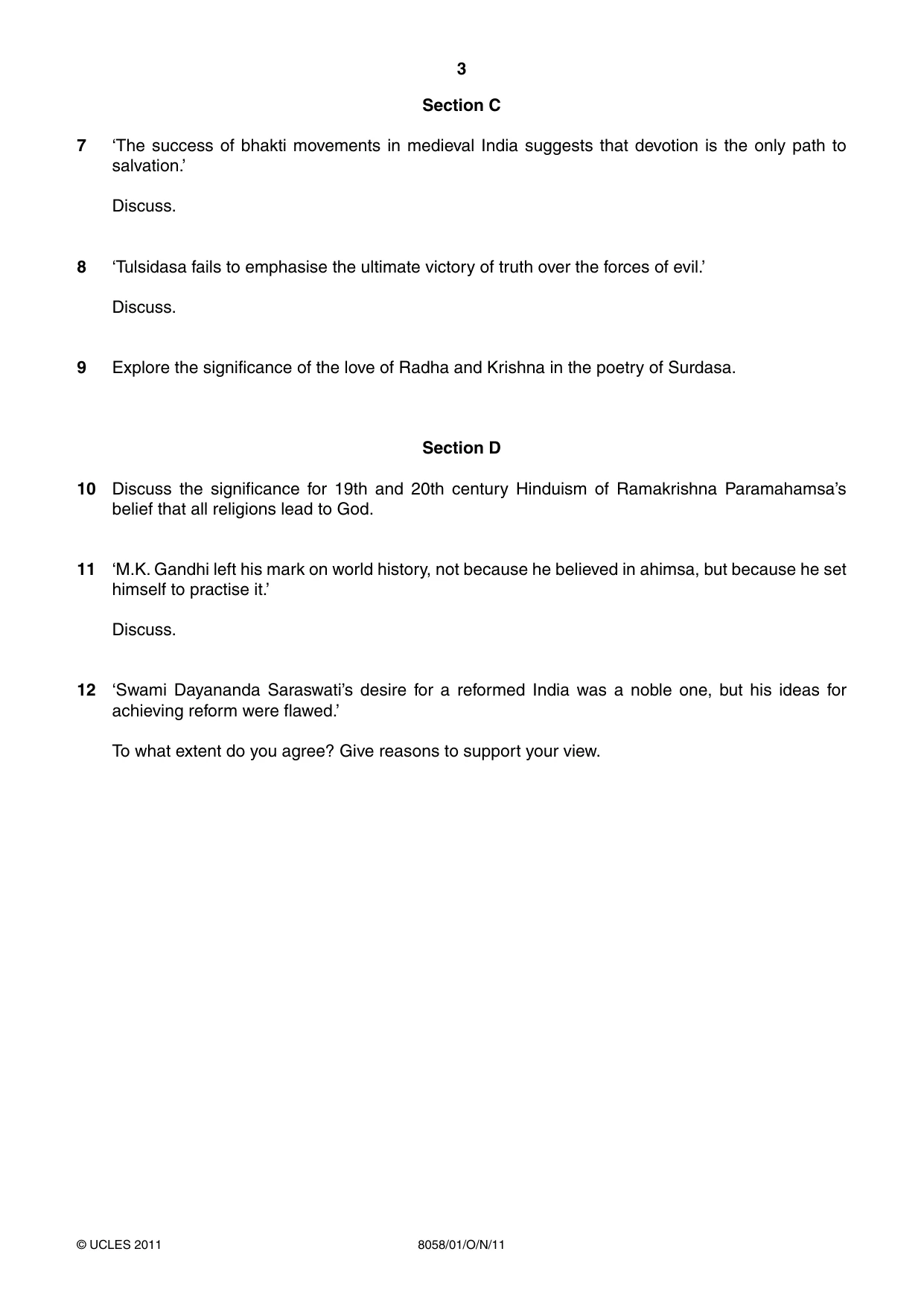
3 8058/01/O/N/11 © UCLES 2011 Section C 7 ‘The success of bhakti movements in medieval India suggests that devotion is the only path to salvation.’ Discuss. 8 ‘Tulsidasa fails to emphasise the ultimate victory of truth over the forces of evil.’ Discuss. 9 Explore the significance of the love of Radha and Krishna in the poetry of Surdasa. Section D 10 Discuss the significance for 19th and 20th century Hinduism of Ramakrishna Paramahamsa’s belief that all religions lead to God. 11 ‘M.K. Gandhi left his mark on world history, not because he believed in ahimsa, but because he set himself to practise it.’ Discuss. 12 ‘Swami Dayananda Saraswati’s desire for a reformed India was a noble one, but his ideas for achieving reform were flawed.’ To what extent do you agree? Give reasons to support your view.
Question paper, page 4
4 8058/01/O/N/11 © UCLES 2011 Permission to reproduce items where third-party owned material protected by copyright is included has been sought and cleared where possible. Every reasonable effort has been made by the publisher (UCLES) to trace copyright holders, but if any items requiring clearance have unwittingly been included, the publisher will be pleased to make amends at the earliest possible opportunity. University of Cambridge International Examinations is part of the Cambridge Assessment Group. Cambridge Assessment is the brand name of University of Cambridge Local Examinations Syndicate (UCLES), which is itself a department of the University of Cambridge. BLANK PAGE
Mark scheme, page 1
UNIVERSITY OF CAMBRIDGE INTERNATIONAL EXAMINATIONS GCE Advanced Subsidiary Level MARK SCHEME for the October/November 2011 question paper for the guidance of teachers 8058 HINDUISM 8058/01 Paper 1, maximum raw mark 100 This mark scheme is published as an aid to teachers and candidates, to indicate the requirements of the examination. It shows the basis on which Examiners were instructed to award marks. It does not indicate the details of the discussions that took place at an Examiners’ meeting before marking began, which would have considered the acceptability of alternative answers. Mark schemes must be read in conjunction with the question papers and the report on the examination. • Cambridge will not enter into discussions or correspondence in connection with these mark schemes. Cambridge is publishing the mark schemes for the October/November 2011 question papers for most IGCSE, GCE Advanced Level and Advanced Subsidiary Level syllabuses and some Ordinary Level syllabuses.
Mark scheme, page 2
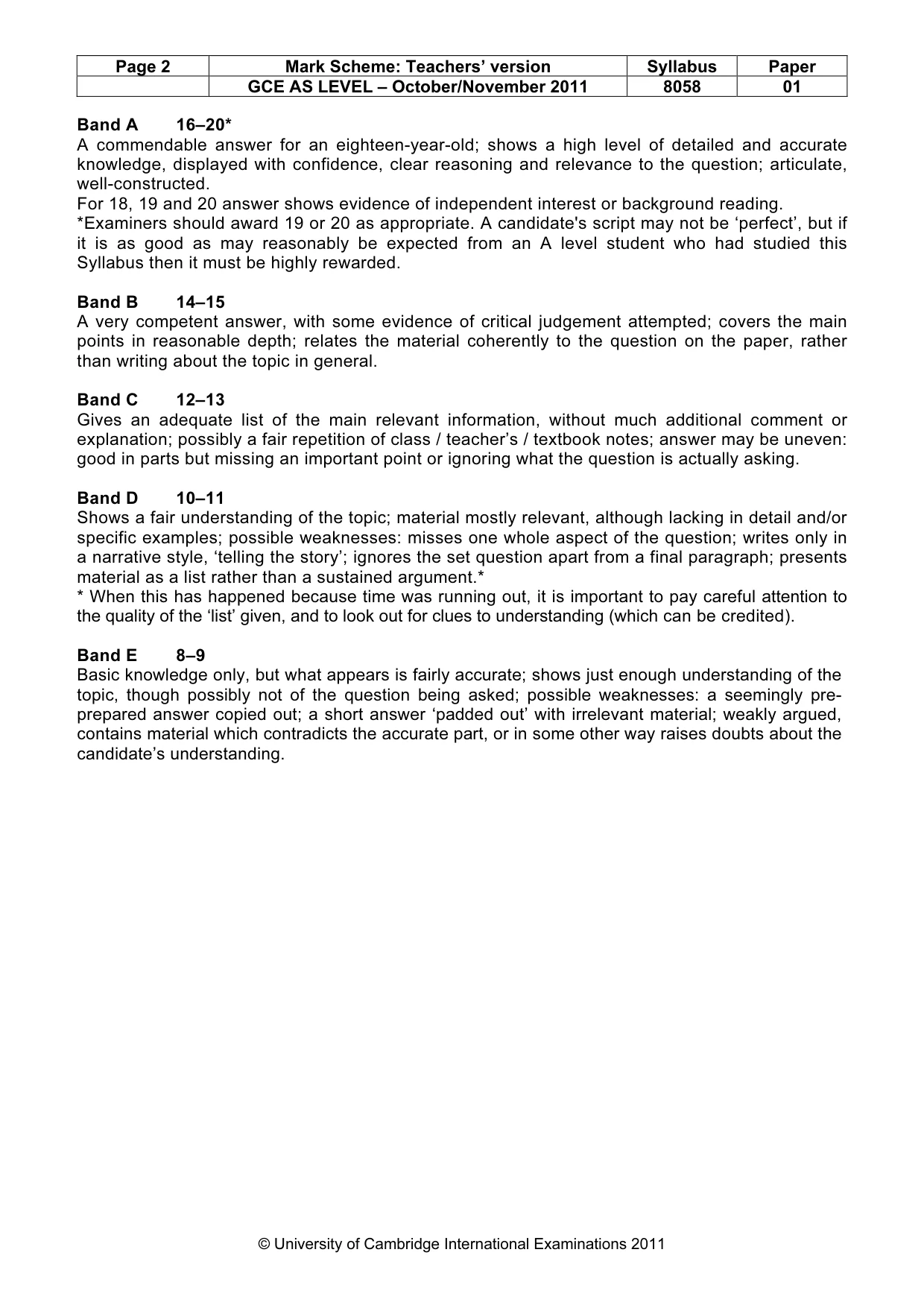
Page 2 Mark Scheme: Teachers’ version Syllabus Paper GCE AS LEVEL – October/November 2011 8058 01 © University of Cambridge International Examinations 2011 Band A 16–20* A commendable answer for an eighteen-year-old; shows a high level of detailed and accurate knowledge, displayed with confidence, clear reasoning and relevance to the question; articulate, well-constructed. For 18, 19 and 20 answer shows evidence of independent interest or background reading. *Examiners should award 19 or 20 as appropriate. A candidate's script may not be ‘perfect’, but if it is as good as may reasonably be expected from an A level student who had studied this Syllabus then it must be highly rewarded. Band B 14–15 A very competent answer, with some evidence of critical judgement attempted; covers the main points in reasonable depth; relates the material coherently to the question on the paper, rather than writing about the topic in general. Band C 12–13 Gives an adequate list of the main relevant information, without much additional comment or explanation; possibly a fair repetition of class / teacher’s / textbook notes; answer may be uneven: good in parts but missing an important point or ignoring what the question is actually asking. Band D 10–11 Shows a fair understanding of the topic; material mostly relevant, although lacking in detail and/or specific examples; possible weaknesses: misses one whole aspect of the question; writes only in a narrative style, ‘telling the story’; ignores the set question apart from a final paragraph; presents material as a list rather than a sustained argument.* * When this has happened because time was running out, it is important to pay careful attention to the quality of the ‘list’ given, and to look out for clues to understanding (which can be credited). Band E 8–9 Basic knowledge only, but what appears is fairly accurate; shows just enough understanding of the topic, though possibly not of the question being asked; possible weaknesses: a seemingly pre- prepared answer copied out; a short answer ‘padded out’ with irrelevant material; weakly argued, contains material which contradicts the accurate part, or in some other way raises doubts about the candidate’s understanding.
Mark scheme, page 3
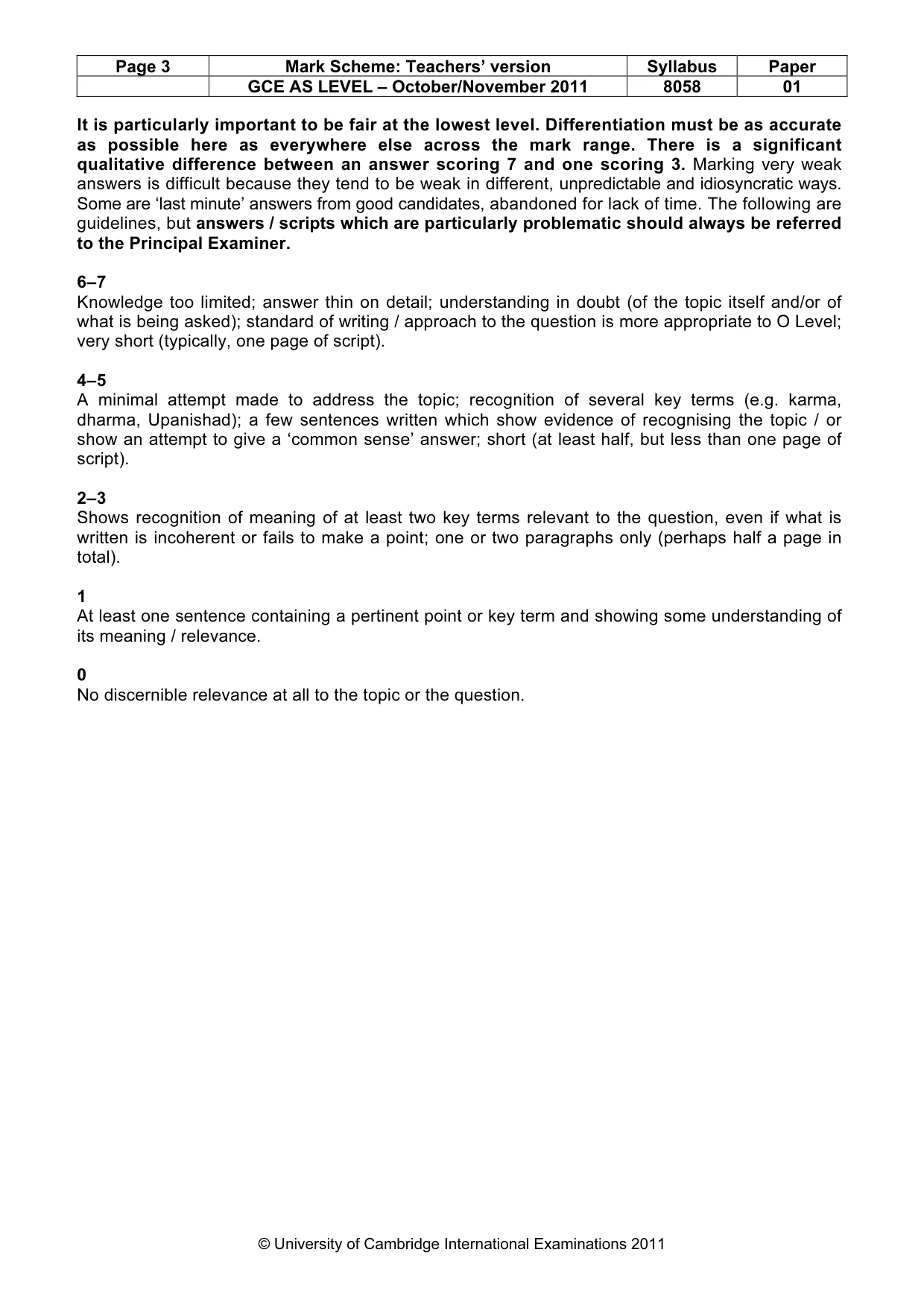
Page 3 Mark Scheme: Teachers’ version Syllabus Paper GCE AS LEVEL – October/November 2011 8058 01 © University of Cambridge International Examinations 2011 It is particularly important to be fair at the lowest level. Differentiation must be as accurate as possible here as everywhere else across the mark range. There is a significant qualitative difference between an answer scoring 7 and one scoring 3. Marking very weak answers is difficult because they tend to be weak in different, unpredictable and idiosyncratic ways. Some are ‘last minute’ answers from good candidates, abandoned for lack of time. The following are guidelines, but answers / scripts which are particularly problematic should always be referred to the Principal Examiner. 6–7 Knowledge too limited; answer thin on detail; understanding in doubt (of the topic itself and/or of what is being asked); standard of writing / approach to the question is more appropriate to O Level; very short (typically, one page of script). 4–5 A minimal attempt made to address the topic; recognition of several key terms (e.g. karma, dharma, Upanishad); a few sentences written which show evidence of recognising the topic / or show an attempt to give a ‘common sense’ answer; short (at least half, but less than one page of script). 2–3 Shows recognition of meaning of at least two key terms relevant to the question, even if what is written is incoherent or fails to make a point; one or two paragraphs only (perhaps half a page in total). 1 At least one sentence containing a pertinent point or key term and showing some understanding of its meaning / relevance. 0 No discernible relevance at all to the topic or the question.
Mark scheme, page 4
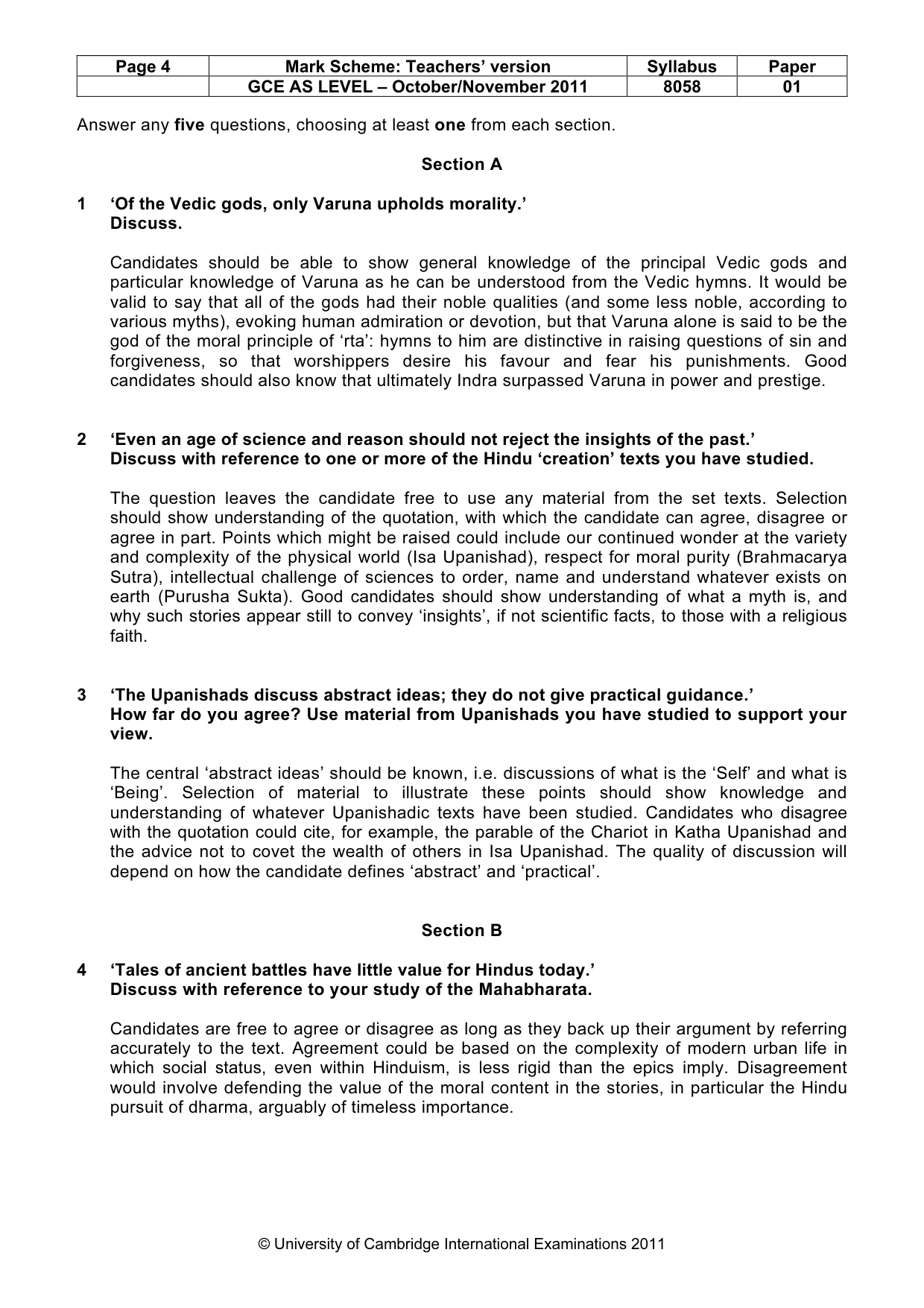
Page 4 Mark Scheme: Teachers’ version Syllabus Paper GCE AS LEVEL – October/November 2011 8058 01 © University of Cambridge International Examinations 2011 Answer any five questions, choosing at least one from each section. Section A 1 ‘Of the Vedic gods, only Varuna upholds morality.’ Discuss. Candidates should be able to show general knowledge of the principal Vedic gods and particular knowledge of Varuna as he can be understood from the Vedic hymns. It would be valid to say that all of the gods had their noble qualities (and some less noble, according to various myths), evoking human admiration or devotion, but that Varuna alone is said to be the god of the moral principle of ‘rta’: hymns to him are distinctive in raising questions of sin and forgiveness, so that worshippers desire his favour and fear his punishments. Good candidates should also know that ultimately Indra surpassed Varuna in power and prestige. 2 ‘Even an age of science and reason should not reject the insights of the past.’ Discuss with reference to one or more of the Hindu ‘creation’ texts you have studied. The question leaves the candidate free to use any material from the set texts. Selection should show understanding of the quotation, with which the candidate can agree, disagree or agree in part. Points which might be raised could include our continued wonder at the variety and complexity of the physical world (Isa Upanishad), respect for moral purity (Brahmacarya Sutra), intellectual challenge of sciences to order, name and understand whatever exists on earth (Purusha Sukta). Good candidates should show understanding of what a myth is, and why such stories appear still to convey ‘insights’, if not scientific facts, to those with a religious faith. 3 ‘The Upanishads discuss abstract ideas; they do not give practical guidance.’ How far do you agree? Use material from Upanishads you have studied to support your view. The central ‘abstract ideas’ should be known, i.e. discussions of what is the ‘Self’ and what is ‘Being’. Selection of material to illustrate these points should show knowledge and understanding of whatever Upanishadic texts have been studied. Candidates who disagree with the quotation could cite, for example, the parable of the Chariot in Katha Upanishad and the advice not to covet the wealth of others in Isa Upanishad. The quality of discussion will depend on how the candidate defines ‘abstract’ and ‘practical’. Section B 4 ‘Tales of ancient battles have little value for Hindus today.’ Discuss with reference to your study of the Mahabharata. Candidates are free to agree or disagree as long as they back up their argument by referring accurately to the text. Agreement could be based on the complexity of modern urban life in which social status, even within Hinduism, is less rigid than the epics imply. Disagreement would involve defending the value of the moral content in the stories, in particular the Hindu pursuit of dharma, arguably of timeless importance.
Mark scheme, page 5
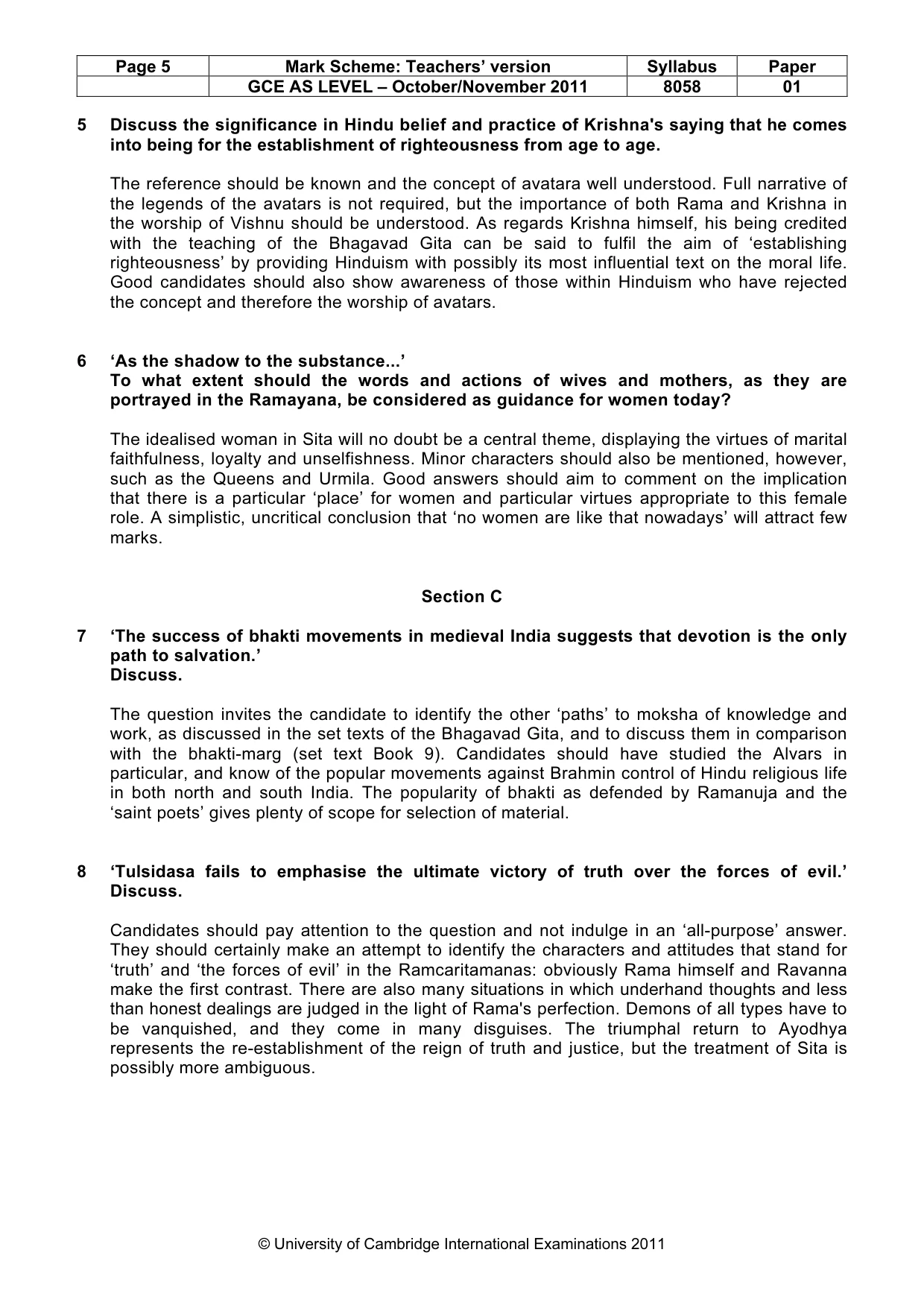
Page 5 Mark Scheme: Teachers’ version Syllabus Paper GCE AS LEVEL – October/November 2011 8058 01 © University of Cambridge International Examinations 2011 5 Discuss the significance in Hindu belief and practice of Krishna's saying that he comes into being for the establishment of righteousness from age to age. The reference should be known and the concept of avatara well understood. Full narrative of the legends of the avatars is not required, but the importance of both Rama and Krishna in the worship of Vishnu should be understood. As regards Krishna himself, his being credited with the teaching of the Bhagavad Gita can be said to fulfil the aim of ‘establishing righteousness’ by providing Hinduism with possibly its most influential text on the moral life. Good candidates should also show awareness of those within Hinduism who have rejected the concept and therefore the worship of avatars. 6 ‘As the shadow to the substance...’ To what extent should the words and actions of wives and mothers, as they are portrayed in the Ramayana, be considered as guidance for women today? The idealised woman in Sita will no doubt be a central theme, displaying the virtues of marital faithfulness, loyalty and unselfishness. Minor characters should also be mentioned, however, such as the Queens and Urmila. Good answers should aim to comment on the implication that there is a particular ‘place’ for women and particular virtues appropriate to this female role. A simplistic, uncritical conclusion that ‘no women are like that nowadays’ will attract few marks. Section C 7 ‘The success of bhakti movements in medieval India suggests that devotion is the only path to salvation.’ Discuss. The question invites the candidate to identify the other ‘paths’ to moksha of knowledge and work, as discussed in the set texts of the Bhagavad Gita, and to discuss them in comparison with the bhakti-marg (set text Book 9). Candidates should have studied the Alvars in particular, and know of the popular movements against Brahmin control of Hindu religious life in both north and south India. The popularity of bhakti as defended by Ramanuja and the ‘saint poets’ gives plenty of scope for selection of material. 8 ‘Tulsidasa fails to emphasise the ultimate victory of truth over the forces of evil.’ Discuss. Candidates should pay attention to the question and not indulge in an ‘all-purpose’ answer. They should certainly make an attempt to identify the characters and attitudes that stand for ‘truth’ and ‘the forces of evil’ in the Ramcaritamanas: obviously Rama himself and Ravanna make the first contrast. There are also many situations in which underhand thoughts and less than honest dealings are judged in the light of Rama's perfection. Demons of all types have to be vanquished, and they come in many disguises. The triumphal return to Ayodhya represents the re-establishment of the reign of truth and justice, but the treatment of Sita is possibly more ambiguous.
Mark scheme, page 6
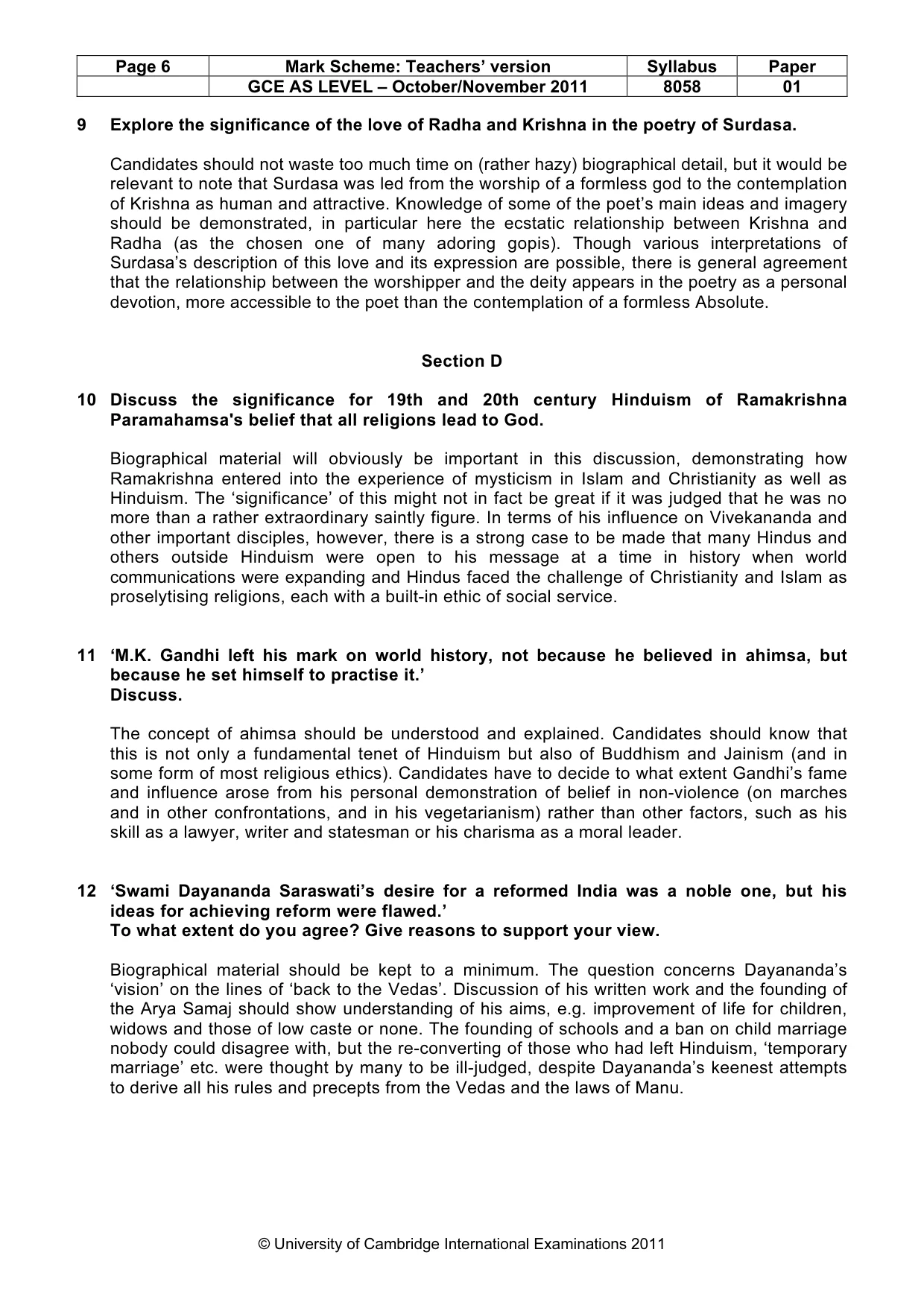
Page 6 Mark Scheme: Teachers’ version Syllabus Paper GCE AS LEVEL – October/November 2011 8058 01 © University of Cambridge International Examinations 2011 9 Explore the significance of the love of Radha and Krishna in the poetry of Surdasa. Candidates should not waste too much time on (rather hazy) biographical detail, but it would be relevant to note that Surdasa was led from the worship of a formless god to the contemplation of Krishna as human and attractive. Knowledge of some of the poet’s main ideas and imagery should be demonstrated, in particular here the ecstatic relationship between Krishna and Radha (as the chosen one of many adoring gopis). Though various interpretations of Surdasa’s description of this love and its expression are possible, there is general agreement that the relationship between the worshipper and the deity appears in the poetry as a personal devotion, more accessible to the poet than the contemplation of a formless Absolute. Section D 10 Discuss the significance for 19th and 20th century Hinduism of Ramakrishna Paramahamsa's belief that all religions lead to God. Biographical material will obviously be important in this discussion, demonstrating how Ramakrishna entered into the experience of mysticism in Islam and Christianity as well as Hinduism. The ‘significance’ of this might not in fact be great if it was judged that he was no more than a rather extraordinary saintly figure. In terms of his influence on Vivekananda and other important disciples, however, there is a strong case to be made that many Hindus and others outside Hinduism were open to his message at a time in history when world communications were expanding and Hindus faced the challenge of Christianity and Islam as proselytising religions, each with a built-in ethic of social service. 11 ‘M.K. Gandhi left his mark on world history, not because he believed in ahimsa, but because he set himself to practise it.’ Discuss. The concept of ahimsa should be understood and explained. Candidates should know that this is not only a fundamental tenet of Hinduism but also of Buddhism and Jainism (and in some form of most religious ethics). Candidates have to decide to what extent Gandhi’s fame and influence arose from his personal demonstration of belief in non-violence (on marches and in other confrontations, and in his vegetarianism) rather than other factors, such as his skill as a lawyer, writer and statesman or his charisma as a moral leader. 12 ‘Swami Dayananda Saraswati’s desire for a reformed India was a noble one, but his ideas for achieving reform were flawed.’ To what extent do you agree? Give reasons to support your view. Biographical material should be kept to a minimum. The question concerns Dayananda’s ‘vision’ on the lines of ‘back to the Vedas’. Discussion of his written work and the founding of the Arya Samaj should show understanding of his aims, e.g. improvement of life for children, widows and those of low caste or none. The founding of schools and a ban on child marriage nobody could disagree with, but the re-converting of those who had left Hinduism, ‘temporary marriage’ etc. were thought by many to be ill-judged, despite Dayananda’s keenest attempts to derive all his rules and precepts from the Vedas and the laws of Manu.
What you needed in this session
Cambridge’s own grade thresholds for 2011 Oct/Nov, Paper 1 · Variant 1. A higher threshold means an easier paper — the bar moves with how the cohort did.