Cambridge A Level Hinduism 9014 — 2019 Oct/Nov Paper 2 · Variant 1
9014/21/O/N/19 · 100 marks · ≈113 min
The question paper and its mark scheme, free to read here and free to download. This is Cambridge’s own paper, exactly as it was sat.
Question paper4 pages

Mark scheme19 pages
Answers below. Sit the paper first if you are practising.
Paper as text
Question paper, page 1
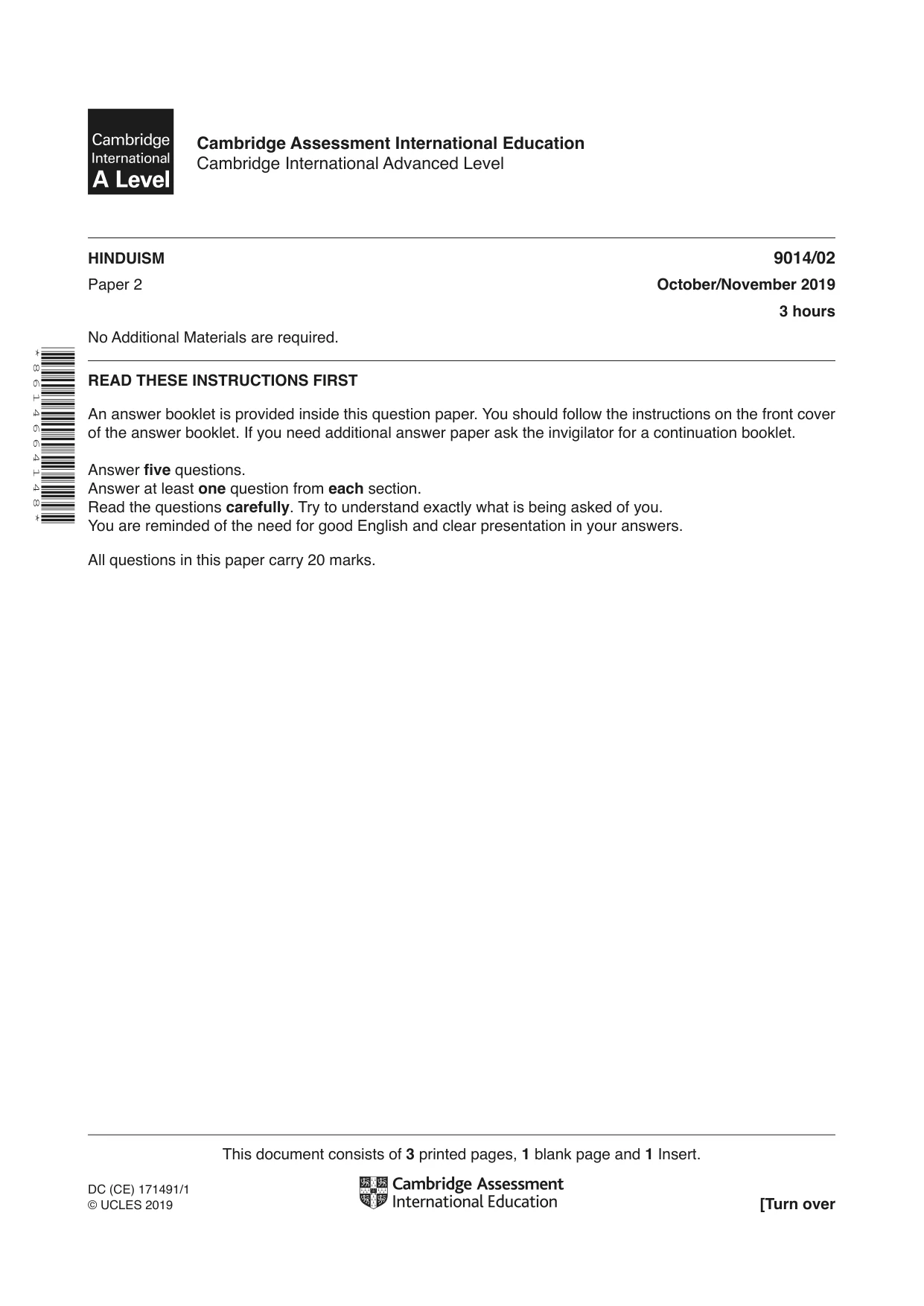
This document consists of 3 printed pages, 1 blank page and 1 Insert. DC (CE) 171491/1 © UCLES 2019 [Turn over Cambridge Assessment International Education Cambridge International Advanced Level * 8 6 1 4 6 6 4 1 4 8 * HINDUISM 9014/02 Paper 2 October/November 2019 3 hours No Additional Materials are required. READ THESE INSTRUCTIONS FIRST An answer booklet is provided inside this question paper. You should follow the instructions on the front cover of the answer booklet. If you need additional answer paper ask the invigilator for a continuation booklet. Answer five questions. Answer at least one question from each section. Read the questions carefully. Try to understand exactly what is being asked of you. You are reminded of the need for good English and clear presentation in your answers. All questions in this paper carry 20 marks.
Question paper, page 2
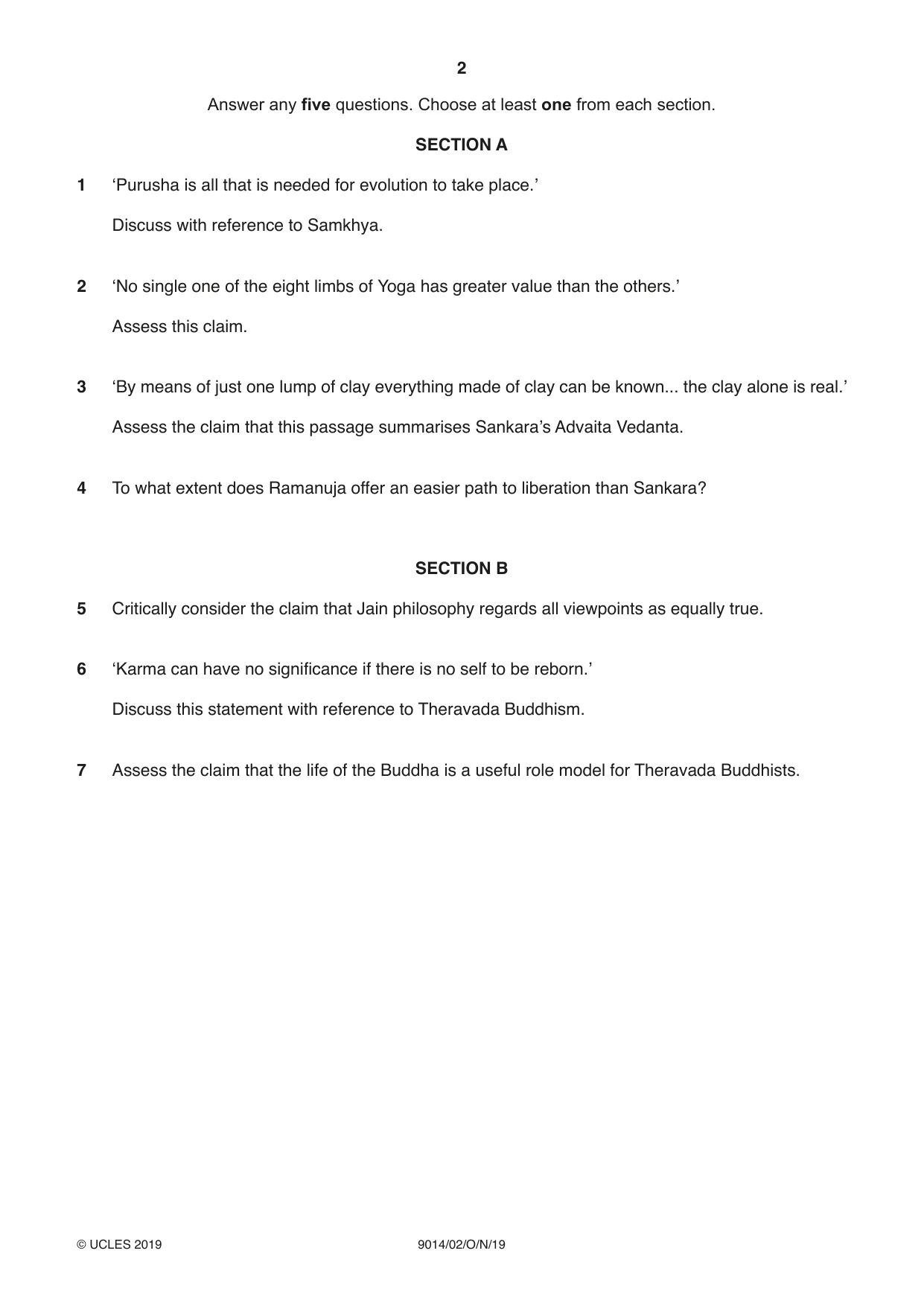
2 9014/02/O/N/19 © UCLES 2019 Answer any five questions. Choose at least one from each section. SECTION A 1 ‘Purusha is all that is needed for evolution to take place.’ Discuss with reference to Samkhya. 2 ‘No single one of the eight limbs of Yoga has greater value than the others.’ Assess this claim. 3 ‘By means of just one lump of clay everything made of clay can be known... the clay alone is real.’ Assess the claim that this passage summarises Sankara’s Advaita Vedanta. 4 To what extent does Ramanuja offer an easier path to liberation than Sankara? SECTION B 5 Critically consider the claim that Jain philosophy regards all viewpoints as equally true. 6 ‘Karma can have no significance if there is no self to be reborn.’ Discuss this statement with reference to Theravada Buddhism. 7 Assess the claim that the life of the Buddha is a useful role model for Theravada Buddhists.
Question paper, page 3
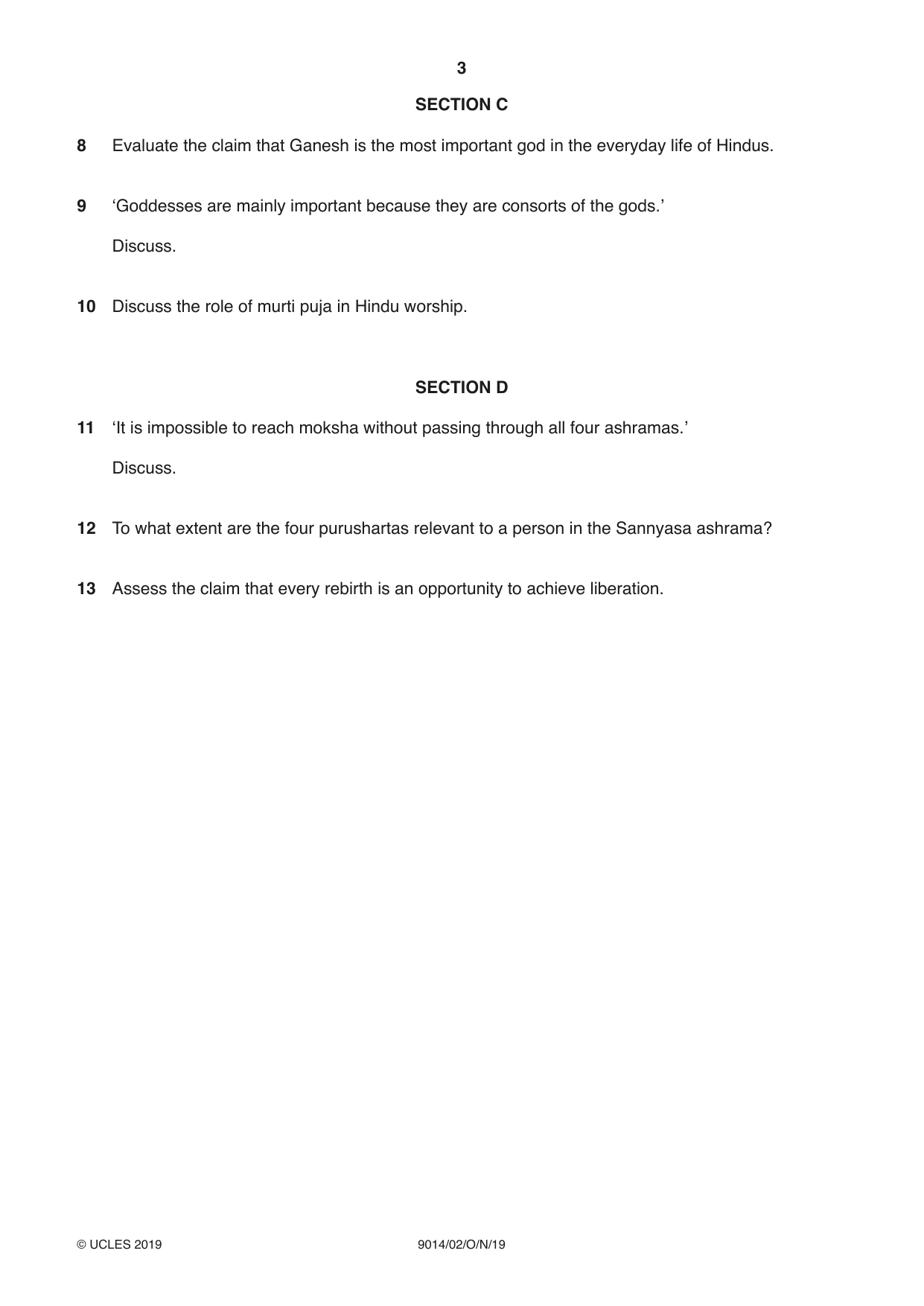
3 9014/02/O/N/19 © UCLES 2019 SECTION C 8 Evaluate the claim that Ganesh is the most important god in the everyday life of Hindus. 9 ‘Goddesses are mainly important because they are consorts of the gods.’ Discuss. 10 Discuss the role of murti puja in Hindu worship. SECTION D 11 ‘It is impossible to reach moksha without passing through all four ashramas.’ Discuss. 12 To what extent are the four purushartas relevant to a person in the Sannyasa ashrama? 13 Assess the claim that every rebirth is an opportunity to achieve liberation.
Question paper, page 4
4 9014/02/O/N/19 © UCLES 2019 BLANK PAGE Permission to reproduce items where third-party owned material protected by copyright is included has been sought and cleared where possible. Every reasonable effort has been made by the publisher (UCLES) to trace copyright holders, but if any items requiring clearance have unwittingly been included, the publisher will be pleased to make amends at the earliest possible opportunity. To avoid the issue of disclosure of answer-related information to candidates, all copyright acknowledgements are reproduced online in the Cambridge Assessment International Education Copyright Acknowledgements Booklet. This is produced for each series of examinations and is freely available to download at www.cambridgeinternational.org after the live examination series. Cambridge Assessment International Education is part of the Cambridge Assessment Group. Cambridge Assessment is the brand name of the University of Cambridge Local Examinations Syndicate (UCLES), which itself is a department of the University of Cambridge.
Mark scheme, page 1
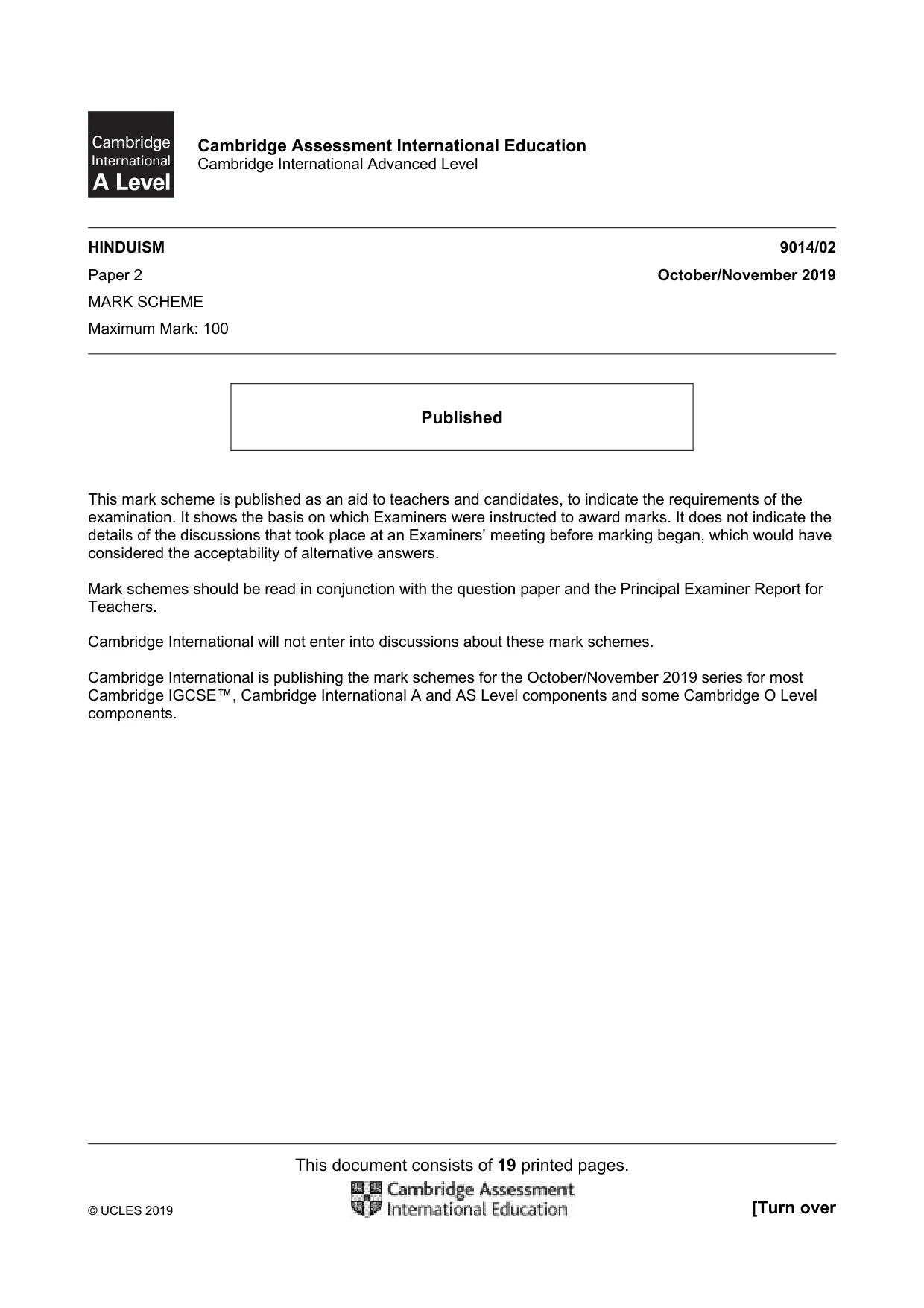
This document consists of 19 printed pages. © UCLES 2019 [Turn over Cambridge Assessment International Education Cambridge International Advanced Level HINDUISM 9014/02 Paper 2 October/November 2019 MARK SCHEME Maximum Mark: 100 Published This mark scheme is published as an aid to teachers and candidates, to indicate the requirements of the examination. It shows the basis on which Examiners were instructed to award marks. It does not indicate the details of the discussions that took place at an Examiners’ meeting before marking began, which would have considered the acceptability of alternative answers. Mark schemes should be read in conjunction with the question paper and the Principal Examiner Report for Teachers. Cambridge International will not enter into discussions about these mark schemes. Cambridge International is publishing the mark schemes for the October/November 2019 series for most Cambridge IGCSE™, Cambridge International A and AS Level components and some Cambridge O Level components.
Mark scheme, page 2
9014/02 Cambridge International A Level – Mark Scheme PUBLISHED October/November 2019 © UCLES 2019 Page 2 of 19 Generic Marking Principles These general marking principles must be applied by all examiners when marking candidate answers. They should be applied alongside the specific content of the mark scheme or generic level descriptors for a question. Each question paper and mark scheme will also comply with these marking principles. GENERIC MARKING PRINCIPLE 1: Marks must be awarded in line with: • the specific content of the mark scheme or the generic level descriptors for the question • the specific skills defined in the mark scheme or in the generic level descriptors for the question • the standard of response required by a candidate as exemplified by the standardisation scripts. GENERIC MARKING PRINCIPLE 2: Marks awarded are always whole marks (not half marks, or other fractions). GENERIC MARKING PRINCIPLE 3: Marks must be awarded positively: • marks are awarded for correct/valid answers, as defined in the mark scheme. However, credit is given for valid answers which go beyond the scope of the syllabus and mark scheme, referring to your Team Leader as appropriate • marks are awarded when candidates clearly demonstrate what they know and can do • marks are not deducted for errors • marks are not deducted for omissions • answers should only be judged on the quality of spelling, punctuation and grammar when these features are specifically assessed by the question as indicated by the mark scheme. The meaning, however, should be unambiguous. GENERIC MARKING PRINCIPLE 4: Rules must be applied consistently e.g. in situations where candidates have not followed instructions or in the application of generic level descriptors. GENERIC MARKING PRINCIPLE 5: Marks should be awarded using the full range of marks defined in the mark scheme for the question (however; the use of the full mark range may be limited according to the quality of the candidate responses seen). GENERIC MARKING PRINCIPLE 6: Marks awarded are based solely on the requirements as defined in the mark scheme. Marks should not be awarded with grade thresholds or grade descriptors in mind.
Mark scheme, page 3
9014/02 Cambridge International A Level – Mark Scheme PUBLISHED October/November 2019 © UCLES 2019 Page 3 of 19 SECTION A Question Answer Marks 1 'Purusha is all that is needed for evolution to take place.' Discuss with reference to Samkhya. Responses might include some of the following material: Samkhya philosophy seeks to explain the real/true nature of the universe which is distinct from the way it appears to be. Samkhya is essentially a dualist philosophy. There are two fundamental substances or principles and everything that exists is the result of interaction between these two. Purusha (spirit) and Prakriti (matter) interact with one another, and when they do things change and evolve. They are opposite but complementary in nature, and liberation is dependent on separating one from the other, or on understanding that they are, in reality, separate. All this suggests that both are of equal importance in a Samkhya based understanding of evolution. Prakriti is not initially manifest, neither is it active in nature. It is characterised by the three Gunas (elements/qualities): sattva (lightness and purity), rajas (passion and movement) and tamas (darkness and inertia). When these three strands are in equilibrium Prakriti is not manifest but remains in a state of potentiality. The universe begins to evolve when this balance of elements is disturbed by the presence of Purusha. A useful metaphor to explain this is the response of material containing iron to the presence of a magnet – without the magnet the material is inert, in the presence of the magnet it moves. Therefore, it could be argued that without Purusha nothing would come to exist as the balance of the Gunas would be maintained. While Purusha might not be the only thing needed, since it cannot cause evolution unless there is something there for it to act upon, it could be argued that it is the most important thing because it is the only active element in the process. Once begun, the process of evolution is continual. It is a chain in which each thing is the product of another thing. The ego is created by the intellect and comes to identify the self with Purusha. This means that the self is viewed as being ultimately rather than apparently real and this misconception prevents Purusha becoming free of its entanglement with Prakriti. This, in turn, means the processes of evolution keep on going. Evolution on the cosmic scale is an unending cycle of creation and destruction but an individual can overcome it by realising the truth – becoming able to discriminate between the Purusha’s actual state and its apparent state. This liberates the individual, but it does not stop the processes of evolution. 20
Mark scheme, page 4
9014/02 Cambridge International A Level – Mark Scheme PUBLISHED October/November 2019 © UCLES 2019 Page 4 of 19 Question Answer Marks 2 ‘No single one of the eight limbs of Yoga has greater value than the others.’ Assess this claim. Responses might include some of the following material: Patanjali’s Eightfold Yoga consists of eight limbs – yama (discipline), niyama (conduct), asana (posture), pranayama (breath), pratyahara (withdrawal of senses), dharana (concentration), dhyana (meditation) and samadhi (absorption). These are sometimes divided into outer and inner limbs, depending on whether they relate to physical or non-physical aspects of the practice, but they are generally understood to be interdependent aspects of achieving the ultimate goal. This is a state of harmony between physical and non-physical aspects of being. This goal is sometimes referred to as chitta-vritti-nirodha (mind-activity- cessation). The activities of the mind take many forms, including both valid cognitions and misconceptions, memories, conceptualisations and sleep. Yoga practice shuts all these down as the constant distraction of thoughts and emotions prevents liberation. The idea that it is the activities of the mind that entrap the self within samsara is rooted in the view of reality proposed by Samkhya philosophy – that the ego creates belief that the ‘I’ that experiences is Purusha. The distraction of thoughts prevents realisation that this is not the case, while the restraint of mental modifications allows the breaking of this identification with the empirical self as the true self. It is also possible for the siddhis (accomplishments) arising from the practice of yoga to be a distraction in themselves. Both physical experiences and states of mind distract consciousness, hence the need for both inner and outer limbs. The manifest world is not wholly unreal, it has existence, but it is also a distraction from the truth; maya is not the delusion that the manifest world is real, but rather that Purusha is a part of it. The practical nature of yoga is important because both ignorance/ delusion and discrimination/liberation take place at the manifest level of reality, in the world. Purusha does nothing, and can do nothing, it is only a witness. Taken as a whole, Eightfold Yoga enables this realisation to develop, while a focus on one part without the others might lead to further delusions. While Yoga is often used as a generic term for meditative exercise and/or mental discipline Patanjali’s Yoga Sutras clearly present Eightfold Yoga as a system with a soteriological focus. The text is almost entirely focused on method, accepting the ontology proposed by Samkhya philosophy, suggesting it was perhaps intended as the practical application that an abstract philosophy lacked. Understanding the philosophical underpinnings of the practice is arguably unnecessary if the eight limbs are followed properly. 20
Mark scheme, page 5
9014/02 Cambridge International A Level – Mark Scheme PUBLISHED October/November 2019 © UCLES 2019 Page 5 of 19 Question Answer Marks 3 ‘By means of just one lump of clay everything made of clay can be known... the clay alone is real.’ Assess the claim that this passage summarises Sankara’s Advaita Vedanta. Responses might include some of the following material: The passage is taken from the Chandogya Upanishad, although it is not necessary to know this in order to respond to the question. As with many such texts it can be interpreted as using a literal example to illustrate something more. This passage says that clay is a substance that can be made into many different things – pots, plates, models and so on – but none of these things change the essential nature of the clay. The new names for what has been made are simply names for those shapes, the clay is still clay and will always be clay. This can be understood as an analogy for the relationship of Brahman to the world, and it is this understanding which provides a link to Sankara’s Advaita Vedanta, which argues that Brahman is the only real thing however many different apparent things there seem to be. Another passage from the same Upanishad that is commonly cited as central to Sankara’s thinking is ‘Before this there was non-being, one only, without a second... And it thought to itself let me become many, let me multiply myself’. Sankara’s interpretation of this Upanishad is that it teaches the substance of the universe is Brahman, and Brahman is all that there is. Brahman does not actually change, any more than clay does when made into a pot, but it may appear to do so to a mind that is deluded by maya. Such change is only apparent, not ultimately real. This position is known as satkaryavada, which means that the effect pre-exists in the cause – the pot is an effect, and it always exists in the clay, cause and effect are identical. On the larger scale this means that the world (as effect) and Brahman (as cause) are identical with one another. What appears as cause and effect does not involve any actual change but only apparent change, an apparent manifestation of plurality where there is really only a single thing (vivartavada). This can also be understood as adhyasa (superimposition), the attribution of qualities to something which it does not have in reality due to ignorance of its true nature. The classic example of the rope that is mistaken for a snake in dim light illustrates this: the reality is a rope, which is harmless and inanimate; the error is to see a snake with all the attributes of a snake. What is seen in no way changes the true nature of the rope, any more than seeing plurality changes the true nature of Brahman. But while the belief that it is a snake holds, the beholder will be affected by their belief that a snake is present in the room with them. Their behaviour is informed by what is conventionally real (what they think they see) rather than by what is actually real. 20
Mark scheme, page 6
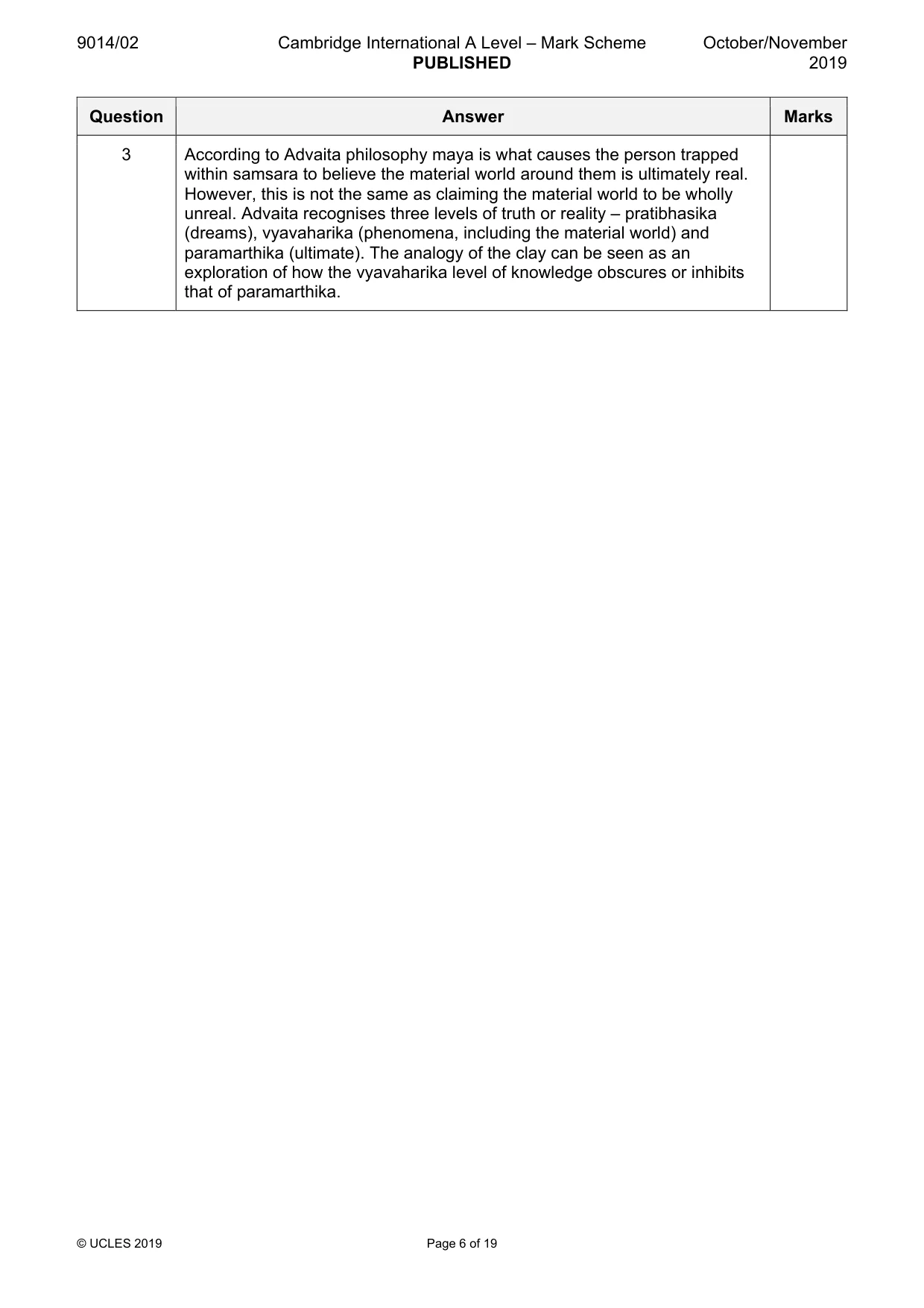
9014/02 Cambridge International A Level – Mark Scheme PUBLISHED October/November 2019 © UCLES 2019 Page 6 of 19 Question Answer Marks 3 According to Advaita philosophy maya is what causes the person trapped within samsara to believe the material world around them is ultimately real. However, this is not the same as claiming the material world to be wholly unreal. Advaita recognises three levels of truth or reality – pratibhasika (dreams), vyavaharika (phenomena, including the material world) and paramarthika (ultimate). The analogy of the clay can be seen as an exploration of how the vyavaharika level of knowledge obscures or inhibits that of paramarthika.
Mark scheme, page 7
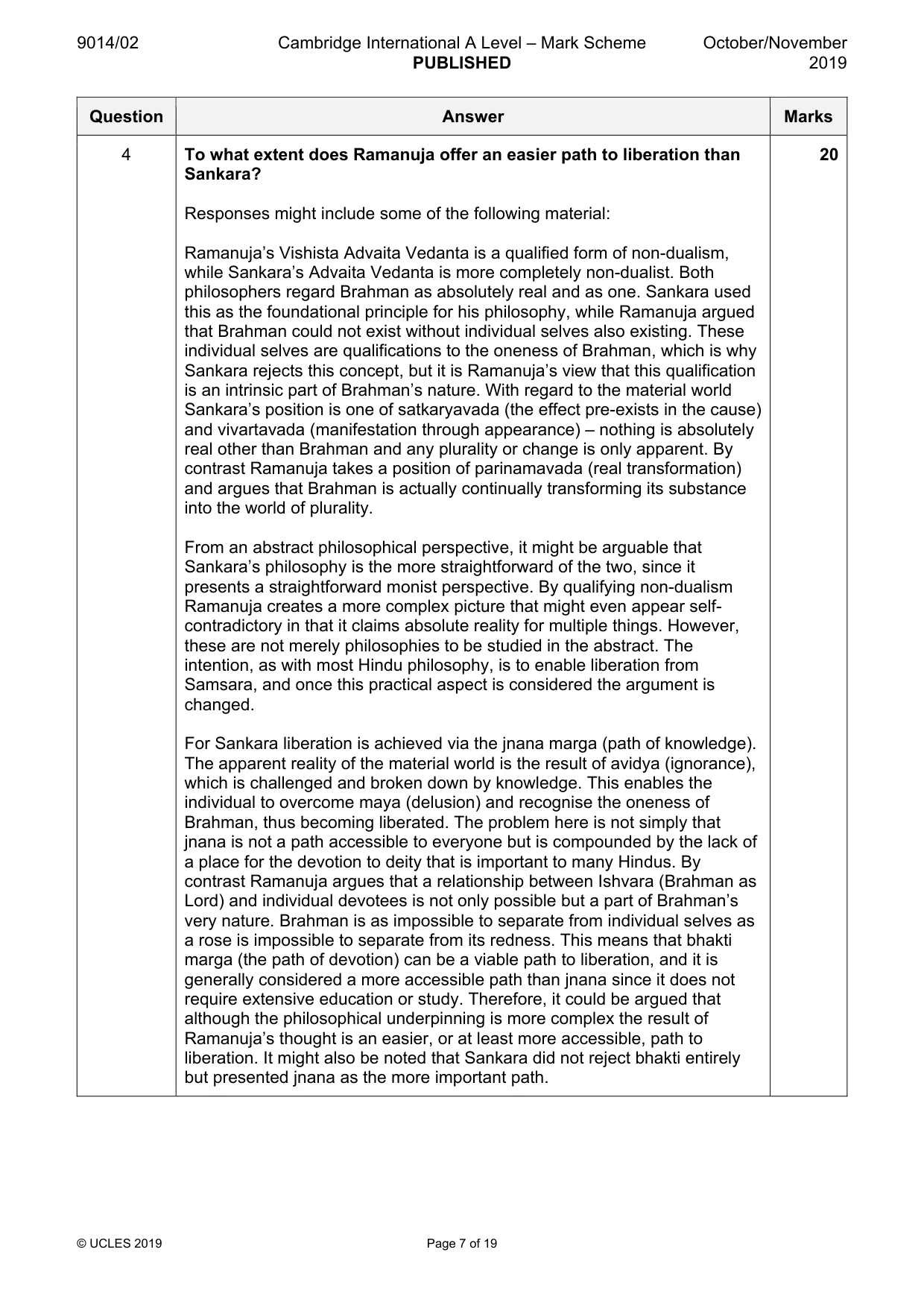
9014/02 Cambridge International A Level – Mark Scheme PUBLISHED October/November 2019 © UCLES 2019 Page 7 of 19 Question Answer Marks 4 To what extent does Ramanuja offer an easier path to liberation than Sankara? Responses might include some of the following material: Ramanuja’s Vishista Advaita Vedanta is a qualified form of non-dualism, while Sankara’s Advaita Vedanta is more completely non-dualist. Both philosophers regard Brahman as absolutely real and as one. Sankara used this as the foundational principle for his philosophy, while Ramanuja argued that Brahman could not exist without individual selves also existing. These individual selves are qualifications to the oneness of Brahman, which is why Sankara rejects this concept, but it is Ramanuja’s view that this qualification is an intrinsic part of Brahman’s nature. With regard to the material world Sankara’s position is one of satkaryavada (the effect pre-exists in the cause) and vivartavada (manifestation through appearance) – nothing is absolutely real other than Brahman and any plurality or change is only apparent. By contrast Ramanuja takes a position of parinamavada (real transformation) and argues that Brahman is actually continually transforming its substance into the world of plurality. From an abstract philosophical perspective, it might be arguable that Sankara’s philosophy is the more straightforward of the two, since it presents a straightforward monist perspective. By qualifying non-dualism Ramanuja creates a more complex picture that might even appear self- contradictory in that it claims absolute reality for multiple things. However, these are not merely philosophies to be studied in the abstract. The intention, as with most Hindu philosophy, is to enable liberation from Samsara, and once this practical aspect is considered the argument is changed. For Sankara liberation is achieved via the jnana marga (path of knowledge). The apparent reality of the material world is the result of avidya (ignorance), which is challenged and broken down by knowledge. This enables the individual to overcome maya (delusion) and recognise the oneness of Brahman, thus becoming liberated. The problem here is not simply that jnana is not a path accessible to everyone but is compounded by the lack of a place for the devotion to deity that is important to many Hindus. By contrast Ramanuja argues that a relationship between Ishvara (Brahman as Lord) and individual devotees is not only possible but a part of Brahman’s very nature. Brahman is as impossible to separate from individual selves as a rose is impossible to separate from its redness. This means that bhakti marga (the path of devotion) can be a viable path to liberation, and it is generally considered a more accessible path than jnana since it does not require extensive education or study. Therefore, it could be argued that although the philosophical underpinning is more complex the result of Ramanuja’s thought is an easier, or at least more accessible, path to liberation. It might also be noted that Sankara did not reject bhakti entirely but presented jnana as the more important path. 20
Mark scheme, page 8
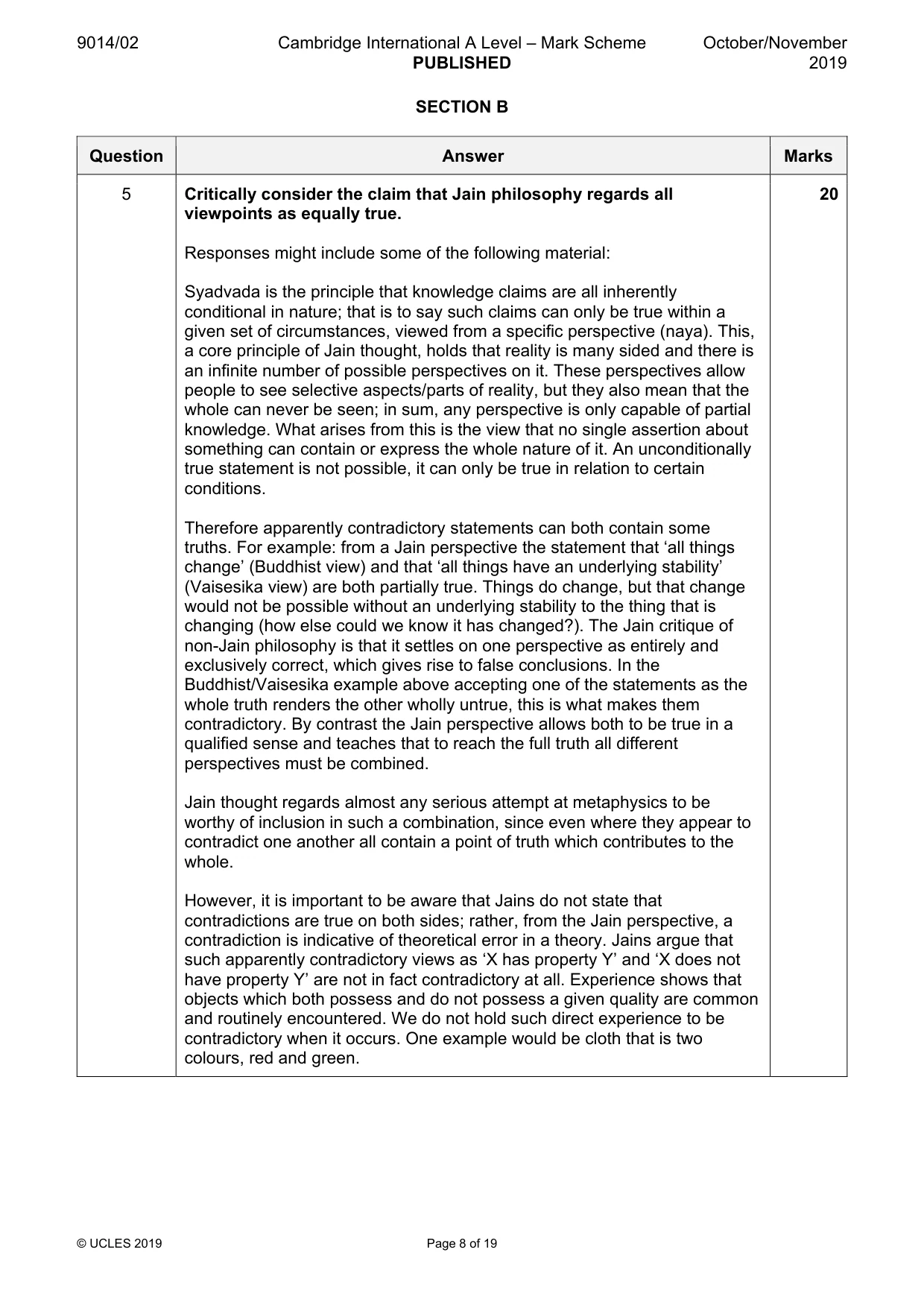
9014/02 Cambridge International A Level – Mark Scheme PUBLISHED October/November 2019 © UCLES 2019 Page 8 of 19 SECTION B Question Answer Marks 5 Critically consider the claim that Jain philosophy regards all viewpoints as equally true. Responses might include some of the following material: Syadvada is the principle that knowledge claims are all inherently conditional in nature; that is to say such claims can only be true within a given set of circumstances, viewed from a specific perspective (naya). This, a core principle of Jain thought, holds that reality is many sided and there is an infinite number of possible perspectives on it. These perspectives allow people to see selective aspects/parts of reality, but they also mean that the whole can never be seen; in sum, any perspective is only capable of partial knowledge. What arises from this is the view that no single assertion about something can contain or express the whole nature of it. An unconditionally true statement is not possible, it can only be true in relation to certain conditions. Therefore apparently contradictory statements can both contain some truths. For example: from a Jain perspective the statement that ‘all things change’ (Buddhist view) and that ‘all things have an underlying stability’ (Vaisesika view) are both partially true. Things do change, but that change would not be possible without an underlying stability to the thing that is changing (how else could we know it has changed?). The Jain critique of non-Jain philosophy is that it settles on one perspective as entirely and exclusively correct, which gives rise to false conclusions. In the Buddhist/Vaisesika example above accepting one of the statements as the whole truth renders the other wholly untrue, this is what makes them contradictory. By contrast the Jain perspective allows both to be true in a qualified sense and teaches that to reach the full truth all different perspectives must be combined. Jain thought regards almost any serious attempt at metaphysics to be worthy of inclusion in such a combination, since even where they appear to contradict one another all contain a point of truth which contributes to the whole. However, it is important to be aware that Jains do not state that contradictions are true on both sides; rather, from the Jain perspective, a contradiction is indicative of theoretical error in a theory. Jains argue that such apparently contradictory views as ‘X has property Y’ and ‘X does not have property Y’ are not in fact contradictory at all. Experience shows that objects which both possess and do not possess a given quality are common and routinely encountered. We do not hold such direct experience to be contradictory when it occurs. One example would be cloth that is two colours, red and green. 20
Mark scheme, page 9
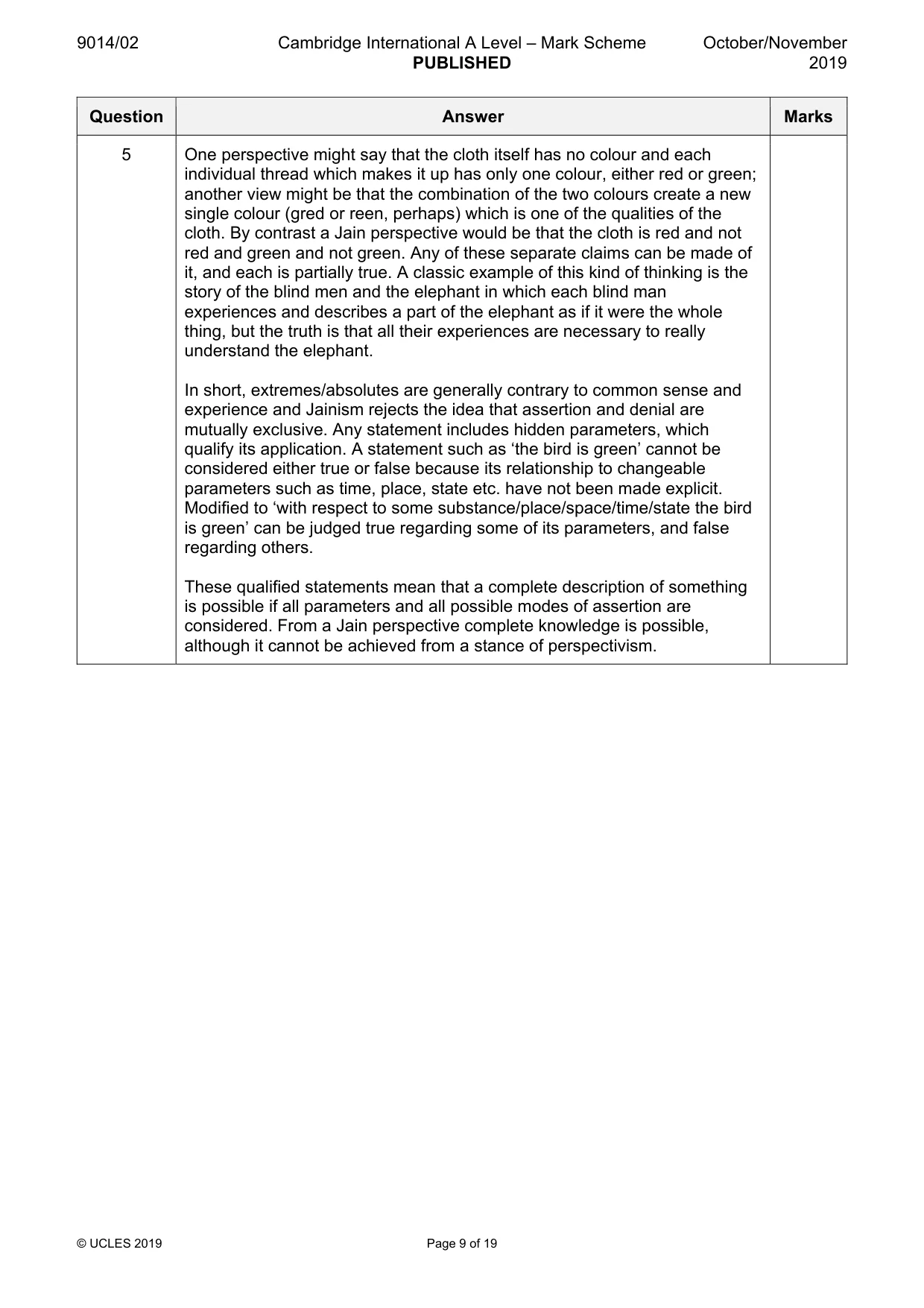
9014/02 Cambridge International A Level – Mark Scheme PUBLISHED October/November 2019 © UCLES 2019 Page 9 of 19 Question Answer Marks 5 One perspective might say that the cloth itself has no colour and each individual thread which makes it up has only one colour, either red or green; another view might be that the combination of the two colours create a new single colour (gred or reen, perhaps) which is one of the qualities of the cloth. By contrast a Jain perspective would be that the cloth is red and not red and green and not green. Any of these separate claims can be made of it, and each is partially true. A classic example of this kind of thinking is the story of the blind men and the elephant in which each blind man experiences and describes a part of the elephant as if it were the whole thing, but the truth is that all their experiences are necessary to really understand the elephant. In short, extremes/absolutes are generally contrary to common sense and experience and Jainism rejects the idea that assertion and denial are mutually exclusive. Any statement includes hidden parameters, which qualify its application. A statement such as ‘the bird is green’ cannot be considered either true or false because its relationship to changeable parameters such as time, place, state etc. have not been made explicit. Modified to ‘with respect to some substance/place/space/time/state the bird is green’ can be judged true regarding some of its parameters, and false regarding others. These qualified statements mean that a complete description of something is possible if all parameters and all possible modes of assertion are considered. From a Jain perspective complete knowledge is possible, although it cannot be achieved from a stance of perspectivism.
Mark scheme, page 10
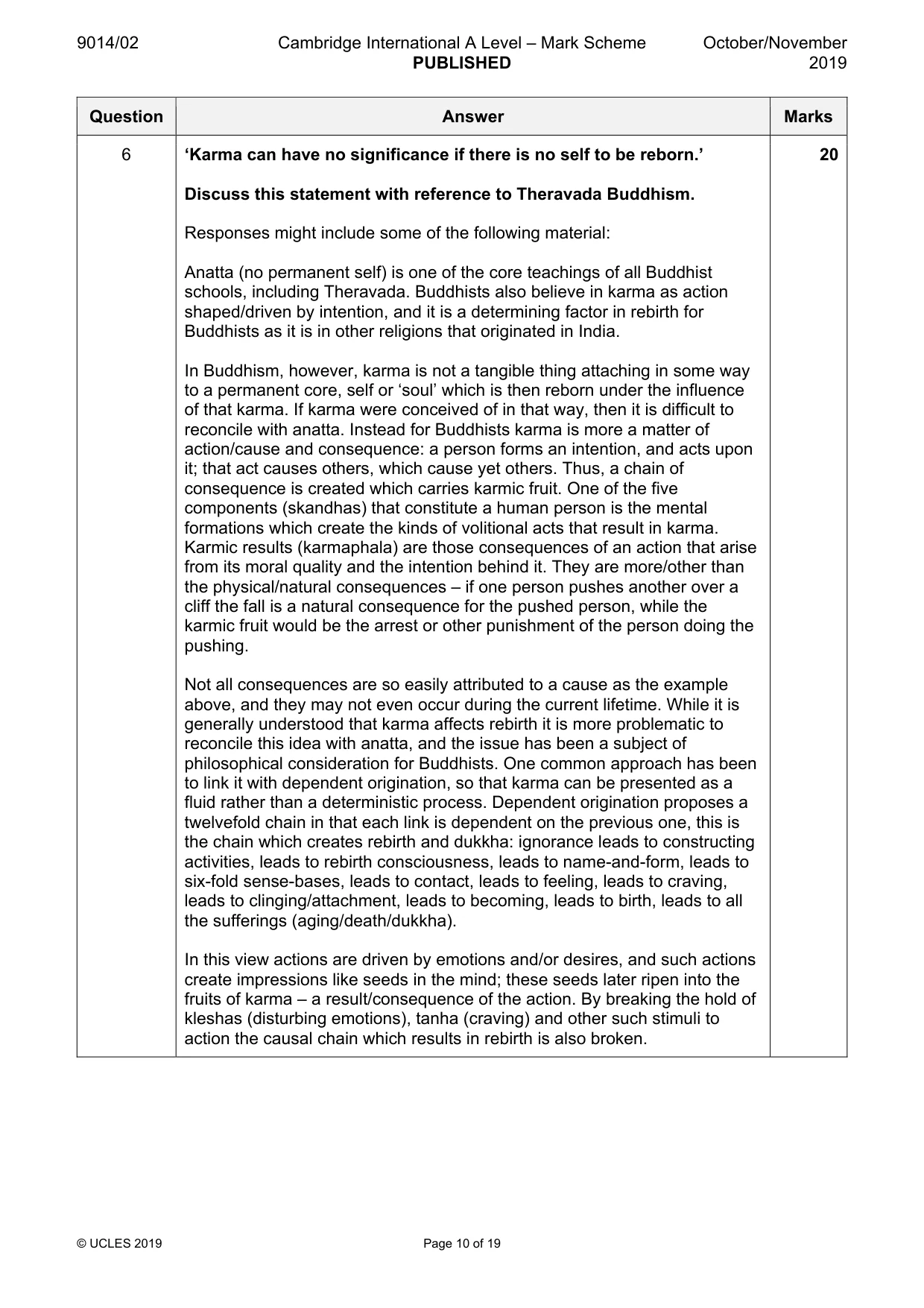
9014/02 Cambridge International A Level – Mark Scheme PUBLISHED October/November 2019 © UCLES 2019 Page 10 of 19 Question Answer Marks 6 ‘Karma can have no significance if there is no self to be reborn.’ Discuss this statement with reference to Theravada Buddhism. Responses might include some of the following material: Anatta (no permanent self) is one of the core teachings of all Buddhist schools, including Theravada. Buddhists also believe in karma as action shaped/driven by intention, and it is a determining factor in rebirth for Buddhists as it is in other religions that originated in India. In Buddhism, however, karma is not a tangible thing attaching in some way to a permanent core, self or ‘soul’ which is then reborn under the influence of that karma. If karma were conceived of in that way, then it is difficult to reconcile with anatta. Instead for Buddhists karma is more a matter of action/cause and consequence: a person forms an intention, and acts upon it; that act causes others, which cause yet others. Thus, a chain of consequence is created which carries karmic fruit. One of the five components (skandhas) that constitute a human person is the mental formations which create the kinds of volitional acts that result in karma. Karmic results (karmaphala) are those consequences of an action that arise from its moral quality and the intention behind it. They are more/other than the physical/natural consequences – if one person pushes another over a cliff the fall is a natural consequence for the pushed person, while the karmic fruit would be the arrest or other punishment of the person doing the pushing. Not all consequences are so easily attributed to a cause as the example above, and they may not even occur during the current lifetime. While it is generally understood that karma affects rebirth it is more problematic to reconcile this idea with anatta, and the issue has been a subject of philosophical consideration for Buddhists. One common approach has been to link it with dependent origination, so that karma can be presented as a fluid rather than a deterministic process. Dependent origination proposes a twelvefold chain in that each link is dependent on the previous one, this is the chain which creates rebirth and dukkha: ignorance leads to constructing activities, leads to rebirth consciousness, leads to name-and-form, leads to six-fold sense-bases, leads to contact, leads to feeling, leads to craving, leads to clinging/attachment, leads to becoming, leads to birth, leads to all the sufferings (aging/death/dukkha). In this view actions are driven by emotions and/or desires, and such actions create impressions like seeds in the mind; these seeds later ripen into the fruits of karma – a result/consequence of the action. By breaking the hold of kleshas (disturbing emotions), tanha (craving) and other such stimuli to action the causal chain which results in rebirth is also broken. 20
Mark scheme, page 11
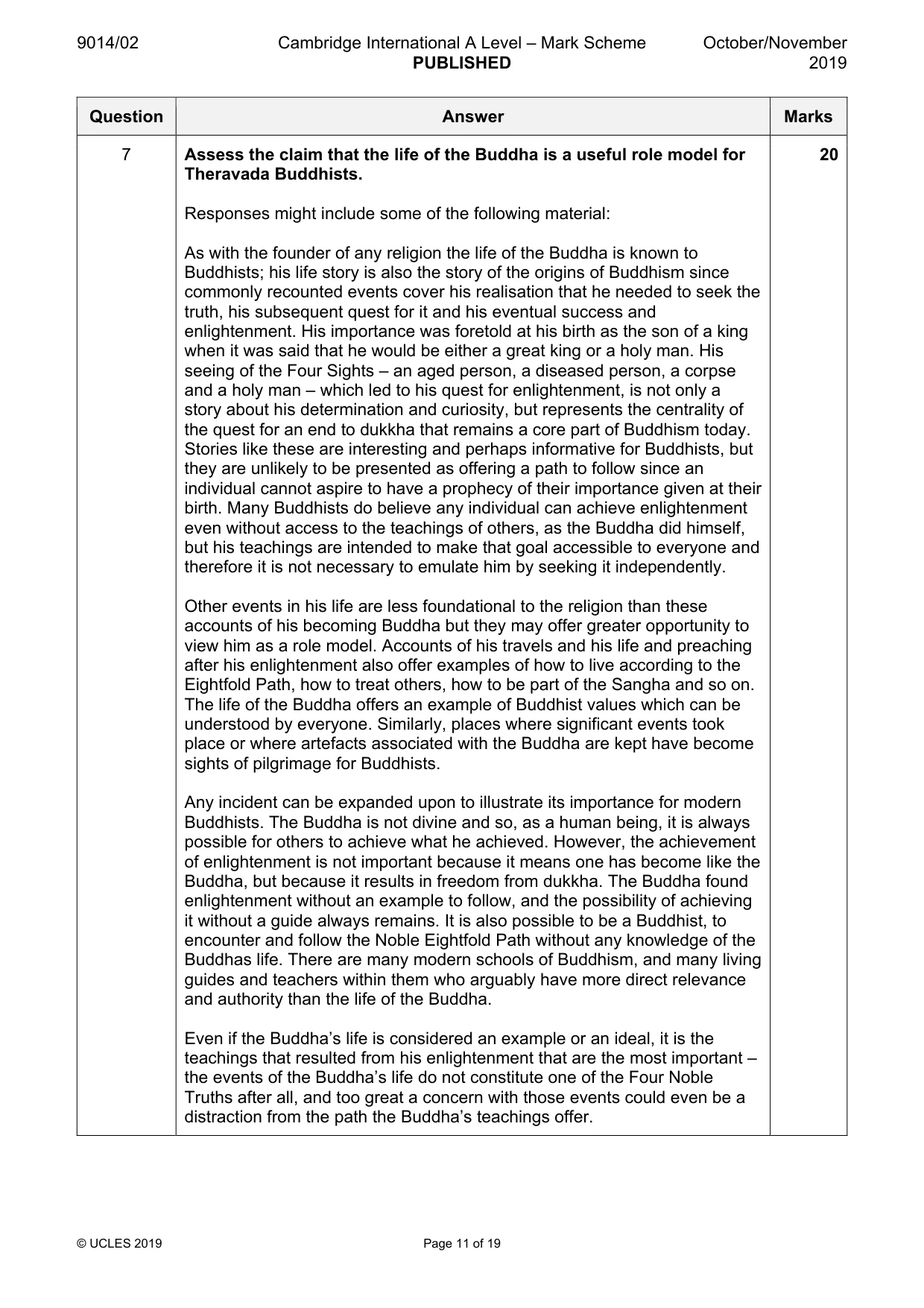
9014/02 Cambridge International A Level – Mark Scheme PUBLISHED October/November 2019 © UCLES 2019 Page 11 of 19 Question Answer Marks 7 Assess the claim that the life of the Buddha is a useful role model for Theravada Buddhists. Responses might include some of the following material: As with the founder of any religion the life of the Buddha is known to Buddhists; his life story is also the story of the origins of Buddhism since commonly recounted events cover his realisation that he needed to seek the truth, his subsequent quest for it and his eventual success and enlightenment. His importance was foretold at his birth as the son of a king when it was said that he would be either a great king or a holy man. His seeing of the Four Sights – an aged person, a diseased person, a corpse and a holy man – which led to his quest for enlightenment, is not only a story about his determination and curiosity, but represents the centrality of the quest for an end to dukkha that remains a core part of Buddhism today. Stories like these are interesting and perhaps informative for Buddhists, but they are unlikely to be presented as offering a path to follow since an individual cannot aspire to have a prophecy of their importance given at their birth. Many Buddhists do believe any individual can achieve enlightenment even without access to the teachings of others, as the Buddha did himself, but his teachings are intended to make that goal accessible to everyone and therefore it is not necessary to emulate him by seeking it independently. Other events in his life are less foundational to the religion than these accounts of his becoming Buddha but they may offer greater opportunity to view him as a role model. Accounts of his travels and his life and preaching after his enlightenment also offer examples of how to live according to the Eightfold Path, how to treat others, how to be part of the Sangha and so on. The life of the Buddha offers an example of Buddhist values which can be understood by everyone. Similarly, places where significant events took place or where artefacts associated with the Buddha are kept have become sights of pilgrimage for Buddhists. Any incident can be expanded upon to illustrate its importance for modern Buddhists. The Buddha is not divine and so, as a human being, it is always possible for others to achieve what he achieved. However, the achievement of enlightenment is not important because it means one has become like the Buddha, but because it results in freedom from dukkha. The Buddha found enlightenment without an example to follow, and the possibility of achieving it without a guide always remains. It is also possible to be a Buddhist, to encounter and follow the Noble Eightfold Path without any knowledge of the Buddhas life. There are many modern schools of Buddhism, and many living guides and teachers within them who arguably have more direct relevance and authority than the life of the Buddha. Even if the Buddha’s life is considered an example or an ideal, it is the teachings that resulted from his enlightenment that are the most important – the events of the Buddha’s life do not constitute one of the Four Noble Truths after all, and too great a concern with those events could even be a distraction from the path the Buddha’s teachings offer. 20
Mark scheme, page 12
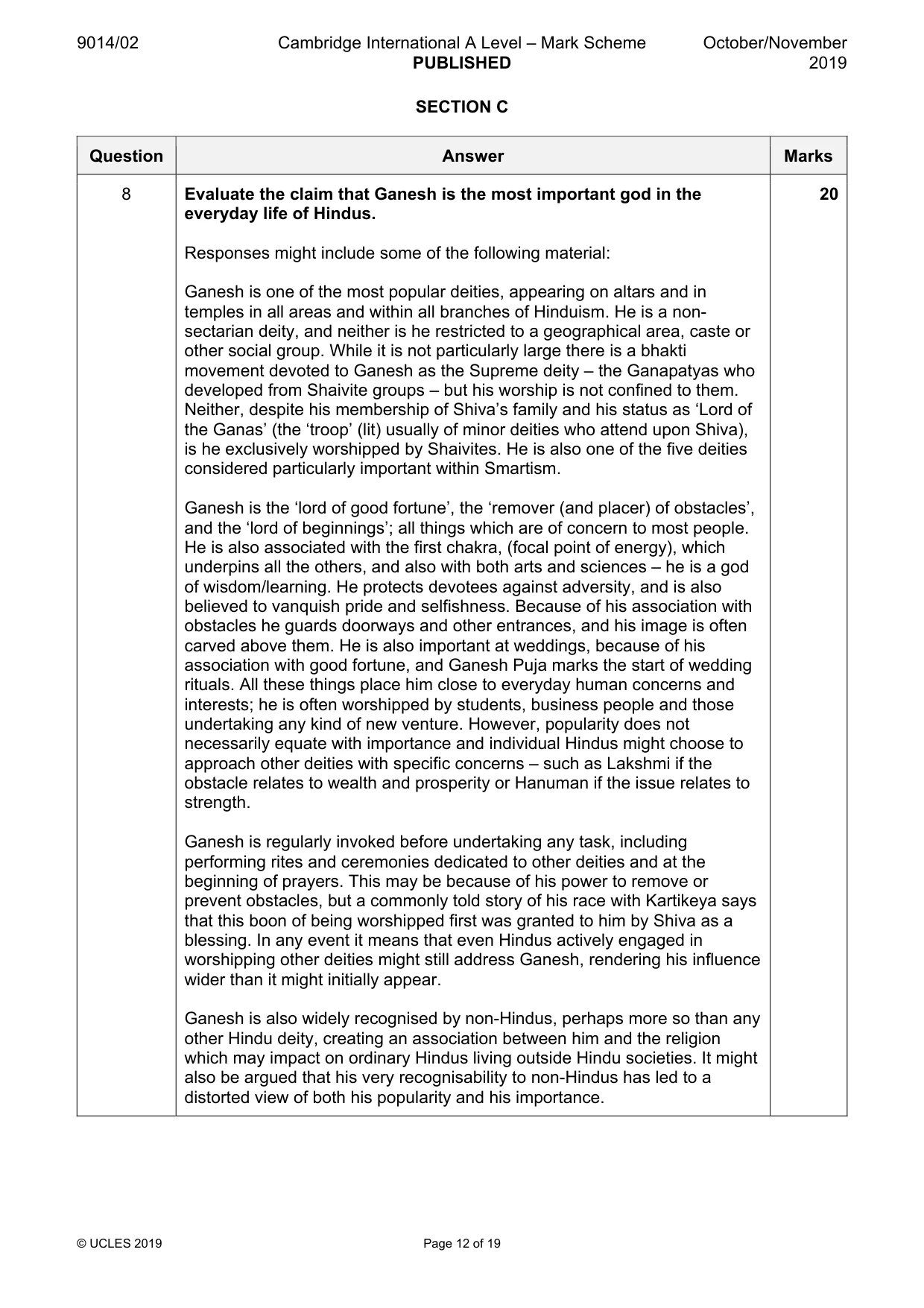
9014/02 Cambridge International A Level – Mark Scheme PUBLISHED October/November 2019 © UCLES 2019 Page 12 of 19 SECTION C Question Answer Marks 8 Evaluate the claim that Ganesh is the most important god in the everyday life of Hindus. Responses might include some of the following material: Ganesh is one of the most popular deities, appearing on altars and in temples in all areas and within all branches of Hinduism. He is a non- sectarian deity, and neither is he restricted to a geographical area, caste or other social group. While it is not particularly large there is a bhakti movement devoted to Ganesh as the Supreme deity – the Ganapatyas who developed from Shaivite groups – but his worship is not confined to them. Neither, despite his membership of Shiva’s family and his status as ‘Lord of the Ganas’ (the ‘troop’ (lit) usually of minor deities who attend upon Shiva), is he exclusively worshipped by Shaivites. He is also one of the five deities considered particularly important within Smartism. Ganesh is the ‘lord of good fortune’, the ‘remover (and placer) of obstacles’, and the ‘lord of beginnings’; all things which are of concern to most people. He is also associated with the first chakra, (focal point of energy), which underpins all the others, and also with both arts and sciences – he is a god of wisdom/learning. He protects devotees against adversity, and is also believed to vanquish pride and selfishness. Because of his association with obstacles he guards doorways and other entrances, and his image is often carved above them. He is also important at weddings, because of his association with good fortune, and Ganesh Puja marks the start of wedding rituals. All these things place him close to everyday human concerns and interests; he is often worshipped by students, business people and those undertaking any kind of new venture. However, popularity does not necessarily equate with importance and individual Hindus might choose to approach other deities with specific concerns – such as Lakshmi if the obstacle relates to wealth and prosperity or Hanuman if the issue relates to strength. Ganesh is regularly invoked before undertaking any task, including performing rites and ceremonies dedicated to other deities and at the beginning of prayers. This may be because of his power to remove or prevent obstacles, but a commonly told story of his race with Kartikeya says that this boon of being worshipped first was granted to him by Shiva as a blessing. In any event it means that even Hindus actively engaged in worshipping other deities might still address Ganesh, rendering his influence wider than it might initially appear. Ganesh is also widely recognised by non-Hindus, perhaps more so than any other Hindu deity, creating an association between him and the religion which may impact on ordinary Hindus living outside Hindu societies. It might also be argued that his very recognisability to non-Hindus has led to a distorted view of both his popularity and his importance. 20
Mark scheme, page 13
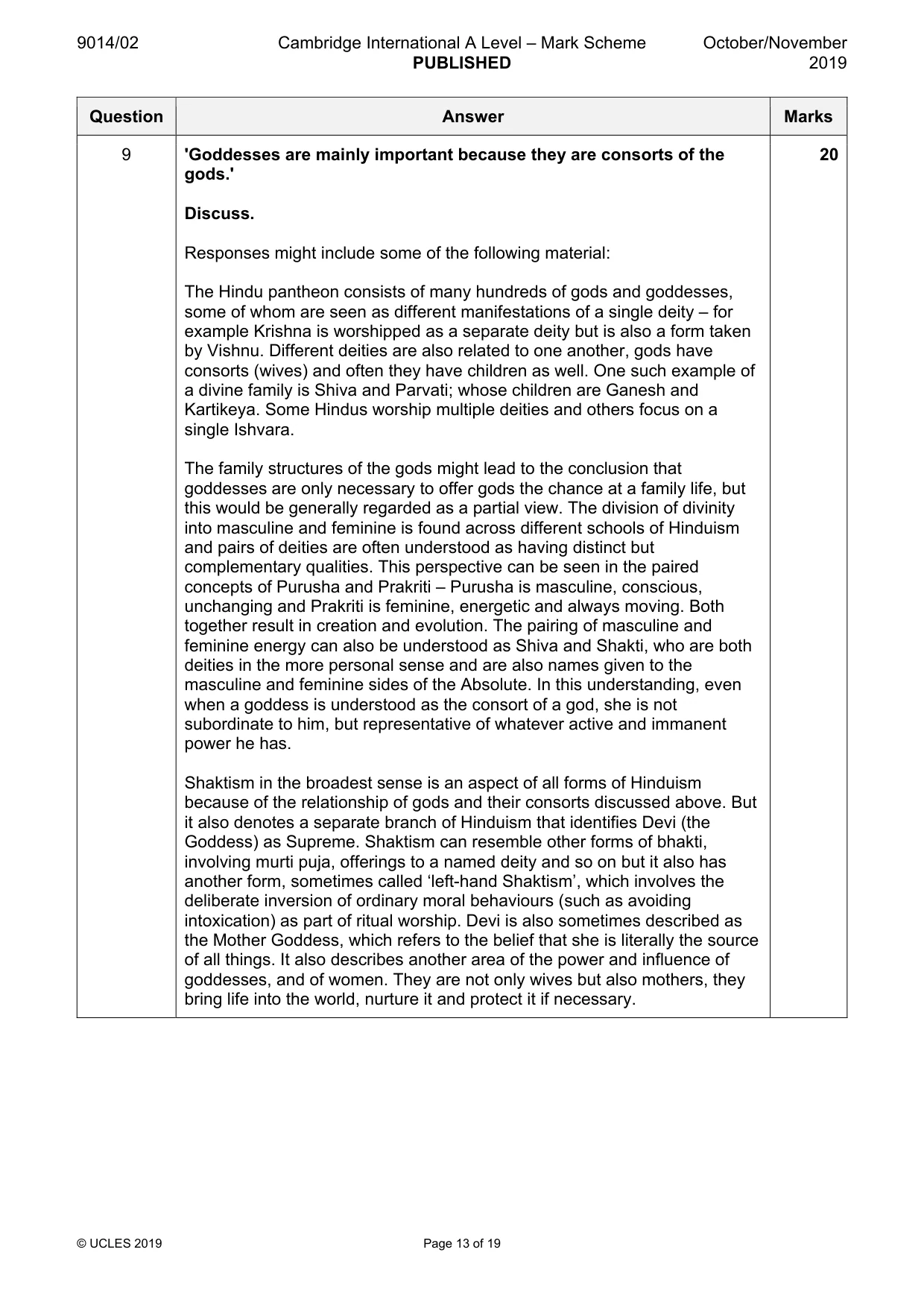
9014/02 Cambridge International A Level – Mark Scheme PUBLISHED October/November 2019 © UCLES 2019 Page 13 of 19 Question Answer Marks 9 'Goddesses are mainly important because they are consorts of the gods.' Discuss. Responses might include some of the following material: The Hindu pantheon consists of many hundreds of gods and goddesses, some of whom are seen as different manifestations of a single deity – for example Krishna is worshipped as a separate deity but is also a form taken by Vishnu. Different deities are also related to one another, gods have consorts (wives) and often they have children as well. One such example of a divine family is Shiva and Parvati; whose children are Ganesh and Kartikeya. Some Hindus worship multiple deities and others focus on a single Ishvara. The family structures of the gods might lead to the conclusion that goddesses are only necessary to offer gods the chance at a family life, but this would be generally regarded as a partial view. The division of divinity into masculine and feminine is found across different schools of Hinduism and pairs of deities are often understood as having distinct but complementary qualities. This perspective can be seen in the paired concepts of Purusha and Prakriti – Purusha is masculine, conscious, unchanging and Prakriti is feminine, energetic and always moving. Both together result in creation and evolution. The pairing of masculine and feminine energy can also be understood as Shiva and Shakti, who are both deities in the more personal sense and are also names given to the masculine and feminine sides of the Absolute. In this understanding, even when a goddess is understood as the consort of a god, she is not subordinate to him, but representative of whatever active and immanent power he has. Shaktism in the broadest sense is an aspect of all forms of Hinduism because of the relationship of gods and their consorts discussed above. But it also denotes a separate branch of Hinduism that identifies Devi (the Goddess) as Supreme. Shaktism can resemble other forms of bhakti, involving murti puja, offerings to a named deity and so on but it also has another form, sometimes called ‘left-hand Shaktism’, which involves the deliberate inversion of ordinary moral behaviours (such as avoiding intoxication) as part of ritual worship. Devi is also sometimes described as the Mother Goddess, which refers to the belief that she is literally the source of all things. It also describes another area of the power and influence of goddesses, and of women. They are not only wives but also mothers, they bring life into the world, nurture it and protect it if necessary. 20
Mark scheme, page 14
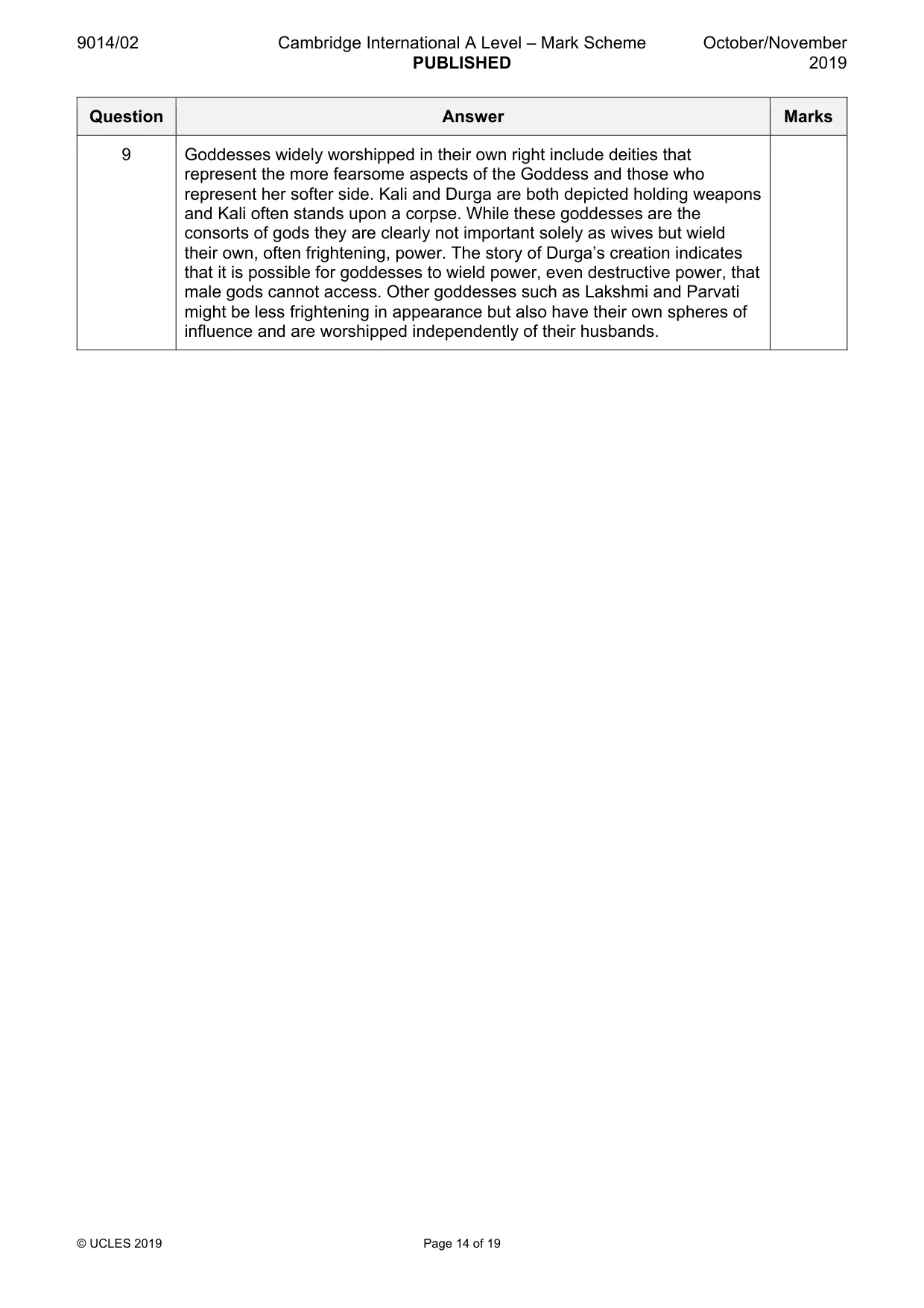
9014/02 Cambridge International A Level – Mark Scheme PUBLISHED October/November 2019 © UCLES 2019 Page 14 of 19 Question Answer Marks 9 Goddesses widely worshipped in their own right include deities that represent the more fearsome aspects of the Goddess and those who represent her softer side. Kali and Durga are both depicted holding weapons and Kali often stands upon a corpse. While these goddesses are the consorts of gods they are clearly not important solely as wives but wield their own, often frightening, power. The story of Durga’s creation indicates that it is possible for goddesses to wield power, even destructive power, that male gods cannot access. Other goddesses such as Lakshmi and Parvati might be less frightening in appearance but also have their own spheres of influence and are worshipped independently of their husbands.
Mark scheme, page 15
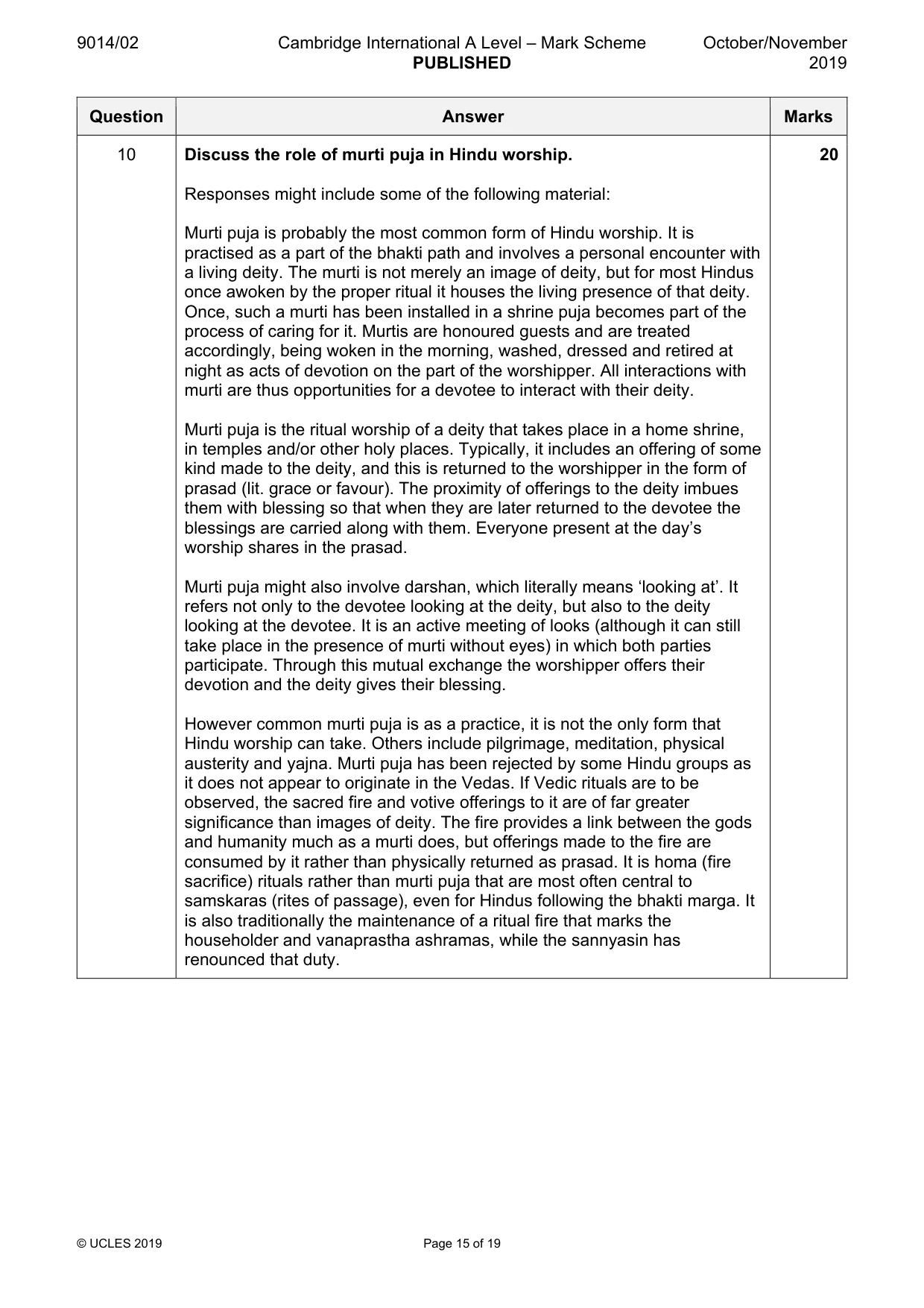
9014/02 Cambridge International A Level – Mark Scheme PUBLISHED October/November 2019 © UCLES 2019 Page 15 of 19 Question Answer Marks 10 Discuss the role of murti puja in Hindu worship. Responses might include some of the following material: Murti puja is probably the most common form of Hindu worship. It is practised as a part of the bhakti path and involves a personal encounter with a living deity. The murti is not merely an image of deity, but for most Hindus once awoken by the proper ritual it houses the living presence of that deity. Once, such a murti has been installed in a shrine puja becomes part of the process of caring for it. Murtis are honoured guests and are treated accordingly, being woken in the morning, washed, dressed and retired at night as acts of devotion on the part of the worshipper. All interactions with murti are thus opportunities for a devotee to interact with their deity. Murti puja is the ritual worship of a deity that takes place in a home shrine, in temples and/or other holy places. Typically, it includes an offering of some kind made to the deity, and this is returned to the worshipper in the form of prasad (lit. grace or favour). The proximity of offerings to the deity imbues them with blessing so that when they are later returned to the devotee the blessings are carried along with them. Everyone present at the day’s worship shares in the prasad. Murti puja might also involve darshan, which literally means ‘looking at’. It refers not only to the devotee looking at the deity, but also to the deity looking at the devotee. It is an active meeting of looks (although it can still take place in the presence of murti without eyes) in which both parties participate. Through this mutual exchange the worshipper offers their devotion and the deity gives their blessing. However common murti puja is as a practice, it is not the only form that Hindu worship can take. Others include pilgrimage, meditation, physical austerity and yajna. Murti puja has been rejected by some Hindu groups as it does not appear to originate in the Vedas. If Vedic rituals are to be observed, the sacred fire and votive offerings to it are of far greater significance than images of deity. The fire provides a link between the gods and humanity much as a murti does, but offerings made to the fire are consumed by it rather than physically returned as prasad. It is homa (fire sacrifice) rituals rather than murti puja that are most often central to samskaras (rites of passage), even for Hindus following the bhakti marga. It is also traditionally the maintenance of a ritual fire that marks the householder and vanaprastha ashramas, while the sannyasin has renounced that duty. 20
Mark scheme, page 16
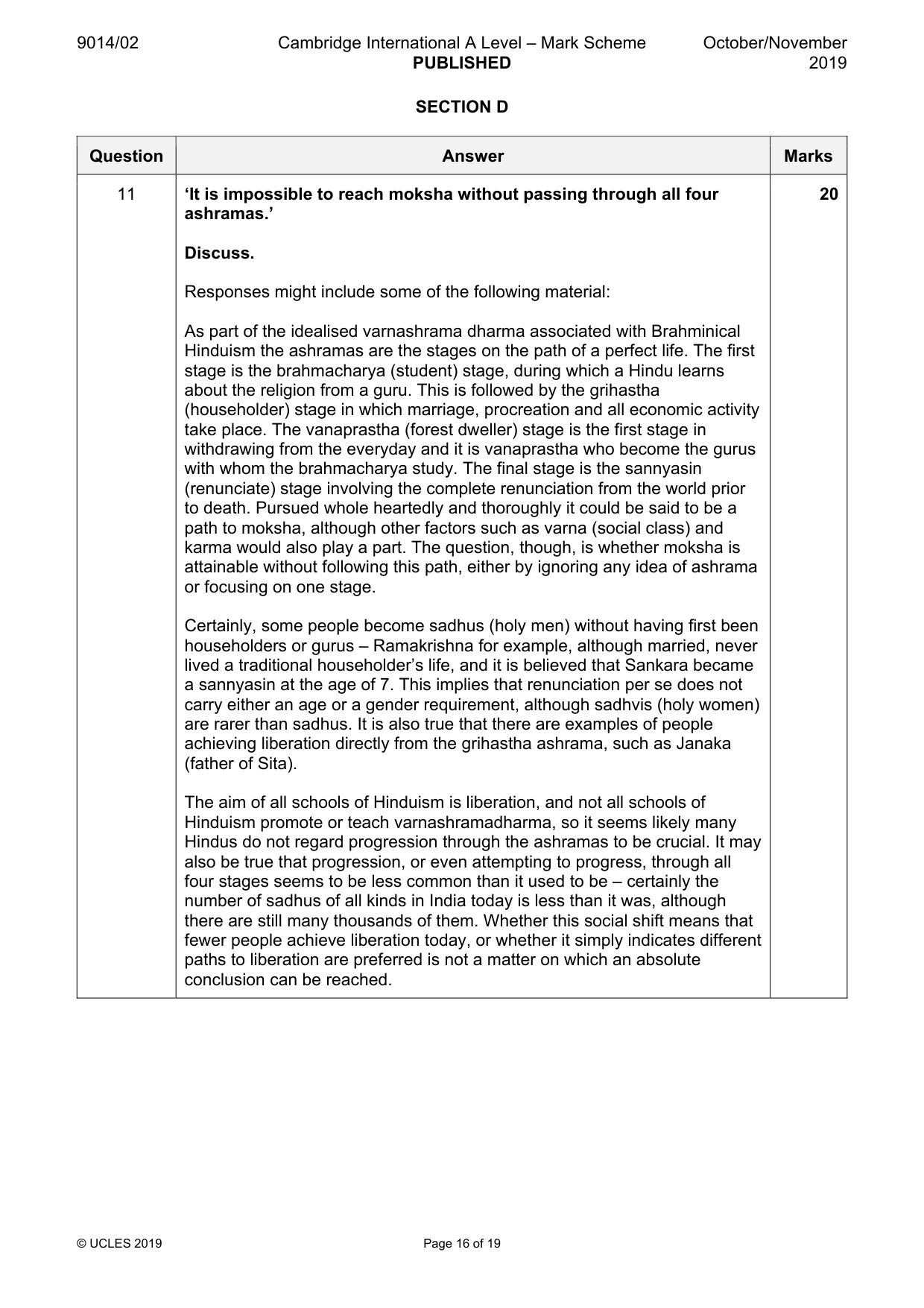
9014/02 Cambridge International A Level – Mark Scheme PUBLISHED October/November 2019 © UCLES 2019 Page 16 of 19 SECTION D Question Answer Marks 11 ‘It is impossible to reach moksha without passing through all four ashramas.’ Discuss. Responses might include some of the following material: As part of the idealised varnashrama dharma associated with Brahminical Hinduism the ashramas are the stages on the path of a perfect life. The first stage is the brahmacharya (student) stage, during which a Hindu learns about the religion from a guru. This is followed by the grihastha (householder) stage in which marriage, procreation and all economic activity take place. The vanaprastha (forest dweller) stage is the first stage in withdrawing from the everyday and it is vanaprastha who become the gurus with whom the brahmacharya study. The final stage is the sannyasin (renunciate) stage involving the complete renunciation from the world prior to death. Pursued whole heartedly and thoroughly it could be said to be a path to moksha, although other factors such as varna (social class) and karma would also play a part. The question, though, is whether moksha is attainable without following this path, either by ignoring any idea of ashrama or focusing on one stage. Certainly, some people become sadhus (holy men) without having first been householders or gurus – Ramakrishna for example, although married, never lived a traditional householder’s life, and it is believed that Sankara became a sannyasin at the age of 7. This implies that renunciation per se does not carry either an age or a gender requirement, although sadhvis (holy women) are rarer than sadhus. It is also true that there are examples of people achieving liberation directly from the grihastha ashrama, such as Janaka (father of Sita). The aim of all schools of Hinduism is liberation, and not all schools of Hinduism promote or teach varnashramadharma, so it seems likely many Hindus do not regard progression through the ashramas to be crucial. It may also be true that progression, or even attempting to progress, through all four stages seems to be less common than it used to be – certainly the number of sadhus of all kinds in India today is less than it was, although there are still many thousands of them. Whether this social shift means that fewer people achieve liberation today, or whether it simply indicates different paths to liberation are preferred is not a matter on which an absolute conclusion can be reached. 20
Mark scheme, page 17
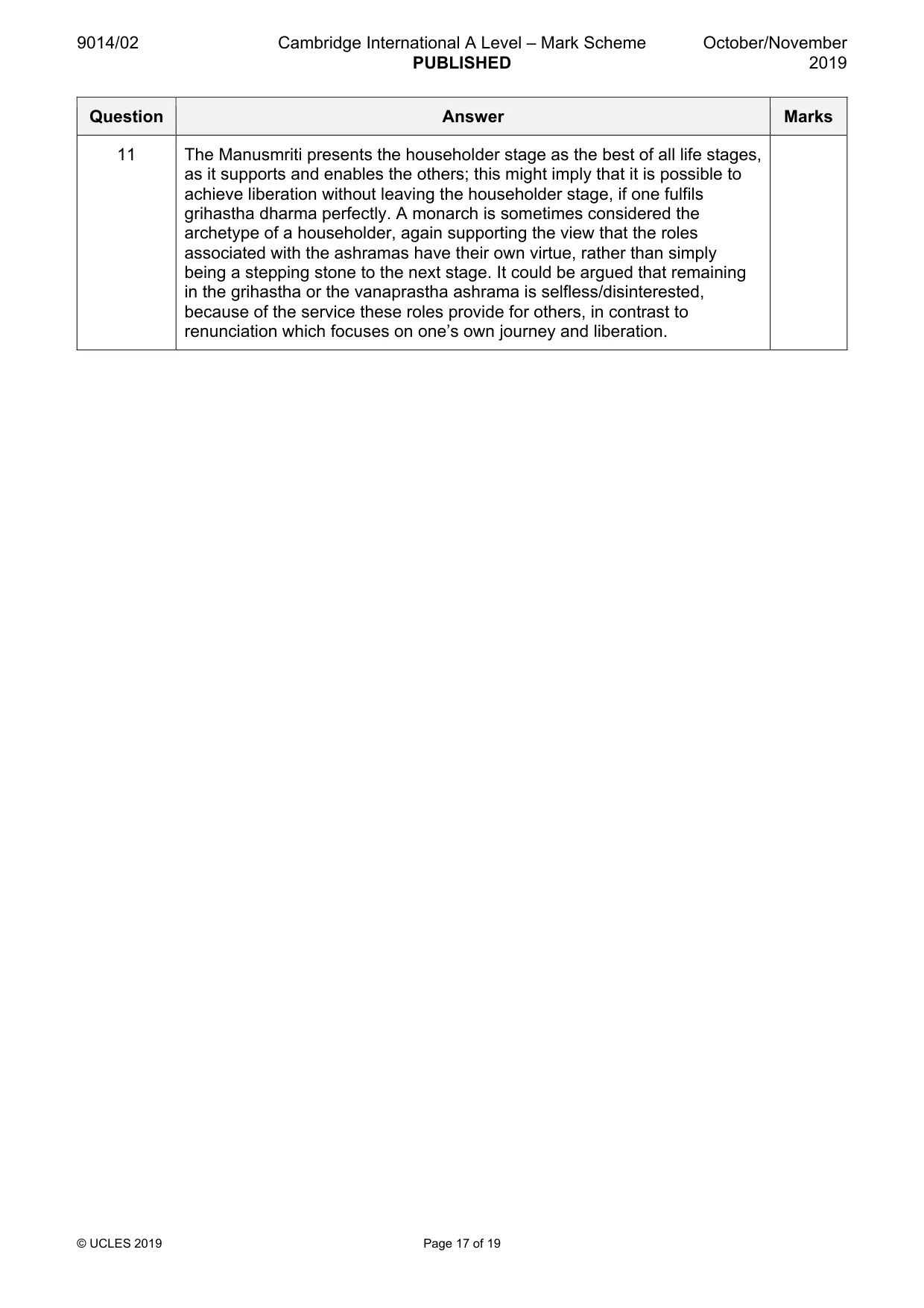
9014/02 Cambridge International A Level – Mark Scheme PUBLISHED October/November 2019 © UCLES 2019 Page 17 of 19 Question Answer Marks 11 The Manusmriti presents the householder stage as the best of all life stages, as it supports and enables the others; this might imply that it is possible to achieve liberation without leaving the householder stage, if one fulfils grihastha dharma perfectly. A monarch is sometimes considered the archetype of a householder, again supporting the view that the roles associated with the ashramas have their own virtue, rather than simply being a stepping stone to the next stage. It could be argued that remaining in the grihastha or the vanaprastha ashrama is selfless/disinterested, because of the service these roles provide for others, in contrast to renunciation which focuses on one’s own journey and liberation.
Mark scheme, page 18
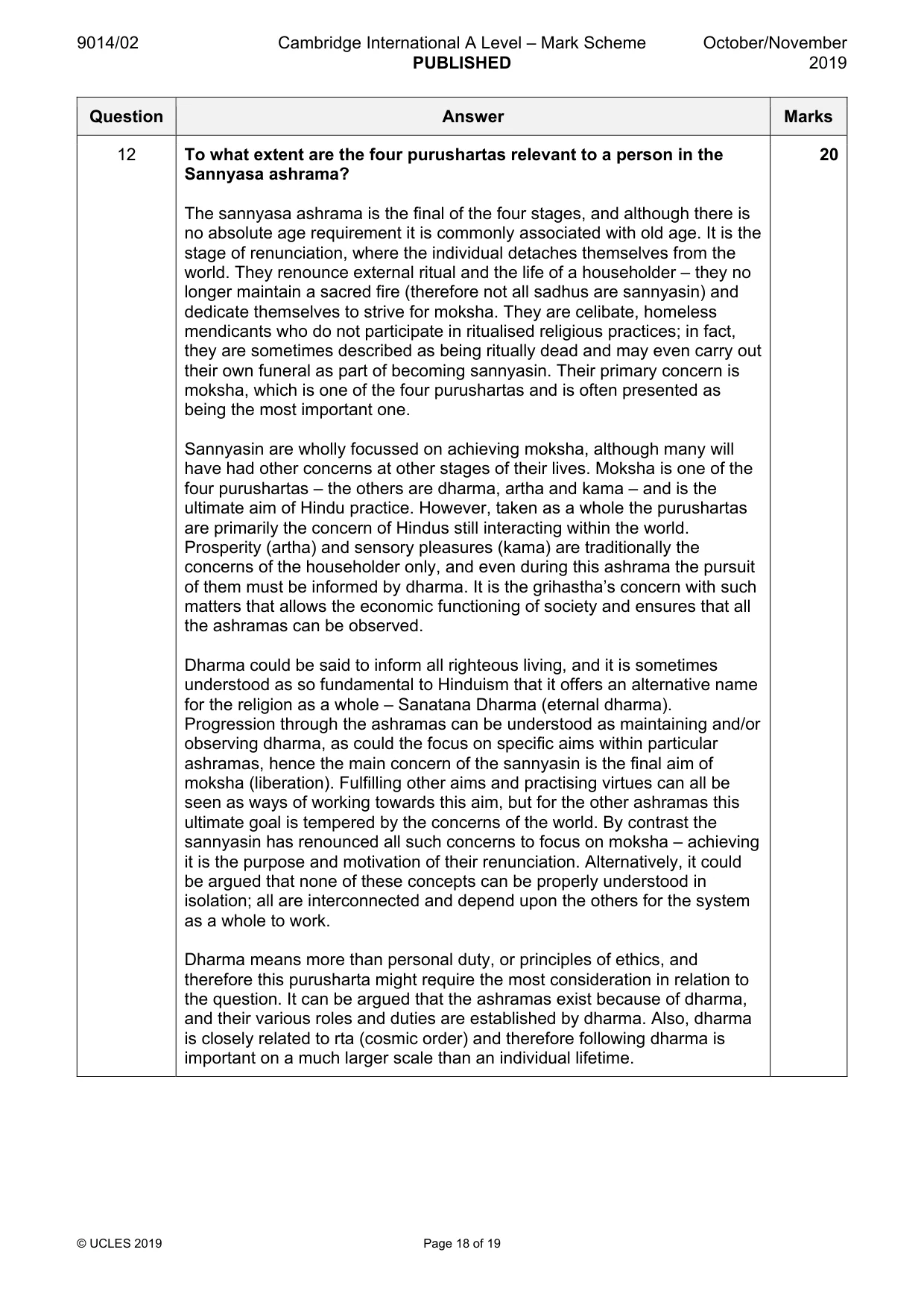
9014/02 Cambridge International A Level – Mark Scheme PUBLISHED October/November 2019 © UCLES 2019 Page 18 of 19 Question Answer Marks 12 To what extent are the four purushartas relevant to a person in the Sannyasa ashrama? The sannyasa ashrama is the final of the four stages, and although there is no absolute age requirement it is commonly associated with old age. It is the stage of renunciation, where the individual detaches themselves from the world. They renounce external ritual and the life of a householder – they no longer maintain a sacred fire (therefore not all sadhus are sannyasin) and dedicate themselves to strive for moksha. They are celibate, homeless mendicants who do not participate in ritualised religious practices; in fact, they are sometimes described as being ritually dead and may even carry out their own funeral as part of becoming sannyasin. Their primary concern is moksha, which is one of the four purushartas and is often presented as being the most important one. Sannyasin are wholly focussed on achieving moksha, although many will have had other concerns at other stages of their lives. Moksha is one of the four purushartas – the others are dharma, artha and kama – and is the ultimate aim of Hindu practice. However, taken as a whole the purushartas are primarily the concern of Hindus still interacting within the world. Prosperity (artha) and sensory pleasures (kama) are traditionally the concerns of the householder only, and even during this ashrama the pursuit of them must be informed by dharma. It is the grihastha’s concern with such matters that allows the economic functioning of society and ensures that all the ashramas can be observed. Dharma could be said to inform all righteous living, and it is sometimes understood as so fundamental to Hinduism that it offers an alternative name for the religion as a whole – Sanatana Dharma (eternal dharma). Progression through the ashramas can be understood as maintaining and/or observing dharma, as could the focus on specific aims within particular ashramas, hence the main concern of the sannyasin is the final aim of moksha (liberation). Fulfilling other aims and practising virtues can all be seen as ways of working towards this aim, but for the other ashramas this ultimate goal is tempered by the concerns of the world. By contrast the sannyasin has renounced all such concerns to focus on moksha – achieving it is the purpose and motivation of their renunciation. Alternatively, it could be argued that none of these concepts can be properly understood in isolation; all are interconnected and depend upon the others for the system as a whole to work. Dharma means more than personal duty, or principles of ethics, and therefore this purusharta might require the most consideration in relation to the question. It can be argued that the ashramas exist because of dharma, and their various roles and duties are established by dharma. Also, dharma is closely related to rta (cosmic order) and therefore following dharma is important on a much larger scale than an individual lifetime. 20
Mark scheme, page 19
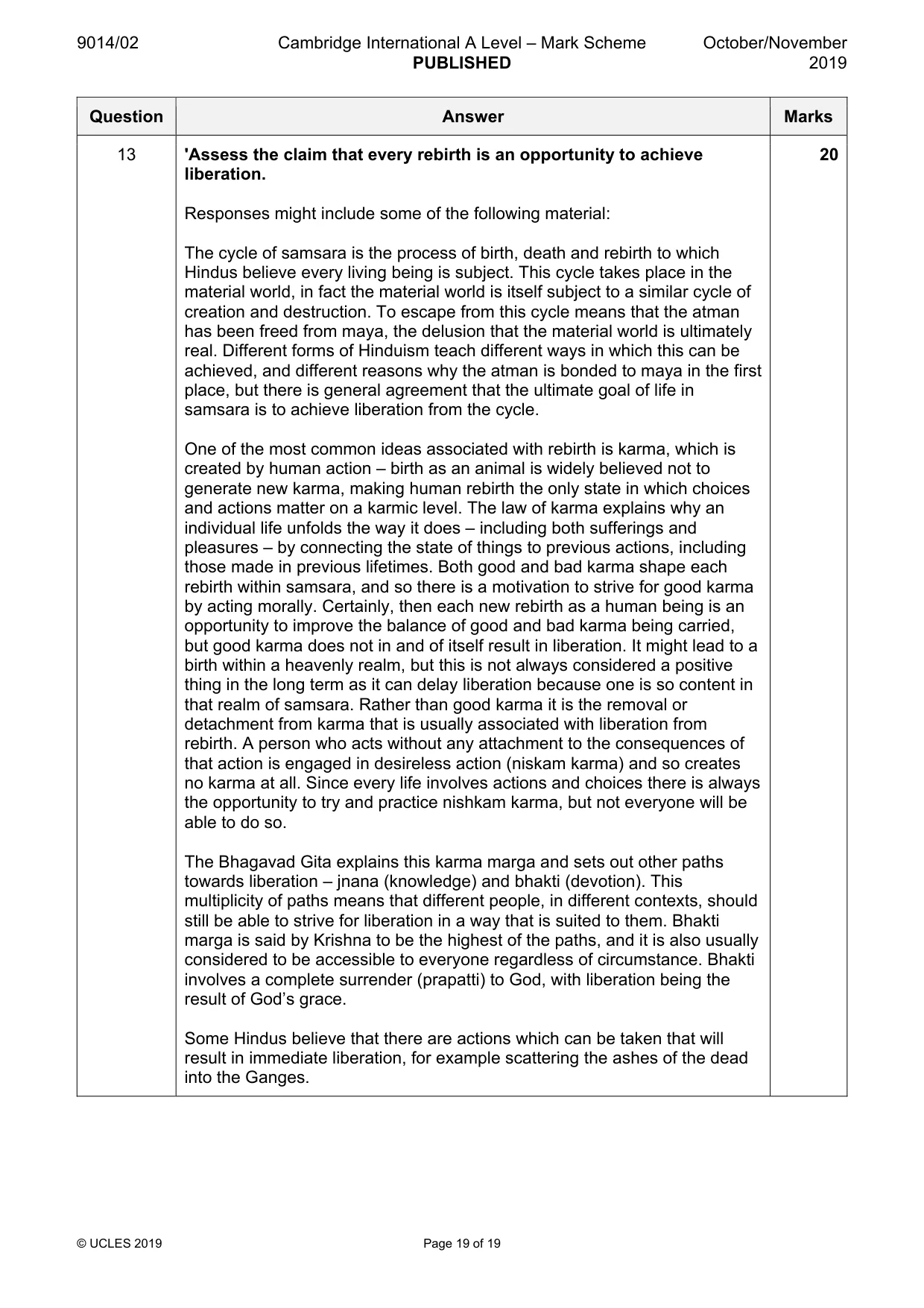
9014/02 Cambridge International A Level – Mark Scheme PUBLISHED October/November 2019 © UCLES 2019 Page 19 of 19 Question Answer Marks 13 'Assess the claim that every rebirth is an opportunity to achieve liberation. Responses might include some of the following material: The cycle of samsara is the process of birth, death and rebirth to which Hindus believe every living being is subject. This cycle takes place in the material world, in fact the material world is itself subject to a similar cycle of creation and destruction. To escape from this cycle means that the atman has been freed from maya, the delusion that the material world is ultimately real. Different forms of Hinduism teach different ways in which this can be achieved, and different reasons why the atman is bonded to maya in the first place, but there is general agreement that the ultimate goal of life in samsara is to achieve liberation from the cycle. One of the most common ideas associated with rebirth is karma, which is created by human action – birth as an animal is widely believed not to generate new karma, making human rebirth the only state in which choices and actions matter on a karmic level. The law of karma explains why an individual life unfolds the way it does – including both sufferings and pleasures – by connecting the state of things to previous actions, including those made in previous lifetimes. Both good and bad karma shape each rebirth within samsara, and so there is a motivation to strive for good karma by acting morally. Certainly, then each new rebirth as a human being is an opportunity to improve the balance of good and bad karma being carried, but good karma does not in and of itself result in liberation. It might lead to a birth within a heavenly realm, but this is not always considered a positive thing in the long term as it can delay liberation because one is so content in that realm of samsara. Rather than good karma it is the removal or detachment from karma that is usually associated with liberation from rebirth. A person who acts without any attachment to the consequences of that action is engaged in desireless action (niskam karma) and so creates no karma at all. Since every life involves actions and choices there is always the opportunity to try and practice nishkam karma, but not everyone will be able to do so. The Bhagavad Gita explains this karma marga and sets out other paths towards liberation – jnana (knowledge) and bhakti (devotion). This multiplicity of paths means that different people, in different contexts, should still be able to strive for liberation in a way that is suited to them. Bhakti marga is said by Krishna to be the highest of the paths, and it is also usually considered to be accessible to everyone regardless of circumstance. Bhakti involves a complete surrender (prapatti) to God, with liberation being the result of God’s grace. Some Hindus believe that there are actions which can be taken that will result in immediate liberation, for example scattering the ashes of the dead into the Ganges. 20
What you needed in this session
Cambridge’s own grade thresholds for 2019 Oct/Nov, Paper 2 · Variant 1. A higher threshold means an easier paper — the bar moves with how the cohort did.