Cambridge A Level Hinduism 9014 — 2014 Oct/Nov Paper 2 · Variant 1
9014/21/O/N/14
The question paper and its mark scheme, free to read here and free to download. This is Cambridge’s own paper, exactly as it was sat.
Question paper4 pages
Mark scheme
No mark scheme is in the library for this paper.
Paper as text
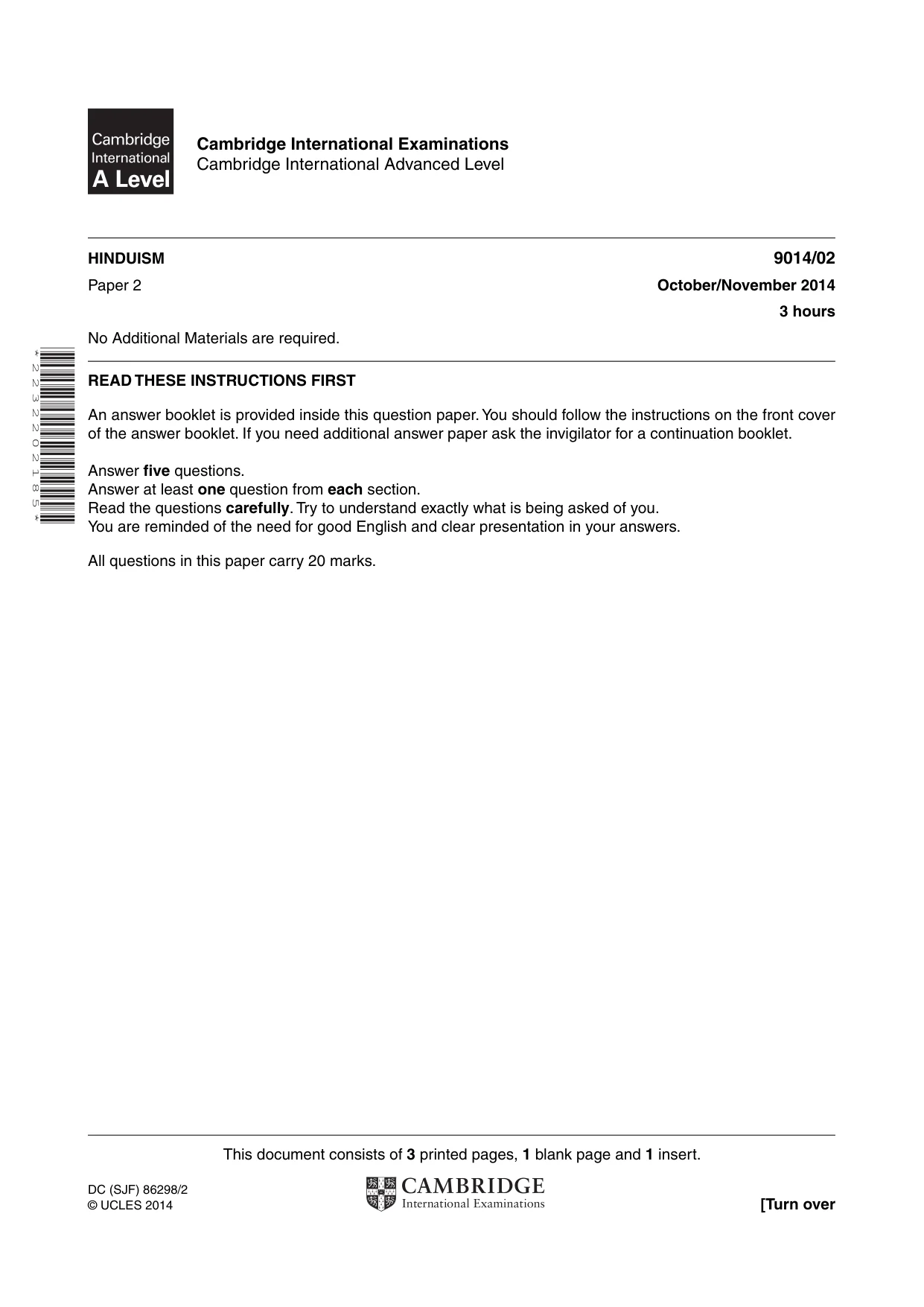
Question paper, page 1
This document consists of 3 printed pages, 1 blank page and 1 insert. DC (SJF) 86298/2 © UCLES 2014 [Turn over Cambridge International Examinations Cambridge International Advanced Level * 2 2 3 2 2 0 2 1 8 5 * HINDUISM 9014/02 Paper 2 October/November 2014 3 hours No Additional Materials are required. READ THESE INSTRUCTIONS FIRST An answer booklet is provided inside this question paper. You should follow the instructions on the front cover of the answer booklet. If you need additional answer paper ask the invigilator for a continuation booklet. Answer five questions. Answer at least one question from each section. Read the questions carefully. Try to understand exactly what is being asked of you. You are reminded of the need for good English and clear presentation in your answers. All questions in this paper carry 20 marks.
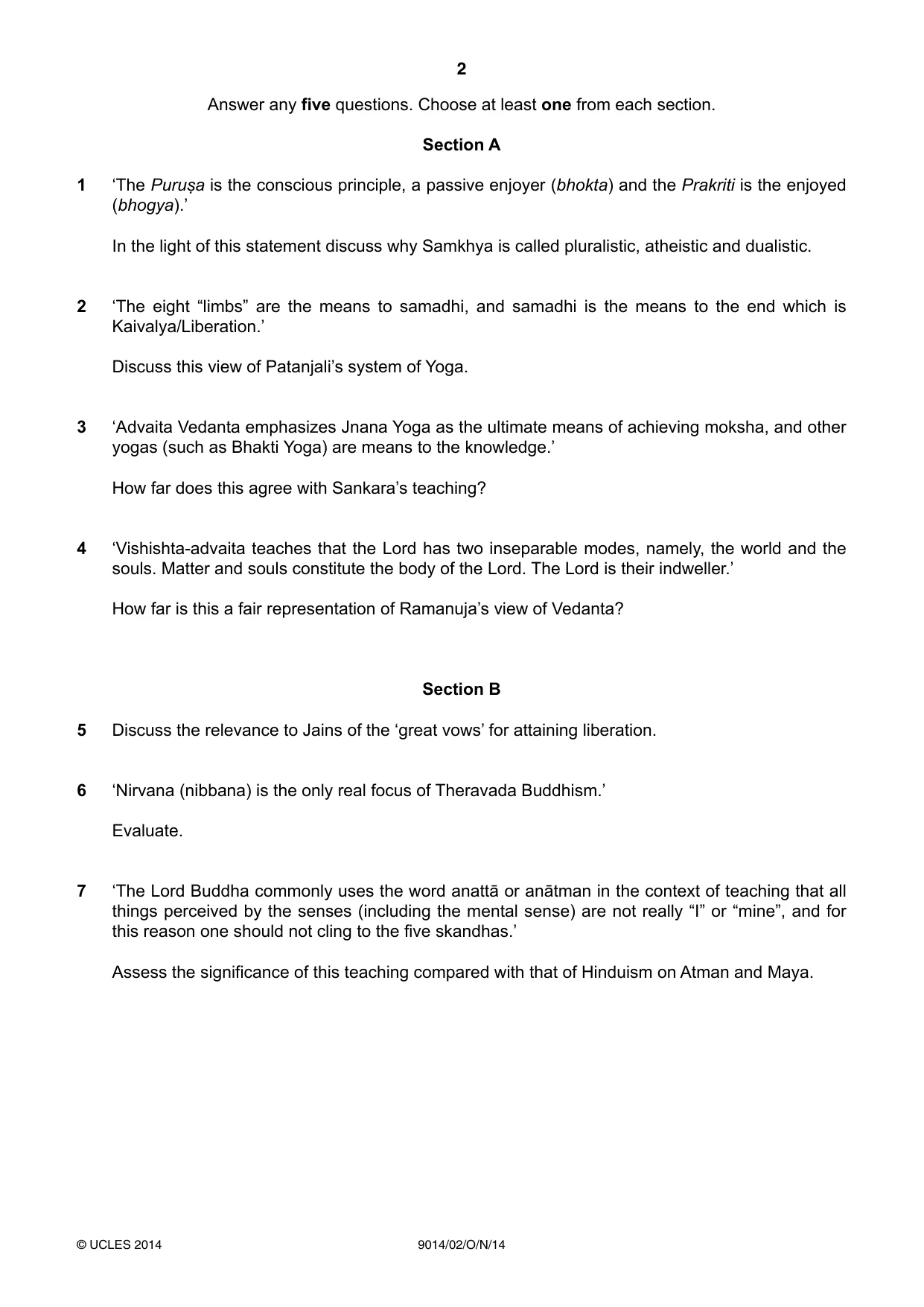
Question paper, page 2
2 9014/02/O/N/14 © UCLES 2014 Answer any five questions. Choose at least one from each section. Section A 1 ‘The Puruṣ a is the conscious principle, a passive enjoyer (bhokta) and the Prakriti is the enjoyed (bhogya).’ In the light of this statement discuss why Samkhya is called pluralistic, atheistic and dualistic. 2 ‘The eight “limbs” are the means to samadhi, and samadhi is the means to the end which is Kaivalya/Liberation.’ Discuss this view of Patanjali’s system of Yoga. 3 ‘Advaita Vedanta emphasizes Jnana Yoga as the ultimate means of achieving moksha, and other yogas (such as Bhakti Yoga) are means to the knowledge.’ How far does this agree with Sankara’s teaching? 4 ‘Vishishta-advaita teaches that the Lord has two inseparable modes, namely, the world and the souls. Matter and souls constitute the body of the Lord. The Lord is their indweller.’ How far is this a fair representation of Ramanuja’s view of Vedanta? Section B 5 Discuss the relevance to Jains of the ‘great vows’ for attaining liberation. 6 ‘Nirvana (nibbana) is the only real focus of Theravada Buddhism.’ Evaluate. 7 ‘The Lord Buddha commonly uses the word anattā or anātman in the context of teaching that all things perceived by the senses (including the mental sense) are not really “I” or “mine”, and for this reason one should not cling to the five skandhas.’ Assess the significance of this teaching compared with that of Hinduism on Atman and Maya.
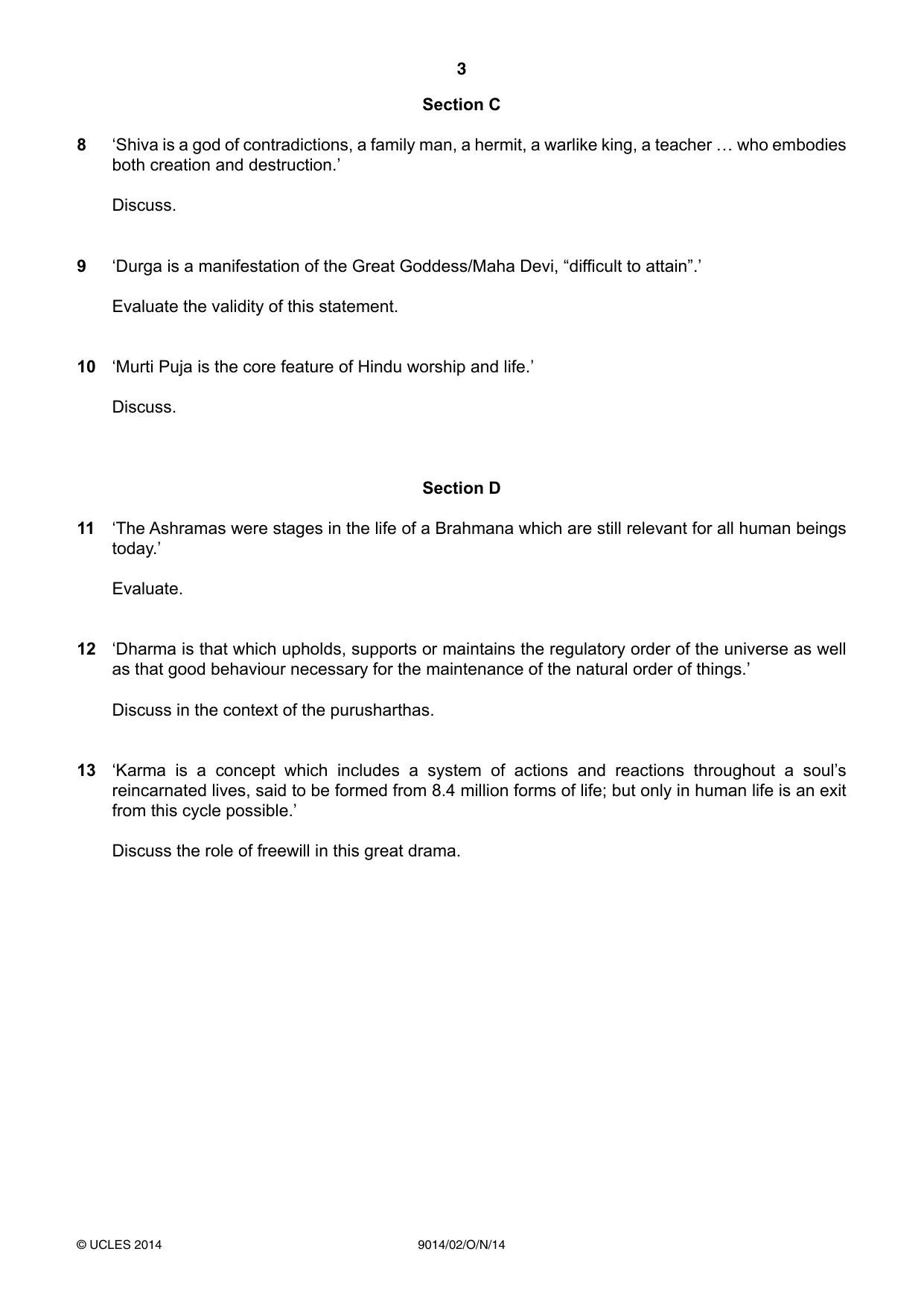
Question paper, page 3
3 9014/02/O/N/14 © UCLES 2014 Section C 8 ‘Shiva is a god of contradictions, a family man, a hermit, a warlike king, a teacher … who embodies both creation and destruction.’ Discuss. 9 ‘Durga is a manifestation of the Great Goddess/Maha Devi, “difficult to attain”.’ Evaluate the validity of this statement. 10 ‘Murti Puja is the core feature of Hindu worship and life.’ Discuss. Section D 11 ‘The Ashramas were stages in the life of a Brahmana which are still relevant for all human beings today.’ Evaluate. 12 ‘Dharma is that which upholds, supports or maintains the regulatory order of the universe as well as that good behaviour necessary for the maintenance of the natural order of things.’ Discuss in the context of the purusharthas. 13 ‘Karma is a concept which includes a system of actions and reactions throughout a soul’s reincarnated lives, said to be formed from 8.4 million forms of life; but only in human life is an exit from this cycle possible.’ Discuss the role of freewill in this great drama.
Question paper, page 4
4 9014/02/O/N/14 © UCLES 2014 Permission to reproduce items where third-party owned material protected by copyright is included has been sought and cleared where possible. Every reasonable effort has been made by the publisher (UCLES) to trace copyright holders, but if any items requiring clearance have unwittingly been included, the publisher will be pleased to make amends at the earliest possible opportunity. Cambridge International Examinations is part of the Cambridge Assessment Group. Cambridge Assessment is the brand name of University of Cambridge Local Examinations Syndicate (UCLES), which is itself a department of the University of Cambridge. BLANK PAGE