Cambridge A Level Hinduism 9014 — 2014 Oct/Nov Paper 1 · Variant 1
9014/11/O/N/14
The question paper and its mark scheme, free to read here and free to download. This is Cambridge’s own paper, exactly as it was sat.
Question paper4 pages
Mark scheme
No mark scheme is in the library for this paper.
Paper as text
Question paper, page 1
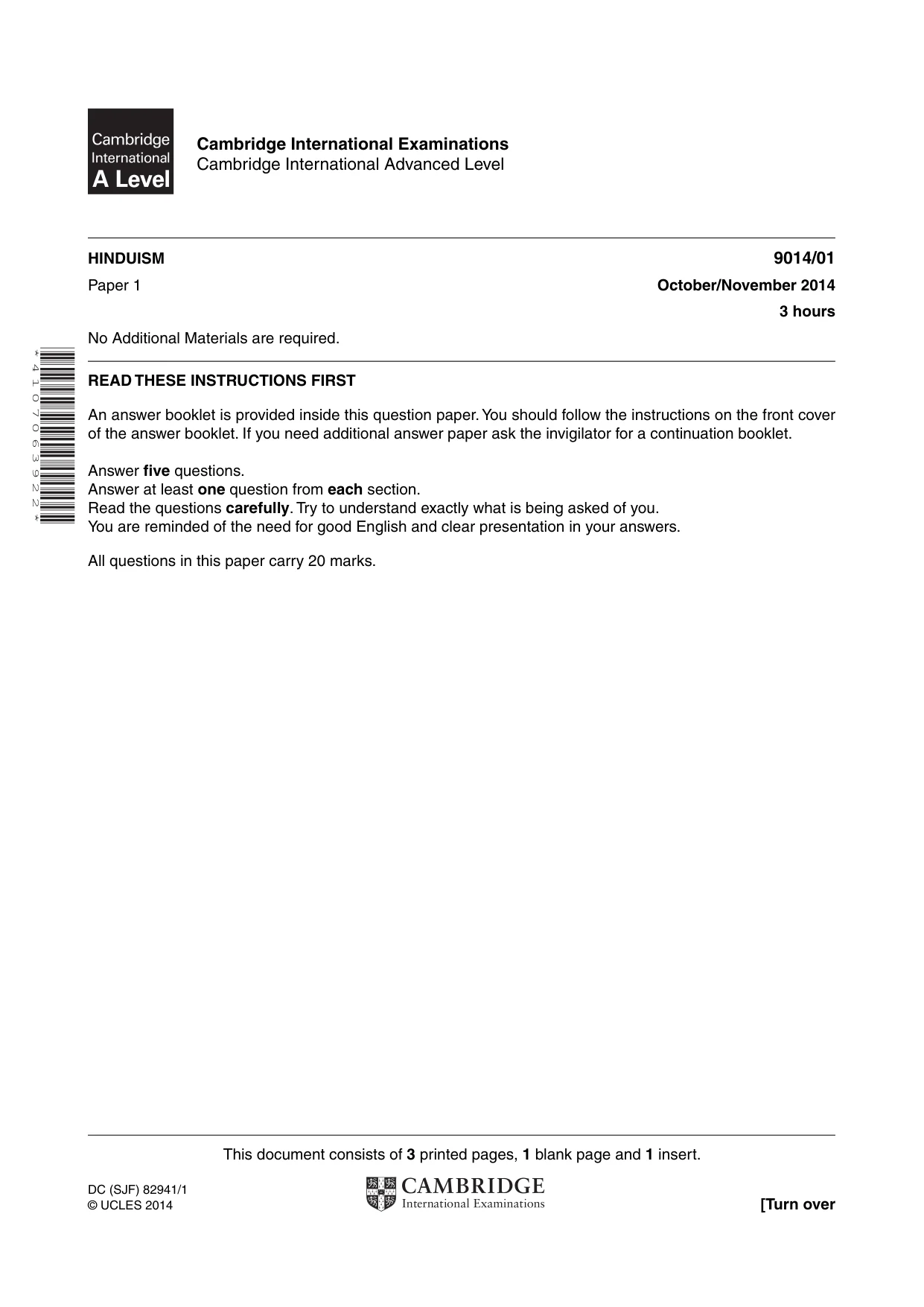
This document consists of 3 printed pages, 1 blank page and 1 insert. DC (SJF) 82941/1 © UCLES 2014 [Turn over Cambridge International Examinations Cambridge International Advanced Level * 4 1 0 7 0 6 3 9 2 2 * HINDUISM 9014/01 Paper 1 October/November 2014 3 hours No Additional Materials are required. READ THESE INSTRUCTIONS FIRST An answer booklet is provided inside this question paper. You should follow the instructions on the front cover of the answer booklet. If you need additional answer paper ask the invigilator for a continuation booklet. Answer five questions. Answer at least one question from each section. Read the questions carefully. Try to understand exactly what is being asked of you. You are reminded of the need for good English and clear presentation in your answers. All questions in this paper carry 20 marks.
Question paper, page 2
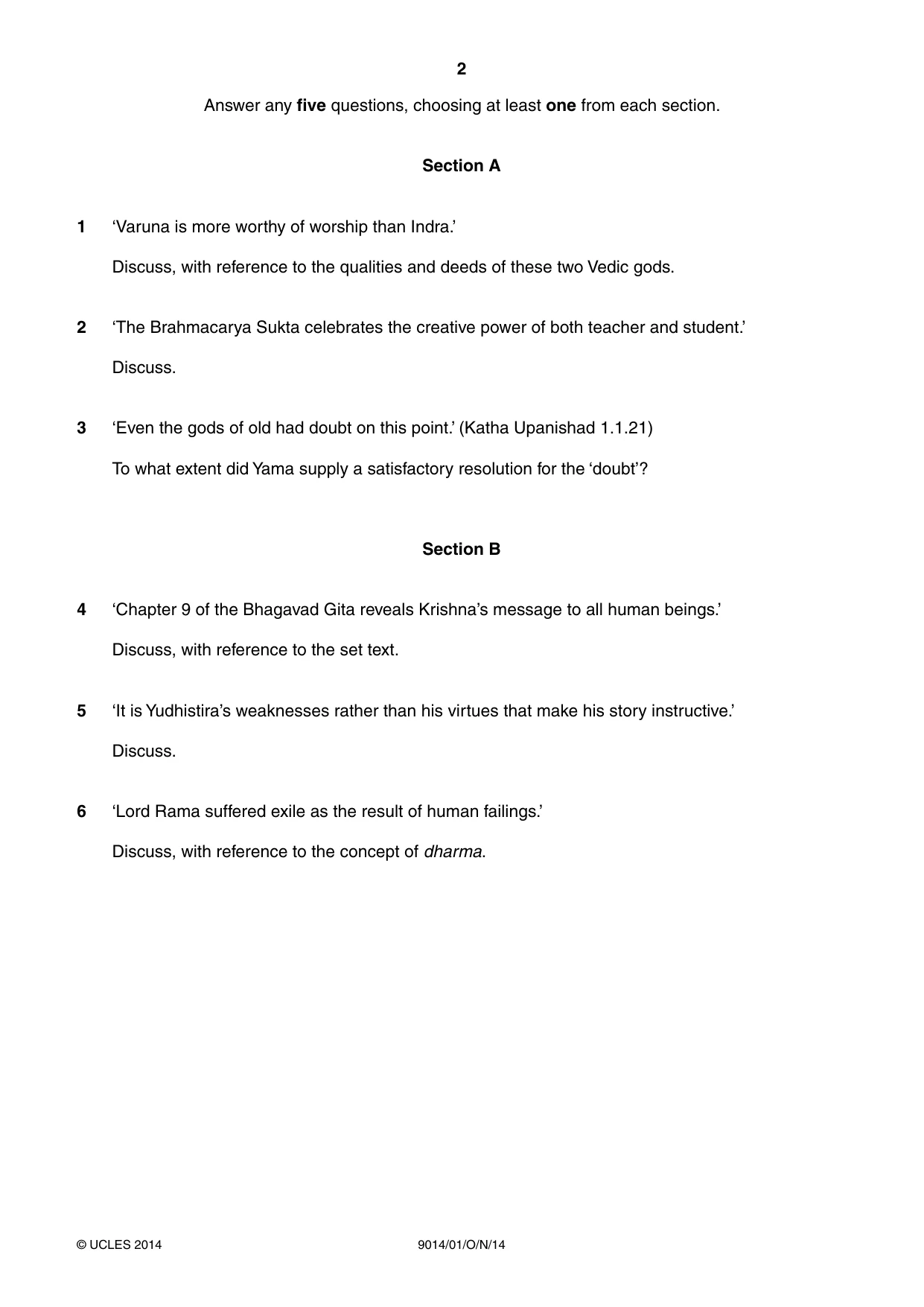
2 9014/01/O/N/14 © UCLES 2014 Answer any five questions, choosing at least one from each section. Section A 1 ‘Varuna is more worthy of worship than Indra.’ Discuss, with reference to the qualities and deeds of these two Vedic gods. 2 ‘The Brahmacarya Sukta celebrates the creative power of both teacher and student.’ Discuss. 3 ‘Even the gods of old had doubt on this point.’ (Katha Upanishad 1.1.21) To what extent did Yama supply a satisfactory resolution for the ‘doubt’? Section B 4 ‘Chapter 9 of the Bhagavad Gita reveals Krishna’s message to all human beings.’ Discuss, with reference to the set text. 5 ‘It is Yudhistira’s weaknesses rather than his virtues that make his story instructive.’ Discuss. 6 ‘Lord Rama suffered exile as the result of human failings.’ Discuss, with reference to the concept of dharma.
Question paper, page 3
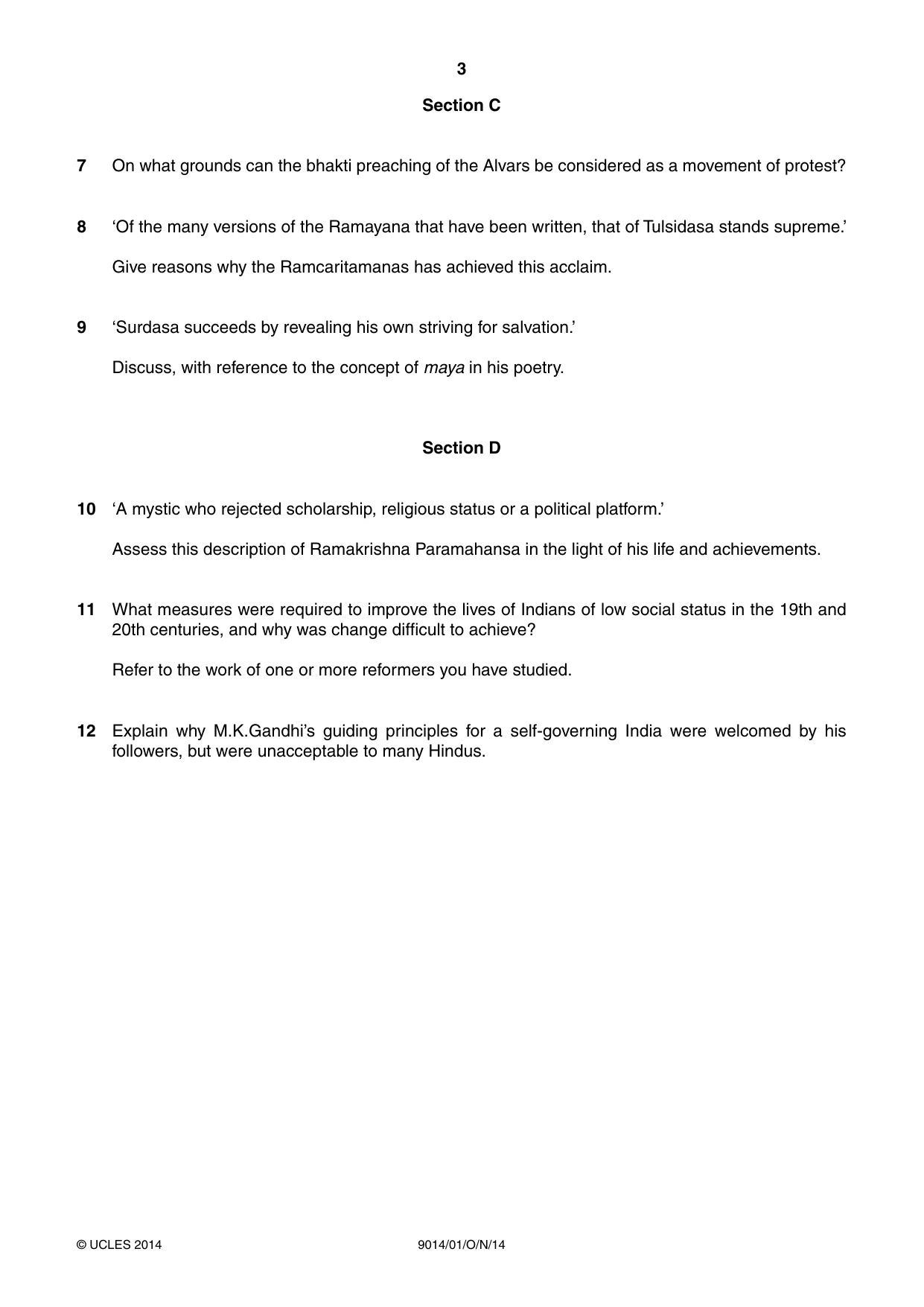
3 9014/01/O/N/14 © UCLES 2014 Section C 7 On what grounds can the bhakti preaching of the Alvars be considered as a movement of protest? 8 ‘Of the many versions of the Ramayana that have been written, that of Tulsidasa stands supreme.’ Give reasons why the Ramcaritamanas has achieved this acclaim. 9 ‘Surdasa succeeds by revealing his own striving for salvation.’ Discuss, with reference to the concept of maya in his poetry. Section D 10 ‘A mystic who rejected scholarship, religious status or a political platform.’ Assess this description of Ramakrishna Paramahansa in the light of his life and achievements. 11 What measures were required to improve the lives of Indians of low social status in the 19th and 20th centuries, and why was change difficult to achieve? Refer to the work of one or more reformers you have studied. 12 Explain why M.K.Gandhi’s guiding principles for a self-governing India were welcomed by his followers, but were unacceptable to many Hindus.
Question paper, page 4
4 9014/01/O/N/14 © UCLES 2014 Permission to reproduce items where third-party owned material protected by copyright is included has been sought and cleared where possible. Every reasonable effort has been made by the publisher (UCLES) to trace copyright holders, but if any items requiring clearance have unwittingly been included, the publisher will be pleased to make amends at the earliest possible opportunity. Cambridge International Examinations is part of the Cambridge Assessment Group. Cambridge Assessment is the brand name of University of Cambridge Local Examinations Syndicate (UCLES), which is itself a department of the University of Cambridge. BLANK PAGE